



Public Health Nutrition in Aging: Addressing Frailty, Sarcopenia, and Functional Decline
A special issue of Epidemiologia (ISSN 2673-3986).
Deadline for manuscript submissions: 15 August 2026 | Viewed by 354
Editor

Special Issue Information
Dear Colleagues,
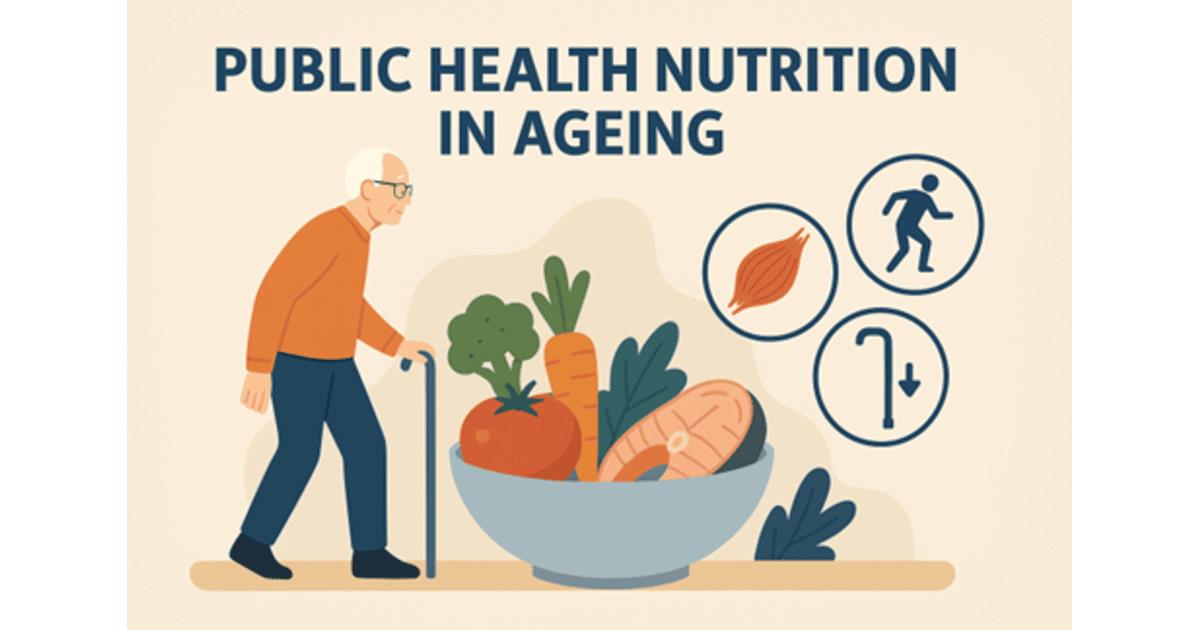
Population ageing has accelerated globally, leading to a considerable rise in conditions that compromise independence and the quality of life in later life. Frailty, sarcopenia, and functional decline are now recognised public health priorities, given their associations with multimorbidity, disability, hospitalisation, and mortality. Their onset reflects complex interactions between biological ageing, lifestyle behaviours, socioeconomic inequality, and environmental exposures. Nutrition plays a central role across this trajectory. Evidence from cohort studies and intervention trials shows that dietary patterns, macro and micronutrient intake, protein quality, inflammatory load, and bioactive compounds can influence muscle mass, strength, physical performance, and resilience. Yet, major gaps persist regarding population-level prevention strategies, the integration of nutritional guidance into routine care, and the development of equitable interventions tailored to diverse ageing populations. This Special Issue builds on decades of research linking diet and functional ageing, while drawing attention to emerging approaches in biomarker science, digital health, metabolomics, lifecourse epidemiology, and personalised nutrition. The aim is to advance scientific understanding of how public health nutrition can prevent, delay, or mitigate frailty, sarcopenia, and functional decline across ageing populations. The Special Issue will gather multidisciplinary work from epidemiology, clinical science, nutrition, gerontology, behavioural sciences, and public health, with a particular focus on the following:
- Mechanistic pathways linking diet, metabolism, inflammation, and muscle function.
- Population-level strategies for early identification and prevention of functional decline.
- The impact of dietary patterns, food systems, and social determinants on healthy ageing.
- Evidence-based interventions, including community, digital, and policy-based nutritional approaches.
- Global and cross-cultural perspectives on nutrition and ageing, including low and middle-income countries.
- Lifecourse influences on nutritional status and later-life physical resilience.
The Special Issue aims to promote both scientific innovation and practical translation for policymakers, clinicians, and public health practitioners.
We particularly welcome submissions that advance the field through novel concepts, methods, or datasets, including the following:
- Advanced biomarker work such as metabolomics, proteomics, inflammatory profiling, and gut microbiome studies.
- Machine learning or AI-driven models predicting frailty or sarcopenia from dietary and lifestyle data.
- Large longitudinal cohort analyses leveraging harmonised datasets across countries.
- Randomised and pragmatic trials of nutrition-based interventions, including protein supplementation, Mediterranean-style diets, whole-food approaches, and multimodal interventions combining diet with physical activity.
- Implementation science examining the feasibility and scalability of nutritional interventions in real-world settings.
- Research on inequalities in nutritional ageing, including food insecurity, social isolation, disability, and cultural food practices.
- Emerging concepts such as nutritional resilience, precision nutrition for older adults, and the interaction between cognitive decline, appetite regulation, and diet.
Special Issue will consider a wide range of high-quality contributions, including the following:
- Original research articles (epidemiological, clinical, intervention, qualitative or mixed-methods).
- Systematic reviews and meta-analyses.
- Methodological papers proposing new nutritional assessment tools, biomarkers, or analytical approaches.
- Policy analyses or evaluations of public health nutrition programmes.
- Brief reports presenting novel or preliminary findings of high relevance.
- Conceptual or theoretical papers advancing frameworks on nutrition, resilience, and ageing.
- Commentaries and perspectives offering critical reflections on research gaps, policy needs, and future directions.
All submissions should demonstrate clear implications for public health, clinical practice, or population-level strategies to support healthy ageing and prevent functional decline.
Prof. Dr. Dorina Cadar
Guest Editor
Manuscript Submission Information
Manuscripts should be submitted online at www.mdpi.com by registering and logging in to this website. Once you are registered, click here to go to the submission form. Manuscripts can be submitted until the deadline. All submissions that pass pre-check are peer-reviewed. Accepted papers will be published continuously in the journal (as soon as accepted) and will be listed together on the special issue website. Research articles, review articles as well as short communications are invited. For planned papers, a title and short abstract (about 250 words) can be sent to the Editorial Office for assessment.
Submitted manuscripts should not have been published previously, nor be under consideration for publication elsewhere (except conference proceedings papers). All manuscripts are thoroughly refereed through a single-anonymized peer-review process. A guide for authors and other relevant information for submission of manuscripts is available on the Instructions for Authors page. Epidemiologia is an international peer-reviewed open access semimonthly journal published by MDPI.
Please visit the Instructions for Authors page before submitting a manuscript. The Article Processing Charge (APC) for publication in this open access journal is 1400 CHF (Swiss Francs). Submitted papers should be well formatted and use good English. Authors may use MDPI's English editing service prior to publication or during author revisions.
Keywords
- frailty
- sarcopenia
- functional decline
- healthy ageing
- public health nutrition
- dietary patterns
- protein intake
- micronutrients
- Mediterranean diet
- nutritional biomarkers
- metabolomics
- gut microbiome
- inflammation
- muscle strength
- physical performance
- dietary inequalities
- food insecurity
- lifecourse nutrition
- resilience
- multimorbidity
- prevention
- older adults
- community interventions
- policy and nutrition
Benefits of Publishing in a Special Issue
- Ease of navigation: Grouping papers by topic helps scholars navigate broad scope journals more efficiently.
- Greater discoverability: Special Issues support the reach and impact of scientific research. Articles in Special Issues are more discoverable and cited more frequently.
- Expansion of research network: Special Issues facilitate connections among authors, fostering scientific collaborations.
- External promotion: Articles in Special Issues are often promoted through the journal's social media, increasing their visibility.
- Reprint: MDPI Books provides the opportunity to republish successful Special Issues in book format, both online and in print.
Further information on MDPI's Special Issue policies can be found here.
