


Need Help?
Announcements
10 July 2026
MDPI’s Journal Cluster of Engineering Physics
Cluster Introduction:
Engineering physics is a broad and interdisciplinary field that connects fundamental physical principles with real-world engineering systems and applications. It focuses on understanding, modeling, and controlling physical processes across multiple scales, bridging core areas of physics with advanced engineering design and technology development. Research in Engineering Physics spans a wide range of topics, including applied physics, plasma physics, thermodynamics and thermal science, fluid mechanics, quantum systems and quantum technologies, nonlinear dynamics, magnetism and the study of magnetic materials. By integrating theoretical physics, computational modeling, and experimental techniques, this field supports innovation in energy systems, advanced materials, photonics, aerospace, micro- and nano-scale devices, and emerging quantum and plasma-based technologies.
MDPI’s cluster of journals in engineering physics is dedicated to advancing research across these interconnected and rapidly developing areas. Each journal in the cluster provides a peer-reviewed platform for original research articles, theoretical developments, advanced simulations, and innovative experimental studies. Emphasis is placed on interdisciplinary approaches that combine physics-based modeling with engineering applications, including applied physics, plasma science, thermofluid systems, quantum and computational physics, nonlinear dynamics, and magnetism. By promoting open access publishing and encouraging cross-disciplinary collaboration, the cluster aims to accelerate the dissemination of high-impact research and foster innovation ranging from fundamental physical understanding to practical engineering solutions across diverse science and technology domains.
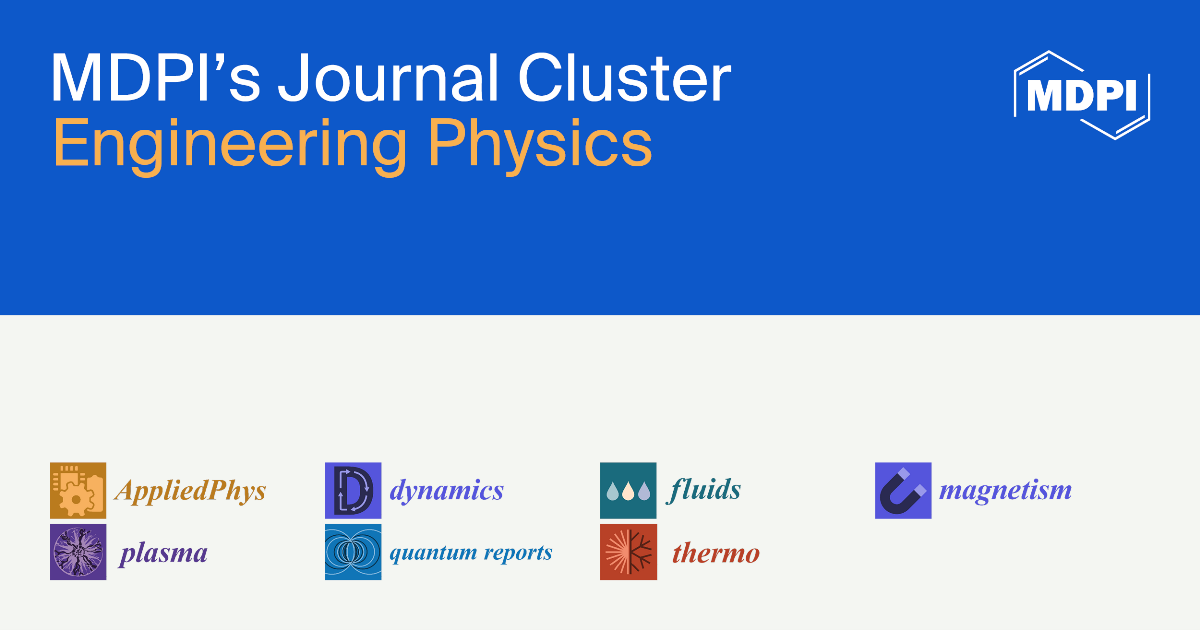
The seven participating journals are as follows:
- AppliedPhys (ISSN 3042-6553) focuses on the application of physical science and technology. AppliedPhys is led by Editors-in-Chief Prof. Dr. Mauro Tonelli (Department of Physics, University of Pisa, Lungarno Antonio Pacinotti, 43, 56126 Pisa, PI, Italy) and Prof. Dr. Yi Zhang (National Laboratory of Solid State Microstructure, School of Physics, Nanjing University, Nanjing 210093, China);
- Dynamics (ISSN 2673-8716) focuses on the broad field of all dynamic phenomena associated with physics. Dynamics is led by Editor-in-Chief Prof. Dr. Christos Volos (Laboratory of Nonlinear Systems, Circuits & Coplexity (LaNSCom), Department of Physics, Aristotle University of Thessaloniki, GR-54124 Thessaloniki, Greece);
- Fluids (ISSN 2311-5521) focuses on all aspects of fluid and its applications, including mathematical modeling, numerical simulation, and experiments. Fluids is led by Editor-in-Chief Prof. Dr. D. Andrew S. Rees (Department of Mechanical Engineering, University of Bath, Bath BA2 7AY, UK);
- Magnetism (ISSN 2673-8724) focuses on magnetism and its related fields. Magnetism is led by Editor-in-Chief Dr. Gerardo F. Goya (Instituto de Nanociencia de Aragon (INA), University of Zaragoza, 50018 Zaragoza, Spain);
- Plasma (ISSN 2571-6182) focuses on all aspects of plasma science, such as plasma physics, plasma chemistry and space plasma. Plasma is led by Editor-in-Chief Prof. Dr. Andrey Starikovskiy (NEQLab, Lewes, DE 19958, USA);
- Quantum Reports (ISSN 2624-960X) focuses on quantum science. Quantum Reports is led by Editor-in-Chief Prof. Dr. Lajos Diósi (1. Wigner Research Center for Physics, H-1121 Budapest, Hungary; 2. Institute of Physics and Astronomy, Eötvös Loránd University, H-1117 Budapest, Hungary);
- Thermo (ISSN 2673-7264) focuses on all areas dealing with experimental, theoretical, and applied thermal sciences. Thermo is led by Editor-in-Chief Prof. Dr. Johan Jacquemin (Materials Science, Energy, and Nano-Engineering MSN Department, Mohammed VI Polytechnic University, Hay Moulay Rachid, Lot 660, Ben Guerir 43150, Morocco).
|
Journal |
Launch Year |
Impact Factor (2025) |
CiteScore (2025) |
First Decision (Median Days) |
Acceptance to Publication (Median Days) |
APC (CHF) |
 |
2025 |
- |
- |
18 |
7 |
1000 |
 |
2021 |
1.1 |
1.8 |
15.3 |
4.1 |
1200 |
 |
2016 |
2.1 |
4.1 |
17 |
2.9
|
1800 |
 |
2021 |
1.2 |
2.3 |
24.3 |
5.7 |
1200 |
 |
2018 |
3.1 |
3.9 |
17.5 |
3.7 |
1400 |
 |
2019 |
1.8 |
2.7 |
20.3 |
3.5 |
1400 |
 |
2021 |
3.9 |
4.4 |
25 |
4.0 |
1200 |
MDPI’s Mission and Values:
As a pioneer of academic open access publishing, MDPI has been serving the scientific community since 1996. Our mission is to foster scientific exchange in all forms and across all disciplines. MDPI’s guidelines for disseminating open science are based on the following values and guiding principles:
- Open access—All of our content is published in open access and distributed under a Creative Commons License, providing free access to science and the latest research, allowing articles to be freely shared and their content reused with proper attribution;
- Timeliness and efficiency—Publishing the latest research through thorough editorial work, ensuring that authors receive a first decision in under 32 days and that papers are published within 7–10 days upon acceptance;
- Simplicity—Offering user-friendly tools and services in one place to enhance the efficiency of our editorial process;
- High-Quality Service—Supporting scholars and their work by providing a range of options, such as journal publication at mdpi.com, early publication at preprints.org, and conferences on sciforum.net, all aimed at maximizing the positive impact of research;
- Flexibility—Adapting and developing new tools and services to meet the changing needs of the research community, driven by feedback from authors, editors, and readers;
- Rooted in Sustainability—Ensuring the long-term preservation of published papers and supporting the future of science through partnerships, sponsorships, and awards.
By adhering to these values and principles, MDPI remains committed to advancing scientific knowledge and promoting open science practices.
Selected Topic and Special Issues:
“Recent Advances in Dynamic Phenomena—3rd Edition”
Guest Editor: Dr. Christos Volos
Deadline for manuscript submissions: 30 October 2026
“10th Anniversary of Fluids—Recent Advances in Fluid Mechanics”
Guest Editor: Prof. Dr. D. Andrew S. Rees
Deadline for manuscript submissions: 31 December 2026
“Beyond Conventional Magnetism: Modeling, Simulation, and Experiment”
Guest Editors: Dr. Roberto Zivieri and Dr. Israa Medlej
Deadline for manuscript submissions: 31 December 2026
“Processes in Atmospheric-Pressure Plasmas—2nd Edition”
Guest Editor: Dr. Dariusz Z. Korzec
Deadline for manuscript submissions: 10 September 2026
“Quantum Computing: Latest Advances and Prospects”
Topic Editors: Prof. Dr. Mingxing Luo, Prof. Dr. Ming Li and Dr. Xue Yang
Deadline for manuscript submissions: 31 March 2027
“Design, Simulation and Optimization of Bio-Inspired Thermal Systems”
Guest Editors: Dr. Andrea Fragnito, Dr. Marcello Iasiello and Dr. Gerardo Maria Mauro
Deadline for manuscript submissions: 10 November 2026
Selected Articles:
“Bridging the Gap Between Extreme Environments and Precision Measurements: Recent Progress in Megagauss Physics”
by Shojiro Takeyama
AppliedPhys 2026, 2(2), 6; https://doi.org/10.3390/appliedphys2020006
“Generalized Miller Formulae for Quantum Anharmonic Oscillators”
by Maximilian T. Meyer and Arno Schindlmayr
Dynamics 2025, 5(3), 34; https://doi.org/10.3390/dynamics5030034
“The Impact of Polydimethylsiloxane (PDMS) in Engineering: Recent Advances and Applications”
by Rui A. Lima
Fluids 2025, 10(2), 41; https://doi.org/10.3390/fluids10020041
“Altermagnetism and Altermagnets: A Brief Review”
by Rupam Tamang, Shivraj Gurung, Dibya Prakash Rai, Samy Brahimi and Samir Lounis
Magnetism 2025, 5(3), 17; https://doi.org/10.3390/magnetism5030017
“Hybrid Dielectric Barrier Discharge Reactor: Production of Reactive Oxygen–Nitrogen Species in Humid Air”
by Dariusz Korzec, Florian Freund, Christian Bäuml, Patrik Penzkofer, Oliver Beier, Andreas Pfuch, Klaus Vogelsang, Frank Froehlich and Stefan Nettesheim
Plasma 2025, 8(3), 27; https://doi.org/10.3390/plasma8030027
“Improving the Solving of Optimization Problems: A Comprehensive Review of Quantum Approaches”
by Deborah Volpe, Giacomo Orlandi and Giovanna Turvani
Quantum Rep. 2025, 7(1), 3; https://doi.org/10.3390/quantum7010003
“Enhancing Battery Available Operating Time (BAOT) via a Passive Series-PCM and Optimized Finned Structures”
by Nicola Bianco, Rosa Francesca De Masi, Andrea Fragnito, Marcello Iasiello, Vittorio Orlanducci and Francesco Piccirillo
Thermo 2026, 6(2), 40; https://doi.org/10.3390/thermo6020040
