Review

Bismuth-Based Multi-Component Heterostructured Nanocatalysts for Hydrogen Generation

Nanochemistry Laboratory, Department of Chemistry, Jamia Millia Islamia, New Delhi 110025, India
*
Author to whom correspondence should be addressed.
Catalysts 2023, 13(2), 295; https://doi.org/10.3390/catal13020295
Submission received: 21 November 2022 / Revised: 12 January 2023 / Accepted: 16 January 2023 / Published: 28 January 2023
(This article belongs to the Section Catalysis for Sustainable Energy)

Abstract

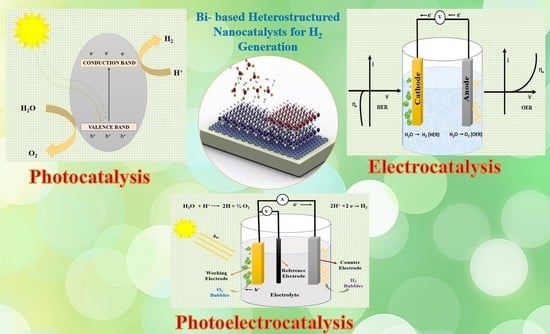
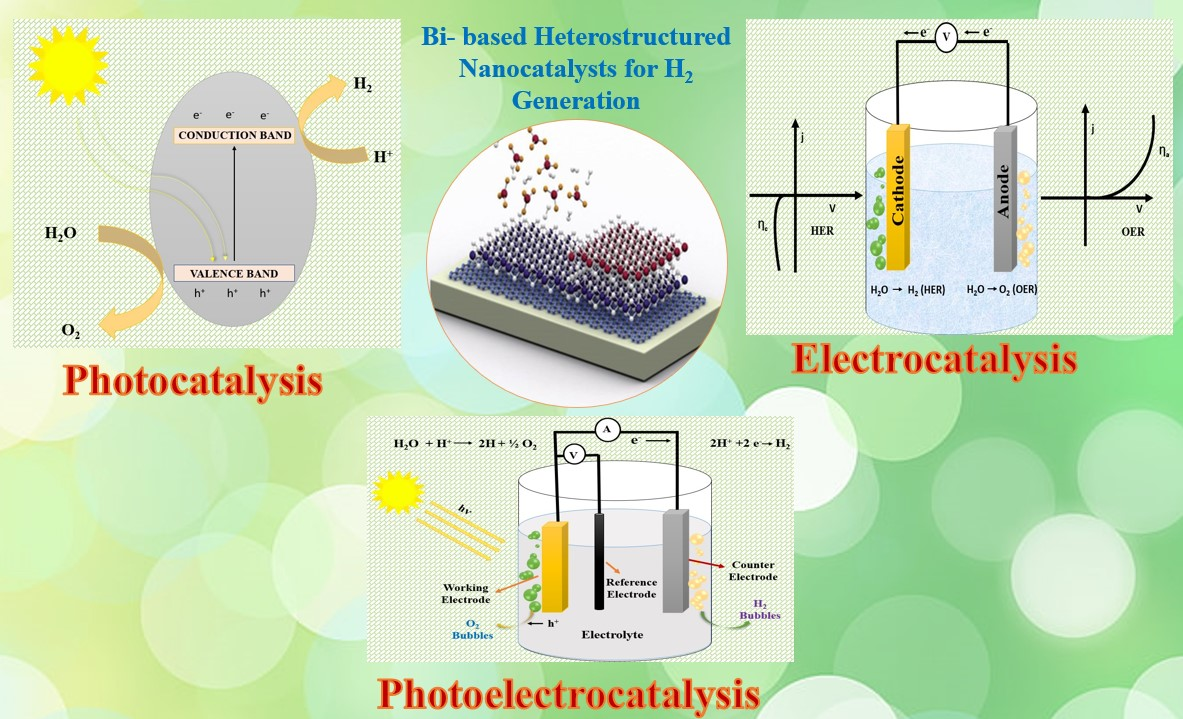
Developing a unique catalytic system with enhanced activity is the topmost priority in the science of H2 energy to reduce costs in large-scale applications, such as automobiles and domestic sectors. Researchers are striving to design an effective catalytic system capable of significantly accelerating H2 production efficiency through green pathways, such as photochemical, electrochemical, and photoelectrochemical routes. Bi-based nanocatalysts are relatively cost-effective and environmentally benign materials which possess advanced optoelectronic properties. However, these nanocatalysts suffer back recombination reactions during photochemical and photoelectrochemical operations which impede their catalytic efficiency. However, heterojunction formation allows the separation of electron–hole pairs to avoid recombination via interfacial charge transfer. Thus, synergetic effects between the Bi-based heterostructured nanocatalysts largely improves the course of H2 generation. Here, we propose the systematic review of Bi-based heterostructured nanocatalysts, highlighting an in-depth discussion of various exceptional heterostructures, such as TiO2/BiWO6, BiWO6/Bi2S3, Bi2WO6/BiVO4, Bi2O3/Bi2WO6, ZnIn2S4/BiVO4, Bi2O3/Bi2MoO6, etc. The reviewed heterostructures exhibit excellent H2 evolution efficiency, ascribed to their higher stability, more exposed active sites, controlled morphology, and remarkable band-gap tunability. We adopted a slightly different approach for reviewing Bi-based heterostructures, compiling them according to their applicability in H2 energy and discussing challenges, prospects, and guidance to develop better and more efficient nanocatalytic systems.
Keywords: nanocatalysis; heterojunctions; water splitting; hydrogen energy; sustainable energy nanocatalysis; heterojunctions; water splitting; hydrogen energy; sustainable energy
Graphical Abstract