1. Introduction
The laboratory has traditionally been a fundamental pillar in the training of engineers, serving as the essential bridge between abstract theoretical concepts and tangible physical phenomena [
1,
2]. In this study, technical competencies refer to the subject-specific experimental and analytical skills used to apply physical principles, follow experimental procedures, analyze data, and solve engineering problems. Under the established framework of “Constructive Alignment” proposed by Biggs [
3], learning objectives, teaching activities, and assessment methods are intentionally coordinated. Accordingly, outcomes in aligned laboratory and theoretical assessments may be expected to show a positive association. Furthermore, the integration of active learning strategies within the laboratory environment has been shown to significantly enhance knowledge retention and conceptual understanding, bridging the gap between theoretical models and real-world engineering problems [
4]. Relevant examples have been reported [
5,
6,
7].
The alignment between theoretical instruction and practical application is an important concern in engineering education. Traditional first-year engineering courses are often taught in isolation, leading to limited conceptual gains and difficulties in transferring knowledge across contexts [
8]. These arguments reinforce the idea that theoretical lectures often present idealized models that can seem detached from physical reality. Evidence suggests that this is especially significant in engineering programs, particularly in subjects such as Physics, and particularly for first-year students. Laboratory practicums can provide scaffolding that connects these abstract principles to experimental activity. When practical activities are deliberately aligned with theoretical content, they can reinforce learning by allowing students to visualize complex phenomena and verify physical laws empirically. In this sense, Nikotic et al. [
9] found that students’ evaluations of laboratory activities were influenced by perceived learning gains in the cognitive domain.
To address this challenge, this study frames the learning process through the lens of Threshold Concepts, defined by Meyer and Land [
10] as “conceptual gateways” that lead to a previously inaccessible way of thinking. These concepts are characterized by being transformative, irreversible, and often counter-intuitive. Navigating these thresholds requires students to traverse a “liminal space”, a state of conceptual oscillation where understanding is not yet solidified.
“A liminal space is a suspended state in which understanding approximates to a kind of mimicry or lack of authenticity … learners may oscillate between old and emergent understandings.”
J. H. Meyer and R. Land [
11]
It is within this space that laboratory practicums may support students as they engage with conceptual thresholds. As highlighted by recent literature in engineering education, limited pedagogical scaffolding during this liminal phase may be associated with superficial learning strategies, where students memorize procedures without internalizing the underlying physical laws [
12]. Moreover, the inherently interdisciplinary nature of engineering education, where concepts from physics, mathematics, and other domains must be integrated, can intensify these liminal difficulties, reinforcing the need for structured support to facilitate meaningful knowledge transfer across disciplinary boundaries [
13,
14,
15].
A contextual factor considered in this study is the degree program’s aggregate entry profile. Here, “entry profile” denotes a degree-level characterization based on institutional indicators such as admission score. In institutions such as the Universitat Politècnica de València (UPV), the coexistence of different degree programs with different entry requirements permits an observational comparison of cohorts situated in distinct degree contexts. From a theoretical perspective, this setting is particularly relevant in light of the threshold concepts framework [
10,
11]. However, the recorded assessment outcomes do not show whether individual students crossed a conceptual threshold or occupied a liminal state.
Specifically, this study explores the relationship between success in the Physics laboratory and exam performance in first-year Physics courses across three academic degrees: Telecommunication Technologies and Systems Engineering (Grado en Ingeniería de Tecnologías y Sistemas de Telecomunicación, GITST), Agri-Food and Rural Environment Engineering (Grado en Ingeniería Agroalimentaria y del Medio Rural, GIAMR), and Forestry and Natural Environment Engineering (Grado en Ingeniería Forestal y del Medio Natural, GIFMN). GIAMR and GIFMN provide the closest within-study comparison because the same course is delivered in both programs by the same teaching staff, with shared laboratory activities and procedures and jointly administered assessments. GITST is included as a complementary reference through the comparable Magnetism and Induction thematic unit; strict curricular equivalence is therefore not assumed across all three programs. In this study, “curricular decoupling” refers specifically to a weakening or loss of correspondence between laboratory performance and the corresponding theoretical-exam performance. The objective was to compare the correspondence between these outcomes across the three degree-program cohorts. The exploratory working hypothesis was that the observed correspondence may differ between degree cohorts, including under the shared curricular, instructional, and assessment conditions of GIAMR and GIFMN. Their different aggregate entry profiles were considered a contextual factor of interest for interpreting the observed patterns rather than a causal variable tested by the present design. The intended audience comprises instructors, course coordinators, and engineering-education researchers evaluating practical–theoretical assessment alignment.
2. Methodology
2.1. Research Design and Framework
This study adopts a comparative, quantitative research design within an observational framework. It compares thematic-unit-specific associations between laboratory and theoretical-exam outcomes and does not treat entry profile as an experimentally isolated variable. GIAMR and GIFMN take the same course in their respective degree programs; it is delivered by the same teaching staff, uses shared laboratory activities and procedures, and has jointly administered assessments, including the written partial examinations. GITST is included as a complementary reference rather than as a strictly equivalent cohort. For this cohort, the study specifically selects the Magnetism and Induction thematic unit because the corresponding laboratory and written partial-exam outcomes provide the most direct available comparison between practical and theoretical assessment.
2.2. Educational Context: First-Year Physics Courses
The analyzed subjects are Física II (course code 12398) in GITST and Fundamentos Físicos de la Ingeniería II in GIAMR (course code 10775) and GIFMN (course code 11001). The latter is listed under different administrative codes because it belongs to two degree programs, although it is delivered as the same course by the same teaching staff, with shared laboratory activities and procedures and jointly administered assessments. For clarity, these subjects are referred to collectively as “first-year Physics courses” throughout the manuscript. The courses were selected because they provide paired laboratory and theoretical assessments suitable for examining practical–theoretical correspondence across the three programs. They cover fundamental topics in Electromagnetism and Wave Physics. For GIAMR and GIFMN, the course is structured into two main thematic units: (1) Electrostatics and Electric Circuits, and (2) Magnetism and Induction. Each thematic unit is associated with a set of mandatory laboratory sessions designed to reinforce key theoretical concepts through experimental practice. The assessment system combines a binary laboratory evaluation (Pass/Fail) with one or more theoretical-practical partial exams, depending on the degree program. In the case of GITST, students are evaluated through two partial exams. For the present analysis, however, only the written partial exam and the laboratory assessment corresponding to the Magnetism and Induction thematic unit were used; the other partial exam and its associated laboratory assessment were not included. This thematic-unit-specific pairing was selected because it provides the most direct alignment between the theoretical and practical components.
In contrast, GIAMR and GIFMN include two partial exams, each associated with one of the thematic units. The same course is delivered in both programs by the same teaching staff, and its assessments are administered jointly. For these two programs, each laboratory outcome was paired with the theoretical partial assessing the corresponding thematic unit. The dataset contained pre-coded binary assessment outcomes (1 = Pass; 0 = Fail). For numerical grades, passing corresponded to a score of at least 5 out of 10.
2.3. Participants and Data Standardization
The study analyzed a dataset of performance observations collected over three academic years (2022–2023, 2023–2024, and 2024–2025). Each observation corresponds to a paired outcome of laboratory performance and theoretical exam result under the degree-specific pairing described above. The analytical unit is therefore a paired assessment observation, not necessarily a unique student. GIAMR and GIFMN use thematic-unit-specific pairs, whereas GITST pairs the laboratory and written partial-exam outcomes corresponding to the Magnetism and Induction thematic unit. Here, a “cohort” denotes the observations associated with each degree program. The distribution of the sample across the three degree programs is not uniform, reflecting differences in cohort size and curricular structure. GITST exhibits the highest proportion of observations, representing 46.5% of the sample (222 observations), and contributes one selected Magnetism and Induction assessment pair. This is followed by GIAMR with 36.3% of the observations (173), and finally GIFMN accounts for 17.2% of the observations (82). For GIAMR and GIFMN, each analytical observation comes from one thematic unit or the other, rather than combining both units.
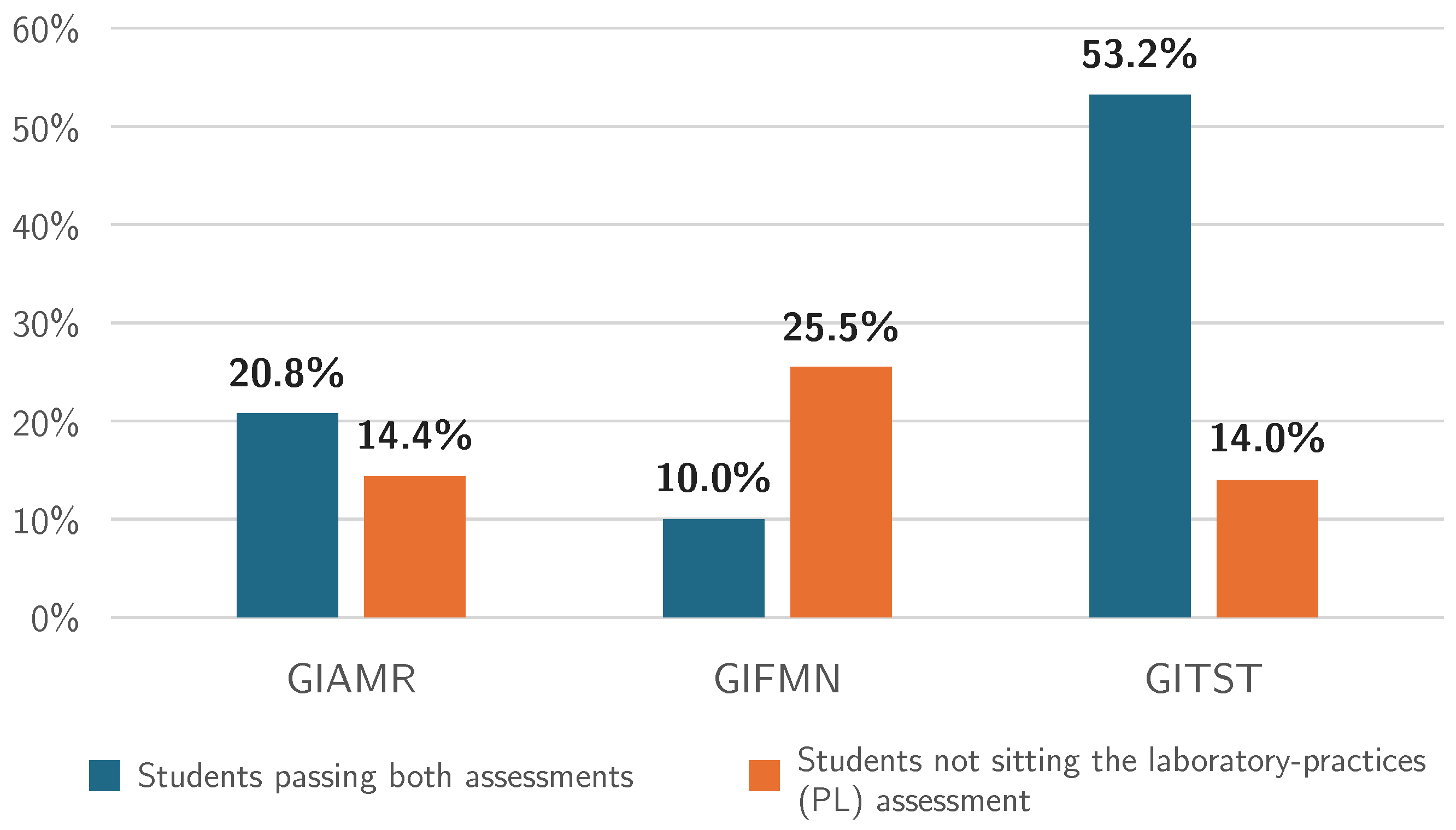
To further characterize the dataset beyond its numerical distribution,
Figure 1 presents the proportion of students who successfully passed both represented assessments, as well as those who did not sit the laboratory-practices (PL) assessment across the three degree programs. The figure is descriptive and uses full degree-specific bases of 202 for GIAMR, 110 for GIFMN, and 222 for GITST, including the records used to calculate non-completion proportions. These bases are distinct from the 173, 82, and 222 paired assessment observations, respectively, entering the contingency-table analyses.
As observed, clear differences emerge among the cohorts. Both represented assessments were passed by 42 of 202 GIAMR students (20.8%), 11 of 110 GIFMN students (10.0%), and 118 of 222 GITST students (53.2%). The PL assessment was not taken by 29 of 202 GIAMR students (14.4%), 28 of 110 GIFMN students (25.5%), and 31 of 222 GITST students (14.0%). These patterns provide an initial indication of heterogeneity in recorded assessment completion across degree programs.
2.4. Institutional Context and Student Profiles
To provide a multidimensional view of the cohorts, institutional indicators were integrated (
Table 1). The standard Admission Score (EBAU) is used here only as a descriptive indicator of prior academic performance at degree-program level; it is not a direct measure of motivation, self-regulation, or individual aptitude. Furthermore, the PARS score (
Programa Académico de Recorrido Sucesivo) refers to the Sequential Academic Pathway Program, a pathway connecting the bachelor’s degree with its qualifying master’s degree.
The term “student profile” is used only for the aggregate institutional characterization presented in
Table 1. These indicators were not linked to the individual assessment observations or included as covariates in a multivariable model; consequently, between-program differences cannot be attributed to individual motivation, degree preference, or engagement.
2.5. Statistical Analysis
The analysis uses established methods rather than proposing a new evaluative framework [
16]. A contingency table cross-classifies laboratory outcomes (Pass/Fail) and theoretical-exam outcomes (Pass/Fail). Several metrics were derived from the resulting
tables [
17]. Association between practical and theoretical performance was evaluated using Pearson’s chi-squared (
) test for independence, calculated without Yates’ continuity correction; the Phi coefficient (
) summarizes the effect size and direction.
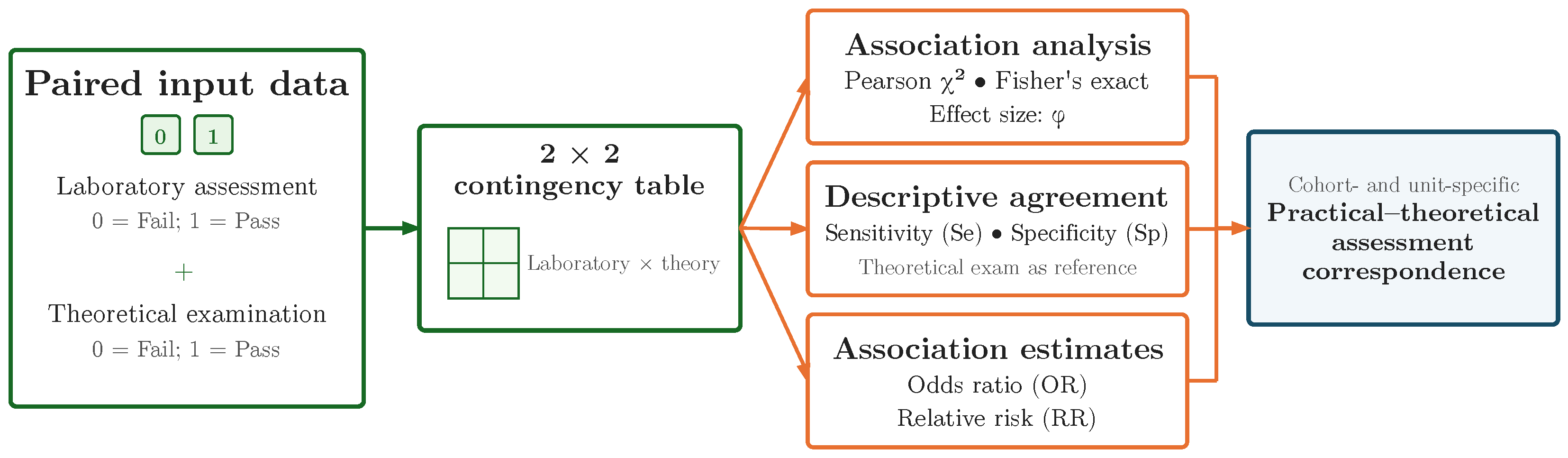
Using the theoretical exam as the reference outcome, sensitivity (Se) is the proportion of observations with a theoretical pass that also had a laboratory pass, whereas specificity (Sp) is the proportion of observations without a theoretical pass that also did not pass the laboratory. These metrics describe classification agreement rather than clinical diagnostic capacity. Finally, the magnitude and direction of the association between laboratory and theoretical outcomes are summarized using the Odds Ratio (OR) and Relative Risk (RR). None of these measures is interpreted as evidence that laboratory performance diagnoses conceptual mastery or causes examination success. The methodological workflow is summarized in
Figure 2.
All statistical analyses, including the computation of contingency matrices and the reported statistical metrics, were performed using Python 3.14 (specifically leveraging the SciPy and Pandas libraries). Expected cell frequencies were inspected, and two-sided Fisher’s exact tests were performed for all five contingency tables as a robustness analysis. When an expected cell frequency was below 5, Fisher’s exact test was used to guide the inferential interpretation, while the Pearson result was retained for comparison. A predetermined significance level of was established for all inferential tests.
3. Results and Discussion
The association between laboratory and theoretical-exam outcomes varied across cohorts. The global comparison (summarized in
Table 2) shows that only GIAMR Partial 1 reached the nominal
threshold under both Pearson’s chi-squared and Fisher’s exact tests.
3.1. GITST (Telecommunications)
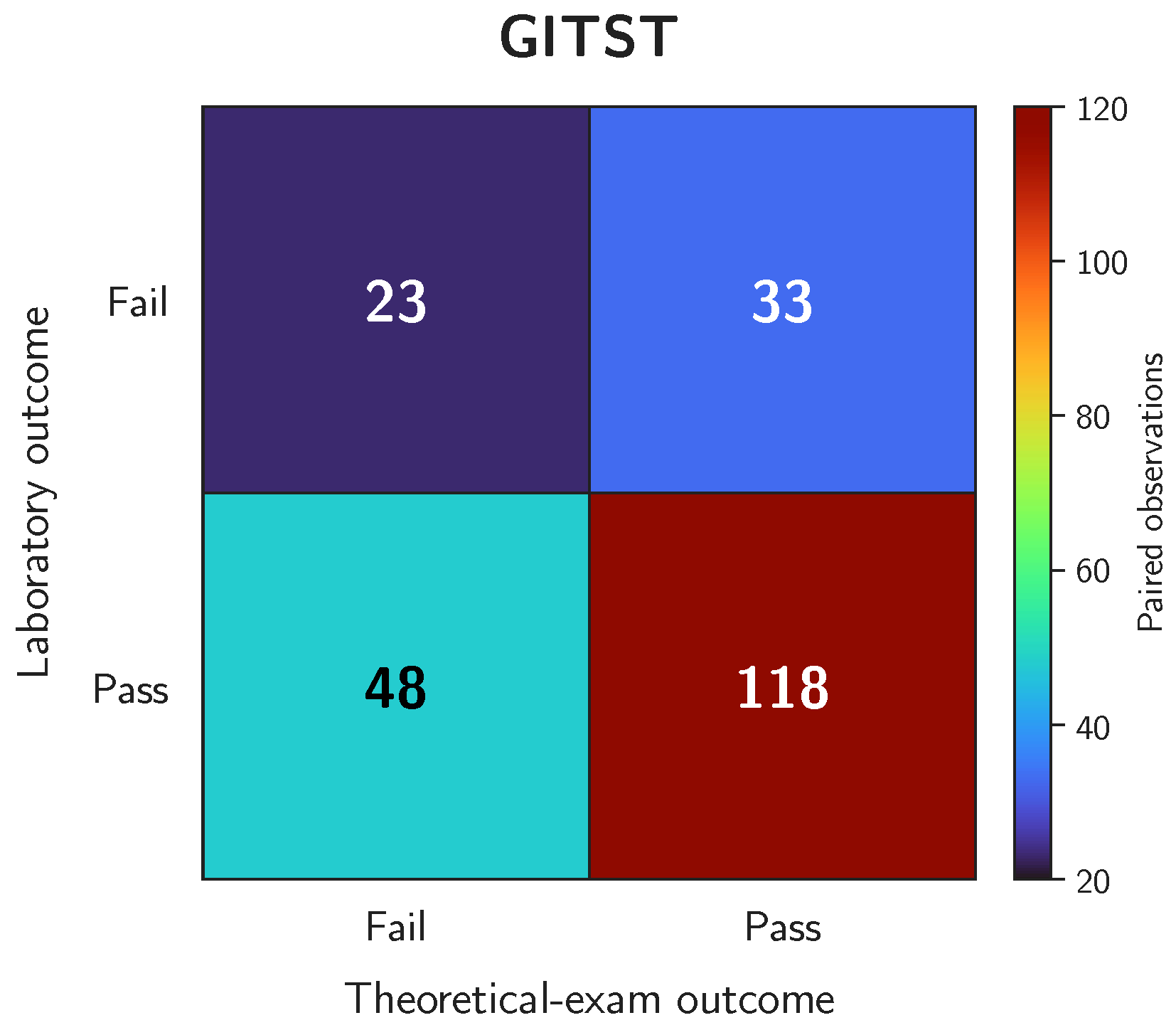
For the GITST cohort, the analysis focused exclusively on the laboratory and written partial-exam outcomes corresponding to the Magnetism and Induction thematic unit. For this pairing, the association was weak and non-significant (Pearson , ; Fisher’s exact ). The Odds Ratio (OR = 1.71) and Relative Risk (RR = 1.21) indicate a positive descriptive association rather than a causal effect of passing the laboratory.
Sensitivity was 78.1% and specificity was 32.4%. In practical terms, while most observations with a theoretical pass also had a laboratory pass, the Magnetism and Induction laboratory assessment showed limited specificity in relation to the corresponding written partial exam: 48 observations combined a laboratory pass with a theoretical-exam fail. This pattern is illustrated in
Figure 3, which presents the
contingency-table heatmap comparing Laboratory and Theoretical Exam outcomes in the Magnetism and Induction thematic unit for the GITST cohort.
3.2. GIAMR (Agricultural Engineering)
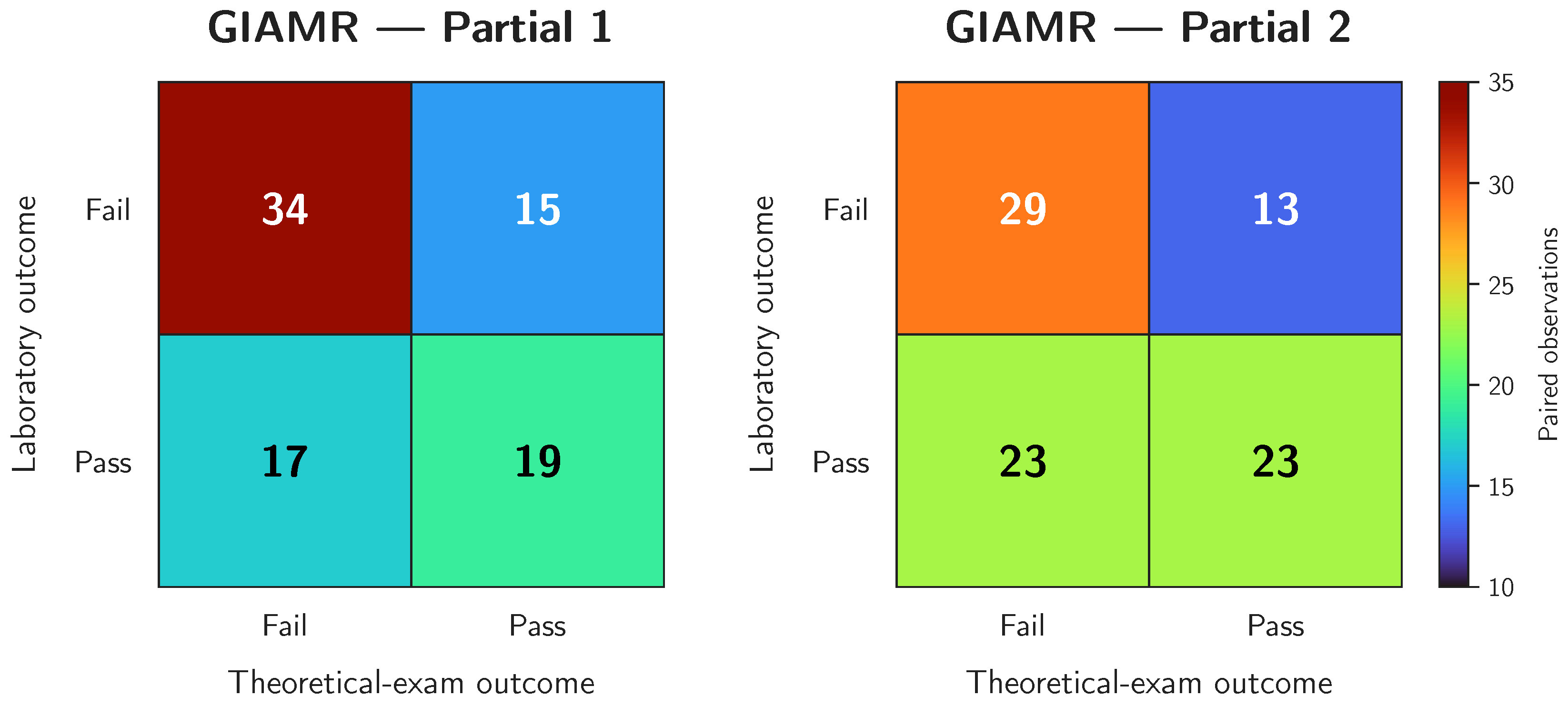
For the first partial exam, the association is statistically significant (, ), and it remained significant under Fisher’s exact test (). The corresponding estimates were OR = 2.53 and RR = 1.72.
For Partial 1, sensitivity was 55.9% and specificity was 66.7%; 34 observations failed both assessments. During the second partial exam, the association was positive but non-significant (OR = 2.23; RR = 1.62; Pearson
; Fisher’s exact
). Its sensitivity was 63.9%, while the specificity was 55.8%. These patterns are illustrated in
Figure 4, which presents the
contingency-table heatmaps comparing Laboratory and Theoretical Exam outcomes for the GIAMR cohort.
3.3. GIFMN (Forestry Engineering)
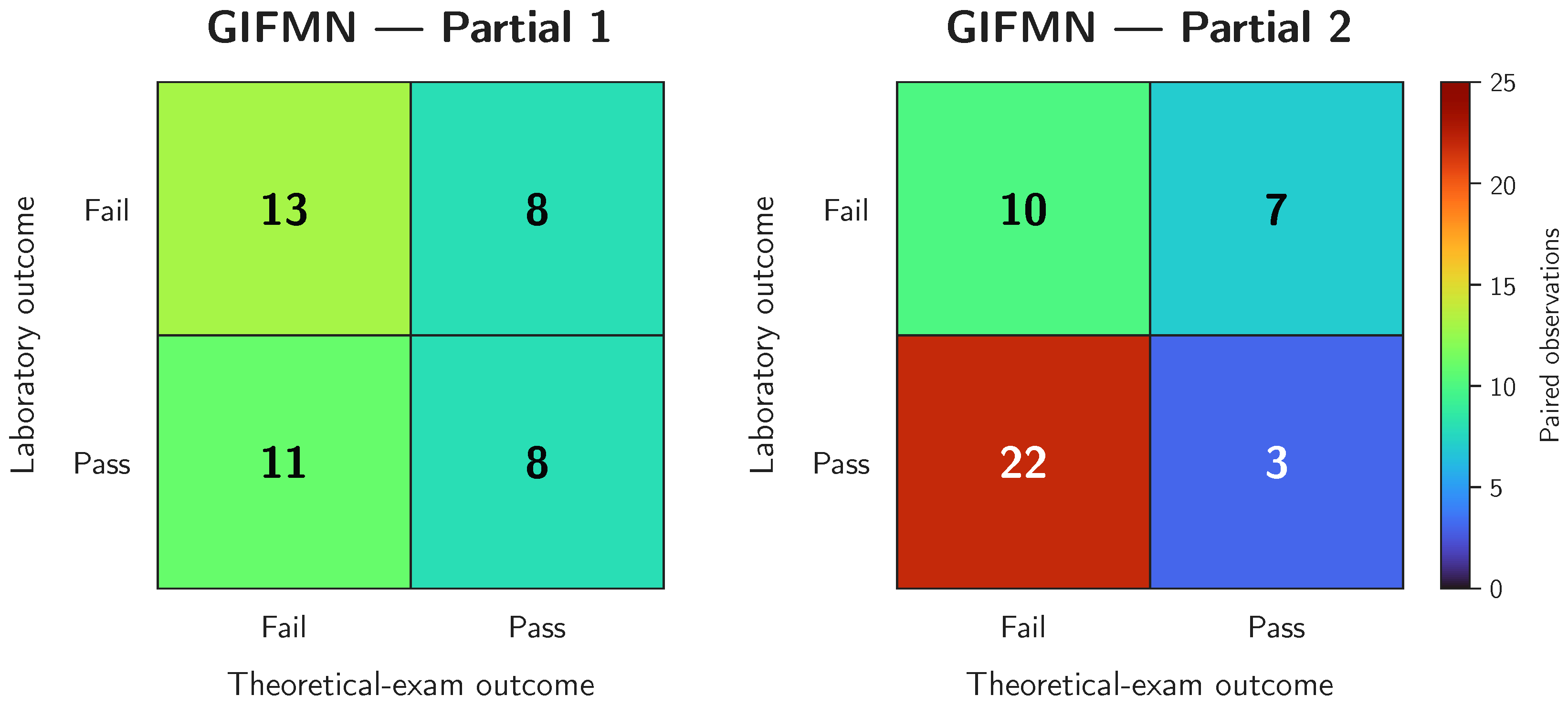
During the first partial exam, no statistically significant association was detected (, ; Fisher’s exact ). The estimates were close to the null (OR = 1.18; RR = 1.11), with sensitivity of 50.0% and specificity of 54.2%. A non-significant result is not evidence that the outcomes are entirely independent.
During the second partial exam, a pronounced inverse descriptive pattern was observed. Although the Pearson
test yielded
, the minimum expected cell frequency was 4.05 and Fisher’s exact test yielded
. Therefore, the association did not reach the
threshold and should be interpreted cautiously. The Odds Ratio was 0.19 and the Relative Risk was 0.29. Out of the 25 GIFMN observations with a laboratory pass, 22 were paired with a failed theoretical exam. Sensitivity and specificity were 30.0% and 31.2%, respectively. This pattern is illustrated in
Figure 5.
3.4. Comparative Analysis of Curricular Alignment
The observed association estimates and contingency-table patterns varied descriptively across cohorts and thematic units. GIAMR Partial 1 was the only comparison that reached the nominal threshold under both tests; GIAMR Partial 2, GITST, and GIFMN Partial 1 were non-significant, while GIFMN Partial 2 retained a pronounced inverse descriptive pattern that was non-significant under Fisher’s exact test.
In the GITST cohort, the analysis used the thematic-unit-specific laboratory and written partial-exam outcomes for Magnetism and Induction. Its role remains complementary because strict curricular equivalence with the shared GIAMR–GIFMN course is not assumed. GIAMR and GIFMN provide the closer thematic-unit-specific comparison because they share the same course, teaching staff, laboratory activities and procedures, and jointly administered assessments. Their contingency-table patterns nevertheless differed descriptively across the analyzed units. This common instructional setting reduces obvious differences in the documented course-level conditions, but separate within-cohort tests do not establish a statistically significant between-cohort difference. Because the design is observational and the entry indicators are aggregate, the observed patterns cannot be attributed to aptitude, motivation, resilience, degree preference, or learning approach. Testing such explanations would require individual-level covariates, larger samples, and a formal interaction or homogeneity analysis.
4. Conclusions
By analyzing 477 paired assessment observations, this study examined practical–theoretical assessment correspondence across three engineering degree contexts. GIAMR and GIFMN provided the closest observational comparison: the same first-year Physics course was delivered in both programs by the same teaching staff, with shared laboratory activities and procedures and jointly administered assessments. GITST was retained as a complementary reference, with its Magnetism and Induction laboratory assessment paired with the corresponding written partial examination.
The observed association estimates and contingency-table patterns varied descriptively across the five assessment pairs. GIAMR Partial 1 was the only comparison that reached the nominal significance threshold under both Pearson’s chi-squared and Fisher’s exact tests (OR = 2.53; RR = 1.72; Pearson ; Fisher ). GIAMR Partial 2 showed a positive but non-significant association, while GITST and GIFMN Partial 1 also showed non-significant associations. GIFMN Partial 2 showed a pronounced inverse descriptive pattern (OR = 0.19; RR = 0.29), with 22 of the 25 observations combining a laboratory pass with a theoretical-exam fail. However, Fisher’s exact test yielded ; this constitutes a descriptively noteworthy signal for educational follow-up and warrants replication, but it should not be described as statistically significant or regarded as conclusive.
Taken together, these findings challenge the assumption that shared curricular, instructional, and assessment arrangements necessarily coincide with uniform practical–theoretical correspondence across degree cohorts. In the cohorts examined, the common GIAMR–GIFMN setting was accompanied by contrasting descriptive patterns, particularly in Partial 2. Because syllabus, teaching staff, laboratory activities, and assessment were shared, this contrast occurred without documented differences in course design or examination structure. Nevertheless, the separate within-cohort tests do not demonstrate a statistically significant between-cohort difference.
The analysis does not identify the mechanism underlying these patterns. The programs’ different aggregate entry profiles remain contextual factors of interest for interpreting these patterns, but the present design cannot isolate their possible role from other student- or cohort-level factors and provides no causal evidence that admission profile, prior aptitude, degree preference, motivation, engagement, or learning approach produced the observed results. Here, “curricular decoupling” denotes only a weakening or loss of correspondence between the recorded outcomes; it is not evidence of curricular failure, deep or superficial learning, or conceptual mastery.
For instructors and course coordinators, the practical implication is that laboratory–theory correspondence should be examined empirically within each degree cohort and thematic unit, even when course design and assessment are shared. The inverse descriptive pattern in GIFMN Partial 2 constitutes a signal for replication and closer assessment review, not a diagnosis of student competence or proof that a particular redesign is required. Prospective studies should evaluate proposed interventions before program-specific recommendations are adopted.
This study presents certain limitations that should be addressed in future research. It was conducted within a single institution (UPV), and the sample sizes across the evaluated cohorts are unbalanced, with 222 observations in GITST compared to 173 in GIAMR and 82 in GIFMN. Although all five analyses use thematic-unit-specific assessment pairs, GITST belongs to a different course and contributes only the Magnetism and Induction pairing, whereas GIAMR and GIFMN contribute two unit-specific pairings from their shared course; strict curricular equivalence across all three programs was therefore not assumed. The smaller subgroup tables limit statistical precision; this was particularly relevant for GIFMN Partial 2, whose minimum expected cell frequency was 4.05 and whose Fisher’s exact test yielded . In addition, the institutional entry indicators are aggregate descriptors that were not linked to individual outcomes or included in a multivariable model, and no formal between-cohort interaction or homogeneity test was performed. Consequently, the analysis cannot identify causal mechanisms or attribute the observed patterns to aptitude, motivation, engagement, or threshold crossing. Replication with larger cohorts, clearly documented academic periods, individual-level covariates, formal tests of between-cohort heterogeneity, and additional institutions is needed.
Author Contributions
Conceptualization, D.T.-S., C.G.-P. and S.C.-I.; methodology, D.T.-S., C.G.-P., P.A.-G., M.G. and S.C.-I.; software, P.A.-G. and L.O.-F.; validation, D.T.-S., C.G.-P., P.A.-G. and S.C.-I.; formal analysis, D.T.-S., C.G.-P., P.A.-G., L.O.-F., M.G. and S.C.-I.; investigation, D.T.-S., C.G.-P. and S.C.-I.; resources, L.O.-F. and J.M.B.-P.-S.; data curation, D.T.-S., C.G.-P. and S.C.-I.; writing—original draft preparation, D.T.-S., C.G.-P., P.A.-G. and S.C.-I.; writing—review and editing, D.T.-S., C.G.-P., P.A.-G., L.O.-F., J.M.B.-P.-S., M.G. and S.C.-I.; visualization, D.T.-S., C.G.-P., P.A.-G., L.O.-F., J.M.B.-P.-S., M.G. and S.C.-I.; supervision, D.T.-S. and S.C.-I. All authors have read and agreed to the published version of the manuscript.
Funding
This research received no external funding.
Institutional Review Board Statement
Not applicable.
Informed Consent Statement
Informed consent was obtained from all subjects involved in the study. All student data were strictly anonymized prior to analysis, ensuring that no individual subject can be identified.
Data Availability Statement
The data that support the findings of this study are not publicly available due to privacy restrictions applying to student academic records. Aggregated results and analysis code may be made available from the corresponding author upon reasonable request, subject to institutional and data protection requirements.
Acknowledgments
P. Arizo-García acknowledges financial support from Generalitat Valenciana, European Union (European Social Fund. Investing in Your Future) through grant CIACIF/2022/255. This work has been carried out as part of the active participation in the Educational Innovation Group “Multidisciplinary Teaching Innovation Methodology (Teach-Inn)” (GIE-64) of the University of Las Palmas de Gran Canaria.
Conflicts of Interest
The authors declare no conflicts of interest.
Abbreviations
The following abbreviations are used in this manuscript:
| EBAU | Spanish University Entrance Examination |
| GIAMR | Agri-Food and Rural Environment Engineering |
| GIFMN | Forestry and Natural Environment Engineering |
| GITST | Telecommunication Technologies and Systems Engineering |
| OR | Odds Ratio |
| PARS | Sequential Academic Pathway Program |
| RR | Relative Risk |
| Se | Sensitivity |
| Sp | Specificity |
| UPV | Universitat Politècnica de València |
References
- Feisel, L.D.; Rosa, A.J. The role of the laboratory in undergraduate engineering education. J. Eng. Educ. 2005, 94, 121–130. [Google Scholar] [CrossRef] [Scilit]
- Tembrevilla, G.; Phillion, A.; Zeadin, M. Experiential learning in engineering education: A systematic literature review. J. Eng. Educ. 2024, 113, 195–218. [Google Scholar] [CrossRef] [Scilit]
- Biggs, J. Enhancing teaching through constructive alignment. High. Educ. 1996, 32, 347–364. [Google Scholar] [CrossRef] [Scilit]
- Prince, M. Does active learning work? A review of the research. J. Eng. Educ. 2004, 93, 223–231. [Google Scholar] [CrossRef] [Scilit]
- AbdelSattar, A.; Labib, W. Active learning in engineering education: Teaching strategies and methods of overcoming challenges. In Proceedings of the 2019 8th International Conference on Educational and Information Technology, Cambridge, UK, 2–4 March 2019; Association for Computing Machinery: New York, NY, USA, 2019; pp. 255–261. [Google Scholar]
- Ramirez-Vazquez, R.; Martins, M.I.; Escobar, I.; Martinez-Plaza, A.; Adelantado, C.; Beléndez, A.; Arribas, E. Physics laboratory practices. An experience and approach for Physics teaching. In Proceedings of the INTED2022 Proceedings, IATED, Online, 7–8 March 2022; IATED: Valencia, Spain, 2022; pp. 5725–5734. [Google Scholar]
- Ariza, J.Á. Bringing active learning, experimentation, and student-created videos in engineering: A study about teaching electronics and physical computing integrating online and mobile learning. Comput. Appl. Eng. Educ. 2023, 31, 1723–1749. [Google Scholar] [CrossRef] [Scilit]
- Liron, C.; Steinhauer, H.M.; Raghavan, J.; Berhane, B. Multi-Course Alignment for First-Year Engineering Students: Mathematics, Physics, and Programming in MATLAB. In Proceedings of the 2014 ASEE Annual Conference & Exposition, Indianapolis, IN, USA, 15–18 June 2014; American Society for Engineering Education: Washington, DC, USA, 2014; pp. 24.920.1–24.920.23. [Google Scholar] [CrossRef] [Scilit]
- Nikolic, S.; Suesse, T.; Jovanovic, K.; Stanisavljevic, Z. Laboratory learning objectives measurement: Relationships between student evaluation scores and perceived learning. IEEE Trans. Educ. 2020, 64, 163–171. [Google Scholar] [CrossRef] [Scilit]
- Meyer, J.; Land, R. Threshold concepts and troublesome knowledge: Linkages to ways of thinking and practising within the disciplines. In Improving Student Learning Theory and Practice-10 Years on; Oxford Centre for Staff and Learning Development: Oxford, UK, 2003; pp. 412–424. [Google Scholar]
- Meyer, J.H.; Land, R. Threshold concepts and troublesome knowledge (2): Epistemological considerations and a conceptual framework for teaching and learning. High. Educ. 2005, 49, 373–388. [Google Scholar] [CrossRef] [Scilit]
- Carmichael, P. Threshold concepts, disciplinary differences and cross-disciplinary spaces. In Overcoming Barriers to Student Understanding: Threshold Concepts and Troublesome Knowledge; Routledge: London, UK, 2006; pp. 58–73. [Google Scholar]
- Froyd, J.E.; Ohland, M.W. Integrated engineering curricula. J. Eng. Educ. 2005, 94, 147–164. [Google Scholar] [CrossRef] [Scilit]
- Lattuca, L.R.; Knight, D.B.; Bergom, I.M. Developing a measure of interdisciplinary competence for engineers. In Proceedings of the 2012 ASEE Annual Conference & Exposition, San Antonio, TX, USA, 10–13 June 2012; American Society for Engineering Education: Washington, DC, USA, 2012; pp. 25.415.1–25.415.19. [Google Scholar] [CrossRef] [Scilit]
- Lattuca, L.R.; Knight, D.B.; Ro, H.K.; Novoselich, B.J. Supporting the development of engineers’ interdisciplinary competence. J. Eng. Educ. 2017, 106, 71–97. [Google Scholar] [CrossRef] [Scilit]
- Altman, D.G.; Bland, J.M. Diagnostic tests. 1: Sensitivity and specificity. BMJ Br. Med. J. 1994, 308, 1552. [Google Scholar] [CrossRef] [Scilit] [PubMed]
- Bland, J.M.; Altman, D.G. Statistical methods for assessing agreement between two methods of clinical measurement. Lancet 1986, 327, 307–310. [Google Scholar] [CrossRef] [Scilit]
| Disclaimer/Publisher’s Note: The statements, opinions and data contained in all publications are solely those of the individual author(s) and contributor(s) and not of MDPI and/or the editor(s). MDPI and/or the editor(s) disclaim responsibility for any injury to people or property resulting from any ideas, methods, instructions or products referred to in the content. |



 ,
,