How Does Barbe-Bleue Subjugate His Wives? Psychological and Social Coercion of Women in Interpersonal Power Contexts: A Scoping Review



Abstract
1. Introduction
| SÉLYSETTE (S’élançant après elle et l’arrêtant) Ariane!… Ariane!… Où vas-tu? ARIANE Loin d’ici; là bas, où l’on m’attend encore… M’accompagnes-tu, Sélysette? SÉLYSETTE Quand reviens-tu? ARIANE Je ne reviendrai pas… MÉLISANDE Ariane!… ARIANE M’accompagnes-tu, Mélisande? (Mélisande regarde tour à tour Barbe-Bleue et Ariane, et ne répond point) ARIANE Vois, la porte est ouvert et la campagne est bleue… Ne viens-tu pas, Ygraine? (Ygraine ne tourne pas la tête) | La lune et les étoiles éclairent toutes les routes. La forêt et la mer nous appellent de loin et l’aurore se penche aux voûtes de l’azur, pour nous montrer un monde inondé d’espérance… Venez-vous, Bellangére? BELLANGÉRE (Sèchement) Non. ARIANE Je m’en irai seule, Alladine? (A ces mots, Alladine court à Ariane, se jette dans ses bras et, parmi des sanglots convulsifs, la tient longuement et fiévreusement enlacée) ARIANE (Se dégageant doucement) Reste aussi, Alladine… Adieu, soyez heureuses… (Elle s’éloigne, suivie de la Nourrice. Les femmes se regardent, puis regardent Barbe-Bleue qui relève lentement la tête. Un silence) |
- What are the psychological coercion mechanisms employed by those who perpetrate violence to subjugate and manipulate women?
- What are the social coercion mechanisms employed by those who perpetrate violence to subjugate and manipulate women?
- How does gender socialisation influence and/or legitimise the interpersonal and social power dynamics that subjugate women?
2. Materials and Methods
2.1. Eligibility Criteria, Information Sources and Search
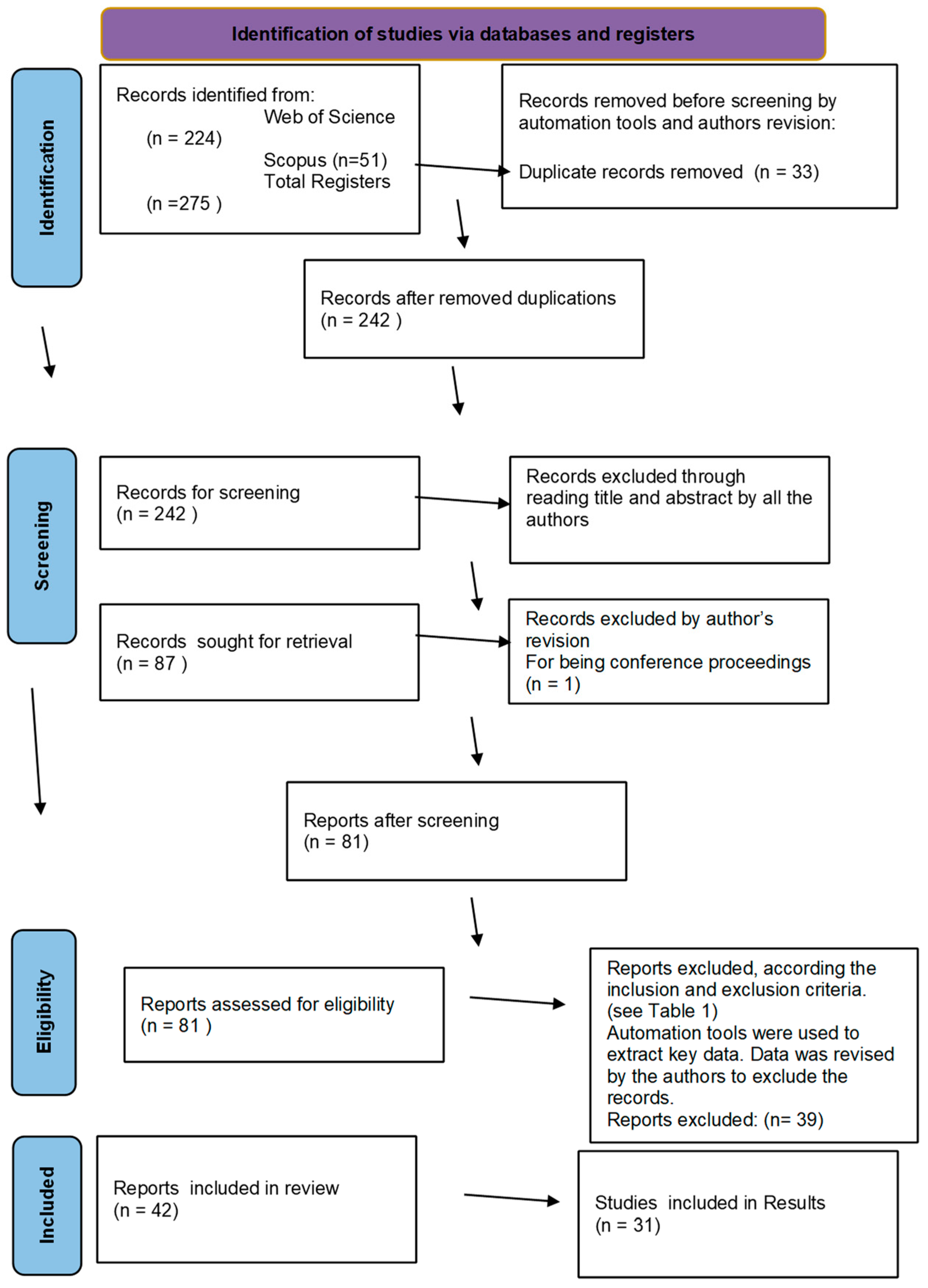
2.2. Selection of Sources of Evidence
2.3. Data Charting and Data Items
2.4. Synthesis of Results
3. Results
3.1. Mechanisms Employed by Those Who Perpetrate Violence
3.2. Mechanisms of Coercion in the Victim’s Social Environment
3.3. The Influence of Gender Socialisation on Legitimising the Interpersonal and Social Power Dynamics That Subjugate Women
4. Discussion
4.1. Practical Implications
4.2. Limitations
5. Conclusions
Author Contributions
Funding
Institutional Review Board Statement
Informed Consent Statement
Data Availability Statement
Acknowledgments
Conflicts of Interest
References
- Ahn, Y. (2019). Yearning for affection: Traumatic bonding between Korean ‘comfort women’ and Japanese soldiers during World War II. European Journal of Women’s Studies, 26(4), 360–374. [Google Scholar] [CrossRef]
- Arboleda-Trujillo, M. A., Lennon, S. E., Pacichana-Quinayáz, S. G., Fandiño, C. A., & Gutiérrez, M. I. (2025). Intimate partner violence: The perspective of men living in two municipalities in Valle del Cauca, Colombia. Salud Mental, 48(2), 111–119. [Google Scholar] [CrossRef]
- Bard Wigdor, G. (2016). Aferrarse o soltar privilegios de género: Sobre masculinidades hegemónicas y disidentes. Península, 11(2), 101–122. [Google Scholar] [CrossRef]
- Barnett, J. P., Maticka-Tyndale, E., & Kenya, T. (2016). Stigma as social control: Gender-based violence stigma, life chances, and moral order in Kenya. Social Problems, 63(2), 447–462. [Google Scholar] [CrossRef]
- Bay-Cheng, L. Y., Maguin, E., & Bruns, A. E. (2018). Who wears the pants: The implications of gender and power for youth heterosexual relationships. Journal of Sex Research, 55(1), 7–20. [Google Scholar] [CrossRef]
- Beare, K., & Boonzaier, F. (2020). South African women’s constructions of sexual consent. Psychology & Sexuality, 11(4), 329–341. [Google Scholar] [CrossRef]
- Bhandari, S. (2024). Exploring intervention with South Asian women in the United States experiencing domestic violence. Journal of Evidence-Based Social Work, 21(4), 474–491. [Google Scholar] [CrossRef]
- Bosna, V. (2024). Talking about violence using fairy tales: Bluebeard, a gentleman with many faces, emblematic of the man who transforms from prince charming into a bad wolf. History of Education & Children’s Literature, 19(2), 575–584. [Google Scholar] [CrossRef]
- Butler, J. (1990). The gender trouble. Routledge. [Google Scholar]
- Chernyak, E. (2018). Intimate partner violence in Tajikistan: Risk and protective factors. Violence and Victims, 33(6), 1124–1147. [Google Scholar] [CrossRef]
- Crenshaw, K. (1989). Demarginalizing the intersection of race and sex: A black feminist critique of antidiscrimination doctrine, feminist theory and antiracist politics. University of Chicago Legal Forum, 1989(1), 8. [Google Scholar]
- Daw, J., Halliwell, G., Hay, S., & Jacob, S. (2023). “You don’t notice it, it’s like boiling water”: Identifying psychological abuse within intimate partner relationships and how it develops across a domestic homicide timeline. Current Psychology: A Journal for Diverse Perspectives on Diverse Psychological Issues, 42(23), 20000–20014. [Google Scholar] [CrossRef]
- Deshotels, T. H., Forsyth, C. J., Earwood, S., New, B., & Fulmer, J. (2019). For HE tells me so: Techniques of neutralization applied to Christian domestic discipline. Deviant Behavior, 40(6), 732–751. [Google Scholar] [CrossRef]
- Duby, Z., Bergh, K., Jonas, K., Reddy, T., Bunce, B., Fowler, C., & Mathews, C. (2023). “Men rule horizontal ellipsis this is the normal thing. We normalise it and it’s wrong”: Gendered power in decision-making around sex and condom use in heterosexual relationships amongst adolescents and young people in South Africa. AIDS and Behavior, 27(6), 2015–2029. [Google Scholar] [CrossRef] [PubMed]
- Effiong, J. E., Ibeagha, P. N., & Iorfa, S. K. (2022). Traumatic bonding in victims of intimate partner violence is intensified via empathy. Journal of Social and Personal Relationschips, 39(12), 3619–3637. [Google Scholar] [CrossRef]
- Fanghanel, A. (2025). Queerying consent: Romantic relationship scripts, rape myths, and the ‘sex game gone wrong’. Sexualities, 1–20. [Google Scholar] [CrossRef]
- Gomez-Pulido, E., Garrido-Macías, M., Miss-Ascencio, C., & Expósito, F. (2024). Under the shadows of gender violence: An exploration of sexual consent through Spanish university women’s experiences. The European Journal of Psychology Applied to Legal Context, 16(2), 111–123. [Google Scholar] [CrossRef]
- Gutzmer, K., Ludwig-Barron, N. T., Wyatt, G. E., Hamilton, A. B., & Stockman, J. K. (2016). “Come on baby. You know I love you”: African American women’s experiences of communication with male partners and disclosure in the context of unwanted sex. Archives of Sexual Behavior, 45(4), 807–819. [Google Scholar] [CrossRef]
- Herman, J. L. (2022). Trauma and recovery: The aftermath of violence—From domestic abuse to political terror (revisada, ed.). Basic Books. [Google Scholar]
- Hill, R. L., Richards, D., & Savigny, H. (2023). Normalising sexualised violence in popular culture: Eroding, erasing and controlling women in rock music. Feminist Media Studies, 23(3), 1107–1123. [Google Scholar] [CrossRef]
- Hooks, B. (2000a). All about love. New visions. Harper Collins. [Google Scholar]
- Hooks, B. (2000b). Feminism is for everybody. Passionate politics. Southend Press. [Google Scholar]
- Hooks, B. (2004). The will to change: Men, masculinity, and love. Atria Books. [Google Scholar]
- Isaiah, U. S., Effiong, J. E., Udokang, I., Ogwuche, S., Udoukok, E. N., & Iorfa, S. K. (2024). Need for closure is linked with traumatic bonding among victims of intimate partner violence: A mediation approach. Journal of Social and Personal Relationships, 41(7), 2006–2022. [Google Scholar] [CrossRef]
- Jesussek, C. (2023). The tales of bluebeard’s wives: Carmen maria Machado’s intertextual storytelling in in the dream house and “The Husband Stitch”. Literature, 3(3), 327–341. [Google Scholar] [CrossRef]
- Johnson, M. P., & Leone, J. (2005). The differential effects of intimate terrorism and situational couple violence. Journal of Family Issues, 26(3), 322–349. [Google Scholar] [CrossRef]
- Lahav, Y. (2021). Painful bonds: Identification with the aggressor and distress among IPV survivors. Journal of Psychiatric Research, 144, 26–31. [Google Scholar] [CrossRef]
- Lahav, Y. (2023). Hyper-sensitivity to the perpetrator and the likelihood of returning to abusive relationships. Journal of Interpersonal Violence, 38(1–2), NP1815–NP1841. [Google Scholar] [CrossRef] [PubMed]
- Lerner, G. (1986). The creation of patriarchy. Oxford University Press. [Google Scholar]
- Lipinsky, A. S., & Goldner, L. (2026). Antecedents, characteristics, and dynamics of IPV in the Israeli Jewish ultra-orthodox community: A cultural exploration. Journal of Family Violence, 41, 31–44. [Google Scholar] [CrossRef]
- Litinetskaia, M., & Guelfi, J. D. (2021). État amoureux normal et pathologique. Annales Médico-Psychologiques, 179, 280–285. [Google Scholar] [CrossRef]
- Llano-Suárez, A., Lana, A., & Fernández-Feito, A. (2026). Intimate partner sexual violence in young people: A qualitative study. Journal of Youth Studies, 1–18. [Google Scholar] [CrossRef]
- MacKinnon, C. A. (1989). Toward a feminist theory of the state. Harvard University Press. [Google Scholar]
- McLeod, D. A., Sharp, S. F., Gatlin, L., & Jones, M. S. (2019). No idle threat: Coercive control and enacted violence in the pre-prison relationships of incarcerated women. Violence and Victims, 34(3), 452–473. [Google Scholar] [CrossRef]
- McRobbie, A. (2004). Notes on ‘what not to wear’ and post-feminist symbolic violence. Sociological Review, 52(2), 97–109. [Google Scholar] [CrossRef]
- Metz, C., Calmet, J., & Thevenot, A. (2019). Women subjected to domestic violence: The impossibility of separation. Psychoanalytic Psychology, 36(1), 36–43. [Google Scholar] [CrossRef]
- Miao, L., & Westmarland, N. (2025). ‘There are too many women with love brains’: Domestic violence and victim blaming in China. Journal of Gender-Based Violence, 1–18. [Google Scholar] [CrossRef]
- Mitchell, E., & Bennett, L. R. (2020). Pressure and persuasion: Young Fijian women’s experiences of sexual and reproductive coercion in romantic relationships. Violence Against Women, 26(12–13), 1555–1573. [Google Scholar] [CrossRef]
- Mohd Ali, F. R. (2025). Unseen and unheard: The silent suffering of women in sacred contexts. Australian Feminist Studies, 40(126), 473–484. [Google Scholar] [CrossRef]
- Ptacek, J. (2023). Feeling trapped: Social class and violence against women (1st ed., Vol. 9). University of California Press. [Google Scholar] [CrossRef]
- Rodgers, K. B., Hust, S. J. T., Li, J., Kang, S., & Garcia, A. L. (2023). Sexual scripts and sexual consent: Gender stereotypes, music-media messages, and sexual consent expectancies among college men and women. Journal of Interpersonal Violence, 38(15–16), 9264–9289. [Google Scholar] [CrossRef]
- Rosenberg, M. L., Butchart, A., Mercy, J., Narasimhan, V., Waters, H., & Marshall, M. S. (2006). Interpersonal violence. In D. T. Jamison, J. G. Breman, A. R. Measham, G. Alleyne, M. Claeson, D. B. Evans, P. Jha, A. Mills, & P. Musgrove (Eds.), Disease control priorities in developing countries (2nd ed., pp. 755–770). Oxford University Press and World Bank. [Google Scholar]
- Schneider, N. M. (2018). The mask of happiness: Unmasking coercive control in intimate relationships. Journal of Psychiatric Practice, 24(1), 48–50. [Google Scholar] [CrossRef] [PubMed]
- Stark, E. (2007). Coercive control: How men entrap women in personal life. Oxford University Press. [Google Scholar]
- Šudila Žilinská, M., & Bianchi, G. (2025). Beyond yes and no: Discursive constructions of grey area and sexual boundaries in women’s lives in Slovakia. Sex Roles, 91(10), 68. [Google Scholar] [CrossRef]
- Tricco, A. C., Lillie, E., Zarin, W., O’Brien, K. K., Colquhoun, H., Levac, D., Moher, D., Peters, M. D. J., Horsley, T., Weeks, L., Hempel, S., Akl, E. A., Chang, C., McGowan, J., Stewart, L., Hartling, L., Aldcroft, A., Wilson, M. G., Garritty, C., … Straus, S. E. (2018). PRISMA extension for scoping reviews (PRISMA-ScR): Checklist and explanation. Annals of Internal Medicine, 169(7), 467–473. [Google Scholar] [CrossRef]
- Tullio, V., Lanzarone, A., Scalici, E., Vella, M., Argo, A., & Zerbo, S. (2021). Violence against women in heterosexual couples: A review of psychological and medico-legal considerations. Medicine, Science and the Law, 61, 113–124. [Google Scholar] [CrossRef] [PubMed]
- Vera Cruz, G., & Sheridan, T. (2022). The normalization of violence during sex among young Mozambicans reportedly under the influence of pornography. Sexuality & Culture, 26(1), 397–417. [Google Scholar] [CrossRef]
- Walker, L. E. A. (1979). The battered woman. Harper & Row. [Google Scholar]
- Watson, L. (2018). Fifty shades of bluebeard? Dukas’s Ariane et Barbe-Bleue in the twenty-first century. Twentieth-Century Music, 15(3), 399–438. [Google Scholar] [CrossRef]
- Zapcic, I., Fabbri, M., & Karandikar, S. (2024). ‘How can I love you if you don’t let me do this?’ Evaluating the effects of the red pill seduction community experienced by intimate partners. Journal of Aggression, Maltreatment & Trauma, 33(3), 273–290. [Google Scholar] [CrossRef]


| (“women” OR “girl” OR “female”) AND (“gender based violence” OR “gender violence” OR “intimate partner violence” OR “sexual violence”) | AND (“coercion” OR “control”) |
| AND “psychological manipulation” | |
| AND “traumatic bonding” | |
| AND “gender socialisation” OR “gender scripts” |
| Inclusion Criteria |
|
| Exclusion Criteria |
|
| Authors | Title | Year | Methodology and Participants | Psychological Coercion Mechanisms from an Individual Abuser | Social-Environmental Coercion Mechanisms | Gender Socialisation and Sexual Scripts |
|---|---|---|---|---|---|---|
| Ahn, Yonson (Ahn, 2019) | Yearning for affection: Traumatic bonding between Korean ‘comfort women’ and Japanese soldiers during World War II | 2019 | South Korea and Japan. (Tokyo, Seoul, Incheon, and Ulsan). Qualitative study based on a combination of in-depth interviews between 1992 and 1996, and published/second-hand interview sources. 9 participants. 4 Japanese veterans and 5 Korean “comfort women” victim-survivors. | It describes psychological coercion tactics such as gaslighting, humiliation, emotional manipulation, and intimidation, amongst others. | No relevant information | No relevant information |
| Arboleda-Trujillo, M.A.; Lennon, S.E.; Pacichana-Quinayaz, S.G.; Fandiño, C.A.; Gutiérrez, M.I. (Arboleda-Trujillo et al., 2025) | Intimate Partner Violence: The Perspective of Men Living in Two Municipalities in Valle del Cauca, Colombia | 2025 | Colombia. Open-questions interviews. An exploratory qualitative study using focus group discussions. The study used a socioecological approach; six focus groups were conducted. Men aged over 18, residents of Comuna, Cali, or Tuluá. They were recruited through community leaders and snowball sampling; the sample also included local community leaders. | It describes male discourses that normalise psychological coercion. | This article describes economic domination as a structural element, functioning as a mechanism for coercion and the maintenance of submission. | Describe the reproduction of patriarchal gendered norms. |
| Bard Wigdor, Gabriela (Bard Wigdor, 2016) | Aferrarse o soltar privilegios de género: sobre masculinidades hegemónicas y disidentes | 2016 | Argentina, specifically Córdoba city (Capital de Córdoba). Theoretical and empirical approach. The article draws on international masculinity studies and on qualitative interviews conducted in 2015. 15 interviews with men: 5 in-depth interviews and 10 semi-structured interviews. Men aged 20 to 40 from the popular sectors and the professional sectors. The broader material also included activists from anti-patriarchal men’s organisations, groups on “new fatherhoods,” and professional men in Córdoba who did not participate in such organisations. | No relevant information | No relevant information | Describes patriarchal norms and especially masculinities. |
| Barnett, J.P.; Maticka-Tyndale, E.; Kenya, T. (Barnett et al., 2016) | Stigma as Social Control: Gender-Based Violence Stigma, Life Chances, and Moral Order in Kenya | 2016 | Kenya, specifically Nakuru, Nairobi, and Meru. Qualitative study using focus groups and one-on-one interviews. Data were collected through focus group discussions with women survivors and interviews with close others and key informants. 59 participants in total: 40 women survivors in focus groups, 11 close others, and 8 key informants. Primary participants: women survivors of intimate partner violence/spousal GBV Close others: family members or close friends referred by the women Key informants: people working with or knowledgeable about spousal GBV, including paralegals, lawyers, chiefs, a counselor, and a female police officer. | No relevant information | This article describes economic domination as a structural element, functioning as a mechanism for coercion and the maintenance of submission. | Describes patriarchal marital norms. |
| Bay-Cheng, Laina Y.; Maguin, Eugene; Bruns, Anne E. (Bay-Cheng et al., 2018) | Who Wears the Pants: The Implications of Gender and Power for Youth Heterosexual Relationships | 2018 | United States. Participants were U.S. residents recruited through Amazon Mechanical Turk (MTurk). Convergent mixed-methods study using a web-based Digital Sexual Life History Calendar (d/SLHC). The study combined quantitative ratings of relationships with qualitative open-ended accounts, and the quantitative data were analysed with linear mixed modeling, while the qualitative data were examined through directed content analysis. 114 participants were included in this analysis. They provided data on 395 heterosexual relationships. Emerging adults aged 18–25, all cisgender, including 59 women and 55 men. | It describes mechanisms of psychological coercion as a means of controlling one’s partner. | No relevant information | No relevant information |
| Beare, Kayla; Boonzaier, Floretta (Beare & Boonzaier, 2020) | South African women’s constructions of sexual consent | 2020 | South Africa, at a university in Cape Town. Qualitative study using a feminist framework and focus group discussions. Data were analysed with Foucauldian Discourse Analysis (FDA). 25 participants. University students with experience of romantic heterosexual relationships. Most participants identified as cisgender women (24), and one participant identified as genderqueer. Ages ranged from 19 to 38 years. | It describes mechanisms of psychological coercion, such as pressure or fear. | No relevant information | Describes how gender roles impact consent. |
| Bhandari, Shreya (Bhandari, 2024) | Exploring Intervention with South Asian Women in the United States Experiencing Domestic Violence | 2024 | United States. Qualitative study based on in-depth telephone interviews. The study used a convenience sample, and the interviews were analysed using thematic analysis within the CDC ecological model framework. 20 participants. South Asian women in the U.S. who had experienced domestic violence. Participants were aged 27 to 68 and were recruited through one South Asian women’s organisation and snowball sampling. They came from different South Asian backgrounds, including India, Pakistan, Nepal, Bhutan, Bangladesh, the UK/India, and the U.S. | No relevant information | No relevant information | Describes gender roles in marital relationships and family socialisation. |
| Chernyak, E. (Chernyak, 2018) | Intimate partner violence in Tajikistan: Risk and protective factors | 2018 | Tajikistan. Quantitative secondary data analysis based on the 2012 Tajik Demographic and Health Survey (TjDHS). The study used SPSS 21.0 and STATA 13, including univariate descriptive analysis and multilevel regression models for survey data, with binomial and ordered logistic regression. 4401 women. Ever-married or cohabiting women aged 15–49 who completed the domestic violence module of the TjDHS. | No relevant information | This article examines the pressure from family to stay in a toxic relationship and how this affects one’s ability to leave it. | No relevant information |
| Daw, Jennifer; Halliwell, Gemma; Hay, Susie; Jacob, Suzanne (Daw et al., 2023) | You don’t notice it, it’s like boiling water: Identifying psychological abuse within intimate partner relationships and how it develops across a domestic homicide timeline | 2023 | United Kingdom. The study focuses on survivors in the UK and on intimate partner relationships in the context of domestic homicide risk. Qualitative survivor-led study using secondary analysis of semi-structured interview transcripts. The authors used deductive Framework Analysis, guided by the Domestic Homicide Timeline (DHT). 12 participants. Women survivors of intimate partner abuse/nonviolent coercive control, all aged over 18 at interview; most were White British. | It describes non-violent psychological coercion tactics such as manipulation, isolation or the confusion of victims. | This research identifies how the victim’s social circle fosters a culture of silence that makes it difficult for her to leave the abusive relationship. | No relevant information |
| Deshotels, Tina Hebert; Forsyth, Craig J.; Earwood, Stephanie; New, BreeAnna; Fulmer, Jennifer (Deshotels et al., 2019) | For HE tells me so: Techniques of neutralization applied to Christian domestic discipline | 2019 | United States. The authors were affiliated with universities in Alabama, Louisiana, and New Mexico, and the study analysed online material from Christian Domestic Discipline communities. Qualitative document/online content analysis. The study analysed publicly available anonymous internet sources, specifically 16 Christian Domestic Discipline websites and 35 testimonials, using a coding scheme based on techniques of neutralisation. 51 data sources in total: 16 websites and 35 testimonials. The testimonials were written by self-identified Christian Domestic Discipline practitioners, specifically male “Heads of Household” and female partners/wives. | No relevant information | No relevant information | Analyses Christian Domestic Discipline. |
| Duby, Zoe; Bergh, Kate; Jonas, Kim; Reddy, Tarylee; Bunce, Brittany; Fowler, Chantal; Mathews, Catherine (Duby et al., 2023) | Men Rule horizontal ellipsis this is the Normal Thing. We Normalise it and it’s Wrong: Gendered Power in Decision-Making Around Sex and Condom Use in Heterosexual Relationships Amongst Adolescents and Young People in South Africa | 2023 | South Africa, in six districts across six provinces: Western Cape, KwaZulu-Natal, Mpumalanga, North West, Eastern Cape, and Free State. Mixed-methods study combining a cross-sectional telephone survey with qualitative in-depth interviews. Survey data were analysed using multinomial regression; qualitative data were analysed through iterative thematic analysis. Survey: 515 AGYW. Qualitative interviews: 50 AGYW and 9 male partner/peer respondents. Adolescent girls and young women (AGYW) aged 15–24, plus 9 male partner/peer respondents aged 18+. | No relevant information | No relevant information | Describes influence of patriarchal norms on the decision-making of women about sexuality. |
| Effiong, James Edem; Ibeagha, Peace N.; Iorfa, Steven Kator (Effiong et al., 2022) | Traumatic bonding in victims of intimate partner violence is intensified via empathy | 2022 | Nigeria, specifically Awka, Anambra State, and Lagos. Quantitative study using purposive sampling and self-report questionnaires. Data were analysed using the Hayes regression-based PROCESS macro to test mediation. 345 participants. Women victims of intimate partner violence recruited from two domestic/sexual violence response centres in Nigeria; ages 18–61. | It describes how victims develop traumatic bonds that perpetuate the coercive relationship. | No relevant information | No relevant information |
| Fanghanel, Alexandra (Fanghanel, 2025) | Queerying consent: Romantic relationship scripts, rape myths, and the ‘sex game gone wrong’ | 2025 | England and Wales/UK. The cases analysed were limited to English and Welsh jurisdiction. Qualitative legal case analysis based on in-depth analysis of Crown Court case transcripts. The author identified cases through LexisNexis, WestLaw, Law Pages, media searches, and triangulation with “We Can’t Consent to This”, then analysed the judge’s summing-up statements. 14 legal cases. Court cases involving women killed or injured by men where a claim was made that the relevant sexual acts were consensual. | No relevant information | No relevant information | Analyses the impact of patriarchal norms on consent defined in legal proceedings. |
| Gomez-Pulido, E.; Garrido-Macías, M.; Miss-Ascencio, C.; Expósito, F. (Gomez-Pulido et al., 2024) | Under the Shadows of Gender Violence: An Exploration of Sexual Consent through Spanish University Women’s Experiences; Bajo la sombra de la violencia de género: una exploración del consentimiento sexual a través de experiencias de mujeres estudiantes universitarias españolas | 2024 | Spain, specifically the University of Granada. Mixed-methods research based on two independent studies. Study 1: 308 Spanish female university students. Quantitative cross-sectional survey. Aged 18–44, identified as heterosexual or bisexual, and had at least one sexual relationship with a man. Study 2: 8 Spanish female university students. Qualitative study exploring personal narratives about consent. | No relevant information | No relevant information | Describes the interplay among sexual scripts and consent. |
| Gutzmer, K.; Ludwig-Barron, N.T.; Wyatt, G.E.; Hamilton, A.B.; Stockman, J.K. (Gutzmer et al., 2016) | “Come on Baby. You Know I Love You”: African American Women’s Experiences of Communication with Male Partners and Disclosure in the Context of Unwanted Sex | 2016 | United States, specifically San Diego, California. Qualitative study using semi-structured in-depth interviews. Data were analysed using a systematic inductive analytic approach with a hierarchical coding scheme. 19 participants. Sexually active African American women, aged 18–44, living in San Diego County, who reported at least one incident of sexual coercion by a current or former intimate male partner since age 18. | No relevant information | This article describes power relationships as a structural element, functioning as a mechanism for coercion and the maintenance of submission. | No relevant information |
| Hill, Rosemary Lucy; Richards, Daisy; Savigny, Heather (Hill et al., 2023) | Normalising sexualised violence in popular culture: eroding, erasing and controlling women in rock music | 2023 | United Kingdom, based on the U.K. Official Rock and Metal Chart. Mixed qualitative and quantitative content analysis of popular music. The authors sampled chart-topping rock and metal songs at 5-year intervals from 1995 to 2015, coded lyrics, artwork, and music videos using a coding frame on sexual violence, and then conducted discourse analysis. No human participants. 60 songs. The units of analysis were No. 1 rock and metal singles from the U.K. Official Chart, representing mainstream rock/metal songs across several subgenres. | No relevant information | No relevant information | Analyses the presence of sexual scripts subjugating women in music. |
| Isaiah, Uwemedimo S.; Effiong, James E.; Udokang, Innih; Ogwuche, Samson; Udoukok, Emekubong N.; Iorfa, Steven Kator (Isaiah et al., 2024) | Need for closure is linked with traumatic bonding among victims of intimate partner violence (A mediatory approach) | 2024 | Nigeria, specifically, participants were recruited from Awka, Anambra State, and Lagos. Quantitative study using purposive sampling. Data were collected with self-report questionnaires, and the analysis used the Hayes regression-based PROCESS macro to test mediation. 345 participants. Women who were victims of intimate partner violence, recruited from two domestic/sexual violence response centers in Nigeria. Their ages ranged from 18 to 61 years. | It describes mechanisms of psychological coercion such as intermittent reinforcement, cognitive distortions, and the undermining of self-esteem, amongst others. | No relevant information | No relevant information |
| Lahav, Yael (Lahav, 2023) | Hyper-Sensitivity to the Perpetrator and the Likelihood of Returning to Abusive Relationships | 2023 | Israel. Quantitative cross-sectional study using an online survey. Participants were recruited through a Facebook advertisement, and the study used a convenience sample. 258 participants. Adult Israeli women in Israel who had left their abusive intimate partners and reported a history of intimate partner violence. | Describes the mechanism of identifying with the aggressor as emotional coercion. | This research identifies how the victim’s social circle fosters a culture of silence that makes it difficult for her to leave the abusive relationship. | No relevant information |
| Lahav, Yael (Lahav, 2021) | Painful bonds: Identification with the aggressor and distress among IPV survivors | 2021 | Israel. Quantitative cross-sectional study using an online survey conducted through Facebook recruitment and administered via Qualtrics. The study used a convenience sample. 297 participants. Adult Israeli Jewish women living in Israel aged 18–78 who reported current or previous intimate partner violence. 68 reported current IPV, and 229 reported past IPV. | Describes the mechanism of identification with the aggressor resulting from prolonged coercive dynamics. | No relevant information | No relevant information |
| Lipinsky, Aiala Szyfer; Goldner, Limor (Lipinsky & Goldner, 2026) | Antecedents, Characteristics, and Dynamics of IPV in the Israeli Jewish Ultra-Orthodox Community: A Cultural Exploration | 2026 | Israel (JUO) community. Qualitative study using semi-structured interviews based on the Clinical Ethnographic Narrative Interview (CENI) approach. The interviews were analysed using an Interpretive Phenomenological Analysis (IPA) approach. 15 participants. Israeli Jewish Ultra-Orthodox women (JUO) community. Aged approximately 30 to 55, who were currently living with or separated/divorced from abusive partners and had experienced intimate partner violence. | No relevant information | This article examines two factors, linked to social pressure, that make it difficult to leave an abusive relationship: the stigma surrounding divorce and separation, and the culture of silence. | Describes religious and family socialisation in patriarchal gender norms |
| Llano-Suárez, Andrea; Lana, Alberto; Fernandez-Feito, Ana (Llano-Suárez et al., 2026) | Intimate partner sexual violence in young people: a qualitative study | 2026 | Spain, specifically a public university in northern Spain (University of Oviedo). Qualitative descriptive phenomenological study. Data were collected through 17 semi-structured individual interviews and 4 focus groups, and analysed through content analysis using MAXQDA 2020. 37 participants, 17 interviews, and 4 focus groups. Male and female undergraduate students, aged 18–26, from 15 degree programs, who had been in a relationship of at least one month and had engaged in sexual intercourse. | No relevant information | This article suggests that peer groups and friendships can influence a person’s decision to remain in a toxic relationship. The normalisation and legitimisation of sexual pressure within these interactions is a factor that can lead to the subjugation being taken for granted. | Analyses patriarchal norms and socialisation in it. |
| McLeod, David Axlyn; Sharp, Susan F.; Gatlin, Leah; Jones, Melissa S. (McLeod et al., 2019) | No Idle Threat: Coercive Control and Enacted Violence in the Pre-Prison Relationships of Incarcerated Women | 2019 | United States, specifically Oklahoma. Quantitative study using a stratified random sample of incarcerated women in three women’s correctional facilities. Data were collected through a self-administered questionnaire using items from the Coercive Control Measure and the Revised Conflict Tactics Scales (CTS2). 367 participants. Incarcerated adult women in Oklahoma prisons, reporting on their intimate relationships in the 12 months prior to incarceration. | No relevant information | This article describes economic domination as a structural element, functioning as a mechanism for coercion and the maintenance of submission. | No relevant information |
| Metz, Claire; Calmet, Jeremy; Thevenot, Anne (Metz et al., 2019) | Women Subjected to Domestic Violence: The Impossibility of Separation | 2019 | France. Qualitative study based on semi-directive interviews. The data were analysed through both quantitative text analysis using ALCESTE software and qualitative content/discourse analysis. 30 participants. Women victims of domestic violence who had separated from their violent partner. The sample included women in shelters/reintegration centers, women from the general population, and women connected through an association supporting women from Turkey. | No relevant information | This article examines the pressure from family to stay in a toxic relationship and how this affects one’s ability to leave it. | No relevant information |
| Mitchell, Elke; Bennett, Linda Rae (Mitchell & Bennett, 2020) | Pressure and Persuasion: Young Fijian Women’s Experiences of Sexual and Reproductive Coercion in Romantic Relationships | 2020 | Fiji, specifically Suva. An ethnographic qualitative study using in-depth interviews and participant observation. The data were transcribed verbatim and analysed thematically using NVivo 10 and inductive analysis. 17 participants in the in-depth interviews. Young unmarried iTaukei (Indigenous Fijian) women, aged 18–26, attending university in Suva. | No relevant information | No relevant information | Describes family socialisation in gendered norms. |
| Mohd Ali, Fauzah Rahimah (Mohd Ali, 2025) | Unseen and Unheard: The Silent Suffering of Women in Sacred Contexts | 2025 | A case situated in a Malay-Muslim context in Malaysia. Qualitative case study/case report based on the lived experience of one patient: a middle-aged professional woman who became a second wife in a polygamous marriage. | It describes mechanisms of coercion and control in which the husband engages in narcissistic abuse. | No relevant information | Highlights the relevance to reproducing gender norms of socialisation in Malay-Muslim communities. |
| Rodgers, K.B.; Hust, S.J.T.; Li, J.; Kang, S.; Garcia, A.L. (Rodgers et al., 2023) | Sexual Scripts and Sexual Consent: Gender Stereotypes, Music-Media Messages, and Sexual Consent Expectancies Among College Men and Women | 2023 | United States, specifically a northwestern university (Washington State University). Quantitative study using an online survey. Participants viewed music videos with sexual/objectifying content and then completed measures on sexual stereotypes, experiences of sexual violence, perceptions of women in the videos, and sexual consent expectancies. The authors used linear mixed modeling with Maximum Likelihood. 364 participants. Undergraduate college students, aged 18–25, mostly White, recruited from general education communication courses. | No relevant information | No relevant information | Analyses the impact of sexual scripts of subjugating women in music. |
| Schneider, Nicole (Schneider, 2018) | The Mask of Happiness: Unmasking Coercive Control in Intimate Relationships | 2018 | USA (author) Conceptual/illustrative article. It is a professional discussion piece that defines and explains coercive control through a case vignette. The article includes a fictional case vignette (“Meredith and Ron”) used for illustration. | It describes the difficulties victims face in identifying the dynamics of psychological coercion in relationships. | This research identifies how the victim’s social circle fosters a culture of silence that makes it difficult for her to leave the abusive relationship. | No relevant information |
| Sudila Zilinska, Miroslava; Bianchi, Gabriel (Šudila Žilinská & Bianchi, 2025) | Beyond Yes and No: Discursive Constructions of Grey Area and Sexual Boundaries in Women’s Lives in Slovakia | 2025 | Slovakia. Qualitative study using feminist relational discourse analysis (FRDA). Data were collected through focus groups and serial individual interviews. The analysis combined Foucauldian discourse analysis and the Listening Guide approach. 30 participants. 18 women in 3 focus groups and 12 women in individual interviews (each interviewed twice). Adult women in Slovakia, aged 35–54, predominantly heterosexual, reflecting on their sexual experiences, boundaries, and grey-area situations. | No relevant information | No relevant information | Describes different sexual scripts of women. |
| Tullio, Valeria; Lanzarone, Antonietta; Scalici, Edoardo; Vella, Marco; Argo, Antonina; Zerbo, Stefania (Tullio et al., 2021) | Violence against women in heterosexual couples: A review of psychological and medico-legal considerations | 2021 | Italy (authors) Short narrative review. The authors conducted a comprehensive PubMed search focusing on intimate partner violence against women, attachment styles, risk factors, and the victim–perpetrator relationship. | It describes mechanisms of psychological coercion such as gaslighting, traumatic dependency, and power dynamics. | No relevant information | No relevant information |
| Vera Cruz, Germano Vera; Sheridan, Taylor (Vera Cruz & Sheridan, 2022) | The Normalization of Violence during Sex among Young Mozambicans Reportedly under the Influence of Pornography | 2022 | Mozambique, specifically urban areas around Maputo, Matola, Marracuene, and Boane. Mixed qualitative–quantitative study using semi-structured individual interviews. Interview responses were subjected to discourse thematic, semantic, and frequency analysis, with additional frequency comparison tests. 105 participants. Mozambican adolescents and young adults aged 16–22 who had already watched pornographic videos; 57 male and 48 female participants. | No relevant information | No relevant information | Describe sexual scripts that foster female subjugation. |
| Zapcic, Ian; Fabbri, Megan; Karandikar, Sharvari (Zapcic et al., 2024) | ‘How Can I Love You if You Don’t Let Me Do this?’ Evaluating the Effects of the Red Pill Seduction Community Experienced by Intimate Partners | 2024 | Mainly the United States, with participants also from the United Kingdom and mainland Europe. Qualitative study using interpretative phenomenological analysis (IPA). Data were collected through six in-depth, semi-structured interviews, conducted by phone or Skype audio. 6 participants. Cisgender, heterosexual women who had been current or former intimate partners of men involved in The Red Pill (TRP) community. Participants were aged 20–38 at the time of the interview. | It describes mechanisms of psychological coercion such as control, confusion, and manipulation. | No relevant information | No relevant information |
Disclaimer/Publisher’s Note: The statements, opinions and data contained in all publications are solely those of the individual author(s) and contributor(s) and not of MDPI and/or the editor(s). MDPI and/or the editor(s) disclaim responsibility for any injury to people or property resulting from any ideas, methods, instructions or products referred to in the content. |
© 2026 by the authors. Licensee MDPI, Basel, Switzerland. This article is an open access article distributed under the terms and conditions of the Creative Commons Attribution (CC BY) license.
Share and Cite
Duque-Sánchez, E.; Schubert, T.; Garcia-Yeste, C.; Rios, O. How Does Barbe-Bleue Subjugate His Wives? Psychological and Social Coercion of Women in Interpersonal Power Contexts: A Scoping Review. Behav. Sci. 2026, 16, 983. https://doi.org/10.3390/bs16060983
Duque-Sánchez E, Schubert T, Garcia-Yeste C, Rios O. How Does Barbe-Bleue Subjugate His Wives? Psychological and Social Coercion of Women in Interpersonal Power Contexts: A Scoping Review. Behavioral Sciences. 2026; 16(6):983. https://doi.org/10.3390/bs16060983
Chicago/Turabian StyleDuque-Sánchez, Elena, Tinka Schubert, Carme Garcia-Yeste, and Oriol Rios. 2026. "How Does Barbe-Bleue Subjugate His Wives? Psychological and Social Coercion of Women in Interpersonal Power Contexts: A Scoping Review" Behavioral Sciences 16, no. 6: 983. https://doi.org/10.3390/bs16060983
APA StyleDuque-Sánchez, E., Schubert, T., Garcia-Yeste, C., & Rios, O. (2026). How Does Barbe-Bleue Subjugate His Wives? Psychological and Social Coercion of Women in Interpersonal Power Contexts: A Scoping Review. Behavioral Sciences, 16(6), 983. https://doi.org/10.3390/bs16060983