


The Distribution of Asian American Scholarship Awards Among Chinese, Indian, and Filipino Individuals

Abstract
1. Introduction
1.1. Structural Influences on the Social Perceptions of Asian Americans
1.2. The Role of Perceived Typicality in Scholarship Distribution
1.3. The Present Research
2. Study 1
2.1. Method
2.1.1. Participants and Design
2.1.2. Procedure
2.1.3. Essays
2.1.4. Measures
2.2. Results
2.2.1. Pre-Registered Analysis Plan
2.2.2. Asian American Scholarship Worthiness
2.2.3. Perceived Asian Typicality
2.2.4. Perceived Competence
2.2.5. Perceived Asian Identity
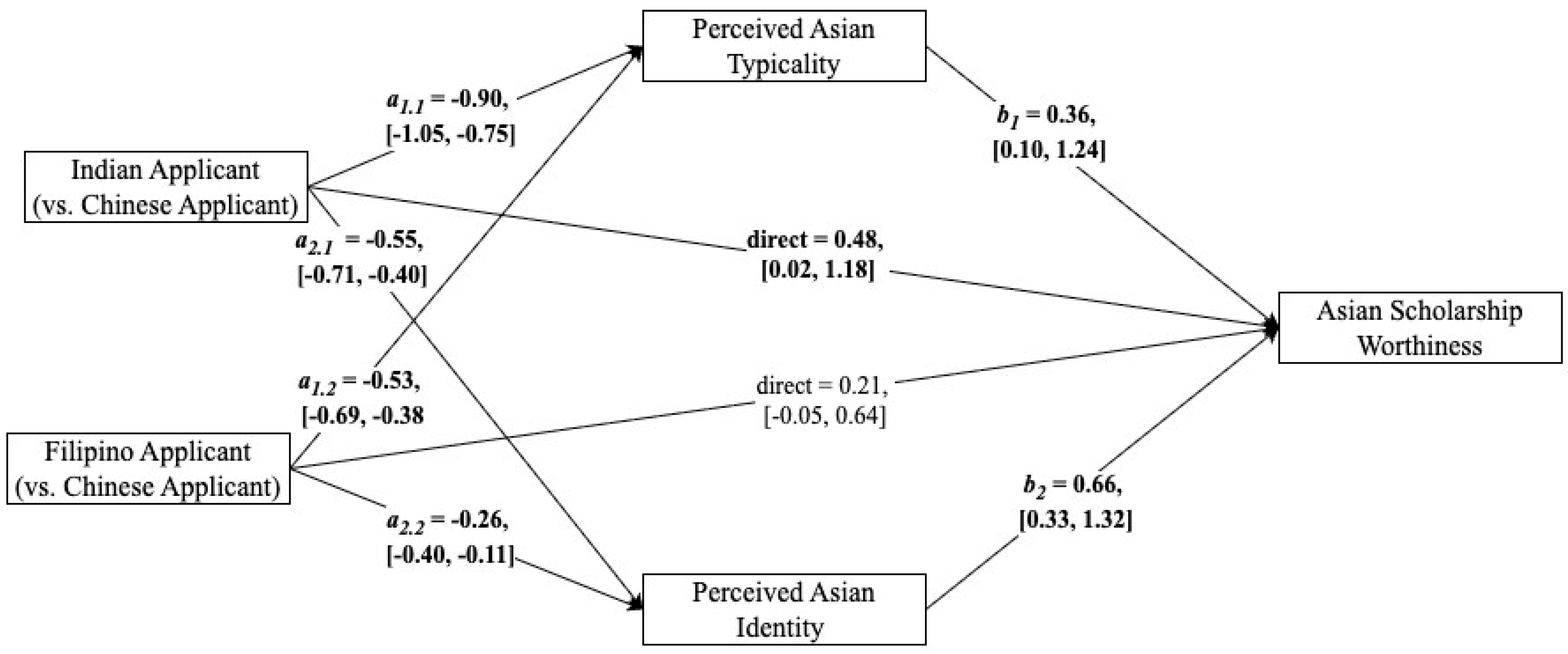
2.2.6. Exploratory Parallel Mediation Analysis
2.3. Discussion
3. Study 2
3.1. Method
3.1.1. Participants and Design
3.1.2. Procedure
3.2. Results
3.2.1. Pre-Registered Analysis Plan
3.2.2. Scholarship Worthiness
Equivalence Testing
3.2.3. Perceived Asian Typicality
3.2.4. Perceived Competence
3.2.5. Perceived Asian Identity
3.3. Discussion
4. General Discussion
Limitations and Future Directions
5. Conclusions
Supplementary Materials
Author Contributions
Funding
Institutional Review Board Statement
Informed Consent Statement
Data Availability Statement
Conflicts of Interest
| 1 | At the time of data collection, this was the standard compensation rate. |
| 2 | We pre-registered that participants had to pass two attention checks; however, for one-third of our participants there was not a second attention check due to a programming error by the experimenter. Therefore, we only analyzed data from participants who passed one attention check. |
| 3 | We additionally asked participants to rate the applicants on perceived warmth (Fiske et al., 2002) and a series of Asian-specific stereotypes (e.g., foreign, good at STEM)—see Supplementary Materials for results. |
| 4 | All analyses are collapsed across the clustering variable. |
| 5 | At the time of data collection, this compensation rate was standard. |
| 6 | Note that the use of Bonferroni tests was not pre-registered in our analysis plan, but seemed to be the most reasonable path forward. |
| 7 | We decided to choose Cohen’s d = ±0.152 as our equivalence bound because d = 0.152 is the effect size for the Chinese–Indian comparison in the Asian undergraduate scholarship condition—the only significant comparison in this set of analyses. |
| 8 | In Study 1, the chi-square results for each applicant race condition are as follows: Chinese applicant condition, X2(1, N = 513) = 6.33, p = .012; Indian applicant condition, X2(1, N = 511) = .05, p = .825; and Filipino applicant condition, X2(1, N = 516) = 0.31, p = .860. In Study 2, the chi-square results for each applicant race condition are as follows: Chinese applicant condition, X2(1, N = 545) = 13.28, p < 0.001; Indian applicant condition, X2(1, N = 546) = .36, p = .549; and Filipino applicant condition, X2(1, N = 537) = .42, p = .517. |
References
- Bless, H., & Waenke, M. (2000). Can the same information be typical and atypical? How perceived typicality moderates assimilation and contrast in evaluative judgments. Personality and Social Psychology Bulletin, 26(3), 306–314. [Google Scholar] [CrossRef]
- Buchanan, E. M., & Scofield, J. E. (2018). Methods to detect low quality data and its implication for psychological research. Behavior Research Methods, 50(6), 2586–2596. [Google Scholar] [CrossRef] [PubMed]
- Cheryan, S., & Markus, H. R. (2020). Masculine defaults: Identifying and mitigating hidden cultural biases. Psychological Review, 127(6), 1022–1052. [Google Scholar] [CrossRef] [PubMed]
- Chun, K. T. (1995). The myth of Asian American success and its educational ramifications. In D. T. Nakanishi, & T. Y. Nishida (Eds.), The Asian American educational experience: A source book for teachers and students (pp. 95–112). Routledge. [Google Scholar]
- Cooley, E., & Payne, B. K. (2019). A group is more than the average of its parts: Why existing stereotypes are applied more to the same individuals when viewed in groups than when viewed alone. Group Processes & Intergroup Relations, 22(5), 673–687. [Google Scholar] [CrossRef]
- Craig, M. A., & Bodenhausen, G. V. (2018). Category (non) fit modulates extrapolative stereotyping of multiply categorizable social targets. Social Cognition, 36(5), 559–588. [Google Scholar] [CrossRef]
- Devine, P. G., & Baker, S. M. (1991). Measurement of racial stereotype subtyping. Personality and Social Psychology Bulletin, 17(1), 44–50. [Google Scholar] [CrossRef]
- ETS. (2021). Scoring guide for the issue task. Available online: https://www.ets.org/gre/revised_general/prepare/analytical_writing/issue/scoring_guide (accessed on 8 June 2026).
- Fiske, S. T., Cuddy, A. J. C., Glick, P., & Xu, J. (2002). A model of (often mixed) stereotype content: Competence and warmth respectively follow from perceived status and competition. Journal of Personality and Social Psychology, 82(6), 878–902. [Google Scholar] [CrossRef]
- Fiske, S. T., & Neuberg, S. L. (1990). A continuum of impression formation, from category-based to individuating processes: Influences of information and motivation on attention and interpretation. In M. P. Zanna (Ed.), Advances in experimental social psychology (Vol. 23, pp. 1–74). Academic Press. [Google Scholar] [CrossRef]
- Germano, A. L., Ziegler, S. A., Banham, L., & Cheryan, S. (2021). Do diversity awards discourage applicants from marginalized groups from pursuing more lucrative opportunities? Psychological Science, 32(9), 1346–1361. [Google Scholar] [CrossRef]
- Ghavami, N., & Peplau, L. A. (2013). An intersectional analysis of gender and ethnic stereotypes: Testing three hypotheses. Psychology of Women Quarterly, 37(1), 113–127. [Google Scholar] [CrossRef]
- Ginther, D. K., Kahn, S., & Schaffer, W. T. (2016). Gender, race/ethnicity, and National Institutes of Health R01 research awards: Is there evidence of a double bind for women of color? Academic Medicine, 91(8), 1098–1107. [Google Scholar] [CrossRef]
- Ginther, D. K., Schaffer, W. T., Schnell, J., Masimore, B., Liu, F., Haak, L. L., & Kington, R. (2011). Race, ethnicity, and NIH research awards. Science, 333(6045), 1015–1019. [Google Scholar] [CrossRef] [PubMed]
- Goh, J. X., Bandt-Law, B., Cheek, N. N., Sinclair, S., & Kaiser, C. R. (2022). Narrow prototypes and neglected victims: Understanding perceptions of sexual harassment. Journal of Personality and Social Psychology, 122(5), 873–893. [Google Scholar] [CrossRef] [PubMed]
- Goh, J. X., & McCue, J. (2021). Perceived prototypicality of Asian subgroups in the United States and the United Kingdom. Journal of Experimental Social Psychology, 97, 104201. [Google Scholar] [CrossRef]
- Good, J. J., Chavez, G. F., & Sanchez, D. T. (2010). Sources of self-categorization as minority for mixed-race individuals: Implications for affirmative action entitlement. Cultural Diversity & Ethnic Minority Psychology, 16(4), 453–460. [Google Scholar] [CrossRef]
- Good, J. J., Sanchez, D. T., & Chavez, G. F. (2013). White ancestry in perceptions of Black/White biracial individuals: Implications for affirmative-action contexts. Journal of Applied Social Psychology, 43, E276–E286. [Google Scholar] [CrossRef]
- Hechtman, L. A., Moore, N. P., Schulkey, C. E., Miklos, A. C., Calcagno, A. M., Aragon, R., & Greenberg, J. H. (2018). NIH funding longevity by gender. Proceedings of the National Academy of Sciences of the United States of America, 115(31), 7943–7948. [Google Scholar] [CrossRef]
- Hinzman, L., & Maddox, K. B. (2017). Conceptual and visual representations of racial categories: Distinguishing subtypes from subgroups. Journal of Experimental Social Psychology, 70, 95–109. [Google Scholar] [CrossRef]
- Jin, C. H. (2021, May 25). 6 charts that dismantle the trope of Asian Americans as a model minority. NPR. Available online: https://www.npr.org/2021/05/25/999874296/6-charts-that-dismantle-thetrope-of-asian-americans-as-a-model-minority (accessed on 8 June 2026).
- Johnson, K. L., Freeman, J. B., & Pauker, K. (2012). Race is gendered: How covarying phenotypes and stereotypes bias sex categorization. Journal of Personality and Social Psychology, 102(1), 116–131. [Google Scholar] [CrossRef]
- Johnston, L., & Hewstone, M. (1992). Cognitive models of stereotype change: 3. Subtyping and the perceived typicality of disconfirming group members. Journal of Experimental Social Psychology, 28(4), 360–386. [Google Scholar] [CrossRef]
- Johnston, L., Hewstone, M., Pendry, L., & Frankish, C. (1994). Cognitive models of stereotype change (4): Motivational and cognitive influences. European Journal of Social Psychology, 24(2), 237–265. [Google Scholar] [CrossRef]
- Kaiser, C. R., & Wilkins, C. L. (2010). Group identification and prejudice: Theoretical and empirical advances and implications. Journal of Social Issues, 66(3), 461–476. [Google Scholar] [CrossRef]
- Krogstad, J. M., & Im, C. (2025, May 1). Key facts about Asians in the U.S. Pew Research Center. Available online: https://www.pewresearch.org/short-reads/2025/05/01/key-facts-about-asians-in-the-us/ (accessed on 8 June 2026).
- Lakens, D., Scheel, A. M., & Isager, P. M. (2018). Equivalence testing for psychological research: A tutorial. Advances in Methods and Practices in Psychological Science, 1(2), 259–269. [Google Scholar] [CrossRef]
- Lee, J., & Ramakrishnan, K. (2020). Who counts as Asian. Ethnic and Racial Studies, 43(10), 1733–1756. [Google Scholar] [CrossRef]
- Lincoln, A. E., Pincus, S., Koster, J. B., & Leboy, P. S. (2012). The Matilda effect in science: Awards and prizes in the US, 1990s and 2000s. Social Studies of Science, 42(2), 307–320. [Google Scholar] [CrossRef]
- Luo, W. (2017). Testing mediation effects in cross-classified multilevel data. Behavior Research Methods, 49(2), 674–684. [Google Scholar] [CrossRef] [PubMed]
- Maddox, K. B. (2004). Perspectives on racial phenotypicality bias. Personality and Social Psychology Review, 8(4), 383–401. [Google Scholar] [CrossRef] [PubMed]
- Maddox, K. B., & Gray, S. A. (2002). Cognitive representations of Black Americans: Reexploring the role of skin tone. Personality and Social Psychology Bulletin, 28(2), 250–259. [Google Scholar] [CrossRef]
- Markus, H. R. (2008). Pride, prejudice, and ambivalence: Toward a unified theory of race and ethnicity. American Psychologist, 63(8), 651–670. [Google Scholar] [CrossRef]
- Maurer, K. L., Park, B., & Rothbart, M. (1995). Subtyping versus subgrouping processes in stereotype representation. Journal of Personality and Social Psychology, 69(5), 812–824. [Google Scholar] [CrossRef]
- McDonald’s Corporation. (n.d.). Write the next chapter of your story with the McDonald’s HACER® National Scholarship. McDonald’s. Available online: https://www.mcdonalds.com/us/en-us/community/hacer.html (accessed on 8 June 2026).
- Mora, L. (2022, October 7). Hispanic enrollment reaches new high at four-year colleges in the U.S., but affordability remains an obstacle. The Pew Research Center. Available online: https://www.pewresearch.org/short-reads/2022/10/07/hispanic-enrollment-reaches-new-high-at-four-year-colleges-in-the-u-s-but-affordability-remains-an-obstacle/ (accessed on 8 June 2026).
- Muthén, L. K., & Muthén, B. O. (1998–2017). Mplus user’s guide (8th ed.). Muthén & Muthén. [Google Scholar]
- National Science Foundation. (2023). Diversity and STEM: Women, minorities, and persons with Disabilities. Available online: https://www.nsf.gov/reports/statistics/diversity-stem-women-minorities-persons-disabilities-2023 (accessed on 8 June 2026).
- New York State Assembly. (2021). Assembly Bill A6896: Requires the collection of certain demographic information by certain state agencies, boards, departments and commissions. New York State Legislature. Available online: https://www.nysenate.gov/legislation/bills/2021/A6896 (accessed on 8 June 2026).
- Pejic, S. R., & Deska, J. C. (2025). Narrow prototypes of Asian subgroups in the United States: Implications for the Stop Asian Hate movement. Group Processes & Intergroup Relations, 28(3), 528–545. [Google Scholar] [CrossRef]
- Richards, Z., & Hewstone, M. (2001). Subtyping and subgrouping: Processes for the prevention and promotion of stereotype change. Personality and Social Psychology Review, 5(1), 52–73. [Google Scholar] [CrossRef]
- Roth, E. M., & Shoben, E. J. (1983). The effect of context on the structure of categories. Cognitive psychology, 15(3), 346–378. [Google Scholar] [CrossRef]
- Sanchez, D. T., & Bonam, C. M. (2009). To disclose or not to disclose biracial identity: The effect of biracial disclosure on perceiver evaluations and target responses. Journal of Social Issues, 65(1), 129–149. [Google Scholar] [CrossRef]
- Sanchez, D. T., & Chavez, G. (2010). Are you minority enough? Language ability affects targets’ and perceivers’ assessments of a candidate’s appropriateness for affirmative action. Basic and Applied Social Psychology, 32(1), 99–107. [Google Scholar] [CrossRef]
- Sanchez, D. T., Good, J. J., & Chavez, G. (2011). Blood quantum and perceptions of black-white biracial targets: The black ancestry prototype model of affirmative action. Personality and Social Psychology Bulletin, 37(1), 3–14. [Google Scholar] [CrossRef] [PubMed]
- Shivaram, D. (2021, December 12). Southeast Asians are underrepresented in STEM. The label ‘Asian’ boxes them out more. National Public Radio. Available online: https://www.npr.org/2021/12/12/1054933519/southeast-asian-representation-science (accessed on 8 June 2026).
- Smith, E. R., & Zárate, M. A. (1992). Exemplar-based model of social judgment. Psychological Review, 99(1), 3–21. [Google Scholar] [CrossRef]
- Suh, Y., An, S., & Forest, D. (2015). Immigration, imagined communities, and collective memories of Asian American experiences: A content analysis of Asian American experiences in Virginia US history textbooks. The Journal of Social Studies Research, 39(1), 39–51. [Google Scholar] [CrossRef]
- U.S. Census Bureau. (2012). The Asian population: 2010. Available online: https://www.census.gov/prod/cen2010/briefs/c2010br-11.pdf (accessed on 8 June 2026).
- U.S. Office of Management and Budget. (1997). Revisions to the standards for the classification of federal data on race and ethnicity. Available online: https://obamawhitehouse.archives.gov/omb/fedreg_1997standards (accessed on 8 June 2026).
- Vang, H. (2025). The Perpetual foreigner and model minority spectrum: Comparing how Southeast and East Asian Americans experience racialization. Race and Social Problems, 17(4), 291–306. [Google Scholar] [CrossRef]
- Vinluan, A. C., & Kraus, M. W. (2026). The misperception of Asian subgroup representation in STEM. Communications Psychology, 4(21). [Google Scholar] [CrossRef]
- Vinluan, A. C., & Remedios, J. D. (2024). Asian American representation within psychology: Who is included? Who is left out? Collabra: Psychology, 10(1), 117903. [Google Scholar] [CrossRef]
- Westfall, J. (2015). PANGEA: Power analysis for general anova designs. Unpublished manuscript. Available online: http://jakewestfall.org/publications/pangea.pdf (accessed on 8 June 2026).
- Wilkins, C. L., Kaiser, C. R., & Rieck, H. (2010). Detecting racial identification: The role of phenotypic prototypicality. Journal of Experimental Social Psychology, 46(6), 1029–1034. [Google Scholar] [CrossRef]
- Wilton, L. S., Sanchez, D. T., & Chavez, G. F. (2013). Speaking the language of diversity: Spanish fluency, white ancestry, and skin color in the distribution of diversity awards to Latinos. Basic and Applied Social Psychology, 35(4), 346–359. [Google Scholar] [CrossRef]
- Yam, K., & Chaidez, A. (2024, September 12). Asian Americans see mixed results in enrollment after end of affirmative action. NBC News. Available online: https://www.nbcnews.com/news/asianamerica/affirmative-action-enrollment-asian-americans-rcna170716 (accessed on 8 June 2026).
- Yuen, N. W., Smith, S. L., Pieper, K., Choueiti, M., Yao, K., & Dinh, D. (2021). The prevalence and portrayal of Asian and pacific islanders across 1,300 popular films. Available online: https://www.nancywyuen.com/uploads/3/8/1/3/38136681/aii_aapi-representation-across-films-2021-05-18.pdf (accessed on 8 June 2026).

| Measure | M (SD) | 1. | 2. | 3. | 4. |
|---|---|---|---|---|---|
| 1. Competence | 5.46 (0.91) | ||||
| 2. Asian Identity | 5.10 (1.49) | .323 * | |||
| 3. Asian Typicality | 5.04 (1.51) | .196 * | .499 * | ||
| 4. Asian Scholarship Worthiness | 5.03 (1.33) | .589 * | .458 * | .334 * |
| Measure | M (SD) | 1. | 2. | 3. | 4. |
|---|---|---|---|---|---|
| 1. Competence | 5.39 (0.90) | ||||
| 2. Asian Identity | 4.91 (1.57) | .248 * | |||
| 3. Asian Typicality | 4.90 (1.55) | .113 * | .491 * | ||
| 4. Scholarship Worthiness | 4.80 (1.33) | .549 * | .353 * | .179 * |
Disclaimer/Publisher’s Note: The statements, opinions and data contained in all publications are solely those of the individual author(s) and contributor(s) and not of MDPI and/or the editor(s). MDPI and/or the editor(s) disclaim responsibility for any injury to people or property resulting from any ideas, methods, instructions or products referred to in the content. |
© 2026 by the authors. Licensee MDPI, Basel, Switzerland. This article is an open access article distributed under the terms and conditions of the Creative Commons Attribution (CC BY) license.
Share and Cite
Vinluan, A.C.; Maddox, K.B.; Remedios, J.D. The Distribution of Asian American Scholarship Awards Among Chinese, Indian, and Filipino Individuals. Behav. Sci. 2026, 16, 981. https://doi.org/10.3390/bs16060981
Vinluan AC, Maddox KB, Remedios JD. The Distribution of Asian American Scholarship Awards Among Chinese, Indian, and Filipino Individuals. Behavioral Sciences. 2026; 16(6):981. https://doi.org/10.3390/bs16060981
Chicago/Turabian StyleVinluan, A. Chyei, Keith B. Maddox, and Jessica D. Remedios. 2026. "The Distribution of Asian American Scholarship Awards Among Chinese, Indian, and Filipino Individuals" Behavioral Sciences 16, no. 6: 981. https://doi.org/10.3390/bs16060981
APA StyleVinluan, A. C., Maddox, K. B., & Remedios, J. D. (2026). The Distribution of Asian American Scholarship Awards Among Chinese, Indian, and Filipino Individuals. Behavioral Sciences, 16(6), 981. https://doi.org/10.3390/bs16060981

