Article

Designing Human–AI Synergy Systems: The Influence of AI-Driven Sustainable HRM and AI-Based Decision-Making on Employee Engagement and Resilience

by
Khalid Mehmood
1,*,
Muhammad Mohsin Hakeem
2,
Sangheon Han
3,
Gyung Yeol Yang
3,
Nourah O. Alshaghdali
4 and
Irma Potháczky Rácz
5
1
Research Center of Hubei Micro and Small Enterprises Development, School of Economics and Management, Hubei Engineering University, Xiaogan 432000, China
2
NUCB Business School, Nagoya University of Commerce and Business, Nagoya 460-0003, Aichi, Japan
3
NUCB Undergraduate School, Nagoya University of Commerce and Business, Nisshin 470-0193, Aichi, Japan
4
Department of Business, College of Business Administration, Princess Nourah bint Abdulrahman University, P.O. Box 84428, Riyadh 11671, Saudi Arabia
5
Department of Corporate Leadership and Marketing, Kautz Gyula Faculty of Business and Economics, Széchenyi István University, Egyetem tér 1., 9026 Győr, Hungary
*
Author to whom correspondence should be addressed.
Systems 2026, 14(5), 522; https://doi.org/10.3390/systems14050522
Submission received: 15 January 2026 / Revised: 4 April 2026 / Accepted: 22 April 2026 / Published: 7 May 2026

Abstract

This study investigates the influence of artificial intelligence-driven sustainable human resource management (AI-SHRM) on employee job engagement and resilience, with a particular focus on the mediating role of relational contracts. Anchored in the social exchange paradigm, the study examines how the fulfillment of relational contracts fosters positive work outcomes, thereby enhancing overall organizational performance. Additionally, this research explores the role of perceived artificial intelligence decision-making (PAIDM) in amplifying these outcomes by promoting fairness and transparency within HR practices. Utilizing data from a three-wave field survey of 481 respondents in China, the findings reveal that AI-SHRM significantly enhances relational contracts, leading to increased job engagement and resilience. Moreover, PAIDM serves as a significant moderating factor, intensifying the positive effects by strengthening perceptions of equitable treatment. This research advances both theoretical and practical perspectives on AISHRM, relational contracts, and the role of AI-driven decisions in contemporary workplace dynamics, offering critical insights for future organizational studies.

1. Introduction

The recent few decades have been characterized by a large discussion on whether human resource management is a strategic asset for contemporary organizations [1]. This has provoked a massive number of empirical scholarships, indicating that artificial intelligence-driven sustainable human resource management (AISHRM) should have a beneficial effect on the attitudes and behaviors of employees in the work settings [2,3]. A central consideration is that these practices play a pivotal role in building unique employee capabilities and behavioral competencies that are the foundation of the ability to achieve and sustain competitive differentiation and superior performance outcomes for an organization. Knowing its importance for contemporary organizations, the current research delves into how AI-SHRM could influence employees’ work engagement and satisfaction, a key indicator of organizational performance. Although a positive relationship between HRM and performance was found [3,4], it is still not clear how AI-SHRM impact employees’ outcomes. Further, to better understand the complexity of the link, earlier studies suggested studying the indirect paths between HRM practices and outcomes [5,6]. Therefore, based on social exchange theory (SET) [7], we explore relational contract as an underlying mechanism between AISHRM and employee outcomes.
Relational contracts reflect employees’ perceptions of implicit obligations and expectations within the employment relationship, extending beyond formal legal agreements [8]. They serve as a cognitive framework through which employees interpret organizational intentions and evaluate the credibility of managerial actions over time. In technology-enabled work environments, where algorithmic processes increasingly mediate organizational decisions, such interpretive mechanisms become particularly salient in shaping how employees assess fairness, consistency, and organizational commitment. Accordingly, relational contracts provide an important explanatory pathway for understanding how AI-driven HR practices influence employees’ perceptions of the employment relationship and, ultimately, their work-related attitudes and behaviors. Prior research suggests that when organizations fulfill these implicit obligations, employees reciprocate through positive attitudinal and behavioral responses, including greater engagement and commitment [9,10,11].
Furthermore, we propose that the application of AI in decision-making can support the positive interactions between employees and organizations because the decisions will be transparent and equitable. Since artificial intelligence improves the decision-making processes [12], we suggest that artificial intelligence decision-making might foster the perception that the organization is living up to its duties, namely in cases when technology is used to conduct performance evaluations, issue tasks, or promotions. Similarly, based on artificial intelligence decision-making, it is possible to develop trust in the decisions made by individuals in their organization and consider it rational and largely based on the valid data. This would make them feel more secure and they might believe that the relational contract is being met. Consequently, this may further increase the willingness and motivation of an individual to work and be more resilient and engaged at the workplace [13].
The outcomes of the current research offer several contributions. First, this research is based on behavioral human resource management literature [14] by exploring employee’s workplace outcomes of AI-SHRM. Empirically, employing SET, this study offers a better understanding of the impact of AI-SHRM on two performance indicators, such as work engagement and resilience. Second, taking insights from social exchanges, we consider the relational contract as a mediating variable. Hence, this investigation unearths the mechanism of transmitting the effect of AI-SHRM on employees’ positive outcomes via relational contract. Third, we extend the current theorizing between AI-SHRM and positive outcomes by exploring artificial intelligence decision-making as a boundary condition. Finally, we provide insights to human resource professionals on how to use artificial intelligence to ensure fair and unbiased decisions, fostering desirable employee work outcomes.

2. Literature Review and Hypotheses Development

Drawing on social exchange theory (SET) [7], this study conceptualizes AI-SHRM as a critical organizational mechanism that shapes employees’ perceptions of the employment relationship and, in turn, influences their work-related attitudes and behaviors. SET suggests that employees reciprocate favorable organizational treatment with positive attitudinal and behavioral responses, particularly when they perceive long-term commitment and support from the organization [5,6]. In this context, AI-SHRM practices, such as data-driven performance evaluation, enhanced transparency, and development-oriented HR initiatives, serve as signals of organizational intent that influence employees’ evaluation of mutual obligations. These perceptions are reflected in relational contracts, which capture how employees assess the extent to which the organization is committed to sustaining a reciprocal and long-term exchange relationship [8]. When such relational exchanges are strengthened, employees are more likely to respond with higher levels of engagement and resilience, as they feel supported and valued within the employment relationship [9,13]. However, the effectiveness of this exchange process may depend on how employees interpret the use of artificial intelligence in organizational decision-making. When PAIDM is viewed as fair and consistent, it reinforces employees’ confidence in organizational processes and strengthens the positive influence of AI-SHRM on relational contracts and subsequent employee outcomes [12]. Thus, SET provides a coherent theoretical foundation for understanding how AI-enabled HR practices, relational exchange mechanisms, and technology-related perceptions jointly shape employee engagement and resilience.

2.1. AI-SHRM and Relational Contract

Relational contract reflects employees’ perceptions regarding the nature of their employment relationship with the organization and emphasizes long-term, trust-based exchanges characterized by mutual commitment and socio-emotional investment [8,15]. Unlike short-term transactional arrangements, relational contracts capture employees’ expectations of enduring cooperation, loyalty, and mutual support within the employment relationship [16]. Prior research suggests that HR practices that emphasize employee well-being, fairness, and long-term development play an important role in shaping such relational exchanges [5,17]. In this regard, AI-driven sustainable HRM (AI-SHRM) represents an emerging organizational approach that integrates artificial intelligence with sustainability-oriented HR practices to promote transparency, fairness, and employee development. When organizations implement AI-enabled HR practices in an ethical and sustainability-oriented manner, employees are likely to interpret these practices as signals of organizational commitment to their long-term growth and well-being rather than as purely transactional mechanisms [18,19]. These signals reduce uncertainty in the employment relationship, enhance perceptions of organizational support and justice, and strengthen employees’ beliefs that the organization values reciprocal and enduring exchange relationships [20]. Empirical research further indicates that sustainable HRM practices, such as flexible work arrangements, career development opportunities, and employee voice mechanisms, foster loyalty and trust, thereby reinforcing relational contracts between employees and organizations [17,20]. The integration of AI technologies into such sustainable HR systems may further strengthen relational exchanges by improving decision transparency, enabling data-driven fairness, and supporting employee participation in organizational processes [21]. Consequently, when AI-driven HR practices are aligned with employees’ expectations of fairness, development, and well-being, they are likely to reinforce relational contracts and strengthen employees’ perceptions of a stable and mutually beneficial employment relationship [22,23].
H1. 
The AI-SHRM is positively associated with employees’ relational contract.

2.2. The Role of Relational Contract in Shaping Employee Engagement and Resilience

Relational contracts emphasize long-term, socio-emotional exchanges between employees and their organizations and are characterized by mutual trust, loyalty, and commitment [15]. Within such employment relationships, interactions between employers and employees extend beyond short-term economic exchanges and instead reflect open-ended cooperation and shared expectations of long-term mutual support [16]. These relational exchanges foster a work environment in which employees feel valued, respected, and supported, encouraging them to invest greater cognitive, emotional, and physical energy into their work roles. As a result, relational contracts are frequently associated with positive employee attitudes and behaviors that benefit both individuals and organizations [15]. Prior research indicates that workplaces characterized by strong relational contracts cultivate supportive climates that enhance employee motivation and involvement in their work [16,24,25,26]. Employee engagement reflects employees’ enthusiasm, dedication, and absorption in their work roles, often translating into higher levels of effort and performance [27]. When employees perceive strong relational contracts with their organization, they are more likely to feel a sense of stability and support in the employment relationship. These perceptions encourage employees to reciprocate the organization’s commitment by demonstrating greater involvement and enthusiasm toward their work. Consequently, relational contracts are expected to foster higher levels of employee engagement.
In addition to enhancing engagement, relational contracts may also strengthen employees’ resilience in the workplace. Employee resilience refers to the ability to adapt, recover, and even thrive in the face of uncertainty, adversity, or organizational change [28]. Relational contracts create a sense of long-term security and trust, which helps employees cope with workplace stress and reduces concerns about opportunistic treatment by the organization [8]. When employees believe that their organization values the relationship and will provide support during difficult situations, they develop stronger confidence in their ability to manage work-related challenges. This perceived organizational support has been shown to enhance employees’ capacity to adapt and recover from stressful events [29]. Empirical studies further suggest that relational contracts can reduce emotional exhaustion and strengthen adaptive coping responses during periods of organizational change [30]. For example, organizations characterized by strong relational exchange relationships have been shown to foster greater employee resilience and lower turnover intentions during crises such as the COVID-19 pandemic [31]. Therefore, by promoting trust, stability, and supportive organizational relationships, relational contracts are likely to enhance employees’ resilience in the workplace.
H2. 
Relational contracts have a positive impact on employee engagement.
H3. 
Relational contracts have a positive impact on employee resilience.

2.3. Relational Contract as an Intermediate Process

According to the SET [7], incorporating the norm of reciprocity, mutual benefits result from positive economic and social exchanges [32,33] for employees and employers alike. Hence, employers may consider AISHRM as a facilitator of various exchange associations [34], which indicates organizations’ trust and commitment towards their employees. To fully understand the association between AI-SHRM and performance indicators such as engagement and resilience, scholars have suggested underlying processes which link AI-SHRM and positive outcomes indirectly and help to elucidate this association [3,5,35]. For example, ref. [3] suggested work engagement as an intermediary variable between HRM practices and employees’ outcomes. Similarly, ref. [36] found resilience as an underlying process between AI-SHRM and employees’ outcomes. Extending this line of research, our study proposes that an individual’s relational contract serves as an underlying potential mechanism that could help to transmit the impact of AI-SHRM into key performance indicators such as work engagement and resilience. According to social exchange view, AI-SHRM is supposed to influence the relational contract since they constitute part of the organization’s obligations towards their employees [37], and employees recognize them as inducements.
AI-SHRM leverages AI to personalize developmental opportunities, provide real-time performance feedback, predict burnout risks, and facilitate transparent career-pathing [38]. However, mere presence of sophisticated AI-driven HR systems does not automatically translate into higher engagement and resilience unless employees perceive these practices as signals of organizational support and goodwill. When AI-SHRM is implemented in a manner that strengthens relational contracts through AI, employees may develop higher levels of trust in the organization and feel greater obligation to reciprocate with adaptive behaviors during adversity [17]. Ref. [39] found that perceived relational contracts fully mediated the positive relationship between AI-based HRM practices and work engagement and resilience, with the indirect impact being effective only when employees believed AI tools were used transparently and supportively. Therefore, we contend that the AI-SHRM practices adopted by an organization improve the relational contract. Consequently, relational contract fulfillment can enable employee’s performance, such as work engagement and resilience [9,40], enhancing organizational performance outcomes [41]. Based on the social exchanges perspective and the literature cited above, we propose the following hypotheses:
H4. 
Relational contract mediates the relationship between the AI-SHRM and employee engagement.
H5. 
Relational contract mediates the relationship between AI-SHRM and employee resilience.

2.4. Role of PAIDM as a Moderator

AI can be conceptualized as “decisions by technological means without human involvement” ([42], p. 7). In other words, it is the process through which the increasingly growing and diverse personal data “are subsequently processed by algorithms, which are then utilized to make (data-driven) decisions” ([43], p. 4). As AI becomes extremely entrenched in contemporary organizational decision-making, the potential role of AI, including generative AI, is undeniable [44,45]. According to studies, AI provides opportunities and challenges to organizations and employees alike. For example, learning algorithms, at the core of AI, facilitate the fast analysis of big datasets, which significantly increases the accuracy and effectiveness of decision-making processes [46]. Hence, we suggest that AI decision-making could moderate the relationship between relational contracts and employee’s positive outcomes.
Relational contracts are characterized by mutual monetary and non-monetary rewards [15,47], which focus on long-term, socio-emotional exchanges between employees and their employers, nurturing a robust sense of affiliation. In this kind of contracts, the employer–employee relationships are defined on the basis of open-ended interaction and long-term objectives, which allow the employees to develop and evolve within their company [16]. By showing the employees that AI systems are transparently and equally integrated into the decision-making process, the relational contract is reaffirmed as the organization shows that implicit promises of fairness and care are upheld even in the case of technology use [19]. We believe that AI tools can reinforce these relationships by being effective and fair in answering personal needs in modern organizations where online communication and big data are prevalent. Predictive analytics and feedback processing are artificially driven mechanisms that can offer a systematic tool to decision-makers to quickly determine and address the concerns of employees [48], to ensure that employees become more engaged and resilient.
Similarly, other research works endorse the argument that AI systems can augment relational connections by improving communication efficiency and by increasing transparency. Explainable and transparent AI-based decision-making minimizes the fear of arbitrary or mysterious treatment in the employees, which is a significant risk of relational contracts in digital transformation settings [49]. Ref. [50] shows that the human resources systems based on AI can evaluate the workload balance, provide feedback and predict trends in job outcomes, which is also crucial in the development of relational contracts. This, in its turn, reinforces the engagement and resilience since employees will be psychologically safer to experiment, learn through failure, and remain engaged throughout the disruptive technological change [15]. In simple terms, once organizational members feel that the employer has an advanced AI system that can listen to their needs and prioritize them, this might help them to be more engaged and resilient. Thus, integrating real-time decision-making with the help of AI, organizations will be able to strengthen their commitment to employees, thus defining the desirable outcomes of relational contracts [51]. Furthermore, perceived fairness of AI-driven decisions increases the buffering impact of relational contracts on stress and burnout. Studies show that fair AI implementation mitigates the negative impact of algorithm aversion and enhances employees’ willingness to accept technological authority [52]. Within a strong relational contract, such fairness perceptions transform AI from a potential threat into a supportive tool that aligns with the organization’s long-term commitment to employee well-being, thereby increasing engagement and resilience [53]. Based on the above-mentioned arguments, we propose the following hypotheses:
H6. 
Perceived AI-based decision-making strengthens the positive relationship between relational contracts and employee engagement.
H7. 
Perceived AI-based decision-making strengthens the positive relationship between relational contract and employee resilience.

2.5. Integrated Model

We suggest a moderated-mediation model in which a relational contract mediates the positive link between AI-SHRM and employee engagement and resilience, and AI-driven decision-making moderates the relationship between relational contract and employee engagement and resilience relationship (see Figure 1). Moreover, following [54], the moderating variable (i.e., perceived AI-driven decision-making) also moderates the strength of the relational contract intervening influence in the AI-SHRM–employee engagement and resilience outcomes. As a result, we propose the following hypothesis.
H8. 
The indirect relationship between AI-SHRM and employee engagement, linked through relational contracts, is stronger when perceived AI-based decision-making is stronger rather than weaker.
H9. 
The indirect relationship between AI-SHRM and employee resilience, linked through relational contracts, is stronger when perceived AI-driven decision-making is stronger rather than weaker.

3. Materials and Methods

China’s selection as the focal context for this study is grounded in the country’s unique and rapidly evolving service industry landscape, which provides a rich framework for examining the intricate relationships among relational contract (RC), AI-driven sustainable HRM (AI-SHRM), perceived AI-driven decision-making (PAIDM), employee engagement (EE), and resilience (ER). China’s high-speed economic development process driven by excessive industrialization and urbanization has made the service industry face complex challenges of employment, such as high turnover, heterogeneity of employment practice, and increasing demand for skilled human resources. These dynamics suggest the critical importance of studying the role of AISHRM in shaping employee-related outcomes in this changing organizational world. Also, China’s collectivist ethos which places so much value on reciprocal obligations and loyalty in employer–employee relationships, is consistent with social exchange theory, which was the theoretical foundation for this research. Such a cultural orientation not only improves the applicability of RC as a mediating mechanism but also strengthens the relevance of PAIDM in optimizing HR strategies to promote EE and ER. In sum, China’s complex socioeconomic and cultural environment provide an ideal platform to promote empirical and theoretical knowledge on the dynamic interplay of AI-SHRM, relational contract and employee outcomes in the global services industry.
To rigorously assess the study hypotheses, this research adopted a time-lagged survey design. Data were gathered in different organizations in China with specific target of information technology sector. The selection criterion was based on organizations that have more than 1370 employees as it is generally assumed that larger organizations would give more variety. Full-time employees who have more than one year of experience in their organization were targeted by surveys. Management support was ensured at the top management level to enable smooth data collection, and the human resource managers were encouraged to help in the distribution of the questionnaires during working hours. The employees were advised to fill in the questionnaires during breaks and hand in the answers in a sealed envelope at specific collection points with confidentiality and anonymity [55]. The IDs of the respondents were noted so that they could be tracked down by different stages of data collection.
Initially, a pilot study was conducted involving twenty respondents to test the questionnaire, and to cover the issues around clarity, coherence, and contextual sensitivity to the Chinese organizational settings. Participants were asked to assess the wording, readability, and overall comprehensibility of the instrument, and minor revisions were made accordingly to improve clarity and ensure conceptual consistency across all constructs. The pilot study, exploratory factor analysis (EFA), and reliability assessments were conducted for the entire measurement instrument, including AI-SHRM, relational contract, employee engagement, employee resilience, and perceived AI-based decision-making (PAIDM). The EFA results confirmed that all items loaded appropriately on their respective constructs (loadings > 0.60), the Kaiser–Meyer–Olkin (KMO) value exceeded the recommended threshold, and Bartlett’s test of sphericity was significant. In addition, Cronbach’s alpha values exceeded 0.70 for all constructs, and an expert panel review ensured face and content validity. Notably, the pilot study data were excluded from the final dataset used for hypothesis testing. To control the bias of social desirability and common method variance, a multi-time data collection strategy was considered with data collected at monthly intervals [55]. It was confirmed that the responses would be analyzed in bulk with no “right” or “wrong” answers. Further, the participants were assured that their responses would remain confidential and will be used solely for research purposes. A pre-study statistical power analysis established that a minimum of 103 participants were needed to conduct a strong model evaluation and that the effect size of interest was projected to be 0.150. Moreover, the power level was set at 80% and four predictors were used with a 95% confidence level. The final sample was way above this standard, making it a strong dataset of 1370 respondents.
Data collection process was done in three stages. During phase one (T1), the demographic data and answers on AI-SHRM and PAIDM were collected, which led to 943 valid answers. A month later, phase two (T2) aimed at gathering information about RC, with the result of 679 valid responses. In the last stage (T3), we collected EE and ER resulted in 481 valid responses (response rate: 70.83%). In the final sample (see Table 1), 57.6 percent of the respondents were female, 58.8 percent had bachelor’s degrees and 48.9 percent fell within the age group of 26–30 years. Moreover, 76.93% of them worked in their organization for 1–5 years, while 17.5% worked for 6–10 years.

Measures

This study, conducted in China, required the adaptation of measurement instruments originally developed in English. In order to realize semantic equivalence among the languages, a strict translation protocol was adhered to using back-translation technique as recommended [56]. Initially, the survey tools were translated into Chinese by three bilingual professionals, who are a certified translator of Chinese English and two experts in the area of organizational behavior. Afterwards, the organizational experts translated the items into Chinese. Later, a thorough review was conducted in order to resolve any linguistic inconsistencies. After translation of the items was completed, back-translation of the items was done to English, and a comparison of the original and back-translated items was done. This process enabled the team to spot and fix out differences to ensure linguistic and conceptual consistency.
In an attempt to improve the face and content validity, the adapted scales were scrutinized in relation to the construct definitions, whereby a sum score decision rule was used to determine the appropriateness of the items. A 15-item scale adapted from [57] and ref. [58] was used to measure AI-SHRM and sample items such as “AI supports flexible work arrangements that promote employee well-being and work–life balance.” The RC was rated on a 7-item scale by [59], with an example item “I feel this company returns the effort which employees invest in this company.” Perceived AI-based decision-making (PAIDM) refers to employees’ perceptions of how artificial intelligence is integrated into organizational decision-making processes, particularly in HR-related activities, where human judgment is complemented by AI-driven systems to enhance the objectivity, consistency, and data-driven nature of decisions. The construct was measured using a five-item scale adapted from prior studies on artificial intelligence and decision-making in organizational contexts [38,60,61,62,63]. The items were designed to capture employees’ evaluations of AI-based decision processes in areas such as performance appraisal, rewards, and career development. Specifically, the items assessed: “AI-based systems in my organization ensure fair and consistent decisions regarding career development, performance appraisal, and rewards”; “AI-driven recommendations in my workplace help clarify how organizational commitments to employees are fulfilled, enhancing my sense of trust and transparency”; “Decisions supported by AI tools in HR processes reflect objective evaluations of my contributions, strengthening my belief in organizational reciprocity”; “When AI informs work-related decisions, outcomes are more aligned with the expectations set during my employment relationship”; and “AI-integrated HR practices improve the timeliness and accuracy of decisions that impact my professional growth and satisfaction.” EE was measured using a five-item adapted scale from [64]. An example item was “Being a member of my organization is very fulfilling.” Finally, ER used a three-item scale based on ref. [3], which incorporated such items such as “Usually take stressful things at work in stride.” Table 2 demonstrates the factor loadings and reliability of the studied variables.

4. Results

4.1. Preliminary Analysis

Non-response is one key concern in research using surveys, as it usually distorts findings when unaddressed [55,65]. To minimize the non-response bias, we implemented a two-fold strategy; first, we guaranteed respondents of confidentiality, which would allow them to participate [66], and then, we used statistical tests as suggested by [67]. Particularly, a Mann–Whitney U test was made to compare the answers of the initial participants (first 90) with the final participants (last 90) on the core variables and found no statistically significant difference. This result means that our findings were not affected by non-response bias.
Further, considering the self-reporting nature of the data made CMB another potential concern [55]; to address this, we sought various types of preventive and diagnostic remedies that ensured the integrity of the relationship of variables. In keeping with [55], we designed the questionnaire so that language was unambiguous and items were clear and specific, and we counterbalanced items for dependent and independent variables and assured participants that their responses would remain anonymous to reduce response distortion by assuring them that there were no “right” or “wrong” answers.
Statistical checks also verified the fact that CMB did not have significant influence on the results. First, Harman’s single-factor test was conducted through the use of principal component analysis in the statistical software package SPSS 26.0, and the result showed that a single-factor accounts for only 35.106% of the variance, which is an indication of minimal CMB [68,69]. Moreover, the model fitness of the single-factor model (i.e., all variables are combined into one factor) using the CFA marker method was poor (χ2 = 9000.758, df = 560, χ2/df = 16.073, TLI = 0.400, CFI = 0.436, RMSEA = 0.177), which further emphasized that CMB was not of much concern. KMO measures that exceeded 0.80 were also used as an adequate sample quality indicator value of our study is 0.935 [70]. As shown in Table 3, all HTMT values remained below the accepted cutoff of 0.85, verifying that the variables maintain sufficient independence from one another. Taken together, these facts prove the reliability of the study and help to prove the strong results.

4.2. Descriptive Statistics and CFA

The means, standard deviations, and correlation values for the study variables are presented in Table 4, where correlations align with our hypothesized relationships. A confirmatory factor analysis (CFA) was performed to assess the distinctiveness of the constructs such as RC, PAIDM, EE, ER, and AI-SHRM. The hypothesized five-factor model demonstrated excellent fit statistics (χ2 = 1599.651, df = 550, χ2/df = 2.908, TLI = 0.924, CFI = 0.930, RMSEA = 0.063), indicating satisfactory discriminant validity. This model outperformed alternative models, such as a four-factor model in which AI-SHRM + PC, PAIDM, EE, and ER were combined (χ2/df = 7.942, TLI = 0.724, CFI = 0.743, RMSEA = 0.120), three-factor model in which AI-SHRM + RC + PAIDM, EE, and ER were combined (χ2/df = 12.147, TLI = 0.556, CFI = 0.585, RMSEA = 0.154), two-factor model in which AI-SHRM + RC + PAIDM + EE and ER were combined (χ2/df = 15.004, TLI = 0.443, CFI = 0.476, RMSEA = 0.171), and single-factor model in which all factors were combined (χ2 = 9000.758, df = 560, χ2/df = 16.073, TLI = 0.400, CFI = 0.436, RMSEA = 0.177), underscoring the reliability of construct distinctions. As shown in Table 3, factor loadings consistently exceeded the 0.60 threshold, supporting convergent validity. Additionally, CRs values were above 0.80, and AVE values surpassed 0.50, affirming the model’s robustness and suitability for subsequent hypothesis testing.

4.3. Hypothesis Testing

We applied PROCESS macro of Model 1 (interaction effect), Model 4 (indirect effect), and Model 14 (moderated mediation effect) to test the hypotheses [71]. Findings are demonstrated in Table 5. Hypothesis 1 posited that there would be a positive relationship between AI-SHRM and RC and indeed this was supported by the significant positive relationship [b = 0.2421, SE = 0.0441, 95% CI (0.1555, 0.3287)]. Hypothesis 2 (RC was positively related to EE) showed that a strong positive link [b = 0.4857, SE = 0.0380, 95% CI (0.4110, 0.5605)]. Likewise, Hypothesis 3, which suggests a positive relationship between RC and ER, was also validated [b = 0.4367, SE = 0.0374, 95% CI (0.3633, 0.5102)]. In Hypothesis 4, which was that RC would mediate the relationship between AI-SHRM and EE, the analysis showed that the indirect effect was significant [indirect effect = 0.1176, 95% Boot CI (0.0643, 0.1710)], thereby the hypothesis was accepted. Hypothesis 5 suggested that RC had a mediating effect on the AI-SHRM-ER relationship was also supported, with a positive and significant indirect effect [indirect effect = 0.1057, 95 percent Boot CI (0.0558, 0.1582)] (see Table 6).
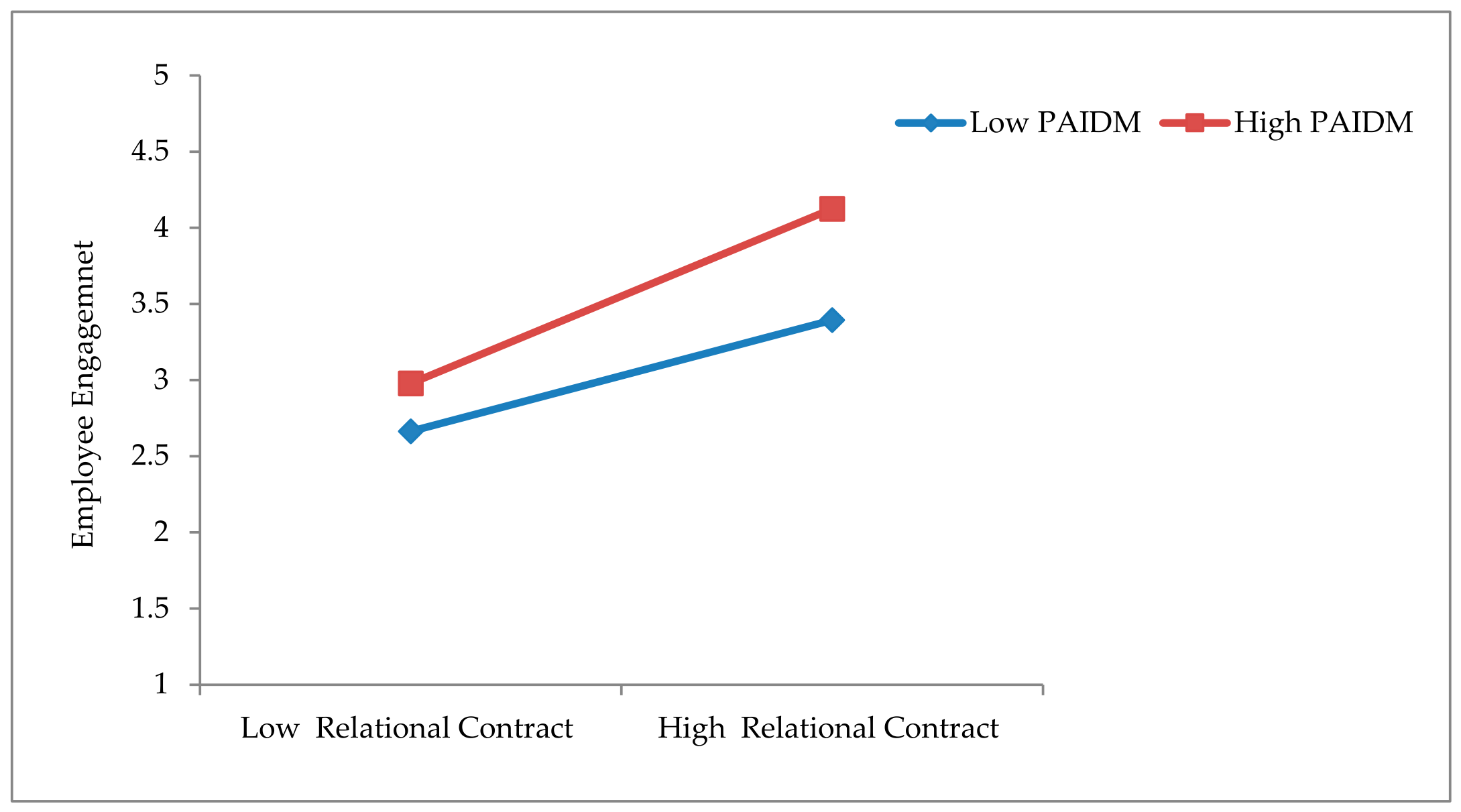
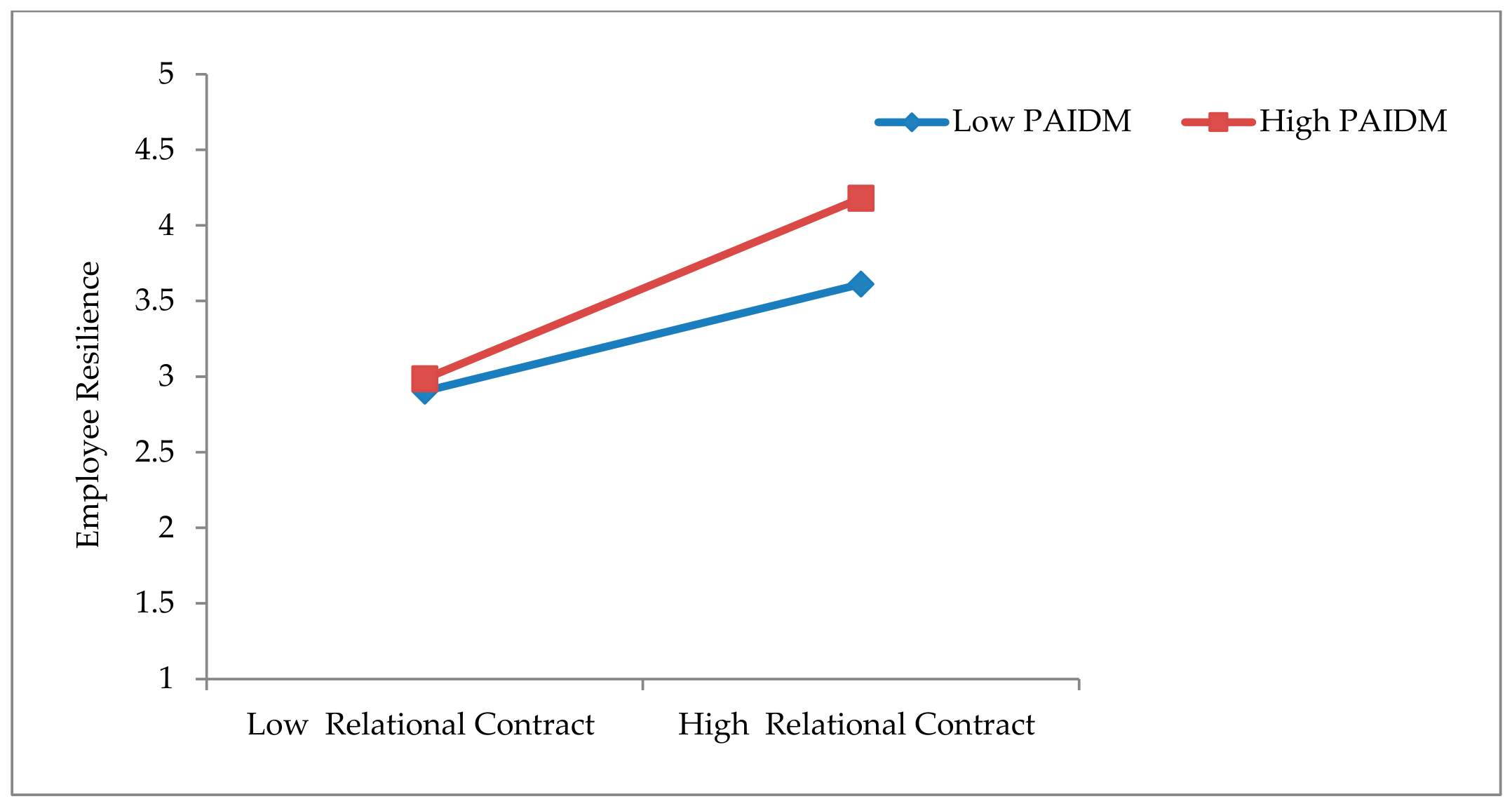
Further, Hypothesis 6 proposed a moderating effect of PAIDM on the relationship between RC-EE. The outcome validates a significant interaction between RC and PAIDM on EE [β = 0.1041, SE = 0.0316, 95% CI (0.0420, 0.1662)]. This is further confirmed with a simple slope test [72] as illustrated in Figure 2. Figure 2 shows that when PAIDM is higher, the positive relationship between relational contract and employee engagement becomes stronger. This indicates that higher levels of PAIDM enhance the extent to which employees translate relational exchange relationships into greater engagement at work. Hypothesis 7 predicted a similar moderating effect of PAIDM on RC-ER, which was substantiated by a significant interaction [β = 0.1212, SE = 0.0321, 95% CI (0.0580, 0.1843)], as revealed in Figure 3. Figure 3 shows that when PAIDM is higher, the positive relationship between relational contract and employee resilience becomes stronger. This indicates that higher levels of PAIDM enhance the extent to which employees translate relational exchange relationships into greater resilience at work.
Finally, Hypotheses 8 and 9 proposed that PAIDM moderates the mediating effect of RC on AISHRM impact on EE and ER, respectively. High levels of PAIDM strengthened the AISHRM-to-EE mediated effect [β = 0.1412, SE = 0.0347, 95% Boot CI (0.0743, 0.2115)], compared to a lower PAIDM level [β = 0.0773, SE = 0.0211, 95% Boot CI (0.0383, 0.1213)]. Similarly, PAIDM intensified the AISHRM-to-ER mediated effect [β = 0.1472, SE = 0.0355, 95% Boot CI (0.0792, 0.2180)] versus lower PAIDM levels [β = 0.0721, SE = 0.0215, 95% Boot CI (0.0340, 0.1172)], supporting both hypotheses.

5. Discussion

The existing research results demonstrate the significance of AISHRM in fostering desirable work outcomes in terms of engagement and resilience mediated by relational contracts. Furthermore, the influence of relational contracts on both outcomes is strengthened by PAIDM as moderator. These findings support the main principles of the social exchange theory [7] in AI-enhanced HRM and provide us with a broader insight into how technology can be used to reinforce, as opposed to undermine, the socio-emotional nature of the employment relationship.
The result makes AISHRM a significant precursor of relational contracts. Our research results are consistent with the existing literature, which suggests that AISHRM can result in the cultivation of a workplace where employees feel that their social-emotional needs are fulfilled, which will make them dedicated and loyal to the organization in the long run [17]. When the employees feel that AI is used sustainably and ethically to promote personalized growth, transparent feedback, predictive burnout, and equitable resource distribution, they can read these measures as indicators of long-term organizational commitment and concern [21]. The outcome validates that AI does not necessarily weaken relationships; rather, when integrated into sustainable HRM architecture, it reinforces employees feeling that the organization is keen on an open-ended, socio-emotional relationship of exchange [22].
The outcomes indicate that relational contracts significantly predict employee engagement. Workers who feel reciprocated loyalty, long-term commitment, and socio-emotional stability with their organization allocate more cognitive, emotional, and physical resources to their work [25]. This highlights the fact that despite the high levels of digitization in workplaces, traditional social exchange processes are strongly predictive of vigor, commitment, and absorption. Further, the mechanism of relational contracts is applicable to SET [7], which explains why implicit organizational obligations are critical to amplify the frequency of exchanged positive actions among individuals [9]. The robust link to resilience implies that relational contracts do not merely motivate performance in the normal circumstances. They also act as a buffer in the minds of employees at times of uncertainty and stress. When employees think that their employer is going to support them even during hardships, they will have a higher adaptive capacity and quicker recuperation after the failure [31]. This finding is especially applicable in high-stress IT industry of China where burnout and turnover are still high.
These findings demonstrate that AISHRM is not a direct cause of increased engagement or resilience, but all the effects are mediated via the socio-emotional process of relational contracts. This fills a long-standing research gap in the HRM-performance literature [73] by demonstrating that advanced, AI-based HRM systems can only produce attitudinal and behavioral payoffs when staff members view them as manifestations of relational (not transactional) intent. It means that even the most developed AI-based HRM packages cannot be viewed as motivational in the absence of the establishment of relational contracts, which will be considered cold and efficiency-oriented tools. Moreover, the boundary specificity of AI in decision-making is also linked to the role of AI in the decision-making process, which may enable perceived transparency and objectivity, thereby increasing the positive impact of relational contracts on personal performance.
The analysis demonstrates that the impact of relational contracts on engagement is significantly greater when the employees feel that the decisions made by AI are fair, transparent, and objective. On the other hand, the effect of relational contracts on the engagement of employees is significantly reduced when the PAIDM is low. It is among the earliest quantitative evidences that perceived algorithmic justice may be a magnifier of social exchange processes instead of disrupting them. Similarly, in high-PAIDM environments, good relational contracts are converted to high adaptive capacity. This suggests that transparent AI decision-making may be especially critical during periods of change or stress, as it reassures employees that the organization continues to honor implicit obligations even when technology mediates key outcomes. This combined focus on relational contracts and technology-based focus is what AISHRM contributes to practice and theory by highlighting the ways through which modern organizations can achieve higher levels of engagement and satisfaction rates among their members. Consequently, this would lead to the enhancement of the overall organizational performance. The findings of this study should also be considered within the broader institutional and cultural context in which the research was conducted. The data were collected in China, a setting characterized by a relatively collectivist cultural orientation and rapid digital transformation. In collectivist environments, employment relationships are often shaped by stronger expectations of mutual obligation, loyalty, and long-term cooperation between employees and organizations. Such contextual characteristics may reinforce the importance of relational exchanges in the workplace, making employees more responsive to HR practices that signal long-term support, fairness, and developmental opportunities. At the same time, China’s rapid adoption of digital technologies and artificial intelligence in organizational settings may increase employees’ familiarity with AI-enabled systems and reduce uncertainty associated with algorithmic decision-making. These contextual conditions may therefore strengthen the observed relationships between AI-driven sustainable HRM, relational contracts, and employee outcomes such as engagement and resilience.

5.1. Theoretical Implications

This study makes several important contributions to management research by advancing the understanding of how AI-driven sustainable HRM (AI-SHRM) reshapes employee–organization relationships in digitally enabled workplaces. First, while prior research has established that HR practices play a central role in fostering mutual trust, long-term commitment, and relational exchange between employees and organizations [5,37], this study extends this perspective by demonstrating that AI-enabled HRM practices constitute a distinct and evolving mechanism through which relational contracts are formed. Specifically, the findings suggest that when AI is integrated ethically to enhance employees’ ability, motivation, and opportunity, it can reduce uncertainty and perceived risks of exploitation, thereby encouraging employees to reframe the employment relationship as a long-term, socio-emotional exchange characterized by mutual growth and commitment [16,23]. In this way, the study contributes to the behavioral management literature by positioning AI-SHRM not merely as a technological enhancement of HR processes, but as a transformative force that reshapes the foundations of relational contracts in contemporary organizations.
Second, although prior studies have linked relational contracts to positive employee outcomes, this study advances the literature by simultaneously examining employee engagement and resilience as complementary outcomes of relational exchange relationships in an AI-enabled context. Consistent with earlier findings [13,24], the results confirm that stronger relational contracts are associated with higher levels of engagement and resilience. However, the present study goes beyond prior research by demonstrating that relational contracts function as a broader mechanism that supports both motivational and adaptive capacities among employees. This is particularly relevant in technology-intensive environments, where employees must not only remain engaged in their work but also adapt to ongoing change and uncertainty. Moreover, relational contracts may represent a particularly salient exchange mechanism in collectivist, high-power-distance contexts such as China, where implicit obligations and loyalty carry strong normative weight, thereby strengthening their influence on employee attitudes and behaviors.
Third, the study contributes to social exchange theory (SET) by introducing a moderated mediation framework that integrates relational contracts as a mediating mechanism and perceived AI-driven decision-making (PAIDM) as a critical boundary condition. While prior research has primarily examined HRM–outcome relationships as direct or mediated effects, the present findings demonstrate that the strength of these relationships depends on how employees perceive AI-based decision processes. Specifically, the results show that the indirect effects of AI-SHRM on engagement and resilience through relational contracts are significantly stronger at higher levels of PAIDM. This finding suggests that technology does not simply automate HR functions, but actively shapes employees’ interpretations of organizational intent, thereby influencing the effectiveness of social exchange relationships. In doing so, the study extends SET by incorporating technology-enabled perceptions as a key contingency influencing exchange processes in modern organizations.
Fourth, the findings highlight the mediating role of relational contracts in translating AI-SHRM into positive employee outcomes, thereby enriching the HRM literature. While previous studies have examined the direct effects of HR practices on engagement and related outcomes, this study demonstrates that the impact of AI-SHRM is largely indirect and operates through the development of trust-based, reciprocal relationships grounded in mutual obligations [15,16]. This insight emphasizes that the effectiveness of AI-driven HR practices depends not only on their functional or efficiency-enhancing capabilities but also on their ability to foster meaningful relational exchanges between employees and organizations. By identifying relational contracts as a central mechanism linking AI-SHRM to engagement and resilience, the study provides a more nuanced understanding of how technology-enabled HR systems influence employee outcomes.
Finally, the study contributes to the emerging literature on AI in HRM by highlighting the role of AI-based decision-making as a reinforcing factor in shaping employee perceptions of fairness, transparency, and organizational commitment [50]. The findings suggest that when AI-driven decisions are perceived as objective and equitable, they strengthen relational exchanges and enhance positive employee outcomes. This extends the limited body of research on technology-driven variables in management by demonstrating that AI does not operate in isolation but interacts with employees’ perceptions to influence relational and behavioral outcomes. Accordingly, the study positions AI-enabled HRM as a socio-technical system, where technological capabilities and human perceptions jointly determine the effectiveness of HR practices.

5.2. Practical Implications

This research has a few useful findings regarding practice and the industry in general. Firstly, the association between relational contracts is positive, and it emphasizes the importance of the AISHRM in the working environments. Organizations may leverage the AISHRM that support the promotion of relational contracts to foster the employee work engagement and resilience. Empirical evidence shows that the strategies that cultivate positive working conditions, long term growth and career development are more likely to generate stronger relational contracts among workers, thus can lead to a higher level of commitment and motivation. The managers can therefore emphasize equal recognition programs, skill-development and communication practices that resonate with individual career and development goals, which in turn motivates a more engaged and satisfied workforce. Moreover, the results indicate that engagement and resilience are significant performance measures that can predict the relational contracts. As a result, organizations ought to emphasize the formation of clear and consistent communication about their promises and make sure that they are fulfilled.
We find that AI-Based decision-making moderates the relationship between relational contracts and outcomes of the performance indicators positively. To retain this beneficial position of AI-driven decision making, top management should consider using technology-driven tools in task assignments, feedback, and performance reviews because these technologies will be able to provide data-driven and transparent information that may reinforce employees with a sense of fairness and trust in organizational decisions. The use of AI in performance reviews might increase the level of trust of employees in such processes, which will foster a more favorable overall organizational climate. To enhance the effects of AI tools, decision-makers can make transparency by clarifying AI-based decisions to employees, which can enhance their engagement and resilience in their work. These investments are rapid to pay off as they almost double the benefits of AI-HRM systems.
The transparent AI decision-making process is essential at times of uncertainty to maintain and even strengthen workforce resilience. Through auditable, explainable AI-based workload balancing tools, early warning of burnout risk, or restructuring decisions, and by actively communicating the benefits of the tools to the organization in terms of how the organization is fulfilling its implicit commitments to employees, leaders can turn potentially trust-eroding incidents into potent examples of relational integrity. Framing AI as an unbiased but compassionate companion that will allow the organization to perform the classic reciprocal obligations appeals to the employees in the collectivist context, like China. Easy, uniform communications can also greatly enhance the favorable outcomes recorded in this research. When both relational contract and perceived AI fairness are prioritized, organizations open the door to a virtuous cycle where advanced technology does not take over the human connection but increases the socio-emotional bases of sustainable performance, increased retention, and authentic organizational resilience.
From a managerial standpoint, the findings also suggest that the effectiveness of AI-driven sustainable HRM practices may depend on the broader institutional and cultural environment in which organizations operate. In employment systems where long-term employment relationships, organizational loyalty, and collective workplace norms are strongly emphasized, relational exchange mechanisms may play a particularly important role in shaping employee responses to HR practices. In such contexts, AI-enabled HR systems that emphasize fairness, employee development, and consistent decision-making may more effectively strengthen relational bonds between employees and organizations, thereby enhancing engagement and resilience. However, in organizational environments characterized by stronger individualistic values or greater skepticism toward algorithmic decision-making, employees may place less emphasis on relational exchange relationships or may be more cautious in accepting AI-supported HR processes. Managers operating across different national or institutional contexts should therefore recognize that the positive outcomes associated with AI-driven HR systems may not emerge automatically. Instead, organizations may need to adapt AI-supported HR practices to local workplace norms, communication styles, and expectations regarding transparency and fairness in decision-making processes.

5.3. Limitations and Future Research

Despite its contributions, this study has several limitations that should be acknowledged. First, the study relies primarily on self-reported data collected from employees, which may introduce common method bias in measuring key constructs, including AI-SHRM, relational contract, employee engagement, employee resilience, and PAIDM. Although data were collected across multiple waves to reduce this issue, respondents may still provide consistent or socially desirable responses across these variables, which may inflate the observed relationships among them. Future research could address this limitation by incorporating multi-source data, such as supervisor-rated engagement or resilience, to provide a more robust assessment of these relationships.
Second, although a multi-wave research design was employed, it introduces the possibility of attrition bias, as some participants may not have completed all waves of data collection. This issue is particularly relevant when examining relationships among AI-SHRM, relational contract, and employee outcomes over time. If individuals who dropped out differ systematically in their perceptions of AI-driven HR practices or relational exchanges compared to those who remained, the estimated relationships among AI-SHRM, relational contract, engagement, and resilience may be affected. Future studies should examine attrition patterns more explicitly to ensure the stability of these findings.
Third, the study was conducted within a single national context (China), which may limit the generalizability of the relationships identified in this study. Employees’ perceptions of AI-SHRM, relational contracts, and PAIDM may vary across institutional and cultural environments, particularly in contexts where attitudes toward technology, fairness, and employment relationships differ. As a result, the strength of the relationships among AI-SHRM, relational contract, engagement, and resilience may not be uniform across different settings.
In addition, future research could extend the present model by examining other relevant employee outcomes and boundary conditions. For example, variables such as organizational attachment or work rumination may further explain how relational contracts influence employee attitudes and behaviors. Moreover, exploring alternative forms of employment relationships, such as transactional contracts, may provide a more comprehensive understanding of how different exchange mechanisms interact with AI-driven HR practices. Finally, qualitative approaches may offer deeper insights into how employees interpret AI-enabled decision-making processes and relational exchanges in organizational settings [74].

6. Conclusions

Overall, the current study reveals valuable insights into the impact of AISHRM on the two performance indicators (i.e., employee engagement and resilience), through the lens of relational contracts. Drawing on SET, this research shows how AISHRM can support positive effects that can lead to improved performance when they are aligned with relational contracts of individuals. Moreover, the boundary condition of AI-based decision-making serves the organizations with an effective means of strengthening the perception of being treated fairly by employees, therefore, enhancing their involvement and commitment. The research has a number of implications for policy makers when making relational contracts. These outputs are supposed to be capitalized on by dedicating more scholarly attention to exploring other potential variables and utilizing different methodologies to gain further and validate the current insights.

Author Contributions

Conceptualization, K.M., M.M.H., S.H. and G.Y.Y.; methodology, K.M., N.O.A., I.P.R. and M.M.H.; software, K.M.; validation, K.M.; formal analysis, K.M.; investigation, K.M.; resources, K.M.; data curation, K.M.; writing—original draft preparation, K.M., M.M.H., S.H., N.O.A. and I.P.R.; writing—review and editing, S.H. and M.M.H.; supervision, K.M.; project administration, K.M. All authors have read and agreed to the published version of the manuscript.

Funding

This research was funded by Princess Nourah bint Abdulrahman University Researchers Supporting Project number (PNURSP2026R543), Princess Nourah bint Abdulrahman University, Riyadh, Saudi Arabia.

Institutional Review Board Statement

This study was conducted in accordance with the Declaration of Helsinki and approved by the Ethics Committee of our institute. Informed consent was obtained from all employees who participated in this study.

Informed Consent Statement

Informed consent for participation was obtained from all subjects involved in the study.

Data Availability Statement

The datasets are available from the corresponding author on reasonable request.

Acknowledgments

The publication of this research was supported by the NUCB Undergraduate School, Nagoya University of Commerce and Business, Sagamine 4-4 Komenokicho, Nisshin, Aichi 470-0193, Japan. In writing this manuscript, we relied on Microsoft Word 365 (built-in Editor) and the Grammarly (Pro version) app to improve readability and ensure grammatical consistency, as these tools employ AI-based algorithms to assist in these tasks.

Conflicts of Interest

The authors declare no conflict of interest.

References

  1. Theriou, G.N.; Chatzoglou, P. The impact of best HRM practices on performance–identifying enabling factors. Empl. Relat. 2014, 36, 535–561. [Google Scholar] [CrossRef]
  2. Evans, M.M.; Robinson, J.A.; Williamson, I.O. The effect of HRM practices on employment outcomes in Indigenous social enterprises. J. Soc. Entrep. 2024, 15, 744–767. [Google Scholar] [CrossRef]
  3. Lu, Y.; Zhang, M.M.; Yang, M.M.; Wang, Y. Sustainable human resource management practices, employee resilience, and employee outcomes: Toward common good values. Hum. Resour. Manag. 2023, 62, 331–353. [Google Scholar] [CrossRef]
  4. Singh, S.K.; Mazzucchelli, A.; Vessal, S.R.; Solidoro, A. Knowledge-based HRM practices and innovation performance: Role of social capital and knowledge sharing. J. Int. Manag. 2021, 27, 100830. [Google Scholar] [CrossRef]
  5. Raeder, S.; Knorr, U.; Hilb, M. Human resource management practices and psychological contracts in Swiss firms: An employer perspective. Int. J. Hum. Resour. Manag. 2012, 23, 3178–3195. [Google Scholar] [CrossRef]
  6. Wright, P.M.; Gardner, T.M.; Moynihan, L.M.; Allen, M.R. The relationship between HR practices and firm performance: Examining causal order. Pers. Psychol. 2005, 58, 409–446. [Google Scholar] [CrossRef]
  7. Blau, P.M. Justice in social exchange. Sociol. Inq. 1964, 34, 193–206. [Google Scholar] [CrossRef]
  8. Morrison, E.W.; Robinson, S.L. When employees feel betrayed: A model of how psychological contract violation develops. Acad. Manag. Rev. 1997, 22, 226–256. [Google Scholar] [CrossRef]
  9. Henderson, D.J.; Wayne, S.J.; Shore, L.M.; Bommer, W.H.; Tetrick, L.E. Leader--member exchange, differentiation, and psychological contract fulfillment: A multilevel examination. J. Appl. Psychol. 2008, 93, 1208–1219. [Google Scholar] [CrossRef] [PubMed]
  10. Mazumdar, B.; Warren, A.; Dupré, K.; Brown, T. Employment expectations: Examining the effect of psychological contract fulfillment on bridge employees’ personal and work attitudes. Pers. Rev. 2023, 52, 1563–1578. [Google Scholar] [CrossRef]
  11. Yu, J. Impacts of psychological contract fulfillment on work attitudes and behaviors during the COVID-19 pandemic: Mediating role of perceived organizational support. Curr. Psychol. 2024, 43, 14851–14860. [Google Scholar] [CrossRef]
  12. Huang, L.; Peissl, W. Artificial Intelligence—A New Knowledge and Decision-Making Paradigm? In Technology Assessment in a Globalized World: Facing the Challenges of Transnational Technology Governance; Springer International Publishing: Cham, Switzerland, 2023; pp. 175–201. [Google Scholar]
  13. Cropanzano, R.; Mitchell, M.S. Social exchange theory: An interdisciplinary review. J. Manag. 2005, 31, 874–900. [Google Scholar] [CrossRef]
  14. Dumont, J.; Shen, J.; Deng, X. Effects of green HRM practices on employee workplace green behavior: The role of psychological green climate and employee green values. Hum. Resour. Manag. 2017, 56, 613–627. [Google Scholar] [CrossRef]
  15. Braganza, A.; Chen, W.; Canhoto, A.; Sap, S. Productive employment and decent work: The impact of AI adoption on psychological contracts, job engagement and employee trust. J. Bus. Res. 2021, 131, 485–494. [Google Scholar] [CrossRef]
  16. Bal, P.M.; Kooij, D.T.; De Jong, S.B. How do developmental and accommodative HRM enhances employee engagement and commitment? The role of psychological contract and SOC strategies. J. Manag. Stud. 2013, 50, 545–572. [Google Scholar] [CrossRef]
  17. Tomprou, M.; Xanthopoulou, D.; Vakola, M. Socio-emotional and monetary employee-organization resource exchanges: Measurement and effects on daily employee functioning. Work Stress 2020, 34, 189–214. [Google Scholar] [CrossRef]
  18. Millward, L.J.; Hopkins, L.J. Psychological contracts, organizational and job commitment. J. Appl. Soc. Psychol. 1998, 28, 1530–1556. [Google Scholar] [CrossRef]
  19. Langer, M.; Landers, R.N. The future of artificial intelligence at work: A review on effects of decision automation and augmentation on workers targeted by algorithms and third-party observers. Comput. Hum. Behav. 2021, 123, 106878. [Google Scholar] [CrossRef]
  20. Guest, D.E. Human resource management and employee well-being: Towards a new analytic framework. Hum. Resour. Manag. J. 2017, 27, 22–38. [Google Scholar] [CrossRef]
  21. Gong, Q.; Fan, D.; Bartram, T. Integrating artificial intelligence and human resource management: A review and future research agenda. Int. J. Hum. Resour. Manag. 2025, 36, 103–141. [Google Scholar] [CrossRef]
  22. Pan, Y.; Froese, F.; Liu, N.; Hu, Y.; Ye, M. The adoption of artificial intelligence in employee recruitment: The influence of contextual factors. In Artificial Intelligence and International HRM; Routledge: Oxfordshire, UK, 2023; pp. 60–82. [Google Scholar]
  23. Dabos, G.E.; Rousseau, D.M. Psychological contracts and informal networks in organizations: The effects of social status and local ties. Hum. Resour. Manag. 2013, 52, 485–510. [Google Scholar] [CrossRef]
  24. Edmans, A.; Pu, D.; Zhang, C.; Li, L. Employee satisfaction, labor market flexibility, and stock returns around the world. Manag. Sci. 2024, 70, 4357–4380. [Google Scholar] [CrossRef]
  25. Laulié, L.; Escaffi-Schwarz, M. Emergence in context: How team-client psychological contract fulfillment is associated with the emergence of team identification or team-member exchange. J. Appl. Psychol. 2024, 110, 67–88. [Google Scholar] [CrossRef] [PubMed]
  26. Wittenberg, H.; Eweje, G.; Taskin, N.; Forsyth, D. Different perspectives on engagement, where to from here? A systematic literature review. Int. J. Manag. Rev. 2024, 26, 410–434. [Google Scholar] [CrossRef]
  27. Harrison, D.A.; Newman, D.A.; Roth, P.L. How important are job attitudes? Meta-analytic comparisons of integrative behavioral outcomes and time sequences. Acad. Manag. J. 2006, 49, 305–325. [Google Scholar] [CrossRef]
  28. Salazar-Altamirano, M.A.; Galván-Vela, E.; Ravina-Ripoll, R.; Bello-Campuzano, M.R. Exploring job satisfaction in fitness franchises: A study from a human talent perspective. BMC Psychol. 2024, 12, 489. [Google Scholar] [CrossRef]
  29. Eisenberger, R.; Huntington, R.; Hutchison, S.; Sowa, D. Perceived organizational support. J. Appl. Psychol. 1986, 71, 500. [Google Scholar] [CrossRef]
  30. Chan, S. The interplay between relational and transactional psychological contracts and burnout and engagement. Asia Pac. Manag. Rev. 2021, 26, 30–38. [Google Scholar] [CrossRef]
  31. Ali, H.N.; Gittell, J.H.; Deng, S.; Stults, C.D.; Martinez, M.; Pertsch, S.; Weger, L.; Dillon, E.C. Relationships and resilience at work and at home: Impact of relational coordination on clinician work–life balance and well-being in times of crisis. Health Care Manag. Rev. 2023, 48, 80–91. [Google Scholar] [CrossRef]
  32. Gould-Williams, J.; Davies, F. Using social exchange theory to predict the effects of HRM practice on employee outcomes: An analysis of public sector workers. Public Manag. Rev. 2005, 7, 1–24. [Google Scholar] [CrossRef]
  33. Shore, L.M.; Tetrick, L.E.; Lynch, P.; Barksdale, K. Social and economic exchange: Construct development and validation. J. Appl. Soc. Psychol. 2006, 36, 837–867. [Google Scholar] [CrossRef]
  34. Shaw, J.D.; Dineen, B.R.; Fang, R.; Vellella, R.F. Employee-organization exchange relationships, HRM practices, and quit rates of good and poor performers. J. Acad. Manag. 2009, 52, 1016–1033. [Google Scholar] [CrossRef]
  35. Veth, K.N.; Korzilius, H.P.; Van der Heijden, B.I.; Emans, B.J.; De Lange, A.H. Which HRM practices enhance employee outcomes at work across the life-span? Int. J. Hum. Resour. Manag. 2019, 30, 2777–2808. [Google Scholar] [CrossRef]
  36. Ogbonnaya, C.; Daniels, K.; Messersmith, J.; Rofcanin, Y. A Theory-Based Analysis of Null Causality between HRM Practices and Outcomes: Evidence from Four-Wave Longitudinal Data. J. Manag. Stud. 2023, 60, 1448–1484. [Google Scholar] [CrossRef]
  37. Uen, J.F.; Chien, M.S.; Yen, Y.F. The mediating effects of psychological contracts on the relationship between human resource systems and role behaviors: A multilevel analysis. J. Bus. Psychol. 2009, 24, 215–223. [Google Scholar] [CrossRef]
  38. Budhwar, P.; Malik, A.; De Silva, M.T.; Thevisuthan, P. Artificial intelligence–challenges and opportunities for international HRM: A review and research agenda. Int. J. Hum. Resour. Manag. 2022, 33, 1065–1097. [Google Scholar] [CrossRef]
  39. Do, H.; Chu, L.X.; Shipton, H. How and when AI-driven HRM promotes employee resilience and adaptive performance: A self-determination theory. J. Bus. Res. 2025, 192, 115279. [Google Scholar] [CrossRef]
  40. Coyle-Shapiro, J.A.M.; Pereira Costa, S.; Doden, W.; Chang, C. Psychological contracts: Past, present, and future. Annu. Rev. Organ. Psychol. Organ. Behav. 2019, 6, 145–169. [Google Scholar] [CrossRef]
  41. Paul, A.K.; Anantharaman, R.N. Impact of people management practices on organizational performance: Analysis of a causal model. Int. J. Hum. Resour. Manag. 2003, 14, 1246–1266. [Google Scholar] [CrossRef]
  42. European Commission. Data Protection Working Party. Directive, 2018, 95/46/EC, Articles 29 and 30. Available online: https://ec.europa.eu/newsroom/article29/items/612053/en (accessed on 20 April 2026).
  43. Newell, S.; Marabelli, M. Strategic opportunities (and challenges) of algorithmic decision-making: A call for action on the long-term societal effects of ‘datification’. J. Strateg. Inf. Syst. 2015, 24, 3–14. [Google Scholar] [CrossRef]
  44. Gao, K.; Zamanpour, A. How can AI-integrated applications affect the financial engineers’ psychological safety and work-life balance: Chinese and Iranian financial engineers and administrators’ perspectives. BMC Psychol. 2024, 12, 555. [Google Scholar] [CrossRef]
  45. Lin, H.; Chen, Q. Artificial intelligence (AI)-integrated educational applications and college students’ creativity and academic emotions: Students and teachers’ perceptions and attitudes. BMC Psychol. 2024, 12, 487. [Google Scholar] [CrossRef]
  46. Huang, A.Y.; Lu, O.H.; Yang, S.J. Effects of artificial Intelligence–Enabled personalized recommendations on learners’ learning engagement, motivation, and outcomes in a flipped classroom. Comput. Educ. 2023, 194, 104684. [Google Scholar] [CrossRef]
  47. Sui, M.; Yu, Z.; Zhou, M. The impact of psychological contract, physical and mental health on burnout in grassroots civil servants: Evidence from China. Psychol. Res. Behav. Manag. 2023, 16, 3461–3476. [Google Scholar] [CrossRef] [PubMed]
  48. Jarrahi, M.H. Artificial intelligence and the future of work: Human-AI symbiosis in organizational decision making. Bus. Horiz. 2018, 61, 577–586. [Google Scholar] [CrossRef]
  49. Wesche, J.S.; Sonderegger, A. Repelled at first sight? Expectations and intentions of job-seekers reading about AI selection in job advertisements. Comput. Hum. Behav. 2021, 125, 106931. [Google Scholar] [CrossRef]
  50. Kaplan, A.; Haenlein, M. Rulers of the world, unite! The challenges and opportunities of artificial intelligence. Bus. Horiz. 2020, 63, 37–50. [Google Scholar] [CrossRef]
  51. Wilson, H.J.; Daugherty, P.R. Collaborative intelligence: Humans and AI are joining forces. Harv. Bus. Rev. 2018, 96, 114–123. [Google Scholar]
  52. Choung, H.; Seberger, J.S.; David, P. When AI is perceived to be fairer than a human: Understanding perceptions of algorithmic decisions in a job application context. Int. J. Hum.–Comput. Interact. 2024, 40, 7451–7468. [Google Scholar] [CrossRef]
  53. Jia, N.; Luo, X.; Fang, Z.; Liao, C. When and how artificial intelligence augments employee creativity. Acad. Manag. J. 2024, 67, 5–32. [Google Scholar] [CrossRef]
  54. Edwards, J.R.; Lambert, L.S. Methods for integrating moderation and mediation: A general analytical framework using moderated path analysis. Psychol. Methods 2007, 12, 1–22. [Google Scholar] [CrossRef]
  55. Podsakoff, P.M.; MacKenzie, S.B.; Lee, J.-Y.; Podsakoff, N.P. Common method biases in behavioral research: A critical review of the literature and recommended remedies. J. Appl. Psychol. 2003, 88, 879–903. [Google Scholar] [CrossRef]
  56. Brislin, R.W. Translation and content analysis of oral and written material. In Handbook of Cross-Cultural Psychology: Methodology; Triandis, H.C., Berry, J.W., Eds.; Allyn and Bacon: Boston, MA, USA, 1980; pp. 389–444. [Google Scholar]
  57. Guerci, M.; Decramer, A.; Van Waeyenberg, T.; Aust, I. Moving beyond the link between HRM and economic performance: A study on the individual reactions of HR managers and professionals to sustainable HRM. J. Bus. Ethics 2019, 160, 783–800. [Google Scholar] [CrossRef]
  58. Jia, X.; Hou, Y. Architecting the future: Exploring the synergy of AI-driven sustainable HRM, conscientiousness, and employee engagement. Discov. Sustain. 2024, 5, 30. [Google Scholar] [CrossRef]
  59. Grimmer, M.; Oddy, M. Violation of the psychological contract: The mediating effect of relational versus transactional beliefs. Aust. J. Manag. 2007, 32, 153–174. [Google Scholar] [CrossRef]
  60. Belhadi, A.; Mani, V.; Kamble, S.S.; Khan, S.A.R.; Verma, S. Artificial intelligence-driven innovation for enhancing supply chain resilience and performance under the effect of supply chain dynamism: An empirical investigation. Ann. Oper. Res. 2024, 333, 627–652. [Google Scholar] [CrossRef]
  61. Chen, D.; Esperança, J.P.; Wang, S. The Impact of Artificial Intelligence on Firm Performance: An Application of the Resource-Based View to e-Commerce Firms. Front. Psychol. 2022, 13, 884830. [Google Scholar] [CrossRef]
  62. Mosqueira-Rey, E.; Hernández-Pereira, E.; Alonso-Ríos, D.; Bobes-Bascarán, J.; Fernández-Leal, Á. Human-in-the-loop machine learning: A state of the art. Artif. Intell. Rev. 2023, 56, 3005–3054. [Google Scholar] [CrossRef]
  63. Radonjić, A.; Duarte, H.; Pereira, N. Artificial intelligence and HRM: HR managers’ perspective on decisiveness and challenges. Eur. Manag. J. 2022, 42, 57–66. [Google Scholar] [CrossRef]
  64. Saks, A.M. Antecedents and consequences of employee engagement. J. Manag. Psychol. 2006, 21, 600–619. [Google Scholar] [CrossRef]
  65. Mehmood, K.; Suhail, A.; Kautish, P.; Hakeem, M.M.; Rashid, M. Turning lemons into lemonade: Social support as a moderator of the relationship between technostress and quality of life among university students. Psychol. Res. Behav. Manag. 2024, 17, 989–1006. [Google Scholar] [CrossRef]
  66. Mehmood, K.; Iftikhar, Y.; Jabeen, F.; Khan, A.N.; Rehman, H. Energizing ethical recycling intention through information publicity: Insights from an emerging market economy. J. Bus. Ethics 2024, 191, 837–863. [Google Scholar] [CrossRef]
  67. Lambert, D.M.; Harrington, T.C. Measuring nonresponse bias in customer service mail surveys. J. Bus. Logist. 1990, 11, 5–25. [Google Scholar]
  68. Khan, A.N.; Mehmood, K.; Le, J.; Khan, N.A. Visionary leadership and leaders’ burnout: A weekly diary analysis. Asia Pac. J. Manag. 2023, 41, 1571–1600. [Google Scholar] [CrossRef]
  69. Mehmood, K.; Iftikhar, Y.; Khan, A.N.; Kwan, H.K. The nexus between high-involvement work practices and employees’ proactive behavior in public service organizations: A time-lagged moderated-mediation model. Psychol. Res. Behav. Manag. 2023, 16, 1571–1586. [Google Scholar] [CrossRef]
  70. Cheng, J.; Usman, M.; Bai, H.; He, Y.; Mehmood, K. Too much of a good thing: How to buffer the unintended adverse effects of empowering leadership? Asia Pac. J. Manag. 2025, 42, 2325–2355. [Google Scholar] [CrossRef]
  71. Hayes, A.F. Introduction to Mediation, Moderation, and Conditional Process Analysis: A Regression-Based Approach; Guilford: New York, NY, USA, 2013. [Google Scholar]
  72. Aiken, L.S.; West, S.G. Multiple Regression: Testing and Interpreting Interactions; SAGE: Thousand Oaks, CA, USA, 1991. [Google Scholar]
  73. Jiang, K.; Lepak, D.P.; Hu, J.; Baer, J.C. How does human resource management influence organizational outcomes? A meta-analytic investigation of mediating mechanisms. Acad. Manag. J. 2012, 55, 1264–1294. [Google Scholar] [CrossRef]
  74. Gyensare, M.A.; Adomako, S.; Amankwah-Amoah, J. Green HRM practices, employee well-being, and sustainable work behavior: Examining the moderating role of resource commitment. Bus. Strategy Environ. 2024, 33, 3129–3141. [Google Scholar] [CrossRef]
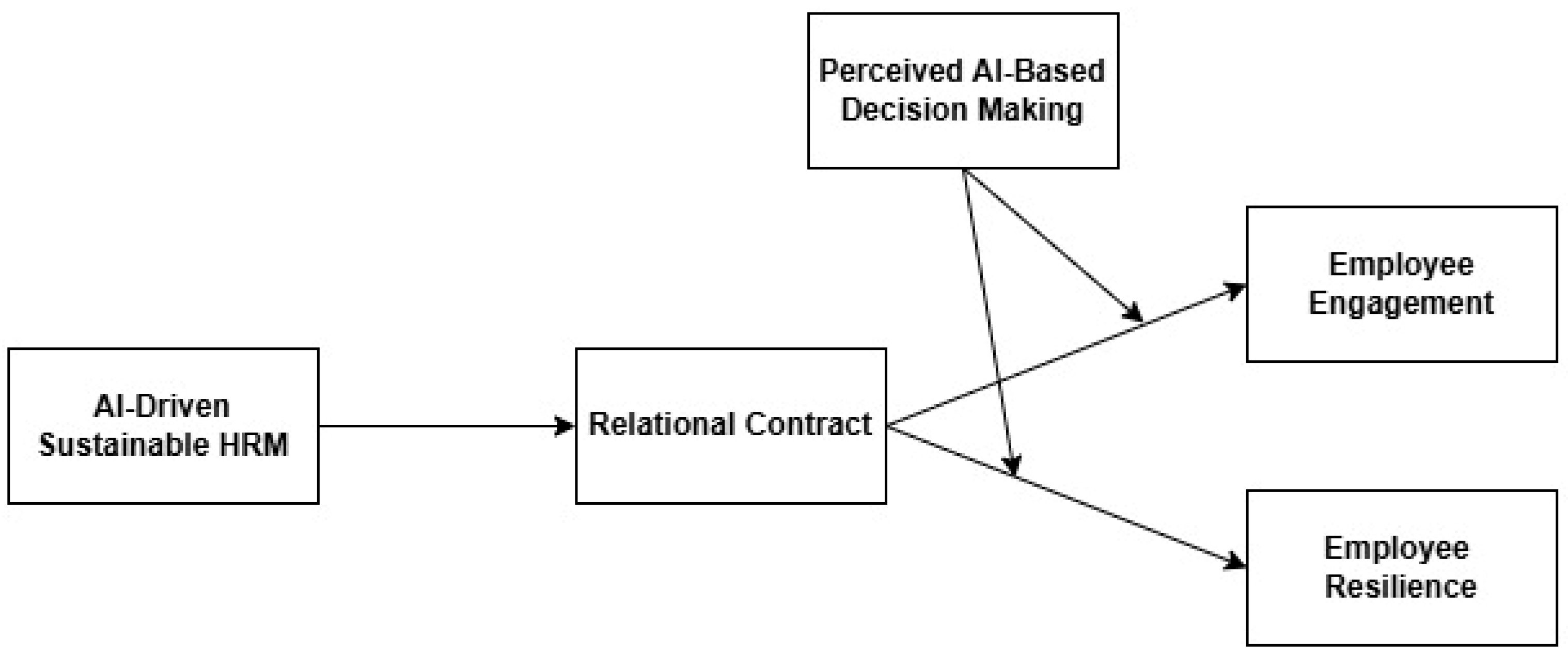
Figure 1. Conceptual model of study.
Systems 14 00522 g001
Figure 2. Interactive effects of relational contract and perceived artificial intelligence decision-making (PAIDM) on employees’ engagement.
Systems 14 00522 g002
Figure 3. Interactive effects of relational contract and perceived artificial intelligence decision-making (PAIDM) on employees’ resilience.
Systems 14 00522 g003
Table 1. Demographics information.
CriteriaFrequency%
Gender
Female27757.6
Male20442.4
Age
18–2519039.5
26–3023548.9
31 and above 5611.6
Educational background
Technical/Vocational degree10521.8
Bachelor’s degree28358.8
Master’s degree and above9319.3
Tenure (Years)
1–537076.9
6–108417.5
Above 10275.6
Table 2. Factor loadings and reliability.
VariablesItems CodeλαCRsAVEMSV
Artificial Intelligence-driven Human Resource Management (AI-SHRM) 0.9650.9660.6530.071
AI-SHRM10.868
AI-SHRM20.833
AI-SHRM30.746
AI-SHRM40.762
AI-SHRM50.760
AI-SHRM60.802
AI-SHRM70.792
AI-SHRM80.843
AI-SHRM90.864
AI-SHRM100.807
AI-SHRM110.757
AI-SHRM120.832
AI-SHRM130.841
AI-SHRM140.801
AI-SHRM150.805
Relational Contract (RC) 0.9440.9440.7080.311
RC10.804
RC20.849
RC30.877
RC40.817
RC50.876
RC60.843
RC70.818
Perceived Artificial Intelligence Decision-Making (PAIDM) 0.9420.9470.7810.212
PAIDM10.923
PAIDM20.922
PAIDM30.865
PAIDM40.882
PAIDM50.824
0.9110.9160.6860.334
Employee Engagement (EE)EE10.867
EE20.843
EE30.810
EE40.788
EE50.831
Employee Resilience (ER) 0.8540.8580.6710.334
ER10.831
ER20.892
ER30.724
Note: All factor loadings (λ) are significant at (p < 0.01).
Table 3. HTMT analysis.
AISHRMRCPAIDMEEER
AI-driven Sustainable Human Resource Management (AI-SHRM)
Relational Contract (RC)0.243
Perceived Artificial Intelligence Decision-Making (PAIDM)0.1040.351
Employee Engagement (EE)0.2220.5300.433
Employee Resilience (ER)0.2400.5020.3280.523
Table 4. Construct’s descriptive statistics.
VariablesMeanSD12345
1. AISHRM3.8721.004(0.808)
2. RC3.6530.9990.243 **(0.841)
3. PAIDM3.5611.1230.105 **0.354 **(0.883)
4. EE3.3310.9570.221 **0.531 **0.437 **(0.828)
5. ER3.4680.9250.240 **0.502 **0.327 **0.523 **(0.819)
Notes: √AVE values appear in parentheses. N = 481; ** p < 0.01, p < 0.05; relational contract = RC, perceived artificial intelligence. Decision-making = PAIDM, employees’ engagement = EE, employees’ resilience = ER, AI-driven sustainable human resource management practices = AI-SHRM.
Table 5. Hypotheses results.
HypothesisEstimateS.E.t-Valuep-ValueLL 95% CIUL 95% CI
Direct effects
H1: AI-SHRM → RC0.24210.04415.49120.00000.15550.3287
H2: RC → EE0.48570.038012.76760.00000.41100.5605
H3: RC → ER0.43670.037411.68050.00000.36330.5102
Moderating effects
H6: RC × PAIDM → EE0.10410.03163.29610.00110.04200.1662
H7: RC × PAIDM → ER0.12120.03213.76920.00020.05800.1843
H8: Results of conditional indirect effects across levels of RC on EE at (±1 of PAIDM)
EstimateBoot S.E.Boot LL 95% CIBoot UL 95% CI
Low SS (−1 SD)0.07730.02110.03830.1213
Mean0.10920.02610.05870.1626
High SS (+1 SD)0.14120.03470.07430.2115
Index of moderated mediation
IndexBoot S.E.Boot LL 95% CIBoot UL 95% CI
0.02840.01070.00940.0514
H9: Results of conditional indirect effects across levels of RC on ER at (±1 of PAIDM)
EstimateBoot S.E.Boot LL 95% CIBoot UL 95% CI
Low SS (−1 SD)0.07210.02150.03400.1172
Mean0.10960.02630.05940.1627
High SS (+1 SD)0.14720.03550.07920.2180
Index of moderated mediation
IndexBoot S.E.Boot LL 95% CIBoot UL 95% CI
0.03340.01150.01270.0577
Note: relational contract = RC, perceived artificial intelligence decision-making = PAIDM, employees’ engagement = EE, employees’ resilience = ER, AI-driven sustainable human resource management practices = AI-SHRM.
Table 6. Bootstrap analysis of mediating effects.
Mediation AnalysisβBoot SE95% Boot LLCI95% Boot ULCISupported
H4: AI-SHRM → RC → EE0.1176 **0.02750.06430.1710Yes
H5: AI-SHRM → RC → ER0.1057 **0.02600.05580.1582Yes
Note: ** p < 0.05; relational contract = RC, employees’ engagement = EE, employees’ resilience = ER, AI-driven sustainable human resource management = AI-SHRM.
Disclaimer/Publisher’s Note: The statements, opinions and data contained in all publications are solely those of the individual author(s) and contributor(s) and not of MDPI and/or the editor(s). MDPI and/or the editor(s) disclaim responsibility for any injury to people or property resulting from any ideas, methods, instructions or products referred to in the content.