1. Introduction
Following the adoption of the Sustainable Development Goals (SDGs) at the United Nations Summit in September 2015, sustainability became an important issue in business practices internationally. The current widespread use of the term “sustainability” is attributed to the report published by the United Nations World Commission on Environment and Development, which emphasized the need for international institutional reform to achieve a balance between the economic and social aspects of sustainable development. The report defines sustainability as “a process of change in which the exploitation of resources, the direction of investments, the orientation of technological development, and institutional change are all in harmony and enhance both current and future potential to meet human needs and aspirations” [
1] (p. 43). The harmonization of the three dimensions of sustainability—economic, social, and environmental—represents the ultimate goal of the SDGs.
The growing social interest in sustainability has motivated the academic community to re-examine the role of management studies in achieving the SDGs [
2] and focus on the concept of sustainable human resource management (HRM) as a means of HRM for the sustainable development of organizations [
3]. Sustainable HRM is defined as “a human resource management strategy and policy that not only focuses on short-term profits but also aims to enhance long-term corporate value, enabling the achievement of economic, social, and environmental goals through internal and external organizational relationships” [
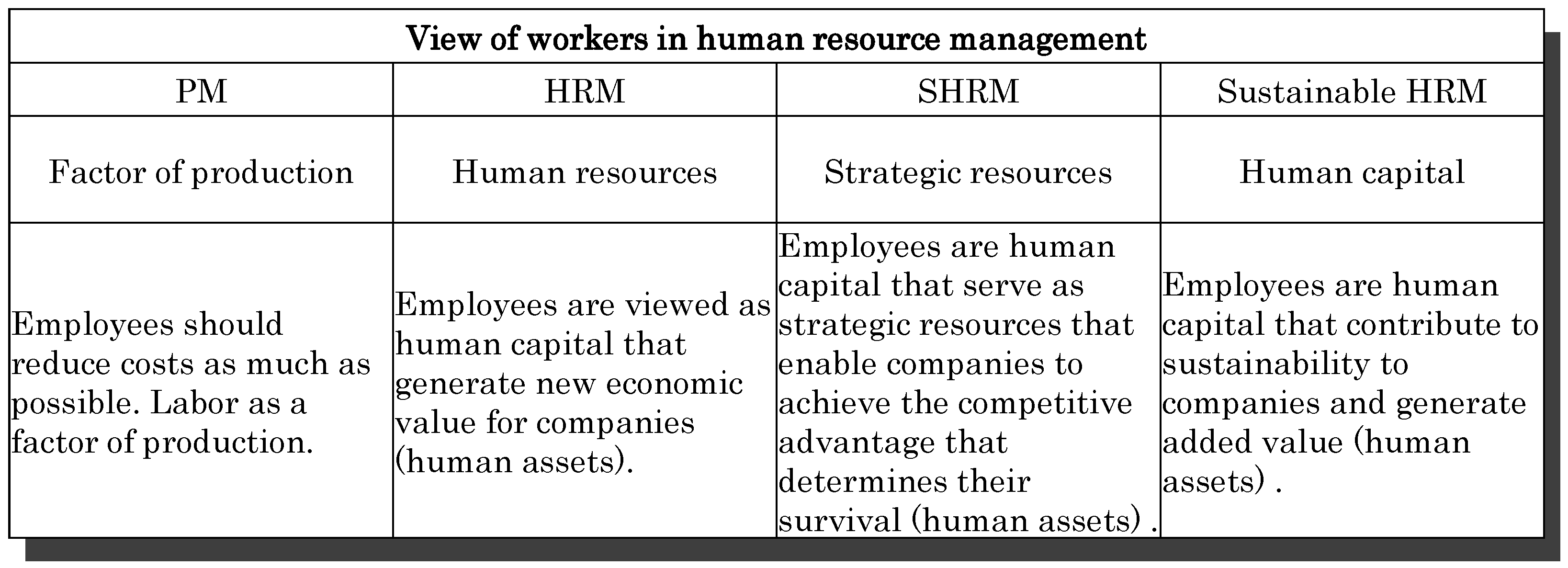
4] (p. 90). It succeeds the evolving paradigm of “people management,” which has transitioned from personnel management (PM) to HRM and strategic HRM (SHRM) (
Figure 1).
However, much of the existing research, while incorporating perspectives that emphasize employee development and well-being, ultimately interprets these elements within a framework that links them to firm performance [
6]. As a result, it has not fully departed from an instrumental understanding that treats human beings as resources for achieving organizational objectives. Socioformation is an interdisciplinary framework that aims to develop human talent and social capabilities to address contextual problems collaboratively and contribute to sustainable social development [
7]. Recent studies have further developed socioformation as a framework for cultivating meta-competencies, collaborative problem solving, and ethical governance in complex sociotechnical environments [
8,
9]. In this study, sustainable social development is treated as a distinct analytical category that refers to the processes through which human capabilities, collaborative practices, and ethical orientations contribute to the transformation of social systems beyond the conventional economic–social–environmental framework of sustainability. This perspective also suggests that the traditional economy–society–environment triad of sustainability, while useful as a macro-level framework, is insufficient for explaining the human developmental and relational processes through which sustainability is enacted in organizations. This limitation highlights the need to move beyond traditional conceptions of sustainability toward the notion of sustainable social development proposed by socioformation. From this perspective, sustainability is pursued through leadership, guidance, and collaborative learning processes that enable individuals and organizations to address complex societal challenges within evolving sociotechnical ecosystems, including emerging networks in which artificial intelligence may support human decision-making and collective problem-solving. From this viewpoint, emphasis is placed on the process through which individuals acquire the capacity to collaboratively address complex societal challenges, implying that human resource development in firms should also be understood as the formation of actors who participate in the creation of social value [
9]. In contemporary discussions of socioformation, this developmental process is also associated with the cultivation of meta-competencies such as collaborative problem solving, ethical judgment, and systemic thinking as well as with the need for responsible governance of emerging technologies, including artificial intelligence, within organizational and societal contexts. Accordingly, this study reconceptualizes sustainable HRM not only as a set of human resource practices aimed at balancing economic, social, and environmental goals but also as an organizational process that connects human formation to sustainable social development. From this perspective, the enhancement of organizational resilience is positioned not as an end in itself but as a consequence of organizational practices that contribute to social sustainability.
HRM emerged as a paradigm to replace PM in the early 1980s. The novelty of the HRM paradigm lies in its approach to human beings, who are viewed as a cost under the PM paradigm, a resource in terms of their existence, and an asset that can generate revenue for companies [
10]. Furthermore, from the 1990s to the early 2000s, the SHRM paradigm emerged, shifting the perspective on workers from viewing them as human resources that add new economic value to companies to viewing them as strategic resources that are a source of competitive advantage for the survival of companies [
5]. In this evolution of HRM paradigms, sustainable HRM emphasizes the importance of focusing not only on financial performance but also on non-financial performance in terms of human and social aspects, such as employee growth and job satisfaction, as a reflection of SHRM’s tendency to prioritize financial returns [
11]. Following Ehnert [
12] and Kramar [
11], the concept of considering workers as investment targets in HRM has gained traction in academia.
However, opinions remain divided on whether sustainable HRM should be positioned as the new HRM paradigm. This stems from the limited empirical evidence on how sustainable HRM is practiced and its contribution to organizational resilience. Most studies on sustainable HRM focus on Western companies, with insufficient verification in countries with different institutional contexts.
In Japan, HRM developed within a system symbolized by the “three sacred treasures” of lifetime employment, seniority-based promotions, and company labour unions. These institutional characteristics affect the implementation of sustainable HRM practices and their impact on organizational resilience. Therefore, empirical research targeting Japanese companies is indispensable for gaining insights that contribute to the generalization and refinement of international sustainable HRM theory. In recent years, Japanese companies have focused on “human capital management,” which enhances organizational resilience through investment in human resources [
13]. Human capital management refers to management practices that improve organizational resilience by considering human resources as “capital” and promoting dialogue with stakeholders through the visualization and disclosure of human resource value and development and the utilization of initiatives. Initiatives in human capital management, such as enhancing organizational resilience and building relationships with stakeholders, embody the principles of sustainable HRM that emphasize the harmony of economic, social, and environmental aspects. Therefore, the practice of human capital management in Japanese companies is considered an extremely effective case study to verify the effectiveness of sustainable HRM.
Based on the above issues, this study focuses on the six perspectives of sustainable HRM [
14] derived from a literature review and explicates how the combination of these practices contributes to enhancing organizational resilience through qualitative comparative analysis (QCA).
The remainder of the paper is organized as follows:
Section 2, based on Dounishi and Kambayashi [
14], outlines the six elements, identified through a tertiary literature review, unique to sustainable HRM. This section organizes the constituent elements of sustainable HRM presented in a fragmented manner in previous studies. It presents the foundation of an analytical framework on which this study is based through a systematic review of the existing research.
Section 3 presents the QCA approach as a method of determining how the six elements of sustainable HRM, derived in
Section 2, improve organizational resilience in Japanese companies through various combinations.
Section 4 organizes the combinations of sustainable HRM practices that ameliorate organizational resilience in Japanese companies based on the QCA results. This section clarifies the sustainable HRM practices that enhance organizational resilience and identifies the elements deemed essential or excluded. Finally,
Section 5 summarizes the findings of this study as conclusions and discusses the implications and remaining issues.
2. Literature Review
Opinions differ regarding the paradigm shift from SHRM to sustainable HRM, with some viewing sustainable HRM as an extension of SHRM rather than a replacement for the SHRM paradigm [
12,
15]. However, some position sustainable HRM as an alternative approach to SHRM, highlighting the distinctive definitional characteristics that differentiate it from SHRM [
16]. Opinions remain divided on whether sustainable HRM should be positioned as a new paradigm, and no evidence exists to support either stance.
To address this, we conducted a tertiary literature review [
14] to systematically examine sustainable HRM. We examined Kramar [
11,
16] and Ehnert [
12,
17], who pioneered sustainable HRM, and organized their opposing views on SHRM and sustainable HRM. However, the differences between SHRM and sustainable HRM discussed by Kramar [
16] are not based on empirical evidence from surveys but remain at the level of recommendations. While Ehnert [
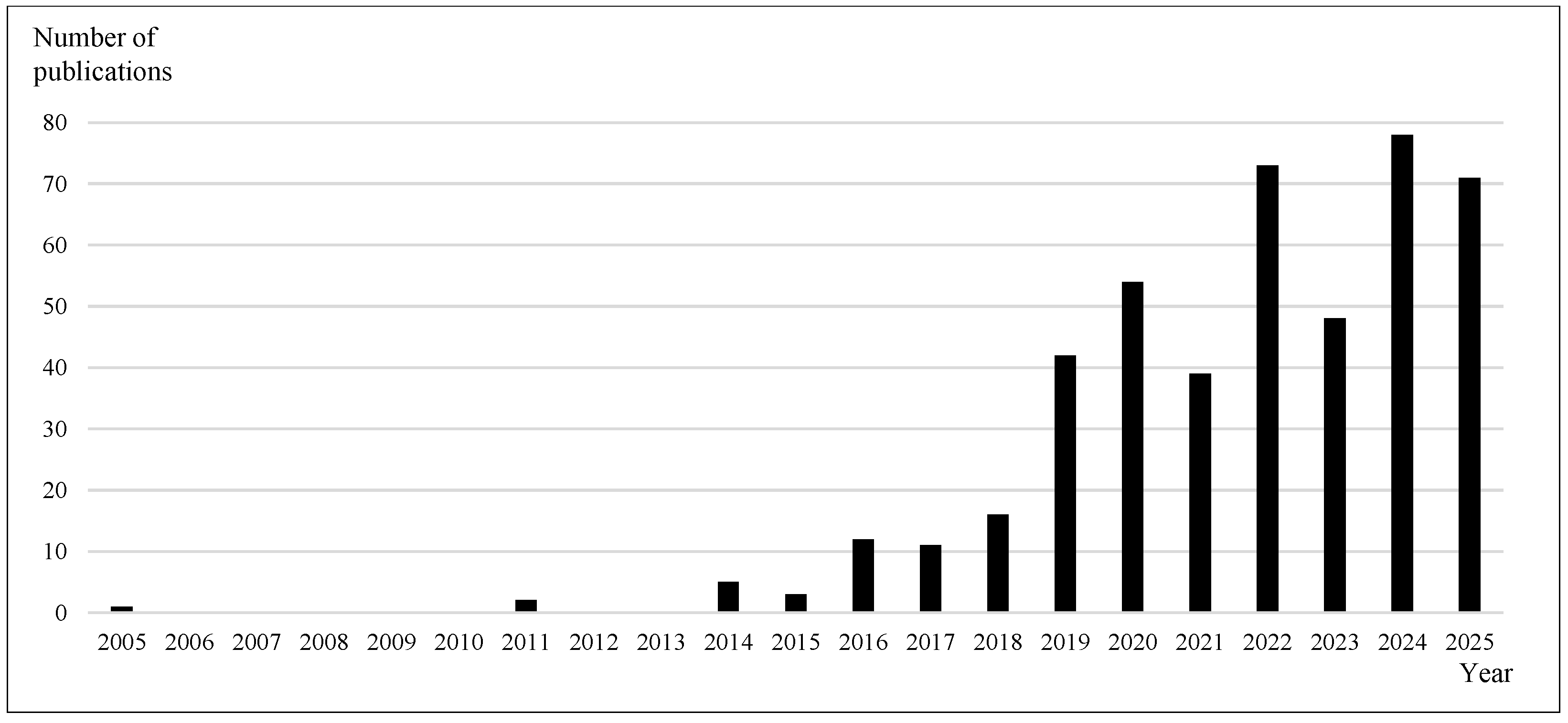
12] organizes SHRM and sustainable HRM based on a literature review up to 2005, considering the increasing trend in the literature related to sustainable HRM since 2019 (
Figure 2), new issues related to sustainable HRM remain.
Figure 2 illustrates this recent growth in the literature, based on a search conducted using Web of Science for the terms “sustainable human resource management” or “sustainable HRM”(search date: 18 August 2025), with the number of retrieved documents indicating a marked increase in scholarly attention in recent years.
Considering the above limitations, we undertook a systematic review of sustainable HRM, summarizing the evidence available to date and comparing it with the results of a comparative analysis by Kramar [
11,
16] and Ehnert [
12,
17] to clarify the issues and challenges of sustainable HRM. Consequently, six distinctive characteristics of sustainable HRM were identified: managing tensions, addressing negative outcomes, stakeholder orientation, promoting measurement and disclosure, broader capability development, and emphasizing non-financial performance.
The first perspective, “managing tensions,” refers to considering the balance between conflicting outcomes and emphasizing both long-term and short-term perspectives. Sustainable HRM achieves positive outcomes across the three dimensions of economic, social, and environmental outcomes [
18], pursuing conflicting outcomes such as efficiency and social legitimacy, short-term benefits, and long-term goals. This perspective is mentioned by both Kramar [
11,
16] and Ehnert [
12,
17], particularly Ehnert [
12], who highlights (1) the “efficiency-substance paradox,” which involves efficiently allocating human resources while maintaining and sustaining the foundation for future human resources; (2) the “economic rationality (efficiency and substance)–relational rationality (social legitimacy) paradox,” which involves maintaining substance, efficiently allocating resources, and fulfilling social responsibility; and the (3) “present–future paradox,” which involves creating short-term profits while aiming for the long-term sustainability of the organization. Although such paradoxes between outcomes are also recognized in SHRM, the distinction lies in the fact that while SHRM achieves business success through the resolution of paradoxes, sustainable HRM pursues conflicting outcomes simultaneously as its objective rather than resolving paradoxes to achieve sustainability. Furthermore, recent empirical studies have begun to examine how human resource management practices oriented toward the simultaneous achievement of environmental, social, and economic outcomes influence organizational performance. For example, Giran et al. [
19], based on interview data, demonstrate that in the practice of sustainable HRM, sustainability is not achieved by resolving paradoxes but by managing tensions arising from the simultaneous pursuit of conflicting outcomes, such as short-term and long-term objectives. In addition, Arshad and Liu [
20] show that strategic green HRM contributes to sustainable performance through innovation, supporting the integrative potential of economic and environmental objectives within organizational strategy. From a socioformative perspective, managing tensions involves not only balancing organizational objectives but also engaging in sociocritical and ethical deliberation regarding territorial tensions that arise between economic development, social well-being, and environmental sustainability.
The second perspective, “addressing negative outcomes,” refers to considering the costs that corporate actions impose on third parties such as stakeholders. Kramar [
11,
16] and Ehnert [
12,
17] mention this perspective, highlighting the importance of minimizing adverse effects on employees and local communities [
21] and imputing negative externalities to make human resource policies sustainable. Specifically, sustainable HRM stresses the need to evaluate potential harms to stakeholders and take action to prevent them. Recent empirical research [
22] has demonstrated that HRM systems introduced to improve organizational performance can inadvertently increase employee health risks. This evidence highlights the importance of considering potential negative externalities of HRM practices within the framework of sustainable HRM. In a socioformative approach, addressing negative outcomes goes beyond minimizing externalities and involves preventing broader forms of harm, including social, cognitive, community, and technological risks that may emerge from organizational practices.
The third perspective, “stakeholder orientation,” refers to placing importance not only on employees but also on stakeholders, such as employees’ families, community groups, labour unions, the ecological environment, and future generations. The ROC model—a sustainable HRM framework that outlines the specific contents of Respect for Employees, Openness to the Environment, and Continuity—emphasizes the importance of respecting stakeholders within and outside the organization and argues that these values should be reflected in HRM policies [
18]. Additionally, Kramar [
11,
16] and Ehnert [
12,
17] emphasize this perspective by stating that sustainable HRM builds trust with stakeholders and establishes mutual resource exchange relationships among stakeholders to sustain resources rather than unilaterally exploiting them [
17]. Under increasing regulatory pressures and heightened stakeholder expectations, firms’ internal sustainability expertise and digital capabilities have been shown to enhance transparency through improved disclosure practices [
23]. These findings suggest that responding to stakeholder expectations involves not only relationship building but also the development of organizational capabilities that support greater transparency and accountability. From a socioformative perspective, stakeholder orientation therefore implies not only dialogue with stakeholders but also the shared responsibility of organizations and communities, present and future, within collaborative sociotechnical ecosystems increasingly shaped by human–AI interaction.
The fourth perspective, “promoting measurement and disclosure,” refers to the measurement using metrics that encompass financial, human, social, and ecological outcomes and disclosure of information for evaluating them [
11,
12,
16,
17]. In particular, Ehnert [
12,
17] describes measurement using composite performance indicators as “multiple bottom-line orientation,” referring to the integration of environmental goals while maintaining organizational efficiency and social responsibility. Generally, the term “bottom line” implies accounting profits; however, in sustainable HRM, multiple bottom lines—economic, human, social, and ecological—should be integrated and multiple indicators, including not only financial indicators but also new social and ecological indicators, should be used in an integrated manner. In recent years, research has increasingly sought to operationalize such multidimensional performance indicators as industry-specific ESG measurement systems, designed in alignment with sectoral characteristics and explicitly linked to the Sustainable Development Goals (SDGs). For example, Ma et al. [
24] develop an ESG indicator framework tailored to the transportation industry, proposing an integrated evaluation system that systematically incorporates social, environmental, and governance dimensions. From a socioformative perspective, measurement and disclosure extend beyond conventional KPIs to include indicators that capture processes of human, social, and territorial transformation.
The fifth perspective, “broader capacity development,” refers to developing capacity to achieve broader strategic outcomes, including financial, human, social, and environmental. This perspective is mentioned by Kramar [
11,
16] but not by Ehnert [
12,
17] and represents a new perspective on sustainable HRM derived from a tertiary literature review. According to Kramar [
11,
16], the capabilities discussed here encompass the knowledge, skills, and values necessary to generate positive financial, human, social, and ecological outcomes in an environment characterized by high uncertainty. Specifically, this perspective underscores developing employees’ capabilities to adapt to environmental changes. However, capability development in sustainable HRM extends beyond merely enhancing job-related skills to adapt to environmental change. This point becomes clearer from the perspective of socioformation, which conceptualizes capability development as a process of human formation. Socioformation can be defined as a theory of interdisciplinary training that operates across educational, social, and organizational environments with the aim of contributing to sustainable social development [
25,
26,
27]. From this perspective, human talent is developed through collaborative problem-solving processes that promote territorial transformation and are increasingly supported by emerging forms of artificial intelligence governance. Socioformation emphasizes the acquisition of collaborative capacities to address complex social challenges and positions organizations as key contexts in which such capacities are cultivated [
9]. From this perspective, socioformative processes involve transdisciplinary learning oriented toward civic formation and the collaborative development of solutions within sociotechnical ecosystems, which is increasingly supported by human–AI collaboration and emerging forms of AI governance [
28]. They involve territorial, ethical, collaborative, and interdisciplinary transformation aimed at improving living conditions through human development and the governance of emerging technologies such as artificial intelligence [
29]. In this context, sustainable social development is understood from a socioformative perspective as the transformation of the territory aimed at improving living conditions through collaborative action and the governance of emerging technologies such as artificial intelligence [
7]. This perspective differs from traditional sustainable development frameworks, which often emphasize macro-level balancing among economic growth, social inclusion, and environmental protection. In contrast, sustainable social development in the socioformative approach focuses on the human, ethical, and territorial processes through which such a balance becomes feasible in practice. Furthermore, unlike global policy agendas such as the Millennium Development Goals, which primarily define development through aggregated international targets, sustainable social development emphasizes the transformation of territories through human development, collaborative action, and context-sensitive governance processes. From this perspective, capability development in organizations should be understood not as the strengthening of task-specific competencies but as a process that also fosters citizenship, enabling individuals to engage proactively in the realization of a sustainable society through the development of meta-competencies such as sociocritical thinking, interdisciplinary collaboration, and ethical responsibility.
The sixth perspective, “emphasizing non-financial performance,” refers to the focus on employee satisfaction, engagement surveys, and well-being. Neither Kramar [
9,
14] nor Ehnert [
10,
15] mentions this issue. Moreover, it was inadequately discussed in the early literature on sustainable HRM and therefore must be analyzed in detail in future research. While the perspective of non-financial performance is also mentioned in SHRM, sustainable HRM prioritizes non-financial performance that underlines the realization of sustainability, including initiatives related to well-being and environmental conservation involving internal and external stakeholders. Moreover, within the field of sustainability research, an increasing number of studies are reconsidering comprehensive evaluation frameworks that incorporate well-being and social foundation indicators [
30]. These studies reflect an emerging trend toward positioning non-financial performance at the core of sustainability assessment, thereby reinforcing the theoretical legitimacy of emphasizing well-being within the framework of Sustainable HRM. From a socioformative perspective, non-financial performance should therefore be understood not only in terms of well-being but also in relation to human agency, ethical life projects, sociocritical thinking, and responsible engagement with emerging technologies.
Although these six perspectives are found in many studies as characteristics unique to sustainable HRM, their relationship with actual financial performance remains unclear. Therefore, exploring ways to identify sustainable HRM practices has significant academic and practical implications. This study adopted the QCA method to clarify the relationship between the patterns of condition combinations composed of these six perspectives and organizational resilience.
4. Analysis Results
First, we sought candidates for the conditions necessary for high organizational resilience to arise but found no combination that met the necessary conditions. Next, we derived sufficient conditions that effectuated high organizational resilience. To derive sufficient conditions, it is necessary to reconstruct the raw data matrix into a complete truth table. The conditions for the incomplete truth table were set using a benchmark of consistency ≥ 0.8, PRI ≥ 0.6, and number of cases ≥ 1 [
39], and the complete truth table was completed using the Quine–McCluskey method (
Table 3).
Table 4 presents the results of the sufficient condition analysis. We focused on the simplicity of interpretation and theoretical validity and adopted the simplest solution that excluded redundant conditions. Compared with complex solutions, the simplest solution is considered the most suitable for clarifying the essential elements of sustainable HRM that contribute to organizational resilience enhancement, as it suppresses case dependency while revealing the essential elements of the causal structure. In
Table 4, the symbols “⬤” and “⊗” indicate that the member score of the variable is “greater than 0.50” and “less than 0.50,” respectively. A blank indicates that the condition is irrelevant.
In the following, based on the notation for general sets in QCA [
40], the Boolean operators “+” in logical expressions mean “or” (logical sum), “*” means “and” (logical product), “~” means “negation (absence) of the condition”, and “→” means “sufficient condition relationship”.
As sufficient conditions, three solutions were obtained: “managing tensions~*promoting measurement and disclosure*emphasizing non-financial performance → high organizational resilience” (C1), “managing tensions*addressing negative outcomes*emphasizing non-financial performance → high organizational resilience” (C2), and “managing tensions*addressing negative outcomes*stakeholder orientation~*promoting measurement and disclosure → high organizational resilience” (C3). Summarizing the solutions, we have the following: “managing tensions~*promoting measurement and disclosure*emphasizing non-financial performance + high organizational resilience” (C1), “managing tensions*addressing negative outcomes*emphasizing non-financial performance + managing tensions*addressing negative outcomes*stakeholder orientation~*promoting measurement and disclosure → high organizational resilience.” Regarding consistency and coverage, which indicate the validity and explanatory power of individual conditions and solution as a whole, consistency ≥ 0.75, basic coverage 0.25–0.65 [
41], intrinsic coverage > 0.01 [
42], solution consistency > 0.8 [
43], and solution coverage ≥ 0.5 [
44] are set as cut-off criteria. All values in
Table 4 meet the criteria, and the three paths, C1–C3, are validated.
Furthermore, the intrinsic coverage ratio refers to the proportion of results covered solely by the individual condition configurations, whereas the solution coverage ratio refers to the proportion of cases in which the solution represents the entire result. These ratios are interpreted similar to R2 (coefficient of determination), with higher values indicating greater importance of the solution [
45]. Thus, paths C1–C3 explain 67% of the high organizational resilience. Furthermore, as the value of the unique coverage ratio for C1 is larger than that for C2 or C3, “managing tensions~*promoting measurement and disclosure*emphasizing non-financial performance → high organizational resilience” (C1) is the most important solution factor.
4.1. Configuration C1: Coexistence of Disclosure Practices and Non-Financial Performance
The pattern described in C1, “managing tensions~*promoting measurement and disclosure*emphasizing non-financial performance → high organizational resilience”, demonstrates that even if companies do not explicitly address the tension between short-term profits and long-term sustainability that is often assumed when implementing sustainable HRM, introducing composite performance indicators and emphasizing non-financial performance can increase the organizational resilience. Here, the important point is that even if managing tensions is not explicitly undertaken, organizational resilience can still be enhanced when promoting measurement and disclosure and emphasizing non-financial performance coexist. The introduction of promoting measurement and disclosure makes both financial and non-financial indicators simultaneously visible and serves to reconstruct the decision-making criteria within the organization. At the same time, emphasizing non-financial performance goes beyond mere quantification or formal disclosure and encourages substantive investment in essential non-financial domains such as human capital and environmental and social elements.
When these two elements are combined, the relationship between short-term profit and long-term sustainability is no longer treated as a zero-sum trade-off; rather, it is institutionally integrated through the design of evaluation systems. In other words, under sustainable HRM, the coexistence of promoting measurement and disclosure and emphasizing non-financial performance functions as a structural condition that enables the simultaneous achievement of short-term profitability and long-term sustainability.
This configuration is consistent with recent developments in human capital disclosure and integrated reporting among Japanese firms. However, the findings of this study suggest that merely enhancing the quantification of indicators or expanding disclosure is insufficient; rather, positioning non-financial performance as a central evaluative axis of management can constitute a structural turning point in organizational resilience. In particular, C1 exhibited the highest unique coverage, indicating that it represents a relatively important pathway in explaining organizational resilience enhancement among Japanese firms. Accordingly, it can be interpreted that, in the Japanese context, the institutional integration of promoting measurement and disclosure and emphasizing non-financial performance is likely to serve as a core mechanism of value creation through sustainable HRM. From a socioformative perspective, this configuration may be interpreted as empirical evidence of a corporate meta-competency that goes beyond symbolic disclosure. By placing non-financial performance at the centre of evaluation systems, organizations orient managerial decision-making toward an ethical project of development and forms of human governance that extend beyond purely algorithmic or financial profitability.
4.2. Configuration C2: Responsible Management and Social Responsibility
The pattern of “managing tensions*addressing negative outcomes*emphasizing non-financial performance → high organizational resilience” in C2 suggests that in sustainable HRM, practices that suppress negative externalities such as environmental destruction and labour exploitation, and an organizational approach to dealing with tensions between short-term profits and long-term sustainability, contribute to increasing organizational resilience when linked to efforts that emphasize non-financial performance. Specifically, internalizing the externalities of corporate actions fosters trust among stakeholders and ensures social responsibility. Emphasizing non-financial performance implies that fulfilling social responsibility towards employees improves organizational resilience, transcending mere cost reduction or efficiency improvements. Thus, the C2 pattern demonstrates that responsible talent management that ensures social responsibility is a sustainable HRM practice.
Accordingly, C2 identifies a pathway in which sustainable HRM operates not merely as a disclosure-oriented framework but as a governance mechanism that embeds social responsibility into core managerial decision-making. Rather than treating sustainability as a peripheral objective, this configuration institutionalizes the alignment between economic performance and social legitimacy. In doing so, it clarifies how responsible people management can function as a structural driver of sustainable value creation. From a socioformative perspective, this pathway can also be interpreted as reflecting sociocritical governance of organizational practices, in which firms actively prevent social and ecological harm while aligning talent management with broader ethical and territorial responsibilities.
4.3. Configuration C3: Substantive Human Capital Investment Beyond Stakeholder-Oriented Disclosure
The pattern of C3, “managing tensions*addressing negative outcomes*stakeholder orientation~*promoting measurement and disclosure → high organizational resilience”, appears paradoxical at first glance. That is, even in the absence of stakeholder orientation, the combination of managing tensions, addressing negative outcomes, and promoting measurement and disclosure may still enable the enhancement of organizational resilience. This finding calls for a reconsideration of conventional stakeholder-oriented views of management, which tend to assume that stakeholder orientation itself is a necessary driver of value creation.
However, particular attention should be paid to the configuration of conditions coexisting in C3. The elements of managing tensions, addressing negative outcomes, and promoting measurement and disclosure are all management practices that are relatively easy to emphasize in external communication and disclosure. These practices possess characteristics that make them relatively easy to introduce in institutional and formal terms, and they may function as signals of rationality and responsibility to external audiences. The results of this study suggest that these elements can contribute to organizational resilience creation precisely when they do not remain merely formal instruments for disclosure to stakeholders.
From a neo-institutional perspective, this configuration can be interpreted through the concept of decoupling [
46]. Decoupling refers to situations in which organizations adopt formal structures or practices to conform to institutional expectations while their core operational activities remain largely unchanged. In the context of sustainable HRM, practices such as measurement, disclosure, and formal tension management may function as symbolic compliance mechanisms that demonstrate alignment with sustainability norms and regulatory expectations without necessarily involving substantive stakeholder engagement. In this sense, the configuration observed in C3 may represent a form of institutionalized decoupling in which organizations construct formal facades of governance and disclosure systems that signal responsibility and rationality to external audiences while maintaining existing internal management practices.
Particularly in the Japanese context, integrated reporting has increasingly been associated with the strengthening of financial accountability to investors [
47]. Against this backdrop, the results of this study suggest that it is crucial for stakeholder-related discourse not to become merely symbolic but to be translated into concrete managerial practices. In socioformative terms, this suggests that the effectiveness of such practices depends on their capacity to move beyond symbolic compliance and contribute to processes of organizational learning and territorial transformation.
5. Discussion
In this study, based on a constructive perspective, we used csQCA to verify the conditions for sustainable HRM that contribute to increasing organizational resilience.
5.1. Conclusions
Instead of treating sustainable HRM as a set of best practices, the configurational results demonstrate that organizational resilience emerges from specific structural alignments among its elements. This shifts the theoretical lens from universalistic prescriptions toward institutional complementarity.
More importantly, the prominence of non-financial performance across multiple configurations suggests that sustainable HRM operates as a mechanism of externality internalization and social value generation. Organizational practices must transition from instrumental sustainability to sociostructural transformation [
9]. In this sense, sustainable HRM contributes not only to firm-level performance but also to societal resilience and human development.
Accordingly, sustainable HRM may be further developed toward a socioformative talent management perspective, wherein employees are regarded as agents embedded in social ecosystems rather than as productive inputs. This paradigm reframes organizational resilience as socially co-created through governance structures that integrate economic rationality, social responsibility, and human development.
Taken together, the findings allow several conclusions to be drawn.
First, the results indicate that organizational resilience does not come from isolated practices. Rather, it emerges from specific configurations in which multiple elements of sustainable HRM operate together as mutually reinforcing structures.
Second, a socioformative reading of the results suggests that organizational human development must be linked to the territory. From this perspective, the development of human talent within organizations contributes not only to internal performance but also to the transformation of the social environments in which organizations are embedded.
Third, the findings indicate that sustainability cannot be reduced to disclosure. While measurement and disclosure systems are important governance tools, sustainable value creation ultimately depends on substantive organizational practices that support human development and non-financial performance.
5.2. Theoretical Implications
The theoretical implications of this study can be summarized as follows. First, this study conceptualizes sustainable HRM not as a mere bundle of discrete practices but as an integral talent management mechanism in which multiple elements operate interdependently, and it presents the causal structure through which organizational resilience emerges in terms of configurations. Prior research has advanced sustainable HRM primarily in a normative manner [
11,
12,
16,
17], yet it has not sufficiently clarified which combinations of practices give rise to value in practice. Building on a tertiary literature review, we organized sustainable HRM into six elements—(1) managing tensions, (2) addressing negative outcomes, (3) stakeholder orientation, (4) promoting measurement and disclosure, (5) broader capability development, and (6) emphasizing non-financial performance—and, using csQCA, we demonstrate that organizational resilience does not require the comprehensive implementation of all six elements. Rather, specific complementarities among selected elements constitute sufficient conditions for value creation. The key theoretical implication is that sustainable HRM should be evaluated not by its degree of comprehensiveness, but by the patterns of alignment among its elements and the operating conditions under which they jointly function.
Second, this study relativizes the view that sustainable HRM should primarily be understood as strengthening accountability through measurement and disclosure and instead identifies the source of organizational resilience in the redesign of evaluative frameworks that place non-financial performance at the centre. In particular, as configuration C1 suggests, the presence of promoting measurement and disclosure does not necessarily lead to value creation if it remains limited to mere visualization or formalization. Rather, when non-financial performance is positioned as a central evaluative axis, investments in human capital are no longer driven by disclosure requirements alone but become substantive investments in underlying non-financial outcomes. Under such conditions, organizational practices oriented toward non-financial performance may enable firms to address sustainability-related tensions implicitly, allowing for paradoxical objectives such as short-term profitability and long-term sustainability to be realized not as trade-offs but as mutually compatible outcomes.
Third, from the perspective of socioformation, this study reconceptualizes employees not as productive inputs but as agents with intrinsic potential and reinterprets sustainable HRM as a form of human resource management that contributes to the realization of social sustainability. Introducing this perspective suggests that organizational resilience should not be understood as something automatically obtained through market evaluation. Rather, it emerges through specific organizational configurations, such as the coexistence of disclosure practices and non-financial performance (C1), responsible management that internalizes social responsibility (C2), and substantive human capital investment that is not merely driven by stakeholder-oriented disclosure (C3). Accordingly, the contribution of this study lies in moving beyond viewing sustainable HRM as a set of recommended practices and, instead, empirically clarifying the mechanisms through which organizational resilience is generated, positioning it as a form of integral talent management that contributes to sustainable social development.
5.3. Practical Implications
The practical implications of this study are summarized as follows: First, it clarifies the practical patterns of sustainable HRM that enhance organizational resilience. In particular, “managing tensions~*promoting measurement and disclosure*emphasizing non-financial performance → high organizational resilience” (C1) is the most important pattern to focus on. From the C1 pattern, the practical essence of sustainable HRM lies not only in the introduction of systems but also in the concurrent pursuit of visualization through multifaceted performance metrics and non-financial performance, including employee well-being. Specifically, focusing on measurements using composite performance metrics does not directly effectuate sustained improvements in organizational resilience; sustainable corporate growth and enhanced organizational resilience become possible only by balancing investments in non-financial performance, including employees’ psychological aspects. Specifically, what is required under human capital management is not to set visualization or quantification as the goal but to simultaneously achieve investments in employees’ psychological aspects, such as engagement and well-being, and link them to measurable systems.
More broadly, these findings imply that organizations should not treat human capital disclosure as a purely reporting-oriented exercise. Instead, measurement systems should function as governance mechanisms that guide managerial decision-making regarding human capital investment. In this sense, the practical challenge for managers is to design evaluation systems in which non-financial performance indicators such as employee engagement, well-being, and psychological safety are not merely monitored but are structurally linked to resource allocation and organizational strategy. By embedding these indicators into the core management system, firms can transform human capital management from a symbolic disclosure practice into a substantive mechanism for sustainable value creation.
Second, based on the comparison between C2 and C3, it is possible to improve organizational resilience by either emphasizing non-financial performance or promoting measurement and disclosure, provided that “managing tensions” and “addressing negative outcomes” are ensured. In particular, when choosing the latter option of “promoting measurement and disclosure”, the risk that the measurement efforts are reduced to a mere formality to appeal to stakeholders remains. While superficially proclaiming “stakeholder orientation”, many firms focus on quantifying data only for the sake of accountability to investors and external parties. However, the C3 pattern indicates that this approach can damage organizational resilience. The key to the success or failure of sustainable HRM lies not in showcasing the use of composite performance metrics to stakeholders but in appropriately measuring and disclosing negative externalities associated with relationships with employees and society. Therefore, the practical implication is that sustainable HRM should prioritize substantive management practices that address organizational externalities, rather than relying on symbolic stakeholder-oriented disclosure. Beyond these managerial implications, the findings also point to an expanded role for human resource departments in the context of emerging technological governance and territorial transformation. Rather than functioning merely as units that evaluate employees through standardized performance indicators, HR departments may increasingly operate as collaborative organizational ecosystems. Within such ecosystems, employees are assessed not only based on conventional performance metrics but also on their capacity to apply sociocritical thinking, responsibly govern technological tools such as artificial intelligence used in managerial processes and contribute to solving real organizational and societal problems that positively affect the corporate social environment. From this perspective, sustainable HRM involves cultivating employees’ ability to integrate human judgement with technological systems, thereby enabling organizations to contribute to territorial transformation and the broader social fabric in which they are embedded.
5.4. Limitations and Future Research Directions
The limitations of this study are as follows: First, the QCA results derived in this study indicate structural patterns and do not necessarily apply to all Japanese companies. In particular, the effects of “stakeholder focus” vary depending on industry characteristics and company size. For example, in service industries that deal with consumers directly, customer relationships directly affect organizational resilience, whereas in manufacturing industries, long-term relationships with business partners and suppliers are likely more important.
Second, as the data in this study are limited to Japanese companies, they do not fully reflect the practices of sustainable HRM that are common in countries across the world. Although the concept of sustainable HRM is discussed internationally, its practical forms vary greatly depending on the institutional background and cultural context of each country. Therefore, there are limitations to generalizing the findings of this study, which are limited to Japan; internationally, it is essential to consider the institutional differences among countries.
Third, the study is subject to measurement and reporting limitations. The coding of sustainable HRM practices relied on textual disclosures in securities reports, which may involve interpretive judgement and may not perfectly reflect actual organizational practices. Firms may also differ in disclosure style or transparency, creating potential reporting bias independent of substantive practices. In addition, although SAF was employed as an indicator of long-term organizational viability, it does not exhaustively capture all aspects of organizational resilience.
Based on the above limitations, we identify the following future research directions: First, the sample size should be increased to deepen comparative research between industries. There may be differences in the mechanisms by which sustainable HRM practices affect organizational resilience between manufacturing and service industries or between traditional and emerging industries. Second, the impact of institutional and cultural backgrounds on the relationship between sustainable HRM practices and organizational resilience should be clarified through international comparisons. Comparisons with overseas companies will verify the uniqueness of the insights in Japan and the generalizability of sustainable HRM practices. Third, future research should combine multiple data sources, such as surveys and interviews, with archival data and examine alternative outcome indicators to further strengthen construct validity and mitigate potential bias.