1. Introduction
In the contemporary knowledge-based economy, firms often expand technologically by searching for, acquiring, and recombining the embodied, experiential know-how that external experts possess and bring into the firm. Once onboarded and socialized, these focal employees implant the seeds of new capabilities, which then help regenerate and enrich the host firm’s existing capability set [
1]. This function of the new recruit is grounded in the origin of his or her embodied capabilities, learnt and internalized through active participation in the value creation processes of prior employers [
2,
3]. By recruiting such experts, the hiring firm hopes to access and internalize the routines and capabilities of other firms where the employee was previously embedded. It represents an evolutionary, predatory form of firm behaviour aimed at accessing, copying, and internalizing distant knowledge and management ideas through the onboarding of new employees as a shortcut and complement to organic organizational learning [
4].
The imperative of fast technological adaptation, combined with the complexity of organizational learning, prompts firms to shorten the cycle of capability emergence by using employees as bridges to identified and desired capability needs [
5]. The new recruit’s knowledge and human capital resources have thus become key variables explaining variability in firm performance despite similar production inputs, consistent with the resource-based view [
6,
7,
8].
Extant literature streams, including learning-by-hiring [
9], employee mobility [
10], and knowledge transfer [
11,
12,
13], have demonstrated that knowledge flows and subsequent integration occur across firm boundaries through employee mobility. However, these studies have predominantly adopted a macro-level perspective [
14,
15,
16,
17]. The micro-level processes, specifically how knowledge travels across organizations through the mobility of an individual employee, and how the receiving firm incorporates and internalizes it, remain less understood. Moreover, the majority of the learning-by-hiring literature does not assume intentionality on the part of the knowledge-seeking firm; knowledge is often portrayed as diffusing or spilling over passively through employee mobility rather than being actively appropriated in a targeted and deliberate manner by the hiring organization. For example, mobility is frequently conceptualized as a mechanism through which knowledge “spills over” between firms as a byproduct of individual movement rather than a deliberate strategic action by the hiring firm [
9]. This gap stems partly from methodological challenges in capturing and granularizing knowledge transfer in patent citations between host and destination firms [
18].
The present conceptual article addresses this gap from a systems-thinking perspective. Adopting a practitioner-informed view of the focal phenomenon [
19], we propose that knowledge-centric recruitment constitutes a distinct dynamic capability, defined as the firm’s ability to integrate, build, and reconfigure internal and external competences to address rapidly changing environments [
20]. Unlike standard vacancy-based recruitment [
21], KCR is deliberately focused on knowledge-hires to build organizational capabilities. The article describes the specific steps, tactics, and internal processes through which firms can use recruitment as a deliberate knowledge-development strategy [
10]. It presents a conceptual model of knowledge-centric recruitment (KCR) that illuminates not only the individual-level transfer process, but also the strategies and process design options available to hiring firms for targeted knowledge access through senior professionals from rival organizations. The value of an inbound capability is evaluated through the lens of contextual capability fit, a novel construct developed in this article. To advance understanding of these dynamics, the present study addresses the following two research questions:
The remainder of the article is structured as follows:
Section 2 presents the Theoretical Background and Method through an integrative review of the relevant literature streams;
Section 3 develops the knowledge-centric recruitment (KCR) model, its four micro-foundations, and the novel construct of contextual capability fit;
Section 4 discusses the theoretical contributions, practical implications, limitations, and avenues for future research; and
Section 5 concludes the paper.
2. Theoretical Background and Methods
This section provides the theoretical foundations for the proposed knowledge-centric recruitment (KCR) model by integrating key streams from the knowledge-based view, tacit knowledge theory, learning-by-hiring, absorptive capacity, knowledge distance, person–organization fit, and strategic recruitment. An integrative approach was adopted [
22,
23] to synthesize these diverse bodies of literature and identify convergences, tensions, and gaps relevant to the micro-foundations of deliberate capability acquisition through hiring.
To ensure transparency and replicability, the literature was collected through a structured yet flexible process. Searches were conducted in major academic databases (Web of Science, Scopus, and Google Scholar) using combinations of keywords and phrases such as “learning-by-hiring”, “employee mobility”, “knowledge transfer”, “tacit knowledge”, “absorptive capacity”, “knowledge distance”, “person-organization fit”, “strategic recruitment”, and “human capital resources”. The search was limited to publications from 1990 to 2024, with priority given to high-impact Q1 and Q2 journals in management and organization studies. Inclusion criteria focused on conceptual relevance, theoretical influence, and direct contribution to understanding the micro-processes of knowledge transfer and capability building via hiring. The final sample is subjective to a degree, reflecting the authors’ judgement of the most representative and impactful works within the core theoretical streams. Given the vast volume of literature in these fields, the review does not aim for exhaustive coverage but rather to showcase, integrate, and build upon the more general conclusions emerging from the selected papers. This focused synthesis directly informs the proposed KCR model and the novel construct of contextual capability fit. During the preparation of this manuscript, generative AI tools (Anara Pro and SuperGrok Heavy) were used to assist with literature summarization, argument structuring, and language refinement; all outputs were critically reviewed, substantially edited where necessary, and verified by the authors, who take full responsibility for the final text.
2.1. Learning-by-Hiring
Organizations learn by hiring employees from other firms operating in similar business contexts. They then combine the new hire’s knowledge with their own existing knowledge base [
9,
12,
13]. In this way, employee mobility acts as a bridge that allows knowledge to travel between firms [
16]. This process is known as learning-by-hiring. It provides a shortcut to the complex and costly task of developing organizational knowledge internally [
5,
24]. Knowledge workers serve as repositories and carriers of complex, tacit knowledge that is difficult to transfer unless the employee moves along with it [
25,
26,
27,
28]. Empirical evidence supports the strategic potential of this mechanism. Firms actively recruit experienced engineers and managers from rival companies to acquire specific technological capabilities, which leads to significant improvements in innovation output and technological positioning [
29]. Mobility from technologically distant firms can enhance innovation when the hiring firm possesses sufficient absorptive capacity [
1,
16,
30]. Post-hire learning dynamics depend on incumbent–newcomer interactions [
14].
A closely related stream examines knowledge diffusion through employee mobility and spin-outs. Spin-outs and targeted hiring from rivals facilitate substantial inter-firm knowledge flows, particularly of tacit and complex technological knowledge [
29]. Related work on spin-outs and mobility shows that mobility serves as an effective conduit for knowledge that is otherwise difficult to transfer [
14,
15,
16,
17]. However, like the broader learning-by-hiring literature, this stream has largely concentrated on macro-level outcomes (e.g., patent citations and firm-level innovation rates) rather than the deliberate micro-level processes of capability identification, targeted selection, and strategic integration.
However, simply accessing knowledge does not guarantee its effective use. Absorptive capacity—the firm’s ability to recognize the value of new information, assimilate it, and apply it to commercial ends—is a key enabler [
31]. Absorptive capacity is influenced by shared organizational norms, distribution of expertise, and incumbent inertia [
14,
32,
33]. Path dependence further shapes learning outcomes in profound ways. Organizations tend to build upon and favour their existing technological trajectories and knowledge bases. This creates cognitive and organizational inertia that makes it more difficult to recognize, assimilate, and integrate distant or novel knowledge brought by external hires [
14,
19,
33]. This path-dependent bias toward local search and incremental improvement directly interacts with knowledge distance—the extent to which incoming knowledge diverges from the receiving firm’s existing knowledge stock [
33]. Moderate knowledge distance can help overcome path dependence and introduce valuable novelty [
13], while excessive distance creates cognitive barriers and increases integration costs [
34]. This tension has been conceptualized as “related variety” [
35,
36], suggesting that some cognitive overlap is necessary for effective transfer and learning. Consequently, hiring choices in the KCR model are shaped by two main factors: the firm’s path-dependent trajectory and its strategic need for a particular capability. When the strategic need is high, firms may deliberately accept greater person-organization risks with the chosen candidate. These choices are evaluated through the contextual capability fit matrix, which will be presented and illustrated later in the paper. Learning-by-hiring and absorptive capacity are interdependent; new hires can also expand the firm’s future absorptive capacity [
37].
2.2. Characteristics of Knowledge and Knowledge Processes in Organizational Contexts
A critical examination of the nature of knowledge within organizations is essential for understanding how employee mobility may affect an organization’s collective knowledge base and why knowledge-centric recruitment becomes a strategic necessity. In the management and organizational literature, knowledge is conceptualized in two primary ways: as a resource or asset that can be owned and protected [
6], and as a dynamic process that emerges, evolves, and expands across multiple levels through social interaction [
38,
39]. The knowledge-based view (KBV) of the firm positions knowledge as the key endogenous factor in a firm’s production function and the primary source of sustained competitive advantage, particularly in dynamic, knowledge-intensive industries [
40,
41,
42].
Gautam et al. [
43] further emphasize that knowledge resources are not only heterogeneous but also causally ambiguous; their value and contribution to performance are difficult for competitors (and sometimes even for the firm itself) to fully observe or replicate. This causal ambiguity arises because much of a firm’s capability is rooted in complex, tacit interactions that cannot be easily disentangled or imitated, thereby enhancing the strategic value of tacit knowledge acquired through employee mobility.
Polanyi [
31,
32] provides the foundational distinction between tacit and explicit knowledge that underpins this view. He famously argued that “we can know more than we can tell,” positioning tacit knowing as a process rather than a static object. Tacit knowledge is logically unspecifiable and resides largely in the preconscious intuitive domain; it is acquired through repeated direct experience and what Polanyi called indwelling, the act of dwelling within a practice so fully that the actor becomes unaware of its separate rules or steps involved. This directly reflects the knowledge-as-process conceptualization, in contrast to the classical philosophical definition of knowledge as ‘’justified true belief” (originating in Plato’s Theaetetus). While explicit knowledge can be codified and transmitted linguistically, tacit knowledge is embodied and context-dependent, making it inherently sticky and difficult to transfer without the individual who embodies it [
42].
Tsoukas [
3] builds on Polanyi to clarify that tacit knowing is not merely hidden knowledge waiting to be converted, but an integral, irreducible dimension of all knowing. He argues that tacit knowledge cannot be fully articulated or converted into explicit form without losing its essential character; instead, it functions as the background that makes explicit knowledge meaningful. Nonaka and Takeuchi [
27] further develop this idea by emphasizing that knowledge is embedded in action, belief, and commitment. Knowledge creation is therefore not a purely cognitive exercise but a deeply personal and social process involving justification, conviction, and active engagement with practice in the community in which it resides [
28].
These characteristics of knowledge, i.e., causal ambiguity, tacitness, embeddedness in action, belief and commitment, and path-dependent embeddedness, underscore the strategic importance of the KCR model. Because valuable capabilities cannot be easily imitated or purchased on the open market, firms must proactively recruit the individuals who embody them. The KCR model’s emphasis on external capability scanning, targeted identification of knowledge-hires, and evaluation through contextual capability fit therefore represents a logical and necessary response to the inherent stickiness, ambiguity, and deeply personal nature of organizational knowledge. Such proactive scanning builds on the broader concept of environmental scanning, through which organizations systematically gather information about external trends and opportunities to inform strategic capability development [
42].
2.3. Person–Organization Fit
Person–organization (P-O) fit theory provides a foundational lens for understanding how individuals align with organizations. Muchinsky and Monahan [
35] distinguished two primary types of P-O fit: supplementary fit, which occurs when the individual and the organization possess similar characteristics, and complementary fit, which occurs when the individual supplies what is missing, in other words, makes whole the knowledge stocks of the organization.
Complementary fit is particularly relevant in knowledge-intensive settings, where new hires are expected to address capability gaps rather than merely reinforce existing attributes.
Subsequent research has expanded this framework. Sekiguchi et al. [
36] emphasize that P-O fit operates at multiple levels and that complementary fit can enhance both individual adjustment and organizational performance when the newcomer brings unique knowledge or skills. Coldwell et al. [
37] highlight the ethical and value-based dimensions of P-O fit, showing that misalignment can lead to negative outcomes during socialization. Phillips, Kristof, and Fahrenkopf [
38,
39,
40] further demonstrate that strong P-O fit reduces turnover intentions and facilitates knowledge sharing, while complementary fit is especially valuable in dynamic environments where organizations seek to import novel capabilities through hiring.
In the context of knowledge-centric recruitment, traditional P-O fit concepts are extended. While supplementary fit supports smooth integration, complementary fit, when combined with moderate knowledge distance, becomes a strategic mechanism for capability enhancement. However, existing P-O fit research has primarily focused on individual-level outcomes (citizenship, loyalty, belonging, etc.) rather than firm-level capability development. The present article builds on and extends this literature by incorporating P-O fit into the broader evaluative lens of contextual capability fit.
2.4. Strategic Recruitment and Human Capital
Strategic recruitment has evolved from traditional vacancy-driven “job-pull” models, in which hiring is triggered only when a position becomes vacant, toward “person-push” approaches, in which the availability of exceptional talent itself can create or reshape jobs [
21]. In knowledge-intensive industries, firms increasingly adopt different search and recruitment strategies that are deliberately adjusted to serve strategic goals beyond the requirements of any specific individual job [
16].
Jøranli [
2] observed that software firms in Oslo moved from ad hoc vacancy-based recruitment to ongoing strategic knowledge-seeking practices. These firms involved senior management and general employees in the recruitment process to ensure that external capability scanning and target hire identification remained closely coordinated with broader organizational objectives. Human capital (individual knowledge, skills, experience and other characteristics—KSAOs) must emerge as unit-level human capital resources through multi-level processes to contribute to competitive advantage [
8,
44]. Knowledge-hires differ fundamentally from ordinary recruits: they are deliberately sourced to disrupt and recalibrate existing capabilities, bringing knowledge and experience with value far beyond a single role.
The KCR model extends this evolution by transforming recruitment into a deliberate capability-acquisition strategy. By integrating external capability scanning and prioritization, the first micro-foundation of the model, with targeted knowledge-hire identification and contextual capability fit evaluation, KCR replaces traditional staffing logic with a proactive, strategic approach to organizational capability building. To clarify how the four literature streams inform the KCR model,
Table 1 synthesizes their core insights and maps them to the model’s micro-foundations and the novel construct of contextual capability fit.
2.5. Theoretical Integration and Research Gaps
The reviewed studies collectively demonstrate that knowledge transfer via hiring is possible and can be strategically valuable. Learning-by-hiring provides the basic mechanism, knowledge processes clarify the sticky and tacit nature of what is transferred, person–organization fit highlights integration challenges, and strategic recruitment points toward the potential for deliberate action. Some studies have begun to examine micro-level aspects of these processes. For example, Fahrenkopf [
40] investigates micro-processes of knowledge flow following mobility, Tzabbar et al. [
1,
16] explore post-hire integration and newcomer-incumbent interactions, and Jain [
14,
15] analyses post-hire learning dynamics. Franco and Filson [
45] further show that targeted hiring from rivals can improve innovation outcomes, while related work on spin-outs and mobility [
46] demonstrates that mobility serves as an effective conduit for knowledge that is otherwise difficult to transfer.
However, these works have important limitations. An essential limitation of the learning-by-hiring and employee mobility studies is their heavy reliance on industry-wide, large-scale analyses that use patents and patent citations as proxies for knowledge flows. Although these studies have provided important macro-level insights, they offer limited granularity on the endogenous micro-processes and strategic decision-making at knowledge-seeking organizations. Moreover, they tend to focus on post-hire outcomes rather than the pre-hire micro-foundational processes. In particular, limited attention has been paid to external capability scanning and prioritization, the strategic mechanisms through which firms systematically identify critical external knowledge domains and proactively seek individuals who embody those capabilities. Furthermore, socialization, recontextualization, and knowledge translation as key constituents of successful capability integration remain underexplored in the context of deliberate hiring strategies.
The present article addresses these gaps by introducing contextual capability fit as an original integrative construct that combines complementary/supplementary quality with knowledge distance, and by proposing the KCR model as a micro-foundational framework that includes external capability scanning and prioritization as a distinct upstream process. This allows firms to move from opportunistic hiring to a proactive, calculative approach to capability building and positions KCR as a form of organizational learning [
14].
3. Toward a Conceptual Model of Knowledge-Centric Recruitment
Building on the theoretical foundations reviewed above, this article proposes the knowledge-centric recruitment (KCR) model as a new talent hiring concept. The model articulates the micro-foundations of deliberate knowledge acquisition through hiring, understood here as the underlying individual-level and interaction-level processes that aggregate to produce firm-level capability outcomes [
47,
48]. It conceptualizes KCR as a dynamic capability comprising four interrelated micro-foundations: (1) external capability scanning and prioritization, (2) identification of target capabilities and knowledge-hires, (3) evaluation through the lens of contextual capability fit, and (4) expectations of knowledge adaptation (translation) during onboarding.
The first micro-foundation, external capability scanning and prioritization, involves the systematic identification of critical knowledge domains where the firm seeks to strengthen its capabilities. Rather than reacting to vacancies, firms that excel at KCR maintain strategic mechanisms to proactively determine where external expertise is needed.
The second micro-foundation concerns the identification of target capabilities and knowledge-hires. Once priority domains are established, the firm pinpoints specific capabilities at rival organizations and identifies individuals who have directly participated in their enactment (as processes, approaches, methods, or routines). Mere familiarity with a capability is insufficient; the knowledge-hire must possess deep, experiential involvement for successful recontextualization.
The third micro-foundation is candidate evaluation through the lens of contextual capability fit. Hiring organizations assess potential inbound capabilities along two dimensions: supplementary versus complementary quality relative to the firm’s existing knowledge base, and knowledge distance (the cognitive or technological dissimilarity from the firm’s current repertoire). This evaluation enables firms to forecast both the strategic value of the capability and the expected socialization difficulty of its integration.
The fourth micro-foundation involves expectations of adaptation during onboarding. Hiring firms anticipate that, through managed socialization, knowledge-hires will adapt and translate elements of their former employers’ capabilities into the new organizational context through interactions (indwelling) with incumbent employees.
Viewed through a systems-thinking lens, these four micro-foundations do not operate in isolation but form an interconnected dynamic system. External capability scanning informs prioritization, which guides targeted identification of knowledge-hires. Contextual capability fit then evaluates the strategic value and integration feasibility of each inbound capability, while expectations of adaptation shape the socialization process. Feedback loops exist throughout: successful capability emergence and corporate performance outcomes feed back into future scanning activities, creating emergent organizational learning and sustained competitive advantage. This systemic architecture directly addresses the reviewer’s call for clearer functional relationships and demonstrates how targeted HRM interventions can produce complex, higher-order performance outcomes.
In addition to the micro-foundations, we advance the following propositions:
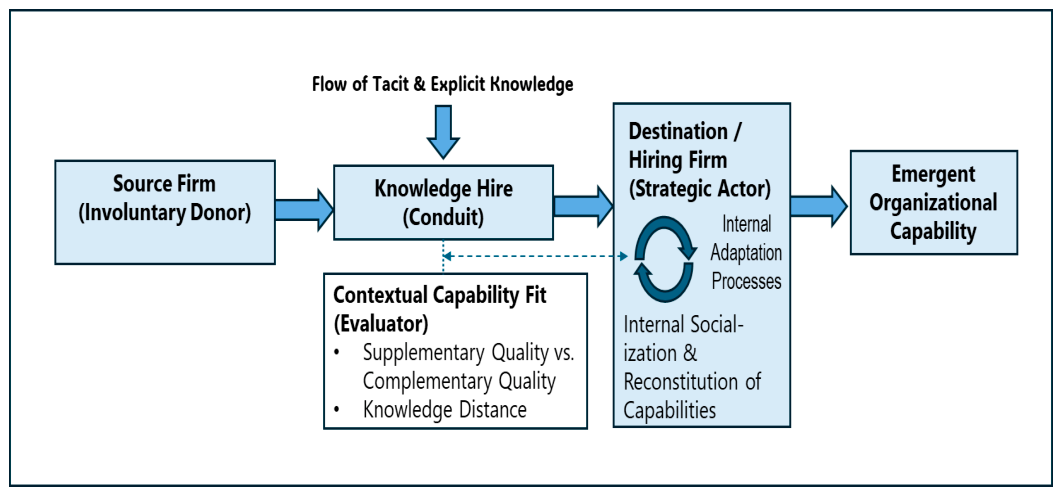
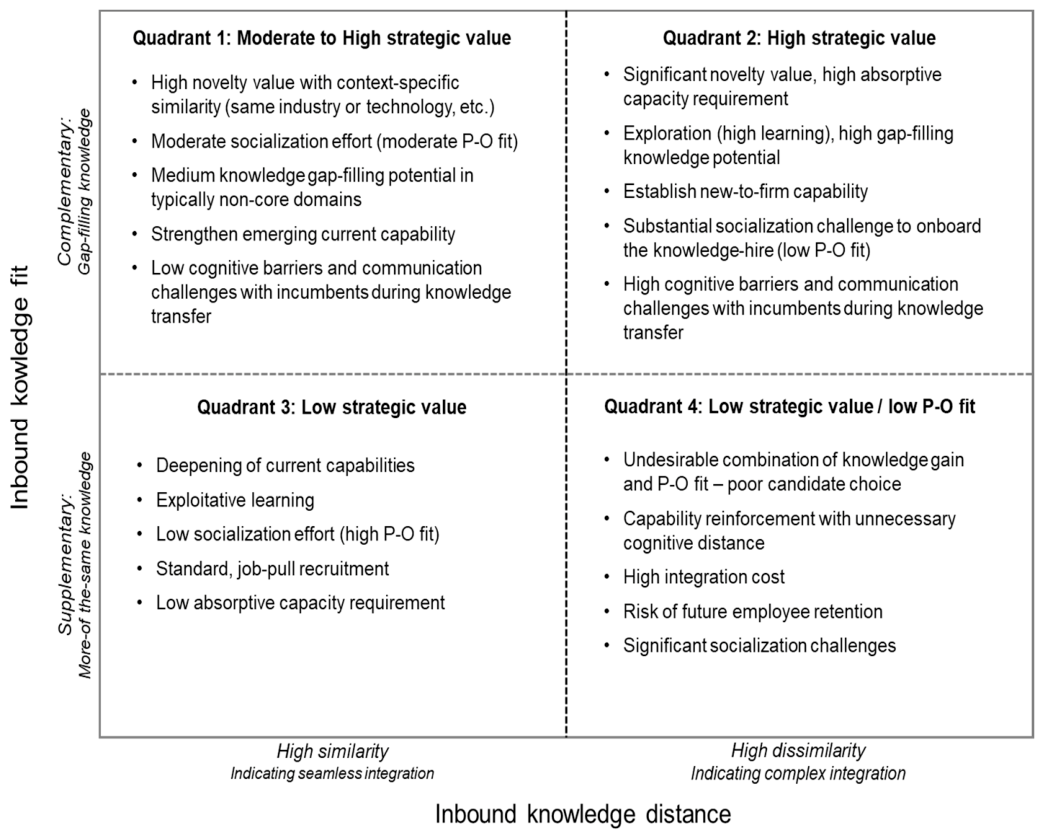
Proposition 1. Knowledge diffusion across firm boundaries through employee mobility is not a passive byproduct of hiring but the outcome of a deliberate knowledge acquisition strategy. As illustrated in Figure 1, the knowledge-centric recruitment (KCR) model constitutes a distinct form of strategic recruitment in which firms first identify valuable target capabilities at rival organizations and then selectively poach individuals who have directly participated in the enactment of those capabilities (as processes, approaches, methods, or routines). This targeted approach extends the learning-by-hiring perspective by emphasizing intentional capability sourcing rather than incidental knowledge spillover. Proposition 2. Contextual capability fit serves as the central evaluative and predictive mechanism of the KCR model. It enables hiring organizations to jointly assess the strategic value of an inbound capability and forecast the expected socialization difficulty of its recontextualization. As shown in Figure 2, the construct integrates two dimensions: (1) supplementary versus complementary quality relative to the firm’s existing knowledge base [3] and (2) knowledge distance—the cognitive or technological dissimilarity—between the source capability and the hiring firm’s current repertoire [8,9]. Moderate knowledge distance offers novelty and learning potential while remaining within absorptive capacity; excessive distance increases socialization costs and integration barriers [9,33]. By mapping potential knowledge-hires onto this framework, firms can identify the most appropriate recruitment targets. The preferred quadrant is contingent on the firm’s strategic urgency for the capability and the extent of existing internal knowledge coverage. In high-demand scenarios, firms may deliberately target higher knowledge distance or recruit multiple knowledge-hires simultaneously for the same capability cluster (e.g., a consulting firm’s hiring entire ‘Sustainability practice’ team from a rival with an aim to establish its own Sustainability practice). This dual predictive function transforms recruitment from a reactive staffing activity into a proactive, calculative tool for capability building and constitutes the principal novel contribution of the KCR model. The integrative review in
Section 2 revealed important limitations in the learning-by-hiring and employee mobility studies. These streams have largely relied on macro-level proxies such as patent citations and industry-wide analyses, providing valuable evidence of knowledge diffusion outcomes but offering limited insight into the deliberate, endogenous micro-processes through which firms identify, evaluate, and integrate external capabilities prior to hiring [
14,
15,
16,
17,
29]. In particular, scant attention has been paid to upstream activities such as external capability scanning and prioritization, or to the calculative evaluation of inbound knowledge relative to existing knowledge stocks.
The knowledge-centric recruitment (KCR) model proposed here directly addresses these gaps by conceptualizing recruitment as a proactive dynamic capability. As depicted in
Figure 1, the model foregrounds four interconnected micro-foundations—external capability scanning and prioritization, identification of target capabilities and knowledge-hires, evaluation through contextual capability fit, and expectations of adaptation during onboarding—that shift the focus from passive or serendipitous knowledge flows to intentional capability acquisition. By placing contextual capability fit at the core of the process,
Figure 1 visually illustrates how firms can move beyond macro-level mobility effects to enact targeted, calculative hiring that fills specific capability gaps while anticipating socialization challenges.
Figure 1 presents an overview of the full knowledge-centric recruitment (KCR) process. It illustrates how the Destination (hiring) Firm acts as a strategic actor that proactively scans for, evaluates, and integrates external capabilities through knowledge-hires. The model highlights the central role of contextual capability fit as the key evaluative mechanism within the broader flow of tacit and explicit knowledge.
The model shows how the Destination Firm acts as a strategic actor that proactively scans for, evaluates (via contextual capability fit), and integrates external capabilities via knowledge-hires. Contextual capability fit serves as the central evaluative mechanism that balances supplementary/complementary quality with knowledge distance to forecast both strategic value and socialization difficulty. Building on the overall process shown in
Figure 1,
Figure 2 details the core evaluative tool of the KCR model. The contextual capability fit matrix integrates two key dimensions: supplementary versus complementary quality and knowledge distance to help firms assess both the strategic value and the expected socialization difficulty of potential knowledge-hires.
Quadrant 1: High Complementary + Low Distance (Optimal Balance)
From the hiring firm’s perspective, this quadrant represents the most favourable combination when the firm seeks meaningful capability enhancement without excessive disruption. The inbound capability addresses important knowledge gaps while remaining relatively close to existing knowledge stocks, allowing smoother integration. Firms with moderate path dependence often prefer this quadrant as it balances novelty with feasible recontextualization.
Quadrant 2: High Complementary + High Distance (High Potential/High Risk)
This quadrant offers a significant strategic upside for firms pursuing radical capability renewal or facing urgent competitive pressures. Although the large knowledge distance increases socialization costs and integration challenges, firms with strong strategic intent and sufficient absorptive capacity may deliberately choose this option. Path dependence plays a critical role here; firms must be willing to break from established routines to capture the high novelty value.
Quadrant 3: High Supplementary + Low Distance (Safe Reinforcement)
This is the safest and least disruptive option from the hiring firm’s standpoint. The inbound capability reinforces existing strengths with high similarity, resulting in easy integration and low socialization effort. Firms with strong path dependence or those prioritizing stability and incremental improvement typically favour this quadrant.
Quadrant 4: High Supplementary + High Distance (Limited Value/High Friction)
This quadrant is generally the least attractive. The capability only reinforces existing areas, but with high cognitive distance, creating unnecessary integration costs without meaningful novelty. Firms rarely choose this option unless under very specific strategic constraints, as it conflicts with path-dependent preferences for efficiency.
4. Discussion
4.1. Central Contribution
The proposed knowledge-centric recruitment (KCR) model advances our understanding of how firms can deliberately leverage employee mobility for capability development. By conceptualizing KCR as a dynamic capability comprising four micro-foundations, external capability scanning and prioritization, identification of target capabilities and knowledge-hires, evaluation through contextual capability fit, and expectations of adaptation during onboarding, the model shifts the focus from passive learning-by-hiring to a proactive, calculative approach to knowledge acquisition.
A central contribution lies in the introduction of contextual capability fit as an original integrative construct. Unlike traditional person–organization fit perspectives that primarily address individual-level adjustment [
3,
4], contextual capability fit serves as a forward-looking evaluative lens. It simultaneously assesses the strategic value of an inbound capability (through supplementary and complementary quality) and forecasts the expected socialization difficulty (through knowledge distance). This dual predictive function addresses a key limitation in the existing literature, which has largely treated knowledge transfer as an ex-post outcome rather than a pre-hire calculable process [
5,
6,
7]. By integrating insights from knowledge distance [
8,
9] and absorptive capacity [
10], contextual capability fit offers firms a practical tool to balance novelty and integration feasibility. From a systems-thinking perspective, the model demonstrates clear functional interrelations and feedback loops among the micro-foundations, enabling emergent capability development and sustained corporate performance improvements.
The KCR model extends the learning-by-hiring literature by highlighting external capability scanning and prioritization as a critical upstream micro-foundation. While prior studies have documented the outcomes of hiring experienced talent [
11,
12,
13], they have paid limited attention to the strategic processes through which firms identify capability gaps and proactively seek individuals who embody the required knowledge. The model thus bridges macro-level mobility research and micro-level strategic action.
From a systems-thinking perspective, the four micro-foundations form an interconnected system with feedback loops: scanning informs prioritization, fit evaluation guides selection, socialization generates emergent capabilities, and performance outcomes feed back into future scanning. KCR can therefore be understood as a specific form of organizational learning [
14], in which knowledge-hires serve as vehicles for the transfer and rearticulation of routines that guide action at the host firm. This holistic view demonstrates how targeted HRM interventions can generate emergent firm-level outcomes such as sustained competitive advantage, innovation capacity, and capability regeneration.
4.2. Theoretical Contributions
This article makes several contributions to key theoretical streams. First, it advances the knowledge-based view and human capital resource literature by showing how individual-level tacit knowledge (sticky and causally ambiguous) can be deliberately transformed into firm-level capability through structured recruitment processes [
15,
16]. Second, it extends person–organization fit theory by repositioning complementary fit from a primarily individual-level adjustment mechanism [
3,
4] to a strategic capability-building tool. By integrating complementary fit with knowledge distance within contextual capability fit, the model shows how recruitment can address critical capability gaps and drive organizational renewal. Third, it reframes the learning-by-hiring stream [
1,
9,
11,
16] by shifting the focus from passive or serendipitous knowledge diffusion to a proactive, intentional capability-acquisition strategy. Collectively, these contributions respond to calls for a more integrated, systems-oriented understanding of how HRM practices contribute to organizational capability development and corporate performance.
4.3. Practical Implications
The KCR model offers organizations a practical framework for aligning recruitment strategies with broader organizational objectives. Rather than treating recruitment as a reactive staffing function, firms can deliberately connect capability needs identified through strategic planning to targeted hiring initiatives. Involving senior managers in the recruitment process enables the organization to cast a wider net for strategic talent and ensures that external capability scanning and knowledge-hire identification are closely coordinated with firm-level goals. This senior-level involvement transforms recruitment from a narrow HR activity into a strategic lever capable of delivering organizational-level outcomes that extend well beyond filling open positions, including capability renewal, accelerated innovation, and enhanced competitive positioning.
For practitioners, the model suggests implementing systematic external capability scanning through strategic audits or priority knowledge lists, applying contextual capability fit assessments during talent evaluation, and designing socialization processes that anticipate different levels of knowledge distance. The choice of recruitment quadrant should be contingent on the firm’s strategic urgency for the capability and the extent of existing internal knowledge coverage. In high-demand capability clusters, firms may deliberately pursue higher knowledge distance or recruit multiple knowledge-hires simultaneously. Organizations that master these micro-foundations can move beyond reactive hiring to treat recruitment as a core strategic capability for sustained competitive advantage.
4.4. Limitations and Future Research
As a conceptual article, this model requires empirical validation. Future research should examine the micro-foundations of the KCR model, with particular attention to socialization, recontextualization, and knowledge translation processes that occur after hiring. Longitudinal studies, especially qualitative approaches that glean insights from co-workers, coaches, line managers, and the knowledge-hires themselves, would be highly valuable for expanding our understanding of how tacit knowledge is actually transferred, adapted, and reconstituted in the host firm. Such research could also test how contextual capability fit predicts both short-term integration success and longer-term capability emergence. Additional work is needed to explore boundary conditions, including industry differences, firm size, and the role of organizational culture in supporting external capability scanning. Finally, comparative studies could examine how KCR practices differ across knowledge-intensive sectors, with particular attention to systemic feedback loops between HRM practices and corporate performance. Future modelling or simulation studies would be particularly valuable to demonstrate the dynamic functioning and performance outcomes of the proposed system.