Article

Evaluation of Anisotropic Turbulence Models for Flash-Boiling Ammonia Sprays for Clean Fuel and Conceptual Electric Vehicle Cooling Systems


by
Mongkol Kaewbumrung
1,
Chalermpol Plengsa-Ard
2 and
Wasan Palasai
3,*
1
Department of Mechanical Engineering, Faculty of Engineering and Architecture, Rajamangala University of Technology Suvarnabhumi, Phranakhon Si Ayutthaya 13000, Thailand
2
Department of Mechanical Engineering, Faculty of Engineering, Kasetsart University, Bangkok 10900, Thailand
3
Department of Mechanical Engineering, Faculty of Engineering, Princess of Naradhiwas University, Narathiwat 96000, Thailand
*
Author to whom correspondence should be addressed.
Energies 2026, 19(6), 1471; https://doi.org/10.3390/en19061471
Submission received: 17 January 2026 / Revised: 3 March 2026 / Accepted: 13 March 2026 / Published: 15 March 2026
(This article belongs to the Section E: Electric Vehicles)

Abstract

Ammonia (NH3) has emerged as a promising carbon-free fuel for next-generation green energy systems due to its high hydrogen density, ease of storage and transport, and compatibility with existing infrastructure. These attributes contrast with hydrogen, which presents major challenges related to storage, safety, and high-pressure handling. Thus, ammonia offers a more practical alternative for combustion-based applications. However, its low reactivity and complex vaporization behavior, particularly under flash-boiling conditions, pose challenges for accurate modeling. This study presents a comprehensive numerical investigation of liquid-ammonia spray behavior under a range of ambient pressures, encompassing both flash-boiling and non-flashing conditions. Simulations were conducted using the Lagrangian particle tracking method, coupled with various turbulence models (the renormalization group (RNG) family, k-ω family, ς f , V2F models) to evaluate their predictive performance. Validation against experimental data for liquid and vapor penetration demonstrated that the V2F model achieved the best overall balance between accuracy and computational efficiency. Under strong flash-boiling conditions (2 bar), rapid droplet breakup and notable cooling were observed, with droplet temperatures decreasing to approximately 235 K within a few millimeters of the nozzle. In contrast, the cooling effect was more moderate under non-flashing conditions at higher ambient pressures (10–15 bar). Although the current findings were based on numerical simulations, experimental studies are ongoing to validate and refine the modeling framework further. This work provided valuable insights into the coupled effects of turbulence, phase change, and thermal transport in superheated ammonia sprays. Future research will build upon these results by extending the model to NH3/H2 dual-fuel systems, refining turbulence-phase interaction models, and exploring the potential application of ammonia-based flash-boiling cooling systems for electric vehicle (EV) battery thermal management.

1. Introduction

The global transition toward sustainable and low-carbon energy systems has intensified the search for alternative fuels that are both efficient and environmentally benign. Among these candidates, ammonia (NH4) has emerged as a promising energy vector due to its carbon-free composition, high energy density, and compatibility with existing storage and distribution infrastructure [1]. Its versatility as both a direct combustion fuel and a hydrogen carrier positions ammonia as a compelling option for decarbonizing power generation, propulsion systems, and industrial processes [2]. Studies have highlighted that ammonia can substantially reduce greenhouse gas emissions while providing a reliable energy source for future low-carbon economies [3]. Recent advancements in ammonia spray combustion further substantiate its potential as a carbon-free fuel. For example, experimental and numerical investigations have demonstrated improvements in combustion stability and thermal efficiency, particularly in gas turbine applications. Specifically, co-combustion of ammonia with other fuels, such as methane, has been shown to enhance flame stability in gas turbines and similar combustion systems, thereby contributing to the development of more efficient and sustainable energy technologies [4,5]. At the same time, these studies have acknowledged the challenge of mitigating NOx emissions, emphasizing the importance of optimizing the combustion conditions and fuel blends to minimize pollutant levels while maximizing efficiency [6,7]. The accuracy of ammonia combustion prediction strongly depends on the spray injection process, which determines flow development, vaporization, and subsequent ignition behavior. Often, spray analysis is performed under non-reacting conditions to resolve flow dynamics and capture the influence of ambient pressure within combustion chambers [8,9]. Ammonia sprays are particularly complex due to coupled processes such as flash boiling, evaporation, and turbulence-flame interaction [10,11,12]. A central challenge lies in controlling emissions while ensuring efficient energy conversion, which requires a thorough understanding of ammonia flash-boil spray dynamics [13,14]. Flash boiling occurs when a high-pressure subcooled liquid is injected into an environment below its saturation pressure, triggering rapid nucleation, explosive atomization, and intense vapor formation [15,16]. Experimental studies have investigated both macroscopic and microscopic spray behavior under flare, transition, and non-flashing regimes. Based on their results, spray penetration and velocity increased with the pressure ratio in the flare regime but decreased in the transition regime, while higher pressure ratios produced larger and more uniform droplets [10]. Constant-volume chamber studies have confirmed that high ambient temperatures strongly influence flash boiling, inducing jet instabilities and complex evaporation dynamics. Typically, the spray develops through three distinct axial stages: an initial flash-boiling dominated phase, a suppression stage due to high-temperature evaporation, and a stabilized transition stage at elevated temperatures [17]. Furthermore, shadowgraphy experiments have revealed that nozzle diameter significantly affected spray morphology, with cone angles decreasing in the flare regime and increasing in the transition regime as ambient pressure rises [18]. Extended ammonia injection has been reported to enhance flame entrainment and facilitate stable diffusion combustion, highlighting the importance of injection timing and mixing for reliable ignition [19]. Other diagnostics, including droplet imaging, Mie scattering, and thermocouples, have indicated that flash-boiling ammonia results in rapid spray contraction, fine droplets (Sauter mean diameter, SMD ≈ 16 μm), and strong evaporative cooling that provide critical benchmarks for model validation [20]. In addition, Schlieren-based studies have confirmed that the ambient pressure governs spray regimes, while thermodynamic effects dominate the flare regime and aerodynamic forces govern the transition regime [21,22]. Furthermore, spray collapse phenomena at sub-saturation pressures highlight ammonia’s high latent heat and rapid vaporization behavior [23]. Despite advances in diagnostics, limitations persist in resolving fine-scale structures due to the transient, multiphase nature of flash boiling under engine-relevant conditions [24,25].
Therefore, computational fluid dynamics (CFD) has become an essential tool for investigating ammonia spray processes. Large eddy simulation (LES) within a Eulerian–Lagrangian framework has been applied to assess multiple phase-change models, with the combined Zuo and Langmuir–Knudsen formulation providing the closest agreement with experimental penetration length, spray morphology, and droplet temperature distribution, while capturing enhanced evaporation at low pressures [26]. Ammonia spray flows exhibit highly nonlinear behavior, necessitating turbulence models that can accurately resolve jet–gas interactions [14,27,28]. Advances include the integration of the discrete random walk model, which improves droplet size and velocity predictions, and LES with adaptive mesh refinement, which accurately captures atomization and ignition across nozzle sizes [29,30]. Furthermore, LES studies using the OpenFOAM software have demonstrated that in-nozzle flow effects and thermal breakup modeling enhance predictions of radial expansion and droplet evolution, particularly with refined grids [31]. Flash boiling has been confirmed to alter the penetration and droplet dynamics, with coupled Frossling and flash-boiling models in LES frameworks successfully predicting breakup and evaporation under unsteady conditions [32]. Reynolds-averaged Navier-Stokes (RANS) studies have been used to determine that RNG and realizable k-ε models enhance penetration predictions compared to the standard k-ε model, although parameter tuning is still necessary [33]. Additionally, grid-sensitivity studies have confirmed that mesh refinement is critical for accurate phase-change resolution [34]. In parallel, efforts have extended to premixed ammonia–hydrogen combustion in swirl-stabilized burners, where Reynolds stress models (RSM) had strong agreement with LES in predicting velocity, flame structure, and NOx emissions while balancing accuracy and computational cost [35,36]. Notably, RNG k-ε models have proven effective in capturing non-reacting swirl flows [37]. Beyond combustion, ammonia’s role in electric vehicle (EV) thermal management has gained increasing attention. A novel ammonia boiling-based battery thermal management system (BTMS) using aluminum cold plates was proposed to improve EV battery cooling. In this design, liquid ammonia evaporates within channels between cells, absorbing heat and stabilizing battery temperatures. Then, the generated vapor is routed to an onboard generator for electricity production. The ammonia-based BTMS demonstrated superior thermal performance compared to mini-channel liquid cooling, air cooling, and direct boiling systems [38]. Earlier studies confirmed the dual benefits of ammonia-based thermal systems, demonstrating their capability to provide effective battery cooling while simultaneously enabling power regeneration, thereby enhancing both safety and energy efficiency in electric and hybrid vehicles [39,40]. Additional innovations include ammonia sorption thermal batteries for compact heat storage [41] and ammonia flow batteries with foam copper electrodes, which improve thermo-electric conversion and discharge efficiency under regenerative conditions [42]. Furthermore, ammonia sorption thermal batteries and Phase change materials-based BTMS reviews have emphasized the opportunities for innovation while noting unresolved challenges in safety, control, and integration [43,44,45].
Previous CFD studies on flash-boiling sprays have largely relied on RNG k-ε turbulence models coupled with KH–RT breakup models [11,25,46]. While these approaches have produced useful results, discrepancies remain in predicting vapor and liquid penetration, particularly under flash-boiling conditions [47,48]. In addition, sensitivity analyses of turbulence coefficients have been limited in scope. To address these gaps, the current study was based on the hypothesis that spray-ambient interactions are governed by highly nonlinear exchanges of momentum and energy from the moment of injection. Although relaminarization is unlikely under engine-relevant conditions [49,50,51], turbulence decay and spray structural transitions suggest that advanced turbulence models may offer improved predictive accuracy. In particular, models, such as V2F, which resolve near-wall turbulence and anisotropic effects more accurately, are hypothesized to enhance predictions of flash-boiling spray penetration. Accordingly, the objective of the current study was to carry out a systematic evaluation of advanced turbulence models, with a particular emphasis on the V2F model, to enhance the prediction of ammonia spray dynamics across a wide range of ambient pressures. This study included comparative assessments of penetration, SMD, and turbulence statistics against experimental data, with the ultimate goal of refining predictive models for ammonia sprays in both combustion systems and emerging green energy applications such as EV thermal management.

2. Mathematical Formulation of the Euler-Lagrange Framework

In spray simulations using the Euler-Lagrange framework, the gas phase is calculated by solving the transient Reynolds-averaged Navier-Stokes equations along with the energy transport equations for the gas mixture. The motion of liquid droplets is tracked using the Lagrangian particle tracking (LPT) method. The set of governing equations is:
ρ t + ρ u i x i = S m a s s
ρ u i t + ρ u i u j x j = p x i + σ i j x j + S m o m , i
ρ e t + u j ρ e x j = p u j x i + σ i j u i x j + x j K + c p μ t Pr t T x j + x j ρ D m m h m Υ m x j + S e n g
σ i j = μ u i x j + u j x i + μ 2 3 μ u k x k δ i j
where ρ , p , T and e are the density, pressure, temperature and internal energy of the gas phase, respectively, u i is the velocity component in Cartesian coordinates, c p is specific heat at constant pressure, Pr t is the turbulent Prandtl number, δ i j is the Kronecker delta, σ i j is Reynolds stress tensor, μ is the viscosity, μ is the dilatational viscosity, K is the thermal conductivity, D m is the species mass diffusivity of species m , Υ m is the mass fraction and h m is the species specific enthalpy, S m a s s , S m o m , i , and S e n g are the mass, momentum and energy sources term from turbulent gas-liquid interaction, respectively. In another publication, both the RNG k ε and standard k ε turbulence models were widely used to predict the flow behavior of ammonia spray injection; however, discrepancies were observed between the simulation results and the experimental data, indicating limitations in the predictive accuracy of these models for this application [11,35,37,46]. Based on our hypothesis outlined above, adding nonlinear transport terms may help to reduce the current gap in the accuracy of turbulence models. We believe that calibrating turbulence model parameters can further improve predictive performance. To test this, we included several turbulence models that have not yet been studied widely for ammonia combustion, such as the rapid distortion model (RDM), ς f , and V2F. In addition, well-established models that have already undergone parameter calibration, such as RNG k ε , SST k ω , and the standard k ε model, were included for comparison in this investigation. All of the additional transport equations will be discussed in the next section.

3. Mathematical Formulation of Turbulence Modeling

This section presents the turbulence models considered in the current study. As part of the investigation methodology, multiple turbulence models were evaluated to assess their predictive accuracy by comparing the simulation results with available experimental data, including vapor penetration, liquid penetration, and the SMD. Liquid ammonia (NH3) was injected into the computational domain, following the experimental setup reproduced from Zembi et al. [15,52]. The turbulence models tested in this study were STD k ε , SST k ω , RNG k ε , realizable k ε and V2F. The detailed formulation and governing equations are available in the Converge CFD V4.0 manual [53] and are not repeated here. In contrast, the turbulence equation models of rapid distortion RNG k ε and ς f are less commonly documented in the context of ammonia spray simulations. Therefore, the full model formulations for these two turbulence models are provided and described in detail here to support reproducibility and ensure clarity for future researchers.

3.1. Rapid Distortion RNG k ε Model

Initially, the RNG k ε turbulence model was developed to describe incompressible flows. However, it has been extended to account for compressibility effects, making it widely applicable in simulations of internal combustion engines. Based on rapid distortion theory, the model was modified by adjusting the coefficient Cε3 to better capture turbulence behavior under high-strain-rate conditions [53,54]. The system of transport equations can be written as:
ρ k t + ρ u i k x i = C μ ρ u i ˜ x j + u j ˜ x i k 2 ε 2 3 δ i j ρ k + C μ ρ k 2 ε u k ˜ x k u i x j + 1 Pr k x j μ + C μ ρ k 2 ε k x j ρ ε + C s 1.5 S s
ρ ε t + ρ u i ε x i = x j μ + μ t Pr ε ε x j 2 3 C ε 1 C ε 3 + 2 3 C μ C η k ε u k x k ρ ε u i x i + C ε 1 C η u i x j τ i j C ε 2 ρ ε + C s S s ε k
where
C η = η 1 η / η o 1 + β η 3
η = k ε 2 S i j S i j
τ i j = 2 μ t S i j 1 3 δ i j u k x k
C ε 3 = 1 + 2 C ε 1 1.5 γ 1 + 1 δ 6 C μ C η η 3
and S s is a source term that represents interactions of the turbulence with the discrete phase (spray), C S is a corresponding coefficient that appears in both the k and ε transport equations, the factor of 1.5 is an empirical constant, and γ is the ratio of specific heat.
The model coefficients are defined as:
C μ = 0.0845 C ε 2 = 1.42 C ε 2 = 1.68
β = 0.012 η o = 4.38

3.2. ς f Model

Primarily, this model focuses on improving the computational performance of the V2F model, specifically related to sensitivity to new wall grid spacing by solving a transport equation of the velocity scale ratio ( ς ) and applying a quasi-linear pressure-strain model in the f equation. In this model, we still solve the k and ε transport equation but we have modified ε by imposing the Kolmogorov time and length scale as lower bounds on the turbulence dissipation. The transport equation for ς , the equation after modification of ε and the elliptic relaxation function are described as, respectively:
ρ k t + ρ u j k x j = Υ ρ ε + x j μ + μ t σ k k x j
ρ ε t + ρ u j ε x j = C ε 1 Υ C ε 2 ρ ε τ + x j μ + μ t σ ε ε x j
ρ ς t + ρ u j ς x j = ρ f ρ ς k Υ + x j μ + μ t σ ς ς x j
L 2 x j f x j f = 1 τ C 1 + C 2 Υ ε ς 2 3
where
μ t = C μ ρ ς k τ
τ = max min k ε , 0.6 6 C μ 2 S i j S i j ζ , C τ μ ε 1 / 2
L = C L max min k 3 / 2 ε , k 1 / 2 6 C μ 2 S i j S i j ζ , C η μ 3 ε 1 / 4
Finally, the model constant coefficients in Equations (11)–(17) are defined as:
C 1 = 0.40 C 2 = 0.65 σ k = 1.00
C μ = 0.22 C η = 85.00 σ ε = 1.30
C ε 2 = 1.90 C L = 0.36 σ ζ = 1.20
C τ = 6.00 C ε 1 = 1.40 1.00 + 0.012 / ς
Further details on the model coefficients can be found in the Converge CFD manual [53].

3.3. LPT Approach for Liquid Phase

The LPT method tracks the movement of Lagrangian parcels throughout the computational domain. Each parcel represents a certain number of droplets with identical properties such as diameter and velocity. The parcels are treated as point masses and thus contain no volume. Position and velocity are updated at each time step, based on differential equations for trajectory and momentum [53]:
d x p d t = u p
m p d u p d t = C D π D p 2 8 ρ g u g + u p u g u p + m p g 1 ρ g ρ p
where u p is the parcel velocity, m p is the parcel mass, x p is the parcel position from the Eulerian flow field, u g is the gas velocity, and the drag coefficient is calculated based on the Schiller-Naumann drag model, which is considered a standard model for sparsely distributed spherical parcels:
C D = 0.424 Re r e l > 1000 24 Re r e l 1 + 1 6 Re r e l 2 / 3 Re r e l 1000

3.4. Evaporation and Boiling Processes

The evaporation and flash boiling processes were modeled based on heat and mass transfer between the liquid droplet and the surrounding gas. In general, evaporation occurs when the droplet surface temperature reaches the local saturation temperature, with heat from the surrounding gas driving vaporization at the interface. In flash boiling, the liquid is in a superheated state, which means its temperature exceeds the boiling point at the local ambient pressure. When exposed to this lower-pressure environment, rapid nucleation and bubble growth occur within the droplet, leading to explosive breakup and greatly enhanced vaporization [28]. The model captures both mechanisms by accounting for external heat transfer to the droplet surface (subcooled condition) and internal energy redistribution within the superheated droplet condition [11,55]. These processes are described by:
d r p d t = ξ e v a p ω ˙ e v a p ξ b o i l ω ˙ b o i l
where ω e v a p and ω ˙ b o i l are the rates of evaporation and boiling, and flash boiling, respectively, ξ e v a p and ξ b o i l are the evaporation and boiling, and flash boiling control parameters, respectively. The droplet evaporation rate of the NH3 liquid droplet was modeled based on:
ω ˙ e v a p = ρ D 2 ρ l r p Γ v , s Γ v , 1 Γ v , s 2.0 + 0.6 Re p 0.5 μ g ρ g D g 1 / 3 ln 1 + Γ v , s Γ v , 1 Γ v , s Γ v , s Γ v , 1 Γ v , s
where Dg is the diffusion coefficient of the gas mixture, Γ v , is the vapor mass fraction far away from the droplet surface, and Γ v , s is the vapor mass fraction at the droplet surface, which is obtained from the theory of the vapor-liquid equilibrium based on:
Γ v , s = 1 + p p s 1 M W g M W N H 3 1
where p s is the saturation vapor pressure and M W g and M W N H 3 are the molar mass of the ambient gas and the ammonia vapor, respectively. During evaporation, the temperature of the droplet changes over time. The droplet temperature was calculated assuming that the temperature inside the droplet remains uniform throughout, without any variation from the center to the surface, using the energy conservation equation:
c p , l m p d T p d t = A p Q p 4 π ρ l r p 2 ω ˙ e v a p H v a p
where c p , l is the liquid specific heat capacity, T p is the droplet mean temperature, H v a p is the latent heat of vaporization, and Q p is the heat conduction rate, which was evaluated from the relation:
Q p = λ g T g T p 2 r p 2.0 + 0.6 Re p 0.5 Pr g 1 / 3 ln 1 + Γ v , s Γ v , 1 Γ v , s Γ v , s Γ v , 1 Γ v , s
where Pr g is the Prandtl number of the ambient gas defined by Pr g = c p , g μ g / λ g , in which c p , g and μ g are the specific heat capacity and ambient gas viscosity, respectively.
Typically, in droplet boiling, when the droplet temperature exceeds the boiling point at the local pressure, a conventional boiling model is used to calculate the boiling rate. The formulation is based on the assumption that phase change occurs at the droplet surface once the superheat condition is met:
ω ˙ b o i l = λ g ρ l c p , g r p 1 + 0.23 Re p ln 1 + c p , g T g T p H v a p
In this model, once the droplet temperature reaches its boiling point, it is assumed to remain constant at that temperature. Unless otherwise specified, the conventional boiling process has been simplified by treating the droplet as continuously boiling from that point onward [11,43,53].

3.5. Liquid Flash Boiling Models

The following subsection outlines the methodology used to model liquid flash boiling. The droplet vaporization model predicts how the droplet radius changes over time. This study applied the Frossling correlation to estimate the vaporization rate and to evaluate the rate of droplet size reduction over time. The Frossling correlation applied was expressed as:
d r o d t = B d α spray ρ g D 2 ρ l r o 2.0 + 0.6 Re d 1 / 2 μ a i r ρ g D 1 / 3 ln 1 + B d B d
where α spray is a scaling factor for the mass transfer coefficient, ρ 1 and ρ g are the discrete (liquid) phase and continuous (gas) phase densities, respectively, D is the mass diffusivity of the liquid vapor in air, and we define B d as:
B d = ψ 1 ψ 1 1 ψ 1
where ψ 1 is the vapor mass fraction at the droplet’s surface and ψ 1 is the vapor mass fraction. A flash boiling model developed by Price et al. [56] was used to model the flash boiling process. In this model, the total vaporization rate d M / d t represents the rate of change of the drop mass as the sum of the subcooled evaporation rate d M s c / d t and the superheated evaporation rate d M s h / d t , defined as:
d M d t = d M s h d t + d M s c d t
Under superheated conditions, the droplet’s internal temperature is assumed to remain uniform. In contrast, the surface temperature is set equal to the boiling temperature of the fuel at the corresponding ambient pressure. The subcooled term accounts for heat transfer from the surrounding gas to the droplet surface, whereas the superheat term represents heat transfer from the droplet core to its surface. The subcooled term was calculated as:
d M s c d t = 2 π r p p D i T f R f ln p p v p p s 2 + 0.6 Re p 0.5 S c g 0.33
where Re is the Reynolds number, S c g is the Schmidt number, D i is binary diffusivity, T f is the vapor film temperature, R f is the vapor film specific gas constant, p v and p s are the partial vapor pressure of NH3 in the computational cell and temperature dependent saturation pressure of NH3, respectively.
The subcooled term was calculated based on the drop density and the radius rate of change from the specified Frossling correlation. The superheat evaporation term was calculated as:
d M s h d t = 4 π r d 2 α T T b H L
where H L is the latent heat of the liquid vaporization and T b is the boiling temperature. The heat transfer coefficient α was a scaled form of the empirical relation:
α = 760 T T b 0.26 when   0 ( T - T b ) 5 27 T T b 2.33 when   5 ( T - T b ) 25 13800 T T b 0.39 when   ( T - T b ) 25
The uniform temperature model, which Converge CFD v4.0 uses to calculate the droplet temperature for all droplets up to a maximum radius applies the following energy balance:
A ¯ d Q d = c d , l m d d T d d t H L d m d d t
where A d is the droplet surface area, c d , l is the liquid heat capacity, T d is the droplet temperature, md is the drop mass, and HL is the latent heat of vaporization. More details on the original theory are available in the Converge CFD manual [53].

4. Material Properties and Methods

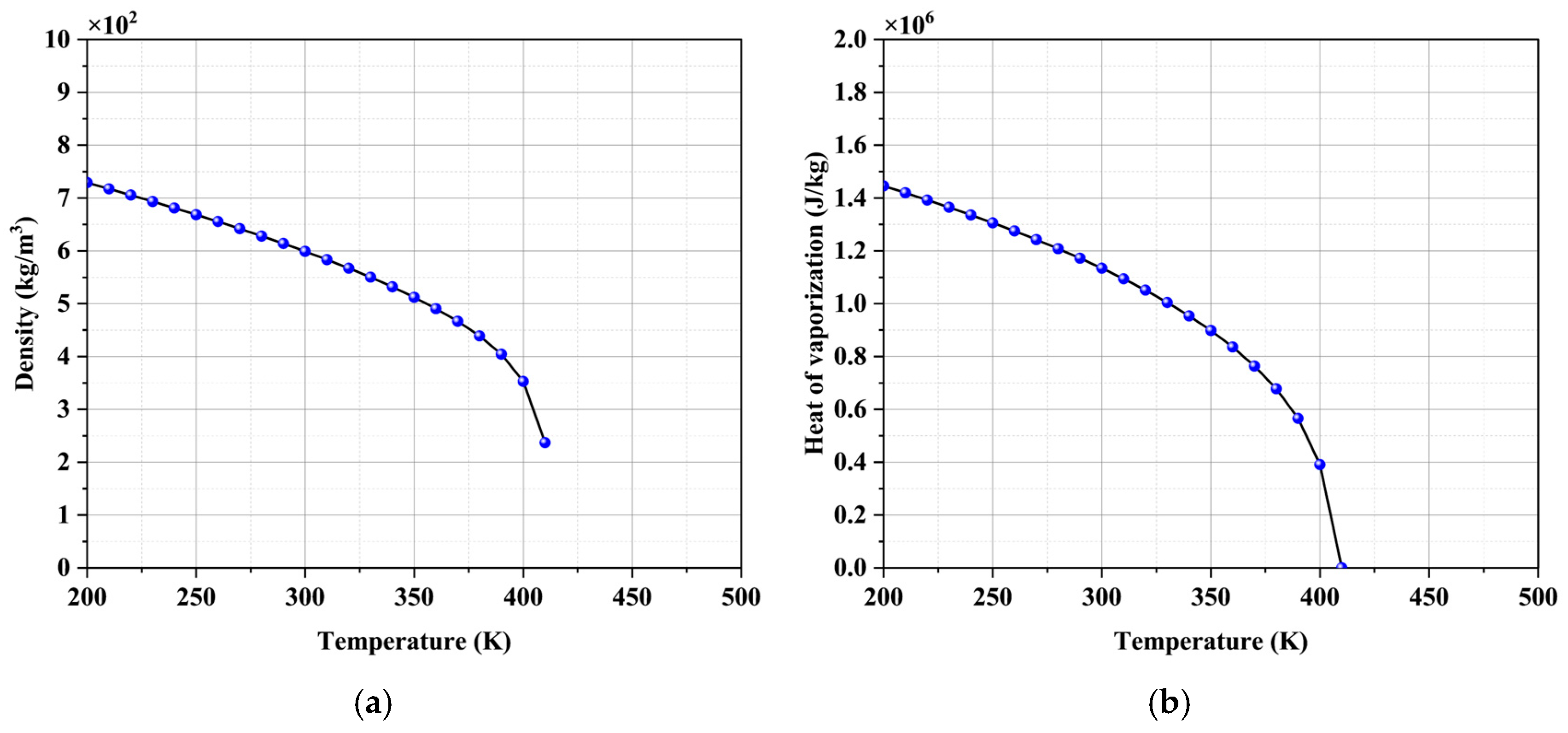
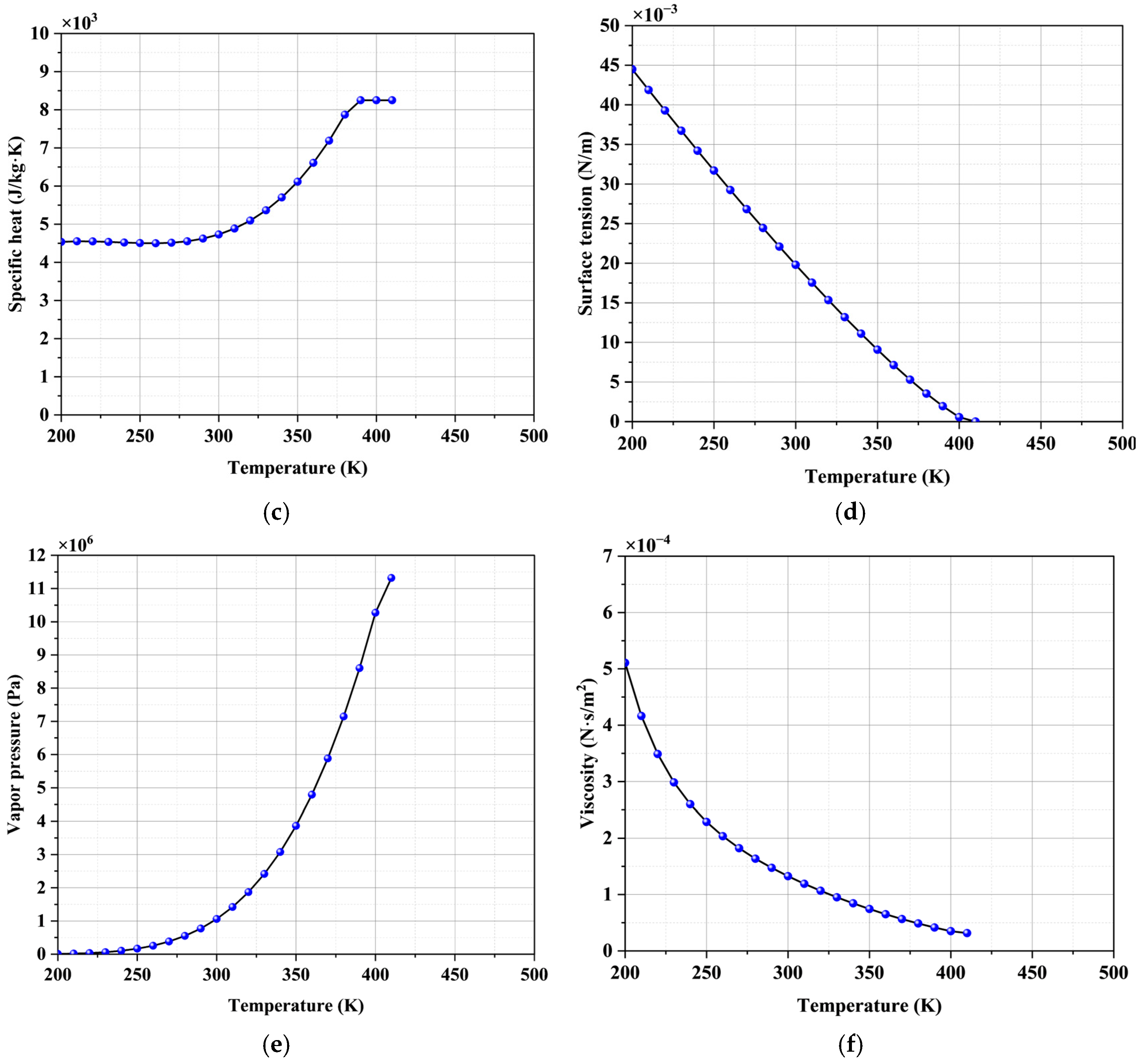
The Eulerian-Lagrangian two-phase flow framework was applied, incorporating source terms for heat, mass, and momentum exchange, as described by He et al. [8]. The thermophysical properties for liquid ammonia were directly sourced from the Converge CFD v4.0 material database, consistent with the validated dataset used by Zembi et al. [15,52], as illustrated in Figure 1.
Table 1 summarizes five simulation cases designed to investigate flash-boiling regimes. Each case involved liquid-ammonia injection at 120 bar and 293 K, with the ambient temperature fixed at 293 K. The ambient pressure was varied from 2 to 15 bar, and the flash-boiling intensity was characterized by the pressure ratio (Rp), defined as the ratio of the saturation vapor pressure of ammonia at the injection temperature to the ambient pressure. This parameter serves as a key indicator of the degree of superheating and its effect on spray behavior. In this study, the flash boiling phenomenon by R p = P v T L N H 3 / P a when R p > 1.0 are described by the presence of flash boiling. The case with 2 bar ambient pressure (Rp = 4.285) corresponds to a strong flash boiling situation [15,52].

5. Grid Independence Analysis

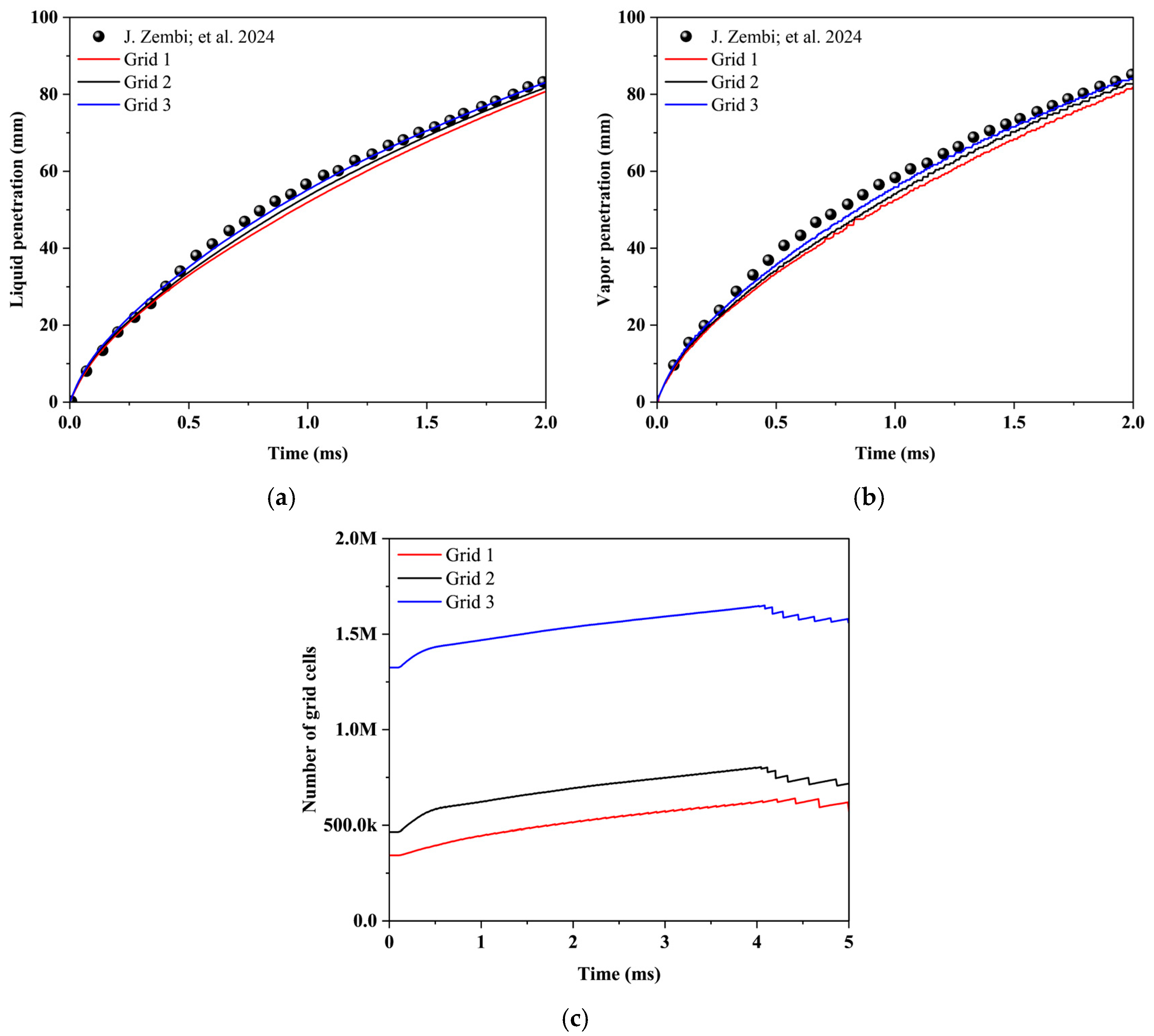
All simulations were conducted using the Converge CFD v4.0 software. A grid independence study was performed at an ambient pressure of 2 bar to ensure numerical accuracy and to minimize mesh-induced uncertainties using Case 5 with the V2F turbulence model. Initially, the base grid size was set to 2.0 mm and progressively refined to minimum grid sizes of 0.5 mm, 0.25 mm, and 0.125 mm. Adaptive mesh refinement was activated based on velocity and temperature gradients to improve the resolution in regions with high flow gradients. Spray penetration was used as a reference indicator for comparison. Based on the results, as shown in Figure 2, reducing the minimum cell size below 0.125 mm produced negligible changes in key spray characteristics, suggesting mesh convergence [31]. Consequently, a minimum grid size of 0.125 mm was adopted in all subsequent simulations to strike a balance between computational cost and accuracy.
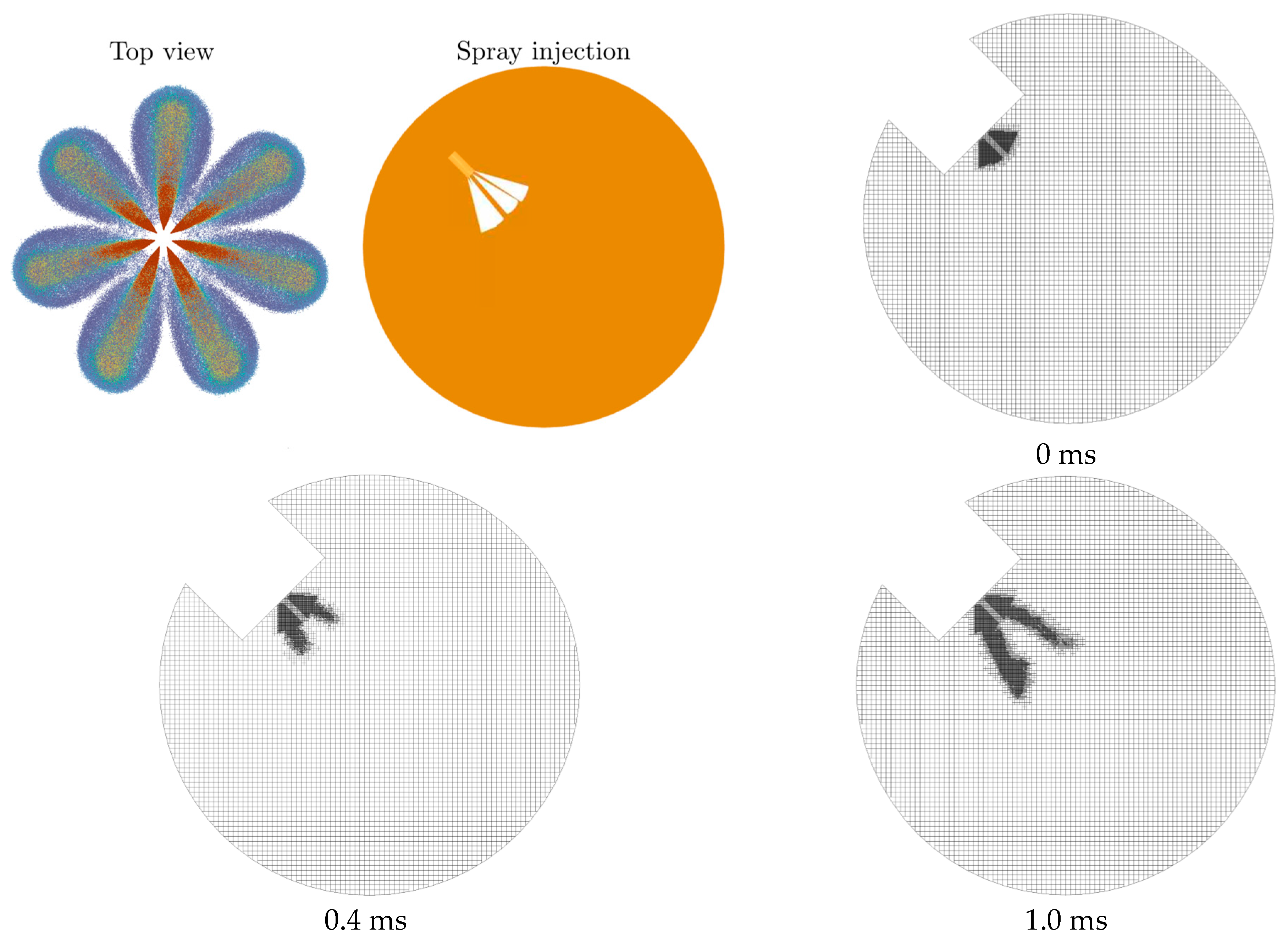
For the boundary conditions, a cylindrical constant-volume chamber was defined with a diameter of 80 mm and a height of 95 mm. The spray injection pressure was 120 bar with seven holes of 150 μm in diameter. No-slip wall conditions were applied at any boundary and adiabatic conditions were assumed unless explicitly stated otherwise. The injector nozzle was defined as a mass flow inlet with time-dependent injection profiles. Ambient gas conditions were initialized based on experimental pressure and temperature settings corresponding to the flash-boiling and non-flash-boiling scenarios, as described by Zembi et al. [15,52]. All simulations were initialized with a pre-defined quiescent environment to isolate the spray development phenomena. The computational domain, boundary condition, initial grid size and final grid size are shown in Figure 3.
A numerical study on the spray characteristics of liquid ammonia was conducted using varying model constants. The initial and boundary conditions for each case are summarized in Table 1.

6. Numerical Framework and Boundary Conditions

This section describes the numerical framework and boundary conditions used in the simulation study of flash-boiling liquid-ammonia sprays. All simulations were performed using the Converge CFD v4.0 software within an Eulerian-Lagrangian framework. The modeling approach consisted of spray breakup and evaporation models, liquid parcel collision handling, and numerical schemes, as summarized in Table 2. The simulation setup and validation were designed to replicate experimentally relevant conditions reported by Zembi et al. [15,52]. For the gas phase, the compressible RANS equations were solved using the finite volume method with a collocated variable arrangement. Pressure–velocity coupling was achieved through the pressure-implicit with splitting of operators algorithm, ensuring accurate resolution of mass and momentum conservation.
The simulations were performed on the WATA High-Performance Computing Cluster at Kasetsart University, Bangkok, Thailand, which is equipped with 32 AMD EPYC 7443 processors and operates using a CentOS 7 environment. Details regarding computational time usage for each case are presented in the Section 7.

7. Results and Discussion

This section presents the simulation results for the flash-boiling ammonia sprays under varying injection pressures, nozzle diameters, ambient temperatures, and turbulence models. All cases were simulated using the Converge CFD v4.0 software, using the validated mesh settings and boundary conditions referenced from experimental studies. The analysis focused on the key spray characteristics of liquid and vapor penetration, droplet distribution, and gas field properties. A comparative assessment of different turbulence models was used to evaluate their predictive accuracy levels under both flash-boiling and non-flash-boiling conditions. The following sections consist of the validation of computational results, a detailed interpretation of the findings, a discussion of key phenomena, and future directions for model development and research.

7.1. NH3 Spray Penetration Validation

All numerical curves were evaluated, considering a 99% liquid fuel mass fraction for calculating liquid penetration and a 0.10% vapor fuel mass fraction for calculating vapor penetration.
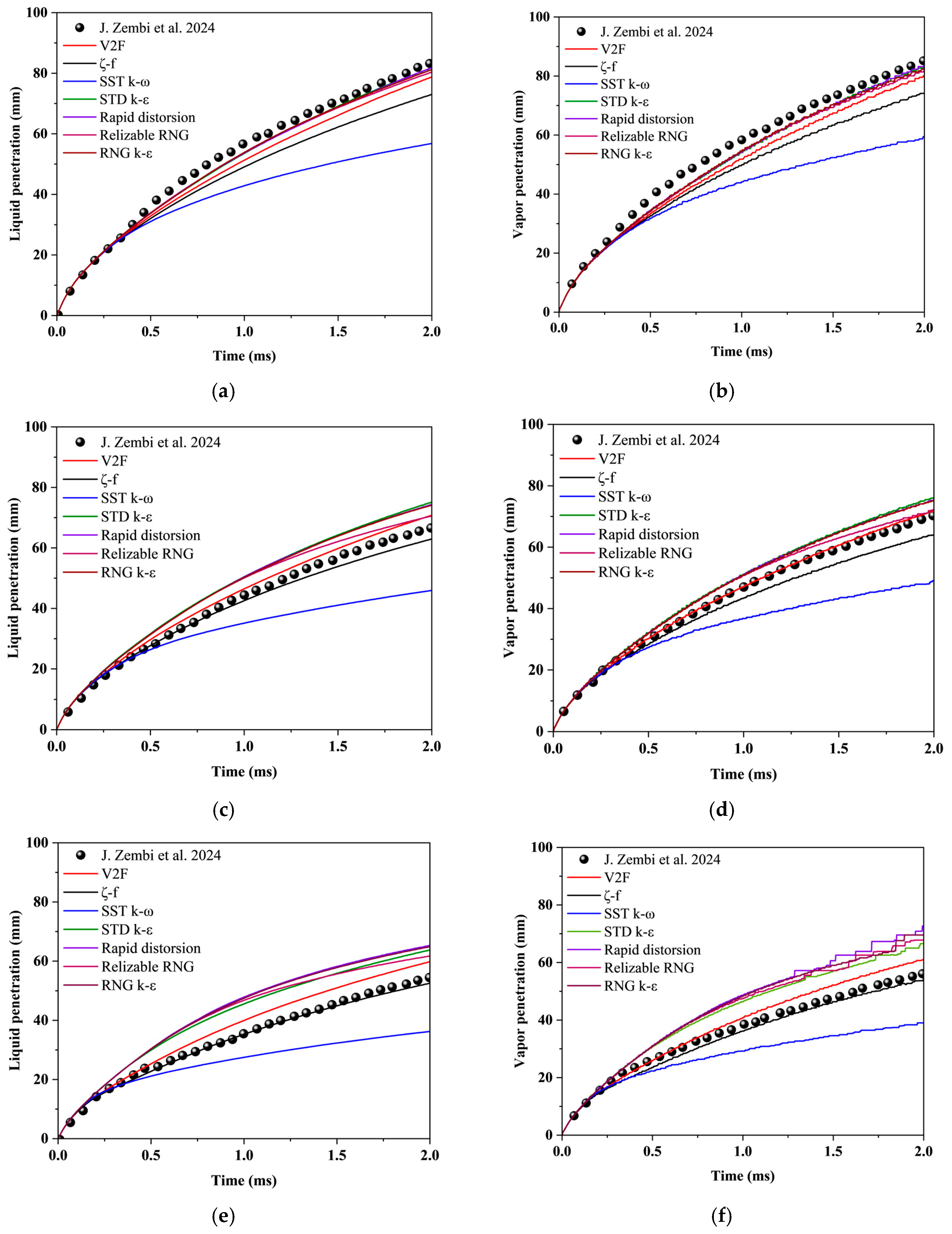
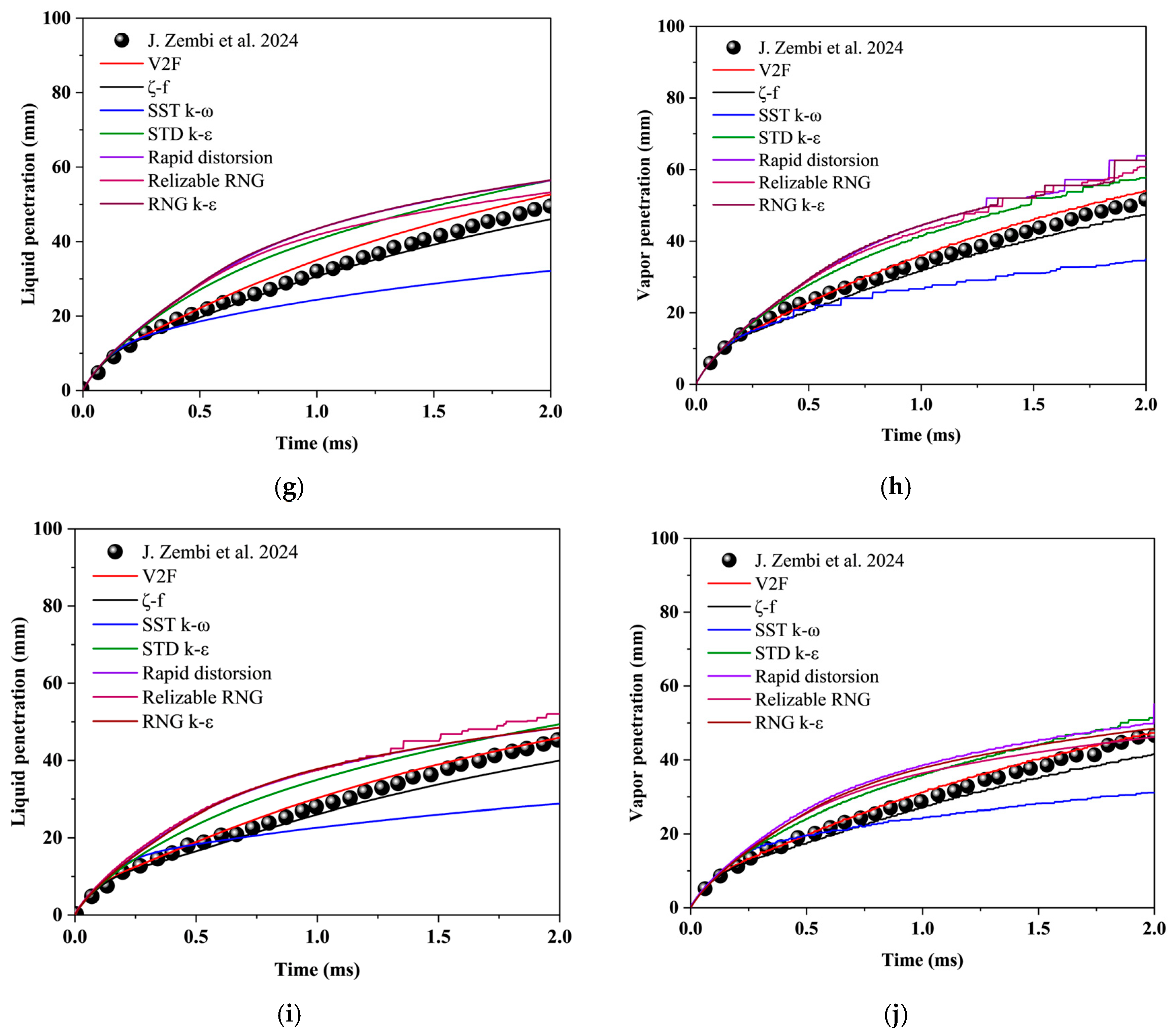
The effects of various turbulence models on liquid and vapor penetration during liquid-ammonia injection were analyzed and compared with experimental data, as illustrated in Figure 4. At 2 bar, the simulations using the standard k ε , rapid distortion RNG, realizable RNG, and RNG models showed strong agreement with the experimental results for both liquid and vapor penetration, particularly up to 2 ms after the start of injection. These models provided the most accurate predictions in terms of penetration length and trend alignment. In contrast, the SST k ω model produced the least accurate results. The ς f and V2F models produced moderately accurate predictions, underestimating slightly compared to the experiments. At 4 bar, the behavior changed. For liquid penetration, the standard k ε , rapid distortion RNG, realizable RNG, and RNG k ε models began to overpredict penetration after approximately 0.25 ms. The SST k ω model remained the least accurate. The V2F model slightly overpredicted, while the ς f model slightly underpredicted the penetration length. For vapor penetration, the general trend remained similar to that of liquid penetration. Notably, the V2F model showed excellent agreement with the experimental data, making it the best-performing model under these conditions. At higher ambient pressures (7, 10, and 15 bar), the simulation results followed trends similar to those observed at 4 bar. The V2F model continued to perform well across all conditions, while the ς f model consistently demonstrated strong agreement with the experimental measurements, particularly for vapor penetration. From these findings, it can be concluded that the V2F and ς f turbulence models provided the most accurate predictions for both liquid and vapor penetration in flash-boiling ammonia sprays. Although turbulence modelling of flash boiling remains challenging, these two models offer promising potential. Their transport equations and model parameters should be refined further to enhance predictive capability in future work.

7.2. SMD Validation

This section discusses the reliability of the numerical framework in capturing spray atomization behavior based on a validation of the predicted SMD against available experimental data. SMD is a critical parameter for characterizing droplet size distribution and directly influences evaporation rate, NH3-air mixing, and overall combustion efficiency [15,52]. Accurate prediction of SMD is crucial, particularly under flash-boiling conditions, where rapid phase changes can greatly alter the dynamics of droplets. The following analysis compares the simulation results from various turbulence models with experimental benchmarks, thereby evaluating the capability of the selected turbulence and spray models to reproduce realistic atomization behavior.
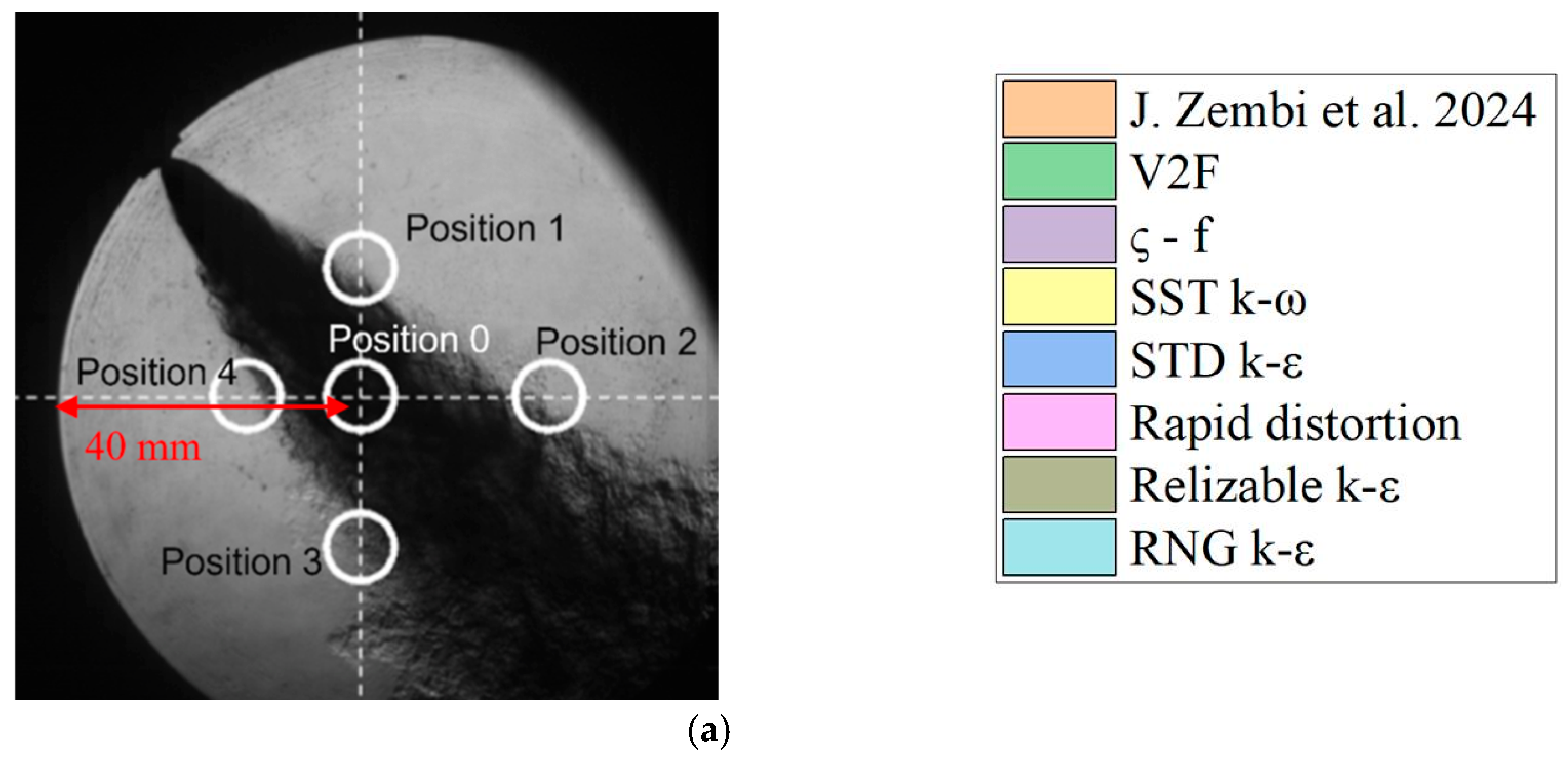
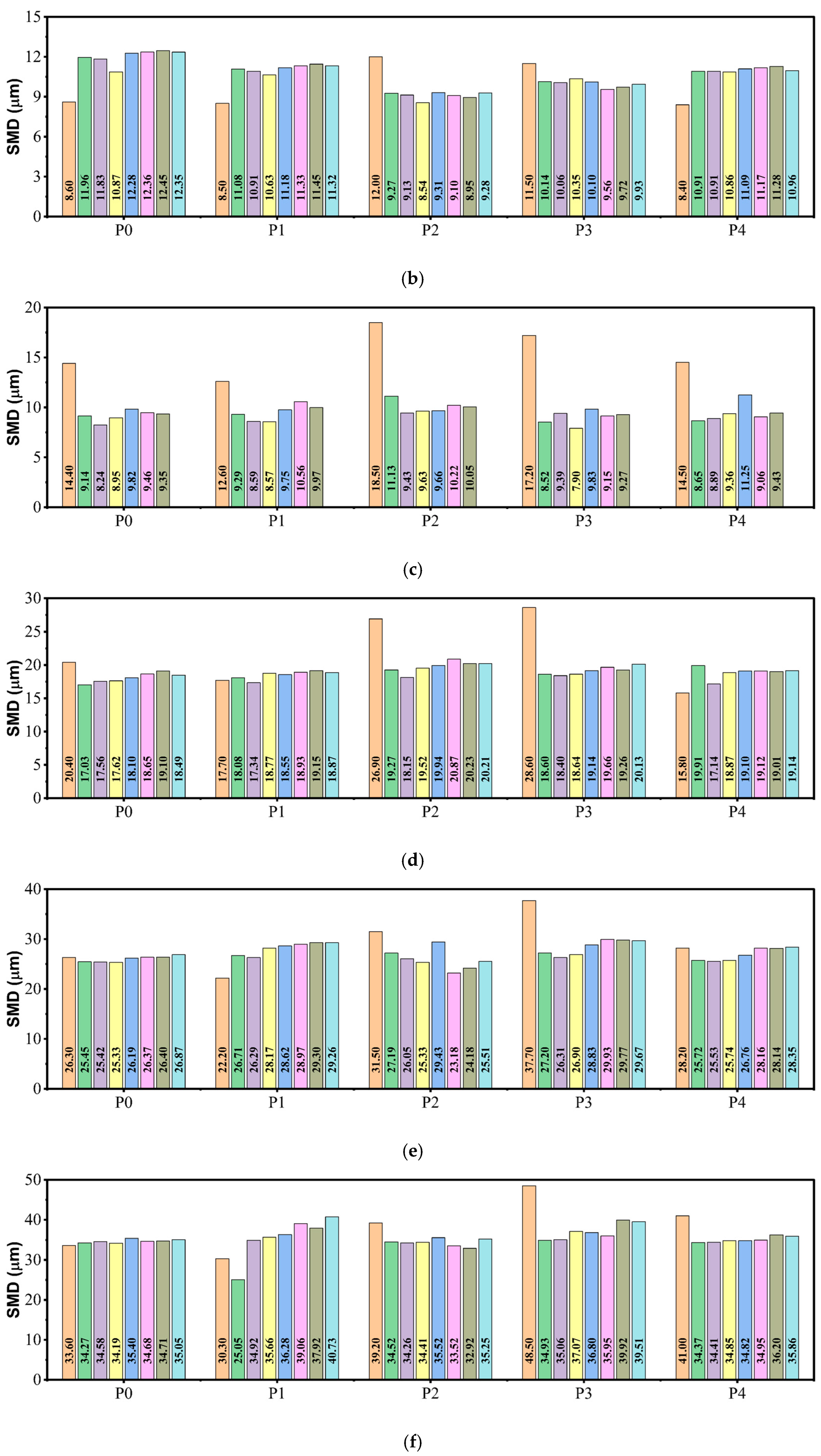
The computational results were reproduced based on previous experimental data to validate the predicted SMD, as shown in Figure 5, across five measurement locations. A range of turbulence models was used to investigate their effect on the accuracy of their SMD predictions. The findings indicated consistently that across all ambient pressure conditions, the numerical simulations tended to underpredict the SMD compared to experimental measurements. This observation aligned with findings of variation in SMD results reported in other studies [52,56], highlighting that accurately predicting SMD remains a major challenge in spray modeling. This underprediction suggested limitations in the current theoretical formulations and numerical implementations, particularly in the interaction between turbulence models, boiling and flash boiling models, and evaporation sub-models. These findings underscored the need for further refinement of the physical models and numerical calibration, particularly in capturing the complex interactions between turbulence, spray dynamics, and phase-change phenomena. Future work should focus on improving the coupling strategies between the energy and momentum equations, refining transport formulations, and enhancing the breakup and evaporation models, especially under challenging conditions such as flash boiling and superheated spray environments.
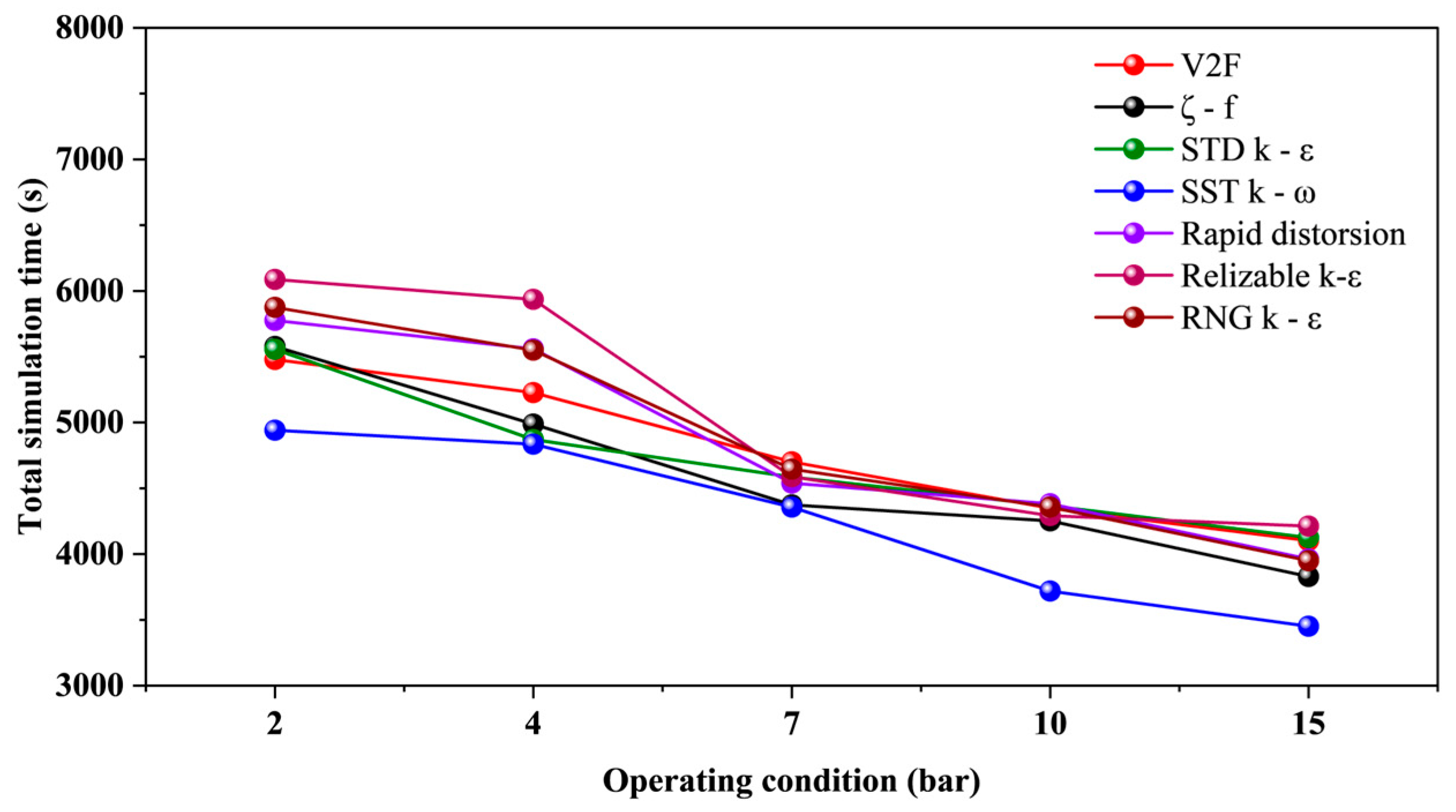
During spray penetration, the injection of liquid ammonia into the chamber generates a complex flow field that involves evaporation, boiling, droplet breakup, and interfacial interactions within each droplet. These processes are modeled using the LPT approach for the liquid phase, where a representative set of droplets is tracked throughout the simulation domain. Numerical simulation time is an important metric, as it reflects computational efficiency and helps identify areas for future improvement in model performance. Figure 6 illustrates the simulation time required for each operating condition and turbulence model. Among the models tested, the SST k-ω model had the lowest computational cost but also the poorest penetration accuracy. In contrast, the ς f and V2F models provided more accurate predictions, with V2F achieving the most favorable balance between accuracy and efficiency. In addition, the V2F turbulence model outperformed the ς f model in terms of computational time by approximately 10% under low-pressure conditions, where vigorous flash boiling occurred. Based on these results, future work should focus on refining the turbulence model coefficients and numerical solvers to achieve further improvements in both predictive accuracy and computational efficiency. Such advancements will be essential for optimizing spray modeling under flash-boiling conditions and supporting the broader adoption of ammonia as a carbon-free fuel.

7.3. Spray Characteristics Using V2F Model

In this section, we analyze the spray characteristics of liquid ammonia to evaluate key flow behaviors (evaporation, boiling, spray dispersion). This analysis was based on the mass fraction penetration, turbulence-induced flow structures, and the decay of spray momentum, as indicated by turbulent kinetic energy (TKE). Special attention was given to the flash boiling phenomenon across a range of operating conditions, from low ambient pressure (2 bar, representing vigorous flash boiling) to high ambient pressure (15 bar, representing non-flashing conditions).
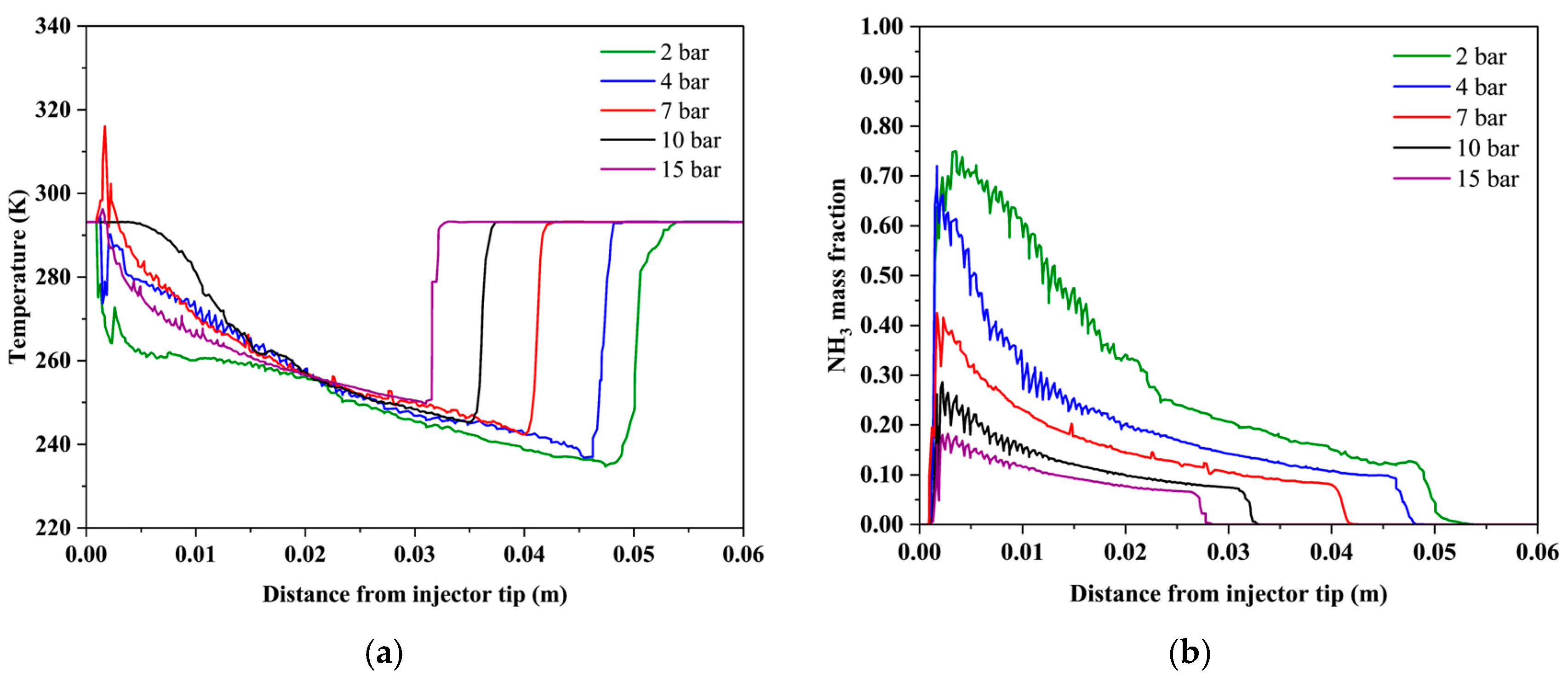
Figure 7a illustrates the gas temperature distribution along the spray centerline at 1 ms after the start of injection for various ambient pressure conditions using the V2F turbulence model. The predicted gas temperatures ranged from 234 K to 316 K, reflecting the strong thermal effects of ammonia vaporization under both flash-boiling and non-flashing regimes. Ammonia has a high heat of vaporization (approximately 1200 kJ/kg at 293 K) compared to 310 kJ/kg for isooctane, which leads to pronounced evaporative cooling, particularly under flash-boiling conditions. This cooling effect was clearly visible in the temperature profiles, which differentiate between flashing and non-flashing cases. At higher ambient pressures (10 and 15 bar), corresponding to non-flashing conditions, the droplets remained subcooled. During vaporization, the droplet temperature decreased to approximately 245 K (a reduction of 16.38%), while the surrounding gas cooled modestly from 293 K to slightly lower values. Although this cooling effect was moderate, it was notable, given ammonia’s ability to rapidly absorb heat and facilitate efficient heat exchange with its surroundings.
More substantial cooling occurred under the flash-boiling conditions, particularly at 4 and 7 bar. In these cases, the droplet temperatures dropped to approximately 243 K (17.06%), and the surrounding gas also displayed notable cooling due to accelerated vaporization. In the most extreme case, at an ambient pressure of 2 bar, flash boiling was very intense, with the droplets cooling rapidly to approximately 235 K (19.79%) within a few millimeters from the nozzle, and the gas temperature decreased by nearly 60 K from the initial value. This marked temperature drop was a direct consequence of the intense phase change and the associated absorption of latent heat. These findings confirmed the expected thermal behavior of ammonia under varying flash boiling intensities, emphasizing the importance of accurate thermal modeling in predicting spray dynamics.
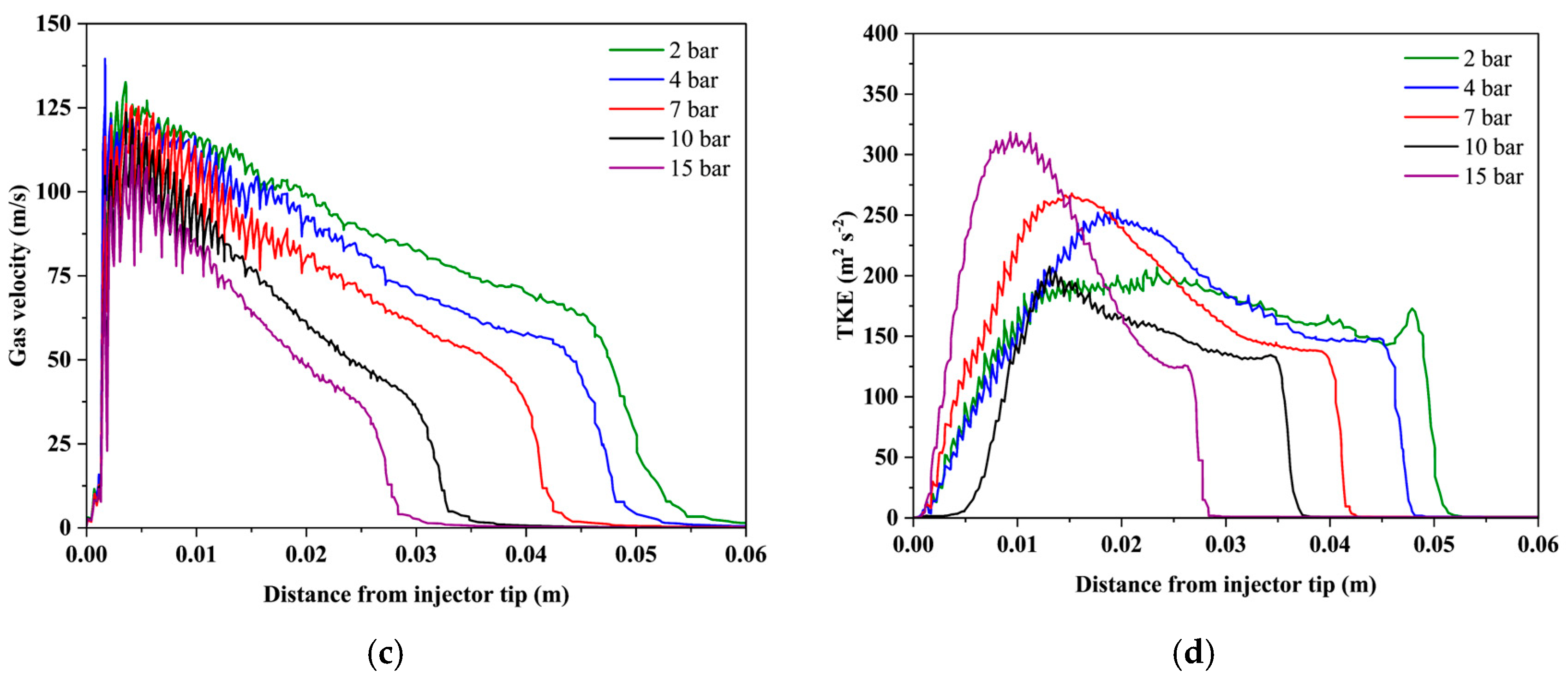
Figure 7b illustrates the mass fraction of ammonia along the spray centerline. Higher ambient pressures suppressed the overall penetration of vapor into the chamber. In particular, at 15 bar, there was a higher concentration of ammonia within the first 15 mm from the nozzle, likely due to the enhanced interactions between the ambient gas and the ammonia immediately after injection, which initiated vaporization and promoted rapid droplet breakup. The breakup process produced a broader distribution of medium and fine droplets that subsequently evaporated into gaseous ammonia. This observation was consistent with Figure 7c, which shows increased velocity fluctuations in the vicinity of the nozzle region. These fluctuations suggested enhanced mixing and momentum exchange, supporting the rapid phase change from liquid to vapor and the dispersion of ammonia mass in the surrounding air.
Furthermore, Figure 7d reveals the distribution of TKE along the spray axis, as each ammonia droplet interacts with the surrounding turbulent field and, in turn, contributes to the generation of additional turbulence through droplet–gas and droplet–droplet interactions. While the degree of TKE fluctuation appeared to be similar across most cases, the 15 bar condition had a notably higher peak that could be attributed to the resistance encountered by the spray as it penetrated the denser, high-pressure ambient environment. The higher ambient pressure induced stronger local shear and compressive effects, thereby amplifying turbulence production near the spray core. One limitation of this finding was that it is based solely on numerical simulations using the V2F turbulence model. While the model demonstrated strong predictive capability, the experimental validation is still ongoing. Further investigation is required to confirm these results under controlled experimental conditions and to identify and address any discrepancies that may arise. Bridging this gap will be essential for refining the turbulence and phase-change models to enhance their accuracy and reliability.

7.4. Axial Distribution of Key Flow Properties in Ammonia Sprays Using V2F Turbulence Model

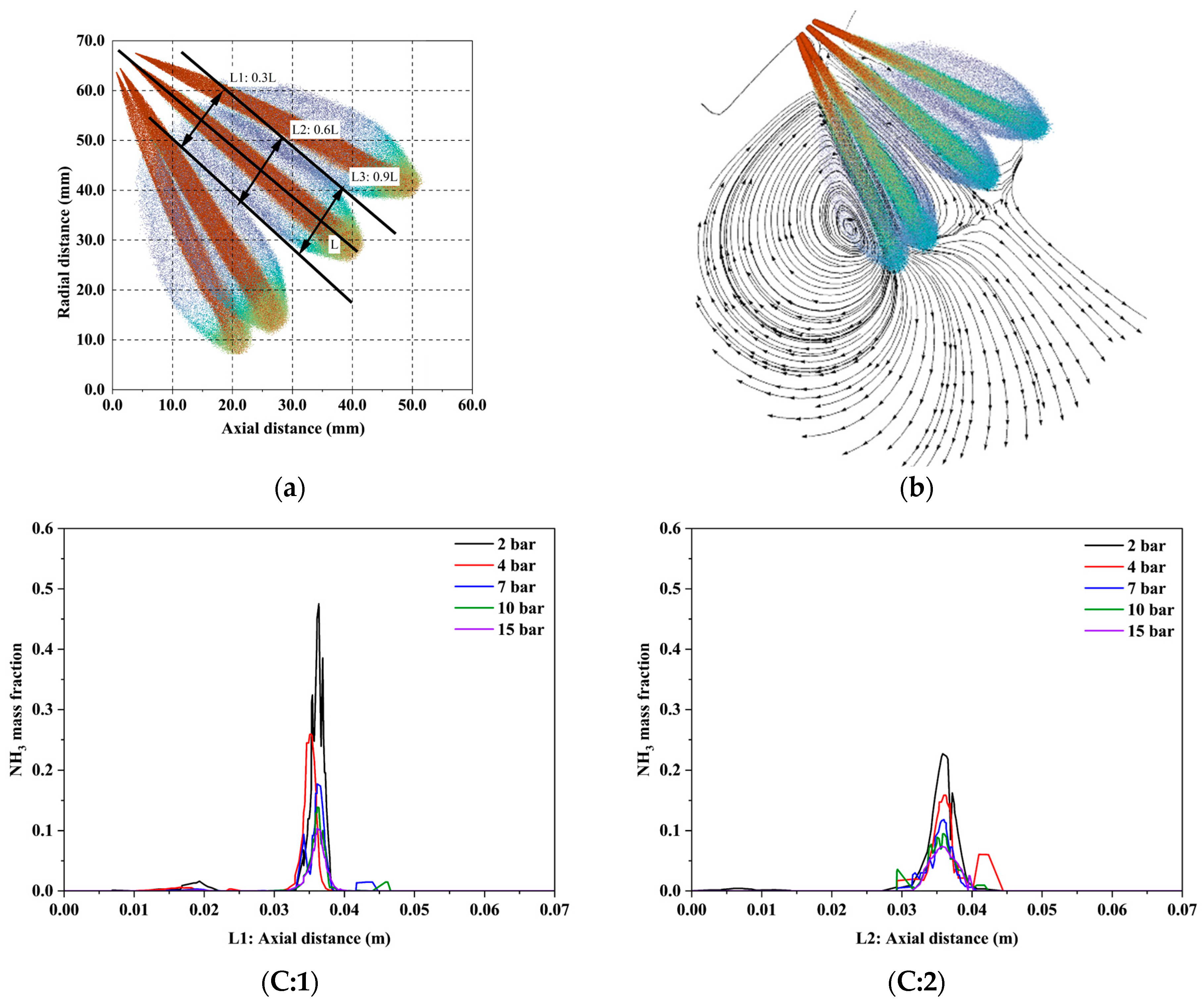
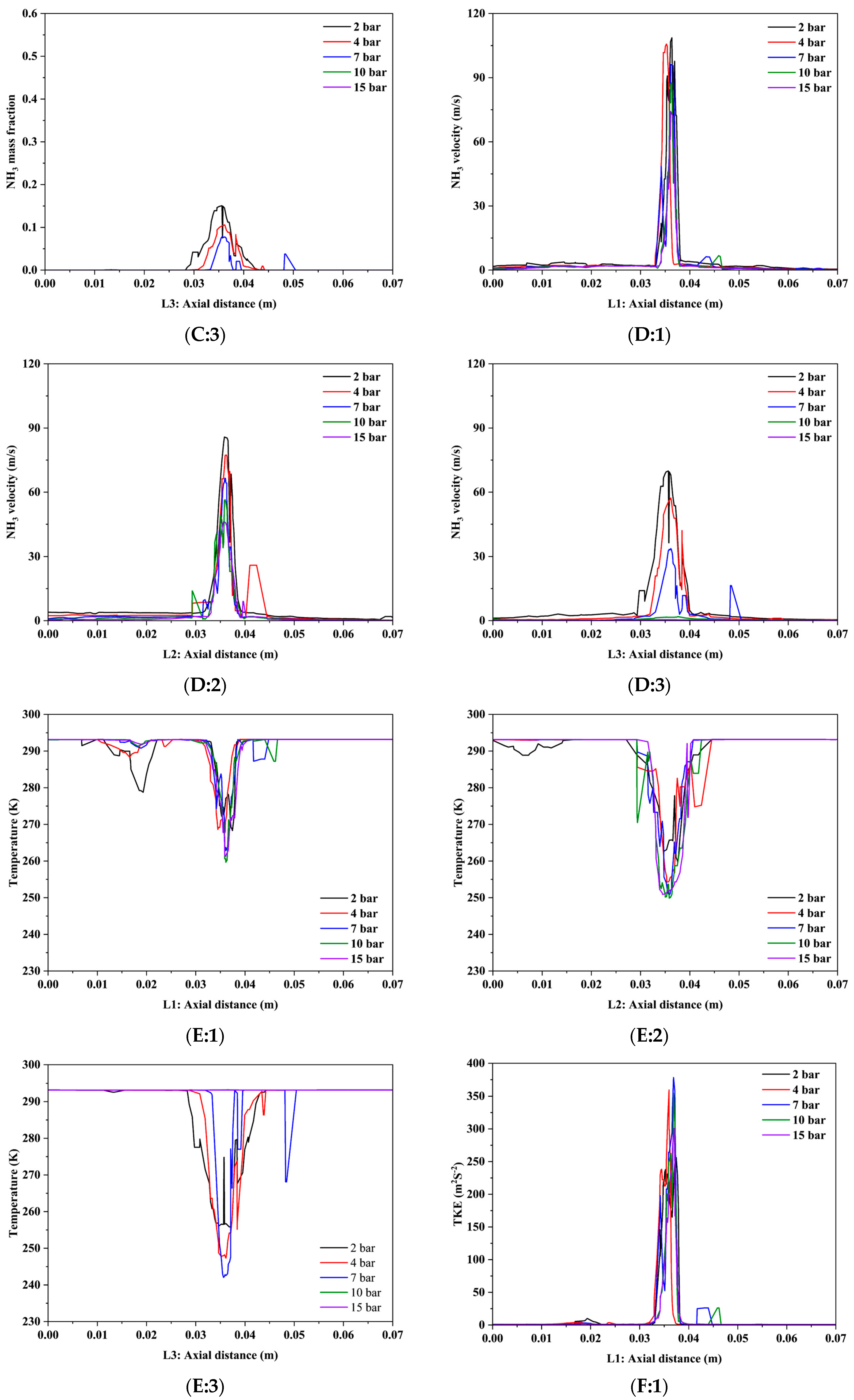
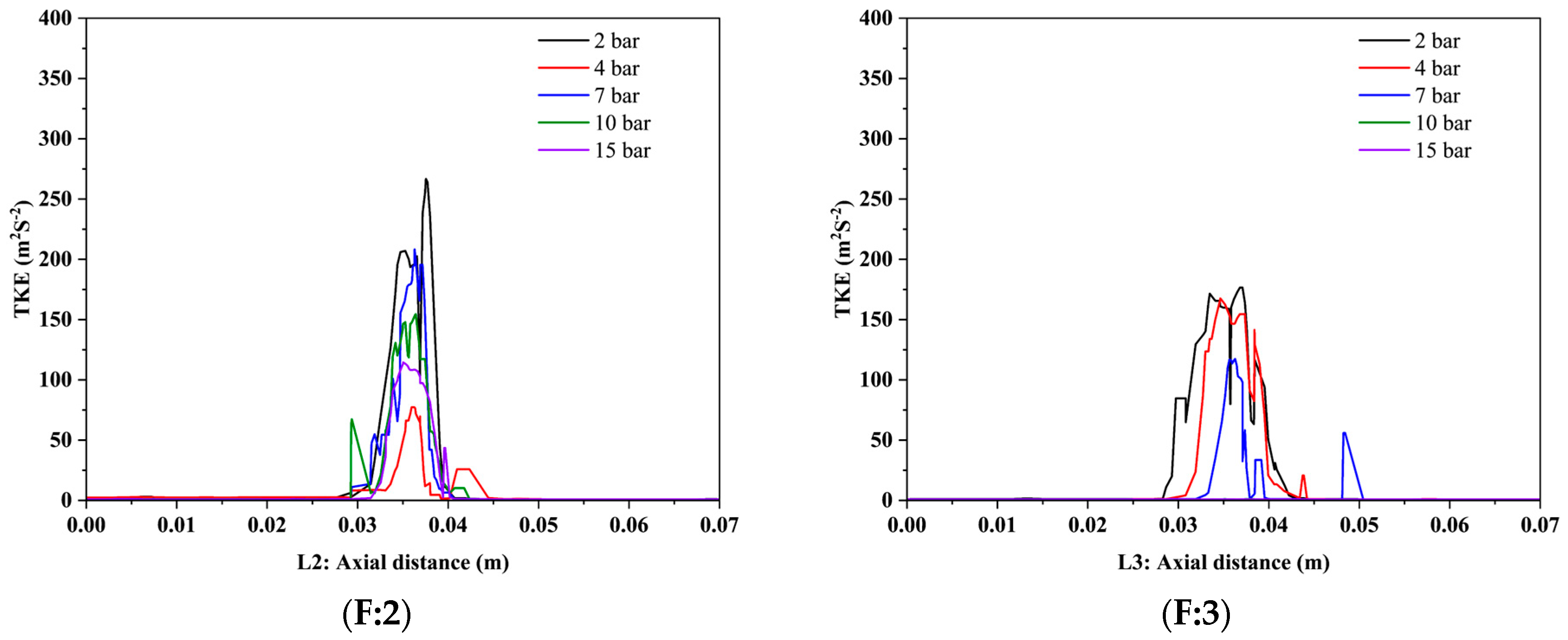
This section presents a comparative analysis of the spray behavior predicted by the various turbulence models, focusing on four key parameters: ammonia mass fraction, gas temperature, TKE, and axial gas velocity. Figure 8 encompasses both flash-boiling and non-flash conditions to assess how each turbulence model captured the evolution of spray structure and flow dynamics. The comparison aimed to highlight the differences in predictive capability, identify model-specific strengths and limitations, and support the selection of an appropriate turbulence model for accurately simulating flash-boiling ammonia sprays. The interaction between the spray shape and the surrounding ambient gas induced clear circulation zones, as evidenced by the streamlined patterns. These interactions facilitated momentum transfer and heat exchange between the ammonia spray droplets and the gas phase. Additionally, the shear layer at the spray-ambient interface promoted droplet nucleation and secondary breakup. Notably, the ammonia mass fraction, velocity, and TKE all peaked near the spray tip, while the temperature was lowest in this region due to rapid heat exchange and evaporative cooling. However, the current simulation results confirmed that under high-pressure conditions, the spray penetration length, temperature distribution, and ammonia mass fraction were greatly reduced.
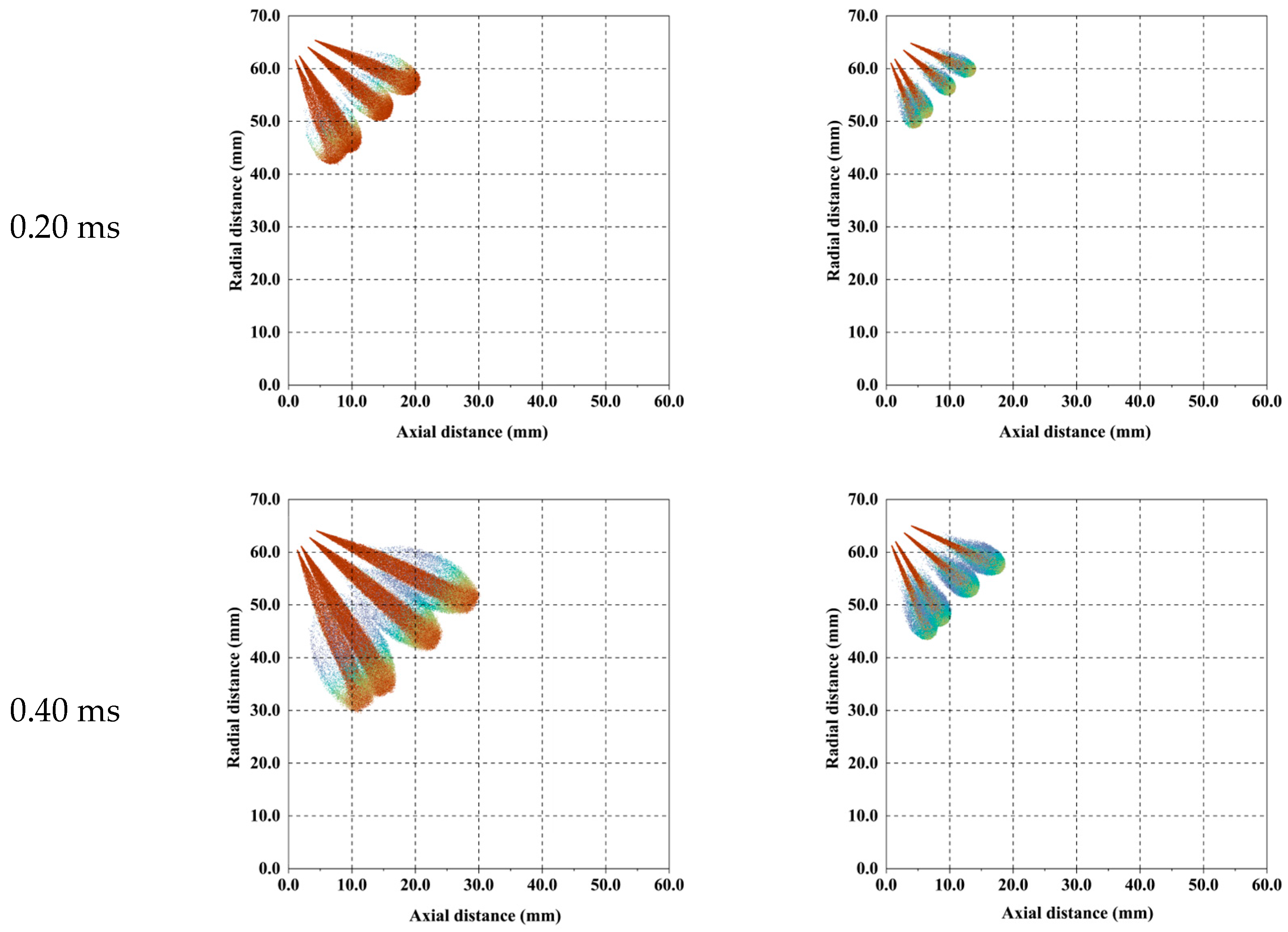
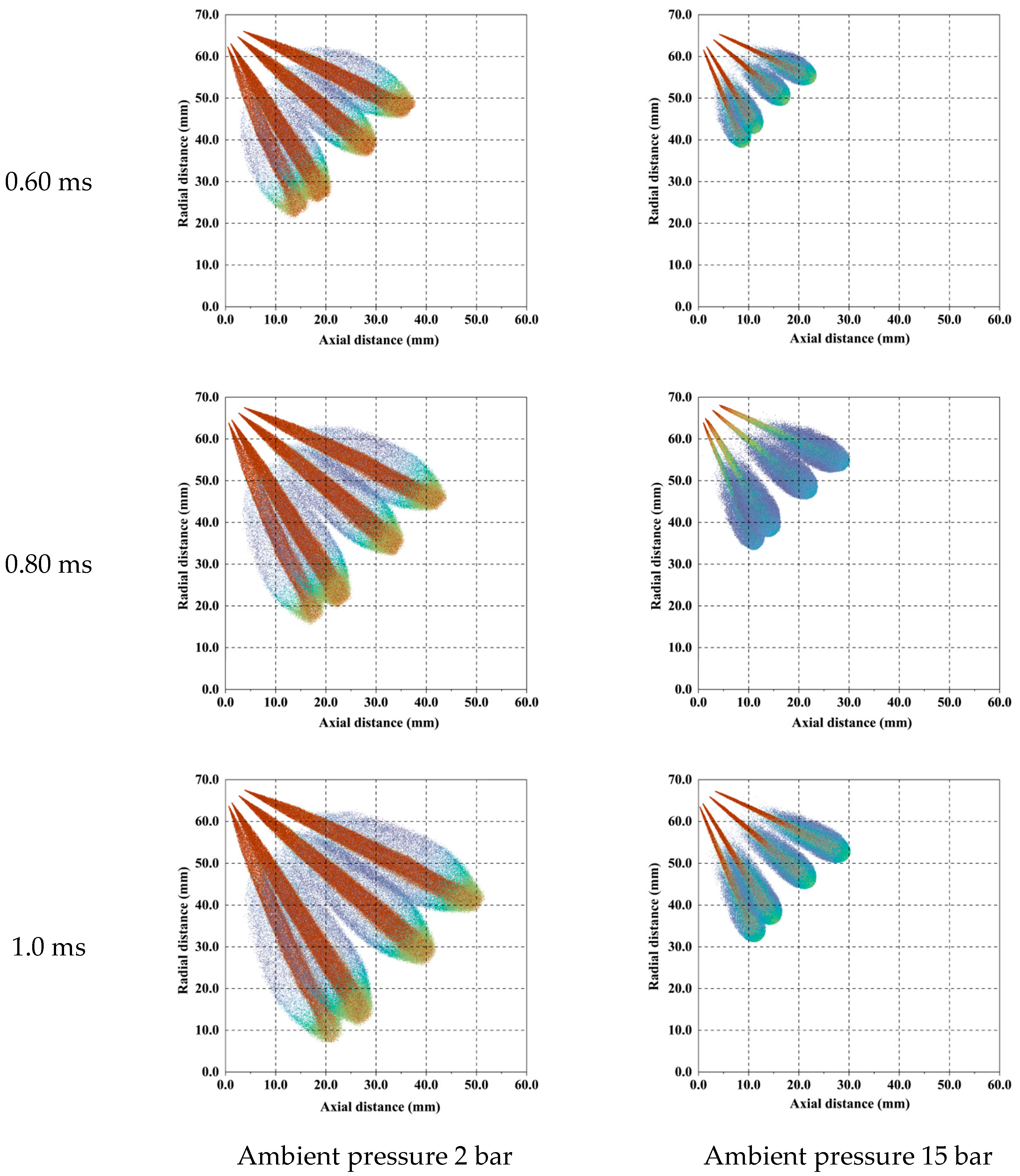
Figure 9 shows that the longer spray penetration observed at low ambient pressure (e.g., 2 bar) was attributed primarily to flash boiling that enhanced droplet breakup and maintained a higher axial momentum. Under these conditions, the superheated liquid ammonia rapidly vaporized, resulting in explosive breakup and the formation of fine droplets, allowing the spray to travel farther with less resistance from the surrounding gas. In contrast, spray penetration was notably shorter at a high ambient pressure (15 bar) due to two main factors. First, the flash boiling was suppressed at higher pressures because the ammonia was no longer in a superheated state. Consequently, the spray behaved more like a conventional liquid jet, with slower droplet breakup and reduced evaporation. Second, the higher gas density at elevated pressure increased the aerodynamic drag on the droplets, causing them to lose momentum more quickly, leading to shorter penetration distances and a more compact spray morphology.
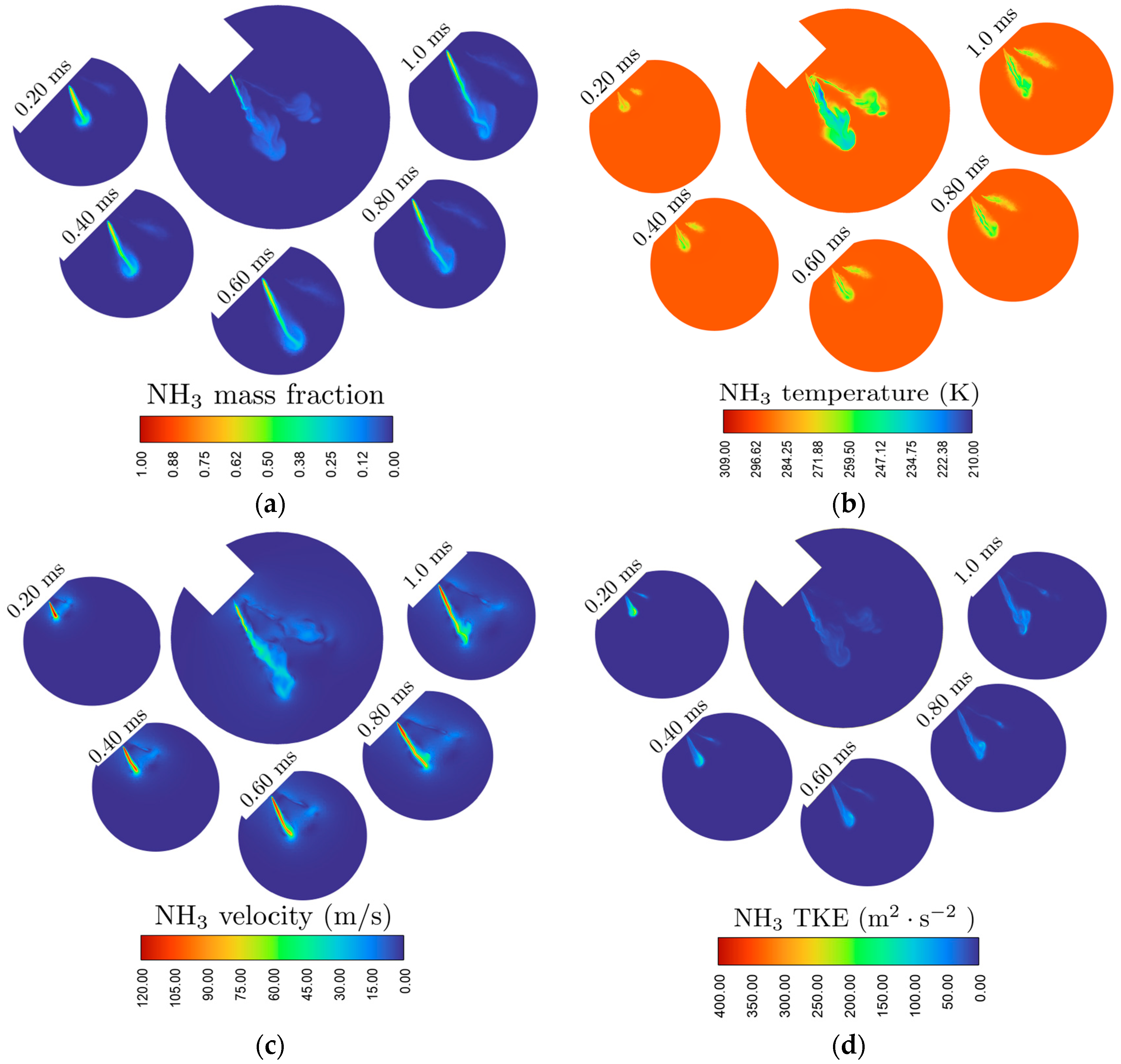
Additionally, as shown in Figure 10, the critical influence of ambient pressure on 2 bar ammonia spray behavior highlighted the necessity of incorporating flash-boiling dynamics in the design of next-generation thermal systems. The analysis of the contour distributions of the ammonia mass fraction, velocity, TKE, and temperature revealed essential thermofluid characteristics immediately following injection. These spatial contours reflect not only the intensity of the phase change but also the efficiency of momentum and heat transfer, which are key performance indicators for advanced thermal control technologies. Notably, such insights extend beyond combustion applications. The demonstrated heat absorption and rapid vapor expansion characteristics of flash-boiling ammonia sprays present a promising frontier for EV battery thermal management, where compact, efficient, and responsive cooling strategies are needed urgently. By leveraging the localized cooling effects and dynamic flow behavior captured in these simulations, ammonia spray technologies may offer a viable pathway toward clean, zero-emission thermal regulation systems in EVs and other green energy platforms. These results should contribute to bridging the gap between sustainable fuel research and functional thermal design in emerging energy systems.

7.5. Thermal–Turbulence Interaction in Ammonia Sprays

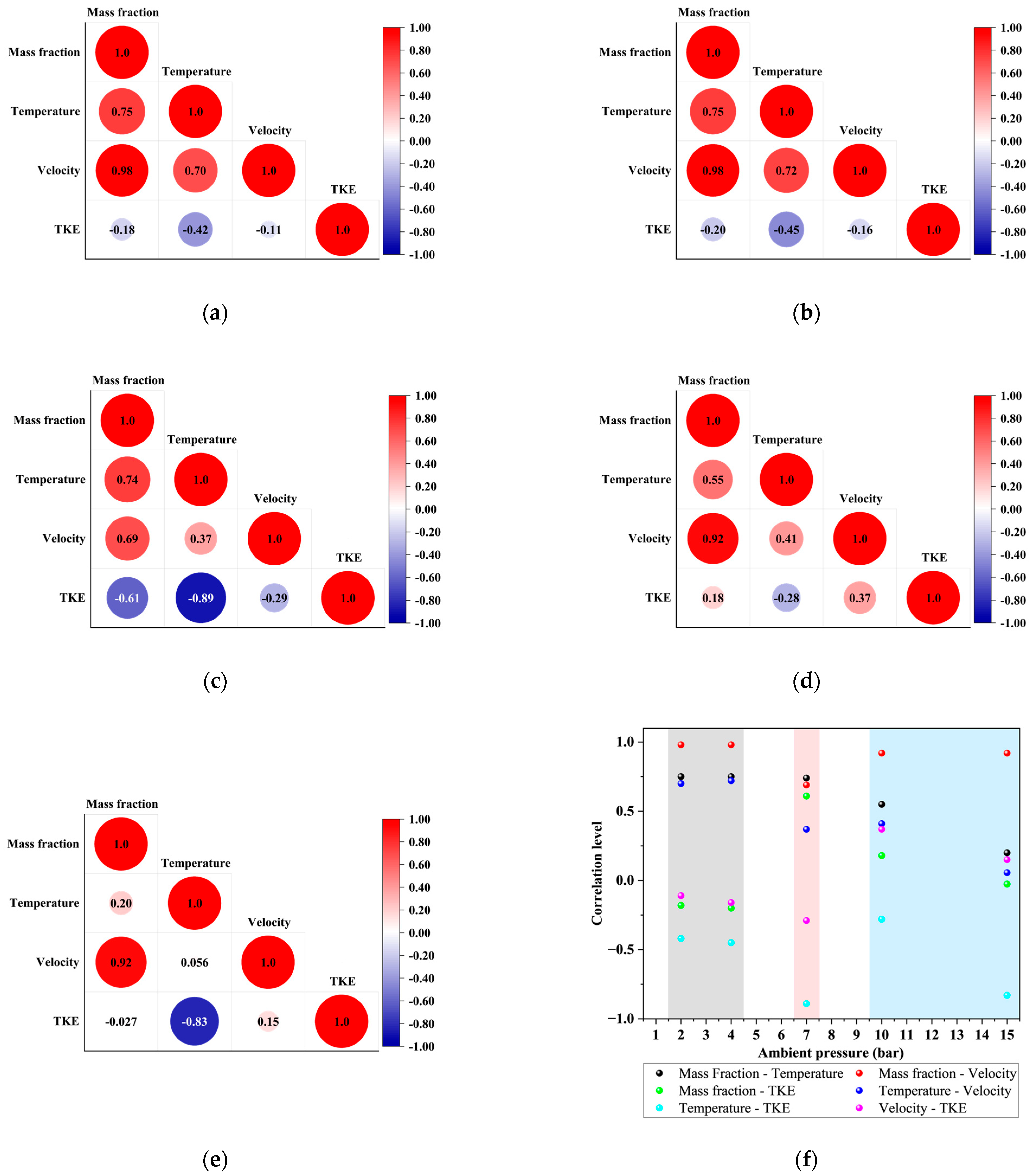
This subsection uses correlation analysis to examine the coupled behavior of key physical quantities consisting of temperature, ammonia mass fraction, gas velocity, and TKE,. Based on the results in Figure 11, under flash-boiling conditions (2 and 4 bar), as described in Figure 11a,b, the Spearman’s rank correlation coefficients between key physical parameters were consistent and aligned. In particular, there was a strong positive relationship between the ammonia mass fraction and gas velocity, indicating that increased local vapor content corresponded to higher flow momentum in the spray core [51]. Conversely, there was a negative correlation between the temperature and TKE, where regions of strong cooling (due to vaporization) were associated with elevated turbulence levels, likely driven by a rapid phase change and droplet breakup. Under non-flash-boiling conditions (10 and 15 bar), as described in Figure 11d,e, the mass fraction-velocity correlation remained highly positive, while the temperature-TKE correlation was weaker but still negative. These trends reflected the reduced intensity of vaporization and turbulence generation at higher ambient pressures, where phase change proceeds more gradually. These findings provide valuable insights for enhancing mathematical modeling approaches. Specifically, the observed correlations between thermodynamic and turbulent flow variables could inform the development of coupled source terms or closure relationships in spray and turbulence models. For example, incorporating correlation-driven coupling between the vapor mass fraction and velocity could enhance momentum source modeling, while integrating temperature-TKE relationships could improve the turbulence-heat transfer interaction terms. Such refinements could contribute to more accurate and physically consistent formulations in future CFD frameworks for ammonia and multi-component fuel sprays.

7.6. Limitations of V2F Model for Flash-Boiling Phenomena

The CFD results using the V2F turbulence model were in good agreement with the validation data for both the liquid and vapor phases, confirming its overall accuracy in capturing bulk spray flow characteristics. This strong agreement underpinned confidence in the model’s ability to capture the fundamental momentum and species transport of the multiphase flow. However, a notable limitation emerged in predicting the spray morphology, which did not exhibit the expected flash-boiling behavior. We suspect this discrepancy was not a result of a fundamental failure in the V2F model itself, but rather a reflection of the model’s inherent theoretical assumptions and the specific challenges of simulating such complex phenomena. The V2F turbulence model is based on time-averaged equations and is known to struggle with capturing the highly transient, fine-scale turbulent structures that are characteristic of explosive flash boiling and the subsequent droplet breakup process [57,58]. The rapid bubble nucleation and atomization that define flash boiling occur on scales that are often much smaller than the typical grid resolution used in a RANS framework [59,60]. Additionally, the anisotropy V2F model and its associated multiphase closure relationships may not fully account for the strong, direct coupling between phase change and turbulence generation. There was a negative correlation between temperature and TKE under flash-boiling conditions (suggesting a physical connection), the current model formulation may not adequately capture the TKE source terms associated with the rapid expansion and disintegration of the liquid phase. These limitations highlight a critical area for future work. A more accurate representation of flash-boiling phenomena would require one of the following:
  • Refining the V2F model to include a dedicated source term for TKE production driven by the latent heat of vaporization. This would directly link the phase change rate to the generation of turbulence, thereby improving the prediction of spray morphology;
  • Utilizing more advanced models, such as an LES or direct numerical simulation approach, which could resolve the fine-scale turbulent eddies responsible for droplet breakup. However, these methods come with considerably higher computational costs.

7.7. Limitations to Addressing SMD Deviation

The deviation in SMD is not necessarily a flaw in the current model implementation, but rather a reflection of the fundamental challenges in predicting droplet breakup and atomization from first principles within a RANS framework. Notable points are:
  • SMD is a statistical measure of droplet size distribution. Predicting it accurately requires capturing the fine-scale turbulent eddies and interfacial instabilities that govern the breakup of the liquid jet into individual droplets. The V2F model, like other RANS models, solves for the time-averaged turbulent quantities. Therefore, it cannot resolve these small-scale, transient phenomena.
  • Often, the droplet breakup and atomization models are semi-empirical. Typically, CFD spray models rely on sub-models (Kelvin–Helmholtz, Rayleigh–Taylor, or WAVE models) to predict droplet sizes. These models contain constants that are tuned to match experimental data for specific fluids and conditions. Even advanced turbulence models, such as V2F, cannot fully compensate for the inherent simplifications of these breakup models.
Beyond the general spray morphology, our model predictions for the SMD also showed only marginal agreement with the experimental data. This is a common challenge in modeling atomizing sprays and points to a substantial limitation of our current modeling approach. While the V2F model successfully captured the bulk liquid and vapor phase behavior, predicting the fine-scale droplet size distribution remains difficult. Primarily, the SMD is governed by primary and secondary atomization processes, which are inherently transient and strongly influenced by the local turbulent structures at the liquid–gas interface. However, the RANS-based turbulence model used in the current study inherently averages out these fluctuations and is therefore unable to resolve the fine-scale structures where droplet breakup occurs. Consequently, the a priori assumptions within the semi-empirical atomization models used in our simulation likely dominated the SMD prediction. While these models are a necessary simplification for RANS simulations, they can only provide a statistical representation of the complex physics; often, their constants are not universally applicable across all operating conditions, particularly when transitioning from non-flashing to flash-boiling regimes.

8. Conclusions

This study investigated the spray characteristics of liquid ammonia under various ambient conditions using advanced numerical modeling techniques. The effects of different turbulence models, initial ammonia temperature, and ambient temperature on spray morphology and vaporization behavior were analyzed systematically. Key spray parameters (liquid penetration, vapor penetration, and SMD) were evaluated and validated against experimental data to assess the predictive performance of the simulations. The findings should offer valuable insights into the intricate relationships between fluid dynamics, thermodynamics, and phase-change behavior in superheated ammonia sprays.
  • The V2F and ς f turbulence models demonstrated superior performance in simulating ammonia spray dynamics, particularly due to their ability to better capture turbulence anisotropy compared to traditional models.
  • SMD prediction remains a challenge across all cases, underscoring the need for further refinement of models that describe droplet breakup, evaporation, and turbulence-phase interaction.
  • Spray penetration decreases with increasing ambient pressure, as higher gas density suppresses flash boiling and increases aerodynamic drag, resulting in reduced droplet breakup and more compact spray structures. However, under strong flash-boiling conditions, such as at 2 bar, the predicted spray morphology revealed limitations in the current modeling assumptions, suggesting that further refinement of the mathematical model, particularly regarding spray shape in intense flashing regimes, may be necessary to achieve more accurate predictions.
  • The V2F model demonstrated strong predictive capability across all evaluated parameters (ammonia mass fraction, gas velocity, temperature, and TKE, closely matching physical expectations across the various tested operating conditions.
  • Correlation analysis between temperature, mass fraction, velocity, and TKE revealed consistent trends that should inform the development of improved mathematical models and source terms for turbulence-spray interaction in multiphase CFD.
  • The validated modeling framework and insights from this study should provide a strong foundation for the future application of flash-boiling ammonia sprays in clean combustion systems and advanced thermal management technologies, such as EV battery cooling, where rapid heat removal and efficient phase change are critical.
  • A limitation of this study is that the validation relies on a single published experimental dataset. Therefore, the conclusions are restricted to the tested operating conditions and model settings, and the results should be interpreted as a benchmarking and sensitivity assessment of turbulence-model performance for flash-boiling ammonia sprays.

9. Future Work and Applications in Green Energy and Thermal Management

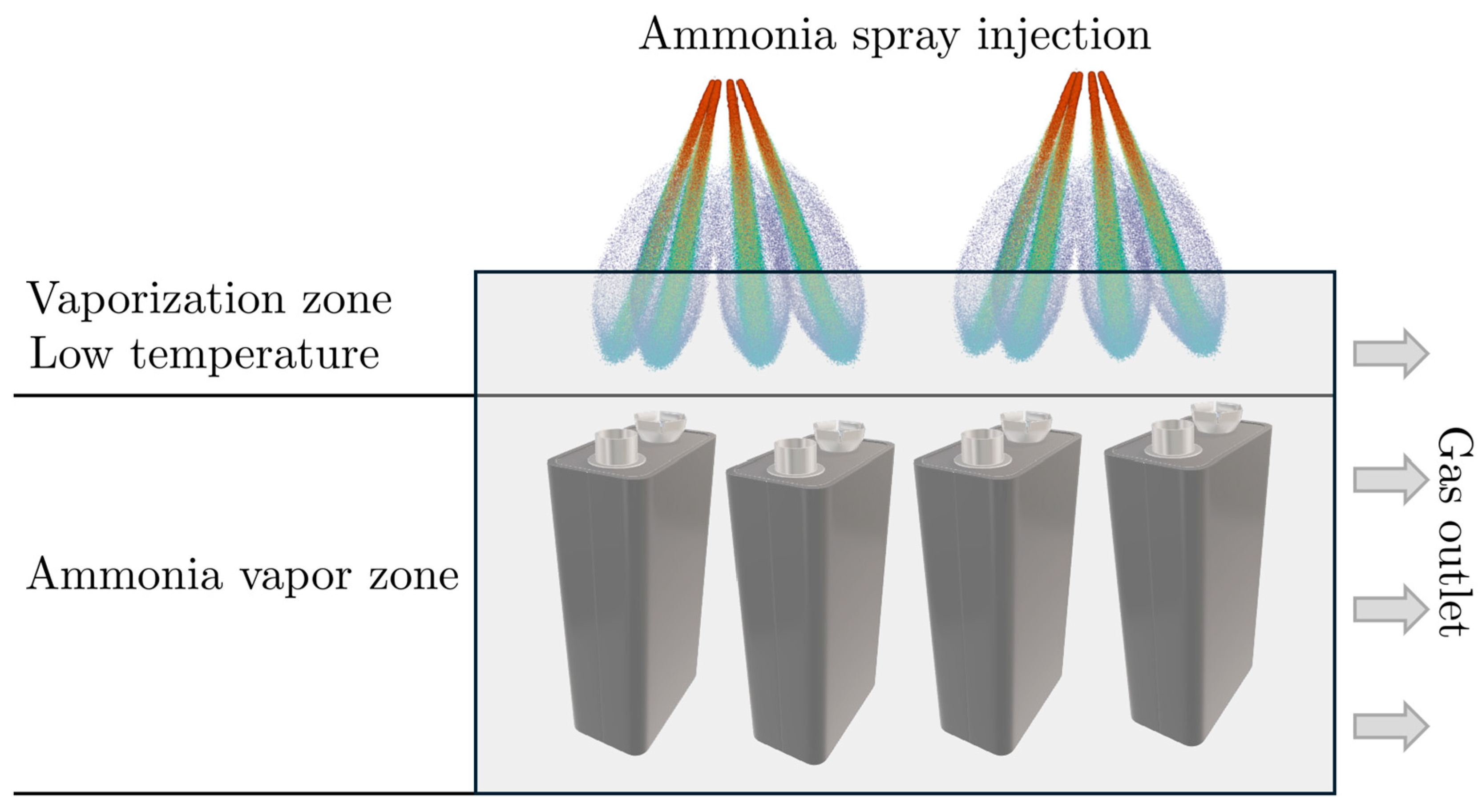
Building on the present findings, future research should extend the simulation framework to incorporate detailed chemical kinetics for ammonia–hydrogen dual-fuel combustion and progress the optimization of injector design for low-carbon energy systems. Beyond combustion, ammonia has great potential in green and renewable energy applications. Its high latent heat of vaporization and favorable thermophysical properties make it a strong candidate for next-generation cooling technologies, particularly in EVs, as preliminarily conceptualized in Figure 12. Ammonia-based cooling offers promising opportunities for battery thermal management systems, where efficient heat removal is essential to ensure safety, extend the battery lifespan, and maintain optimal performance. The insights gained in this study, particularly regarding flash-boiling spray dynamics and turbulence-phase interaction, should directly inform the development of ammonia spray cooling systems capable of delivering rapid and localized heat extraction. Future work should combine numerical and experimental investigations to explore multiphase spray cooling in confined geometries, integrate it with compact heat exchangers, and develop robust safety mechanisms for the use of ammonia in closed-loop systems. With successful advancements in these research directions, ammonia has the potential to play a critical dual role by supporting the decarbonization of combustion-based propulsion, while simultaneously enabling high-efficiency thermal management solutions in the expanding landscape of electrified and renewable energy technologies.

Author Contributions

Conceptualization, W.P., M.K. and C.P.-A.; methodology, W.P. and M.K.; software, W.P., M.K. and C.P.-A.; validation, M.K.; formal analysis, W.P., M.K. and C.P.-A.; investigation, W.P.; resources, M.K. and C.P.-A.; writing-original draft preparation, W.P. and M.K.; writing-review and editing, M.K. and C.P.-A.; visualization, M.K.; supervision, W.P. and M.K.; project administration, W.P.; funding acquisition, W.P. All authors have read and agreed to the published version of the manuscript.

Funding

This research received no external funding.

Data Availability Statement

The data that support the findings of this study are available from the corresponding author, W.P., upon reasonable request.

Conflicts of Interest

The authors declare no conflicts of interest.

References

  1. Zhang, Z.; Zhang, H.; Jiang, H.; Li, L. Green ammonia: Revolutionizing sustainable energy for a carbon-free future. J. Mater. Chem. A 2024, 12, 33334–33361. [Google Scholar] [CrossRef]
  2. Dey, S.; Das, P.K.; Deb, M.; Sastry, G.R.K. Green Ammonia: An Alternative Sustainable Energy Source for Clean Combustion. In Energy, Environment, and Sustainability; Springer: Singapore, 2024; pp. 11–24. [Google Scholar] [CrossRef]
  3. Mashruk, S.; Shi, H.; Mazzotta, L.; Ustun, C.E.; Aravind, B.; Meloni, R.; Alnasif, A.; Boulet, E.; Jankowski, R.; Yu, C.; et al. Perspectives on NOX Emissions and Impacts from Ammonia Combustion Processes. Energy Fuels 2024, 38, 19253–19292. [Google Scholar] [CrossRef] [PubMed]
  4. Szanthoffer, A.G.; Zsély, I.G.; Kawka, L.; Papp, M.; Turányi, T. Testing of NH3/H2 and NH3/syngas combustion mechanisms using a large amount of experimental data. Appl. Energy Combust. Sci. 2023, 14, 100127. [Google Scholar] [CrossRef]
  5. Li, Y.; Sun, H.; Al-Ansari, M.M.; Gavurová, B.; Sekar, M. Assessment and optimization of combustion efficiency and emissions of industrial gases burner blended with hydrogen and ammonia gaseous fuel. Renew. Energy 2025, 252, 123543. [Google Scholar] [CrossRef]
  6. Okafor, E.C.; Kurata, O.; Yamashita, H.; Inoue, T.; Tsujimura, T.; Iki, N.; Hayakawa, A.; Ito, S.; Uchida, M.; Kobayashi, H. Liquid ammonia spray combustion in two-stage micro gas turbine combustors at 0.25 MPa; Relevance of combustion enhancement to flame stability and NOx control. Appl. Energy Combust. Sci. 2021, 7, 100038. [Google Scholar] [CrossRef]
  7. Shen, Y.; Zhang, K.; Duwig, C. Investigation of wet ammonia combustion characteristics using LES with finite-rate chemistry. Fuel 2022, 311, 122422. [Google Scholar] [CrossRef]
  8. He, X.; Liu, Y.; Zhang, H.; Bi, S.; Xu, K.; Zhao, J. Characteristics of high-pressure liquid ammonia sprays and combustion process in ammonia/diesel HPDI dual-fuel engines. J. Energy Inst. 2025, 120, 102059. [Google Scholar] [CrossRef]
  9. Wang, C.; Chen, Z.; Li, T.; Zhao, P.; Chen, H. A comparative study the spray and combustion of diesel and ammonia engine under cross and horizontally-opposed dual direct injection. J. Energy Inst. 2025, 120, 102076. [Google Scholar] [CrossRef]
  10. Liu, X.; Yao, X.; Wang, Z.; Tang, C. Single hole ammonia spray macroscopic and microscopic characteristics at flare and transition flash boiling regions. Appl. Therm. Eng. 2023, 235, 121443. [Google Scholar] [CrossRef]
  11. Zhang, Y.; Xu, L.; Zhu, Y.; Xu, S.; Bai, X.S. Numerical study on liquid ammonia direct injection spray characteristics under engine-relevant conditions. Appl. Energy 2023, 334, 120680. [Google Scholar] [CrossRef]
  12. An, Z.; Xing, J.; Kurose, R. Recent progresses in research on liquid ammonia spray and combustion: A review. Appl. Energy Combust. Sci. 2024, 20, 100293. [Google Scholar] [CrossRef]
  13. Zhou, X.; Li, T.; Chen, R.; Wei, Y.; Wang, X.; Wang, N.; Li, S.; Kuang, M.; Yang, W. Ammonia marine engine design for enhanced efficiency and reduced greenhouse gas emissions. Nat. Commun. 2024, 15, 2110. [Google Scholar] [CrossRef]
  14. Chen, S.; Qenawy, M.; Tian, J.; Wang, Z.; Wang, H.; Yu, K.; Wang, J.; Chen, B.; Xiong, J. From principles to practice: Review of recent advances and perspectives in spray flash evaporation technology towards thermal management of energy systems. Energy Convers. Manag. 2025, 326, 119499. [Google Scholar] [CrossRef]
  15. Zembi, J.; Battistoni, M.; Pandal, A.; Pelé, R.; Brequigny, P.; Hespel, C.; Mounaïm-Rousselle, C. Lagrangian CFD modeling of ammonia sprays: A correlation across flash boiling and evaporative conditions. Int. Commun. Heat Mass Transf. 2024, 158, 107866. [Google Scholar] [CrossRef]
  16. Song, X.; Hu, Y.; Zhao, F.; Yu, W. Modelling of liquid ammonia spray based on flash boiling breakup driven by thermal growth of multiple bubbles. Energy 2025, 325, 136129. [Google Scholar] [CrossRef]
  17. Ma, Y.; Zhong, W.; Lai, S.; Chen, J.; Pachiannan, T.; Zhang, L.; Yuan, W.; He, Z. Experimental study on the flash boiling spray characteristics and jet fluctuation of high-pressure direct injection liquid ammonia. Appl. Therm. Eng. 2024, 257, 124032. [Google Scholar] [CrossRef]
  18. Zhong, W.; Chen, J.; Li, C.; Huang, Y.; Pachiannan, T.; Jiang, Z.; Yuan, Y.; He, Z. Visualization study on flash boiling spray characteristics of high-pressure liquid ammonia with different nozzle diameters. Fuel 2024, 367, 131525. [Google Scholar] [CrossRef]
  19. Zhang, Z.; Long, W.; Cui, Z.; Dong, P.; Tian, J.; Tian, H.; Meng, X. Visualization study on the ignition and diffusion combustion process of liquid phase ammonia spray ignited by diesel jet in a constant volume vessel. Energy Convers. Manag. 2024, 299, 117889. [Google Scholar] [CrossRef]
  20. Liu, J.; Zhang, M.; An, Z.; Chen, J.; Wang, J.; Tang, C.; Huang, Z. Morphological and mechanistic study of a continuous flash boiling liquid ammonia spray. Phys. Fluids 2025, 37, 013327. [Google Scholar] [CrossRef]
  21. Li, S.; Liu, S.; Wang, N.; Li, T.; Chen, R.; Yi, P.; Huang, S.; Zhou, X. Atomization and evaporation characteristics of liquid ammonia spray under engine intake stroke conditions. Energy 2025, 316, 134589. [Google Scholar] [CrossRef]
  22. Wang, S.; Zhang, R.; Mao, X.; Wang, L.; Wei, H.; Pan, J. An investigation on liquid ammonia spray: Emphasis on flash boiling and non-flash boiling characteristics. Appl. Therm. Eng. 2025, 269, 126224. [Google Scholar] [CrossRef]
  23. Shen, L.; Leach, F. An experimental study on the macroscopic behaviours of ammonia sprays in a constant volume chamber. Int. J. Hydrogen Energy 2025, 126, 386–395. [Google Scholar] [CrossRef]
  24. Li, X.; Wang, S.; Yang, S.; Qiu, S.; Sun, Z.; Hung, D.L.S.; Xu, M. A review on the recent advances of flash boiling atomization and combustion applications. Prog. Energy Combust. Sci. 2024, 100, 101119. [Google Scholar] [CrossRef]
  25. Zhang, Y.; Chu, C.; Liu, Z.; Jia, M. Improved dynamics, atomization, and vaporization models for liquid ammonia spray simulations under diverse ambient conditions. Int. J. Multiph. Flow 2025, 188, 105225. [Google Scholar] [CrossRef]
  26. An, Z.; Xing, J.; Kurose, R. Numerical study on the phase change and spray characteristics of liquid ammonia flash spray. Fuel 2023, 345, 128229. [Google Scholar] [CrossRef]
  27. Yao, N.-N.; Chen, Y.-F.; Wei, L.-M.; Xu, Q.-Y.; Pan, W.-G. Progress in CFD simulation for ammonia-fueled internal combustion engines and gas turbines. J. Energy Inst. 2024, 119, 101951. [Google Scholar] [CrossRef]
  28. Qiu, S.; Wang, S.; Zhang, Y.; Li, Y.; Xu, M.; Li, X. Dynamics and mechanisms of spray plume interference under flash boiling conditions. Energy 2025, 314, 134121. [Google Scholar] [CrossRef]
  29. Xia, L.; Montazeri, H.; Blocken, B. On the accuracy of Eulerian-Lagrangian CFD simulations for spray evaporation in turbulent flow. Int. J. Therm. Sci. 2025, 208, 109461. [Google Scholar] [CrossRef]
  30. Yang, R.; Liu, H.; Zhang, S.; Li, J.; Tang, Q.; Yao, M. Optical and numerical study on high-pressure liquid ammonia spray atomization and ignition characteristics under different injector nozzle diameters. Energy Convers. Manag. 2025, 333, 119781. [Google Scholar] [CrossRef]
  31. Jin, Z.; Wu, H.; Xu, S.; Zhou, D.; Mi, S.; Qian, Y.; Lu, X. A unified spray model for large eddy simulations under non-flashing and flash boiling conditions: Effects of in-nozzle flow and external thermal breakup in liquid ammonia injection. Int. J. Multiph. Flow 2025, 184, 105116. [Google Scholar] [CrossRef]
  32. Yang, R.; Liu, H.; Li, B.; Tang, Q.; Yao, M. Experimental and numerical investigation on the superheated and subcooled ammonia spray characteristics under high injection pressure. Fuel 2025, 387, 134320. [Google Scholar] [CrossRef]
  33. Hu, Y.; Li, J.; Chen, H.; Zhang, F.; Wang, L. Numerical study on spray characteristics of liquid ammonia based on variable model constants. Appl. Therm. Eng. 2024, 261, 125166. [Google Scholar] [CrossRef]
  34. Chen, X.; Long, W.; Ma, C.; Dong, P.; Zhang, Z.; Tian, J.; Nishida, K.; Tian, H. Experimental and modeling study on liquid phase ammonia spray characteristics under high-pressure injection and engine-like ambient conditions. Int. Commun. Heat Mass Transf. 2025, 164, 108853. [Google Scholar] [CrossRef]
  35. Giuntini, L.; Frascino, L.; Ariemma, G.B.; Sorrentino, G.; Galletti, C.; Ragucci, R. Modeling of Ammonia MILD Combustion in Systems with Internal Recirculation. Combust. Sci. Technol. 2023, 195, 3513–3528. [Google Scholar] [CrossRef]
  36. Mazzotta, L.; Lamioni, R.; Agati, G.; Evangelisti, A.; Rispoli, F.; Valera-Medina, A.; Borello, D. On the Impact of CFD Turbulence Models for Premixed NH3/H2 Combustion on Emissions and Flame Characteristics in a Swirl-Stabilized Burner. Flow Turbul. Combust. 2025, 114, 1043–1063. [Google Scholar] [CrossRef]
  37. Ilbas, M.; Kekul, O.; Karyeyen, S. Investigation into Thermal-Fluid interaction of ammonia turbulent swirling flames under various Non-Premixed burner conditions. Fuel 2022, 312, 122967. [Google Scholar] [CrossRef]
  38. Al-Zareer, M.; Dincer, I.; Rosen, M.A. Development and evaluation of a new ammonia boiling based battery thermal management system. Electrochim. Acta 2018, 280, 340–352. [Google Scholar] [CrossRef]
  39. Al-Zareer, M.; Dincer, I.; Rosen, M.A. Electrochemical modeling and performance evaluation of a new ammonia-based battery thermal management system for electric and hybrid electric vehicles. Electrochim. Acta 2017, 247, 171–182. [Google Scholar] [CrossRef]
  40. Al-Zareer, M.; Dincer, I.; Rosen, M.A. Heat transfer modeling of a novel battery thermal management system. Numer. Heat Transf. Part A Appl. 2018, 73, 277–290. [Google Scholar] [CrossRef]
  41. Lee, J.W.; Park, J.H.; Choi, H.W.; Kang, Y.T. Ammonia sorption thermal battery with water-loaded sorbent driven by low-temperature heat source. Energy Convers. Manag. 2023, 295, 117653. [Google Scholar] [CrossRef]
  42. Yang, J.; Yu, Q.; Chen, S.; Yan, F.; Yu, Y. Analysis of discharge performance and thermo-electric conversion efficiency in thermally regenerative ammonia-based flow battery with foam copper electrode. Energy Convers. Manag. 2024, 311, 118523. [Google Scholar] [CrossRef]
  43. Zhang, W.Y.; Mehari, A.; Zhang, X.J.; Roskilly, A.P.; Jiang, L. Ammonia-based sorption thermal battery: Concepts, thermal cycles, applications, and perspectives. Energy Storage Mater. 2023, 62, 102930. [Google Scholar] [CrossRef]
  44. Fathimathul Faseena, A.M.; Sreekumar, A. Advances, perspectives and challenges in phase change material based battery thermal management: A comprehensive review. J. Energy Storage 2025, 113, 115644. [Google Scholar] [CrossRef]
  45. Yaw, C.T.; Rajamony, R.K.; Bhutto, Y.A.; Bakthavatchalam, B.; Kottala, R.K.; Chopra, K.; Paw, J.K.S.; Doroody, C.; Allasi, H.L.; Soudagar, M.E.M. Two phase heat transfer approaches for battery thermal management: Current status, challenges and future outlook. Results Eng. 2025, 27, 105749. [Google Scholar] [CrossRef]
  46. Shin, J.; Park, S. Numerical analysis and optimization of combustion and emissions in an ammonia-diesel dual-fuel engine using an ammonia direct injection strategy. Energy 2023, 289, 130014. [Google Scholar] [CrossRef]
  47. Pelé, R.; Mounaïm-Rousselle, C.; Bréquigny, P.; Hespel, C.; Bellettre, J. First Study on Ammonia Spray Characteristics with a Current GDI Engine Injector. Fuels 2021, 2, 253–271. [Google Scholar] [CrossRef]
  48. Lewandowski, M.T.; Pasternak, M.; Haugsvær, M.; Løvås, T. Simulations of ammonia spray evaporation, cooling, mixture formation and combustion in a direct injection compression ignition engine. Int. J. Hydrogen Energy 2023, 52, 916–935. [Google Scholar] [CrossRef]
  49. Kaewbumrung, M.; Plengsa-Ard, C. Numerical simulation of jet impingement relaminarization using nonlinear eddy viscosity turbulence models. Eng. Appl. Comput. Fluid Mech. 2023, 17, 2162132. [Google Scholar] [CrossRef]
  50. Kaewbumrung, M.; Plengsa-Ard, C. Relaminarization of jet impingement on a flat plate using separation-induced transition correction turbulence modeling, preliminarily applied in archeological applications. Heliyon 2024, 10, e26040. [Google Scholar] [CrossRef]
  51. Kaewbumrung, M.; Nutasarin, K.; Plengsa-Ard, C.; Palasai, W. Investigating Environmental Impacts on Mural Preservation in Heritage Buildings Using Computational Fluid Dynamics: A Case Study of the Ratchaburana Historical Temple, Thailand. Results Eng. 2025, 27, 106127. [Google Scholar] [CrossRef]
  52. Zembi, J.; Battistoni, M.; Pandal, A.; Rousselle, C.; Pelè, R.; Brequigny, P.; Hespel, C. Numerical Study of Ammonia Spray with a GDI Engine Injector. J. Ammon. Energy 2023, 1, 59–73. [Google Scholar] [CrossRef]
  53. Richards, K.J.; Senecal, P.K.; Pomraning, E. CONVERGE 4; Convergent Science: Madison, WI, USA, 2024. [Google Scholar]
  54. Han, Z.; Reitz, R.D. Turbulence Modeling of Internal Combustion Engines Using RNG κ-ε Models. Combust. Sci. Technol. 1995, 106, 267–295. [Google Scholar] [CrossRef]
  55. Akram, M.S.; Yeganeh, M.; Cheng, Q.; Kaario, O.; Larmi, M. Experimental Study on Flash Boiling of Ammonia Fuel Sprays—A Potential Alternative Fuel; SAE: Warrendale, PA, USA, 2023. [Google Scholar] [CrossRef]
  56. Price, C.; Hamzehloo, A.; Aleiferis, P.; Richardson, D. Numerical modelling of droplet breakup for flash-boiling fuel spray predictions. Int. J. Multiph. Flow 2020, 125, 103183. [Google Scholar] [CrossRef]
  57. Zhang, C.; Bounds, C.P.; Foster, L.; Uddin, M. Turbulence Modeling Effects on the CFD Predictions of Flow over a Detailed Full-Scale Sedan Vehicle. Fluids 2019, 4, 148. [Google Scholar] [CrossRef]
  58. Rahman, M.M. Developing code-friendly variant of V2F turbulence model. Comput. Fluids 2020, 196, 104346. [Google Scholar] [CrossRef]
  59. Price, C.; Hamzehloo, A.; Aleiferis, P.; Richardson, D. Numerical modelling of fuel spray formation and collapse from multi-hole injectors under flash-boiling conditions. Fuel 2018, 221, 518–541. [Google Scholar] [CrossRef]
  60. Loureiro, D.D.; Reutzsch, J.; Kronenburg, A.; Weigand, B.; Vogiatzaki, K. Primary breakup regimes for cryogenic flash atomization. Int. J. Multiph. Flow 2020, 132, 103405. [Google Scholar] [CrossRef]
Figure 1. Liquid-ammonia properties: (a) Density, (b) Heat of vaporization, (c) Specific heat, (d) Surface tension, (e) Vapor pressure and (f) Viscosity.
Energies 19 01471 g001aEnergies 19 01471 g001b
Figure 2. Case 5 grid independence study: (a) Liquid penetration, (b) Vapor penetration and (c) Number of grid cells [15].
Energies 19 01471 g002
Figure 3. Computational domain and transient adaptive mesh refinement.
Energies 19 01471 g003
Figure 4. Comparison of experimental data with current simulation results using various turbulence models for liquid and vapor penetration: (a) Liquid penetration of 2 bar, (b) Vapor penetration of 2 bar, (c) Liquid penetration of 4 bar, (d) Vapor penetration of 4 bar, (e) Liquid penetration of 7 bar, (f) Vapor penetration of 7 bar, (g) Liquid penetration of 10 bar, (h) Vapor penetration of 10 bar, (i) Liquid penetration of 15 bar, and (j) Vapor penetration of 15 bar [15].
Energies 19 01471 g004aEnergies 19 01471 g004b
Figure 5. Comparison between experimental data and current simulation results using different turbulence models for SMD: (a) experiment from Zembi et al. [15,52], (b) 2 bar, (c) 4 bar, (d) 7 bar, (e) 10 bar, and (f) 15 bar [15].
Energies 19 01471 g005aEnergies 19 01471 g005b
Figure 6. Comparison of simulation time required for each operating condition using different turbulence models.
Energies 19 01471 g006
Figure 7. Comparison of centerline spray properties for each operating condition using V2F turbulence model: (a) gas temperature, (b) ammonia mass fraction, (c) gas velocity, and (d) TKE.
Energies 19 01471 g007aEnergies 19 01471 g007b
Figure 8. Simulation results of axial spray penetration properties: (a) Measurement location in the x–y plane, (b) Spray-induced circulation around spray shape, (C:1C:3) Mass fraction, (D:1D:3) Velocity, (E:1E:3) Temperature, and (F:1F:3) TKE.
Energies 19 01471 g008aEnergies 19 01471 g008bEnergies 19 01471 g008c
Figure 9. Time-resolved comparison of ammonia spray evolution at ambient pressures of 2 bar and 15 bar at 0.2 ms intervals shown in the x–y plane.
Energies 19 01471 g009aEnergies 19 01471 g009b
Figure 10. Contour plots of spray evolution at 0.20 ms intervals on central vertical plane for 2 bar case: (a) NH3 mass fraction, (b) gas temperature, (c) NH3 velocity magnitude, and (d) TKE.
Energies 19 01471 g010
Figure 11. Correlation coefficients of: (a) 2 bar, (b) 4 bar, (c) 7 bar, (d) 10 bar, (e) 15 bar, and (f) summary of correlation levels.
Energies 19 01471 g011
Figure 12. Conceptual design of next-generation thermal–electric high-density EV battery.
Energies 19 01471 g012
Table 1. Specifications of initial conditions for ammonia spray simulations. Values are reproduced from Zembi et al. [15].
Study CaseTLNH3 (K)Ta (K) ρ a (kg/m3)Ρa (Bar)Rp
12932932.3824.285
22932934.7642.143
32932938.3271.224
429329311.88100.857
529329317.82150.571
Table 2. CFD model used and numerical settings.
Model ParameterSetup
Spray breakup modelKelvin–Helmholtz and Rayleigh–Taylor (KH-RT)
B1 = 17.5, B0 = 1.75 [15]
Standard k-εCε1 = 1.55 [52]
Spray evaporation modelFrossling model
Spray collision modelO’Rourke
Liquid parcel collision modelNTC collision
Equation of stateRedilich-Kwong
Initial, min, max time step (s)1 × 10⁻⁷, 1 × 10⁻⁸, 1 × 10⁻⁴
Numerical schemePressure-implicit with splitting of operator’s algorithm—density-based
Convective flux schemeFlux blending
Pressure–velocity couplingLegacy Rhie-Chow scheme
Drop drag modelDynamic drop drag
Disclaimer/Publisher’s Note: The statements, opinions and data contained in all publications are solely those of the individual author(s) and contributor(s) and not of MDPI and/or the editor(s). MDPI and/or the editor(s) disclaim responsibility for any injury to people or property resulting from any ideas, methods, instructions or products referred to in the content.