
First Known Cranium of Cuvieronius (Proboscidea: Gomphotheriidae) from North America

 ,
,  ,
, 
Abstract
1. Introduction
2. Methods
2.1. Institutional Abbreviations
2.2. Comparative Material Examined
2.3. Anatomical Terminology
2.4. Conservation
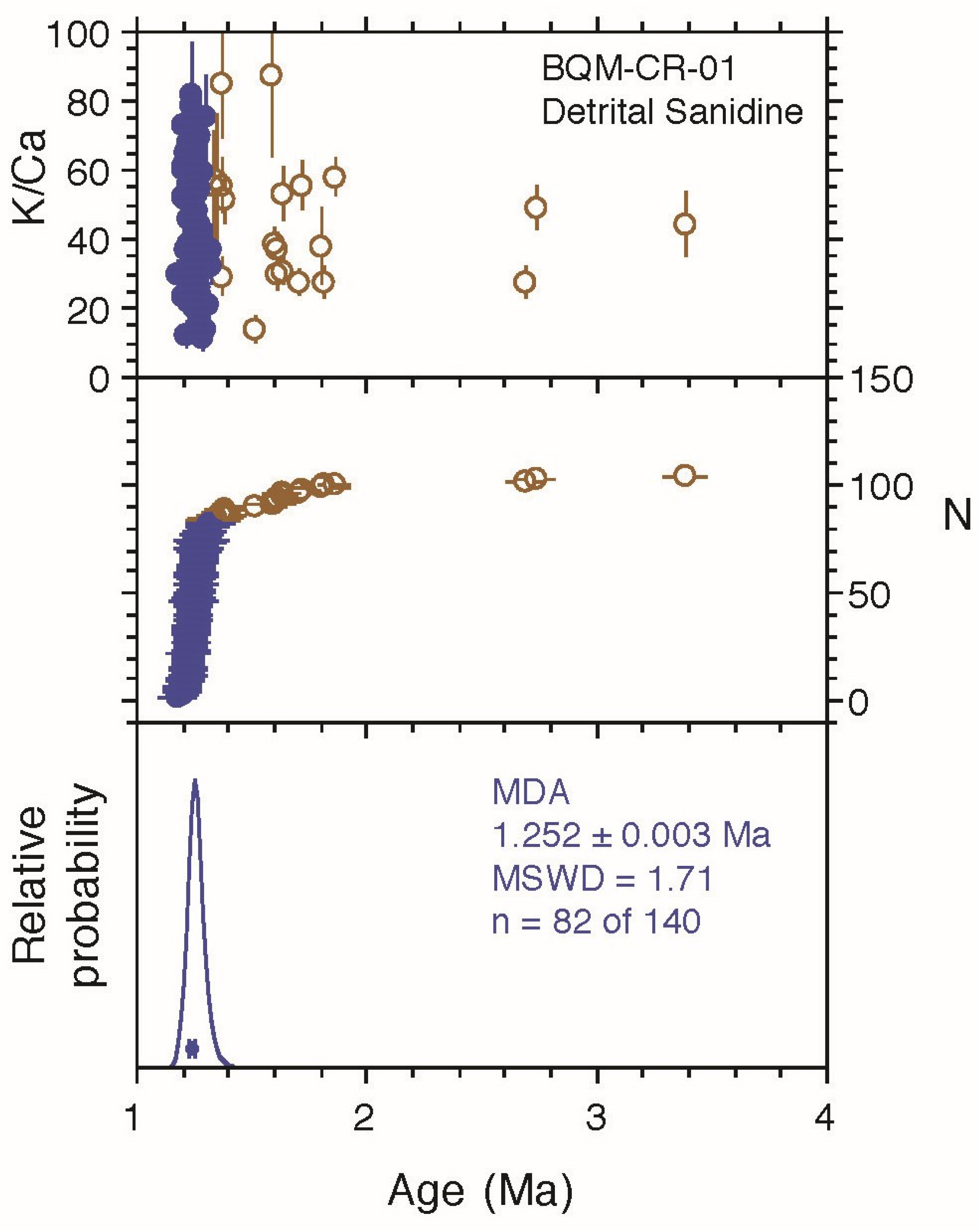
2.5. 40Ar/39Ar Age Determination
2.6. Stable Isotope Analysis
3. Systematic Paleontology
3.1. Referred Specimen
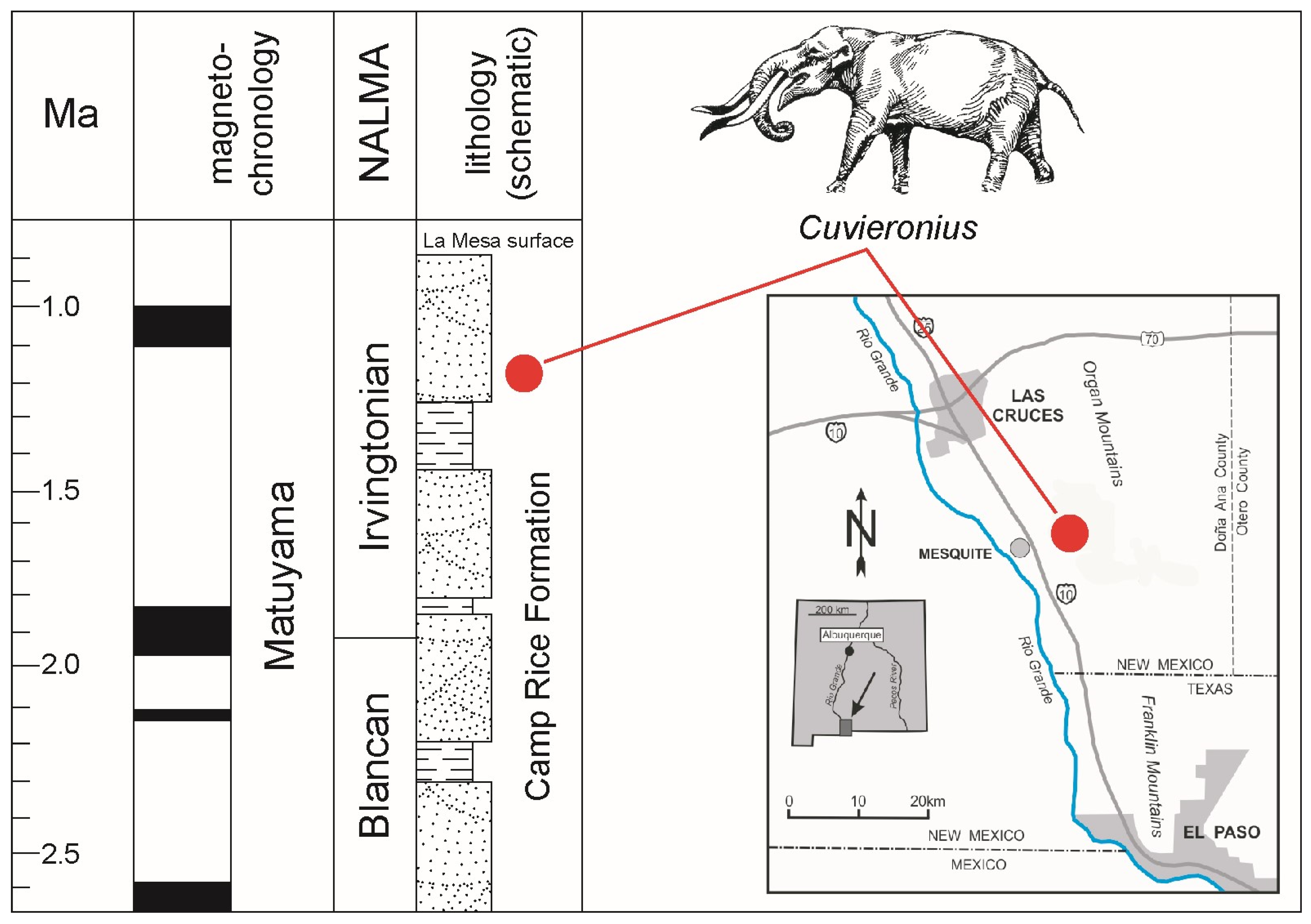
3.2. Locality
3.3. Geological Context: The Camp Rice Formation
3.4. Geologic Horizon
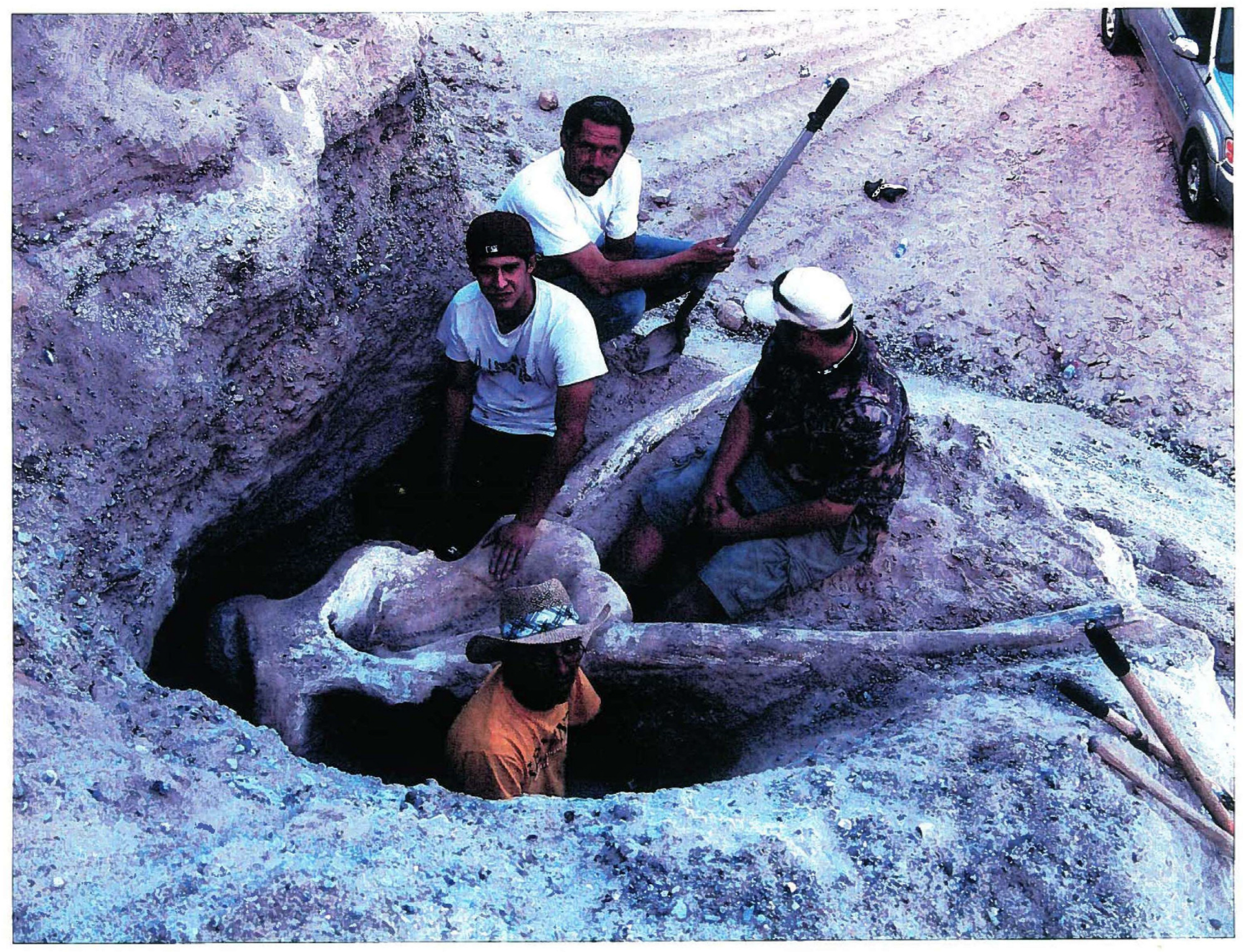
3.5. Taphonomic Setting
3.6. Differential Diagnosis of NMSU 15722
4. Description
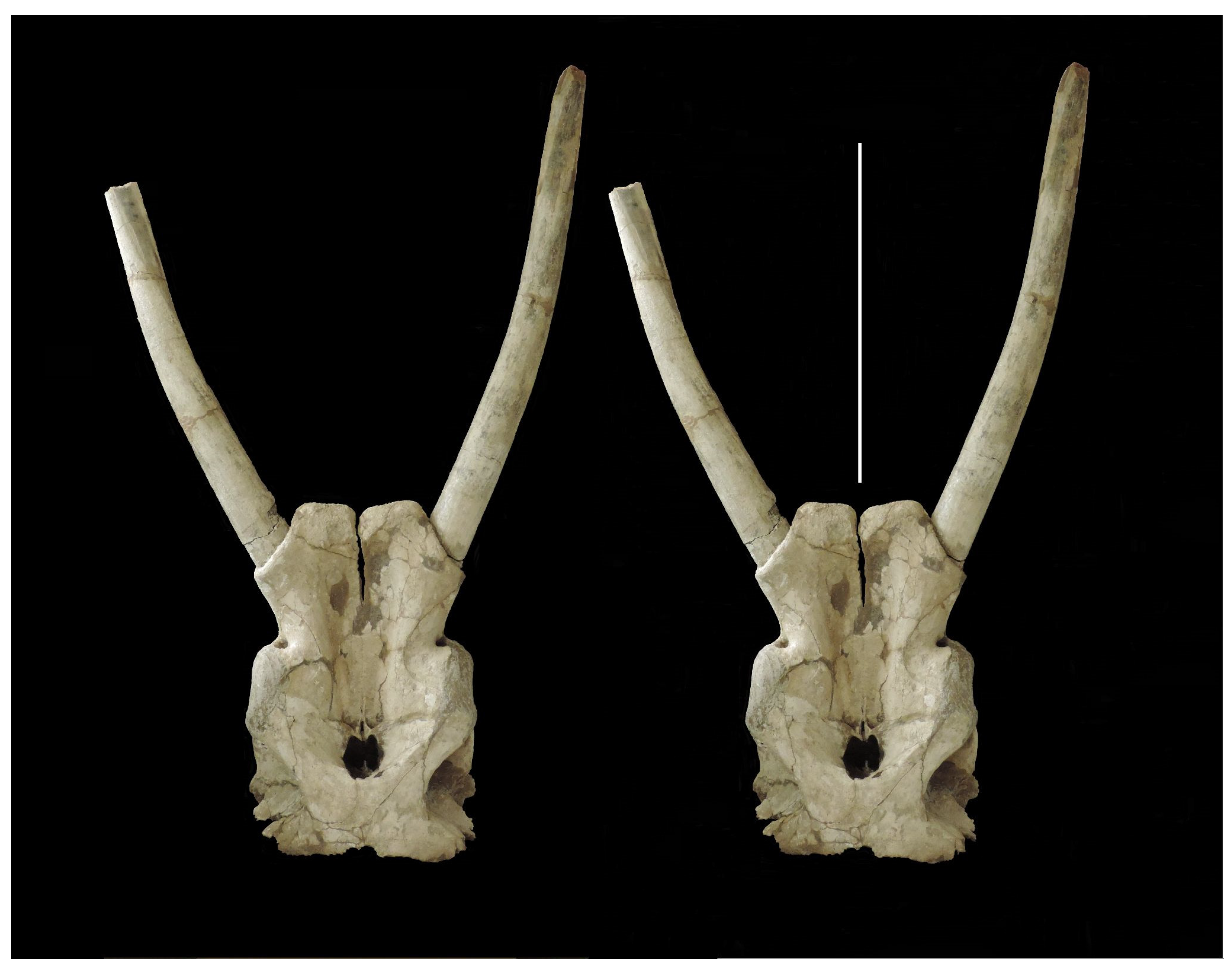
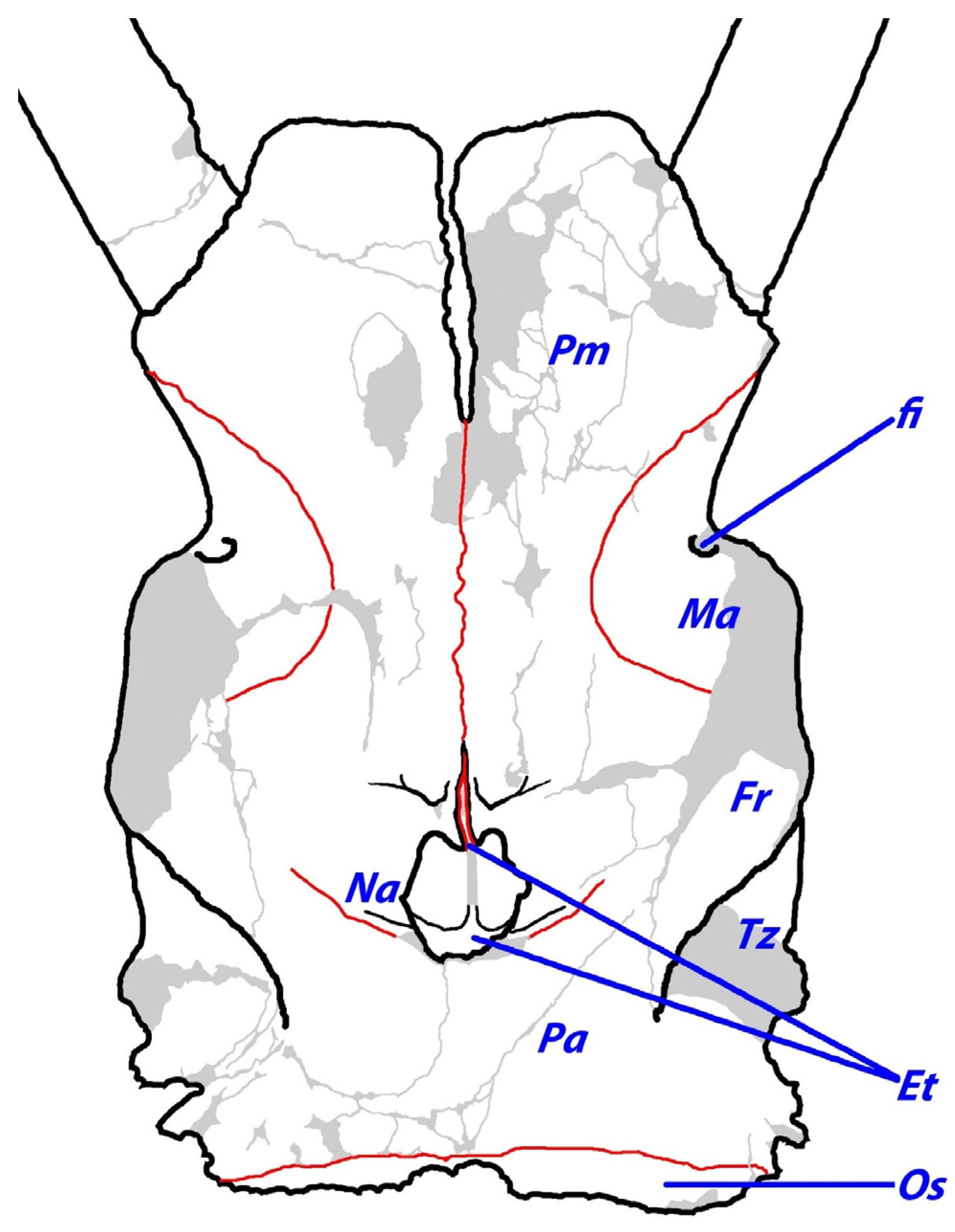
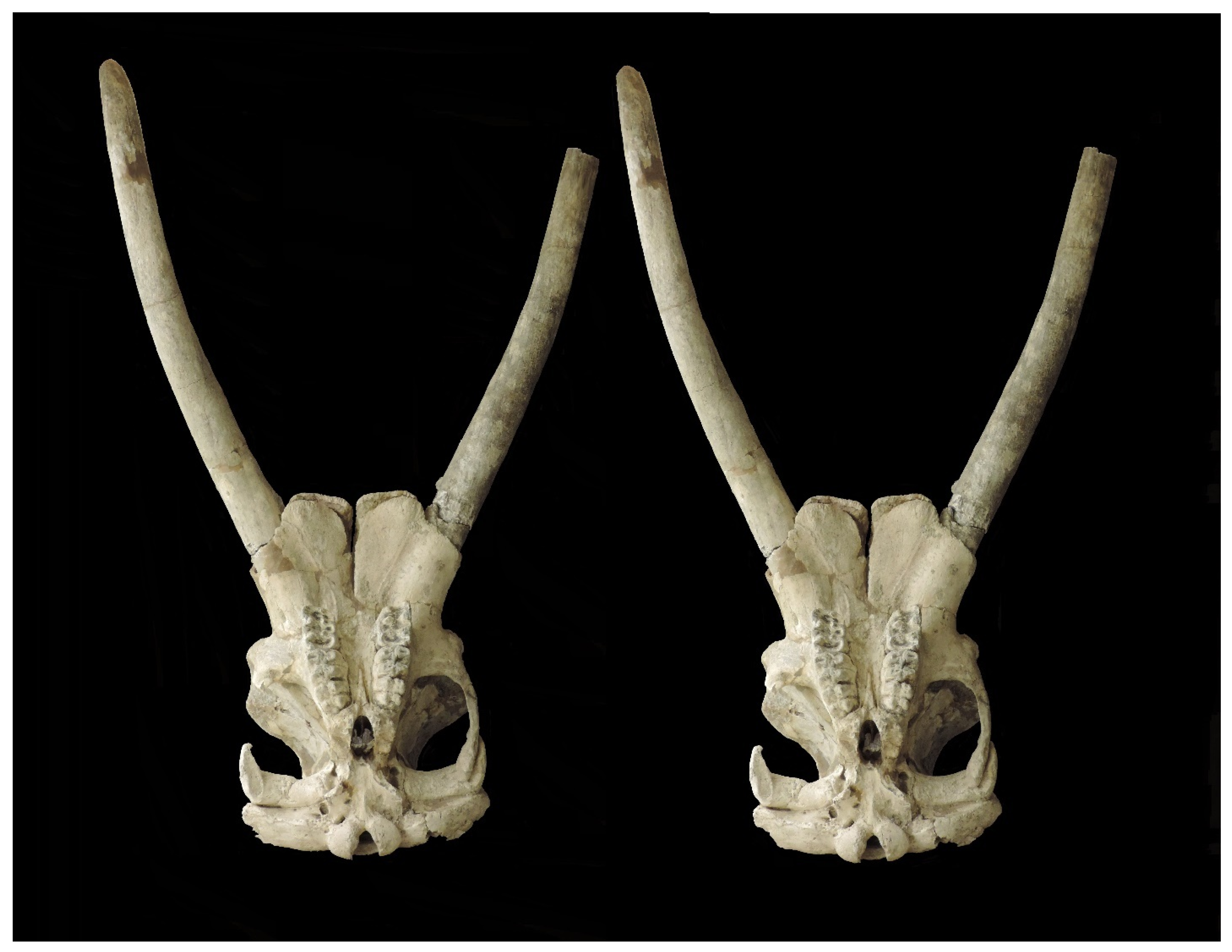
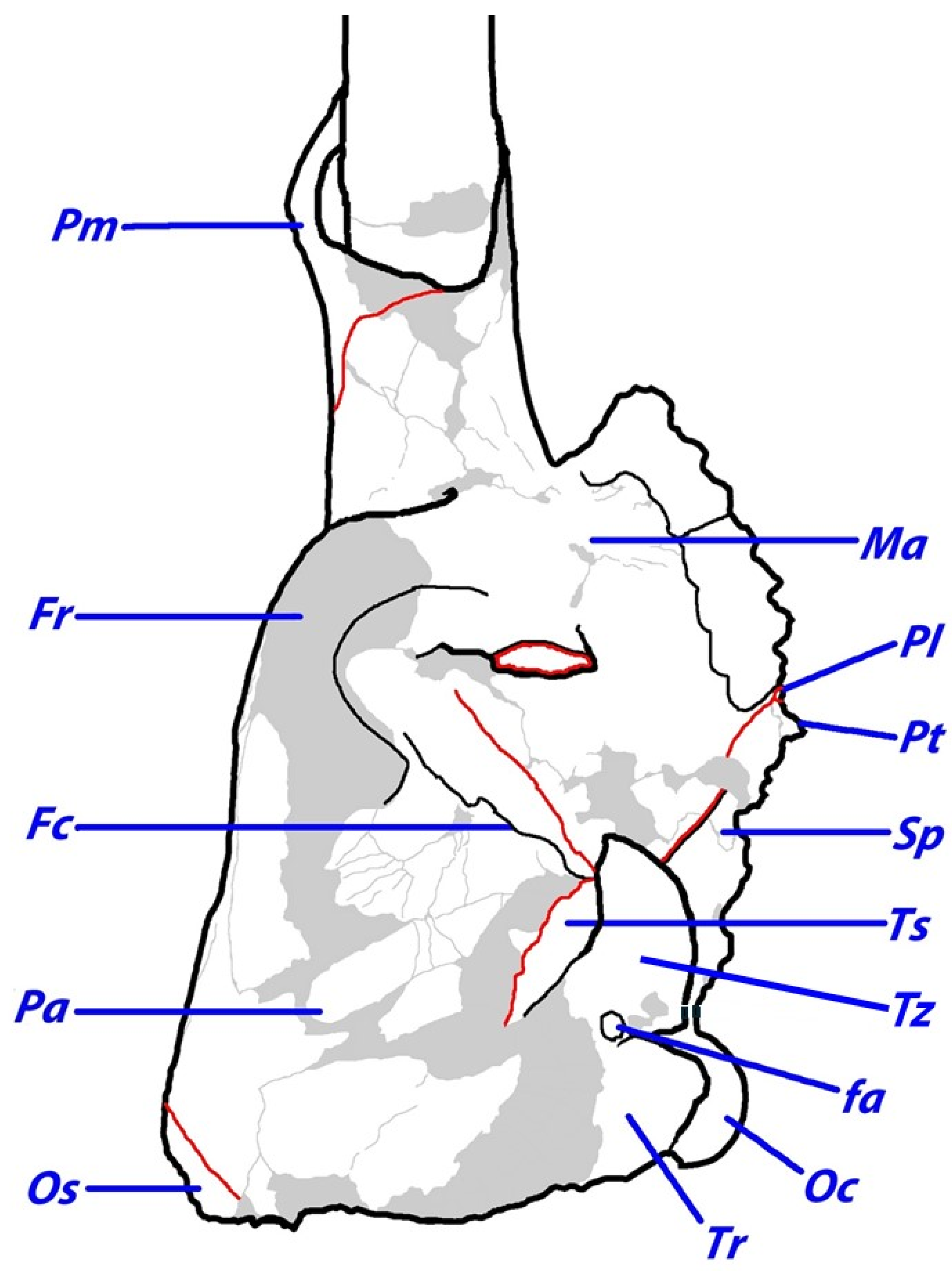
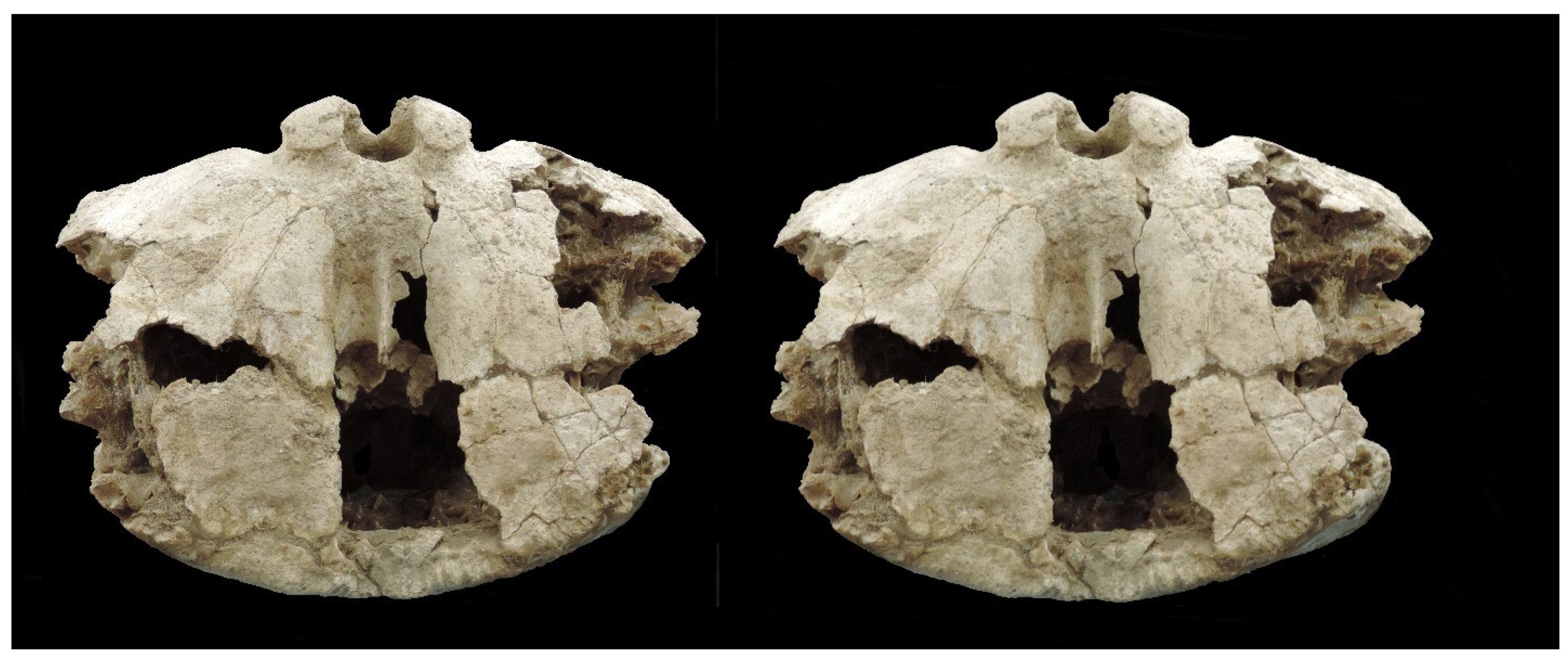
4.1. Dorsal Aspect
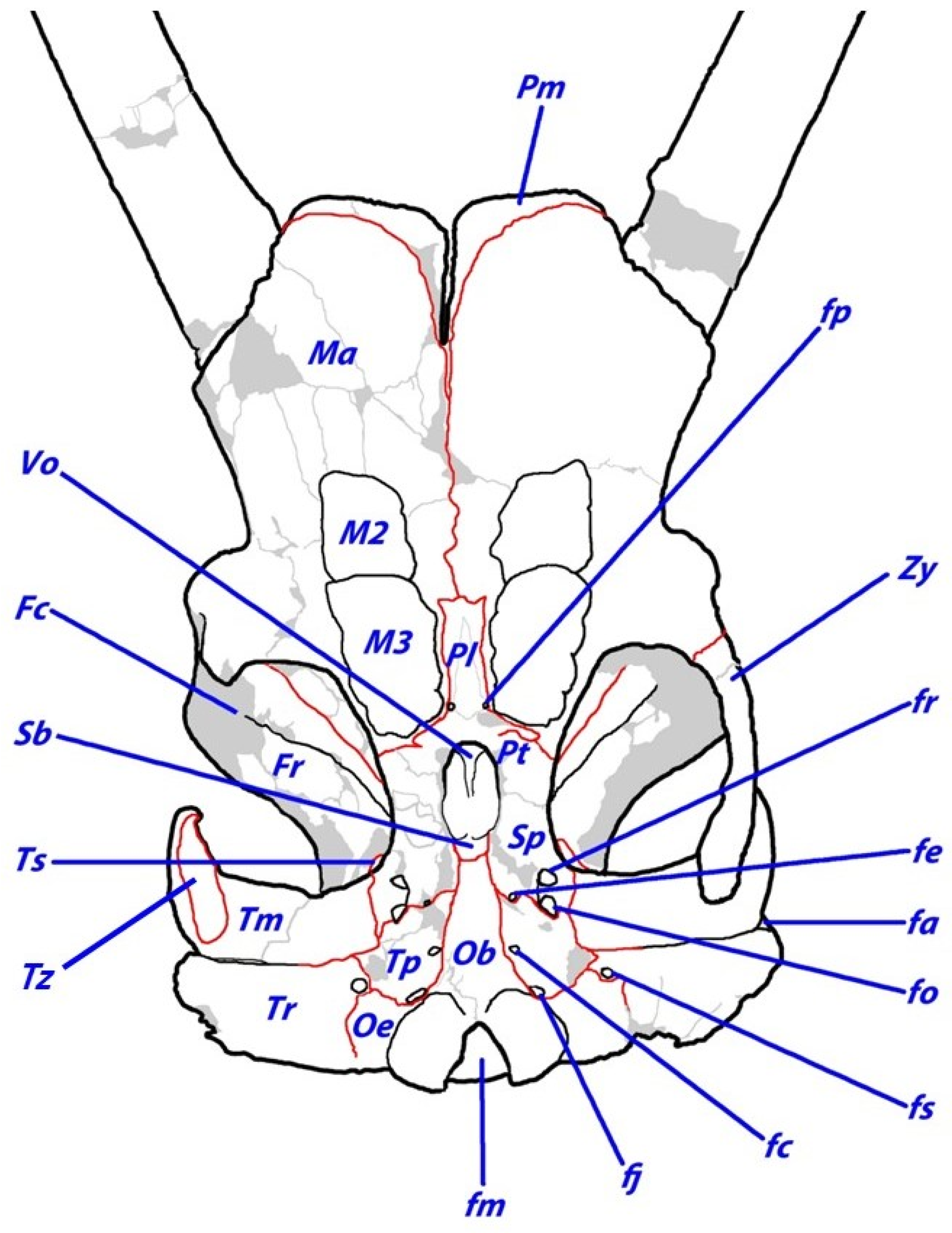
4.2. Ventral Aspect
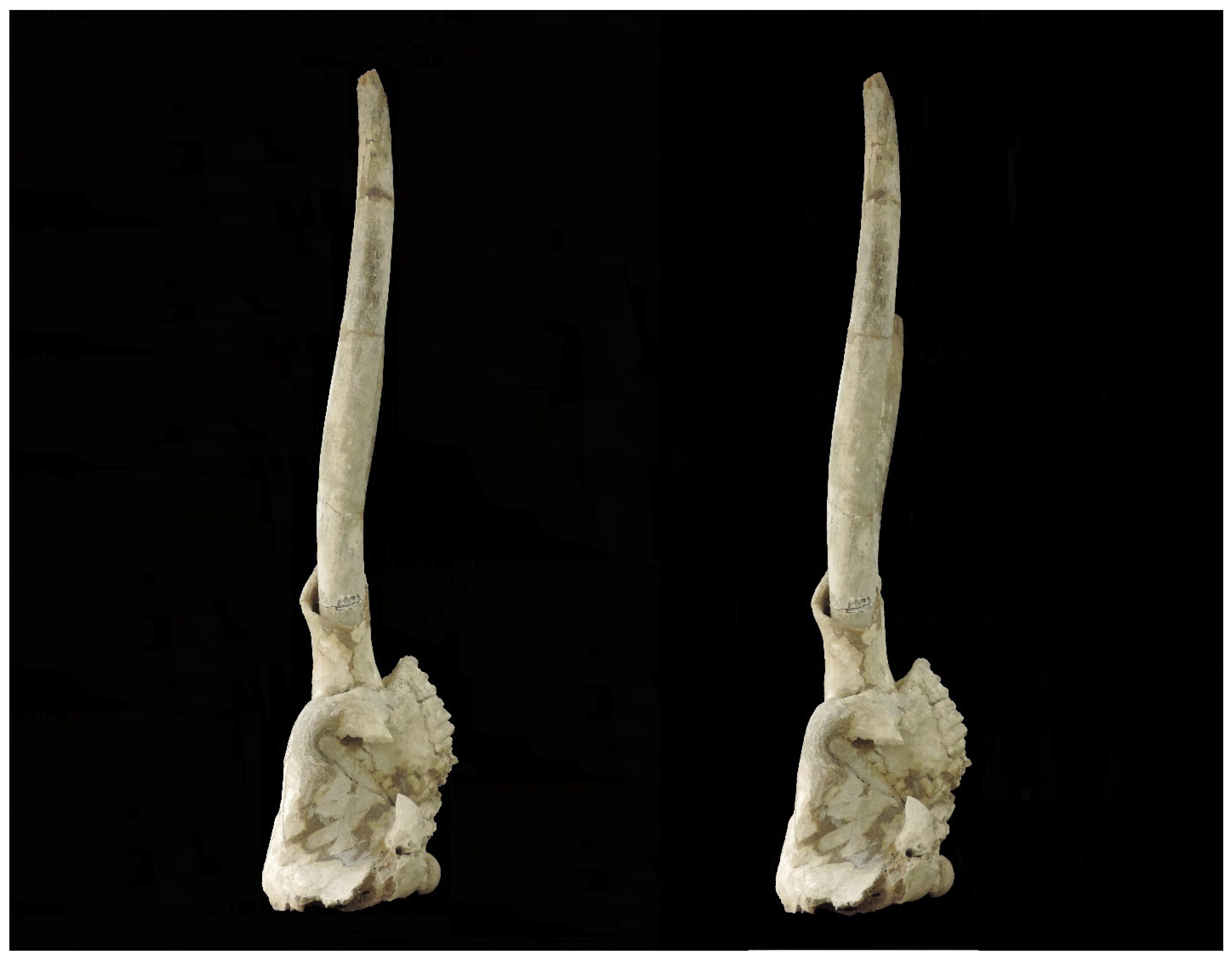
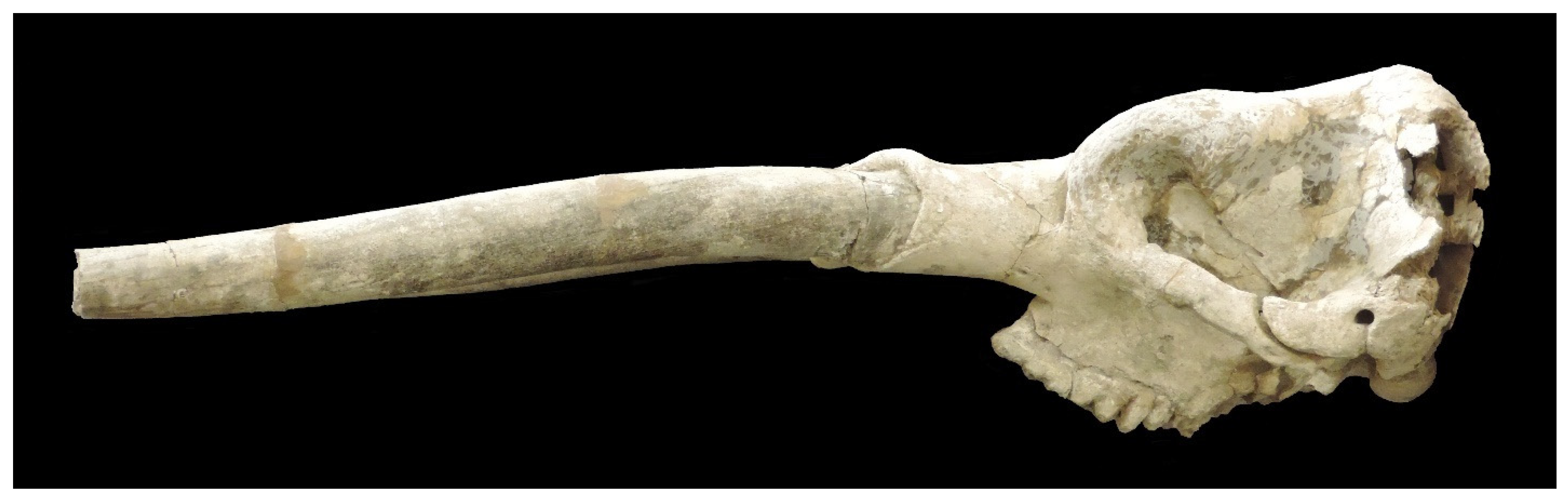
4.3. Lateral Aspect
4.4. Caudal Aspect
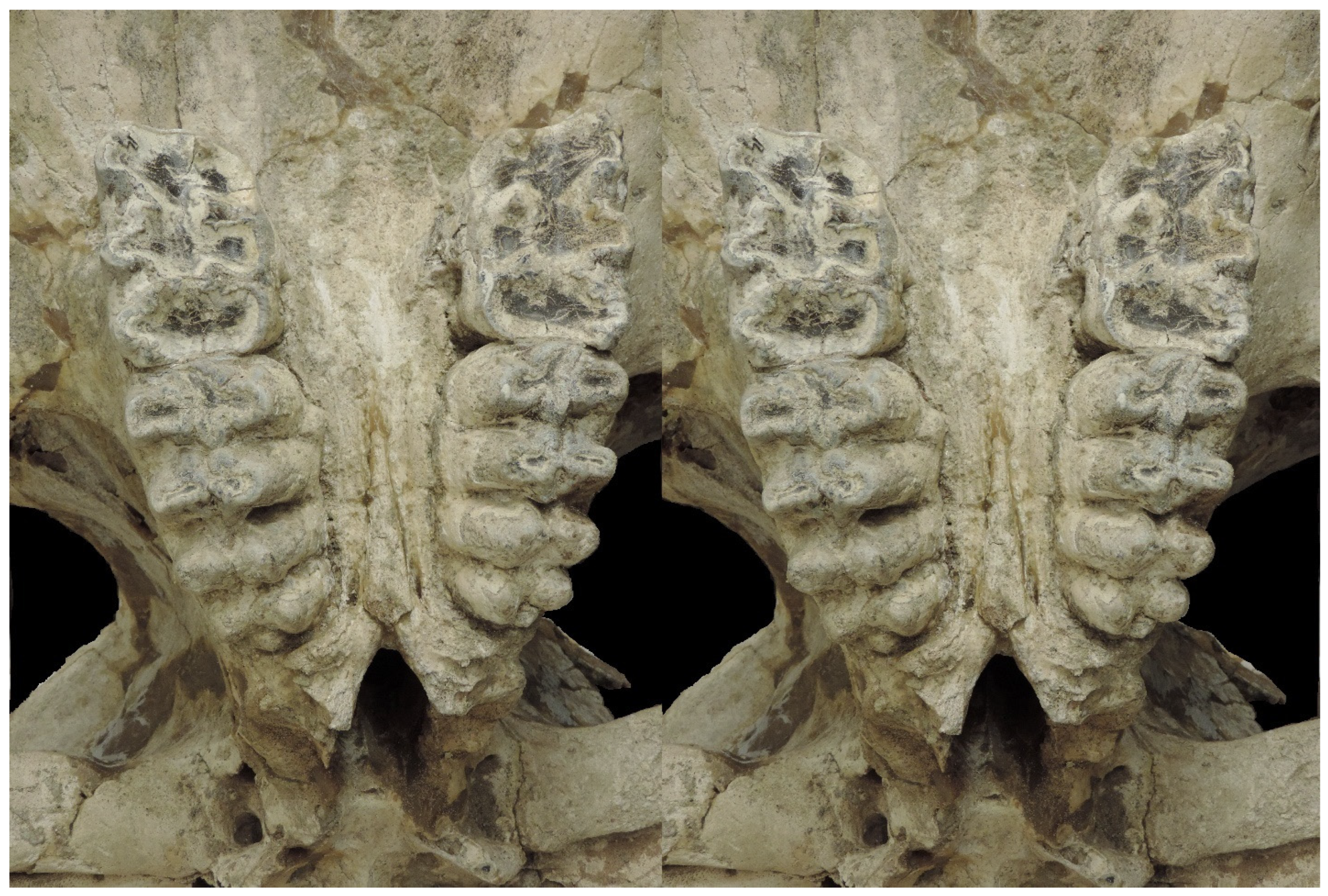
4.5. Molars
5. Comparative Description
5.1. Compared with South American Cuvieronius hyodon
5.2. Compared with Rhynchotherium
5.3. Compared with Gomphotherium
6. Sex Determination
7. 40Ar/39Ar Age Determination
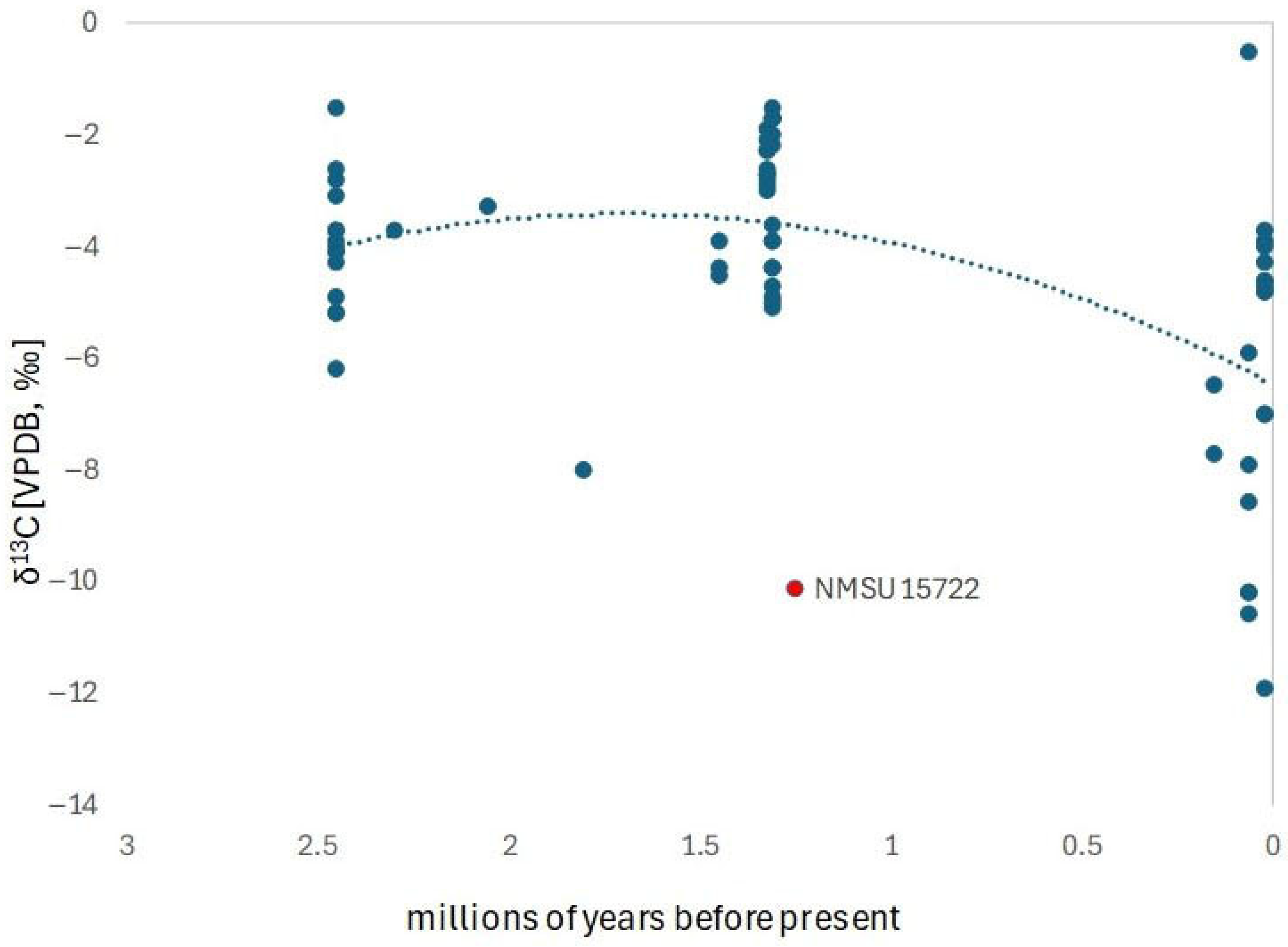
8. Stable Isotope Analysis
9. Discussion
9.1. 40Ar/39Ar Age Determination
9.2. Stable Isotope Analysis
9.3. Dental Morphology and Feeding Ecology
9.4. Taxonomic Assignment
10. Conclusions
Supplementary Materials
Author Contributions
Funding
Data Availability Statement
Acknowledgments
Conflicts of Interest
References
- Tedford, R.H. Mammalian Biochronology of the Late Cenozoic Basins of New Mexico. Geol. Soc. Am. Bull. 1981, 92, 1008. [Google Scholar] [CrossRef]
- Vanderhill, J.B. Lithostratigraphy, Vertebrate Paleontology, and Magnetostratigraphy of Plio-Pleistocene Sediments in the Mesilla Basin, New Mexico. Ph.D. Thesis, University of Texas, Austin, TX, USA, 1986. [Google Scholar]
- Harris, A. Pleistocene Vertebrates of Arizona, New Mexico, and Trans-Pecos Texas; UTEP Biodiversity Collections, Centennial Museum, and Department of Biological Sciences, University of Texas at El Paso: El Paso, Texas, 2012; pp. 1–1631. Available online: https://www.researchgate.net/publication/236842872_Pleistocene_Vertebrates_of_Arizona_New_Mexico_and_Trans-Pecos_Texas (accessed on 18 December 2025).
- Morgan, G.S.; Harris, A.H. Pliocene and Pleistocene Vertebrates of New Mexico. N. M. Mus. Nat. Hist. Sci. Bull. 2015, 68, 233–427. [Google Scholar]
- Mack, G.H.; Salyards, S.L.; James, W.C. Magnetostratigraphy of the Plio-Pleistocene Camp Rice and Palomas Formations in the Rio Grande Rift of Southern New Mexico. Am. J. Sci. 1993, 293, 49–77. [Google Scholar] [CrossRef]
- Mack, G.H.; Seager, W.R.; Leeder, M.R.; Perez-Arlucea, M.; Salyards, S.L. Pliocene and Quaternary History of the Rio Grande, the Axial River of the Southern Rio Grande Rift, New Mexico, USA. Earth-Sci. Rev. 2006, 79, 141–162. [Google Scholar] [CrossRef]
- Lucas, S.G. Case 3479 Cuvieronius Osborn, 1923 (Mammalia, Proboscidea): Proposed Conservation. Bull. Zool. Nomencl. 2009, 66, 265–270. [Google Scholar] [CrossRef]
- Nordenskiöld, E. Über Die Säugetierfossilien Des Tarijatals, Südamerika. I Mastodon andium Cuv. Proc. R. Swed. Acad. Sci. 1903, 37, 161–166. Available online: http://hdl.handle.net/2027/hvd.32044066263096 (accessed on 18 December 2025).
- Boule, M.; Thevenin, A. Mammifères Fossiles de Tarija; Soudier: Paris, France, 1920; pp. 1–255; pls. I–XXVI. Available online: https://archive.org/details/mammifresfossi00bouluoft/page/n11/mode/2up (accessed on 18 December 2025).
- Lucas, S.G. Case 3515 Rhynchotherium Falconer, 1868 (Mammalia; Proboscidea): Proposed Conservation of Usage by Designation of Rhynchotherium falconeri Osborn, 1923 as the Type Species. Bull. Zool. Nomencl. 2010, 67, 158–162. [Google Scholar] [CrossRef]
- Miller, W.E. A Rhynchotherium Skull and Mandible from Southeastern Arizona. Brigh. Young Univ. Geol. Stud. 1990, 36, 57–67. [Google Scholar]
- van der Merwe, N.J.; Bezuidenhout, A.J.; Seegers, C.D. The Skull and Mandible of the African Elephant (Loxodonta africana). Onderstepoort J. Vet. Res. 1995, 62, 245–260. [Google Scholar]
- Kuiper, K.F.; Deino, A.; Hilgen, F.J.; Krijgsman, W.; Renne, P.R.; Wijbrans, J.R. Synchronizing Rock Clocks of Earth History. Science 2008, 320, 500–504. [Google Scholar] [CrossRef]
- Koch, P.L.; Tuross, N.; Fogel, M.L. The Effects of Sample Treatment and Diagenesis on the Isotopic Integrity of Carbonate in Biogenic Hydroxylapatite. J. Archaeol. Sci. 1997, 24, 417–429. [Google Scholar] [CrossRef]
- Fox, D.L.; Fisher, D.C. Dietary Reconstruction of Miocene Gomphotherium (Mammalia, Proboscidea) from the Great Plains Region, USA, Based on the Carbon Isotope Composition of Tusk and Molar Enamel. Palaeogeogr. Palaeoclimatol. Palaeoecol. 2004, 206, 311–335. [Google Scholar] [CrossRef]
- Illiger, J.K.W. Prodromus Systematis Mammalium et Avium Additis Terminis Zoographicis Utriusque Classis, Eorumque Versione Germanica; Sumptibus C. Salfeld: Berlin, Germany, 1811; pp. 1–302. Available online: https://www.biodiversitylibrary.org/item/188747#page/7/mode/1up (accessed on 18 December 2025).
- Hay, O.P. Further Observations on Some Extinct Elephants. Proc. Biol. Soc. Wash. 1922, 35, 97–101. Available online: https://www.biodiversitylibrary.org/part/6682 (accessed on 18 December 2025).
- Osborn, H.F. New Subfamily, Generic, and Specific Stages in the Evolution of the Proboscidea. Am. Mus. Novit. 1923, 99, 1–4. Available online: https://digitallibrary.amnh.org/items/8c56f046-e088-4174-91fe-f9377dac5433 (accessed on 18 December 2025).
- Cope, E.D. The Extinct Mammalia of the Valley of Mexico. Proc. Am. Philos. Soc. 1885, 22, 1–21. [Google Scholar]
- Hawley, J.W.; Kottlowski, F.E.; King, W.E.; Strain, W.S.; Seager, W.R.; LeMone, D.E. The Santa Fe Group in the South-Central New Mexico Border Region. Bord. Stratigr. Symp. N. M. Bur. Mines Miner. Resour. Circ. 1969, 104, 52–76. [Google Scholar]
- Perez-Arlucea, M.; Mack, G.H.; Leeder, M.R. Reconstructing the Ancestral (Plio-Pleistocene) Rio Grande in Its Active Tectonic Setting, Southern Rio Grande Rift, New Mexico, USA. Sedimentology 2000, 47, 701–720. [Google Scholar] [CrossRef]
- Seager, W.R.; Clemons, R.E.; Hawley, J.W.; Kelley, R.E. Geology of Northwest Part of Las Cruces 1° × 2° Sheet 1982. In New Mexico Bureau of Mines and Mineral Resources Geologic Map 53, Scale 1:125,000; New Mexico Bureau of Mines & Mineral Resources: Socorro, NM, USA. [CrossRef]
- Mack, G.H.; Salyards, S.L.; McIntosh, W.C.; Leeder, M.R. Reversal Magnetostratigraphy and Radioisotopic Geochronology of the Plio-Pleistocene Camp Rice and Palomas Formations, Southern Rio Grande Rift. In Las Cruces Country II; Mack, G.H., Austin, G.S., Barker, J.M., Eds.; New Mexico Geological Society Guidebook, 49th Field Conference, Las Cruces, NM, USA; New Mexico Geological Society: Socorro, NM, USA, 1988; Volume 49, pp. 229–236. [Google Scholar] [CrossRef]
- Lucas, S.G.; Morgan, G.S.; Estep, J.W.; Mack, G.H.; Hawley, J.W. Co-Occurrence of the Proboscideans Cuvieronius, Stegomastodon, and Mammuthus in the Lower Pleistocene of Southern New Mexico. J. Vertebr. Paleontol. 1999, 19, 595–597. [Google Scholar] [CrossRef]
- Morgan, G.S.; Hulbert, R.C.; Gottlieb, E.S.; Amato, J.M.; Mack, G.H.; Jonell, T.N. The Tapir Tapirus (Mammalia: Perissodactyla) from the Late Pliocene (Early Blancan) Tonuco Mountain Local Fauna, Camp Rice Formation, Doña Ana County, Southern New Mexico. N. M. Geol. 2017, 39, 28–39. [Google Scholar] [CrossRef]
- Houde, P.; Peltier, D. A New Stegomastodon Skull (Proboscidea: Gomphotheriidae) from the Camp Rice Formation, Doña Ana County, New Mexico. In Las Cruces Country III; Mack, G.H., Hampton, B.A., Ramos, F.C., Witcher, J.C., Ulmer-Scholle, D.S., Eds.; New Mexico Geological Society Guidebook, 69th Field Conference, Las Cruces, NM, USA; New Mexico Geological Society: Socorro, NM, USA, 2018; Volume 69, pp. 53–56. Available online: https://www.researchgate.net/publication/365333186_A_new_Stegomastodon_skull_Proboscidea_Gomphotheriidae_from_the_Camp_Rice_Formation_Dona_Ana_County_New_Mexico (accessed on 18 December 2025). [CrossRef]
- Mack, G.H.; McIntosh, W.C.; Leeder, M.R.; Monger, H.C. Plio-Pleistocene Pumice Floods in the Ancestral Rio Grande, Southern Rio Grande Rift, USA. Sediment. Geol. 1996, 103, 1–8. [Google Scholar] [CrossRef]
- Mack, G.; Dunbar, N.; Foster, R. New Sites of 3.1-Ma Pumice Beds in Axial Fluvial Strata of the Camp Rice and Palomas Formations, Southern Rio Grande Rift. N. M. Geol. 2009, 31, 31–37. [Google Scholar] [CrossRef]
- Mothé, D.; Ferretti, M.P.; Avilla, L.S. The Dance of Tusks: Rediscovery of Lower Incisors in the Pan-American Proboscidean Cuvieronius hyodon Revises Incisor Evolution in Elephantimorpha. PLoS ONE 2016, 11, e0147009. [Google Scholar] [CrossRef]
- Mothé, D.; dos Santos Avilla, L. Mythbusting Evolutionary Issues on South American Gomphotheriidae (Mammalia: Proboscidea). Quat. Sci. Rev. 2015, 110, 23–35. [Google Scholar] [CrossRef]
- Pidgeon, E. The Fossil Remains of the Animal Kingdom; Whittaker, Treacher and Co.: London, UK, 1830; pp. 1–544. Available online: https://archive.org/details/fossilremainsofa00pidg (accessed on 18 December 2025).
- Prado, J.L.; Alberdi, M.T. A Cladistic Analysis among Trilophodont Gomphotheres (Mammalia, Proboscidea) with Special Attention to the South American Genera. Palaeontology 2008, 51, 903–915. [Google Scholar] [CrossRef]
- Prado, J.L.; Alberdi, M.T. Global Evolution of Equidae and Gomphotheriidae from South America. Integr. Zool. 2014, 9, 434–443. [Google Scholar] [CrossRef] [PubMed]
- Todd, N.E. New Phylogenetic Analysis of the Family Elephantidae Based on Cranial-Dental Morphology. Anat. Rec. 2010, 293, 74–90. [Google Scholar] [CrossRef]
- Martinez Antelo, H. Cuvieronius Museo Nacional de Paleontología y Arqueología, Tarija, Bolivia. Available online: https://www.fotopaises.com/foto/tarija-bolivia-bolivia-25566 (accessed on 18 December 2025).
- Martinez Antelo, H. Cuvieronius Museo Nacional de Paleontología y Arqueología, Tarija, Bolivia. Available online: https://www.fotopaises.com/foto/tarija-bolivia-25565 (accessed on 18 December 2025).
- Lucas, S.G. The Palaeobiogeography of South American Gomphotheres. J. Paleogeography 2013, 2, 19–40. [Google Scholar] [CrossRef]
- Cruz Casso, R. Museo Paleontológico Para La Ciudad de Tarija/Cruz Casso, Raquel/37233_RESUMEN.pdf. 2017. Available online: https://biblioteca.uajms.edu.bo/opac_css/index.php?lvl=search_result (accessed on 18 December 2025).
- Baleka, S.; Varela, L.; Tambusso, P.S.; Paijmans, J.L.A.; Mothé, D.; Stafford, T.W.; Fariña, R.A.; Hofreiter, M. Revisiting Proboscidean Phylogeny and Evolution through Total Evidence and Palaeogenetic Analyses Including Notiomastodon Ancient DNA. iScience 2022, 25, 103559. [Google Scholar] [CrossRef]
- Osborn, H.F. Proboscidea: A Monograph of the Discovery, Evolution, Migration and Extinction of the Mastodonts and Elephants of the World, Volume I Mœritheroidea Deinotheroidea Mastodontoidea; The American Museum Press: New York, NY, USA, 1936; pp. 1–802. Available online: https://archive.org/details/proboscideamonog01osbo (accessed on 18 December 2025).
- Gregory, W.K. Adaptive Significance of the Shortening of the Elephant’s Skull. Bull. Am. Mus. Nat. Hist. 1903, 19, 387–394. [Google Scholar]
- Jie, Y.; Wenyu, W.; Hang, J. Reconstruction of the Jaw-Closing Muscles of Platybelodon tongxinensis (Amebelodontidae, Proboscidea) and Discussion of Cranial Evolution from Long-Jawed Mastodont to Short-Jawed Elephantid. Vertebr. Palasiat. 1990, 28, 284–295. [Google Scholar]
- Chiyo, P.I.; Obanda, V.; Korir, D.K. Illegal Tusk Harvest and the Decline of Tusk Size in the African Elephant. Ecol. Evol. 2015, 5, 5216–5229. [Google Scholar] [CrossRef]
- Campbell-Staton, S.C.; Arnold, B.J.; Gonçalves, D.; Granli, P.; Poole, J.; Long, R.A.; Pringle, R.M. Ivory Poaching and the Rapid Evolution of Tusklessness in African Elephants. Science 2021, 374, 483–487. [Google Scholar] [CrossRef]
- Tassy, P. Growth and Sexual Dimorphism among Miocene Elephantoids: The Example of Gomphotherium angustidens. In The Proboscidea; Shoshani, J., Tassy, P., Eds.; Oxford University Press: Oxford, UK, 1996; pp. 92–100. [Google Scholar]
- Cisneros, J.C. New Pleistocene Vertebrate Fauna from El Salvador. Rev. Bras. Paleontol. 2005, 8, 239–255. [Google Scholar] [CrossRef]
- Martinez Antelo, H. Cuvieronius Museo Nacional de Paleontología y Arqueología, Tarija, Bolivia. Available online: https://www.fotopaises.com/foto/tarija-bolivia-25564 (accessed on 18 December 2025).
- ibolivia.org Museo Nacional Paleontológico. Available online: https://www.ibolivia.org/museo-nacional-paleontologico-tarija (accessed on 18 December 2025).
- Museo Nacional de Paleontología y Arqueología, Tarija, Bolivia Museo Nacional de Paleontología y Arqueología, Tarija, Bolivia. Available online: https://munaparq.uajms.edu.bo/exposicion/sala-1/ (accessed on 18 December 2025).
- Museo Nacional Paleontológico Arqueológico de Tarija Museo Nacional Paleontológico Arqueológico de Tarija. Available online: https://www.ibolivia.org/museo-nacional-paleontologico-tarija (accessed on 18 December 2025).
- Carrasco Patzi, M.R.; Carrasco, C.C. Museo Nacional de Paleontología y Arqueología, Tarija, Bolivia. Available online: https://www.youtube.com/watch?v=c05axHZ6AAcandt=244s (accessed on 18 December 2025).
- Alberdi, M.T.; Prado, J.L. Fossil Gomphotheriidae from Argentina. Historia Evolutiva y Paleobiogeográfica de los Vertebrados de América del Sur Contribuciones del MACN. 2016, Volume 6, pp. 275–283. Available online: https://www.researchgate.net/publication/324570077_Fossil_Gomphotheriidae_from_Argentina (accessed on 18 December 2025).
- Mothé, D.; dos Santos Avilla, L.; Asevedo, L.; Borges-Silva, L.; Rosas, M.; Labarca-Encina, R.; Souberlich, R.; Soibelzon, E.; Roman-Carrion, J.L.; Ríos, S.D.; et al. Sixty Years after ‘The Mastodonts of Brazil’: The State of the Art of South American Proboscideans (Proboscidea, Gomphotheriidae). Quat. Int. 2017, 443, 52–64. [Google Scholar] [CrossRef]
- Nasholds, M.W.M.; Zimmerer, M.J. High-Precision 40Ar/39Ar Geochronology and Volumetric Investigation of Volcanism and Resurgence Following Eruption of the Tshirege Member, Bandelier Tuff, at the Valles Caldera. J. Volcanol. Geotherm. Res. 2022, 431, 107624. [Google Scholar] [CrossRef]
- Boecklen, W.J.; Yarnes, C.T.; Cook, B.A.; James, A.C. On the Use of Stable Isotopes in Trophic Ecology. Annu. Rev. Ecol. Evol. Syst. 2011, 42, 411–440. [Google Scholar] [CrossRef]
- Cerling, T.E.; Harris, J.M. Carbon Isotope Fractionation between Diet and Bioapatite in Ungulate Mammals and Implications for Ecological and Paleoecological Studies. Oecologia 1999, 120, 347–363. [Google Scholar] [CrossRef]
- Cerling, T.E.; Andanje, S.A.; Blumenthal, S.A.; Brown, F.H.; Chritz, K.L.; Harris, J.M.; Hart, J.A.; Kirera, F.M.; Kaleme, P.; Leakey, L.N.; et al. Dietary Changes of Large Herbivores in the Turkana Basin, Kenya from 4 to 1 Ma. Proc. Natl. Acad. Sci. USA 2015, 112, 11467–11472. [Google Scholar] [CrossRef]
- Pardi, M.I.; DeSantis, L.R.G. Dietary Plasticity of North American Herbivores: A Synthesis of Stable Isotope Data over the Past 7 Million Years. Proc. R. Soc. B Biol. Sci. 2021, 288, 20210121. [Google Scholar] [CrossRef]
- Sánchez, B.; Prado, J.L.; Alberdi, M.T. Feeding Ecology, Dispersal, and Extinction of South American Pleistocene Gomphotheres (Gomphotheriidae, Proboscidea). Paleobiology 2004, 30, 146–161. [Google Scholar] [CrossRef]
- Pérez-Crespo, V.A.; Laurito, C.A.; Arroyo-Cabrales, J.; Valerio, A.L.; Cienfuegos-Alvarado, E.; Otero, F.J. Feeding Habits of the Gomphothere Cuvieronius hyodon in Costa Rica: A Biochemical Approach. Hist. Biol. 2024, 36, 734–741. [Google Scholar] [CrossRef]
- Smith, G.J.; DeSantis, L.R.G. Extinction of North American Cuvieronius (Mammalia: Proboscidea: Gomphotheriidae) Driven by Dietary Resource Competition with Sympatric Mammoths and Mastodons. Paleobiology 2020, 46, 41–57. [Google Scholar] [CrossRef]
- Gomes, J.P.B.; Bunevich, R.B.; Sartorato, A.C.L.; Tedeschi, L.R.; Tonietto, S.N.; Tucker, M.E.; Whitaker, F. Early Diagenetic Evolution Based on Petrography and Stable Isotope Analysis in the Barra Velha Formation of the Brazilian Pre-salt. Depos. Rec. 2025, 11, 70–94. [Google Scholar] [CrossRef]
- Stevens, R.E.; Pederzani, S.; Britton, K.; Wexler, S.K. Bones and Teeth Isotopes as Archives for Palaeoclimatic, Palaeoenvironmental and Palaeoecological Data. Quat. Sci. Rev. 2025, 357, 109320. [Google Scholar] [CrossRef]
- Wang, Y.; Cerling, T.E. A Model of Fossil Tooth and Bone Diagenesis: Implications for Paleodiet Reconstruction from Stable Isotopes. Palaeogeogr. Palaeoclimatol. Palaeoecol. 1994, 107, 281–289. [Google Scholar] [CrossRef]
- Domingo, L.; Prado, J.L.; Alberdi, M.T. The Effect of Paleoecology and Paleobiogeography on Stable Isotopes of Quaternary Mammals from South America. Quat. Sci. Rev. 2012, 55, 103–113. [Google Scholar] [CrossRef]
- Pérez-Crespo, V.A.; Prado, J.L.; Alberdi, M.T.; Arroyo-Cabrales, J.; Johnson, E. Diet and Habitat for Six American Pleistocene Proboscidean Species Using Carbon and Oxygen Stable Isotopes. Ameghiniana 2015, 53, 39–51. [Google Scholar] [CrossRef]
- MacFadden, B.J.; Shockey, B.J. Ancient Feeding Ecology and Niche Differentiation of Pleistocene Mammalian Herbivores from Tarija, Bolivia: Morphological and Isotopic Evidence. Paleobiology 1997, 23, 77–100. [Google Scholar] [CrossRef]
- Labarca, R.O.; Lopez, P.G. Los Mamiferos finiPleistocénicos de La Formación Quebrada Quereo (IV Regiónchile): Biogeografía e Inferencias Paleoambi-Entales. Mastozool. Neotrop. 2016, 13, 89–101. [Google Scholar]
- Marín-Leyva, A.H.; Mainou, L.; Perez-Crespo, V.A.; Straulino Mainou, L.; Arreola, I.M.; Solís-Pichardo, G.; Cienfuegos-Alvarado, E.; Alberdi, M.T. The Life Story of a Gomphothere from East-Central Mexico: A Multidisciplinary Approach. J. S. Am. Earth Sci. 2021, 111, 103442. [Google Scholar] [CrossRef]
- Morgan, G.S.; MacFadden, B.J.; Martínez, M. Quaternary Gomphotheres (Mammalia: Proboscidea: Gomphotheriidae) from the Continental Shelf, Pearl Islands, Panama. Quat. Int. 2016, 392, 335–348. [Google Scholar] [CrossRef]
- Lucas, S.G. Cuvieronius (Mammalia, Proboscidea) from the Neogene of Florida. N. M. Mus. Nat. Hist. Sci. Bull. 2008, 44, 31–38. [Google Scholar]
- Mothé, D.; Kinoshita, A.; Baffa, O.; Luna, C.A. Doing the Time Warp Again: Electron Spin Resonance Dating Reveals Oldest Numeric Age for Notiomastodon platensis Ameghino, 1888 (Mammalia, Proboscidea). Geobios 2025, 91, 81–88. [Google Scholar] [CrossRef]
- Mothé, D.; Avilla, L.S.; Cozzuol, M.; Winck, G.R. Taxonomic Revision of the Quaternary Gomphotheres (Mammalia: Proboscidea: Gomphotheriidae) from the South American Lowlands. Quat. Int. 2012, 276–277, 2–7. [Google Scholar] [CrossRef]
- Mothé, D.; Avilla, L.S.; Cozzuol, M.A. The South American Gomphotheres (Mammalia, Proboscidea, Gomphotheriidae): Taxonomy, Phylogeny, and Biogeography. J. Mamm. Evol. 2013, 20, 23–32. [Google Scholar] [CrossRef]
- Lucas, S.G. Taxonomic Nomenclature of Cuvieronius and Haplomastodon, Proboscideans from the Plio-Pleistocene of the New World. N. M. Mus. Nat. Hist. Sci. Bull. 2008, 44, 409–415. [Google Scholar]
- Lucas, S.G.; Alvarado, G.E. Fossil Proboscidea from the Upper Cenozoic of Central America: Taxonomy, Evolutionary and Paleobiogegraphic Significance. Rev. Geológica América Cent. 2010, 42, 9–42. [Google Scholar] [CrossRef][Green Version]
- Takai, F.; Arozqueta, B.; Mizuno, T.; Yoshida, A.; Kondo, H. On Fossil Mammals from the Tarija Department, Southern Bolivia. Res. Inst. Evol. Biol. Tokyo 1984, 4, 1–63. [Google Scholar]
- Takai, F.; Mizuno, T.; Iwasaki, Y.; Kotake, T.; Yoshida, A.; Arozqueta, B. Fossil Mammals Excavated in the Tarija Basin, Bolivia. Res. Inst. Evol. Biol. Tokyo 1980, 2, 1–63. [Google Scholar]
- Takai, F.; Mizuno, T.; Iwasaki, Y.; Tanaka, K.; Yoshida, A. Tarija Mammal-Bearing Formation in Bolivia. Res. Inst. Evol. Biol. Tokyo 1982, 3, 1–72. [Google Scholar]
- Ferretti, M.P. A Review of South American Proboscideans. In Neogene Mammals. New Mexico Museum of Natural Science Bulletin; Lucas, S.G., Morgan, G.S., Spielman, J.A., Prothero, D.R., Lucas, S.G., Morgan, G.S., Spielman, J.A., Prothero, D.R., Eds.; New Mexico Museum of Natural History and Science: Albuquerque, NM, USA, 2008; Volume 44, pp. 381–391. [Google Scholar]
- Kozak, K.H.; Wiens, J.J. Climatic Zonation Drives Latitudinal Variation in Speciation Mechanisms. Proc. R. Soc. B Biol. Sci. 2007, 274, 2995–3003. [Google Scholar] [CrossRef]
- Hending, D. Cryptic Species Conservation: A Review. Biol. Rev. 2025, 100, 258–274. [Google Scholar] [CrossRef]
- Shin, C.P.; Allmon, W.D. How We Study Cryptic Species and Their Biological Implications: A Case Study from Marine Shelled Gastropods. Ecol. Evol. 2023, 13, e10360. [Google Scholar] [CrossRef]
- Allmon, W.D. Studying Species in the Fossil Record: A Review and Recommendations for a More Unified Approach. In Species and Speciation in the Fossil Record; Allmon, W.D., Yacobucci, M.M., Eds.; The University of Chicago Press: Chicago, IL, USA; London, UK, 2016; pp. 59–120. Available online: https://books.google.com/books?hl=en&lr=&id=_2cpDQAAQBAJ&oi=fnd&pg=PA59&dq=Studying+species+in+the+fossil+record:+A+review+and+recommendations+for+a+more+unified+approach&ots=OTxGvpoHlr&sig=qdeo-PThhHIzv4caraq_5JwUt6I#v=onepage&q&f=false (accessed on 18 December 2025).
- Hutton, J.X. Theory of the Earth; or an Investigation of the Laws Observable in the Composition, Dissolution, and Restoration of Land upon the Globe. Earth Environ. Sci. Trans. R. Soc. Edinb. 1788, 1, 209–304. [Google Scholar] [CrossRef]
- Darwin, C. On the Origin of Species by Means of Natural Selection or the Preservation of Favoured Races in the Struggle for Life, 1st ed.; John Murray: London, UK, 1859; pp. 1–502. Available online: https://www.gutenberg.org/files/1228/1228-h/1228-h.htm (accessed on 18 December 2025).
- de Souza Barbosa, F.H.D.S.; Araújo-Júnior, H.I.D.; Mothé, D.; dos Santos Avilla, L. Osteological Diseases in an Extinct Notiomastodon (Mammalia, Proboscidea) Population from the Late Pleistocene of Brazil. Quat. Int. 2017, 443, 228–232. [Google Scholar] [CrossRef]
- Bailleul, A.M.; O’Connor, J.; Zhang, S.; Li, Z.; Wang, Q.; Lamanna, M.C.; Zhu, X.; Zhou, Z. An Early Cretaceous Enantiornithine (Aves) Preserving an Unlaid Egg and Probable Medullary Bone. Nat. Commun. 2019, 10, 1275. [Google Scholar] [CrossRef]
- Buckley, M.; Recabarren, O.P.; Lawless, C.; García, N.; Pino, M. A Molecular Phylogeny of the Extinct South American Gomphothere through Collagen Sequence Analysis. Quat. Sci. Rev. 2019, 224, 105882. [Google Scholar] [CrossRef]
- Hsieh, S.; Plotnick, R.E. The Representation of Animal Behaviour in the Fossil Record. Anim. Behav. 2020, 169, 65–80. [Google Scholar] [CrossRef]
- Buchmann, R.; Rodrigues, T. Resistance of Cervical Vertebrae in Response to Muscular Stresses in Pterosaurs: Implications for Foraging Habits and Skeletal Pneumatization. PeerJ 2025, 13, e20388. [Google Scholar] [CrossRef]
- Chacón-Duque, J.C.; Thomas Thorpe, J.A.; Li, W.; Dehasque, M.; Pečnerová, P.; Barlow, A.; Díez-del-Molino, D.; Henneberger, K.; Jin, C.; Moreland, K.N.; et al. A Million Years of Mammoth Mitogenome Evolution. Mol. Biol. Evol. 2025, 42, msaf065. [Google Scholar] [CrossRef]
- Mármol-Sánchez, E.; Fromm, B.; Oskolkov, N.; Pochon, Z.; Dehasque, M.; Aslanzadeh, M.; Bozlak, E.; Brown, K.; Van Der Valk, T.; Kalogeropoulos, P.; et al. Ancient RNA Expression Profiles from the Extinct Woolly Mammoth. Cell 2026, 189, 52–69.e22. [Google Scholar] [CrossRef]
- Gaytán, Á.; Bergsten, J.; Canelo, T.; Pérez-Izquierdo, C.; Santoro, M.; Bonal, R. DNA Barcoding and Geographical Scale Effect: The Problems of Undersampling Genetic Diversity Hotspots. Ecol. Evol. 2020, 10, 10754–10772. [Google Scholar] [CrossRef] [PubMed]
- Rowe, A.G.; Bataille, C.P.; Baleka, S.; Combs, E.A.; Crass, B.A.; Fisher, D.C.; Ghosh, S.; Holmes, C.E.; Krasinski, K.E.; Lanoë, F.; et al. A Female Woolly Mammoth’s Lifetime Movements End in an Ancient Alaskan Hunter-Gatherer Camp. Sci. Adv. 2024, 10, eadk0818. [Google Scholar] [CrossRef] [PubMed]
- Mayr, E. Change of Genetic Environment and Evolution. In Evolution as a Process; Huxley, J., Hardy, A.C., Ford, E.B., Eds.; Allen & Unwin: London, UK, 1954; pp. 157–180. Available online: https://www.bibsonomy.org/bibtex/10fdc2e4ddded4d1e8f68b37545baa6ca (accessed on 18 December 2025).
- Templeton, A.R. The Theory of Speciation via the Founder Principle. Genetics 1980, 94, 1011–1038. [Google Scholar] [CrossRef]
- Templeton, A.R. The Reality and Importance of Founder Speciation in Evolution. BioEssays 2008, 30, 470–479. [Google Scholar] [CrossRef]
- Carson, H.L.; Templeton, A.R. Genetic Revolutions in Relation to Speciation Phenomena: The Founding of New Populations. Annu. Rev. Ecol. Syst. 1984, 15, 97–131. [Google Scholar] [CrossRef]
- Wright, S. Isolation by Distance. Genetics 1943, 28, 114–138. [Google Scholar] [CrossRef]
- Relethford, J. Global Patterns of Isolation by Distance Based on Genetic and Morphological Data. Hum. Biol. 2004, 76, 499–513. [Google Scholar] [CrossRef]
- Ramachandran, S.; Deshpande, O.; Roseman, C.C.; Rosenberg, N.A.; Feldman, M.W.; Cavalli-Sforza, L.L. Support from the Relationship of Genetic and Geographic Distance in Human Populations for a Serial Founder Effect Originating in Africa. Proc. Natl. Acad. Sci. USA 2005, 102, 15942–15947. [Google Scholar] [CrossRef]
- DeGiorgio, M.; Jakobsson, M.; Rosenberg, N.A. Explaining Worldwide Patterns of Human Genetic Variation Using a Coalescent-Based Serial Founder Model of Migration Outward from Africa. Proc. Natl. Acad. Sci. USA 2009, 106, 16057–16062. [Google Scholar] [CrossRef]
- 1000 Genomes Project Consortium. A Global Reference for Human Genetic Variation. Nature 2015, 526, 68. [Google Scholar] [CrossRef]
- Woodburne, M.O. The Great American Biotic Interchange: Dispersals, Tectonics, Climate, Sea Level and Holding Pens. J. Mamm. Evol. 2010, 17, 245–264. [Google Scholar] [CrossRef]
- Montes, C.; Cardona, A.; Jaramillo, C.; Pardo, A.; Silva, J.C.; Valencia, V.; Ayala, C.; Pérez-Angel, L.C.; Rodriguez-Parra, L.A.; Ramirez, V.; et al. Middle Miocene Closure of the Central American Seaway. Science 2015, 348, 226–229. [Google Scholar] [CrossRef]
- O’Dea, A.; Lessios, H.A.; Coates, A.G.; Eytan, R.I.; Restrepo-Moreno, S.A.; Cione, A.L.; Collins, L.S.; De Queiroz, A.; Farris, D.W.; Norris, R.D.; et al. Formation of the Isthmus of Panama. Sci. Adv. 2016, 2, e1600883. [Google Scholar] [CrossRef] [PubMed]
- Jaramillo, C. Evolution of the Isthmus of Panama: Biological, Paleoceanographic and Paleoclimatological Implications. In Mountains, Climate and Biodiversity; Hoorn, C., Perrigo, A., Antonelli, A., Eds.; John Wiley & Sons Ltd.: Hoboken, NJ, USA, 2018; pp. 323–338. [Google Scholar]
- Mora, A.; Villagómez, D.; Parra, M.; Caballero, V.M.; Spikings, R.; Horton, B.K.; Mora-Bohórquez, J.A.; Ketcham, R.A.; Arias-Martínez, J.P. Chpt 4: Late Cretaceous to Cenozoic uplift of the northern Andes: Paleogeographic implications. In The Geology of Colombia, Volume 3 Paleogene—Neogene; Gómez, J., Mateus–Zabala, D., Eds.; Servicio Geológico Colombiano, Publicaciones Geológicas Especiales: Bogotá, Colombia, 2020; Volume 37, pp. 89–121. [Google Scholar] [CrossRef]
- Mothé, D.; Jaramillo, C.; Krigsfeld Shuster, G.; Oikawa, N.; Escobar-Florez, S. Ain’t No Mountain High Enough? New Records of Notiomastodon platensis (Mammalia, Proboscidea) from Colombia and the Quaternary Dry Corridor of the Cauca Valley. Hist. Biol. 2024, 36, 241–252. [Google Scholar] [CrossRef]
- Nei, M.; Maruyama, T.; Chakraborty, R. The Bottleneck Effect and Genetic Variability in Populations. Evolution 1975, 29, 1–10. [Google Scholar] [CrossRef] [PubMed]
- Whyte, I.; Van Aarde, R.; Pimm, S.L. Managing the Elephants of Kruger National Park. Anim. Conserv. 1998, 1, 77–83. [Google Scholar] [CrossRef]
- de Silva, S. On Predicting Elephant Population Dynamics. Gajah 2010, 33, 12–16. [Google Scholar]
- Turkalo, A.K.; Wrege, P.H.; Wittemyer, G. Slow Intrinsic Growth Rate in Forest Elephants Indicates Recovery from Poaching Will Require Decades. J. Appl. Ecol. 2017, 54, 153–159. [Google Scholar] [CrossRef]
- Baker, A.J.; Moeed, A. Rapid Genetic Differentiation and Founder Effect in Colonizing Populations of Common Mynas (Acridotheres tristis). Evolution 1987, 41, 525–538. [Google Scholar] [CrossRef]
- BirdLife Data Zone 2025 Common Myna Acridotheres tristis Species Fact Sheet. Available online: https://datazone.birdlife.org/species/factsheet/common-myna-acridotheres-tristis (accessed on 18 December 2025).
- Wittemyer, G.; Daballen, D.; Douglas-Hamilton, I. Comparative Demography of an At-Risk African Elephant Population. PLoS ONE 2013, 8, e53726. [Google Scholar] [CrossRef]
- Palkopoulou, E.; Dalén, L.; Lister, A.M.; Vartanyan, S.; Sablin, M.; Sher, A.; Edmark, V.N.; Brandström, M.D.; Germonpré, M.; Barnes, I.; et al. Holarctic Genetic Structure and Range Dynamics in the Woolly Mammoth. Proc. R. Soc. B Biol. Sci. 2013, 280, 20131910. [Google Scholar] [CrossRef]
- Bacon, C.D.; Silvestro, D.; Jaramillo, C.; Smith, B.T.; Chakrabarty, P.; Antonelli, A. Biological Evidence Supports an Early and Complex Emergence of the Isthmus of Panama. Proc. Natl. Acad. Sci. USA 2015, 112, 6110–6115. [Google Scholar] [CrossRef] [PubMed]
- Casamiquela, R.M.; Shoshani, J.; Dillehay, T.D. South American Proboscideans: General Introduction and Reflections on Pleistocene Extinctions. In The Proboscidea; Shoshani, J., Tassy, P., Eds.; Oxford University Press: Oxford, UK, 1996; pp. 316–320. [Google Scholar]
- Sanchez, G.; Holliday, V.T.; Gaines, E.P.; Arroyo-Cabrales, J.; Martínez-Tagüeña, N.; Kowler, A.; Lange, T.; Hodgins, G.W.L.; Mentzer, S.M.; Sanchez-Morales, I. Human (Clovis)–Gomphothere (Cuvieronius sp.) Association ∼13,390 Calibrated yBP in Sonora, Mexico. Proc. Natl. Acad. Sci. USA 2014, 111, 10972–10977. [Google Scholar] [CrossRef] [PubMed]
- Reguero, M.A.; Candela, A.M.; Alonso, R.N. Biochronology and Biostratigraphy of the Uquía Formation (Pliocene–Early Pleistocene, NW Argentina) and Its Significance in the Great American Biotic Interchange. J. S. Am. Earth Sci. 2007, 23, 1–16. [Google Scholar] [CrossRef]
- Woodburne, M.O.; Cione, A.L.; Tonni, E.P. Central American Provincialism and the Great American Biotic Interchange. In Advances in Late Tertiary Vertebrate Paleontology in Mexico and the Great American Biotic Interchange; Carranza-Castaneda, Ó., Lindsay, E.H., Eds.; Universidad Nacional Autónoma de México, Instituto de Geología and Centro de Geociencias: Mexico City, Mexico, 2006; Publicación Especial; pp. 73–101. Available online: https://www.researchgate.net/publication/228461083_Central_American_provincialism_and_the_Great_America_Biotic_Interchange (accessed on 18 December 2025).
- Hoppe, K.A. The Biogeochemistry and Paleoecology of Late Pleistocene Proboscideans from the Southern United States. Ph.D. Thesis, Princeton University, Princeton, NJ, USA, 1999. DAI-B 60/11, Dissertation Abstracts International, Dissertation/thesis number 9948639. [Google Scholar]
- Bonhof, W.J.; Pryor, A.J.E. Proboscideans on Parade: A Review of the Migratory Behaviour of Elephants, Mammoths, and Mastodons. Quat. Sci. Rev. 2022, 277, 107304. [Google Scholar] [CrossRef]
- Miller, J.H.; Fisher, D.C.; Crowley, B.E.; Secord, R.; Konomi, B.A. Male Mastodon Landscape Use Changed with Maturation (Late Pleistocene, North America). Proc. Natl. Acad. Sci. USA 2022, 119, e2118329119. [Google Scholar] [CrossRef]
- Kowalik, N.; Anczkiewicz, R.; Müller, W.; Spötl, C.; Bondioli, L.; Nava, A.; Wojtal, P.; Wilczyński, J.; Koziarska, M.; Matyszczak, M. Revealing Seasonal Woolly Mammoth Migration with Spatially-Resolved Trace Element, Sr and O Isotopic Records of Molar Enamel. Quat. Sci. Rev. 2023, 306, 108036. [Google Scholar] [CrossRef]
- McCloskey, J. A Multi-Isotope Investigation of Mammoth Diet, Habitat, and Movement Patterns in the Central Great Plains, USA. Ph.D. Thesis, University of Nebraska-Lincoln, Lincoln, NE, USA, 2025. Department of Earth and Atmospheric Sciences: Dissertations, Theses, and Student Research. 174. Available online: https://digitalcommons.unl.edu/geoscidiss/174 (accessed on 18 December 2025).
- Van Der Valk, T.; Pečnerová, P.; Díez-del-Molino, D.; Bergström, A.; Oppenheimer, J.; Hartmann, S.; Xenikoudakis, G.; Thomas, J.A.; Dehasque, M.; Sağlıcan, E.; et al. Million-Year-Old DNA Sheds Light on the Genomic History of Mammoths. Nature 2021, 591, 265–269. [Google Scholar] [CrossRef]
- Debruyne, R.; Chu, G.; King, C.E.; Bos, K.; Kuch, M.; Schwarz, C.; Szpak, P.; Gröcke, D.R.; Matheus, P.; Zazula, G.; et al. Out of America: Ancient DNA Evidence for a New World Origin of Late Quaternary Woolly Mammoths. Curr. Biol. 2008, 18, 1320–1326. [Google Scholar] [CrossRef]
- Arrieta-Donato, E.; Tavares-Guzmán, Á.; Bravo-Lopez, M.; Villa-Islas, V.; Castillo-Carbajal, A.; Li, W.; Garfias-Morales, E.; Padilla-Bustos, R.; Sandoval-Velasco, M.; Córdoba-Barradas, L.; et al. Columbian Mammoth Mitogenomes from Mexico Uncover the Species’ Complex Evolutionary History. Science 2025, 390, 47–52. [Google Scholar] [CrossRef]
- Lister, A.M.; Sher, A.V.; Van Essen, H.; Wei, G. The Pattern and Process of Mammoth Evolution in Eurasia. Quat. Int. 2005, 126–128, 49–64. [Google Scholar] [CrossRef]
- Karpinski, E.; Hackenberger, D.; Zazula, G.; Widga, C.; Duggan, A.T.; Golding, G.B.; Kuch, M.; Klunk, J.; Jass, C.N.; Groves, P.; et al. American Mastodon Mitochondrial Genomes Suggest Multiple Dispersal Events in Response to Pleistocene Climate Oscillations. Nat. Commun. 2020, 11, 4048. [Google Scholar] [CrossRef] [PubMed]
- Nyakaana, S.; Arctander, P. Population Genetic Structure of the African Elephant in Uganda Based on Variation at Mitochondrial and Nuclear Loci: Evidence for Male-biased Gene Flow. Mol. Ecol. 1999, 8, 1105–1115. [Google Scholar] [CrossRef] [PubMed]
- Wooller, M.J.; Bataille, C.; Druckenmiller, P.; Erickson, G.M.; Groves, P.; Haubenstock, N.; Howe, T.; Irrgeher, J.; Mann, D.; Moon, K.; et al. Lifetime Mobility of an Arctic Woolly Mammoth. Science 2021, 373, 806–808. [Google Scholar] [CrossRef]
- de Flamingh, A.; Sole, C.L.; van Aarde, R.J. Genetic Evidence for Spatial Structuring in a Continuous African Elephant (Loxodonta africana) Population. Conserv. Genet. 2015, 16, 613–623. [Google Scholar] [CrossRef][Green Version]
- Enk, J.; Devault, A.; Widga, C.; Saunders, J.; Szpak, P.; Southon, J.; Rouillard, J.-M.; Shapiro, B.; Golding, G.B.; Zazula, G.; et al. Mammuthus Population Dynamics in Late Pleistocene North America: Divergence, Phylogeography, and Introgression. Front. Ecol. Evol. 2016, 4, 42. [Google Scholar] [CrossRef]
- Avise, J.C.; Robinson, T.J. Hemiplasy: A New Term in the Lexicon of Phylogenetics. Syst. Biol. 2008, 57, 503–507. [Google Scholar] [CrossRef]
- Moore, W.S. Inferring Phylogenies from mtDNA Variation: Mitochondrial-Gene Trees Versus Nuclear-Gene Trees. Evolution 1995, 49, 718. [Google Scholar] [CrossRef]
- Smith, B.T.; Klicka, J. Examining the Role of Effective Population Size on Mitochondrial and Multilocus Divergence Time Discordance in a Songbird. PLoS ONE 2013, 8, e55161. [Google Scholar] [CrossRef]
- Coltorti, M.; Abbazzi, L.; Ferretti, M.P.; Iacumin, P.; Rios, F.P.; Pellegrini, M.; Pieruccini, P.; Rustioni, M.; Tito, G.; Rook, L. Last Glacial Mammals in South America: A New Scenario from the Tarija Basin (Bolivia). Naturwissenschaften 2007, 94, 288–299. [Google Scholar] [CrossRef]
- Borrero, L.A. The Elusive Evidence: The Archeological Record of the South American Extinct Megafauna. In American Megafaunal Extinctions at the End of the Pleistocene; Haynes, G., Ed.; Vertebrate Paleobiology and Paleoanthropology; Springer Netherlands: Dordrecht, The Netherlands, 2009; pp. 145–168. Available online: https://linkinghub.elsevier.com/retrieve/pii/S0960982208009706 (accessed on 18 December 2025).
- Song, S.; Liu, L.; Edwards, S.V.; Wu, S. Resolving Conflict in Eutherian Mammal Phylogeny Using Phylogenomics and the Multispecies Coalescent Model. Proc. Natl. Acad. Sci. USA 2012, 109, 14942–14947. [Google Scholar] [CrossRef] [PubMed]
- Mehta, R.S.; Rosenberg, N.A. The Probability of Reciprocal Monophyly of Gene Lineages in Three and Four Species. Theor. Popul. Biol. 2018, 129, 133–147. [Google Scholar] [CrossRef] [PubMed]
- Caragiulo, A.; Dias-Freedman, I.; Clark, J.A.; Rabinowitz, S.; Amato, G. Mitochondrial DNA Sequence Variation and Phylogeography of Neotropic Pumas (Puma concolor). Mitochondrial DNA 2014, 25, 304–312. [Google Scholar] [CrossRef]
- Culver, M.; Johnson, W.; Pecon-Slattery, J.; O’Brien, S. Genomic Ancestry of the American Puma (Puma concolor). J. Hered. 2000, 91, 186–197. [Google Scholar] [CrossRef]
- Rohland, N.; Reich, D.; Mallick, S.; Meyer, M.; Green, R.E.; Georgiadis, N.J.; Roca, A.L.; Hofreiter, M. Genomic DNA Sequences from Mastodon and Woolly Mammoth Reveal Deep Speciation of Forest and Savanna Elephants. PLoS Biol. 2010, 8, e1000564. [Google Scholar] [CrossRef] [PubMed]



| Dorsal length (premaxillae to occiput) | 940 |
| Preorbital length * | 480 |
| Postorbital length * | 450 |
| Maximum bilateral width (alveolar processes) of premaxillae | 380 |
| Width between infraorbital foramina | 450 |
| Width across orbits * | 650 |
| Minimum bilateral width between temporal lines | 350 |
| Minimum width occiput * | 710 |
| Maximum width incisive fossa | 490 |
| Width external nares | 120 |
| Depth incisive fossa | 10 |
| Bizygomatic width of temporals | 700 |
| Width occipital condyles | 200 |
| Diameter of foramen magnum | 73 |
| Maximum width of palate | 300 |
| Maximum width internal nares | 60 |
| Maximum length internal nares | 130 |
| Width of mandibular facies | 165 |
| Length of premaxillae rostral to M2 | 400 |
| Depth tooth row alveoli to skull roof above orbit | 520 |
| Depth mastoid to skull roof | 400 |
| Diameter orbit * | 130 |
| Height occipital crest to top of foramen magnum | 450 |
| Width nuchal fossa | 105 |
| Tusk length (R) | >1500 |
| Diameter of base of tusk min × max (R) | 134 × 137 |
| Diameter of base of tusk min × max (L) | 132 × 141 |
| Circumference of base of tusk (R) | 432 |
| Circumference of base of tusk (L) | 435 |
| Maximum width of enamel band (R) | 60 |
| Maximum width of enamel band (L) | 58 |
| M2 length × width | 140 × 90 |
| M3 length × width | 174 × 92 |
| Angle | C. cf. tropicus 1 | C. hyodon 2 | Rhynchotherium 3 | Loxodonta 4,5 | Elephas 5 |
|---|---|---|---|---|---|
| A | 28 (R), 31 (L) | 27 (R), 31 (L) | 31 (R), 44 (L) | 81 4, 62 5 | 83 |
| B | 21 (R), ~24 (L) | ~21 (R), ~29 (L) | ~20 (R), ~31 (L) | ~71 4, 66 5 | 57 |
| C | 41 (R), 42 (L) | ~34 (R), ~35 (L) | 41 (R), ~45 (L) | 77 4, 70 5 | 85 |
| D | ~30 (R), ~36 (L) | ~30 (R), ~35 (L) | ~31 (R), ~36 (L) | 70 4, 73 5 | 59 |
| E | −6 (R), −4 (L) | −4 (R, L) | −3 (R), −4 (L) | 161 4, 153 5 | 165 |
| F | 5 (L) | ~8 (R), ~6 (L) | 9 (R), ~12 (L) | 18 4, 11 5 | 30 |
| MDA | |||||||
|---|---|---|---|---|---|---|---|
| Sample | L# | Irrad | Analysis | N of N | MSWD | K/Ca ± 1 s | Age (Ma) ± 1 s |
| BQM-CR-01 | 70501 | NM-328A | WMA | 82 of 140 | 1.7 | 44 ± 19 | 1.252 ± 0.003 |
Disclaimer/Publisher’s Note: The statements, opinions and data contained in all publications are solely those of the individual author(s) and contributor(s) and not of MDPI and/or the editor(s). MDPI and/or the editor(s) disclaim responsibility for any injury to people or property resulting from any ideas, methods, instructions or products referred to in the content. |
© 2026 by the authors. Licensee MDPI, Basel, Switzerland. This article is an open access article distributed under the terms and conditions of the Creative Commons Attribution (CC BY) license.
Share and Cite
Houde, P.; Lucas, S.G.; Heizler, M.; Ricci, J.; Boecklen, W.J.; Hampton, B. First Known Cranium of Cuvieronius (Proboscidea: Gomphotheriidae) from North America. Diversity 2026, 18, 92. https://doi.org/10.3390/d18020092
Houde P, Lucas SG, Heizler M, Ricci J, Boecklen WJ, Hampton B. First Known Cranium of Cuvieronius (Proboscidea: Gomphotheriidae) from North America. Diversity. 2026; 18(2):92. https://doi.org/10.3390/d18020092
Chicago/Turabian StyleHoude, Peter, Spencer G. Lucas, Matthew Heizler, Julia Ricci, William J. Boecklen, and Brian Hampton. 2026. "First Known Cranium of Cuvieronius (Proboscidea: Gomphotheriidae) from North America" Diversity 18, no. 2: 92. https://doi.org/10.3390/d18020092
APA StyleHoude, P., Lucas, S. G., Heizler, M., Ricci, J., Boecklen, W. J., & Hampton, B. (2026). First Known Cranium of Cuvieronius (Proboscidea: Gomphotheriidae) from North America. Diversity, 18(2), 92. https://doi.org/10.3390/d18020092