


Abstract
To understand the demography of an evolutionarily naïve fish species that sometimes coexists with an invasive predator, we collected mark–recapture data and size–frequency data of two populations of southern leatherside chub (Lepidomeda aliciae), one of which coexists with nonnative brown trout (Salmo trutta). For each population, we estimated vital rates from mark–recapture data to inform a stage-structured matrix transition model. We also used size–frequency distributions from these populations in an integral projection model. Southern leatherside chub from the predator-free environment exhibited higher survival (except age-0) and lower average realized fecundity than the population from the predator environment. Survival rates of age-0 in the predator environment were double the rates in the predator-free habitat. Growth transitions from the smallest size class and reproduction at medium sizes had a combined elasticity of nearly 0.70 in the predator environment, but only 0.43 in the predator-free population. Our results indicate that the southern leatherside chub in Lost Creek that are sympatric with invasive brown trout have reduced abundance and survival of larger individuals and higher age-0 survival and value of reproduction at smaller sizes, compared to the Salina Creek population.
1. Introduction
Predators can act as strong selective agents in shaping the demography and life history dynamics of prey species [1,2,3,4]. Predation affects prey populations through direct mortality and indirectly by prompting costly defensive strategies, such as changes in behavior, physiology, and habitat use [5,6,7,8], or by altering ecosystem conditions, such as trophic cascades or competitive release [9,10,11,12,13]. Differences in predation can also drive divergence in life history strategies—e.g., reproductive timing, offspring size and number, and growth rates—among populations, if populations experience differential predation pressures [1]. Such disparities in life history strategies can lead to variation in demographic rates, including survival and population growth, which can be key indicators of population resilience and long-term persistence [14].
The introduction of nonnative predators can especially impact native populations when native species are evolutionarily naïve to the novel predation risk [15,16,17,18,19]. Evolutionarily naïve species often lack effective antipredator responses (e.g., morphological, physiological, behavioral, or life history strategies) to counteract the effects of the novel predators [18,20,21,22,23], and so experience disproportionate effects of predation, relative to non-naïve prey species. Additionally, the effects of predation are not likely to be uniformly experienced across life stages or sizes [10].
It is well established that invasive predators can alter prey population dynamics [24,25,26,27], yet the demographic consequences can be complex due to context-dependent ecological interactions. Although extinction is a common outcome for evolutionarily naïve species when exposed to novel predation risk, coexistence can occur [1,8,20,28]. According to the age-specific mortality hypothesis, populations that co-occur with predators exhibit higher adult mortality and lower juvenile mortality relative to populations in predator-free environments [1,29]. Hence, we might expect that predator-naïve populations that coexist with a novel predator would exhibit demographic patterns similar to coevolved prey populations. However, few studies have reported on the demographic response of an evolutionarily naïve species that has achieved coexistence with an invasive predator [30]. Comparing the demography of allopatric predator-naïve populations to those coexisting with novel predators could clarify aspects of the ecological and evolutionary effects of invasive predation.
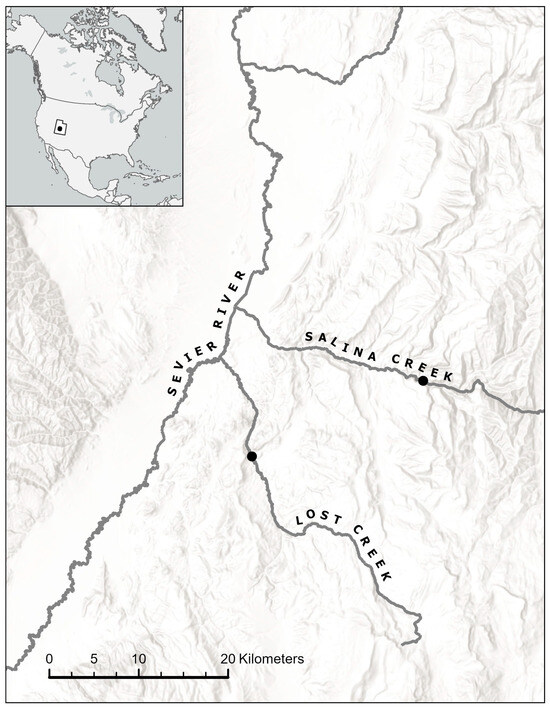
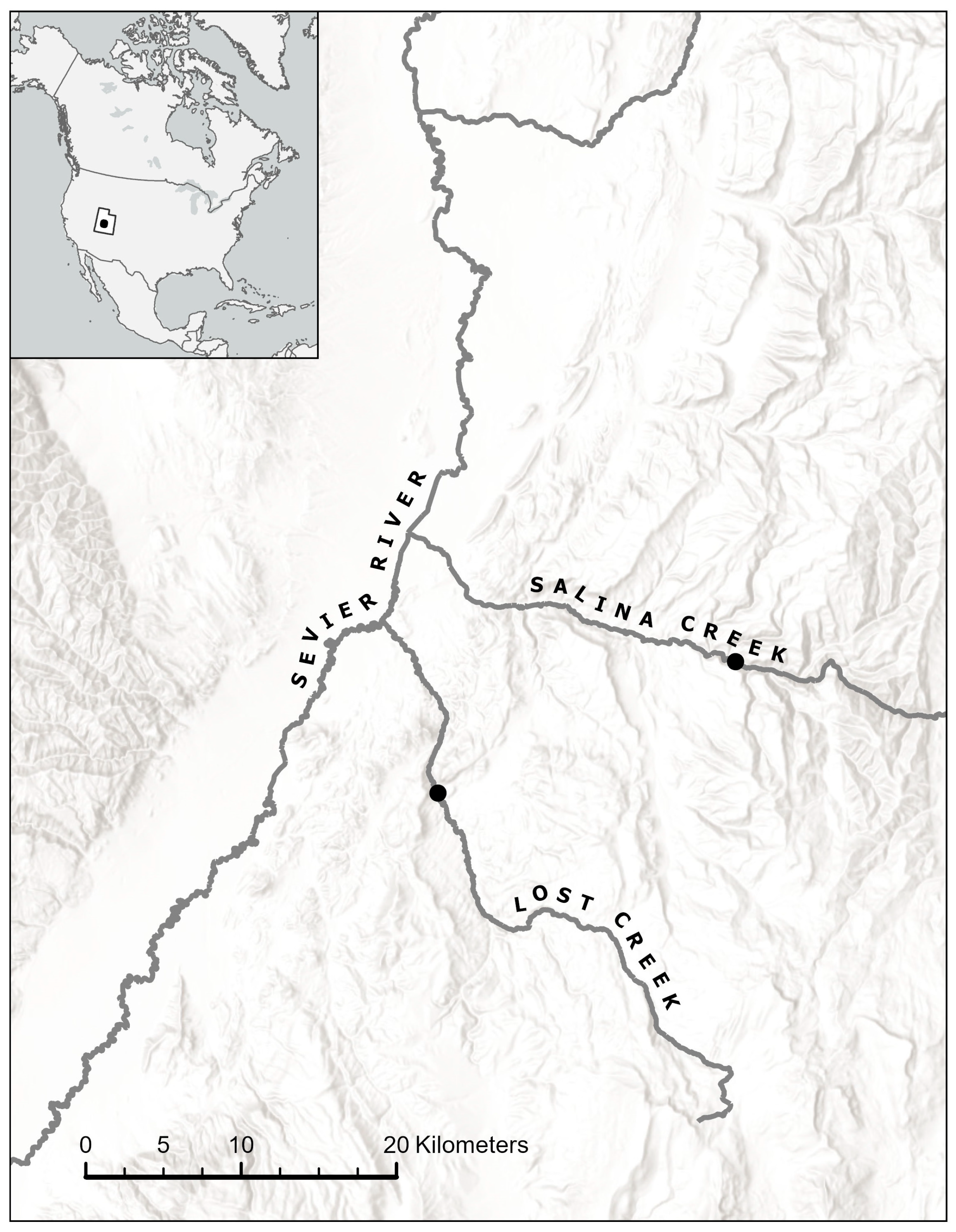
In this case study, we compared demographic models of two populations of southern leatherside chub (Lepidomeda aliciae) experiencing differential predation pressure. Southern leatherside chub are a threatened, small-stream fish with geographically adjacent populations (Figure 1) in very similar creeks in central Utah, USA [28]. However, in Lost Creek, nonnative, predatory brown trout (Salmo trutta) have become established, while in Salina Creek, brown trout do not occur [31,32]. This system allows us to compare the demographic patterns of two populations residing in similar habitats but for the presence of the introduced predator. We employed two modeling approaches—a matrix transition model based on mark–recapture data and an integral projection model based on size–frequency distributions. From these, we derived survival, reproduction, and population growth rates from both sets of data for both populations. The low number of populations available for study due to the range-wide decline of the species precludes rigorous testing of predation as a causal mechanism. Nevertheless, the imperiled status of the species and uncommon novelty of coexistence of southern leatherside chub and brown trout merit presentation of the data.
Figure 1.
Map showing sites where southern leatherside chub were sampled for the demography study in Lost Creek (38.8414 N 111.8625 W, elev. 1746 m) and Salina Creek (38.9044 N 111.69 W, elev. 1807 m). Inset shows the location of the study area in Utah.
2. Materials and Methods
2.1. Study System
Southern leatherside chub are a rare fish species of the family Leucisidae found in small streams of the eastern Great Basin in central Utah in the western United States [33,34,35]. They live up to 8 years and reach standard lengths (SLs) of 140 mm [36,37]. They have one breeding season annually—from mid to late summer [37,38].
Salina Creek (upstream from the town of Salina, Sevier County, Utah; 38.9044 N 111.69 W, elev. 1807 m) and Lost Creek (just southwest of Salina, Sevier County, Utah; 38.8414 N 111.8625 W, elev. 1746 m) are two adjacent stream systems where populations of southern leatherside chub occur (Figure 1). Both river systems have similar habitat quality such as range of depths (Salina Creek depth range was 0.25–1.5 m, and Lost Creek depth range was 0.30–2.0 m during the study period) and the presence of backwaters and side channels [28,33,39]. Habitats in these streams consist of a heterogeneous instream structure, such as deep pools (>1 m) and riffles, as well as cover from riparian vegetation and undercut banks. Brown trout—a nonnative, piscivorous salmonid— were introduced into Utah in the early 1900s and stocked in streams across Utah where native cutthroat trout (Oncorhynchus clarkii utah) were once present [28]. Southern leatherside chub coexist with nonnative brown trout in Lost Creek (density of brown trout in the studied section of Lost Creek was estimated at 80 per km of stream in 1995 [40]), which prey upon southern leatherside chub (i.e., predator environment) [35]. Large aquatic predators capable of consuming adult southern leatherside chub, such as brown trout, are absent in Salina Creek (i.e., non-predator environment) [28]. Other species present at both sites include speckled dace (Rhinichthys osculus), mottled sculpin (Cottus bairdii), and mountain sucker (Catostomus platyrhynchus) [36,41], none of which prey upon adult southern leatherside chub. Here we refer to the population in Lost Creek with brown trout present as a predator environment and the population in Salina Creek absent of brown trout as a predator-free environment, though it is likely that early life stages of our native species of interest experience predation from other native species, including adult southern leatherside chub.
Although we have termed these stream systems as predator and non-predator, with the latter “naïve to predation”, these populations were likely not entirely naïve to all forms of predation. Larger individuals in these populations likely experienced little to no predation pressure from other fish prior to the introduction of brown trout, but early life stages are probably consumed by a variety of native predators, including conspecifics, though chub likely rapidly outgrow the gape-limited predation risk posed by most native fish species. Evolutionarily, some populations of the species likely co-occurred with Bonneville cutthroat trout; however, these native trout are generally small-bodied when occurring in stream environments and rarely reach sizes sufficient to allow for general piscivory [42]. In contrast, introduced brown trout are routinely piscivorous at sizes above 30 cm and can consume fish up to 40% of their body length—encompassing nearly all size classes of southern leatherside chub [28]. Moreover, brown trout exhibit higher rates of fish predation than native cutthroat trout [35,43]. Thus, while we recognize that larval and small juvenile chub face natural predation pressures, the populations studied here have likely never experienced significant predation on adults from other fish species until the introduction of brown trout.
2.2. Mark–Recapture Design
To obtain vital rates for southern leatherside chub, we conducted a multi-year mark–recapture study in Lost Creek and Salina Creek from 2003 to 2006. In each stream, we established four contiguous 50 m segments and blocked each at the downstream end with nets. Fish were removed from each segment using three successive electrofishing passes with a Smith-Root LR-24 backpack electrofisher (Vancouver, WA, USA). Segments were sampled sequentially in an upstream direction. Captured fish were sorted into aerated tubs by species; non-target species were released immediately, while southern leatherside chub were retained for measurement and marking.
Southern leatherside chub were measured (standard length, SL) and assigned to one of three size classes based on size-at-maturity and known growth patterns [28,37]. Individuals measuring 40–64 mm SL were marked with Visual Implant Elastomer (VIE; Northwest Marine Technology, Inc., Anacortes, WA, USA) at the dorsal insertion of the caudal fin. Fish between 65 and 84 mm SL were marked at the ventral insertion of the caudal fin, and those greater than 84 mm SL were marked at the base of the anal fin. Each year of capture was denoted by a unique elastomer color. Individuals less than 40 mm SL, presumed to be young-of-the-year, were excluded from the study due to the limited detectability during electrofishing. Visual Implant Elastomer marks have been shown to remain visible in southern leatherside chub for multiple years [36]. Because there is no evidence of sexual dimorphism in the species, individuals were not sexed.
In 2004, we expanded our sampling efforts beyond the original four 50 m segments. In this year, we sampled additional 50 m segments downstream beginning at distances of 50, 100, 250, and 500 m from the lower boundary of the original sampling area. Upstream, sampling included segments located at 0, 100, and 200 m from the uppermost boundary of the original reach. We applied a second VIE tag to all southern leatherside chub recaptured from previous years captured in these extended segments using the same protocol to indicate size class and year of capture as before. New captures in the extended segments were not marked.
In 2005, upstream and downstream sampling was standardized to 150 m in each direction from the original four segments, sampled in 50 m increments. Unmarked individuals captured within the original segments were marked according to the same protocol used in previous years. In 2006, our sampling was restricted to Salina Creek, and no new marks were administered that year.
2.3. Population Projection Models
To model the population dynamics of southern leatherside chub, we employed two widely used population projection approaches: a stage-structured matrix model [44] and an integral projection model (IPM) [45]. Both models are common in ecological research; however, they are rarely applied side-by-side to the same populations using related datasets [46]. The stage-structured matrix model relies on discrete size or age classes and incorporates vital rates—specifically, survival and fecundity—to project population dynamics over time. These rates are typically derived from capture–recapture data, making this approach informative for identifying the influence of specific life stages on population growth. In contrast, integral projection models are usually built from individual-level capture–recapture data to estimate survival, growth, and reproduction as continuous functions of body size. However, in this study, we use size–frequency distributions, rather than mark–recapture data, to parameterize the IPM.
Our study system allowed for a direct comparison of the two analytical approaches to assess how an invasive predator influences the demography of an evolutionarily naïve species. This comparison provides a framework for evaluating the utility of each model under different datasets. These approaches differ in their data requirements and modeling frameworks but offer complementary perspectives on population dynamics.
2.4. Matrix Transition Model
To determine the survival rates of the southern leatherside chub, we used Program MARK [44] to estimate survival (φ) and recapture (p) probabilities for the populations from the two streams. We analyzed the data with the “Multi-strata Recaptures Only” function within Program MARK, to evaluate survival and recapture probabilities similar to a Cormack–Jolly–Seber framework (CJS) [47,48,49,50,51]. The CJS model uses log likelihood (logeL) to estimate φ and p given the probabilities of the observed encounter histories:
where EH are the observed capture histories with n as the number of unique histories observed in the dataset, and Xj is the number of individuals with the capture history EHj. The probability of each capture is the product of φ and p across the various capture events and intervening periods. Our Salina Creek data included four capture events, with three intervening periods: 2003–2006. For example, there were eleven individuals that were originally captured in 2003, not captured in 2004, but recaptured in both 2005 and 2006. This gives a capture history of 1011. The probability of this capture history is , which incorporates the fact that though the individuals were not captured during the second event, they were known to be alive because they were subsequently captured alive.
The assumptions of this approach include homogeneity of survival and capture probabilities among individuals within a population or group, but fates of individuals are independent of each other [51]. These are often referred to as the iii assumptions, i.e., independence of fates and identity of rates of individuals. Additional assumptions are that marks are not lost or missed, sampling duration is negligible relative to intervening survival periods, and handling effects are random among individuals. See Lebreton et al. [51] for a more comprehensive description of this model and the iii assumptions.
We utilized the multi-strata approach to incorporate an additional estimation of the probability of transition among strata or groups (ψ) [52,53]. Our strata were the body length bins of small, medium, and large individuals. We interpret the ψ parameter to be the proportion of surviving individuals that transition to a larger size class. We fit a single model for each location that included a single mean φ estimate for each size class, a constant p rate across all size groups and years, and single mean ψ from small to medium, small to large, and medium to large. We used a sine link function. The probability of transitioning from a larger stratum to a smaller one (e.g., large to small) was fixed at 0. The model estimated seven parameters.
We estimated realized fecundity (F) from our 2004 electrofishing samples using the relationship between fish size and number of oocytes reported by Billman et al. [28] for each stream. Reproductive females are only in the medium and large classes. Using sex ratios in Billman et al. [28], we estimated the number and mean size of females in the medium and large classes. We then estimated the number of oocytes produced by the average female for each class given the mean size of females in each class and estimated the total number of oocytes produced by all females in that size class by multiplying the mean number of oocytes by the number of females captured in 2004. To estimate the probability of survival of age-0 fish (from egg to the lower size limit of the smallest size class), we divided the total number of individuals observed in the small size class by the combined total number of eggs produced by medium and large females. We calculated realized fecundity for each size class by multiplying the probability of survival of age-0 fish by the total number of eggs produced in that class. Finally, we divided the number of surviving offspring (i.e., small individuals produced) by the number of reproductive females in each size class to estimate size-specific realized fecundity for medium and large females in each stream.
We used the estimated probabilities of survival and the realized fecundity estimates in a size-structured matrix population model to estimate the population growth rate (λ) of each location (Table 1). Because we excluded fish smaller than 40 mm (effectively age-0 individuals), we used a matrix framework analogous to a pre-reproduction census, though our samples were post-reproduction. This model assumes that individuals must survive for one year (i.e., age-0) to be counted for the first time in the census as newly observed stage-1 (small) individuals, i.e., juveniles or age-1 individuals [44]. Back-transformed estimates from the mark–recapture model were entered into the diagonal as φ (1 − ψ), i.e., the probability of surviving and remaining in the same size class. The probability of surviving and transitioning to a larger size class, calculated as φ ψ, was entered on the appropriate sub-diagonal. Realized fecundity rates for medium and large individuals were also entered in the appropriate column of the first row. The λ for each population during the period of study was calculated by finding the dominant eigenvalue of each matrix, using the eigen function within Program R [54]. We used standard errors from the Program MARK models to create upper and lower limit matrices from which 95% confidence intervals for λ were generated. We estimated the stable age distribution using the normalized eigenvector associated with the dominant eigenvalue for the population matrix, i.e., dividing each value in the eigenvector by the sum of all values in the eigenvector. We also calculated elasticity values for each matrix entry of both populations. Elasticities are measures of the relative contribution of each demographic process (i.e., of each matrix entry) to the population growth rate [55,56].
Table 1.
Transition matrices of southern leatherside chub in Salina (predator absent) and Lost (predator present) Creeks generated from estimates of survival and transition produced using Program MARK multi-strata function and estimates of realized fecundity as described in the text.
2.5. Integral Projection Model
To determine the effect of an introduced predator on an evolutionarily naïve species, we used size distribution data from three successive years from both sites for an IPM [45,57] represented as the form , where represents the abundance of size-x individuals at time t. represents the abundance of size-y individuals at time t−1. The kernel k depends on the parameter set θ and is split up into 4 pieces: , where s is the survival function for an individual of size y, and g is a function for the distribution of the potential size of an individual at time t given they were at size y at time t−1. The function b represents the abundance of new recruits from an individual of size y at time t−1, and f is the probability of an individual of size y reproducing. Our southern leatherside chub IPM model uses a logistic function for s and f (which is scaled by a parameter scalar) and a normal distribution for g and b. The parameters included are shown in the following equations:
This includes eleven estimated parameters, though we fix to be 0.75. Biologically, represents the estimate of realized fecundity for a given-sized fish. In practice, this value had to be set somewhere between 0.5 and 1 for the model training process to proceed. By fixing this parameter, we assume consistency in realized fecundity across different environmental conditions. This assumption simplifies computation, but in a more complex model that seeks to capture environmental variability (our model assumes a constant environment), we would have to further explore the ramifications of fixing this parameter value. Nonetheless, in the current model, fixing this value of at 0.75 helps with estimating the other parameters and with identifiability. Additionally, σ2g and σ2b represent the variance for the normal distributions of g and b.
To account for the variability that occurs from the size–frequency data, we use a hierarchical structure to filter the true IPM structure. This approach enhances the robustness of parameter estimates by modeling both individual-level variation and population-level trends. The abundance of is used as the mean function in a Poisson process, which is then used as the likelihood for the data [58,59]. For example, if represents observed counts at size x at time t, we would say that . To evaluate the integral step at each time point, the mean function and the kernel are decomposed into Fourier basis functions. This allows the mean function to be treated as continuous, as opposed to previous approaches that discretize this process. The mean function is decomposed into ; here, are the Fourier basis functions and are random coefficients which need to be estimated. We utilized Fourier basis functions to capture continuous variation in size structure, which is appropriate for species like the southern leatherside chub that exhibit continuous growth. The kernel is decomposed as . In this case, the basis coefficients are deterministic given the parameter set, so they do not need to be estimated. The IPM integral then becomes which simplifies to because of the properties of orthonormal basis functions. The resultant infinite sum is truncated to have a number of components that balance computational costs and accuracy.
This basis function approach has been used in integral models in spatial–temporal statistics [60,61]; however, the likelihood in these cases is typically linear and normally distributed. In the case of our IPM, the likelihood is a Poisson process, so the parameters of the kernel and the random basis coefficients controlling the density of the population were estimated using Markov chain Monte Carlo (MCMC) methods [62]. Another advantage of this approach is that credible intervals can be found for all vital rates, and a number of probability statements can be made about them. Population growth rate (λ) is computed as the eigenvalue corresponding to the first eigenfunction of the kernel (k). λ is computed numerically by discretizing the space in a fine grid. We follow the approach of Doak et al. [46] and discretize the domain where the size profiles are distinguished. This creates a large matrix from which we found the eigenvalue and function that gives us the long-term growth rate and stable size distribution.
3. Results
3.1. Matrix Transition Model
The constant recapture probability was estimated at 0.65 (95% CI = 0.61–0.70) in the predator-free environment and 0.80 (CI = 0.36–0.97) in the predator environment. Salina Creek (N = 3501) had a higher number of captured southern leatherside chub, including recaptures, compared to Lost Creek (N = 1482; Table 2), largely because there were no captures in Lost Creek in 2006.
Table 2.
Summary of southern leatherside chub captured and released in Salina Creek (non-predator) and Lost Creek (predator) during 2003–2006. Released numbers include all fish captured and released during that year, including recaptures. The values across the rows indicate the number of individuals originally captured and released during the year and recaptured for the first time in the subsequent year, as well as the total recaptures.
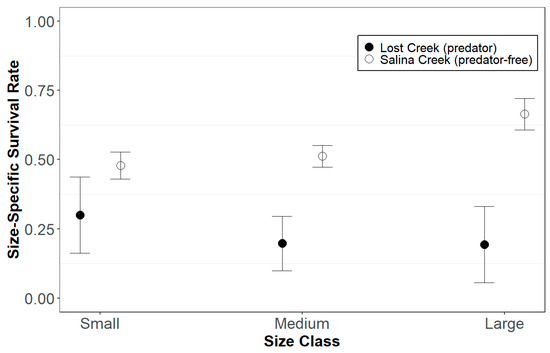
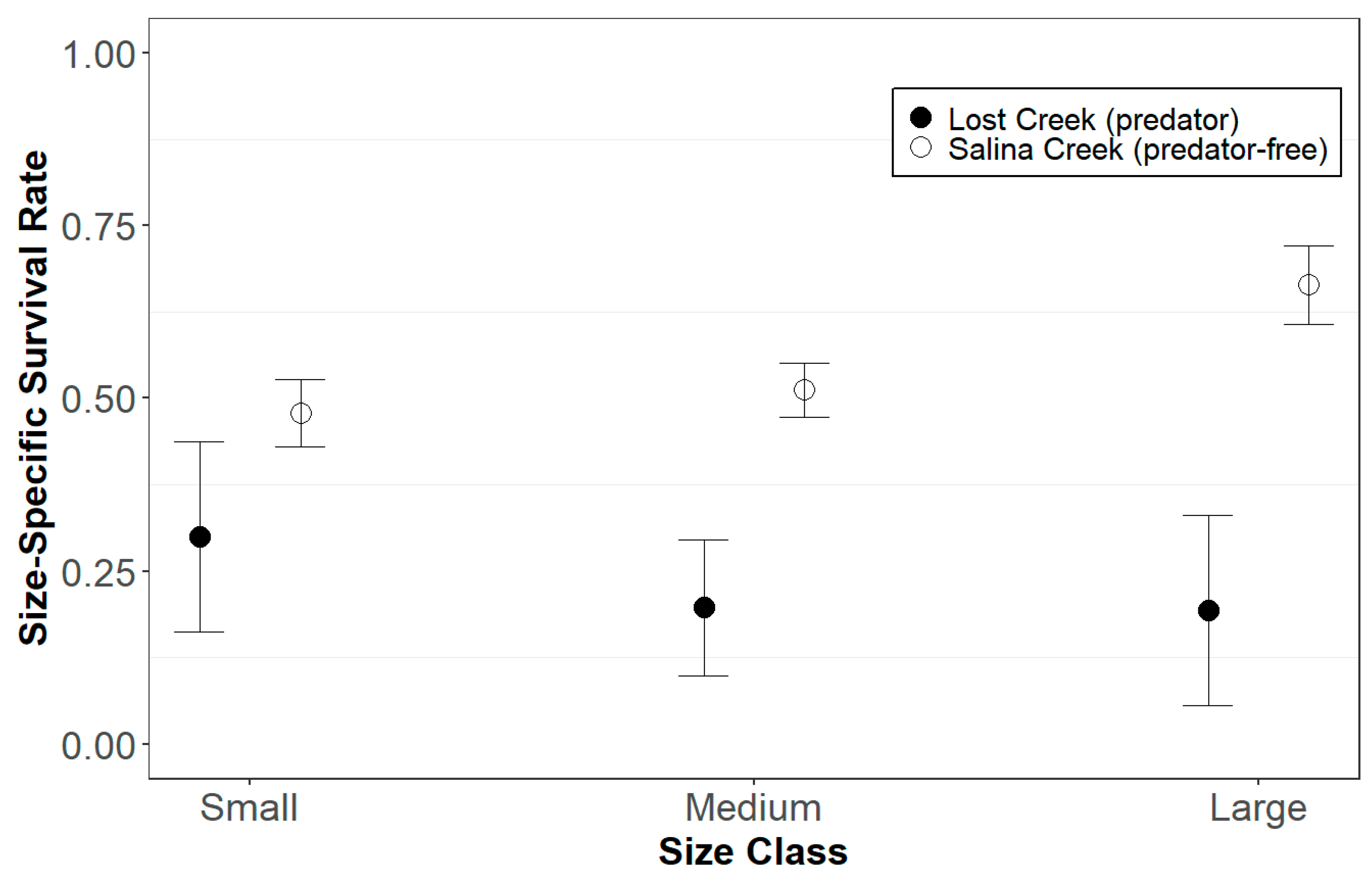
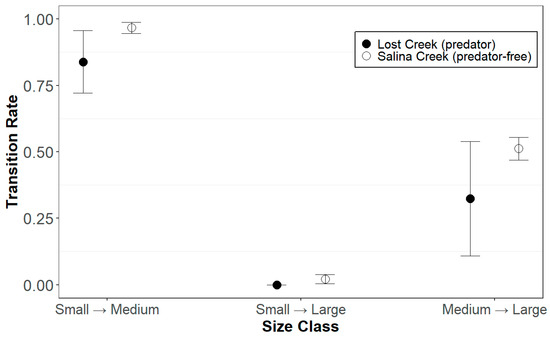
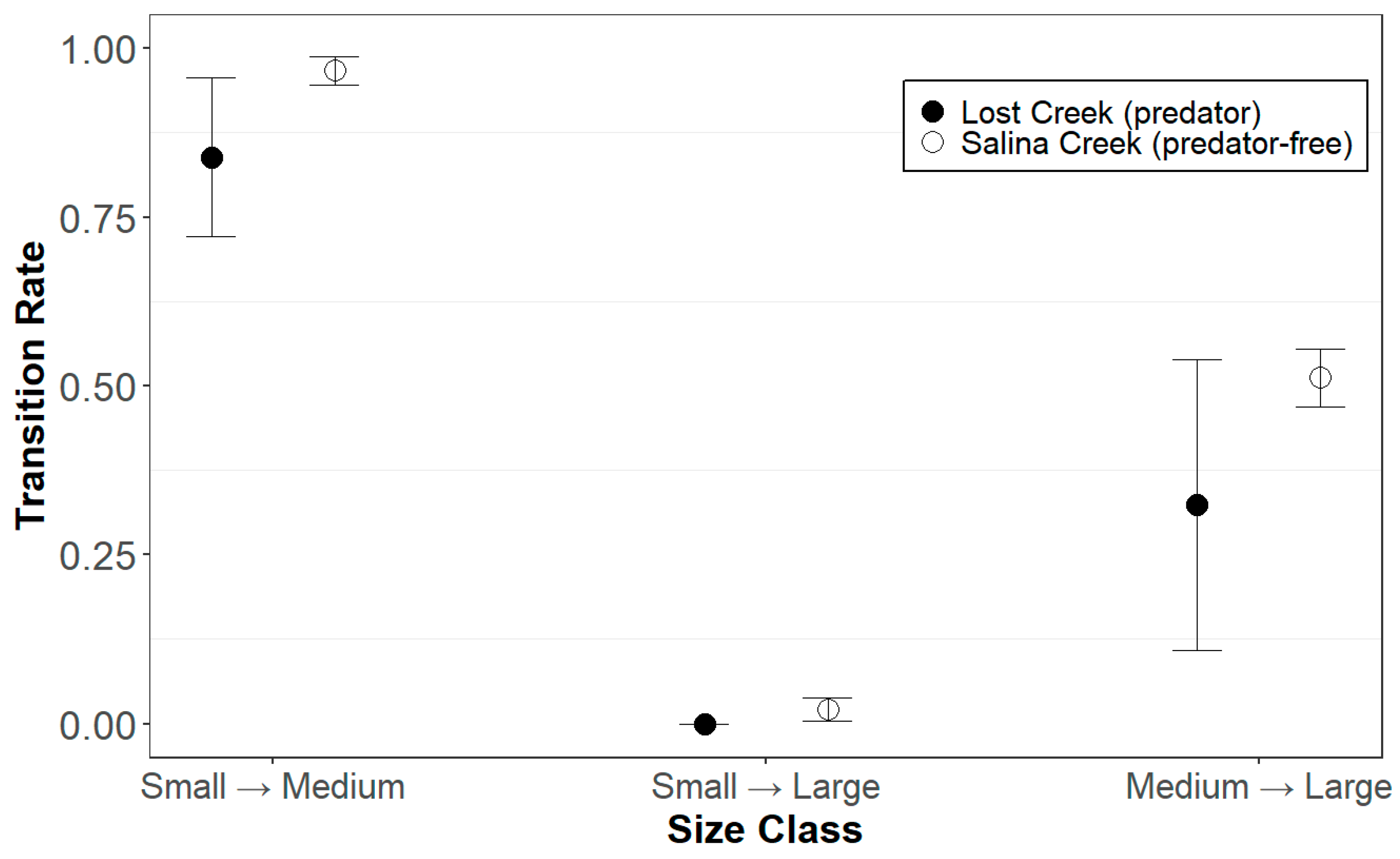
Southern leatherside chub in the predator-free environment survived at a higher rate in all size classes than those in the predator environment (Figure 2). Individuals from the small size class had the lowest difference in survival between the predator environment and the predator-free environment. This contrasts with the individuals from the large size class, which had the greatest difference in survival between the two environments. Southern leatherside chub transitioned at the highest rate in both environments between the small and medium size classes (Figure 3). The transition between the medium and large size classes was the next highest but was almost half of the small-to-medium transition rate. There were no statistical differences in transition rates between the predator and predator-free environments.
Figure 2.
Average size-specific survival rates (error bars are 95% confidence intervals) for southern leatherside chub in Lost Creek (predator) and Salina Creek (predator-free) from mark–recapture data.
Figure 3.
Average transition rates between size classes (error bars are 95% confidence intervals) for southern leatherside chub in Lost Creek (predator) and Salina Creek (predator-free) from mark–recapture data.
Across both systems, reproductive females in the same size class produced a similar number of oocytes (Table 3). Large females consistently produced more eggs than medium females. Total egg production (oocytes times the number of females) followed a similar pattern, with higher totals for large females in both environments. Survival of age-0 was estimated to be over twice as high in the predator environment (0.0033) than in the predator-free environment (0.0014). Thus, realized fecundity was also greater in the predator environment for both reproductive size classes (Table 3).
Table 3.
Summary of site- and size-specific reproduction for southern leatherside chub in predator-free (Salina Creek) and predator (Lost Creek) environments during 2004, including mean standard length (SL, mm), estimated number of oocytes per reproductive female (# Oocytes—given mean SL and based on relationships described by Billman et al. [28]), estimated number of eggs produced by all reproductive females in that size class (Eggs), estimated number of small fish produced (based on estimated survival from age-0 stage class to small class), and realized fecundity (F), calculated as the number of surviving small fish per reproductive female. Estimates are provided only for the medium and large size classes, because small individuals are not reproductively mature.
The population growth rate (λ) for Salina Creek, the predator-free environment, was >1, indicating positive population growth over the time period of the study (Table 4). Conversely, λ was less than one in Lost Creek, the predator environment; however, the confidence interval included one, suggesting zero population growth during the study period for Lost Creek.
In both populations, the smallest size stage had the greatest proportion of individuals (based on the stable age distribution), but there was a greater proportion of individuals in the small size stage from Lost Creek (predator) compared to Salina Creek (predator-free; Table 4). Reproductive values were 1.00, 2.79, and 5.74 for the small, medium, and large size stages, respectively, in Salina Creek (predator-free), and reproductive values were 1.00, 3.58, and 10.16 for the same size stages in Lost Creek (predator).
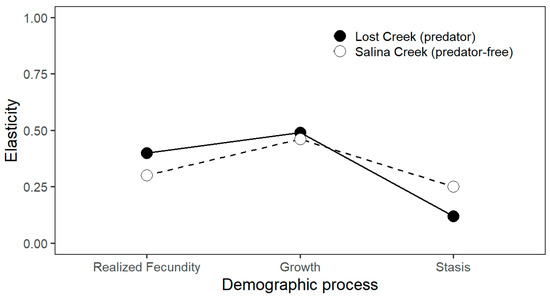
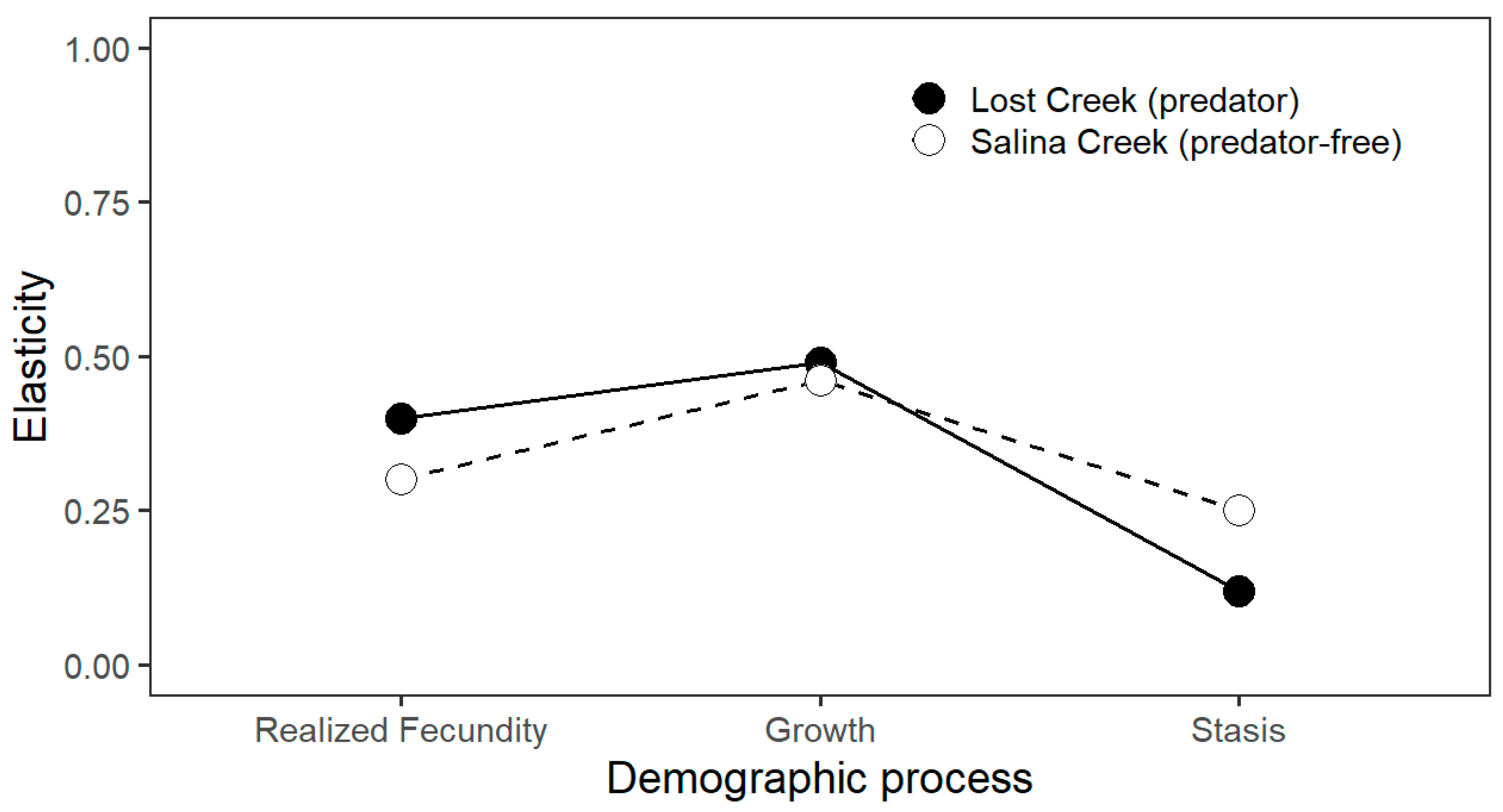
Elasticity analysis of the transition matrices showed each size class had a similar influence on λ in Salina Creek (predator-free; Table 5). This was not the case for Lost Creek (predator). Small and medium-sized individuals from the predator environment had a greater impact on λ than large individuals (Table 5). In the predator-free environment, the fecundity of both medium and large females had similar elasticities, whereas in the predator environment, the fecundity of medium-sized females had a substantially higher elasticity value than that of large-sized females. The survival (stasis) of large adults had a greater elasticity in the predator-free population compared to a remarkably low elasticity in the predator population (Table 5). When the elasticities were summed according to the three demographic processes (fecundity, growth, and stasis), growth was the most influential demographic process for both populations. The predator-free population was relatively more influenced by stasis, and the predator population was more influenced by fecundity (Figure 4).
Figure 4.
Summed elasticities of realized fecundity, growth, and stasis for southern leatherside chub in Lost Creek (predator) and Salina Creek (predator-free) from the matrix transition model. The values represent the proportional change in the population growth rate (λ) given a proportional change in elements of each model that represent the demographic processes.
3.2. Integral Projection Model
While the values from the integral projection model cannot be compared directly with the matrix model vital rates, we observed similar patterns of the effect of the introduced predator on an evolutionarily naïve species. The IPM suggests that the presence of brown trout—the invasive predator—is associated with increased mortality rates, greater fecundity, and a greater proportion of smaller individuals in the southern leatherside chub, relative to the population without the predator.
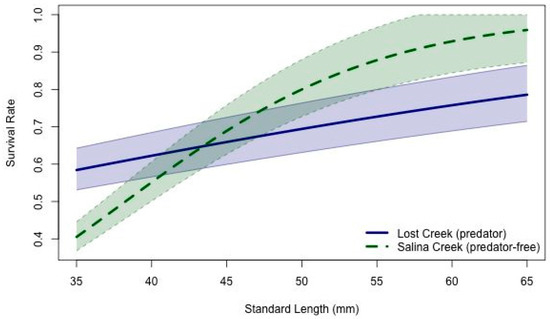
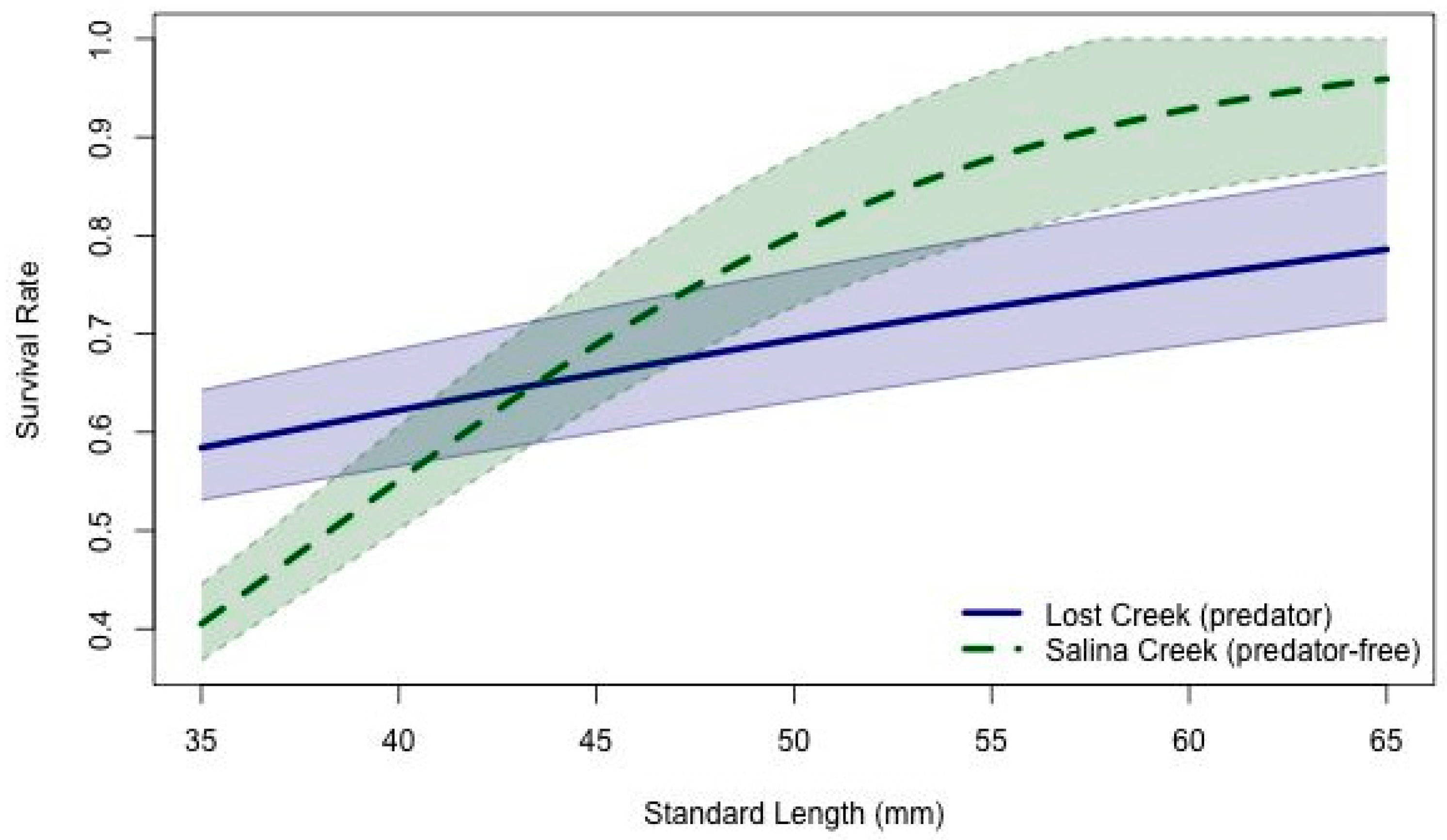
The slope of the survival rate curve represents how much the probability of survival changes with size. The survival rate curve showed a higher slope (in the logit scale) for survival in the predator-free environment (0.12, 95% CI: 0.10–0.14) than in the predator environment (0.03, CI: 0.02–0.05), indicating that survival among sizes in Lost Creek increases only slightly with size, whereas survival across sizes in Salina Creek changes dramatically with size. At small sizes, survival is higher in Lost Creek (predator), but at larger sizes, survival is higher in Salina Creek (predator-free; Figure 5).
Figure 5.
Survival probability (shaded areas represent 95% credible intervals) in Salina Creek (predator-free) and Lost Creek (predator) as a continuous function of size, as calculated from the integral projection model.
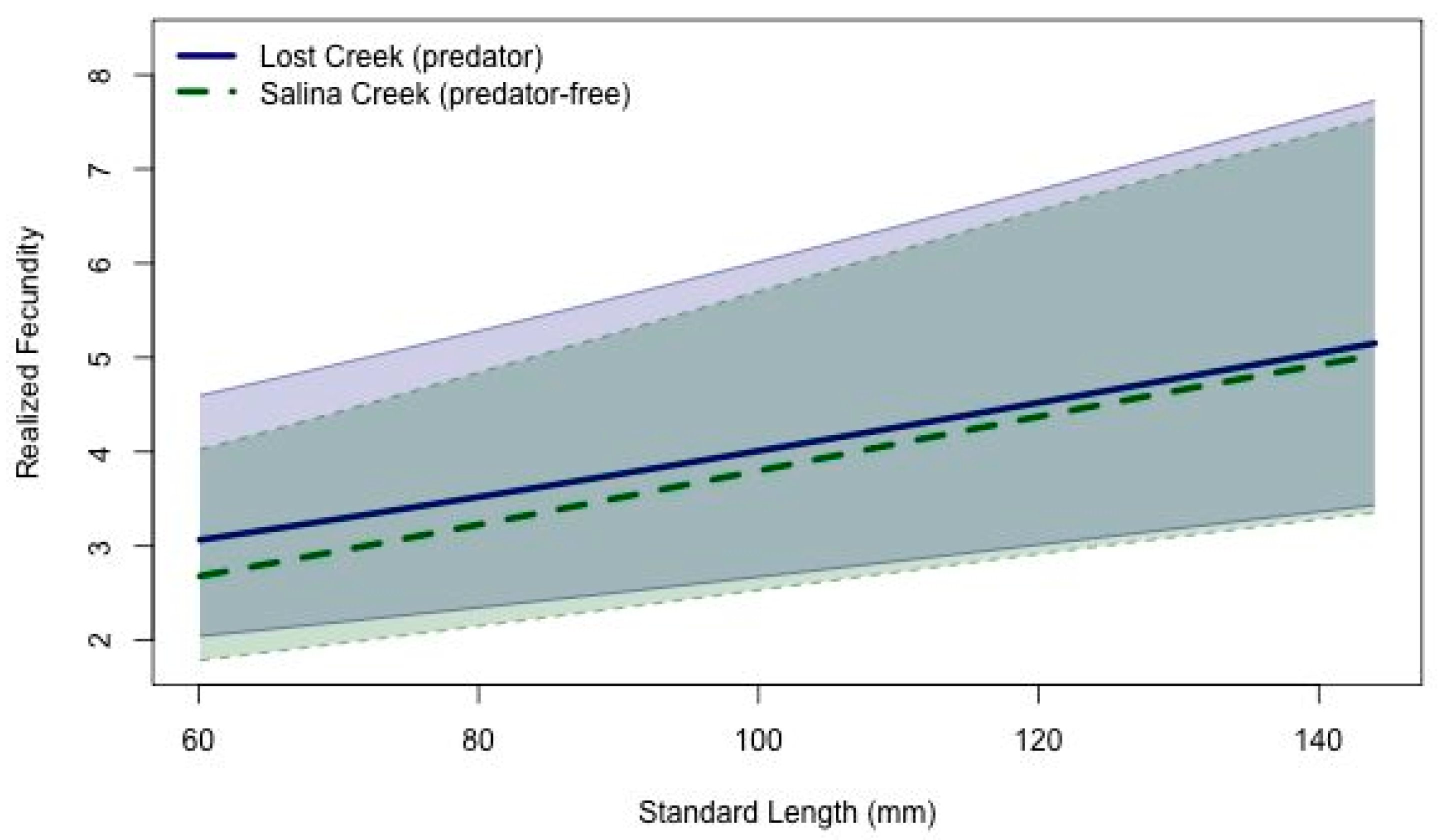
Annual somatic growth rates (averaged across all sizes) did not differ between fish from Lost Creek (predator) and fish from Salina Creek (predator-free), with annual somatic growth rates of 13.9 mm (CI: 9.5–19.8) and 12.4 mm (CI: 8.9–17.0), respectively. In the IPM, realized fecundity (number of individuals recruited to 40 mm SL) increased from about three at 60 mm SL to about five at 140 mm SL. However, there is no significant difference in realized fecundity between the two populations (Figure 6).
Table 4.
Summary of population demographics in both Salina Creek (predator-free) and Lost Creek (predator). Population growth includes 95% confidence intervals in parentheses. For the matrix transition model approach, these were calculated using standard errors of survival and transition rates from Program MARK. Stable age distribution in the order of small, medium, and large lengths is derived from the matrix transition model.
Table 5.
Elasticity of entries of the transition matrices for southern leatherside chub populations in Salina Creek (predator-free) and Lost Creek (predator).
Population growth rates (λ) estimated by the IPM were >1 in both populations, but the 95% credible intervals broadly overlapped unity (Table 4), suggesting a stable population (i.e., zero growth) in both locations during our study period. The estimate of λ in Lost Creek (predator) was lower than the estimate of λ in Salina Creek (predator-free), but the 95% credible intervals broadly overlapped each other, suggesting no difference in population growth rate between populations (Table 4). Furthermore, the broad overlap of 95% confidence intervals from the matrix model estimates of λ compared to the estimates of λ derived from the IPM and the corresponding 95% credible intervals suggests that estimates of population growth rates do not differ between methods.
Figure 6.
Realized fecundity (shaded areas represent 95% credible intervals) calculated for Lost Creek (solid line; predator) and Salina Creek (dashed line; predator-free) from the integral projection model. Realized fecundity represents the number of individuals recruited to measurable size (40 mm SL) from an individual of a given reproductive size.
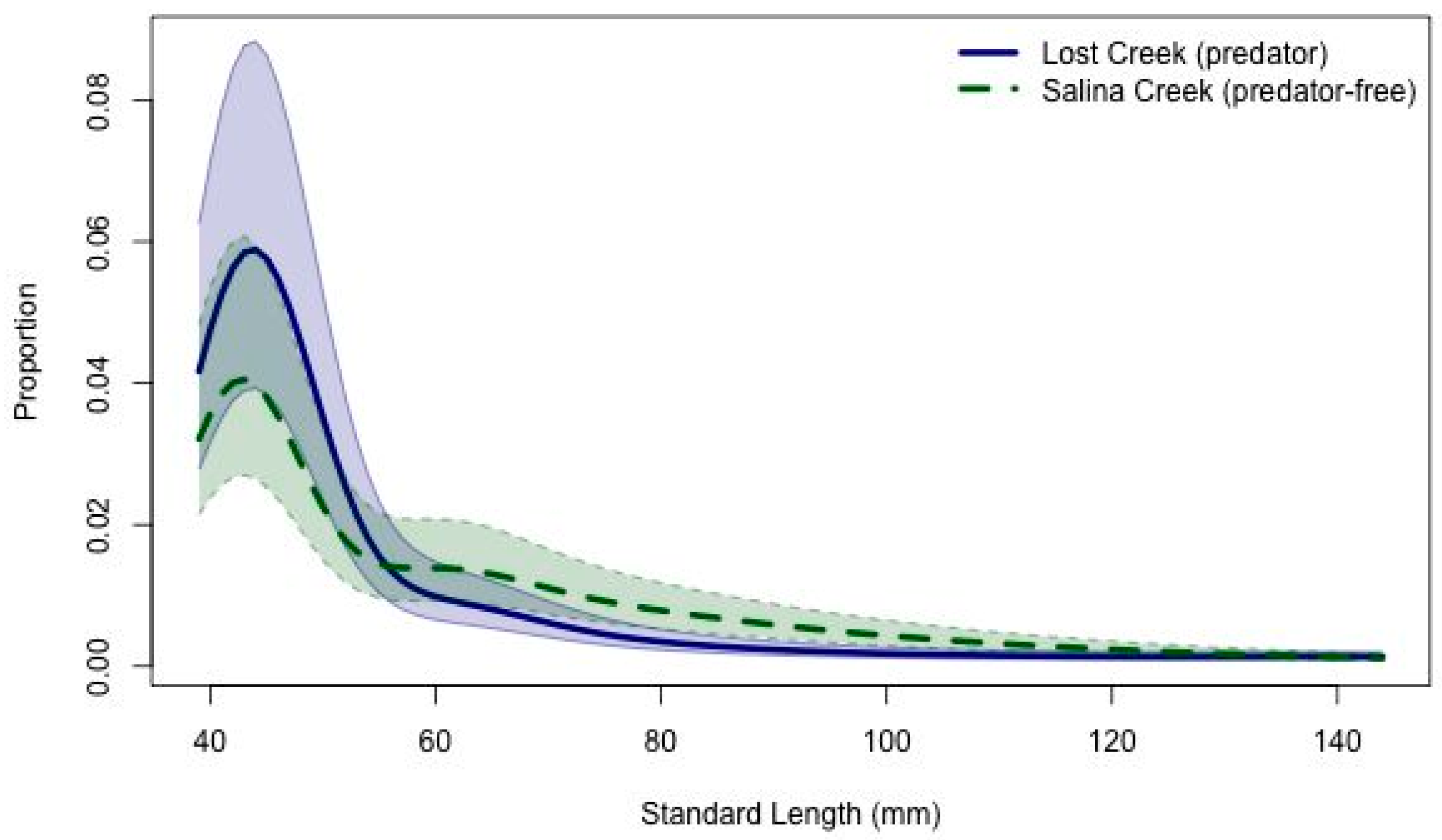
Overall, the stable size distribution showed that in each population, small individuals (<60 mm SL) were more abundant than other size classes (Figure 7). Smaller individuals (up to about 60 mm SL) comprised a higher proportion of the population in Lost Creek (predator) compared to Salina Creek (predator-free). Conversely, individuals larger than 60 mm SL comprised a larger proportion of the population in Salina Creek (predator-free) compared to Lost Creek (predator; Figure 7).
Figure 7.
Size distribution (shaded areas represent 95% credible intervals) calculated from the IPM for Lost Creek (solid line) and Salina Creek (dashed line). Lines represent the proportion of individuals in the population across the range of sizes as the population stabilizes under constant vital rates (survival, growth, and reproduction).
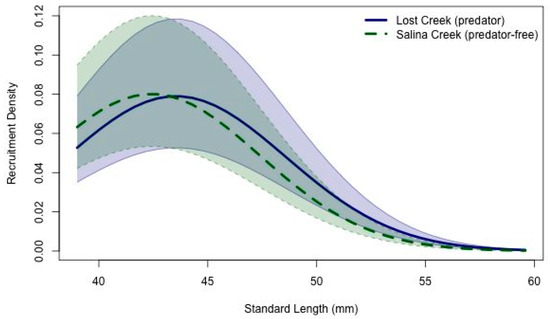
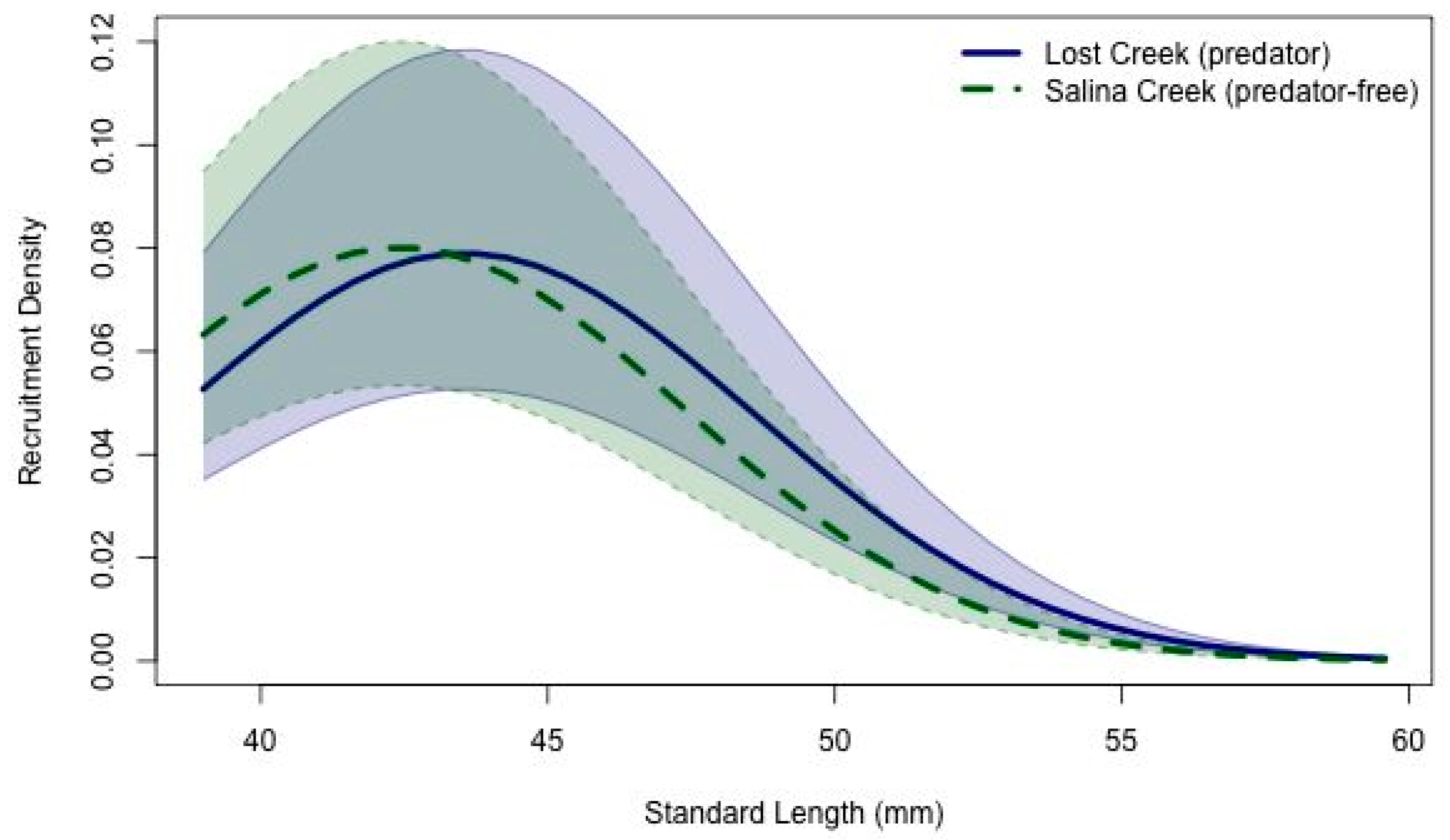
Recruitment density describes the relative frequency of newly recruited individuals across the range of body sizes. In the predator-free environment, recruitment density peaked at approximately 42 mm SL, whereas in the predator environment, the peak shifted rightward to around 45 mm SL (Figure 8). This shift resulted in greater recruitment density of larger-sized individuals in Lost Creek (predator) compared to Salina Creek (predator-free). The 95% credible intervals broadly overlapped at smaller recruit sizes (below 50 mm SL), suggesting no difference between populations. However, at the larger recruit sizes (above 50 mm SL), more recruits were added in Lost Creek (predator) compared to Salina Creek (predator-free).
Figure 8.
Size distribution of newly recruited individuals in the smallest size class as predicted by the IPM for the Lost Creek and Salina Creek populations of southern leatherside chub. The distribution reflects the range and relative frequencies of sizes at which new individuals enter the population.
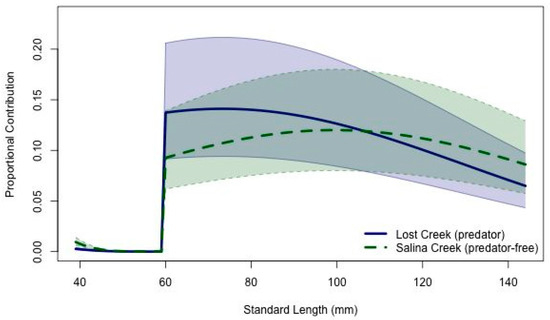
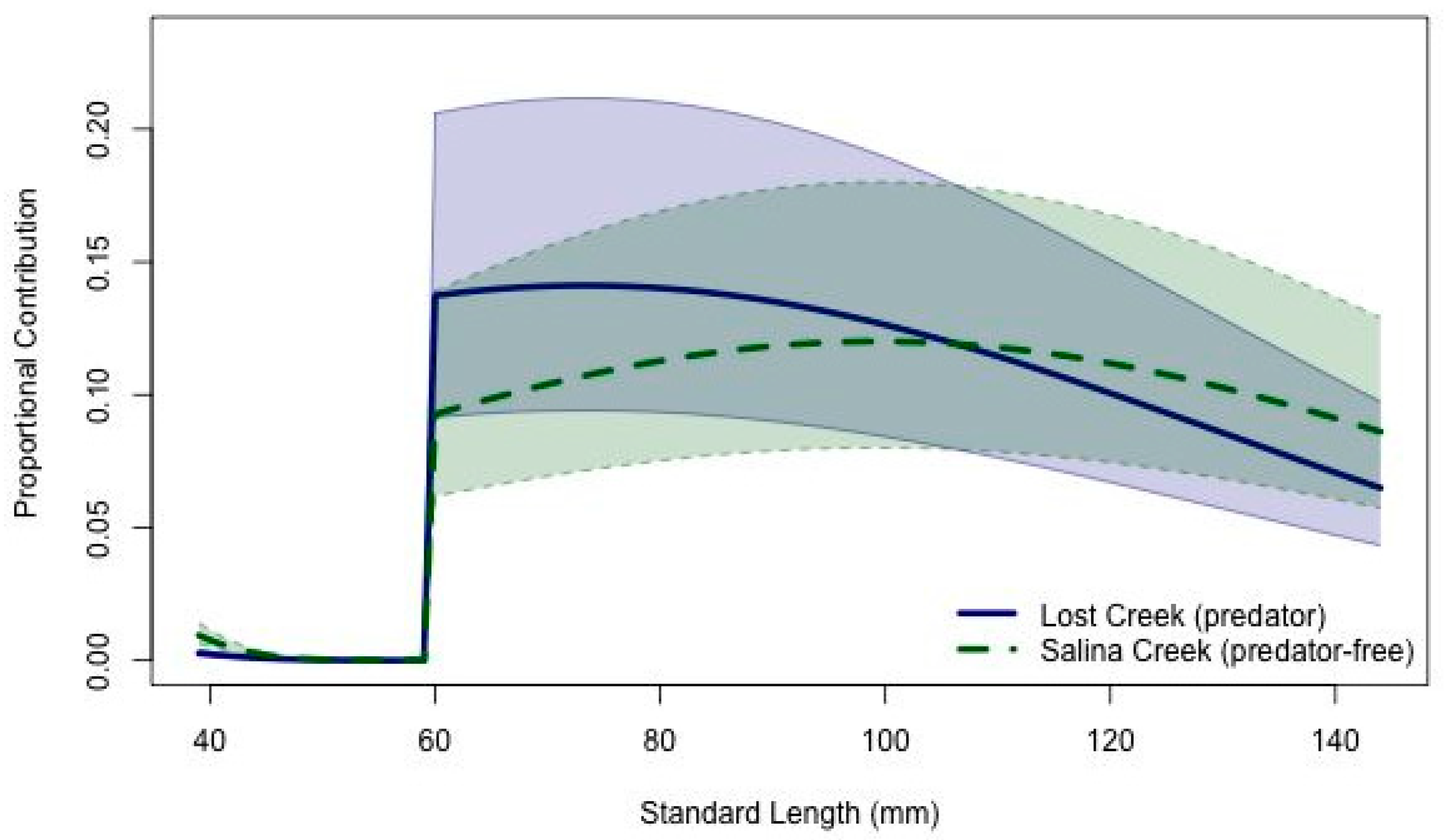
The proportional contribution of size to recruitment revealed that pre-reproductive individuals contributed minimally to recruitment of age-1 individuals (Figure 9). In general, medium-sized individuals contributed proportionally more to recruitment of age-1 individuals compared to larger sizes in both populations. Although the mean lines suggest that medium-sized individuals contributed proportionally more to recruitment in the predator environment of Lost Creek and larger individuals contributed proportionally more to recruitment in the predator-free environment of Salina Creek, the 95% credible intervals broadly overlapped across the entire size range, suggesting that there were no significant differences between populations.
Figure 9.
Proportional contribution (shaded areas represent 95% credible intervals) of different body sizes to overall recruitment in the Lost Creek (predator) and Salina Creek (predator-free) populations of southern leatherside chub, as derived from the IPM. The proportional contribution shows which sizes of reproductive individuals contribute most to producing new recruits.
4. Discussion
In the presence of brown trout predators, southern leatherside chub appear to recruit at slightly larger size than in the absence of brown trout, which could be a compensatory response to increased adult mortality (Table 1; Figure 7). Additionally, we observed differences in the rate of transitions from small to medium size and reproduction by medium-sized individuals in the predator Lost Creek population (Table 5; Figure 8). Together, these rates account for nearly 70% of the weight contributing to population growth (measured by elasticity). In contrast, these same processes comprise only 43% of the elasticity in the predator-free Salina Creek population, despite Salina Creek exhibiting nearly double the absolute survival rate of small individuals (Figure 2). In Lost Creek, large fish exert far less demographic influence through survival and fecundity than their counterparts in Salina Creek.
Mortality rates of age-0 southern leatherside chub were less than half in the predator environment compared to the predator-free stream despite the physical habitats being very similar [28]. These results are consistent with an increase in predation-driven mortality of adult stream fish in the presence of introduced brown trout, thereby reducing predation by larger native stream fish on eggs or young-of-year southern leatherside chub. Under this pattern of extrinsic mortality (high adult mortality relative to juvenile mortality), the age-specific mortality hypothesis predicts that populations should evolve smaller size (and often earlier age) at maturity and should increase reproductive effort to smaller (younger) size classes [29,63,64]. Previous studies conducted on a wide variety of taxa, including decapod crustaceans, sunfish, gobies, songbirds, and large ungulates, have demonstrated that differences among populations in the mortality rates of juveniles and adults lead to parallel interpopulation variation in life-history traits, including size- or age-specific reproductive effort, which is consistent with predictions from the age-specific mortality hypothesis [65,66,67,68,69].
If brown trout in Lost Creek do prey primarily on larger individuals, it could reduce mortality rates of smaller leatherside chub that could otherwise be vulnerable to predation by larger southern leatherside chub (a phenomenon known as intra-guild predation) [70,71]. This phenomenon appears to explain mortality patterns in eastern mosquitofish (Gambusia holbrooki) in the presence of predatory pickerel (Esox niger). Mosquitofish showed significantly lower neonate mortality in the presence of pickerel than in the absence of pickerel, presumably resulting from decreased intraguild predation [72]. The extent to which such indirect effects explain increased juvenile survival in leatherside chub is unknown, but they could explain the patterns that we observed.
Reznick et al. [73] noted a different type of indirect effect of predators on guppies, mediated through their influence on population density. By reducing guppy density, predation increased per capita resource availability, which in turn promoted faster growth and earlier maturity. Under such density-independent conditions, individuals in these populations reproduced at smaller sizes and younger ages, also consistent with the patterns we observed in our study of southern leatherside chub. Hence, predation by brown trout on leatherside chub could have at least two types of indirect effects, each potentially contributing to the overall mortality schedules that we have documented here.
Brown trout have been implicated as a likely culprit for the decline of southern leatherside chub across its range and have even been blamed for the extirpation of some populations [35]. Our limited case study of southern leatherside chub in Lost Creek suggests that coexistence between brown trout and southern leatherside chub might be a possibility; however, it is not yet clear if southern leatherside chub and introduced brown trout have reached a stable coexistence in this system, or if the process of extirpation is just prolonged in this instance. Certainly, a perturbed and reduced population of southern leatherside chub in Lost Creek will be more at risk to stochastic events.
Although our study is based on a limited number of populations, this constraint reflects the current conservation reality of southern leatherside chub, with many populations already extirpated and few viable systems remaining for comparison. Despite this limitation, our approach provides valuable insight because the two study streams are located in close proximity and share highly similar environmental conditions. This environmental similarity strengthens inference by reducing the likelihood that differences in demography are driven by habitat variability rather than predation pressure. Future research could conduct phased monitoring of intermediate processes and incorporate environmental covariates to improve model accuracy.
Despite utilizing different types of data from the same populations, the size-structured matrix transition model and the IPM provided consistent and complementary results for demography in response to invasive predators. Both methods generate basic demographic information (such as population growth rates) that permits comparison across differing predation regimes (Table 6). There are, however, some differences in the two approaches. For example, the matrix transition model provides elasticities, which the IPM does not, and the IPM provides assessment of continuous variation across size of the functions rather than across discrete bins, which the matrix approach does not.
Table 6.
Comparison of the demographic parameters obtained from mark–recapture data and stage-structured matrix transition model versus a size–frequency distribution and integral projection model.
Finally, to our knowledge, few IPMs have employed a Bayesian approach using size–frequency data alone [74,75]. Most rely on mark–recapture data to build vital rate functions (e.g., survival, growth, fecundity, and recruitment) individually [46]. Our study demonstrates that a Bayesian IPM based on size–frequency data can yield demographic insights similar to those from matrix models built on mark–recapture data. This finding broadens the utility of size-based IPMs for studying population dynamics when mark–recapture data collection is impractical. Moreover, our approach simplifies demographic modeling by leveraging size–frequency data, which are substantially easier and less costly to collect than traditional mark–recapture data.
Author Contributions
Conceptualization, M.C.B. and J.B.J.; methodology, M.C.B., J.E.R., J.J.Z.-V., E.J.B. and R.A.R.; validation, M.C.B., J.E.R., J.B.J. and R.A.R.; formal analysis, M.C.B.; investigation, M.C.B.; resources, M.C.B.; data curation, M.C.B., J.E.R. and B.M.O.; writing—original draft preparation, M.C.B., J.E.R. and B.M.O.; writing—review and editing, M.C.B., J.E.R., E.J.B., B.M.O., J.B.J., J.J.Z.-V. and R.A.R.; visualization, M.C.B., J.E.R., E.J.B., B.M.O., J.B.J., J.J.Z.-V. and R.A.R.; supervision, M.C.B.; project administration, M.C.B.; funding acquisition, M.C.B. and J.B.J. All authors have read and agreed to the published version of the manuscript.
Funding
This research was funded by the Utah Division of Wildlife Resources under the following grant number 036288.
Institutional Review Board Statement
Utah Division of Wildlife Resources provided collecting permits for this work (COR # 1COLL5950, approved 10 April 2003). All field work, including handling of fish specimens, was approved by the BYU Institute Animal Care and Use Committee (Protocol # 090503, approved 9 May 2003).
Data Availability Statement
Data for this study have been archived in Dryad and are publicly available at https://doi.org/10.5061/dryad.573n5tbp5.
Acknowledgments
We thank K.E. Mock and A. Gleason for their input on early concepts of the manuscript, and the many field technicians whose efforts made this work possible. We also want to thank four anonymous reviewers for their constructive feedback that improved the quality of the manuscript.
Conflicts of Interest
Author Josh E. Rasmussen was employed by the company Conservation Logic LLC, but maintains no conflict of interest with this research. The remaining authors declare that the research was conducted in the absence of any commercial or financial relationships that could be construed as a potential conflict of interest.
References
- Johnson, J.B.; Zúñiga-Vega, J.J. Differential Mortality Drives Life-History Evolution and Population Dynamics in the Fish Brachyrhaphis rhabdophora. Ecology 2009, 90, 2243–2252. [Google Scholar] [CrossRef] [Scilit]
- Gervasi, V.; Nilsen, E.B.; Sand, H.; Panzacchi, M.; Rauset, G.R.; Pedersen, H.C.; Kindberg, J.; Wabakken, P.; Zimmermann, B.; Odden, J.; et al. Predicting the Potential Demographic Impact of Predators on Their Prey: A Comparative Analysis of Two Carnivore-Ungulate Systems in Scandinavia. J. Anim. Ecol. 2012, 81, 443–454. [Google Scholar] [CrossRef] [Scilit] [PubMed]
- Walsh, M.R.; Cooley, F.; Biles, K.; Munch, S.B. Predator-Induced Phenotypic Plasticity within- and across-Generations: A Challenge for Theory? Proc. R. Soc. B Biol. Sci. 2015, 282, 20142205. [Google Scholar] [CrossRef] [Scilit]
- Miller, T.E.X.; Rudolf, V.H.W. Thinking inside the Box: Community-Level Consequences of Stage-Structured Populations. Trends Ecol. Evol. 2011, 26, 457–466. [Google Scholar] [CrossRef] [Scilit] [PubMed]
- Creel, S.; Christianson, D. Relationships between Direct Predation and Risk Effects. Trends Ecol. Evol. 2008, 23, 194–201. [Google Scholar] [CrossRef] [Scilit] [PubMed]
- Johnson, J.B.; Belk, M.C. Predators as Agents of Selection and Diversification. Diversity 2020, 12, 415. [Google Scholar] [CrossRef] [Scilit]
- Moseby, K.; van der Weyde, L.; Letnic, M.; Blumstein, D.T.; West, R.; Bannister, H. Addressing Prey Naivety in Native Mammals by Accelerating Selection for Antipredator Traits. Ecol. Appl. 2023, 33, c2780. [Google Scholar] [CrossRef] [Scilit]
- Wallach, A.D.; Ripple, W.J.; Carroll, S.P. Novel Trophic Cascades: Apex Predators Enable Coexistence. Trends Ecol. Evol. 2015, 30, 146–153. [Google Scholar] [CrossRef] [Scilit]
- Pinto-Coelho, R.M.; Bezerra-Neto, J.F.; Miranda, F.; Mota, T.G.; Resck, R.; Santos, A.M.; Maia-Barbosa, P.M.; Mello, N.; Marques, M.M.; Campos, M.O. The Inverted Trophic Cascade in Tropical Plankton Communities: Impacts of Exotic Fish in the Middle Rio Doce Lake District, Minas Gerais, Brazil. Braz. J. Biol. 2008, 68, 1025–1037. [Google Scholar] [CrossRef] [Scilit]
- Fraser, D.F.; Lamphere, B.A. Predation as A Facilitator of Invasion Success in A Stream Fish. Bull. Ecol. Soc. Am. 2013, 94, 260–264. [Google Scholar] [CrossRef] [Scilit]
- Sharpe, D.M.; Chapman, L.J. Niche Expansion in a Resilient Endemic Species Following Introduction of a Novel Top Predator. Freshw. Biol. 2014, 59, 2539–2554. [Google Scholar] [CrossRef] [Scilit]
- Richardson, D.C.; Charifson, D.M.; Stanson, V.J.; Stern, E.M.; Thompson, J.E.; Townley, L.A. Reconstructing a Trophic Cascade Following Unintentional Introduction of Golden Shiner to Lake Minnewaska, New York, USA. Inland Waters 2016, 6, 29–33. [Google Scholar] [CrossRef] [Scilit]
- Haberyan, K.A. A Trophic Cascade Following the Introduction of an Omnivorous Fish, Dorosoma cepedianum, in a Mid-Continental Reservoir (Mozingo Studies IV). Am. Midl. Nat. 2021, 186, 176–198. [Google Scholar] [CrossRef] [Scilit]
- Metcalf, C.J.E.; Pavard, S. Why Evolutionary Biologists Should Be Demographers. Trends Ecol. Evol. 2007, 22, 205–212. [Google Scholar] [CrossRef] [Scilit]
- Kovach, R.P.; Al-Chokhachy, R.; Whited, D.C.; Schmetterling, D.A.; Dux, A.M.; Muhlfeld, C.C. Climate, Invasive Species and Land Use Drive Population Dynamics of a Cold-Water Specialist. J. Appl. Ecol. 2017, 54, 638–647. [Google Scholar] [CrossRef] [Scilit]
- Wayne, A.F.; Maxwell, M.A.; Ward, C.G.; Wayne, J.C.; Vellios, C.V.; Wilson, I.J. Recoveries and Cascading Declines of Native Mammals Associated with Control of an Introduced Predator. J. Mammal. 2017, 98, 489–501. [Google Scholar] [CrossRef] [Scilit]
- Carthey, A.J.R.; Blumstein, D.T. Predicting Predator Recognition in a Changing World. Trends Ecol. Evol. 2018, 33, 106–115. [Google Scholar] [CrossRef] [Scilit]
- Van der Weyde, L.K.; Blumstein, D.T.; Letnic, M.; Tuft, K.; Ryan-Schofield, N.; Moseby, K.E. Can Native Predators Be Used as a Stepping Stone to Reduce Prey Naivety to Novel Predators? Behav. Ecol. 2023, 34, 63–75. [Google Scholar] [CrossRef] [Scilit]
- McLean, A.; Zarini, S.; McCallum, E.S.; Marentette, J.R.; Koops, M.A.; Bolker, B.M.; Balshine, S. Twenty Years in the Making: Long Term Population Dynamics of an Invasive Fish in a Contaminated Ecosystem. Biol. Invasions 2025, 27, 82. [Google Scholar] [CrossRef] [Scilit]
- Sih, A.; Bolnick, D.I.; Luttbeg, B.; Orrock, J.L.; Peacor, S.D.; Pintor, L.M.; Preisser, E.; Rehage, J.S.; Vonesh, J.R. Predator-Prey Naïveté, Antipredator Behavior, and the Ecology of Predator Invasions. Oikos 2010, 119, 610–621. [Google Scholar] [CrossRef] [Scilit]
- Medina, F.M.; Bonnaud, E.; Vidal, E.; Tershy, B.R.; Zavaleta, E.S.; Josh Donlan, C.; Keitt, B.S.; Corre, M.; Horwath, S.V.; Nogales, M. A Global Review of the Impacts of Invasive Cats on Island Endangered Vertebrates. Glob. Change Biol. 2011, 17, 3503–3510. [Google Scholar] [CrossRef] [Scilit]
- Brown, G.E.; Ferrari, M.C.O.; Elvidge, C.K.; Ramnarine, I.; Chivers, D.P. Phenotypically Plastic Neophobia: A Response to Variable Predation Risk. Proc. R. Soc. B Biol. Sci. 2013, 280, 20122712. [Google Scholar]
- Martin, C.W. Naïve Prey Exhibit Reduced Antipredator Behavior and Survivorship. PeerJ 2014, 2, e665. [Google Scholar] [CrossRef] [Scilit]
- Mills, M.D.; Rader, R.B.; Belk, M.C. Complex Interactions between Native and Invasive Fish: The Simultaneous Effects of Multiple Negative Interactions. Oecologia 2004, 141, 713–721. [Google Scholar] [CrossRef] [Scilit]
- Carlsson, N.O.L.; Jeschke, J.M.; Holmqvist, N.; Kindberg, J. Long-Term Data on Invaders: When the Fox Is Away, the Mink Will Play. Biol. Invasions 2010, 12, 633–641. [Google Scholar] [CrossRef] [Scilit]
- Brown, T.R.; Todd, C.R.; Hale, R.; Swearer, S.E.; Coleman, R.A. Testing the Adaptive Advantage of a Threatened Species over an Invasive Species Using a Stochastic Population Model. J. Environ. Manag. 2020, 264, 110524. [Google Scholar] [CrossRef] [Scilit] [PubMed]
- Wittmann, M.J.; Hutzenthaler, M.; Gabriel, W.; Metzler, D. Ecological and Genetic Effects of Introduced Species on Their Native Competitors. Theor. Popul. Biol. 2013, 84, 25–35. [Google Scholar] [CrossRef] [Scilit] [PubMed]
- Billman, E.J.; Tjarks, B.J.; Belk, M.C. Effect of Predation and Habitat Quality on Growth and Reproduction of a Stream Fish. Ecol. Freshw. Fish 2011, 20, 102–113. [Google Scholar] [CrossRef] [Scilit]
- Reznick, D.N.; Butler, M.J.; Rodd, F.H.; Ross, P. Life-History Evolution in Guppies (Poecilia reticulata): Differential Mortality as a Mechanism for Natural Selection. Evolution 1996, 50, 1651–1660. [Google Scholar]
- Rasmussen, J.E.; Belk, M.C.; Habit, E.; Shiozawa, D.K.; Hepworth, R.D.; Anthony, A. Variation in Size-at-Age between Native Cutthroat and Introduced Brown Trout in Allopatry and Sympatry: Implications for Competitive Interaction. Aquat. Biol. 2011, 13, 285–292. [Google Scholar] [CrossRef] [Scilit]
- Wilson, K.W.; Belk, M.C. Current Distribution and Habitat Use of Leatherside Chub (Gila copei) in the Sevier and Beaver River Drainages in South Central Utah; Utah Division of Wildlife Resources: Salt Lake City, UT, USA, 1996.
- Billman, E.J.; Kreitzer, J.D.; Creighton, J.C.; Habit, E.; McMillan, B.; Belk, M.C. Habitat Enhancement and Native Fish Conservation: Can Enhancement of Channel Complexity Promote the Coexistence of Native and Introduced Fishes? Environ. Biol. Fishes 2013, 96, 555–566. [Google Scholar] [CrossRef] [Scilit]
- Wilson, K.W.; Belk, M.C. Habitat Characteristics of Leatherside Chub (Gila copei) at Two Spatial Scales. West. N. Am. Nat. 2001, 61, 36–42. [Google Scholar]
- Johnson, J.B.; Dowling, T.E.; Belk, M.C. Neglected Taxonomy of Rare Desert Fishes: Congruent Evidence for Two Species of Leatherside Chub. Syst. Biol. 2004, 53, 841–855. [Google Scholar] [CrossRef] [Scilit] [PubMed]
- Belk, M.C.; Johnson, J.B. Biological Status of Leatherside Chub: A Framework for Conservation of Western Freshwater Fishes. Am. Fish. Soc. Symp. 2007, 53, 67–76. [Google Scholar]
- Rasmussen, J.E.; Belk, M.C. Dispersal Behavior Correlates with Personality of a North American Fish. Curr. Zool. 2012, 58, 260–270. [Google Scholar] [CrossRef] [Scilit]
- Johnson, J.B.; Belk, M.C.; Shiozawa, D.K. Age, Growth, and Reproduction of Leatherside Chub (Gila copei). Great Basin Nat. 1995, 55, 183–187. [Google Scholar]
- Munro, A.D.; Scott, A.P.; Lam, T.J. Reproductive Seasonality in Teleosts: Environmental Influences; CRC Press: Boca Raton, FL, USA, 1990; Volume 264. [Google Scholar]
- Walser, C.A.; Belk, M.C.; Shiozawa, D.K. Habitat Use of Leatherside Chub (Gila copei) in the Presence of Predatory Brown Trout (Salmo trutta). Great Basin Nat. 1999, 59, 272–277. [Google Scholar]
- Belk, M.C.; Wilson, K.W. Survey of Sevier River Drainage to Determine Distribution of Leatherside Chub (Gila copei): Field Summary Report; Department of Zoology, Brigham Young University: Provo, UT, USA, 1995. [Google Scholar]
- Olsen, D.G.; Belk, M.C. Relationship of Diurnal Habitat Use of Native Stream Fishes of the Eastern Great Basin to Presence of Introduced Salmonids. West. N. Am. Nat. 2005, 65, 501–506. [Google Scholar]
- Nannini, M.A. Impact of Introduced Brown Trout (Salmo trutta) on Two Native Cyprinid Species, Leatherside Chub (Gila copei) and Redside Shiner (Richardsonius balteatus). Doctoral Dissertation, Brigham Young University, Provo, UT, USA, 2001. [Google Scholar]
- McHugh, P.; Budy, P.; Thiede, G.; VanDyke, E. Trophic Relationships of Nonnative Brown Trout, Salmo Trutta, and Native Bonneville Cutthroat Trout, Oncorhynchus Clarkii Utah, in a Northern Utah, USA River. Environ. Biol. Fishes 2008, 81, 63–75. [Google Scholar] [CrossRef] [Scilit]
- Caswell, H. Matrix Population Models: Construction, Analysis, and Interpretation, 2nd ed.; Sinauer Associates Inc.: Sunderland, MA, USA, 2000. [Google Scholar]
- Easterling, M.R.; Ellner, S.P.; Dixon, P.M. Size-Specific Sensitivity: Applying a New Structured Population Model. Ecology 2000, 81, 694–708. [Google Scholar] [CrossRef]
- Doak, D.F.; Waddle, E.; Langendorf, R.E.; Louthan, A.M.; Isabelle Chardon, N.; Dibner, R.R.; Keinath, D.A.; Lombardi, E.; Steenbock, C.; Shriver, R.K.; et al. A Critical Comparison of Integral Projection and Matrix Projection Models for Demographic Analysis. Ecol. Monogr. 2021, 91, e01447. [Google Scholar] [CrossRef] [Scilit]
- White, G.C. NOREMARK: Population Estimation from Mark-Resighting Surveys. Wildl. Soc. Bull. 1996, 1, 50–52. [Google Scholar]
- Cormack, R.M. Estimates of Survival from the Sighting of Marked Animals. Biometrika 1964, 51, 429–438. [Google Scholar] [CrossRef] [Scilit]
- Jolly, G.M. Explicit Estimates from Capture-Recapture Data with Both Death and Immigration-Stochastic Model. Biometrika 1965, 52, 225–247. [Google Scholar] [CrossRef] [Scilit] [PubMed]
- Seber, G.A. A Note on the Multiple-Recapture Census. Biometrika 1965, 52, 249–259. [Google Scholar] [CrossRef] [Scilit]
- Lebreton, J.D.; Burnham, K.P.; Clobert, J.; Anderson, D.R. Modeling Survival and Testing Biological Hypotheses Using Marked Animals—A Unified Approach with Case-Studies. Ecol. Monogr. 1992, 62, 67–118. [Google Scholar] [CrossRef] [Scilit]
- Arnason, A.N. The Estimation of Population Size, Migration Rates and Survival in a Stratified Population. Res. Popul. Ecol. 1973, 15, 1–8. [Google Scholar] [CrossRef] [Scilit]
- Brownie, C.; Hines, J.E.; Nichols, J.D.; Pollock, K.H.; Hestbeck, J.B. Capture-Recapture Studies for Multiple Strata Including Non-Markovian Transitions. Biometrics 1993, 49, 1173–1187. [Google Scholar] [CrossRef] [Scilit]
- R Core Team. R: A Language and Environment for Statistical Computing; R Foundation for Statistical Computing: Vienna, Austria, 2025. [Google Scholar]
- de Kroon, H.; Plaisier, A.; Groenendael, J.v.; Caswell, H. Elasticity: The Relative Contribution of Demographic Parameters to Population Growth Rate. Ecology 1986, 67, 1427–1431. [Google Scholar] [CrossRef] [Scilit]
- de Kroon, H.; Groenendael, J.M.v.; Ehrlén, J. Elasticities: A Review of Methods and Model Limitations. Ecology 2000, 81, 607–618. [Google Scholar] [CrossRef]
- Merow, C.; Dahlgren, J.P.; Metcalf, C.J.E.; Childs, D.Z.; Evans, M.E.K.; Jongejans, E.; Record, S.; Rees, M.; Salguero-Gómez, R.; McMahon, S.M. Advancing Population Ecology with Integral Projection Models: A Practical Guide. Methods Ecol. Evol. 2014, 5, 99–110. [Google Scholar] [CrossRef] [Scilit]
- Ghosh, S.; Gelfand, A.E.; Clark, J.S. Inference for Size Demography from Point Pattern Data Using Integral Projection Models. J. Agric. Biol. Environ. Stat. 2012, 17, 641–677. [Google Scholar] [CrossRef] [Scilit]
- Gelfand, A.E.; Ghosh, S.; Clark, J.S. Scaling Integral Projection Models for Analyzing Size Demography. Stat. Sci. 2013, 28, 641–658. [Google Scholar] [CrossRef] [Scilit]
- Xu, K.; Wikle, C.K.; Fox, N.I. A Kernel-Based Spatio-Temporal Dynamical Model for Nowcasting Weather Radar Reflectivities. J. Am. Stat. Assoc. 2005, 100, 1133–1144. [Google Scholar] [CrossRef] [Scilit]
- Cressie, N.; Wikle, C.K. Statistics for Spatio-Temporal Data; John Wiley & Sons: Hoboken, NJ, USA, 2011. [Google Scholar]
- Gelman, A.; Carlin, J.B.; Stern, H.S.; Dunson, D.B.; Vehtari, A.; Rubin, D.B. Bayesian Data Analysis; Taylor & Francis: Abingdon, UK, 2013. [Google Scholar]
- Roff, D.A. Life History Evolution; Sinauer Associates: Sunderland, MA, USA, 2002. [Google Scholar]
- Bronikowski, A.M.; Clark, M.E.; Rodd, F.H.; Reznick, D.N. Population-Dynamic Consequences of Predator-Induced Life History Variation in the Guppy (Poecilia reticulata). Ecology 2002, 83, 2194–2204. [Google Scholar] [CrossRef]
- Glazier, D.S. Age-Specific Mortality Predicts Body-Mass Scaling of Offspring Mass and Number. Evol. Ecol. 2024, 38, 513–535. [Google Scholar] [CrossRef] [Scilit]
- Ferguson, S.H. Using Survivorship Curves to Estimate Age of First Reproduction in Moose (Alces alces). Wildl. Biol. 2002, 8, 129–136. [Google Scholar] [CrossRef] [Scilit]
- Martin, T.E. A Conceptual Framework for Clutch-Size Evolution in Songbirds. Am. Nat. 2014, 183, 313–324. [Google Scholar] [CrossRef] [Scilit]
- Bertschy, K.A.; Fox, M.G. The Influence of Age-Specific Survivorship on Pumpkinseed Sunfish Life Histories. Ecology 1999, 80, 2299–2313. [Google Scholar] [CrossRef]
- Kornis, M.S.; Weidel, B.C.; Vander Zanden, M.J. Divergent Life Histories of Invasive Round Gobies (Neogobius melanostomus) in Lake Michigan and Its Tributaries. Ecol. Freshw. Fish 2017, 26, 563–574. [Google Scholar] [CrossRef] [Scilit]
- Holt, R.D.; Huxel, G.R. Alternative Prey and the Dynamics of Intraguild Predation: Theoretical Perspectives. Ecology 2007, 88, 2706–2712. [Google Scholar] [CrossRef] [Scilit] [PubMed]
- Chang, F.H.; Cardinale, B.J. Intraguild Predation (IGP) Can Increase or Decrease Prey Density Depending on the Strength of IGP. Ecology 2020, 101, e03012. [Google Scholar] [CrossRef] [Scilit] [PubMed]
- Winkelman, D.L.; Aho, J.M. Direct and Indirect Effects of Predation on Mosquitofish Behavior and Survival. Oecologia 1993, 96, 300–303. [Google Scholar] [CrossRef] [Scilit]
- Reznick, D.; Bryant, M.J.; Bashey, F. R- and K- Selection Revisted: The Role of Population Rgulation in Life History Evolution. Ecology 2002, 83, 1509–1520. [Google Scholar] [CrossRef] [Scilit]
- Erguler, K.; Mendel, J.; Petrić, D.V.; Petrić, M.; Kavran, M.; Demirok, M.C.; Gunay, F.; Georgiades, P.; Alten, B.; Lelieveld, J. A Dynamically Structured Matrix Population Model for Insect Life Histories Observed under Variable Environmental Conditions. Sci. Rep. 2022, 12, 11587. [Google Scholar] [CrossRef] [Scilit]
- González, E.J.; Martorell, C.; Bolker, B.M. Inverse Estimation of Integral Projection Model Parameters Using Time Series of Population-level Data. Methods Ecol. Evol. 2016, 7, 147–156. [Google Scholar] [CrossRef] [Scilit]

Disclaimer/Publisher’s Note: The statements, opinions and data contained in all publications are solely those of the individual author(s) and contributor(s) and not of MDPI and/or the editor(s). MDPI and/or the editor(s) disclaim responsibility for any injury to people or property resulting from any ideas, methods, instructions or products referred to in the content. |
© 2026 by the authors. Licensee MDPI, Basel, Switzerland. This article is an open access article distributed under the terms and conditions of the Creative Commons Attribution (CC BY) license.