


Abstract
Designing thermal–fluid devices that reduce peak temperature while limiting pressure loss is challenging because high-fidelity (HF) Navier–Stokes–convection simulations make direct HF-driven topology optimization computationally expensive. This study presents a two-dimensional, steady, laminar multifidelity topology design framework for thermal–fluid devices operating in a low-to-moderate Reynolds number regime. A computationally efficient low-fidelity (LF) Darcy–convection model is used for topology optimization, where SEMDOT decouples geometric smoothness from the analysis field to produce CAD-ready boundaries. The LF optimization minimizes a P-norm aggregated temperature subject to a prescribed volume fraction constraint; the inlet–outlet pressure difference and the P-norm parameter are varied to generate a diverse candidate set. All candidates are then evaluated using a steady incompressible HF Navier–Stokes–convection model in COMSOL 6.3 under a consistent operating condition (fixed flow; pressure drop reported as an output). In representative single- and multi-channel case studies, SEMDOT designs reduce the HF peak temperature (e.g., ~337 K to ~323 K) while also reducing the pressure drop (e.g., ~18.7 Pa to ~12.6 Pa) relative to conventional straight-channel layouts under the same operating point. Compared with a conventional RAMP-based pipeline under the tested settings, the proposed approach yields a more favorable Pareto distribution (normalized hypervolume 1.000 vs. 0.923).
1. Introduction
Heat transfer devices such as cooling channels and heat sinks are crucial to thermal management across electronics, power systems, and advanced manufacturing. As heat fluxes rise with device miniaturization and performance demands, there is growing pressure to design flow–thermal architectures that simultaneously enhance heat removal and contain hydraulic losses [1,2,3].
Topology optimization (TO) seeks the optimal distribution of material and void within a prescribed design domain to satisfy performance requirements under given constraints, enabling radical topological changes (such as hole creation and merging) beyond traditional shape or size optimization [4,5,6,7,8] and achieve superior bio-inspired design [9]. Originating with the seminal work of Bendsøe and Kikuchi [10] and later generalized to multiple physics [11,12,13,14,15,16], TO has evolved over the past few decades into a rich family of methods, including the classical density-based approach [6], level-set methods [17,18,19], bi-directional evolutionary structural optimization (BESO) [20,21,22], and moving morphable components (MMCs) [23,24,25]. Despite these advances, TO was long criticized for producing “organic” geometries that were difficult to fabricate by conventional means [26,27,28]. With the advent of additive manufacturing, however, such freeform structures have become increasingly realizable in practice, catalyzing renewed development and broader application of TO [29,30,31].
For thermal–fluid problems in TO, directly solving the steady Navier–Stokes equations coupled with convection–diffusion during optimization is often prohibitive [32]; thus, low-fidelity (LF) Darcy–convection surrogates are commonly employed to explore designs efficiently [33,34,35], while high-fidelity (HF) evaluations are reserved for accurate flow–thermal assessment and final selection. Nonetheless, a modeling gap typically persists between LF and HF formulations—particularly regarding near-wall transport and flow structures—which can impair the direct transfer of LF-optimized designs. Addressing such gaps calls for a multifidelity strategy that encourages broad yet physically meaningful exploration at low cost, followed by rigorous HF screening.
Multifidelity topology design (MFTD) [36,37,38] provides such a pathway by embedding TO within the broader concept of multifidelity optimization (MFO). MFO combines models of differing fidelity to manage computational cost without sacrificing solution quality and has attracted attention in structural and multidisciplinary optimization [39,40,41]. While function-based surrogates (e.g., polynomial regression, Kriging, radial basis functions, and support vector regression) are effective for low-dimensional global search [42], their scalability is limited by the high number of design variables inherent to TO. MFTD circumvents this limitation by using LF physics models to generate diverse topology candidates and HF analyses to score and select them; hence, handling high-dimensional design spaces is more effective than conventional function surrogates.
Most LF implementations rely on the density method with penalization (SIMP), which enforces near-binary designs via power-law interpolations between elemental densities and material properties. Since the same element field serves both finite element analysis (FEA) and boundary formation, SIMP often yields blurry, staircase-like interfaces that require shape optimization or other post-processing to recover accurate boundaries [6]. Level-set approaches can produce sharp boundaries, but performance can be sensitive to initialization [43,44]. To provide a more easy-to-use, flexible, and efficient platform, Fu et al. [45,46] proposed the Smooth-Edged Material Distribution for Optimizing Topology (SEMDOT) approach, which combines the smooth geometric representation with the robustness and efficiency of density-based updates. By decoupling geometric smoothness from the analysis density field, SEMDOT yields crisp, CAD-ready boundaries while preserving the computational advantages of density-based TO.
In summary, while Darcy-based LF thermal–fluid topology optimization followed by HF validation is validated, existing pipelines commonly adopt density-based formulations in the LF stage, which often yield blurry or staircase-like material interfaces. Such artifacts typically require post-processing to recover accurate, manufacturable boundaries, thereby introducing additional uncertainty in geometry transfer and HF remeshing. To address this limitation, we integrate SEMDOT into the LF stage to decouple boundary representation from the analysis field, producing smooth, CAD-ready boundaries that can be transferred to HF evaluation in a more direct and robust manner. The main contributions of this work are summarized as follows:
- Proposing an SEMDOT-based multifidelity TO pipeline for thermal–fluid design that couples an efficient Darcy–convection LF model with Navier–Stokes–convection HF verification, achieving a practical balance between scalability and fidelity.
- Introducing a seeding strategy tailored to thermal–fluid objectives, using inlet pressure and P-norm aggregation as levers to generate diverse, high-potential LF designs that transfer effectively to HF evaluation.
- Demonstrating the framework on representative single- and multi-channel problems, showing improved thermal uniformity and reduced peak temperature at competitive or lower pressure drops, as well as discussions on how multifidelity selection consolidates these gains.
The remainder of the paper is organized as follows. Section 2 presents the governing equations for the HF and LF models. Section 3 describes the SEMDOT representation and multifidelity optimization workflow with seeding. Section 4 details the optimization problem and objective aggregation. Section 5 reports the numerical studies and compares the LF–HF results, followed by the conclusions and outlook in Section 6.
2. Governing Equations
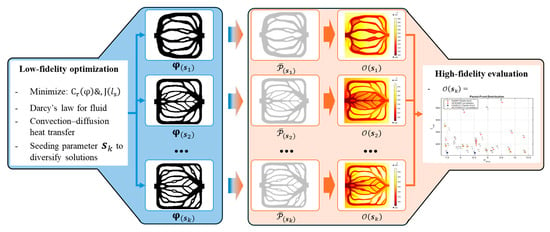
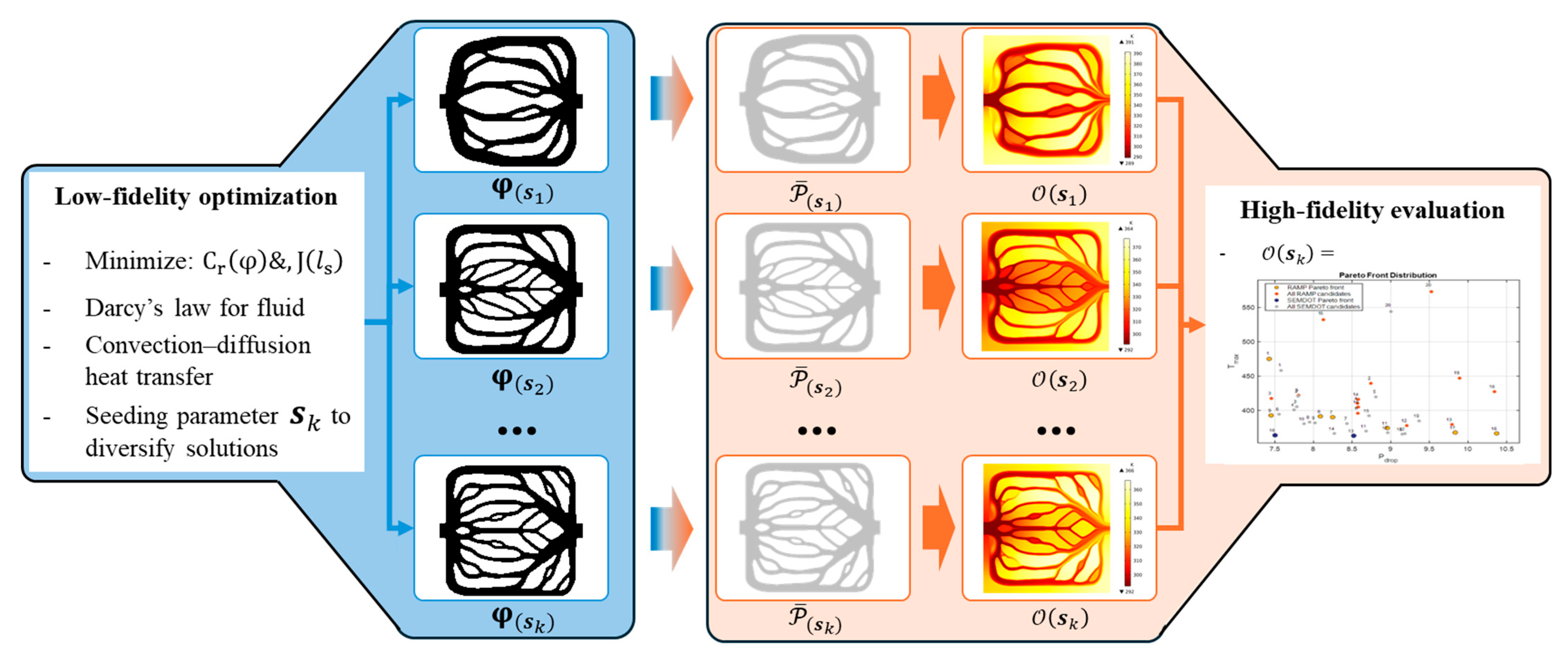
In the design of thermal–fluid devices, high-fidelity models are often required to accurately capture the underlying physics. For instance, the incompressible steady Navier–Stokes equations, coupled with the convection–diffusion heat transfer formulation, are capable of fully representing the essential phenomena of laminar flow and thermal transport. However, employing such models directly in TO is not computationally affordable due to the significant cost associated with repeatedly solving the coupled nonlinear equations. To alleviate this, a multifidelity optimization framework is adopted. Specifically, a low-fidelity model based on Darcy’s law for fluid transport combined with the convection–diffusion formulation for heat transfer is utilized during the optimization process, providing a computationally efficient yet physically meaningful approximation. The optimized designs are subsequently validated using the high-fidelity Navier–Stokes (NS) equations model, thereby ensuring both efficiency in the design process and reliability of the final solutions. The schematic illustration of multifidelity topology design is shown in Figure 1.
Figure 1.
Schematic illustration of multifidelity topology design.
2.1. High-Fidelity Governing Equations
In this work, it is assumed that the designed heat-dissipating components are relatively small in size, and the inlet velocity of the coolant is low. Consequently, the overall Reynolds number of the device remains in a low range. The high-fidelity model employed in this study is based on the incompressible steady-state NS equations coupled with the convection–diffusion equation for heat transfer. The governing equations for the fluid flow are given as follows [47]:
where the Equation (1) indicates the momentum conservation equation, denotes the velocity vector field of the fluid, and is the static pressure. The material parameters include the density and the dynamic viscosity . It is noted that Equation (1) should be coupled with the continuity equation to make sure the mass conservation:
The NS equations describe laminar fluid motion by accounting for the balance among inertial, viscous, and pressure forces. Due to the presence of the convective term , the equations are highly nonlinear. As a result, the solution cannot rely on the principle of superposition and typically requires iterative numerical methods.
For the modeling of heat transfer, the convection–diffusion equation is employed, which captures both advective transport driven by the flow field and conductive diffusion within the medium. The governing equation is given as follows:
where represents the temperature field. The material parameters include the material density , the specific heat capacity , and the thermal conductivity . The source term represents internal heat generation, if present. It should be mentioned that Equations (1)–(3) provide a comprehensive representation of the coupled fluid–thermal behavior in thermal–fluid devices.
2.2. Low-Fidelity Governing Equations
To improve computational efficiency during optimization, a low-fidelity model is adopted in which the fluid motion is governed by Darcy’s law rather than the full NS equations. Darcy’s formulation assumes a linear relation between the fluid velocity and the pressure gradient, i.e.,
where is the permeability of the porous medium and is the fluid viscosity. Inserting this into the continuity equation (Equation (2)) and by ignoring the body force term yields the following model:
Compared with the full NS equations, the Darcy model eliminates the nonlinear convective acceleration term and neglects the detailed resolution of velocity boundary layers. The equation thereby degenerates into a linear elliptic form, which significantly reduces the computational complexity of the solution process. This simplification is reasonable in the present context because the main role of the flow model in the optimization process is to provide an approximate transport mechanism for heat convection, rather than resolving fine-scale flow structures. Based on the above Darcy flow model, the convective heat transfer model thereby becomes [48] the following:
It should be emphasized that this Darcy–convection model is adopted as a low-fidelity transport surrogate and is most appropriate when inertia is secondary at the surrogate scale. If the framework is extended to higher Reynolds numbers where transitional/turbulent effects, separation, and strong inertial transport become important, the Darcy approximation may no longer provide a reliable ranking of candidates. In such regimes, HF validation would require turbulence modeling and potentially unsteady simulations, and the LF surrogate would need to be upgraded (e.g., Brinkman/Forchheimer-type corrections or an NS/Stokes-based penalization model) to preserve LF→HF transferability.
3. Framework of SEMDOT Method
3.1. Formulation of SEMDOT
In the conventional density-based topology optimization framework, the material properties in the governing equations introduced in the previous section are described using a continuous density field , which is fully coupled with the finite element mesh. In this context, denotes a fluid region, while corresponds to a solid region. The primary motivation for introducing a continuous design variable—typically constrained within the interval [0,1]—is to transform the original discrete 0–1 combinatorial optimization problem into a continuous and differentiable one. This relaxation significantly reduces computational complexity by avoiding the combinatorial explosion inherent to discrete formulations. More importantly, it enables the objective function and constraints to become differentiable with respect to the design variables, allowing the use of sensitivity analysis in conjunction with efficient gradient-based optimization algorithms.
Typically, in the context of the Darcy equation, the relationship between the density variable and the permeability of the porous medium is established using the Rational Approximation of Material Properties (RAMP) interpolation scheme [49,50]:
In this formulation, and denote the permeabilities of the solid and fluid phases, respectively, while is the corresponding penalization factor that controls the convexity of the interpolation. The fluid viscosity is assumed to be constant throughout the domain. Similarly, for the convection–diffusion equation governing heat transfer, a RAMP interpolation scheme is also employed to relate the density variable to the thermal conductivity :
where and represent the thermal conductivities of the solid and fluid phases, respectively, while is the penalization factor controlling the interpolation convexity. In contrast, for the material density and the specific heat capacity , simple linear interpolation schemes are adopted due to their relatively weaker influence on the overall optimization results:
where is the effective density, and are the densities of the solid and fluid phases, respectively, is the effective specific heat capacity, and and denote the specific heat capacities of the solid and fluid phases. From Equations (7)–(10), the limiting cases can be verified explicitly as follows:
These limits confirm that the interpolations are consistent with the definition (solid) and (fluid).
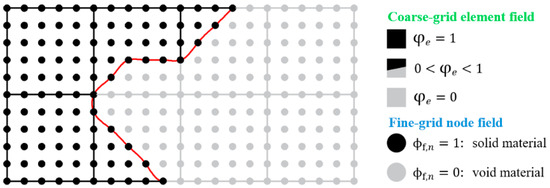
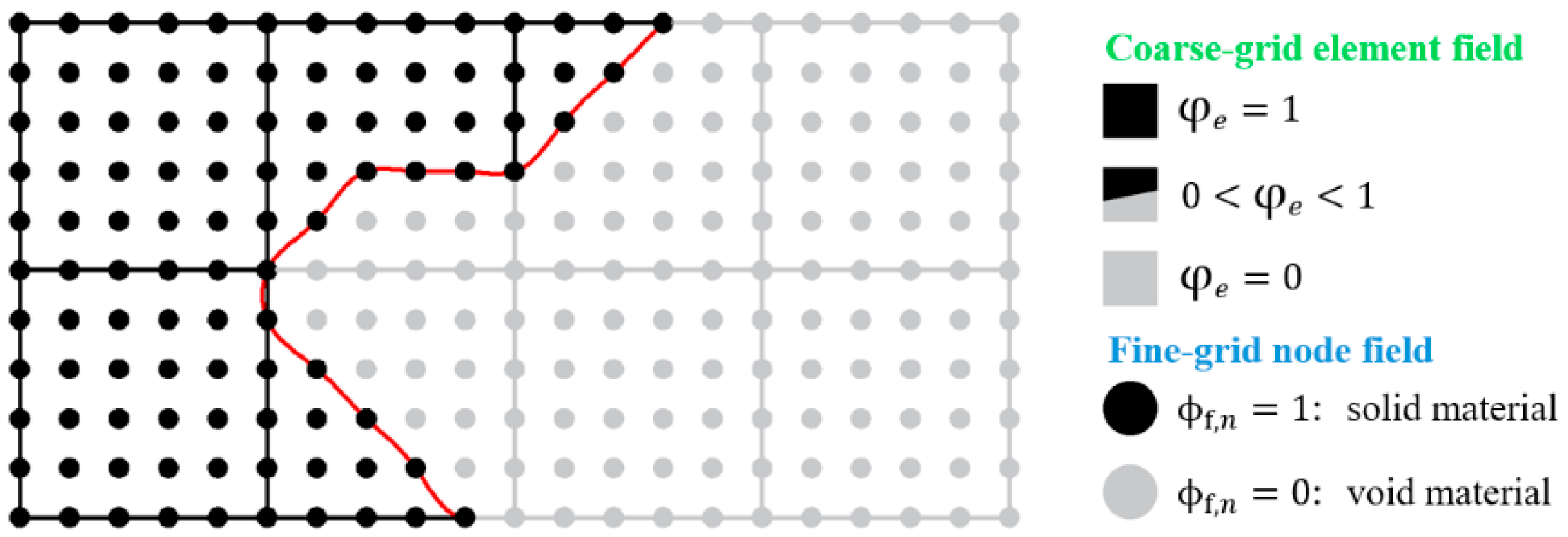
However, due to the resolution limitation imposed by the finite element mesh, the resulting topology often exhibits jagged, staircase-like boundaries. Such artifacts significantly hinder the quality of the final geometric representation and pose challenges for downstream applications such as CAD reconstruction and manufacturing. To address this issue and to produce a smooth and well-defined structural boundary, the SEMDOT method, whose smooth boundary strategy is demonstrated in Figure 2, is selected for this work.
Figure 2.
An illustration of the SEMDOT method.
One of the most elegant aspects of the SEMDOT framework lies in its moderate decoupling of the geometric representation (i.e., fine-grid node field ) and the finite element analysis (FEA) density field (i.e., coarse-grid element field ). In this framework, the low-dimensional density field is used for the most computationally intensive tasks, including forward FEA, backward sensitivity analysis, and optimization updates via gradient-based solvers. The coarse-grid element field will be firstly smoothed by a convolution filter to avoid some numerical issues like the checkerboard phenomenon:
where is the set of elements for which the center-to-center distance to the element. It is noted that is smaller than the filter radius , and is a weight factor defined as follows:
After that, the smoothed distribution is mapped onto the fine-grid , which provides a more refined representation capable of capturing intricate geometrical details. This mapping is carried out using bi-cubic interpolation, where the density value at the fine grid for the node is computed as a weighted combination of the values at the surrounding coarse-grid element:
where denotes the density value at the coarse-grid element , represents the corresponding bi-cubic interpolation basis function, and is the set of the neighboring coarse-grid element index associated with the fine-grid node . To alleviate the staircasing artifacts that are inherent to density-based methods, the convolution-based filtering procedure will apply again to the interpolated fine-grid field, thereby improving boundary smoothness and geometric fidelity.
Subsequently, a smoothed Heaviside projection is employed to obtain a clear representation of the material distribution, where the steepness parameter is progressively updated to sharpen the transition between solid and void regions.
The structural geometry is further represented by a level-set function, in which the threshold is iteratively determined using a bi-section scheme to strictly satisfy the prescribed volume constraint, which could be expressed as the following 1D optimal problem:
Finally, the updated high-dimensional grid-based field serves as the initial guess for the next optimization cycle, forming a closed-loop process that gradually refines the topological design toward smooth and well-defined boundaries.
3.2. CAD Reconstruction Based on SEMDOT Results
To facilitate downstream CAD modeling and meshing, it is first necessary to convert the SEMDOT-designed density field into an explicit structural boundary. Since the SEMDOT result is represented by the filtered design variable , the solid–void interface can be consistently defined as the isocontour of at a prescribed threshold :
where MSA (*) indicates the Marching Squares Algorithm [51,52,53], which could be easily realized through the MATLAB 2024a internal function; the details of its formulation are omitted here, and interested readers could refer to the work [54]; yields a polyline boundary, which includes point coordinates and topological information. Then, to enable robust CAD modeling and meshing, the non-uniformly distributed polyline is resampled to obtain a uniformly spaced point set , and the arc-length interval of the polyline could be fixed as . The Equal Arc-Length Resampling Algorithm proposed in [55] is adopted here to achieve this goal:
Similarly, the procedure is readily implemented via MATLAB’s built-in functions; the implementation details are omitted for brevity. The final resampled polyline could then be directly exported into a format, encoding the point coordinates and connectivity in a CAD-compatible structure. These files are subsequently imported into commercial CAE software, where the closed contours are meshed for high-fidelity finite element simulations. During the meshing phase, a third-party mesh generation software (such as COMSOL Multiphysics 6.3 [56]) is employed to discretize the extracted geometry using free triangular elements. To ensure controllability and consistency, the minimum edge length of the generated triangular mesh is set equal to the arc-length interval defined during the resampling process. As a result, by adjusting the control parameter , which specifies the number of resampled boundary points, both the geometric accuracy and the final number of mesh elements can be directly regulated.
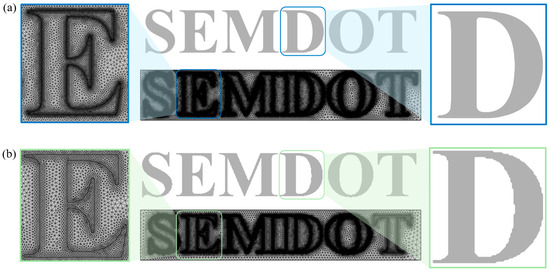
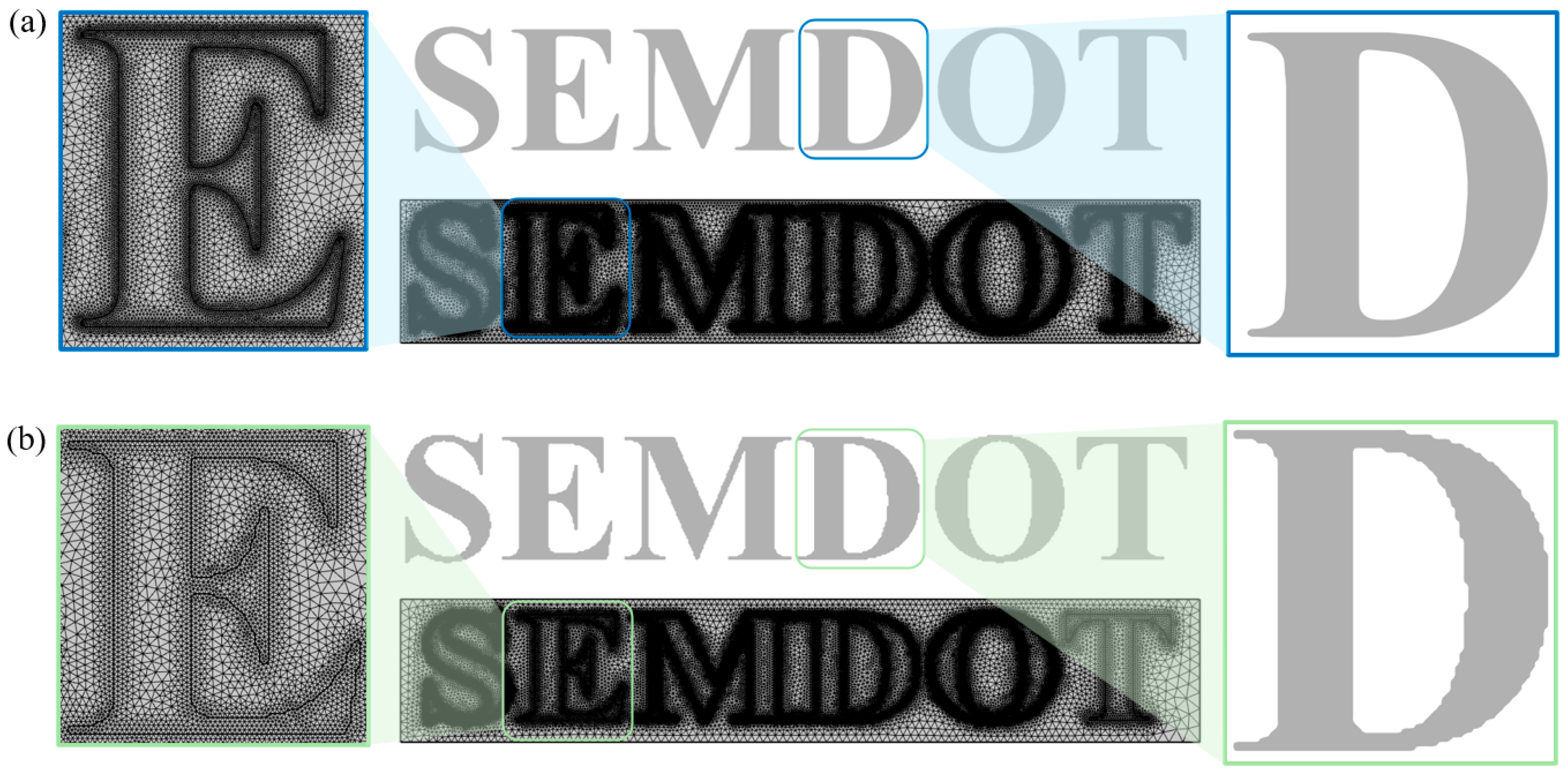
It is worth noting that the SEMDOT framework ultimately produces a high-resolution and smoothly distributed field . Consequently, during the processes described in Equations (18) and (19), the reconstruction of smooth polylines can be achieved in a straightforward and accurate manner. In contrast, the conventional density-based method extracts polylines directly from the low-resolution density field , which inherently limits the smoothness of the reconstructed boundaries. This fundamental distinction is illustrated in Figure 3a, where SEMDOT enables the generation of smooth polylines, whereas the traditional approach leads to jagged or staircase boundary representations shown in Figure 3b.
Figure 3.
An illustration of boundary expression for word ‘SEMDOT’ between SEMDOT algorithm and conventional method, (a) dense-mesh case; (b) sparse-mesh case.
4. Formulations of Optimization Model
4.1. Formulation of Low-Fidelity Optimization Model
For thermal–fluid device design, our primary focus is to achieve the optimal design of structural performance under the constraint of a structural weight ratio. Within the SEMDOT framework, the optimization model for this can be expressed as follows:
where is set as , which could be used to avoid matrix singularity, and represents the general objective function. In this work, the objective is to minimize the maximum temperature within the design domain. This constraint could be restated in terms of a single differentiable global expression through the aggregation method. The P-norm aggregation function is adopted [57], and could be approximately expressed by the following:
where is the global P-norm measure, is the temperature value for the eth element, and is the aggregation parameter. Note that the P-norm approaches the real maximum value when . However, a large value tends to make the problem ill-conditioned. A relatively small value is preferred in practice given the convergence stability, leading to the gap between the exact and the approximated maximum temperature. Therefore, the aggregation parameter is taken as a seed parameter and could be optimized.
4.2. Formulation of Multifidelity Optimization Model
As shown in Figure 1, an LF model is constructed. This model must be able to be optimized by the gradient method and generate promising design solutions to the original optimization problem. The next step is selecting the seeding parameters. LF optimization generates a number of design solutions by varying the combinations of these parameters. In LF optimization, candidate solutions are generated by solving the following LF optimization problem for K seeding parameter combinations:
where represents the design population and represents the seeding parameters combination. In heat transfer problems, a trade-off exists between pressure drop and heat dissipation performance. In the HF evaluation, the maximum temperature is adopted as the performance metric for the heat dissipation. This metric is crucial in engineering applications such as electronic device cooling, as it directly affects component reliability, lifespan, and failure risk.
5. Case Studies and Discussions
All numerical examples presented here were implemented using a combination of MATLAB and COMSOL. Specifically, the low-fidelity optimization and the subsequent CAD-based post-processing were carried out in MATLAB, whereas the high-fidelity simulations and the visualization of the corresponding results were performed in COMSOL. All simulations and computations were executed on a high-performance workstation equipped with dual AMD EPYC 7763 CPUs (128 cores, 2.45–3.5 GHz), 1 TB of RAM, and two NVIDIA RTX A6000 GPUs.
The LF iterations are terminated when either (i) the relative change in the objective function between two successive iterations falls below 0.001, indicating that the objective has effectively stabilized, or (ii) the maximum number of iterations reaches 200, which serves as a practical upper bound to control the computational cost.
5.1. Single-Channel Design
5.1.1. Boundary Conditions and Parameter Settings for Single-Channel Design
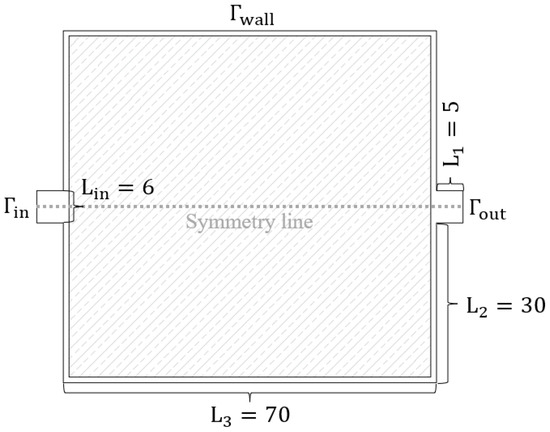
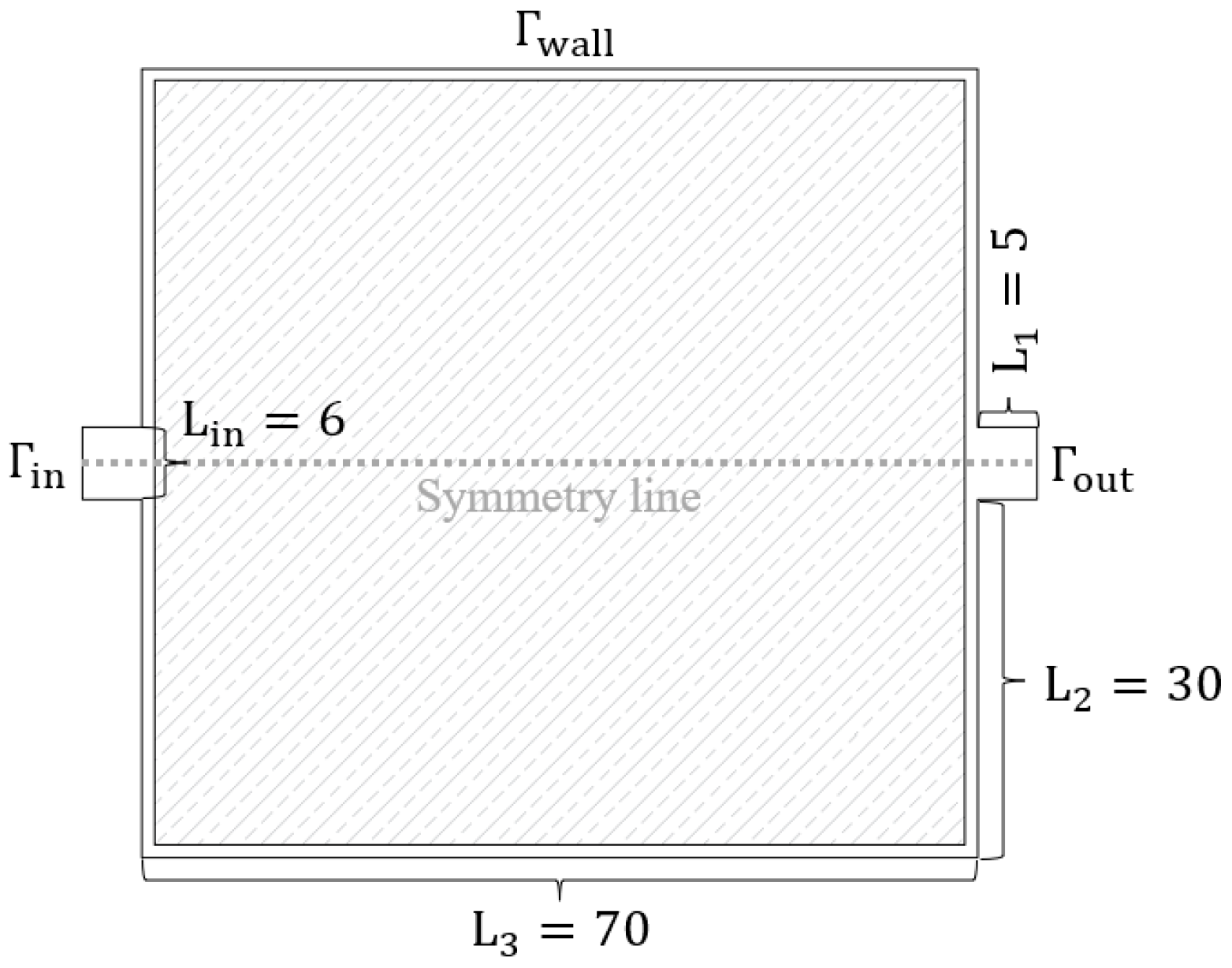
The most common case of a parallel channel with a single inlet and a single outlet is used as the first case study. The corresponding boundary conditions and geometric dimensions are illustrated in Figure 4.
Figure 4.
Boundary condition and its corresponding geometry configuration for single-channel design (all lengths are in meters, m).
In this case, the inlet and outlet positions are fixed. Owing to symmetry, only half of the domain is considered, which is discretized into a element mesh. For the SEMDOT nodal field, a finer resolution of a node is employed. Regarding the boundary conditions, a Dirichlet pressure condition is prescribed at the fluid inlet, with zero pressure at the outlet. For the heat transfer problem, the inlet temperature is set to , and the input pressure . For the projection parameters, the is initially set to 2 and double in every 30 iterations until it reaches 32. The prescribed volume fraction is 0.5. The optimization and material parameters used in the LF topology optimization and HF simulations are summarized in Table 1.
Table 1.
Parameters of LF optimization.
5.1.2. Validation of Low-Fidelity Optimization Results for Single-Channel Design
After 200 iterations, the topologically optimized structure could be obtained. The convergence history of the proposed optimization procedure is shown in Figure 5a. The objective function decreases rapidly in the early iterations, followed by a gradual decline with minor oscillations until convergence around iteration 120. The constraint function remains negative throughout optimization, ensuring feasibility within the admissible design space. Meanwhile, the threshold parameter evolves adaptively, rising from its initial value and stabilizing near 0.53, which sharpens the transition from intermediate densities to a distinct 0–1 boundary. Figure 5b illustrates the evolutionary process of the structure at different iterations. At the initial stage (Itr. 1–10), the design exhibits coarse and irregular material distributions without clear flow passages. By iteration 20–30, the structure gradually forms primitive channel-like features, though still fragmented. As the optimization proceeds (Itr. 40–60), a more connected and branching network emerges, providing preliminary flow paths. Finally, after about 120 iterations, the topological design stabilizes into a well-defined branched structure, which remains consistent until the final iteration (Itr. 200). Overall, the results demonstrate fast convergence, strict constraint satisfaction, and stable boundary evaluation, highlighting the robustness of the proposed framework.
Figure 5.
Single-Channel Design. (a) Convergence history and (b) evolutionary history for fluid channel distribution during optimization.
Figure 6 presents a comparative analysis between the SEMDOT-based topology-optimized design (top row, a-1 to a-4) and the conventional channel design (bottom row, b-1 to b-4) under the HF simulation framework. In the HF simulations, a fixed inlet flow rate corresponding to an average inlet velocity of 0.1 m/s is prescribed. Unless otherwise specified, all remaining boundary conditions and material properties are identical for all cases, ensuring a consistent operating condition for performance comparison.
Figure 6.
Comparison between SEMDOT design (a-1~4) and conventional straight-line design (b-1~4).
A mesh-independence analysis is performed for the SEMDOT-based design (Figure 6, a-1) to determine an appropriate mesh resolution for the high-fidelity simulations. Five progressively refined values of are examined to assess mesh convergence, and the corresponding results are summarized in Table 2. It is observed that further mesh refinement leads to only marginal changes in the monitored quantities, indicating that mesh-independent solutions have been reached. Considering both geometric accuracy and computational cost, is selected, and this mesh resolution is consistently adopted in all subsequent HF simulations.
Table 2.
The mesh-independence analysis.
From a geometrical standpoint, the SEMDOT design naturally evolves into a branched, bio-inspired network (a-1), in sharp contrast to the rigid, straight-channel configuration of the conventional design (b-1). The velocity distribution further demonstrates this difference: the SEMDOT structure achieves a more uniform flow allocation across the entire domain (a-2), whereas the conventional straight-channel layout suffers from flow concentration in the central passages and relatively stagnant regions near the side walls (b-2). A similar trend is observed in the temperature field comparison. The SEMDOT structure yields a more homogeneous thermal distribution with a reduced peak temperature (a-3), while the conventional design exhibits steep gradients and local hot spots, particularly in the downstream region (b-3). Pressure drop analysis also highlights the superiority of the SEMDOT design: it achieves a smoother pressure profile with a lower overall loss (~12.6 Pa) compared with the conventional counterpart (~18.7 Pa) (a-4 vs. b-4).
It can be concluded that the SEMDOT framework not only produces adaptive, bio-inspired geometrical layouts but also simultaneously enhances flow uniformity, improves thermal management, and reduces energy consumption, thereby significantly outperforming the conventional straight-channel design.
5.2. Multi-Channel Design
5.2.1. Boundary Conditions and Parameter Settings for Multi-Channel Design
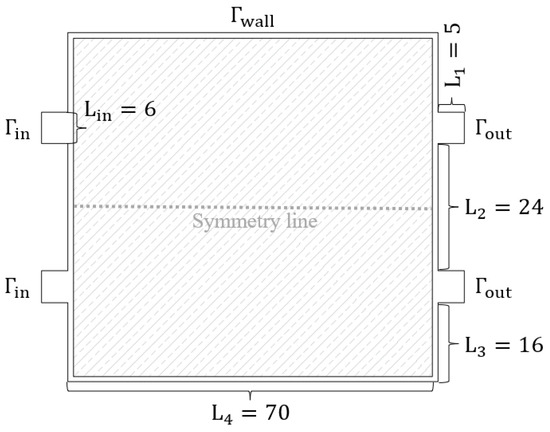
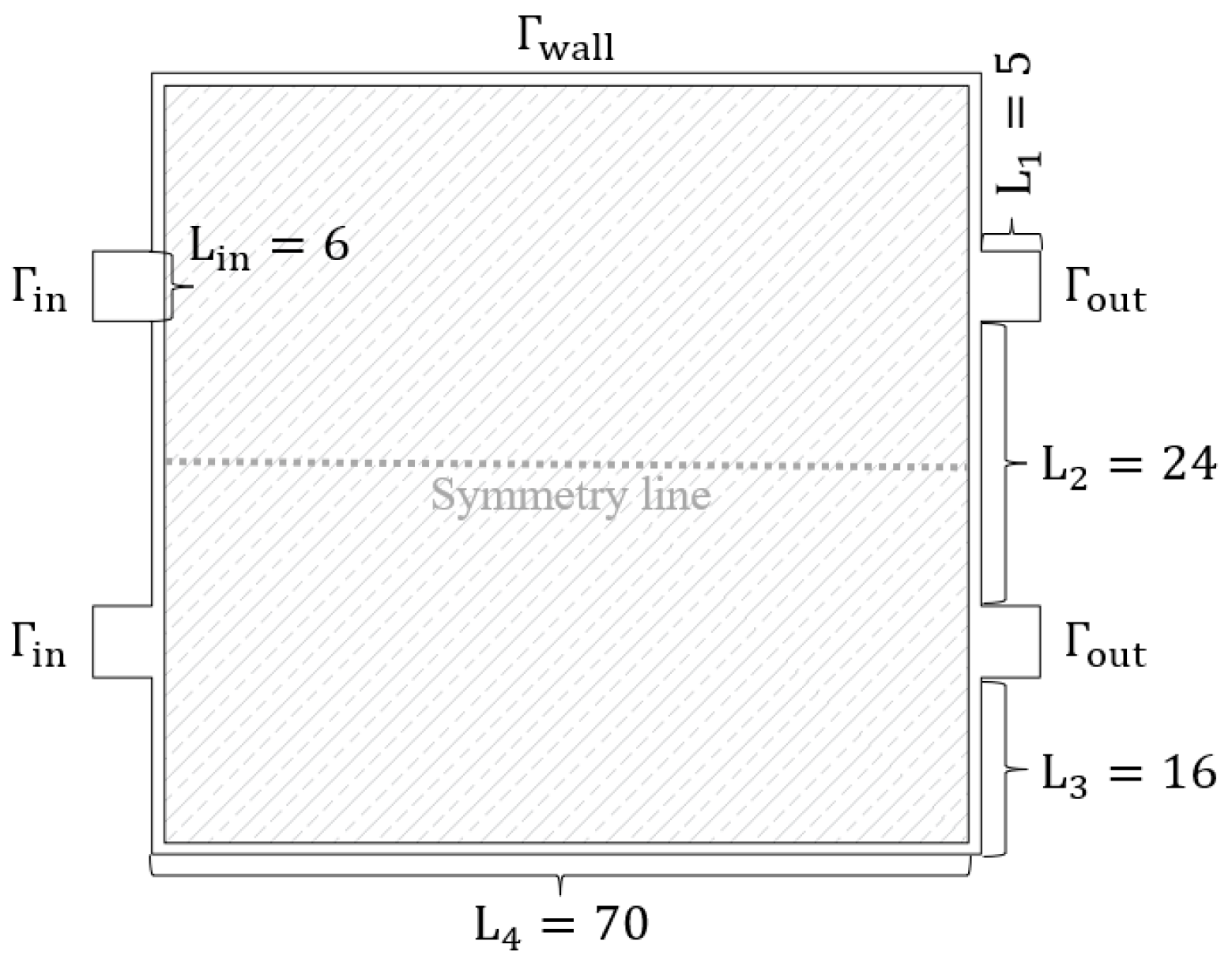
In the second case, a symmetric double-channel configuration is considered, as shown in Figure 7. Two inlets are located on the left and two outlets on the right, both aligned with the horizontal symmetry line. The none unit geometric dimensions are as follows: (channel length), (top outlet height), (distance from the top wall to the upper outlet centerline), (distance from the bottom wall to the lower outlet centerline), and (inlet length). The same mesh and boundary settings as in the single-channel case are used.
Figure 7.
Boundary condition and its corresponding geometry configuration for double-channel design.
5.2.2. Validation of Low-Fidelity Optimization Results for Single-Channel Design
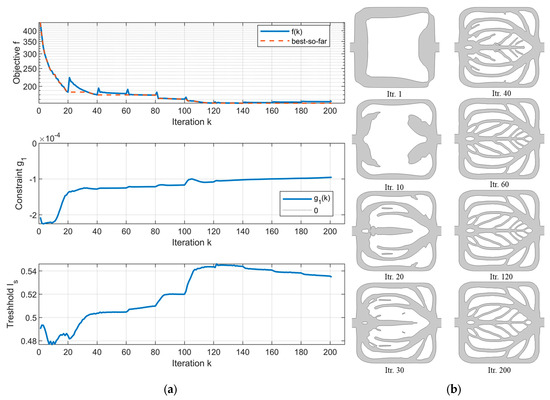
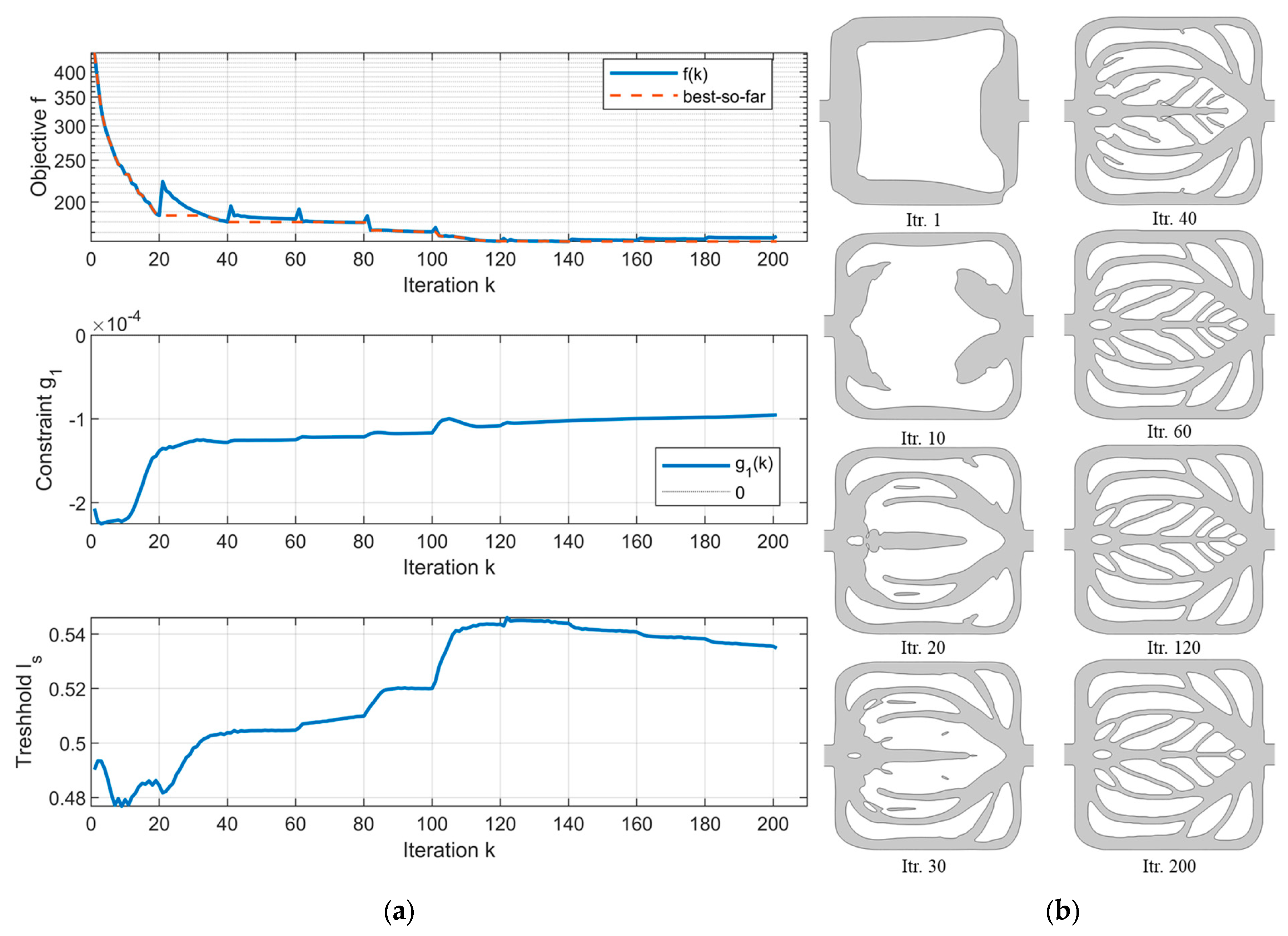
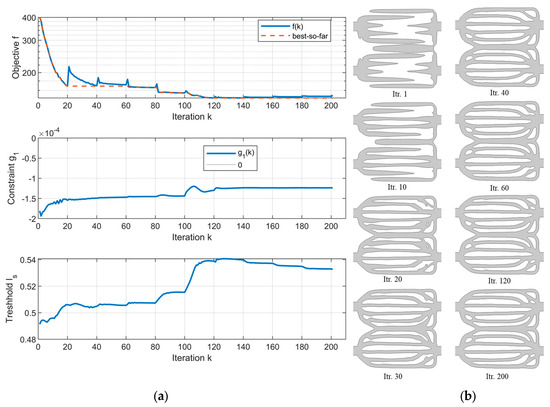
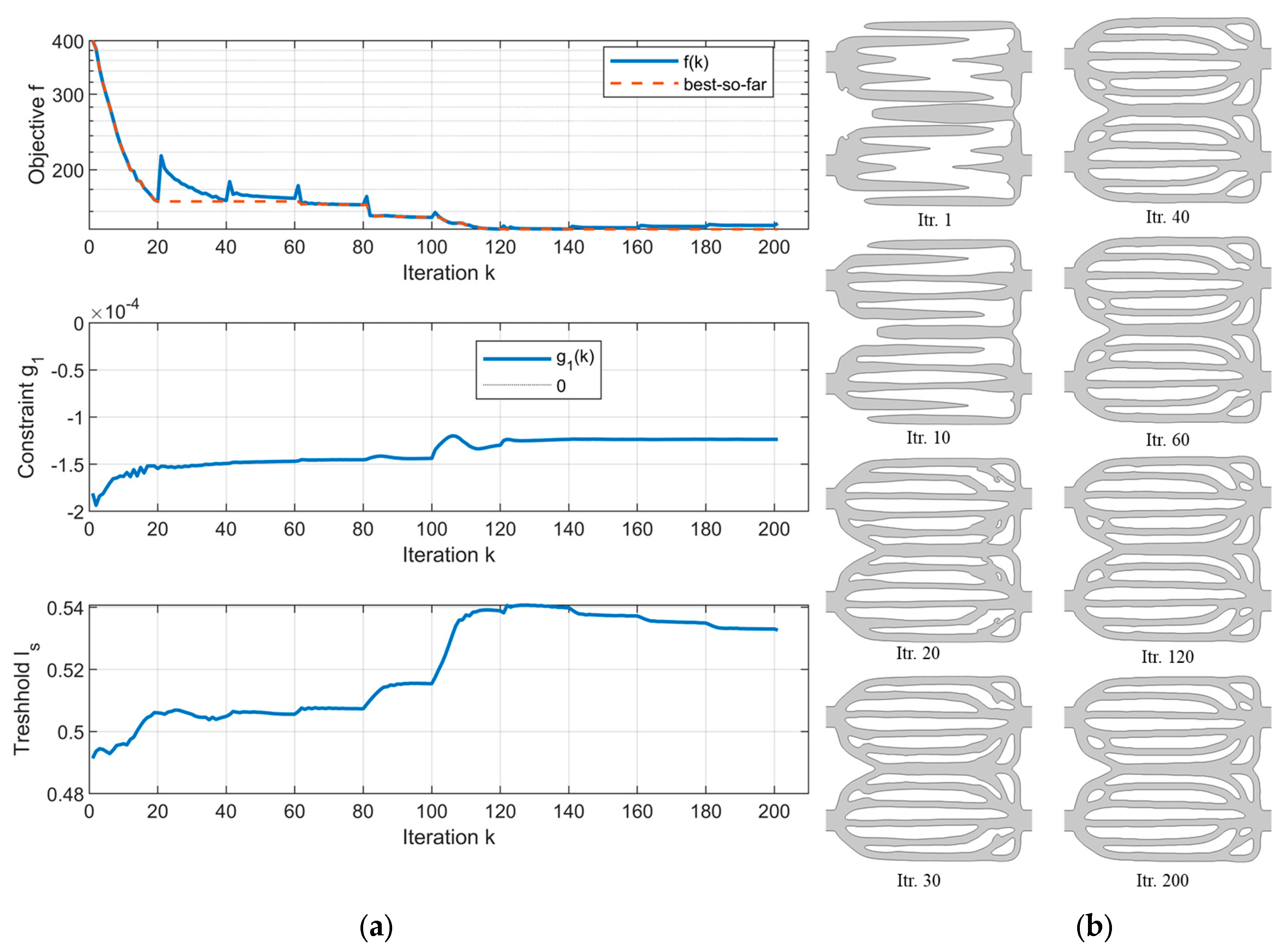
After 200 iterations, a converged topological design is obtained, as illustrated in Figure 8. In Figure 8a, the convergence history shows that the objective function decreases sharply during the early iterations, then gradually declines with minor fluctuations and stabilizes around iteration 120, while the constraint function g1(k) remains negative throughout, confirming feasibility within the design space. At the same time, the threshold parameter ls increases adaptively and stabilizes at near 0.54, which promotes a smooth transition from intermediate densities to a distinct 0–1 boundary. In Figure 8b, the structural evolution reveals that the initial layouts (Itr. 1–10) are irregular and fragmented, but by iterations 20–30, primitive channel-like features appear, followed by progressively connected and branched networks during iterations 40–60. From iteration 120 onward, the structure stabilizes into a well-defined branched topology that persists until the final iteration (Itr. 200). These results collectively demonstrate rapid convergence, reliable constraint handling, and robust structural refinement, highlighting the effectiveness of the proposed framework in generating stable and physically meaningful designs.
Figure 8.
(a) Convergence history and (b) evolutionary history for fluid channel distribution during optimization.
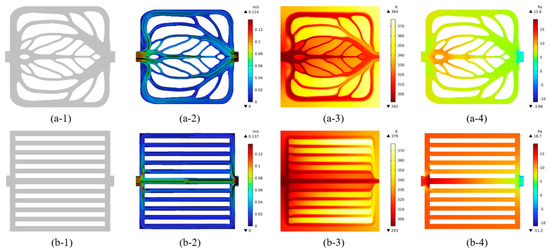
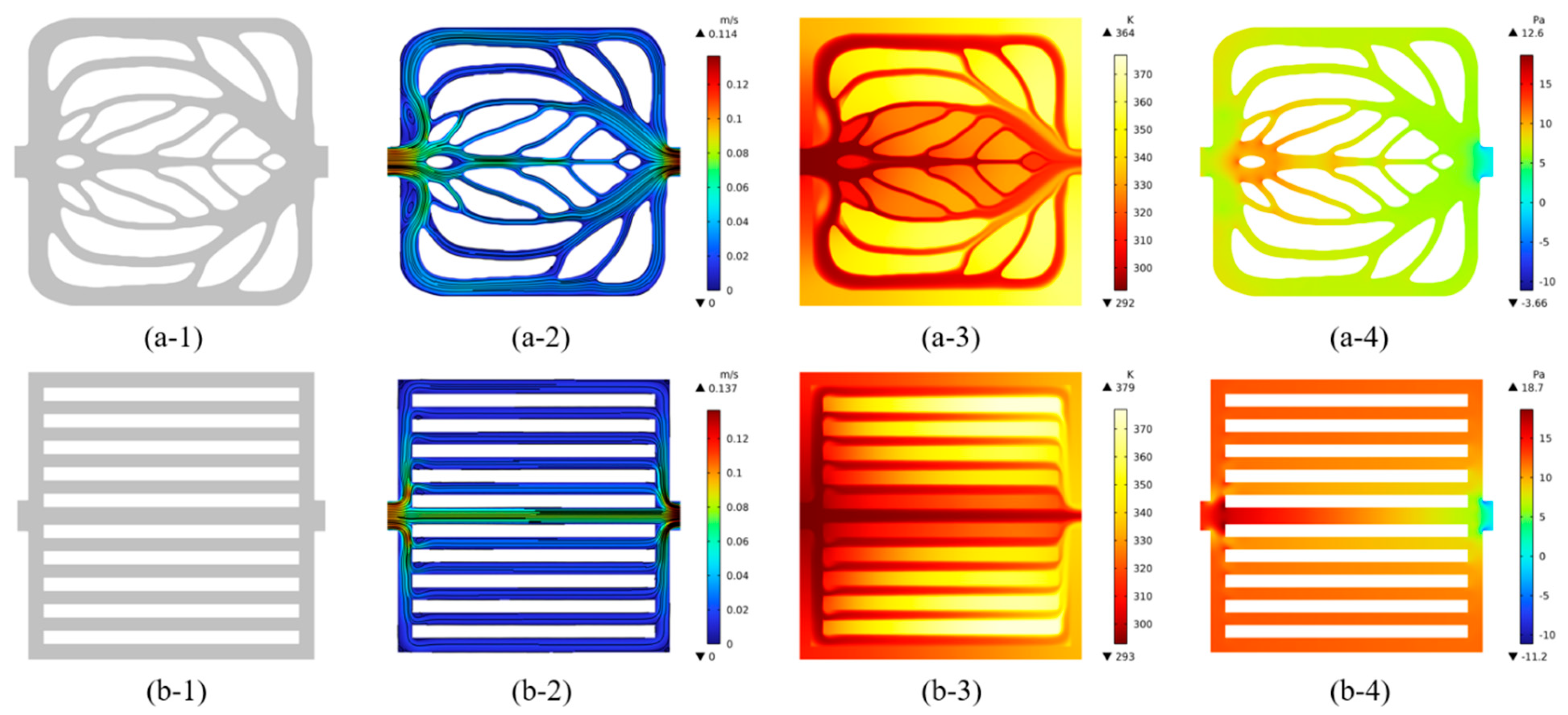
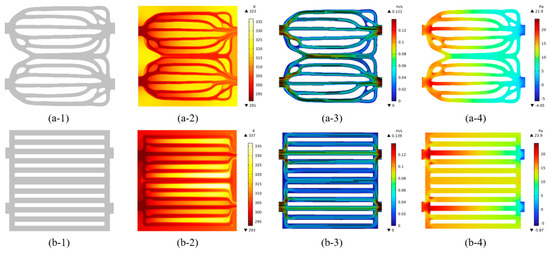
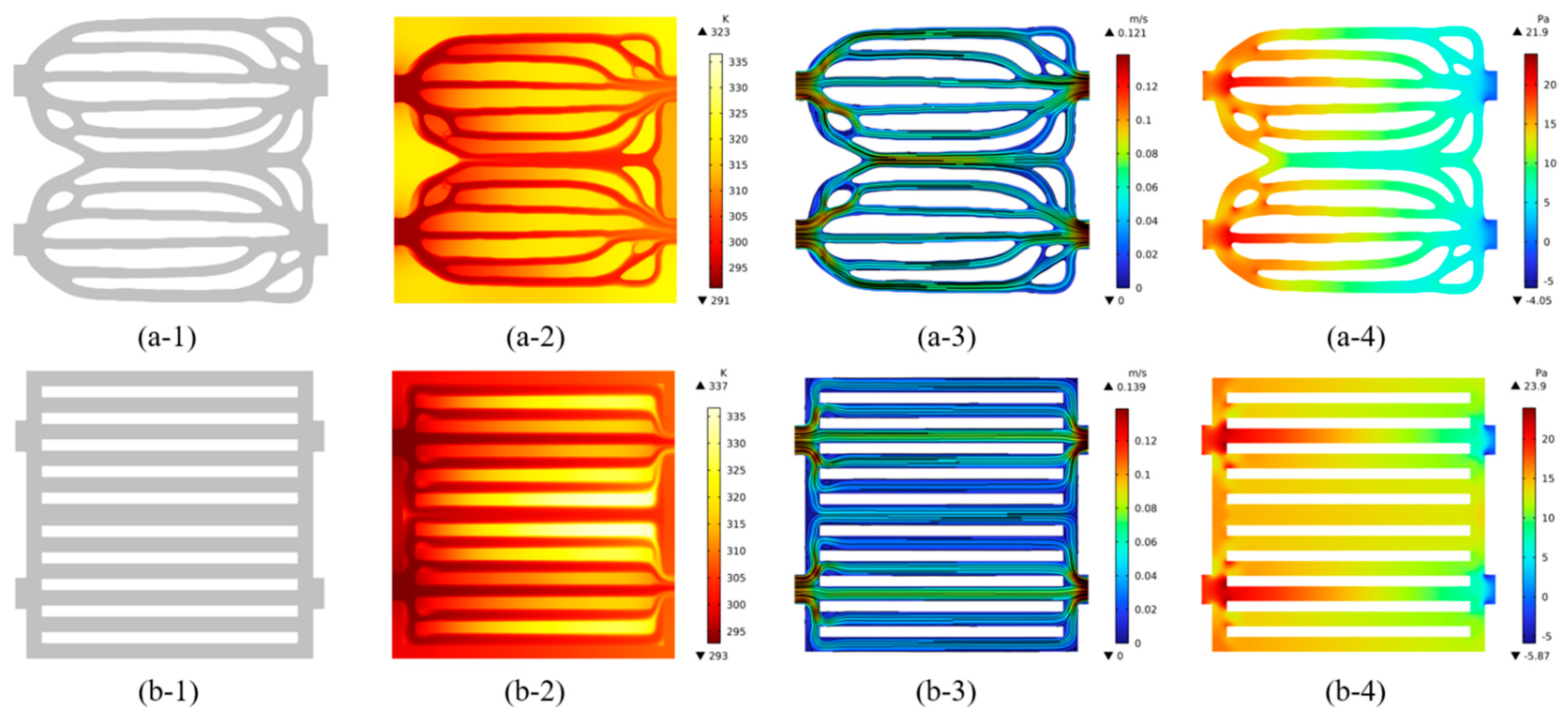
As illustrated in Figure 9, both the SEMDOT-optimized design (top row) and the conventional parallel-channel design (bottom row) achieve continuous flow passages that enable fluid transport and heat dissipation, with similar global flow directions, a temperature rise along the flow path, and pressure drop trends from inlet to outlet. Despite these commonalities, the SEMDOT result demonstrates clear superiority in multiple aspects. The optimized structure forms branched, bio-inspired flow channels that allow more uniform fluid distribution, whereas the conventional design relies on rigid parallel passages with less flexibility. Consequently, the SEMDOT design achieves a lower maximum temperature (~323 K compared to ~337 K), a more homogeneous thermal field without large hot spots, and smoother velocity streamlines that better utilize the entire cooling domain. In addition, the pressure drop is slightly reduced (21.9 Pa vs. 23.9 Pa) and more evenly distributed, avoiding localized losses observed in the conventional layout. Overall, the SEMDOT framework not only preserves the basic functionality of flow and heat transfer but also significantly improves cooling uniformity, thermal efficiency, and hydraulic performance compared with the traditional design.
Figure 9.
Comparison between SEMDOT design (a-1~4) and conventional straight-line design (b-1~4).
5.3. Multifidelity Single-Channel Design
In this case study, we further investigate the impact of discrepancies between low- and high-fidelity models on the optimization results. Due to the modeling gap between the LF and HF models, directly adopting low-fidelity solutions does not necessarily guarantee superior performance in HF simulations. To address this issue, two adjustable feeding parameters are introduced to enhance cross-fidelity consistency. The first is the inlet pressure, which compensates for deviations in the flow rate, pressure drop, and heat transfer response between the two models. The second is the aggregation factor, which regulates the conservativeness and smoothness of the constraint functions, thereby enabling the LF optimization to better capture hot spot regions under HF evaluation. By systematically tuning these parameters within the LF optimization and calibrating them at critical points through HF simulations, the transferability of the LF results is significantly improved, leading to a more robust multifidelity optimization process.
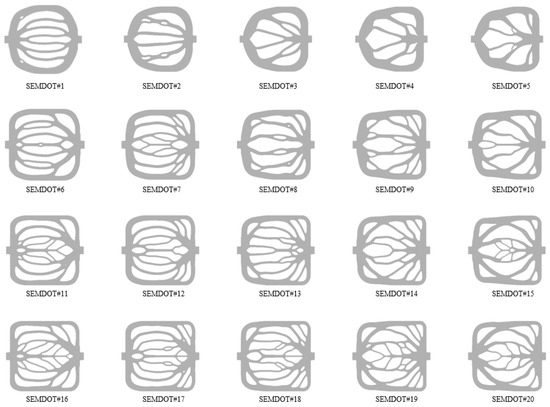
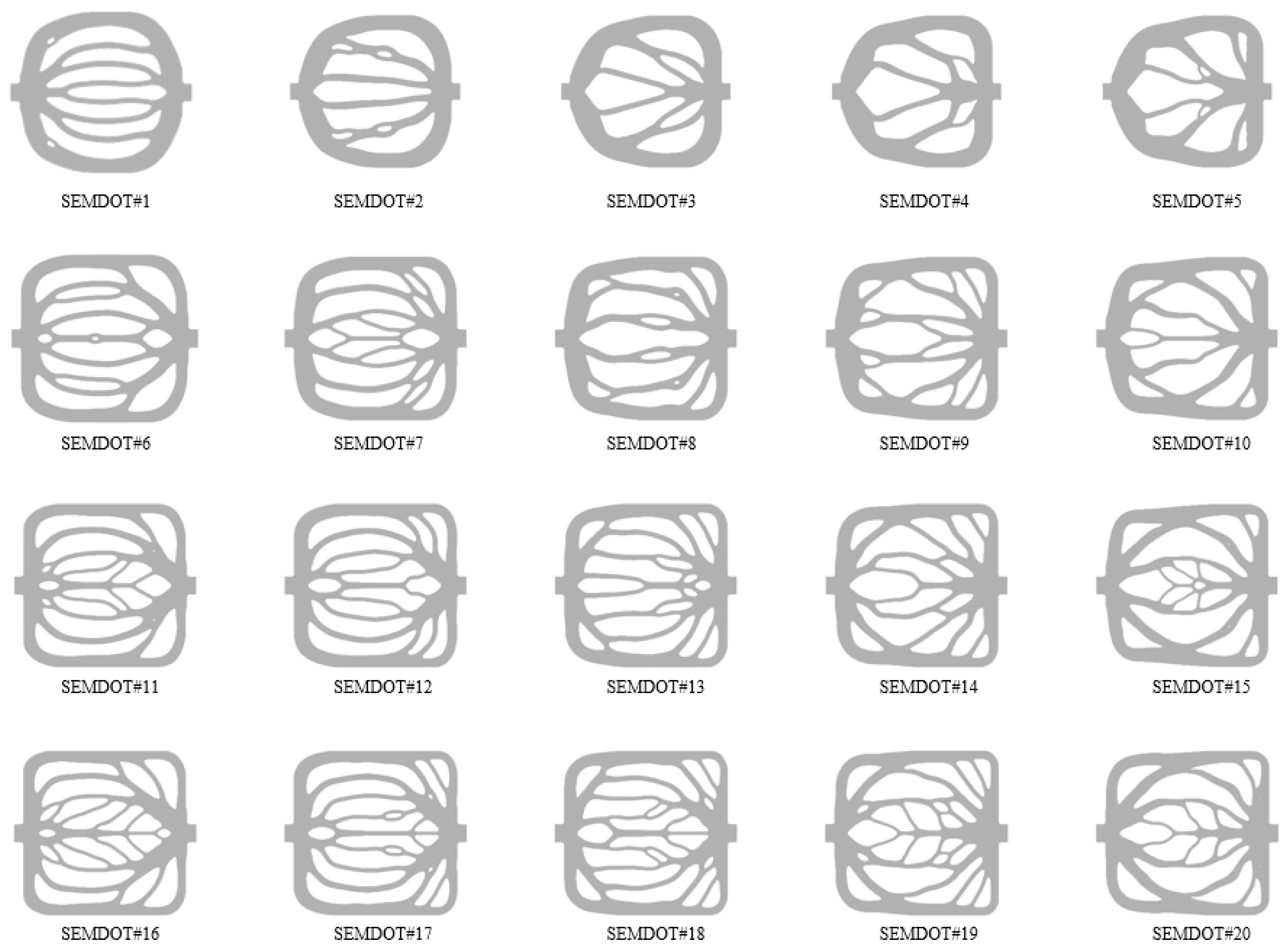
The seeding parameters for the LF optimization based on SEMDOT are summarized in Table 3. A total of 20 cases are considered, with varied over {50,100,150,200} and P varied over {1,2,4,8,16}. Figure 10 presents the distribution of flow channels generated by the SEMDOT algorithm under varying optimization parameters. From left to right, as the aggregation factor P increases from 1 to 16, the optimized geometries evolve from relatively coarse and sparsely branched channels toward finer and more intricate branching networks, indicating that a larger P promotes higher structural complexity. From top to bottom, as the imposed inlet–outlet pressure difference increases from 50 to 200, the channel networks gradually develop additional secondary branches, enabling more uniform fluid coverage under higher driving forces. Overall, the combined effect of P and the pressure difference governs the balance between channel coarseness and branching density, leading to a rich variety of flow topologies ranging from simple main conduits to highly branched tree-like structures.
Table 3.
Seeding parameters for LF optimization in SEMDOT.
Figure 10.
Twenty flow channel designs generated by SEMDOT subjected to different and .
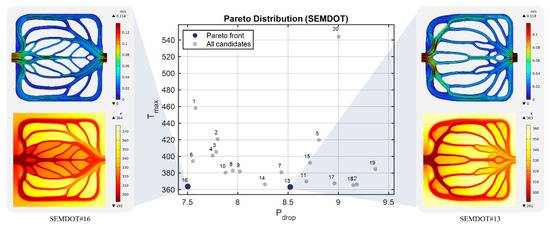
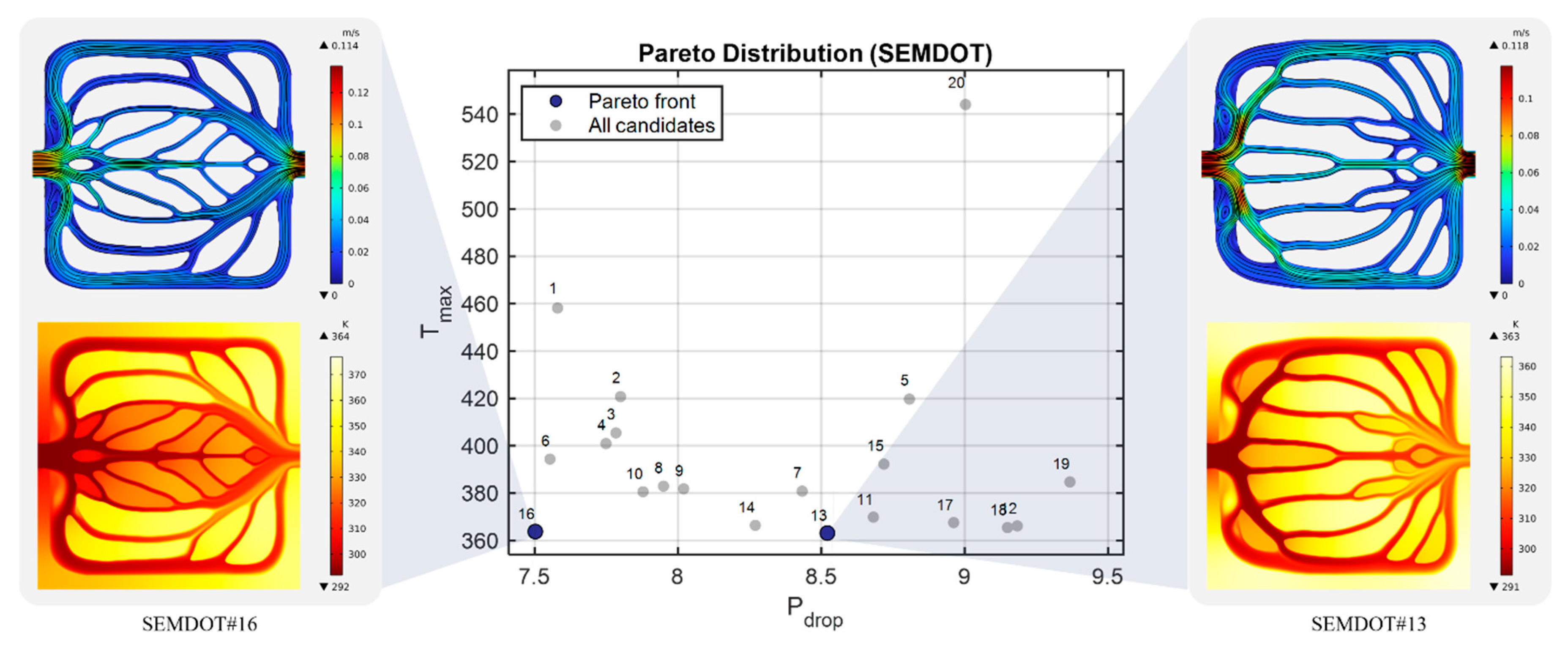
Figure 11 illustrates the Pareto distribution of the SEMDOT-optimized designs with respect to the maximum temperature and pressure drop, together with the representative flow–thermal results. The scatter plot shows a clear Pareto front, indicating the inherent trade-off between cooling performance and hydraulic resistance. Two Rank-1 results are selected (SEMDOT#13 and SEMDOT#16). SEMDOT#13 maintains the lowest maximum temperature (≈363 K) while exhibiting a higher pressure drop. In contrast, Design #16 achieves the very lowest maximum temperature (≈364 K) and the lowest pressure drop (7.502 Pa) by forming a dense and uniformly branched channel network. This reveals an interesting phenomenon: within the proposed case, when the high-fidelity simulation is conducted under low Reynolds number boundary conditions, the low-fidelity optimization yields better performance if a larger pressure drop boundary condition and a smaller aggregation factor (approaching an average-temperature evaluation) are adopted. However, no clear trend can be identified to confirm that this observation holds universally across all cases.
Figure 11.
Pareto distribution for 20 SEMDOT designs and two RANK-1 results selected to show fluid velocity and temperature distributions.
5.4. Comparisons with Conventional Methods
In this subsection, the SEMDOT algorithm is compared with the RAMP method. For the RAMP formulation, an additional projection is applied to the density field to obtain clearer boundaries, with the parameter settings and evolution consistent with Equation (16), except that the threshold is fixed at 0.5. The boundaries are then post-processed and extracted using the procedure described in Section 3.2, before being imported into COMSOL for high-fidelity simulations. All other parameters remain consistent with those used in the SEMDOT algorithm.
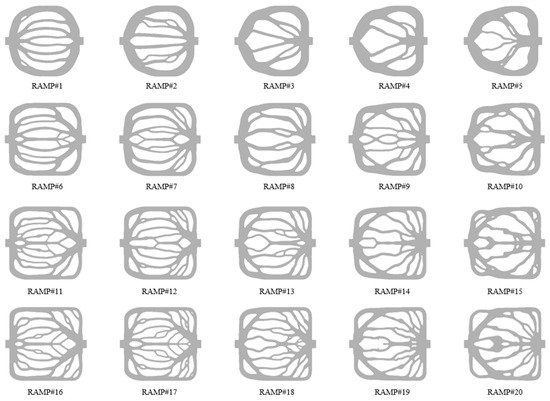
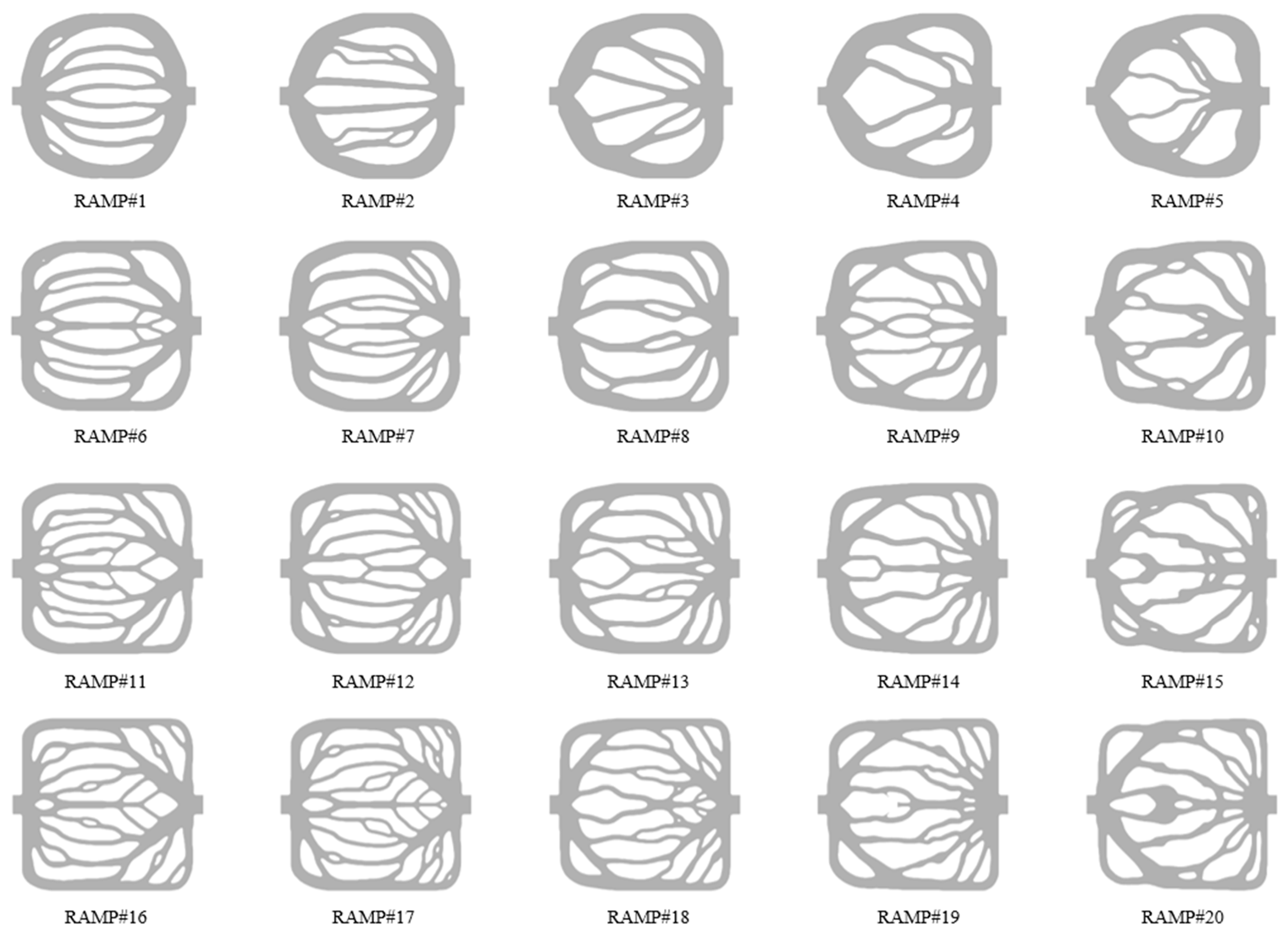
The seeding parameters for the LF optimization based on RAMP are summarized in Table 4. As with Section 5.3, a total of 20 cases are considered, with varied over {50,100,150,200} and P varied over {1,2,4,8,16}. Figure 12 presents the distribution of flow channels generated by the RAMP algorithm under varying optimization parameters. Similar to SEMDOT, the geometrical patterns in the RAMP results exhibit a strong correlation with the values of and P. However, in the cases with a larger P, the final shapes are less satisfactory: several designs fail to converge (for example, the unresolved bifurcation in RAMP#19) or exhibit locally oversized channels (such as RAMP#15 and RAMP#20).
Table 4.
Seeding parameters for LF optimization in RAMP.
Figure 12.
Twenty flow channel designs generated by RAMP with different and .
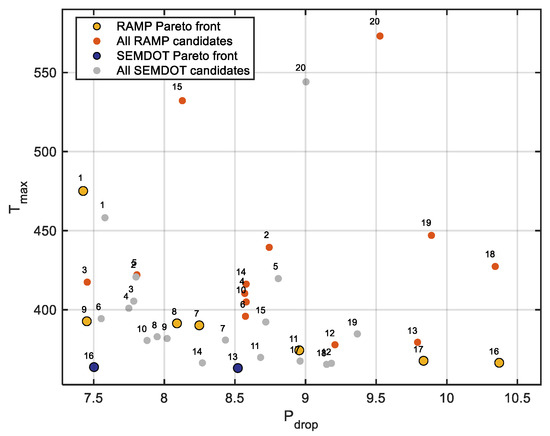
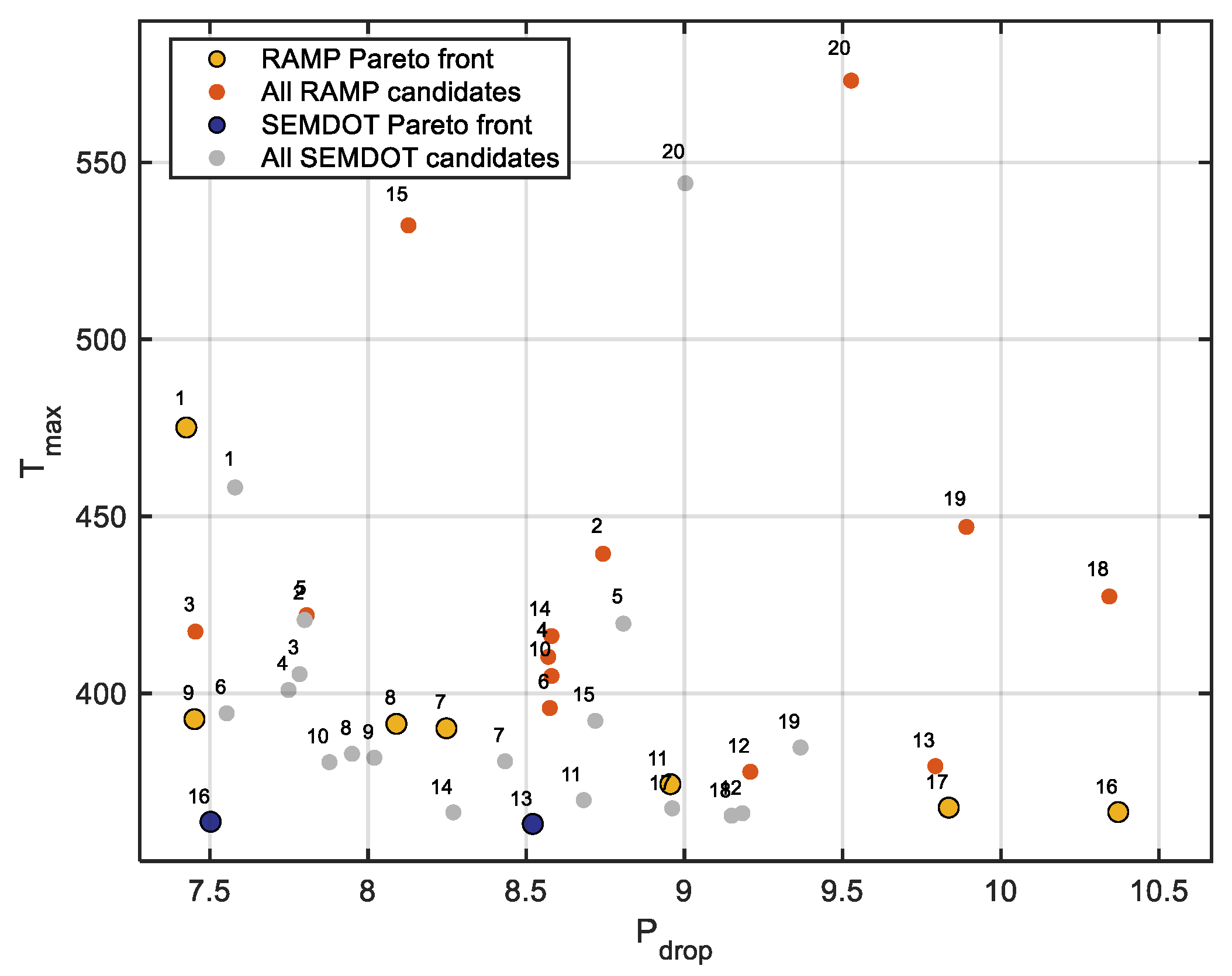
Subsequently, the series of SEMDOT designs are compared with those obtained using RAMP (see Figure 13). While certain RAMP results achieve lower pressure drops than SEMDOT, they generally perform worse in terms of maximum temperature reduction. Quantitatively, if the hypervolume value of SEMDOT is normalized to 1, the corresponding value for RAMP is 0.923. This indicates that, under the design conditions considered in this study, SEMDOT yields overall better performance in comparison with RAMP.
Figure 13.
Comparison of Pareto distribution between SEMDOT and RAMP designs.
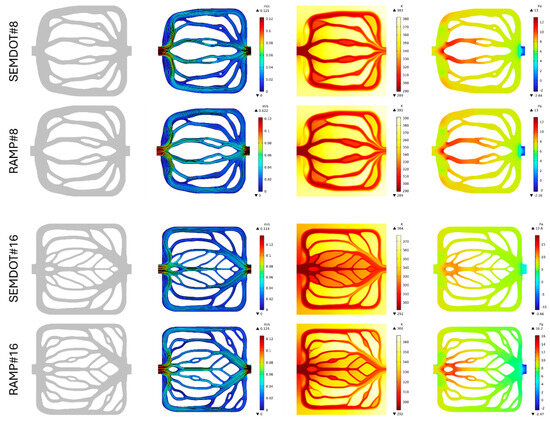
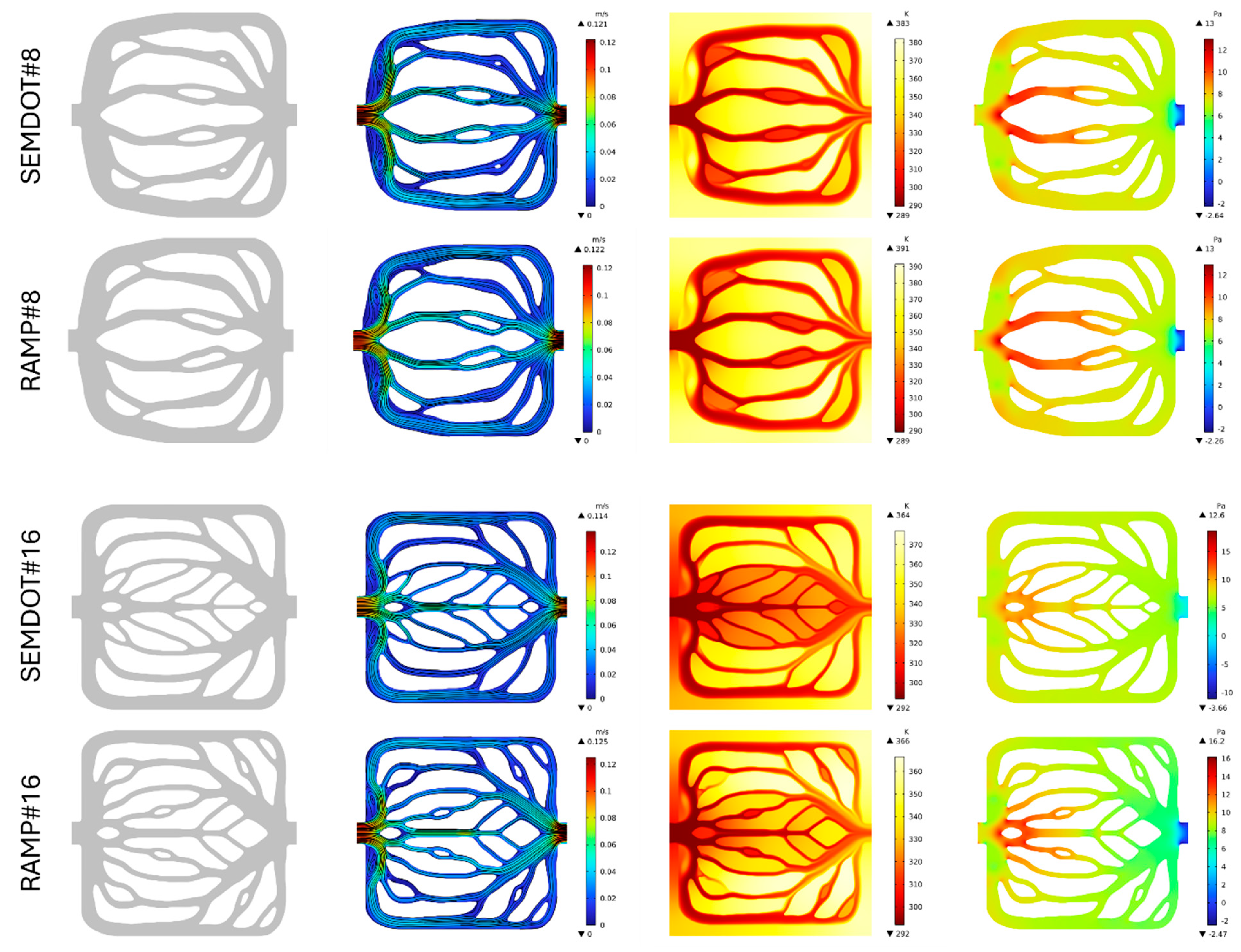
Four sets of results were randomly selected for pairwise comparison under identical optimization parameters. Specifically, the comparisons were conducted between SEMDOT#8 and RAMP#8, as well as SEMDOT#16 and RAMP#16, with each pair representing the corresponding RANK-1 design from the two methods.
The detailed comparison is shown in Figure 14. It can be observed that, for the selected cases, the overall material distributions obtained by the two methods are in close agreement, differing only in a few localized regions.
Figure 14.
Comparison of SEMDOT and RAMP results subjected to the same seeding parameters.
6. Conclusions
In this work, a multifidelity topology optimization framework for thermal–fluid devices was proposed by integrating a low-fidelity Darcy-based model with a high-fidelity Navier–Stokes formulation, in conjunction with the SEMDOT method. The SEMDOT framework enables the generation of smooth and well-defined structural boundaries through the decoupling of finite element analysis and geometric representation, thereby facilitating robust CAD reconstruction and high-fidelity validation.
Numerical studies on single- and multi-channel heat dissipation devices show that the proposed approach can efficiently generate bio-inspired branched channel layouts that improve heat dissipation and hydraulic performance relative to conventional straight-channel designs under a consistent comparison condition. In a representative single-channel case, the selected SEMDOT design reduced the HF peak temperature from approximately 337 K to 323 K (about 4% reduction in ) while also reducing the HF pressure drop from approximately 18.7 Pa to 12.6 Pa (about 33% reduction in ) at the same operating point. Moreover, when compared with a conventional density-based (RAMP) pipeline under the tested settings, SEMDOT yielded a more favorable Pareto performance in the presented examples (e.g., higher normalized hypervolume).
The framework is particularly relevant to forced-convection cooling components where geometry needs to be exported and manufactured, such as cold plates and compact heat exchangers for electronics and battery thermal management, and additively manufactured cooling inserts, because the LF stage directly produces CAD-ready boundaries and the final selection is based on HF CFD validation. In its current form, the method is immediately applicable to 2D, steady, laminar, low-to-moderate Reynolds number design scenarios where steady HF simulations are an appropriate qualification tool and where a rapid LF-to-CAD-to-HF loop provides practical engineering value.
However, the current study is still limited to (i) 2D, steady, laminar flow and heat transfer, (ii) the specific seeding ranges and aggregation parameter choices explored herein, and (iii) reconstruction and remeshing procedures that can influence Δp and hot spot metrics, particularly when performance differences are small. Extending the conclusions beyond this scope (e.g., to turbulence, transients, or fully 3D devices) requires additional verification.
Accordingly, future work will extend the proposed framework to turbulent flow regimes, transient thermal management problems, and investigate hybrid LF surrogates such as Brinkman (Darcy–Brinkman) or related extensions to incorporate viscous diffusion and improve near-wall accuracy when inertia becomes non-negligible. In addition, we will pursue large-scale three-dimensional designs to broaden the applicability of the framework to advanced cooling system design and manufacturing-oriented topology optimization.
Author Contributions
Conceptualization, Y.S. and Y.-F.F.; methodology, Y.G. and S.X.; software, Y.G.; validation, Y.S., S.X. and Y.G.; formal analysis, Y.S. and S.X.; investigation, Y.S. and S.X.; resources, Y.-F.F. and S.X.; data curation, Y.S. and Y.G.; writing—original draft preparation, S.X. and Y.S.; writing—review and editing, S.X., Y.G. and Y.-F.F.; visualization, Y.S. and S.X.; supervision, S.X.; project administration, S.X.; funding acquisition, Y.-F.F. All authors have read and agreed to the published version of the manuscript.
Funding
This research received no external funding.
Data Availability Statement
The original contributions presented in this study are included in the article. Further inquiries can be directed to the corresponding authors.
Conflicts of Interest
The authors declare no conflicts of interest.
References
- Ahmed, H.E.; Salman, B.H.; Kherbeet, A.S.; Ahmed, M. Optimization of thermal design of heat sinks: A review. Int. J. Heat Mass Transf. 2018, 118, 129–153. [Google Scholar] [CrossRef] [Scilit]
- Alexandersen, J.; Sigmund, O.; Aage, N. Large scale three-dimensional topology optimisation of heat sinks cooled by natural convection. Int. J. Heat Mass Transf. 2016, 100, 876–891. [Google Scholar] [CrossRef] [Scilit]
- Alexandersen, J.; Aage, N.; Andreasen, C.S.; Sigmund, O. Topology optimisation for natural convection problems. Int. J. Numer. Methods Fluids 2014, 76, 699–721. [Google Scholar] [CrossRef] [Scilit]
- Sigmund, O.; Maute, K. Topology optimization approaches: A comparative review. Struct. Multidiscip. Optim. 2013, 48, 1031–1055. [Google Scholar] [CrossRef] [Scilit]
- Guo, Y.; Xu, S.; Wang, Y.; Liu, J.; Ahmad, R.; Ma, Y. DGTO: Derivable geodesics-coupled topology optimization for multi-axis hybrid additive and subtractive manufacturing with curved layer generation. Addit. Manuf. 2025, 105, 104786. [Google Scholar] [CrossRef] [Scilit]
- Bendsøe, M.P.; Sigmund, O. Material interpolation schemes in topology optimization. Arch. Appl. Mech. 1999, 69, 635–654. [Google Scholar] [CrossRef] [Scilit]
- Sigmund, O. A 99 line topology optimization code written in Matlab. Struct. Multidiscip. Optim. 2001, 21, 120–127. [Google Scholar] [CrossRef] [Scilit]
- Liu, J.; Zou, Z.; Li, Z.; Zhang, M.; Yang, J.; Gao, K.; Wu, Z. A clustering-based multiscale topology optimization framework for efficient design of porous composite structures. Comput. Methods Appl. Mech. Eng. 2025, 439, 117881. [Google Scholar] [CrossRef] [Scilit]
- Liu, J.; Liu, J.; Gao, K.; Mohagheghian, I.; Fan, W.; Yang, J.; Wu, Z. A bioinspired gradient curved auxetic honeycombs with enhanced energy absorption. Int. J. Mech. Sci. 2025, 291, 110189. [Google Scholar] [CrossRef] [Scilit]
- Bendsøe, M.P.; Kikuchi, N. Generating optimal topologies in structural design using a homogenization method. Comput. Methods Appl. Mech. Eng. 1988, 71, 197–224. [Google Scholar] [CrossRef] [Scilit]
- Xu, S.; Liu, J.; Li, X.; Ma, Y. A full-scale topology optimization method for surface fiber reinforced additive manufacturing parts. Comput. Methods Appl. Mech. Eng. 2022, 401, 115632. [Google Scholar] [CrossRef] [Scilit]
- Xu, S.; Liu, J.; Ma, Y. Residual stress constrained self-support topology optimization for metal additive manufacturing. Comput. Methods Appl. Mech. Eng. 2022, 389, 114380. [Google Scholar] [CrossRef] [Scilit]
- Deaton, J.D.; Grandhi, R.V. A survey of structural and multidisciplinary continuum topology optimization: Post 2000. Struct. Multidiscip. Optim. 2014, 49, 1–38. [Google Scholar] [CrossRef] [Scilit]
- Meng, K.; Liu, J.; Yu, H. Multi-material topology optimization considering interface stresses under coupled thermal and dynamic loads. Comput. Methods Appl. Mech. Eng. 2025, 446, 118312. [Google Scholar] [CrossRef] [Scilit]
- Muayad, H.; Raffaele, C.; Marco, D.; Hamed, F.; Movahedi Rad, M. Thermo-mechanical reliability-based topology optimization for imperfect elasto-plastic materials. Int. J. Mech. Mater. Des. 2025, 21, 1755–1776. [Google Scholar] [CrossRef] [Scilit]
- Habashneh, M.; Cucuzza, R.; Domaneschi, M.; Rad, M.M. Advanced elasto-plastic topology optimization of steel beams under elevated temperatures. Adv. Eng. Softw. 2024, 190, 103596. [Google Scholar] [CrossRef] [Scilit]
- Wang, M.Y.; Wang, X.; Guo, D. A level set method for structural topology optimization. Comput. Methods Appl. Mech. Eng. 2003, 192, 227–246. [Google Scholar] [CrossRef] [Scilit]
- Wang, S.; Lim, K.M.; Khoo, B.C.; Wang, M.Y. An extended level set method for shape and topology optimization. J. Comput. Phys. 2007, 221, 395–421. [Google Scholar] [CrossRef] [Scilit]
- Yaji, K.; Yamada, T.; Kubo, S.; Izui, K.; Nishiwaki, S. A topology optimization method for a coupled thermal–fluid problem using level set boundary expressions. Int. J. Heat Mass Transf. 2015, 81, 878–888. [Google Scholar] [CrossRef] [Scilit]
- Huang, X.; Xie, Y.-M. A further review of ESO type methods for topology optimization. Struct. Multidiscip. Optim. 2010, 41, 671–683. [Google Scholar] [CrossRef] [Scilit]
- Huang, X.; Xie, Y.M. Bi-directional evolutionary topology optimization of continuum structures with one or multiple materials. Comput. Mech. 2009, 43, 393–401. [Google Scholar] [CrossRef] [Scilit]
- Xiong, Y.; Zhao, Z.-L.; Lu, H.; Shen, W.; Xie, Y.M. Parallel BESO framework for solving high-resolution topology optimisation problems. Adv. Eng. Softw. 2023, 176, 103389. [Google Scholar] [CrossRef] [Scilit]
- Zhang, W.; Yuan, J.; Zhang, J.; Guo, X. A new topology optimization approach based on Moving Morphable Components (MMC) and the ersatz material model. Struct. Multidiscip. Optim. 2016, 53, 1243–1260. [Google Scholar] [CrossRef] [Scilit]
- Zhang, W.; Song, J.; Zhou, J.; Du, Z.; Zhu, Y.; Sun, Z.; Guo, X. Topology optimization with multiple materials via moving morphable component (MMC) method. Int. J. Numer. Methods Eng. 2018, 113, 1653–1675. [Google Scholar] [CrossRef] [Scilit]
- Du, Z.; Cui, T.; Liu, C.; Zhang, W.; Guo, Y.; Guo, X. An efficient and easy-to-extend Matlab code of the Moving Morphable Component (MMC) method for three-dimensional topology optimization. Struct. Multidiscip. Optim. 2022, 65, 158. [Google Scholar] [CrossRef] [Scilit]
- Xu, S.; Liu, J.; Yaji, K.; Lu, L. Topology optimization for hybrid additive-subtractive manufacturing incorporating dynamic process planning. Comput. Methods Appl. Mech. Eng. 2024, 431, 117270. [Google Scholar] [CrossRef] [Scilit]
- Liu, J.; Huang, J.; Zheng, Y.; Hou, S.; Xu, S.; Ma, Y.; Huang, C.; Zou, B.; Li, L. Challenges in topology optimization for hybrid additive–subtractive manufacturing: A review. Comput.-Aided Des. 2023, 161, 103531. [Google Scholar] [CrossRef] [Scilit]
- Liu, J.; Ma, Y. A survey of manufacturing oriented topology optimization methods. Adv. Eng. Softw. 2016, 100, 161–175. [Google Scholar] [CrossRef] [Scilit]
- Xu, S.; Liu, J.; He, D.; Tang, K.; Yaji, K. Self-support structure topology optimization for multi-axis additive manufacturing incorporated with curved layer slicing. Comput. Methods Appl. Mech. Eng. 2025, 438, 117841. [Google Scholar] [CrossRef] [Scilit]
- Guo, Y.; Liu, J.; Ahmad, R.; Ma, Y. Concurrent structural topology and fabrication sequence optimization for multi-axis additive manufacturing. Comput. Methods Appl. Mech. Eng. 2025, 435, 117627. [Google Scholar] [CrossRef] [Scilit]
- Ren, H.; Chen, Z.; Shen, X.; Xiong, Y. Manufacturability-aware topology and toolpath co-design for continuous fiber-reinforced composites additive manufacturing. Comput. Methods Appl. Mech. Eng. 2025, 444, 118162. [Google Scholar] [CrossRef] [Scilit]
- Dilgen, S.B.; Dilgen, C.B.; Fuhrman, D.R.; Sigmund, O.; Lazarov, B.S. Density based topology optimization of turbulent flow heat transfer systems. Struct. Multidiscip. Optim. 2018, 57, 1905–1918. [Google Scholar] [CrossRef] [Scilit]
- Zhao, X.; Zhou, M.; Sigmund, O.; Andreasen, C.S. A “poor man’s approach” to topology optimization of cooling channels based on a Darcy flow model. Int. J. Heat Mass Transf. 2018, 116, 1108–1123. [Google Scholar] [CrossRef] [Scilit]
- Luo, J.-W.; Yaji, K.; Chen, L.; Tao, W.-Q. Data-driven multifidelity topology design for enhancing turbulent natural convection cooling. Int. J. Heat Mass Transf. 2025, 240, 126659. [Google Scholar] [CrossRef] [Scilit]
- Schewe, F.; Fleischer, D.; Elham, A. Industrial application of thermofluid topology optimization to rollbonding cold plates with dedicated manufacturing constraints. Struct. Multidiscip. Optim. 2023, 66, 230. [Google Scholar] [CrossRef] [Scilit]
- Yaji, K.; Yamasaki, S.; Fujita, K. Multifidelity design guided by topology optimization. Struct. Multidiscip. Optim. 2020, 61, 1071–1085. [Google Scholar] [CrossRef] [Scilit]
- Kii, T.; Yaji, K.; Fujita, K.; Sha, Z.; Conner Seepersad, C. Latent crossover for data-driven multifidelity topology design. J. Mech. Des. 2024, 146, 051713. [Google Scholar] [CrossRef] [Scilit]
- Kato, M.; Kii, T.; Yaji, K.; Fujita, K. Maximum stress minimization via data-driven multifidelity topology design. J. Mech. Des. 2025, 147, 081702. [Google Scholar] [CrossRef] [Scilit]
- Peherstorfer, B.; Willcox, K.; Gunzburger, M. Survey of multifidelity methods in uncertainty propagation, inference, and optimization. Siam Rev. 2018, 60, 550–591. [Google Scholar] [CrossRef] [Scilit]
- Park, C.; Haftka, R.T.; Kim, N.H. Remarks on multi-fidelity surrogates. Struct. Multidiscip. Optim. 2017, 55, 1029–1050. [Google Scholar] [CrossRef] [Scilit]
- March, A.; Willcox, K. Constrained multifidelity optimization using model calibration. Struct. Multidiscip. Optim. 2012, 46, 93–109. [Google Scholar] [CrossRef] [Scilit]
- Forrester, A.; Sobester, A.; Keane, A. Engineering Design via Surrogate Modelling: A Practical Guide; John Wiley & Sons: Hoboken, NJ, USA, 2008. [Google Scholar]
- Van Dijk, N.P.; Maute, K.; Langelaar, M.; Van Keulen, F. Level-set methods for structural topology optimization: A review. Struct. Multidiscip. Optim. 2013, 48, 437–472. [Google Scholar] [CrossRef] [Scilit]
- Yamada, T.; Izui, K.; Nishiwaki, S.; Takezawa, A. A topology optimization method based on the level set method incorporating a fictitious interface energy. Comput. Methods Appl. Mech. Eng. 2010, 199, 2876–2891. [Google Scholar] [CrossRef] [Scilit]
- Fu, Y.-F.; Rolfe, B.; Chiu, L.N.; Wang, Y.; Huang, X.; Ghabraie, K. SEMDOT: Smooth-edged material distribution for optimizing topology algorithm. Adv. Eng. Softw. 2020, 150, 102921. [Google Scholar] [CrossRef] [Scilit]
- Fu, Y.-F.; Rolfe, B. Smooth Topological Design of Continuum Structures; CRC Press: Boca Raton, FL, USA, 2025. [Google Scholar]
- Alexandersen, J.; Andreasen, C.S. A review of topology optimisation for fluid-based problems. Fluids 2020, 5, 29. [Google Scholar] [CrossRef] [Scilit]
- Qian, X.; Dede, E.M. Topology optimization of a coupled thermal-fluid system under a tangential thermal gradient constraint. Struct. Multidiscip. Optim. 2016, 54, 531–551. [Google Scholar] [CrossRef] [Scilit]
- Osanov, M.; Guest, J.K. Topology optimization for architected materials design. Annu. Rev. Mater. Res. 2016, 46, 211–233. [Google Scholar] [CrossRef] [Scilit]
- Gao, T.; Xu, P.; Zhang, W. Topology optimization of thermo-elastic structures with multiple materials under mass constraint. Comput. Struct. 2016, 173, 150–160. [Google Scholar] [CrossRef] [Scilit]
- Mantz, H.; Jacobs, K.; Mecke, K. Utilizing Minkowski functionals for image analysis: A marching square algorithm. J. Stat. Mech. Theory Exp. 2008, 2008, P12015. [Google Scholar] [CrossRef] [Scilit]
- Ho, C.-C.; Wu, F.-C.; Chen, B.-Y.; Chuang, Y.-Y.; Ouhyoung, M. Cubical marching squares: Adaptive feature preserving surface extraction from volume data. Comput. Graph. Forum 2005, 24, 537–545. [Google Scholar] [CrossRef] [Scilit]
- Gómez, J.V.; Lumbier, A.; Garrido, S.; Moreno, L. Planning robot formations with fast marching square including uncertainty conditions. Robot. Auton. Syst. 2013, 61, 137–152. [Google Scholar] [CrossRef] [Scilit]
- Maple, C. Geometric design and space planning using the marching squares and marching cube algorithms. In Proceedings of the 2003 International Conference on Geometric Modeling and Graphics, 2003. Proceedings, London, UK, 16–18 July 2003; pp. 90–95. [Google Scholar]
- Xu, C.; Chen, J.; Ge, Y.; Li, M. Theoretical formulation/development of signal sampling with an equal arc length using the frame theorem. EURASIP J. Adv. Signal Process. 2022, 2022, 59. [Google Scholar] [CrossRef] [Scilit]
- Multiphysics, C. Introduction to COMSOL Multiphysics®; COMSOL Multiphysics: Burlington, MA, USA, 1998; Volume 9, p. 32. [Google Scholar]
- Kiyono, C.Y.; Vatanabe, S.L.; Silva, E.C.N.; Reddy, J. A new multi-p-norm formulation approach for stress-based topology optimization design. Compos. Struct. 2016, 156, 10–19. [Google Scholar] [CrossRef] [Scilit]
- Xu, S.; Kawabe, H.; Yaji, K. Evolutionary de-homogenization using a generative model for optimizing solid-porous infill structures considering the stress concentration issue. arXiv 2024, arXiv:2412.19154. [Google Scholar] [CrossRef] [Scilit]

Disclaimer/Publisher’s Note: The statements, opinions and data contained in all publications are solely those of the individual author(s) and contributor(s) and not of MDPI and/or the editor(s). MDPI and/or the editor(s) disclaim responsibility for any injury to people or property resulting from any ideas, methods, instructions or products referred to in the content. |
© 2026 by the authors. Licensee MDPI, Basel, Switzerland. This article is an open access article distributed under the terms and conditions of the Creative Commons Attribution (CC BY) license.