
Topology Optimisation of Heat Sinks Embedded with Phase-Change Material for Minimising Temperature Oscillations

Abstract
1. Introduction
1.1. Motivation
1.2. Literature
1.3. Contributions
1.4. Paper Layout
2. Physical Model
2.1. The Transient Thermal Diffusion Problem
2.2. Material Interpolation
2.3. Latent Heat of Fusion
2.4. Boundary Conditions
2.5. Weak Form and Approximations
3. Optimisation Problem
3.1. Topology Optimisation
3.2. Objective Functional
3.3. Filtering
3.4. The Adjoint Method
4. Implementation
4.1. Packages
4.2. The Code
- Defining the initial design as a uniform distribution of material.
- Solve the physical problem with FEniCS.
- Compute the objective and constraint sensitivities using the adjoint method.
- Update the design using GCMMA.
- Check for convergence. If the convergence criteria are not satisfied, update the geometry and go back to step 2; otherwise, stop the optimisation loop.
- Save the final optimised design.
4.3. Data
5. Results
5.1. Considering the Full Time History
Thermal Energy and Heat Flux Fields
5.2. Considering Only the Quasi-Steady-State
5.2.1. Optimised Designs and Performance
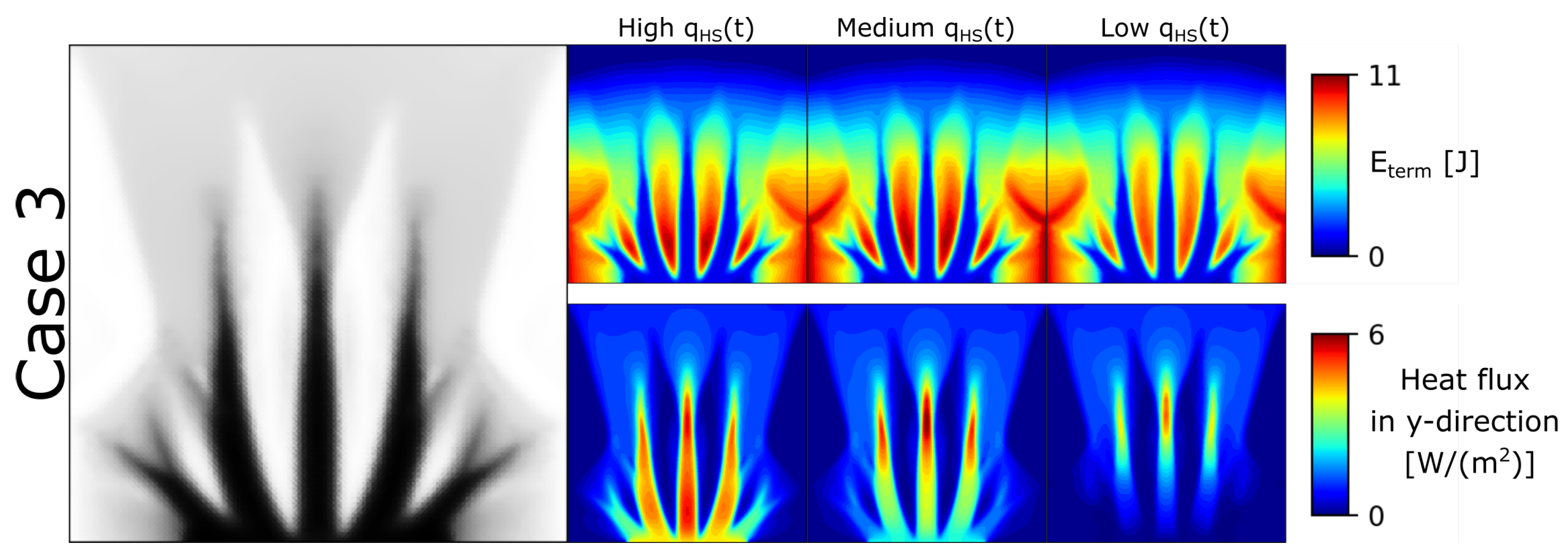
5.2.2. Thermal Energy and Heat Flux Fields
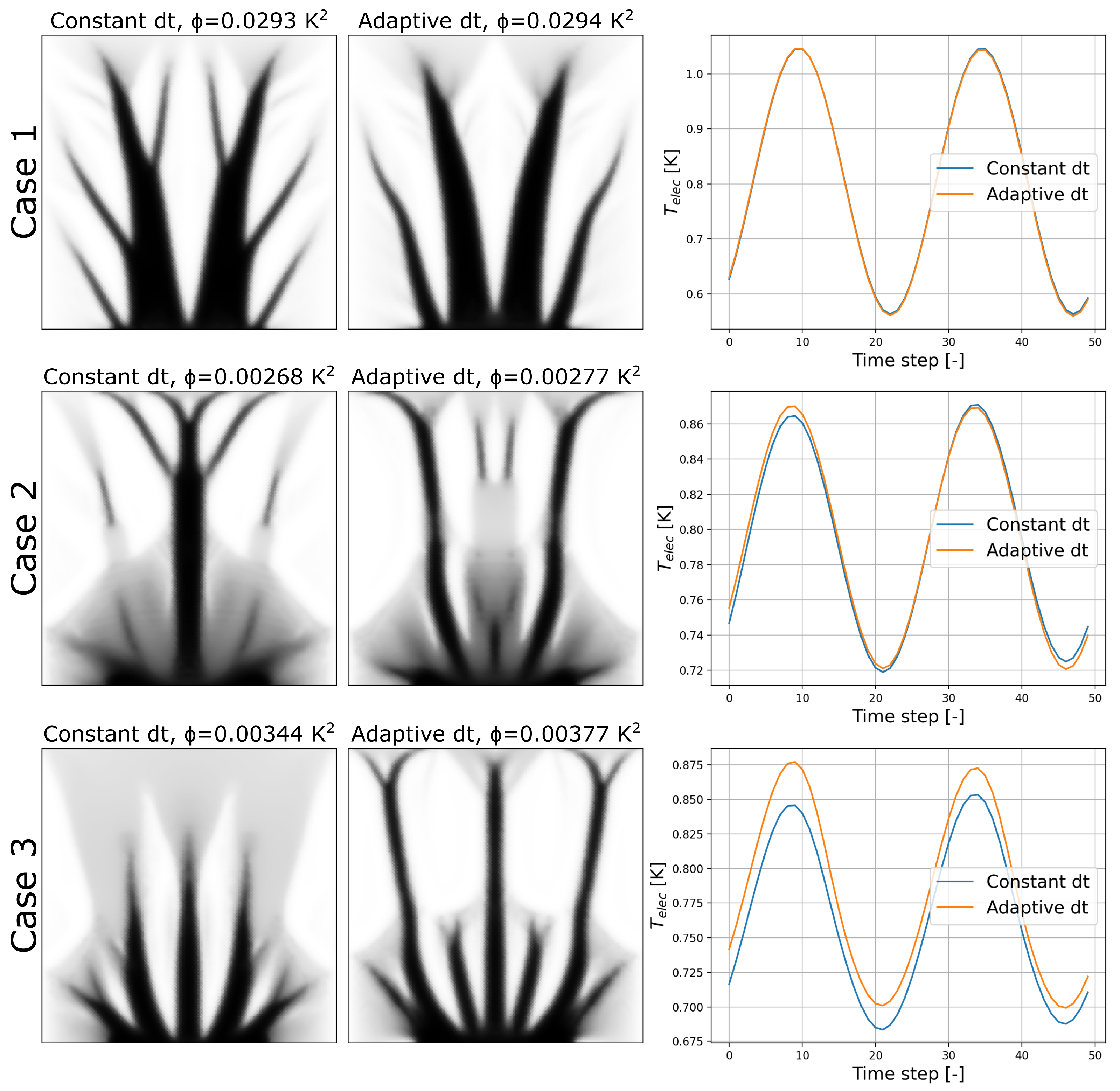
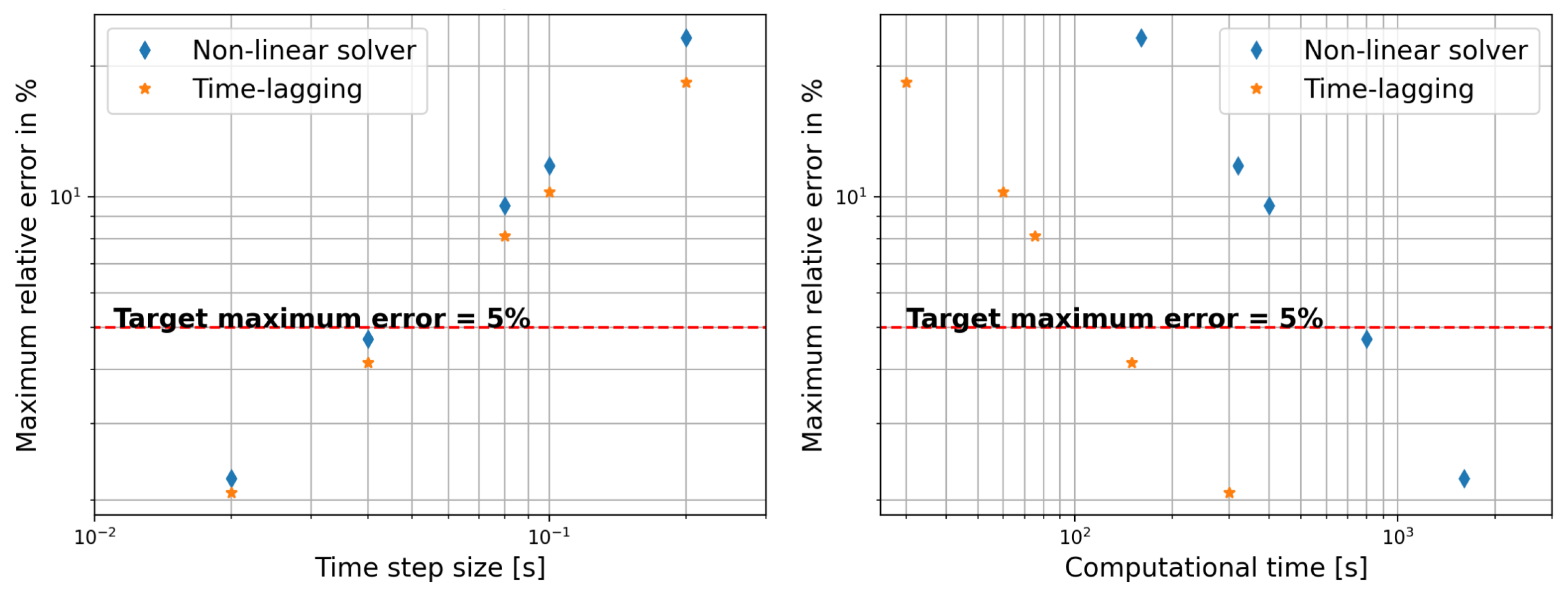
5.3. Varying Time Step Sizes
5.4. Effect of Forcing Discrete Designs
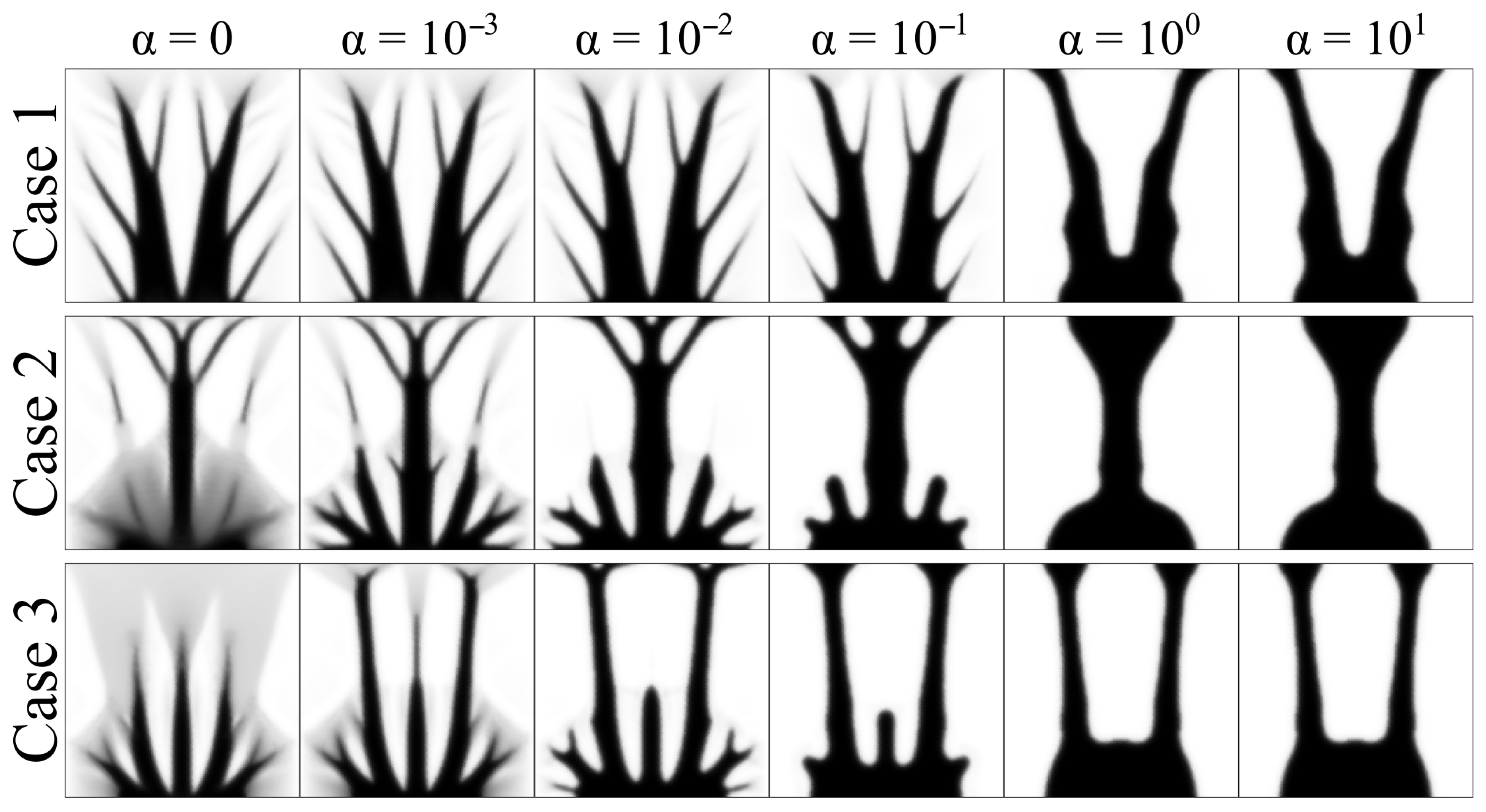
5.4.1. Explicit Penalisation
5.4.2. Optimised Designs and Performance
6. Discussion
7. Conclusions
Supplementary Materials
Author Contributions
Funding
Data Availability Statement
Acknowledgments
Conflicts of Interest
Appendix A. Simple Homogenisation-Based Parametrisation
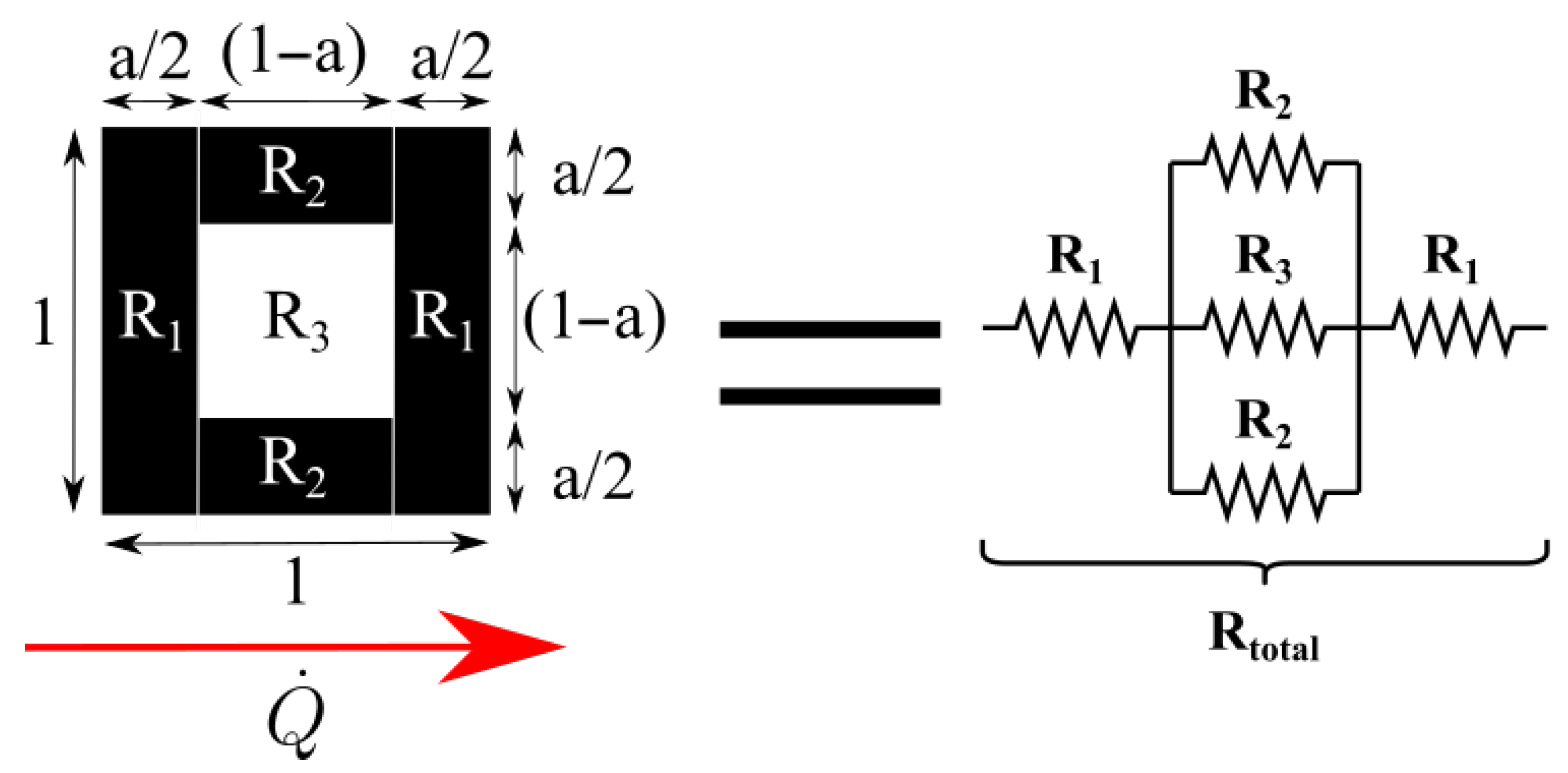
Appendix A.1. Derivation of kT(ρ)

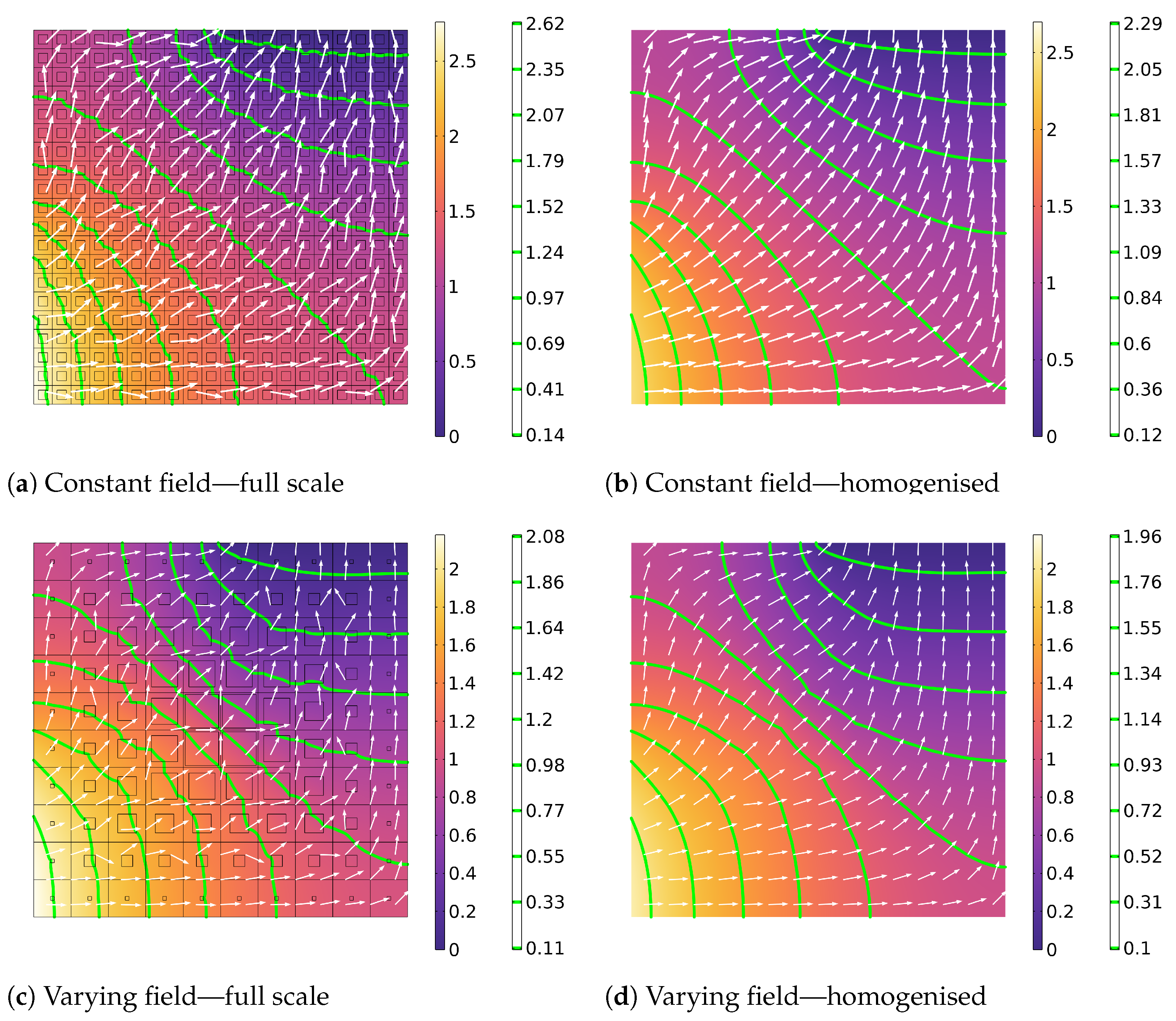
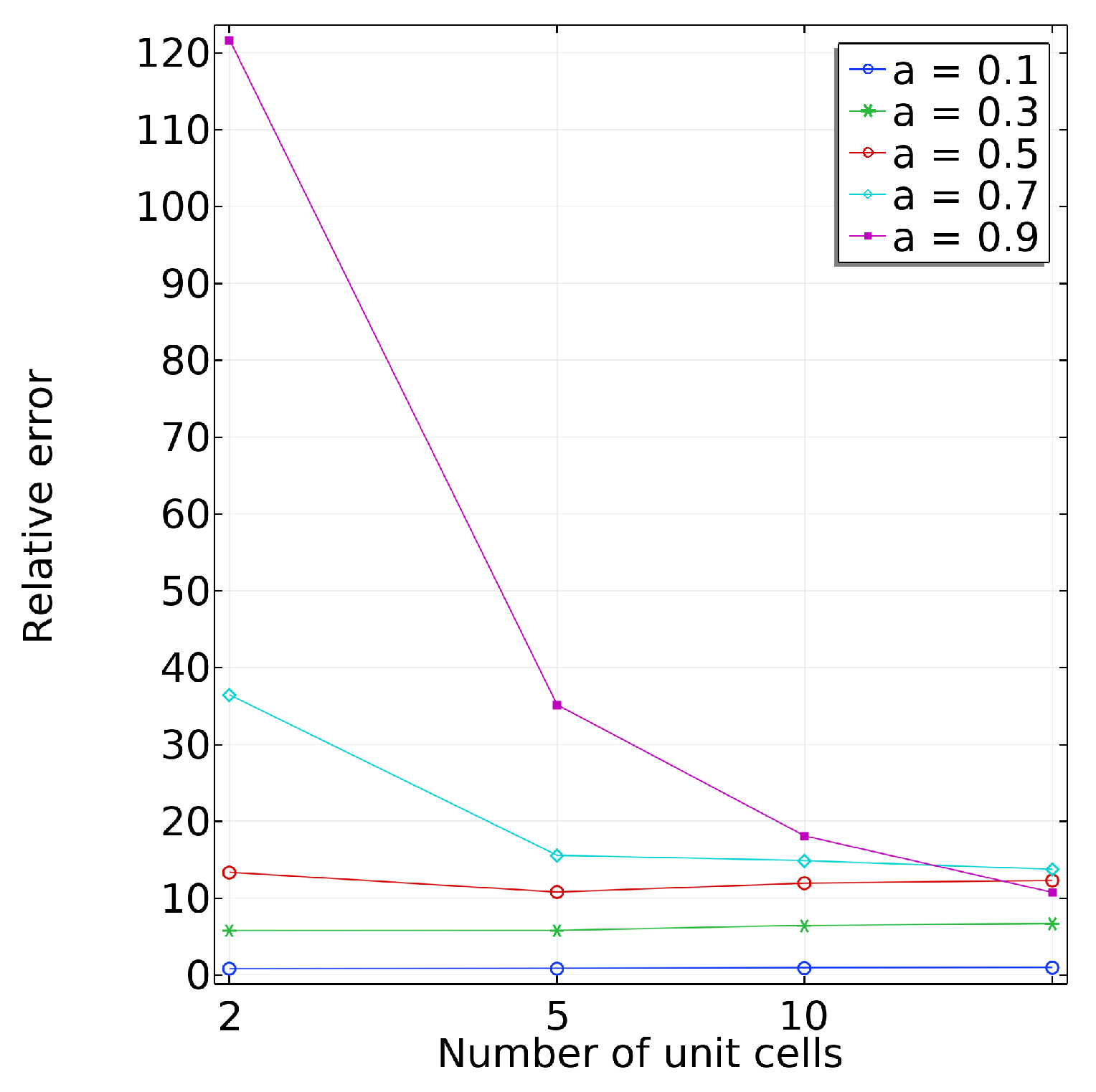
Appendix A.2. Verification of Homogenisation


Appendix B. Verification of Implementation
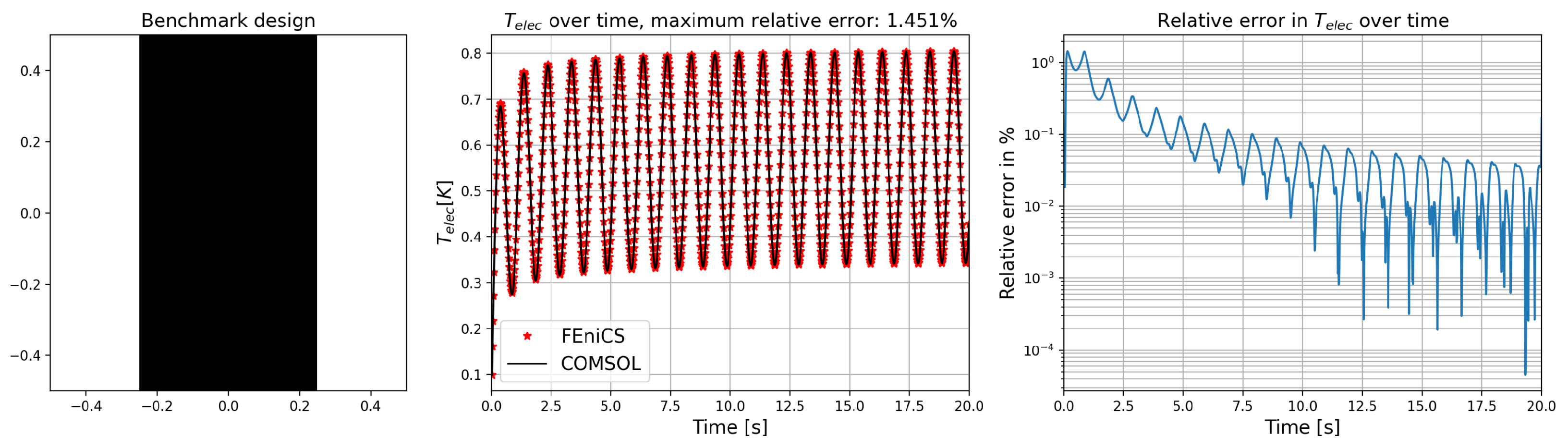
Appendix B.1. Comparison with COMSOL


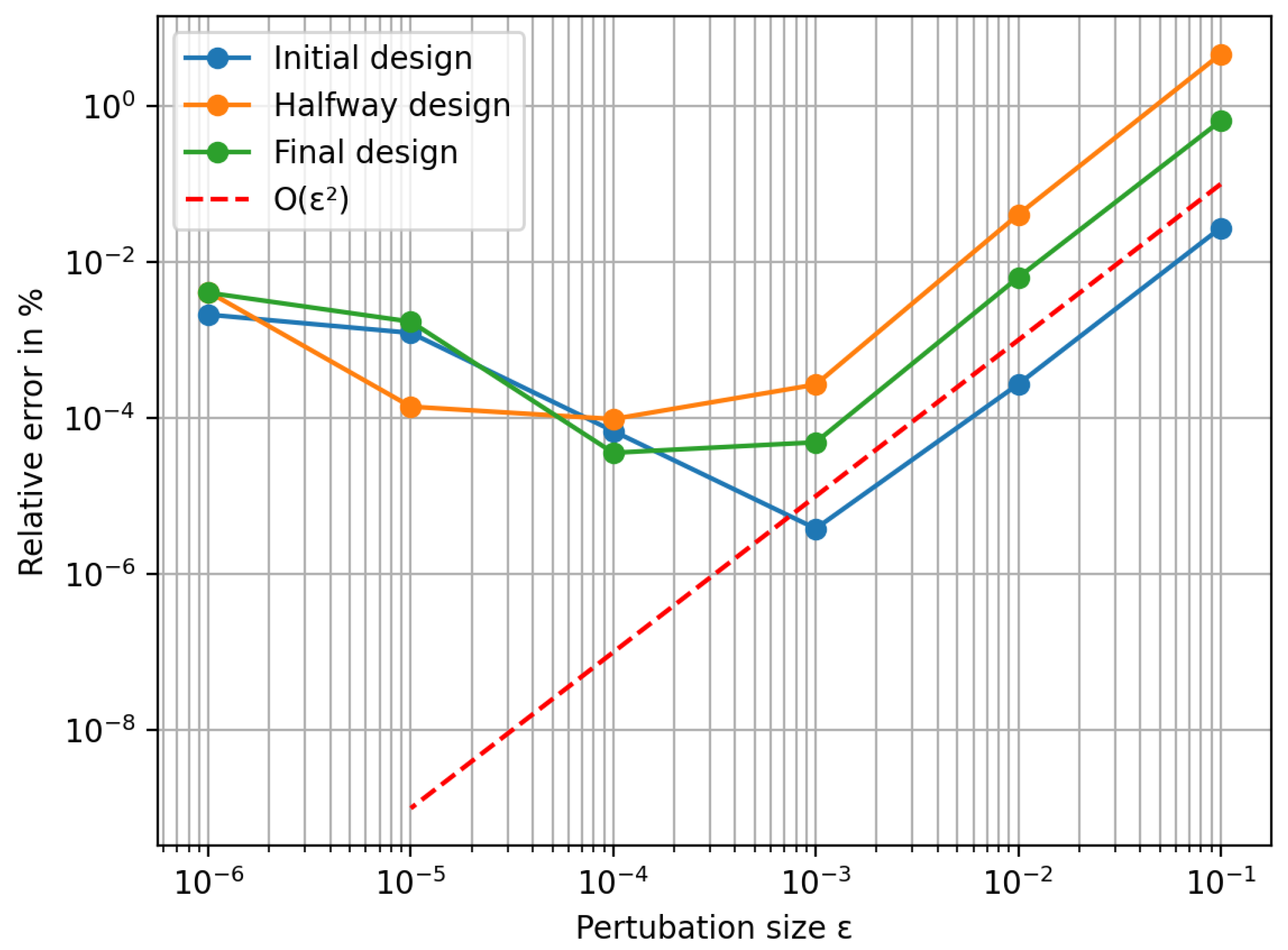
Appendix B.2. Finite Difference Check

References
- Depiver, J.a.; Mallik, S.; Harmanto, D. Solder joint failures under thermo-mechanical loading conditions—A review. Adv. Mater. Process. Technol. 2021, 7, 1–26. [Google Scholar] [CrossRef]
- Sahoo, S.K.; Das, M.K.; Rath, P. Application of TCE-PCM based heat sinks for cooling of electronic components: A review. Renew. Sustain. Energy Rev. 2016, 59, 550–582. [Google Scholar] [CrossRef]
- Kalbasi, R.; Afrand, M.; Alsarraf, J.; Tran, M.D. Studies on optimum fins number in PCM-based heat sinks. Energy 2019, 171, 1088–1099. [Google Scholar] [CrossRef]
- Guibert, A.T.R.; Bookwala, M.; Kim, H.A. Level-set topology optimization of heat sinks with phase-change material. Int. J. Heat Mass Transf. 2024, 231, 125818. [Google Scholar] [CrossRef]
- Guibert, A.T.; Bookwala, M.; Kim, A.A. Design of Electric Aircraft Battery Packs Embedded With Phase-Change Material via Level-Set Topology Optimization. In Proceedings of the AIAA SCITECH 2025 Forum, Orlando, FL, USA, 6–10 January 2025. [Google Scholar] [CrossRef]
- Hosseinizadeh, S.; Tan, F.; Moosania, S. Experimental and numerical studies on performance of PCM-based heat sink with different configurations of internal fins. Appl. Therm. Eng. 2011, 31, 3827–3838. [Google Scholar] [CrossRef]
- Dbouk, T. A review about the engineering design of optimal heat transfer systems using topology optimization. Appl. Therm. Eng. 2017, 112, 841–854. [Google Scholar] [CrossRef]
- Alexandersen, J.; Andreasen, C.S. A Review of Topology Optimisation for Fluid-Based Problems. Fluids 2020, 5, 29. [Google Scholar] [CrossRef]
- Fawaz, A.; Hua, Y.; Le Corre, S.; Fan, Y.; Luo, L. Topology optimization of heat exchangers: A review. Energy 2022, 252, 124053. [Google Scholar] [CrossRef]
- Varanasi, S.; Ananthasuresh, G.K. Analysis and Topology Optimization of Heat Sinks with a Phase- Change Material on COMSOL MultiphysicsTM Platform. In Proceedings of the COMSOL Users Conference 2006, Bangalore, India, 7 November 2006. [Google Scholar]
- Ho, J.; See, Y.; Leong, K.; Wong, T. An experimental investigation of a PCM-based heat sink enhanced with a topology-optimized tree-like structure. Energy Convers. Manag. 2021, 245, 114608. [Google Scholar] [CrossRef]
- See, Y.; Ho, J.; Leong, K.; Wong, T. Experimental investigation of a topology-optimized phase change heat sink optimized for natural convection. Appl. Energy 2022, 314, 118984. [Google Scholar] [CrossRef]
- Iradukunda, A.C.; Vargas, A.; Huitink, D.; Lohan, D. Transient thermal performance using phase change material integrated topology optimized heat sinks. Appl. Therm. Eng. 2020, 179, 115723. [Google Scholar] [CrossRef]
- Bianco, N.; Fragnito, A.; Iasiello, M.; Mauro, G.M. Design of PCM-based heat sinks through topology optimization. J. Phys. Conf. Ser. 2023, 2509, 012001. [Google Scholar] [CrossRef]
- Christensen, M.B.M.; Alexandersen, J. Topology optimisation of heat sinks embedded with phase-change material for minimising temperature oscillations. HAL, 2023; p. hal-04185641. Available online: https://hal.science/hal-04185641v1/ (accessed on 13 December 2025).
- Christensen, M.B.M.; Alexandersen, J. Online Resource, heatSinkPCM Code at GitHub. 2023. Available online: https://github.com/sdu-multiphysics/heatSinkPCM/ (accessed on 12 January 2026).
- Pizzolato, A.; Sharma, A.; Maute, K.; Sciacovelli, A.; Verda, V. Topology optimization for heat transfer enhancement in Latent Heat Thermal Energy Storage. Int. J. Heat Mass Transf. 2017, 113, 875–888. [Google Scholar] [CrossRef]
- Pizzolato, A.; Sharma, A.; Maute, K.; Sciacovelli, A.; Verda, V. Design of effective fins for fast PCM melting and solidification in shell-and-tube latent heat thermal energy storage through topology optimization. Appl. Energy 2017, 208, 210–227. [Google Scholar] [CrossRef]
- Pizzolato, A.; Sharma, A.; Ge, R.; Maute, K.; Verda, V.; Sciacovelli, A. Maximization of performance in multi-tube latent heat storage—Optimization of fins topology, effect of materials selection and flow arrangements. Energy 2020, 203, 114797. [Google Scholar] [CrossRef]
- Zhao, M.; Tian, Y.; Hu, M.; Zhang, F.; Yang, M. Topology optimization of fins for energy storage tank with phase change material. Numer. Heat Transf. Part A Appl. 2020, 77, 284–301. [Google Scholar] [CrossRef]
- Yao, Q.; Zhao, C.; Zhao, Y.; Wang, H.; Li, W. Topology optimization for heat transfer enhancement in latent heat storage. Int. J. Therm. Sci. 2021, 159, 106578. [Google Scholar] [CrossRef]
- Tian, Y.; Liu, X.; Xu, Q.; Luo, Q.; Zheng, H.; Song, C.; Zhu, Z.; Gao, K.; Dang, C.; Wang, H.; et al. Bionic topology optimization of fins for rapid latent heat thermal energy storage. Appl. Therm. Eng. 2021, 194, 117104. [Google Scholar] [CrossRef]
- Laasri, I.A.; Elmaazouzi, Z.; Outzourhit, A.; Mghazli, M.O. Investigation of different topology-optimized fin structures in a cylindrical latent heat thermal energy storage unit. Therm. Sci. Eng. Prog. 2022, 33, 101372. [Google Scholar] [CrossRef]
- Peremans, B.; Blommaert, M.; Baelmans, M. Topology optimization of a rectangular phase change material module. J. Energy Storage 2023, 70, 107891. [Google Scholar] [CrossRef]
- Zhang, X.; Yang, X.; Zhang, Y.; Xu, J.; Guo, X. Phase change heat transfer enhancement based on topology optimization of fin structure. Int. J. Heat Mass Transf. 2023, 214, 124402. [Google Scholar] [CrossRef]
- Alnæs, M.; Blechta, J.; Hake, J.; Johansson, A.; Kehlet, B.; Logg, A.; Richardson, C.; Ring, J.; Rognes, M.E.; Wells, G.N. The FEniCS Project Version 1.5. Arch. Numer. Softw. 2015, 3, 9–23. [Google Scholar] [CrossRef]
- Logg, A.; Mardal, K.A.; Wells, G. (Eds.) Automated Solution of Differential Equations by the Finite Element Method: The FEniCS Book; Lecture Notes in Computational Science and Engineering; Springer: Berlin/Heidelberg, Germany, 2012; Volume 84. [Google Scholar] [CrossRef]
- Laurain, A. A level set-based structural optimization code using FEniCS. Struct. Multidiscip. Optim. 2018, 58, 1311–1334. [Google Scholar] [CrossRef]
- Qian, X. Undercut and overhang angle control in topology optimization: A density gradient based integral approach. Int. J. Numer. Methods Eng. 2017, 111, 247–272. [Google Scholar] [CrossRef]
- Mezzadri, F.; Bouriakov, V.; Qian, X. Topology optimization of self-supporting support structures for additive manufacturing. Addit. Manuf. 2018, 21, 666–682. [Google Scholar] [CrossRef]
- Yan, J.; Xiang, R.; Kamensky, D.; Tolley, M.T.; Hwang, J.T. Topology optimization with automated derivative computation for multidisciplinary design problems. Struct. Multidiscip. Optim. 2022, 65, 151. [Google Scholar] [CrossRef]
- Jauregui, C.M.; Hyun, J.; Neofytou, A.; Gray, J.S.; Kim, H.A. Avoiding reinventing the wheel: Reusable open-source topology optimization software. Struct. Multidiscip. Optim. 2023, 66, 145. [Google Scholar] [CrossRef]
- Jia, Y.; Wang, C.; Zhang, X.S. FEniTop: A simple FEniCSx implementation for 2D and 3D topology optimization supporting parallel computing. Struct. Multidiscip. Optim. 2024, 67, 140. [Google Scholar] [CrossRef]
- Jegadheeswaran, S.; Pohekar, S.D. Performance enhancement in latent heat thermal storage system: A review. Renew. Sustain. Energy Rev. 2009, 13, 2225–2244. [Google Scholar] [CrossRef]
- Sigmund, O.; Petersson, J. Numerical instabilities in topology optimization: A survey on procedures dealing with checkerboards, mesh-dependencies and local minima. Struct. Optim. 1998, 16, 68–75. [Google Scholar] [CrossRef]
- Lazarov, B.S.; Wang, F.; Sigmund, O. Length scale and manufacturability in density-based topology optimization. Arch. Appl. Mech. 2016, 86, 189–218. [Google Scholar] [CrossRef]
- Lazarov, B.S.; Sigmund, O. Filters in topology optimization based on Helmholtz-type differential equations. Int. J. Numer. Methods Eng. 2011, 86, 765–781. [Google Scholar] [CrossRef]
- Michaleris, P.; Tortorelli, D.A.; Vidal, C.A. Tangent operators and design sensitivity formulations for transient non-linear coupled problems with applications to elastoplasticity. Int. J. Numer. Methods Eng. 1994, 37, 2471–2499. [Google Scholar] [CrossRef]
- Choi, K.K.; Kim, N.H. Structural Sensitivity Analysis and Optimization 1; Mechanical Engineering Series; Springer: New York, NY, USA, 2005. [Google Scholar] [CrossRef]
- Mitusch, S.; Funke, S.; Dokken, J. dolfin-adjoint 2018.1: Automated adjoints for FEniCS and Firedrake. J. Open Source Softw. 2019, 4, 1292. [Google Scholar] [CrossRef]
- Svanberg, K. A Class of Globally Convergent Optimization Methods Based on Conservative Convex Separable Approximations. SIAM J. Optim. 2002, 12, 555–573. [Google Scholar] [CrossRef]
- Deetman, A. GCMMA-MMA-Python. 2020. Available online: https://github.com/arjendeetman/GCMMA-MMA-Python (accessed on 3 October 2022).
- Hirschey, J.; Gluesenkamp, K.R.; Mallow, A.; Graham, S. Review of Inorganic Salt Hydrates with Phase Change Temperature in Range of 5 °C to 60 °C and Material Cost Comparison with Common Waxes. In Proceedings of the 5th International High Performance Buildings Conference at Purdue, West Lafayette, IN, USA, 9–12 July 2018. [Google Scholar]
- Kraiem, M.; Karkri, M.; Fois, M.; Sobolciak, P. Thermophysical Characterization of Paraffins versus Temperature for Thermal Energy Storage. Buildings 2023, 13, 877. [Google Scholar] [CrossRef]
- Sigmund, O. Morphology-based black and white filters for topology optimization. Struct. Multidiscip. Optim. 2007, 33, 401–424. [Google Scholar] [CrossRef]
- COMSOL Multiphysics, Version 6. Software for Multiphysics Simulation. COMSOL AB: Stockholm, Sweden, 2023.
- Haftka, R.T.; Gürdal, Z. Elements of Structural Optimization, 3rd revised and expanded ed.; Number v. 11 in Solid Mechanics and Its Applications; Kluwer Academic Publishers: Dordrecht, The Netherlands; Boston, MA, USA, 1992. [Google Scholar]



| Description | Symbol | Value | Units |
|---|---|---|---|
| Domain size | |||
| Mesh size | [-] | ||
| Final time | 20 | ||
| Number of time steps | 500 | [-] | |
| Time step size | 0.04 |
| Description | Symbol | Value | Units |
|---|---|---|---|
| Thermal conductivity HCM | 10 | ||
| Density HCM | 1 | ||
| Heat capacity HCM | 1 | ||
| Thermal conductivity PCM | 0.01 | ||
| Density PCM | 1 | ||
| Heat capacity PCM | 1 | ||
| Melting temperature | 0.5 | ||
| Melting temperature range | 0.5 | ||
| Latent heat of fusion | 10 |
| Description | Symbol | Value | Units |
|---|---|---|---|
| Heat transfer coefficient | 5 | ||
| Initial temperature | 0 | ||
| Surrounding temperature | 0 | ||
| Average heat rate from electronic component | 1 | ||
| Heat rate oscillation frequency | 1 | ||
| Maximum volume fraction of HCM | 0.3 | [-] | |
| Steepness factor for smooth Heaviside step function | 25 | [-] | |
| Filter parameter | r | 0.01 | [-] |
| Tested at | Optimised for | ||
|---|---|---|---|
| Case 1 | Case 2 | Case 3 | |
| Case 1 | 1 | 2.96 | 2.63 |
| Case 2 | 2.06 | 1 | 1.29 |
| Case 3 | 1.59 | 0.99 | 1 |
| Tested at | Optimised for | ||
|---|---|---|---|
| Case 1 | Case 2 | Case 3 | |
| Case 1 | 1 | 1.39 | 1.26 |
| Case 2 | 1.44 | 1 | 1.01 |
| Case 3 | 1.32 | 1.36 | 1 |
| Tested at | Optimised for | ||||||||
|---|---|---|---|---|---|---|---|---|---|
| Case 1 | Case 2 | Case 3 | Case 1 | Case 2 | Case 3 | Case 1 | Case 2 | Case 3 | |
| Case 1 | 1 | 1.39 | 1.26 | 1 | 2.02 | 1.61 | 1 | 1.48 | 1.05 |
| Case 2 | 1.44 | 1 | 1.01 | 1.01 | 1 | 0.93 | 0.70 | 1 | 0.71 |
| Case 3 | 1.32 | 1.36 | 1 | 1.02 | 1.35 | 1 | 1.12 | 1.52 | 1 |
Disclaimer/Publisher’s Note: The statements, opinions and data contained in all publications are solely those of the individual author(s) and contributor(s) and not of MDPI and/or the editor(s). MDPI and/or the editor(s) disclaim responsibility for any injury to people or property resulting from any ideas, methods, instructions or products referred to in the content. |
© 2026 by the authors. Licensee MDPI, Basel, Switzerland. This article is an open access article distributed under the terms and conditions of the Creative Commons Attribution (CC BY) license.
Share and Cite
Christensen, M.B.M.; Alexandersen, J. Topology Optimisation of Heat Sinks Embedded with Phase-Change Material for Minimising Temperature Oscillations. Computation 2026, 14, 23. https://doi.org/10.3390/computation14010023
Christensen MBM, Alexandersen J. Topology Optimisation of Heat Sinks Embedded with Phase-Change Material for Minimising Temperature Oscillations. Computation. 2026; 14(1):23. https://doi.org/10.3390/computation14010023
Chicago/Turabian StyleChristensen, Mark Bjerre Müller, and Joe Alexandersen. 2026. "Topology Optimisation of Heat Sinks Embedded with Phase-Change Material for Minimising Temperature Oscillations" Computation 14, no. 1: 23. https://doi.org/10.3390/computation14010023
APA StyleChristensen, M. B. M., & Alexandersen, J. (2026). Topology Optimisation of Heat Sinks Embedded with Phase-Change Material for Minimising Temperature Oscillations. Computation, 14(1), 23. https://doi.org/10.3390/computation14010023