Article

A Tripartite Feedback Framework for AI-Assisted Assessment of Complex Reports in Higher Education


by
Demetrios T. Venetsanos
Department of Aeronautics, Imperial College London, London SW7 2AZ, UK
AI Educ. 2026, 2(3), 26; https://doi.org/10.3390/aieduc2030026
Submission received: 26 May 2026 / Revised: 4 July 2026 / Accepted: 13 July 2026 / Published: 1 August 2026

Abstract

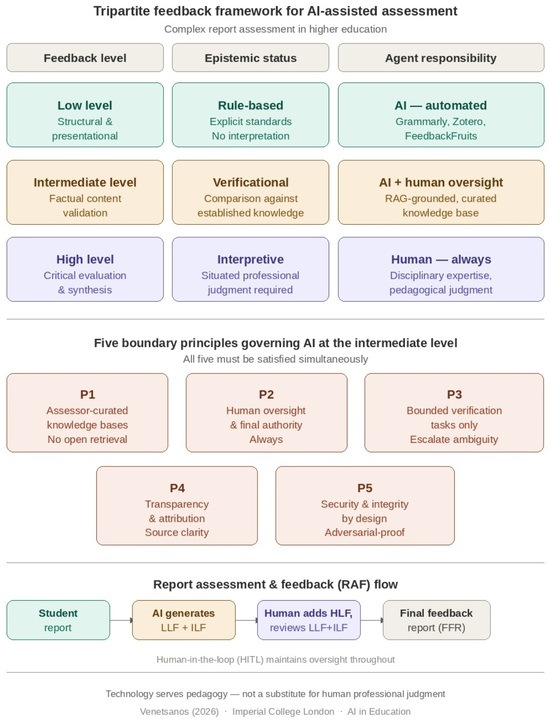
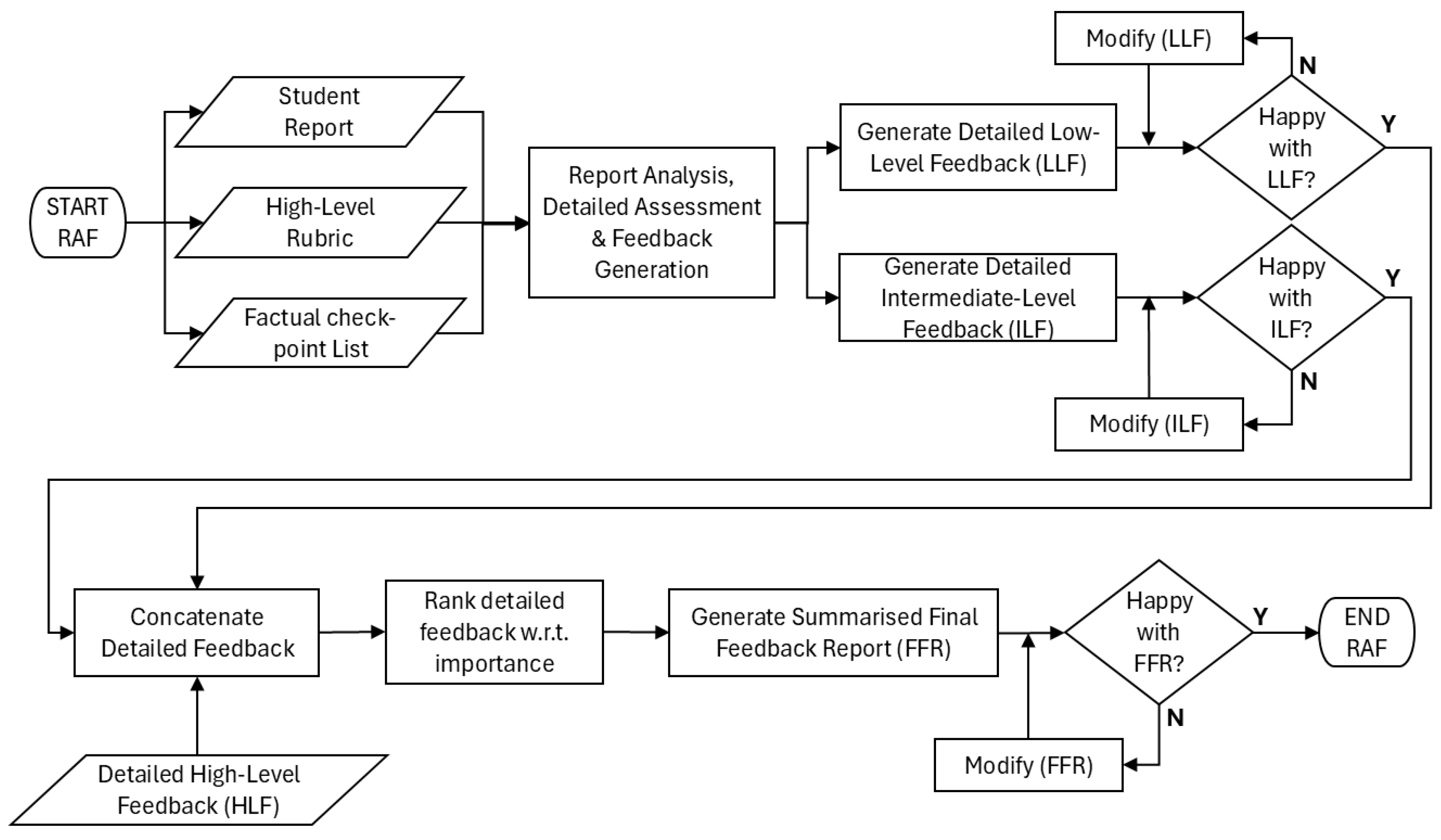
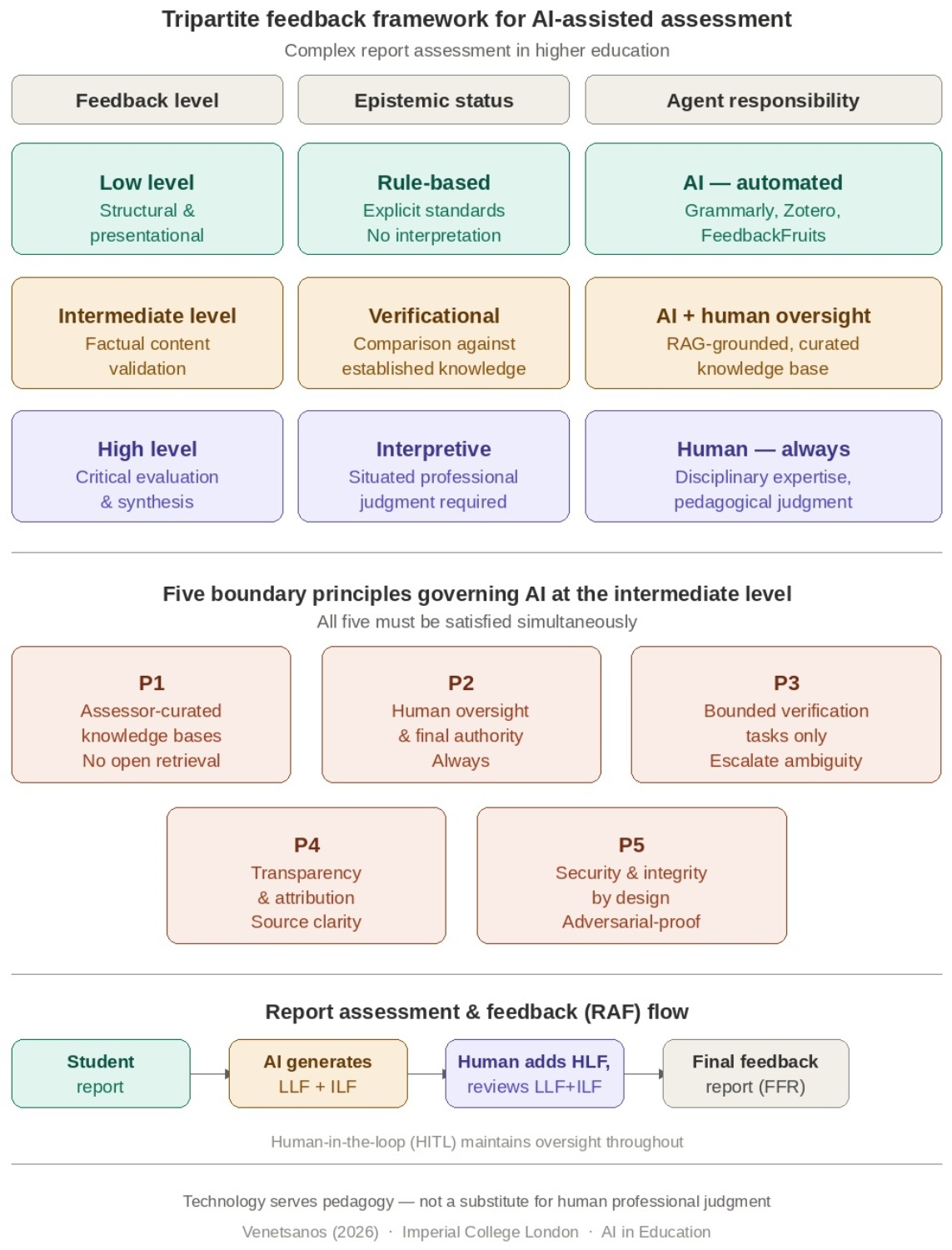
Assessment feedback on complex written reports remains one of the most persistent and resource-intensive challenges in higher education. However, no principled framework exists for deciding which feedback tasks might appropriately involve artificial intelligence and which must remain human responsibilities. This paper addresses that gap by proposing a tripartite feedback framework that distinguishes three analytically distinct levels: low-level structural and presentational feedback, intermediate-level factual content validation, and high-level critical evaluation and synthesis. Grounded in established feedback theory, including Hattie and Timperley’s feedback model and Boud and Molloy’s sustainable feedback design principles, the framework provides pedagogically justified criteria for allocating tasks between AI systems and human assessors, rather than automating whatever technology can technically perform. Five non-negotiable boundary principles govern any AI involvement at the intermediate level, preserving human oversight, academic accountability, and assessment integrity. This paper examines current technological capabilities and limitations at each level, proposes a phased implementation pathway with explicit human-in-the-loop requirements, and addresses implications for feedback literacy, student agency, equity, and security. A comprehensive mixed-methods evaluation design specifying the evidence required for empirical validation is also presented. The framework’s contribution lies not in prescriptive solutions but in providing structured categories, explicit boundary conditions, and validation criteria to guide context-sensitive institutional decision-making about AI integration in assessment.
Keywords: tripartite feedback framework; AI-assisted assessment; human-in-the-loop; feedback literacy; retrieval-augmented generation; higher education tripartite feedback framework; AI-assisted assessment; human-in-the-loop; feedback literacy; retrieval-augmented generation; higher education
Graphical Abstract