
Proceeding Paper

Search Space Reduction for Efficient Rupture Localization in Water Distribution Networks †
Civil and Environmental Engineering Department, Politecnico di Milano, 20133 Milan, Italy
*
Author to whom correspondence should be addressed.
Presented at the 6th International Conference on Efficient Water Systems (EWaS6), Thessaloniki, Greece, 11–14 May 2026.
Environ. Earth Sci. Proc. 2026, 44(1), 57; https://doi.org/10.3390/eesp2026044057
Published: 9 July 2026

Abstract

Leakage detection is a key challenge in water distribution systems, yet the reliability of numerical methods is often difficult to validate, as consistent field data before and after application are seldom available. To tackle this limitation, a reliable experimental and numerical platform is under development at Politecnico di Milano to validate advanced monitoring tools and methodologies: the E-NET benchmark network, a scaled (length scale 1:44) model of a widely used numerical benchmark case. An active monitoring strategy for new rupture localization is here applied to the numerical model of the E-NET. The method is further refined by applying a search-space reduction criterion based on sensor adjacency and distance, yielding results consistent with the original methodology while significantly reducing computational time. The combined numerical–experimental benchmark will allow quantitative validation of the methodology on a physical network under real transient conditions and support the assessment of the inherent limitations in current network models and optimization algorithms. These results mark a crucial step towards real network applicability.

1. Introduction

Water losses remain a major challenge in the management of water distribution networks (WDNs). Despite decades of research and increasingly sophisticated monitoring and optimization techniques, a significant gap persists between methodological developments and practical implementation [1]. Numerous leak localization approaches have been proposed, including sensitivity-based, inverse problems, Bayesian, fuzzy logic model-based, neural networks, and data-driven methods [2]. However, their validation typically relies on synthetic networks or incomplete field data, limiting robust performance assessment. To address this limitation, a combined experimental and numerical benchmark platform is currently under development at Politecnico di Milano: the E-NET system, a laboratory-scale implementation of the widely adopted Araujo (AJ) numerical benchmark network [3]. The platform is conceived to enable controlled leak generation, repeatable testing conditions, and systemic comparison between simulated and measured hydraulic responses.
Within this framework, an active monitoring strategy for the localization of newly occurring ruptures based on a pressure residual analysis is applied to the numerical model of the E-NET. The original approach developed for the AJ benchmark [4] is further refined through a search space reduction criterion aimed at improving computational efficiency. The methodology is applied consistently to both numerical models to evaluate its transferability and assess the effects of scaling assumptions and laboratory constraints. Ultimately, this study serves as a methodological basis for its experimental validation on the E-NET platform.

2. Materials and Methods

2.1. Burst Localization Method

The rupture localization method adopted in this study was originally developed for the AJ network and detailed in [4]. The approach assumes that each leak generates a distinctive pressure fingerprint across the network. In this study, the method was implemented through the EPANET-MATLAB (version Toolkit v2.2), interfaced with EPANET (version 2.2) and MATLAB (version R2024a).
New leak events are simulated in the network by adding fictitious nodes at the mid-length of the pipes and modeling leakage flow through an emitter equation. Pressure residuals are computed with respect to a reference baseline scenario [4] and organized into a signature matrix S , whose columns represent the expected hydraulic response for each potential leak location:
S = [ s i j ] R n s   × n p
s i j = p ^ i f j p ^ i 0
where p ^ i 0 is the pressure at node i for the base scenario; p ^ i f j is the pressure at node i   due to the leakage of entity f   at node j ; n p is the number of potential leakage positions (equal to the number of pipes); and n s is the number of installed sensors.
An unknown (“test”) leak event is simulated using random emitter coefficients in the range from 10−4 to 10−1; the corresponding residual vector is compared with the reference signature matrix through correlation analysis; and the leak is localized by selecting the candidate position associated with the maximum cumulative correlation. New leakages are simulated at all potential leak positions using different leakage magnitudes. For a given number of sensors, all possible sensor configurations are evaluated, and localization capacity is defined as the number of correctly identified leak positions. To account for realistic sensor accuracy, instrument resolution is incorporated directly into the simulated pressure data: three accuracy levels were considered (0.001, 0.01, and 0.1 bar, hereafter referred to as sens4, sens3, and sens2), representing typical measurement accuracies, together with an ideal reference case with no accuracy limitation (sens∞).

2.2. Search Space Reduction (SSR)

As the number of sensors increases, the number of possible sensor configurations grows combinatorially, leading to a significant computational burden even for small-sized networks such as AJ and E-NET. Therefore, a search space reduction (SSR) strategy is essential to ensure the applicability of the proposed methodology and its extension to larger networks. From a hydraulic perspective, not all configurations are equally informative. Spatially clustered layouts tend to generate highly correlated pressure signals, providing limited additional information while leaving other areas insufficiently monitored. Furthermore, early-stage simulations confirmed that higher-performing configurations consistently exhibited spatial dispersion. Accordingly, an SSR strategy based on node adjacency and proximity is introduced.
The analysis is limited to configurations with n s   <   N / 2 , where n s is the number of sensors and N is the number of nodes. This choice is motivated by both performance and operational considerations: localization performance increases rapidly from sparse deployments but tends to plateau once moderate network coverage is achieved, while installing sensors in more than half of the nodes would be unrealistic in practice.
The SSR is therefore defined as a proximity-filtered adjacency constraint.
Let V = { 1 , , N } denote the set of nodes and let C V be a sensor configuration such that C = n s . Let A be the network adjacency matrix, where A u v = 1 if nodes u and v are adjacent and 0 otherwise. A strict non-adjacency constraint would prevent sensor clustering but may be overly restrictive, as adjacent nodes connected by long pipes can belong to hydraulically distinct areas and provide non-redundant information. For this reason, pipe length is incorporated into the admissibility criterion. A minimum threshold is defined as
Lmin = τ Lmedian,
where τ is a dimensionless parameter and L median is the median pipe length of the network. The admissibility condition is thus formalized as
u , v   C ,   u v :         A u v = 0     o r   L u v L m i n
A sensor configuration is admissible only if any pair of selected nodes is either non-adjacent or, if adjacent, connected by a pipe with length greater than or equal to the prescribed threshold.

2.3. The E-NET Benchmark Platform

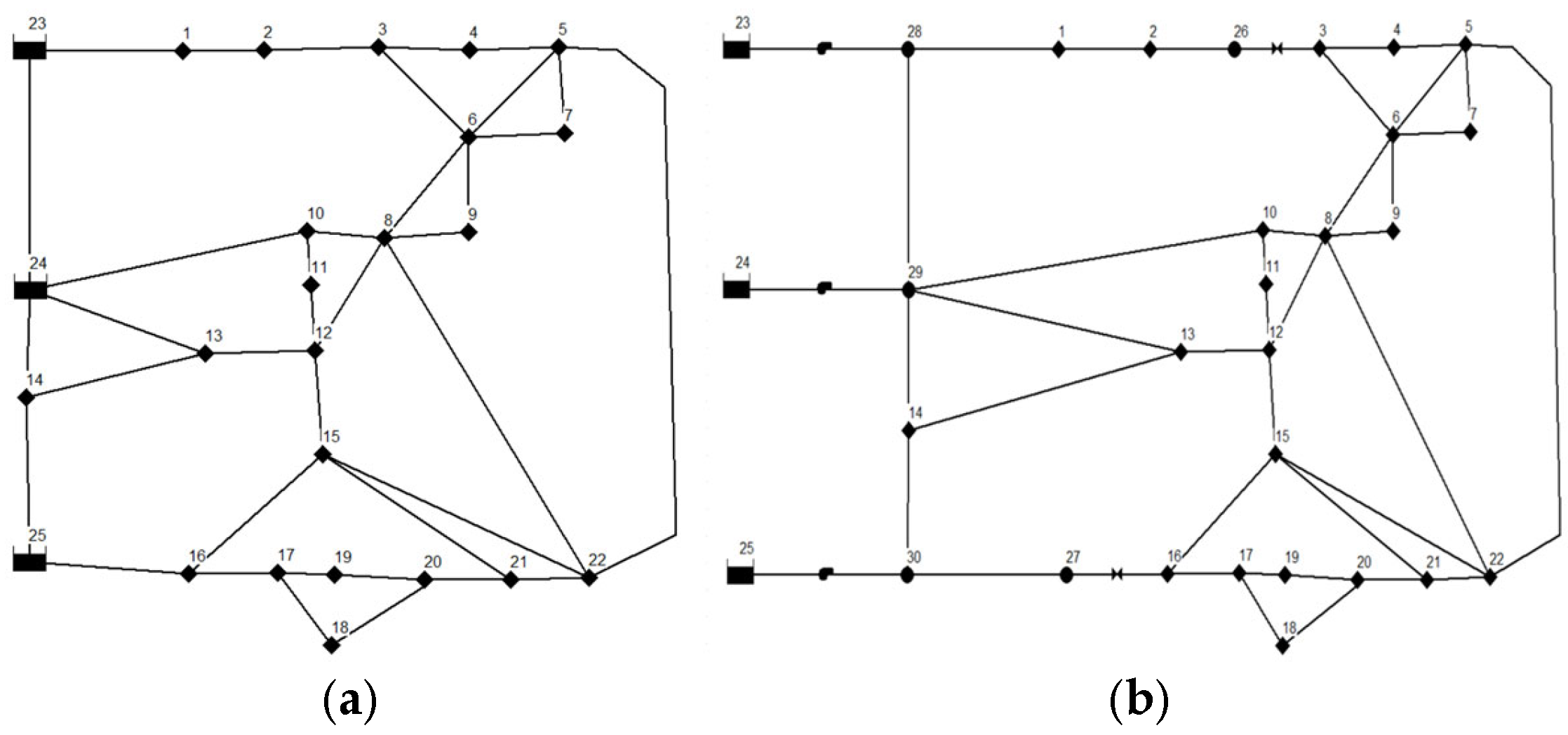
The E-NET system is a scaled (1:44) model of the widely adopted Araujo (AJ) benchmark network, developed by preserving the original topology while adapting it to laboratory constraints, namely uniform elevation and uniform roughness. The reservoirs of the original AJ network are replaced by pumping stations in the E-NET configuration. The layouts of the two networks considered in this study are shown in Figure 1. Comparative simulations confirm consistency with the original AJ network in terms of head losses and total head distribution, while differences in nodal pressures arise due to the absence of elevation variability [5]. Consequently, the E-NET model exhibits a more hydraulically homogeneous pressure field, which slightly alters the residual patterns generated by leaks. In this study, the E-NET configuration is used to test the optimized strategy originally developed for the AJ network, in order to assess the transferability of the proposed framework under scaled hydraulic conditions and to provide the basis for its subsequent validation within the experimental platform.

3. Results

3.1. Search Space Reduction (SSR)

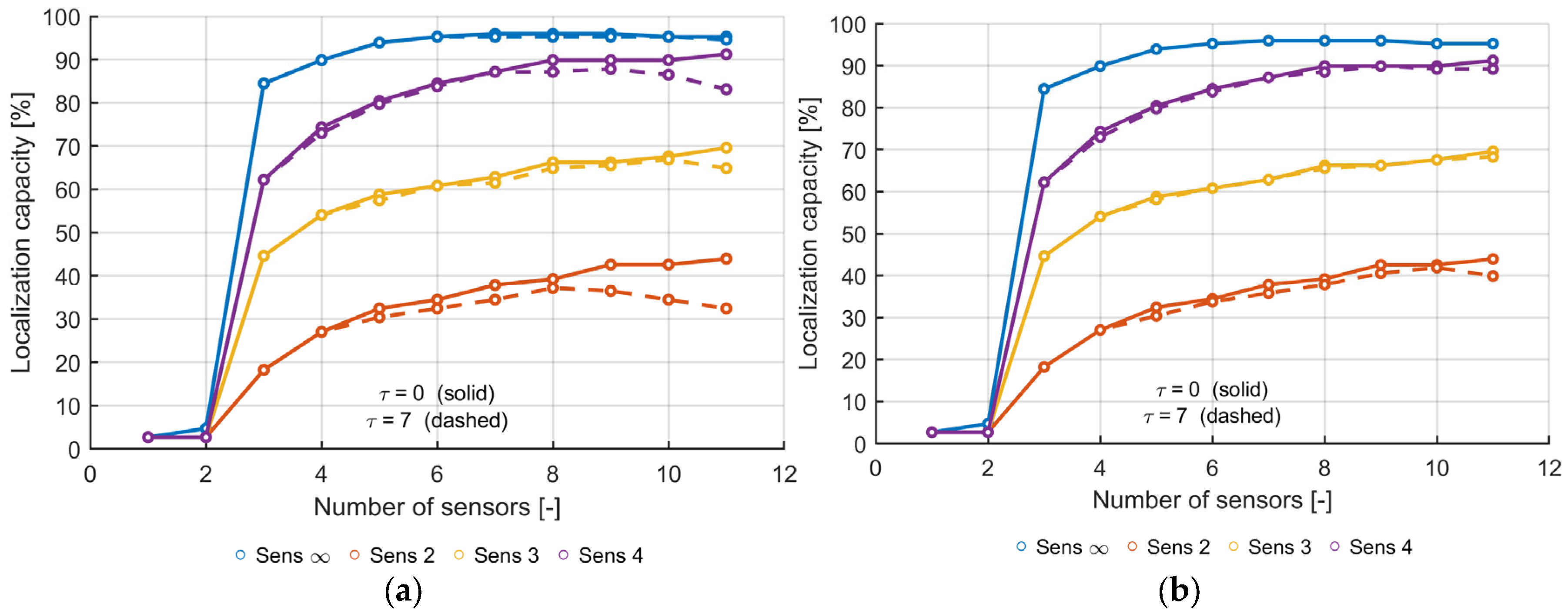
The search space reduction (SSR) is first evaluated by enforcing a strict non-adjacency condition, corresponding to a threshold exceeding the maximum pipe length Lmax (i.e., τ = 7). However, as shown in Figure 2a, localization capacity decreases compared to the full search case (τ = 0) as the number of sensors increases. The largest deviation occurs for the 10−1 sensitivity level (sens2) with 11 sensors, where performance is approximately 26% lower. This indicates that the strict criterion is overly restrictive at higher sensor densities, excluding hydraulically informative sensor configurations.
The SSR is then tested with τ = 1, adopting the median pipe length Lmedian as the threshold for hydraulic proximity. In this formulation, only sensor pairs connected by pipes shorter than Lmedian are considered redundant. This relaxed condition preserves combinations that are spatially close but hydraulically distinguishable. As illustrated in Figure 2b, the proximity criterion improves localization performance compared to the strict non-adjacency approach, which corresponds to τ = 7. The application of the SSR strategy leads to a substantial reduction in computational time. Table 1 reports the runtime computed considering the exhaustive evaluation of all simulations across all sensitivity levels for each SSR configuration.

3.2. Sensitivity Analysis on τ

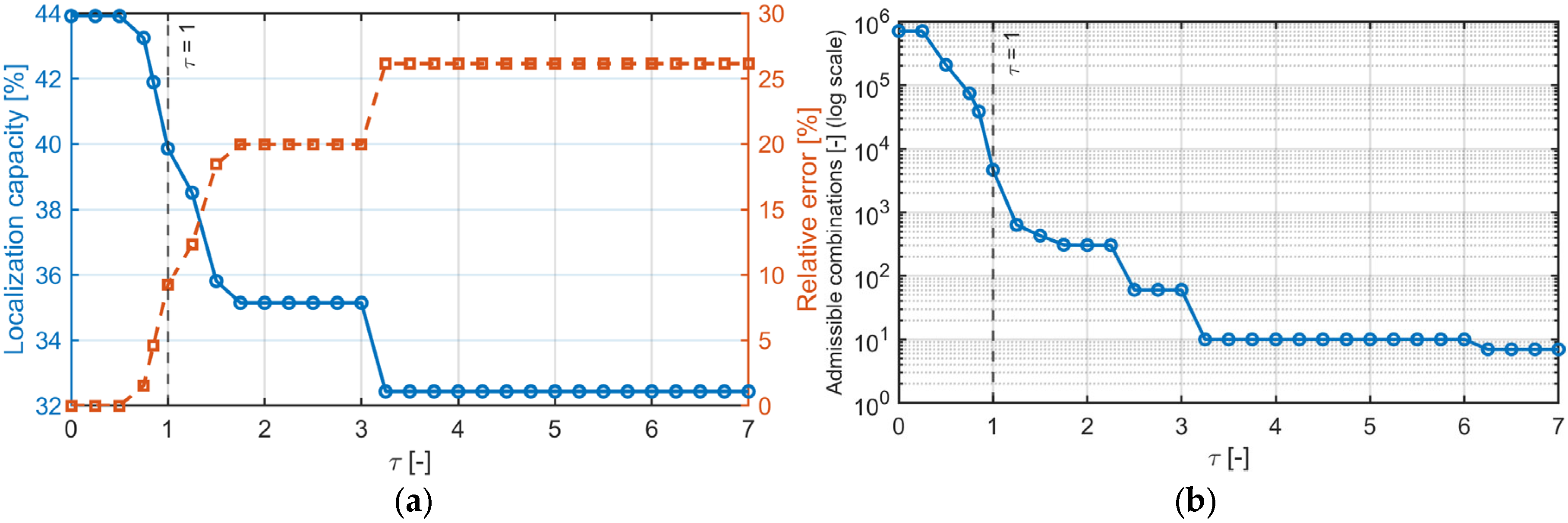
A sensitivity analysis is performed to assess the impact of the threshold parameter τ on localization performance and computational efficiency. The analysis focuses on the most penalizing configuration, namely the case with 11 sensors (highest computational burden) and the lowest instrument sensitivity level (10−2, sens2), which exhibits the largest performance gap between the full-search and SSR configurations.
As shown in Figure 3a, the localization capacity remains unchanged for low τ values (τ ≤ 0.5), maintaining a baseline performance of approximately 44%. For τ between 0.75 and 1, a moderate decrease is observed, with localization capacity reducing to about 39.9% at τ = 1 (≈9% relative reduction in localization capacity). Beyond this point, performance declines more markedly, stabilizing around 35% for τ ≥ 1.5 (≈20% reduction in localization capacity) and further decreasing to approximately 32.4% for τ ≥ 3.25 (≈26% loss).
Conversely, Figure 3b shows that the number of admissible sensor combinations drops dramatically as τ increases. At τ = 1, the search space is reduced by two orders of magnitude compared to the full-search case (from approximately 7 × 10⁵ to 4.6 × 10³ combinations). Therefore, τ = 1 represents a balanced trade-off under the most demanding configuration, where the reduction in localization capacity remains below 10%. For higher sensitivity levels, the performance gap is smaller, while computational gains remain comparable.

3.3. SSR on the E-NET

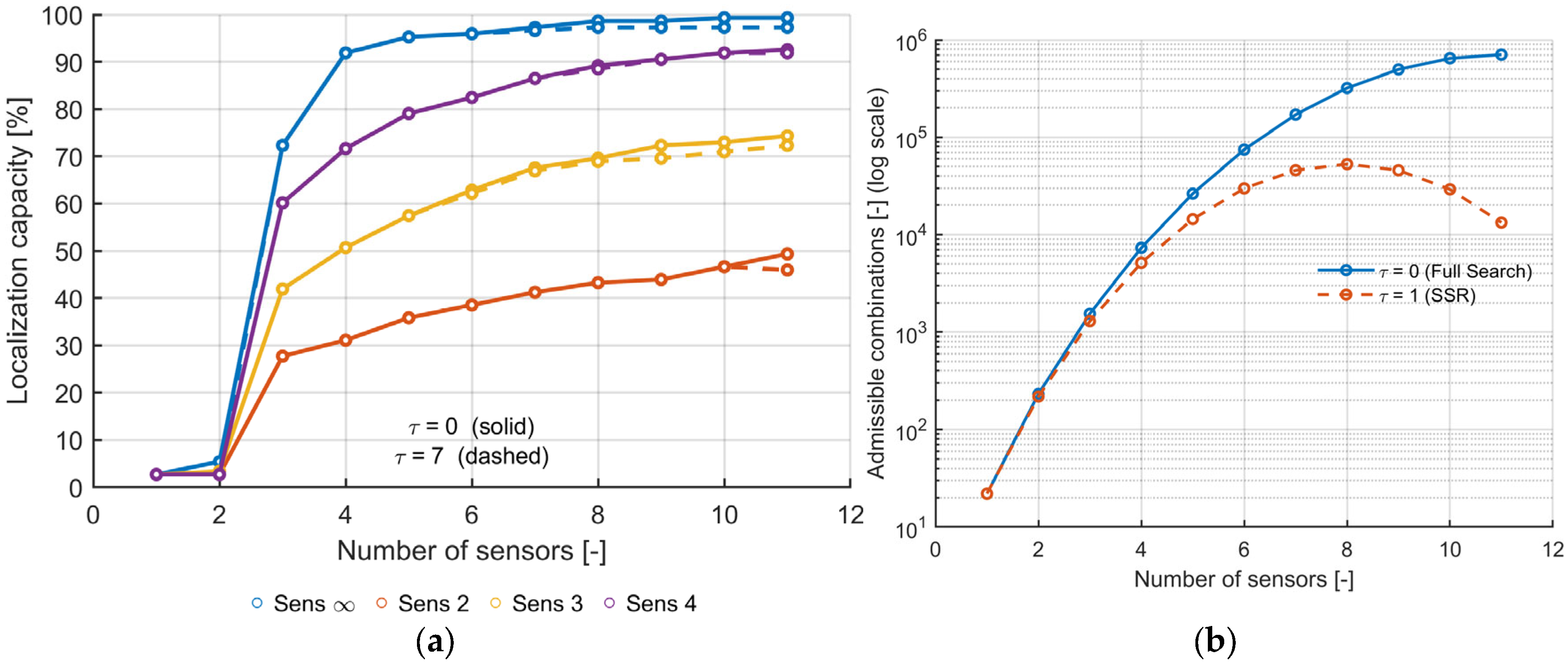
The SSR strategy is applied to the E-NET numerical model to assess its transferability to the scaled laboratory configuration. The analysis focuses on the proximity-based criterion with τ = 1, previously identified as the most balanced trade-off between computational efficiency and localization performance.
As shown in Figure 4a, the localization capacity obtained with τ = 1 remains close to the full-search case (τ = 0) across all considered sensor numbers and instrument accuracy levels. Figure 4b highlights the substantial reduction in the number of admissible configurations, significantly decreasing computational effort.
The results obtained on the E-NET model are consistent with those observed on the AJ benchmark. In particular, the proximity-based SSR criterion (τ = 1) produces a comparable reduction of approximately two orders of magnitude in the combinatorial search space, while preserving localization performance within similar margins.

4. Conclusions

This study presents the refinement and transfer of a rupture localization strategy within the framework of the AJ benchmark and its scaled laboratory counterpart, the E-NET platform. The methodology is optimized through a proximity-based search space reduction (SSR) strategy aimed at improving computational feasibility while preserving localization performance. The optimized framework is first assessed on the AJ network, where τ = 1 provided a balanced trade-off between performance and computational savings. It is then applied to the E-NET numerical model to evaluate its transferability under scaled hydraulic conditions. The proximity-based SSR criterion (τ = 1) produces a comparable reduction of approximately two orders of magnitude in the combinatorial search space, while preserving localization performance within similar margins.
Results confirm the robustness of the optimized strategy and further support its transferability to the scaled E-NET configuration. This represents a key step toward the practical applicability of rupture localization methodologies in large real water distribution systems and provides a methodological basis for future experimental validation on the physical E-NET platform.

Author Contributions

Conceptualization, S.M. and G.F.; methodology, S.G. and G.D.; software, G.D. and S.G.; validation, S.G., G.F. and S.M.; formal analysis, S.G.; investigation, G.D. and S.G.; resources, G.D. and S.G.; data curation, S.G.; writing—original draft preparation, S.G.; writing—review and editing, G.F. and S.M.; visualization, S.G.; supervision, G.F. and S.M.; project administration, G.F. and S.M.; funding acquisition, S.M. All authors have read and agreed to the published version of the manuscript.

Funding

The project was supported by MUSA—Multilayered Urban Sustainability Action—project, funded by the European Union—NextGenerationEU, under the National Recovery and Resilience Plan (NRRP) Mission 4 Component 2 Investment Line 1.5: Strengthening of research structures and creation of R&D “innovation ecosystems”, set up of “territorial leaders in R&D” (project code ECS 00000037).

Institutional Review Board Statement

Not applicable.

Informed Consent Statement

Not applicable.

Data Availability Statement

The data supporting the findings of this study are available from the corresponding author upon reasonable request.

Conflicts of Interest

The authors declare no conflicts of interest.

References

  1. Mutikanga, H.E.; Sharma, S.K.; Vairavamoorthy, K. Methods and Tools for Managing Losses in Water Distribution Systems. J. Water Resour. Plan. Manag. 2013, 139, 166–174. [Google Scholar] [CrossRef]
  2. Romero-Ben, L.; Alves, D.; Blesa, J.; Cembrano, G.; Puig, V.; Duviella, E. Leak detection and localization in water distribution networks: Review and perspective. Annu. Rev. Control 2023, 55, 392–419. [Google Scholar] [CrossRef]
  3. Araujo, L.S.; Ramos, H.; Coelho, S.T. Pressure Control for Leakage Minimisation in Water Distribution Systems Management. Water Resour. Manag. 2006, 20, 133–149. [Google Scholar] [CrossRef]
  4. Batzella, E.; Ferrarese, G.; Malavasi, S. Sensor Placement for Rupture Detection Using a Continuous Monitoring Strategy. Eng. Proc. 2024, 69, 91. [Google Scholar] [CrossRef]
  5. Malavasi, S.; Fathi, A.; Benzi, S.; Ferrarese, G. E-NET: Laboratory-Scale WDN Supporting Advanced Water Management Research. In Proceedings of the 21st International Computing & Control in the Water Industry Conference(CCWI 2025), Sheffield, UK, 1–3 September 2025. [Google Scholar]
  6. Jowitt, P.W.; Chengchao, X. Optimal Valve Control in Water-Distribution Networks. J. Water Resour. Plan. Manag. 1990, 116, 455–472. [Google Scholar] [CrossRef]
Figure 1. Layout of the water distribution networks considered in the study: (a) Araujo network reconstructed by the authors in EPANET based on the topological information available in Refs. [4,6] and (b) E-NET network, adapted from [5].
Eesp 44 00057 g001
Figure 2. Localization capacity as a function of the number of installed sensors under different search space reduction (SSR) thresholds. Solid lines represent the reference case without SSR (τ = 0), while dashed lines indicate the application of spatial constraints. (a) Strict non-adjacency criterion (τ = 7), where adjacent nodes are excluded from the same sensor configuration. (b) Proximity-based criterion (τ = 1), using the median pipe length as a hydraulic threshold.
Eesp 44 00057 g002
Figure 3. Sensitivity analysis of the SSR threshold τ for the configuration with 11 sensors and the lowest instrument sensitivity level (10−2). (a) Localization capacity (left axis, blue) and relative error (right axis, red) as a function of τ. (b) Number of admissible sensor combinations as a function of τ (logarithmic scale).
Eesp 44 00057 g003
Figure 4. Application of the search space reduction (SSR) strategy to the E-NET numerical model. (a) Localization capacity as a function of the number of installed sensors for the full-search case (τ = 0, solid line) and the proximity-based criterion (τ = 1, dashed line). (b) Number of admissible sensor configurations as a function of the number of installed sensors for τ = 0 (solid line), and τ = 1 (dashed line).
Eesp 44 00057 g004
Table 1. Computational performance under different search space reduction (SSR) thresholds.
SSR ThresholdRuntime 1 [min]Total Combinations [-]Runtime Reduction [%]SSR [%]
τ = 035359’799’468--
τ = 1242632’89293%94%
τ = 737102’33299%99%
1 Runtime and N. of combinations are computed considering the exhaustive evaluation of all simulations across all sensitivity levels for each SSR configuration.
Disclaimer/Publisher’s Note: The statements, opinions and data contained in all publications are solely those of the individual author(s) and contributor(s) and not of MDPI and/or the editor(s). MDPI and/or the editor(s) disclaim responsibility for any injury to people or property resulting from any ideas, methods, instructions or products referred to in the content.