1. Introduction
The stable 4-sphere of genus n is the connected sum Σ = Σ(n) of n copies of S
2 × S
2. The stable 4-sphere Σ(n) is canonically diffeomorphic to the double branched covering space S space S
4(F)
2 of S
4 branched along a trivial surface-knot F of genus n in S
4; see [
1]. Here, a
trivial surface-knot of genus
n in S
4 is a surface-knot bounding a handlebody of genus n smoothly embedded in S
4, whose pair (S
4, F) is called a
trivial surface-knot space of genus n. An
orthogonal basis of the stable 4-sphere Σ(n) is a pairwise basis (x
∗, x′
∗) = {(x
i, x′
i)| i = 1, 2, ..., n} of the second integral homology group H
2(Σ(n); Z) which is a free abelian group of rank 2n such that the intersection numbers in Σ(n) have Int(x
i, x
j) = Int(x
i, x′
j) = Int(x′
i, x
j) = Int(x′
i, x′
j) = 0 for all i, j except for that Int(x
i, x′
i) = Int(x’
i, x
i) = 1 for all i. Known as Wall‘s result, any two orthogonal bases of every stable 4-sphere Σ are transformed into each other by an orientation-preserving diffeomorphism Σ of the stable 4-sphere Σ, [
2]. The
standard O2-sphere basis of the stable 4-sphere Σ(n) is the 2-sphere pair system (S
2 × 1
*, 1 × S
2*) = {(S
2× 1
i, 1 × S
2i) | i = 1, 2, ..., n} in Σ(n). An
O2-sphere basis of Σ(n) is a 2-sphere pair system (S
∗, S’
∗) = {(S
i, S′
i)| i = 1, 2, ..., n} of Σ(n), sent to the standard O2-sphere basis (S
2 × 1
*, 1 × S
2*) by an orientation-preserving diffeomorphism of Σ(n), or equivalently, which can rewrite the stable 4-sphere Σ(n) as the connected sum of the genus one stable 4-spheres S
i × S’
i (i = 1, 2, ..., n). Wall’s result is essentially equivalent to saying that every orthogonal basis (x
∗, x’
∗) of Σ(n) is represented by an O2-sphere basis (S
∗, S’
∗) of Σ(n), i.e., x
i = [S
i] and x’
i = [S’
i] (i = 1, 2, ..., n), because any two O2-sphere bases of Σ are transformed into each other by an orientation-preserving diffeomorphism of Σ(n).
In this paper, another proof of Wall’s result is presented, strengthened in the sense that the diffeomorphism σ is taken to be the lift f′ of an equivalence f of (S
4, F) to the stable 4-sphere S
4(F)
2 = Σ(n). Here, an
equivalence of (S
4, F) is an orientation-preserving diffeomorphism of S
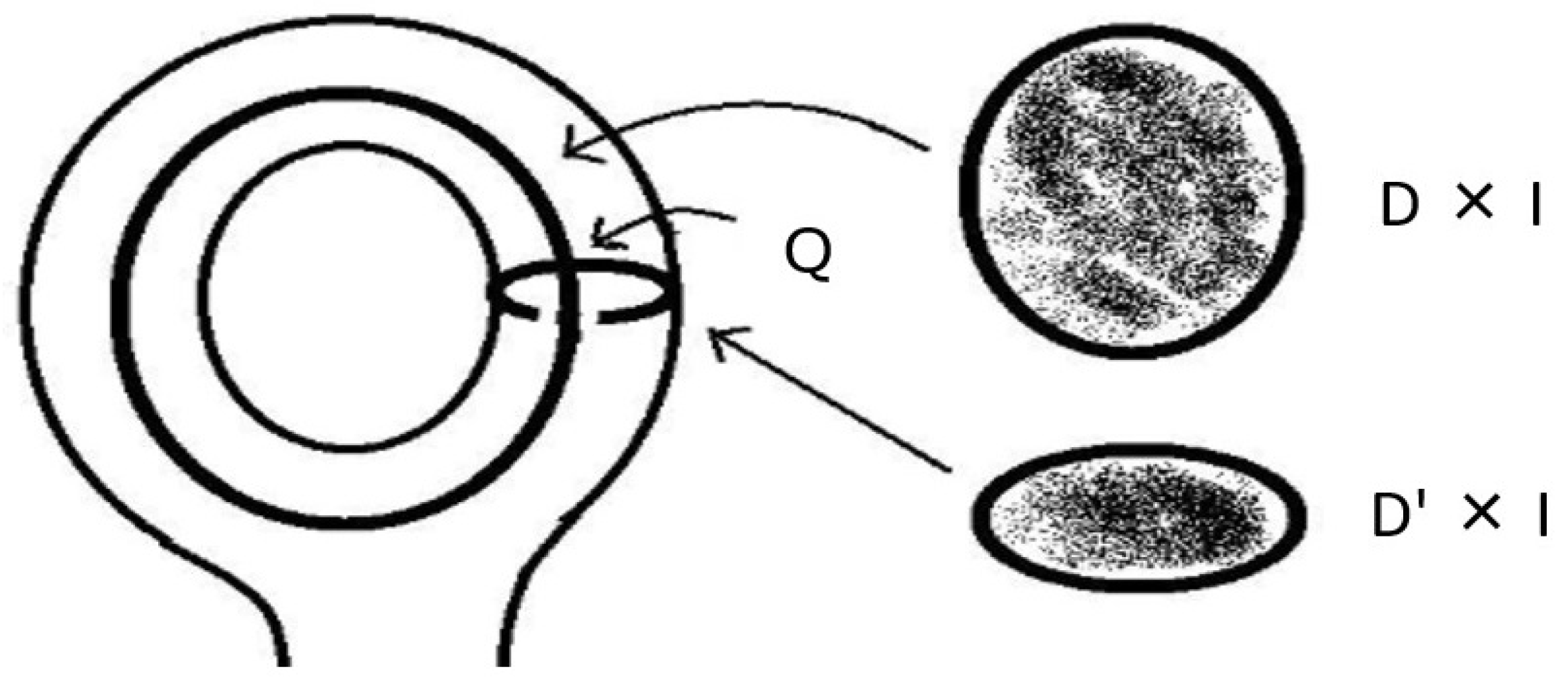
4 keeping the oriented trivial surface-knot F set-wise fixed. To state the main theorem (Theorem 1), the notion of an orthogonal 2-handle pair, or briefly an O2-handle pair on F, is needed. A
2-handle on a trivial surface-knot F is a 2-handle D × I on F smoothly embedded in S
4 such that (D × I) ∩ F = (∂D) × I for a closed interval I with 0 as the center, and D × 0 is called the
core disk of the 2-handle D × I and identified with D. An
orthogonal 2-handle pair, or briefly an
O2-handle pair on F in S
4, is a pair (D × I, D′ × I) of 2-handle D × I and D′ × I on F which meet F only with the attaching annuli (∂D) ×I and (∂D′) ×I so that the loops ∂D and ∂D′ meet transversely at just one point x
0, and the intersection (∂D) × I ∩ (∂D′) × I is diffeomorphic to the square Q = {x
0} ×I ×I; see
Figure 1, [
3]. For a trivial surface-knot F of genus n in S
4, an O2-handle basis of F is a system (D∗ × I, D′∗× I) of mutually disjoint O2-handle pairs (Di × I, D′
i× I) (i = 1, 2, ..., n) on F in S
4. Let p: Σ(n) = S
4(F)
2 → S
4 be the double branched covering projection branched along F, and α the nontrivial covering involution of S
4(F)
2. The preimage p
−1(F) of F is the fixed-point set of α, diffeomorphic to F and written by the same notation as F. For every O2-handle basis (D∗ × I, D′∗× I) on F in S
4, the O2-sphere basis (S(D
∗), S(D′
∗)) in Σ(n) is constructed so that S(D
i) = D
i ∪ αD
i and S(D′
i) = D′
i ∪ αD′
i (i = 1, 2, ..., n) are the preimages of the disks D
i and D′
i (i = 1, 2, ..., n) in S
4 by the double branched covering projection p, respectively, [
1]. The orientations of S(D
i) and S(D′
i) are taken with the orientations of D
i and D′
i and the opposite orientations of αD
i and αD′
i, respectively. The main theorem (Theorem 1) is stated as follows.
Theorem 1.
Every stable 4-sphere Σ(n) is the double branched covering space S4(F)2 of S4 branched along a trivial surface-knot F of genus n. Every orthogonal basis (x∗, x′∗) of Σ(n) is represented by an O2-sphere basis (S(E∗x), S(E′∗x)) of Σ(n) constructed from an O2-handle basis (E∗x × I, E′∗x × I) on F in S4. For any two orthogonal bases (x∗, x′∗) and (y∗, y′∗) of Σ(n), there are O2-handle bases (E∗x × I, E′∗x × I) and (E∗y × I, E′∗y × I) on F in S4 which are transformed into each other by an equivalence f of (S4, F) so that (x∗, x′∗) and (y∗, y′∗) are represented by the O2-sphere bases (S(E∗x), S(E′∗x)) and (S(E∗y), S(E′∗y)), respectively, which are transformed into each other by the lift f’ of f to S4(F)2 = Σ(n).
A key to showing Theorem 1 is the following lemma.
Lemma 1 (Key Lemma).
For every orthogonal basis (x∗, x′∗) of the stable 4-sphere Σ (n), there is an O2-handle basis (E∗ × I, E′∗ × I) on a trivial surface-knot F of genus n in S4 with Σ(n) =S4(F)2 such that (x∗, x′∗) is represented by the O2-sphere basis (S(E∗), S(E′∗)) of Σ(n).
A loop basis of F is a pair system (e
∗, e′
∗) of oriented simple loop pairs (e
i, e′
i) (i = 1, 2, ..., n) on F which represents a basis for H
1(F; Z) such that e
i ∩ e
j = e′
I ∩ e′
j = e
i ∩ e′
j = ∅ for all distinct i, and j and e
i ∩ e′
i are one point with the intersection number Int(e
i, e′
i) = +1 in F for all i. Every oriented loop c on F bounds an immersed surface C in S
4 with C ∩ F = c. The map q: H
1(F; Z) → Z
2 sending the homology class [c] in H
1(F; Z) to the Z
2-self-intersection number of C in S
4 with respect to the F-framing is called the Z
2-quadratic function associated with the surface-knot F in S
4. The identity q(x + y) = q(x) + q(y)+ Int
F(x, y)
2 for all x, y in H
1(F;Z) is used for calculation, where Int
F(x, y)
2 denotes the Z
2 -intersection number of x and y in F. A simple loop basis (e
∗, e′
∗) of F is
spin if q(e
i) = q(e′
i) = 0 for all i. The loop pair system (∂D
∗, ∂D′
∗) for any O2-handle basis (D
∗ × I, D′
∗ × I) on F is a spin loop basis of F. Every handlebody smoothly embedded in S
4 is smoothly isotopic to a standard handlebody in the equatorial 3-sphere S
3 of S
4. Thus, a trivial surface-knot F in S
4 may be taken in the standard position in S
3, where a standard O2-handle basis and a standard spin loop basis on F are taken. Any two spin loop bases on F are transformed into each other by an equivalence of (S
4, F), [
3] ((2.5.1), (2.5.2)), [
4]. Hence every spin loop basis on F bounds the core disk pair system of an O2-handle basis on F. The core disk pair systems of any two O2-handle bases on F bounded by the same loop basis are transformed into each other by an equivalence of (S
4, F), [
5]. Under these preliminaries, the proof of Theorem 1 assuming Lemma 1 is done as follows.
Proof of Theorem 1 assuming Lemma 1.
The first claim is shown, [1]. The second claim is shown by Lemma 1. If the third claim is proven, then the conclusion will be shown. By Lemma 1, let x
i = [S(E
ix)], x′
i = [S(E′
ix)] and y
i = [S(E
iy)], y′
i = [S(E′
iy)] for O2-handle bases (E
∗x × I, E′
∗x × I) and (E
∗y × I, E′
∗y × I) on a trivial surface-knot F of genus n in S
4. Then there is an equivalence g
0 of (S
4, F) sending the spin loop basis (∂E
∗x, ∂E′
∗x) of F to the spin loop basis (∂E
∗y, ∂E′
∗y) of F, [
3,
4]. For the O2-handle bases (g
0E
∗x × I, g
0E′
∗x × I) and (E
∗y × I, E′
∗y × I) on F with the same attaching part in F, there is an equivalence g of (S
4, F) such that (gg
0E
∗x × I, gg
0E′
∗x × I) = (E
∗y × I, E′
∗y × I), [
5]. The composite equivalence f = gg
0 of (S
4, F) lifts to a diffeomorphism f′ of Σ (n)= S
4(F)
2 sending the O2-sphere basis (S(E
∗x), S(E′
∗x)) to the O2-sphere basis (S(E
∗y), S(E′
∗y)) and hence sending (x
i, x′
i) = ([S(E
ix)], [S(E′
ix)]) to (y
i, y′
i) = ([S(E
iy)], [S(E′
iy)]) for all i. This completes the proof of Theorem 1 assuming Lemma 1. □
Theorem 1 is a revised version of an incorrect claim [6] (Lemma 3.1) that was originally intended for use in the paper [1], which was written instead by using Wall’s result [2]. The proof of Key Lemma (Lemma 2) is done in
Section 2. Two applications of Theorem 1 are done in
Section 3 and
Section 4. In
Section 3, it is shown that every orientation-preserving diffeomorphism of Σ is nothing but the lift of an equivalence of a trivial surface-knot space (S
4, F) to the double branched covering space Σ = S
4(F)
2 up to a smooth isotopy and a composition of an identity-shift. In
Section 4, a TOP version of Theorem 1 is done for every TOP stable 4-sphere of genus n (i.e., topological 4-manifold homeomorphic to the stable 4-space of genus n). Here, even if it is a smooth 4-manifold, unless it is diffeomorphic to the stable 4-sphere of genus n, the TOP trivial surface-knot space cannot be smooth.
2. Proof of Key Lemma (Lemma 1)
For a disk D, let D
o = D \ ∂D. The following lemma gives basic information on the intersection numbers of the lifting O2-sphere bases of two O2-handle bases of F in S
4, which corrects a computation error of [
6] (Lemma 3.1).
Lemma 2.
For an O2-handle basis (D∗× I, D′∗× I) on a trivial surface-knot F of genus n in S4, let (k∗, k′∗) = (∂D∗, ∂D′∗) be the spin loop basis of F. For a 2-handle E × I on F in S4, assume that the homology class [e] of the simple loop e = ∂E in F is given by the intersection numbers Int([e],[k’j]) = sj and Int([e],[kj]) = s’j in F for some integers sj, s′j (j = 1, 2, ..., n). Then the homology class [S(E)] in Σ is written as [S(E)] = Σnj = 1 (sj + 2mj) [S(Dj)] + Σnj = 1 (s′j + 2m′j) [S(D′j)], where mj and m′j are integers given by the intersection numbers Int (Eo, D′jo) and Int (Eo, Djo) in S4, respectively.
Proof of Lemma 2.
Let N(F)c = cl(S4 \N(F)) for a regular neighborhood N(F) of F in S4. Consider that the disk Ee = E ∩ N(F)c transversely meets the disks Dje = Dj ∩ N(F)c and D′je = D′j ∩ N(F)c with the intersection points Eo ∩ Djo and Eo ∩ D′jo for all i, respectively. The intersection number of the lift of Ee and the lift of Dje to S4(F)2 = Σ is equal to Int(Ee, Dje) + Int(αEe, αDje) = 2 Int(Ee, Dje) = 2 Int(Eo, Djo) = 2m′j. Similarly, the intersection number between the lift of Ee and the lift of D′je to S4(F)2 = Σ is equal to Int(Ee,D′je) + Int(αEe, αD′je) = 2 Int(Ee, D′je) = 2 Int(Eo, D′jo) = 2mj. By using the intersection numbers Int([e],[kj]) = s’j, Int([e],[k’j]) = sj in F and examining the geometric intersections between the lift of E ∩ N(F) and the lifts of Dj ∩ N(F), D′j ∩ N(F) to S4(F)2 = Σ, the identities Int([S(E)],[S(Dj)]) = s′j + 2m′j, Int([S(E)],[S(D′j)]) = sj + 2mj are obtained. Since ([S(D*)],[S(D′*)]) is an orthogonal basis of Σ, the desired identity is obtained. This completes the proof of Lemma 2. □
By using Lemma 2, the following lemma is obtained.
Lemma 3.
For every orthogonal basis (x∗, x′∗) of Σ, there is an O2-handle basis (E∗× I, E′∗× I) on the trivial surface-knot F of genus n in S4 such that xi = [S(Ei)] + 2Ai + 2A′i, x′i = [S(E′i)] + 2Bi + 2B′i for all i, where Ai= Σnj = 1 aij[S(Ej)], A′i= Σnj = 1 a′ij[S(E′j)], Bi= Σnj = 1 bij[S(Ej)], and B′i = Σnj = 1 b′ij[S(E′j)] with some integers aij, a′ij, bij, b′ij for all i, j.
Proof of Lemma 3.
For an O2-handle basis (D∗ × I, D′∗× I) on a trivial surface-knot F of genus n in S4, write xi and x′i as integral linear combinations of the homology classes on [S(D∗)] and [S(D′∗)] such that xi = Σnj = 1 cij [S(Dj)] + Σnj = 1 c′ij [S(D′j)], x′i = Σnj = 1 dij [S(Dj)] + Σnj = 1 d′ij [S(D′j)] for all i. Since (x∗, x′∗) and ([S(D*)],[S(D′*)]) are orthogonal bases of Σ, the identities Σnj = 1 cijc′ij = Σnj = 1 dijd′ij = 0, Σnj = 1 (cijd′ij + c′ijdij) = 1 hold for all i. Let (k∗, k′∗) = (∂D∗, ∂D′∗) be a spin loop basis of F. Then there is a spin loop basis (ℓ∗, ℓ′∗) on F such that [ℓi] = Σnj = 1 cij [kj] + Σnj = 1 c′ij [k′j], [ℓ′i] = −Σnj = 1 dij [kj] + Σnj = 1 d′ij [k′j] for all i in H1(F; Z). In fact, a simple loop basis (ℓ*, ℓ′*) on F with the identities above is constructed by a diffeomorphism realization between symplectic bases of F. Then the Z2-quadratic function q: H1(F; Z) → Z2 gives q([ℓi]) =Σnj = 1 cijc′ij = 0, q([ℓ′i]) = Σnj = 1 dijd′ij = 0 for all i, showing that the simple loop basis (ℓ*, ℓ′*) is a spin loop basis on F. Let (E* ×I, E′*× I) be an O2-handle basis of F with (∂E*, ∂E′*) = (ℓ*.ℓ′*). By Lemma 2, [S(Ei)] = Σnj = 1(cij + 2mij) [S(Dj)] + Σnj = 1(c′ij + 2m′ij) [S(D′j)], [S(E′i)] = Σnj = 1(dij + 2nij) [S(Dj)] + Σnj = 1(d′ij + 2n′ij) [S(D′j)] with some integers mij, m′ij, nij, n′ij for all i, j, Thus, xi = [S(Ei)] − 2Σnj = 1mij[S(Dj)] − 2Σnj = 1m′ij[S(D′j)], x′i = [S(E′i)] − 2Σnj = 1nij[S(Dj)] − 2Σnj = 1n′ij [S(D′j)] for all i. The homology classes [S(Dj)], [S(D′j)] are Z-linear combinations of the basis ([S(E*)], [S(E′*)]) of H2(Σ;Z), the desired identities with some Ai, A′i, Bi, B′i are obtained. This completes the proof of Lemma 3. □
Let S
4 be the one-point compactification of the 4-space R
4. For the 3-space R
3 and an interval J ⊂ R, the notation R
3J = { (x, t) ∈ R
4| x ∈ R
3, t ∈ J } is used. Consider the trivial surface-knot F as a standard surface in R
3 and the O2-handle basis (D
∗ × I, D′
∗ × I) on F is embedded in R
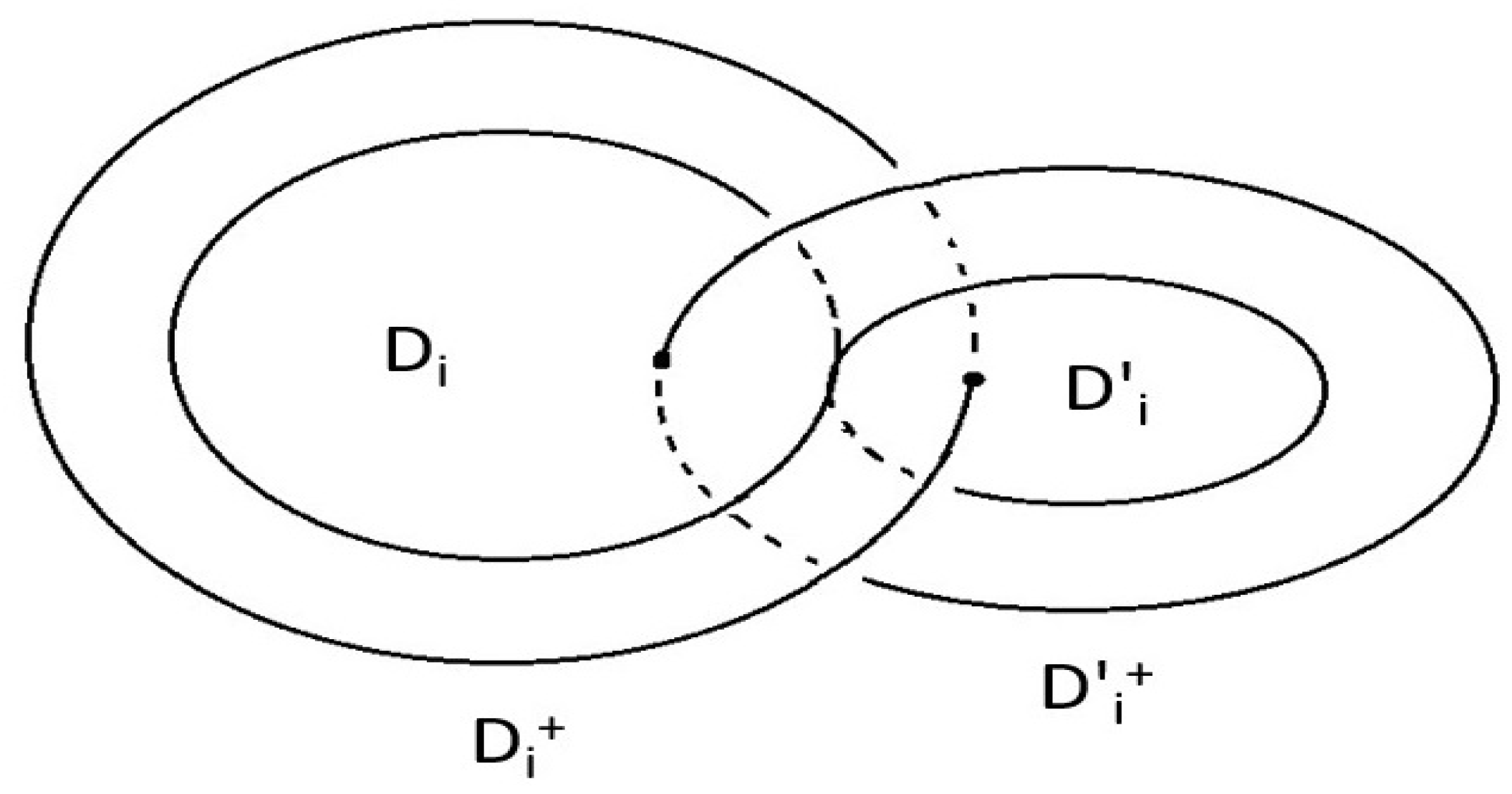
3. Let D
i+ be a slightly extended disk of D
i so that the boundary loop ∂(D
i+) is disjoint from F and meets the disk D′
i transversely at a single point, and D′
i+ a slightly extended disk of D′
i so that the boundary loop ∂(D′
i+) is disjoint from F and meets the disk D
i transversely at a single point;
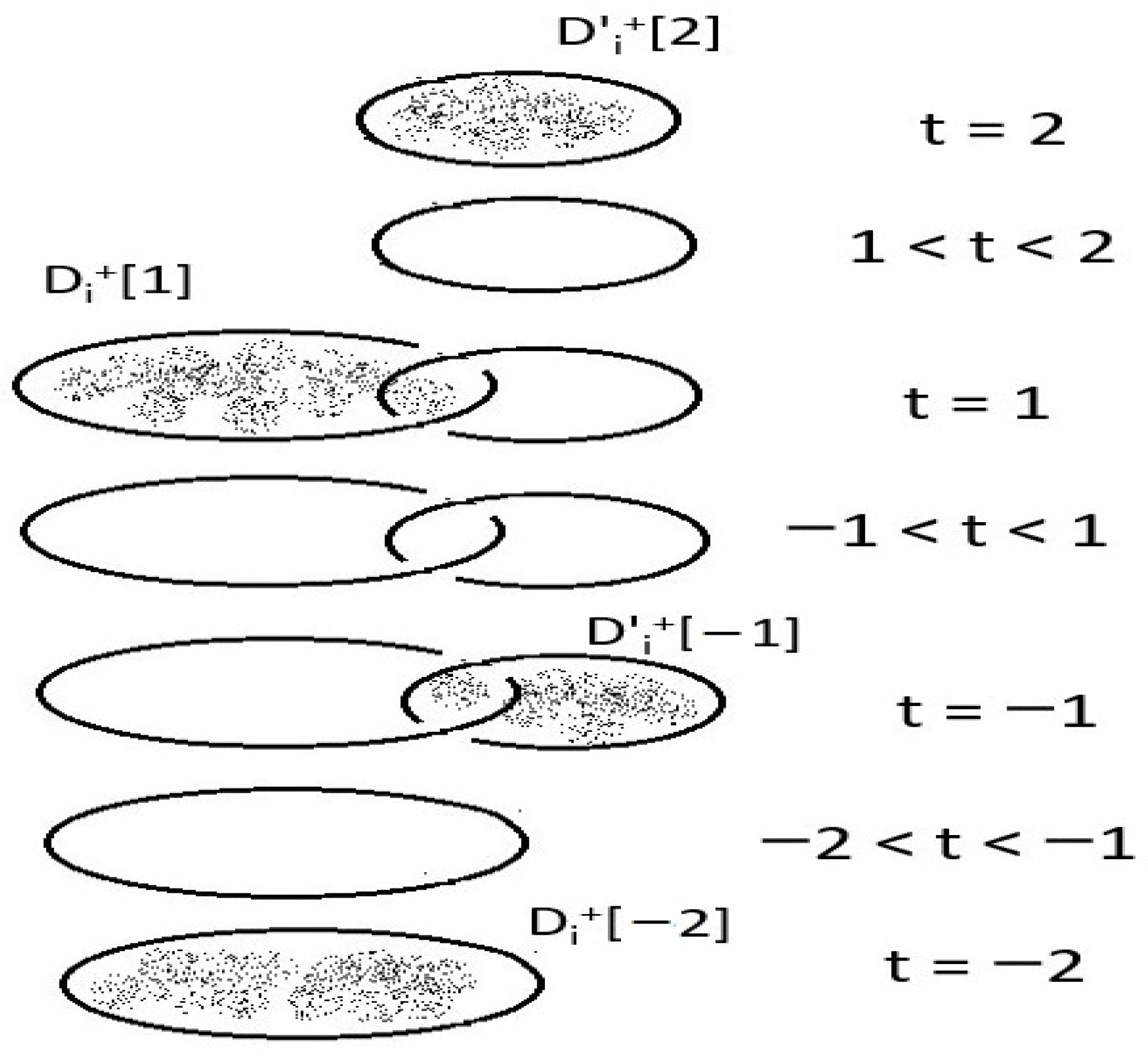
Figure 2. A
2-sphere surrounding D
i is a 2-sphere S
i in R
4 which is the boundary of the 3-ball D
i+[−2,1] in R
4, and a
2-sphere surrounding D′
i is a 2-sphere S′
i in R
4 which is the boundary of the 3-ball (D′
i)
+[−1,2] in S
4. The 2-spheres S
i, S′
i (i = 1, 2, ..., n) are disjoint for distinct indexes i and meet transversely in just two points with opposite signs in R
3[±1] for the same index i. The 2-sphere pair (S
i, S′
i) in S
4 is called
Montesinos’s twin,
Figure 3, [
7]. The connected sum D
i # S
i is made along an arc β′ in S′
i joining the intersection point D
i ∩ S′
i in R
3[0] with the intersection point of S
i ∩ S′
i in R
3, [1]. The 2-sphere S
i is oriented so that the disk D
i # S
i is oriented with the orientation inherited from D
i. Similarly, the connected sum D′
i # S′
i is made along an arc β in S
i joining the intersection point D′
i ∩ S
i in R
3[0] with the intersection point of S
i ∩ S ′
i in R
3[−1]. The 2-sphere S′
i is oriented so that the disk D′
i # S′
i is oriented with the orientation inherited from D′
i. To show Lemma 1, the following lemma is used.
Lemma 4.
The homology classes [Si] and [S′i] in Σ are given by [Si] = −[S(Di)], [S′i] = −[S(D′i)] for all i.
Proof of Lemma 4.
From construction, Si and S′i are disjoint from S(Dj) and S(D’j) for every j ≠ i, and the intersection numbers Int([Si],[S(Di)]) = Int([Si],[Si]) = Int([S’i],[S′i]) = Int([S’i],[S(D’i)]) = 0, and Int([Si], [S(D’i)]) = ε and Int([S′i],[S(Di)]) = ε′ for ε, ε′ = ±1, so that [Si] = ε[S(Di)], [S′i] = ε′[S(D′i)]. By the identities [αS(Di)] = −[S(Di)], Int([αS(Di)],[αS′i]) = Int([S(Di)],[S′i]), the identity [αS′i] = −[S′i] is obtained. Similarly, since [αS(D′i)] = −[S(D′i)], Int([αS(D′i)],[αSi]) = Int([S(D′i)], [Si]), the identity [αSi] = − [Si] is obtained. Let (E∗ × I, E′∗ × I) be the O2-handle basis on F given by (Ei, E′i) = (Di#Si, D′i #S′i) and (Ej, E′j) = (Dj, D′j) for j ≠ i. Then the identities [S(Ei)] = [S(Di] + [Si] − [αSi] = [S(Di)] + 2[Si], [S(E′i)] = [S(D′i] + [S′i] − [αS′i] = [S(D′i)] + 2[S′i] are obtained in Σ. The desired identities [Si] = − [S(Di)], [S′i] = − [S(D′i)] are obtained from the identities [Si] = ε[S(Di)], [S′i] = ε′ [S(D′i)] and Int([S(Ei)],[S(E′i)]) = Int([S(Di],[S(D′i)]) = 1. This completes the proof of Lemma 4. □
As a by-product of the proof of Lemma 4, an elementary transformation on an O2-handle basis on a trivial surface-knot in S4 was found to change an O2-sphere basis of Σ. In fact, the following elementary transformation on the O2-handle basis (D∗ × I, D′∗ × I) on F is given by Lemma 4.
Operation 1.
An O2-handle basis (D∗ × I,D′∗ × I) on F is changed into an O2-handle basis (E∗× I, E′∗× I) on F with the same attachment as (D∗ × I, D′∗ × I) such that [S(Ei)] = −[S(Di)], [S(E′i)] = −[S(D′i)] in Σ and (Ej, E′j) = (Dj, D′j), j ≠ i, for any given i.
Here are further elementary transformations on the O2-handle basis (D∗ × I, D′∗ ×I) on F.
Operation 2.
Let i ≠ j and join the intersection point vi = Di ∩ S′i with the intersection point v′j = D′j ∩ Sj by an arc γ in S4 whose interior is disjoint from F and (D* × I, D′* × I), where the 2-spheres S′i and Sj are taken to be unoriented. Construct the connected sum pairs (Ei, E′i) = (Di # Sj, D′i) and (Ej, E′j) = (Dj, D′j # S′i) along the arc γ. For h ≠ i, j, let (Eh, E′h) = (Dh, D′h). Then (E* × I, E′* × I) is an O2-handle basis on F with the same attachment as (D* × I, D′* × I) such that [S(Ei)] = [S(Di)] −2ε [S(Dj)], [S(E′j)] = [S(D′j)] +2ε [S(D′i)] with ε = ±1 in Σ and E′i = D′i, Ej = Dj, (Eh, E′h) = (Dh,D′h), h ≠ i, j for any given distinct indexes i and j.
In fact, the identities above are obtained because in the following identities [S(Ei)] = [S(Di] + 2ε[Sj] = [S(Di)] − 2ε[S(Dj)], [S(E′j)]) = [S(D′j)] + 2ε′[S′i] = [S(D′j)] − 2ε′[S(D′i)] with ε′ = ±1 given by Lemma 4, the identity ε + ε′ = 0 is obtained from the intersection number Int([S(Ei)], [S(E′j)]) = 0.
Operation 3.
Let i ≠ j and join the intersection point vi = Di ∩ S′i with the intersection point v′j = Dj ∩ S′j by an arc γ in S4 whose interior is disjoint from F and (D* × I, D′* × I), where the 2-spheres S′i and S′j are taken to be unoriented. Construct the connected sum pairs (Ei, E′i) = (Di # S′j, D′i) and (Ej, E′j) = (Dj # S′i, D′j) along the arc γ. For h ≠ i, j, let (Eh, E′h) = (Dh, D′h). Then (E* × I, E′* ×I) is an O2-handle basis on F with the same attachment as (D* × I, D′* × I) such that [S(Ei)] = [S(Di)] − 2ε [S(D′j)], [S(Ej)] = [S(Dj)] + 2ε [S(D′i)] with ε = ±1 in Σ and E′i = D′i, E′j = D′j, (Eh, E′h) = (Dh, D′h), h ≠ i, j for any given distinct indexes i and j.
In fact, the identities above are obtained because in the following identities [S(Ei)] = [S(Di)] + 2ε[S′j] = [S(Di)] − 2ε[S(D′j)], [S(Ej)]) = [S(Dj)] + 2ε′[Si] = [S(Dj)] − 2ε′[S(D′i)] with ε′ = ±1 given by Lemma 4, the identity ε + ε′ = 0 is obtained from the intersection number Int([S(Ei)], [S(Ej)]) = 0.
Operation 4.
Let i ≠ j and join the intersection point vi = D′i ∩ Si with the intersection point v′j = D′j ∩ Sj by an arc γ in S4 whose interior is disjoint from F and (D* × I, D′* × I), where the 2-spheres Si and Sj are taken to be unoriented. Construct the connected sum pairs (Ei, E′i) = (Di, D′i # Sj) and (Ej, E′j) = (Dj, D′j # Si) along the arc γ. For h ≠ i, j, let (Eh,E′h) = (Dh, D′h). Then (E* × I, E′* × I) is an O2-handle basis on F with the same attachment as (D* × I, D′* × I) such that [S(E′i)] = [S(D′i)] −2ε [S(Dj)], [S(E′j)] = [S(D′j)] +2ε [S(Di)] with ε = ±1 in Σ and Ei = Di, Ej = Dj, (Eh, E′h) = (Dh, D′h), h ≠ i, j for any given distinct indexes i and j.
In fact, the identities above are obtained because in the following identities [S(E′i)] = [S(D′i)]+ 2ε[Sj] = [S(D′i)] − 2ε[S(Dj)], [S(E′j)]) = [S(D′j)] + 2ε′[Si] = [S(D′j)] − 2ε′[S(Di)] with ε′ = ±1 given by Lemma 4, the identity ε + ε′ = 0 is obtained from the intersection number Int([S(E′i)], [S(E′j)]) = 0.
In Operations 2–4, the sign ε can take both +1 and −1, because a normal 3-disk bundle of the arc γ in S4 admits a Hopf-link bundle of the arc γ which is used for the connected sum and the Hopf link has a component-preserving inversion. The following observation on an odd integer u and a non-zero integer c is used for the proof of Lemma 2.
Observation 1.
Let u be an odd integer, c a non-zero integer, and ε = ±1 the sign of the product integer uc. If |c| ≥ |u|, then 0 ≤ |2c − 2εu| < 2|c|. If |u| > |c|, then the integer u − 2εc is odd with 1 ≤ |u − 2εc| < |u|.
In fact, let ε′c > 0 for ε′ = ±1. If ε′c ≥ ε′εu > 0, then 0 ≤ 2ε′c − 2ε′εu < 2ε′c, showing that |c| ≥ |u| implies 0 ≤ |2c − 2εu| < 2|c|. If ε′εu > 2ε′c > 0, then 0 < ε′εu −2ε′c < ε′εu. If 2ε′c > ε′εu > ε′c > 0, then 0 > ε′εu −2ε′c > −ε′c > −ε′εu. These inequalities imply 1 ≤ |u − 2εc| < |u|, as desired.
In applications of Observation 1 to the proof of Lemma 1, it is shown that the coefficients ui = 1 + 2aii of [S(Ei)] in xi and u’i = 1 + 2a’ii of [S(E’i)] in x′i are odd integers. The proof of Lemma 1 is done as follows.
Proof of Lemma 1.
Fix the orthogonal basis (x*, x′∗) of Σ. By Lemma 3, there is an O2-handle basis (E* × I, E′* × I) on F such that xi = [S(Ei)] + 2Ai + 2A′i, x′i = [S(E′i)] + 2Bi + 2B′i for all i, where Ai = Σnj = 1 aij[S(Ej)], A′i = Σnj = 1 a′ij[S(E′j)], Bi = Σnj = 1 bij[S(Ej)], B′i = Σnj = 1 b′ij[S(E′j)] with some integers aij, a′ij, bij, b′ij for all i, j. Let n = 1. Since (x1, x′1) and ([S(E1)], [S(E′1)]) are orthogonal bases of Σ, it holds that a′11 = b′11 = 0 and either a11 = b11 = 0 or a11 = b11 = −1, so that either xi = [S(Ei)], x′i = [S(E′i)] or xi = −[S(Ei)], x′i = −[S(E′i)]. For the latter case, apply Operation 1 to obtain x1 = [S(E1)] and x′1 = [S(E′1)]. Let n ≥ 2. By a finite number of Operation 2 and Observation 1 using the transformations [S(En)] → [S(En)] ± 2[S(Ej)] and [S(Ej)] → [S(Ej)] ± 2[S(En)] for j < n, there is an O2-handle basis (E∗ × I, E′∗ × I) on F such that xn = ε[S(En)] + 2A′n(ε = ±1), x′n = [S(E′n)] + 2Bn + 2B′n for some A’n, Bn, B’n. By a finite number of Operation 3 and Observation 1 using the transformations [S(En)] → [S(En)] ± 2[S(E′j)] for j < n, there is an Identity xn = ε[S(En)] + 2a’nn[S(E′n)] for some integer a’nn. Then a’nn = 0, because Int(xn, xn) = Int([S(En)], [S(En)]) = Int([S(E’n)], [S(E’n)]) = 0 and Int}([S(En)], [S(E’n)]) = 1. Thus, xn = ε [S(En)], x′n = [S(E′n)] + 2Bn + 2B′n with some Bn, B′n. By a finite number of Operation 4 and Observation 1 using the transformations [S(E′n)] → [S(E′n)] ± 2[S(Ej)] for j <n, the identities xn = ε [S(En)], x′n = [S(E′n)] + 2bnn[S(En)] + 2B′n are obtained for some integer bnn and some B′n. By Operation 1, assume that ε =1. Use that (x∗, x′∗) and ([S(E∗)], [S(E′∗)]) are orthogonal bases of Σ. Since Int(x′n, x′n) = 4bnn = 0 and thus bnn = 0, the identities xn = [S(En)], x′n = [S(E′n)] + 2B′n are obtained. Then B′n = 0, for Int(xj, x′n) = 0 (j < n) or 1(j = n), and the identities xn = [S(En)], x′n = [S(E′n)] are obtained. Let Fn−1 be the trivial surface-knot of genus n−1 in S4 obtained from F by surgery along the O2-handle pair (En × I, E′n × I), [3]. Then the system (xi, x′i) (i = 1, 2, ..., n − 1) is an orthogonal basis for the stable 4-sphere Σ(n−1) = S4(Fn−1)2 of genus n−1. By inductive assumption on n, there is a replacement of the O2-handle basis (Ei× I,E′i × I) (i = 1, 2, ..., n − 1) on Fn−1 keeping the attaching part fixed so that xi = [S(Ei)] and xi = [S(E′i)] for all i (i = 1, 2, ..., n − 1) in Σ(n − 1). Thus, there is an O2-handle basis (E∗ × I, E′∗× I) on F such that xi = [S(Ei)] and x′i = [S(E′i)] for all i (i = 1, 2, ..., n) in Σ = Σ(n), [3]. This completes the proof of Lemma 1. □
This completes the proof of Theorem 1.