


Abstract
Writing is both a cognitive–linguistic activity and an emotional academic experience. For students with Specific Learning Difficulties (SLDs), written production may involve tension, anticipated failure, reduced confidence, and frustration, especially when handwriting demands compete with idea generation, spelling control, and text organization. These emotional responses are educationally important because they may influence persistence, written productivity, revision behavior, and academic participation. This study examined emotional responses to handwritten and digitally supported computer-based writing among 60 secondary education students, including 40 students with formally diagnosed SLD and 20 students without learning difficulties. Each participant completed two writing tasks, one handwritten and one digitally supported computer-based, in a counterbalanced order. The computer-based condition functioned as a digitally supported writing environment, with spell-checking and grammar-checking enabled. After each condition, students completed the Writing Emotional Response Scale (WERS), a 12-item study-specific instrument assessing writing anxiety, writing confidence, writing frustration, and perceived ease. The WERS was developed as a preliminary measure of immediate, task-specific emotional responses. Students with SLD reported lower anxiety, lower frustration, higher confidence, and higher perceived ease during digitally supported writing. The study contributes to educational psychology by linking writing modality, SLD, and emotional accessibility.
1. Introduction
Writing is one of the most demanding academic activities because it requires the coordination of linguistic, cognitive, motor, and self-regulatory processes. Students must generate ideas, retrieve vocabulary, organize sentences, monitor spelling, manage transcription, revise emerging text, and maintain the communicative purpose of the task. Contemporary research conceptualizes writing as a multidimensional activity involving transcription, text generation, self-regulation, motivation, and contextual affordances (Graham, 2019; Graham et al., 2024; Kim et al., 2024; Malpique et al., 2025). Writing should therefore be understood not only as a language-based academic skill but also as a psychological activity shaped by students’ cognitive resources, perceived competence, emotional reactions, and sense of control. This perspective is especially important because emotional responses during writing are not peripheral to academic performance. Writing anxiety, frustration, low confidence, and perceived difficulty may reduce persistence, limit revision behavior, interfere with idea development, and restrict students’ willingness to participate in written tasks. Conversely, confidence and perceived ease may support sustained engagement, text production, strategy use, and academic participation.
For students with Specific Learning Difficulties (SLDs), particularly those with dyslexia or written-expression difficulties, writing may become both cognitively demanding and emotionally burdensome. Difficulties in spelling accuracy, handwriting fluency, text length, lexical retrieval, morphological control, sentence construction, and organization can make writing feel slow, effortful, exposing, and discouraging. Dyslexia and learning-difficulty research emphasizes that literacy difficulties interact with cognitive processing, academic participation, self-perception, and emotional adjustment (Cainelli et al., 2023; Catts & Petscher, 2022; Snowling et al., 2020). Thus, writing difficulty may concern not only the final product but also the emotional experience of producing that text. For this reason, writing support for students with SLD should not be evaluated only through accuracy, fluency, or text quality, but also through the extent to which it reduces unnecessary emotional barriers and allows students to engage with writing without excessive anxiety, frustration, or anticipated failure.
The emotional dimension of writing is theoretically and educationally important. Writing anxiety, reduced confidence, frustration, and avoidance may limit students’ willingness to engage in writing and reduce opportunities for practice, feedback, and improvement. Studies on writing self-efficacy and writing anxiety indicate that students’ beliefs about their writing ability and their emotional reactions during writing are associated with writing performance, strategy use, persistence, and text quality (Busse et al., 2023; Golparvar & Khafi, 2021; S. Li & An, 2024; B. Li et al., 2022; Sabti et al., 2019; Skar et al., 2023; Sun & Wang, 2020; Xu et al., 2023). Recent writing research has also emphasized the role of feedback, assessment, and technology-mediated writing environments in shaping learners’ emotional and motivational experiences. For example, Zhou and Wang (2026) linked generative artificial intelligence acceptance, writing anxiety, writing self-efficacy, and writing feedback literacy in educational writing contexts, while Wang et al. (2023) highlighted the importance of measurement precision in writing-related assessment and feedback literacy. Although these studies were conducted in English as a foreign language or English-medium instruction contexts rather than among students with SLD, they reinforce the broader point that writing support should be examined through affective, motivational, and measurement-sensitive perspectives, not only through final text quality.
Writing modality may play a critical role in shaping this emotional experience. Handwriting can intensify perceived difficulty because it requires sustained graphomotor production, spatial organization, spelling monitoring, and continuous visual control of written output. In contrast, digitally supported computer-based writing may reduce some demands by allowing easier correction, deletion, revision, and continuation of text. Research on handwriting, keyboarding, digital writing, and assistive technologies suggests that writing medium can influence fluency, written production, accessibility, and support for struggling writers (Feng et al., 2019; Gong et al., 2022; Jiménez & Hernández-Cabrera, 2019; Malpique et al., 2020; Matre & Cameron, 2024; Ok & Rao, 2019). In the present study, however, the computer-based condition should be understood more precisely as digitally supported computer-based writing rather than keyboarding alone, because spell-checking and grammar-checking functions were enabled. This distinction is important because any emotional benefit may reflect the combined effect of reduced graphomotor demands, easier revision, less permanent visible error, and automated linguistic support.
The study is informed by a complementary theoretical logic linking writing demands, perceived control, perceived competence, and participation. Cognitive Load Theory (Sweller et al., 2019), Control-Value Theory (Pekrun, 2024), Social Cognitive Theory (Bandura, 1997), and Self-Determination Theory (Ryan & Deci, 2020) provide complementary lenses for interpreting how writing conditions may shape immediate emotional responses.
A clear gap remains. Existing literature has examined writing outcomes, intervention effects, text quality, digital accessibility, writing anxiety, and self-efficacy, but fewer studies examine students’ immediate emotional responses to handwritten and digitally supported computer-based writing within the same empirical design. This limitation is especially important for secondary students with formally diagnosed SLD. The present study addresses this gap by examining writing anxiety, writing confidence, writing frustration, and perceived ease after handwritten and digitally supported computer-based writing tasks. Its originality lies in treating writing modality as a psychologically meaningful condition that may shape students’ immediate emotional experience of writing, not merely as a technical or productivity-related variable. By focusing on immediate, state-like emotional responses after each writing condition, the study differs from research that examines general writing attitudes, trait writing anxiety, or broad self-efficacy beliefs. The aim is not to claim that digitally supported writing removes writing difficulties, but to examine whether it is experienced as less emotionally burdensome and more manageable by students with SLD.
The study was guided by four research questions:
- RQ1. What emotional responses do students with SLD report after handwritten and digitally supported computer-based writing tasks?
- RQ2. To what extent is digitally supported computer-based writing associated with lower writing anxiety and frustration compared with handwriting?
- RQ3. To what extent is digitally supported computer-based writing associated with higher writing confidence and perceived ease compared with handwriting?
- RQ4. Are differences in emotional responses between handwriting and digitally supported computer-based writing more pronounced among students with SLD than among students without learning difficulties?
Writing is increasingly understood as a multidimensional activity in which cognitive, linguistic, motor, motivational, and emotional processes operate together rather than separately. Students’ written products do not only reflect linguistic knowledge; they also reflect the extent to which the writing situation allows students to manage cognitive load, emotional pressure, and perceived control (Graham, 2019; Graham et al., 2024; Kim et al., 2024; Malpique et al., 2025). From a cognitive load perspective, writing may become especially demanding when transcription, spelling, monitoring, and idea generation compete for limited cognitive resources (Sweller et al., 2019). This is particularly important for students with Specific Learning Difficulties (SLDs), for whom lower fluency in spelling, handwriting, or written expression may leave fewer resources available for planning, organization, and revision.
For students with SLD, writing may be especially demanding because persistent literacy difficulties interact with processing speed, working memory, school participation, self-perception, and emotional adjustment (Cainelli et al., 2023; Catts & Petscher, 2022; Snowling et al., 2020). Repeated correction, visible errors, slow production, and unfinished tasks may gradually make writing associated with anxiety, frustration, low confidence, and avoidance. Recent work on dyslexia and emotional functioning supports this broader interpretation, linking literacy difficulties with self-concept, anxiety, and school-related stress (Gibby-Leversuch et al., 2021). In secondary education, this issue becomes especially important because writing is not limited to language lessons; it becomes a central means of demonstrating knowledge across subjects. Thus, difficulties in writing may restrict broader academic participation, not only written-language performance.
Writing anxiety, confidence, frustration, and perceived ease are psychologically meaningful because they influence how students approach and sustain writing. Research on writing anxiety and self-efficacy shows that motivational beliefs are associated with performance, strategy use, persistence, and willingness to revise (Busse et al., 2023; Golparvar & Khafi, 2021; B. Li et al., 2022; S. Li & An, 2024; Razmi & Ghane, 2024; Sabti et al., 2019; Sun & Wang, 2020). However, much of this evidence comes from second-language writing, university samples, or general populations, limiting direct transfer to secondary students with diagnosed SLD. Moreover, many studies examine relatively stable writing anxiety, writing attitudes, or writing self-efficacy, whereas less is known about students’ immediate, task-specific emotional responses after different writing conditions.
Recent writing research also highlights the importance of feedback, assessment, and technology-mediated writing environments for learners’ emotional and motivational experiences. Zhou and Wang (2026), for example, examined the interplay among generative artificial intelligence acceptance, writing anxiety, writing self-efficacy, and writing feedback literacy in English-medium instruction contexts. Wang et al. (2023) developed and validated a scale of writing assessment feedback literacy, underscoring the importance of measurement quality in writing-related research. Although these studies do not focus on students with SLD, they show that contemporary writing research increasingly treats writing support, feedback, affect, and measurement as interconnected rather than separate issues. This is relevant to the present study because emotional responses to writing accommodations also require careful measurement rather than informal observation alone.
Control-value theory helps explain why the same writing task may be experienced differently by different students. Academic emotions are shaped by perceived control and value (Pekrun, 2024). In writing, perceived control may involve the belief that one can spell, organize ideas, revise mistakes, and complete the task. For students with SLD, handwriting and spelling demands may reduce perceived control; when control feels low, anxiety and frustration become more likely, whereas manageable conditions may support confidence and willingness to continue. Social Cognitive Theory further supports this interpretation by conceptualizing confidence as a task-specific belief in one’s capability to organize and execute the actions required for successful performance (Bandura, 1997). Self-Determination Theory also suggests that learning conditions supporting perceived competence and autonomy may increase students’ willingness to participate and persist in academic tasks (Ryan & Deci, 2020). Together, these frameworks suggest that the emotional experience of writing depends on the interaction between task demands, perceived control, perceived competence, and opportunities for successful participation.
Handwriting and digitally supported computer-based writing are not neutral alternatives. Handwriting requires graphomotor control, spatial organization, letter formation, spelling monitoring, and sustained physical effort. Digitally supported computer-based writing changes the task environment because typed text can be corrected, deleted, moved, expanded, and revised more easily. Studies on handwriting, keyboarding, and digital writing suggest that writing medium can influence transcription fluency, productivity, revision opportunities, and accessibility (Cerni & Job, 2024; Feng et al., 2019; Gong et al., 2022; Jiménez & Hernández-Cabrera, 2019; Malpique et al., 2020, 2025; Rogne et al., 2024). For students with SLD, these affordances may be emotionally important because they can reduce the permanence and visibility of errors, allow correction without rewriting entire sections, and make it easier to continue composing after a mistake.
The evidence should be interpreted critically. Digitally supported computer-based writing should not be presented as automatically superior to handwriting. Handwriting may support orthographic and motor processes, and typing requires keyboard familiarity, visual monitoring, and digital fluency (Feng et al., 2019; Ibaibarriaga et al., 2025). The more precise question is whether digitally supported computer-based writing reduces specific barriers for students whose handwriting and transcription demands interfere with participation. The present study is positioned within this psychologically grounded approach. This distinction is central to the present study because the computer-based condition included spell-checking and grammar-checking functions. Therefore, the study does not isolate keyboarding as a single mechanism. Rather, it examines a digitally supported writing environment that combines typing, screen-based text production, easier editing, and automated linguistic support.
Interventions and accommodations for students with SLD have traditionally focused on improving transcription skills, spelling, written expression, strategy use, and access to assistive technologies. Such approaches are important, but they often emphasize text quality, task completion, or productivity more than students’ immediate emotional experience during writing. Digital writing supports, including word processing, spell-checking, grammar-checking, speech-to-text tools, and revision-friendly interfaces, may function not only as productivity tools but also as emotional-support mechanisms when they reduce avoidable barriers in the writing process (Matre & Cameron, 2024; Ok & Rao, 2019). This does not mean that digital writing removes the need for instruction in handwriting, spelling, or written expression. Rather, it suggests that accommodations should be evaluated both in terms of performance and in terms of emotional accessibility.
This perspective is relevant for inclusive education. Accommodations for students with SLD are usually justified in terms of access and fairness, but they should also be evaluated in terms of emotional participation. A support that allows a student to write more easily may matter not only because it increases output, but also because it reduces the emotional cost of writing. The originality of the present study lies in connecting writing modality, SLD, and immediate emotional experience within one empirical framework. Emotional accessibility refers here to the extent to which a writing condition allows students to engage in written production with reduced anxiety and frustration and with greater confidence and perceived ease. This concept complements, rather than replaces, performance-based evaluation. A support that increases output but leaves students anxious, avoidant, or unwilling to continue writing may be educationally incomplete. Conversely, a support that reduces emotional barriers may create better conditions for persistence, practice, feedback uptake, and longer-term writing development.
A clear gap therefore remains. Existing literature has examined writing outcomes, intervention effects, text quality, digital accessibility, writing anxiety, and self-efficacy, but fewer studies examine students’ immediate emotional responses to handwritten and digitally supported computer-based writing within the same empirical design. This limitation is especially important for secondary students with formally diagnosed SLD. The present study addresses this gap by examining writing anxiety, writing confidence, writing frustration, and perceived ease after handwritten and digitally supported computer-based writing tasks. Its originality lies in treating writing modality as a psychologically meaningful condition that may shape students’ immediate emotional experience of writing, not merely as a technical or productivity-related variable.
2. Materials and Methods
2.1. Research Design
The study employed a comparative repeated-measures design to examine students’ emotional responses to two writing modalities: handwritten writing and digitally supported computer-based writing. Each participant completed both conditions, allowing emotional responses to be compared within the same student. The design included one within-participant factor, writing modality, with two levels, and one between-participant factor, student group, with two levels: students with formally diagnosed SLD and students without reported learning difficulties.
The design was selected because the study aimed to examine task-specific emotional responses rather than general attitudes toward writing. Handwriting and digitally supported computer-based writing were treated as psychologically meaningful conditions that may impose different transcription, monitoring, correction, and revision demands (Feng et al., 2019; Gong et al., 2022; Malpique et al., 2025). The emotional questionnaire was administered immediately after each writing condition to capture condition-specific responses while the writing experience was recent. Because each participant experienced both writing conditions, the design reduced between-person variability and allowed the study to focus on within-student emotional differences between handwritten and digitally supported computer-based writing. The order of conditions was counterbalanced to reduce possible order, fatigue, or practice effects.
2.2. Participants
The sample consisted of 60 secondary education students. Forty students had a formal diagnosis of SLD, and 20 students without reported learning difficulties formed the comparison group. Students in the SLD group had official diagnostic documentation from recognized public diagnostic or educational support services. The comparison group consisted of students with no reported history of learning difficulties according to school and parental information.
The SLD group was intentionally defined through formal diagnostic status rather than through a single diagnostic subtype. Accordingly, the group may have included students with dyslexia, written-expression difficulties, or mixed literacy-related learning profiles. This reflects the heterogeneity typically encountered in school-based support services. However, because the sample size did not permit reliable subgroup analyses, diagnostic subtype was not used as an additional analytical factor. This issue is acknowledged as a limitation and as a direction for future research.
Inclusion criteria were enrollment in secondary education and ability to complete both handwritten and digitally supported computer-based writing tasks. Students were excluded if they had uncorrected sensory impairments, severe motor difficulties preventing completion of either condition, or insufficient Greek language proficiency. Written informed consent was obtained from parents or legal guardians, and student assent was obtained before participation. Table 1 summarizes the demographic and diagnostic characteristics of the participants by group.
Table 1.
Participant Characteristics by Group.
2.3. Writing Conditions and Procedure
Each participant completed two comparable writing tasks: one handwritten and one digitally supported computer-based. The tasks were designed to be similar in topic familiarity, genre, expected length, and cognitive demand. In the handwritten condition, students wrote using paper and pen or pencil. In the computer-based condition, students wrote using a standard word-processing environment with spell-checking and grammar-checking functions enabled. Thus, the computer-based condition is best interpreted as digitally supported writing rather than keyboarding alone.
This operationalization was chosen to reflect an ecologically valid school accommodation rather than a laboratory-isolated typing condition. In authentic educational settings, students who use computers for writing commonly have access to correction, deletion, revision, and automated language-support functions. Therefore, the study examined handwritten writing in comparison with a digitally supported writing environment. This distinction is important because any differences in emotional responses may reflect the combined influence of typing, easier revision, reduced permanence of visible errors, and automated spelling or grammar support.
Both tasks were completed in a quiet educational setting under researcher supervision. Students received 20 min per task. Parallel topics were matched for genre, familiarity, expected text length, and cognitive demand. The order of conditions was counterbalanced: 30 students completed handwriting first, and 30 completed digitally supported computer-based writing first. Immediately after each writing task, students completed the WERS.
The immediate administration of the WERS after each condition was intended to capture state-like emotional responses to the specific writing experience rather than general writing attitudes or stable self-efficacy beliefs. Students were instructed to respond based on how they felt during the task they had just completed.
2.4. Writing Emotional Response Scale
Students’ emotional responses were measured using the Writing Emotional Response Scale (WERS), a 12-item self-report instrument developed for this study. The WERS includes four three-item subscales: writing anxiety, writing confidence, writing frustration, and perceived ease. Students responded on a 5-point Likert-type scale ranging from 1 (strongly disagree) to 5 (strongly agree). Subscale scores were calculated by averaging the three items belonging to each dimension for each condition.
The WERS was developed through a theory-driven and content-validation procedure. First, an initial pool of items was generated from the study’s conceptual framework and from prior work on writing anxiety, writing self-efficacy, academic emotions, frustration, and perceived task manageability. The four dimensions were selected to capture both negative emotional responses, namely anxiety and frustration, and positive or enabling responses, namely confidence and perceived ease, immediately after a writing task. Second, the initial item pool was reviewed by experts in special education, educational psychology, and writing research, who evaluated item clarity, developmental appropriateness, construct relevance, and redundancy. Items that were ambiguous, double-barreled, overly general, or developmentally inappropriate were revised or removed. Third, the revised version was checked with secondary students comparable in age to the target sample to examine comprehensibility, response burden, and wording. Minor wording adjustments were made before final administration.
Because the WERS was designed to capture immediate emotional responses after a specific writing condition, it should not be interpreted as a general writing-attitude scale or as a trait measure of writing self-efficacy. The present study therefore provides preliminary evidence of content validity and internal consistency, while further research is needed to examine factorial validity, test–retest reliability, convergent validity, and measurement invariance across diagnostic groups and writing modalities. Table 2 presents the Writing Emotional Response Scale items organized by subscale.
Table 2.
Writing Emotional Response Scale Items.
2.5. Theoretical Alignment and Supplementary Indicators
The WERS subscales were selected to reflect the theoretical logic of the study. Writing anxiety and frustration capture negative emotional responses linked to perceived difficulty and low control. Writing confidence captures perceived capability, and perceived ease captures whether the condition felt manageable and supportive of idea expression.
The theoretical alignment was used to guide interpretation rather than to claim that all theoretical constructs were directly measured. For example, cognitive load and perceived control were not assessed through independent validated scales; they were used as interpretive frameworks for understanding why different writing conditions may be associated with different emotional responses. Therefore, conclusions concerning cognitive load, perceived control, and emotional accessibility are presented cautiously and should be tested directly in future studies. Table 3 presents the theoretical alignment between the emotional constructs used in the study and the analytical role of each theoretical perspective.
Table 3.
Theoretical Alignment of Emotional Constructs.
Selected linguistic indicators were included as supplementary exploratory variables: number of words, number of sentences, lexical types, conjunctions, and total words with prefixes and suffixes. These indicators represented productivity, text production, lexical variety, cohesion-related language use, and morphological elaboration.
These indicators were not intended to provide a full linguistic or writing-quality assessment. They were included only as exploratory indicators of written production that could be examined in relation to emotional responses. Accordingly, correlations between WERS scores and linguistic indicators were interpreted as supplementary and non-causal.
2.6. Data Analysis
Descriptive statistics were calculated for each WERS subscale by writing modality and group. Internal consistency was examined using Cronbach’s alpha. Because the WERS data were based on Likert-type responses and the sample size was modest, Wilcoxon signed-rank tests compared handwriting and computer-based writing within groups, and Mann–Whitney U tests compared students with and without SLD within each condition. Modality-related change scores were then calculated by subtracting handwriting scores from computer-based scores and comparing these change scores between groups. This directly addressed whether modality-related emotional changes were stronger among students with SLD. Effect sizes were calculated as r = Z/(N). Spearman’s rho correlations examined associations between emotional responses and selected linguistic indicators. Results were interpreted with exact p values and effect sizes, and exploratory analyses were interpreted cautiously.
The use of non-parametric tests was selected for three reasons. First, the WERS used 5-point Likert-type response categories, and subscale scores were based on three-item averages. Second, the sample size was modest, particularly in the comparison group. Third, the study used a newly developed instrument for which distributional assumptions could not be treated as fully established. Wilcoxon signed-rank tests were therefore appropriate for within-participant comparisons between writing modalities, Mann–Whitney U tests were appropriate for between-group comparisons, and Spearman’s rho was appropriate for monotonic associations involving emotional-response scores and exploratory writing indicators.
Alternative analytical approaches, such as repeated-measures ANOVA, mixed-effects models, or generalized estimating equations, may be useful in larger samples. However, given the modest sample size, the ordinal nature of the WERS responses, and the preliminary status of the instrument, the present analysis prioritized robust non-parametric comparisons and transparent effect-size reporting. Effect sizes were interpreted not only in terms of statistical magnitude but also in terms of pedagogical relevance, especially where modality-related changes suggested meaningful reductions in emotional burden for students with SLD.
3. Results
3.1. Internal Consistency and Descriptive Statistics
Cronbach’s alpha coefficients ranged from 0.81 to 0.88, indicating acceptable to good internal consistency for all WERS subscales. Given that each subscale contained only three items, these values were considered satisfactory for preliminary use. These coefficients provide initial evidence that the WERS subscales were internally consistent in the present sample. However, they should be interpreted as preliminary reliability evidence rather than as full psychometric validation of the instrument. The internal consistency coefficients for the WERS subscales are reported in Table 4.
Table 4.
Internal Consistency of the WERS Subscales.
Descriptive statistics showed the clearest modality differences among students with SLD. They reported higher anxiety and frustration during handwriting and higher confidence and perceived ease during computer-based writing. The non-SLD group showed the same general direction, but differences were smaller. This descriptive pattern suggests that handwriting was experienced as more emotionally burdensome by students with SLD, whereas digitally supported computer-based writing was associated with a more favorable emotional profile. Importantly, these descriptive findings do not by themselves establish the mechanism responsible for the difference; rather, they provide the basis for the within-group and between-group comparisons reported below. Descriptive statistics for emotional responses by group and writing modality are presented in Table 5.
Table 5.
Descriptive Statistics for Emotional Responses by Group and Writing Modality.
3.2. Within-Group and Between-Group Comparisons
Wilcoxon signed-rank tests indicated that, for students with SLD, all four emotional dimensions differed significantly between handwriting and computer-based writing. Anxiety and frustration were lower during computer-based writing, whereas confidence and perceived ease were higher. Effect sizes were large. Pedagogically, these large effects indicate that the shift from handwriting to digitally supported writing was not only statistically detectable but also educationally meaningful for students with SLD. The largest effects were observed for perceived ease, frustration, and anxiety, suggesting that the digital condition may have reduced the immediate emotional burden of writing for this group. For students without learning difficulties, differences were smaller; confidence and perceived ease increased significantly, whereas anxiety and frustration did not reach conventional significance. This pattern suggests that digitally supported writing may benefit many students, but its emotional relevance was more pronounced among students whose writing difficulties made handwriting especially demanding. The Wilcoxon signed-rank test results for within-group comparisons between writing modalities are reported in Table 6.
Table 6.
Wilcoxon Signed-Rank Tests Comparing Emotional Responses Between Writing Modalities.
Mann–Whitney U tests showed significant group differences during handwriting across all four dimensions. Students with SLD reported higher anxiety and frustration and lower confidence and perceived ease. In the computer-based condition, group differences were smaller and not statistically significant. This reduction in between-group differences is important because it suggests that the digitally supported condition narrowed the emotional gap between students with and without SLD. However, this finding should be interpreted as evidence of reduced emotional disparity in the present sample, not as proof that digital writing eliminates the underlying writing difficulties associated with SLD. The Mann–Whitney U test results for between-group comparisons within each writing modality are reported in Table 7.
Table 7.
Mann–Whitney U Tests Comparing Students with and Without SLD within Each Writing Modality.
3.3. Modality-Related Emotional Change and Correlations
Change-score analyses directly tested whether the emotional difference between handwriting and digitally supported computer-based writing was more pronounced among students with SLD. Students with SLD showed larger favorable changes across all four dimensions. The largest differences were observed for perceived ease, writing frustration, and writing anxiety. These findings directly address the fourth research question. They indicate that the emotional shift from handwriting to digitally supported computer-based writing was significantly stronger among students with SLD than among students without learning difficulties. In practical terms, the digital condition was associated with approximately one scale-point improvement for the SLD group across the main emotional dimensions, whereas the corresponding changes in the non-SLD group were smaller. The between-group comparisons of modality-related emotional change scores are reported in Table 8.
Table 8.
Between-Group Comparisons of Modality-Related Emotional Change Scores.
Exploratory Spearman correlations indicated that higher anxiety and frustration were associated with shorter texts, whereas higher confidence and perceived ease were associated with greater productivity or selected elaboration indicators. These associations are correlational and should not be interpreted causally. They should also be interpreted as supplementary rather than central evidence, because the study was primarily designed to examine emotional responses across writing modalities, not to provide a full linguistic analysis of text quality. Nevertheless, the pattern is theoretically meaningful: less favorable emotional responses tended to co-occur with reduced written production, whereas confidence and perceived ease tended to co-occur with greater productivity or lexical and cohesive elaboration. The exploratory Spearman correlations between emotional responses and selected writing indicators are reported in Table 9.
Table 9.
Spearman Correlations Between Emotional Responses and Selected Writing Indicators.
3.4. Conceptual Summary
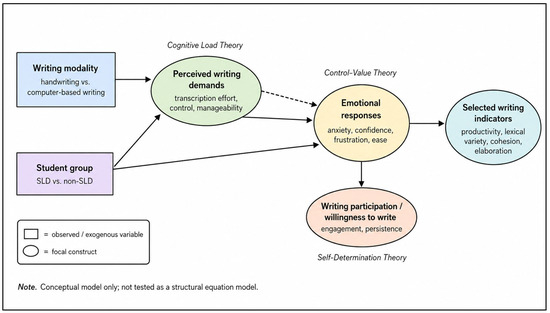
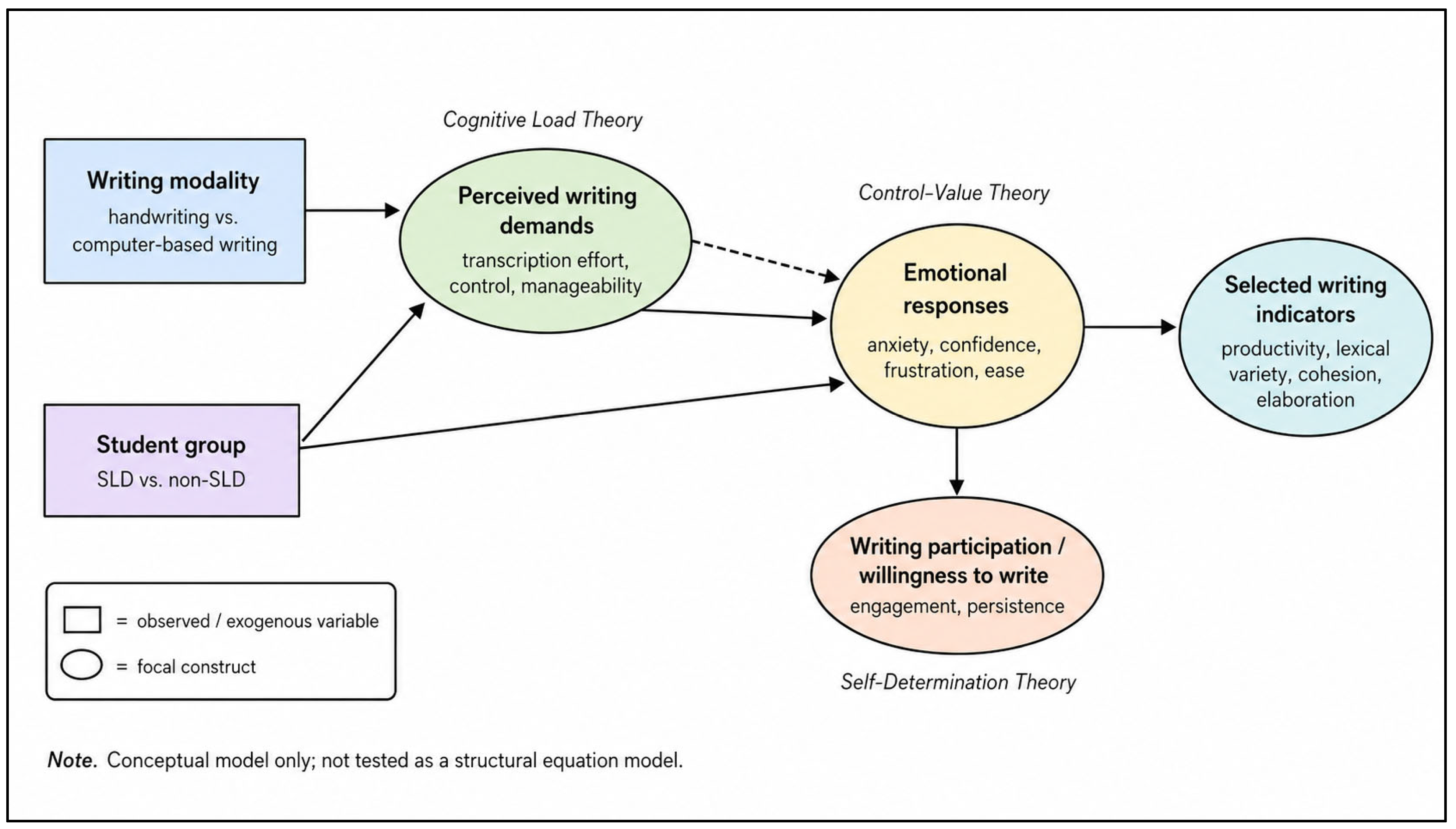
Overall, the results suggest that digitally supported computer-based writing may reduce the emotional burden of writing for students with SLD. Figure 1 summarizes the conceptual logic of the study. The model is not presented as a tested structural equation model, but as a framework for organizing the study’s assumptions and findings. The figure should therefore be read as a heuristic summary rather than as an empirically tested causal model. The statistically tested findings concern group differences, modality differences, modality-related change scores, and exploratory correlations. Constructs such as perceived demands, perceived control, and writing participation are included in the figure as conceptual propositions that help interpret the findings and should be tested directly in future research.
Figure 1.
Conceptual Model Linking Writing Modality with Perceived Demands, Emotional Responses, and Writing Participation. Note. The model is intended as a conceptual synthesis of the study’s theoretical assumptions and empirical findings. Solid relationships should be interpreted as relationships supported by the present analyses, whereas broader pathways involving perceived demands, perceived control, and writing participation should be understood as conceptual propositions requiring direct testing in future research.
4. Discussion
The present study examined emotional responses to handwritten and digitally supported computer-based writing among secondary education students with and without SLD. It addressed a focused gap in writing and educational-psychology research by examining immediate emotional responses to writing modality within the same empirical design. The findings indicate that students with SLD experienced handwriting as more emotionally demanding than digitally supported computer-based writing. During handwriting, they reported higher anxiety and frustration and lower confidence and perceived ease. These findings support the view that writing modality is not merely a technical feature of written production but may shape the emotional conditions under which students with SLD engage in writing.
This pattern is theoretically coherent. Handwriting requires graphomotor control, spelling monitoring, spatial organization, and transcription effort. For students with SLD, these demands may compete with idea generation, vocabulary retrieval, and text organization, making difficulty more visible and increasing the anticipation of failure. This interpretation aligns with research showing that dyslexia and related learning difficulties are connected with school participation, self-perception, anxiety, and emotional adjustment (Busse et al., 2023; Catts & Petscher, 2022; Snowling et al., 2020). However, the present study did not directly measure cognitive load, perceived control, or failure anticipation. Therefore, these constructs should be understood as theoretically plausible explanations rather than empirically tested mechanisms. The data show that students reported different emotional responses across writing conditions; future studies should directly measure the cognitive and motivational processes that may explain these differences.
Digitally supported computer-based writing was associated with a more positive emotional profile, especially among students with SLD. The change-score analysis strengthened this interpretation by showing that the emotional shift from handwriting to digitally supported computer-based writing was larger for students with SLD than for students without learning difficulties. The enabled spell-checking and grammar-checking functions are important: the digital condition represented a typical digitally supported writing environment, not keyboarding alone. Therefore, the emotional benefit may reflect the combined effect of typing, screen-based production, easier revision, deletion, correction, and automated writing support. This distinction is central to the interpretation of the findings. The study does not show that typing alone reduces writing anxiety or frustration. Rather, it suggests that a digitally supported writing environment may reduce the immediate emotional burden of writing for students with SLD. In practical terms, the support may come not only from replacing handwriting with keyboarding, but also from making errors easier to correct, reducing the permanence of visible mistakes, and allowing students to continue composing without repeatedly rewriting text.
The findings should not be overstated. The study does not prove that digitally supported computer-based writing directly reduces cognitive load, permanently improves motivation, or eliminates writing difficulties. The stronger claim is that digitally supported computer-based writing was experienced as less emotionally threatening and more manageable than handwriting, particularly by students with SLD. This distinction avoids a simplistic technological interpretation and positions writing modality as a condition that can shape the emotional context of writing. This cautious interpretation is especially important because the WERS was a newly developed instrument. Although internal consistency was acceptable to good, the scale requires further validation before stronger psychometric claims can be made. Thus, the findings should be read as preliminary but meaningful evidence that immediate emotional responses to writing modality deserve systematic attention in SLD research.
The exploratory correlations add nuance. Higher anxiety and frustration were associated with shorter texts, whereas higher confidence and perceived ease were associated with greater productivity and selected indicators of lexical variety and cohesion. The direction of influence cannot be determined; students may feel more confident because they write more successfully, or they may write more successfully because they feel less anxious and more in control. Most likely, these processes are reciprocal (Busse et al., 2023; Golparvar & Khafi, 2021; S. Li & An, 2024; Sabti et al., 2019; Sun & Wang, 2020). For this reason, the linguistic indicators should be interpreted as exploratory and supplementary rather than as direct evidence of writing quality. Nevertheless, they strengthen the educational relevance of the emotional findings by suggesting that anxiety, frustration, confidence, and perceived ease may be linked to students’ actual written production. This supports the broader argument that emotional accessibility is not separate from academic participation but may be one of its enabling conditions.
The results also contribute to current writing research by connecting emotional responses, writing support, and measurement issues. Recent studies have emphasized that writing feedback, technology-mediated support, writing anxiety, and writing self-efficacy are interrelated dimensions of contemporary writing instruction (Wang et al., 2023; Zhou & Wang, 2026). The present study extends this discussion to secondary students with SLD by showing that the emotional experience of writing may differ substantially depending on whether students write by hand or in a digitally supported environment. Although the present study does not examine feedback literacy or artificial intelligence-based writing support directly, it reinforces the broader point that writing tools and supports should be evaluated through psychological and affective outcomes as well as through textual outcomes.
The originality of the study is threefold: it brings immediate emotional responses into the study of writing modality, focuses on students with SLD, and connects emotional responses with selected writing indicators. This gives the study a clearer psychological contribution than a purely technical comparison of handwriting and digitally supported computer-based writing. More specifically, the study shifts attention from whether digital writing simply improves writing output to whether it changes the affective experience of writing. This is important because accommodations that increase access but leave students anxious, frustrated, or avoidant may remain educationally incomplete. Conversely, supports that reduce emotional barriers may create better conditions for persistence, practice, feedback uptake, and longer-term writing development.
4.1. Educational and Psychological Implications
The findings suggest that students with SLD may resist or avoid writing not because they lack ideas or effort, but because the writing condition itself may trigger anxiety, frustration, and anticipated failure. Digitally supported computer-based writing should therefore be considered a potentially supportive accommodation whose value lies not only in increasing output but also in reducing emotional barriers. Assessment practices should distinguish handwriting limitations from written-language competence, especially in secondary education where written production becomes increasingly important across subjects. This distinction has direct implications for inclusive assessment: when handwriting demands prevent students from demonstrating their knowledge, handwritten output may underestimate students’ actual written-language competence and content understanding.
Digital writing accommodations should also be embedded in regular instruction rather than reserved only for high-stakes assessment. Students need repeated opportunities to develop typing fluency, digital revision strategies, and confidence in digitally supported computer-based writing environments. Emotional outcomes should be included in evaluations of writing interventions because a support that improves text length but leaves students anxious and avoidant may not be educationally sufficient. At the same time, digital writing accommodations require careful implementation. Schools must consider access to devices, teacher training, typing proficiency, appropriate use of spell-checking and grammar-checking tools, and clear assessment policies. Without such conditions, digitally supported writing may reproduce inequalities rather than reduce them.
The findings also suggest that emotional accessibility should be treated as a legitimate criterion when evaluating accommodations for students with SLD. Emotional accessibility does not mean lowering academic expectations. Rather, it means removing unnecessary affective barriers that prevent students from participating fully in writing tasks. In this sense, digitally supported writing may allow educators to assess students’ ideas, organization, and written communication more fairly, while still providing instruction in handwriting and spelling where these skills remain educationally relevant.
4.2. Limitations and Future Research
Several limitations should be acknowledged. First, the sample size was modest, particularly in the comparison group. Second, the WERS was developed for this study and requires further validation, including factorial structure, test–retest reliability, convergent validity, and measurement invariance. Third, self-report data may be influenced by social desirability, momentary mood, or item interpretation.
Fourth, spell-checking and grammar-checking functions were enabled during the computer-based condition. This strengthens ecological validity but means that findings cannot be attributed solely to keyboarding or reduced graphomotor demands. Fifth, the study did not include direct measures of typing fluency, handwriting fluency, spelling accuracy, or prior computer familiarity. Sixth, although the order of conditions was counterbalanced, carryover effects cannot be completely eliminated. Finally, the correlations between emotions and writing indicators were exploratory and cannot establish causality. Future studies should use longitudinal or experimental designs to examine whether repeated access to digitally supported writing reduces writing anxiety over time.
Another limitation concerns the heterogeneity of the SLD group. Although all students had formal diagnostic documentation, the study did not have sufficient statistical power to compare subgroups of students with dyslexia, written-expression difficulties, or mixed learning profiles. Emotional responses to handwriting and digitally supported writing may differ across these profiles, particularly when spelling, graphomotor fluency, or text-organization difficulties are differently distributed. Future studies should recruit larger samples that allow diagnostic subgroup analyses.
Prior familiarity with digital writing tools may also have influenced students’ responses. Students who were more experienced with typing, word-processing software, or automated correction tools may have experienced the computer-based condition as more manageable independently of SLD status. Conversely, students with limited typing fluency may not have fully benefited from the digital environment. Future studies should therefore include direct measures of typing fluency, handwriting fluency, spelling accuracy, digital-writing familiarity, and students’ attitudes toward technology.
Future research should also examine the mechanisms suggested but not directly tested in the present study. In particular, studies should include validated measures of cognitive load, perceived control, writing self-efficacy, task value, and writing avoidance. Such work would make it possible to test whether digitally supported writing improves emotional responses because it reduces transcription demands, increases perceived control, supports confidence, or changes students’ expectations of success. Larger samples would also allow researchers to use mixed-effects models or structural models to examine within-student and between-student variability more precisely.
5. Conclusions
The present study positions writing modality as a psychologically meaningful factor in the writing experiences of students with SLD. Digitally supported computer-based writing was associated with lower writing anxiety and frustration and higher confidence and perceived ease, particularly among students with SLD. The change-score findings further suggest that the emotional improvement from handwriting to digitally supported computer-based writing was more pronounced in the SLD group than in the comparison group.
The study contributes to educational psychology by showing that writing accommodations can be evaluated through emotional as well as performance-related outcomes. For students with SLD, digitally supported writing may reduce unnecessary affective barriers and support more inclusive participation in written-language activities. At the same time, the findings should be interpreted cautiously: the study examined immediate emotional responses to a digitally supported writing condition, not the long-term effects of digital writing or the isolated effect of keyboarding alone. Future research should validate the WERS further and examine whether reduced emotional burden during digitally supported writing translates into sustained improvements in writing engagement, performance, and academic participation.
Author Contributions
Conceptualization, I.V., G.P. and A.-S.A.; methodology, I.V., G.P. and A.-S.A.; formal analysis, G.P. and I.V.; investigation, I.V., C.P. and Z.K.; data curation, I.V. and G.P.; writing—original draft preparation, I.V., G.P. and A.-S.A.; writing—review and editing, D.V.K., E.M., C.P. and Z.K.; supervision, A.-S.A. and G.P.; project administration, I.V. and G.P. All authors have read and agreed to the published version of the manuscript.
Funding
This research received no external funding.
Institutional Review Board Statement
The study was conducted in accordance with the Declaration of Helsinki and was approved by National and Kapodistrian University of Athens (Approval Code: 169) on 1 September 2024.
Informed Consent Statement
Written informed consent was obtained from the parents or legal guardians of all participating students. Student assent was also obtained before participation.
Data Availability Statement
The data supporting the findings of this study are not publicly available due to ethical and privacy restrictions involving minors and students with Specific Learning Difficulties. Aggregated results are reported in the manuscript. Further information may be made available by the corresponding author upon reasonable request and subject to applicable ethical and data-protection restrictions.
Conflicts of Interest
The authors declare no conflicts of interest.
References
- Bandura, A. (1997). Self-efficacy: The exercise of control. W. H. Freeman. [Google Scholar]
- Busse, V., Graham, S., Müller, N., & Utesch, T. (2023). Understanding the interplay between text quality, writing self-efficacy and writing anxiety in learners with and without migration background. Frontiers in Psychology, 14, 1130149. [Google Scholar] [CrossRef] [Scilit]
- Cainelli, E., Vedovelli, L., Carretti, B., & Bisiacchi, P. (2023). EEG correlates of developmental dyslexia: A systematic review. Annals of Dyslexia, 73(2), 184–213. [Google Scholar] [CrossRef] [Scilit]
- Catts, H. W., & Petscher, Y. (2022). A cumulative risk and resilience model of dyslexia. Journal of Learning Disabilities, 55(3), 171–184. [Google Scholar] [CrossRef] [Scilit]
- Cerni, T., & Job, R. (2024). Spelling processing during handwriting and typing and the role of reading and visual-motor skills when typing is less practiced than handwriting. Reading and Writing, 37, 205–230. [Google Scholar] [CrossRef] [Scilit]
- Feng, L., Lindner, A., Ji, X. R., & Joshi, R. M. (2019). The roles of handwriting and keyboarding in writing: A meta-analytic review. Reading and Writing, 32, 33–63. [Google Scholar] [CrossRef] [Scilit]
- Gibby-Leversuch, R., Hartwell, B. K., & Wright, S. (2021). Dyslexia, literacy difficulties and the self-perceptions of children and young people: A systematic review. Current Psychology, 40, 5595–5612. [Google Scholar] [CrossRef] [Scilit]
- Golparvar, S. E., & Khafi, A. (2021). The role of L2 writing self-efficacy in integrated writing strategy use and performance. Assessing Writing, 47, 100504. [Google Scholar] [CrossRef] [Scilit]
- Gong, T., Zhang, M., & Li, C. (2022). Association of keyboarding fluency and writing performance in online-delivered assessment. Assessing Writing, 51, 100575. [Google Scholar] [CrossRef] [Scilit]
- Graham, S. (2019). Changing how writing is taught. Review of Research in Education, 43(1), 277–303. [Google Scholar] [CrossRef] [Scilit]
- Graham, S., Collins, A. A., & Ciullo, S. (2024). Evidence-based recommendations for teaching writing. Education 3–13, 52(7), 979–992. [Google Scholar] [CrossRef] [Scilit]
- Ibaibarriaga, G., Acha, J., & Perea, M. (2025). The impact of handwriting and typing practice in children’s letter and word learning: Implications for literacy development. Journal of Experimental Child Psychology, 253, 106195. [Google Scholar] [CrossRef] [Scilit]
- Jiménez, J. E., & Hernández-Cabrera, J. A. (2019). Transcription skills and written composition in Spanish beginning writers: Pen and keyboard modes. Reading and Writing, 32(7), 1847–1879. [Google Scholar] [CrossRef] [Scilit]
- Kim, Y.-S. G., Wolters, A., & Lee, J. W. (2024). Reading and writing relations are not uniform: They differ by linguistic grain size, developmental phase, and measurement. Review of Educational Research, 94(3), 311–342. [Google Scholar] [CrossRef] [Scilit]
- Li, B., Yu, Q., & Tang, M. (2022). Research on correlation between English writing self-efficacy and psychological anxiety of college students. Frontiers in Psychology, 13, 957664. [Google Scholar] [CrossRef] [Scilit] [PubMed]
- Li, S., & An, H. (2024). Task-specific writing anxiety and self-efficacy are separate from general L2 writing anxiety and self-efficacy and they have differential associations with the effects of written corrective feedback in pre-task and within-task planning. System, 126, 103480. [Google Scholar] [CrossRef] [Scilit]
- Malpique, A. A., Pino-Pasternak, D., & Roberto, M. S. (2020). Writing and reading performance in Year 1 Australian classrooms: Associations with handwriting automaticity and writing instruction. Reading and Writing, 33(3), 783–805. [Google Scholar] [CrossRef] [Scilit]
- Malpique, A. A., Pino-Pasternak, D., Valcan, D., & Ledger, S. (2025). The contributions of transcription skills to paper-based and computer-based text composing in the early years. Reading and Writing, 38, 1091–1123. [Google Scholar] [CrossRef] [Scilit]
- Matre, M. E., & Cameron, D. L. (2024). A scoping review on the use of speech-to-text technology for adolescents with learning difficulties in secondary education. Disability and Rehabilitation: Assistive Technology, 19(3), 1103–1116. [Google Scholar] [CrossRef] [Scilit]
- Ok, M. W., & Rao, K. (2019). Digital tools for supporting writing instruction for students with learning disabilities. Intervention in School and Clinic, 55(1), 53–59. [Google Scholar] [CrossRef] [Scilit]
- Pekrun, R. (2024). Control-value theory: From achievement emotion to a general theory of human emotions. Educational Psychology Review, 36, 83. [Google Scholar] [CrossRef] [Scilit]
- Razmi, M. H., & Ghane, M. H. (2024). The impact of written corrective feedback on students’ writing performance, self-efficacy, and anxiety. Journal of Writing Research, 16(2), 271–321. [Google Scholar] [CrossRef] [Scilit]
- Rogne, W. M., Rønneberg, V., Gamlem, S. M., Spilling, E. F., & Uppstad, P. H. (2024). Effects of digitalisation on learning to write: A naturalistic experiment. Learning and Instruction, 93, 101970. [Google Scholar] [CrossRef] [Scilit]
- Ryan, R. M., & Deci, E. L. (2020). Self-determination theory. In F. Maggino (Ed.), Encyclopedia of quality of life and well-being research. Springer. [Google Scholar] [CrossRef] [Scilit]
- Sabti, A. A., Md Rashid, S., Nimehchisalem, V., & Darmi, R. (2019). The impact of writing anxiety, writing achievement motivation, and writing self-efficacy on writing performance: A correlational study of Iraqi tertiary EFL learners. SAGE Open, 9(4), 1–13. [Google Scholar] [CrossRef] [Scilit]
- Skar, G. B., Graham, S., & Huebner, A. R. (2023). Efficacy for writing self-regulation, attitude toward writing, and quality of second grade students’ writing. Frontiers in Psychology, 14, 1265785. [Google Scholar] [CrossRef] [Scilit] [PubMed]
- Snowling, M. J., Hulme, C., & Nation, K. (2020). Defining and understanding dyslexia: Past, present and future. Oxford Review of Education, 46(4), 501–513. [Google Scholar] [CrossRef] [Scilit] [PubMed]
- Sun, T., & Wang, C. (2020). College students’ writing self-efficacy and writing self-regulated learning strategies in learning English as a foreign language. System, 90, 102221. [Google Scholar] [CrossRef] [Scilit]
- Sweller, J., van Merriënboer, J. J. G., & Paas, F. (2019). Cognitive architecture and instructional design: 20 years later. Educational Psychology Review, 31, 261–292. [Google Scholar] [CrossRef] [Scilit]
- Wang, Y., Derakhshan, A., Pan, Z., & Ghiasvand, F. (2023). Chinese EFL teachers’ writing assessment feedback literacy: A scale development and validation study. Assessing Writing, 56, 100726. [Google Scholar] [CrossRef] [Scilit]
- Xu, W., Zhao, P., Yao, Y., Pang, W., & Zhu, X. (2023). Effects of self-efficacy on integrated writing performance: A cross-linguistic perspective. System, 115, 103065. [Google Scholar] [CrossRef] [Scilit]
- Zhou, C., & Wang, Y. (2026). University students’ writing feedback literacy in the AI era: The interplay of generative AI acceptance, writing anxiety and writing self-efficacy in Chinese EMI educational contexts. European Journal of Education, 61(1), e70478. [Google Scholar] [CrossRef] [Scilit]

Disclaimer/Publisher’s Note: The statements, opinions and data contained in all publications are solely those of the individual author(s) and contributor(s) and not of MDPI and/or the editor(s). MDPI and/or the editor(s) disclaim responsibility for any injury to people or property resulting from any ideas, methods, instructions or products referred to in the content. |
© 2026 by the authors. Licensee MDPI, Basel, Switzerland. This article is an open access article distributed under the terms and conditions of the Creative Commons Attribution (CC BY) license.