1. Introduction
Juvenile idiopathic arthritis (JIA) is the most common chronic rheumatic disease in childhood, marked by persistent joint inflammation, risk of uveitis, and systemic manifestations. The disease is characterized by immune-mediated synovial inflammation driven by a complex interplay of genetic susceptibility and environmental triggers. Dysregulated innate and adaptive immune responses lead to progressive cartilage and bone damage if untreated [
1]. The wrist is the fourth-most frequently affected joint, and its involvement is linked to aggressive disease and reduced likelihood of sustained drug-free remission [
2,
3,
4,
5]. Early wrist arthritis is a poor prognostic factor, as it contributes to irreversible hand deformities, impaired daily function, handwriting difficulties, and school avoidance [
6,
7,
8]. Imaging plays a central role in disease assessment. While ultrasound is increasingly used in pediatric practice, its reliability remains operator-dependent [
9,
10]. Magnetic resonance imaging (MRI) is more sensitive, detecting subclinical synovitis and early damage, and thereby directly informing management [
11]. Encouraged by the promising outcomes of arthroscopic synovectomy (AS) in adults, pediatric wrist arthroscopic synovectomy has been introduced as a therapeutic option with the aim of alleviating pain and improving range of motion in refractory wrist JIA [
12,
13].
Given the frequency of wrist involvement in JIA, its association with refractory disease, and its profound impact on quality of life, we conducted this study to evaluate the disease burden and joint damage associated with wrist arthritis in a tertiary pediatric JIA group. Several cohort studies have examined wrist involvement in JIA, typically including between 40 and 100 patients, often without detailed longitudinal imaging or procedural outcome data [
4,
14,
15,
16]. With 88 patients and integrated analysis of MRI-driven management decisions and arthroscopic synovectomy outcomes, our cohort represents one of the largest single-center studies focusing specifically on wrist arthritis in JIA.
2. Materials and Methods
2.1. Study Design
We conducted a retrospective review of case notes for all children and adolescents (0–18 years) with juvenile idiopathic arthritis and wrist involvement treated at a tertiary pediatric rheumatology center at Birmingham Children’s Hospital in the United Kingdom. Patients diagnosed between January 2014 and December 2019 were included. Data collection was performed retrospectively over a two-year period between January 2021 and December 2022.
2.2. Patients
Eligible patients had a clinical diagnosis of JIA based on history, physical examination, and laboratory testing, and fulfilled the International League of Associations for Rheumatology (ILAR) classification criteria [
17]. Patients with wrist involvement were identified through institutional clinical records over the study period. Wrist involvement was defined as clinically detected synovitis confirmed by physical examination and/or the requirement for intra-articular glucocorticoid injection. Given that intra-articular injections are routinely performed at our center for active joint disease, this strategy ensured comprehensive capture of patients with clinically significant wrist arthritis.
Exclusion criteria were: (i) incomplete clinical data, (ii) age >16 years at diagnosis, or (iii) an alternative final diagnosis. All patients received standard-of-care therapy and were followed longitudinally at our center. Treatment was aligned with international guidelines, including early initiation of methotrexate for persistent disease and escalation to biologic therapy in cases of inadequate response, poor prognostic features, or associated uveitis. Access to biologic therapy was governed by institutional and national reimbursement policies, which required prior failure or intolerance of conventional disease-modifying anti-rheumatic drugs (DMARDs) [
18].
2.3. Clinical and Demographic Data
Clinical data were extracted from case notes, departmental databases, and hospital electronic records using a standardized proforma. Variables collected included age, gender, age at onset, disease duration, ILAR subtype, uveitis status, and all medications up to the last follow-up. We recorded the time to initiation and duration of DMARDs and biologics, as well as the interval between methotrexate and biologic therapy. Disease activity at last follow-up was assessed using the clinical Juvenile Arthritis Disease Activity Score in 71 joints (cJADAS-71) [
19]. Clinical remission was defined according to the Wallace criteria, which require the absence of active arthritis, no systemic symptoms, normal inflammatory markers, and a physician’s global assessment indicating no disease activity for a specified duration [
20].
2.4. Treatment Exposure and Outcomes
The number of intra-articular glucocorticoid wrist injections was recorded for each patient. All injections were performed using triamcinolone hexacetonide (0.5 mg/kg per joint) under aseptic conditions, typically with ultrasound guidance where feasible. The interval between wrist disease onset and the first radiographic evidence of damage was determined. Patients with wrist involvement at diagnosis were compared with those who developed wrist disease later in the disease course to evaluate differences in disease severity, treatment requirements, and outcomes.
2.5. MRI and Damage Assessment
MRI examinations were performed using standardized pediatric wrist protocols on 1.5T or 3T scanners. Sequences included T1-weighted, T2-weighted with fat suppression, and post-contrast T1-weighted sequences following intravenous gadolinium administration, where clinically indicated. Imaging assessments focused on synovial hypertrophy, joint effusion, bone marrow edema, and structural damage, including erosions, joint space narrowing, and carpal crowding.
Each scan was then evaluated for its impact on management, including: repeat glucocorticoid injection, methotrexate or biologic initiation/optimization, switch to an alternative drug, observation, or no change (due to predominant damage). Additional analyses identified refractory patients requiring arthroscopic synovectomy, with assessment of JIA subtype, pain, cJADAS-71, and Childhood Health Assessment Questionnaire (CHAQ) scores before and after surgery.
2.6. Imaging Assessment
All scans were interpreted by an experienced pediatric musculoskeletal radiologist. Formal scoring systems such as the pediatric Rheumatoid Arthritis MRI Score (pRAMRIS) were not applied due to the retrospective design and variability in imaging acquisition. Instead, a pragmatic classification was used to distinguish active inflammation from structural damage:
Normal
Active disease (effusion, synovial enhancement, bone marrow edema, early crowding)
Erosive changes (significant erosions, crowding, subluxation, fusion, or remodeling)
2.7. Data Analysis
Data were managed and analyzed using Microsoft Excel (Office Professional Plus 2016). Continuous variables were summarized using mean and standard deviation (SD) when normally distributed, and median with interquartile range (IQR) when distributions were non-normal. Normality was assessed using visual inspection of data distribution and summary statistics. Categorical variables were reported as frequencies and percentages.
Comparative analyses were performed using chi-square or Fisher’s exact test for categorical variables and Mann–Whitney U test for continuous variables. A p-value < 0.05 was considered statistically significant.
2.8. Ethical Approval
This study was registered with the institutional Clinical Audit Registration and Management System (CARMS-31212). In line with UK National Research Ethics Service guidance, formal research ethics committee approval and individual informed consent were not required, as the study was conducted by the treating clinical team using data previously collected as part of routine care.
3. Results
3.1. Patient Characteristics
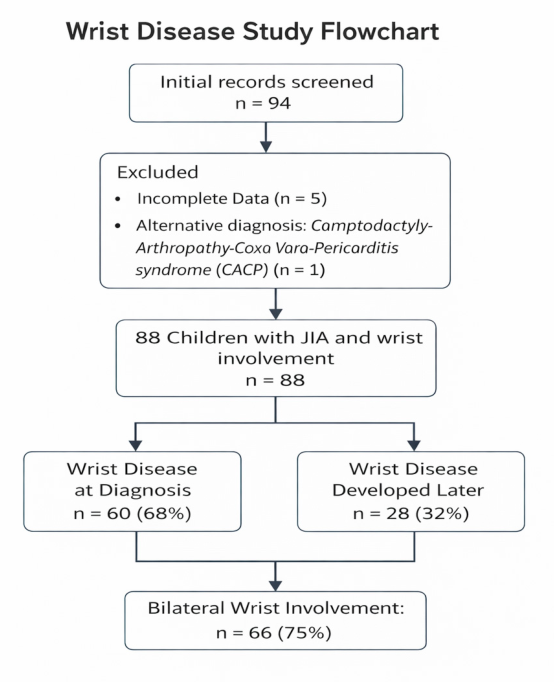
A total of 94 patients met the inclusion criteria, of whom 88 patients (94%) were eligible for final analysis (
Figure 1).
The cohort included 71 females (81%) and 17 males (19%), with a mean age at diagnosis of 6 ± 4.5 years (range 0–15). The mean age at last follow-up was 13 ± 3.7 years, and the mean disease duration was 6.4 ± 3.8 years. Eleven children were diagnosed before 2 years of age, including one infant at 10 months (
Table 1).
Wrist involvement was present at diagnosis in 60 patients (68%), while 28 patients (32%) developed wrist disease later during follow-up. In the overall cohort, the median time to wrist synovitis was 0 months, indicating that most patients presented with early disease. However, the mean time was 15 months, reflecting a subgroup with delayed onset. Among patients without wrist involvement at diagnosis, wrist synovitis developed after a median of 37 months (IQR 22–70), demonstrating a bimodal pattern of disease onset. Bilateral wrist disease occurred in 66 patients (75%) overall. Early wrist arthritis was not limited to a specific age group: 30% of those with early involvement were adolescents (10–15 years), and 26% were diagnosed before 2 years of age.
3.2. Treatment Exposure
All patients received standard-of-care management consistent with international guidelines (
Table 2). Methotrexate (MTX) was initiated in 85 patients (96%), with a mean start time of 8 months after diagnosis (median 4 months; IQR 2–9) and a mean treatment duration of 42 months (IQR 17–55). Three patients—one with persistent oligoarthritis and two with extended oligoarthritis—achieved remission after glucocorticoid injections alone and were discharged without systemic therapy.
Most patients (77, 88%) required escalation beyond MTX, reflecting the aggressive nature of wrist disease. The first biologic agent was etanercept in 68 patients (88%) and adalimumab in 9 patients (11%). All patients who had adalimumab as their first biologic had evidence of concomitant uveitis. Among non-uveitis patients who failed etanercept, adalimumab was again the most common second-line biologic. Thirty-three patients (34%) required a second biologic, 14 (16%) a third, and 4 (5%) a fourth. The mean interval between starting MTX and the first biologic was 23 months (IQR 7–29).
3.3. Intra-Articular Glucocorticoid Therapy
Glucocorticoid injections (triamcinolone hexacetonide, 0.5 mg/kg/joint) were used extensively across the cohort. A total of 476 wrist injections were performed, corresponding to a mean of five injections per patient (range 2–19). The median flare-free interval following the first injection was 17 months, after which most required repeat injections or systemic therapy escalation.
3.4. Disease Activity and Outcomes
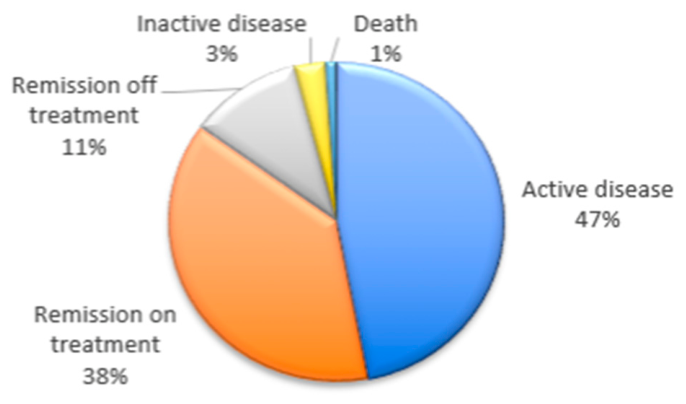
At the last recorded follow-up, outcome data were available for all 88 patients (
Figure 2). Forty-one patients (47%) had active disease, including 24 patients who had already transitioned to adult services. Ten patients (11%) achieved clinical remission off medication, and 33 patients (38%) were in remission on therapy. Three patients (3%) had inactive disease but had not yet met remission criteria. The single death occurred in a patient with comorbid epilepsy and was attributed to sudden unexpected death in epilepsy (SUDEP), unrelated to JIA or its treatment.
Subgroup analysis showed that oligoarticular JIA patients had the best outcomes, with 37% achieving inactive disease and 25% remaining highly active. Among polyarticular JIA cases, 39% achieved inactive or low disease activity, whereas 53% remained in moderate-to-high disease states. The mean clinical Juvenile Arthritis Disease Activity Score (cJADAS-71) was 6 (range 0–91) at last follow-up.
3.5. Magnetic Resonance Imaging (MRI) Findings
A total of 163 wrist MRIs were performed in 55 patients during the study period (
Table 3). The first MRI was normal in 2 patients, showed active synovitis in 31 patients, and erosive changes in 22 patients. Among the 19 patients imaged within three months of presentation, 16 patients (84%) already had erosive changes, underscoring the early destructive potential of wrist arthritis in JIA.
MRI findings influenced management in approximately two-thirds of cases, prompting escalation or modification of systemic therapy. In the remaining third, MRI demonstrated a predominant damage rather than active inflammation, leading to maintenance of existing therapy or a “watchful-wait” approach. Among 163 scans, the most common management actions following MRI included repeat intra-articular glucocorticoid injection (24.5%), biologic initiation or escalation (22.7%), and continuation of current therapy due to inactive or damaged joint (21.5%). These findings illustrate the practical value of MRI not only for detecting subclinical disease but also for preventing unnecessary treatment escalation when irreversible damage predominates.
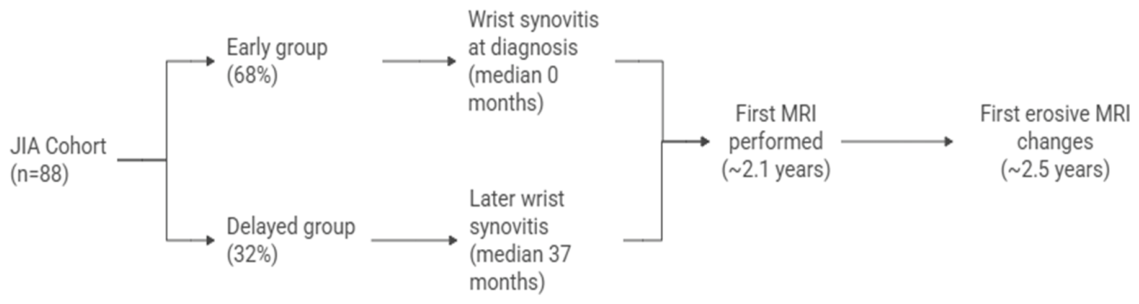
The mean interval from diagnosis to first MRI scan was 2.1 years (IQR 0–3), and erosive changes typically appeared at 2.5 years (IQR 0–4). On average, two MRI studies (range 1–3) were obtained before erosive changes were detected (
Figure 3).
Among the 22 patients with erosive disease on first MRI, the predominant JIA subtypes were polyarticular (46%), extended oligoarthritis (27%), systemic (18%), and psoriatic arthritis (9%). The mean disease duration at first MRI was 3 years (range 0–14). Before MRI confirmation of damage, patients had received a mean of three intra-articular glucocorticoid wrist injections (range 0–9). One child with long-standing systemic JIA, treated before the biologics era, underwent nine injections before his first MRI.
Subgroup analyses were performed to explore clinically relevant differences within the cohort. Comparative analysis between patients with wrist involvement at diagnosis and those who developed wrist disease later during follow-up demonstrated that early wrist involvement was associated with older age at diagnosis (median 7 vs. 3 years,
p = 0.005) and earlier initiation of biologic therapy (median 28 vs. 40 months,
p = 0.041). Importantly, patients with early wrist involvement had significantly higher rates of erosive disease during the disease course (57% vs. 32%,
p = 0.035). No significant differences were observed in sex distribution, ANA positivity, uveitis, bilateral disease, biologic exposure, or synovectomy rates. JIA subtype distribution differed between groups, with polyarticular disease being the most common subtype in both groups, but more frequent among patients who developed wrist involvement later (64% vs. 43%) (
Table 4).
Exploratory analyses of the cohort according to ANA status, sex, and JIA subtype did not demonstrate consistent or clinically meaningful differences beyond established associations (e.g., ANA positivity and uveitis) and were therefore not included.
3.6. Arthroscopic Synovectomy
Twelve patients (14%) underwent arthroscopic synovectomy (AS) between 2017 and 2021. The majority had polyarticular disease (n = 9), followed by extended oligoarthritis (n = 2) and persistent oligoarthritis (n = 1). Compared with non-surgical patients, those requiring synovectomy were more likely to have undergone MRI assessment (100% vs. 57%, p = 0.003). Destructive changes on the first MRI were more frequent in the synovectomy group (50% vs. 21%), although this did not reach statistical significance (p = 0.066). Patients who underwent arthroscopic synovectomy were more likely to have erosive disease during the disease course compared with those managed non-surgically (75% vs. 45%, p = 0.048).
The mean pre-operative pain score was 2.8, improving to 0.8 post-operatively. Childhood Mean Health Assessment Questionnaire (CHAQ) scores improved from 0.7 to 0.2, consistent with subjective functional gains. Three patients had stable pain and function, while three lacked adequate follow-ups for assessment. The mean cJADAS-71 changed minimally (4 to 5), reflecting that AS targeted mechanical pain rather than systemic inflammation. No perioperative complications, infections, or functional deterioration were observed.
4. Discussion
The evaluation of long-term outcomes in childhood arthritis remains a major research priority. Identifying prognostic factors, defining remission trajectories, and refining imaging-based assessment are essential to improving the care of children with juvenile idiopathic arthritis (JIA) [
5,
20,
21,
22]. The present study highlights that wrist arthritis represents a particularly aggressive JIA phenotype, characterized by early onset, frequent bilaterality, high treatment burden, and limited rates of drug-free remission despite the use of modern biologic therapy.
Our findings align with earlier reports that wrist involvement predicts more refractory disease and poorer functional outcomes [
2,
3,
4,
7]. Consistent with these observations, polyarticular RF-negative JIA was the most predominant subtype in our cohort (40%), a pattern also reported in other series where wrist arthritis is frequent, occurs predominantly in females (81%), and is associated with a low incidence of uveitis (18%) [
3,
14]. Nearly 70% of patients presented with wrist synovitis at diagnosis, and three-quarters eventually developed bilateral disease—figures higher than those described in some population-based cohorts [
6,
20,
23]. These observations suggest that early wrist disease may identify a subgroup with a distinct inflammatory trajectory, possibly reflecting a combination of mechanical stress, compact synovial anatomy, and delayed recognition of early synovitis in this joint. In exploratory subgroup analyses, patients who developed wrist involvement later during the disease course were younger at diagnosis, had a longer time to biologic initiation, and demonstrated a lower prevalence of erosive disease compared to those with wrist involvement at diagnosis. Again, these findings may suggest that early wrist involvement represents a more aggressive disease phenotype. The median time to first MRI-documented erosive change of approximately three years reinforces the aggressive course once wrist inflammation becomes established.
Early bilateral wrist involvement and rapid progression to erosive changes emerged as potential markers of poor prognosis. Children exhibiting these features may warrant closer surveillance and earlier escalation to biologic therapy. MRI findings led to treatment modification in two-thirds of cases in this cohort, underscoring the modality’s central role in disease monitoring and individualized management. Beyond its diagnostic utility, MRI should be considered a prognostic and decision-support tool, particularly in patients with incomplete clinical remission or discordant clinical–laboratory findings. Once erosive damage occurred, it proved irreversible: all our patients with MRI-proven erosions demonstrated persistent structural changes on subsequent scans despite treatment optimization.
While ultrasound is a valuable and accessible tool in pediatric rheumatology, it remains operator-dependent and may underestimate deep joint structures such as the wrist [
9,
10]. In contrast, MRI provides superior visualization of synovial inflammation, bone marrow edema, and early erosive changes [
11]. Direct comparative studies between MRI and ultrasound in wrist JIA remain limited, and further research is needed to define their complementary roles. In our study, MRI helped to prevent unnecessary therapeutic escalation in one-third of cases by confirming damage rather than activity. This underscores its potential to optimize resource utilization and avoid overtreatment. The detection of erosive changes within months of diagnosis in some patients indicates that standard clinical evaluation may underestimate early destructive disease. Incorporating MRI into early and follow-up assessment protocols—perhaps annually for high-risk patients—could refine management algorithms.
Arthroscopic synovectomy (AS) provided symptomatic benefit for selected refractory cases. Approximately half of our surgically treated patients reported notable improvement in pain and functional scores, consistent with earlier small series reporting 40–60% improvement in pain and hand function [
12,
13]. The absence of major postoperative complications further supports the safety of this intervention. Additionally, patients requiring arthroscopic synovectomy had a higher prevalence of erosive disease, suggesting that the need for surgical intervention reflects more advanced or treatment-refractory disease. However, these observations should be interpreted with caution given the exploratory nature of the analyses and the relatively small sample size. The minimal change observed in cJADAS-71 before and after surgery emphasizes that AS is not disease-modifying; rather, its value lies in mechanical decompression, pain relief, and quality-of-life improvement once structural damage is established. Future prospective studies should evaluate whether earlier surgical intervention—before irreversible cartilage loss—could yield greater benefit.
The high number of intra-articular glucocorticoid injections observed in this cohort reflects both the persistent nature of wrist synovitis in JIA and the limited durability of local therapy in this anatomically complex joint. While intra-articular injections provide rapid symptom relief and are an important component of early management, repeated injections may indicate refractory disease and the need for earlier systemic escalation. Additionally, cumulative exposure raises considerations regarding potential local effects, including soft tissue atrophy and joint structure alteration, although these were not systematically assessed in this study. These findings highlight the importance of balancing local and systemic therapies in managing wrist arthritis.
Our results complement those of Hemke et al. and Malattia et al., who reported a high frequency of wrist involvement and validated pediatric MRI scoring systems (pRAMRIS) [
4,
16,
24]. However, few prior studies have longitudinally correlated MRI findings with management changes and surgical outcomes within the same cohort. This combination of imaging-based decision tracking and procedural outcomes represents a key strength of our study and provides pragmatic insight into real-world care pathways.
Almost half of the cohort remained active at the last follow-up, with many transitioning to adult services. This underscores the importance of coordinated adolescent transition programs and multidisciplinary management integrating rheumatology, hand surgery, physiotherapy, and occupational therapy. Such models may facilitate earlier detection of functional decline, support timely rehabilitation, and minimize disability during the critical transition to adulthood.
4.1. Limitation
The retrospective design inevitably limited the uniformity of data collection and precluded standardized MRI scoring. Treatment decisions were often influenced by multi-joint disease activity, complicating attribution of outcomes specifically to wrist involvement. Additionally, the absence of a comparator group and the single-center nature of this study restrict generalizability. Nevertheless, the consistent imaging protocol, comprehensive follow-up, and integration of clinical, radiological, and surgical data strengthen the internal validity of our findings.
4.2. Future Directions
Prospective multicenter studies employing standardized pediatric MRI scoring systems (e.g., pRAMRIS) are warranted to confirm these findings and identify imaging biomarkers predictive of irreversible damage. The establishment of longitudinal registries that link MRI features to clinical outcomes could inform personalized treatment algorithms. Furthermore, randomized controlled trials comparing arthroscopic synovectomy with optimized medical therapy are needed to determine its optimal timing and long-term efficacy.
5. Conclusions
Wrist arthritis in juvenile idiopathic arthritis represents a distinct and aggressive disease subset with substantial long-term morbidity. In this cohort, early and bilateral wrist involvement was common, frequently leading to persistent activity, erosive joint damage, and high rates of biologic escalation. Despite optimized therapy, nearly half of the patients continued to have active disease at the last follow-up, emphasizing the chronic and treatment-resistant nature of wrist synovitis in JIA.
Magnetic resonance imaging proved invaluable in both clinical and therapeutic decision-making. By differentiating active inflammation from irreversible structural damage, MRI guided appropriate escalation or de-escalation of therapy in most cases, and prevented unnecessary treatment modifications in others. These findings support the integration of systematic MRI surveillance into the routine management of high-risk joints such as the wrist.
Arthroscopic synovectomy emerged as a safe and beneficial adjunct for selected patients with refractory disease, offering significant pain and functional improvement even when systemic inflammation persisted.
Overall, this study underscores the importance of early detection, standardized imaging, and multidisciplinary care in mitigating long-term disability. Prospective multicenter studies using validated pediatric MRI scoring systems are warranted to define optimal timing of interventions and to establish evidence-based treatment algorithms for this vulnerable patient population.