Article

Real-World Experience with Ruxolitinib in Myeloproliferative Neoplasms: A Single-Center Study from Oman


by
Najah Abdullah Al-salmi
1,
Bushra Salman
2,*,
Yaman Walid Kassab
3,4,*,
Shireen Imam Bakhsh Al Zadjali
2,
Mullaicharam Bhupathyraaj
3,
Zainab Ali Al Lawati
2,
Murtadha Al-Khabori
2 and
Salam AL-Kindi
2
1
Pharmacy Department, Sultan Qaboos University Hospital, University Medical City, Muscat 123, Oman
2
Pharmacy Department, National Hematology and Bone Marrow Transplant Cmeter, University Medical City, Muscat 123, Oman
3
College of Pharmacy, National University of Science and Technology, Muscat 130, Oman
4
College of Pharmacy, Al-Bayah University, Baghdad 10001, Iraq
*
Authors to whom correspondence should be addressed.
J. Oman Med. Assoc. 2026, 3(1), 7; https://doi.org/10.3390/joma3010007
Submission received: 15 December 2025 / Revised: 5 April 2026 / Accepted: 24 April 2026 / Published: 5 May 2026

Abstract

Background: Myeloproliferative neoplasms (MPNs)—including primary myelofibrosis (PMF), polycythemia vera (PV), and essential thrombocythemia (ET)—are clonal stem-cell disorders driven by JAK–STAT pathway activation within an inflammatory microenvironment. Ruxolitinib (RUX), a JAK1/2 inhibitor, improves splenomegaly and symptom burden in myelofibrosis and serves as second-line therapy in hydroxyurea-resistant/intolerant PV. However, real-world data from Middle Eastern populations remains scarce. This study evaluates the effectiveness, safety, and dosing practices of RUX in a heterogeneous Omani MPN cohort. Methods: Electronic records were reviewed for adults diagnosed with MF, PV, or ET who received RUX at Sultan Qaboos University Hospital or the National Hematology and BMT Center between 2018 and 2025. Only patients with at least six months of follow-up were included. Clinical variables, laboratory results, dosing information, and data on treatment responses and toxicities were extracted. Outcomes focused on spleen size changes, symptom improvement, hematologic responses, adverse events, and reasons for treatment discontinuation. Results: Twenty-eight patients were included (71% PMF; mean age 52.6 years). The median time from diagnosis to RUX initiation was 28 months. Among MF patients, mean spleen size decreased by 35% (p = 0.003); 28% achieved ≥35% reduction. Symptomatic improvement was reported by 60%. LDH levels remained unchanged. PV patients showed spleen control in 75% and symptom benefit in all cases, while ET responses were limited. Cytopenias (21%) and infections (11%) were the most common toxicities; discontinuation occurred in 8/28 of patients, and two patients died while on therapy. Initial dosing was frequently inappropriate, particularly underdosing in MF and overdosing in PV. Conclusions: RUX provided meaningful spleen and symptom improvement in MF and PV; however, toxicity, delayed initiation, and inconsistent dosing practices limited overall outcomes. Enhanced guideline-based dosing, proactive toxicity management, and structured multidisciplinary follow-up are essential to optimize RUX use in regional MPN practice.

1. Introduction

Myeloproliferative neoplasms (MPNs) include primary myelofibrosis (PMF), polycythemia vera (PV), and essential thrombocythemia (ET). These BCR-ABL1-negative myeloid disorders arise from acquired mutations involving JAK2, CALR, or MPL, which activate the JAK–STAT pathway [1]. JAK2 V617F is the most common mutation, occurring in approximately two-thirds of all MPN cases and in the vast majority of patients with PV (~95%). In contrast, MPL mutations occur in ~5–10% and CALR mutations in ~25–35% of ET and PMF cases [1].
MPNs impose high symptom burden (fatigue, night sweats, pruritus, bone pain, early satiety) and splenomegaly that impair quality of life; these are routinely quantified using the 10-item MPN-SAF Total Symptom Score (MPN-SAF TSS/MPN-10) [2].
Ruxolitinib (RUX), an oral JAK1/2 inhibitor, was the first targeted therapy to transform symptomatic management in myelofibrosis (MF). The pivotal phase 3 COMFORT trials demonstrated clinically meaningful spleen volume reductions and symptom improvements vs. placebo (COMFORT-I) [3] and vs. best available therapy (COMFORT-II) [4], with signals for survival advantage that persisted on long-term follow-up despite crossover [5]. Subsequent real-world and extended-access data have reinforced durable spleen/symptom responses and a consistent safety profile, with cytopenias as the main dose-limiting toxicity [6]. RUX is also established in PV after hydroxyurea resistance/intolerance: RESPONSE [7] and RESPONSE-2 [8] showed superior hematocrit control (with reduced need for phlebotomy), spleen reduction, and symptom benefit vs. best available therapy, with durable efficacy at 5 years. In ET, randomized data (MAJIC-ET) did not demonstrate superiority over contemporary second-line options [9], although symptom improvement can occur in selected cases [10]; accordingly, the role of RUX in ET remains limited and off-label, but the NCCN guidelines note it may be considered in certain high-risk or refractory cases in which conventional therapies are inadequate [11].
Studies have shown that maintaining adequate RUX dose intensity is clinically important. In MF, the real-world RR6 model showed that suboptimal dosing (<20 mg twice daily at baseline, 3 and 6 months) limited early spleen reduction and predicted inferior overall survival (OS) [12]. In PV, a large U.S. real-world chart review found that only about half of patients initiated RUX at the recommended 10 mg twice-daily dose, with frequent early dose modifications—mainly increases for persistent phlebotomy need or symptoms—and most patients who discontinued therapy did so without any dose changes, suggesting opportunities for improved early dose optimization to achieve sustained hematocrit control and long-term benefit [13].
Safety considerations with RUX include dose-dependent anemia and thrombocytopenia, as well as an increased risk of infections [14]—particularly herpes zoster—with vigilance advised for tuberculosis/hepatitis B reactivation in endemic settings [15]; careful tapering is recommended to mitigate discontinuation syndrome [16].
International guidelines [17] recommend RUX for symptomatic or higher-risk MF and as second-line therapy in hydroxyurea-resistant/intolerant PV [11], with therapy tailored by clinical and molecular risk [11]. However, Middle Eastern pharmacogenetic variations, distinct infectious epidemiology, and differences in healthcare resources may influence both safety and efficacy [18]. Data on MPN epidemiology in Oman are sparse, with possible underreporting due to diagnostic and access limitations. Understanding local practice patterns and outcomes is essential for optimizing therapy. We therefore report our center’s experience with RUX across MF, PV, and ET, focusing on effectiveness (spleen and symptom responses, hematocrit control), safety (cytopenias, infections), and practice patterns in a real-world MPN population.

2. Materials and Methods

2.1. Study Design and Setting

This single-center retrospective cohort study included all adults with MPNs who received RUX at Sultan Qaboos University Hospital and the National Hematology and Bone Marrow Transplant Center, University Medical City, from January 2018 to March 2025. All consecutive patients who initiated RUX and had at least six months of follow-up were eligible for inclusion.

2.2. Eligibility Criteria

Inclusion criteria: (i) adult patients diagnosed with primary or secondary MF, PV, ET, or mixed phenotypes as documented by the treating clinician; (ii) exposure to RUX for an approved or clinically justified indication; (iii) baseline data available and follow-up for at least six months after starting RUX.
Exclusion criteria: (i) missing baseline variables such as diagnosis, blood counts, spleen size, or symptom data, (ii) use of RUX for other (non-MPN) indications, (iii) pediatric patients.

2.3. Study Variables

Data were extracted from electronic patient records and covered the following domains:
  • Demographics
  • Age, gender, body mass index, smoking and alcohol history.
  • Comorbid conditions and the presence of renal or hepatic impairment.
  • Time from initial diagnosis to the start of RUX.
  • Baseline clinical and laboratory details
  • Primary diagnosis, risk category, and documented gene mutations.
  • Spleen size and symptom profile.
  • Hemoglobin level, platelet count, white blood cell count, and hematocrit for patients with PV.
  • Treatment characteristics
  • Start date of RUX, initial dose, most recent dose, and treatment duration.
  • Dose changes, treatment interruptions, and restarts.
  • Concomitant therapies including hydroxyurea, aspirin, darbepoetin, corticosteroids, and hydroxychloroquine.
  • Efficacy outcomes
  • Change in spleen size.
  • Proportion with at least a thirty-five percent spleen reduction.
  • Hematologic responses and symptom improvement.
  • Safety outcomes
  • Type, frequency, and severity of adverse reactions such as anemia, thrombocytopenia, cytopenias, infections, liver enzyme elevation, and bleeding.
  • Management approaches and treatment discontinuation with recorded reasons.

2.4. Outcome Definitions

Spleen size was assessed clinically as palpable length below the left costal margin (BCM) at the mid-clavicular line and recorded in centimeters (cm) before and after RUX initiation. Symptom outcomes were based on patient-reported complaints and physician assessments documented in the EPR. Hematologic parameters including blood counts obtained from laboratory results were taken as the last result prior to RUX initiation and the results closest to the 3- and 6-month follow-up points. The Charlson Comorbidity Index (CCI) was calculated to account for baseline comorbidities. Dosing and dose adjustments were evaluated against the approved product labeling, taking into account baseline platelet count and any documented renal or hepatic impairment [19]. Safety outcomes included the occurrence, type, and severity of adverse drug reactions (ADRs) as per CTCAE v5.0 criteria [20], with infections categorized by type and site. ADR management strategies (dose reduction, treatment interruption, discontinuation, or supportive care) and reasons for permanent discontinuation were recorded as documented in the EPR.

2.5. Sample Size Calculation

This retrospective study included all eligible adult patients with MPNs who received ruxolitinib during the study period at the participating tertiary care institutions in Oman. Because of the rarity of MPNs and the limited number of patients receiving ruxolitinib, a consecutive sampling approach was used, and all eligible cases were included.
No a priori sample size calculation was performed because the study was designed as a real-world retrospective observational analysis based on available clinical records rather than on hypothesis-driven recruitment. The final sample, therefore, reflects the total accessible population meeting the inclusion criteria during the study period.

2.6. Statistical Analysis

Descriptive statistics were used to summarize demographic, clinical, and treatment characteristics, with continuous variables reported as mean (standard deviation) or median (interquartile range) depending on distribution, and categorical variables presented as frequencies and percentages. Within-patient changes in continuous outcomes, such as spleen size and hematologic parameters, were assessed using paired t-tests or Wilcoxon signed-rank tests for non-normally distributed data, with results reported as mean differences and 95% confidence intervals, as well as relative percentage change from baseline. Comparisons between subgroups (e.g., MF vs. PV) were conducted using independent t-tests or Mann–Whitney U tests for continuous variables and χ2 or Fisher’s exact tests for categorical variables. Statistical significance was set at p < 0.05 (two-tailed). All data were analyzed using Stata version 18.5 (StataCorp, College Station, TX, USA).

2.7. Ethical Considerations

This study was approved by the Ethics and Biosafety Committee at College of Pharmacy, National University of Science and Technology (Approval No.- EBS/PRES0601-COP/MSc/III-05/F24-25) on 15 July 2025 and the Medical Ethics and Research Committee at Sultan Qaboos University Hospital (IRB No. SQU-EC/168/2025 MREC# 3617) on 1 July 2025.

3. Results

3.1. Baseline Demographics, Genetics and Lab Results

A total of 28 patients were included in the study, comprising 13 (46%) males and 15 (54%) females. The mean age at diagnosis was 52.6 ± 13.8 years. The majority had a diagnosis of PMF (20 patients, 71%), followed by PV (4 patients, 14%). One patient had MF secondary to PV; one patient had ET with PV, and two patients had ET alone. Any degree of renal impairment was present in six patients (21%) with four patients having CrCl < 60 mL/min, while no patients had documented liver impairment. The CCI at diagnosis was 0 in seven patients (25%), 1 in nine patients (32%), 2–3 in eight patients (29%), and ≥4 in four patients (18%). Hypertension was the most common underlying disorder in 15/28 (54%) patients, followed by diabetes in 7/28 (25%) patients. Prior to starting RUX, 20 patients (71%) were on other medications for their comorbidities. The median duration from diagnosis to RUX initiation was 28.0 months (IQR 13.2–95.3), with a range of 0 to 231 months.
Among patients with PMF (n = 20), the baseline hemoglobin level before treatment was 11.05 ± 3.13 g/dL. Notably, 10 patients (50%) had hemoglobin levels < 10 g/dL at baseline. The mean platelet count was 342.7 ± 226.1 × 10⁹/L. When stratified by platelet categories, two patients (10.0%) had platelet counts between 50 and <100 × 109/L, four patients (20%) had counts between 100 and <200 × 109/L, and 14 patients (70%) had platelet counts ≥ 200 × 109/L. The median baseline LDH level was 665.5 U/L (IQR: 331.5–898 U/L). Only two patients (10%) had LDH values below 250 U/L, while the majority, 18 patients (90%), had elevated LDH levels (≥250 U/L). The median baseline white blood cell (WBC) count was 8.45 × 10⁹/L (IQR: 5.55–15.75 × 10⁹/L). Nearly all patients had counts below 25 × 109/L, with only one patient (5%) presenting with WBC ≥ 25 × 109/L. Although leukocytosis was rarely observed, the majority of patients (12/20, 60%) had received prior immunosuppressive therapy, mainly hydroxyurea, before starting RUX.
Based on the International Prognostic Scoring System (IPSS), risk stratification at baseline was as follows: four patients (20%) were classified as low risk, one patient (5%) as intermediate-1, 14 patients (70%) as intermediate-2, and one patient (5%) as high risk. Two patients (10%) had documented thrombosis.
Conversely, the eight patients with other MPNs (PV, ET, or secondary MF), had a higher mean baseline hemoglobin level before treatment of 13.1 ± 2.15 g/dL. Only one patient had a hemoglobin level < 10 g/dL at baseline. PV patients had baseline platelet levels of 815 ± 541.2 × 10⁹/L, and ET patients had an average count of 1086.5 ± 89.8 × 10⁹/L. The mean hematocrit in PV, MF secondary to PV and PV/ET patients prior to therapy was 45 ± 7%. One PV patient and the patient with secondary MF had thrombosis, whereas ET patients did not report thrombosis in this cohort. All PV patients (n = 4) had received prior hydroxyurea and were maintained on aspirin. Moreover, one PV patient was on regular phlebotomy. Similarly, regular phlebotomy was evident in the secondary MF patient.
Genetic testing revealed that the majority of patients carried a JAK2 mutation (19 patients, 68%). CALR-positive mutations were identified in five patients (18%), while MPL codon 515-positive status was detected in one MF patient. Moreover, triple-negative status was reported in one MF patient. Additionally, two patients had missing mutation data. The baseline demographic and clinical characteristics are shown in Table 1.

3.2. Efficacy

At baseline, patients presented with a range of MPN-related symptoms. The most frequently reported was splenomegaly (23/28, 82%), followed by anemia (13/28, 46%) and fatigue (10/28, 36%). Other symptoms included pain (11/28, 39%), hepatomegaly (8/28, 29%), dizziness (8/28, 29%), headache (7/28, 25%), and nausea (5/28, 18%).
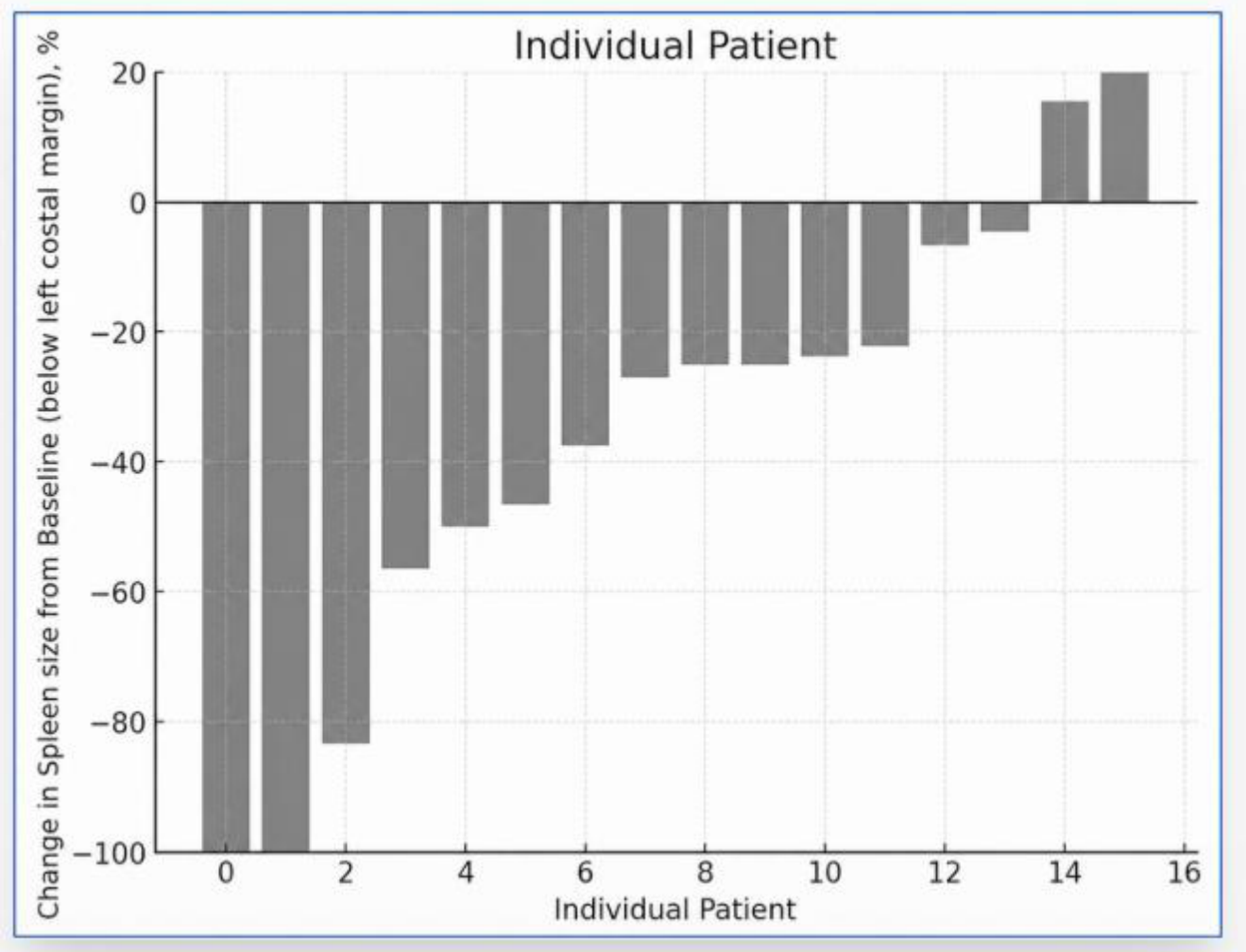
In PMF, among the 16 patients with paired measurements, the mean spleen size before treatment was 16.1 cm (SD 7.3), compared with 11.2 cm (SD 8.6) after treatment. The mean absolute reduction was 4.9 cm (95% CI: 1.9–7.9). When expressed as relative change, the mean percentage reduction in spleen size was 35% (95% CI: −55.0 to −14.9), which was statistically significant (t = 3.48, df = 15, p = 0.003) (Figure 1).
When spleen response was analyzed categorically (n = 18), 28% of patients achieved a >35% reduction in spleen size, while a further 38.9% experienced a 20–34% reduction. Furthermore, 11% had only minor improvement (5–19%), and 16.7% showed no measurable reduction. Baseline hemoglobin levels did not significantly differ between patients who achieved a ≥35% spleen reduction and those who did not (11.7 g/dL vs. 10.9 g/dL, p = 0.663). Likewise, baseline platelet count was not associated with spleen response (p = 0.244).
In terms of global symptom burden, the majority of PMF patients reported clinical benefit after RUX therapy. Notably, 12/20 (60%) experienced clear symptomatic improvement, four (20%) reported mild improvement, and four (20%) had no reported change. Looking at specific symptoms:
-
Fatigue improved in 63% (10/16) of patients, while 38% (6/16) reported no change.
-
Anemia improved in 47% (7/15), whereas 53% (8/15) had no improvement.
-
Splenomegaly improved in 82% (14/17), with 18% (3/17) showing no improvement.
-
Hepatomegaly improved in 73% (11/15), with 7% (1/15) reporting mild improvement and 20% (3/15) showing no change.
Serum LDH levels did not significantly change with treatment. The mean LDH decreased from 656.6 U/L at baseline to 632.6 U/L at 6 months, but this difference was not statistically significant (p = 0.76).
Importantly, baseline demographic factors (age, sex, BMI, CCI) did not have a significant impact on spleen response in PMF.
Splenomegaly was present in three out of four PV patients, of whom three (75%) showed improvement during RUX therapy; in two cases, the reduction exceeded 35%. Symptomatic improvement was reported in all the patients. Splenomegaly was also observed in the secondary MF patient and in one of the two ET patients, where the ET patient had a mild reduction of 5–19%, whereas the secondary MF patient showed no spleen response. A few patients had missing spleen size data. The difference between PMF and non-PMF patients in terms of spleen size reduction ≥ 35% was not statistically significant (p = 0.621).

3.3. Toxicity

Adverse drug reactions (ADRs) were reported as follows: anemia (6/28, 21%), cytopenia (6/28, 21%), infections (3/28, 11%; including two fungal and one herpes zoster virus infection), liver function test (LFT) derangements (2/28, 7%), gastrointestinal bleeding (2/28, 7%), and single cases of headache, dizziness, abdominal pain, acute kidney injury, edema, and rash.
With respect to hematologic toxicity, longitudinal laboratory analyses confirmed trends toward cytopenias during treatment. In MF patients with paired data (n = 19), the mean hemoglobin level declined from 10.8 g/dL before treatment to 10.0 g/dL at 6 months. The mean absolute reduction was 0.83 g/dL (95% CI: −0.13 to 1.79), which did not reach statistical significance (p = 0.085).
Similarly, platelet counts declined from a mean of 339.7 × 10⁹/L before treatment to 299.6 × 10⁹/L at 6 months. The mean reduction was 40.1 × 10⁹/L (95% CI: −6.1 to 86.3), which also did not reach statistical significance (p = 0.085). However, when platelet counts were examined categorically, a significant downward shift was observed (χ2 = 17.45, p = 0.002). Overall, four patients (21%) moved down by one platelet category after 6 months of RUX.
Regarding ADR management strategies, most patients required no intervention (57.1%), while dose reduction was applied in 10.7%, stepwise dose reduction followed by discontinuation in 14.3%, direct discontinuation in 7.1%, and temporary hold with symptomatic management in 10.7%. Treatment discontinuation due to ADRs or death occurred in 10 patients (36%). Other causes of discontinuation included disease progression (3/28; 11%), patient decision (1/28; 4%) or transition to hematopoietic stem cell transplantation (1/28; 4%).

3.4. Dosing Appropriateness

Among patients with PMF (n = 20), the most common starting regimen was 5 mg twice daily (nine patients, 45%), followed by 10 mg twice daily (five patients, 25%). Only four of 20 patients (20%) were started on an appropriate dose, while the majority (65%) received a lower-than-recommended dose. Conversely, in PV patients, the starting dose was inappropriately high (20 mg BID) in three of four cases (75%), while one patient received a low starting dose (5 mg BID). The secondary MF patient (initially diagnosed as PV) was appropriately started on 10 mg BID, whereas the patient with concurrent PV and ET received a lower dose (5 mg BID). In addition, two ET patients received off-label RUX (20 mg BID and 5 mg BID), despite both having platelet counts > 200 × 109/L.
By the last follow-up, dosing patterns had shifted: the most common regimens in PMF patients were 10 mg BID (eight patients, 40%) and 20 mg BID (seven patients, 35%), while 5 mg BID was maintained in four patients (20%). At this stage, dosing appropriateness improved to 35% (p = 0.002). In the PV cohort, two patients were subsequently corrected to 10 mg BID, as was the patient with concurrent PV/ET (p = 0.071).
Most patients were compliant with their prescribed RUX regimen (23/28, 82.1%), while five patients (17.9%) reported non-compliance during follow-up.

3.5. Treatment Duration

The median treatment duration for patients with MF was 34.5 months (IQR: 15–84; range: 6–121), while PV patients had a median duration of 36 months (IQR: 18–49; range: 7–55). The single patient with secondary MF remained on therapy for 3 months, and the patient with concurrent PV/ET for 15 months. ET patients (n = 2) had a median treatment duration of 51.5 months (range: 15–88). The difference in treatment duration between PMF vs. other MPNs was not statistically significant (p = 0.252). Among patients who discontinued treatment, the median overall duration of therapy was 35 months (IQR 21–88; p = 0.636). At a median follow-up duration of 49.1 (IQR 16.3–81.7; range 6.2–121.1) months, the OS rate was 93%. Both observed deaths were in patients diagnosed with PMF; one was attributed to diffuse alveolar hemorrhage leading to respiratory failure, while the second occurred at home, and the exact cause of death could not be definitively determined due to limited available documentation.

4. Discussion

This study provides the first real-world evaluation of RUX in patients with MPNs in Oman. We observed clinically meaningful benefits, with a mean 35% reduction in spleen size and 60% of patients reporting marked symptomatic improvement, particularly in fatigue and splenomegaly. However, ADRs were frequent, with cytopenias (21%) and infections (11%) being the most common, leading to treatment discontinuation in 36% of patients.
The mean age at diagnosis in our PMF cohort was 52.6 years, notably younger than the median age of >65 years reported in the pivotal COMFORT trials [3,4]. This trend toward earlier presentation is consistent with observations from Asian and Middle Eastern populations, although our patients appear younger even compared with the multinational MERGE registry (median age 58 years, IQR 47–66) [18]. Younger age at presentation may carry clinical implications. In a large cohort study of >1500 MPN patients from Mayo Clinic and Italian centers, age at diagnosis was identified as a significant prognostic variable; younger patients demonstrated significantly better OS, and mutation status further influenced survival outcomes, particularly in PMF. Notably, CALR-positive mutations were observed predominantly in younger patients, which is consistent with studies linking CALR gene status to a more favorable prognosis, including better OS and lower comparative thrombotic risk [21]. In our cohort, genetic distribution mirrored international patterns [22] with JAK2 V617F observed in 68%. The lack of CALR enrichment despite the relatively young age of our patients might be influenced by incomplete molecular testing and small sample size.
Comorbidities were generally mild in our cohort, with most patients having low CCI scores. Cardiometabolic conditions such as diabetes, hypertension, and ischemic heart disease have been independently associated with inferior OS and higher thrombotic risk in MPNs irrespective of driver mutation status [23]. Notably, 71% of our patients were receiving concomitant chronic medications, underscoring the need for careful assessment of drug–drug interactions. RUX is primarily metabolized by CYP3A4 (and to a lesser extent by CYP2C9); co-administration with strong CYP3A4 inhibitors can increase systemic exposure and hematologic toxicity [24]. Additive myelosuppressive or immunosuppressive effects with agents such as corticosteroids may further predispose to infection, particularly herpes zoster, which is a recognized complication of JAK inhibition [25]. Accordingly, medication review, vaccination (including influenza and zoster), and infection prophylaxis should be routine components of supportive care in RUX-treated patients.
The relatively long median interval between diagnosis and RUX initiation (28 months) is likely due to reliance on cytoreductive therapy compounded by systemic access barriers, as the drug was only added to our formulary in 2022. Previously, non-formulary procurement often required more than six months, delaying treatment for eligible patients. In contrast, the multinational MERGE registry (≈1000 patients, 20 countries) reported a median interval of ~12 months (IQR 1–36), with most patients (60–70%) receiving prior hydroxyurea. Hydroxyurea remains the most widely available first-line cytoreductive agent in many regions, including the Middle East, commonly used to control leukocytosis and splenomegaly before RUX approval or reimbursement [18]. However, evidence supports earlier RUX use: a pooled COMFORT I/II analysis showed significantly better spleen response and OS when treatment began within 12 months of diagnosis [26], while the JUMP post hoc analysis confirmed higher response rates and longer survival among patients treated early, irrespective of fibrosis grade [27]. The delayed initiation in our cohort may have attenuated treatment response and contributed to the higher discontinuation rate (~40%) observed.

4.1. Efficacy and Safety Outcomes

Among MF patients, RUX produced a significant reduction in spleen size, with a mean decrease of 35%, closely mirroring the pivotal COMFORT-I/II trials [3,4,26], where approximately 30–40% of patients achieved ≥35% spleen volume reduction; in our cohort, 28% of patients achieved ≥35% spleen reduction. Notably, two-thirds achieved ≥ 20% reduction, confirming a meaningful clinical benefit consistent with global data. These findings are comparable to a Korean multicenter study (n = 123), in which 51.2% achieved ≥25% spleen reduction [28].
However, this response was lower than that reported in the JUMP phase 3b study (27), in which >50% reduction in palpable spleen length occurred in over 70% of patients. In JUMP, several factors were independently associated with superior spleen response—lower risk category (OR 0.65; 95% CI 0.44–0.95), upfront RUX use (OR 0.53; 95% CI 0.38–0.75), and doses > 20 mg/day (OR 0.47; 95% CI 0.33–0.68) [29]. The comparatively lower response in our population likely reflects compromises in all three factors, as most patients received RUX later in their disease course, at reduced doses, and with higher baseline risk.
Smaller real-world studies also reported higher response rates. A Turkish cohort (n = 57) showed ≥35% spleen reduction in 56.6% of patients overall and 43.4% at 6 months [30], while a Portuguese cohort (n = 15) demonstrated a median reduction of 67% in 80% of the cohort at the first month and 75% in 83% after one year [31]. In these studies, in which the inclusion criteria and risk groups were comparable to our study, approximately 70% of patients received full-dose therapy, compared with only 20% at initiation and 35% at last follow-up in our cohort, highlighting the impact of dose optimization.
Symptom improvement was observed in 60% of patients, lower than the 98.5% reported in the Korean study and >90% in the Turkish cohort using MPN-SAF TSS [28,30]. This again likely reflects delayed treatment, suboptimal dosing, and the absence of standardized symptom assessment in our study. Symptom control is one of the main treatment goals in MPNs as they severely impact patients’ quality of life and ability to perform daily activities. The German Study Group for MPN (GSG-MPN) showed that severe symptoms especially fatigue and weight loss were linked to inferior OS. This suggests that systematic evaluation using validated tools is essential and should be considered in clinical practice.
Notably, LDH levels showed no significant change, aligning with evidence that RUX exerts its benefit mainly through cytokine modulation rather than through direct disease modification [32], highlighting the need to further evaluate inflammatory biomarkers in this cohort.
In PV, spleen control was achieved in 3/4 (75%) of patients, with half (2/4) attaining >35% reduction while maintaining hematocrit under adjunctive measures. This finding was consistent with the established therapeutic role of ruxolitinib in PV [33]. In a large multicenter PV trial (n = 126), resolution of palpable splenomegaly was also seen in around half of the cohort, but fair comparisons remain limited due to the very few patients in our study [34]. ET patients, who received off-label therapy, demonstrated limited spleen responses, though one reported symptomatic benefit. ET is driven predominantly by megakaryocytic proliferation and cytokine-mediated microvascular disturbances rather than marked splenic extramedullary hematopoiesis. This helps explain the comparatively muted spleen response to RUX [33]. Nevertheless, several studies have demonstrated improvement in selected ET symptoms, especially when other treatment options are exhausted [10].
RUX showed a manageable safety profile, consistent with pivotal trials and real-world experience. The predominant toxicities were anemia and cytopenias, which are the dose-limiting myelosuppressive effects of JAK inhibition [35]. Previous studies have demonstrated that RUX-induced anemia typically peaks within the first 12 weeks and stabilizes thereafter as disease control improves and supportive measures are implemented [4,14,36]. In our cohort, mean declines in hemoglobin and platelet counts did not reach statistical significance, yet a significant categorical decrease in platelet levels reinforces the need for close hematologic surveillance. Reported rates of grade ≥ 3 anemia (42–45%) and thrombocytopenia (8–13%) in the COMFORT trials were notably higher than in our cohort [14], possibly reflecting conservative dosing and cautious patient selection. Although treatment discontinuation occurred in a significant proportion of patients, many remained on therapy for a prolonged duration prior to discontinuation.
Infectious complications occurred in 11% of patients, including fungal and herpes zoster infections, aligning with prior evidence that JAK inhibition increases susceptibility to opportunistic infections [37]. Long-term safety data indicate a cumulative infection risk of up to 72%, with the most frequently reported infections including upper respiratory tract infections (63.9%), herpes zoster (19.4%), urinary tract infections (16.7%), and pneumonia (16.7%). Severe (grade 3–4) infections were observed in approximately 27% of patients, with rare but serious opportunistic infections such as Actinomyces and disseminated mycobacterial infections reported even several years after treatment initiation [38].
Despite this, most adverse events remain manageable with dose adjustment or temporary interruption. The treatment discontinuation rate of 39% was higher than in clinical trials but comparable to that in other real-world studies, in which comorbidities, cytopenias, and limited supportive resources often influence treatment persistence [27,39]. Importantly, long-term data suggest that the incidence of hematologic adverse events plateaus over time, supporting the sustained tolerability of ruxolitinib. However, a potential increased risk of non-melanoma skin cancers and other secondary malignancies has been reported with prolonged exposure, underscoring the need for continued vigilance and long-term surveillance [38].

4.2. Dosing Practices

Inappropriate initial dosing was common in this cohort, with most PMF patients started on lower-than-recommended doses and most PV patients overdosed relative to guideline-based regimens. Such deviations likely contributed to reduced efficacy and increased toxicity in some cases. Comparable real-world observations have been reported across multiple countries—including the USA, Canada, France, Germany, Spain, and the U.K.—where more than half of MF patients were initiated on off-label ruxolitinib doses [40]. Similarly, in PV, only 50% received the recommended 10 mg twice-daily dose, though baseline characteristics appear similar between appropriately and inappropriately dosed groups [13]. While cautious underdosing often reflects concern about baseline cytopenias, persistent subtherapeutic dosing has been linked to inferior spleen responses and overall outcomes [41]. Conversely, excessive dosing in PV has been associated with higher discontinuation rates without additional clinical benefit [13]. These patterns highlight the importance of structured pharmacist-led interventions—including early dose verification, toxicity counseling, and adherence monitoring—which have demonstrated improvements in both safety and long-term treatment continuity in MPN management [42]. The observed non-compliance in a subset of patients further emphasizes the need for sustained patient engagement and multidisciplinary oversight to ensure optimal ruxolitinib use.

4.3. Survival and Treatment Duration

Median treatment duration for MF was 34.5 months, comparable to other real-world studies, and OS at a median 49-month follow-up was 93%. Both deaths occurred in PMF, reflecting the aggressive nature of this subtype. In the ERNEST European Registry for MPNs, the median OS in MF was 7.7 years, with survival benefit not diminished when RUX was used in the second-line setting compared with first-line use [43]. Other studies showed prolonged survival rates exceeding 75% after >80 months of treatment with RUX [6].

4.4. Strengths and Limitations

This study has several limitations, including its single-center, retrospective design, modest sample size, and incomplete molecular profiling, which may limit generalizability. However, myeloproliferative neoplasms are relatively rare disorders, and real-world studies—particularly single-center experiences—often involve limited patient numbers. The published evidence similarly reflects small cohorts outside large registries; for example, studies from Portugal and Turkey included 15 and 57 patients, respectively. In this context, and considering the population size in Oman, our sample size is consistent with previously reported real-world experiences [30,31,38]. In addition, symptom improvement was evaluated through patient self-report and physician assessment rather than by using a structured, validated tool such as the MPN-SAF Total Symptom Score (TSS). The absence of standardized patient-reported outcome measures (PROMs) may have led to underestimation of the true symptomatic benefit and introduces potential recall and observer bias. This limitation may also affect the objectivity and comparability of treatment response assessment. Such limitations are common in real-world settings, in which systematic implementation of PROMs is often lacking, thereby restricting comparability with pivotal trials that employ validated symptom instruments. Furthermore, spleen size assessment was based on clinical palpation documented in routine practice, as standardized imaging measurements were not consistently available in this retrospective cohort; this approach, while less precise and subject to inter-observer variability, has also been reported in real-world studies [30].
Despite these constraints, this study provides valuable real-world evidence on ruxolitinib use in Oman, where data on MPN epidemiology and treatment outcomes remain limited.

5. Conclusions

In summary, RUX was effective in reducing splenomegaly and symptom burden in MF and PV, but its benefits were tempered by hematologic toxicity and suboptimal dosing practices. Optimizing prescribing through guideline adherence and enhanced multidisciplinary management will be essential to maximize its clinical value in MPN patients.

Author Contributions

Conceptualization, N.A.A.-s. and S.I.B.A.Z.; methodology, N.A.A.-s.; software, N.A.A.-s.; validation, M.B., M.A.-K. and S.A.-K.; formal analysis, N.A.A.-s. and B.S.; resources, Y.W.K. and M.B.; data curation, N.A.A.-s. and Z.A.A.L.; writing—original draft preparation, B.S.; writing—review and editing, Y.W.K., S.I.B.A.Z., M.A.-K. and S.A.-K.; visualization, N.A.A.-s.; supervision, Y.W.K., S.I.B.A.Z. and S.A.-K.; project administration, N.A.A.-s.; funding acquisition, Not applicable. All authors have read and agreed to the published version of the manuscript.

Funding

This research received no external funding.

Institutional Review Board Statement

This study was approved by the Ethics and Biosafety Committee at the College of Pharmacy, National University of Science and Technology (Approval No.: EBS/PRES0601-COP/MSc/III-05/F24-25) and the Medical Ethics and Research Committee at Sultan Qaboos University Hospital (IRB No. SQU-EC/168/2025, MREC# 3617).

Informed Consent Statement

Formal written informed consent was not obtained for this study. The requirement for informed consent was waived, as patients provide general consent at the time of registration to receive treatment at the hospital. All treatments administered during the study period were part of standard clinical care.

Data Availability Statement

Protocols and de-identified, aggregated data that underline the results reported in this article are available for non-commercial scientific purposes upon reasonable request from the corresponding authors.

Acknowledgments

The authors would like to thank Al-Bayan University for supporting this research.

Conflicts of Interest

The authors declare no conflicts of interest.

Abbreviations

The following abbreviations are used in this manuscript:
AbbreviationDefinition
ADRsAdverse Drug Reactions
BCR-ABL1Breakpoint Cluster Region–Abelson Murine Leukemia Viral Oncogene
BCMBelow Costal Margin
BIDTwice Daily (bis in die)
BMIBody Mass Index
BMTBone Marrow Transplant
CCICharlson Comorbidity Index
cmCentimeter
CrClCreatinine Clearance
CTCAECommon Terminology Criteria for Adverse Events
EPRElectronic Patient Record
ETEssential Thrombocythemia
HUHydroxyurea
IQRInterquartile Range
IRBInstitutional Review Board
IPSSInternational Prognostic Scoring System
JAKJanus Kinase
LDHLactate Dehydrogenase
LFTsLiver Function Tests
MFMyelofibrosis
MPNMyeloproliferative Neoplasm
MPN-SAF TSS/MPN-10Myeloproliferative Neoplasm Symptom Assessment Form Total Symptom Score
MPLMyeloproliferative Leukemia Virus Oncogene
NCCNNational Comprehensive Cancer Network
OSOverall Survival
PMFPrimary Myelofibrosis
PVPolycythemia Vera
RUXRuxolitinib
SDStandard Deviation
SQUHSultan Qaboos University Hospital
TSSTotal Symptom Score
WBCWhite Blood Cell Count

References

  1. Li, B.; Rampal, R.K.; Xiao, Z. Targeted therapies for myeloproliferative neoplasms. Biomark. Res. 2019, 7, 15. [Google Scholar] [CrossRef] [PubMed] [PubMed Central]
  2. Emanuel, R.M.; Dueck, A.C.; Geyer, H.L.; Kiladjian, J.J.; Slot, S.; Zweegman, S.; Te Boekhorst, P.A.W.; Commandeur, S.; Schouten, H.C.; Sackmann, F.; et al. Myeloproliferative neoplasm (MPN) symptom assessment form total symptom score: Prospective international assessment of an abbreviated symptom burden scoring system among patients with MPNs. J. Clin. Oncol. 2012, 30, 4098–4103. [Google Scholar] [CrossRef] [PubMed] [PubMed Central]
  3. Verstovsek, S.; Mesa, R.A.; Gotlib, J.; Levy, R.S.; Gupta, V.; DiPersio, J.F.; Catalano, J.V.; Deininger, M.; Miller, C.; Silver, R.T.; et al. A Double-Blind, Placebo-Controlled Trial of Ruxolitinib for Myelofibrosis. N. Engl. J. Med. 2012, 366, 799–807. [Google Scholar] [CrossRef] [PubMed]
  4. Harrison, C.; Kiladjian, J.J.; Al-Ali, H.K.; Gisslinger, H.; Waltzman, R.; Stalbovskaya, V.; McQuitty, M.; Hunter, D.S.; Levy, R.; Knoops, L.; et al. JAK inhibition with ruxolitinib versus best available therapy for myelofibrosis. N. Engl. J. Med. 2012, 366, 787–798. [Google Scholar] [CrossRef] [PubMed]
  5. Harrison, C.N.; Vannucchi, A.M.; Kiladjian, J.J.; Al-Ali, H.K.; Gisslinger, H.; Knoops, L.; Cervantes, F.; Jones, M.M.; Sun, K.; McQuitty, M.; et al. Long-term findings from COMFORT-II, a phase 3 study of ruxolitinib vs. best available therapy for myelofibrosis. Leukemia 2016, 30, 1701–1707. [Google Scholar] [CrossRef] [PubMed] [PubMed Central]
  6. Al-Ali, H.K.; Gerds, A.T.; Grunwald, M.R.; Yu, J. A Review of Real-World Experience with Ruxolitinib for Myelofibrosis. Clin. Lymphoma Myeloma Leuk. 2025, 25, e262–e281. [Google Scholar] [CrossRef] [PubMed]
  7. Vannucchi, A.M.; Kiladjian, J.J.; Griesshammer, M.; Masszi, T.; Durrant, S.; Passamonti, F.; Harrison, C.N.; Pane, F.; Zachee, P.; Mesa, R.; et al. Ruxolitinib versus standard therapy for the treatment of polycythemia vera. N. Engl. J. Med. 2015, 372, 426–435. [Google Scholar] [CrossRef] [PubMed] [PubMed Central]
  8. Passamonti, F.; Griesshammer, M.; Palandri, F.; Egyed, M.; Benevolo, G.; Devos, T.; Callum, J.; Vannucchi, A.M.; Sivgin, S.; Bensasson, C.; et al. Ruxolitinib for the treatment of inadequately controlled polycythaemia vera without splenomegaly (RESPONSE-2): A randomised, open-label, phase 3b study. Lancet Oncol. 2017, 18, 88–99. [Google Scholar] [CrossRef] [PubMed]
  9. Harrison, C.N.; Mead, A.J.; Panchal, A.; Fox, S.; Yap, C.; Gbandi, E.; Houlton, A.; Alimam, S.; Ewing, J.; Wood, M.; et al. Ruxolitinib vs. best available therapy for ET intolerant or resistant to hydroxycarbamide. Blood 2017, 130, 1889–1897. [Google Scholar] [CrossRef] [PubMed] [PubMed Central]
  10. Gunawan, A.; Harrington, P.; Garcia-Curto, N.; McLornan, D.; Radia, D.; Harrison, C. Ruxolitinib for the Treatment of Essential Thrombocythemia. Hemasphere 2018, 2, e56. [Google Scholar] [CrossRef] [PubMed] [PubMed Central]
  11. NCCN [Internet]. Guidelines Detail. Available online: https://www.nccn.org/guidelines/guidelines-detail?category=1&id=1477 (accessed on 15 August 2025).
  12. Maffioli, M.; Mora, B.; Ball, S.; Iurlo, A.; Elli, E.M.; Finazzi, M.C.; Polverelli, N.; Rumi, E.; Caramella, M.; Carraro, M.C.; et al. A prognostic model to predict survival after 6 months of ruxolitinib in patients with myelofibrosis. Blood Adv. 2022, 6, 1855–1864. [Google Scholar] [CrossRef] [PubMed]
  13. Altomare, I.; Parasuraman, S.; Paranagama, D.; Kish, J.; Lord, K.; Yu, J.; Colucci, P. Real-World Dosing Patterns of Ruxolitinib in Patients with Polycythemia Vera Who Are Resistant to or Intolerant of Hydroxyurea. Clin. Lymphoma Myeloma Leuk. 2021, 21, e915–e921. [Google Scholar] [CrossRef] [PubMed]
  14. Verstovsek, S.; Mesa, R.A.; Livingston, R.A.; Hu, W.; Mascarenhas, J. Ten years of treatment with ruxolitinib for myelofibrosis: A review of safety. J. Hematol. Oncol. 2023, 16, 82. [Google Scholar] [CrossRef] [PubMed]
  15. Adas, M.A.; Alveyn, E.; Cook, E.; Dey, M.; Galloway, J.B.; Bechman, K. The infection risks of JAK inhibition. Expert Rev. Clin. Immunol. 2022, 18, 253–261. [Google Scholar] [CrossRef] [PubMed] [PubMed Central]
  16. Palandri, F.; Palumbo, G.A.; Elli, E.M.; Polverelli, N.; Benevolo, G.; Martino, B.; Abruzzese, E.; Tiribelli, M.; Tieghi, A.; Latagliata, R.; et al. Ruxolitinib discontinuation syndrome: Incidence, risk factors, and management in 251 patients with myelofibrosis. Blood Cancer J. 2021, 11, 4. [Google Scholar] [CrossRef]
  17. Harrison, C.N.; Bose, P.; Ellis, M.H.; Gupta, V.; Kiladjian, J.J.; Mascarenhas, J.; Mathews, V.; Passamonti, F.; Koschmieder, S. Consensus-Based Best Practice Recommendations for Myelofibrosis Management in Routine Clinical Practice with a Focus on Patients with Cytopenias: Systematic Literature Review and Clinical Practice Recommendations from a Global Consensus Group. Blood 2023, 142, 2355. [Google Scholar] [CrossRef]
  18. Yassin, M.A.; Taher, A.; Mathews, V.; Hou, H.A.; Shamsi, T.; Tuğlular, T.F.; Xiao, Z.; Kim, S.; Depei, W.; Li, J.; et al. MERGE: A Multinational, Multicenter Observational Registry for Myeloproliferative Neoplasms in Asia, including Middle East, Turkey, and Algeria. Cancer Med. 2020, 9, 4512–4526. [Google Scholar] [CrossRef] [PubMed]
  19. Prescribing Information|JAKAFI®® (Ruxolitinib) [Internet]. Available online: https://www.jakafi.com/jakafi-prescribing-information (accessed on 13 November 2025).
  20. Common Terminology Criteria for Adverse Events (CTCAE) v5.0 [Internet]. Available online: https://icommuse.com/ctcae5/index.html (accessed on 13 November 2025).
  21. Tefferi, A.; Guglielmelli, P.; Larson, D.R.; Finke, C.; Wassie, E.A.; Pieri, L.; Gangat, N.; Fjerza, R.; Belachew, A.A.; Lasho, T.L.; et al. Long-term survival and blast transformation in molecularly annotated essential thrombocythemia, polycythemia vera, and myelofibrosis. Blood 2014, 124, 2507–2513. [Google Scholar] [CrossRef] [PubMed] [PubMed Central]
  22. Rumi, E.; Cazzola, M. Diagnosis, risk stratification, and response evaluation in classical myeloproliferative neoplasms. Blood 2017, 129, 680–692. [Google Scholar] [CrossRef] [PubMed] [PubMed Central]
  23. How, J.; Leiva, O.; Redd, R.; Marneth, A.E.; DeAngelo, D.J.; Dieli-Conwright, C.M.; El-Jawahri, A.; Kamaz, B.; Kim, C.; Lindsley, R.C.; et al. Cardiovascular risk factors in myeloproliferative neoplasms: Associations with survival and thrombotic outcomes. Blood Vessel. Thromb. Hemost. 2025, 2, 100051. [Google Scholar] [CrossRef] [PubMed]
  24. Appeldoorn, T.Y.J.; Munnink, T.H.O.; Morsink, L.M.; Hooge, M.N.L.; Touw, D.J. Pharmacokinetics and Pharmacodynamics of Ruxolitinib: A Review. Clin. Pharmacokinet. 2023, 62, 559–571. [Google Scholar] [CrossRef] [PubMed] [PubMed Central]
  25. Jarneborn, A.; Kopparapu, P.K.; Jin, T. The Dual-Edged Sword: Risks and Benefits of JAK Inhibitors in Infections. Pathogens 2025, 14, 324. [Google Scholar] [CrossRef] [PubMed]
  26. Verstovsek, S.; Kiladjian, J.J.; Vannucchi, A.M.; Mesa, R.A.; Squier, P.; Hamer-Maansson, J.E.; Harrison, C. Early intervention in myelofibrosis and impact on outcomes: A pooled analysis of the COMFORT-I and COMFORT-II studies. Cancer 2023, 129, 1681–1690. [Google Scholar] [CrossRef] [PubMed]
  27. Palandri, F.; Al-Ali, H.K.; Guglielmelli, P.; Zuurman, M.W.; Sarkar, R.; Gupta, V. Benefit of Early Ruxolitinib Initiation Regardless of Fibrosis Grade in Patients with Primary Myelofibrosis: A Post Hoc Analysis of the Single-Arm Phase 3b JUMP Study. Cancers 2023, 15, 2859. [Google Scholar] [CrossRef] [PubMed] [PubMed Central]
  28. Jung, E.H.; Hong, J.; Kim, S.Y.; Park, Y.; Yuh, Y.J.; Mun, Y.C.; Lee, W.-S.; Park, S.-K.; Bang, S.M. Real-World Outcomes of Ruxolitinib in Patients with Myelofibrosis Focusing on Red Blood Cell Transfusion: A Multicenter Study from the MPN Working Party of the Korean Society of Hematology. Clin. Lymphoma Myeloma Leuk. 2022, 22, e931–e937. [Google Scholar] [CrossRef] [PubMed]
  29. Gupta, V.; Griesshammer, M.; Martino, B.; Foltz, L.; Tavares, R.; Al-Ali, H.K.; Giraldo, P.; Guglielmelli, P.; Lomaia, E.; Bouard, C.; et al. Analysis of predictors of response to ruxolitinib in patients with myelofibrosis in the phase 3b expanded-access JUMP study. Leuk. Lymphoma 2021, 62, 918–926. [Google Scholar] [CrossRef] [PubMed]
  30. Arikan, F.; Toptas, T.; Atagunduz, I.K.; Ercan, T.; Oruc, O.; Yilmaz, F.; Tuglular, T. Real-life ruxolitinib experience in intermediate-risk myelofibrosis. Blood Res. 2021, 56, 322–331. [Google Scholar] [CrossRef] [PubMed] [PubMed Central]
  31. Almeida, A.; Alnajjar, K.; Viriato, D. Real-World Evidence of Ruxolitinib in the Treatment of Myelofibrosis: Experince of A Portuguese Hospital Center. Value Health 2016, 19, A577. [Google Scholar] [CrossRef] [PubMed]
  32. Passamonti, F.; Mora, B. Myelofibrosis. Blood 2023, 141, 1954–1970. [Google Scholar] [CrossRef]
  33. Wang, L.; Li, J.; Arbitman, L.; Zhang, H.; Shao, H.; Martin, M.; Moscinski, L.; Song, J. Current Advances in the Diagnosis and Treatment of Major Myeloproliferative Neoplasms. Cancers 2025, 17, 1834. [Google Scholar] [CrossRef] [PubMed] [PubMed Central]
  34. Coltoff, A.; Mesa, R.; Gotlib, J.; Shulman, J.; Rampal, R.K.; Siwoski, O.; Yacoub, A.; Moliterno, A.; Yang, A.; Braunstein, E.; et al. Real-World Outcomes of Ruxolitinib Treatment for Polycythemia Vera. Clin. Lymphoma Myeloma Leuk. 2020, 20, 697–703.e1. [Google Scholar] [CrossRef] [PubMed] [PubMed Central]
  35. Stuckey, R.; Segura Díaz, A.; Gómez-Casares, M.T. Myelofibrosis: Treatment Options After Ruxolitinib Failure. Curr. Oncol. 2025, 32, 339. [Google Scholar] [CrossRef] [PubMed] [PubMed Central]
  36. Verstovsek, S.; Mesa, R.A.; Gotlib, J.; Levy, R.S.; Gupta, V.; DiPersio, J.F.; Catalano, J.V.; Deininger, M.W.; Miller, C.B.; Silver, R.T.; et al. Efficacy, safety and survival with ruxolitinib in patients with myelofibrosis: Results of a median 2-year follow-up of COMFORT-I. Haematologica 2013, 98, 1865–1871. [Google Scholar] [CrossRef] [PubMed] [PubMed Central]
  37. Winthrop, K.L. The emerging safety profile of JAK inhibitors in rheumatic disease. Nat. Rev. Rheumatol. 2017, 13, 234–243. [Google Scholar] [CrossRef] [PubMed]
  38. Blanco-Sánchez, A.; Ayala, R.; Carreño-Tarragona, G.; Colmenares, R.; López-Muñoz, N.; Sáez, A.; Palacios-Berraquero, M.L.; Hernández, J.; Martínez-López, J. Long-Term Safety Profile of Ruxolitinib in Chronic Myeloproliferative Neoplasms: A Comprehensive Real-World Analysis. EJHaem 2025, 6, e70152. [Google Scholar] [CrossRef] [PubMed] [PubMed Central]
  39. Koschmieder, S.; Isfort, S.; Schulte, C.; Jacobasch, L.; Geer, T.; Reiser, M.; Koenigsmann, M.; Heinrich, B.; Wehmeyer, J.; von der Heyde, E.; et al. Real-world analysis of ruxolitinib in myelofibrosis: Interim results focusing on patients who were naïve to JAK inhibitor therapy treated within the JAKoMo non-interventional, phase IV trial. Ann. Hematol. 2023, 102, 3383–3399. [Google Scholar] [CrossRef] [PubMed] [PubMed Central]
  40. Real-World Analysis of Ruxolitinib Treatment Patterns and Outcomes Among Patients with Myelofibrosis|Blood|American Society of Hematology [Internet]. Available online: https://ashpublications.org/blood/article/134/Supplement_1/4750/428727/Real-World-Analysis-of-Ruxolitinib-Treatment (accessed on 14 November 2025).
  41. Breccia, M.; Palandri, F.; Martelli, M.; Mendicino, F.; Malato, A.; Palumbo, G.A.; Sibilla, S.; Di Renzo, N.; Abruzzese, E.; Siragusa, S.; et al. Dosing and clinical outcomes of ruxolitinib in patients with myelofibrosis in a real-world setting: Interim results of the Italian observational study (ROMEI). Cancer 2025, 131, e35801. [Google Scholar] [CrossRef] [PubMed] [PubMed Central]
  42. Palandri, F.; Auteri, G.; Abruzzese, E.; Caocci, G.; Bonifacio, M.; Mendicino, F.; Latagliata, R.; Iurlo, A.; Branzanti, F.; Garibaldi, B.; et al. Ruxolitinib Adherence in Myelofibrosis and Polycythemia Vera: The “RAMP” Italian multicenter prospective study. Ann. Hematol. 2024, 103, 1931–1940. [Google Scholar] [CrossRef] [PubMed] [PubMed Central]
  43. Guglielmelli, P.; Ghirardi, A.; Carobbio, A.; Masciulli, A.; Maccari, C.; Mora, B.; Rumi, E.; Triguero, A.; Finazzi, M.C.; Pettersson, H.; et al. Impact of ruxolitinib on survival of patients with myelofibrosis in the real world: Update of the ERNEST Study. Blood Adv. 2022, 6, 373–375. [Google Scholar] [CrossRef] [PubMed] [PubMed Central]
Figure 1. Individual patient percentage change in palpable spleen size from baseline (cm) below left costal margin in the myelofibrosis cohort.
Joma 03 00007 g001
Table 1. Baseline demographic and clinical characteristics.
Baseline CharacteristicOverall
N$ = 28
PMF
N = 20
Others (PV, Secondary MF, PV/ET, ET)
N = 8
p-Value
Age at diagnosis (years), mean ± SD52.6 ± 13.855.6 ± 13.145.1 ± 13.30.070
Sex, female, n# (%)15 (54)10 (50)5 (63)0.686
BMI (kg/m2), mean ± SD24.2 ± 4.723.5 ± 5.025.8 ± 3.70.257
Renal impairment *, n (%)4 (14)4 (20)0 (0)0.141
CCI * score, n (%)0: 7 (25)
1: 9 (32)
2–3: 8 (29)
≥4: 4 (14)
0: 3 (15)
1: 6 (30)
2–3: 7 (35)
≥4: 4 (20)
0: 4 (50)
1: 3 (37.5)
2–3: 1 (12.5)
≥4: 0 (0)
0.068 **
Taking medications for co-morbidities, n (%)20 (71)16 (80)4 (40)0.172
Duration from diagnosis to RUX initiation (months), median (IQR)28 (13–95)21 (7–80)80 (45–130)0.037
Hemoglobin, mean ± SD11.6 ± 3.011.1 ± 3.113.1 ± 2.20.100
Platelets, mean ± SD465.5 ± 375.5342.7 ± 226.1772.5 ± 451.10.002
WBC, median (IQR)9.0 (5.8–15.8)8.5 (5.6–15.8)9.0 (7.7–16.5)0.666
LDH, median (IQR)473.0 (274.5–817.5)665.5 (331.5–898.0)260.5 (215.5–317.5)0.011
Risk stratification, n (%)-Low: 4 (20)
Intermediate-1: 1 (5)
Intermediate-2: 14 (70)
High: 1 (5)
PV and PV/ET, n = 5
Low: 3 (60)
High: 2 (40)
ET, n = 2
Very low risk: 1 (50)
Low risk: 1 (50)
Secondary MF, n = 1
Intermediate-1: 1 (100)
-
Thrombosis4 (14)2 (10)2 (25)0.684
Mutational statusJAK2 positive-19 (68)
CALR-positive-5 (18)
MPL codon 515-1 (4) Triple-negative-1 (4)
Missing-2 (7)
JAK2 positive-13 (65)
CALR-positive-4 (20)
MPL codon 515-1 (5) Triple-negative-1 (5)
Missing-1 (5)
PV and PV/ET, n = 5
JAK2 positive-5 (100)

ET, n = 2
JAK2 positive-1 (50)
CALR-positive-1 (50)

Secondary MF, n = 1
Missing-1 (100)
0.445
Prior hydroxyurea19 (68)12 (60)7 (88)0.214
Concomitant aspirin13 (46)8 (29)5 (63)0.410
* (CrCl < 60 mL/min); ** p-value refers to comparison of CCI categories (0–1, ≥2) between patients with PMF and non-PMF diagnoses. $N denotes the total study population; n# denotes subgroup sample sizes. BMI: body mass index, CCI: Charlson comorbidity index, CrCl: creatinine clearance, ET: essential thrombocythemia, IQR: interquartile range, LDH: lactate dehydrogenase, MF: myelofibrosis, PMF: primary myelofibrosis, PV: polycythemia vera, RUX: ruxolitinib, SD: standard deviation, WBC: white blood count.
Disclaimer/Publisher’s Note: The statements, opinions and data contained in all publications are solely those of the individual author(s) and contributor(s) and not of MDPI and/or the editor(s). MDPI and/or the editor(s) disclaim responsibility for any injury to people or property resulting from any ideas, methods, instructions or products referred to in the content.