Review

Classical, Modern, and Hybrid Statistical Approaches in Aerobiology

1
Africa Industrial Research Center, National Chung Hsing University, Taichung 40227, Taiwan
2
Department of Bio-Industrial Mechatronics Engineering, National Chung Hsing University, Taichung 40227, Taiwan
*
Author to whom correspondence should be addressed.
Aerobiology 2026, 4(2), 12; https://doi.org/10.3390/aerobiology4020012 (registering DOI)
Submission received: 22 April 2026 / Revised: 3 June 2026 / Accepted: 9 June 2026 / Published: 14 June 2026

Abstract

Aerobiology, the science that studies atmospheric biological particles (including pollen, fungal spores, bacteria, and viruses), has undergone a profound transformation from a descriptive, observational discipline into a predictive, data-driven field, thanks to advances in statistical methods and environmental sensing technologies. Early research, based on classical statistical methods such as descriptive analysis, correlation analysis, and linear regression, established a fundamental understanding of seasonal dynamics and environmental relationships. However, the inherent complexity of aerosol biological systems—characterized by nonlinear interactions, spatiotemporal variability, and multiscale processes—has spurred the adoption of modern statistical techniques. These techniques include time-series analysis, generalized linear and additive models, spatial statistics, Bayesian inference, machine learning, and data assimilation, often combined with high-resolution environmental monitoring and sensor networks. In recent years, hybrid modeling approaches have emerged, combining mechanistic understanding of atmospheric transport and biological emissions processes with data-driven learning to improve the accuracy, robustness, and interpretability of predictions. This review comprehensively compares classical, modern, and hybrid statistical methods in air biology, exploring their theoretical foundations, practical applications, and inherent limitations. Furthermore, this review highlights emerging paradigms such as uncertainty quantification, causal inference, digital twins, and AI-driven real-time prediction systems. It also discusses challenges, including data heterogeneity, model interpretability, and cross-regional portability. By treating aerobiology as a complex adaptive environmental–biological system, this study highlights statistical methods that link observations to mechanisms and advance scalable, reliable, systems-oriented prediction frameworks for future research and applications.

1. Introduction

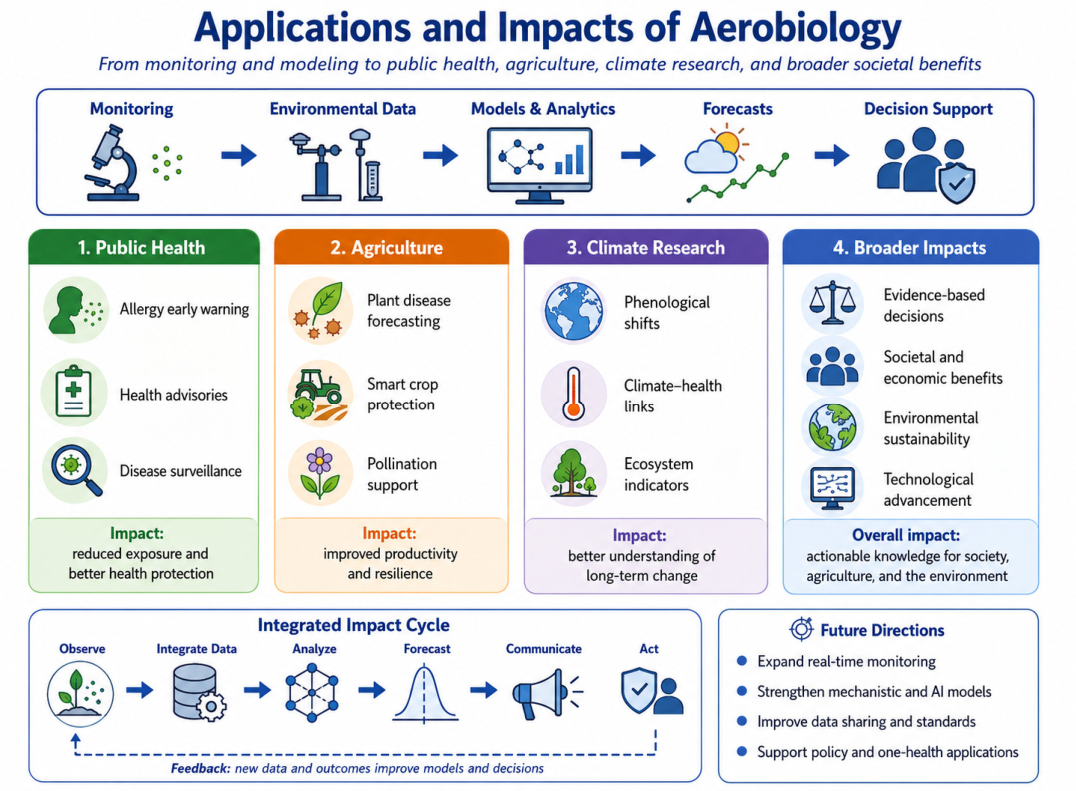
Aerobiology investigates the sources, transport, dynamics, and impacts of biological particles suspended in the atmosphere, including pollen, fungal spores, bacteria, and viruses [1,2,3]. This airflow carries pollen from distant plants, fungal spores from hidden colonies, bacteria lifted from the soil surface, and viral particles that can influence global health patterns [1]. Aerobiology is the science that seeks to understand this flow of life—its origins, transport mechanisms, transformations, and eventual return to the Earth’s surface [1,2]. Aerobiology is the intersection of atmospheric science, plant biology, epidemiology, and environmental engineering, and it studies phenomena that directly impact human health, agricultural productivity, and ecosystem stability [1,2]. Aerobiology is expected to play an increasingly important role in addressing complex environmental and social challenges because airborne biological particles connect climate, ecosystems, agriculture, and human health. Pollen, spores, microbes, and bioaerosols influence allergy risk, respiratory disease, crop protection, plant disease spread, biodiversity change, and environmental exposure. By combining monitoring networks, meteorological data, remote sensing, statistical models, and predictive systems, aerobiology can provide early warning, risk assessment, and decision support. Its future contribution lies in transforming invisible atmospheric biological processes into practical knowledge for public health, food security, climate adaptation, and sustainable environmental management [1,2,3].
For much of the twentieth century, air biology relied primarily on meticulous observation and manual measurements. Researchers used volumetric samplers, such as Hearst traps, to collect airborne particulate matter onto slides and performed time-consuming microscopic counting to record seasonal patterns and environmental associations [3,4]. These early works, supported by classical statistical tools such as descriptive statistics, correlation analysis, and linear regression, laid the foundation for understanding pollen calendars, spore dynamics, and their relationship to meteorological variables [4,5]. These methods reflected both their advantages and limitations at the time: they could systematically characterize airborne biological particles, but were constrained by scarce data, limited temporal resolution, and insufficient computational power [4,5].
Even in these early studies, an important understanding has emerged. The atmosphere is not merely a passive transport medium, but an active, dynamic system that interacts with biological processes in complex and often nonlinear ways [1,2]. Airborne particulate matter is shaped by biological emissions, including flowering and spore release, and by atmospheric conditions such as temperature, humidity, radiation, and wind, as well as by transport processes such as advection, turbulence, and deposition [2,5,6].
These interacting processes span multiple spatial and temporal scales, producing patterns that simple linear or univariate analyses cannot fully capture [5,6,7].
Air biology has entered a new era after technological advancements in data collection methods. Automated monitoring systems, environmental sensor networks, and remote sensing platforms have generated datasets with higher resolution and broader spatiotemporal coverage [8,9,10]. This shift has transformed the field from a data-constrained discipline to a data-rich, systems-oriented science [8,9,10]. In this context, while traditional statistical methods remain valuable for exploratory analysis and baseline understanding, they have proven insufficient to address the complexity of modern air biology systems [5,6,9].
Therefore, aerobiology increasingly employs advanced statistical and computational methods to address nonlinear dynamics, multivariate interactions, spatiotemporal heterogeneity, and inherent uncertainty [5,6,7,10]. Time-series analysis can characterize and predict temporal patterns, while generalized linear and additive models provide a flexible framework for modeling nonlinear relationships [5,6]. Spatial and spatiotemporal statistics can analyze geographic variability and transport processes [10,11], and Bayesian or probabilistic learning methods have been incorporated into modern forecasting workflows [9]. In recent years, machine learning and artificial intelligence have further expanded forecasting capabilities, particularly in real-time forecasting and large-scale data integration [8,9,10].
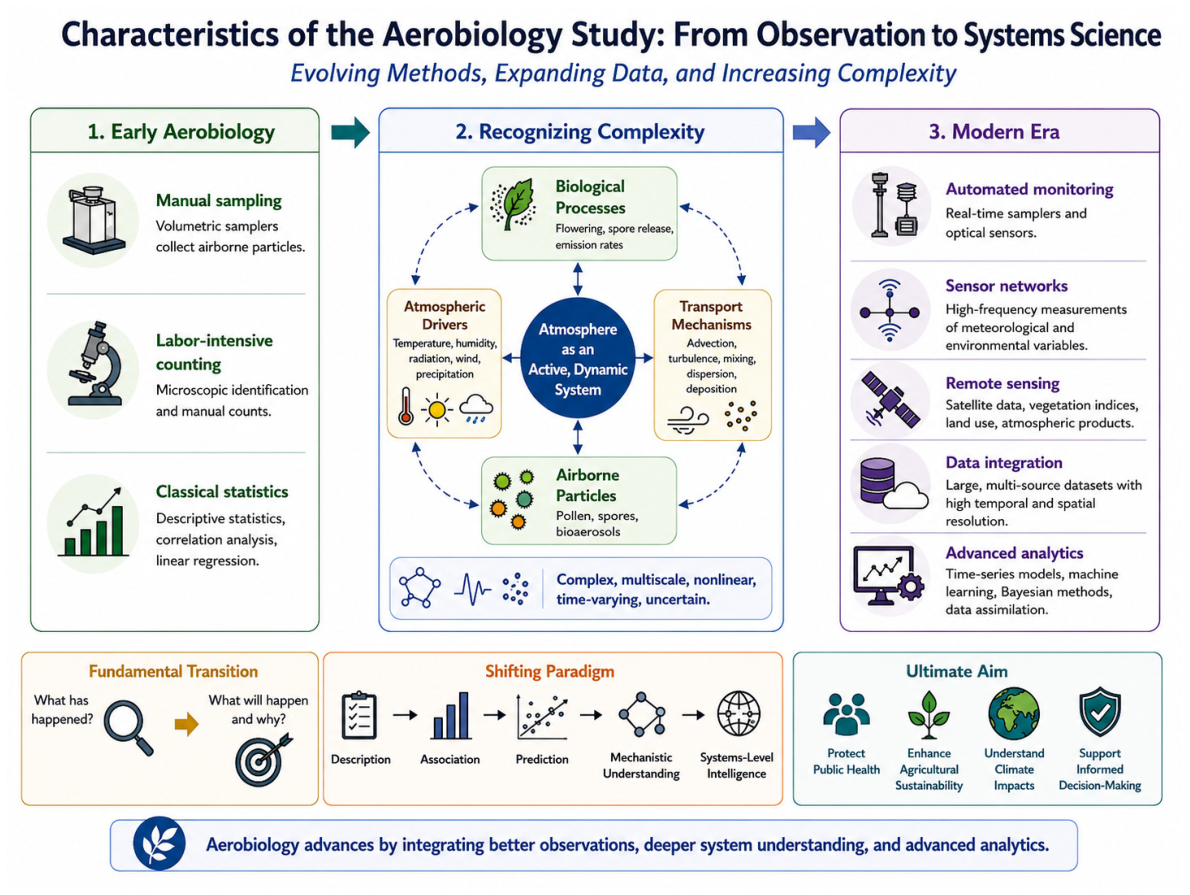
This shift echoes trends in other complex systems fields, such as greenhouse environmental control, semiconductor manufacturing, and closed-loop life support systems, where the interaction of multiple variables and feedback mechanisms necessitates sophisticated analytical methods. In all these fields, statistical modeling has evolved from descriptive analysis to predictive and decision-support frameworks, reflecting a shift towards a systems engineering perspective. The main characteristics of aerobiological systems are summarized in Figure 1.
Despite these advances, modern statistical methods are not without limitations. Many data-driven models require large datasets, may lack interpretability, and are difficult to generalize across regions and environmental conditions [8,9,10,11]. These challenges have led to the emergence of hybrid modeling paradigms that combine mechanistic understanding of biological and atmospheric processes with data-driven statistical learning [5,10,11]. By combining physical insights with computational power, hybrid approaches promise to improve accuracy, robustness, and interpretability [5,10,11].
In this context, aerobiology can be understood as a complex adaptive environmental–biological system in which empirical observation, theoretical understanding, and statistical modeling must be closely integrated [1,2,5]. Aerobiology advances when empirical observations are linked with mechanistic understanding and integrated through coherent data frameworks. Measurements of pollen, spores, bacteria, and other biological aerosols reveal seasonal patterns, diurnal variation, spatial gradients, and episodic bursts. These observations become more meaningful when interpreted through mechanisms such as biological emission, phenology, turbulence, advection, deposition, humidity effects, and meteorological thresholds. By integrating monitoring data, environmental sensors, remote sensing, statistical models, and process-based knowledge, aerobiology can move from description toward prediction and explanation. Such integration supports uncertainty quantification, causal interpretation, cross-regional transferability, real-time forecasting, and reliable hybrid prediction frameworks.
In this review, the literature was selected to support a methodological analysis of statistical development in aerobiology. Peer-reviewed journal articles were searched in Google Scholar, ResearchGate, Elsevier, Springer, ScienceDirect, and Wiley Online Library using combinations of the keywords “classical statistics and aerobiology,” “modern statistics and aerobiology,” and “hybrid statistics and aerobiology.” Relevant chapters and academic books were also examined to provide historical and conceptual background. Articles were included when they addressed airborne biological particles, aerobiological monitoring, statistical modeling, forecasting, spatiotemporal analysis, machine learning, or hybrid process–data approaches. Studies were prioritized if they clearly linked statistical methods with biological, meteorological, or environmental interpretation. The 66 selected publications were then organized into three review categories: classical descriptive and inferential statistics, modern computational and predictive methods, and hybrid integrative frameworks for systems-oriented aerobiological analysis. This literature is from the United States, Western Europe, Northern Asia, and Southeast Asia.
This review aims to comprehensively and critically examine the development of statistical methods in aerobiology, from classical foundations to modern and hybrid methods, focusing on their theoretical basis, practical applications, and limitations. Through this perspective, statistical thinking is not only a technical tool but also a conceptual framework that reshapes how we observe, understand, and ultimately predict aerobiology.

2. Characteristics of Aerobiological Data

Understanding the statistical treatment of aerobiological data requires first recognizing the intrinsic nature of the system from which these data arise. Aerobiology does not deal with static or isolated variables but with a continuously evolving environmental–biological system in which particles are emitted, transported, transformed, and deposited under the influence of interacting physical and biological processes [1,12]. As such, aerobiological data inherit the complexity of the system itself, exhibiting multiscale structure, strong spatiotemporal variability, nonlinear dynamics, and inherent stochasticity, all compounded by practical challenges in data acquisition and measurement [1,13].

2.1. Multiscale Dynamics

Aerobiological processes occur across multiple spatial and temporal scales, each governed by distinct yet interconnected mechanisms [1,12]. At the microscale, pollen release and fungal spore discharge are governed by physiological triggers and microenvironmental conditions [1,14,15,16]. At canopy and local scales, vegetation structure and airflow determine early dispersion, while plant-generated turbulence affects particle movement [1,14]. At the landscape scale, particles pass through agricultural, forest, and urban environments, where land use and surface roughness influence airflow and deposition [12,15]. At regional scales, long-distance transport may move particles hundreds or thousands of kilometers, linking ecosystems and exposure patterns [12]. These scales interact through feedback: local emissions affect regional transport, while regional meteorology modifies local dispersion, making scale integration essential for statistical modeling [1,12].

2.2. Temporal Structure and Dynamics

Aerobiological datasets show strong temporal organization, reflecting biological rhythms and atmospheric dynamics [13,14,16]. Seasonal patterns are prominent, with annual cycles driven by plant phenology and climate, producing predictable periods of high pollen or spore concentrations [7,16]. These seasonal trends are accompanied by diurnal variations, as emission rates and atmospheric mixing differ between day and night, often generating characteristic daily cycles in particle concentrations [13,14].
Beyond periodicity, aerobiological data show strong temporal dependence, with current observations influenced by past states [7,13]. This autocorrelation results from biological persistence, such as prolonged flowering, and atmospheric processes, including particle accumulation and gradual dispersion [7,13]. Therefore, aerobiological observations cannot be treated as independent but require analytical frameworks that explicitly account for time dependence and memory effects [7,13].

2.3. Spatial Heterogeneity

Spatial variability is another defining feature of aerobiological data [14,15]. Airborne particle concentrations vary across environments because of differences in vegetation composition, land use, topography, and microclimate [12,14,15]. Urban areas may show distinct aerobiological signatures compared with rural or forested regions, reflecting differences in plant species, surface structures, and heat island effects [14,15]. Elevation gradients also influence temperature, humidity, and wind patterns, producing systematic spatial differences in particle behavior [12].
At finer scales, microclimatic zones within the same landscape can produce localized variation, while at broader scales, regional transport can create spatial gradients or episodic events affecting large areas simultaneously [12,14,15]. This heterogeneity requires spatial and geostatistical methods that capture local variability, spatial dependence, and interactions with temporal dynamics [13,14,15].

2.4. Nonlinearity and Threshold Behavior

Aerobiological systems are inherently nonlinear, with many processes exhibiting threshold responses and complex interactions among variables [7,16]. Biological emissions often depend on specific environmental triggers rather than gradual changes. Flowering may begin only after temperature exceeds critical preseason thresholds, while pollen season timing and concentration often respond nonlinearly to temperature, precipitation, and other meteorological drivers [7,16]. Similarly, wind, humidity, and atmospheric conditions can shift particle behavior from predictable transport to irregular turbulent dispersion [1,16].
Interactions among variables, such as temperature–humidity coupling or radiation effects on plant physiology, further increase nonlinearity [1,16]. Saturation effects may also occur when stronger drivers no longer produce proportional increases in emissions [16]. Therefore, simple linear models are often insufficient and require more flexible statistical approaches [7,16].

2.5. Stochasticity and Uncertainty

Even under similar environmental conditions, aerobiological observations show substantial variability due to stochastic processes [1,13]. Atmospheric turbulence, wind gusts, and chaotic mixing introduce variability in particle transport and concentration [1]. Biological systems add uncertainty because emission rates differ among plants or colonies due to genetic and physiological variation [1,16]. Measurement processes also introduce noise through instrument sensitivity, calibration, and sampling limitations [17,18].
This stochasticity means aerobiological data cannot be fully described by deterministic relationships alone [1,13]. Probabilistic frameworks are therefore needed to quantify uncertainty, characterize variability, and provide robust predictions under changing conditions [7,13]. The characteristics of aerobiological data are listed in Table 1.

2.6. Data Quality and Measurement Challenges

Beyond intrinsic system complexity, aerobiological data face important data-quality challenges [17,18]. Missing observations commonly result from instrument downtime or sampling limitations [17]. Measurement noise and differences among instruments can also create inconsistencies, especially when datasets are combined across monitoring networks or when systems shift from manual to automatic monitoring [17,18]. Aerobiological datasets may include rare extreme events, such as pollen bursts or long-distance transport, which are difficult to model but important for health and environmental management [12,18].
These challenges require statistical methods that are flexible, robust, and capable of handling incomplete, noisy, and heterogeneous data [17,18].

2.7. Aerobiology as a Moving Complex Adaptive System

Together, these characteristics define aerobiology as a moving complex adaptive system [1,7,12]. Multiscale interactions, spatiotemporal variability, nonlinear dynamics, and stochasticity create information-rich but difficult data [1,13,16]. The atmosphere actively shapes biological processes, while emissions feed back through transport and exposure dynamics [1,12,19]. This interconnectedness requires advanced statistical methods integrating diverse data, cross-scale behavior, empirical observations, and mechanistic understanding [7,13,18,19].

3. Classical Statistics: The Era of Description and Insight

The early development of aerobiology was shaped not by the ambition to predict, but by the necessity to observe, measure, and organize [20,21]. Before the emergence of modern computational tools and large-scale datasets, the central scientific challenge lay in transforming scattered observations of airborne biological particles into coherent and interpretable knowledge [20,22]. Classical statistics provided the intellectual and methodological foundation for this transformation [21,22]. It enabled researchers to move from qualitative descriptions of airborne life toward quantitative characterization, establishing the first structured understanding of pollen dynamics, spore dispersion, and their environmental relationships [20,23]. In this sense, classical statistics represents not merely a set of techniques, but an era in which aerobiology was defined by description, insight, and the gradual unveiling of hidden regularities within complex natural phenomena [21,22].

3.1. Foundations of Measurement and Early Quantification

The rise of classical statistics in aerobiology was closely tied to the development of measurement technologies [3,20]. Instruments such as the Hirst-type volumetric sampler revolutionized the field by providing continuous, time-resolved data on airborne particles [3]. For the first time, researchers could systematically collect quantitative records of pollen grains and spores over extended periods [3,20]. However, while measurement technology advanced, analytical tools remained relatively simple, constrained by limited computational resources and the nascent state of statistical modeling [21,22].
Within this context, classical statistical methods emerged as the primary means of interpreting data [21,22]. Their role was not to simulate complex systems or generate forecasts, but to extract order from variability [21]. The emphasis was on summarization, comparison, and pattern recognition [22]. This foundational phase established the empirical backbone of aerobiology, upon which all subsequent developments would be built [20,23].

3.2. Descriptive Statistics: Establishing Baseline Knowledge

The first and most essential task in early aerobiological research was to describe the data [21,22]. Descriptive statistics provided the tools to condense large volumes of observational data into interpretable metrics [21]. Measures such as mean concentration, median, standard deviation, and percentiles enabled researchers to characterize the central tendency and variability of airborne particle concentrations [21,24]. Seasonal averages and indices were developed to capture recurring annual patterns, while peak values identified periods of maximum biological activity [23,25].
These descriptive measures were far from trivial [23]. They enabled the definition of key concepts, including the start and end of pollen seasons, the duration and intensity of exposure periods, and the degree of interannual variability [23,25]. By comparing these metrics across regions and time periods, researchers could identify geographic differences and long-term trends [25]. In essence, descriptive statistics transformed raw counts of microscopic particles into structured knowledge about environmental processes [21,23].
Despite their apparent simplicity, these methods played a transformative role [21]. They provided a common language for the field, allowing results to be standardized, compared, and communicated [22]. Even in contemporary aerobiology, descriptive statistics remain indispensable as the first step in any analysis, serving as a baseline against which more complex models are evaluated [21,24].

3.3. Distribution Analysis: Recognizing Patterns in Variability

As datasets accumulated, researchers began to examine not only average behavior but also the distributional characteristics of aerobiological data [23,26]. It quickly became evident that airborne particle concentrations rarely followed normal distributions [26]. Instead, the data often exhibited pronounced right-skewness, heavy tails, and episodic spikes corresponding to sudden bursts of biological activity or favorable meteorological conditions [26,27].
To better represent these patterns, alternative distributions such as the log-normal and gamma distributions were introduced [26,27]. These models provided improved fits to empirical data and allowed for a more accurate description of variability, particularly in the presence of extreme values [26]. Frequency analysis of these distributions helped quantify the probability of high-concentration events, which are particularly important in health-related applications such as allergy forecasting [27].
However, while distributional models enhanced descriptive accuracy, they remained largely empirical [21]. They described how data were distributed but did not explain why such patterns emerged [21,26]. The underlying biological and atmospheric mechanisms remained implicit, highlighting a key limitation of classical approaches [21].

3.4. Correlation Analysis: Identifying Environmental Associations

With descriptive baselines and distributional patterns established, attention turned to understanding the relationships between airborne biological particles and environmental variables [23,28]. Correlation analysis became a central tool in this effort [28]. Using measures such as Pearson and Spearman correlation coefficients, researchers quantified the strength and direction of associations between particle concentrations and meteorological factors, including temperature, humidity, rainfall, and wind speed [28,29].
These analyses revealed intuitive and often consistent relationships [28,29]. For example, higher temperatures were frequently associated with increased pollen release, while rainfall tended to reduce airborne concentrations through washout effects [28]. Humidity played a complex role, influencing both biological emission processes and atmospheric transport dynamics [29].
The strength of correlation analysis lies in its simplicity and interpretability [28]. It provided a straightforward means of identifying potential drivers of aerobiological variability [28]. However, it also introduced conceptual limitations [28]. Correlation does not imply causation, and observed associations could arise from indirect relationships or shared dependencies on other variables [28,29]. Furthermore, correlation measures are inherently limited in capturing nonlinear interactions [28].

3.5. Linear Regression: Quantifying Relationships

Building upon correlation analysis, linear regression models were introduced to quantify the relationships between aerobiological variables and environmental drivers [21,24]. In its simplest form, regression expressed pollen or spore concentration as a function of meteorological variables [24,29]. Multiple regression models incorporated several predictors simultaneously, offering a more structured framework [24].
The appeal of linear regression lies in its interpretability [24]. Regression coefficients could be directly interpreted as measures of sensitivity [24]. This made regression models valuable for hypothesis testing and early predictive insights [24,29].
However, linear regression relies on assumptions such as linearity, independence, and homoscedasticity [24]. In aerobiological systems, these assumptions are often violated due to nonlinearity and temporal dependence [29]. Multicollinearity among environmental variables can further complicate interpretation [24]. As a result, while regression models provided valuable insights, their applicability was limited in complex systems [24,29].

3.6. Analysis of Variance and Hypothesis Testing

Another important component of classical statistics in aerobiology was the use of analysis of variance (ANOVA) and hypothesis testing [21,24]. These methods enabled comparisons across regions, seasons, and species [23,25]. By partitioning variability into within-group and between-group components, ANOVA provided a framework for assessing statistical significance [24].
Hypothesis testing introduced rigor into aerobiological research [21,24]. It allowed scientists to move beyond descriptive comparisons and make inferential statements [21]. For example, differences between urban and rural pollen levels could be formally evaluated [25].
While powerful, these methods depend on assumptions such as normality and independence [24]. These assumptions are not always satisfied in aerobiological data [29]. Nevertheless, they played a crucial role in establishing scientific standards [21,24].

3.7. Early Time-Series Perspectives

Although classical statistics was primarily descriptive, early efforts sought to account for temporal structure using simple time-series techniques. Moving averages were used to smooth fluctuations, while autocorrelation analysis provided insights into temporal dependence [30].
These approaches represented the first steps toward recognizing the dynamic nature of aerobiological systems. However, they lacked the sophistication required for predictive modeling [30]. The classical statistics that represent the era of description and insight are listed in Table 2.

3.8. Strengths and Limitations of Classical Approaches

Classical statistical methods offered several enduring strengths [21,24]. They were simple, transparent, and interpretable, requiring modest data and computational resources [21]. Their theoretical foundations were well established [24]. Most importantly, they enabled the transformation of aerobiology into a quantitative discipline [20,23].
At the same time, their limitations became increasingly apparent [29,30]. Classical methods struggle to capture nonlinear relationships, complex interactions, and multiscale dynamics [29]. They provide limited support for predictive modeling and are often inadequate for handling temporal and spatial dependence [30].
In retrospect, the era of classical statistics in aerobiology can be understood as a period of essential groundwork [20,21]. It established the foundations upon which modern approaches were built [21]. By converting observations into insights, classical statistics paved the way toward a deeper understanding of airborne biological systems [20,23].

4. Transformation: From Description to Prediction

The late 20th and early 21st centuries marked a decisive turning point in the methodology of atmospheric biology. The field, long reliant on observation, manual sampling, and retrospective interpretation, began to shift towards prediction, model integration, and decision support. Advancements in monitoring technologies, data availability, increased computing power, and the growing societal demand for reliable predictions drove this transformation [8,18,31]. Thus, this shift was not only historical but also methodological, redefining the questions posed by atmospheric biology and the analytical tools needed to answer them [18,31].
A primary driver was the expansion of data sources. Automated monitoring systems gradually replaced labor-intensive manual sampling, enabling continuous, high-resolution measurements of airborne bioparticles [8,18]. Environmental sensor networks added synchronized meteorological records, including temperature, humidity, wind, and radiation, allowing for joint analysis of particle dynamics and its environmental drivers [8,31]. Remote sensing and environmental informatics further expanded the spatial dimensions of atmospheric biology observations, linking local monitoring stations to regional and global environmental contexts [10,31]. Therefore, air biology has transformed from a data-scarce discipline to a data-rich field, and its core methodological challenge is no longer simply data collection, but rather the integration, coordination, and interpretation of data [8,18,31].
The second driving factor is the growth of computing power. High-performance computing has enabled the application of analytical techniques that were previously difficult to use in air biology research [9,31,32]. Models are increasingly able to incorporate multiple predictors, nonlinear responses, time dependencies, spatial variability, and uncertainty [9,31,32,33,34]. This has enabled research methods to shift from descriptive summaries and simple correlations to dynamic modeling frameworks that can characterize the behavior of systems over time [9,31,32,33]. Techniques such as time series models, spatial statistics, generalized regression methods, Bayesian methods, machine learning, and data assimilation have become increasingly important because they can handle the complexity of modern air biology datasets.
The third driving factor is the need for prediction. Growing concern about allergies, respiratory health, crop pollination, and the spread of plant diseases has spurred the need for reliable predictive and early-warning systems [8,18,31]. Therefore, aerosol biology models must move beyond interpreting the past and begin predicting future conditions under changing environmental contexts [18,31]. This requires models to support decision-making by correlating observational data, environmental drivers, uncertainty estimates, and operational thresholds [31].
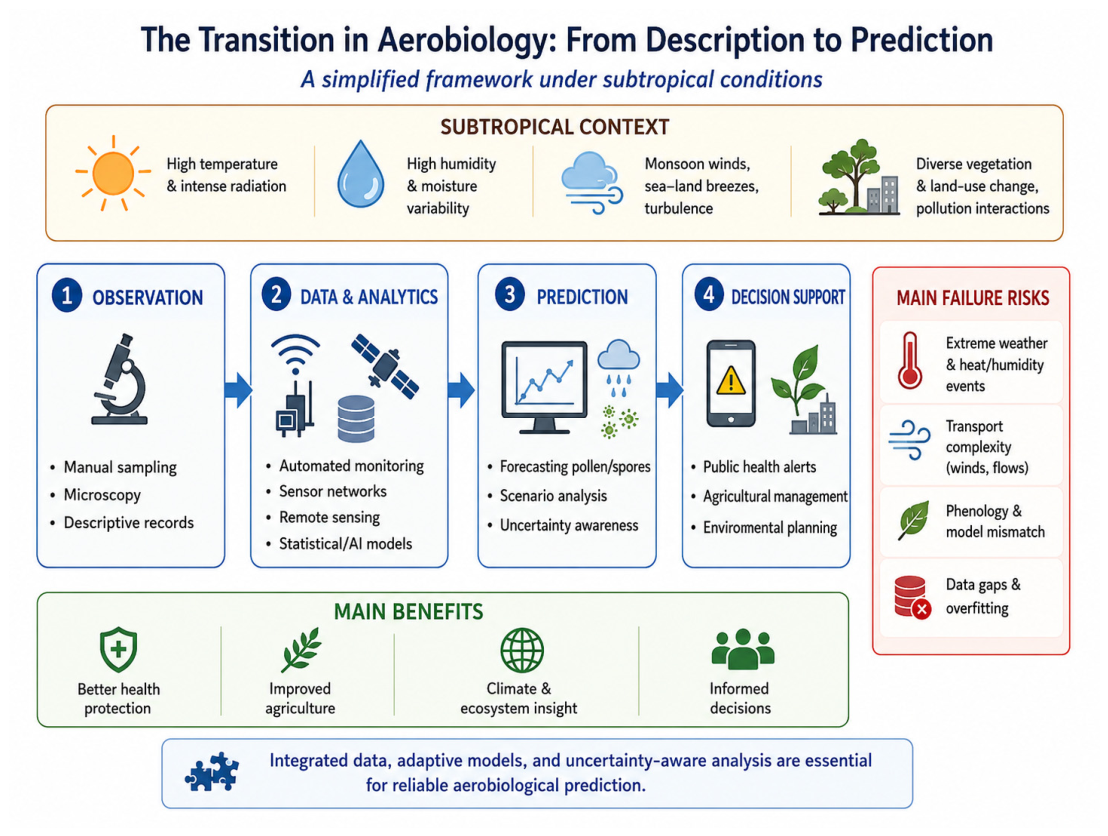
These developments have collectively shifted the methodological direction of the field. The core question has shifted from “What happened?” to “What will happen?” and increasingly towards “What might happen under changing conditions?” [18,31]. This necessitates a shift from static descriptive methods to dynamic predictive frameworks [9,31,32,33]. This also requires recognizing aerosol biology as a complex system characterized by nonlinear interactions, multiscale processes, time dependence, spatial heterogeneity, and inherent uncertainty [31,35,36,37,38,39].
Conceptually, this shift can be understood as an evolution from static description to dynamic modeling, and ultimately to predictive intelligence [9,10,31,32,33,38,39,40,41]. Classical statistical methods remain crucial for baseline characterization and interpretation, but they are insufficient on their own. As the complexity of aerosol biology datasets increases, their limitations in handling time dependence, nonlinear relationships, multivariate interactions, and uncertainties become increasingly apparent [9,31,32,33,34,35]. Therefore, modern aerosol biology requires an integrated methodological framework that combines empirical observation, statistical modeling, mechanistic understanding, and predictive decision support.
The transition to modern statistical approaches was therefore not simply a matter of methodological advancement but a necessary response to the changing nature of the problem itself [31]. It marked the beginning of a new era in aerobiology, one in which prediction, uncertainty quantification, and system-level understanding became central objectives [10,31,38]. Developed models in aerobiology should not only describe airborne biological particles but also support practical decision-making. Predictive models can transform monitoring data, meteorological variables, biological knowledge, and uncertainty estimates into actionable information for allergy warnings, crop disease management, public health preparedness, and environmental risk assessment. When model outputs are linked to decision thresholds, confidence intervals, scenario analysis, and real-time updating, they become useful tools for managers, clinicians, farmers, and policymakers. Therefore, model development should be evaluated not only by statistical accuracy but also by interpretability, reliability, timeliness, and usefulness in supporting informed decisions.
Figure 2 summarizes this transition from descriptive observation toward predictive and systems-oriented aerobiology.

5. Modern Statistical Methods: Capturing Complexity

5.1. Time-Series Analysis: Modeling Temporal Dynamics in Aerobiology

Time-series analysis represents one of the most important methodological advances in modern aerobiology, reflecting the recognition that airborne biological processes are inherently dynamic and temporally structured [9,32,33]. Unlike classical statistical approaches that treat observations as independent, time-series methods explicitly account for temporal dependence, acknowledging that past states, accumulated environmental conditions, and ongoing biological processes influence current pollen or spore concentrations [9,32]. This perspective aligns closely with the nature of aerobiological systems, where seasonality, diurnal cycles, and lagged responses to meteorological drivers create complex temporal patterns that require dedicated analytical frameworks [9,34,35].

5.1.1. ARIMA Models: Linear Temporal Dependence and Short-Term Forecasting

Among the earliest and most widely adopted time-series models in aerobiology are Autoregressive Integrated Moving Average (ARIMA) models [9,32]. These models provide a flexible yet structured approach to capturing temporal dependencies by combining autoregression, differencing, and moving-average components [32]. Through this combination, ARIMA models can represent a wide range of temporal behaviors observed in aerobiological data [9,32].
In practical applications, ARIMA models have been extensively used for short-term forecasting of pollen and spore concentrations [9,32]. Their strength lies in their ability to model autocorrelation structures, allowing predictions based on recent observations without requiring detailed mechanistic understanding of the underlying biological or atmospheric processes [32]. This makes them particularly useful in operational settings, where timely forecasts are needed for allergy warnings or environmental monitoring [9,31,32].
However, ARIMA models are fundamentally linear. They assume that relationships between past and present values can be adequately described using linear combinations [32]. This assumption may not hold in systems characterized by nonlinear biological responses and threshold effects [31,33,34]. Additionally, standard ARIMA formulations are limited in their ability to incorporate exogenous variables such as temperature, humidity, or wind unless extended into more complex variants [9,32]. These limitations highlight the need for more flexible approaches to address the full complexity of aerobiological dynamics [31,33].

5.1.2. Seasonal Models: Capturing Periodicity in Biological Cycles

A defining feature of aerobiological data is its strong seasonality, driven by plant phenology and recurring environmental conditions [9,34]. Seasonal ARIMA and related seasonal forecasting approaches extend the ARIMA framework by explicitly incorporating periodic components, allowing the model to account for regular cycles such as annual pollen seasons or diurnal emission patterns [9].
By introducing seasonal structure, such models can capture both short-term fluctuations and long-term periodic behavior [9]. This makes them particularly well-suited for modeling pollen calendars, where the timing, duration, and intensity of seasonal peaks are of primary interest [9,31]. In addition, decomposition and smooth trend approaches have been used to identify long-term changes, including shifts in pollen seasons associated with climate change [35,38].
Despite their ability to represent periodicity, seasonal models still operate largely within a linear framework and may struggle to capture irregular or abrupt changes in system behavior [9,33]. Moreover, the assumption of fixed seasonal patterns may not hold under rapidly changing environmental conditions, requiring adaptive or more flexible modeling approaches [35,38].

5.1.3. State-Space Models: Hidden Dynamics and Real-Time Updating

State-space models represent a significant conceptual advancement in time-series analysis by introducing the notion of hidden or latent system states [9,39]. In this framework, observed aerobiological data are treated as noisy measurements of an underlying process that evolves according to state equations [39]. This separation between observed data and true system states enables a more realistic representation of complex systems, in which measurements are imperfect and influenced by multiple sources of uncertainty [38,39].
A key advantage of state-space models is their ability to incorporate filtering techniques, most notably Kalman-filter-type updating, enabling recursive estimation of system states as new data become available [39]. This makes state-space approaches particularly well-suited for real-time applications, where continuous updating and adaptation are required [8,39]. In aerobiology, such models can be used to integrate observational data with dynamic system representations, improving both estimation accuracy and predictive performance [38,39].
Furthermore, state-space and data-assimilation approaches are highly flexible and can be extended to include exogenous variables, stochastic components, missing data, and irregular sampling intervals [38,39]. As a result, they serve as a bridge between purely statistical models and more mechanistic representations of biological and atmospheric processes [38,39].

5.1.4. Nonlinear Time-Series Models: Capturing Thresholds and Regime Shifts

While linear models such as ARIMA provide valuable insights, they are often insufficient for capturing the nonlinear dynamics inherent in aerobiological systems [31,33,34,35]. Biological processes frequently exhibit threshold behavior, in which small changes in environmental conditions can trigger abrupt transitions, such as flowering onset or sudden spore release [34,35]. Similarly, atmospheric processes can produce regime shifts under different meteorological conditions [31,33].
Nonlinear time-series and related machine learning-enhanced temporal models have been developed to address these complexities [33,40,41]. These methods are better suited to capturing episodic behavior, extreme events, and sudden spikes in concentration [33,40,41]. However, nonlinear models entail greater complexity in both formulation and estimation, often requiring larger datasets and more sophisticated computation [31,40,41].

5.1.5. Synthesis: From Temporal Description to Predictive Dynamics

The evolution of time-series analysis in aerobiology reflects a broader shift from descriptive characterization to dynamic modeling and prediction [9,31,32,33]. Early approaches focused on identifying temporal patterns and dependencies, while modern methods aim to capture the underlying processes that generate these patterns [9,31,39]. By incorporating autoregression, seasonality, hidden states, and nonlinear dynamics, time-series models provide a comprehensive toolkit for understanding and forecasting airborne biological phenomena [9,32,33,39,40,41].
At the same time, no single method is sufficient to address all aspects of aerobiological complexity. Linear models offer simplicity and interpretability, state-space models provide flexibility and real-time adaptability, and nonlinear approaches capture richer system behavior [9,32,33,39,40,41]. The continued development of time-series analysis in aerobiology, therefore, lies in integration rather than replacement [31].

5.2. Regression-Based Modern Methods

Regression-based modern methods extend the classical regression framework to better accommodate the distributional properties, nonlinear dynamics, and delayed responses that characterize aerobiological data [34,35]. As the field moved beyond simple linear assumptions, these approaches provided a balance between statistical rigor, interpretability, and flexibility, making them particularly suitable for modeling environmental–biological interactions [34,35].

5.2.1. Generalized Linear Models (GLMs)

Generalized Linear Models represent a fundamental extension of classical linear regression by allowing the response variable to follow non-normal distributions [34]. This is especially important in aerobiology, where pollen and spore concentrations are often recorded as count-like or skewed data [34,35]. Within the GLM framework, Poisson regression is commonly used for count data, while alternative distributions such as the negative binomial can accommodate overdispersion [34]. As a result, GLMs have become standard tools for quantifying the influence of meteorological drivers on airborne biological particles [31,34].

5.2.2. Generalized Additive Models (GAMs)

While GLMs improve flexibility in terms of data distribution, they still assume linear relationships on the scale of the link function. Generalized Additive Models address this limitation by replacing linear terms with smooth, nonparametric functions [34,35]. This capability is particularly valuable in aerobiology, where relationships between environmental variables and biological responses are often nonlinear and may involve thresholds or saturation effects [34,35]. At the same time, GAMs retain a comparatively high degree of interpretability, since each smooth term can be visualized and interpreted independently [34]. This balance between flexibility and transparency has made GAMs one of the most widely used tools in modern aerobiological modeling [31,34,35].

5.2.3. Distributed Lag Models

A distinctive feature of aerobiological systems is that environmental effects are often not immediate but occur with a time lag [35]. Temperature and humidity conditions may influence flowering, spore maturation, or release over several preceding days [35]. Distributed lag and distributed-lag nonlinear approaches are designed to capture these delayed relationships by allowing predictor variables to have effects distributed across multiple lags [35]. By incorporating lagged environmental effects, these models provide a more realistic representation of how atmospheric conditions influence airborne particle concentrations over time and can improve predictive performance in forecasting applications [35].
Together, these regression-based modern methods represent a substantial advance over classical approaches. They enable the modeling of non-normal data, nonlinear relationships, and delayed effects while maintaining the interpretability essential for scientific understanding and practical application [34,35].

5.3. Spatial and Spatiotemporal Statistics

Aerobiological phenomena are inherently spatial, shaped by vegetation distribution, land use, atmospheric transport pathways, and regional meteorological conditions [10,36,37]. Airborne biological particles do not remain confined to their sources but are continuously redistributed across landscapes, creating evolving spatial gradients and patterns [36,37]. As a result, understanding aerobiology requires statistical frameworks capable of capturing both spatial dependence and its interaction with temporal dynamics [10,36,37].

5.3.1. Geostatistics and Spatial Interpolation

Geostatistical methods provide a foundational approach for analyzing and mapping spatial variability in aerobiological data [36]. Building on spatial dependence, kriging and related interpolation techniques enable estimation of airborne particle concentrations at unobserved locations using measurements from monitoring stations [36]. This is particularly valuable in aerobiology, where observation networks are often sparse and unevenly distributed [10,36]. Through such methods, it becomes possible to generate continuous spatial maps of pollen or spore concentrations, providing a more comprehensive view of exposure patterns across regions [36].

5.3.2. Spatial Autocorrelation and Pattern Detection

Beyond interpolation, spatial statistics also aim to quantify the degree of clustering or dispersion in aerobiological data [36,37]. Spatial autocorrelation analyses help identify hotspots of biological activity, regional transport patterns, and areas of elevated exposure risk [36,37]. Such analyses are essential for distinguishing random variation from structured spatial processes linked to vegetation, topography, and prevailing winds [36,37].

5.3.3. Spatiotemporal Models and Integrated Frameworks

While spatial analysis provides a snapshot across space, aerobiological systems are fundamentally dynamic, requiring models that integrate both spatial and temporal dimensions [10,37]. Spatiotemporal models extend geostatistical approaches by incorporating time explicitly, allowing the evolution of spatial patterns to be modeled [10,37]. These frameworks support regional forecasting, improve estimation in data-sparse areas, and facilitate cross-site comparison [10,37].
Through these approaches, spatial and spatiotemporal statistics provide a critical bridge between localized observations and large-scale system understanding, enabling aerobiology to move toward regionally integrated predictive frameworks [10,36,37].

5.4. Bayesian Statistical Methods

Bayesian statistical methods represent a fundamental shift in how uncertainty, knowledge, and inference are treated in aerobiology [38,39]. Rather than relying solely on observed data, the Bayesian framework combines prior knowledge with new evidence to produce posterior distributions, offering a probabilistic description of system behavior [38]. This approach is particularly well-suited to aerobiological systems, where data are often noisy, incomplete, and influenced by multiple interacting processes [38,39].

5.4.1. Bayesian Inference: A Probabilistic Framework

The core of Bayesian methods is the principle that unknown quantities can be described probabilistically. Prior information from previous studies, expert knowledge, or mechanistic understanding can be formally incorporated and updated using observed data [38]. In aerobiology, Bayesian inference enables parameter estimation under uncertainty and facilitates model comparison and selection [38].

5.4.2. Hierarchical Bayesian Models: Multilevel Structures

Aerobiological data are often structured across multiple levels, such as monitoring stations nested within regions or time series observed across climatic zones [38]. Hierarchical Bayesian models provide a natural framework for representing such multilevel structures by allowing parameters to vary across groups while sharing information through higher-level distributions [38]. This partial pooling can improve estimation, especially when site-specific datasets are limited [38].

5.4.3. Data Assimilation: Integrating Models and Observations

A key strength of Bayesian and probabilistic methods lies in their ability to integrate observational data with dynamic models through data-assimilation techniques [39]. Approaches such as Kalman-filter-based updating allow model states or parameters to be revised as new observations become available [39]. In aerobiology, data assimilation can combine process-based emission and transport models with real-world measurements, improving state estimation and forecasting, especially as near-real-time automatic monitoring becomes more available [8,18,39].
Overall, Bayesian methods offer a coherent and flexible framework for addressing the complexity and uncertainty inherent in aerobiological systems [38,39].

5.5. Machine Learning Approaches

Machine learning represents a major evolution in aerobiological methodology, shifting the focus from predefined model structures to data-driven pattern recognition and predictive intelligence [9,10,31,40,41]. Unlike traditional statistical approaches that rely on explicit assumptions about functional relationships, machine learning algorithms learn these relationships directly from data [10,40,41]. This makes them particularly effective for modeling complex, nonlinear, and high-dimensional interactions [10,31,40,41].

5.5.1. Supervised Learning: Nonlinear Predictive Models

Supervised learning underpins most machine learning applications in aerobiology, where models are trained to predict pollen concentration or exposure risk from environmental inputs [10,31,41]. Common algorithms include Random Forest, Support Vector Machines, Gradient Boosting, and related ensemble methods [10,41]. These models have been applied to short-term pollen forecasting and classification of exposure levels, and they can integrate multiple environmental variables into unified predictive frameworks [10,31,41].

5.5.2. Deep Learning: High-Dimensional and Structured Data

Deep learning extends machine learning by using multi-layer neural networks that learn hierarchical representations of data [33,40,41]. In aerobiology, LSTM and recurrent architectures have shown promise for time-series forecasting because they can capture long-range temporal dependencies and sequential patterns [40,41]. Convolutional and hybrid deep learning approaches have also been used for structured environmental inputs and gridded data [31,40].
These approaches are especially powerful when large datasets are available, but they often require substantial computational resources and careful tuning [31,40,41].

5.5.3. Strengths, Limitations, and Practical Considerations

Machine learning approaches offer clear advantages in predictive performance and in modeling nonlinear and multivariate interactions [10,31,40,41]. They are particularly valuable in operational forecasting systems, where accuracy and adaptability are critical [10,31]. However, these benefits come with trade-offs. Many machine learning models, especially deep learning architectures, function as black boxes, providing limited interpretability and making it harder to extract mechanistic insight [31,40,41]. In addition, these methods are data-intensive and may be sensitive to overfitting or reduced transferability across locations and years [10,31,41].
Overall, machine learning has become an essential component of modern aerobiology, complementing traditional statistical approaches by providing powerful predictive tools while highlighting the continuing need to balance accuracy with interpretability [10,31,40,41]. The modern statistical methods are listed in Table 3.

5.5.4. Operational Forecasting, Validation, and Data Requirements

Several important aerobiological forecasting methods warrant greater attention, as they determine whether modern models can be used reliably in operational systems. First, cross-validation strategies are essential for testing generalization. Random train–test splitting is often inappropriate for aerobiological time series because it may leak temporal information. More suitable approaches for spatial transferability include rolling-origin validation, blocked time-series validation, leave-one-season-out validation, and leave-one-station-out validation [31,32,33,34,35,36,37]. These strategies evaluate whether models can predict new days, new seasons, or new regions rather than merely reproduce patterns already present in the training data.
Second, explainable AI should be included as a necessary complement to machine learning and deep learning. Methods such as variable-importance analysis, partial-dependence plots, accumulated local effects, SHAP values, and interpretable surrogate models can help identify whether temperature, humidity, wind, precipitation, radiation, land use, or lagged pollen concentrations are driving the prediction [31,40,41]. This is especially important because black-box models may achieve high accuracy but provide limited mechanistic insight or weak scientific credibility.
Third, transfer learning and domain adaptation are increasingly relevant because aerobiological monitoring networks are geographically uneven. Models trained in data-rich regions may not perform well in regions with different vegetation, climate, sampling methods, or pollen calendars [10,31,36,37,40,41]. Transfer learning can reuse representations learned from long-term or multi-station datasets, while local calibration adjusts the model to regional conditions. This approach is promising for data-sparse areas but requires careful validation to avoid biased forecasts.
Fourth, uncertainty propagation should be considered in operational forecasting. Forecast uncertainty arises from sensor error, missing observations, meteorological forecast uncertainty, model parameter uncertainty, and biological stochasticity [38,39]. Bayesian models, ensemble prediction, quantile regression, conformal prediction, and data assimilation can propagate these uncertainties into prediction intervals or probabilistic risk classes [38,39]. Such outputs are more useful for decision-making than single deterministic forecasts.
Deep learning datasets in aerobiology typically combine multi-year pollen or spore concentration records with meteorological variables, lagged observations, calendar indicators, phenological indices, land-use variables, remote sensing products such as NDVI or MODIS-derived vegetation information, and sometimes gridded weather or atmospheric transport data [31,33,40,41]. LSTM and recurrent models require continuous time-series data with enough seasonal cycles to learn temporal memory, while convolutional or hybrid models require structured spatial or gridded environmental inputs [33,40,41]. As a practical minimum, deep learning applications generally need several years of consistent observations, high temporal resolution, reliable meteorological covariates, careful gap filling, and independent seasonal or spatial validation. When datasets are small, GAMs, GLMs, distributed-lag models, Bayesian hierarchical models, or hybrid approaches may be more robust than deep learning [34,35,38,39].

5.6. Strengths and Limitations of Modern Methods

Modern statistical and computational methods have fundamentally transformed aerobiology, enabling the field to move from descriptive analysis toward predictive and systems-oriented modeling [9,10,31,32,33,34,39,40,41]. These approaches offer powerful tools for capturing nonlinear relationships, spatial heterogeneity, temporal dependence, and uncertainty [10,34,35,36,37,39,40,41]. They have greatly enhanced predictive capability for public health, agriculture, and environmental management [8,10,18,31,40,41].
At the same time, their sophistication introduces new challenges. A primary limitation is dependence on large, high-quality datasets, which remain uneven across monitoring networks [8,10,18,31,36,41]. Interpretability is another central concern: while traditional statistical models often offer transparent relationships, many modern machine learning methods are more opaque [10,31,40,41]. Overfitting, transferability, and generalization under changing environmental conditions also remain important issues [10,31,35,40,41].
These strengths and limitations point toward balanced strategies that combine predictive power with interpretability and robustness. Rather than replacing older methods entirely, modern approaches are most effective when integrated with domain knowledge, mechanistic understanding, and careful statistical design [31,38,39].

6. Hybrid Statistical Approaches

The increasing complexity of aerobiological systems has revealed a fundamental limitation of relying exclusively on either purely statistical or purely mechanistic models [11,31,39]. Statistical approaches, including machine learning, excel at identifying patterns in data but often lack physical interpretability and reliable extrapolation beyond the training domain [11,31,42]. Mechanistic models, grounded in biological and atmospheric processes, provide explanatory power but may struggle with parameter uncertainty, incomplete knowledge, and real-world variability [11,39,43]. Hybrid statistical approaches have emerged as a response to this dichotomy, seeking to integrate the strengths of both paradigms into unified modeling frameworks that are both predictive and physically meaningful [31,42,43,44].

6.1. Conceptual Foundation

6.1.1. The Need for Integration

Hybrid modeling is rooted in the recognition that aerobiology is a coupled environmental–biological system governed by both known mechanisms and partially understood processes [11,39]. Atmospheric transport models describe advection, turbulence, and deposition, while biological or phenological models capture processes such as flowering development, pollen emission, and release timing [25,39,45]. However, these mechanistic representations are often simplified and may omit critical interactions or local variability [11,39,43]. Conversely, data-driven models can capture complex relationships but may fail to generalize robustly beyond observed conditions [31,42].
Hybrid approaches address this gap by combining mechanistic understanding with statistical learning [11,31,39,42,43,44]. In this framework, physical and biological principles provide structure and constraints, while statistical or machine learning components adapt to the data, capture residual variability, and improve predictive performance [31,42,43,44].

6.1.2. Framework of Hybrid Modeling

At a conceptual level, hybrid models can be viewed as layered systems [31,42,43,44]. The mechanistic layer encodes known processes, such as emission rates, atmospheric transport, and deposition dynamics [11,39,43]. The statistical layer captures discrepancies between model predictions and observations, learning from data to refine outputs [42,44]. These layers can interact dynamically through updating or correction mechanisms, allowing the model to improve as new data becomes available [31,39,44]. Such frameworks move beyond static modeling toward adaptive, continuously improving systems [39,44].

6.2. Types of Hybrid Models

6.2.1. Physics-Informed Machine Learning

One prominent class of hybrid approaches is physics-informed machine learning, in which physical laws and constraints are embedded directly into machine learning models [42,44]. Rather than allowing the model to learn arbitrary relationships, physical consistency is enforced through constraints derived from conservation laws, transport equations, or process limits [42,44]. In aerobiology, this can mean embedding atmospheric dispersion structure, emission logic, or phenological thresholds into data-driven models [11,31,39,42].
This approach offers two key advantages. First, it can improve generalization by discouraging physically implausible predictions. Second, it can improve interpretability by linking model behavior to known processes [42,44].

6.2.2. Residual Learning

Residual learning represents another widely used hybrid strategy [43,44]. In this approach, a mechanistic model first generates baseline predictions based on established physical and biological principles. A machine learning model is then trained to predict the residuals between these baseline predictions and the observations [43,44]. By focusing on correcting model deficiencies rather than replacing the entire modeling framework, residual learning provides a targeted way of improving forecast accuracy [43,44].
In aerobiological applications, this logic is relevant when atmospheric transport models capture large-scale pollen movement but still miss local effects, measurement uncertainties, or unmodeled source variability [11,39,43].

6.2.3. Data Assimilation Systems

Data assimilation represents a dynamic form of hybrid modeling in which observational data are continuously integrated into model predictions [39,44]. Techniques such as the Kalman filter, the ensemble Kalman filter, and related sequential updating methods enable real-time adjustment of model states based on new observations [39,44].
In aerobiology, data assimilation integrates sensor measurements with process-based models of emission and transport [39]. This is particularly valuable for operational forecasting, where timely and accurate updates are essential [31,39].

6.3. Applications in Aerobiology

Hybrid statistical approaches are increasingly used in various aerobiological contexts [11,25,31,39,45]. One common application is coupling atmospheric dispersion models with statistical or machine learning components to improve the prediction of airborne particle concentrations [11,39,43]. In this framework, mechanistic models simulate large-scale transport processes, while data-driven components capture local variability and nonlinear interactions [43,44].
Another important application is the integration of phenological models with statistical forecasting methods [25,45]. By combining biological knowledge of plant development with data-driven analysis of environmental drivers, hybrid models can more accurately predict the timing and intensity of pollen seasons [25,45]. These approaches are particularly relevant under climate change, where established seasonal patterns are shifting [11,25].
Hybrid models are also increasingly used to integrate multi-source data, including ground observations, automated monitoring, remote sensing proxies, and meteorological forecasts [31,45]. This supports more comprehensive multi-scale modeling for both research and operational use [11,31].

6.4. Advantages of Hybrid Approaches

The primary advantage of hybrid statistical approaches lies in their ability to combine complementary strengths [11,31,39,42,43,44]. By integrating mechanistic understanding with data-driven learning, these models can achieve higher predictive accuracy than either approach alone while remaining more physically grounded than black-box models [42,43,44]. They are also potentially more robust under changing conditions, because physical constraints provide stability while statistical components adapt to new data [39,42,44].
Hybrid models can also offer better interpretability than purely data-driven methods, because their structure remains linked to physical and biological mechanisms [25,39,42]. This balance between accuracy and interpretability is especially important in aerobiology, where forecasts can support public-health and environmental-management decisions [11,31].

6.5. Challenges and Future Directions of the Statistical Methdels

Despite their promise, hybrid approaches present substantial challenges [11,31,39,42,43,44]. Model integration is inherently complex, requiring careful coupling between mechanistic and statistical components that may differ in scale, structure, and assumptions [39,43,44]. Computational demands can also be high, especially in regional or near-real-time applications [39,42,44].
Furthermore, the development of hybrid models requires interdisciplinary expertise spanning atmospheric science, biology, statistics, and computer science [11,31,42]. Looking ahead, hybrid statistical approaches are likely to play a central role in advancing aerobiology toward integrated predictive systems that are both adaptive and process-aware [11,25,31,39,42,43,44,45]. The comparative analysis of the classical, modern, and hybrid approaches in aerobiology is presented in Table 4.

7. Uncertainty and Causality

7.1. Uncertainty Quantification

Uncertainty quantification has become a central component of modern aerobiological modeling, reflecting the recognition that predictions of airborne biological particles are inherently probabilistic rather than deterministic [46,47,48]. The complex interplay of biological processes, atmospheric dynamics, and measurement limitations introduces multiple layers of uncertainty that must be explicitly characterized to ensure reliable interpretation and decision-making [2,46,47]. Rather than treating uncertainty as an undesirable artifact, contemporary approaches view it as essential information that defines the confidence and robustness of model outputs [46,48].

7.1.1. Sources of Uncertainty

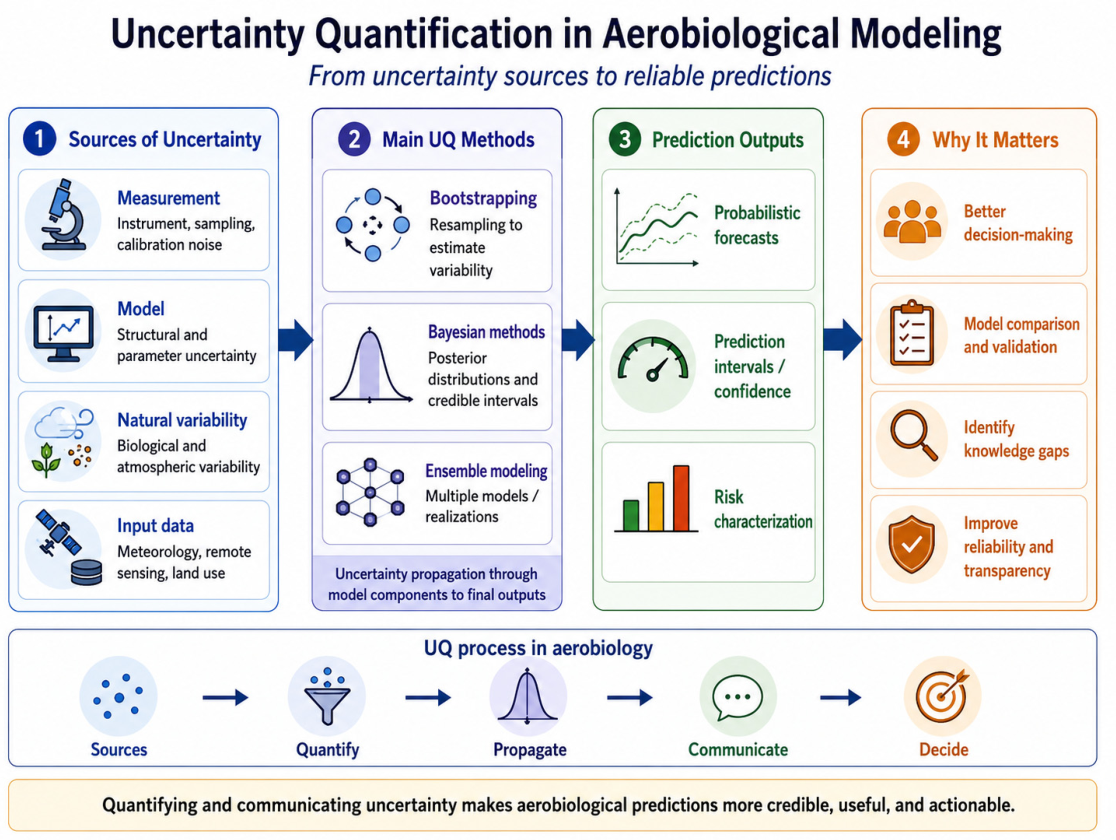
Uncertainty in aerobiological systems arises from several interconnected sources [2,46]. Measurement error is one of the most immediate contributors, stemming from instrument limitations, sampling variability, and calibration differences across monitoring networks [2,49]. Even with advanced sensors, airborne particle counts are subject to noise and potential bias, particularly at low concentrations or under highly variable conditions [2,49].
Model-related uncertainty represents another major component [46,47]. Structural uncertainty arises when the chosen model fails to fully capture the underlying processes governing emission, transport, and deposition [46,47]. Parameter uncertainty further complicates modeling efforts, as estimated coefficients may vary depending on data quality, temporal coverage, and environmental conditions [46,47].
In addition, stochastic variability inherent in both biological systems and atmospheric processes introduces irreducible uncertainty [2,46]. Random fluctuations in wind patterns, turbulence, and biological emission rates contribute to variability that cannot be fully predicted, even with perfect models and data [2,46].

7.1.2. Methods for Quantifying Uncertainty

To address these challenges, a range of statistical techniques has been developed to quantify and propagate uncertainty [46,47,48]. Bootstrapping methods provide a nonparametric approach by repeatedly resampling observed data to generate distributions of model estimates [47]. This allows for the assessment of variability without strong assumptions about underlying distributions [47].
Bayesian approaches offer a formal probabilistic framework, producing credible intervals that reflect uncertainty in both parameters and predictions [46,48]. By integrating prior knowledge with observed data, Bayesian methods provide a coherent mechanism for updating uncertainty as new information becomes available [46].
Ensemble modeling represents another powerful strategy, particularly in predictive applications [50]. By combining multiple models or multiple realizations under varying assumptions, ensemble approaches generate a distribution of possible outcomes rather than a single deterministic prediction [50]. This improves robustness and provides insight into uncertainty ranges and scenario likelihoods [50].

7.1.3. Implications for Aerobiological Prediction

The incorporation of uncertainty into aerobiological modeling has important practical implications [2,46]. In applications such as pollen forecasting or public health advisories, understanding the confidence associated with predictions is as critical as the predictions themselves [2]. Uncertainty-aware models enable more informed decision-making by distinguishing between high-confidence forecasts and situations where variability reduces reliability [46].
Moreover, explicit quantification of uncertainty facilitates model comparison, validation, and improvement [46,47]. By identifying sources and magnitudes of uncertainty, researchers can prioritize data collection, refine model structures, and enhance predictive performance [46,47].
In this way, uncertainty quantification transforms aerobiology from a discipline focused solely on prediction accuracy to one that emphasizes reliability, transparency, and risk-aware analysis [2,46,47,48]. Figure 3 summarizes the major sources, methods, and implications of uncertainty quantification in aerobiological modeling.

7.2. Causal Inference

While modern statistical and machine learning methods have greatly enhanced predictive capability in aerobiology, prediction alone does not fully address the scientific objective of understanding underlying mechanisms [51,52]. Causal inference seeks to move beyond correlation toward identifying cause-and-effect relationships among environmental variables, biological processes, and airborne particle dynamics [51,52,53]. In aerobiology, this distinction is crucial, as observed relationships may arise from indirect pathways or confounding factors rather than direct causation [51,52].

7.2.1. Conceptual Foundations of Causality

Causal inference is grounded in the idea that relationships among variables form structured systems rather than isolated associations [51,52]. In aerobiology, airborne particle concentrations are influenced by networks of interacting factors, including meteorological drivers, plant phenology, land-use patterns, and atmospheric transport processes [11,51].
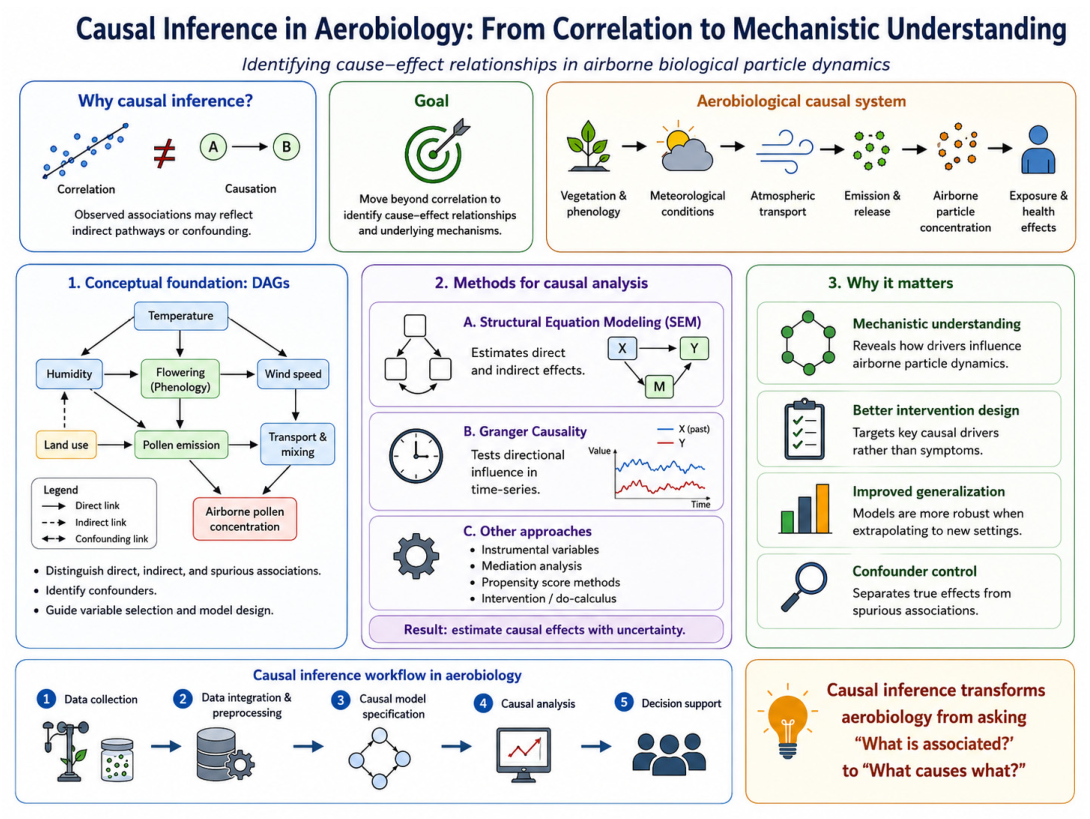
Directed acyclic graphs (DAGs) provide a powerful framework for representing such relationships [51,53]. By encoding variables as nodes and causal links as directed edges, DAGs clarify assumptions about system structure and help distinguish between direct, indirect, and spurious associations [51,53]. This approach also supports the identification of confounding variables and guides statistical model design for estimating causal effects [51].

7.2.2. Methods for Causal Analysis

Several methodological approaches have been developed to operationalize causal inference [51,52,53,54]. Structural equation modeling (SEM) offers a flexible framework for representing complex systems of relationships, allowing multiple dependent and independent variables to be analyzed simultaneously [54]. By specifying pathways and latent variables, SEM enables quantification of both direct and indirect effects [54].
Granger causality provides a complementary time-series-based approach [52]. Testing whether past values of one variable improve the prediction of another provides a statistical criterion for identifying directional influence in temporal data [52]. Although not definitive proof of causality, it is particularly useful in aerobiology for exploring lagged environmental effects [52].

7.2.3. Implications for Aerobiological Understanding

Incorporating causal inference into aerobiology represents a shift from predictive modeling toward mechanistic understanding [51,52,53]. By identifying causal pathways, researchers can better interpret observed patterns, design more effective interventions, and improve model generalization under changing environmental conditions [51,52].
This is especially important in the context of climate change, where extrapolation beyond historical data requires models grounded in causal mechanisms rather than empirical correlations [11,51].
Ultimately, causal inference strengthens the scientific foundation of aerobiology by linking statistical analysis with system-level understanding, enabling the field to progress from identifying patterns to explaining processes [51,52,53,54]. Figure 4 illustrates how causal inference links statistical analysis with mechanistic interpretation in aerobiology.
Uncertainty quantification, causal inference, digital twins, and AI-driven real-time prediction systems represent important frontier challenges for aerobiology. Uncertainty quantification is needed because aerobiological data are affected by sensor error, missing observations, stochastic atmospheric turbulence, and biological variability. Causal inference is required to move beyond correlation and identify whether meteorological, ecological, or land-use factors truly drive observed particle dynamics. Digital twins offer a promising framework for integrating monitoring data, process-based models, and scenario simulations, but require reliable calibration and validation. AI-driven real-time prediction systems can improve operational forecasting, yet they must address interpretability, data quality, regional transferability, and computational robustness. These challenges define the next stage of systems-oriented aerobiological modeling.

8. Integration with Environmental Monitoring Systems

The advancement of modern aerobiology is inseparable from the evolution of environmental monitoring systems [55,56,57]. As the field has transitioned from sparse, manual observations to data-rich, predictive frameworks, the integration of real-time sensing technologies and large-scale environmental datasets has become essential [55,56]. This integration not only enhances data availability but also transforms how aerobiological systems are observed, modeled, and managed [57]. By linking ground-based measurements with distributed sensor networks and remote sensing platforms, aerobiology is increasingly positioned as a real-time, system-level science [55,56,57,58].

8.1. IoT and Sensor Networks: From Discrete Observation to Continuous Monitoring

The emergence of Internet of Things (IoT) technologies has fundamentally reshaped aerobiological data collection [55]. Traditional monitoring methods relied on periodic sampling and manual analysis, resulting in datasets with limited temporal resolution [2]. In contrast, IoT-based sensor networks enable continuous, high-frequency monitoring of airborne biological particles and environmental variables [55]. These systems consist of interconnected sensors that measure parameters such as particle concentration, temperature, humidity, wind speed, and radiation, and transmit data in real time to centralized or cloud-based platforms [55,58,59].
This transition from discrete to continuous observation has significant implications [55,56]. First, it allows the capture of rapid temporal dynamics, including diurnal variations and short-term fluctuations [56]. Second, it supports adaptive modeling, in which statistical or machine learning models can be continuously updated as new data becomes available [57]. Such dynamic updating is particularly important for forecasting applications, where timely predictions depend on the most recent information [50,57].
Moreover, distributed sensor networks enable expanded spatial coverage [55]. By deploying sensors across diverse environments—urban, agricultural, and natural landscapes—it becomes possible to capture spatial heterogeneity in airborne particle concentrations [55]. This reduces reliance on single-point observations and improves model generalizability [56].
These sensors require calibration against reference equipment to assess their sensitivity drift over time and their behavior at low temperatures and high humidity. For example, in the study of PM2.5 and PM1, DustTrak was first calibrated against gravimetric reference measurements under side-by-side sampling, giving strong regressions for PM2.5 and PM1, but showing raw DustTrak values overestimated gravimetric concentrations by about 2.8–3.1 times [60]. The corrected DustTrak then served as the reference for AS-LUNG-P low-cost sensors, which required two-segment linear calibration and showed acceptable precision, with CV generally below 10%. The study did not directly evaluate long-term sensitivity drift or low-temperature behavior. At relatively high humidity (60–80% RH), no significant humidity correction was needed, although humidity effects were acknowledged as instrument-dependent [60].

8.2. Real-Time Data Integration and Adaptive Modeling

The availability of real-time data streams introduces new opportunities for integrating observation and modeling [57,61]. In traditional workflows, data collection and analysis were sequential processes with significant delays [56]. Modern systems enable simultaneous data acquisition and model updating, creating feedback loops in which observations continuously inform predictions [57,61].
This integration supports adaptive modeling frameworks [48,61]. Time-series models, Bayesian updating procedures, and data assimilation techniques can incorporate incoming data to refine system state estimates and improve forecast accuracy [48,61]. In operational contexts such as allergy forecasting or agricultural decision support, this capability is particularly valuable [2,61].
Real-time integration also facilitates anomaly detection and early warning systems [57,62]. Sudden increases in pollen or spore concentrations can be identified promptly, enabling timely responses in public health or crop management [2,62]. Thus, environmental monitoring systems extend aerobiology from retrospective analysis to proactive management [57].

8.3. Remote Sensing: Expanding Spatial and Environmental Context

While ground-based sensor networks provide detailed local measurements, their spatial coverage is limited [58,63]. Remote sensing technologies, particularly satellite-based observations, address this limitation by offering broad spatial coverage and consistent measurements across large geographic areas [63,64].
Vegetation indices such as the Normalized Difference Vegetation Index (NDVI) provide insights into plant growth and phenological stages closely linked to pollen production [63,64,65]. Changes in vegetation greenness can indicate the onset or progression of flowering periods, offering predictive value for pollen release [63,65]. Land-use and land-cover data further help identify sources of airborne particles by distinguishing agricultural, forested, and urban environments [64].
Remote sensing also contributes to the characterization of environmental drivers, including surface temperature, soil moisture, and radiation patterns [63,64]. These variables influence biological processes and atmospheric dynamics, making them critical inputs for predictive models [58,63]. Integrating satellite data with ground-based observations enables multi-scale modeling that captures both local variability and regional trends [58].

8.4. Coupling Monitoring Systems with Modeling Frameworks

The full potential of environmental monitoring systems is realized when they are tightly coupled with statistical and computational models [57,61]. In such systems, data flows continuously from sensors and satellites into modeling frameworks, generating predictions, uncertainty estimates, and decision-support outputs [57].
For example, hybrid models combine mechanistic atmospheric transport models with machine learning algorithms trained on sensor data, while data assimilation techniques continuously update model states [61,66]. This creates dynamic, self-correcting systems in which predictions improve as new data becomes available [61,66].
This integration also enables cross-scale analysis [58]. Local observations can be contextualized within regional patterns derived from remote sensing, while large-scale trends can be linked back to site-specific measurements [58,63]. Such multi-scale integration is essential for understanding aerobiological complexity [58].

8.5. Challenges and Future Perspectives

Despite its transformative potential, integrating environmental monitoring systems presents several challenges [55,56]. Data heterogeneity remains a key issue, as measurements from different sensors and platforms vary in accuracy, resolution, and format [55]. Ensuring data quality, consistency, and interoperability is therefore critical [55].
Additionally, managing and processing large, continuous data streams requires substantial computational resources and advanced infrastructure [57]. Issues related to data storage, transmission, and real-time processing must be addressed to fully exploit these systems [57].
There is also a need for standardized protocols and collaborative frameworks to enable data sharing across regions and institutions [55,56]. Such coordination is essential for building comprehensive datasets and advancing global-scale aerobiological research [56].
Looking forward, the integration of IoT, remote sensing, and advanced modeling is likely to drive the development of intelligent aerobiological systems [57,61]. These systems will not only monitor and predict airborne biological particles but also adapt to changing conditions, support decision-making, and deepen understanding of environmental–biological interactions [57]. The integration with environmental monitoring systems of main contribution and key challenge is listed in Table 5.

9. Applications and Impacts

The advancement of statistical and computational methods in aerobiology has significantly expanded its practical applications, transforming the field from a largely observational science into one with direct societal, agricultural, and environmental relevance [31,67,68,69]. By enabling more effective monitoring, modeling, and prediction of airborne biological particles, aerobiology now plays an important role in public health management, agricultural systems, and the study of climate change [31,67,68,69,70,71,72]. These applications demonstrate how improved analytical frameworks can translate into tangible impacts across multiple domains [31,68,69,70,71,72].

9.1. Public Health: From Monitoring to Early Warning

One of the most immediate and impactful applications of aerobiology lies in public health, particularly in the management of allergic diseases and airborne infections [31,67,68]. Pollen and fungal spores are major triggers of respiratory conditions such as allergic rhinitis and asthma, affecting large populations worldwide [67,73]. The development of predictive models based on time-series analysis, regression methods, and machine learning has enabled the creation of allergy forecasting systems that provide advanced warnings of high-exposure periods [31].
These forecasting systems allow individuals and healthcare providers to take preventive measures, such as adjusting medication schedules or limiting outdoor exposure during peak pollen days [31]. Beyond allergies, aerobiological monitoring also contributes to disease surveillance by informing research on airborne pathogens and microbial exposure dynamics [68]. While direct routine monitoring of viruses remains technically challenging, integrating aerobiological information with epidemiological frameworks offers a useful pathway for assessing disease risk and understanding transmission dynamics [68].
The incorporation of real-time sensor networks, automatic monitoring, and model-updating approaches further strengthens these applications by supporting earlier warning and faster response [18,31]. Sudden increases in airborne particle concentrations can be detected and communicated more rapidly, improving public health preparedness [18,31]. In this way, aerobiology contributes not only to understanding environmental exposures but also to mitigating their impacts on human health [31,67].

9.2. Agriculture: Managing Risk and Optimizing Productivity

In agricultural systems, aerobiology provides essential insights into both beneficial and harmful biological processes [69,70]. Airborne spores are key agents in the spread of many plant diseases, and their monitoring and prediction are crucial for effective crop protection [69,70]. Statistical and model-based frameworks that integrate meteorological data with airborne inoculum measurements can support disease forecasting, enabling more targeted interventions such as optimized fungicide timing or crop-management adjustments [70,71].
At the same time, aerobiology also plays an important role in pollination studies, especially in crops influenced by airborne pollen transport and flowering phenology [69]. Understanding the timing, distribution, and transport of pollen can inform strategies related to reproductive success, pollination management, and yield stability in relevant systems [69]. The integration of aerobiological modeling with broader digital agriculture and monitoring tools further enhances its value for site-specific and risk-aware management [70,71].
As agricultural systems face increasing pressures from climate variability, pathogen emergence, and the need to reduce unnecessary inputs, aerobiology provides a useful tool for adaptive management and risk assessment [69,70,71].

9.3. Climate Change Research: Detecting Shifts and Long-Term Trends

Aerobiology also plays a vital role in understanding the impacts of climate change on biological and ecological systems [67,72,73]. Airborne particles such as pollen serve as sensitive indicators of environmental change, reflecting shifts in plant phenology, species distribution, and ecosystem dynamics [72,73]. Long-term aerobiological datasets have revealed changes in the timing, duration, and intensity of pollen seasons, often associated with rising temperatures and changing environmental conditions [72,73].
These shifts have important implications not only for ecosystems but also for human health, as longer or more intense pollen seasons can increase exposure and aggravate allergic disease [67,72,73]. By combining statistical analysis with climate information, researchers can identify trends, explore likely drivers, and project future scenarios under changing climate conditions [72].
In addition, aerobiological studies contribute to broader ecological understanding by linking atmospheric processes with terrestrial ecosystems [67,72]. Changes in airborne particle dynamics may reflect alterations in vegetation composition, land-use patterns, or environmental stressors, providing a window into long-term ecological change [67,72]. The integration of aerobiology with climate modeling and environmental monitoring further strengthens its capacity to capture these interactions across scales [31,72].

9.4. Broader Impacts and Future Directions

Across these domains, aerobiology applications illustrate the transition from descriptive science to actionable knowledge [31,68,69,70,71,72]. The ability to monitor, model, and predict airborne biological particles supports more informed decision-making in health, agriculture, and environmental management [31,67,68,69,70,71,72]. At the same time, these applications highlight the importance of integrating statistical methods, environmental monitoring systems, and domain-specific knowledge [18,31,70].
As technologies continue to evolve, the impact of aerobiology is likely to expand further [18,31]. Advances in sensor technology, data integration, and artificial intelligence are expected to enable more precise and timely predictions. At the same time, interdisciplinary collaboration will strengthen the connection between scientific understanding and practical implementation [18,31,70]. In this context, aerobiology serves as a model for translating complex environmental data into meaningful societal benefits [31,67,68,69,70,71,72]. Figure 5 illustrates the applications and impacts of aerobiology.

10. Systems Engineering Perspective

The development of aerobiology as a predictive, data-driven discipline requires a systems engineering perspective that integrates monitoring, modeling, forecasting, and decision-making [74,75]. Instead of treating pollen, spores, and other airborne biological particles as isolated observations, aerobiology can be viewed as a complex adaptive system composed of interacting environmental, biological, atmospheric, and analytical components [74,75,76]. This framework is useful because practical aerobiological forecasting depends not only on statistical accuracy but also on how well data sources, process knowledge, models, and decisions are integrated into an operational system [75,77,78].

10.1. Aerobiology as a Complex Adaptive System

The continuous interaction of environmental inputs, biological emission processes, and atmospheric transport mechanisms drives aerobiological systems [58,75,76]. Temperature, humidity, radiation, wind, and precipitation influence plant phenology, spore production, pollen release, and emission intensity [58,76]. Once emitted, airborne particles are dispersed, transported, transformed, and deposited by atmospheric processes such as turbulence, advection, diffusion, and deposition [58]. The measured concentrations of pollen or spores are therefore system outputs that reflect both biological activity and atmospheric dynamics [58,76].
These outputs can also feed back into ecological, agricultural, and social systems. High spore concentrations may increase disease risk and alter crop or vegetation health, thereby influencing future emission patterns [77]. Climate-driven vegetation shifts may also change long-term aerobiological dynamics [75,76]. Such feedback explains why aerobiology should be modeled as a dynamic and adaptive system rather than as a simple input–output relationship [74,75].

10.2. System Structure: Inputs, Processes, Outputs, and Monitoring

From a systems engineering viewpoint, aerobiology can be organized into inputs, processes, outputs, and monitoring functions [78]. Inputs include meteorological and environmental variables such as temperature, humidity, radiation, rainfall, wind speed, land use, and vegetation status [58,76]. Because these inputs are multidimensional and time-varying, they require continuous observation through meteorological stations, bioaerosol samplers, environmental sensor networks, and remote sensing systems [18,78].
The process layer includes biological mechanisms, such as flowering, spore maturation, and particle release, as well as atmospheric mechanisms, such as dispersion, long-distance transport, and deposition [58,76]. Outputs are measurable pollen or spore concentrations, exposure indices, disease-risk indicators, or forecast alerts generated from monitoring and modeling systems [18,76]. In practical applications, these outputs support public health advisories, allergy warnings, crop disease management, and environmental risk assessment [39,78].

10.3. Statistical Models as System Components

In this framework, statistical and computational models are not only analytical tools but functional components of the aerobiological system [39,76,78]. First, they act as observers by converting noisy, incomplete, and heterogeneous measurements into estimates of system state [39,66]. Filtering, smoothing, calibration, and data assimilation help reconstruct hidden processes from sensor records and monitoring data [39,66].
Second, models act as predictors. Time-series models, regression methods, spatial models, Bayesian approaches, and machine learning algorithms forecast pollen peaks, spore dispersal events, and exposure risk under current and future environmental conditions [39,58,76]. These forecasts are especially important for operational applications in public health and agriculture [76,77].
Third, models support decision-making. Although aerobiological systems cannot be controlled directly as engineered machines can, model outputs guide human interventions. Pollen forecasts may support public health warnings, while spore or disease-risk predictions may guide fungicide timing, crop protection, or land-management actions [76,77]. In this sense, aerobiological models provide informational feedback for adaptive management [75,78].

10.4. Feedback, Adaptation, and Integrated System Design

Feedback is central to the systems engineering interpretation of aerobiology [74,75,78]. Environmental changes affect biological emissions; emissions alter atmospheric concentrations; concentrations influence health, agriculture, and ecosystems; and monitoring outputs inform human decisions that may modify land use, crop management, or warning systems [75,76,77,78]. The system therefore remains in dynamic adjustment rather than static equilibrium [74,75].
Integrated system design requires coordination among sampling networks, environmental sensors, statistical models, mechanistic knowledge, uncertainty analysis, and decision thresholds [39,76,78]. It also requires adaptive frameworks that can respond to changing climate conditions, new monitoring technologies, and regional differences in vegetation and sampling capacity [18,66,75]. By treating aerobiology as an interconnected monitoring–modeling–decision system, researchers can develop tools that not only describe and predict airborne biological processes but also support timely, scalable, and adaptive responses to public health, agricultural, and environmental challenges [18,38,58,66,74,75,76,77,78].

11. Challenges and Future Directions

As aerobiology advances toward a predictive, data-intensive, and systems-oriented science, it faces a set of intertwined challenges that reflect both the complexity of the underlying processes and the limitations of current methodologies [57,76,79,80]. At the same time, emerging technologies and conceptual frameworks offer promising directions for overcoming these barriers and reshaping the field into a more integrated and adaptive discipline [11,57,73,80,81].

11.1. Persistent Challenges in Modern Aerobiology

One of the most fundamental challenges lies in data heterogeneity. Aerobiological data are collected from diverse sources, including manual samplers, automated sensors, and satellite or model-linked platforms, each with different spatial resolutions, temporal frequencies, and measurement uncertainties [76,79]. Integrating these heterogeneous datasets into coherent analytical frameworks remains difficult, often requiring extensive preprocessing, calibration, harmonization, and standardization [79]. Without consistent data standards, model performance and comparability across regions can be significantly compromised [79].
Closely related is the issue of model transferability. Models developed for specific geographic regions or climatic conditions often perform poorly when applied elsewhere, because vegetation composition, meteorological regimes, and local environmental conditions strongly influence both biological emissions and atmospheric transport [11,76]. As a result, models that are highly accurate in one context may fail to generalize, limiting their usefulness in cross-regional and large-scale studies [11,76].
Interpretability presents another critical challenge, particularly in machine learning and deep learning. While these models can achieve high predictive accuracy, their internal mechanisms are often opaque, making it difficult to extract mechanistic insights or validate behavior against known physical and biological principles [57,81]. This creates a tension between accuracy and transparency, especially in applications where understanding underlying processes is as important as the predictions themselves [57,81].
In addition, the availability of long-term datasets remains limited in many regions. Although recent technological advances have increased data-collection capacity, many monitoring networks still have relatively short operational histories, constraining their ability to detect long-term trends, assess climate-driven changes, and validate models over extended time scales [73,79]. The lack of consistent, multi-decadal datasets remains a substantial barrier to advancing aerobiological research under global environmental change [73].

11.2. Emerging Directions: Toward Intelligent and Integrated Systems

Despite these challenges, several emerging directions offer pathways for advancing the field. One of the most promising is the development of digital twins, which are virtual, dynamically updated representations of real-world environmental systems [80]. These digital environments integrate data, models, and simulation tools to represent system behavior in near real time, enabling scenario analysis, forecasting, and decision support [80]. In aerobiology, such a framework could support predictive experimentation and operational management by continuously linking observations with model states [80].
Another important direction is the rise of AI-driven autonomous systems. These systems combine real-time data acquisition, machine learning, and adaptive modeling to create forecasting frameworks that continuously update as new observations arrive [57,80]. In aerobiology, such systems have the potential to deliver real-time pollen and spore forecasts that adjust dynamically to changing environmental conditions and improve through continued learning [57].
Physics-informed artificial intelligence further enhances this trajectory by integrating domain knowledge into data-driven models. By embedding physical constraints and process knowledge within machine learning algorithms, these approaches aim to overcome the limitations of purely data-driven methods, improving both generalization and interpretability [57,81]. In aerobiology, this could involve incorporating atmospheric transport structure or phenological rules into learning frameworks so that predictions remain consistent with known system behavior [81].

11.3. Toward a Systems Engineering Future

Looking ahead, the future of aerobiology lies in integrating these emerging technologies into a systems engineering framework [57,80]. Rather than treating data, models, and applications as separate components, the field is moving toward interconnected systems characterized by feedback loops, adaptive updating, and multi-scale integration [11,57,80]. In such systems, monitoring networks provide continuous data streams, models process and interpret these data in real time, and decision-support tools guide actions that influence system behavior [80].
This vision requires not only technological innovation but also interdisciplinary collaboration, bringing together expertise in biology, atmospheric science, statistics, remote sensing, and computer science [57,76,80]. It also demands stronger approaches to data sharing, standardization, and infrastructure development, ensuring that the benefits of advanced modeling can be realized across regions and applications [79,80].
In this evolving landscape, today’s challenges can serve as catalysts for innovation. By addressing issues of data heterogeneity, transferability, interpretability, and long-term observation, aerobiology can move toward a future defined by intelligent, adaptive, and integrated systems capable of capturing the full complexity of the invisible biological processes that shape our environment [11,57,73,76,79,80,81]. The challenges and future directions of aerobiological study are listed in Table 6.
Shikhovtsev et al. [82] examined the poorly understood relationship between sulfur dioxide (SO2) concentration and small-scale atmospheric turbulence over Southern Baikal, using observations from Listvyanka station. It shows that surface SO2 concentration tends to increase when vertical turbulent specific heat flux is negative, especially during the development of low-level jet streams and strong vertical wind-speed shear below the jet altitude. Romano summarized research on bioaerosols, including bacteria, fungi, viruses, pollen, and microbial fragments, and their atmospheric transport, health effects, agricultural relevance, and role in cloud and ice-nucleation processes [83]. It highlights studies on pathogenic species in PM10, biological ice nuclei, pollen–pollution interactions, SARS-CoV-2-related bioaerosol control, mask contamination, and urban, indoor, and industrial air quality. They indicated that airflow patterns, thermal inversions, and the microphysical characteristics of the boundary layer fundamentally determine both the local and regional transport of bioaerosols. These transport functions involve physical models and require integrating model development and parameter estimation using statistical methods. It is worth further investigation.

12. Conclusions

The development of statistical methods in air biology—from classic descriptive approaches to modern computational techniques and the emerging hybrid integrative frameworks—represents a profound transformation in analytical capabilities and scientific perspectives. This development not only reflects methodological advancements but also a deeper understanding of the inherent complexity of biological systems in the air. Initially a field based on meticulous observation and empirical description, air biology has evolved into a predictive, systems-oriented science capable of addressing real-world challenges in areas such as health, agriculture, and environmental management.
Classical statistical methods laid a crucial foundation for this development. Early researchers transformed raw observational data into structured knowledge through descriptive statistics, correlation analysis, regression models, and hypothesis testing. These methods provided clarity, interpretability, and a universal analytical language, enabling the identification of seasonal patterns, environmental relationships, and regional differences in airborne bioparticles. Despite their limitations, classical methods remain indispensable for baseline characterization, exploratory analysis, and model validation. Their enduring value lies in their transparency and solid theoretical foundation.
However, as our understanding of the complexity of atmospheric biological systems deepens, the limitations of traditional methods become increasingly apparent. The nonlinear interactions between biological processes, atmospheric dynamics, and environmental drivers, as well as multi-scale variability and stochastic behavior, necessitate more precise analytical tools. Modern statistical methods have emerged to address these challenges, including time series modeling, generalized linear and additive models, spatial and spatiotemporal statistics, Bayesian inference, and machine learning. These methods have significantly enhanced the ability to capture time dependencies, nonlinear relationships, and spatial heterogeneity, transforming aerobiology into a predictive science capable of generating actionable insights.
At the same time, modern methods also bring new challenges. The increasing reliance on large datasets, the risk of overfitting, and the limited interpretability of complex models (especially in machine learning) highlight the necessity of carefully designed and validated models. Balancing predictive accuracy with mechanistic understanding remains a core issue, particularly in applications where transparency and reliability are paramount.
Hybrid statistical methods have emerged as a promising approach to addressing these challenges. By combining mechanistic knowledge of biological emissions and atmospheric transport with data-driven learning, hybrid models can achieve a balance between accuracy and interpretability. These methods are highly compatible with systems engineering principles, emphasizing integration, feedback, and adaptation. They enable models to utilize both physical understanding and empirical data simultaneously, thus establishing a more robust and universally applicable framework.
A key conceptual advance highlighted in this paper is the view of atmospheric biogeography as a complex adaptive system. In this system, biological, atmospheric, and environmental processes interact through dynamic feedback loops, generating patterns that evolve and scale. In this context, statistical models are not only analytical tools but also an indispensable part of system understanding and management. They serve as observers interpreting data, predictors forecasting future states, and decision support mechanisms guiding action.
Looking ahead, the future of air biology lies in the rigor of traditional methods, the integration of modern computing power, and the development of hybrid systems. Emerging technologies such as IoT sensor networks, remote sensing platforms, artificial intelligence, and digital twins will further expand the scope and resolution of data, enabling real-time monitoring and adaptive modeling. These developments will contribute to building intelligent, autonomous systems capable of continuous learning and dynamic response.
Meanwhile, addressing long-standing challenges such as data heterogeneity, model transferability, interpretability, and the need for long-term datasets requires continuous methodological innovation and interdisciplinary collaboration. Integrating statistical methods into a systems engineering framework offers a pathway to overcoming these challenges, helping to build models that are not only accurate but also robust, interpretable, and scalable.
From a technical perspective, the ultimate significance of this review lies in recognizing that statistical methods in aerosol biology have evolved from simple descriptions to multi-layered analytical frameworks capable of handling high-dimensional, nonlinear, and dynamically coupled atmospheric biological data. Atmospheric bioparticles are influenced by emission sources, meteorological transport, deposition processes, land-use patterns, seasonal phenology, and microbial ecological interactions. Therefore, effective statistical analysis must move beyond isolated variable tests and employ comprehensive modeling strategies that characterize temporal autocorrelation, spatial dependence, nonlinear response surfaces, uncertainty propagation, and scale-dependent variability. Classical statistical techniques remain crucial for data screening, baseline estimation, hypothesis building, and transparent interpretation. However, they are increasingly being complemented by generalized regression frameworks, spatiotemporal models, Bayesian hierarchical methods, machine learning algorithms, and physical-data-driven hybrid systems. Technically, model development should not only emphasize predictive efficacy but also prioritize data quality control, feature selection, parameter identifiability, cross-validation, uncertainty quantification, and external portability across regions and monitoring platforms. The convergence of IoT sensors, remote sensing, molecular detection, and image-based automated classification technologies has further increased the need for robust computational processes to transform heterogeneous data streams into reliable biological and environmental indicators. In this context, hybrid modeling is particularly important because it combines mechanistic knowledge of aerosol transport, biorelease, and environmental forcing with adaptive learning based on observational data. Such models can improve interpretability and applicability. Therefore, the future technical framework for aerosol biostatistics should be built upon reproducible workflows, standardized datasets, interpretable algorithms, and decision-oriented validation. These elements will enable aerosol biology to evolve from an observation-based discipline into a quantitatively rigorous, predictive, and widely applicable science, supporting public health early warning systems, agricultural disease prediction, biodiversity monitoring, and environmental risk management.
Ultimately, the ongoing development of statistical methods will enable aerobiology to fully realize its potential as a predictive science of aerial life. By linking empirical observations with mechanistic understanding and integrating data, models, and decision-making processes, aerobiology promises to play an increasingly important role in addressing the complex environmental and social challenges of an ever-changing and interconnected world.

Author Contributions

Conceptualization, H.-Y.C. and C.C.; methodology, H.-Y.C. and C.C.; software, C.C.; formal analysis, H.-Y.C.; investigation, H.-Y.C. and C.C.; data curation, H.-Y.C.; writing—original draft preparation, H.-Y.C. and C.C.; writing—review and editing, H.-Y.C. and C.C.; visualization, C.C.; supervision, C.C.; project administration, C.C. All authors have read and agreed to the published version of the manuscript.

Funding

This research received no external funding.

Institutional Review Board Statement

Not applicable.

Informed Consent Statement

Not applicable.

Data Availability Statement

The data are unavailable because a statement is still pending.

Acknowledgments

During the preparation of this manuscript/study, the authors used Grammarly, version 14.1267.0, to revise the English and GPT-5.5 to modify these figures. The authors have reviewed and edited the output and take full responsibility for the content of this publication.

Conflicts of Interest

The authors declare no conflicts of interest.

Abbreviations

The following abbreviations are used in this manuscript:
AIArtificial Intelligence
ANOVAAnalysis of Variance
ARIMAAutoregressive Integrated Moving Average
AS-LUNG-PAS-LUNG-P low-cost sensor
CVCoefficient of Variation
DAGsDirected Acyclic Graphs
DLMsDistributed Lag Models
GAMsGeneralized Additive Models
GLMGeneralized Linear Model
GLMsGeneralized Linear Models
LSTMLong Short-Term Memory
MODISModerate Resolution Imaging Spectroradiometer
NDVINormalized Difference Vegetation Index
PM1Particulate Matter with aerodynamic diameter ≤ 1 μm
PM2.5Particulate Matter with aerodynamic diameter ≤ 2.5 μm
PM10Particulate Matter with aerodynamic diameter ≤ 10 μm
RFRandom Forest
SARIMASeasonal Autoregressive Integrated Moving Average
SARS-CoV-2Severe Acute Respiratory Syndrome Coronavirus 2
SEMStructural Equation Modeling
SVMSupport Vector Machine

References

  1. Després, V.R.; Huffman, J.A.; Burrows, S.M.; Hoose, C.; Safatov, A.S.; Buryak, G.; Fröhlich-Nowoisky, J.; Elbert, W.; Andreae, M.O.; Pöschl, U.; et al. Primary biological aerosol particles in the atmosphere: A review. Tellus B Chem. Phys. Meteorol. 2012, 64, 15598. [Google Scholar] [CrossRef]
  2. Sofiev, M.; Bergmann, K.C. (Eds.) Allergenic Pollen: A Review of the Production, Release, Distribution and Health Impacts; Springer: Dordrecht, The Netherlands, 2013. [Google Scholar]
  3. Hirst, J.M. An automatic volumetric spore trap. Ann. Appl. Biol. 1952, 39, 257–265. [Google Scholar] [CrossRef]
  4. Galán, C.; Ariatti, A.; Bonini, M.; Clot, B.; Crouzy, B.; Dahl, A.; Fernández-González, D.; Frenguelli, G.; Gehrig, R.; Isard, S.; et al. Recommended terminology for aerobiological studies. Aerobiologia 2017, 33, 293–305. [Google Scholar] [CrossRef]
  5. Scheifinger, H.; Belmonte, J.; Buters, J.; Celenk, S.; Damialis, A.; Dechamp, C.; García-Mozo, H.; Gehrig, R.; Grewling, Ł.; Halley, J.M.; et al. Monitoring, modelling and forecasting of the pollen season. In Allergenic Pollen: A Review of the Production, Release, Distribution and Health Impacts; Sofiev, M., Bergmann, K.C., Eds.; Springer: Dordrecht, The Netherlands, 2013; pp. 71–126. [Google Scholar]
  6. Dhawan, S.; Kumar, A.; Mehta, D.S.; Khare, M. A review of airborne pollen and its interactions with air pollutants, urbanization, and climate change: Implications for human health and monitoring gaps. Curr. Allergy Asthma Rep. 2025, 25, 62. [Google Scholar] [CrossRef]
  7. Zhang, Y.; Bielory, L.; Georgopoulos, P.G. Predicting onset and duration of airborne allergenic pollen season in the United States. Atmos. Environ. 2015, 103, 297–306. [Google Scholar] [CrossRef] [PubMed]
  8. Plaza, M.P.; Kolek, F.; Leier-Wirtz, V.; Brunner, J.O.; Traidl-Hoffmann, C.; Damialis, A. Detecting airborne pollen using an automatic, real-time monitoring system: Evidence from two sites. Int. J. Environ. Res. Public Health 2022, 19, 2471. [Google Scholar] [CrossRef]
  9. Muzalyova, A.; Brunner, J.O.; Traidl-Hoffmann, C.; Damialis, A. Forecasting Betula and Poaceae airborne pollen concentrations on a 3-hourly resolution in Augsburg, Germany: Toward automatically generated, real-time predictions. Aerobiologia 2021, 37, 425–446. [Google Scholar] [CrossRef]
  10. Zewdie, G.K.; Lary, D.J.; Levetin, E.; Garuma, G.F. Applying deep neural networks and ensemble machine learning methods to forecast airborne Ambrosia pollen. Int. J. Environ. Res. Public Health 2019, 16, 1992. [Google Scholar] [CrossRef]
  11. Ren, X.; Cai, T.; Mi, Z.; Bielory, L.; Nolte, C.G.; Georgopoulos, P.G. Modeling past and future spatiotemporal distributions of airborne allergenic pollen across the contiguous United States. Front. Allergy 2022, 3, 959594. [Google Scholar] [CrossRef]
  12. Menzel, A.M.; Ghasemifard, H.; Yuan, Y.; Estrella, N. A first pre-season pollen transport climatology to Bavaria, Germany. Front. Allergy 2021, 2, 627863. [Google Scholar] [CrossRef]
  13. Nowosad, J.; Stach, A.; Kasprzyk, I.; Grewling, Ł.; Latałowa, M.; Puc, M.; Myszkowska, D.; Chmielewska, E.W.; Piotrowska-Weryszko, K.; Chłopek, K.; et al. Temporal and spatiotemporal autocorrelation of daily concentrations of Alnus, Betula, and Corylus pollen in Poland. Aerobiologia 2015, 31, 159–177. [Google Scholar] [CrossRef]
  14. Jetschni, J.; Jochner-Oette, S. Spatial and temporal variations of airborne Poaceae pollen along an urbanization gradient assessed by different types of pollen traps. Atmosphere 2021, 12, 974. [Google Scholar] [CrossRef]
  15. Weinberger, K.R.; Kinney, P.L.; Lovasi, G.S. A review of spatial variation of allergenic tree pollen within cities. Arboric. Urban For. 2015, 41, 57–68. [Google Scholar] [CrossRef]
  16. Schramm, P.J.; Brown, C.L.; Saha, S.; Conlon, K.C.; Manangan, A.P.; Bell, J.E.; Hess, J.J. A systematic review of the effects of temperature and precipitation on pollen concentrations and season timing, and implications for human health. Int. J. Biometeorol. 2021, 65, 1615–1628. [Google Scholar] [CrossRef]
  17. Picornell, A.; Oteros, J.; Ruiz-Mata, R.; Recio, M.; Trigo, M.M.; Martínez-Bracero, M.; Lara, B.; Serrano-García, A.; Galán, C.; García-Mozo, H.; et al. Methods for interpolating missing data in aerobiological databases. Environ. Res. 2021, 200, 111391. [Google Scholar] [CrossRef] [PubMed]
  18. Buters, J.T.M.; Clot, B.; Galán, C.; Gehrig, R.; Gilge, S.; Hentges, F.; O’cOnnor, D.; Sikoparija, B.; Skjoth, C.; Tummon, F.; et al. Automatic detection of airborne pollen: An overview. Aerobiologia 2024, 40, 13–37. [Google Scholar] [CrossRef]
  19. Cervigón, P.; Ferencova, Z.; Cascón, Á.; Romero-Morte, J.; Galán Díaz, J.; Sabariego, S.; Torres, M.; Gutiérrez-Bustillo, A.M.; Rojo, J. Importance of the quality management of aerobiological monitoring networks: The case study of Madrid region in Spain. Sci. Total Environ. 2024, 954, 176544. [Google Scholar] [CrossRef]
  20. Gregory, P.H. The Microbiology of the Atmosphere, 2nd ed.; Leonard Hill: London, UK, 1973. [Google Scholar]
  21. Legendre, P.; Legendre, L. Numerical Ecology, 3rd ed.; Elsevier: Amsterdam, The Netherlands, 2012. [Google Scholar]
  22. Box, G.E.P.; Hunter, J.S.; Hunter, W.G. Statistics for Experimenters: Design, Innovation, and Discovery, 2nd ed.; Wiley: New York, NY, USA, 2005. [Google Scholar]
  23. Emberlin, J.; Mullins, J.; Corden, J.; Jones, S.; Millington, W.; Brooke, M.; Savage, M. Regional variations in grass pollen seasons in the UK, long-term trends and forecast models. Clin. Exp. Allergy 1999, 29, 347–356. [Google Scholar] [CrossRef]
  24. Montgomery, D.C.; Peck, E.A.; Vining, G.G. Introduction to Linear Regression Analysis, 5th ed.; Wiley: New York, NY, USA, 2012. [Google Scholar]
  25. Andersen, T.B. A model to predict the beginning of the pollen season. Grana 1991, 30, 269–275. [Google Scholar] [CrossRef]
  26. Limpert, E.; Stahel, W.A.; Abbt, M. Log-normal distributions across the sciences: Keys and clues. Bioscience 2001, 51, 341–352. [Google Scholar] [CrossRef]
  27. Ranta, H.; Kubin, E.; Siljamo, P.; Sofiev, M. Long distance pollen transport cause problems for determining the timing of birch pollen season in Fennoscandia by using phenological observations. Grana 2006, 45, 297–304. [Google Scholar] [CrossRef]
  28. Soldevilla, C.G.; González, P.C.; Teno, P.A.; Vilches, E.D. Spanish Aerobiology Network (REA): Management and Quality Manual; Servicio de Publicaciones de la Universidad de Córdoba: Córdoba, Spain, 2007; pp. 1–300. [Google Scholar]
  29. Puc, M. Artificial neural network model of the relationship between Betula pollen and meteorological factors in Szczecin (Poland). Int. J. Biometeorol. 2012, 56, 395–401. [Google Scholar] [CrossRef]
  30. Chatfield, C.; Xing, H. The Analysis of Time Series: An Introduction with R; Chapman and Hall/CRC: Boca Raton, FL, USA, 2019. [Google Scholar]
  31. Zhu, X.; Katelaris, C.H.; Beggs, P.J.; Devadas, R. Floating in the air: Forecasting allergenic pollen concentration for managing urban public health. Int. J. Digit. Earth 2024, 17, 2306894. [Google Scholar] [CrossRef]
  32. Rodríguez-Rajo, F.J.; Valencia-Barrera, R.M.; Vega-Maray, A.M.; Suárez, F.J.; Fernández-González, D.; Jato, V. Prediction of airborne Alnus pollen concentration by using ARIMA models. Ann. Agric. Environ. Med. 2006, 13, 25–32. [Google Scholar]
  33. Aznarte, J.L.; Benítez, J.M.; Lugilde, D.N.; Fernández, C.D.L.; de la Guardia, C.D.; Alba Sánchez, F. Forecasting airborne pollen concentration time series with neural and neuro-fuzzy models. Expert Syst. Appl. 2007, 32, 1218–1225. [Google Scholar] [CrossRef]
  34. Cotos-Yáñez, T.R.; Rodríguez-Rajo, F.J.; Jato, V. Short-term prediction of Betula airborne pollen concentration in Vigo (NW Spain) using logistic additive models and partially linear models. Int. J. Biometeorol. 2004, 48, 179–185. [Google Scholar] [CrossRef]
  35. Lam, H.C.; Anees-Hill, S.; Satchwell, J.; Symon, F.; Macintyre, H.; Pashley, C.H.; Marczylo, E.L.; Douglas, P.; Aldridge, S.; Hansell, A. Association between ambient temperature and common allergenic pollen and fungal spores: A 52-year analysis in central England, United Kingdom. Sci. Total Environ. 2024, 906, 167607. [Google Scholar] [CrossRef]
  36. Oteros, J.; Bergmann, K.C.; Menzel, A.; Damialis, A.; Traidl-Hoffmann, C.; Schmidt-Weber, C.; Buters, J. Spatial interpolation of current airborne pollen concentrations where no monitoring exists. Atmos. Environ. 2019, 199, 435–442. [Google Scholar] [CrossRef]
  37. Nowosad, J.; Stach, A.; Kasprzyk, I.; Grewling, Ł.; Latałowa, M.; Puc, M.; Myszkowska, D.; Weryszko-Chmielewska, E.; Piotrowska-Weryszko, K.; Chłopek, K.; et al. Spatiotemporal models for predicting high pollen concentration level of Corylus, Alnus, and Betula. Int. J. Biometeorol. 2016, 60, 843–855. [Google Scholar] [CrossRef]
  38. Zhang, Y.; Isukapalli, S.S.; Bielory, L.; Georgopoulos, P.G. Bayesian analysis of climate change effects on observed and projected airborne levels of birch pollen. Atmos. Environ. 2013, 68, 64–73. [Google Scholar] [CrossRef] [PubMed]
  39. Sofiev, M. On possibilities of assimilation of near-real-time pollen data by atmospheric composition models. Aerobiologia 2019, 35, 523–531. [Google Scholar] [CrossRef]
  40. Picornell, A.; Hurtado, S.; Antequera-Gómez, M.L.; Barba-González, C.; Ruiz-Mata, R.; de Gálvez-Montañez, E.; Navas-Delgado, I. A deep learning LSTM-based approach for forecasting annual pollen curves: Olea and Urticaceae pollen types as a case study. Comput. Biol. Med. 2024, 168, 107706. [Google Scholar] [CrossRef]
  41. Shokouhi, B.V.; de Hoogh, K.; Gehrig, R.; Eeftens, M. Estimation of historical daily airborne pollen concentrations across Switzerland using a spatio temporal random forest model. Sci. Total Environ. 2024, 906, 167286. [Google Scholar] [CrossRef]
  42. Sharma, H.; Shrivastava, M.; Singh, B. Physics informed deep neural network embedded in a chemical transport model for the Amazon rainforest. npj Clim. Atmos. Sci. 2023, 6, 28. [Google Scholar] [CrossRef]
  43. Xu, M.; Jin, J.; Wang, G.; Segers, A.; Deng, T.; Lin, H.X. Machine learning based bias correction for numerical chemical transport models. Atmos. Environ. 2021, 248, 118022. [Google Scholar] [CrossRef]
  44. Li, S.; Xing, J. Enhancing 72-hour air quality forecasting with an observation-driven deep learning chemistry transport model. Environ. Int. 2025, 197, 109689. [Google Scholar] [CrossRef]
  45. Papadogiannaki, S.; Karatzas, K.; Kontos, S.; Poupkou, A.; Melas, D. A multi-model approach to pollen season estimations: Case study for Olea and Quercus in Thessaloniki, Greece. Atmosphere 2025, 16, 454. [Google Scholar] [CrossRef]
  46. Beven, K. Environmental Modelling: An Uncertain Future? CRC Press: Boca Raton, FL, USA, 2018. [Google Scholar]
  47. Efron, B.; Tibshirani, R.J. An Introduction to the Bootstrap; Chapman and Hall/CRC: Boca Raton, FL, USA, 1994. [Google Scholar]
  48. Gelman, A.; Carlin, J.B.; Stern, H.S.; Dunson, D.B.; Vehtari, A.; Rubin, D.B. Bayesian Data Analysis, 3rd ed.; CRC Press: Boca Raton, FL, USA, 2013. [Google Scholar]
  49. Buters, J.T.M.; Antunes, C.; Galveias, A.; Bergmann, K.C.; Thibaudon, M.; Galán, C.; Schmidt-Weber, C.; Oteros, J. Pollen and spore monitoring in the world. Clin. Transl. Allergy 2018, 8, 9. [Google Scholar] [CrossRef]
  50. Leutbecher, M.; Palmer, T.N. Ensemble forecasting. J. Comput. Phys. 2008, 227, 3515–3539. [Google Scholar] [CrossRef]
  51. Pearl, J. Causality: Models, Reasoning, and Inference, 2nd ed.; Cambridge University Press: Cambridge, UK, 2009. [Google Scholar]
  52. Granger, C.W.J. Investigating causal relations by econometric models and cross-spectral methods. Econometrica 1969, 37, 424–438. [Google Scholar] [CrossRef]
  53. Hernán, M.A.; Robins, J.M. Causal Inference: What If; Chapman and Hall/CRC: Boca Raton, FL, USA, 2020. [Google Scholar]
  54. Kline, R.B. Principles and Practice of Structural Equation Modeling; Guilford Publications: New York, NY, USA, 2023. [Google Scholar]
  55. Hart, J.K.; Martinez, K. Environmental sensor networks: A revolution in the earth system science? Earth Sci. Rev. 2006, 78, 177–191. [Google Scholar] [CrossRef]
  56. Shinde, S.R.; Karode, A.H.; Suralkar, S.R. Review on IoT based environment monitoring system. Int. J. Electron. Commun. Eng. Technol. 2017, 8, 103–108. [Google Scholar]
  57. Reichstein, M.; Camps-Valls, G.; Stevens, B.; Jung, M.; Denzler, J.; Carvalhais, N.; Prabhat. Deep learning and process understanding for data-driven Earth system science. Nature 2019, 566, 195–204. [Google Scholar] [CrossRef] [PubMed]
  58. Sofiev, M.; Siljamo, P.; Ranta, H.; Rantio-Lehtimäki, A. Towards numerical forecasting of long-range air transport of birch pollen: Theoretical considerations and a feasibility study. Int. J. Biometeorol. 2006, 50, 392–402. [Google Scholar] [CrossRef] [PubMed]
  59. Gubbi, J.; Buyya, R.; Marusic, S.; Palaniswami, M. Internet of Things (IoT): A vision, architectural elements, and future directions. Future Gener. Comput. Syst. 2013, 29, 1645–1660. [Google Scholar] [CrossRef]
  60. Chi, N.D.T.; Ngan, T.A.; Cong-Thanh, T.; Huy, D.H.; Lung, S.-C.C.; Hien, T.T. Calibration of DustTrak and Low-Cost Sensors and Their Application for Assessment of Inhalation Exposures to Traffic-Related PM2.5 and PM1 in Ho Chi Minh City. Atmosphere 2023, 14, 1504. [Google Scholar] [CrossRef]
  61. Evensen, G. Data Assimilation: The Ensemble Kalman Filter, 2nd ed.; Springer: Berlin, Germany, 2009. [Google Scholar]
  62. Zhang, Y.; Bocquet, M.; Mallet, V.; Seigneur, C.; Baklanov, A. Real-time air quality forecasting, part I: History, techniques, and current status. Atmos. Environ. 2012, 60, 632–655. [Google Scholar] [CrossRef]
  63. Pettorelli, N.; Vik, J.O.; Mysterud, A.; Gaillard, J.M.; Tucker, C.J.; Stenseth, N.C. Using the satellite-derived NDVI to assess ecological responses to environmental change. Trends Ecol. Evol. 2005, 20, 503–510. [Google Scholar] [CrossRef]
  64. Running, S.W.; Thornton, P.E.; Nemani, R.; Glassy, J.M. Global terrestrial gross and net primary productivity from the earth observing system. In Methods in Ecosystem Science; Springer: New York, NY, USA, 2000; pp. 44–57. [Google Scholar]
  65. Zhang, X.; Friedl, M.A.; Schaaf, C.B.; Strahler, A.H.; Hodges, J.C.; Gao, F.; Reed, B.C.; Huete, A. Monitoring vegetation phenology using MODIS. Remote Sens. Environ. 2003, 84, 471–475. [Google Scholar] [CrossRef]
  66. Talagrand, O. Data assimilation: Making sense of observations. In Evaluation of Assimilation Algorithms; Springer: Berlin, Germany, 2010; pp. 217–240. [Google Scholar]
  67. Burge, H.A. An update on pollen and fungal spore aerobiology. J. Allergy Clin. Immunol. 2002, 110, 544–552. [Google Scholar] [CrossRef]
  68. Fernstrom, A.; Goldblatt, M. Aerobiology and its role in the transmission of infectious diseases. J. Pathog. 2013, 2013, 493960. [Google Scholar] [CrossRef]
  69. Frenguelli, G. The contribution of aerobiology to agriculture. Aerobiologia 1998, 14, 95–100. [Google Scholar] [CrossRef]
  70. Newlands, N.K. Model-based forecasting of agricultural crop disease risk at the regional scale, integrating airborne inoculum, environmental, and satellite-based monitoring data. Front. Environ. Sci. 2018, 6, 63. [Google Scholar] [CrossRef]
  71. Espinosa, K.C.S.; Vázquez, L.D.; Fernández-González, M.; Almaguer, M.; Rodríguez-Rajo, F.J. Aeromycological studies in the crops of the main cereals: A systematic review. J. Agric. Food Res. 2023, 14, 100732. [Google Scholar] [CrossRef]
  72. Ziska, L.H.; Makra, L.; Harry, S.K.; Bruffaerts, N.; Hendrickx, M.; Coates, F.; Saarto, A.; Thibaudon, M.; Oliver, G.; Damialis, A.; et al. Temperature-related changes in airborne allergenic pollen abundance and seasonality across the northern hemisphere: A retrospective data analysis. Lancet Planet. Health 2019, 3, e124–e131. [Google Scholar] [CrossRef]
  73. Gehrig, R.; Gassner, M.; Schmid-Grendelmeier, P.; Clot, B. 50 years of pollen monitoring in Basel (Switzerland) demonstrate the influence of climate change on airborne pollen. Front. Allergy 2021, 2, 677159. [Google Scholar] [CrossRef]
  74. Holland, J.H. Complex adaptive systems. Daedalus 1992, 121, 17–30. [Google Scholar]
  75. Holling, C.S. Understanding the complexity of economic, ecological, and social systems. Ecosystems 2001, 4, 390–405. [Google Scholar] [CrossRef]
  76. Vélez-Pereira, A.M.; Fernández-González, M.; Rodríguez-Rajo, F.J. Aerobiological modeling I: A review of predictive models. Sci. Total Environ. 2021, 795, 148783. [Google Scholar] [CrossRef] [PubMed]
  77. Van der Heyden, H.; Dutilleul, P.; Charron, J.B.; Bilodeau, G.J.; Carisse, O. Monitoring airborne inoculum for improved plant disease management: A review. Agron. Sustain. Dev. 2021, 41, 40. [Google Scholar] [CrossRef]
  78. Blanchard, B.S.; Fabrycky, W.J. Systems Engineering and Analysis, 5th ed.; Pearson: Harlow, UK, 2023. [Google Scholar]
  79. Tummon, F.; Bruffaerts, N.; Çelenk, S.; Choël, M.; Clot, B.; Crouzy, B.; Galán, C.; Gilge, S.; Hajkova, L.; Mokin, V.; et al. Towards standardisation of automatic pollen and fungal spore monitoring: Best practises and guidelines. Aerobiologia 2024, 40, 39–55. [Google Scholar] [CrossRef]
  80. Hazeleger, W.; Aerts, J.P.M.; Bauer, P.; Bierkens, M.F.P.; Camps-Valls, G.; Dekker, M.M.; Doblas-Reyes, F.J.; Eyring, V.; Finkenauer, C.; Grundner, A.; et al. Digital twins of the Earth with and for humans. Commun. Earth Environ. 2024, 5, 463. [Google Scholar] [CrossRef]
  81. Pang, M.; Jin, J.; Segers, A.; Lin, H.X.; Wang, G.; Liao, H.; Han, W. Zeeman: A Deep Learning Framework for Regional Atmospheric Chemistry Forecasting. Geophys. Res. Lett. 2026, 53, e2025GL117459. [Google Scholar] [CrossRef]
  82. Shikhovtsev, M.Y.; Shikhovtsev, A.Y.; Kovadlo, P.G.; Obolkin, V.A.; Molozhnikova, Y.V. Influence of Air Movement Structure on Microphysical Properties of the Atmosphere over Listvyanka. Atmos. Ocean. Opt. 2025, 38, 180–187. [Google Scholar] [CrossRef]
  83. Romano, S. Bioaerosols: Composition, Meteorological Impact, and Transport. Atmosphere 2023, 14, 590. [Google Scholar] [CrossRef]
Figure 1. The characteristics of the aerobiology study.
Aerobiology 04 00012 g001
Figure 2. Transition from description to prediction in aerobiological research.
Aerobiology 04 00012 g002
Figure 3. Uncertainty quantification in aerobiological modeling.
Aerobiology 04 00012 g003
Figure 4. Causal inference framework in aerobiology.
Aerobiology 04 00012 g004
Figure 5. Conceptual framework of the applications and impacts of aerobiology.
Aerobiology 04 00012 g005
Table 1. Characteristics of Aerobiological Data for the Description and Statistical Implication.
CharacteristicDescription in Aerobiological SystemsStatistical ImplicationKey References
System complexityAerobiological data arise from coupled biological and atmospheric processes, including emission, transport, transformation, and deposition.Requires integrative, multivariate, and system-based modeling.[1,12,13]
Multiscale dynamicsProcesses occur from microscale emission physiology to canopy, landscape, and regional transport scales.Requires hierarchical, multilevel, or scale-integrated models.[1,12,14,15,16]
Temporal seasonalityPollen and spore concentrations show seasonal cycles driven by phenology and climate.Requires seasonal decomposition, periodic functions, and phenology-based predictors.[7,13,16]
Diurnal variabilityWithin-day variation reflects emission rates, radiation, atmospheric stability, and boundary-layer dynamics.Requires high-resolution temporal models; daily aggregation may hide important patterns.[13,14]
Temporal dependencePrevious biological and atmospheric states influence current concentrations.Requires time-series methods; independence assumptions are inappropriate.[7,13]
Spatial heterogeneityConcentrations vary with vegetation, land use, topography, microclimate, and elevation.Requires spatial or geostatistical models and validation beyond single-site data.[12,14,15]
Spatiotemporal interactionSpatial patterns and temporal dynamics interact through local emissions and regional meteorology.Requires spatiotemporal models that jointly represent space and time.[12,13,14,15]
NonlinearityRelationships among meteorology, biology, and particle concentration are often nonlinear.Requires flexible methods such as GAMs, nonlinear regression, or machine learning.[1,7,16]
Threshold behaviorFlowering, spore release, and emissions may occur only after environmental thresholds are exceeded.Requires threshold, regime-switching, or piecewise models.[7,16]
StochasticityTurbulence, wind gusts, chaotic mixing, and biological variation introduce random variability.Requires probabilistic or stochastic modeling frameworks.[1,13,16]
Measurement uncertaintyInstrument limits, calibration differences, and sampling methods affect data accuracy.Requires calibration, measurement-error modeling, and uncertainty quantification.[17,18]
Missing dataInstrument downtime and sampling limitations often create incomplete time series.Requires imputation, robust estimation, and sensitivity analysis.[17]
Extreme eventsSudden pollen peaks or long-distance transport episodes may dominate exposure patterns.Requires event-based or extreme-value analysis; outliers should be evaluated carefully.[12,18]
Data heterogeneityDifferent monitoring networks may use different methods, instruments, and spatial coverage.Requires harmonization, standardization, and cross-validation across datasets.[17,18]
Table 2. Classical Statistics—The Era of Description and Insight.
Classical Statistical ComponentRole in Early AerobiologyMain ContributionMain LimitationKey References
Foundations of measurement and early quantificationContinuous sampling technologies, especially Hirst-type volumetric samplers, enabled systematic records of airborne pollen and spores.Converted scattered observations into organized numerical data for long-term comparison.Measurement advanced faster than modeling; analyses remained simple.[3,20,21,22]
Descriptive statisticsMeans, medians, standard deviations, percentiles, seasonal averages, indices, and peak values summarized particle concentrations.Established baseline knowledge of season start, duration, intensity, peaks, and interannual variation.Described patterns but did not reveal mechanisms or causal structure.[21,22,23,24,25]
Seasonal and baseline characterizationAnnual pollen and spore patterns were summarized using standardized seasonal metrics.Defined exposure periods and provided a common language for comparison.It could oversimplify irregular seasons and unusual events.[23,25]
Distribution analysisNon-normal, skewed, heavy-tailed, and episodic concentration patterns were described using log-normal or gamma distributions.Improved representation of variability and high-concentration events.Remained empirical and did not explain biological or meteorological causes.[21,23,26,27]
Correlation analysisPearson and Spearman correlations were used to assess associations between particle concentrations and meteorological variables.Identified potential environmental drivers such as temperature, rainfall, humidity, and wind.Could not establish causation and was vulnerable to confounding and nonlinear effects.[23,28,29]
Linear regressionSimple and multiple regression related pollen or spore concentrations to environmental predictors.Quantified sensitivities through interpretable coefficients and supported early prediction.Linearity, independence, homoscedasticity, and multicollinearity were common problems.[21,24,29]
Analysis of variance (ANOVA)Compared concentrations across sites, seasons, taxa, or environmental categories.Added inferential rigor for testing group differences.Relied on assumptions such as normality and independence.[21,23,24,25,29]
Hypothesis testingUsed significance testing to move beyond visual or descriptive comparisons.Helped establish rigorous and reproducible statistical inference.Statistical significance did not always imply ecological importance.[21,24]
Early time-series perspectivesMoving averages and autocorrelation analysis examined temporal structure and short-term fluctuations.Recognized memory and dynamic dependence in aerobiological data.Too rudimentary for complex temporal dynamics or reliable forecasting.[30]
Overall legacy of classical statisticsFocused on observation, description, comparison, and first-order inference.Transformed raw particle counts into structured scientific knowledge and laid the foundation for modern methods.Limited explanatory and predictive power for nonlinear, spatiotemporal, and stochastic systems.[20,21,22,23,24,30]
Table 3. Modern Statistical Methods Used in Aerobiology.
Method CategoryCore ConceptApplication in AerobiologyStrengthsLimitationsKey References
Time-series analysisModels temporal dependence, seasonality, autocorrelation, and lagged responses.Pollen/spore dynamics, seasonal cycles, and short-term forecasting.Captures temporal structure in biological and atmospheric processes.Requires careful specification; may struggle with nonlinearity or regime shifts.[9,32,33,34,35]
ARIMA modelsUse autoregression, differencing, and moving averages to model linear temporal dependence.Short-term forecasting of pollen and spore concentrations.Simple, interpretable, and effective for short-term prediction.Limited to nonlinear effects and exogenous variables.[9,31,32]
Seasonal time-series modelsAdd seasonal or periodic components to time-series models.Pollen calendars, seasonal peaks, and climate-related phenological shifts.Captures periodicity and seasonal variation.Less effective when seasonal patterns are unstable or changing.[9,31,35,38]
State-space modelsRepresent hidden system states from noisy observations, often using Kalman filtering.Real-time estimation, forecasting, and model updating.Handles noise, missing data, irregular sampling, and recursive updating.Requires specification of latent system dynamics.[8,38,39]
Nonlinear time-series modelsCapture thresholds, regime shifts, and nonlinear temporal patterns.Abrupt pollen release, extreme spikes, and biological–meteorological interactions.Represents complex and realistic system dynamics.More computationally demanding and less interpretable.[31,33,34,35,40,41]
Generalized Linear Models (GLMs)Extend regression to non-normal data using link functions.Count-based or skewed pollen/spore data and meteorological relationships.Statistically rigorous and interpretable.Limited to complex nonlinear interactions.[31,34,35]
Generalized Additive Models (GAMs)Use smooth functions to model nonlinear relationships.Nonlinear pollen responses to temperature, humidity, radiation, and other drivers.Flexible yet interpretable; smooth effects can be visualized.Sensitive to smoothing choices and possible overfitting.[31,34,35]
Distributed Lag Models (DLMs)Model delayed effects of predictors across time lags.Lagged meteorological effects on pollen release and concentration.Captures biological delays and improves forecasting.Requires careful lag selection and interpretation.[35]
Geostatistics and spatial interpolationUse spatial dependence to estimate values at unobserved locations.Mapping pollen/spore concentrations across monitoring networks.Produces continuous exposure maps and supports regional assessment.Sensitive to network density and stationarity assumptions.[10,36]
Spatial autocorrelation analysisQuantifies clustering or dispersion in spatial data.Detects hotspots, transport pathways, and spatial exposure gradients.Distinguishes structured spatial patterns from random variation.Limited when used without temporal modeling.[36,37]
Spatiotemporal modelsIntegrate spatial and temporal dependencies into a single framework.Regional forecasting, dynamic mapping, and cross-site comparison.Captures system dynamics across space and time.Computationally intensive and data-demanding.[10,36,37]
Bayesian inferenceCombines prior knowledge and observed data into posterior estimates.Parameter estimation, model comparison, and uncertainty analysis.Provides explicit uncertainty quantification.Requires prior specification and more computation.[38]
Hierarchical Bayesian modelsModel nested data structures with partial pooling across groups.Multi-site and multi-region aerobiological datasets.Improves estimation when local data are sparse.More complex to implement and interpret.[38]
Data assimilationCombines observations with dynamic models through recursive updating.Real-time forecasting using monitoring, emission, and transport models.Improves adaptive prediction and state estimation.Requires integration of statistical and mechanistic models.[8,18,39]
Machine learningLearns complex relationships directly from data.Nonlinear, high-dimensional environmental–biological prediction.High predictive accuracy and flexibility.Limited interpretability, risk of overfitting, and large data requirements.[9,10,31,40,41]
Supervised learningUses labeled data to predict concentrations or classify exposure risk.Short-term pollen forecasting and risk classification.Handles nonlinearities and interactions.Requires tuning and may lack transparency.[10,31,41]
Deep learningUses neural networks to learn hierarchical or sequential patterns.LSTM-based time-series forecasting and structured environmental data analysis.Captures long-range temporal dependence and complex patterns.Requires large datasets, high computation, and careful interpretation.[31,33,40,41]
Table 4. Comparative Analysis—Classical vs. Modern vs. Hybrid Approaches in Aerobiology.
AspectClassical ApproachesModern ApproachesHybrid Approaches
Primary focusDescription, summarization, and first-order interpretation of pollen and spore observations.Prediction and flexible modeling of temporal, spatial, nonlinear, and multivariate relationships.Integration of mechanistic knowledge with statistical or machine learning models.
Typical methodsDescriptive statistics, distribution analysis, correlation, linear regression, ANOVA, and simple smoothing.ARIMA, state-space models, GLMs, GAMs, distributed lag models, geostatistics, Bayesian models, and machine learning.Physics-informed machine learning, residual learning, data assimilation, and process-based statistical forecasting.
Complexity handlingLow; best for simple comparisons and baseline patterns.High; captures autocorrelation, non-normality, nonlinear responses, lag effects, and spatial dependence.Very high; combines process knowledge, dynamic updating, and data-driven correction.
InterpretabilityHigh; results are transparent and easy to explain.Moderate to low; flexible models, especially machine learning, may be less transparent.Moderate to high; mechanistic structure improves interpretability, but complexity remains.
Data requirementLow; can be used with small datasets and limited computation.High; requires richer time series, environmental covariates, and larger datasets.High; requires both observational data and mechanistic inputs.
Predictive powerLow; mainly useful for description and exploratory inference.High; suitable for forecasting, pattern recognition, and dynamic modeling.Very high; combines mechanistic structure with statistical adaptability.
Physical consistencyLow; usually describes empirical associations without enforcing biological or atmospheric realism.Moderate; some methods include process structure, but many remain data-driven.High; physical and biological constraints are explicitly incorporated.
Adaptability to changing conditionsLow; less effective under climate change, nonstationarity, or shifting source conditions.High; Bayesian and machine learning models can update with new data.Very high; mechanistic constraints provide stability while statistical layers adapt.
Main strengthProvides baseline knowledge and a common language for measurement and comparison.Captures complex dynamics and improves forecasting accuracy.Balances accuracy, interpretability, and process realism.
Main limitationLimited ability to represent nonlinear, stochastic, and multiscale behavior.May reduce interpretability and extrapolation reliability.Requires greater computation, design effort, and validation.
Table 5. Integration with Environmental Monitoring Systems of Main Contribution and Key Challenge.
ComponentRole in Modern AerobiologyMain ContributionKey Challenge/ImplicationKey References
Overall integration of monitoring systemsModern aerobiology increasingly depends on environmental monitoring systems that connect field observations, real-time sensing, and large-scale environmental datasets. This marks a shift from sparse manual records toward predictive, system-level analysis.Expands aerobiology from isolated sampling to continuous observation, model support, and operational management. It strengthens the field’s ability to observe, predict, and respond in near real time.Requires coordination across sensors, data platforms, and modeling frameworks, as well as robust handling of heterogeneous data sources.[55,56,57,58]
IoT and sensor networksIoT-based systems link airborne particle sensors with measurements of temperature, humidity, wind speed, radiation, and related variables, transmitting data continuously to centralized platforms.Replaces discrete, delayed observations with continuous, high-frequency monitoring. This improves temporal resolution and allows short-term dynamics to be captured more effectively.Dependence on sensor reliability, calibration, data transmission, and standardization across distributed networks.[55,58,59]
From discrete to continuous monitoringTraditional aerobiological monitoring often relied on periodic sampling and manual interpretation. Continuous networked sensing now allows data to be collected at much shorter time intervals.Makes it possible to detect diurnal cycles, rapid fluctuations, and short-lived concentration peaks that would be missed by low-frequency sampling.Higher data volume increases the need for automated quality control, storage, and rapid analytical processing.[2,55,56]
Expanded spatial coverageDistributed sensor deployment across urban, agricultural, and natural landscapes allows monitoring beyond single-point observations.Improves the representation of spatial heterogeneity in airborne biological particles and reduces overreliance on a single station as a proxy for broader regions.Network placement and uneven coverage may still bias regional interpretation if not carefully designed.[55,56]
Real-time data integrationModern monitoring systems enable simultaneous data acquisition and model updating rather than delayed, sequential workflows.Creates feedback loops in which incoming observations continuously refine predictions, enhancing forecast responsiveness and operational utility.Requires compatible pipelines to stream data into models without interruption or significant latency.[57,61]
Adaptive modelingContinuous monitoring supports time-series updating, Bayesian learning, and data assimilation, allowing models to adjust as new observations arrive.Improves forecast accuracy and supports dynamic estimation of current aerobiological conditions, especially in allergy forecasting and agricultural decision support.Adaptive systems demand robust algorithms that can learn from noisy, incomplete, or rapidly changing data streams.[48,50,57,61]
Anomaly detection and early warningReal-time monitoring can identify sudden spikes in pollen or spore concentrations and trigger alerts.Extends aerobiology from retrospective interpretation toward proactive management in public health and crop protection.Early warning systems must distinguish true extreme events from sensor noise or transient errors.[2,57,62]
Remote sensingSatellite and other remote sensing platforms provide spatially extensive observations that complement local ground-based monitoring.They provide regional context that sensors alone cannot provide, enabling a broader assessment of source areas and environmental conditions.Remote sensing has coarser resolution and indirect links to airborne particles, so it must be interpreted together with ground data.[58,63,64]
Vegetation and land-surface indicatorsIndices such as NDVI, along with land-use and land-cover information, help identify vegetation dynamics, phenological stage, and likely source regions.Supports prediction of pollen production and flowering progression by linking vegetation condition to aerobiological source strength.These are proxy measures, so their relationship to airborne concentrations may vary by species, landscape, and season.[63,64,65]
Environmental driver characterizationRemote sensing also provides surface temperature, soil moisture, and radiation information relevant to biological release and atmospheric behavior.Improves predictive modeling by incorporating regional environmental drivers that are not readily measured on the ground.Integration across scales remains challenging because local airborne concentrations may respond differently from regional surface indicators.[58,63,64]
Coupling with modeling frameworksThe greatest value of monitoring systems emerges when sensor and satellite data are tightly linked to statistical, hybrid, or computational models.Enables dynamic, self-correcting systems that generate forecasts, uncertainty estimates, and decision-support outputs. Hybrid models and data assimilation are especially important here.Successful coupling requires interoperability, calibration, and continuous updating across data and model components.[57,61,66]
Cross-scale integrationLocal sensor observations can be interpreted in the context of regional patterns from remote sensing, while regional signals can be linked to site-level conditions.Supports true multi-scale understanding of aerobiological systems and improves both scientific analysis and operational forecasting.Cross-scale consistency is difficult because local variability and regional trends do not always align directly.[58,63]
Table 6. Challenges and Future Directions of the Statistical Approaches in Aerobiology.
ThemeChallenge or Future DirectionRelevance to AerobiologyKey ImplicationKey References
Data heterogeneityAerobiological data now come from manual samplers, automatic sensors, remote sensing products, and model-linked platforms, all with different temporal resolutions, spatial scales, and uncertainty structures.This diversity enriches observation but complicates integration into a single analytical framework. Harmonization across instruments and platforms is often difficult and can affect comparability across studies and regions.Stronger preprocessing, calibration, standardization, and shared data protocols are essential for reliable model development and cross-site comparison.[76,79]
Model transferabilityModels calibrated in one region often perform poorly in another because vegetation, climate, meteorological forcing, and source characteristics vary substantially.This limits the generalizability of predictive models and constrains large-scale applications, especially across climatic zones or contrasting landscapes.Future models must be more adaptive, region-aware, and robust to environmental variability if they are to support broader operational use.[11,76]
InterpretabilityMachine learning and deep learning can provide strong predictive performance, but their internal logic is often difficult to interpret in biological or atmospheric terms.In aerobiology, prediction alone is not enough; users also need scientifically credible explanations linked to phenology, transport, and exposure processes.The field must balance predictive accuracy with transparency, especially for public health and environmental management applications.[57,81]
Limited long-term datasetsMany aerobiological monitoring systems have relatively short operational histories, despite recent growth in sensing capacity.Short records make it difficult to detect long-term trends, assess climate change impacts, and validate models over multiple decades.Sustained monitoring and consistent long-term archives are crucial for future research on environmental change and phenological shifts.[73,79]
Digital twinsA promising future direction is the development of digital twins: virtual, dynamically updated representations of real aerobiological systems.Such systems could connect monitoring, simulation, and forecasting in near real time, allowing scenario analysis and operational decision support.Digital twins may transform aerobiology from retrospective analysis to proactive, continuously updated system management.[80]
AI-driven autonomous systemsReal-time data acquisition combined with machine learning and adaptive updating enables autonomous forecasting systems.In aerobiology, these systems could generate continuously improving pollen and spore forecasts that respond dynamically to changing observations and environmental conditions.This direction supports real-time warning systems and more responsive decision-making frameworks.[57,80]
Physics-informed artificial intelligencePhysics-informed AI embeds process knowledge and physical constraints into machine learning algorithms.This is especially important in aerobiology, where purely data-driven models may predict well but violate atmospheric transport logic or biological realism.It offers a pathway toward models that are both more interpretable and more robust outside the training domain.[57,81]
Systems engineering integrationThe field is moving toward interconnected systems in which monitoring, modeling, and decision support operate through feedback loops and adaptive updating.Aerobiology increasingly requires multi-scale integration across sensors, models, atmospheric processes, biological emissions, and operational outputs.Future progress depends on treating aerobiology as a coordinated system rather than a set of isolated datasets and methods.[11,57,80]
Interdisciplinary collaborationAddressing the current limitations requires collaboration across biology, atmospheric science, statistics, remote sensing, and computer science.No single discipline can fully address the coupled biological, environmental, and computational challenges of modern aerobiology.Interdisciplinary work will be central to building intelligent and integrated aerobiological systems.[57,76,80]
Data sharing and infrastructureAdvanced models cannot be widely deployed without stronger data-sharing practices, harmonized standards, and better technical infrastructure.Infrastructure gaps remain a major bottleneck, especially when integrating multi-source data across regions or institutions.Investments in common standards, open data frameworks, and interoperable systems are essential for the field’s next stage.[79,80]
Overall future trajectoryCurrent challenges are not merely obstacles; they define the agenda for the next generation of aerobiological science.By addressing heterogeneity, transferability, interpretability, and long-term monitoring, aerobiology can evolve into a predictive, adaptive, and system-level discipline.The future points toward intelligent, integrated, and continuously learning frameworks capable of capturing the full complexity of airborne biological processes.[11,57,73,76,79,80,81]
Disclaimer/Publisher’s Note: The statements, opinions and data contained in all publications are solely those of the individual author(s) and contributor(s) and not of MDPI and/or the editor(s). MDPI and/or the editor(s) disclaim responsibility for any injury to people or property resulting from any ideas, methods, instructions or products referred to in the content.