
Classical, Modern, and Hybrid Statistical Approaches in Aerobiology


Abstract
1. Introduction
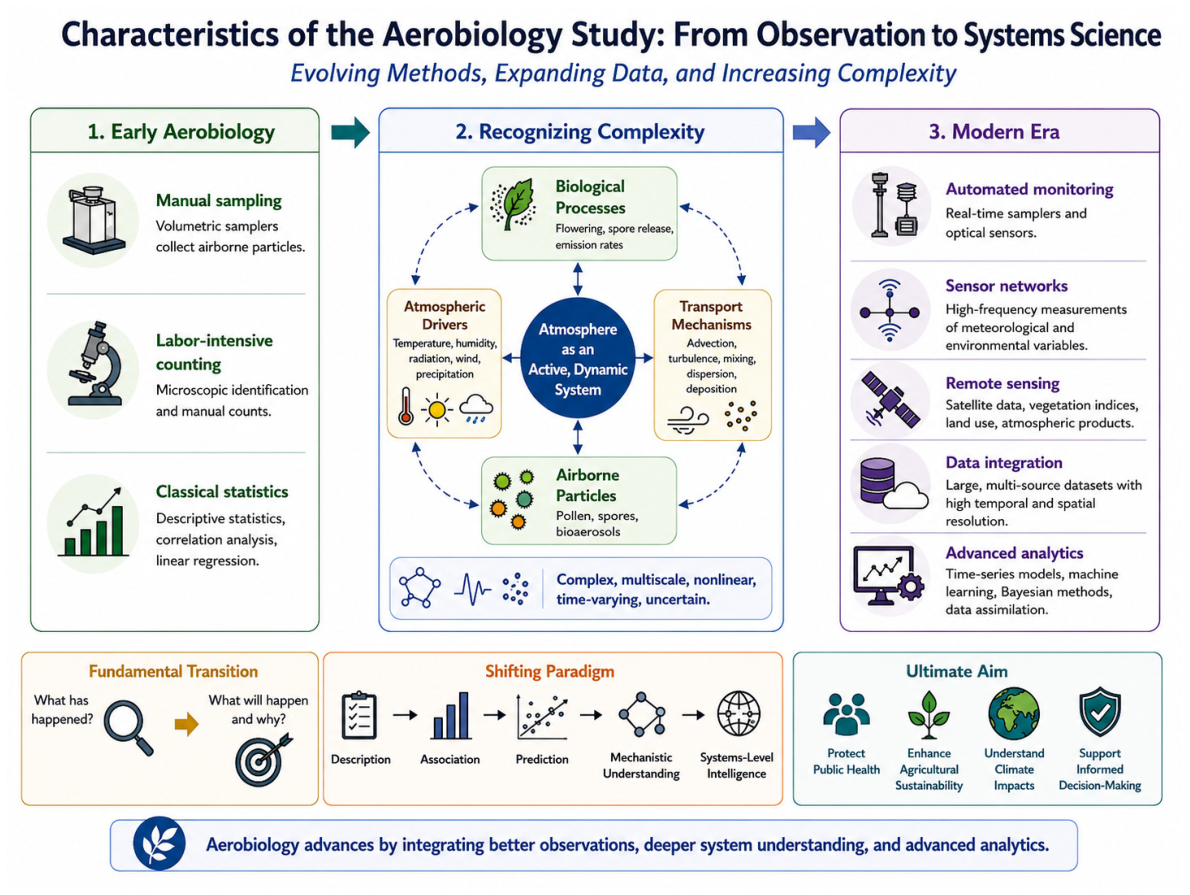
2. Characteristics of Aerobiological Data
2.1. Multiscale Dynamics
2.2. Temporal Structure and Dynamics
2.3. Spatial Heterogeneity
2.4. Nonlinearity and Threshold Behavior
2.5. Stochasticity and Uncertainty
2.6. Data Quality and Measurement Challenges
2.7. Aerobiology as a Moving Complex Adaptive System
3. Classical Statistics: The Era of Description and Insight
3.1. Foundations of Measurement and Early Quantification
3.2. Descriptive Statistics: Establishing Baseline Knowledge
3.3. Distribution Analysis: Recognizing Patterns in Variability
3.4. Correlation Analysis: Identifying Environmental Associations
3.5. Linear Regression: Quantifying Relationships
3.6. Analysis of Variance and Hypothesis Testing
3.7. Early Time-Series Perspectives
3.8. Strengths and Limitations of Classical Approaches
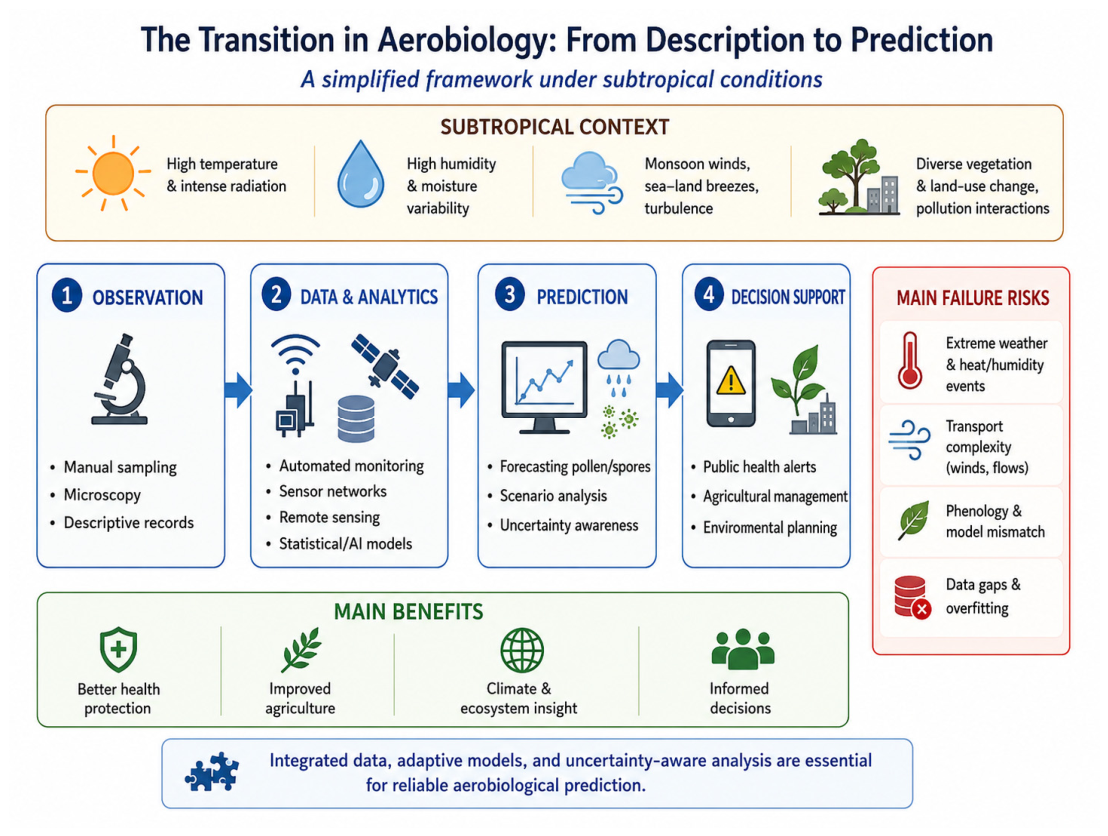
4. Transformation: From Description to Prediction
5. Modern Statistical Methods: Capturing Complexity
5.1. Time-Series Analysis: Modeling Temporal Dynamics in Aerobiology
5.1.1. ARIMA Models: Linear Temporal Dependence and Short-Term Forecasting
5.1.2. Seasonal Models: Capturing Periodicity in Biological Cycles
5.1.3. State-Space Models: Hidden Dynamics and Real-Time Updating
5.1.4. Nonlinear Time-Series Models: Capturing Thresholds and Regime Shifts
5.1.5. Synthesis: From Temporal Description to Predictive Dynamics
5.2. Regression-Based Modern Methods
5.2.1. Generalized Linear Models (GLMs)
5.2.2. Generalized Additive Models (GAMs)
5.2.3. Distributed Lag Models
5.3. Spatial and Spatiotemporal Statistics
5.3.1. Geostatistics and Spatial Interpolation
5.3.2. Spatial Autocorrelation and Pattern Detection
5.3.3. Spatiotemporal Models and Integrated Frameworks
5.4. Bayesian Statistical Methods
5.4.1. Bayesian Inference: A Probabilistic Framework
5.4.2. Hierarchical Bayesian Models: Multilevel Structures
5.4.3. Data Assimilation: Integrating Models and Observations
5.5. Machine Learning Approaches
5.5.1. Supervised Learning: Nonlinear Predictive Models
5.5.2. Deep Learning: High-Dimensional and Structured Data
5.5.3. Strengths, Limitations, and Practical Considerations
5.5.4. Operational Forecasting, Validation, and Data Requirements
5.6. Strengths and Limitations of Modern Methods
6. Hybrid Statistical Approaches
6.1. Conceptual Foundation
6.1.1. The Need for Integration
6.1.2. Framework of Hybrid Modeling
6.2. Types of Hybrid Models
6.2.1. Physics-Informed Machine Learning
6.2.2. Residual Learning
6.2.3. Data Assimilation Systems
6.3. Applications in Aerobiology
6.4. Advantages of Hybrid Approaches
6.5. Challenges and Future Directions of the Statistical Methdels
7. Uncertainty and Causality
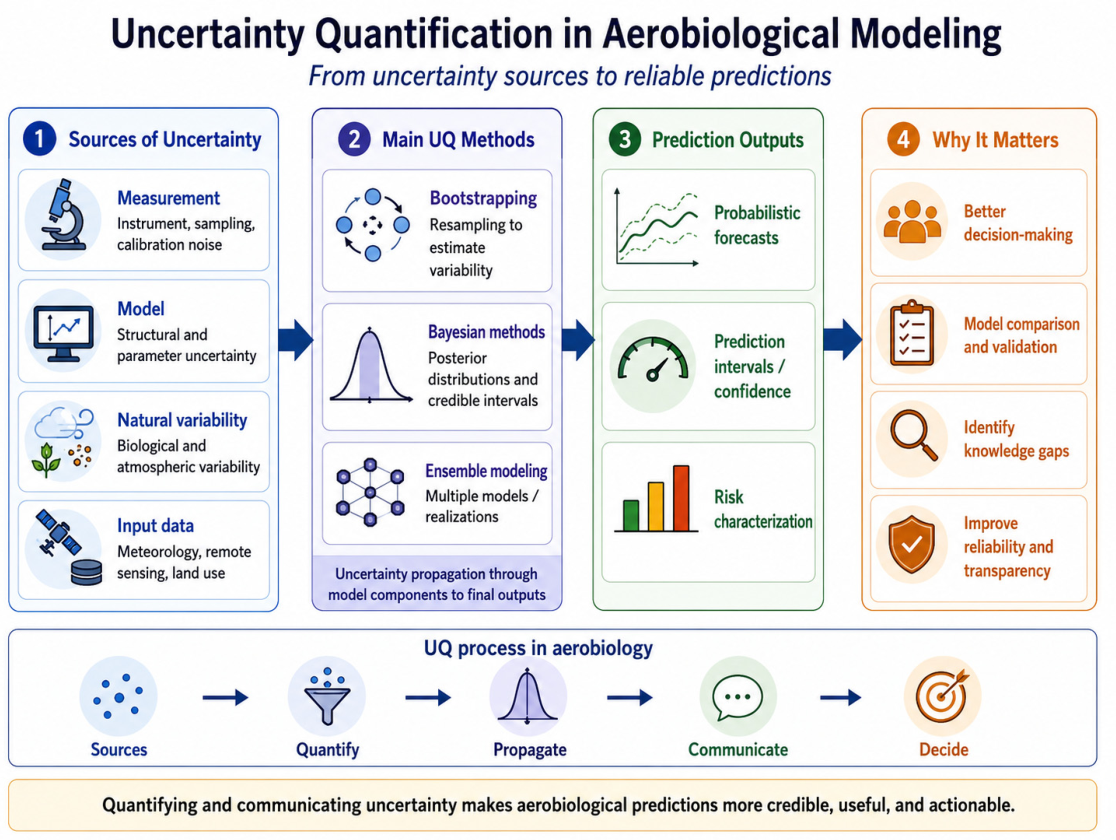
7.1. Uncertainty Quantification
7.1.1. Sources of Uncertainty
7.1.2. Methods for Quantifying Uncertainty
7.1.3. Implications for Aerobiological Prediction
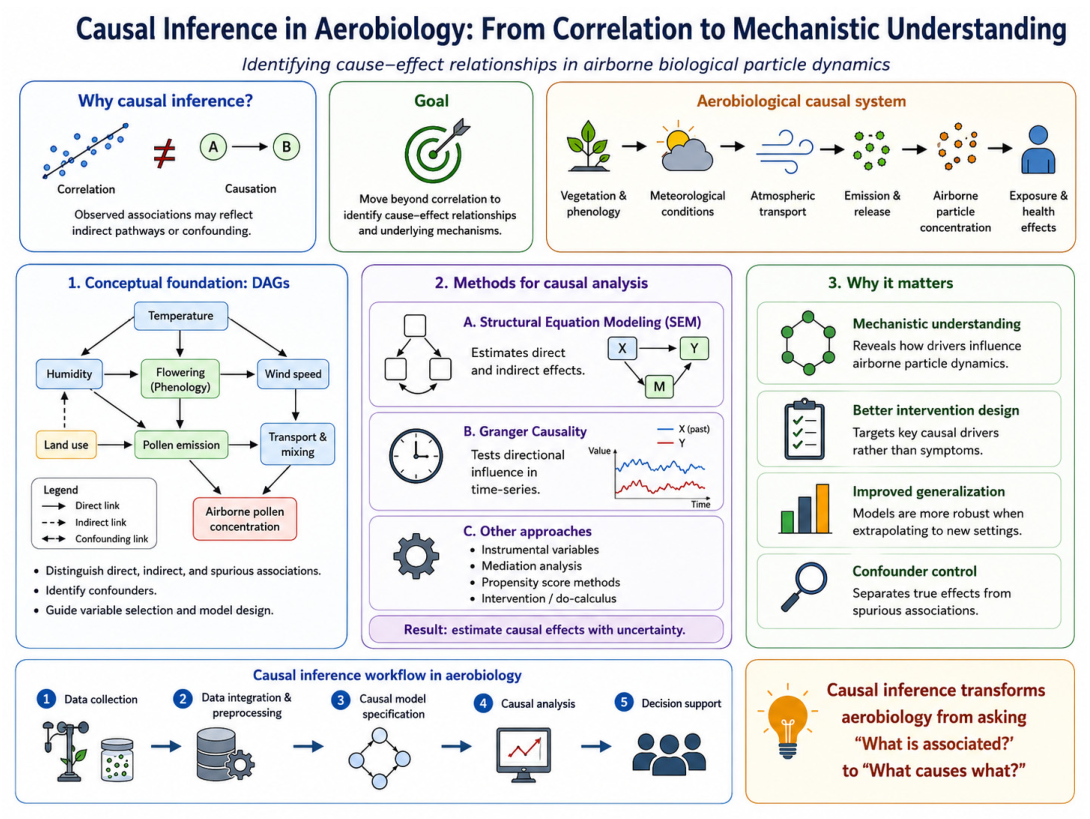
7.2. Causal Inference
7.2.1. Conceptual Foundations of Causality
7.2.2. Methods for Causal Analysis
7.2.3. Implications for Aerobiological Understanding
8. Integration with Environmental Monitoring Systems
8.1. IoT and Sensor Networks: From Discrete Observation to Continuous Monitoring
8.2. Real-Time Data Integration and Adaptive Modeling
8.3. Remote Sensing: Expanding Spatial and Environmental Context
8.4. Coupling Monitoring Systems with Modeling Frameworks
8.5. Challenges and Future Perspectives
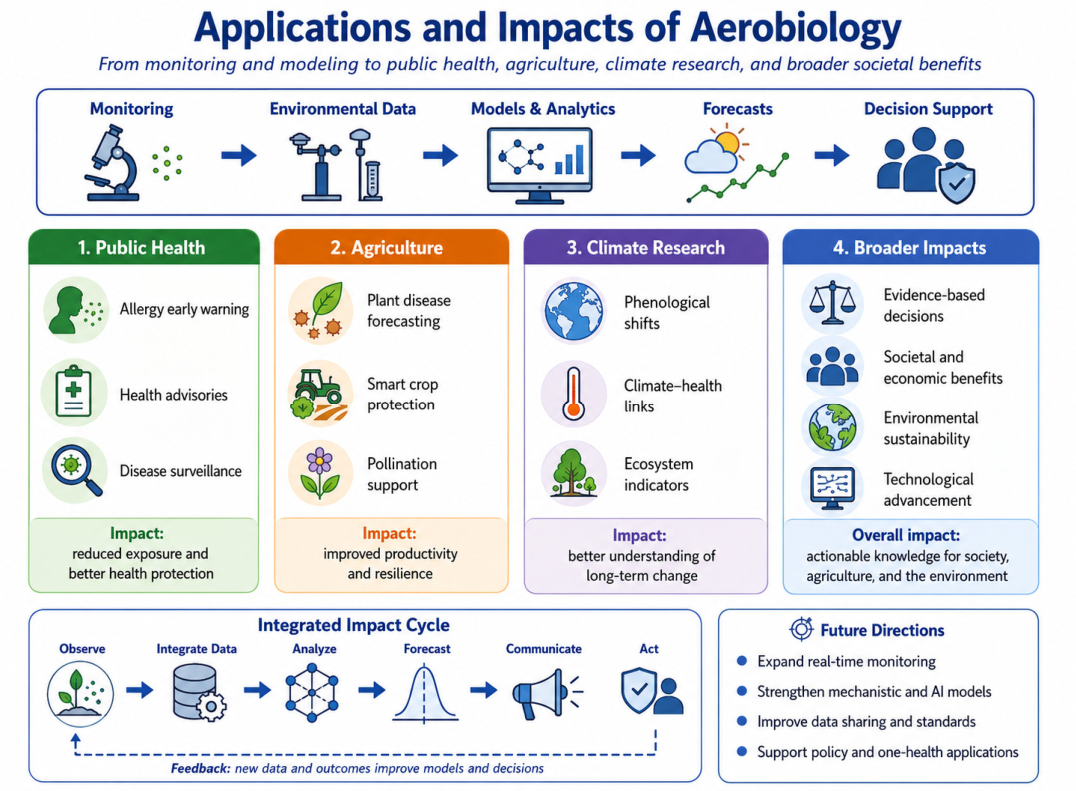
9. Applications and Impacts
9.1. Public Health: From Monitoring to Early Warning
9.2. Agriculture: Managing Risk and Optimizing Productivity
9.3. Climate Change Research: Detecting Shifts and Long-Term Trends
9.4. Broader Impacts and Future Directions
10. Systems Engineering Perspective
10.1. Aerobiology as a Complex Adaptive System
10.2. System Structure: Inputs, Processes, Outputs, and Monitoring
10.3. Statistical Models as System Components
10.4. Feedback, Adaptation, and Integrated System Design
11. Challenges and Future Directions
11.1. Persistent Challenges in Modern Aerobiology
11.2. Emerging Directions: Toward Intelligent and Integrated Systems
11.3. Toward a Systems Engineering Future
12. Conclusions
Author Contributions
Funding
Institutional Review Board Statement
Informed Consent Statement
Data Availability Statement
Acknowledgments
Conflicts of Interest
Abbreviations
| AI | Artificial Intelligence |
| ANOVA | Analysis of Variance |
| ARIMA | Autoregressive Integrated Moving Average |
| AS-LUNG-P | AS-LUNG-P low-cost sensor |
| CV | Coefficient of Variation |
| DAGs | Directed Acyclic Graphs |
| DLMs | Distributed Lag Models |
| GAMs | Generalized Additive Models |
| GLM | Generalized Linear Model |
| GLMs | Generalized Linear Models |
| LSTM | Long Short-Term Memory |
| MODIS | Moderate Resolution Imaging Spectroradiometer |
| NDVI | Normalized Difference Vegetation Index |
| PM1 | Particulate Matter with aerodynamic diameter ≤ 1 μm |
| PM2.5 | Particulate Matter with aerodynamic diameter ≤ 2.5 μm |
| PM10 | Particulate Matter with aerodynamic diameter ≤ 10 μm |
| RF | Random Forest |
| SARIMA | Seasonal Autoregressive Integrated Moving Average |
| SARS-CoV-2 | Severe Acute Respiratory Syndrome Coronavirus 2 |
| SEM | Structural Equation Modeling |
| SVM | Support Vector Machine |
References
- Després, V.R.; Huffman, J.A.; Burrows, S.M.; Hoose, C.; Safatov, A.S.; Buryak, G.; Fröhlich-Nowoisky, J.; Elbert, W.; Andreae, M.O.; Pöschl, U.; et al. Primary biological aerosol particles in the atmosphere: A review. Tellus B Chem. Phys. Meteorol. 2012, 64, 15598. [Google Scholar] [CrossRef]
- Sofiev, M.; Bergmann, K.C. (Eds.) Allergenic Pollen: A Review of the Production, Release, Distribution and Health Impacts; Springer: Dordrecht, The Netherlands, 2013. [Google Scholar]
- Hirst, J.M. An automatic volumetric spore trap. Ann. Appl. Biol. 1952, 39, 257–265. [Google Scholar] [CrossRef]
- Galán, C.; Ariatti, A.; Bonini, M.; Clot, B.; Crouzy, B.; Dahl, A.; Fernández-González, D.; Frenguelli, G.; Gehrig, R.; Isard, S.; et al. Recommended terminology for aerobiological studies. Aerobiologia 2017, 33, 293–305. [Google Scholar] [CrossRef]
- Scheifinger, H.; Belmonte, J.; Buters, J.; Celenk, S.; Damialis, A.; Dechamp, C.; García-Mozo, H.; Gehrig, R.; Grewling, Ł.; Halley, J.M.; et al. Monitoring, modelling and forecasting of the pollen season. In Allergenic Pollen: A Review of the Production, Release, Distribution and Health Impacts; Sofiev, M., Bergmann, K.C., Eds.; Springer: Dordrecht, The Netherlands, 2013; pp. 71–126. [Google Scholar]
- Dhawan, S.; Kumar, A.; Mehta, D.S.; Khare, M. A review of airborne pollen and its interactions with air pollutants, urbanization, and climate change: Implications for human health and monitoring gaps. Curr. Allergy Asthma Rep. 2025, 25, 62. [Google Scholar] [CrossRef]
- Zhang, Y.; Bielory, L.; Georgopoulos, P.G. Predicting onset and duration of airborne allergenic pollen season in the United States. Atmos. Environ. 2015, 103, 297–306. [Google Scholar] [CrossRef] [PubMed]
- Plaza, M.P.; Kolek, F.; Leier-Wirtz, V.; Brunner, J.O.; Traidl-Hoffmann, C.; Damialis, A. Detecting airborne pollen using an automatic, real-time monitoring system: Evidence from two sites. Int. J. Environ. Res. Public Health 2022, 19, 2471. [Google Scholar] [CrossRef]
- Muzalyova, A.; Brunner, J.O.; Traidl-Hoffmann, C.; Damialis, A. Forecasting Betula and Poaceae airborne pollen concentrations on a 3-hourly resolution in Augsburg, Germany: Toward automatically generated, real-time predictions. Aerobiologia 2021, 37, 425–446. [Google Scholar] [CrossRef]
- Zewdie, G.K.; Lary, D.J.; Levetin, E.; Garuma, G.F. Applying deep neural networks and ensemble machine learning methods to forecast airborne Ambrosia pollen. Int. J. Environ. Res. Public Health 2019, 16, 1992. [Google Scholar] [CrossRef]
- Ren, X.; Cai, T.; Mi, Z.; Bielory, L.; Nolte, C.G.; Georgopoulos, P.G. Modeling past and future spatiotemporal distributions of airborne allergenic pollen across the contiguous United States. Front. Allergy 2022, 3, 959594. [Google Scholar] [CrossRef]
- Menzel, A.M.; Ghasemifard, H.; Yuan, Y.; Estrella, N. A first pre-season pollen transport climatology to Bavaria, Germany. Front. Allergy 2021, 2, 627863. [Google Scholar] [CrossRef]
- Nowosad, J.; Stach, A.; Kasprzyk, I.; Grewling, Ł.; Latałowa, M.; Puc, M.; Myszkowska, D.; Chmielewska, E.W.; Piotrowska-Weryszko, K.; Chłopek, K.; et al. Temporal and spatiotemporal autocorrelation of daily concentrations of Alnus, Betula, and Corylus pollen in Poland. Aerobiologia 2015, 31, 159–177. [Google Scholar] [CrossRef]
- Jetschni, J.; Jochner-Oette, S. Spatial and temporal variations of airborne Poaceae pollen along an urbanization gradient assessed by different types of pollen traps. Atmosphere 2021, 12, 974. [Google Scholar] [CrossRef]
- Weinberger, K.R.; Kinney, P.L.; Lovasi, G.S. A review of spatial variation of allergenic tree pollen within cities. Arboric. Urban For. 2015, 41, 57–68. [Google Scholar] [CrossRef]
- Schramm, P.J.; Brown, C.L.; Saha, S.; Conlon, K.C.; Manangan, A.P.; Bell, J.E.; Hess, J.J. A systematic review of the effects of temperature and precipitation on pollen concentrations and season timing, and implications for human health. Int. J. Biometeorol. 2021, 65, 1615–1628. [Google Scholar] [CrossRef]
- Picornell, A.; Oteros, J.; Ruiz-Mata, R.; Recio, M.; Trigo, M.M.; Martínez-Bracero, M.; Lara, B.; Serrano-García, A.; Galán, C.; García-Mozo, H.; et al. Methods for interpolating missing data in aerobiological databases. Environ. Res. 2021, 200, 111391. [Google Scholar] [CrossRef] [PubMed]
- Buters, J.T.M.; Clot, B.; Galán, C.; Gehrig, R.; Gilge, S.; Hentges, F.; O’cOnnor, D.; Sikoparija, B.; Skjoth, C.; Tummon, F.; et al. Automatic detection of airborne pollen: An overview. Aerobiologia 2024, 40, 13–37. [Google Scholar] [CrossRef]
- Cervigón, P.; Ferencova, Z.; Cascón, Á.; Romero-Morte, J.; Galán Díaz, J.; Sabariego, S.; Torres, M.; Gutiérrez-Bustillo, A.M.; Rojo, J. Importance of the quality management of aerobiological monitoring networks: The case study of Madrid region in Spain. Sci. Total Environ. 2024, 954, 176544. [Google Scholar] [CrossRef]
- Gregory, P.H. The Microbiology of the Atmosphere, 2nd ed.; Leonard Hill: London, UK, 1973. [Google Scholar]
- Legendre, P.; Legendre, L. Numerical Ecology, 3rd ed.; Elsevier: Amsterdam, The Netherlands, 2012. [Google Scholar]
- Box, G.E.P.; Hunter, J.S.; Hunter, W.G. Statistics for Experimenters: Design, Innovation, and Discovery, 2nd ed.; Wiley: New York, NY, USA, 2005. [Google Scholar]
- Emberlin, J.; Mullins, J.; Corden, J.; Jones, S.; Millington, W.; Brooke, M.; Savage, M. Regional variations in grass pollen seasons in the UK, long-term trends and forecast models. Clin. Exp. Allergy 1999, 29, 347–356. [Google Scholar] [CrossRef]
- Montgomery, D.C.; Peck, E.A.; Vining, G.G. Introduction to Linear Regression Analysis, 5th ed.; Wiley: New York, NY, USA, 2012. [Google Scholar]
- Andersen, T.B. A model to predict the beginning of the pollen season. Grana 1991, 30, 269–275. [Google Scholar] [CrossRef]
- Limpert, E.; Stahel, W.A.; Abbt, M. Log-normal distributions across the sciences: Keys and clues. Bioscience 2001, 51, 341–352. [Google Scholar] [CrossRef]
- Ranta, H.; Kubin, E.; Siljamo, P.; Sofiev, M. Long distance pollen transport cause problems for determining the timing of birch pollen season in Fennoscandia by using phenological observations. Grana 2006, 45, 297–304. [Google Scholar] [CrossRef]
- Soldevilla, C.G.; González, P.C.; Teno, P.A.; Vilches, E.D. Spanish Aerobiology Network (REA): Management and Quality Manual; Servicio de Publicaciones de la Universidad de Córdoba: Córdoba, Spain, 2007; pp. 1–300. [Google Scholar]
- Puc, M. Artificial neural network model of the relationship between Betula pollen and meteorological factors in Szczecin (Poland). Int. J. Biometeorol. 2012, 56, 395–401. [Google Scholar] [CrossRef]
- Chatfield, C.; Xing, H. The Analysis of Time Series: An Introduction with R; Chapman and Hall/CRC: Boca Raton, FL, USA, 2019. [Google Scholar]
- Zhu, X.; Katelaris, C.H.; Beggs, P.J.; Devadas, R. Floating in the air: Forecasting allergenic pollen concentration for managing urban public health. Int. J. Digit. Earth 2024, 17, 2306894. [Google Scholar] [CrossRef]
- Rodríguez-Rajo, F.J.; Valencia-Barrera, R.M.; Vega-Maray, A.M.; Suárez, F.J.; Fernández-González, D.; Jato, V. Prediction of airborne Alnus pollen concentration by using ARIMA models. Ann. Agric. Environ. Med. 2006, 13, 25–32. [Google Scholar]
- Aznarte, J.L.; Benítez, J.M.; Lugilde, D.N.; Fernández, C.D.L.; de la Guardia, C.D.; Alba Sánchez, F. Forecasting airborne pollen concentration time series with neural and neuro-fuzzy models. Expert Syst. Appl. 2007, 32, 1218–1225. [Google Scholar] [CrossRef]
- Cotos-Yáñez, T.R.; Rodríguez-Rajo, F.J.; Jato, V. Short-term prediction of Betula airborne pollen concentration in Vigo (NW Spain) using logistic additive models and partially linear models. Int. J. Biometeorol. 2004, 48, 179–185. [Google Scholar] [CrossRef]
- Lam, H.C.; Anees-Hill, S.; Satchwell, J.; Symon, F.; Macintyre, H.; Pashley, C.H.; Marczylo, E.L.; Douglas, P.; Aldridge, S.; Hansell, A. Association between ambient temperature and common allergenic pollen and fungal spores: A 52-year analysis in central England, United Kingdom. Sci. Total Environ. 2024, 906, 167607. [Google Scholar] [CrossRef]
- Oteros, J.; Bergmann, K.C.; Menzel, A.; Damialis, A.; Traidl-Hoffmann, C.; Schmidt-Weber, C.; Buters, J. Spatial interpolation of current airborne pollen concentrations where no monitoring exists. Atmos. Environ. 2019, 199, 435–442. [Google Scholar] [CrossRef]
- Nowosad, J.; Stach, A.; Kasprzyk, I.; Grewling, Ł.; Latałowa, M.; Puc, M.; Myszkowska, D.; Weryszko-Chmielewska, E.; Piotrowska-Weryszko, K.; Chłopek, K.; et al. Spatiotemporal models for predicting high pollen concentration level of Corylus, Alnus, and Betula. Int. J. Biometeorol. 2016, 60, 843–855. [Google Scholar] [CrossRef]
- Zhang, Y.; Isukapalli, S.S.; Bielory, L.; Georgopoulos, P.G. Bayesian analysis of climate change effects on observed and projected airborne levels of birch pollen. Atmos. Environ. 2013, 68, 64–73. [Google Scholar] [CrossRef] [PubMed]
- Sofiev, M. On possibilities of assimilation of near-real-time pollen data by atmospheric composition models. Aerobiologia 2019, 35, 523–531. [Google Scholar] [CrossRef]
- Picornell, A.; Hurtado, S.; Antequera-Gómez, M.L.; Barba-González, C.; Ruiz-Mata, R.; de Gálvez-Montañez, E.; Navas-Delgado, I. A deep learning LSTM-based approach for forecasting annual pollen curves: Olea and Urticaceae pollen types as a case study. Comput. Biol. Med. 2024, 168, 107706. [Google Scholar] [CrossRef]
- Shokouhi, B.V.; de Hoogh, K.; Gehrig, R.; Eeftens, M. Estimation of historical daily airborne pollen concentrations across Switzerland using a spatio temporal random forest model. Sci. Total Environ. 2024, 906, 167286. [Google Scholar] [CrossRef]
- Sharma, H.; Shrivastava, M.; Singh, B. Physics informed deep neural network embedded in a chemical transport model for the Amazon rainforest. npj Clim. Atmos. Sci. 2023, 6, 28. [Google Scholar] [CrossRef]
- Xu, M.; Jin, J.; Wang, G.; Segers, A.; Deng, T.; Lin, H.X. Machine learning based bias correction for numerical chemical transport models. Atmos. Environ. 2021, 248, 118022. [Google Scholar] [CrossRef]
- Li, S.; Xing, J. Enhancing 72-hour air quality forecasting with an observation-driven deep learning chemistry transport model. Environ. Int. 2025, 197, 109689. [Google Scholar] [CrossRef]
- Papadogiannaki, S.; Karatzas, K.; Kontos, S.; Poupkou, A.; Melas, D. A multi-model approach to pollen season estimations: Case study for Olea and Quercus in Thessaloniki, Greece. Atmosphere 2025, 16, 454. [Google Scholar] [CrossRef]
- Beven, K. Environmental Modelling: An Uncertain Future? CRC Press: Boca Raton, FL, USA, 2018. [Google Scholar]
- Efron, B.; Tibshirani, R.J. An Introduction to the Bootstrap; Chapman and Hall/CRC: Boca Raton, FL, USA, 1994. [Google Scholar]
- Gelman, A.; Carlin, J.B.; Stern, H.S.; Dunson, D.B.; Vehtari, A.; Rubin, D.B. Bayesian Data Analysis, 3rd ed.; CRC Press: Boca Raton, FL, USA, 2013. [Google Scholar]
- Buters, J.T.M.; Antunes, C.; Galveias, A.; Bergmann, K.C.; Thibaudon, M.; Galán, C.; Schmidt-Weber, C.; Oteros, J. Pollen and spore monitoring in the world. Clin. Transl. Allergy 2018, 8, 9. [Google Scholar] [CrossRef]
- Leutbecher, M.; Palmer, T.N. Ensemble forecasting. J. Comput. Phys. 2008, 227, 3515–3539. [Google Scholar] [CrossRef]
- Pearl, J. Causality: Models, Reasoning, and Inference, 2nd ed.; Cambridge University Press: Cambridge, UK, 2009. [Google Scholar]
- Granger, C.W.J. Investigating causal relations by econometric models and cross-spectral methods. Econometrica 1969, 37, 424–438. [Google Scholar] [CrossRef]
- Hernán, M.A.; Robins, J.M. Causal Inference: What If; Chapman and Hall/CRC: Boca Raton, FL, USA, 2020. [Google Scholar]
- Kline, R.B. Principles and Practice of Structural Equation Modeling; Guilford Publications: New York, NY, USA, 2023. [Google Scholar]
- Hart, J.K.; Martinez, K. Environmental sensor networks: A revolution in the earth system science? Earth Sci. Rev. 2006, 78, 177–191. [Google Scholar] [CrossRef]
- Shinde, S.R.; Karode, A.H.; Suralkar, S.R. Review on IoT based environment monitoring system. Int. J. Electron. Commun. Eng. Technol. 2017, 8, 103–108. [Google Scholar]
- Reichstein, M.; Camps-Valls, G.; Stevens, B.; Jung, M.; Denzler, J.; Carvalhais, N.; Prabhat. Deep learning and process understanding for data-driven Earth system science. Nature 2019, 566, 195–204. [Google Scholar] [CrossRef] [PubMed]
- Sofiev, M.; Siljamo, P.; Ranta, H.; Rantio-Lehtimäki, A. Towards numerical forecasting of long-range air transport of birch pollen: Theoretical considerations and a feasibility study. Int. J. Biometeorol. 2006, 50, 392–402. [Google Scholar] [CrossRef] [PubMed]
- Gubbi, J.; Buyya, R.; Marusic, S.; Palaniswami, M. Internet of Things (IoT): A vision, architectural elements, and future directions. Future Gener. Comput. Syst. 2013, 29, 1645–1660. [Google Scholar] [CrossRef]
- Chi, N.D.T.; Ngan, T.A.; Cong-Thanh, T.; Huy, D.H.; Lung, S.-C.C.; Hien, T.T. Calibration of DustTrak and Low-Cost Sensors and Their Application for Assessment of Inhalation Exposures to Traffic-Related PM2.5 and PM1 in Ho Chi Minh City. Atmosphere 2023, 14, 1504. [Google Scholar] [CrossRef]
- Evensen, G. Data Assimilation: The Ensemble Kalman Filter, 2nd ed.; Springer: Berlin, Germany, 2009. [Google Scholar]
- Zhang, Y.; Bocquet, M.; Mallet, V.; Seigneur, C.; Baklanov, A. Real-time air quality forecasting, part I: History, techniques, and current status. Atmos. Environ. 2012, 60, 632–655. [Google Scholar] [CrossRef]
- Pettorelli, N.; Vik, J.O.; Mysterud, A.; Gaillard, J.M.; Tucker, C.J.; Stenseth, N.C. Using the satellite-derived NDVI to assess ecological responses to environmental change. Trends Ecol. Evol. 2005, 20, 503–510. [Google Scholar] [CrossRef]
- Running, S.W.; Thornton, P.E.; Nemani, R.; Glassy, J.M. Global terrestrial gross and net primary productivity from the earth observing system. In Methods in Ecosystem Science; Springer: New York, NY, USA, 2000; pp. 44–57. [Google Scholar]
- Zhang, X.; Friedl, M.A.; Schaaf, C.B.; Strahler, A.H.; Hodges, J.C.; Gao, F.; Reed, B.C.; Huete, A. Monitoring vegetation phenology using MODIS. Remote Sens. Environ. 2003, 84, 471–475. [Google Scholar] [CrossRef]
- Talagrand, O. Data assimilation: Making sense of observations. In Evaluation of Assimilation Algorithms; Springer: Berlin, Germany, 2010; pp. 217–240. [Google Scholar]
- Burge, H.A. An update on pollen and fungal spore aerobiology. J. Allergy Clin. Immunol. 2002, 110, 544–552. [Google Scholar] [CrossRef]
- Fernstrom, A.; Goldblatt, M. Aerobiology and its role in the transmission of infectious diseases. J. Pathog. 2013, 2013, 493960. [Google Scholar] [CrossRef]
- Frenguelli, G. The contribution of aerobiology to agriculture. Aerobiologia 1998, 14, 95–100. [Google Scholar] [CrossRef]
- Newlands, N.K. Model-based forecasting of agricultural crop disease risk at the regional scale, integrating airborne inoculum, environmental, and satellite-based monitoring data. Front. Environ. Sci. 2018, 6, 63. [Google Scholar] [CrossRef]
- Espinosa, K.C.S.; Vázquez, L.D.; Fernández-González, M.; Almaguer, M.; Rodríguez-Rajo, F.J. Aeromycological studies in the crops of the main cereals: A systematic review. J. Agric. Food Res. 2023, 14, 100732. [Google Scholar] [CrossRef]
- Ziska, L.H.; Makra, L.; Harry, S.K.; Bruffaerts, N.; Hendrickx, M.; Coates, F.; Saarto, A.; Thibaudon, M.; Oliver, G.; Damialis, A.; et al. Temperature-related changes in airborne allergenic pollen abundance and seasonality across the northern hemisphere: A retrospective data analysis. Lancet Planet. Health 2019, 3, e124–e131. [Google Scholar] [CrossRef]
- Gehrig, R.; Gassner, M.; Schmid-Grendelmeier, P.; Clot, B. 50 years of pollen monitoring in Basel (Switzerland) demonstrate the influence of climate change on airborne pollen. Front. Allergy 2021, 2, 677159. [Google Scholar] [CrossRef]
- Holland, J.H. Complex adaptive systems. Daedalus 1992, 121, 17–30. [Google Scholar]
- Holling, C.S. Understanding the complexity of economic, ecological, and social systems. Ecosystems 2001, 4, 390–405. [Google Scholar] [CrossRef]
- Vélez-Pereira, A.M.; Fernández-González, M.; Rodríguez-Rajo, F.J. Aerobiological modeling I: A review of predictive models. Sci. Total Environ. 2021, 795, 148783. [Google Scholar] [CrossRef] [PubMed]
- Van der Heyden, H.; Dutilleul, P.; Charron, J.B.; Bilodeau, G.J.; Carisse, O. Monitoring airborne inoculum for improved plant disease management: A review. Agron. Sustain. Dev. 2021, 41, 40. [Google Scholar] [CrossRef]
- Blanchard, B.S.; Fabrycky, W.J. Systems Engineering and Analysis, 5th ed.; Pearson: Harlow, UK, 2023. [Google Scholar]
- Tummon, F.; Bruffaerts, N.; Çelenk, S.; Choël, M.; Clot, B.; Crouzy, B.; Galán, C.; Gilge, S.; Hajkova, L.; Mokin, V.; et al. Towards standardisation of automatic pollen and fungal spore monitoring: Best practises and guidelines. Aerobiologia 2024, 40, 39–55. [Google Scholar] [CrossRef]
- Hazeleger, W.; Aerts, J.P.M.; Bauer, P.; Bierkens, M.F.P.; Camps-Valls, G.; Dekker, M.M.; Doblas-Reyes, F.J.; Eyring, V.; Finkenauer, C.; Grundner, A.; et al. Digital twins of the Earth with and for humans. Commun. Earth Environ. 2024, 5, 463. [Google Scholar] [CrossRef]
- Pang, M.; Jin, J.; Segers, A.; Lin, H.X.; Wang, G.; Liao, H.; Han, W. Zeeman: A Deep Learning Framework for Regional Atmospheric Chemistry Forecasting. Geophys. Res. Lett. 2026, 53, e2025GL117459. [Google Scholar] [CrossRef]
- Shikhovtsev, M.Y.; Shikhovtsev, A.Y.; Kovadlo, P.G.; Obolkin, V.A.; Molozhnikova, Y.V. Influence of Air Movement Structure on Microphysical Properties of the Atmosphere over Listvyanka. Atmos. Ocean. Opt. 2025, 38, 180–187. [Google Scholar] [CrossRef]
- Romano, S. Bioaerosols: Composition, Meteorological Impact, and Transport. Atmosphere 2023, 14, 590. [Google Scholar] [CrossRef]



| Characteristic | Description in Aerobiological Systems | Statistical Implication | Key References |
|---|---|---|---|
| System complexity | Aerobiological data arise from coupled biological and atmospheric processes, including emission, transport, transformation, and deposition. | Requires integrative, multivariate, and system-based modeling. | [1,12,13] |
| Multiscale dynamics | Processes occur from microscale emission physiology to canopy, landscape, and regional transport scales. | Requires hierarchical, multilevel, or scale-integrated models. | [1,12,14,15,16] |
| Temporal seasonality | Pollen and spore concentrations show seasonal cycles driven by phenology and climate. | Requires seasonal decomposition, periodic functions, and phenology-based predictors. | [7,13,16] |
| Diurnal variability | Within-day variation reflects emission rates, radiation, atmospheric stability, and boundary-layer dynamics. | Requires high-resolution temporal models; daily aggregation may hide important patterns. | [13,14] |
| Temporal dependence | Previous biological and atmospheric states influence current concentrations. | Requires time-series methods; independence assumptions are inappropriate. | [7,13] |
| Spatial heterogeneity | Concentrations vary with vegetation, land use, topography, microclimate, and elevation. | Requires spatial or geostatistical models and validation beyond single-site data. | [12,14,15] |
| Spatiotemporal interaction | Spatial patterns and temporal dynamics interact through local emissions and regional meteorology. | Requires spatiotemporal models that jointly represent space and time. | [12,13,14,15] |
| Nonlinearity | Relationships among meteorology, biology, and particle concentration are often nonlinear. | Requires flexible methods such as GAMs, nonlinear regression, or machine learning. | [1,7,16] |
| Threshold behavior | Flowering, spore release, and emissions may occur only after environmental thresholds are exceeded. | Requires threshold, regime-switching, or piecewise models. | [7,16] |
| Stochasticity | Turbulence, wind gusts, chaotic mixing, and biological variation introduce random variability. | Requires probabilistic or stochastic modeling frameworks. | [1,13,16] |
| Measurement uncertainty | Instrument limits, calibration differences, and sampling methods affect data accuracy. | Requires calibration, measurement-error modeling, and uncertainty quantification. | [17,18] |
| Missing data | Instrument downtime and sampling limitations often create incomplete time series. | Requires imputation, robust estimation, and sensitivity analysis. | [17] |
| Extreme events | Sudden pollen peaks or long-distance transport episodes may dominate exposure patterns. | Requires event-based or extreme-value analysis; outliers should be evaluated carefully. | [12,18] |
| Data heterogeneity | Different monitoring networks may use different methods, instruments, and spatial coverage. | Requires harmonization, standardization, and cross-validation across datasets. | [17,18] |
| Classical Statistical Component | Role in Early Aerobiology | Main Contribution | Main Limitation | Key References |
|---|---|---|---|---|
| Foundations of measurement and early quantification | Continuous sampling technologies, especially Hirst-type volumetric samplers, enabled systematic records of airborne pollen and spores. | Converted scattered observations into organized numerical data for long-term comparison. | Measurement advanced faster than modeling; analyses remained simple. | [3,20,21,22] |
| Descriptive statistics | Means, medians, standard deviations, percentiles, seasonal averages, indices, and peak values summarized particle concentrations. | Established baseline knowledge of season start, duration, intensity, peaks, and interannual variation. | Described patterns but did not reveal mechanisms or causal structure. | [21,22,23,24,25] |
| Seasonal and baseline characterization | Annual pollen and spore patterns were summarized using standardized seasonal metrics. | Defined exposure periods and provided a common language for comparison. | It could oversimplify irregular seasons and unusual events. | [23,25] |
| Distribution analysis | Non-normal, skewed, heavy-tailed, and episodic concentration patterns were described using log-normal or gamma distributions. | Improved representation of variability and high-concentration events. | Remained empirical and did not explain biological or meteorological causes. | [21,23,26,27] |
| Correlation analysis | Pearson and Spearman correlations were used to assess associations between particle concentrations and meteorological variables. | Identified potential environmental drivers such as temperature, rainfall, humidity, and wind. | Could not establish causation and was vulnerable to confounding and nonlinear effects. | [23,28,29] |
| Linear regression | Simple and multiple regression related pollen or spore concentrations to environmental predictors. | Quantified sensitivities through interpretable coefficients and supported early prediction. | Linearity, independence, homoscedasticity, and multicollinearity were common problems. | [21,24,29] |
| Analysis of variance (ANOVA) | Compared concentrations across sites, seasons, taxa, or environmental categories. | Added inferential rigor for testing group differences. | Relied on assumptions such as normality and independence. | [21,23,24,25,29] |
| Hypothesis testing | Used significance testing to move beyond visual or descriptive comparisons. | Helped establish rigorous and reproducible statistical inference. | Statistical significance did not always imply ecological importance. | [21,24] |
| Early time-series perspectives | Moving averages and autocorrelation analysis examined temporal structure and short-term fluctuations. | Recognized memory and dynamic dependence in aerobiological data. | Too rudimentary for complex temporal dynamics or reliable forecasting. | [30] |
| Overall legacy of classical statistics | Focused on observation, description, comparison, and first-order inference. | Transformed raw particle counts into structured scientific knowledge and laid the foundation for modern methods. | Limited explanatory and predictive power for nonlinear, spatiotemporal, and stochastic systems. | [20,21,22,23,24,30] |
| Method Category | Core Concept | Application in Aerobiology | Strengths | Limitations | Key References |
|---|---|---|---|---|---|
| Time-series analysis | Models temporal dependence, seasonality, autocorrelation, and lagged responses. | Pollen/spore dynamics, seasonal cycles, and short-term forecasting. | Captures temporal structure in biological and atmospheric processes. | Requires careful specification; may struggle with nonlinearity or regime shifts. | [9,32,33,34,35] |
| ARIMA models | Use autoregression, differencing, and moving averages to model linear temporal dependence. | Short-term forecasting of pollen and spore concentrations. | Simple, interpretable, and effective for short-term prediction. | Limited to nonlinear effects and exogenous variables. | [9,31,32] |
| Seasonal time-series models | Add seasonal or periodic components to time-series models. | Pollen calendars, seasonal peaks, and climate-related phenological shifts. | Captures periodicity and seasonal variation. | Less effective when seasonal patterns are unstable or changing. | [9,31,35,38] |
| State-space models | Represent hidden system states from noisy observations, often using Kalman filtering. | Real-time estimation, forecasting, and model updating. | Handles noise, missing data, irregular sampling, and recursive updating. | Requires specification of latent system dynamics. | [8,38,39] |
| Nonlinear time-series models | Capture thresholds, regime shifts, and nonlinear temporal patterns. | Abrupt pollen release, extreme spikes, and biological–meteorological interactions. | Represents complex and realistic system dynamics. | More computationally demanding and less interpretable. | [31,33,34,35,40,41] |
| Generalized Linear Models (GLMs) | Extend regression to non-normal data using link functions. | Count-based or skewed pollen/spore data and meteorological relationships. | Statistically rigorous and interpretable. | Limited to complex nonlinear interactions. | [31,34,35] |
| Generalized Additive Models (GAMs) | Use smooth functions to model nonlinear relationships. | Nonlinear pollen responses to temperature, humidity, radiation, and other drivers. | Flexible yet interpretable; smooth effects can be visualized. | Sensitive to smoothing choices and possible overfitting. | [31,34,35] |
| Distributed Lag Models (DLMs) | Model delayed effects of predictors across time lags. | Lagged meteorological effects on pollen release and concentration. | Captures biological delays and improves forecasting. | Requires careful lag selection and interpretation. | [35] |
| Geostatistics and spatial interpolation | Use spatial dependence to estimate values at unobserved locations. | Mapping pollen/spore concentrations across monitoring networks. | Produces continuous exposure maps and supports regional assessment. | Sensitive to network density and stationarity assumptions. | [10,36] |
| Spatial autocorrelation analysis | Quantifies clustering or dispersion in spatial data. | Detects hotspots, transport pathways, and spatial exposure gradients. | Distinguishes structured spatial patterns from random variation. | Limited when used without temporal modeling. | [36,37] |
| Spatiotemporal models | Integrate spatial and temporal dependencies into a single framework. | Regional forecasting, dynamic mapping, and cross-site comparison. | Captures system dynamics across space and time. | Computationally intensive and data-demanding. | [10,36,37] |
| Bayesian inference | Combines prior knowledge and observed data into posterior estimates. | Parameter estimation, model comparison, and uncertainty analysis. | Provides explicit uncertainty quantification. | Requires prior specification and more computation. | [38] |
| Hierarchical Bayesian models | Model nested data structures with partial pooling across groups. | Multi-site and multi-region aerobiological datasets. | Improves estimation when local data are sparse. | More complex to implement and interpret. | [38] |
| Data assimilation | Combines observations with dynamic models through recursive updating. | Real-time forecasting using monitoring, emission, and transport models. | Improves adaptive prediction and state estimation. | Requires integration of statistical and mechanistic models. | [8,18,39] |
| Machine learning | Learns complex relationships directly from data. | Nonlinear, high-dimensional environmental–biological prediction. | High predictive accuracy and flexibility. | Limited interpretability, risk of overfitting, and large data requirements. | [9,10,31,40,41] |
| Supervised learning | Uses labeled data to predict concentrations or classify exposure risk. | Short-term pollen forecasting and risk classification. | Handles nonlinearities and interactions. | Requires tuning and may lack transparency. | [10,31,41] |
| Deep learning | Uses neural networks to learn hierarchical or sequential patterns. | LSTM-based time-series forecasting and structured environmental data analysis. | Captures long-range temporal dependence and complex patterns. | Requires large datasets, high computation, and careful interpretation. | [31,33,40,41] |
| Aspect | Classical Approaches | Modern Approaches | Hybrid Approaches |
|---|---|---|---|
| Primary focus | Description, summarization, and first-order interpretation of pollen and spore observations. | Prediction and flexible modeling of temporal, spatial, nonlinear, and multivariate relationships. | Integration of mechanistic knowledge with statistical or machine learning models. |
| Typical methods | Descriptive statistics, distribution analysis, correlation, linear regression, ANOVA, and simple smoothing. | ARIMA, state-space models, GLMs, GAMs, distributed lag models, geostatistics, Bayesian models, and machine learning. | Physics-informed machine learning, residual learning, data assimilation, and process-based statistical forecasting. |
| Complexity handling | Low; best for simple comparisons and baseline patterns. | High; captures autocorrelation, non-normality, nonlinear responses, lag effects, and spatial dependence. | Very high; combines process knowledge, dynamic updating, and data-driven correction. |
| Interpretability | High; results are transparent and easy to explain. | Moderate to low; flexible models, especially machine learning, may be less transparent. | Moderate to high; mechanistic structure improves interpretability, but complexity remains. |
| Data requirement | Low; can be used with small datasets and limited computation. | High; requires richer time series, environmental covariates, and larger datasets. | High; requires both observational data and mechanistic inputs. |
| Predictive power | Low; mainly useful for description and exploratory inference. | High; suitable for forecasting, pattern recognition, and dynamic modeling. | Very high; combines mechanistic structure with statistical adaptability. |
| Physical consistency | Low; usually describes empirical associations without enforcing biological or atmospheric realism. | Moderate; some methods include process structure, but many remain data-driven. | High; physical and biological constraints are explicitly incorporated. |
| Adaptability to changing conditions | Low; less effective under climate change, nonstationarity, or shifting source conditions. | High; Bayesian and machine learning models can update with new data. | Very high; mechanistic constraints provide stability while statistical layers adapt. |
| Main strength | Provides baseline knowledge and a common language for measurement and comparison. | Captures complex dynamics and improves forecasting accuracy. | Balances accuracy, interpretability, and process realism. |
| Main limitation | Limited ability to represent nonlinear, stochastic, and multiscale behavior. | May reduce interpretability and extrapolation reliability. | Requires greater computation, design effort, and validation. |
| Component | Role in Modern Aerobiology | Main Contribution | Key Challenge/Implication | Key References |
|---|---|---|---|---|
| Overall integration of monitoring systems | Modern aerobiology increasingly depends on environmental monitoring systems that connect field observations, real-time sensing, and large-scale environmental datasets. This marks a shift from sparse manual records toward predictive, system-level analysis. | Expands aerobiology from isolated sampling to continuous observation, model support, and operational management. It strengthens the field’s ability to observe, predict, and respond in near real time. | Requires coordination across sensors, data platforms, and modeling frameworks, as well as robust handling of heterogeneous data sources. | [55,56,57,58] |
| IoT and sensor networks | IoT-based systems link airborne particle sensors with measurements of temperature, humidity, wind speed, radiation, and related variables, transmitting data continuously to centralized platforms. | Replaces discrete, delayed observations with continuous, high-frequency monitoring. This improves temporal resolution and allows short-term dynamics to be captured more effectively. | Dependence on sensor reliability, calibration, data transmission, and standardization across distributed networks. | [55,58,59] |
| From discrete to continuous monitoring | Traditional aerobiological monitoring often relied on periodic sampling and manual interpretation. Continuous networked sensing now allows data to be collected at much shorter time intervals. | Makes it possible to detect diurnal cycles, rapid fluctuations, and short-lived concentration peaks that would be missed by low-frequency sampling. | Higher data volume increases the need for automated quality control, storage, and rapid analytical processing. | [2,55,56] |
| Expanded spatial coverage | Distributed sensor deployment across urban, agricultural, and natural landscapes allows monitoring beyond single-point observations. | Improves the representation of spatial heterogeneity in airborne biological particles and reduces overreliance on a single station as a proxy for broader regions. | Network placement and uneven coverage may still bias regional interpretation if not carefully designed. | [55,56] |
| Real-time data integration | Modern monitoring systems enable simultaneous data acquisition and model updating rather than delayed, sequential workflows. | Creates feedback loops in which incoming observations continuously refine predictions, enhancing forecast responsiveness and operational utility. | Requires compatible pipelines to stream data into models without interruption or significant latency. | [57,61] |
| Adaptive modeling | Continuous monitoring supports time-series updating, Bayesian learning, and data assimilation, allowing models to adjust as new observations arrive. | Improves forecast accuracy and supports dynamic estimation of current aerobiological conditions, especially in allergy forecasting and agricultural decision support. | Adaptive systems demand robust algorithms that can learn from noisy, incomplete, or rapidly changing data streams. | [48,50,57,61] |
| Anomaly detection and early warning | Real-time monitoring can identify sudden spikes in pollen or spore concentrations and trigger alerts. | Extends aerobiology from retrospective interpretation toward proactive management in public health and crop protection. | Early warning systems must distinguish true extreme events from sensor noise or transient errors. | [2,57,62] |
| Remote sensing | Satellite and other remote sensing platforms provide spatially extensive observations that complement local ground-based monitoring. | They provide regional context that sensors alone cannot provide, enabling a broader assessment of source areas and environmental conditions. | Remote sensing has coarser resolution and indirect links to airborne particles, so it must be interpreted together with ground data. | [58,63,64] |
| Vegetation and land-surface indicators | Indices such as NDVI, along with land-use and land-cover information, help identify vegetation dynamics, phenological stage, and likely source regions. | Supports prediction of pollen production and flowering progression by linking vegetation condition to aerobiological source strength. | These are proxy measures, so their relationship to airborne concentrations may vary by species, landscape, and season. | [63,64,65] |
| Environmental driver characterization | Remote sensing also provides surface temperature, soil moisture, and radiation information relevant to biological release and atmospheric behavior. | Improves predictive modeling by incorporating regional environmental drivers that are not readily measured on the ground. | Integration across scales remains challenging because local airborne concentrations may respond differently from regional surface indicators. | [58,63,64] |
| Coupling with modeling frameworks | The greatest value of monitoring systems emerges when sensor and satellite data are tightly linked to statistical, hybrid, or computational models. | Enables dynamic, self-correcting systems that generate forecasts, uncertainty estimates, and decision-support outputs. Hybrid models and data assimilation are especially important here. | Successful coupling requires interoperability, calibration, and continuous updating across data and model components. | [57,61,66] |
| Cross-scale integration | Local sensor observations can be interpreted in the context of regional patterns from remote sensing, while regional signals can be linked to site-level conditions. | Supports true multi-scale understanding of aerobiological systems and improves both scientific analysis and operational forecasting. | Cross-scale consistency is difficult because local variability and regional trends do not always align directly. | [58,63] |
| Theme | Challenge or Future Direction | Relevance to Aerobiology | Key Implication | Key References |
|---|---|---|---|---|
| Data heterogeneity | Aerobiological data now come from manual samplers, automatic sensors, remote sensing products, and model-linked platforms, all with different temporal resolutions, spatial scales, and uncertainty structures. | This diversity enriches observation but complicates integration into a single analytical framework. Harmonization across instruments and platforms is often difficult and can affect comparability across studies and regions. | Stronger preprocessing, calibration, standardization, and shared data protocols are essential for reliable model development and cross-site comparison. | [76,79] |
| Model transferability | Models calibrated in one region often perform poorly in another because vegetation, climate, meteorological forcing, and source characteristics vary substantially. | This limits the generalizability of predictive models and constrains large-scale applications, especially across climatic zones or contrasting landscapes. | Future models must be more adaptive, region-aware, and robust to environmental variability if they are to support broader operational use. | [11,76] |
| Interpretability | Machine learning and deep learning can provide strong predictive performance, but their internal logic is often difficult to interpret in biological or atmospheric terms. | In aerobiology, prediction alone is not enough; users also need scientifically credible explanations linked to phenology, transport, and exposure processes. | The field must balance predictive accuracy with transparency, especially for public health and environmental management applications. | [57,81] |
| Limited long-term datasets | Many aerobiological monitoring systems have relatively short operational histories, despite recent growth in sensing capacity. | Short records make it difficult to detect long-term trends, assess climate change impacts, and validate models over multiple decades. | Sustained monitoring and consistent long-term archives are crucial for future research on environmental change and phenological shifts. | [73,79] |
| Digital twins | A promising future direction is the development of digital twins: virtual, dynamically updated representations of real aerobiological systems. | Such systems could connect monitoring, simulation, and forecasting in near real time, allowing scenario analysis and operational decision support. | Digital twins may transform aerobiology from retrospective analysis to proactive, continuously updated system management. | [80] |
| AI-driven autonomous systems | Real-time data acquisition combined with machine learning and adaptive updating enables autonomous forecasting systems. | In aerobiology, these systems could generate continuously improving pollen and spore forecasts that respond dynamically to changing observations and environmental conditions. | This direction supports real-time warning systems and more responsive decision-making frameworks. | [57,80] |
| Physics-informed artificial intelligence | Physics-informed AI embeds process knowledge and physical constraints into machine learning algorithms. | This is especially important in aerobiology, where purely data-driven models may predict well but violate atmospheric transport logic or biological realism. | It offers a pathway toward models that are both more interpretable and more robust outside the training domain. | [57,81] |
| Systems engineering integration | The field is moving toward interconnected systems in which monitoring, modeling, and decision support operate through feedback loops and adaptive updating. | Aerobiology increasingly requires multi-scale integration across sensors, models, atmospheric processes, biological emissions, and operational outputs. | Future progress depends on treating aerobiology as a coordinated system rather than a set of isolated datasets and methods. | [11,57,80] |
| Interdisciplinary collaboration | Addressing the current limitations requires collaboration across biology, atmospheric science, statistics, remote sensing, and computer science. | No single discipline can fully address the coupled biological, environmental, and computational challenges of modern aerobiology. | Interdisciplinary work will be central to building intelligent and integrated aerobiological systems. | [57,76,80] |
| Data sharing and infrastructure | Advanced models cannot be widely deployed without stronger data-sharing practices, harmonized standards, and better technical infrastructure. | Infrastructure gaps remain a major bottleneck, especially when integrating multi-source data across regions or institutions. | Investments in common standards, open data frameworks, and interoperable systems are essential for the field’s next stage. | [79,80] |
| Overall future trajectory | Current challenges are not merely obstacles; they define the agenda for the next generation of aerobiological science. | By addressing heterogeneity, transferability, interpretability, and long-term monitoring, aerobiology can evolve into a predictive, adaptive, and system-level discipline. | The future points toward intelligent, integrated, and continuously learning frameworks capable of capturing the full complexity of airborne biological processes. | [11,57,73,76,79,80,81] |
Disclaimer/Publisher’s Note: The statements, opinions and data contained in all publications are solely those of the individual author(s) and contributor(s) and not of MDPI and/or the editor(s). MDPI and/or the editor(s) disclaim responsibility for any injury to people or property resulting from any ideas, methods, instructions or products referred to in the content. |
© 2026 by the authors. Licensee MDPI, Basel, Switzerland. This article is an open access article distributed under the terms and conditions of the Creative Commons Attribution (CC BY) license.
Share and Cite
Chen, H.-Y.; Chen, C. Classical, Modern, and Hybrid Statistical Approaches in Aerobiology. Aerobiology 2026, 4, 12. https://doi.org/10.3390/aerobiology4020012
Chen H-Y, Chen C. Classical, Modern, and Hybrid Statistical Approaches in Aerobiology. Aerobiology. 2026; 4(2):12. https://doi.org/10.3390/aerobiology4020012
Chicago/Turabian StyleChen, Hsuan-Yu, and Chiachung Chen. 2026. "Classical, Modern, and Hybrid Statistical Approaches in Aerobiology" Aerobiology 4, no. 2: 12. https://doi.org/10.3390/aerobiology4020012
APA StyleChen, H.-Y., & Chen, C. (2026). Classical, Modern, and Hybrid Statistical Approaches in Aerobiology. Aerobiology, 4(2), 12. https://doi.org/10.3390/aerobiology4020012