From Deficit Thinking to Systemic Analysis: Utilizing Abbott Elementary as Public Pedagogy in the Interdisciplinary Classroom



Abstract
1. Introduction
2. Conceptual Framework
2.1. Public Pedagogy: The “Why” of Popular Culture in Higher Education
“Higher education bestows cultural capital, values and knowledge that are increasingly important to active citizenship and democratic participation in the ethical and political debates that shape our lives. In other words, higher education ought to have a central role to play in the health of democracy in society, in its contribution to civic life and in producing educational identities which support higher education’s civic capacity” (p. 43).
2.2. Cultural Studies: The “How” of Critical Engagement
2.2.1. Encoding, Decoding, and Agency
- Dominant-hegemonic position—viewers unthinkingly accept the encoded message, seeing “the [media] as the [media] sees itself” [14] (p. 124);
- Negotiated position—viewers acknowledge the intended message, but adapt it to local situational contexts [6];
- Oppositional position—viewers decode the message contrary to the creator’s intent, critiquing the media’s construction.
2.2.2. Critical Intersectional Multiculturalism and Multiperspectival Analysis
3. Literature Review
3.1. The Role of “Urban Schools” Media in the University Classroom
3.1.1. Media as a Catalyst for Reflection
3.1.2. Limitations and Potential of the “Case Study” Approach
3.2. Abbott Elementary as a Counternarrative Within the Genre
3.2.1. The Abbott Phenomenon and Its Format
3.2.2. The Ensemble as a Site of Multiperspectival Analysis
3.2.3. Centering Systemic Advocacy over “Saving”
4. Materials and Methods
4.1. Context and Course Design
4.2. Participants
4.3. Data Collection
4.4. Data Analysis
4.5. Researcher Positionality
5. Findings
5.1. RQ1: Abbott Elementary as Public Pedagogy and Student Perspectives
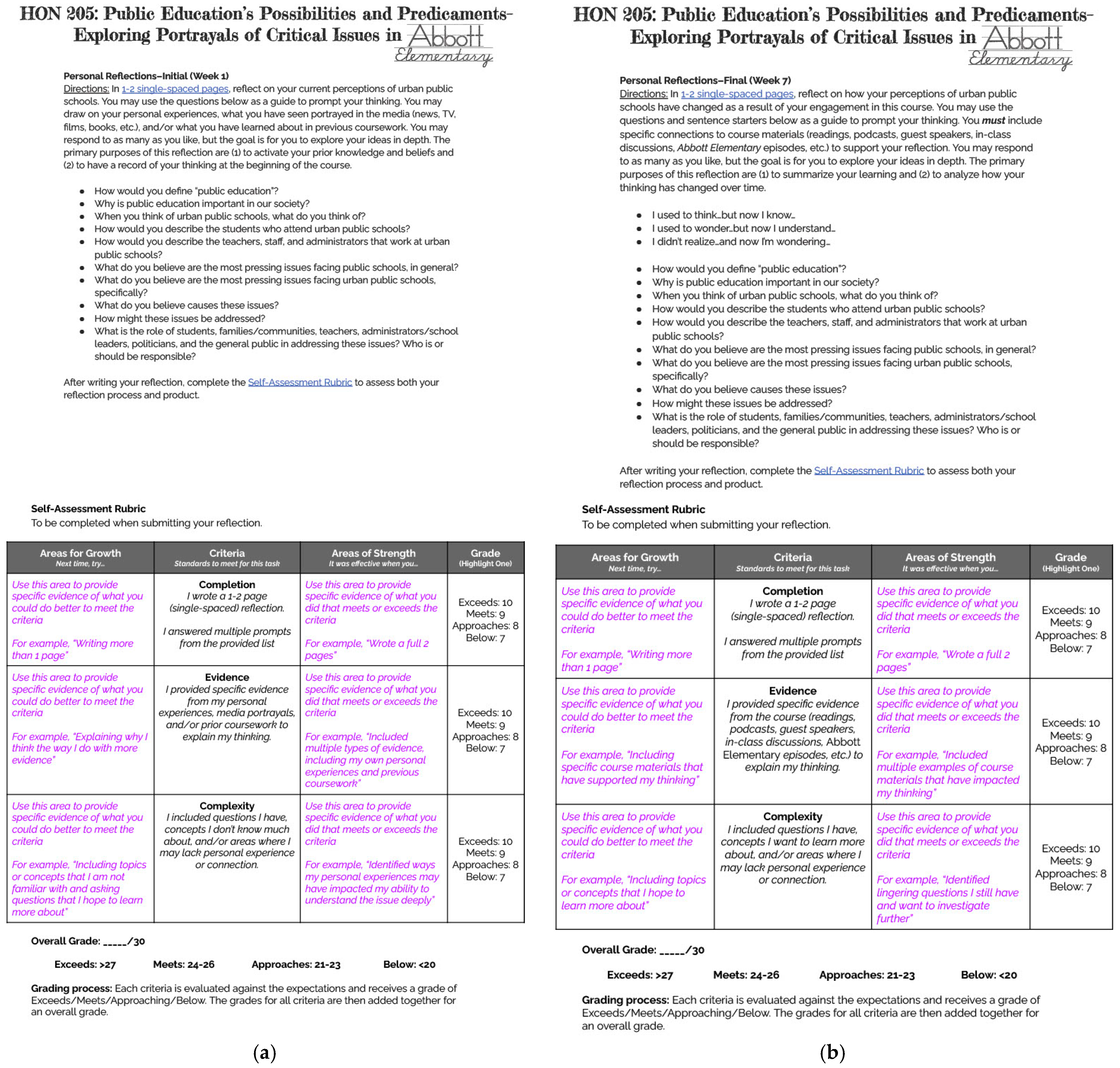
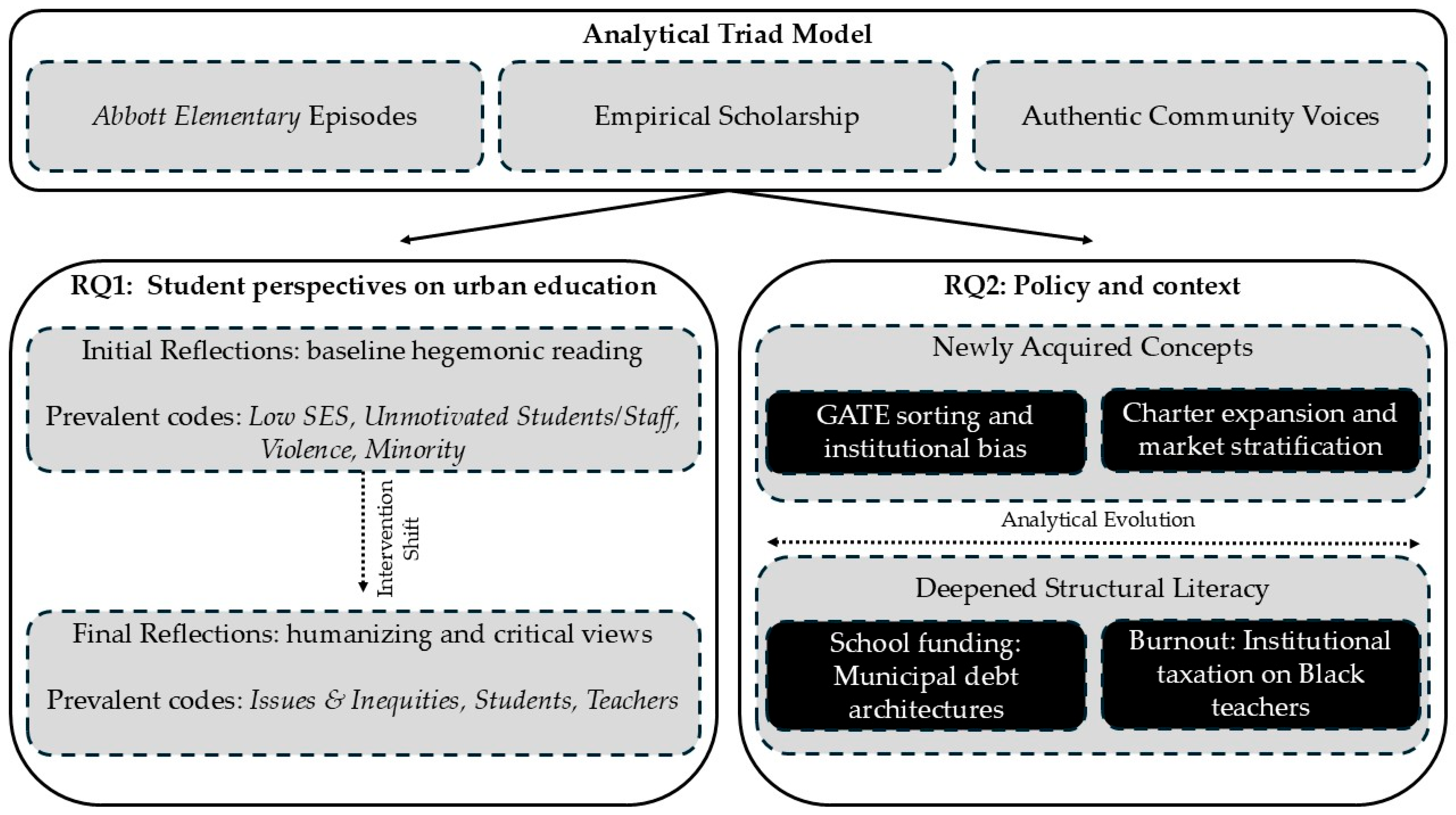
5.1.1. Baseline Perspectives: Articulating Hegemonic and Deficit Narratives
“I think about fights breaking out, graffiti in the bathrooms, and bullying in the halls … When I think of public schools, specifically those in urban areas, I think ‘unsafe.’ These larger schools may have more security guards, more cameras, and more places to hide, but all I can think about is how there are so many students and so few staff members to be able to notice the warning signs before something happens”.
“Especially for urban students who may be experiencing very real issues at home, a teacher is an extremely important figure. For some students, a teacher may be their only adult role model … Examples of this can be seen in the media. For example, in the show Glee, many of the students are struggling with difficult issues at home. However, when they enter the school they are able to stop thinking about it and join a community. This community is created by their passionate teacher (Mr. Shue) … [Another] example I often think of in the media is Mrs. Honey from Matilda … she must be patient and understanding to help Matilda understand her gift on her own”.
5.1.2. Transformed Perspectives: Articulating Humanizing and Critical Views
“However, through this show, I realized that a lot of media has skewed my understanding of what urban school settings are like. Starting off, the kids were just like any other batch of normal kids with some differences in cultural background. They were not portrayed in a sense that made me feel bad for the teacher in any regard. The show also did a great job portraying a wide array of kids by portraying goofy kids, nerdy kids, and kids of all different backgrounds to normalize that the kids in Abbott are like the kids in any other public school. The show also does a great job of breaking the idea of the ‘savior’ teacher and even makes fun of the concept … The teachers are shown that they want the best for their kids but they also want to connect with them as well instead of ‘saving’ them”.
“Now when I think of urban public schools, I think about how there is a funding issue and inequities in the education system that are in place because of systematic flaws that have existed for quite some time … I used to not understand why teachers in Chicago Public Schools would constantly be striking, but with this new acquired knowledge, I now understand the frustration that urban public educators can experience due to low funding and the systemic issues that exist within the entire institution of education”.
“After less than 2 months in this class, I now see how my thoughts were incorrect and lacked a common understanding of urban public schools … As we saw in an earlier episode of Abbott Elementary, teachers, like Janine, often feel responsible to ‘fix’ the school themselves … The episode of Abbott Elementary we watched, titled ‘Light Bulb’, really highlighted the impact this mindset can have on the rest of the school community. This episode did an awesome job portraying how the issue of underfunding can contribute to teacher burnout … It allowed me to look at the problem as it affects teachers, as opposed to my old view of just looking at the issue in relation to the students”.
5.2. RQ2: Multiperspectival Analysis of Policy and Context
5.2.1. The Acquisition of New Policy Concepts
“I was not aware that there are many inequities that exist within gifted programs and that many minority groups aren’t given the same access to them as other groups of students. For example, in Dr. Ford’s article ‘Culturally and Linguistically Diverse Students in Gifted Education: Recruitment and Retention Issues’, she talks about how African American, Hispanic/Latino, and American Indian students are poorly represented in gifted education. This has to do with a variety of factors, including flawed recruitment, stereotypical thinking, and problems with standardized testing”.
“One issue that Abbott Elementary depicts quite well is the idea of a gifted program. In the show we see the creation of a gifted program that is meant to support academically talented students … but as is shown in the episode, gifted programs as they are usually crafted, end up causing more harm than good for many students whether they are in the gifted program or not. Often gifted programs in schools target academic success, and do not take into consideration other forms of genius … In Abbott Elementary we see this initially, with the gifted program being comprised of academically advanced students, who were able to participate in more engaging and creative lessons, while students who were not put into the gifted program were unable to participate. Quickly it becomes apparent that other students are being negatively impacted by the gifted program”.
“In the initial reflection, I talked about how for my clinicals … families can pick where they send their children … This causes an enrollment disparity between schools. As schools become more unequal, racial and socio-economic problems grow. According to the article ‘School Choice and Who Has a Right to Choose’, ‘school choice policies today are far less focused on achieving racial diversity than they are on competition in the marketplace’ … Before taking this class, I didn’t know the difference between the types of schools but after engaging in the material I was able to gain a better understanding”.
5.2.2. From Individualized Issues to Systemic Complexity
“Another common issue that I think about when I picture an urban public school, is the issue of underfunding … I witnessed at my own school just how little money goes towards keeping the building from falling apart. For example, at my high school, there was a hole in the ceiling that was constantly dripping dirty, mucky water onto the floors. It stunk up the hallway and even caused a couple people to slip. This hole was left unattended to for half a year before it got fixed. In that time, the school finished a brand-new gymnasium, locker room, and weight room expansion that cost millions of dollars, which just shows where their priorities lie”.
“Depending on the area surrounding the school, the more or less funding a school may receive due to property taxes. It is one big circle, students attend a poorly funded school, do not receive the best education because they don’t have access to certain resources … We would commonly discuss that the circle of the neighborhood does not have good schools so people take their money elsewhere which leads to increasing home values in certain areas which means more property taxes for those schools and less for the schools that aren’t good … It is one big endless cycle”.
“One example of an issue I misunderstood is the issue of underfunding. At the beginning of the semester, I simply thought that schools just didn’t have the resources to adequately support their students … I now realize that there is a lot more to it. For example, I didn’t know schools have their own credit scores and have to apply for loans via these credit scores … Another fact relating to school funding that shocked me was the fact that only about 10% of funding comes from the federal government, and a majority of the rest comes from property taxes in the school’s district … You’d think the government would see the issue with this and provide more funding to more struggling schools, but they don’t”.
“In regards to school funding, I learned that throwing money at the issue is not the correct solution, as I had believed previously. I thought that if schools could just have more money, then they would be able to lift themselves up … Big boosts in spending were not resulting in improvement of student achievement. Throwing money at the problem doesn’t work, because that money is often put towards schools trying to ‘play catch up’. These schools are having to put that money towards resources like textbooks—resources that suburban schools already have had for decades”.
“In general, I believe that the most pressing issue facing public schools is the massive teacher shortage … This is causing teachers to flee the profession … These issues include the lack of support in their job, feeling emotionally and mentally exhausted, low wages, large class sizes … When it comes to the teachers, especially at urban public schools, I believe that they are very underappreciated because in the news, the one distinct thing that I can remember about Chicago Public Schools is that it seems that their teachers are constantly on strike. I am not really sure their exact reasoning for their strikes, but I assume it has to do with their tough working conditions”.
“The fact that teacher burnout became a theme in our classroom discussions is very notable because that means to me that teacher burnout is not single dimensional and instead is complexly related to all or most of the other issues we discussed in class. Essentially, to fix teacher burnout, placing all the responsibility on teachers to practice self-care and create boundaries is not a solution. We must instead work to create a more healthy environment for teachers to operate inside of”.
“In the second episode of Abbott Elementary, Janine demonstrated the effects of teacher burnout because she spent a lot of her energy attempting to fix the broken light in the hallway when no one else was going to. This led her to not eating throughout the day and eventually fainting. I feel that this episode was able to demonstrate how many teachers end up taking extra jobs around the school when there are problems. However, this can be harmful for teachers because they can get exhausted doing these large amounts of work. I think that it was important that Abbott Elementary touched on this because this is a part of teaching that isn’t really talked about … we do not want teachers leaving the field due to overworking”.
6. Discussion
6.1. Abbott Elementary as a Catalyst for Public Pedagogy
6.2. Disrupting Deficit Narratives Through the Abbott Elementary Counternarrative
6.3. The Utility of Multiperspectival Analysis in Interdisciplinary Contexts
7. Limitations and Future Directions
7.1. Limitations
7.2. Recommendations for Practice and Pedagogy
7.3. Recommendations for Future Research
8. Conclusions
Author Contributions
Funding
Institutional Review Board Statement
Informed Consent Statement
Data Availability Statement
Acknowledgments
Conflicts of Interest
References
- van Zoonen, L. Entertaining the Citizen: When Politics and Popular Culture Converge; Rowman & Littlefield: Lanham, MD, USA, 2005. [Google Scholar] [CrossRef]
- Kachorsky, D.; Reid, S.F.; Chapman, K. Education through TIME: Representations of US education on TIME magazine covers. AERA Open 2020, 6, 1–19. [Google Scholar] [CrossRef]
- Giroux, H.A. Hollywood film as public pedagogy: Education in the crossfire. Afterimage 2008, 35, 7–13. [Google Scholar] [CrossRef]
- Ahn, C.; Leggo, C. Teachers in film: Always in process. Can. J. Educ. 2019, 42, 117–137. [Google Scholar]
- Aronson, B.A. The white savior industrial complex: A cultural studies analysis of a teacher educator, savior film, and future Teachers. J. Crit. Thought Prax. 2017, 6, 36–54. [Google Scholar] [CrossRef]
- Kellner, D. Media Culture: Cultural Studies, Identity, and Politics in the Contemporary Moment, 2nd ed.; Routledge: New York, NY, USA, 2020. [Google Scholar] [CrossRef]
- Giroux, H.A. Breaking into the movies: Public pedagogy and the politics of film. Policy Futures Educ. 2011, 9, 686–695. [Google Scholar] [CrossRef]
- Jones, S.; Some, K.J. Pop Culture Media as Curricular Text: Designing an Interdisciplinary Undergraduate Seminar Using Abbott Elementary. Educ. Sci. 2024, 14, 1241. [Google Scholar] [CrossRef]
- Stebbins, R.A. Exploratory Research in the Social Sciences; Sage Publications: Thousand Oaks, CA, USA, 2001. [Google Scholar] [CrossRef]
- Kellner, D. Media Culture: Cultural Studies, Identity, and Politics Between the Modern and the Postmodern; Routledge: New York, NY, USA, 1995. [Google Scholar]
- Freire, P. Pedagogy of the Oppressed, 30th anniversary ed.; Continuum: New York, NY, USA, 2000. [Google Scholar]
- Freire, P. Pedagogy of Freedom: Ethics, Democracy, and Civic Courage; Rowman and Littlefield: Lanham, MD, USA, 2000. [Google Scholar] [CrossRef]
- Walker, M. Pedagogy and the politics and purposes of higher education. Arts Human. High. Ed. 2002, 1, 43–58. [Google Scholar] [CrossRef]
- Tillman, L.C.; Trier, J. Boston public as public pedagogy: Implications for teacher preparation and school leadership. Peabody J. Educ. 2007, 82, 121–149. [Google Scholar] [CrossRef]
- Hall, S. Encoding—Decoding (1980). In Crime and Media, 1st ed.; Greer, C., Ed.; Routledge: London, UK, 2010; pp. 44–55. [Google Scholar] [CrossRef]
- Miretzky, D. Teaching the class with the class: Debunking the need for heroes. Multicult. Educ. 2017, 24, 40–48. [Google Scholar]
- Porter, V. Making and meaning: The role of the producer in British films. J. Br. Cine. Telev. 2012, 9, 7–25. [Google Scholar] [CrossRef]
- The Hill: ‘Abbott Elementary’ Goes All-In Against Charter Schools. Available online: https://thehill.com/blogs/in-the-know/3908754-abbott-elementary-goes-all-in-against-charter-schools/ (accessed on 28 May 2026).
- USA Today: Here’s What ‘Abbott Elementary’ and Quinta Brunson Get Wrong About Charter Schools. Available online: https://www.usatoday.com/story/opinion/voices/2023/03/22/abbott-elementary-wrong-charter-schools/11515726002/ (accessed on 25 June 2026).
- Time: Why Abbott Elementary’s Charter Schools Arc Hit Home for Teachers. Available online: https://time.com/6264261/abbott-elementary-charter-school-teachers/ (accessed on 28 May 2026).
- Crenshaw, K.W. Mapping the Margins: Intersectionality, Identity Politics, and Violence Against Women of Color. In The Public Nature of Private Violence; Fineman, M.A., Ed.; Routledge: New York, NY, USA, 2013; pp. 93–118. [Google Scholar] [CrossRef]
- Delamarter, J. Avoiding practice shock: Using teacher movies to realign pre-service teachers’ expectations of teaching. Aust. J. Teach. Educ. 2015, 40, 1–14. [Google Scholar] [CrossRef][Green Version]
- Tanase, M. Meeting student needs in the Freedom Writers movie: An activity in a classroom management course. J. Invit. Theory Pract. 2013, 19, 4–14. [Google Scholar] [CrossRef]
- Townsel, K.H. Exploring diversity and professionalism with preservice teachers using film clips as prompts. Delta Kappa Gamma Bull. 2016, 82, 55–62. [Google Scholar]
- Webb, C.L.; Kapavik, R.R. Motivated by the movies: How Hollywood influences preservice teachers’ pedagogical knowledge. Int. J. Educ. Hum. Dev. 2017, 3, 10–13. [Google Scholar]
- Freedman, D. Acceptance and alignment, misconception and inexperience: Preservice teachers, representations of students, and media culture. Cult. Stud. Crit. Methodol. 2003, 3, 79–95. [Google Scholar] [CrossRef]
- Long, S.L.; Pope, C.A. The role of the teacher, real and imagined. In Exploring Teachers in Fiction and Film; Shoffner, M., Ed.; Routledge: New York, NY, USA, 2016; pp. 24–35. [Google Scholar]
- Mungur, A.; Wylie, S. Teacher films: Examining Hollywood representations of our practice. Counc. J. Soc. Stud. 2021, 27–36. [Google Scholar]
- Trier, J. Sordid fantasies’: Reading popular ‘inner-city’ school films as racialized texts with pre-service teachers. Race Ethn. Educ. 2005, 8, 171–189. [Google Scholar] [CrossRef]
- Trier, J. Designing a case study from the popular culture text Boston Public. Multicult. Educ. 2010, 17, 49–56. [Google Scholar]
- Hampsten, K. Teaching Competent Cross-Cultural Communication with Abbott Elementary. In Teaching Popular Culture in the Humanities Classroom; Archiopoli, A.M., Hampsten, K., Fish Hatfield, E., Eds.; Lexington Books: London, UK, 2024; pp. 176–186. [Google Scholar] [CrossRef]
- Pimentel, C. Critical race talk in teacher education through movie analysis: From “Stand and Deliver” to “Freedom Writers”. Multicult. Educ. 2010, 17, 51–56. [Google Scholar]
- Vandermeersche, G.; Soetaert, R.; Rutten, K. ‘Shall I tell you what is wrong with Hector as a teacher?’: The history boys, stereotypes of popular and high culture, and teacher education. J. Pop. Film Telev. 2013, 41, 88–97. [Google Scholar] [CrossRef]
- Bulman, R.C. Teachers in the ‘hood: Hollywood’s middle-class fantasy. Urban Rev. 2002, 34, 251–276. [Google Scholar] [CrossRef]
- Brown, S.; Brown, A. Laughing to Keep from Crying at Abbott Elementary: Humor’s Potential in the Teacher Demoralization Crisis. In Television Sitcom and Cultural Crisis; Holladay, H.W., Classen, C.L., Eds.; Routledge: London, UK, 2024; pp. 29–42. [Google Scholar] [CrossRef]
- Lewis, O. The Children of Sanchez: Autobiography of a Mexican Family; Random House: New York, NY, USA, 1961. [Google Scholar]
- Grant, P.A. Using popular films to challenge preservice teachers’ beliefs about teaching in urban schools. Urban Educ. 2002, 37, 77–95. [Google Scholar] [CrossRef]
- Lewis, M.A.; Renga, I.P. (Re)imagining life in the classroom: Inciting dialogue through an examination of teacher-student Relationships in film. In Exploring Teachers in Fiction and Film; Shoffner, M., Ed.; Routledge: New York, NY, USA, 2016; pp. 65–76. [Google Scholar]
- ABC Entertainment: About Abbott Elementary. Available online: https://abc.com/show/e4f28254-2fc4-4cc1-b9bb-eee0564c178e/about-the-show (accessed on 28 May 2026).
- TV Insider: Abbott Elementary Becomes ABC’s First Comedy Debut to Quadruple Its Ratings. Available online: https://www.tvinsider.com/1030140/abbott-elementary-season-1-quadruple-ratings-abc/ (accessed on 28 May 2026).
- Gutterman, R.S. Liable, Naaaht: The Mockumentary: Litigation, liability and the First Amendment in the works of Sacha Baron Cohen. J. Sports Ent. Law 2022, 13, 141–180. [Google Scholar]
- Wong, C.P.; Esposito, J. “It’s a Calling. You Answered.” Abbott Elementary and Viewing Audience as Ethnographer of Education. Depart. Crit. Qual. Res. 2023, 12, 48–71. [Google Scholar] [CrossRef]
- Cupid, S.; Harris, T.M.; Winfield, A.S.; Harris, R.; Butler, D. “Abbott Elementary” and the Resilient Black Girl Dork: Reimagining Black Womanhood. In US Media and Diversity; Dixon, T.L., Mastro, D., Eds.; Routledge: New York, NY, USA, 2024; pp. 158–181. [Google Scholar] [CrossRef]
- Esposito, J.; Foster, P.E. The Black female principal in reel/real life: An intersectional examination of Ava Coleman on Abbott Elementary. Rev. Educ. Ped. Cult. Stud. 2026, 48, 16–32. [Google Scholar] [CrossRef]
- Yosso, T.J.; García, D.G. From Ms. J. to Ms. G.: Analyzing racial microaggressions in Hollywood’s urban school genre. In Hollywood’s Exploited: Public Pedagogy, Corporate Movies, and Cultural Crisis, 1st ed.; Frymer, B., Kashani, T., Nocella, A.J., Heertum, R., Eds.; Palgrave Macmillan: New York, NY, USA, 2010; pp. 85–103. [Google Scholar] [CrossRef] [PubMed]
- The Conversation: How Real Is ‘Abbott Elementary’? A Former Philadelphia School Teacher Weighs In. Available online: https://theconversation.com/how-real-is-abbott-elementary-a-former-philadelphia-school-teacher-weighs-in-174762 (accessed on 28 May 2026).
- Education Week: A Q&A with Abbott Elementary Star Quinta Brunson—‘Who Are We Without Teachers?’. Available online: https://www.edweek.org/teaching-learning/a-q-a-with-abbott-elementary-star-quinta-brunson-who-are-we-without-teachers/2022/01 (accessed on 28 May 2026).
- Beers, G.K.; Probst, R.E. Disrupting Thinking: Why How We Read Matters; Scholastic: New York, NY, USA, 2017. [Google Scholar]
- Storey, J. Cultural Studies and the Study of Popular Culture, 3rd ed.; Edinburgh University Press: Edinburgh, UK, 2010. [Google Scholar] [CrossRef]
- Strauss, A.; Corbin, J. Basics of Qualitative Research: Grounded Theory Procedures and Techniques; Sage: Newbury Park, CA, USA, 1990. [Google Scholar] [CrossRef]
- Milner, H.R., IV. Race, culture, and researcher positionality: Working through dangers seen, unseen, and unforeseen. Educ. Res. 2007, 36, 388–400. [Google Scholar] [CrossRef]
- Ford, D.Y.; Grantham, T.C.; Whiting, G.W. Culturally and linguistically diverse students in gifted education: Recruitment and retention issues. Except. Child. 2008, 74, 289–306. [Google Scholar] [CrossRef]
- MindShift: How Do You Cultivate the Genius in All Students? Available online: https://www.kqed.org/mindshift/58492/how-do-you-cultivate-genius-in-all-students (accessed on 28 May 2026).
- Harmon, M.; Horn, I.S. Seeking Healing Through Black Sisterhood: Examining the Affordances of a Counterspace for Black Women Pre-Service Teachers. AILACTE J. 2021, 105–132. [Google Scholar]



| Topic | Abbott Elementary Episode | Texts/Materials |
|---|---|---|
| Urban Teachers and Schools (According to Hollywood) | Pilot | Research Article: “Urban School” Genre in Film (Sociology) News Media: Interview with Quinta Brunson * |
| Teacher Burnout and Rest as Resistance | S1E2 “Light Bulb” | News Media: Former Teacher Reflects on Abbott Elementary’s Accuracy * Podcast Episode: Retaining and Sustaining Black Teachers * |
| School Funding | S1E3 “Wishlist” | Article: School Debt (Economics) Policy Brief: Foundations of School Funding (Education Policy) Practitioner Article: Teaching School Debt (Teacher Pedagogy) Podcast Episode: School Money |
| Gifted & Talented Programs | S1E6 “Gifted Program” | Research Article: Diverse Students in Gifted Education (Special Education) * Podcast Episode: Recognizing the Genius in All Students * |
| Charter Schools and School Choice | S2E19 “Festival” | Book Chapters: The Racial Politics of School Choice (Educational Leadership and Policy) * Podcast Episode: Community Response to Charter School Takeovers * |
| The Sisterhood of Black Women Teachers | S2E21 “Mom” | Research Article: Black Women Pre-Service Teachers (Teacher Preparation) * Podcast Episode: Learning and Unlearning with Abbott Elementary * |
| Make It Real, But Make It Funny | n/a | News and Magazine Articles: Abbott Elementary Character Profiles * |
| Student | Gender | Race/Ethnicity | Year of Study | Major/Program of Study |
|---|---|---|---|---|
| Allison | Female | African American, white | Sophomore | Early Childhood Education |
| Bartleby | Female | white | First-Year | Middle Level Education, Psychology Minor |
| Bella | Female | white, Hispanic | First-Year | Elementary Education |
| Camden | Nonbinary | white | First Year | Geology |
| Clark | Female | white | First-Year | Criminal Justice |
| Don | Male | white | Senior | Computer Science |
| Faye | Nonbinary | white | Sophomore | Early Childhood Education |
| Graham D. | Male | white | First-Year | Computer Science |
| Graham R. | Cisgender Male | white | Sophomore | English Education |
| Karson | Female | Black/African American | Junior | English Writing and Rhetoric |
| Kasey | Female | white | Sophomore | Elementary Education |
| Katie | Female | white | Junior | English Education |
| KM | Female | Asian, white | Senior | Art Education |
| Lexi | Female | white | First-Year | Mathematics Education |
| Luke | Male | white | Sophomore | Economics, History |
| Marco | Male | white | Senior | Actuarial Science |
| Molly | -- | -- | Junior | Middle Level Education |
| Naomi | Female | white | Sophomore | Middle Level Education |
| Poppy | Female | white | Junior | Elementary Education |
| Spencer | Male | white | Senior | Accounting |
| Stacey | Female | white | Junior | Elementary Education |
| Texas | Male | South Asian (Indian) | Senior | Music Education |
| Tiffany | Female | white | Sophomore | Elementary Education |
| Willa | Female | white | Sophomore | Early Childhood Education |
Disclaimer/Publisher’s Note: The statements, opinions and data contained in all publications are solely those of the individual author(s) and contributor(s) and not of MDPI and/or the editor(s). MDPI and/or the editor(s) disclaim responsibility for any injury to people or property resulting from any ideas, methods, instructions or products referred to in the content. |
© 2026 by the authors. Licensee MDPI, Basel, Switzerland. This article is an open access article distributed under the terms and conditions of the Creative Commons Attribution (CC BY) license.
Share and Cite
Jones, S.; Some, K.J. From Deficit Thinking to Systemic Analysis: Utilizing Abbott Elementary as Public Pedagogy in the Interdisciplinary Classroom. Trends High. Educ. 2026, 5, 55. https://doi.org/10.3390/higheredu5030055
Jones S, Some KJ. From Deficit Thinking to Systemic Analysis: Utilizing Abbott Elementary as Public Pedagogy in the Interdisciplinary Classroom. Trends in Higher Education. 2026; 5(3):55. https://doi.org/10.3390/higheredu5030055
Chicago/Turabian StyleJones, Sara, and Kountiala J. Some. 2026. "From Deficit Thinking to Systemic Analysis: Utilizing Abbott Elementary as Public Pedagogy in the Interdisciplinary Classroom" Trends in Higher Education 5, no. 3: 55. https://doi.org/10.3390/higheredu5030055
APA StyleJones, S., & Some, K. J. (2026). From Deficit Thinking to Systemic Analysis: Utilizing Abbott Elementary as Public Pedagogy in the Interdisciplinary Classroom. Trends in Higher Education, 5(3), 55. https://doi.org/10.3390/higheredu5030055