Article

Navigating the University Transition: The Role of Social Media in Student Wellbeing and Adjustment


1
Department of Psychology, University of Liverpool, Liverpool L69 7ZA, UK
2
Department of Electrical Engineering and Electronics, University of Liverpool, Liverpool L69 3GJ, UK
*
Author to whom correspondence should be addressed.
Trends High. Educ. 2026, 5(3), 54; https://doi.org/10.3390/higheredu5030054
Submission received: 6 April 2026 / Revised: 14 June 2026 / Accepted: 18 June 2026 / Published: 24 June 2026

Abstract

The transition to university is a critical period of academic, social, and emotional adjustment. Social media plays a central yet complex role, offering opportunities for connection while also posing risks to wellbeing, productivity, and social integration. This study explores how first-year undergraduates experience and interprets their social media use during this transition. Using a constructivist grounded theory approach, nine focus groups were conducted with 40 first-year students at a UK university. Analysis generated a model conceptualising social media as a ‘double-edged sword’ within the broader social transition. Five interrelated themes were identified: social transition, polarised attitudes, quality of social connection, wellbeing support, and quantity and form of use. Social media supported early connection-building, maintaining peer ties, and accessing support, yet excessive or passive use intensified social comparison, fear of missing out, and academic distraction. Students recognised problematic use themselves, often prompting peer intervention to restore balance. Form, purpose, and perceived impact shaped experiences more than time spent. Findings highlight the importance of student agency, peer networks, and institutional support, offering implications for promoting healthy social media practices, wellbeing, and smoother transitions to university life.

1. Introduction

The transition from secondary education to university study represents a major personal and academic life change for students [1], with approximately 80% of UK students relocating away from home [2]. During this period, first-year undergraduates often face substantial psychological, academic, and social adjustments [3,4,5,6], including increased academic pressure [7], which can influence academic outcomes [8]. Supporting students to reconceptualise themselves as higher education learners is therefore critical [9], particularly as many first-year undergraduate students experience identity instability [10] and a diminished sense of belonging [11]. Belongingness and self-efficacy are key predictors of academic achievement [12], and academic belongingness is closely tied to the social challenges students encounter as they navigate new peer relationships and unfamiliar social norms. Belonging is increasingly understood as relational, situated and shaped through students’ interactions with peers, staff and institutional environments [13,14].
These social challenges are especially pronounced in the first year, with students reporting greater difficulties than those in later stages of study [15]. Homesickness is common but can be alleviated through social connectivity [16,17]. The transition also heightens vulnerability to anxiety, loneliness, and low self-esteem [18]. Loneliness is a particular concern due to its strong association with mental distress [19], especially when combined with the increased independence required for daily living and learning [20]. Insufficient preparation from secondary school teachers can further exacerbate the shift to university-level learning [21]. At a time when students are already at risk of loneliness and reduced belongingness, the move to a new environment can disrupt existing social attachments, exposing social gaps [2]. These early social experiences, shaped by prior attachment patterns and disparities in social or academic capital, play a central role in determining whether students can access the broader developmental, educational and occupational benefits of tertiary study.
Despite these challenges, tertiary education offers substantial developmental, educational and occupational benefits [22,23,24,25,26,27], and interventions that foster hope, meaning and belonging can support students as they navigate new academic and social demands [28,29] wellbeing. Overall, the transition to university elicits a spectrum of emotional responses, both positive and negative [30,31].
Increasingly, these experiences are intertwined with social media use, which can enhance connection and belonging for some students, while for others it may intensify comparison, exclusion, and distraction, shaping how effectively they engage with academic and social aspects of university life.
Social media plays a complex and multifaceted role in this transition. Although many students struggle to build new social connections, social media can help bridge connectivity gaps [32,33,34], combat loneliness [35] and maintain existing social ties [36]. International students, for example, use online platforms to sustain communication with peers in their countries of origin [37,38]. Social media also facilitates the formation of new social networks, supports integration into university life, and contributes to identity development in adolescence and early adulthood [39,40], including sexual-identity expression [41], self-esteem [42] and identity exploration [43]. First-year students frequently rely on online spaces for guidance and reassurance [44], exchanging advice and peer support during the first semester [45,46]. Yet these benefits coexist with risks such as social comparison, distraction, and exposure to exclusion, which can undermine wellbeing and adjustment.
Excessive engagement with social media has been linked to poor academic outcomes [47]. For international students, strong reliance on existing ‘home’ ties can affect integration into host communities by reducing social participation and a sense of belonging [48]. In this study, problematic social media use (PSMU) is defined as excessive and unregulated use that disrupts daily functioning [49,50], a construct closely related to excessive social media use [51]. Excessive use is associated with sleep disturbance [52], which in turn negatively affects academic performance [53]. PSMU has been associated with depression and anxiety [54] and tends to intensify during periods of stress [55] and uncertainty [56], conditions characteristic of the transition to university [6]. First-year university students, already vulnerable to anxiety, appear particularly at risk of PSMU [57,58]. Conceptualising PSMU as an addiction [59] highlights its severity, with global public health implications [60]. Platforms such as TikTok, with their continuous content supply, are especially addictive [61], and algorithmic targeting further amplifies engagement and exacerbates PSMU [62,63]. These dynamics highlight the need for closer examination of social media use within higher education contexts. This study therefore examines social media use as part of the wider transition to university, with a particular focus on how students interpret its role in connection, belonging, wellbeing and adjustment.
Although previous research has examined academic adjustment, social belonging, and social media use during the university transition, these domains are often studied in isolation. This fragmentation limits understanding of how digital practices interact with identity development and wellbeing in the first year of higher education. Moreover, the literature frequently frames social media in binary terms, either beneficial or harmful, overlooking its dual role as both a facilitator of connection and a potential barrier to adjustment. Students are also commonly treated as a homogenous group, despite evidence that technology varies across student populations [64] and may be shaped by disciplinary context [65]. This study builds on our previous work and contributes to the literature in three key ways. First, it situates social media use within the broader context of identity development, belonging, and academic adjustment during the transition to university. Second, it adopts a balanced perspective that recognises both the benefits and risks of social media use. providing a nuanced account of students’ lived experiences. Third, it draws on accounts from students across three disciplinary areas, allowing disciplinary context to be acknowledged while making clear that the study was not designed as a formal comparative comparison.
The central contribution of the study is to show how first-year students actively negotiate social media as part of their social transition, particularly through purposeful use, passive use, peer support and the perceived quality of connection.
To achieve these aims, the study analyses students’ accounts generated through focus group discussions. Guided by these aims, the study addresses the following research questions: How do first-year university students experience and interpret their social media use during the transition to university, and in what ways do they perceive it as supporting or hindering their wellbeing, sense of belonging and academic adjustment?

2. Materials and Methods

2.1. Participants

Participants were first-year undergraduate students enrolled in Psychology (P), Electrical Engineering and Electronics (EEE), and Computer Science (CS) programmes at the University of (anonymised). Recruitment took place via course mailing lists, in-class announcements, and student-led promotional activities. Inclusion criteria required participants to be aged 18 or over, enrolled in their first semester of study, and active social media users. Students with a diagnosed mental health disorder, specifically depression/anxiety or social media addiction, were excluded. This exclusion criterion was used to reduce the risk of distress in a focus-group setting, particularly as discussions could include wellbeing, problematic use and mental-health-related experiences. However, this decision may have limited the inclusion of students with direct lived experience of the issues discussed. This decision was made as a safeguarding measure rather than because these experiences were considered irrelevant to the research question.
Forty students took part across nine focus groups, each comprising between two and six participants. Compensation was provided in the form of vouchers. Psychology students also received course credit, as the study was advertised through the internal Psychology research participation scheme. Although recruitment included students from Psychology, Computer Science and Electrical Engineering and Electronics, the study was not designed as a systematic comparison between disciplines. Any discipline-related observations are therefore interpreted as contextual insights rather than as evidence of systematic disciplinary variation. Table 1 summarises the composition of the focus groups.

2.2. Focus Group Procedure

Focus groups were conducted on campus between February and May 2024. Each session was co-facilitated by a student intern from the university’s career service and a psychology student researcher to create a more comfortable peer environment that encouraged open discussion. A semi-structured interview guide was used flexibly to explore students’ social media use, frequency and forms of engagement, perceived benefits and risks, wellbeing, belonging, and adjustment to university. At the start of each session, facilitators reminded participants of their right to withdraw at any time and emphasised confidentiality and anonymity, while also explaining that confidentiality could not be fully guaranteed within a focus group setting because other participants were present. Participants were therefore asked to maintain this confidentiality and not to share identifiable information disclosed by others outside the group. Sessions lasted approximately 60 min ranging from 25 to 121 min, were audio-recorded with informed consent, and transcribed verbatim. Transcripts were anonymised prior to analysis, and all data were stored securely on the University of (anonymised) encrypted storage system.

2.3. Analysis

Data were analysed using a constructivist grounded theory approach [66], allowing theoretical insights to emerge inductively from participants’ accounts. Analysis was conducted by psychology internship students under the supervision of an experienced qualitative researcher. Audio recordings were transcribed verbatim into Microsoft Word (Office 365) and anonymised before coding. Coding was iterative rather than linear, with codes compared within and across focus groups as the analysis progressed. The analytic process comprised three stages:
  • Initial open coding: Line-by-line analysis to capture participants’ actions, experiences, and meanings.
  • Axial and focused coding: Within and across focus groups to refine initial codes into broader conceptual categories.
  • Selective coding: Relationships between the most significant categories were examined and organised around the central concept of social media as a double-edged feature of the university transition. Memo-writing supported the development of analytic insights, provided an audit trail of decision-making, recorded analytic decisions and helped explore relationships between categories. Themes were not generated solely by grouping similar responses, but by examining how categories explained students’ negotiation of social media during the transition to university. Rigour was enhanced through double coding of a subset transcripts by student researchers, with discrepancies resolved through consensus under supervision. Reflexivity was maintained through analytic memos and regular debrief sessions, enabling the team to critically reflect on assumptions and potential biases. Data collection and analysis proceeded iteratively until theoretical sufficiency was reached, indicated by the absence of substantially new categories and the consolidation of relationships between existing categories. This judgement was based on the consolidation of the analytic model rather than a claim that no further individual experiences could have emerged.

2.4. Ethics

Ethical approval was granted by the University Research Ethics Committee, ensuring compliance with institutional and national ethical standards. All participants provided informed consent, in line with the Helsinki declaration and were debriefed following participation and were reminded of their right to withdraw without penalty. Anonymity was preserved through pseudonyms and the removal of identifying information from transcripts.

3. Results

3.1. Grounded Theory Model

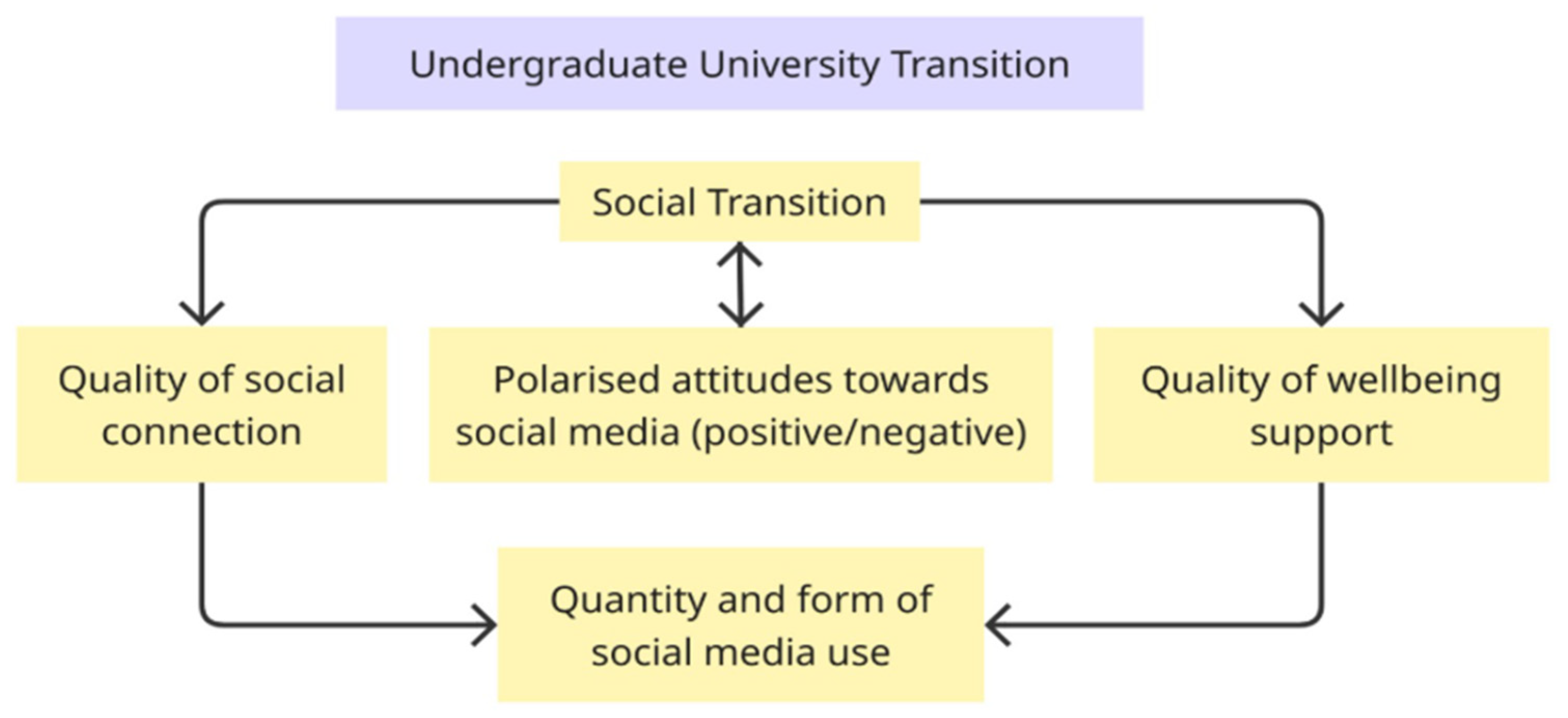
Figure 1 presents the conceptual model developed through constructivist grounded theory analysis of students’ experiences of social media use during the transition to university. The model begins with the overarching transition to university, which simultaneously triggers a social transition as students’ established social environments shift. Within this period of change, students expressed both positive and negative attitudes toward social media. For some, social media enhanced communication and supported adjustment; for others, it intensified self-comparison and fostered addictive tendencies. These contrasting attitudes captured students’ characterisation of social media—“I think it’s a double edged sword” (R5, CS1)—forming the central organising concept of the analysis. The social transition shaped the quality of students’ social connectivity, with many increasingly relying on social media to initiate, maintain or supplement social relationships. It also influenced the availability and perceived adequacy of wellbeing support, which in turn affects the extent and form of social media use. This relationship was not linear; rather, students’ accounts suggested that social transition, connection quality, wellbeing support and patterns of use shaped one another across the early university experience. Patterns of use ranged from highly engaged and potentially problematic to deliberate disengagement. Together, these processes illustrate how social media is embedded within, and shaped by, the broader social and emotional dynamics of the university transition. The model therefore positions students’ negotiation of social media as both a resource for connection and a potential source of disruption as the core category linking the themes. This core category helps explain how social media could support transition when used purposefully and relationally, but could disrupt adjustment when use became passive, comparison-based, or difficult to regulate.

3.2. Theme 1: Social Transition

Alongside the academic transition, students described undergoing a substantial social transition as moving from familiar networks of friends and family to a new and unfamiliar social environment at university. This shift heightened their reliance on social media as a tool for navigating uncertainty: “you have to find your flatmates and your friends from Facebook […] I literally added anybody on Instagram and Snapchat from there, cause you’re just desperate at that moment” (R7, P3).
Communication emerged as a primary motivation for social media use, “most of my time would be spent trying to communicate” (R1, EEE2), particularly through WhatsApp, Instagram, and Snapchat. Social media was widely regarded as a technological necessity, “now phones are like an inevitable thing so you always have it with you” (R3, EEE3), and played a key role even before arrival on campus. Students used online platforms to connect with future course mates or flatmates: “Snapchat is really easy to connect with people” (R4, P2). Social media broadened opportunities for connection beyond course cohorts or accommodation groups, enabling students to join society group chats and interest-based communities.
University-led digital communication further supported this process by promoting social events, highlighting wellbeing resources, and signalling available support. Online communication thus acted as an initial bridge into social engagement, reducing emotional and practical barriers to forming new relationships. However, students also noted that reliance on digital interaction could limit the depth and frequency of in-person connections, creating a more fragile form of social connectivity.
Digital communication also introduced challenges. Some students described a reduced perceived need for embodied interaction, meeting face-to-face, and the resulting consequences: “Sometimes annoying when you have social media so you don’t have to meet in person and people just text you in the middle of the night and just saying random things” (R5, CS1). Students also reflected on barriers to embodied social interaction, specifically the initiation of face-to-face interactions: “some people would find it easier to text than actually reach out, which, again, can become a problem in the future” (R1, EEE2). At the same time, social media enables connectivity where physical distance is socially restrictive: “keeping in touch with friends and stuff is obviously a big one. A lot of my friends have gone to like different uni, so I don’t see them anymore (R6, CS1). Therefore, restrictive physical proximity to friends and family can often be resolved through digital connectivity, including phone calls or text-based messaging. Furthermore, social media enables connectivity online: “I do have Instagram and I do use it, but that’s mainly to see the social life of my friends and what they’re up to and that’s how I keep in touch” (R6, CS4). However, conversely, for others it intensified social comparison and heightened feelings of inadequacy: “[…] there’s like definitely a bigger pressure to post just videos where you’re being like perfect, like you’re having a great day.” (R2, EEE1). Overall, social media was experienced as both enabling and constraining. It facilitated new social connections, strengthened social support, and eased the emotional challenges of social isolation. Yet it also encouraged unhelpful social comparison and increased vulnerability during a period of significant social change. These contrasting experiences contributed to the polarised attitudes toward social media that underpin the grounded theory model, in which students simultaneously recognised its value for connection and its potential to undermine wellbeing. This theme therefore establishes the social transition as the context within which students’ later accounts of connection quality, support, and patterns of use should be understood.

3.3. Theme 2: Polarised Attitude Towards Social Media Use

Students expressed a distinctly polarised attitude toward social media use, frequently describing it binarily: “I think it’s a double edged sword” (R5, CS1). On one side, social media offered clear benefits, including communication, entertainment, and access to information. Social media platforms were used preferentially over other standard internet search engines: “[…] especially TikTok […] it’s almost like another Google search engine. It’s a lot quicker and faster” (R5, P2). This was particularly noticeable within international student groups, seeking information about their new city of residence. YouTube supported academic learning by providing course-specific explanations and revision content: “[…] and in YouTube, we learn the content that they’re supposed to teach in the lecture.” (R3, CS4). Social media also enabled students to express aspects of their identities and connect with peers who shared similar interests: “With my friends, it’s been… they found it more comforting in social media because they’re able to find people who are similar to them” (R4, EEE2).
However, students also highlighted significant drawbacks. Many described the pressure to present an idealised online persona: “one thing that people think about a lot is what they post and curating themselves in a certain way, which on one hand could be a good thing, but, on the other hand, it becomes a game where you kind of get stuck in your own head and looking at what you’re posting.” (R1, CS3). This behaviour contributed to feelings of inadequacy among peers: “I used to be worried like posting stuff on, maybe Instagram, like people would judge or something.” (R5, CS2). Students also reported frequent exposure to negative news and misinformation, and hate speech, noting that online anonymity often reduced respect and civility compared to face-to-face interactions.
Concerns about addictiveness were widespread, particularly in relation to short-form, personalised content. TikTok was repeatedly identified as especially difficult to disengage from: “TikTok is just endless, endless scrolling. So yeah, it’s kind of not as easy to limit my time [compared to messaging people]” (R4, P1). Although students recognised their overuse, “spend too much time [online]” (R3, EEE3), they described extended periods of passive scrolling, often framed as relaxation or emotional regulation during stress. Yet this behaviour also served as avoidance, displacing academic tasks and reinforcing procrastination. Students described cycles of guilt and frustration: “constantly have the sense of underachievement which will result in […] feeling unhappy” (R3, EEE1). They also reported reduced attention spans and sleep disruption: “my attention span is way lower compared to before, especially because of TikTok” (R4, CS1); “I find that if I can’t sleep, I’ll start scrolling” (R8, EEE3); “and, like, I want a good night’s sleep and [I’m] just lying in bed and I physically, like, can’t shut off my brain” (R5, P2).
Despite these challenges, many students believed that the negative effects could be mitigated through controlled ‘screen time’: “it’s all about how you use it at the end of the day” (R3, EEE3). Some felt confident in their ability to control their use—“when it comes to procrastinating […] that is, in my opinion, my own fault […] we are within our control (R4, CS4)—and regulate use: “[we can] switch off from it” (R1, EEE2). Conversely, others struggled, particularly when academic deadlines approached: “when you have a task to study for […] I like procrastinating by going on social media, even though I know I’m going to regret it later.” (R6, EEE3). Students acknowledged the need for support in managing their usage: “[…] everyone is being aware of [their] mental [health…] and so they are trying to reach out to people […]” (S2, CS1).
Importantly, concerns about problematic social media use (PSMU) extended beyond time spent online to the ways digital engagement shaped the quality of their social interaction. As one student reflected: “scrolling for hours […] especially like at the start of uni, it might prevent you from […] leaving your room […] you might not bond with your friends, much” (R3, P2). This highlights the overlap between digital activity and in-person interaction, both being factors that shape students’ experience and level of social connection during the transition to university. This theme extends the model by showing that students evaluated social media not only by frequency of use, but by whether it supported agency, connection, and academic engagement.

3.4. Theme 3: Quality of Social Connection

The quality of social connectivity emerged as a central component of students’ transition experiences. Students described social connectivity as operating on two interrelated levels: firstly, the development of close, one-to-one relationship, and secondly, a broader sense of belonging within the wider student community. These dimensions shaped how supported, integrated, and socially confident students felt, emphasising that meaningful connection, not simply activity, was crucial during the first year.
Social media played a key role in facilitating early connections, often before students arrived on campus. Joining accommodation-based Facebook groups helped reduce the anxiety of meeting new people: “so it wasn’t like meeting a brand-new person […] I would know who you are already” (R4, EEE2). University-run group chats and interest-based communities further reduced feelings of isolation by enabling students to connect with peers who shared similar backgrounds or hobbies.
Maintaining social connectivity was also heavily mediated by digital platforms. Students’ perceptions of the ability to stay connected without social media were framed as challenging: “[other students might] struggle making […] closer connections because they can’t keep in touch” (R6, P1). Social media functioned as a continuity tool, supporting ongoing interactions and allowing relationships to deepen over time.
Connections often developed through a combination of online and in-person interactions: “I made friends online, then met them in Uni, and I’m in close with them now.” (R4, CS2). Online spaces provided a low-pressure entry point to social engagement, which then translated into meaningful face-to-face relationships. For students facing structural barriers, such as gender imbalances within their course, digital platforms helped compensate for limited in-person opportunities: “I was the only female on my course, […] the apps did connect me to people […]” (R8, EEE3). International students similarly described social media as essential for overcoming initial social deficits: “[…] I actually have no clue […] who I can contact […] the app was actually helpful to make many other friends” (R3, EEE3).
However, high levels of connectivity also introduced relational strain. Constant availability blurred boundaries, leading to irritation and fatigue: “people just text you in the middle of the night” (R5, CS1). Students also described communication barriers inherent in text-based interaction, including misunderstandings and reduced emotional nuance: “the amount of misunderstandings that have because someone has [texted] something instead of, like actually communicating it with me […]” (R6, CS1). These challenges required additional emotional and cognitive effort to manage, sometimes negatively impacting the perceived quality of the social connection. These relational complexities also shed light on the role of wellbeing support during the transition to university, particularly how students sought, perceived, and engaged with available support in the context of their digital practices. This demonstrates why the quality of connection, rather than connection alone, became central to understanding the role of social media in transition.

3.5. Theme 4: Quality of Wellbeing Support

Students demonstrated awareness of the wellbeing risks associated with problematic social media use and described implementing self-imposed strategies to limit unhelpful habits: “I’ll put [my phone] on like study mode […] then I’m not tempted to just check.” (R5, P1). When these strategies were absent or became ineffective, however, problematic social media use was common. In such cases, close social connections often intervened: “[…] if I am using [social media] too much […] my flatmate will just knock on my door until he drags me out to the kitchen” (R3, P1). These accounts illustrate how excessive social media use was recognised not only by students themselves but also by those around them, with informal peer interventions acting as a corrective to digital overuse. This highlights the importance of external regulation and suggests that peer support often precedes help-seeking from formal services.
Students reported that university-provided online resources enhanced access to wellbeing and mental health support, with one noting: “there’s loads of resources for like mental health and whatever […]” (R4, CS1). Online portals were viewed as convenient entry points to support: “[through] an online form […] someone will reach out to you.” (R2, CS1). Those who engaged with services described them as reliable and of high quality: “I currently take counselling sessions […] I know I can contact them.” (R1, CS3); “therapy, service and everything. That’s quite good.” (R5, EEE2). However, the quality and accessibility of support varied. Some students encountered barriers that prolonged waiting times, particularly for one-to-one therapy: “It wasn’t […] easy; it took me a while to find the form […] I got the counselling session before I got the therapy session.” (R1, CS3). Others were unaware of available support, did not perceive a need for support, or actively avoided formal help: “I know people who don’t know anything about [available services]. So, I think there just needs to be more awareness” (R4, CS1). Some expressed a preference for emotional self-sufficiency, framing coping as an individual responsibility: “if you’re struggling […] I would never [e-mail university services], just, kind of, do it on my own […]” (R4, P2). These accounts highlight the role of agency in help-seeking; those who actively sought support were likely to receive it.
Social media also contributed positively to wellbeing, when used to access emotional support through trusted networks. Institutionally promoted activities shared online were noted as opportunities for connection: “[the university gave] a lot of like chances to socialise […]” (R3, P2). In this way, social media acted as a catalyst for embodied or face-to-face social contact, facilitating integration into broader student networks during the transition to university.
Students also described observing peers disclose personal mental health information to large, public online audiences; a practice generally viewed as unhelpful. While close online connections were considered effective sources of emotional support, wider social media networks were perceived as impersonal and less trustworthy. As a result, students were reluctant to disclose personal difficulties publicly: “[…] I just go to the people who I’m closest with […] rather than just putting it out everywhere.” (R6, P1); “you always can message [your] friend […], they are the best psychologists you can ever have.” (R2, CS1). These accounts reflect a preference for selective, trusted channels of support, where emotional disclosure is directed toward relationships perceived as responsive and safe.
Overall, students valued social media less as a space for public expression and more as a tool for maintaining immediate, one-to-one access to supportive peers. Across the focus groups, wellbeing was shaped not only by who students connected with, but also by how often and in what ways platforms were used. These insights led into Theme 5, which examines the quantity and form of social media engagement during the transition to university. This theme highlights peer regulation as an important part of the model, showing that students’ social media use was shaped not only by individual self-control but also by the support and intervention of close social networks.

3.6. Theme 5: Quantity and Form of Social Media Use

Problematic social media use among undergraduate university students was shaped by both quantity and form of their engagement, varying across individuals and contextual factors. Daily use was typical, with many students reporting engagement throughout the day, particularly before going to bed and immediately upon waking: “The only time I really scroll through nowadays—because I’ve been trying to eliminate it—is like during the morning, when I wake” (R4, CS4); “I usually use it mostly in the morning. It’s like a procrastinator.” (R2, EEE1). For some, social media was deeply embedded in everyday routines, with usage reaching up to seven hours per day and more than 30 h per week. Such sustained engagement was widely perceived as excessive and difficult to regulate, described as both time-consuming and intrusive. High-frequency use was commonly associated with academic procrastination, reduced productivity, and difficulty sustaining attention: “TikTok, I use to procrastinate” (R4, P2); “when you have a task to study for like an assignment to complete, I feel like I like procrastinating by going on social media, even though, like, I know I’m going to regret it later, [and] I always do.” (R6, EEE3). This seemed to indicate that frequent use shaped not only how students spent their time but also how effectively they were able to meet academic demands.
Habitual use was often attributed to ‘endless’ scrolling of highly engaging content: “[…it gets] addictive, quite quickly. […] I’ve just spent hours scrolling […] time was, just, flown by.” (R2, EEE3). Algorithmically curated content encouraging passive, absorbing engagement, illustrating how platform design could unintentionally displace academic activity. However, excessive use was not universal. Some students described more deliberate or restrained patterns of engagement: “I try to limit my social media usage, so I only use Instagram on the weekends. I deleted it on the weekdays because I have a bad habit of losing myself and spending hours a day [online]” (R5, CS4). These contrasting accounts highlight the role of personal regulation and intentionality in shaping students’ experiences.
The form of social media use was influenced by students’ frequency, platform choice, and purpose of engagement. Students used multiple platforms for diverse reasons, including entertainment, academic support, or social connectivity. Social connectedness was central: “[I connect with] the people that I meet in uni […] to stay in touch […]” (R4, CS4). This helped students to navigate the transition to university and maintain emerging social networks. Yet constant connectivity also intensified self-comparison, heightening unrealistic personal expectations, and the fear of missing out (FoMO): “[when] you’re not [involved], you feel like […]” (R4, CS4), “a nobody.” (R3, CS4). Thus, while social media supported continuity in new relationships, it simultaneously heightened awareness of exclusion, undermining self-perception and emotional wellbeing.
Students also used social media for entertainment, with both active posting and passive consumption providing positive emotional experiences. Active, intentional use, such as watching content with a specific purpose, was described as productive and informative: “Short videos can teach you a lot of information […]” (R4, CS4). In contrast, passive consumption was associated with distraction, negative self-comparison, and significant time loss, reinforcing the addictive qualities of social media. A related form of active use involved curating a digital persona, which students linked to heightened self-monitoring and comparison: “[…] people think about […] what they post and curating themselves in a certain way […] could be a good thing […but you are often…] stuck in your own head and looking at what you’re posting.” (R1, CS3).
Overall, the findings indicate that social media use during the transition to university was experienced as both supportive and disruptive, with its impact shaped by the ways in which it was used. Higher levels of engagement were often associated with reduced academic productivity, increased self-criticism, and more compulsive patterns of use, particularly when characterised by passive scrolling or social comparison. In contrast, more moderated and purposeful engagement, such as maintaining contact with peers, organising social activities, or accessing support, was associated with stronger feelings of connection and a smoother adjustment to university life.
Taken together, these patterns suggest that students conceptualise problematic social media use not simply in terms of time spent online, but in relation to the form, intention, and perceived consequences of their engagement. In addressing the research question, the findings position social media as an ambivalent element of the transition experience, capable of both supporting belonging and wellbeing and amplifying stress, comparison, and disengagement. Its influence appears to be shaped by students’ agency, their social context, and the meanings they attribute to their digital practices during the first year of university.

4. Discussion

4.1. Situating the Findings Within the Existing Literature

This study explored how first-year university students experienced and interpreted their social media use during the transition to university, and how they perceived it as supporting or hindering wellbeing, belonging, and academic adjustment. The findings highlight the extent to which social media is embedded within the broader social transition that accompanies entry to higher education. Students frequently relied on digital platforms to maintain existing relationships and develop new ones, positioning social media as a key mechanism through which early social integration was negotiated. At the same time, participants consistently described their engagement as ambivalent. Social media was viewed as both enabling connection and contributing to comparison, distraction, and patterns of use that were sometimes difficult to regulate. Importantly, the perceived impact of social media appeared closely linked to the quality of students’ social connections and support networks, which shaped both how and why these platforms were used. Its contribution lies in showing that students did not experience social media as simply helpful or harmful, but negotiated it actively in relation to purpose, context, connection quality and perceived consequences. In doing so, the study contributes by shifting attention away from whether social media is beneficial or harmful in itself, towards how students interpret and regulate social media within the relational context of transition.
The transition into undergraduate study is widely recognised as a period of academic, social and emotional disruption [67,68,69,70,71,72], with social integration and meaningful connection playing an important role in adjustment, wellbeing and retention [71,73,74,75]. The present findings extend this work by showing how social media is embedded in students’ attempts to maintain existing relationships while forming new ones, something which is particularly important when distance from home communities is larger. Geographical distance from home can intensify transition challenges, particularly for students living away from home or studying internationally [76,77]. In this context, social media helped students bridge past and present social environments by maintaining family and friendship connections while developing new university ties. Social media can support belonging and bonding social capital [35,78], but its effects depend on the form and purpose of engagement. Passive use and comparison-based engagement have been linked to anxiety, stress and identity-related distress [79,80], suggesting the value of emotional and digital literacy initiatives that help students manage the affective demands of online spaces [81,82]. These findings also align with evidence that problematic outcomes are shaped by motives for use and platform design, rather than time online alone [83,84,85], and that comparison-based engagement may exacerbate psychosocial vulnerabilities during transition [76,86]. Social media has reshaped communication practices, particularly where opportunities for in-person interaction are limited [87,88,89,90]. Consistent with previous work, students described digital communication as reducing loneliness, increasing familiarity and providing a low-pressure entry point for new social interactions [35,87,91,92]. However, online participation was also perceived as necessary for maintaining inclusion, particularly through group chats [93], reinforcing evidence that digital communication often complements rather than replaces in-person connection [94,95,96]. The findings also reinforce the role of FoMO and social comparison in problematic social media use [97,98]. Students described social media as both facilitating connection and amplifying comparison, pressure and compulsive engagement, reflecting wider evidence linking problematic use with sleep disruption, reduced productivity, psychological dependence and poorer mental health [57,99,100,101,102]. The findings further highlight the protective role of social support. Perceived online support may buffer against problematic social media use [103], while organic in-person relationship building can mitigate risk and support belonging [103,104,105]. These opportunities for authentic connection may be particularly important for undergraduates from marginalised groups, including Black and Asian Minority Ethnic (BAME) students, for whom peer mentoring and supportive networks can foster stronger forms of social connectivity [105]. More broadly, the findings reinforce the close interdependence between wellbeing and social connectedness during the early stages of university life.
In first-year transition contexts, help-seeking is often socially mediated and largely self-directed [106]. University students frequently confide in friends before accessing formal mental health services when confronting personal challenges [107]. Similarly, support-seeking related to social media use among young adults tends to occur within close peer networks rather than through institutional services [108]. Within this context, social media can function as a social aid during the transition to university, particularly when it facilitates offline interaction and helps students locate and connect with peers during early stages of adjustment [35]. Wellbeing support often emerges through these strong interpersonal ties [109], suggesting that trusted peer networks may play an important role in mediating access to more formal support systems. Strengthening the quality of students’ social connectivity may therefore represent an important pathway for improving wellbeing outcomes during the first year of study.
The study also highlighted students’ awareness of their own social media behaviours. Participants frequently reflected on the quantity and nature of their engagement, recognising that social media could simultaneously enhance belonging [35,78] while also intensifying existing emotional vulnerabilities [76,86]. Undergraduate social media use is typically characterised by high levels of engagement and deep integration into daily routines, with increased use often accompanying indicators of problematic social media use (PSMU) [110]. Consistent with this literature, students described how extensive use could undermine academic productivity through distraction and habitual engagement [111,112]. Many also reported a sense that their use was not always fully under their control, sometimes expressing regret following periods of prolonged engagement [112]. Nevertheless, participants also described strategies to manage these challenges, such as limiting access during study periods or using platform features designed to reduce distraction, demonstrating a degree of agency in regulating their digital practices [111].
Finally, the findings highlight the influence of FoMO and social comparison processes on students’ wellbeing, reinforcing themes identified across the analysis [86]. This pattern is consistent with broader evidence linking increased social media engagement with lower self-esteem [36,97]. Addressing these dynamics may therefore be important in supporting student wellbeing during the transition to university. Evidence suggests that self-esteem and emotional resilience can be strengthened through the development of close, supportive relationships [113], as well as through improved perceptions of the availability and quality of existing support networks [114]. These insights underscore the importance of fostering environments that support meaningful social connection as students navigate the complexities of early undergraduate life.

4.2. Advice for Educators/Policy Makers

The recommendations presented here focus on supporting reflective, purposeful social media practices while strengthening opportunities for meaningful peer connection during the first-year transition. Rather than simply advising students to reduce social media use, universities should help students develop strategies for managing digital boundaries, recognising unhelpful comparisons and using online spaces to support, rather than replace, meaningful connections.
First, higher education institutions should continue to promote healthy social media practices online. Institutional content can encourage students to adopt self-control strategies, for example, simple prompts such as “stop scrolling” have been shown to reduce excessive use [115]. In parallel, online messaging should aim to reduce negative social comparison [80].
Second, in light of increasing social media restrictions in secondary schools, universities should consider implementing digital boundary measures to curb problematic social media use both on campus and in pre-arrival contexts. Designated low-distraction study or social spaces could provide students with environments where they can manage online distraction more easily. Third, existing student-led bodies, including residential advisors and student societies, should be supported and recognised for their role in coordinating regular events. These activities enrich the extracurricular experience and emphasise the social and skill-building value of participation in university societies. Such low-pressure, organic opportunities for social connection are essential for fostering student belonging and social cohesion, particularly during the first month of university when isolation is often most pronounced.
International students warrant particular attention, as they are at heightened risk of homesickness and emotional distress due to geographical and cultural distance from home [76]. Social support can mitigate acculturation-related stress [116] and wellbeing resources should therefore be tailored to the specific needs of international students [117]. Many seek host-country support through social media, where perceived support can act as a buffer against stress [118]. Higher education institutions should ensure that culturally relevant activities and support structures are available to enhance social connectivity, belonging and self-esteem, factors that may, in turn, reduce PSMU.

4.3. Study Limitations

Several limitations should be considered when interpreting the findings. Participation in the study was voluntary and therefore reflects the perspectives of students who chose to take part. As a result, the experiences captured may not represent the full range of views among first-year students, particularly those who may be less engaged with university activities or less willing to discuss their social media practices in a group setting. The inclusion of students from three disciplinary areas allowed the analysis to consider a broader range of student experiences, but the sample size and qualitative design mean that the findings should not be interpreted as evidence of systematic disciplinary differences.
The study also relied on students’ self-reported experiences rather than objective measures of social media use, academic performance, or patterns of digital engagement. Consequently, the findings reflect participants’ perceptions and interpretations of their behaviour rather than directly measured outcomes. While this aligns with the interpretive aims of qualitative research, it limits the extent to which conclusions can be drawn about the measurable academic or behavioural impacts of social media use. Additionally, the recruitment approach may have shaped the sample, as Psychology students were offered course credit while students from other disciplines received vouchers. This may have influenced students’ motivation to participate and should be considered when interpreting the findings. This also means that any apparent differences between disciplinary groups should be interpreted cautiously, as they may reflect recruitment context as well as programme-level experience.
The focus group format may have also shaped the data produced. Although group discussion can encourage reflection and the sharing of experiences, it may also constrain responses where participants feel reluctant to express dissenting views or disclose more personal experiences in a group context. Individual interviews may have captured additional perspectives that were less visible within the group setting. The exclusion of students with diagnosed anxiety, depression or social media addiction may also have restricted the range of experiences captured, particularly given the study’s focus on wellbeing and problematic social media use. The findings should therefore not be read as representing the experiences of students with diagnosed mental health difficulties or social media addiction, whose transition experiences may differ in important ways.
Finally, the study was conducted within a single UK Russell Group university. Institutional context may influence both students’ experiences of transition and their patterns of social media use. As such, the findings may not fully reflect the experiences of students studying in other higher education environments, including post 1992 universities or further education colleges where demographic profiles, institutional structures, and support systems may differ.
Despite these limitations, the study provides valuable insight into how first-year students understand and navigate social media during the transition to university, highlighting important areas for future research and institutional support.

4.4. Conclusions

This study highlights the central role social media now plays in students’ transition to university. Digital platforms are deeply embedded in how students maintain existing relationships, establish new connections, and develop a sense of belonging within unfamiliar social environments. For many participants, social media functioned as a practical tool for navigating the social disruption associated with entering higher education.
At the same time, students recognised that its effects depend on how it is used. Passive engagement and comparison-based interactions were often associated with reduced wellbeing and distraction from academic work, while more purposeful use supported communication and social integration. Importantly, students themselves demonstrated awareness of excessive use and described both personal and peer-driven strategies to regulate engagement.
Overall, the findings emphasise the need for a balanced approach to digital engagement during the transition to university. While social media can facilitate communication, coordination, and connection, opportunities for in-person interaction remain critical for developing deeper relationships and supporting wellbeing. Universities therefore have an important role in helping students navigate these digital environments effectively. This may include embedding discussions of healthy social media practices, within orientation and induction activities, ensuring accessible wellbeing resources, and creating opportunities for meaningful offline social interaction during the early stages of university life. Supporting students to develop reflective and balanced approaches to social media use may not only reduce potential risks associated with overuse but also enhance social integration, wellbeing, and successful adjustment to the academic and social demands of university. Purposeful use, peer support, and meaningful connection as shown by this study are therefore some of the key areas through which universities can support healthier digital engagement during transition.

Author Contributions

Conceptualization, M.L. and M.R.; methodology, M.L. and M.R.; software, J.C.C.-B., S.R. and S.B.; validation, J.C.C.-B., S.R. and S.B.; formal analysis, J.C.C.-B., S.R., S.B. and C.H.; investigation, M.L., M.R., C.H., J.C.C.-B., S.R. and S.B.; resources, C.H.; data curation, J.C.C.-B., S.R. and S.B.; writing—original draft preparation, J.C.C.-B., S.R., S.B., M.L., M.R. and C.H.; writing—review and editing, J.C.C.-B., S.R., S.B., M.L., M.R. and C.H.; visualization, J.C.C.-B.; supervision, M.L., M.R. and C.H.; project administration, J.C.C.-B., C.H., M.L. and M.R.; funding acquisition, C.H. All authors have read and agreed to the published version of the manuscript.

Funding

This research was funded by the Faculty of Science and Engineering, University of Liverpool, through the Learning and Teaching Enhancement Project (Funding number: 75096518).

Institutional Review Board Statement

The study was conducted in accordance with the Declaration of Helsinki, and the protocol was approved by the Ethics Committee of the University of Liverpool (date 16.11.2023/no.12991).

Informed Consent Statement

Informed consent was obtained from all subjects involved in the study.

Data Availability Statement

Meeting ethical and data-protection constraints, anonymised data excerpts supporting the findings of this study are openly available in Zenodo at https://doi.org/10.5281/zenodo.19352061 [119].

Acknowledgments

We would like to thank Alysson Freitas and Lucky Ali for their valuable contributions to this project as student researchers, including their support in co-facilitating the focus groups. Their engagement, insight, and involvement in the research process were greatly appreciated and helped shape the development of this work. Generative artificial intelligence was used only for language refinement during manuscript preparation, primarily to support accessibility when using voice to text dictation software (Microsoft Word Dictate speech-to-text feature; Microsoft 365 Apps Version 2605, Build 20026.20182). It was not used in the design of the study, data collection, analysis, or interpretation of the findings.

Conflicts of Interest

The authors declare no conflicts of interest.

References

  1. Sevinç, S.; Gizir, C.A. Factors Negatively Affecting University Adjustment from the Views of First-Year University Students: The Case of Mersin University. Educ. Sci. Theory Pract. 2014, 14, 1301–1308. Available online: https://files.eric.ed.gov/fulltext/EJ1045063.pdf (accessed on 17 June 2026).
  2. Worsley, J.D.; Harrison, P.; Corcoran, R. Bridging the Gap: Exploring the Unique Transition from Home, School or College into University. Front. Public Health 2021, 9, 634285. [Google Scholar] [CrossRef] [PubMed]
  3. Clinciu, A.I. Adaptation and Stress for the First-Year University Students. Procedia—Soc. Behav. Sci. 2013, 78, 718–722. [Google Scholar] [CrossRef]
  4. Gayton, A.; Wegorowski, P. Looking Back to Move Forward: Tracing Students’ Experiences of Transitioning to University. J. Prax. High. Educ. 2025, 7, 28–51. [Google Scholar] [CrossRef]
  5. Korhonen, V. Academically Engaged or Not? An Exploratory Study on Modelling and Assessing the Engagement of First-Year Students at a Research-Intensive University in Finland. Assess. Eval. High. Educ. 2021, 46, 1048–1064. [Google Scholar] [CrossRef]
  6. Stokoe, M.; Nordstokke, D.; Wilcox, G. First Year Students’ Perceptions of the Transition to University: The Role of Informational, Instrumental, and Emotional Support. Int. J. Res. Educ. Sci. 2024, 10, 377–393. [Google Scholar] [CrossRef]
  7. Macaskill, A. Undergraduate Mental Health Issues: The Challenge of the Second Year of Study. J. Ment. Health 2018, 27, 214–221. [Google Scholar] [CrossRef] [PubMed]
  8. Credé, M.; Niehorster, S. Adjustment to College as Measured by the Student Adaptation to College Questionnaire: A Quantitative Review of Its Structure and Relationships with Correlates and Consequences. Educ. Psychol. Rev. 2012, 24, 133–165. [Google Scholar] [CrossRef]
  9. Briggs, A.R.J.; Clark, J.; Hall, I. Building Bridges: Understanding Student Transition to University. Qual. High. Educ. 2012, 18, 3–21. [Google Scholar] [CrossRef]
  10. Scanlon, L.; Rowling, L.; Weber, Z. ‘You Don’t Have like an Identity … You Are Just Lost in a Crowd’: Forming a Student Identity in the First-Year Transition to University. J. Youth Stud. 2007, 10, 223–241. [Google Scholar] [CrossRef]
  11. Thomas, L. Developing Inclusive Learning to Improve the Engagement, Belonging, Retention, and Success of Students from Diverse Groups. In Widening Higher Education Participation; Elsevier: Amsterdam, The Netherlands, 2016; pp. 135–159. [Google Scholar]
  12. Swanson, E.; Melguizo, T.; Martorell, P. Examining the Relationship Between Psychosocial and Academic Outcomes in Higher Education: A Descriptive Analysis. AERA Open 2021, 7, 23328584211026967. [Google Scholar] [CrossRef]
  13. Gravett, K.; Ajjawi, R. Belonging as Situated Practice. Stud. High. Educ. 2022, 47, 1386–1396. [Google Scholar] [CrossRef]
  14. Meehan, C.; Howells, K. In Search of the Feeling of ‘Belonging’ in Higher Education: Undergraduate Students Transition into Higher Education. J. Furth. High. Educ. 2019, 43, 1376–1390. [Google Scholar] [CrossRef]
  15. Osafo, A.B.; Ohene-Darko, S.; Agormedah, E.K.; Omane-Adjekum, C. Navigating the Transition to Higher Education: Understanding the Experience among First-Year University Students. J. Tert. Educ. Learn. 2025, 3, 51–64. [Google Scholar] [CrossRef]
  16. Liu, E. Exploring Social Connectedness and Its Impact on University Adjustment and Wellbeing: A Mixed-Methods Study in New Zealand. Rangahau Aranga AUT Grad. Rev. 2023, 2, 1. [Google Scholar] [CrossRef]
  17. McLean, L.; Gaul, D.; Penco, R. Perceived Social Support and Stress: A Study of 1st Year Students in Ireland. Int. J. Ment. Health Addict. 2023, 21, 2101–2121. [Google Scholar] [CrossRef] [PubMed]
  18. Kılıç, M.; Karakuş, Ö. The Study of the Relationships between Social Appearance Anxiety Self-Esteem Loneliness Level among University studentsÜniversite Öğrencilerinin Sosyal Görünüş Kaygıları Ile Benlik Saygıları ve Yalnızlık Düzeyleri Arasındaki Ilişkinin Incelenmesi. J. Hum. Sci. 2016, 13, 3837. [Google Scholar] [CrossRef]
  19. McIntyre, J.C.; Worsley, J.; Corcoran, R.; Harrison Woods, P.; Bentall, R.P. Academic and Non-Academic Predictors of Student Psychological Distress: The Role of Social Identity and Loneliness. J. Ment. Health 2018, 27, 230–239. [Google Scholar] [CrossRef] [PubMed]
  20. Thompson, M.; Pawson, C.; Evans, B. Navigating Entry into Higher Education: The Transition to Independent Learning and Living. J. Furth. High. Educ. 2021, 45, 1398–1410. [Google Scholar] [CrossRef]
  21. Van Rooij, E.C.M.; Jansen, E.P.W.A. “Our Job Is to Deliver a Good Secondary School Student, not a Good University Student.” Secondary School Teachers’ Beliefs and Practices Regarding University Preparation. Int. J. Educ. Res. 2018, 88, 9–19. [Google Scholar] [CrossRef]
  22. Schneider, M.; Preckel, F. Variables Associated with Achievement in Higher Education: A Systematic Review of Meta-Analyses. Psychol. Bull. 2017, 143, 565–600. [Google Scholar] [CrossRef] [PubMed]
  23. OECD. Education at a Glance 2023: OECD Indicators; Education at a Glance; OECD: Paris, France, 2023. [Google Scholar]
  24. Greenfield, E.A.; Akincigil, A.; Moorman, S.M. Is College Completion Associated with Better Cognition in Later Life for People Who Are the Least, or Most, Likely to Obtain a bachelor’s degree? J. Gerontol. Ser. B 2020, 75, 1286–1291. [Google Scholar] [CrossRef] [PubMed]
  25. D’Addio, A.C. Intergenerational Transmission of Disadvantage: Mobility or Immobility Across Generations? OECD Social, Employment and Migration Working Papers; OECD Publishing: Paris, France, 2007; No. 52; Available online: https://www.oecd.org/en/publications/intergenerational-transmission-of-disadvantage_217730505550.html (accessed on 17 June 2026).
  26. Myyry, L.; Juujärvi, S.; Pesso, K. Change in Values and Moral Reasoning during Higher Education. In Meaning, Measurement, and Correlates of Moral Development; Routledge: Oxfordshire, UK, 2013; Volume 10, pp. 269–284. [Google Scholar] [CrossRef]
  27. Magolda, M.B.B. Making Their Own Way: Narratives for Transforming Higher Education to Promote Self-Development, 1st ed.; Routledge: New York, NY, USA, 2023. [Google Scholar]
  28. Wong, W.L.; Cheung, S. The Role of Hope in College Transition: Its Cross-lagged Relationships with Psychosocial Resources and Emotional Well-being in First-year College Students. J. Adolesc. 2024, 96, 771–788. [Google Scholar] [CrossRef] [PubMed]
  29. Yeager, D.S.; Walton, G.M.; Brady, S.T.; Akcinar, E.N.; Paunesku, D.; Keane, L.; Kamentz, D.; Ritter, G.; Duckworth, A.L.; Urstein, R.; et al. Teaching a Lay Theory before College Narrows Achievement Gaps at Scale. Proc. Natl. Acad. Sci. USA 2016, 113, E3341–E3348. [Google Scholar] [CrossRef] [PubMed]
  30. Elias, H.; Noordin, N.; Mahyuddin, R.H. Achievement Motivation Self-Efficacy in Relation to Adjustment among University Students. J. Soc. Sci. 2010, 6, 333–339. [Google Scholar] [CrossRef]
  31. Tenkorang, S.; Forde, L.D.; Nyarko-Sampson, E. Academic and Personal-Social Adjustment Challenges of University of Cape Coast Freshmen. J. Educ. Pract. 2020, 11, 18. [Google Scholar] [CrossRef]
  32. Ellison, N.B.; Steinfield, C.; Lampe, C. The Benefits of Facebook “Friends:” Social Capital and College Students’ Use of Online Social Network Sites. J. Comput.-Mediat. Commun. 2007, 12, 1143–1168. [Google Scholar] [CrossRef]
  33. Maunder, R.E.; Cunliffe, M.; Galvin, J.; Mjali, S.; Rogers, J. Listening to Student Voices: Student Researchers Exploring Undergraduate Experiences of University Transition. High. Educ. 2013, 66, 139–152. [Google Scholar] [CrossRef]
  34. Ye, S.; Ho, K.K.W.; Zerbe, A. The Effects of Social Media Usage on Loneliness and Wellbeing: Analysing Friendship Connections of Facebook, Twitter and Instagram. Inf. Discov. Deliv. 2021, 49, 136–150. [Google Scholar] [CrossRef]
  35. Thomas, L.; Orme, E.; Kerrigan, F. Student Loneliness: The Role of Social Media Through Life Transitions. Comput. Educ. 2020, 146, 103754. [Google Scholar] [CrossRef]
  36. Valkenburg, P.M.; Koutamanis, M.; Vossen, H.G.M. The Concurrent and Longitudinal Relationships between Adolescents’ Use of Social Network Sites and Their Social Self-Esteem. Comput. Hum. Behav. 2017, 76, 35–41. [Google Scholar] [CrossRef] [PubMed]
  37. Gaitán-Aguilar, L.; Hofhuis, J.; Bierwiaczonek, K.; Carmona, C. Social Media Use, Social Identification and Cross-Cultural Adaptation of International Students: A Longitudinal Examination. Front. Psychol. 2022, 13, 1013375. [Google Scholar] [CrossRef] [PubMed]
  38. Li, C.; Ning, G.; Xia, Y.; Guo, K.; Liu, Q. Does the Internet Bring People Closer Together or Further Apart? The Impact of Internet Usage on Interpersonal Communications. Behav. Sci. 2022, 12, 425. [Google Scholar] [CrossRef] [PubMed]
  39. Avci, H.; Baams, L.; Kretschmer, T. A Systematic Review of Social Media Use and Adolescent Identity Development. Adolesc. Res. Rev. 2025, 10, 219–236. [Google Scholar] [CrossRef] [PubMed]
  40. Pan, Y.; Coleman, L.; Manago, S.; Goodof, D. Effects of Social Media Usage on Social Integration of University Students. Int. J. Technol. Teach. Learn. 2019, 15, 1–17. [Google Scholar] [CrossRef]
  41. Noon, E.J.; Yang, C.; Pesout, O.; Stefańczyk, M.M.; Seiler, G. Insta-Identity: The Longitudinal Reciprocal Relationship between Authentic and Positive Self-Presentation on Instagram and the Sexual Identity Development of Sexual Minority Youth. Comput. Hum. Behav. 2024, 158, 108278. [Google Scholar]
  42. Yang, C.; Holden, S.M.; Carter, M.D.K. Emerging Adults’ Social Media Self-Presentation and Identity Development at College Transition: Mindfulness as a Moderator. J. Appl. Dev. Psychol. 2017, 52, 212–221. [Google Scholar] [CrossRef]
  43. Michikyan, M. Linking Online Self–Presentation to Identity Coherence, Identity Confusion, and Social Anxiety in Emerging Adulthood. Br. J. Dev. Psychol. 2020, 38, 543–565. [Google Scholar] [CrossRef] [PubMed]
  44. Thomas, L.; Briggs, P.; Hart, A.; Kerrigan, F. Understanding Social Media and Identity Work in Young People Transitioning to University. Comput. Hum. Behav. 2017, 76, 541–553. [Google Scholar] [CrossRef]
  45. Stebleton, M.J.; Kaler, L.S.; Potts, C. “Am I Even Going to Be Well-Liked in Person?”: First-Year Students’ Social Media Use, Sense of Belonging, and Mental Health. J. Coll. Character 2022, 23, 210–226. [Google Scholar] [CrossRef]
  46. Strand, M.; Eng, L.S.; Gammon, D. Combining Online and Offline Peer Support Groups in Community Mental Health Care Settings: A Qualitative Study of Service Users’ Experiences. Int. J. Ment. Health Syst. 2020, 14, 39. [Google Scholar] [CrossRef] [PubMed]
  47. Bhandarkar, A.M.; Pandey, A.K.; Nayak, R.; Pujary, K.; Kumar, A. Impact of Social Media on the Academic Performance of Undergraduate Medical Students. Med. J. Armed Forces India 2021, 77, S37–S41. [Google Scholar] [CrossRef] [PubMed]
  48. Hofhuis, J.; Van Egmond, M.C.; Lutz, F.E.; Von Reventlow, K.; Rohmann, A. The Effect of Social Network Sites on International Students’ Acculturation, Adaptation, and Wellbeing. Front. Commun. 2023, 8, 1186527. [Google Scholar] [CrossRef]
  49. Arness, D.C.; Ollis, T. A Mixed-Methods Study of Problematic Social Media Use, Attention Dysregulation, and Social Media Use Motives. Curr. Psychol. 2023, 42, 24379–24398. [Google Scholar] [CrossRef] [PubMed]
  50. Blackwell, D.; Leaman, C.; Tramposch, R.; Osborne, C.; Liss, M. Extraversion, Neuroticism, Attachment Style and Fear of Missing out as Predictors of Social Media Use and Addiction. Personal. Individ. Differ. 2017, 116, 69–72. [Google Scholar] [CrossRef]
  51. Nor, N.; Iqbal, N.; Shaari, A. The Role of False Self-Presentation and Social Comparison in Excessive Social Media Use. Behav. Sci. 2025, 15, 675. [Google Scholar] [CrossRef] [PubMed]
  52. Alimoradi, Z.; Lin, C.-Y.; Broström, A.; Bülow, P.H.; Bajalan, Z.; Griffiths, M.D.; Ohayon, M.M.; Pakpour, A.H. Internet Addiction and Sleep Problems: A Systematic Review and Meta-Analysis. Sleep Med. Rev. 2019, 47, 51–61. [Google Scholar] [CrossRef] [PubMed]
  53. Gaultney, J.F. The Prevalence of Sleep Disorders in College Students: Impact on Academic Performance. J. Am. Coll. Health 2010, 59, 91–97. [Google Scholar] [CrossRef] [PubMed]
  54. Shannon, H.; Bush, K.; Shvetz, C.; Paquin, V.; Morency, J.; Hellemans, K.; Guimond, S. Longitudinal Problematic Social Media Use in Students and Its Association with Negative Mental Health Outcomes. Psychol. Res. Behav. Manag. 2024, 17, 1551–1560. [Google Scholar] [CrossRef] [PubMed]
  55. Hou, X.-L.; Wang, H.-Z.; Hu, T.-Q.; Gentile, D.A.; Gaskin, J.; Wang, J.-L. The Relationship between Perceived Stress and Problematic Social Networking Site Use among Chinese College Students. J. Behav. Addict. 2019, 8, 306–317. [Google Scholar] [CrossRef] [PubMed]
  56. Liang, J.; Zhang, X.; Leung, D.K.K.; Leung, L. Under the Shadow of Uncertainty: A Longitudinal Study Tracing the Pathway from Future Uncertainty to Psychological Distress Through Social Media Addiction and Emotional Exhaustion. Soc. Media Soc. 2025, 11, 20563051251342225. [Google Scholar] [CrossRef]
  57. Limniou, M.; Raja, M.; Donovan, M.; Hands, C. An Exploratory Study of First-Year Students’ Mental Health Support and Problematic Use of Social Media. Trends High. Educ. 2025, 4, 9. [Google Scholar] [CrossRef]
  58. Luo, X. Effects of Social Anxiety and Subjective Wellbeing on Problematic Mobile Social Media Use in First-Year University Students: The Mediating Role of Self-Esteem. Psychol. Rep. 2025, 128, 2463–2483. [Google Scholar] [CrossRef] [PubMed]
  59. Nagori, N.; Vasava, K.; Vala, A.U.V.U.; Ratnani, I.J. Association of Sleep Quality and Internet Addiction among the Medical Students. Int. J. Res. Med. Sci. 2019, 7, 2703. [Google Scholar] [CrossRef]
  60. Wang, J.; Wang, S. The Emotional Reinforcement Mechanism of and Phased Intervention Strategies for Social Media Addiction. Behav. Sci. 2025, 15, 665. [Google Scholar] [CrossRef] [PubMed]
  61. Manzoor, R.; Sajjad, M.; Shams, S.; Sarfraz, S. TikTok Scrolling Addiction and Academic Procrastination in Young Adults. Pak. J. Humanit. Soc. Sci. 2024, 12, 3290–3295. [Google Scholar] [CrossRef]
  62. Metzler, H.; Garcia, D. Social Drivers and Algorithmic Mechanisms on Digital Media. Perspect. Psychol. Sci. 2024, 19, 735–748. [Google Scholar] [PubMed]
  63. Qin, Y.; Omar, B.; Musetti, A. The Addiction Behavior of Short-Form Video App TikTok: The Information Quality and System Quality Perspective. Front. Psychol. 2022, 13, 932805. [Google Scholar] [CrossRef] [PubMed]
  64. Pumptow, M.; Brahm, T. Higher Education Students Differ in Their Technology Use. Comput. Educ. Open 2023, 5, 100149. [Google Scholar] [CrossRef]
  65. Prescott, J.; Wilson, S.E.; Becket, G. Students’ Attitudes Towards Facebook and Online Professionalism: Subject Discipline, Age and Gender Differences. Health Soc. Care Educ. 2013, 2, 3–10. [Google Scholar] [CrossRef][Green Version]
  66. Charmaz, K. Constructing Grounded Theory: A Practical Guide Through Qualitative Analysis; Sage Publications: London, UK, 2006. [Google Scholar]
  67. Diehl, K.; Jansen, C.; Ishchanova, K.; Hilger-Kolb, J. Loneliness at Universities: Determinants of Emotional and Social Loneliness among Students. Int. J. Environ. Res. Public Health 2018, 15, 1865. [Google Scholar] [CrossRef] [PubMed]
  68. Gravett, K.; Winstone, N.E. Storying Students’ Becomings into and through Higher Education. Stud. High. Educ. 2021, 46, 1578–1589. [Google Scholar] [CrossRef]
  69. Chandrasena, P.P.C.M.; Ilankoon, I.M.P.S. The Impact of Social Media on Academic Performance and Interpersonal Relations among Health Sciences Undergraduates. J. Educ. Health Promot. 2022, 11, 117. [Google Scholar] [CrossRef] [PubMed]
  70. Young, E.; Thompson, R.; Sharp, J.; Bosmans, D. Emotional Transitions? Exploring the Student Experience of Entering Higher Education in a Widening-Participation HE-in-FE Setting. J. Furth. High. Educ. 2020, 44, 1349–1363. [Google Scholar] [CrossRef]
  71. Jusri, R.; Lechner, C. The Level and Development of University Students’ Social Integration: Personality Traits and Person-Environment Fit Predict Integration with Fellow Students and Teaching Staff. High. Educ. 2025, 89, 651–670. [Google Scholar] [CrossRef]
  72. Liu, L.; Su, T.; Chen, J.; Chen, Y.; Liu, G. Relationships between Depression and Difficulties in Emotion Regulation among First-Year College Students: A Network Analysis Approach. BMC Psychol. 2025, 13, 834. [Google Scholar] [CrossRef] [PubMed]
  73. Paura, L.; Arhipova, I.; Vitols, G.; Sproge, S. Analysis of Student Dropout Risk in Higher Education Using Proportional Hazards Model and Based on Entry Characteristics. Data 2025, 10, 110. [Google Scholar] [CrossRef]
  74. Pinto, A.F.; Mjøen, O.M.; Reed, N.P. Beyond the First Week: Sustaining the Feeling of Social Inclusion and Sense of Belonging for Students. Int. J. Qual. Stud. Health Wellbeing 2024, 19, 2421032. [Google Scholar] [CrossRef] [PubMed]
  75. Ruihua, L.; Hassan, N.C.; Qiuxia, Z.; Sha, O.; Jingyi, D. A Systematic Review on the Impact of Social Support on College Students’ Wellbeing and Mental Health. PLoS ONE 2025, 20, e0325212. [Google Scholar] [CrossRef] [PubMed]
  76. Medani, K.E.; Alqadhibi, M.A.; Almutairi, A.M.; Asiree, R.H.A.; Silsilah, M.A.; Almutairi, K.N.; Sami, W. Challenges University Students Face While Studying Away from Hometown: A Cross-Sectional Study. J. Pharm. Bioallied Sci. 2024, 16, S459–S462. [Google Scholar] [CrossRef] [PubMed]
  77. Higher Education Statistics Agency. Higher Education Student Statistics: UK 2023/24 Released; Higher Education Statistics Agency: Bristol, UK, 2025. [Google Scholar]
  78. Xiong, Y.; Zhou, Y. The Impact of Online Social Interaction on College Students’ Socio-Emotional Competence Mediated by Bonding Social Capital. Sci. Rep. 2025, 15, 33287. [Google Scholar] [CrossRef] [PubMed]
  79. Taylor, Z.; Yankouskaya, A.; Panourgia, C. Social Media Use, Loneliness and Psychological Distress in Emerging Adults. Behav. Inf. Technol. 2024, 43, 1312–1325. [Google Scholar] [CrossRef]
  80. Yang, C.; Holden, S.M.; Carter, M.D.K.; Webb, J.J. Social Media Social Comparison and Identity Distress at the College Transition: A Dual–Path Model. J. Adolesc. 2018, 69, 92–102. [Google Scholar] [CrossRef] [PubMed]
  81. Cage, E.; Jones, E.; Ryan, G.; Hughes, G.; Spanner, L. Student Mental Health and Transitions into, through and out of University: Student and Staff Perspectives. J. Furth. High. Educ. 2021, 45, 1076–1089. [Google Scholar] [CrossRef]
  82. Marquès-Donoso, A.; Carrasco Polaino, R.; Martínez-Hernández, A.; Revuelta Mediavilla, P. Social Media Use and Digital Self-Perception in University Students. Sustainability 2025, 17, 11125. [Google Scholar] [CrossRef]
  83. Huang, P.-C.; Latner, J.D.; O’Brien, K.S.; Chang, Y.-L.; Hung, C.-H.; Chen, J.-S.; Lee, K.-H.; Lin, C.-Y. Associations between Social Media Addiction, Psychological Distress, and Food Addiction among Taiwanese University Students. J. Eat. Disord. 2023, 11, 43. [Google Scholar] [CrossRef] [PubMed]
  84. Tang, Y.; He, W. Impact of Social Media Addiction on College Students’ Academic Procrastination: A Chain Mediated Effect of Lack of Self-Control and Fear of Missing Out. Front. Psychol. 2025, 16, 1668567. [Google Scholar] [CrossRef] [PubMed]
  85. Dorrestein, M.; Nutley, S.B.; Thorell, L.B. Screen Time, Addictive Use of Social Media, Motives for Social Media Use and Social Media Content: Interrelations and Associations with Psychosocial Problems. Int. J. Ment. Health Addict. 2026, 24, 2051–2067. [Google Scholar] [CrossRef]
  86. Anto, A.; Asif, R.O.; Basu, A.; Kanapathipillai, D.; Salam, H.; Selim, R.; Zaman, J.; Eisingerich, A.B. Exploring the Impact of Social Media on Anxiety Among University Students in the United Kingdom: Qualitative Study. JMIR Form. Res. 2023, 7, e43037. [Google Scholar] [CrossRef] [PubMed]
  87. Winstone, L.; Mars, B.; Haworth, C.M.A.; Kidger, J. Social Media Use and Social Connectedness among Adolescents in the United Kingdom: A Qualitative Exploration of Displacement and Stimulation. BMC Public Health 2021, 21, 1736. [Google Scholar] [CrossRef] [PubMed]
  88. Boyd, D.M.; Ellison, N.B. Social Network Sites: Definition, History, and Scholarship. J. Comput.-Mediat. Commun. 2007, 13, 210–230. [Google Scholar] [CrossRef]
  89. Gebremariam, H.T.; Dea, P.; Gonta, M. Digital Socialization: Insights into Interpersonal Communication Motives for Socialization in Social Networks among Undergraduate Students. Heliyon 2024, 10, e39507. [Google Scholar] [CrossRef] [PubMed]
  90. Amelia, L.; Balqis, N. Changes in Communication Patterns in the Digital Age. ARRUS J. Soc. Sci. Humanit. 2023, 3, 544–556. [Google Scholar] [CrossRef]
  91. Ferguson, C.; DiGiacomo, M.; Saliba, B.; Green, J.; Moorley, C.; Wyllie, A.; Jackson, D. First Year Nursing Students’ Experiences of Social Media during the Transition to University: A Focus Group Study. Contemp. Nurse 2016, 52, 625–635. [Google Scholar] [CrossRef] [PubMed]
  92. Fini, C.; Era, V.; Cuomo, G.; Falcinelli, I.; Gervasi, M.A.; Candidi, M.; Mazzuca, C.; Liuzza, M.T.; Winter, B.; Borghi, A.M. Digital Connection, Real Bonding: Brief Online Chats Boost Interpersonal Closeness Regardless of the Conversational Topic. Heliyon 2025, 11, e42526. [Google Scholar] [CrossRef] [PubMed]
  93. Lehmann, C.; Utz, S. Media Use in Groups of Friends: Relationships with Connectedness. New Media Soc. 2025. OnlineFirst. [Google Scholar] [CrossRef]
  94. Hall, J.A.; Liu, D. Social Media Use, Social Displacement, and Wellbeing. Curr. Opin. Psychol. 2022, 46, 101339. [Google Scholar] [CrossRef] [PubMed]
  95. Verduyn, P.; Schulte-Strathaus, J.C.C.; Kross, E.; Hülsheger, U.R. When Do Smartphones Displace Face-to-Face Interactions and What to Do about It? Comput. Hum. Behav. 2021, 114, 106550. [Google Scholar] [CrossRef]
  96. Steinsbekk, S.; Bjørklund, O.; Valkenburg, P.; Nesi, J.; Wichstrøm, L. The New Social Landscape: Relationships among Social Media Use, Social Skills, and Offline Friendships from Age 10–18 Years. Comput. Hum. Behav. 2024, 156, 108235. [Google Scholar] [CrossRef] [PubMed]
  97. Servidio, R.; Soraci, P.; Griffiths, M.D.; Boca, S.; Demetrovics, Z. Fear of Missing out and Problematic Social Media Use: A Serial Mediation Model of Social Comparison and Self-Esteem. Addict. Behav. Rep. 2024, 19, 100536. [Google Scholar] [CrossRef] [PubMed]
  98. Fioravanti, G.; Casale, S.; Benucci, S.B.; Prostamo, A.; Falone, A.; Ricca, V.; Rotella, F. Fear of Missing out and Social Networking Sites Use and Abuse: A Meta-Analysis. Comput. Hum. Behav. 2021, 122, 106839. [Google Scholar] [CrossRef]
  99. Vorderer, P.; Krömer, N.; Schneider, F.M. Permanently Online—Permanently Connected: Explorations into University Students’ Use of Social Media and Mobile Smart Devices. Comput. Hum. Behav. 2016, 63, 694–703. [Google Scholar] [CrossRef]
  100. Moretta, T.; Franceschini, C.; Musetti, A. Loneliness and Problematic Social Networking Sites Use in Young Adults with Poor vs. Good Sleep Quality: The Moderating Role of Gender. Addict. Behav. 2023, 142, 107687. [Google Scholar] [CrossRef] [PubMed]
  101. Beukeboom, C.J.; Pollmann, M. Partner Phubbing: Why Using Your Phone during Interactions with Your Partner Can Be Detrimental for Your Relationship. Comput. Hum. Behav. 2021, 124, 106932. [Google Scholar] [CrossRef]
  102. Carbonell-Colomer, M.; Marchena-Giráldez, C.; Bernabéu-Brotóns, E. Social Media and Functional Deterioration: Indicators of Problematic Use in University Students. Front. Psychol. 2025, 16, 1720760. [Google Scholar] [CrossRef] [PubMed]
  103. Brailovskaia, J.; Rohmann, E.; Bierhoff, H.-W.; Schillack, H.; Margraf, J. The Relationship between Daily Stress, Social Support and Facebook Addiction Disorder. Psychiatry Res. 2019, 276, 167–174. [Google Scholar] [CrossRef] [PubMed]
  104. Huang, L.; Zeng, M.; Wen, X. Social Support, Online Social Support, and Problematic Social Media Use: A Three-Level Meta-Analysis. Addict. Behav. 2026, 174, 108579. [Google Scholar] [CrossRef] [PubMed]
  105. Van Der Velden, G.J.; Meeuwsen, J.A.L.; Fox, C.M.; Stolte, C.; Dilaver, G. Peer-Mentorship and First-Year Inclusion: Building Belonging in Higher Education. BMC Med. Educ. 2023, 23, 833. [Google Scholar] [CrossRef] [PubMed]
  106. Wilde, N.; Foxcroft, D.; Davies, E. Exploring Mental Health Literacy and Help-Seeking Behaviours at University—A Survey of UK Undergraduate Students Considering the COM-B Model. J. Furth. High. Educ. 2025, 49, 1187–1202. [Google Scholar] [CrossRef]
  107. Pinho, L.G.; Engström, M.; Silva, M.R.; Fonseca, C.; Lindberg, M.; Jelinek, L.; Börsting, J.; Afonso, A.; Jacinto, G.; Nilsson, A.; et al. Help-Seeking Preferences and Barriers for Mental Health Problems among University Students in Portugal, Germany, and Sweden. J. Affect. Disord. 2025, 379, 782–792. [Google Scholar] [CrossRef] [PubMed]
  108. Van Den Broeck, E.; Poels, K.; Walrave, M. Older and Wiser? Facebook Use, Privacy Concern, and Privacy Protection in the Life Stages of Emerging, Young, and Middle Adulthood. Soc. Media Soc. 2015, 1, 2056305115616149. [Google Scholar] [CrossRef]
  109. Utz, S.; Breuer, J. The Relationship Between Use of Social Network Sites, Online Social Support, and Wellbeing: Results from a Six-Wave Longitudinal Study. J. Media Psychol. 2017, 29, 115–125. [Google Scholar] [CrossRef] [PubMed]
  110. Brailovskaia, J.; Margraf, J. Less Sense of Control, More Anxiety, and Addictive Social Media Use: Cohort Trends in German University Freshmen between 2019 and 2021. Curr. Res. Behav. Sci. 2023, 4, 100088. [Google Scholar] [CrossRef]
  111. Biedermann, D.; Kister, S.; Breitwieser, J.; Weidlich, J.; Drachsler, H. Use of Digital Self-Control Tools in Higher Education—A Survey Study. Educ. Inf. Technol. 2024, 29, 9645–9666. [Google Scholar] [CrossRef]
  112. Rixen, J.O.; Meinhardt, L.-M.; Glöckler, M.; Ziegenbein, M.-L.; Schlothauer, A.; Colley, M.; Rukzio, E.; Gugenheimer, J. The Loop and Reasons to Break It: Investigating Infinite Scrolling Behaviour in Social Media Applications and Reasons to Stop. Proc. ACM Hum.-Comput. Interact. 2023, 7, 228. [Google Scholar] [CrossRef]
  113. Harris, M.A.; Orth, U. The Link between Self-Esteem and Social Relationships: A Meta-Analysis of Longitudinal Studies. J. Pers. Soc. Psychol. 2020, 119, 1459–1477. [Google Scholar] [CrossRef] [PubMed]
  114. Vicary, E.; Kapadia, D.; Bee, P.; Brooks, H. Mapping Support Systems: A Cross-Sectional Examination of Personal Support Networks, Perceived Support, Mental Health Outcomes, and Help-Seeking Behaviours among UK Undergraduate Students. BMC Public Health 2025, 25, 3190. [Google Scholar] [CrossRef] [PubMed]
  115. Dijkstra, A.; Bodamer, W. The Working Memory Approach of Persuasion: Induced Eye Movements Lead to More Social Media Self-control Behaviours. Br. J. Soc. Psychol. 2024, 63, 170–185. [Google Scholar] [CrossRef] [PubMed]
  116. Kristiana, I.F.; Karyanta, N.A.; Simanjuntak, E.; Prihatsanti, U.; Ingarianti, T.M.; Shohib, M. Social Support and Acculturative Stress of International Students. Int. J. Environ. Res. Public Health 2022, 19, 6568. [Google Scholar] [CrossRef] [PubMed]
  117. Han, R.; Walter, Z.C.; Maccallum, F.; Dingle, G.A. First-Year Domestic and International University Students’ Knowledge and Use of Mental Health Services and Self-Care Practices in Australia. Aust. Psychol. 2025, 60, 68–80. [Google Scholar] [CrossRef]
  118. Li, L.; Peng, W. Transitioning through Social Media: International Students’ SNS Use, Perceived Social Support, and Acculturative Stress. Comput. Hum. Behav. 2019, 98, 69–79. [Google Scholar] [CrossRef]
  119. Limniou, M.; Hands, C.; Cunningham-Bell, J.; Ransley, S.; Brar, S.; Raja, M. Social Media in Student Wellbeing and Adjustment [Data set]. Zenodo 2026. [Google Scholar] [CrossRef]
Figure 1. Conceptual model of social media use during the university transition.
Higheredu 05 00054 g001
Table 1. Focus group constitution by discipline, gender, and age.
DisciplineNumber of
Focus Groups
Participants (M/F)Age Range
(Mean ± SD)
Total Duration (Minutes)
Psychology (P)313 (2M, 11F)19–21 (19.8 ± 0.7)207
Computer Science (CS)313 (6M, 7F)18–23 (19.2 ± 1.8)202
Electrical Engineering and Electronics (EEE)314 (8M, 6F)18–20 (18.6 ± 0.6)212
Disclaimer/Publisher’s Note: The statements, opinions and data contained in all publications are solely those of the individual author(s) and contributor(s) and not of MDPI and/or the editor(s). MDPI and/or the editor(s) disclaim responsibility for any injury to people or property resulting from any ideas, methods, instructions or products referred to in the content.