Article

Developing Learning Technology Professionals in the Scholarship of Teaching and Learning (SoTL): Insights from a Cross-Institutional Mentor Scholar Scheme


1
School of Education, University of Nottingham, Nottingham NG8 1BB, UK
2
Warwick International Higher Education Academy, University of Warwick, Coventry CV4 8UW, UK
3
Centre for Innovation in Education, University of Liverpool, Liverpool L69 3GR, UK
4
School of Social Sciences, Lancaster University, Lancaster LA1 4YW, UK
5
Teaching and Learning Academy, Liverpool John Moores University, Merseyside L2 2QP, UK
*
Author to whom correspondence should be addressed.
Trends High. Educ. 2026, 5(1), 17; https://doi.org/10.3390/higheredu5010017
Submission received: 29 December 2025 / Revised: 25 January 2026 / Accepted: 4 February 2026 / Published: 9 February 2026

Abstract

Debates are taking place in the higher education literature regarding the changing roles of learning technology professionals and their contributions to the scholarship of teaching and learning (SoTL). Whilst much literature discusses motivations and barriers for these professionals in engaging with SoTL, less attention has been directed towards how such engagement might be nurtured and developed. This paper analyses an intervention project designed as a cross-institutional mentoring scheme which aimed to foster SoTL habits and skills in learning technology professionals. The mentor scholar scheme encompassed a series of online group meetings and one-on-one advisor meetings, involving 22 scholars and 18 advisors over a 12-month period. Data was collected using a range of methods including questionnaires and interviews. Our analysis uses Cultural–Historical Activity Theory to grasp the dynamics of the mentor scholar scheme and derive insights into how learning technology professionals attempt to engage with SoTL in their practice. The scheme developed in ways unanticipated by our original design. Key contradictions in the activity were evident through persistent difficulties for learning technology professionals in identifying as a scholar, finding a place within a broader scholarly community, developing a loyalty to scholarship, and positioning it against longstanding professional priorities. Nonetheless, participants viewed the scheme as successful, and we put forward considerable experience of how to mediate and address these issues. The paper contributes new perspectives on catalysing scholarly identity among professional staff in higher education, highlighting the importance of a scholarly community, understanding scholarship as distinct from professionalism, and suggesting that mentoring must be a relational and adaptive process.

1. Introduction

The scholarship of teaching and learning (SoTL) has increasingly become an integral element of learning technology professionals’ roles and is important to the long-term digital strategic ambitions of many higher education institutions [1,2]. In this instance, we define a learning technology professional as an individual who works at the intersection of education and technology, supporting the integration of digital tools and pedagogical practices in teaching and learning environments. Recent research has highlighted how the rapid pace of digital technological change and the COVID-19 pandemic pivot to online teaching have intensified the need for research-informed learning technology professionals. However, as elaborated further in the literature review section, scholars have identified a persistent gap. Despite the growing significance of learning technology professionals within higher education institutions, there remains limited empirical research examining their roles, including how these roles have developed and increased in significance in response to digital technological change, government, student, and employer demands, as well as teaching and supporting learning professional standards requirements [3,4,5,6]. Despite the growing significance of learning technology professionals within higher education institutions, there remains limited empirical research examining the role, including how these roles have developed and increased in significance in response to digital technological change, government, student, and employer demands, as well as teaching and supporting learning professional standards requirements [3,4,5,6]. This gap is particularly significant given researchers’ recognition that learning technology professionals operate in a field where social capital and professional networks serve as crucial resources for development and practice.
The literature increasingly emphasises the challenges faced by many learning technology professionals. Where scholarship is discussed, these challenges include difficulties in engaging with scholarship due to institutional constraints, as well as knowing what to research and where to disseminate research (since, whilst being expert practitioners, they are often novice researchers). There are also reported differences between institutions in how they support their learning technology professionals with SoTL and their perceptions of its usefulness for their professional practice. There is a recognition that developing expertise in SoTL for practitioners is a complex journey, “a process of becoming” [7] involving “constant change and mediation” [8], which is experienced as a relational and processual sense of belonging [9].
These discussions dovetail with challenges recognised in the broader literature on SoTL. For Fukuzawa et al. [10], there are numerous issues concerning capacity development for SoTL, which can be clustered into four broad categories: developing a scholarly identity, institutional challenges, accessing/searching for SoTL literature and conducting SoTL research. Fukuzawa et al. propose several strategies to overcome these challenges, including offering mentoring schemes in SoTL, which is the approach we pursue in this paper. However, this categorisation, like much discussion, is focused on intra-institutional challenges. While existing literature identifies both challenges and opportunities within SoTL mentoring schemes, it focuses primarily on single-institution contexts. This represents a shortcoming, particularly for learning technology professionals, where social capital within the profession, wide professional networks and broad collaborative relationships typically serve as a crucial resource [2]. Our study addresses this shortcoming by exploring cross-institutional solutions for SoTL development, examining how collaborative approaches across organisational boundaries can enhance professional development in this field. Whilst the literature provides insights into challenges and the opportunities of mentoring schemes, there is a gap in exploring cross-institutional solutions.
This paper analyses research data from the mentoring scholar scheme developed by the Evaluating Learners’ Experiences of e-Learning Special Interest Group (ELESIG), a special interest group of the Association for Learning Technology (ALT), a national professional body and learned society in the United Kingdom. ALT-ELESIG is a community of researchers and practitioners advocating for the theory and practice of researching learners’ experience in the context of technology-enhanced learning. It also provides a collaborative space for sharing research, discussing methodological approaches, and building expertise in understanding how learners engage with digital technologies in educational settings.
Members of this community, including several of the present authors, initially conceived the ALT-ELESIG scholar scheme as a way to explore these concerns and build a cross-institutional community of practitioners to develop a shared SoTL understanding and language. The scholar scheme was subsequently developed to support ALT-ELESIG members in achieving their professional career goals through structured mentorship and community engagement. The scheme provided a space for participants to network and build professional relationships, create opportunities to gain new skills and knowledge, and further develop and enhance existing expertise in SoTL practices. The scheme sought applicants from the community for scholars (colleagues seeking a professional learning opportunity) and advisors (colleagues who could share their expertise, provide inspiration, and offer links to wider networks).
The scheme drew initial inspiration from two established programmes in Australia: the Australasian Society for Computers in Learning in Tertiary Education (ASCILITE) community mentoring program (CMP) and the UNSW Innovating Teaching and Educational Technology (ITET) fellowship [11]. The scheme drew initial inspiration from two established programmes in Australia: the Australasian Society for Computers in Learning in Tertiary Education (ASCILITE) community mentoring program (CMP) and the UNSW Innovating Teaching and Educational Technology (ITET) fellowship [11]. Building on this earlier work, the ALT-ELESIG scholar scheme adopted similar principles of structured mentorship and community. However, our approach differed in several ways, including group meetings and structuring the scheme around scholars and advisors. This distinctive design, detailed further in Section 4.2, enabled the scheme to function simultaneously as both a professional development intervention and a research study, with data collection embedded throughout the programme to examine how cross-institutional mentoring supports SoTL capability development among learning technology professionals.
Importantly, this mentor scholar scheme differed from many previous support schemes by following a scholar-/advisor model. Advisors are experts in specific fields who provide guidance. Scholars seek guidance and knowledge from experienced advisors. The relationship can benefit both parties and be reciprocal in nature [12]. The scholar space fosters dialogue, new learning, and enhanced education through dialogic processes [13] and moves away from terminology that carries hierarchical preconceptions.
Using Cultural-Historical Activity Theory, this paper seeks to contribute to the existing body of research and provide an understanding of the dynamics of this mentor scholar scheme and derive insights into how technology professionals engage with SoTL in their practice. The underpinning study investigated the effectiveness of the scheme and aimed to contribute to the technology-enhanced learning (TEL) research conversation through the collection and analysis of research participant reflections as they engaged with the mentor scholar scheme [14,15]. The research questions developed to shape this study are:
  • How do learning technology professionals understand and navigate the development of their SoTL practices within a cross-institutional mentoring scholar scheme activity?
  • What are the core dilemmas faced by scholars and advisors as they work together?
  • What aspects of the scheme do participants find especially beneficial or unhelpful?
The purpose of this paper is to analyse the dynamics and contradictions of the mentor scholar scheme as it developed and to highlight what this analysis tells us about the personal and professional challenges of learning technology professionals, and finally, suggest ways forward to address these identified challenges.
In the sections that follow, we first locate our paper within the prior literature on the changing role of learning technology professionals, the position of SoTL in higher education, and the roles of CPD and mentoring support programmes. We then justify and describe the activity theory framework, which we use to reflect on the design of the mentor scholar scheme, to analyse our empirical data, and to present our findings. Next, we describe our case study design, including providing an overview of the evaluative data drawn from the scheme itself and the process of interviewing 17 of the participants about their experiences at the end of the scheme. Our findings section uses our activity theory framework in a way that aims to highlight how participants’ experiences of the scheme were contextualised and riven with contradictions, which can influence ongoing development and attempts to reform practice. In the discussion and conclusion sections, we discuss the implications of our work for future research and development in the area of the professional development of learning technology professionals, especially in regard to our core focus on SoTL.

2. Literature Review

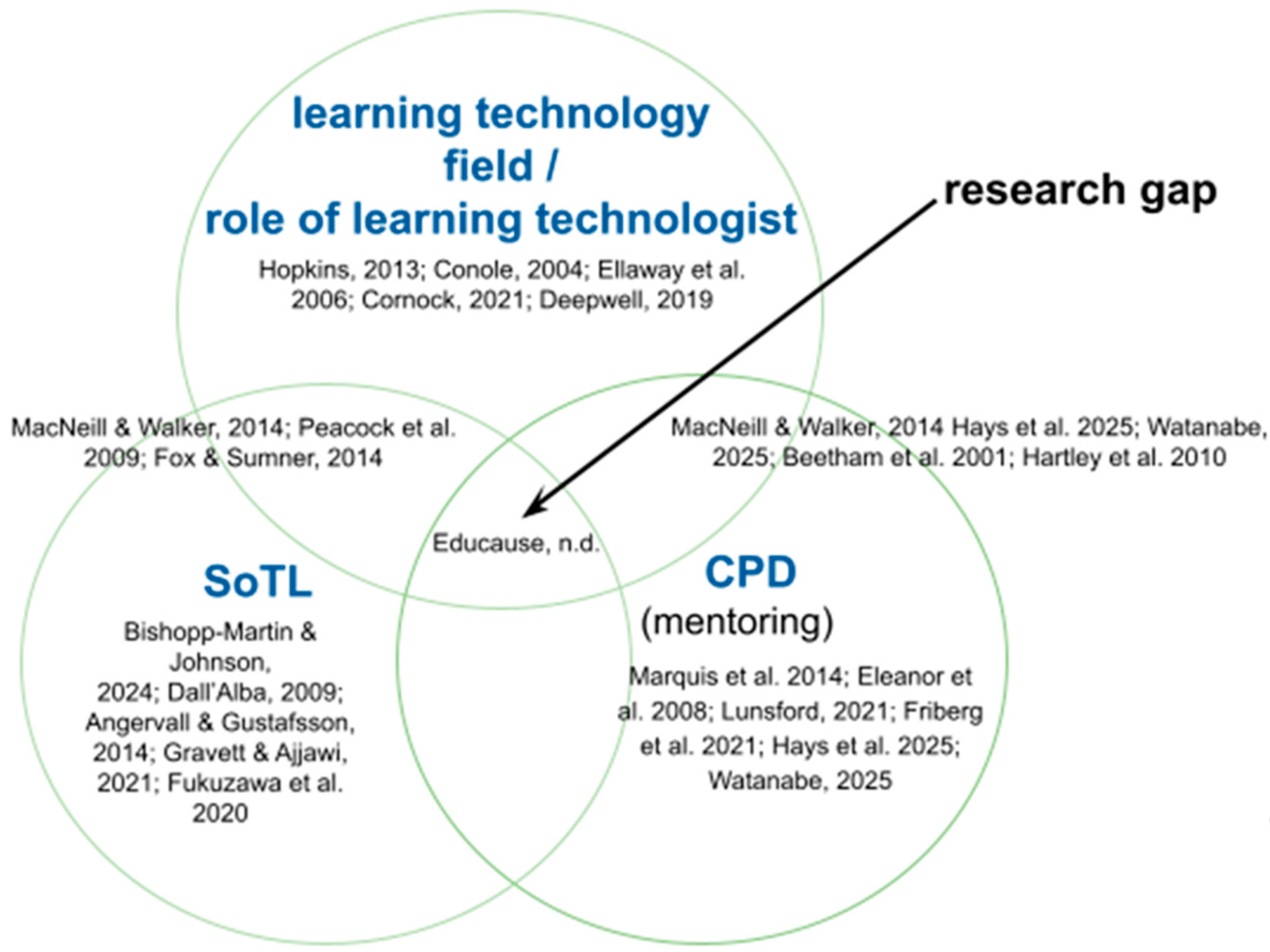
In the literature, there are several overlapping areas of research that are of relevance to the present work (see Figure 1). In turn, these discuss the role of the learning technology professionals, address mentoring and other continuing professional development (CPD) strategies, and debate the place of scholarship of teaching and learning (SoTL). Although we have found a small number of studies at the intersections between these bodies of knowledge, there is a lack of focus on many of the specific challenges addressed by this paper.
Figure 1 illustrates the scope of the literature we reviewed for this study. Vibrant debates exist in the literature about:
  • The changing role of learning technology professionals, where literature focuses on the role of learning technologists in a rapidly changing digital landscape, and the need to engage in CPD as part of their professional practice to respond effectively to these changes [16,17,18]; These discussions became especially prominent during the COVID-19 pandemic [19,20].
  • The position of SoTL in higher education, where the literature reviewed acknowledges a need for more professionals to be engaged in SoTL. While some articles recognise the importance of SoTL for third-space professionals [1], the literature rarely focuses specifically on learning technology professionals [1,7,8,9,10]; and
  • The role of CPD and mentoring in higher education. While various approaches to professional development are documented [21,22,23], much of this research predates the rapid evolution of learning technology roles. Recent frameworks have begun addressing mentor support for SoTL engagement, including a three-stage mentorship model which acknowledges the significance of both formal and informal developmental pathways [24]. Building on this, calls for structured support specifically within educational technology contexts have emerged [25,26]. However, understanding of how mentorship supports the distinctive professional practice of learning technology specialists remains limited.
Reflective accounts of professional development journeys of learning technology professionals emphasise scholarship as a crucial part of the role [16,27]. Conole [17] identified a new specialist ‘breed’ of learning technology professionals who are primarily focused on research, and who collaborate with groups allied with their research interests, such as cognitive psychologists, rather than IT practitioners. This evolution is reflected in the shifting terminology used to describe learning technologists and their position of trust in relation to both technology and pedagogy [19]. Deepwell [20] advocates for a reflective and critical approach to the profession. SoTL could be seen as an essential to this critical practice.
The integration of scholarship into learning technology practice extends beyond individual reflection. Peacock et al.’s study [28] makes a strong case for learning technology professionals to extend their roles to include supporting scholarship, although the study focuses mainly on the potential for providing advice to researchers about using technologies in data collection. This work suggests moving away from understanding the roles of learning technology professionals as split into practitioners and researchers, instead encouraging practitioners to diversify their skills beyond being mere ‘technicians’ and to see their role as increasingly reflective and strategic [28]. A study by Fox and Sumner [29] highlights learning technology professionals’ need to promote their scholarship to increase the profile of learning technology within and outside their institutions. This work highlights, however, that some respondents identify how research is secondary in their role and is typically conducted in their own time due to other responsibilities. Overall, although some studies identify that scholarship is increasingly essential for learning technology professionals (or at least some of them), there has been a paucity of studies that have explored effective methods to integrate and develop SoTL within their roles. There is also limited consideration of how these professionals understand and exert their own agency in relation to the attendant shift in their roles.
If SoTL is an essential part of the learning technology professional’s role, however, to what extent does the literature on professional development for learning technology professionals address this area? As early as 1976, Lawless and Kirkwood [30] explored the training needs of learning technology professionals, which were seen as focused on knowledge of technical systems and course production. Beetham et al.’s study [31] on the career development of learning technology staff identifies the importance of protected CPD time and suggests mentoring as one form of potential CPD. Oliver’s study [6] looks at CPD within the learning technology profession. Although that study does not address scholarship as a core part of the learning technology professional identity, Oliver usefully notes that collaboration is an essential part of the work and identity of these professionals, and that this tends to happen through informal discussions or workshops. Ellaway et al. [18] focus on the practice of learning technology professionals and their agency in their learning environment, although once again, this account does not include SoTL or identity development as a scholar. More recently, Hartley et al. [32] identified core competencies for advanced learning technologies, notably including scholarship within their framework of evaluation models and practices. This represents a departure from earlier literature that overlooked the scholarly dimension of the role. Collectively, these studies underscore the centrality of CPD and, in some cases, acknowledge scholarship as part of professional practice. However, effective CPD models that systematically build capacity for SoTL within the learning technology community remain underexplored in the literature. While institutional constraints may limit scholarly engagement [5], Bishopp-Martin and Johnson [1] argue that SoTL enhances both visibility and credibility for learning technology professionals, suggesting that developing scholarly capacity may be increasingly important for the profession’s future development.
In sum, although these studies cite the central importance of CPD and sometimes identify scholarship as part of the role of learning technology professionals, there remains little discussion of effective CPD models that develop capacity for SoTL within the learning technology community.
Figure 1. Venn diagram showing the links between our research themes: learning technology, SoTL and CPD opportunities. (Hopkins, 2013 [16]; Conole, 2004 [17]; Ellaway et al., 2006 [18]; Cornock, 2021 [19]; Deepwell, 2019 [20]; MacNeill & Walker, 2014 [4]; Peacock et al., 2009 [28]; Fox & Summer, 2014 [29]; Hays et al., 2025 [25]; Watanabe, 2025 [26]; Beetham et al., 2001 [31]; Hartley et al., 2010 [32]; Bishopp-Martin & Johnson, 2024 [1]; Dall’Alba, 2009 [7]; Angervall & Gustafsson, 2014 [8]; Gravett & Ajawi, 2021 [9]; Fukuzawa et al., 2020 [10]; Marquis et al., 2014 [21]; Eleanor et al., 2008 [22]; Lunsford., 2021 [23]; Friberg et al., 2021 [24]).
Higheredu 05 00017 g001
There is a strand of literature on mentoring that addresses its utility as a mechanism for CPD in the context of SoTL, where it is a recognised vehicle for encouraging the development of expertise in understanding theory, methodologies, and practice [33,34]. Such work usefully recognises how the complexity and challenges involved in SoTL make mentoring an ideal support process, especially when undertaken as part of a wider community [21]. Yet such work typically addresses academic stakeholders, omitting the potential for such approaches to be used by other higher education stakeholders, such as those in the field of learning technology, where social capital and networks are particularly valuable [2]. Such mentoring is understood in this literature as taking a wide variety of forms and offering support in many useful ways, but it has also been acknowledged that there is a paucity of research on how it works in practice [22]. Research on online mentoring programmes, such as the MentorNet initiative focused on Women in Science, concludes that the relationship is more productive when motivation and needs of mentors and mentees align [23]. There are a few examples of mentoring schemes that address the learning technology field, such as ‘The Teaching and Learning Pathway’; however, these schemes do not focus on developing skills related to SoTL [35].
Some papers have focused in useful ways on the social settings for nurturing SoTL. Williams et al. [36] and Din et al. [37] have theorised that social networks are important for SoTL development, and they propose that robust social networks are essential for embedding SoTL practices within institutional cultures. The analysis of Tierney et al. [38], who focus on career histories, makes the complementary point that communities of practice—particularly those extending beyond one’s home institution—play a crucial role in SoTL development. The work of du Plessis [39] attempts to provide practical guidelines for establishing successful SoTL communities of practice. Nonetheless, it remains the case that such research generally overlooks the potential for mentoring to be used as a form of CPD aimed at developing the capacity for learning technology professionals in relation to SoTL.
Recent scholarship has begun to address this gap by emphasising the importance of frameworks for supporting SoTL engagement in educational technology contexts. Friberg et al. [24] developed a three-stage developmental framework for SoTL mentorship that recognises both formal and informal pathways, including “unseen opportunities for mentoring” that occur outside traditional structured programmes. While their framework remains focused on academic faculty, it provides a useful foundation for understanding how mentorship relationships develop and shape professional practice. More recently, Hays et al. [25] argue for structured frameworks to support SoTL work in educational technology, while Watanabe [26] provides philosophical justification for collaborative, reflective professional development approaches, acknowledging the complexity and uncertainty inherent in technology-enhanced learning.
This study builds upon these contributions by adapting existing frameworks specifically for learning technology professionals, whose scholarly development through mentoring represents an emerging and underexplored area of inquiry.
Above, we have identified that existing literature:
  • Establishes the increasing importance of SoTL for learning technology professionals but without considering how such professionals navigate this shift in their roles;
  • Highlights the importance of CPD for learning technology professionals, but retains a focus on longstanding competencies rather than considering the potentially different demands of undertaking SoTL in their practice; and
  • Considers the role of mentoring in promoting SoTL, but mainly in relation to academic stakeholders rather than professionals such as those working on learning technology issues.
Therefore, our study seeks to build upon the literature and contribute by focusing on how learning technology professionals understand and navigate the development of their SoTL practices within a cross-institutional mentoring scholar scheme.

3. Theoretical Framework

Our work in this paper is framed by activity theory [40], an established theory often seen as useful for understanding the dynamics of complex situations in higher education and used to understand change and development in practices [41,42].
Activity theory was not initially used to design the mentor scholar scheme, but it subsequently became important to the work of our research team for several reasons. While the mentor scholar scheme was well-received by participants and produced worthwhile outcomes, it unfolded in ways that were, in a range of ways, unanticipated. Our experience of working on the scheme resonated with the writing of Engeström [40], who has written about how activity theory foregrounds the importance of understanding “interventions as contested terrains that are full of resistance, reinterpretation, and surprise from the actors in the design” (p. 369), and Sannino [43], who writes about how activity theory emphasises that “voices of the subjects act as mediators and are embedded in collective change efforts” (p. 571).
We therefore became interested in using activity theory as a way of understanding how the mentor scholar scheme differed from our intentions, and how the experiences of participants were embedded within the dynamics of the wider collective change effort in which they were attempting to further develop their scholarship. This involved the research team using activity theory both retrospectively, in collective reflection about the assumptions that had underpinned our earlier design of the scheme, as well as empirically, guiding our analysis of the empirical data we collected about how the scheme had unfolded in practice. In this paper, therefore, activity theory is used to frame both our initial design for the scheme and our empirical data analysis. For this reason, it is essential to present a brief overview of those aspects of the theory we use.
Activity theory suggests that the analytical priority for understanding practices, such as those of the scholar scheme we analyse in this paper, is to focus on the overall dynamics of activities rather than on more granular actions. This is because human activities—understood as sustained, collective, social endeavours which develop according to their own local histories—frame and provide meaning for the actions people take when pursuing conscious, shorter-term goals [40,42]. Studying activity, therefore, is seen as fundamental for understanding the structure of what people do and the meaning behind it. Moreover, attempting to change human activities is seen as a fundamental way for exposing understanding those structures, which are highly dynamic and often occluded from view, and, for this reason, activity theory often underpins interventionist projects [43].
The project we draw conceptualises the mentor scholar scheme as a case study of a cross-institutional intervention aimed at developing the SoTL work of learning technology professionals. By intervening to support such SoTL work, and by analysing the dynamics of the scheme using the framework we set out in this section, we hope to expose the complexities of learning technology professionals’ attempts to engage in scholarship work under the guidance of an advisor. We use activity theory to reflect on both the original design of the scheme and the activity that emerged as the scheme progressed.
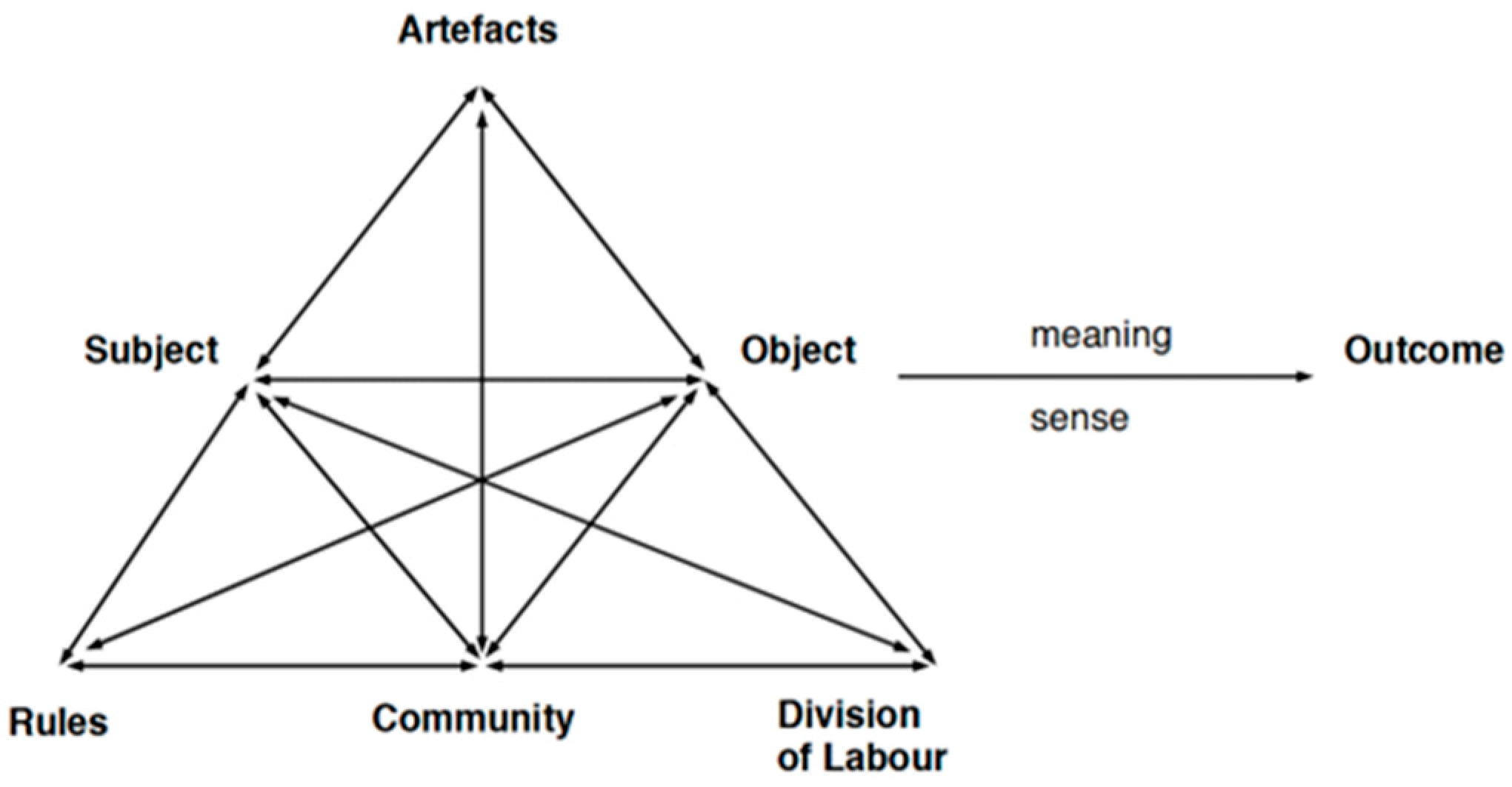
In this paper we use the activity system model [40], a widely used approach for understanding the structure and dynamics of a single activity. The model (see Figure 2) depicts an activity as a set of interlocking, mediated relationships between constituent ‘elements’, all oriented towards an object.
This model has been used in different ways over several decades in what are sometimes characterised as different “generations” of activity theory [44]. In this paper, we focus on the activity system of the mentor scholar scheme and its contradictions as a bounded unit. This usage corresponds to what Engeström and Sannino [44] have called a “second generation unit of analysis” (p. 9). In keeping with our purposes for using the framework, discussed above, doing so will involve presenting our reflections on the initial assumptions underpinning the design of the scheme (in Section 4.2), and then our empirical analysis of how the scheme unfolded in practice (in Section 5).
The core elements denoted in the activity system model are as follows:
  • Object: the material or problem space those involved are working on in an ongoing way; when working on this object, they strive towards an outcome and derive both meaning (rationale) and sense (feeling and affect) from the labour of doing so
  • Subject: the protagonists driving the activity
  • Community: the other stakeholders involved in work on the object
  • Artefacts: the range of material and conceptual tools used for work on the object
  • Rules: ways of regulating the correctness of work on the object, whether codified or tacit
  • Division of labour: patterns of adopting or allocating work on the object, for example because of role, authority or expertise.
Alongside the above elements we use the concept of contradictions, understood as systemic, structural phenomena which emerge within and between activity systems as they develop through their own histories [44,45]. Contradictions are not merely subjective tensions or practical difficulties but instead indicate deep phenomena in which aspects of activity are resolved into poles that are both mutually supportive and mutually undermining. Contradictions are important in the theory because they act as a stimulus for new development and frame the subjective experiences of those who participate in an activity.
Following Engeström [40], our framework differentiates between four types of contradictions in relation to the activity system model:
  • Primary contradictions: those whose poles are located within the same element of activity (for instance, where an object is socially valued in divergent ways);
  • Secondary contradictions: those whose poles are different elements of the same activity system (for instance, between an artefact and some aspect of the division of labour);
  • Tertiary contradictions: those whose poles are newly emerging and previously established aspects of the same activity system (typically, within a process of change);
  • Quaternary contradictions: those whose poles are different activity systems (for instance, where one activity system has changed, and this brings it into conflict with another).
A similar framework has been used in previous projects that have explored the complexities of situations related to learning technology professionals and SoTL. For instance, Greenhow and Belbas [46] used activity theory to investigate curriculum design and technology adoption issues; Joo [47] used it to explore the contradiction of providing distance education to alienated adult learners; and Webb and Welsh [48] used the framework to explore how faculty, staff and students engage in SoTL. In each case, activity theory was valued for its systemic and dynamic analysis, in line with the kind of knowledge we wish to produce in this paper.

4. Research Design

To address our research priorities, we adopted a case study design which focused on the ALT ELESIG scholar scheme as a bounded system, which we aimed to study within its natural environment [49].
This case study design set out to develop multilayered understandings of SoTL for learning technology professionals and explore participants’ experiences and engagement within the real-life context of our mentor scholar scheme over a 12-month period. This is a useful case to study because, as we document further below, the scheme successfully brought together a wide array of relevant practitioners from a range of institutions who pursued their own scholarship within the scheme over several months. To establish breadth, we incorporated multiple data collection methods that complemented the scheme’s process and its participants’ journey in a real-life scholar scheme [49].
The multiple data collection methods employed comprised an initial questionnaire, a “confidence log” exercise, a post-scheme questionnaire, and a semi-structured interview. To deepen understandings of participants’ experience, data was collected at the beginning of the scheme, during the scheme and at the end of the scheme [49]. This is further elaborated in Table 1.
Our case study design elicits perspectives from both scholars and advisors to help us produce insights into how learning technology professionals engage with SoTL through their participation in the mentor scholar scheme. In asking the “how” and “why” questions about the scheme, we were able to design ways for both scholars and advisors to reflect on and document their engagement in the scheme in ways that support our wider study objectives.
We structured our case study using activity theory (see Section 3), which draws attention to the structures and dynamics of human activity systems [50]. We utilised this framework within our case study design as part of the data collection phase and, in particular, in the interview phase.

4.1. Research Site

The research site for the project was ALT-ELESIG, which describes itself as “a community of researchers and practitioners involved in investigations of learners’ experiences and uses of technology” [51]. ELESIG was established in 2008 as a national network across the UK, initially called the Evaluating Learners’ Experiences of e-learning Special Interest Group. It was formally incorporated as a part of the Association for Learning Technology, becoming ALT-ELESIG, in 2009. At the time we commenced the scheme described in this paper in 2021, ALT-ELESIG had nearly 500 members working at educational institutions, mainly across the UK but also in several other countries.
We considered ALT-ELESIG a suitable research site to address our research problem because many members of this community are either learning technology professionals or in adjacent professions, and they have become members on the basis of accepting a set of five shared aims, including “sharing good practice and developments in learner experience research methodology and methods” (aim 1) and “sharing the outcomes of specific learner experience research studies, including successes, issues and challenges” (aim 2) [52]. Additionally, several members of our research team were elected members of the ALT-ELESIG Committee, which facilitated research access and communication to members through official ALT-ELESIG channels about the initiative.

4.2. Intervention Design

The aim of the mentor scholar scheme was to develop a shared understanding of scholarly approaches to learning technology and educational inquiry [51] doing so by providing space, support and guidance in SoTL. The scheme aimed to recruit two kinds of participants, with the quotations taken from our call for participation, which was circulated to all ALT-ELESIG members:
  • Scholars, “those seeking a professional learning opportunity”, and
  • Advisors, “experienced colleagues wanting to support another with their professional learning”.
Those who volunteered to participate as scholars and advisors were matched by the organising team, based on consideration of the interests they expressed in an initial, brief questionnaire. The team tried to match people who had common interests, and to ensure that the skills of the advisor complemented those of the scholar. Subsequently, scholars and advisors were matched into pairs. If they agreed to do so, some advisors supported more than one scholar due to demand for their expertise. Scholars and advisors were invited to an introductory meeting to explore the pathways and learn more about the scheme. They were encouraged to connect at least twice during the scheme, concluding with a group meeting to reflect on their experiences. All meetings were conducted online. While this decision was prompted by the restrictions of the COVID-19 pandemic, it is likely that all or most of these meetings would have been conducted online in any event because the participants were spread across all of the UK.
In undertaking this work, we wished to use activity theory (see Section 3) to understand the experience of participants pursuing that scholarship in a way that highlighted the backdrop of the mentor scholar scheme intervention. To do so, we worked within the research team to reflect upon the design of the scheme itself using our analytical framework. This was accomplished in online team meetings where we explicitly made use of the activity system model. Although we had not initially designed the scheme using activity theory, doing so proved to be a useful exercise, allowing us to make our earlier assumptions more explicit and subsequently enabling us to reflect on where the participants had reinterpreted our design for their own purposes. Below, therefore, we represent the scheme in this way, which will allow us to usefully draw comparisons against how the scheme unfolded in practice in Section 5.
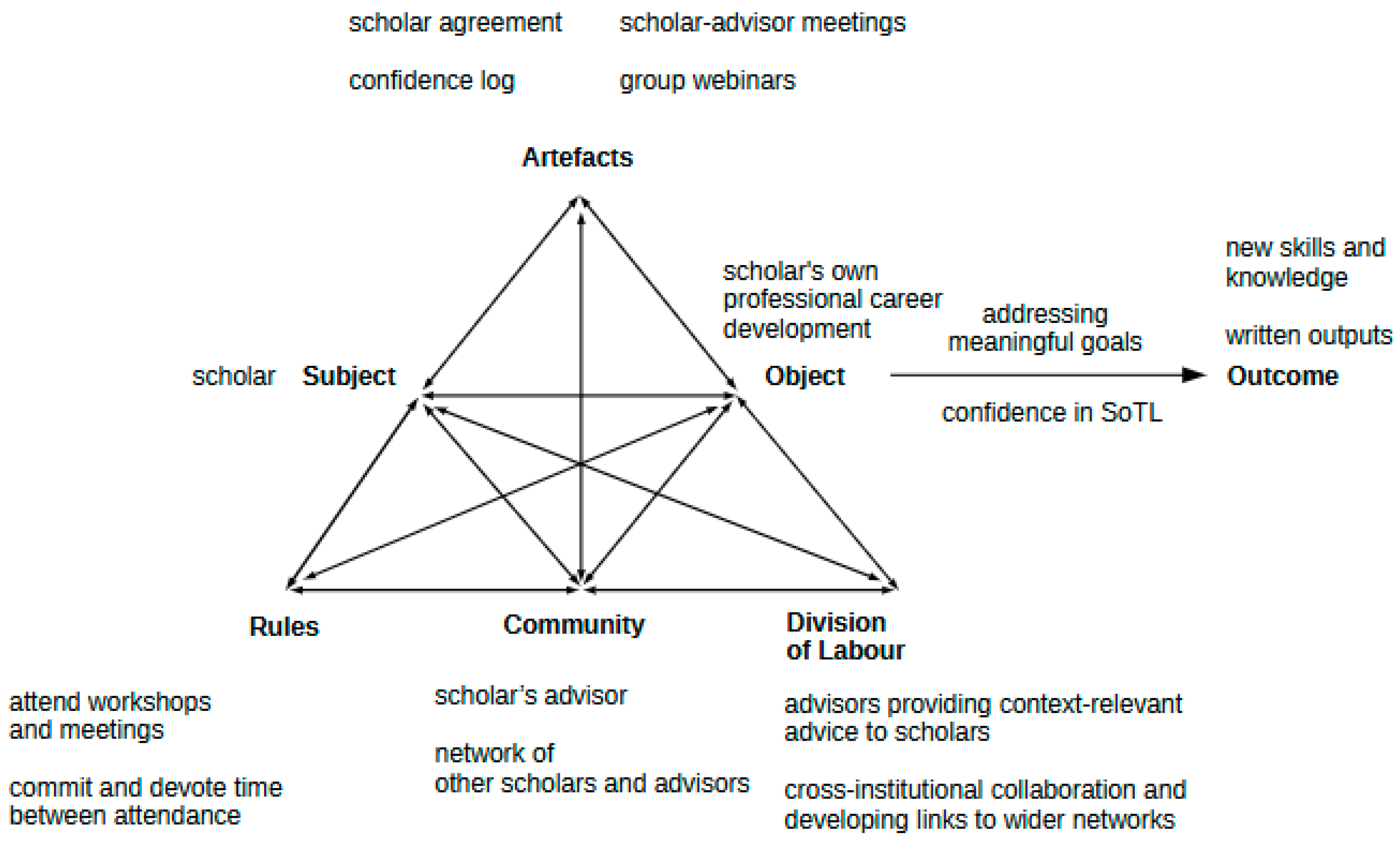
The broad design of the scheme can be represented as shown in Figure 3, which uses the activity system notation introduced earlier. The figure provides a critical analysis of our initial model for the scheme. As the results section below will make clear, in important respects, the scheme diverged from (and built further on) this model when we attempted to put it into practice.
The main object of activity was intended to be the professional career development of those individuals who signed up as scholars within the scheme. The underlying aim of the mentor scholar scheme was to develop a better understanding of scholarly approaches to learning technology and educational inquiry [51]. Yet it was seen as important that everyone involved in the scheme addressed their effort towards real development rather than abstract or idealised discussions of SoTL and that participants recognised that such development would not mean the same thing for different scholars. An attempt was made to convey this idea in the initial call for participation by emphasising that participants might be on different “pathways”, with three different examples provided (which related to professional development plans, SoTL-related professional qualifications, and academic publishing).
The scheme, therefore, aimed to empower each individual scholar, as a subject, to work on addressing their own professional career development in ways that would result in the production of both new skills and knowledge and tangible outputs such as a plan or publication. The work was intended, in other words, to have an explicit meaning of addressing meaningful individual goals, and a personal sense of developing confidence in relation to SoTL.
To undertake this work, scholars would be paired, as mentioned above, with advisors within the scheme. Importantly, both scholars and advisors would have signed up as volunteers for the intervention. Scholars and advisors would meet online to pursue the scholar’s work. At an early stage, this would include filling in a ‘scholar agreement’ document intended to indicate a future commitment to meet and work together, while later each pair would document their progress using a ‘confidence log’ document.
The intention was that scholars and advisors would treat each other as their primary point of contact within the scheme. Yet they would also work within a broader community formed from the other scholars and advisors signed up to the scheme, with group workshop webinars being provided, monthly during term-time, to stimulate wider discussion and address commonly raised issues.
The main rules governing all scheme actions were to commit and devote time, even within inevitably busy working lives, to seek and provide context-relevant advice, and to attempt to maintain motivation throughout the duration of the scheme. Expectations were placed on participants that they would attend scheme workshops and organise a minimum number of one-to-one scholar-advisor meetings. The division of labour promised by the scheme focused on how advisors would support scholars, and on the opportunity for professional networking with people outside of a participant’s own institution. These rules and the division of roles were inspired by Webb and Tierney’s [53] approach, discussed in the literature review. The aim was that conversations within the scholar scheme would allow novice SoTL scholars to discuss their developing conceptions of SoTL, the feasibility of their research questions, their adopted scholarly methodologies, and the ethical considerations of their scholarship.

4.3. Research Participants

In autumn 2020, an expression of interest was circulated to ALT-ELESIG colleagues interested in developing their scholarship practice in digital education via a range of networks, resulting in applications from a range of learning technology professionals, academics, and other professional services staff. Participants came from various UK and other institutions, of widely varying career seniority and degrees of experience with scholarship. Participants were paired up as scholars or advisors based on their declared interests and expertise. Despite the challenges posed by the COVID-19 pandemic, feedback was collected from all of those who initially signed up to gain insight into their challenges and opportunities.
The scholar scheme’s first cohort attracted 51 participants from 42 institutions. The diversity of participants’ institutional roles (see Table 1) reflects the cross-disciplinary nature of SoTL work and the blurred boundaries of responsibility for teaching and learning in higher education. Academic staff comprised 16 participants, while the largest groups were learning technologists (17) and educational developers (18), highlighting how SoTL increasingly sits at the intersection of traditional academic roles and professional service positions. The cohort also included one clinician and one librarian, further illustrating the expanding scope of who is engaging in scholarship about teaching and learning. This role diversity proved significant for the mentoring dynamics, as participants often categorised themselves differently—for example, some as practitioners, others as emerging scholars—creating the nuanced relational complexities explored in our findings.
Whilst we have used the term learning technology professionals in this paper, there is some variance in the professional role titles of the 51 colleagues who signed up as scholars or advisors in the scheme. All participants are involved in learning technology within their role, but some hold academic, educational development or learning technologist roles as identified in Table 1. 17 colleagues from the scheme volunteered to take part in the semi-structured interviews conducted by the project team in 2021–2022.
Our analysis in this paper draws heavily on the semi-structured interviews conducted with six individuals who identified themselves as educational developers, four as learning technologists, and seven as academics (see Table 2). A number of those academics previously held educational development and learning technologist roles, which complicated their identities. This interview sample maintained the mentor scholar scheme’s variance and diversity in professional roles, enabling us to explore how scholarly identity development varied across different professional contexts.

4.4. Data Collection Methods

The research data was collected at various points over a 12-month period from the initial sign-up to the end point of the mentor scholar scheme. There were four data collection methods employed in the study (see Table 3).
The anonymous pre-scheme questionnaire aimed to track participants’ initial challenges and the opportunities they anticipated the mentor scholar scheme would provide. The confidence logs were reflective practice pieces that participants used to document their journey and experiences during the mentor scholar scheme. These logs were also referred to during the interview stage to gain a better understanding of participants’ experiences and the potential impact of the scheme on their professional development. The post-scheme questionnaire collected reflections on participants’ experiences at the end of the scheme. The final, in-depth semi-structured interviews, conducted with 17 participants and having an average duration of 1 h each, allowed for a deeper exploration of the experiences of the advisors and scholars who participated in the scheme. Advisors and scholars were treated as separate, identifiable groups but underwent the same processes as members of the scheme’s community.

4.5. Data Analysis

We wished to make use of activity theory (see Section 3) to understand how the experiences of participants were embedded within the dynamics of the wider collective change effort of the mentor scholar scheme. Doing so acknowledges that participants’ experiences were framed by the scheme but also celebrates that their work took the scheme as a starting point and diverged in many ways from our plans. We therefore used activity theory both to reflect on the assumptions that had underpinned our earlier design of the scheme (which produced the account in Section 4.2), and to interrogate the data we generated from participants’ work in the scheme as it unfolded.
Data from the various sources were integrated into a single dataset and then analysed thematically using the concepts set out in Section 3. We used these concepts as a theory-driven coding frame, in a process of qualitative content analysis [54], rather than using a more inductive approach to data analysis. This approach is in keeping with much scholarship using activity theory for theory-driven analysis, and mirrors that of other papers which have engaged productively with issues concerned with learning technology professionals and with SoTL (which we cited at the end of Section 3). Our priorities were to map the activity system of the mentor scholar scheme and its contradictions, as these arose in practice over the course of the scheme. This involved mapping extracts from the dataset against categories drawn from the activity system elements, such as ‘object’, ‘subject’, and ‘community’. It also involved categorising problems and analysing these as contradictions by comparing them against the emerging picture of the activity system.
All data was anonymised before analysis, though we retained sufficient details about participant identifiers and background to provide context for the narratives and allow for triangulation between sources. As mentioned in Section 4.3, the post-scheme interviews proved to be the richest data source in terms of meaning-making and participant reflection, and so in reality, the 17 interview transcripts became the primary data sources with other forms of data serving in a supporting role.
The work of analysis was theoretically driven but also a source of considerable reflection between the members of the research team. An initial phase of work, undertaken shortly after conducting the post-scheme interviews, involved members of the research team analysing data individually using the theoretical framework as a coding frame to produce their own interpretations of the activity system and its contradictions. Subsequently, the five members of the research team travelled to meet in person to analyse and debate the dynamics of the scheme activity system collectively over the course of a dedicated day. The work of this day involved considerable debate about the object of activity (including whether it was shared between scholars and advisors and whether there was more than one activity system), and work on mapping the other aspects of the system. An important final step was to discuss and reflect on the prominent difficulties expressed in the data, and to analyse these as contradictions which were located in relation to the activity system model which had been produced.
Having produced this initial model of the activity system and its contradictions together, the five researchers then spent further time individually examining the model in light of reading back through the data, communicating their views electronically in emails and synchronous online meetings over the course of around two months. This process produced numerous detailed refinements to the model presented below.

4.6. Ethics

The study was conducted in accordance with the UK Concordat to Support Research Integrity https://ukcori.org/research-integrity-concordat/ (accessed on 3 February 2026) and approved by the Humanities & Social Sciences Research Ethics Committee (HSSREC) of the University of Warwick. Since the research team (the present authors) were drawn from across five different universities, an “Academic Collaboration Agreement” was agreed to and signed by representatives of all universities involved in the research study so that the management of research ethics could be co-ordinated.
In line with the approved ethics protocol for the study, all participants in the mentor scholar scheme were given a participant information sheet detailing what their participation would involve and how the scheme would be evaluated. Having had the chance to ask questions, they signed and returned consent forms to indicate their consent. Furthermore, the participants who participated in reflective one-to-one interviews shortly after the end of the scheme (the 17 interviewees summarised in Table 2) were presented with an additional participant information sheet detailing what would be involved and, having had the chance to ask questions, indicated their consent to be interviewed by signing and returning a separate consent form.

5. Findings

Our analysis in this section explores the activity system as it was enacted in practice over the course of the 12-month period during which the mentor scholar scheme ran. Importantly, this activity system differs markedly from what we had anticipated in our design of the scheme. We do not consider such deviation as indicating the failure of the scheme’s design, but rather as a useful source of knowledge about the motives, practices and tensions associated with learning technology professionals’ attempts to engage with SoTL in a supported way.
In line with the theoretical framework presented in Section 3, we commence by addressing the object of activity, followed by the other elements of the activity system. Subsequently, we present the core contradictions in this activity system identified by our analysis.

5.1. Activity System

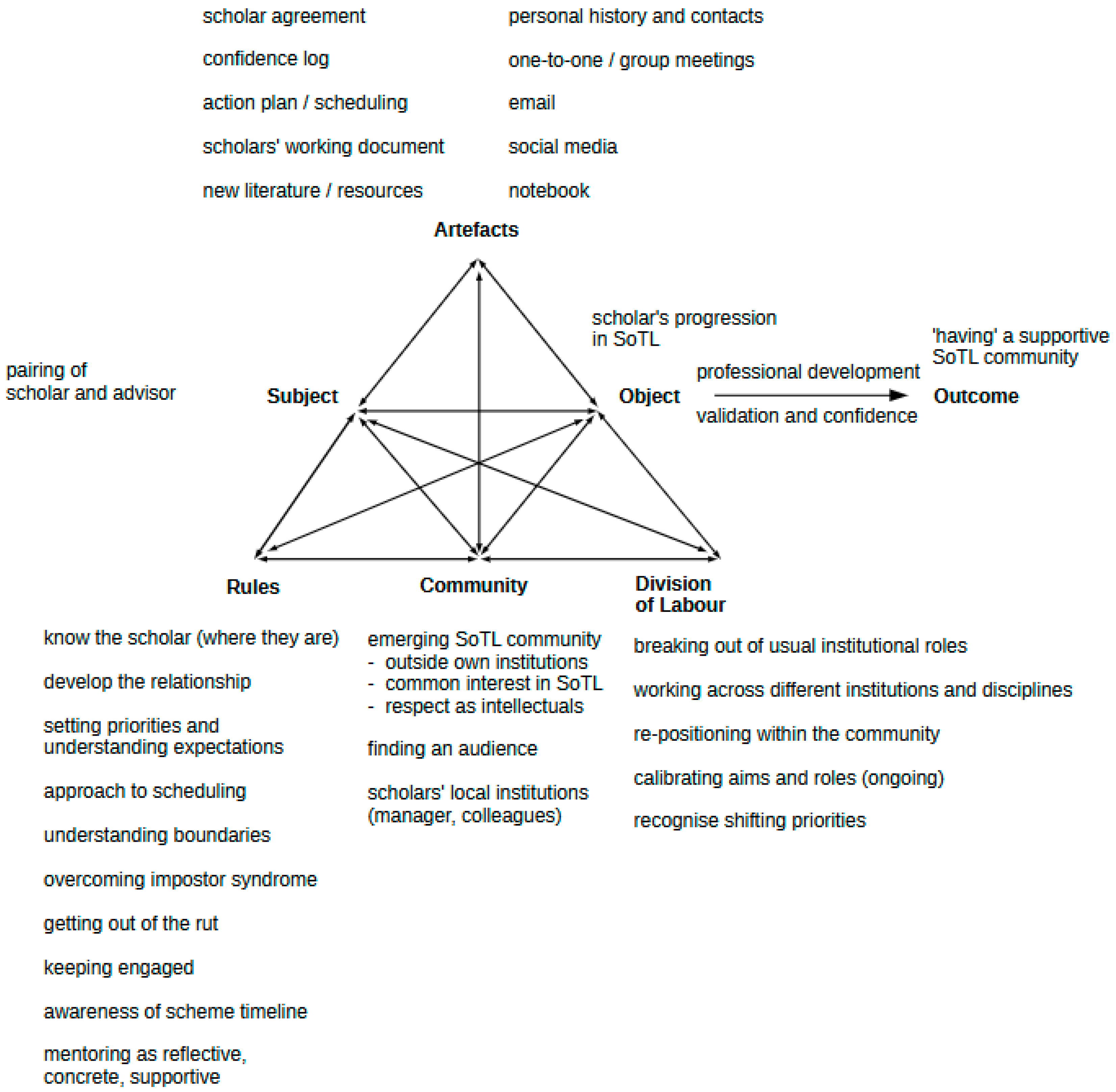
Figure 4 provides an overview of the activity system of the scholar scheme in practice. It will be immediately apparent that this activity system differs in many respects from the design for the scheme represented in Figure 3. Such divergence can be found not only in the greater complexity of how the activity system is mediated but also in key differences in the fundamental object and the evident forms of subjectivity and community engagement. The subsections below will analyse the contours of this activity system in further detail.

5.1.1. Object

Our analysis identified the object of activity as a scholar’s progression in SoTL. Whilst the scheme broadly aimed to nurture new scholars, its social organisation meant that work was carried out with each individual scholar treated as a distinct case. These individuals, who had a prior interest in developing their SoTL skills, presented themselves as the ‘raw material’ worked on by the scheme.
“…because I’m coming from a point of view. I don’t have a PhD. So I haven’t really gone through, you know what, suffered or whatever adjective you’d like to do. Yeah. In that kind of arena, which obviously would then feed through into … [being an] actual, I guess, what sometimes I think about a scholar.”
(Interviewee 17, advisor)
“I wanted to use it [the scheme] to ringfence time for something that I really believe in. And I know what the value is to our work, but it’s so difficult to preserve it. It always seems to get hijacked …”
(Interviewee 14, scholar)
“I think I really should do that […] SoTL is good as the teacher, for the students, good for the university itself, and good for me as well. And it benefits my professional development in my competence qualification and get myself recognized, you know externally and internally [to the institution]. And as I said, through all this, I can gain a sense of treatment and satisfaction. And, well, it certainly links with promotion.”
(Interviewee 4, scholar)
Such individuals were already accomplished professionals. Yet their existing professionalism was disparate, with scholars describing themselves as, among other things, learning technology professionals, institutional managers, programme directors, and academic lecturers. Their expertise was considerably more varied than had been anticipated when designing the scheme. Many described themselves as having had portfolio careers; they recounted their moves between different institutional roles (sometimes over lengthy periods of time), having had periods of private sector work and/or self-employment, and having developed self-taught skills in domains such as project management or computer programming.
Despite their professional achievements, many felt underconfident in scholarship or expressed a lack of previous opportunity. One scholar described their motivation as follows:
“To me, a lot of the reason I joined the scholarship scheme was around the fact that I have never been able to be in a position where I’ve taken it to the next step. That makes sense to actually kind of push it, push it that bit further.”
(Interviewee 7, scholar)
While having personal interest in pursuing scholarship activities, many reported having been discouraged, especially by the perceptions of others in their employing institutions. One participant recounted the discomforting reactions they elicited “when I start talking research talk”. Despite being an established professional in their institution, they recounted, “for some reason they look at me and say […] why are you interested in this?”.
Our design of the scheme had anticipated that the object of activity would be an extension of professional development. Yet professional development was often discussed as a way of rationalising participation (as an official ‘meaning’ for working on the object). Some participants, for instance, needed managerial approval to join and so needed explicitly to frame their involvement as career progression:
“The organisation have never sort of had an articulation around it […]. I think that’s what slightly helps with this type of activity, because it is very scholarly what we’re doing […] but because there has been that sort of soft contract, in a way, […] that’s been a partnership with my manager that they have endorsed that I can do that for my career development and for the development of the institution.”
(Interviewee 14, scholar)
Yet pursuing progression in SoTL was not just about acquiring skills or certificates, but was also about a sense of gaining social validation and personal confidence. Being designated as ‘scholars’ within the scheme symbolised this recognition.
“The learning technologist role… a lot of the time that… it’s about function, function and practicality, rather than the theoretical side or the research side of things. But actually, I feel it’s increasingly important and there haven’t been enough development opportunities really for learning technology professionals to go into that a little bit more in depth.”
(Interviewee 7, scholar)
However, the desired outcome—producing a skilled, confident scholar—was difficult to reconcile with existing institutional structures. Scholars were often pessimistic about gaining recognition as scholars in their own workplaces. Instead, there was a sense that such a scholar would be useful, and would be recognised, within a wider community of mutually supportive people, even though such a community did not yet fully exist. Developing individual scholars was seen as a necessary step towards building this community, and participants had started to feel that they were part of such a community, even if the community itself was nascent.
“I think what’s really good is […] keeping yourself up to date about what things that are happening and what [other] people are interested in […] building networks, that’s a really good thing.”
(Interviewee 1, advisor)

5.1.2. Subjectivity

The subjectivity expressed in the activity system was that of the “pairing” of scholars and advisors. With reference to such pairings, participants spoke extensively about what “we” did, and it was clear that many pairings had become mutual endeavours:
“I think we more ended up on a bit of an even level split because they’ve got lots of published research, whereas I didn’t have any. But I had the expertise in [practice related area]. So it’s more sort of I guess more, more like a buddy type system in a way.”
(Interviewee 7, scholar)
Many pairings evolved into genuine partnerships, sharing the common object of working on the scholar’s progression:
“I suppose to be allocated to someone that I could work with really well, that was a key moment. […] We had to redefine what our relationship was and how we were going forward. A key moment where I could bring her into work I was doing and have that collaboration and hopefully continue that. I mean, I regret that we haven’t really spoken since [the scheme ended].”
(Interviewee 3, advisor)
Participants often expressed their readiness to work with their partner in terms of having similar personal histories. Participants in both roles often recounted working at a succession of educational institutions (and in some cases other types of organisations), moving between academic disciplines and job roles, purposefully getting involved in professional networks outside their employer’s organisation, and facing “impostor syndrome” throughout their careers regarding various aspects of professional practice. They each also tended to share the view that SoTL was important for professional practice, and that its typical lack of formal recognition was problematic. For example, one advisor shared their views about how a “cyclic model” of research and practice would allow people to think critically and go beyond “fighting fires”, while a scholar voiced their frustration at being trapped in a (narrow) “space of problems”. Such common histories and views typically allowed for the development of an easy rapport between pairs:
“I guess it just probably stems back to feeling… So he, I think… knowing my history well. So I started out in e-learning roles and so segued through to educational development. And I think most of the time I was doing more educational development, instructional design, than traditional people might be doing. Because I needed to know ‘why’ like, what was the evidence out there?”
(Interviewee 17, advisor)
Importantly, advisors were typically reluctant to categorise themselves differently from the scholars they worked with. While many advisors had achieved some success in their scholarship, for instance by switching to a formally research-active job role or by publishing a book, they still viewed themselves as confronting, on a day-to-day basis, many of the same dilemmas and problems as those they advised.
The main difference was that, where scholars tended to view their professional role as “hijacking” or having sometimes caused them to “abandon” their previous attempts at undertaking SoTL, advisors seemed more confident at achieving their scholarly aims, even if this sometimes meant “neglecting” their own institutions:
“I think I’m a little bit worried that I am neglecting the institution and that might bite me in the bum in the future [laughs], but that’s how it’s fitted in and also because of… I strongly believe that we have to collaborate more in order to answer these questions.”
(Interviewee 12, advisor)

5.1.3. Community

The community of stakeholders drawn into the orbit of scholar scheme activity was wider than initially envisioned.
As planned, the ALT-ELESIG team fostered a sense of community through regular online synchronous meetings. In line with our expectations, these meetings were considered useful by those scholars and advisors who attended, with the overall scheme activity seen as nurturing a SoTL community of interested practitioners who could offer to individual participants a sense of mutual respect and recognition. Indeed, some participants were concerned about carrying forward the community that they felt had started to emerge:
“I thought the online events were really good. So I particularly remember the initial one… together, group meeting, and how buzzy that was […] a real energy around it. And I think we disappeared in smaller groups—didn’t we?—and had a really good discussions there. I think that’s something that that we could carry forward…”
(Interviewee 3, advisor)
“I thought that was really good. […] I loved that, the framing of it. […] When we all got together and we went to enter the breakout rooms and it was really nice. I really felt very quickly part of a community which would help me…”
(Interviewee 14, scholar)
Overall, however, attendance at times was lower than we had anticipated. Some scheme participants attended only occasionally (or in some cases, hardly ever). Yet this community was appreciated even by those who could not attend. Participants recounted having felt comforted to receive emails about upcoming group workshop webinars and other progress updates, even when unable to attend themselves. Thus, the community remained nascent in terms of membership but was often appreciated more widely as an ambient presence encouraging and legitimating action.
“I do think, although I didn’t engage with them, I think the fact that there were opportunities there to get together online was a really valuable thing to have, and in a sense, there’s a reassurance in knowing that they’re there.”
(Interviewee 7, scholar)
“…those notifications come up […] You know, I’d be doing something, and then I noticed, and then it was like, oh, right, so the momentum… That could be a thing [prompt] to sort of use as a thing around the momentum of things.”
(Interviewee 1, advisor)
Moreover, participants observed that it was important that the scheme’s community extended beyond a single institution, because that allowed for meeting new people “outside my bubble” and placed the scheme outside the structures of institutions and line management:
“…another area of where that broadens my understanding and my approaches [is] working with colleagues across different [settings] and I think that’s been key as well with the scholar scheme. It’s working with colleagues across different institutions and who aren’t always in the same discipline as yourself, that’s been really valuable as well.”
(Interviewee 15, advisor)
“I’ve been put in a role that is about development and I should be trying to build the development, you know […] trying to do that in the institution. But perhaps there’s a lack of confidence in myself that I know what I’m doing. […] And just a general frustration about the lack of organisation around it. It’s like there’s no structure around ‘how’.”
(Interviewee 2, scholar)
Beyond the planned structure, additional stakeholders became involved in unanticipated ways. One key group was the “audiences” for scholars’ SoTL work. These audiences comprised people interested in similar issues or topics to the scholar (though not necessarily conducting their own scholarship), who might provide verbal or written feedback on ideas, presentations, or written materials. These people were often engaged through online platforms or personal networks, sometimes facilitated by advisors.
Another important set of stakeholders were people from the home institutions of the scholars. Sometimes, engaging with such stakeholders could involve attempting to justify the time spent on the work. Yet scholars also commonly reported “reaching out” to colleagues in their home institutions, especially academics and librarians. Doing so was not always successful, since some colleagues were not receptive to such an approach, but sometimes it “unlocked” expertise and resources the scholar had not considered making use of before:
“[This work] unlocked other things that I hadn’t thought about in terms of expertise and resources I have within my own institution to draw upon. Actually, I had a really good meeting with somebody, a colleague in the library [at their own institution] to help to think about my literature review, and I mean, it’s obvious, isn’t it? And yeah, I think, [it] unlocked my own institution, because it reminded me of academics […] I thought, actually, that really builds on the work of Doctor so-and-so here [at this institution]. Because I’d forgotten really. I know a lot of people working in the area who I could talk to and […] create another community for this piece of work.”
(Interviewee 14, scholar)
Scholars also recounted how they reported their progress on the mentor scholar scheme to their work colleagues on a regular basis, occasionally leading to valuable insights or institutional support.

5.1.4. Artefacts

The scholar scheme activity system made use of a wide range of artefacts, both those provided by the research team and those appropriated by the participants from elsewhere. As the activity system matured, the range of artefacts used became more consistent and organised.
The scholar agreement and confidence log were highlighted as useful by many participants. Interviewees recollected that they had “set the tone” during their early actions of joining the scholar scheme and starting to engage with it, and that this had been highly influential on their subsequent experience. The scholar agreement served, as intended, to elicit what participants hoped to achieve (in other words, what their object was), while the confidence log helped to structure the process (how at that object was to be pursued):
“I used the resources that you gave us, so the journal—isn’t it the “confidence log”?—and the…actually writing the agreement as well. It meant you had to really kind of think a little bit more focused about what our time together was going to be about.”
(Interviewee 14, scholar)
However, these artefacts, which had been specifically provided by the scheme, were increasingly complemented as the year’s work progressed. Participants settled into a routine of regular one-to-one meetings, which typically focused on a working document sent in advance by the scholar, such as a draft research article or report. One-to-one meetings focused on these working documents and, over time, came to define how participants saw their object, with the scholar’s agreement progressively receding in influence:
“Obviously the technical tools would be Teams [Microsoft Teams] and text documents. You know… something written down that we could share and then write over and these sorts of things to develop something.”
(Interviewee 12, advisor)
“I was sharing more the documents of the actual project that we’re working on.”
(Interviewee 5, scholar)
Other artefacts were widely used to structure the process, including emails, bullet lists in shared documents, and informal plans written in notebooks. A variety of artefacts, such as online resources, academic papers, and the social media profiles of relevant scholars, were often used to express future possibilities for the scholar’s progression. The latter were either suggested by the advisor or found by the scholar and discussed with the advisor in meetings.
“We talked earlier on about huge amount of research out there. So when someone’s engaged with that literature, like he’s done… very helpful, he sent me a list of 10 or 15 links to research that would be really relevant and helpful to informing our research question.”
(Interviewee 5, scholar)
“I kept it on a notebook as well, what we talked about the last time we met. So I could flip back and we’d go through roughly what we’ve been talking about, where we were, to where she was planning to get to, which was always good as a little bit of a refresher.”
(Interviewee 12, advisor)
The scheme therefore came to be mediated by a combination of artefacts working together, with some provided by the research team and others appropriated from elsewhere by the participants. While the constellation of artefacts played a crucial role overall in shaping the scholar’s progression and the collaborative dynamics of the scheme, we became increasingly aware that the participants’ own artefacts played a greater role than had been anticipated in the design of the intervention.

5.1.5. Rules

In the activity system model, rules are important elements, defined as the range of ways of regulating the correctness of work on the object, sometimes explicitly but quite often in tacit ways which become customary as the activity develops. The collection of rules governing the scholar scheme activity was broader and more nuanced than we had originally envisaged. Whilst some rules were explicit (typically, those aligned with the scheme’s formal design), a wider array of tacit rules emerged. These tacit rules primarily focused on sustaining the scholar-advisor relationship in the context of the community of the activity system. Indeed, it was evident that most of those rules discussed by participants in retrospective interviews were concerned with preserving and supporting the scholar-advisor pairing, rather than with other aspects of the scheme.
The more explicit rules were typically related to scheduling, time management and prioritisation:
“I thought this [scheme] it could… preserving that time and […] having a scheme, having a commitment to meeting, you know, [name of mentor] setting objectives, setting the goals, having the Community…”
(Interviewee 14, scholar)
While the initial design of the mentor scholar scheme did address such considerations, the rules discussed by participants indicated a greater focus on persistence and a more granular set of considerations for how to accomplish this than our design had anticipated. Scheduling required careful negotiation around both scholars’ and advisors’ institutional workloads, seasonal fluctuations and existing commitments. Even here, tacit rules started to emerge, sometimes from modelling the behaviour of a mentor:
“You get an insight into their day-to-day […] so pragmatically is just seeing that the time and how they are trying to make space for it and then perhaps then that gives me ideas and strategies to approach […] to do something similar.”
(Interviewee 3, advisor)
Advisors, like scholars, often struggled to find time, and there was a shared understanding that some meetings would inevitably be cancelled; what mattered “more than apologies” was the commitment to reschedule, which became an important rule for participants. Ongoing awareness of the scheme’s official, overall timeline varied, with participants occasionally relying on reminder emails to stay on track.
Alongside these explicit rules, a set of more tacit customs governed the activity, shaping the quality and buoyance of the advisor-scholar relationship. Advisors emphasised the importance of understanding the scholars’ professional context, motivations and aspirations. Scholars, in turn, found value in articulating these elements to their advisors, which served as a reflective exercise for both parties while also serving to make potentially requirements for regulating the activity relatively more explicit. Advisors spoke of helping scholars navigate feelings of imposter syndrome, which often involved acknowledging their own similar experiences and feelings, and which was necessary if scholars were to make further progress. One advisor described SoTL engagement as a process of “getting comfortable with doubt and uncertainty” and “breaking out of a rut”. These ways of regulating activity were novel to the scholars they had supervised.
Relationship development was universally seen as an essential priority. Actions were judged by their contribution to developing a productive and trusting partnership. Mutual trust and openness were seen as enabling more effective development of such relationships, and mentoring was conceived as needing to be reflective, concrete, and supportive. The metaphor of “coaching” was used by one scholar to describe how they felt meetings were conducted. The development of a joint understanding within scholar-advisor pairings was seen as crucial to maintaining scholars’ momentum with their work at times when other demands threatened to distract them from their engagement.

5.1.6. Division of Labour

In a key respect, the division of labour within the scholar scheme diverged considerably from our original assumptions: as discussed in Section 5.1.2, scholars and mentors worked closely together as a collective subject, and eschewed the more formal division of roles we had envisioned.
In other respects, the division of labour within the scheme broadly reflected the original design idea of providing access to wider networks. Participants valued being able to work with people in different institutions (and, in some cases, those whose roles involved working in different disciplinary contexts), where they felt it was possible to share different experiences and appreciate a wider perspective. Moreover, participants recognised that their work in the scheme allowed them to break out of their usual institutional roles, with one advisor describing how they had put effort into helping a particular scholar to rethink their “insular” positioning within a particular institution. As one respondent noted:
“I am doing much more outside of the institution. Simply because it’s helping me too, because I can’t find anybody in the institution that’s got the time, or really the sort of interest, so this scholar scheme fits in to all of that. Kind of trying to engage with people like [name of mentor], like yourself [interviewer], who had asked similar sorts of [research] questions.”
(Interviewee 12, advisor)
However, a shift in the division of labour was also experienced, in ways which addressed relationships with others who were not formally members of the scheme but who were nonetheless part of the wider community of the activity system. As already discussed in Section 5.1.3, scholars’ accounts often identified how they had been re-positioned within their existing work communities and had felt more confident to intervene in “conversations” within their own institution where they might previously have felt unqualified to participate. In a similar vein, participants discussed feeling that they were starting to recalibrate their own aims and priorities over time, with implications for how they saw their professional work roles.
“I think having those connections to ALT ELESIG… all those professional bodies hopefully can achieve this… we can demonstrate that this is needed and it is valued and that it should be valued as people’s career. So again, […] my own aims coincide with the scheme’s aim. […] It’s intertwined in a sense. My practice with what we want to achieve with it [the scheme].”
(Interviewee 3, advisor)
Yet, such confidence-building was not omnidirectional. Within the scholar scheme itself, scholars reported that they had not felt confident to participate in the wider community outside the scholar-advisor partnership. Despite the ongoing group meetings, to which all scheme participants were invited, and the regular email updates, scholars sometimes expressed that they had felt there were wider conversations in which they were not involved:
“I’d be thinking, well, I’m doing this for a [specific reason]. They’re not talking about [that], so basically they’re off doing their own thing, and I’m not bothered [about] that. […] I don’t know, maybe I could get involved in something like that, [but] your goals were sufficiently fixed and set, [so] that that was never going to happen. To be perfectly honest though, the way it was spoken about, I didn’t get the impression I could join those other conversations. It felt like when I had signed up, I had signed up to [this goal]. Those boxes that asked [in the initial questionnaire]. Are you joining for this or you’re joining for that? So I ticked to join [and] I didn’t get the impression that I could join other ‘groups’.”
(Interviewee 13, scholar)
One participant admitted, however, that they were not sure they would have had the time or motivation to have participated in such an event if they had been directly invited individually.
This variance in engagement highlights a subtle but important aspect of the division of labour. While the scholar-advisor relationship was often experienced as empowering, this did not always translate into broader participation within the scheme’s wider community. The scheme’s structure enabled deep, personalised collaboration, but further support may be needed to help scholars feel confident stepping into more collective spaces, especially where these are identified as focused on scholarship.
Alongside these explicit rules, a set of more tacit customs governed the activity, shaping the quality and buoyance of the scholar-advisor relationship. Advisors emphasised the importance of understanding the scholars’ professional context, motivations and aspirations. Scholars, in turn, found value in articulating these elements to their advisors, which served as a reflective exercise for both parties while also serving to make potentially requirements for regulating the activity relatively more explicit. Advisors spoke of helping scholars navigate feelings of imposter syndrome, which often involved acknowledging their own similar experiences and feelings, and which was necessary if scholars were to make further progress. One advisor described SoTL engagement as a process of “getting comfortable with doubt and uncertainty” and “breaking out of a rut”. These ways of regulating activity were novel to the scholars they had supervised.

5.2. Contradictions

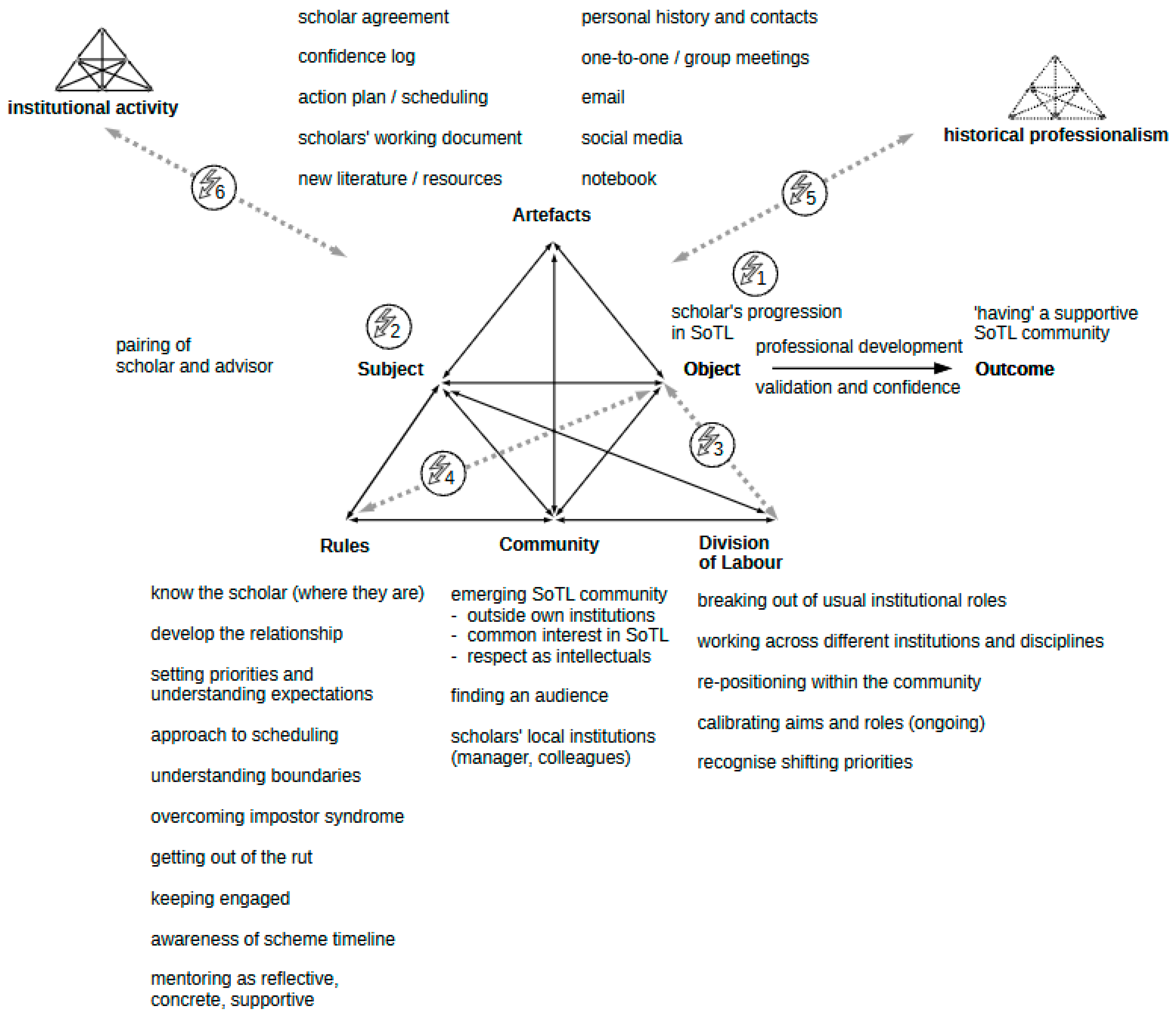
Our analysis highlights six key contradictions in the activity system. Located within and between the structures of the participants’ activity, these contradictions framed their experiences and acted as stimuli for further development of the activity system. We illustrate the locations of these contradictions in Figure 5.

5.2.1. Identifying as a Scholar

The first primary contradiction (labelled 1 in Figure 5) arises from the difficulties faced by those in the scheme in the roles of “scholars”, with identifying and valuing themselves “as a scholar” even while pursuing their scholarship. We analyse this contradiction as a primary contradiction within the object of activity, which focuses on the progression of this scholar. Many scholars did not value themselves as scholars but instead derived confidence to pursue scholarship from other aspects of their professional identity. The contradiction within the object element is therefore between one pole, which values working on progressing further as a scholar, and another pole, which involves questioning whether being a scholar is a viable or desirable identity to adopt.
Many participants expressed discomfort with the label of “scholar” and its implications for their professional identity. One scholar reflected:
“I do not call myself a researcher. Maybe just… I thought TEL practitioner to say that.”
(Interviewee 4, scholar)
Others described a growing awareness that they might never fully embrace the label:
“I think I’m getting used to the idea that I’m never going to feel 100% comfortable with the idea of me being a researcher… hanging around with people in this group has helped me do that because I realise that everybody is doing that.”
(Interviewee 12, advisor)
Some participants found alternative models of scholarship more relatable, such as publishing via social media to reach practitioner communities, suggesting a need to redefine what scholarly practice looks like in their field:
“But maybe it’s … [about] rewriting the narrative… getting permission for our community by our community. I mean, the educational developer or learning technology professionals’ community to just say, … this is how researchers scholarship looks like in our field.”
(Interviewee 17, advisor)
This participant highlighted that making progress on scholarship might destabilise confidence, especially when comparing oneself to others:
“… sometimes you don’t know whether you can legitimately be part of a group, …being a scholar may be more about awareness and what it entails despite not being able to perform it yet?”
(Interviewee 17, scholar)
These reflections point to a deep-rooted tension between striving to become a scholar and the uncertainty that this identity evokes. Making progress in scholarly work often prompts deeper questioning of professional identity. This contradiction highlights the need for schemes like this to support identity negotiation, challenge binary notions of scholarly legitimacy and offer diverse role models. While community dialogue and peer support helped some participants navigate this tension, such tensions seem likely to re-emerge throughout such attempts at scholarly development.

5.2.2. Vulnerability Within the Mentoring Partnership

This primary contradiction (labelled 2 in Figure 5) arises from uncertainties within the pairings of scholars and advisors. We analyse this contradiction as a primary contradiction within the subject of activity. As we elaborated above (Section 5.1.2), the subjectivity expressed in this activity was primarily one of joint pairings of scholars and advisors. Yet enacting this pairing highlighted a high degree of vulnerability—for both parties. The contradiction in the subject element is between one pole of working, in a way based on valuing prior expertise, and another pole of working in an equal partnership, which attempts to eschew harmful power relations.
The initial allocation of pairings often brought uncertainty to the fore quickly. Scholars expressed apprehension about being matched with unfamiliar individuals and being unsure of personalities or expectations:
“Little bit strange and it be scary as well. You don’t know what people, what kind of personality, you know [that you will be paired with].”
(Interviewee 4, scholar)
Many participants were conscious of power dynamics in institutions, and how pre-existing power dynamics may have on the scholar–advisor relationship:
“There’s certainly a power dynamic that exists within institutions where professional services feel academics have more power. But academics also feel that professional services have more power…”
(Interviewee 7, scholar)
Despite early doubts, many relationships developed into productive, collaborative partnerships. Yet doing so did involve at times shifting roles. One advisor, initially unsure of their value, described how the pairing came to have a balanced dynamic:
“I’ve been paired with somebody whose experience I felt exceeded my own, and that was a little bit disconcerting because actually I was sort of sitting there thinking, ‘I’m not sure what I’ve got to offer this person, I’m not sure what value I’m going to actually bring for them’. However, through discussions, I feel like I did offer value, because I felt like I offered something in terms of my background in [specific area], which you know, wasn’t something that they had experienced. […] I think we more ended up on a bit of an even level split.”
(Interviewee 7, scholar)
These dynamics underscore a contradiction between the aim of developing capabilities through mentoring and the influence of pre-existing identities and expectations. While the scheme aimed to foster meaningful collaboration, success often depended on individuals navigating these tensions, with this being an ongoing and protracted struggle.

5.2.3. Confronting the Division of Labour

The next contradiction (labelled 3 in Figure 5) arises from the experience that pursuing scholarship requires negotiating and confronting existing workloads and patterns of working. We analyse this contradiction as a secondary contradiction between a pole located in the object, of pursuing scholarship, and another located in the division of labour, in which aims and roles shift and require recalibration in uncomfortable ways (and which must develop to become very different from those institutional divisions of labour with which participants are more accustomed).
Many participants noticed that the division of labour required for scholarship is not supported by their typical working routine or role:
“When I […] work in the office… I get emails and phone calls all the time.”
(Interviewee 6, scholar)
“I mean, I suppose the last few years when suddenly learning technologists and people of similar, you know… we felt very popular, right? But actually that’s even worse. You know, everything seems totally urgent all the time. And that’s not very good for stepping back and thinking, what’s important in the long term.”
(Interviewee 14, scholar)
Sustaining engagement with scholarship, therefore, proved difficult. Time constraints and competing priorities limited concentration or focus. Participants also struggled to establish their place within the community, both within their home institutions and the wider mentor scholar scheme. One participant voiced this issue in terms of “shyness” about scholarly values:
“There must be something about shyness … or maybe it’s just the lack of shared…”
(Interviewee 12, advisor)
This contradiction reflects a tension between the desire for focused attention on scholarship and the practical barriers to engaging with it within a division of labour that is fragmented and follows reactive patterns. Participants valued the potential sense of belonging and community validation that their work on scholarship offered but felt they remained professionally isolated due to workload and institutional constraints. While early group sessions in the scheme helped foster a sense of shared purpose, this remained a persistent issue that will require more attention in future scholar schemes and potential research.

5.2.4. Maintaining a Focus on a Scholarly Mission

This contradiction (labelled 4 in Figure 5) arises from the challenge of understanding the mission of the scheme and of maintaining focus on this mission as the work of the scheme unfolds. We analyse this contradiction as a secondary contradiction between a pole located in the object of activity, which focuses on the progression of the scholar, and another pole located in the array of rules, which attempt to guide that progression but do so only inadequately, primarily due to the design of the mentor scholar scheme valuing flexibility and authentic ways of working.
Several scholars admitted that they were unsure about what the scheme aimed to achieve at the point that they decided to join it:
“I suppose when I first started the scheme, I’m not gonna lie, I wasn’t sure what I was getting involved with.”
(Interviewee 2, scholar)
This ambiguity also applied to their own personal objectives. Some participants lacked clarity about what they hoped to gain:
“I didn’t have any idea of what my goals were. I didn’t know what I wanted out of the mentorship.”
(Interviewee 7, advisor)
The scheme deliberately made use of a flexible structure in its design. As explained in the research design section, this arose from a recognition that each participant would have unique needs, and this flexible structure was intended to empower scholar–advisor pairs to self-organise around genuine needs rather than imposing an agenda too strongly. However, this flexibility sometimes contributed to an ongoing sense of uncertainty. Whilst some participants appreciated the autonomy, others found the lack of structure disconcerting. As one mentor noted:
“That’s what I would preferred it to have been [more structured], but I do think… even though I kept telling her I don’t know what I’m doing, I think there is like, an expectation, not that you’re going to solve things, but just that you were more experienced. […] I found it uncomfortable.”
(Interviewee 12, advisor)
As pair subjectivities developed, many pairs adapted their focus to meet emerging needs. Some scholars appreciated the flexibility to tailor their experience, whilst others expressed an ongoing desire for a more structured, scheme-wide engagement.
The implication is that this flexibility at the level of the scheme placed a greater burden on the scholar-advisor pairings. Consequently, some of the aims and roles within these pairs were repeatedly re-calibrated along the way. As the pairings started to meet, they were able to schedule the meetings in ways that suited the scholar’s needs, or that their focus of the mentorship turned attention to what the scholar needed at the time, which may have been different from when the scheme started. As the following, excerpts make clear, however, this was achieved variably:
“I was really lucky with who was paired with that worked really well… it is potluck though.”
(Interviewee 15, scholar)
“I think I could have got a lot of value…. If I had been paired with someone further along in publishing.”
(Interviewee 7, advisor)
This contradiction reflects tension between the scheme’s objective, supporting scholars’ progression in SoTL, and the flexible approach to scheme structure. Whilst flexibility allowed for personalisation, it also led to ambiguity and differing experiences. In the absence of prescriptive expectations, some participants struggled to focus on their scholarship work.
The implications of this secondary contradiction include, firstly, the importance of carefully matching pairs with goals that are well articulated and aligned—what the scholar seeks to gain and what the advisor can offer, and where they are in their scholarship journey. Secondly, establishing the objective of the activity and the roles of scholars/advisors more specifically and less broadly at the outset, and dynamically calibrating these to adapt to the evolving needs and circumstances of the pair, are essential for creating conditions that enable success.

5.2.5. Developing Loyalty to Scholarship

This contradiction (labelled 5 in Figure 5) relates to participants’ “loyalty to scholarship”. We analyse this phenomenon as a tertiary contradiction between a pole located in the present activity system and another pole located in those professional activity systems within which scholars and advisors have historically developed their expertise. This is a contradiction because subjects rely heavily on their prior professionalism to function within the activity yet find that myriad aspects of their professional practice cause tensions with the demands of progressing in their scholarship, which are dissimilar to the challenges they usually face in their professional work.
Participants realised quickly that they needed to approach their scholarship practice differently from their typical professional practice:
“I really struggled. I think I rebelled against pedagogy research when I first started at [name of institution] and that’s then what brought me on to this Scholar Scheme because I saw it advertised. I was like, oh, I meant to do that and haven’t really got a clue. So then I was put in with [mentor] and we then just started pulling apart ideas and it made me really focus on what I’m interested in, so I kind of […] fluffed it out some more and was like, well, I suppose that comes off there that comes off there sort of thing. And so I think, I suppose that’s more discussing the scholarship in [general] … The first thing I wrote was hard. I really struggle understanding what qualitative research is for which… I mean, I suppose you can do quantitative for T and L [teaching and learning] as well, but whenever I read educational literature, I find it very ‘feeling’ orientated and reflection. And that’s just not how my mind works. I think because I was trained to look at graphs, look at numbers sort of thing. I think I really struggle with that.”
(Interviewee 2, scholar)
Some participants relished the need to adjust their practice to incorporate more active scholarship as an interesting challenge:
“I want to be doing more of that kind of underpinning around the practice… because it’s really fascinating and interesting.”
(Interviewee 7, scholar)
For others, working in unfamiliar new ways was challenging, and they attempted to reconcile scholarship with their more typical ways of working by focusing on a specific goal:
“…The thing now that absolutely blows my mind is publishing…”
(Interviewee 2, scholar)
These challenges were experienced and resolved disparately by different scholars. For some participants, working in unfamiliar new ways remained a motivating force. However, others found the transition more challenging. Existing habits, institutional constraints and unclear expectations made it difficult for some participants to fully embrace a scholarly identity. Some participants struggled to reconcile their role as team leader or practitioner with the expectations of scholarship, feeling caught between competing professional loyalties. One respondent reflected on this issue at length in the following way:
“It’s very important because I’ve always sort of believed in the research-practice, practice-to-research, sort of cyclic model and feeding in. I think it sort of… Scholarship of Learning and Teaching can feel like a second-class citizen or a little bit marginalised. […] And it isn’t because it isn’t important. When we think about what its role is in society and the transformative nature of education. Our practice has to keep moving forwards and we have to keep thinking critically and… I just feel that if we’re not taking that time… So, for example, in our field, it’s very easy to get a brief, you do the project, it’s got an academic-practice-pedagogy part, that’s the role of what we’re doing. […] But sometimes, just with how much there is to get done, you don’t maybe set the evaluation questions at the beginning, you don’t, perhaps you know, take that scholarly approach to the work you just… You’re just doing it. You know your problem, solving it, and maybe you’re slightly reinventing the wheel, or it’s not got the same level of rigour or thought to it. And it’s not to say that the end isn’t, you know, a good result and doesn’t meet those needs. But there’s that feeling that it could be much more robust and considered and then sometimes we try and retrofit that sort of criticality in the thinking afterwards to something. Did it actually meet what we were trying to do and what I’m trying to do? My team at the moment is [trying] to have a much more scholarly thought process and rigour to it and actually get that in at the beginning […] because otherwise, […] we’re a bit pedestrian or a bit kind of maybe slightly it’s not reductive, but it could be. It runs the risk of just being an IT project, of doing nothing. ‘Oh good, we did the thing. Let’s celebrate. We did the thing!’ And actually it’s there’s so much more to it than that. Does that make sense?”
(Interviewee 14, scholar)
The tension was particularly pronounced for learning technology professionals and academic/educational developers whose primary allegiance often lay with their institution, students, or service roles, rather than with a research or scholarly community. Undertaking effort on pursuing scholarship could be experienced guiltily, as containing a danger of neglecting these more established priorities.
The contradiction lies in the clash between the scheme’s aim to foster scholarly progression and the realities of institutional roles that may not prioritise or recognise scholarship. For many participants developing a “loyalty to scholarship” required not just skill building but a reimagining of what scholarship could look like in their professional context, where they often worked often outside traditional academic norms.

5.2.6. Competing Professional Priorities

This contradiction (labelled 6 in Figure 5) relates to the difficulties of participants facing ongoing, repeated conflicts between their work on the scheme and their obligation in the other activity systems in which they work. We analyse this issue as a quaternary contradiction between a pole located in the activity system of the scholar scheme and another pole located in those institutional activity systems in which participants work to obtain their salary. While many institutions acknowledge an aspiration that their employees will engage in scholarship—and without this acknowledgement it would be difficult for many participants to work within the scheme at all—the burdens they place on their employees undermines efforts which might make this a reality. Moreover, while many participants were deeply committed to scholarship, viewing it as essential for staying current and advancing professionally, they often found their institutional roles did not support or recognise this work in reality:
“There’s just those barriers that are there in terms of how much of that is seen as part of your role. So as I say, I was basically having to carve out time myself to do any of this sort of research, because I’ve got, again, I’ve had other projects [assigned to me].”
(Interviewee 7, scholar)
“I know what the value is to our work, but it’s so difficult to preserve it. It always seems to get hijacked.”
(Interviewee 14, scholar)
Despite their enthusiasm, participants frequently felt confined by institutional expectations that framed their roles as primarily technical or operational, rather than scholarly:
“Too often [the job] it’s about more about the technology and training and support… and less about the pedagogy.”
(Interviewee 5, scholar)
This disconnect created a tension between participants’ desire to contribute to SoTL and the limited space within their roles to pursue it. Some felt discouraged by the perception that scholarship was reserved for academics only, even when their work directly informed teaching and learning environments:
“It would be academics who would be presenting on research, whereas I feel it should also be those learning technology professionals as well.”
(Interviewee 7, scholar)
Participants’ professional roles provided the context and content for their scholarship, allowing them to integrate research into their everyday practice. On the other hand, institutional structures often failed to value or accommodate scholarly work, making it difficult to progress.
The implication is that, for learning technology professionals to thrive as scholars, they need both time and formalised institutional recognition. This includes legitimising SoTL as part of their role and creating pathways for professional development that support scholarly engagement. More broadly, it suggests a need for the field of learning technology to be recognised as a valid academic domain with its own scholarly identity.

6. Discussion

The findings we have presented present a range of insights about the nature of the practices undertaken by learning technology professionals when provided with support to engage with SoTL, and the systemic contradictions which permeate those practices. In this section, we highlight some of the ways in which this analysis adds new perspectives to the literature in which this paper is situated.

6.1. Variations in Identifying as a Scholar in SoTL

Our analysis highlights that identifying as a scholar is a highly fraught terrain for learning technology professionals, a finding that has implications for the literature on the role of these professionals as well as that on SoTL in higher education.
The findings illustrate that participating in a cross-institutional scholar scheme catalysed the development of a scholarly identity among learning technology professionals and educators. This finding confirms and extends prior research. Consistent with Dall’Alba’s [7] view of professional learning as a “process of becoming,” participants resisted strong labels such as “expert” or “scholar”. Instead, they described scholarship as a continuum, which aligns with the findings in Angerwall and Gustafsson’s work [8]. The scheme’s emphasis on peer dialogue and reflection helped participants navigate the tension between striving for visible scholarly progress and maintaining confidence, allowing them to embrace scholarship as an evolving journey.
Our study contributes a distinct perspective to the literature reviewed in Section 2 in addressing learning technology professionals’ recognition of the importance of reflecting on their changing roles. How they understand and experience this reflection is not explored in the prior literature. Participants in our study interpreted scholarship in personalised ways, diverging from traditional disciplinary conceptions and pursuing very different routes to becoming a scholar. Instead of pursuing academic research outputs and citation metrics, some participants emulated role models who engaged in wider forms of scholarly expression, motivations, and goals within the learning technology professional community and challenged as narrow those prominent definitions of scholarly success that are explored, from the perspective of academic stakeholders, in the SoTL mentoring literature.
The scheme’s cross-institutional nature was a key enabler, exposing participants to a wider range of scholarly practices and advisors at different stages of their journey. This supports the idea that broader CPD models, beyond typical intra-institutional forms of provision [9], are particularly effective for this professional group. Consistent with the arguments of Webb and Tierney [53], our findings show that structured mentoring and community support helped demystify SoTL and offered multiple entry points into scholarly identity formation.
Scholars and advisors on the scheme highlighted that their varied prior careers and their established practice of focusing on practicalities and short-term goals meant that they relied on their advisor for confidence and validation. This is a core reason why the joint subjectivity expressed in the activity system (see Section 5.1.2) was so important. There were ongoing difficulties of valuing oneself as a scholar, even where an established professional (see contradiction 1) and where developing a “loyalty” to scholarship went against the grain of the learning technology professional’s own personal and professional developmental history (see contradiction 5).

6.2. The Distinctiveness of Scholarly Objectives

Our analysis demonstrates that pursuing scholarly identity represented a realm of uncertainty for participants, contrasting sharply with the granular, short-term objectives that typically characterise their professional practice, leading to difficulties in fitting SoTL work into existing ways of thinking and working. Our findings highlight the importance of clearly defining the scholarship of teaching and learning (SoTL) at the outset of any professional development scheme. Participants in the scholar scheme often struggled to understand what SoTL involved, how it related to their roles, and why it should be prioritised. This ambiguity led to varied interpretations, misaligned expectations within scholar-advisor pairs, and difficulty achieving milestones. These challenges reflect Fukuzawa et al.’s [10] categorisation of barriers to SoTL engagement, including unclear scholarly identity and institutional constraints.
For learning technology professionals, SoTL is increasingly being recognised as a vital part of professional practice, particularly considering digital transformation and the post-pandemic shift to online education [1]. Yet, as our study confirms, many professionals remain novice researchers despite being expert practitioners. They face uncertainty about what to research, where to disseminate findings, and how scholarship fits within their institutional role remit. Existing literature recognises these professionals’ need for wider competencies but tends to emphasise managerial and institutional examples rather than examining how the professionals themselves conceive of these scholarly responsibilities. This echoes earlier observations by Mitchell et al. [5] and Oliver [6] who noted the evolving but under-theorised role of learning technology professionals in academic development.
Our work makes a distinctive contribution by documenting how the scholar scheme helped participants begin to navigate this complexity, offering a space to reflect on SoTL as a process of becoming [7], shaped by relational and contextual factors [9]. However, the findings suggest that cross-institutional mentoring and community support are particularly effective in this field, where social capital and networks play a crucial role [2,38]. Participants’ difficulties stemmed from the fundamental uncertainty of scholarly development itself—many didn’t know what they wanted from mentorship or what the scholar scheme aimed to achieve, highlighting the challenge of embarking on an unfamiliar professional path.

6.3. The Challenges of Forming Collaborative Scholarly Partnerships

Our analysis highlights that, while forming collaborative partnerships is crucial for these learning technology professionals when conducting SoTL, doing so is a complex relational process. This contribution has implications for the literature on the importance of SoTL for learning technology professionals and on the wider professional development of such professionals.
The findings highlight the complexity of the emergent mentoring relationships within the scholar scheme, particularly in how participants negotiated roles, expectations, and scholarly identity. Mentoring was not simply a transfer of expertise, but a relational and adaptive process shaped by subjectivity, institutional context, and historical professional identity. Pairings often involved individuals who categorised themselves differently in terms of prior history and professional identity, some as practitioners, others as emerging scholars, leading to nuanced dynamics that required mutual understanding and flexibility. This complexity echoes Beetham et al.’s [31] identification of mentoring as a valuable form of CPD for learning technology professionals, particularly when protected time and recognition are provided for scholarship. Yet participants were also, as discussed in Section 5.1.2, reluctant to differentiate themselves from their partner in the scheme. This phenomenon was particularly true of advisors, many of whom conceived of the mentoring relationship as equal and mutually beneficial.
The literature we reviewed on the importance of SoTL for learning technology professionals recognises that the roles of these professionals are expanding but does not consider how these professionals might exert their agency to make this happen. Whilst the literature we reviewed on the CPD of learning technology professionals recognises the importance of collaborative approaches, these are typically framed in terms of formal institutional roles.
A key function of the scholar scheme was to clarify the object of scholarly activity and legitimise the time spent on it. The formal scholar–advisor agreement served as a public recognition of scholarly intent, helping participants justify their involvement within their institutions. This was especially important for learning technology professionals, whose scholarly contributions are often undervalued or misunderstood by their institution. As one participant noted, there is a risk of exploitation when scholarly work by learning technology professionals is not formally recognised, thus underscoring the need for institutional legitimisation of SoTL within professional service roles. This aligns with Oliver’s [6] observation that collaboration is central to learning technology professionals’ identity, yet often occurs informally and without structured support or workload allowance for scholarship.
It is important to note how the scholar-advisor pairing was crucial for scholars in making progress and that such pairings often drew on shared aspects of the personal histories of both partners (as discussed in Section 5.1.2), and that participants often made their own tacit rules which could be interpreted as engaging with the realities of becoming a scholar (as identified in Section 5.1.5). Participants remained hesitant, often because of the power dynamics they had experienced before in their own work (see contradiction 2).
Having explicit rules for the scholar scheme was useful in providing structure for such scholarly partnerships (see Section 5.1.5), and the fact that participants experienced aspects of the community, even if they couldn’t always attend meetings themselves, kept a sense of momentum and perspective in the pairing (as discussed in Section 5.1.3).
Our findings suggest that cross-institutional mentoring, as implemented in the scholar scheme, offers a promising model, providing structure, validation, and access to diverse scholarly practices. Future research should explore how mentoring scholar schemes can better scaffold these complexities, supporting identity negotiation, clarifying expectations, and ensuring that scholarly contributions are recognised across diverse professional contexts. As du Plessis [39] suggests, establishing robust communities of practice is essential for embedding SoTL within institutional cultures, particularly for roles that sit outside traditional academic pathways.

6.4. The Reciprocal Nature of SoTL Mentoring

Our analysis reveals that effective SoTL mentoring for learning technology professionals depends on shared personal histories and mutual recognition rather than primarily on asserting greater levels of knowledge. This contribution has implications for the literature, emphasising that collaborative relationships in SoTL unfold through shared vulnerability and how mentoring can effectively support learning technology professionals in scholarly development. Our findings reveal that there was a variance in the way scholars on the scheme reconceptualised their SoTL understandings and practice in ways that broadly reflect the reviewed SoTL literature [21,22]. Yet the scholar scheme uniquely intersected mentoring as a professional development opportunity with building SoTL capacity for learning technology professionals, an area not previously addressed in the literature. Whilst there are examples of mentoring schemes in the cited learning technology field literature, there is little prior consideration of the intersection of mentoring as a CPD form with developing SoTL capabilities of learning technology professionals.
Participants described mentoring as a reciprocal and context-sensitive relationship. Both scholars and advisors reported learning from each other, with the experience shaped by individual pairings and institutional cultures. As one advisor noted, “you pick up as much as a scholar” (Interviewee 3, advisor), highlighting the mutual reciprocal benefit of the mentoring process. Another described how mentoring prompted reflection on their own practice, reinforcing the developmental value of the scheme. Crucially, these reciprocal relationships became spaces where scholars and advisors could negotiate their evolving professional identities, working through the challenges of positioning themselves as scholars while maintaining credibility in their established practice roles.
Despite its benefits, participants also acknowledged challenges, particularly in relation to the time-intensive nature of scholarship and the difficulty of sustaining momentum. Crucially, advisors addressed these challenges not through traditional expertise transfer but by refusing to position themselves differently from scholars, creating reciprocal relationships that provided essential “permission” for scholarly work within demanding professional contexts. These dilemmas speak directly to how the scheme supported SoTL reflection, the complexities of mentoring relationships, and the practical barriers to scholarly engagement.
Whilst previous studies [6,16,27] have emphasised the importance of collaboration and CPD for learning technology professionals, they have not explored mentoring as a structured pathway for SoTL development. Our study addresses this gap, showing that mentoring when embedded in a cross-institutional community-oriented scheme can play a crucial role in promoting scholarship and raising the profile of learning technology professionals as scholars.

6.5. The Importance of Scholarly Work Being Cross-Institutional

Our findings reveal that the act of joining the scheme was itself significant for participants, representing not just a desire for individual development but an aspiration to belong to a broader scholarly community. Crucially, participants sought this community beyond their own institutions, recognising that their scholarly aspirations required external validation and support networks that their local contexts could not provide. This aligns with Williams et al.’s [36] positioning of social networks as essential for embedding SoTL practices within institutional cultures. Our analysis further supports Tierney et al.’s [38] emphasis on the importance of career histories, showing that communities of practice, particularly those extending beyond one’s home institution, play a crucial role in developing and sustaining SoTL engagement among teaching-focused academics.
Existing literature typically overlooks key aspects of how learning technology professionals navigate scholarly development: how they actively pursue strategic agency beyond their assigned roles, how they seek collaboration across rather than within institutional boundaries, and how institutional contexts shape the effectiveness of mentoring relationships. The contradiction of “Identifying as a scholar” illustrates how participants navigated a complex professional liminality, seeking institutional validation while simultaneously attempting to establish their legitimacy within broader SoTL communities. As one participant noted, “Sometimes you don’t know whether you can legitimately be part of a group, and also you don’t know that that group exists to ask…” (Interviewee 17, advisor).
This highlights the need for more visible and accessible pathways into SoTL communities for learning technology professionals, echoing du Plessis’s [39] emphasis on unity in diversity and nurturing collaboration as foundational principles for successful SoTL communities of practice.
While the scheme focused on mentoring partnerships, participants consistently valued even limited community interactions: “just engaging with other people who are in the same sort of situation yourself in terms of trying to progress with that research. I think that’s valuable” (Interviewee 7, scholar). However, sustaining this engagement proved challenging due to workload pressures, competing priorities, and the challenges of remote collaboration during lockdown.
Scholars often felt that they were unlikely to gain recognition as a scholar in their own workplace (as discussed in Section 5.1.1) and the importance of escaping their bubble and the power structures of their management (as identified in Section 5.1.3). A core way in which advisors helped their scholars was in helping them break out of their insular positioning (as discussed in Section 5.1.6).
It was important for scholars to find an audience (as noted in Section 5.1.3) and see examples of others doing this online in the workshop webinars (as stated in Section 5.1.4). Yet being exposed as a scholar outside their institution remained an uncomfortable experience (see contradiction 3), which would benefit from more support in the future.
Our findings support du Plessis’ [39] call for SoTL communities to be built on collaboration and inclusivity. Future mentor scholar scheme cohorts will experience explicitly integrated community building into the scheme design, will be offered regular cohort-wide touchpoints, facilitate and strengthen cross-institutional networks and address the unique power dynamics learning technology professionals face in higher education environments.
By embracing a “stronger together” approach, future initiatives have the potential to support learning technology professionals in balancing individual scholarly development with collective belonging, validating their contributions, and fostering sustainable engagement with SoTL. This understanding will inform our next stage of work, which will focus on developing structures that more intentionally foster SoTL communities alongside individual scholarly development.

7. Conclusions

This study has presented an analysis of learning technology professionals trying to engage with SoTL. The scholar scheme facilitated individual scholarly progression while also nurturing personal validation, confidence-building, and professional identity formation. The scholar–advisor pairing emerged as the central subject of activity, with mutual trust and joint subjectivity proving essential to sustaining momentum.
The analysis surfaced a rich interplay of objects, relationships, artefacts, and rules that shaped participants’ experiences in complex and often unexpected ways. Artefacts, both formal and informal, structured scholarly engagement, while the rules and division of labour evolved to reflect relational sensitivities and shifting professional contexts. Although the community dimension was intentionally embedded, scholars often engaged more deeply in dyadic relationships than in the wider network, suggesting a need for more intentional support for community integration.
The study also identified key tensions and contradictions, ranging from unclear goals and institutional expectations to challenges in scholarly identity, which influenced how participants engaged with the scheme. These findings underscore the relational and structural complexities of scholarly development and respond directly to our research questions by highlighting both the enabling and constraining elements of the scheme.
The present study does, however, have some important limitations:
  • Our participants were self-selected members of ALT-ELESIG and other relevant networks. Their experience might be different from others who do not engage with such networks, and indeed some learning technology professionals may be less interested in engaging with SoTL at all.
  • We relied extensively on retrospective interviews and questionnaires to trace how the work in the scholar-advisor partnerships unfolded. We did make use of the confidence logs, but these had mainly been designed to be useful for the scholars’ development rather than as a research instrument.
  • There was considerable difference in how specific scholar-advisor pairings progressed and developed. Our data sources do not allow us to make detailed analysis of which pairings worked better than others and why.
Considering the scope, participant diversity, and institutional variability, the scheme demonstrated clear value. It contributed to transformative models of CPD, aligning with and potentially extending Kennedy’s framework [55,56], and offered a scaffold for emergent scholarly practices.
Ultimately, this article evidences the value of a cross-institutional SoTL mentoring scholar scheme in fostering scholarly development. It highlights the importance of intentional design, flexible structures, and supportive relationships in cultivating a sustainable and inclusive scholarly culture.
Our future work will consider clearer pathways for broader engagement, stronger institutional support, and continued attention to the emotional and relational dimensions of scholarly growth. Future scheme work will include the potential for learning technology professionals to be engaged in co-design efforts to produce the structures that would be of most benefit to them in engaging with SoTL.

Author Contributions

Conceptualization, D.S., J.H., T.V.-A., B.B. and J.T.; Methodology, D.S., J.H., T.V.-A., B.B. and J.T.; Formal analysis, D.S., J.H., T.V.-A., B.B. and J.T.; Investigation, D.S., J.H. and T.V.-A.; Data curation, D.S. and J.H.; Writing—original draft, D.S., J.H., T.V.-A., B.B. and J.T.; Writing—review & editing, D.S., J.H., T.V.-A. and B.B.; Visualization, B.B. All authors have read and agreed to the published version of the manuscript.

Funding

This research received no external funding.

Institutional Review Board Statement

The study was conducted in accordance with the conducted in accordance with the principles outlined in the Declaration of Helsinki (1975, revised in 2013). The project was approved by the Humanities & Social Sciences Research Ethics Committee (HSSREC) of the University of Warwick, UK. Project Title: Evaluation of the ALT-ELESIG Scholar Scheme Pilot. Ethical Application Reference: HSSREC 102/20-21. Ethical Approval Date: 12 April 2021. An “Academic Collaboration Agreement” was agreed to and signed by all universities involved in the research study.

Informed Consent Statement

Informed consent was obtained from all subjects involved in the study.

Data Availability Statement

The data presented in this study are available on request from the corresponding author.

Conflicts of Interest

The authors declare no conflict of interest.

References

  1. Bishopp-Martin, S.; Johnson, I. Research and scholarship in learning development. In How to Be a Learning Developer in Higher Education, Critical Perspectives, Community and Practice, 1st ed.; Syska, A., Buckley, C., Eds.; Routledge: London, UK, 2024; pp. 155–163. [Google Scholar]
  2. Hudson, A. New Professionals and New Technologies in New Higher Education? Conceptualising Struggles in the Field. Ph.D. Thesis, Umea University, Umeå, Sweden, 2009. [Google Scholar]
  3. Creaser, H. Training in Educational Technology. J. Educ. Telev. 1978, 4, 4–5. [Google Scholar] [CrossRef] [Scilit]
  4. MacNeill, S.; Walker, D. Is There Something About Learning Technologists? 2014. Available online: https://howsheilaseesit.wordpress.com/2014/10/17/what-sheilas-seen-this-week-1-year-on-thinksup-and-what-is-a-learning-technologist/ (accessed on 17 January 2026).
  5. Mitchell, K.; Simpson, C.; Adachi, C. What’s in a name: The ambiguity and complexity of technology enhanced learning roles. In Proceedings of the ASCILITE 2017: 34th International Conference on Innovation, Practice and Research in the Use of Educational Technologies in Tertiary Education, Toowoomba, QLD, Australia, 4–6 December 2017. [Google Scholar]
  6. Oliver, M. What do Learning Technologists do? Innov. Educ. Teach. Int. 2002, 39, 245–252. [Google Scholar] [CrossRef] [Scilit]
  7. Dall’Alba, G. Learning Professional Ways of Being: Ambiguities of becoming. Educ. Philos. Theory 2009, 41, 34–45. [Google Scholar] [CrossRef] [Scilit]
  8. Angervall, P.; Gustafsson, J. Becoming an Academic Researcher. Policy Futures Educ. 2014, 12, 191–199. [Google Scholar] [CrossRef] [Scilit]
  9. Gravett, K.; Ajjawi, R. Belonging as situated practice. Stud. High. Educ. 2021, 47, 1386–1396. [Google Scholar] [CrossRef] [Scilit]
  10. Fukuzawa, S.; Ashbourne, D.; Rawle, F. Overcoming Challenges to Impactful SoTL. In Evidence-Based Faculty Development Through the Scholarship of Teaching and Learning (SoTL); Plews, R.C., Amos, M.L., Eds.; IGI Global Scientific Publishing: Hershey, PA, USA, 2020; pp. 366–387. [Google Scholar]
  11. Russell, C.; Lee, A. The Innovative Teaching and Educational Technology (ITET) Fellowship: Cultivating communities of practice in learning and teaching. In Proceedings of the ALT-C 2005: 12th International Conference of the Association for Learning Technology, Manchester, UK, 5–7 September 2005. [Google Scholar]
  12. Thomson, K.E.; Trigwell, K.R. The role of informal conversations in developing university teaching? Stud. High. Educ. 2018, 43, 1536–1547. [Google Scholar] [CrossRef] [Scilit]
  13. Wegerif, R. A dialogic theory of teaching thinking. In Theory of Teaching Thinking, International Perspectives, Research on Teaching Thinking and Creativity, 1st ed.; Kerslake, L., Wegerif, R., Eds.; Routledge: London, UK, 2018; pp. 89–104. [Google Scholar]
  14. Selwyn, N. Technology, media and education: Telling the whole story. Learn. Media Technol. 2011, 36, 211–213. [Google Scholar] [CrossRef] [Scilit]
  15. Bennett, S.; Oliver, M. Talking back to theory: The missed opportunities in learning technology research. Res. Learn. Technol. 2011, 19, 179–189. [Google Scholar] [CrossRef]
  16. Hopkins, D. What Is a Learning Technologist, 2nd ed.; 2013. Technology Enhanced Learning Blog, 18.2.2014. Available online: https://www.dontwasteyourtime.co.uk/books/what-is-a-learning-technologist/ (accessed on 21 January 2026).
  17. Conole, G. Symposium 1: The Role of Learning Technology Practitioners and Researchers in Understanding Networked Learning. In Proceedings of the International Conference on Networked Learning, Lancaster, UK, 5 April 2004; Volume 4, pp. 17–22. [Google Scholar]
  18. Ellaway, R.; Begg, M.; Dewhurst, D.; MacLeod, H. In a Glass Darkly: Identity, agency and the role of the learning technologist in shaping the learning environment. E-Learning 2006, 3, 75–87. [Google Scholar] [CrossRef] [Scilit]
  19. Cornock, M. Early-Career Learning Technologists Professional Development: What Is the Role of a Learning Technologist? 2021. Available online: https://mattcornock.co.uk/edtech/early-career-learning-technologists-professional-development-what-is-the-role-of-a-learning-technologist/ (accessed on 17 January 2026).
  20. Deepwell, M. Learning Technology as a Professional Practice: Developing a Critical Perspective. EDUCAUSE Review. 2019. Available online: https://er.educause.edu/articles/2019/10/learning-technology-as-a-professional-practice-developing-a-critical-perspective (accessed on 17 January 2026).
  21. Marquis, E.; Healey, M.; Vine, M. Building Capacity for the Scholarship of Teaching and Learning (SoTL) Using International Collaborative Writing Groups. Int. J. Scholarsh. Teach. Learn. 2014, 8, 12. [Google Scholar] [CrossRef] [Scilit]
  22. Eleanor, R.; Justice, S.D.; Ragins, B.; Kram, K. The roots and meaning of mentoring. In The Roots and Meaning of Mentoring; Ragins, B.R., Kram, K.E., Eds.; SAGE Publications: Thousand Oaks, CA, USA, 2008; pp. 3–16. [Google Scholar]
  23. Lunsford, L.G. The Mentor’s Guide, Five Steps to Build a Successful Mentor Program, 2nd ed.; Routledge: London, UK, 2021. [Google Scholar]
  24. Friberg, J.C.; Frake-Mistak, M.; Healey, R.L.; Sipes, S.; Mooney, J.; Sanchez, S.; Karena, L.; Waller, K.L. A Developmental Framework for Mentorship in SoTL Illustrated by Three Examples of Unseen Opportunities for Mentoring. Teach. Learn. Inq. 2021, 9, 395–414. [Google Scholar] [CrossRef]
  25. Hays, L.; McCollum, B.; Miller-Young, J. Framing the Possibilities: Educational Technology and SoTL in Action. In Educational Technology and the Scholarship of Teaching and Learning: Asking Questions About Our Practices; Hays, L., McCollum, B., Miller-Young, J., Eds.; TRU Open Press: Kamloops, BC, Canada, 2025; pp. 4–5. [Google Scholar]
  26. Watanabe, A. Plurality, Promise, and Forgiveness as Philosophical Foundations for SoTL Projects in Educational Technology Contexts. In Educational Technology and the Scholarship of Teaching and Learning: Asking Questions About Our Practices; Hays, L., McCollum, B., Miller-Young, J., Eds.; TRU Open Press: Kamloops, BC, Canada, 2025; pp. 26–32. [Google Scholar]
  27. Donaldson, J.A. Women’s Voices in the Field of Educational Technology: Our Journeys; Springer International Publishing: Cham, Switzerland, 2016. [Google Scholar]
  28. Peacock, S.; Robertson, A.; Williams, S.; Clausen, M. The Role of Learning Technologists in E-Research. ALT-J Res. Learn. Technol. 2009, 17, 115–129. [Google Scholar] [CrossRef]
  29. Fox, O.; Sumner, N. Analyzing the Roles, Activities, and Skills of Learning Technologists: A Case Study from City University London. Am. J. Distance Educ. 2014, 28, 92–102. [Google Scholar] [CrossRef] [Scilit]
  30. Lawless, C.; Kirkwood, A. Training the Educational Technologist. Br. J. Educ. Technol. 1976, 7, 54–60. [Google Scholar] [CrossRef] [Scilit]
  31. Beetham, H.; Jones, S.; Gornall, L. Career Development of Learning Technology Staff: Scoping Study Final Report. In JISC Committee of Awareness, Liaison and Training Programme; JISC: Bristol, UK, 2001. [Google Scholar]
  32. Hartley, R.; Kinshuk; Koper, R.; Okamoto, T.; Spector, J.M. The Education and Training of Learning Technologists: A Competences Approach. Educ. Technol. Soc. 2010, 13, 206–216. [Google Scholar]
  33. Keshmiri, F. Faculty development for junior educators: Advancing the Scholarship of Teaching and Learning (SoTL) Through Co-Teaching and Mentoring. BMC Res. Notes 2025, 18, 348. [Google Scholar]
  34. Hubball, H.; Clarke, A.; Poole, G. Ten-year reflections on mentoring SoTL research in a research-intensive university. Int. J. Acad. Dev. 2010, 5, 117–129. [Google Scholar] [CrossRef] [Scilit]
  35. EDUCAUSE. The Teaching & Learning Pathway. Available online: https://pathways.educause.edu/pathways/teaching-learning (accessed on 17 January 2026).
  36. Williams, A.L.; Verwoord, R.; Beery, T.A.; Dalton, H.; McKinnon, J.; Strickland, K.; Pace, J.; Poole, G. The Power of Social Networks: A Model for Weaving the Scholarship of Teaching and Learning into Institutional Culture. Teach. Learn. Inq. ISSOTL J. 2013, 1, 49–62. [Google Scholar] [CrossRef]
  37. Din, C.; Alharbi, H.; MacInnis, M.; Mardjetko, A.; Archer-Kuhn, B.; Jamniczky, H.; Jacobsen, M. Leadership, SoTL, and Mentorship in a Teaching Scholars Community of Practice. Mentorship High. Educ. Pap. Postsecond. Learn. Teach. 2022, 5, 93–99. [Google Scholar] [CrossRef] [Scilit]
  38. Tierney, A.M.; Aidulis, D.; Park, J.; Clark, K. Supporting SoTL Development through Communities of Practice. Teach. Learn. Inq. 2020, 8, 32–52. [Google Scholar] [CrossRef] [Scilit]
  39. du Plessis, A.M.; Schreck, C.M.; Bisschoff, C.A.; Coetzee, D.; Kahts-Kramer, S.A.; Oosthuizen, J.J. Recommendations for Success in Forming and Maintaining a SoTL Community of Practice. Teach. Learn. Inq. 2025, 13, 1–17. [Google Scholar] [CrossRef] [Scilit]
  40. Engeström, Y. Activity theory and individual and social transformation. In Perspectives on Activity Theory; Engeström, Y., Miettinen, R., Punamäki, R.L., Eds.; Cambridge University Press: Cambridge, UK, 1999; pp. 19–38. [Google Scholar]
  41. Bligh, B.; Flood, M. Activity Theory in empirical higher education research: Choices, uses, and values. Tert. Educ. Manag. 2017, 23, 125–152. [Google Scholar] [CrossRef] [Scilit]
  42. Kaptelinin, V.; Nardi, B.A. Acting with Technology: Activity Theory and Interaction Design; MIT Press: Cambridge, MA, USA, 2006. [Google Scholar]
  43. Sannino, A. Activity theory as an activist and interventionist theory. Theory Psychol. 2011, 21, 571–597. [Google Scholar] [CrossRef] [Scilit]
  44. Engeström, Y.; Sannino, A. From mediated actions to heterogenous coalitions: Four generations of activity-theoretical studies of work and learning. Mind Cult. Act. 2021, 28, 4–23. [Google Scholar] [CrossRef] [Scilit]
  45. Engeström, Y.; Sannino, A. Discursive manifestations of contradictions in organizational change efforts: A methodological framework. J. Organ. Change Manag. 2011, 24, 368–387. [Google Scholar] [CrossRef] [Scilit]
  46. Greenhow, C.; Belbas, B. Using activity-oriented design methods to study collaborative knowledge-building in e-learning courses within higher education. Comput. Support. Learn. 2007, 2, 363–391. [Google Scholar] [CrossRef] [Scilit]
  47. Joo, K.P. A cultural-historical activity theory investigation of contradictions in open and distance higher education among alienated adult learners in Korea National Open University. Int. Rev. Res. Open Distrib. Learn. 2014, 15, 41–61. [Google Scholar] [CrossRef] [Scilit]
  48. Webb, A.S.; Welsh, A.J. Serendipitous conversations: The 10-year journey in becoming SoTL scholars and educators. Int. J. Acad. Dev. 2021, 30, 248–261. [Google Scholar] [CrossRef] [Scilit]
  49. Flyvbjerg, B. Case Study. In The SAGE Handbook of Qualitative Research, 4th ed.; Denzin, N.K., Lincoln, Y.S., Eds.; SAGE Publications: Thousands Oak, CA, USA, 2011; pp. 301–316. [Google Scholar]
  50. Yamagata-Lynch, L.C. Activity Systems Analysis Methods: Understanding Complex Learning Environments; Springer: New York, NY, USA, 2010. [Google Scholar]
  51. Cox, M.D. Developing the Scholarship of Teaching and Learning Using Faculty Learning Communities. Prof. Organ. Dev. Netw. High. Educ. Arch. 2008, 71. Available online: https://digitalcommons.unl.edu/podarchives/71/ (accessed on 31 August 2025).
  52. ALT n.d. About ELESIG, ALT Website. Available online: https://altc.alt.ac.uk/elesig/about-alt-elesig/ (accessed on 31 August 2025).
  53. Webb, A.S.; Tierney, A.M. Investigating support for scholarship of teaching and learning; We need SoTL educational leaders. Innov. Educ. Teach. Int. 2020, 57, 613–624. [Google Scholar] [CrossRef] [Scilit]
  54. Schreier, M. Qualitative Content Analysis in Practice; Sage Publications Ltd.: London, UK, 2012. [Google Scholar]
  55. Kennedy, A. Models of Continuing Professional Development: A framework for analysis. J.-Serv. Educ. 2005, 31, 235–250. [Google Scholar] [CrossRef]
  56. Kennedy, A. Understanding continuing professional development: The need for theory to impact on policy and practice. Prof. Dev. Educ. 2014, 40, 688–697. [Google Scholar] [CrossRef] [Scilit]
Figure 2. The activity system model.
Higheredu 05 00017 g002
Figure 3. Outline activity system model of the mentor scholar scheme.
Higheredu 05 00017 g003
Figure 4. Elements of the scholar scheme activity system in practice.
Higheredu 05 00017 g004
Figure 5. Contradictions in the scholar scheme activity system. Dotted arrows show the location of contradictions concerned with: (1) Identifying as a scholar; (2) Vulnerability within the mentoring partnership; (3) Confronting the division of labour; (4) Maintaining a focus on a scholarly mission; (5) Developing loyalty to scholarship; and (6) Competing professional priorities.
Higheredu 05 00017 g005
Table 1. Research participants’ scholar scheme role and professional role.
Scholar Scheme RoleProfessional Role
ScholarAcademic (×13)
Educational developer (×11)
Learning technologist (×11)
Clinician (×1)
AdvisorAcademic (×2)
Educational developer (×6)
Learning technologist (×6)
Librarian (×1)
Table 2. List of research participants interviewed.
IntervieweeScheme RoleProfessional Role
Interviewee 1AdvisorAcademic
Interviewee 2ScholarAcademic
Interviewee 3AdvisorEducational developer
Interviewee 4ScholarAcademic
Interviewee 5ScholarLearning technologist
Interviewee 6ScholarEducational developer
Interviewee 7ScholarLearning technologist
Interviewee 8AdvisorEducational developer
Interviewee 9AdvisorLearning technologist
Interviewee 10ScholarAcademic
Interviewee 11AdvisorAcademic
Interviewee 12AdvisorLearning technologist
Interviewee 13ScholarAcademic
Interviewee 14ScholarEducational developer
Interviewee 15AdvisorEducational developer
Interviewee 16ScholarAcademic
Interviewee 17AdvisorEducational developer
Table 3. Research methods focus and their purpose.
Method of Data CollectionPurpose &
Description
Participants & Timing
Pre-scheme
questionnaire
Five questions posed to identify areas of interest, prior experience, and expectations. Disseminated to all participants at scholar scheme sign-up
Confidence logsShort reflective notes written to document participants’ experiences. Rich qualitative data on
engagement and impact.
Participants engaged with the logs during the scheme. It was an optional exercise, but it was encouraged. They were discussed with scholars during interviews.
Post-scheme
questionnaire
Reflections on experience, expectations met, and willingness to be interviewed. Includes open-ended questions.Sent to all participants at the end of the scholar scheme.
InterviewsIn depth semi-structured one-hour interviews (online) with 17 participants. Explored professional identity, hopes, scholar scheme experiences,
future intentions. Linked back to confidence logs
After the scheme finished participants were invited to be interviewed. 17 respondents participated in semi-structured interviews
Disclaimer/Publisher’s Note: The statements, opinions and data contained in all publications are solely those of the individual author(s) and contributor(s) and not of MDPI and/or the editor(s). MDPI and/or the editor(s) disclaim responsibility for any injury to people or property resulting from any ideas, methods, instructions or products referred to in the content.