1. Introduction
Artificial intelligence (AI) is redefining how universities understand learning, teaching, and institutional effectiveness. Globally, AI-driven learning analytics systems transform digital traces, clickstreams, submissions, discussion posts, and eye-tracking data into actionable insights for improving engagement and success [
1]. These advances support adaptive tutoring, predictive retention modelling, and policy decision-making grounded in large-scale educational data [
2].
However, the proliferation of AI in higher education occurs within uneven socio-technical realities. UNESCO and the OECD emphasise that algorithmic innovation must coincide with inclusion, transparency, and respect for local data-governance norms [
3]. UNESCO’s 2025 critique of techno-solutionism warns that global AI policy often privileges Western epistemologies and corporate infrastructures while neglecting indigenous and Global-South perspectives [
4].
Within South Africa, universities operate under the Protection of Personal Information Act [
5], which enshrines principles of consent, accountability, and fairness, values that align with contemporary responsible-AI discourse. This review, therefore, examines how AI-enhanced learning analytics can bridge student engagement data with academic-outcome prediction while adhering to both global ethical norms and South African regulatory expectations.
The present study extends prior reviews by situating the engagement–outcome relationship within a multi-level framework that integrates technological, pedagogical, and ethical dimensions [
6,
7,
8]. It seeks to answer three guiding questions:
- 1.
How do AI-driven learning analytics transform the interpretation of student engagement in higher education?
- 2.
In what ways can engagement indicators be linked to measurable learning outcomes?
- 3.
How can South African higher-education institutions adapt global AI governance and ethical frameworks (e.g., UNESCO, OECD) to their local data policies (e.g., POPIA)?
By addressing these questions, the review contributes to the global conversation on equitable and responsible AI adoption in education, offering contextual insights for South Africa as it navigates the intersection of innovation, governance, and inclusion in the Fourth Industrial Revolution.
2. Literature Review
2.1. From Descriptive LA to Predictive/Prescriptive Ecosystems
Early research in learning analytics (LA) emphasised descriptive dashboards and visual reporting to support awareness and reflection [
9]. Subsequent studies introduced predictive models using classical machine learning algorithms, such as decision trees, random forests, and logistic regression [
6]. As the field matured, researchers explored prescriptive and adaptive applications that provided real-time feedback to both instructors and learners. These approaches moved beyond merely identifying at-risk students to recommending personalised interventions, nudges, and course redesigns grounded in data-driven insight.
Comprehensive reviews reveal exponential growth in AI-enabled learning analytics research but highlight a persistent focus on micro-level student modelling with limited institutional or educator involvement [
10]. Institutional frameworks such as SHEILA and ROMA fill this gap by linking analytics adoption to organisational culture, leadership, and ethical governance, emphasising that successful implementation requires institutional alignment rather than purely technological innovation [
7]. As summarised in
Table 1, representative studies from 2015 to 2025 demonstrate the transition from early predictive modelling to hybrid deep learning and multimodal pipelines, highlighting both methodological diversity and emerging ethical concerns in AI-driven learning analytics [
1,
11].
Collectively, these studies reveal an ongoing expansion in model sophistication and scope, reinforcing the importance of contextual and governance-aware approaches that extend beyond technical optimisation.
Post-2022 methodological developments mark a decisive turn toward transformer-based architectures, for example, BERT, GPT, and Vision Transformers, and hybrid deep-learning pipelines that integrate LSTM or CNN-LSTM networks for temporal and sequential prediction [
1]. Parallel advances in multimodal learning analytics combine clickstream, video, facial expression, eye-tracking, and text-sentiment data to infer cognitive and emotional engagement [
11]. These emerging pipelines exemplify the evolution from predictive to responsible-AI learning analytics, where accuracy is balanced with interpretability, fairness, and explainability [
12].
Scholars further argue for embedding LA within institutional ethics and leadership frameworks [
2,
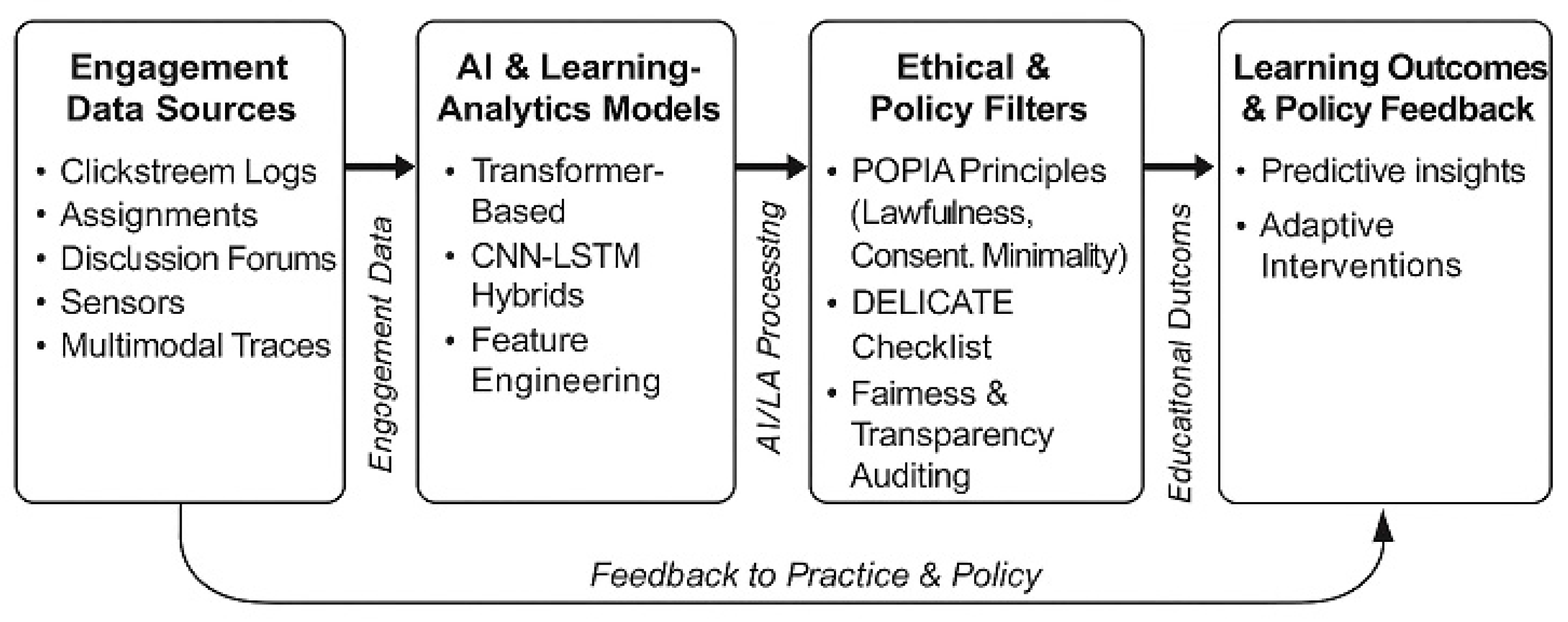
7]. Yet most empirical evidence originates from high-income regions; African implementations remain under-documented despite increasing policy readiness. This review addresses that gap by synthesising international progress and aligning it with South African realities. As illustrated in
Figure 1, the conceptual framework developed for this review integrates technological, pedagogical, and ethical dimensions, mapping how engagement data are transformed through AI analytics into actionable outcomes under responsible-governance constraints.
The framework encapsulates the synthesis of global methodological advances discussed above and sets the stage for the methodological approach adopted in this review.
2.2. Modelling Engagement and Predicting Performance/Retention
A consistent pattern across the corpus is that behavioural clickstreams, often augmented with assessment signals and temporal features, enable early warning models to anticipate course performance and attrition. Time-aware designs that update weekly typically outperform one-shot baselines [
13,
14,
15,
16]. Model families span tree ensembles (RF, XGBoost), margin-based methods (SVM), and sequence/deep models (RNNs/transformers) tailored to learning management system (LMS) chronologies [
13,
15,
17,
18]. Several studies caution that model portability may degrade across cohorts or courses, underscoring the need for local calibration and domain-shift checks [
8,
18,
19]. Beyond accuracy, recent syntheses emphasise feature interpretability (e.g., temporal engagement pace, assessment momentum) and the value of cumulative windows to stabilise predictions mid-semester. Collectively, these findings support incremental, interpretable pipelines that foreground timeliness and decision-usefulness for educators in resource-diverse contexts [
19,
20,
21,
22].
2.3. Surfacing Predictions: Dashboards and the Engagement-Outcomes Gap
Learning analytics dashboards (LADs) remain the predominant channel for surfacing indicators and risk flags. However, rigorous syntheses report no consistent achievement gains from dashboards alone and mixed/small effects on motivation/participation patterns largely attributed to selection effects, heterogeneous indicators, and the absence of closed-loop interventions [
23,
24,
25]. Studies that embed dashboards within orchestrated workflows: nudges, task redesign, advisor escalation, report more promising practice-proximal outcomes (e.g., timely submissions, reduced inactivity), although causal identification remains rare. The implication is that LADs should be treated as infrastructure for action, not endpoints: interfaces need actionable cues (what to do, for whom, when), uncertainty displays, and alignment with institutional support channels to translate engagement signals into improved outcomes [
20,
23,
26,
27].
2.4. Explainability, Integrity, and Governance
As models become more capable, explainability and governance shape whether analytics are trusted and used explainable artificial intelligence (XAI) methods (e.g., model-agnostic attributions) clarify why a learner is flagged and can direct attention to plausible levers (e.g., pacing, assessment preparation), but decision quality ultimately hinges on educator capacity and institutional policy frameworks for fairness, privacy, and accountability [
27,
28,
29]. Recent studies connect explanations to decision-usefulness by pairing salient drivers with suggested actions and uncertainty displays. Governance should codify consent, retention, access, and auditing; teacher-facing designs should avoid opaque flags, present interpretable features, and log actions for impact evaluation [
30,
31,
32].
2.5. South African Learning Analytics Initiatives and Student Success Strategies
Although the global evidence base for learning analytics (LA) is expanding rapidly, South African universities have developed their own ecosystem of analytics-driven student success interventions over the past decade. Early institutional studies highlighted the strategic potential of LA for improving throughput, retention, and decision-making in South African higher education [
33,
34]. At the University of South Africa (UNISA), large-scale ODeL datasets have been used to develop early warning systems, student risk profiling, and progression-monitoring dashboards that reveal patterns of vulnerability, agency, and attrition [
35,
36]. Contact universities have likewise adopted LA to inform teaching and advising. At the University of Pretoria, analytics-enabled advising, gateway-course redesign, and real-time course monitoring form part of an integrated institutional student success strategy developed across more than a decade [
37]. Similarly, differentiated-instruction models using learning analytics dashboards in blended contexts have been implemented to support adaptive teaching and timely interventions [
38]. Sector-wide capacity-building networks such as Siyaphumelela have further accelerated local adoption by supporting universities, including UJ, UCT, SU, Wits, CPUT, and MUT in developing analytics-supported student success programmes [
39].
Across these institutions, several recurring challenges shape the feasibility and effectiveness of LA implementations. First, data fragmentation across LMS, student information systems, and teaching platforms limits the development of unified risk-prediction pipelines. Second, uneven staff data literacy and limited institutional capacity constrain the integration of analytics into teaching practice. Third, multilingual cohorts, bandwidth constraints, and uneven digital access complicate the interpretation of engagement data. Fourth, ethical considerations remain prominent, especially in ODeL contexts where LA raises questions of student surveillance, consent, autonomy, and compliance with POPIA [
35]. These challenges demonstrate the importance of context-specific model calibration and the need for analytics systems that align with local resource realities.
Comparative evidence across institutions indicates substantial variation in analytics maturity and organisational readiness. While some universities have developed structured student success ecosystems informed by analytics (e.g., UP), others remain at early diagnostic stages or rely on fragmented reporting tools. ODeL institutions exhibit different risk signatures from contact universities, reinforcing the need for differentiated LA strategies rather than one-size-fits-all models. The presence of national networks such as Siyaphumelela shows an emerging national coherence, yet the published empirical evidence remains sparse and uneven across institutional types.
These patterns reveal several research gaps unique to the South African context. Despite widespread institutional interest in analytics, peer-reviewed evidence on model performance, longitudinal outcomes, fairness considerations, and implementation impact remains limited. Very few studies rigorously evaluate how LA-driven interventions influence retention, success, or equity at scale. Furthermore, limited African-based datasets and the dominance of Global North evidence hinder the development of culturally and contextually sensitive analytics models. Strengthening South Africa’s empirical base is therefore essential for adapting global AI-enabled learning analytics innovations to local pedagogical, infrastructural, and governance realities.
2.6. Synthesis and Positioning of This Review
Across settings, the evidence base is strongest for predicting performance/retention from engagement traces and weaker for changing outcomes at scale. Where outcomes do improve, the common thread is a prediction-to-action chain: (i) timely, interpretable signals; (ii) orchestrated responses integrated into teaching/advising; (iii) evaluation designs that quantify learning impact and equity effects [
13,
14,
15,
20,
23,
26]. Portability and fairness remain under-reported, with documented degradations across cohorts/institutions [
18,
19]. The present review, therefore, foregrounds how engagement signals are linked to validated outcome change, distils design principles for teacher-in-the-loop workflows and XAI-supported decisions, and derives context-aware guidance for South African universities where bandwidth, multilingualism, and resource constraints heighten the importance of low-overhead interventions and local calibration [
8,
27,
28,
29,
32,
40].
3. Methodology
Following the conceptual framing above, this section explains the methodological procedures that guided the PRISMA-informed narrative review [
41,
42].
This study employed a narrative review design guided by the Preferred Reporting Items for Systematic Reviews and Meta-Analyses (PRISMA 2020) framework to ensure transparency, reproducibility, and methodological rigour. While narrative in nature, the review applied systematic techniques of literature identification, screening, and synthesis to generate a structured yet interpretive overview of global and South African perspectives on AI-driven learning analytics (LA). The approach drew upon best practices for educational technology reviews [
1,
2] and aligned with PRISMA for Scoping Reviews (PRISMA-ScR) and Society for Learning Analytics Research (SoLAR) standards for review quality.
3.1. Search Strategy and Data Sources
A comprehensive search was conducted between September and October 2025 across Scopus, Web of Science, IEEE Xplore, ERIC, SpringerLink, ScienceDirect, and the UNISA institutional repository, complemented by grey literature and UNESCO policy briefs (2022–2025). Boolean search strings included:
(“artificial intelligence” OR “AI”) AND (“learning analytics” OR “educational data mining”) AND (“student engagement” OR “academic performance”) AND (“higher education”) AND (“South Africa” OR “Africa”).
The initial search retrieved 1184 records. Reference management and deduplication were performed in Zotero 6.0, followed by manual verification. Search documentation adhered to PRISMA principles of transparent identification and retrieval.
3.2. Screening and Eligibility Criteria
Eligibility parameters required studies to:
- (a)
Examine AI or machine learning in learning analytics or engagement–performance prediction;
- (b)
Focus on higher education;
- (c)
Be peer-reviewed, published between 2015 and 2025;
- (d)
Written in English.
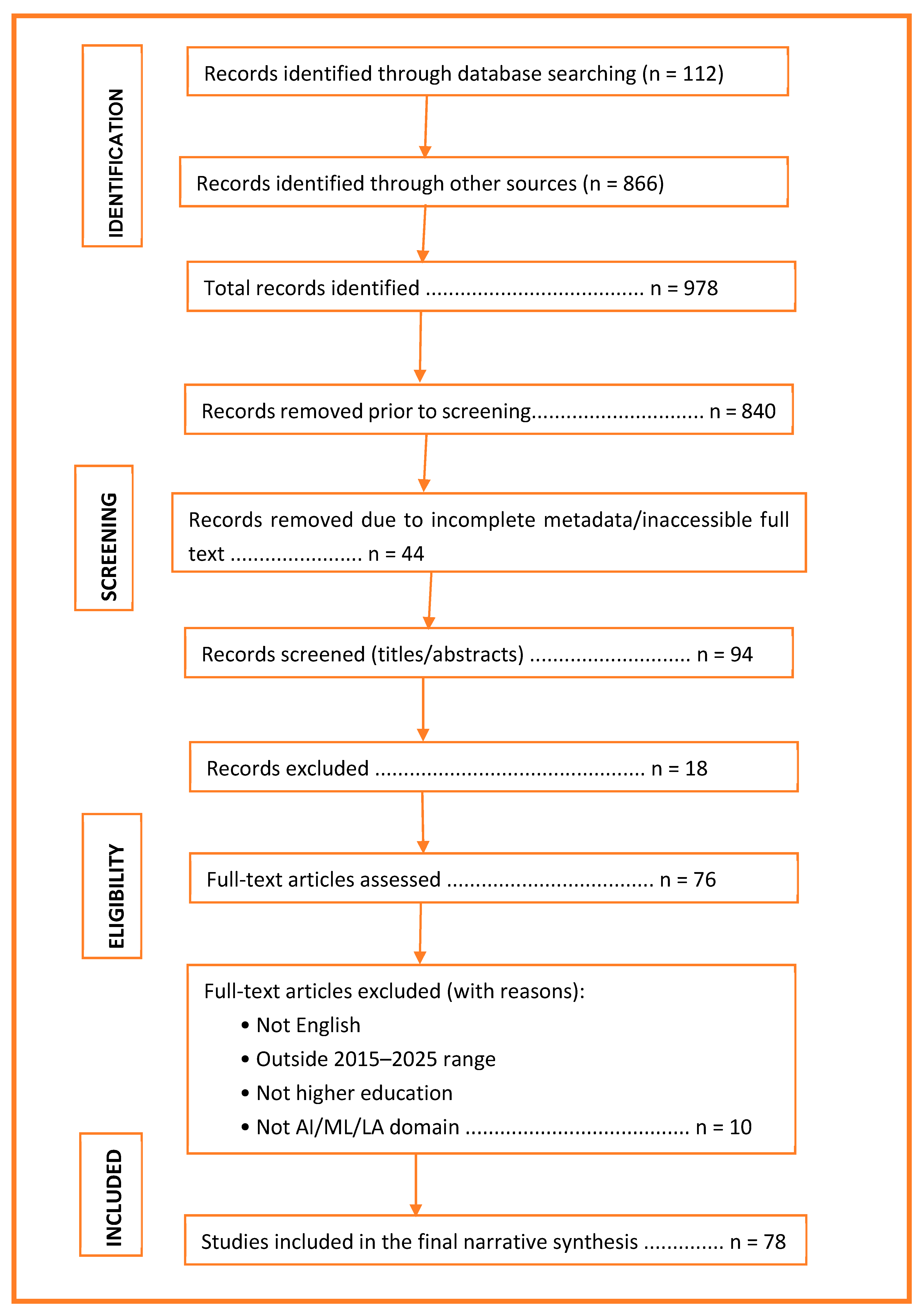
Studies limited to K–12 education, descriptive dashboards, or non-AI analytics were excluded. Two reviewers independently screened all titles and abstracts using a structured Microsoft Excel screening matrix integrated with Zotero references. Inter-rater reliability (κ = 0.82) indicated high agreement; discrepancies were resolved through consensus meetings. Title and abstract screening applied inclusive criteria to capture the breadth of AI-driven learning analytics research; as such, while a limited number of exclusions occurred at the title and abstract screening stage, the majority of exclusions were applied during full-text review and quality appraisal, reflecting the intentionally inclusive initial screening strategy. Screening disagreements were resolved through discussion in structured consensus meetings following independent review.
Following automated and manual deduplication, an additional 44 records were removed prior to title and abstract screening due to incomplete metadata, inaccessible full texts, or non-scholarly document types (e.g., editorials, announcements). These records were excluded before formal screening and are now explicitly accounted for in the updated PRISMA flow diagram. In addition to database searches, 866 records were identified through other sources, including policy documents, institutional reports, as well as backward and forward citation tracing. These records were initially reviewed for relevance, after which 840 were excluded for not meeting the empirical and methodological inclusion criteria. The remaining records were integrated into the full-text eligibility assessment and synthesis process, as reflected in the updated PRISMA flow diagram.
These other sources spanned the same review period (2015–2025) and included policy documents, institutional reports, UNESCO and OECD briefs, as well as backward and forward citation tracing. An initial relevance assessment was applied to exclude items that were non-scholarly, duplicative, or outside the scope of AI-driven learning analytics in higher education.
Table 2 presents the inclusion and exclusion criteria while
Table 3 gives the descriptive characteristics of the studies.
3.3. Data Extraction and Synthesis
Data extraction followed a structured coding template capturing bibliographic metadata, research design, analytic model, contextual focus, and ethical considerations. Data were synthesised thematically using NVivo 14, guided by four dimensions:
- (1)
model development and predictive analytics,
- (2)
multimodal data integration,
- (3)
ethics and governance frameworks, and
- (4)
regional applications (with focus on Africa and South Africa).
The PRISMA four-phase flow identification, screening, eligibility, and inclusion were tracked and recorded to ensure procedural transparency (
Figure 2).
3.4. Quality Appraisal and Reflexivity
To evaluate methodological robustness, a modified Mixed Methods Appraisal Tool (MMAT, 2018) was applied [
42]. Evaluation criteria included clarity of objectives, methodological transparency, ethical disclosure, and data reproducibility. Studies scoring below 50% were excluded from the main synthesis but referenced contextually. Reflexivity was maintained through iterative peer debriefing and co-author dialogue to enhance confirmability and reduce interpretive bias. This aligns with standards of transparency and accountability in narrative synthesis [
2,
7].
Of the 78 studies included in the synthesis, quality appraisal using MMAT classified 29 as high quality, 34 as moderate quality, and 15 as lower quality. Studies scoring below 50% were excluded prior to synthesis. A full list of included studies with MMAT ratings is provided in
Supplementary File S1.
A complete list of the 78 studies included in the synthesis, together with MMAT quality ratings, is provided in
Supplementary File S1. Not all included studies are individually cited in the main manuscript, consistent with narrative review norms; however, all studies contributed to the thematic and analytical synthesis.
3.5. Descriptive Characteristics and Biases of the Reviewed Corpus (2015–2025)
Although this study is not a systematic review, presenting the descriptive characteristics of the corpus aligns with best practices for transparent narrative synthesis. The distribution of study types shows the dominant role of quantitative AI-based predictive modelling (58%), with comparatively few multimodal deep-learning studies (14%) emerging toward the end of the decade under review.
Regionally, the corpus is heavily skewed toward the Global North, with North America and Europe collectively accounting for 72% of all studies. Only six studies originated from Africa, including three from South Africa, highlighting a substantial evidence gap that reduces the external validity of global AI-driven learning analytics models when applied to African higher education.
The methodological spread illustrates the persistence of classical machine-learning techniques, although deep-learning architectures are increasingly represented in post-2020 publications. The biases summarised in the table, including Global North dominance, English-language bias, and infrastructural assumptions, underscore the need for contextual calibration of analytics models and greater empirical work in South African and African settings.
3.6. Methodological Rigour and Limitations
Although narrative reviews allow conceptual depth and interpretive flexibility, they limit quantitative generalisation. Nonetheless, this review’s PRISMA-informed process, anchored by dual screening, explicit eligibility criteria, and systematic synthesis, ensured both breadth and analytical precision. The methodology thus establishes a replicable foundation for future empirical investigations into AI-enhanced learning analytics within South African higher education.
3.7. Research Ethics Statement
This study did not involve human participants or primary data collection; therefore, formal ethical clearance was not required. Nevertheless, all secondary data sources were used responsibly in accordance with institutional research policies and the Protection of Personal Information Act (POPIA, 2013). The review process adhered to standards of integrity, transparency, and respect for intellectual property.
4. Research Gaps and Novelty
4.1. Research Gaps
In this review, the term “decade-focused” refers to literature published between 2015 and 2025. Across the 2015–2025 corpus, several recurring gaps emerge. First, engagement is overwhelmingly operationalised through behavioural clickstreams, with comparatively sparse coverage of cognitive, emotional, and social dimensions. This measurement’s narrowness constrains construct validity and limits the specificity of interventions that can be derived from predictions [
20,
25]. Second, while incremental, time-aware modelling reliably improves predictive accuracy within a course, portability across cohorts, modules, and institutions is rarely stress-tested, raising concerns about domain shift and equity when models are reused without local calibration [
13,
15]. Third, the last-mile problem remains under-designed: accurate models often fail to change outcomes because signals are not embedded in teacher workflows (who acts, when, with what information) or evaluated with designs capable of supporting causal claims [
20,
26]. Relatedly, evidence from learning analytics dashboards indicates inconsistent impact on achievement when indicators are presented without pedagogical scaffolds or targeted interventions [
23]. Fourth, although explainable AI is gaining traction, explanations frequently remain detached from decision-usefulness; without educator data-literacy and interface affordances, transparency may not translate into better actions [
27,
28].
Finally, governance and readiness constraints, privacy, consent, fairness, academic integrity, and institutional capacity are unevenly addressed in deployments, particularly in resource-diverse settings. For South Africa, bandwidth/device constraints and multilingual cohorts shape both the reliability of engagement signals and the feasibility of interventions, underscoring the need for context-aware feature design and capacity building [
29,
40].
4.2. Novelty and Contribution
This review contributes along four axes. (i) Bridge-centric synthesis: We integrate evidence across modelling, dashboards, and orchestration to foreground the mechanisms that connect engagement signals to validate outcome change [
20,
23,
26]. (ii) Design principles for prediction-to-action: We consolidate practitioner-facing patterns, timing, responsibility, required information, uncertainty display, and emphasise auditable, explainable signals aligned with instructional decision points [
11]. (iii) Outcome- and equity-oriented evaluation guidance: We outline quasi-experimental, A/B, and stepped-wedge templates that move beyond accuracy to measure causal impact, alongside fairness and portability checks [
23,
29]. (iv) Context-aware implications for South Africa: We distil low-overhead interventions and AI-literacy strategies suitable for bandwidth/device-limited environments, aligning implementation with local constraints and institutional goals [
40].
Together, these contributions reposition AI-enhanced LA from a primarily predictive enterprise to a responsible, intervention-oriented, and context-aware practice more likely to deliver measurable improvements in student success. Building upon these conceptual and theoretical foundations, the next section details the PRISMA-guided narrative-review methodology adopted to ensure transparency, reproducibility, and analytical rigour. This approach integrates systematic search, screening, and synthesis procedures to provide a structured yet interpretive overview of AI-driven learning analytics research with contextual relevance to South Africa [
32,
40].
It is important to note that only three peer-reviewed empirical studies conducted within South African higher education were identified through the PRISMA-guided selection process. Consequently, some South Africa-specific recommendations presented in subsequent sections should be interpreted as evidence-informed and context-sensitive guidance rather than empirically validated prescriptions. Where recommendations are directly supported by local empirical evidence, this is stated explicitly; otherwise, they are cautiously extrapolated from the broader international literature and aligned with South Africa’s regulatory and institutional context.
5. Discussion
Across the corpus, predictive accuracy for achievement/retention from engagement traces is robust, especially with incremental (weekly) designs. Yet improvements are algorithmic rather than pedagogical when predictions are not tied to instructor workflows. Few studies explicitly examine the feedback loop, how signals are interpreted and acted upon, and even fewer evaluate causal impact on outcomes. Explainability is growing, but decision-usefulness ultimately hinges on educator capacity and institutional policy.
Although this review adopts a narrative design, synthesis was conducted systematically across the full corpus of 78 studies by grouping evidence according to (i) engagement operationalisation, (ii) outcome variables, (iii) methodological approach, and (iv) institutional context. Rather than privileging a small number of canonical sources, findings were compared across thematic clusters, with attention to convergence, divergence, and evidentiary strength. This approach enables cross-study interpretation while remaining sensitive to contextual variation and evidence quality.
Quality appraisal using the MMAT indicates variation in methodological rigour across the corpus. Quantitative predictive studies generally demonstrate strong internal validity but often provide limited transparency regarding feature selection and model interpretability. Qualitative and conceptual studies exhibit stronger reflexivity and contextual sensitivity but vary in empirical grounding. Importantly, patterns observed in higher-quality studies do not contradict those reported in lower-quality contributions; rather, they refine them by emphasising explainability, contextual constraints, and ethical governance. These patterns support the robustness of the synthesised findings while highlighting areas where further empirical strengthening is required (Note: detailed MMAT scoring is documented in
Supplementary File S1.).
The following sub-sections deepen this discussion by situating the synthesised findings within global, ethical, and policy frameworks, providing comparative and future-oriented insights.
5.1. The Future Trajectory of AI-Driven Learning Analytics in Higher Education
The immediate future of AI-driven learning analytics (LA) in higher education will be shaped by accelerating advances in multimodal data processing, explainable AI, and adaptive learning technologies. In the next three to five years, institutions are expected to transition from single-source analytics (e.g., LMS clickstreams) toward multimodal LA ecosystems that integrate behavioural, linguistic, physiological, and contextual student data. Large language models (LLMs) will increasingly augment existing analytics systems by generating qualitative insights, interpreting student discourse, and supporting automated feedback at scale.
Equally significant is the likely shift toward locally calibrated models that can operate effectively in bandwidth-restricted, multilingual, and resource-diverse environments typical of Global South institutions. This shift will be driven by concerns around algorithmic opacity, fairness, trust, and POPIA-compliant governance. As a result, explainability will become a core design requirement, not a peripheral technical feature, particularly in regions where ethical risk, surveillance concerns, and socio-technical inequalities are pronounced.
Finally, as AI becomes more deeply embedded in teaching, assessment, and student support workflows, the near future will require stronger institutional capacity in data literacy, model interpretation, and responsible decision-making. The evolution of LA will therefore be marked by a parallel growth in human-centred AI governance, ensuring that predictive systems enhance student success without reinforcing structural inequalities.
5.2. Mapping Engagement Indicators to Educational Outcomes
Across the reviewed corpus (n = 78), student engagement is most frequently operationalised using behavioural indicators, including LMS logins, page views, time-on-task, assignment submission regularity, and discussion-forum participation. Evidence grouped across multiple quantitative studies suggests that such behavioural signals demonstrate strong and consistent predictive validity for short-term academic outcomes, particularly course grades and early assessment performance, especially in large, structured undergraduate courses with stable participation patterns [
6,
11].
In contrast, the relationship between behavioural engagement and longer-term outcomes, such as retention, progression, and degree completion, is more variable. Several studies report moderate predictive strength when behavioural indicators are combined with prior academic performance or demographic variables, whereas purely click-stream-based models tend to produce reduced accuracy for distal outcomes. This pattern indicates that behavioural engagement alone may be insufficient for capturing the complex processes underlying persistence and completion, particularly across heterogeneous institutional contexts [
9].
Cognitive and metacognitive indicators, including self-regulation proxies, reflective writing features, help-seeking behaviour, and learning strategy signals, appear less frequently in the literature but show stronger conceptual alignment with persistence-related outcomes. Evidence relating to affective engagement is comparatively sparse and inconsistent. While sentiment analysis and discourse-based methods are increasingly applied to capture emotional aspects of engagement, reported associations with academic outcomes vary widely. These inconsistencies reflect both data-quality challenges and unresolved construct validity concerns, particularly where affective signals are inferred from text alone. Multimodal approaches that integrate behavioural, cognitive, and linguistic indicators show promise for early risk detection, but their effectiveness appears highly contingent on institutional context, data completeness, and model interpretability [
2].
Overall, the synthesised evidence indicates that behavioural engagement indicators are most reliable for short-term performance prediction, whereas cognitive and multimodal indicators hold greater potential for modelling persistence and completion, albeit with weaker empirical support to date. These patterns underscore the importance of aligning engagement operationalisation with specific outcome targets and institutional conditions, rather than assuming a uniform engagement–outcome relationship across contexts.
While student engagement is widely recognised as a multidimensional construct encompassing behavioural, cognitive, and emotional components, the reviewed literature largely operationalises engagement through observable behavioural proxies. This reliance introduces construct validity limitations, particularly in Global South contexts. For example, sentiment analysis models trained on Western English corpora may misinterpret code-switching, idiomatic expressions, or culturally specific discourse common in South African learning environments, leading to distorted representations of emotional engagement. Furthermore, “dark engagement” practices, offline study, peer collaboration outside institutional platforms, and intermittent access due to connectivity constraints remain largely invisible to analytics systems. These limitations underscore the need for cautious interpretation of AI-generated engagement metrics and reinforce the importance of contextual calibration and human sense-making.
5.3. South Africa in the African and Global South Learning Analytics Landscape
Although South Africa has made notable progress in institutionalising learning analytics (LA), its developments must be understood within a broader African and Global South context. Across Sub-Saharan Africa, universities increasingly recognise the value of analytics for student success monitoring, early warning systems, and data-driven resource planning, yet adoption remains uneven. Countries such as Kenya, Rwanda, and Nigeria have piloted early alert systems, digital learner-profiling models, and predictive-risk dashboards, but most initiatives remain small-scale and are not grounded in comprehensive ethical or data-governance frameworks [
43]. The African Union’s Digi-tal Transformation Strategy (2020) identifies learning analytics and AI as continental priorities but highlights persistent infrastructural, bandwidth, and legislative gaps that hinder wide-scale deployment [
44].
In this regional landscape, South Africa occupies a comparatively advanced position. The presence of a national data protection law (POPIA), a coordinated student success movement through the Siyaphumelela network, and established institutional analytics programmes at universities such as UNISA, Pretoria, UJ, CPUT, and UCT provide a stronger foundation for scaling responsible LA compared to many African counterparts [
39]. However, South Africa shares several challenges with the broader region, including data fragmentation, limited analytics capacity among staff, infrastructural inequality between institutions, and the scarcity of local empirical datasets on student engagement and AI-driven prediction. These contextual similarities emphasise the need for models that are not only technically robust but also sensitive to African pedagogical contexts, multilingual diversity, and resource constraints [
45].
Despite emerging initiatives across the continent, the African LA evidence base remains disproportionately small when compared to the Global North, with relatively few peer-reviewed studies evaluating model performance, fairness, or the instructional impact of analytics. This evidentiary gap reinforces the significance of the present decade-focused narrative review: by synthesising global methodological advances and grounding them in South Africa’s evolving practice landscape, the review offers insights that may be transferable to other African settings facing similar infrastructural and governance constraints. Consequently, broadening the interpretive lens to the African region enhances the manuscript’s contribution by positioning South Africa not in isolation, but as part of a shared continental effort to harness AI and analytics for equitable student success.
Only three peer-reviewed empirical learning analytics studies conducted within South African higher education were identified, and this limited volume of local evidence constitutes a significant finding, highlighting both capacity gaps and future research priorities.
5.4. Ethical Governance and Policy Alignment in AI-Driven Learning Analytics
The findings reaffirm that ethical governance and data-protection readiness are foundational prerequisites for the sustainable deployment of AI-driven learning analytics (LA) in higher education. In the South African context, the Protection of Personal Information Act (POPIA, 2013) provides a robust legislative framework comparable to the European General Data Protection Regulation (GDPR). However, despite this strong legal foundation, institutional compliance and operationalisation remain uneven, constrained by limited awareness, the absence of dedicated AI or data-ethics governance structures, and capacity limitations among educators and administrators. These gaps highlight that legal compliance alone is insufficient without institutional mechanisms that translate regulatory principles into everyday analytical practice.
Achieving trust in educational AI systems requires explicit accountability mechanisms, transparent data-governance protocols, and ongoing ethical oversight, rather than post-hoc compliance [
2]. Frameworks such as DELICATE [
46] offer practical guidance for operationalising ethical learning analytics by foregrounding learner consent, data minimality, privacy protection, and human oversight throughout the analytics lifecycle. Embedding such frameworks within POPIA-aligned institutional policies can help ensure that AI-enhanced LA systems remain transparent, auditable, and respectful of student autonomy, while reducing risks associated with surveillance, bias, and misuse [
11,
32].
At the global level, ethical AI deployment in higher education is increasingly shaped by policy frameworks that emphasise human-centred design and societal responsibility. The UNESCO (2023) Guidance on Generative AI in Education [
47] underscores principles of human agency, inclusivity, transparency, and sustainability, while the OECD AI Principles (2021) [
48] advocate accountable, values-based AI systems that promote fairness and social well-being. For South African universities, these global standards can be operationalised through POPIA’s accountability, purpose-limitation, and data-minimality provisions, creating a coherent governance architecture that bridges international norms and local regulatory requirements.
A harmonised governance approach integrating UNESCO and OECD ethical principles with national legislation and institution-specific data-ethics structures provides a practical pathway for developing institutional AI-ethics blueprints. Such alignment ensures that innovation in AI-enhanced learning analytics advances pedagogical and student success objectives while remaining consistent with societal values, protecting learners’ rights, and fostering sustained public trust in educational AI systems [
4].
5.5. Global Parallels and Transferability
Building on these governance imperatives, comparative international initiatives further illustrate how ethical AI frameworks are operationalised across diverse higher-education systems. Comparative insights from other world regions provide valuable lessons for South Africa. In Asia, projects like China’s Smart Education Initiative and Singapore’s SkillsFuture Analytics Framework integrate predictive analytics within centralised policy structures, demonstrating how national coordination can accelerate data-driven quality assurance [
47]. European institutions, operating under the OECD AI Principles [
48] and EU Ethics Guidelines for Trustworthy AI, emphasise model interpretability and fairness by deploying explainability dashboards and federated-learning techniques that protect personal data. In Latin America, the MetaRed LA network promotes open-source analytics and equitable access for bandwidth-constrained universities, a context closely aligned with South African infrastructural realities. These parallels highlight that while algorithmic frameworks may be transferable, their success depends on alignment with local governance, linguistic diversity, and institutional capacities.
5.6. Advancing SDG 4: Inclusive and Equitable Quality Education
This review contributes to advancing Sustainable Development Goal 4 (SDG 4), which seeks to ensure inclusive and equitable quality education and promote lifelong learning opportunities for all [
49]. AI-driven learning analytics, when ethically designed, provide data-informed interventions to reduce dropout rates, personalise learning, and identify structural inequities early. By aligning LA practices with SDG 4 targets, specifically those relating to quality, equity, and lifelong learning, South African higher education institutions can transform analytics into tools for inclusion rather than exclusion. This necessitates cross-sector collaboration, ethical foresight, and sustainable infrastructure investment to translate predictive insights into tangible learning outcomes.
5.7. Challenges and Future Research
Despite significant advances in AI-driven learning analytics (LA), several persistent challenges continue to impede widespread, contextually relevant implementation. Data fragmentation across institutional systems undermines interoperability and constrains the development of robust, real-time predictive models. The opacity of algorithmic processes further erodes educators’ confidence, limiting their ability to interpret analytical outputs and act on them pedagogically. Ethical and policy inconsistencies persist while South Africa’s Protection of Personal Information Act (POPIA) provides a strong legislative foundation; its institutional-level enforcement remains uneven. In addition, capacity limitations, manifesting in insufficient AI literacy among educators and weak digital infrastructure, restrict scalability. Compounding these obstacles, most existing models, developed in high-income contexts, fail to capture the socio-educational realities of African learning environments [
32,
40]. These structural and contextual barriers are summarised in
Table 4, while
Table 5 translates them into forward-looking research imperatives aligned with [
47,
48] ethical-AI frameworks.
While these challenges highlight structural and contextual constraints in current AI-driven learning analytics practice, their policy, practical, and research implications are addressed separately in the subsequent sections on Implications, Recommendations, and Future Research Directions.
6. Implications for Policy, Practice, and Governance
The findings of this decade-focused review highlight several critical implications for institutional leaders, policymakers, and practitioners seeking to adopt AI-enhanced learning analytics in South African higher education. First, the transition toward deep learning and multimodal analytics requires universities to invest in robust data infrastructures, including interoperable data systems that allow the integration of LMS, SIS, and learning environment data. Without such integration, predictive modelling remains fragmented and limited in its ability to generate actionable insights.
Second, the dominance of Global North datasets and models underscores the need for contextual calibration of AI systems. South African institutions cannot assume that predictive models developed elsewhere generalise to local pedagogical, cultural, or infra-structural contexts. Instead, institutions should prioritise local data pipelines, local validation studies, and iterative model testing to minimise misclassification risk and avoid algorithmic harm.
Additionally, the ethical landscape of AI adoption, particularly around POPIA compliance, algorithmic opacity, and student autonomy, necessitates a shift toward transparent, accountable, and student-centred governance frameworks. Institutions must articulate clear policies covering data consent, risk signal interpretation, model explainability, and human oversight in decision-making. These governance imperatives align with global calls for responsible AI in education [
47,
48].
Finally, capacity development remains essential. Educators, advisors, and institutional researchers require training in data literacy, AI interpretation, and actionability to ensure that analytics outputs meaningfully enhance teaching and student support. Without such development, even sophisticated AI tools may remain underutilised or misinterpreted.
7. Evidence-Informed and Context-Sensitive Recommendations for Advancing AI-Enhanced Learning Analytics in South Africa
Drawing on the decade-focused narrative synthesis, the following recommendations are proposed to support responsible, effective, and context-aware adoption of AI-enhanced learning analytics in South African higher education:
- (1)
South African universities should prioritise AI-driven learning analytics systems that are locally calibrated, explainable, and pedagogically meaningful. Models developed in high-income contexts should not be adopted uncritically; instead, predictive systems must be validated against local student demographics, multilingual learning environments, and infrastructural realities. Explainable AI (XAI) should be embedded as a standard requirement to ensure transparency, educator trust, and responsible intervention.
- (2)
Institutions should embed AI-enhanced learning analytics within robust governance structures aligned with POPIA, ensuring transparency in data use, informed consent, and human oversight of algorithmic decisions. Clear policies must define accountability for interpreting risk signals, deploying interventions, and safeguarding student autonomy. Ethical governance should therefore be operational, not symbolic, guiding everyday analytical practice.
- (3)
Sustainable adoption of AI-enhanced learning analytics requires capacity development and collaboration. Universities should invest in staff data literacy, AI interpretation skills, and analytics-informed pedagogical practice. At a sectoral level, cross-institutional collaboration through shared datasets, national initiatives (e.g., Siyaphumelela), and joint research platforms should be strengthened to reduce duplication, improve model robustness, and accelerate evidence-based innovation.
8. Future Research Directions
Despite growing interest in AI-driven learning analytics, several research gaps remain, particularly within South African and broader African higher education contexts. Future studies should prioritise the development and validation of context-sensitive AI models using local datasets that reflect linguistic diversity, infrastructural variability, and different modes of provision (contact, blended, and ODeL).
There is also a need for longitudinal and mixed-methods research examining the educational impact of analytics-informed interventions, beyond short-term predictive accuracy, including effects on retention, equity, and student experience. Further empirical work is required on ethical governance and human–AI interaction, especially how explainability, trust, and POPIA-aligned decision-making are enacted in practice. Finally, research into lightweight and resource-efficient AI approaches and cross-institutional collaborations could support more equitable and scalable adoption of learning analytics across South African higher education.
9. Conclusions
This decade-focused narrative review examined the evolution of AI-driven learning analytics in higher education, with particular attention to developments relevant to South Africa. Drawing on literature published between 2015 and 2025, the review highlighted a clear methodological shift from descriptive and rule-based analytics toward predictive, deep-learning, and increasingly multimodal approaches. At the same time, it revealed persistent challenges related to algorithmic opacity, ethical governance, infrastructural inequality, and the transferability of models developed predominantly in Global North contexts.
By situating global methodological advances within the South African and broader African higher-education landscape, the study contributes a context-aware synthesis that foregrounds both the opportunities and constraints associated with AI-enhanced learning analytics in resource-diverse environments. The analysis underscores that technological sophistication alone is insufficient: meaningful impact depends on context-sensitive model calibration, explainable and accountable AI practices, and institutional capacity to interpret and act on analytics insights responsibly.
The implications and recommendations articulated in this review emphasise the need for integrated governance frameworks, human-centred AI design, and cross-institutional collaboration to support equitable and sustainable adoption. Finally, the identified directions for future research point toward the importance of locally grounded empirical studies, longitudinal evaluations of analytics-informed interventions, and continued examination of ethical and human–AI interaction issues. Together, these contributions position AI-driven learning analytics not merely as a technical innovation, but as a socio-technical system whose value in higher education depends on thoughtful alignment with pedagogical, ethical, and contextual realities.