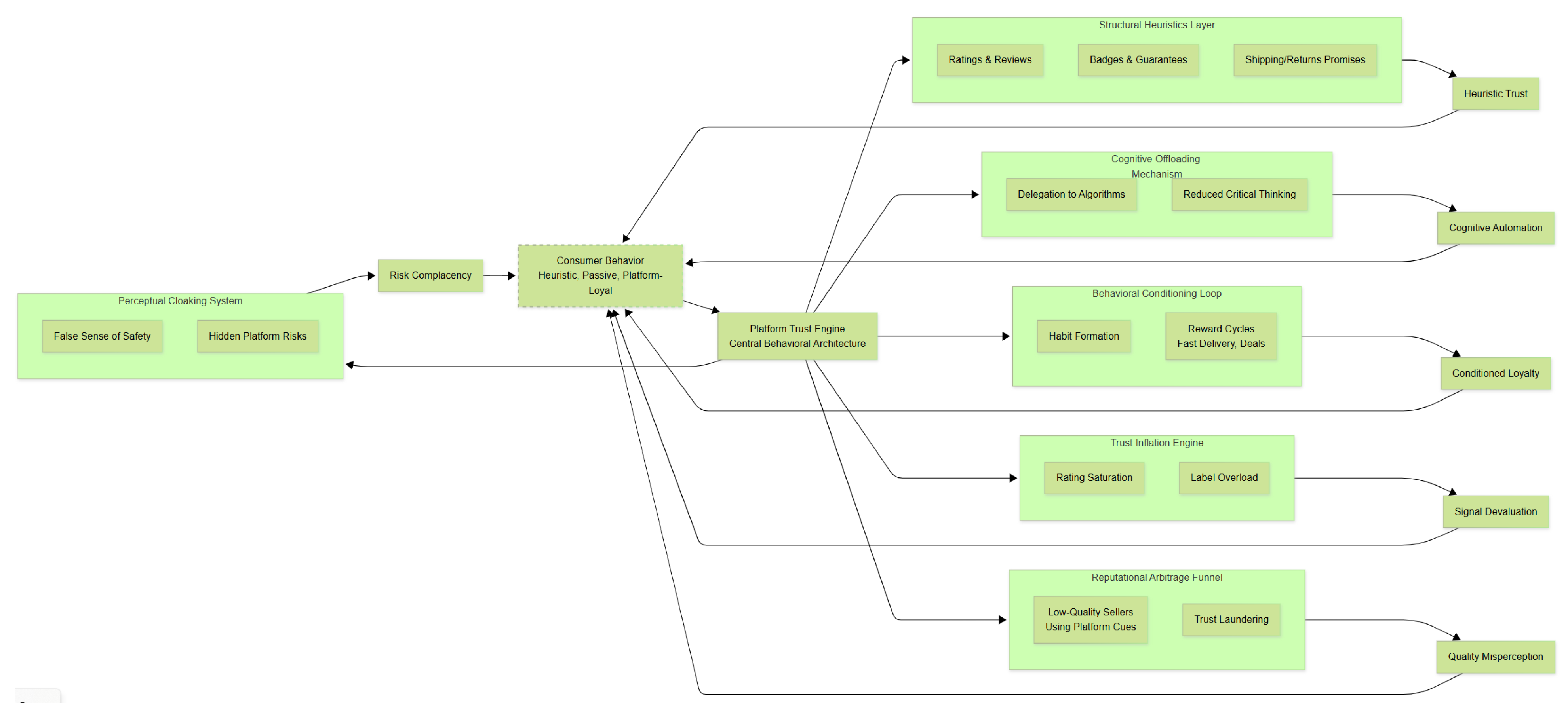

Trust as Behavioral Architecture: How E-Commerce Platforms Shape Consumer Judgment and Agency



Abstract
1. Introduction
1.1. Key Constructs and Definitions
1.2. Aims and Objectives
- Analyze how platform-mediated trust mechanisms displace critical evaluation and promote heuristic consumer behavior.
- Identify the key structural, cognitive, and psychological components that constitute the behavioral architecture of trust.
- Highlight the implications of trust inflation, reputational arbitrage, and algorithmic conditioning in shaping consumer decision-making.
- Develop and articulate the Trust Architecture Framework (TAF) as a novel model that explains how trust functions as a system of soft control in digital marketplaces.
- Propose a set of empirically testable hypotheses derived from the framework to guide future research in platform studies, consumer behavior, and digital governance.
2. Background
3. Method
Search Strategy and Selection Criteria
- Empirical studies examining trust mechanisms in digital commerce;
- Research addressing consumer decision-making on platforms;
- Studies investigating platform design features and behavioral outcomes;
- Publications with clear methodology and sufficient quality indicators.
- Non-English publications;
- Studies focused solely on B2B contexts;
- Research without an empirical component or clear theoretical framework;
- Publications lacking peer review or unverifiable conference proceedings.
4. Thematic Synthesis
4.1. Algorithmic Dependency and Consumer Learning
4.2. How Platforms Exploit Consumer Vulnerabilities
4.3. Psychological Mechanisms Behind Platform Trust
4.4. Platform Trust and Critical Evaluation
4.5. Cultural, Demographic, and Economic Antecedents of Platform Trust
4.6. Major Research Themes over Time
5. Discussion
Hypotheses
6. The Trust Architecture Framework (TAF): A Revised Model of Platform Trust
6.1. Moderating Factors and Boundary Conditions
6.2. Platform-Specific Mechanisms vs. General E-Commerce
7. Conclusions
Practical Implications and Recommendations
- Design trust signals that maintain diagnostic value: Rather than proliferating five-star ratings, implement multi-dimensional quality indicators that help consumers distinguish genuine excellence.
- Enhance transparency around seller vetting: Make quality control processes visible to rebuild the informational value of platform affiliation.
- Implement “friction by design” for high-stakes purchases: Strategic slowing of checkout processes for certain product categories could encourage more deliberative evaluation.
- Mandate algorithmic transparency: Require platforms to disclose how recommendation systems weight factors like profitability vs. consumer fit.
- Establish trust signal authenticity standards: Regulate against manipulated reviews and misleading badges.
- Protect consumer rights to platform-independent information: Ensure consumers can access third-party quality assessments.
- Recognize platform trust as heuristic, not guarantee: Maintain healthy skepticism even on trusted platforms.
- Seek diverse information sources: Consult platform-independent reviews and comparisons for important purchases.
- Monitor quality over time: Track whether product quality from trusted platforms maintains consistency.
Author Contributions
Funding
Institutional Review Board Statement
Informed Consent Statement
Data Availability Statement
Conflicts of Interest
References
- George, B.; Sevak, K.Y. Artificial intelligence in higher education: Opportunities and concerns. Res. Pract. Technol. Enhanc. Learn. 2026, 21, 1–22. [Google Scholar] [CrossRef]
- Tse, S.Y.; Wang, D.T.; Cheung, M.L.; Leung, W.K. Do digital platforms promote or hinder corporate brand prestige? Eur. J. Mark. 2023, 57, 987–1013. [Google Scholar] [CrossRef]
- Mu, J.; Zhang, J.Z. Seller marketing capability, brand reputation, and consumer journeys on e-commerce platforms. J. Acad. Mark. Sci. 2021, 49, 994–1020. [Google Scholar] [CrossRef]
- Sullivan, Y.; Kim, D. Assessing the effects of consumers’ product evaluations and trust on repurchase intention in e-commerce environments. Int. J. Inf. Manag. 2018, 39, 199–219. [Google Scholar] [CrossRef]
- Lăzăroiu, G.; Neguriță, O.; Grecu, I.; Grecu, G.; Mitran, P. Consumers’ Decision-Making Process on Social Commerce Platforms: Online Trust, Perceived Risk, and Purchase Intentions. Front. Psychol. 2020, 11, 890. [Google Scholar] [CrossRef]
- Xiao, Q.; Siponen, M.; Zhang, X.; Lu, F.; Chen, S.; Mao, M. Impacts of platform design on consumer commitment and online review intention: Does use context matter in dual-platform e-commerce? Internet Res. 2022, 32, 1496–1531. [Google Scholar] [CrossRef]
- Zheng, J.; Li, M.; Yuan, D.; Xie, S. Product ranking considering differences across online review platforms: A method based on intuitionistic fuzzy soft sets. J. Oper. Res. Soc. 2024, 76, 1252–1275. [Google Scholar] [CrossRef]
- Qin, C.; Zeng, X.; Liang, S.; Zhang, K. Do Live Streaming and Online Consumer Reviews Jointly Affect Purchase Intention? Sustainability 2023, 15, 6992. [Google Scholar] [CrossRef]
- He, H.; Zhang, S.; Zhu, L. Green Product Quality Supervision Strategy in Online Shopping with Consumer Evaluation and Complaint. Front. Environ. Sci. 2021, 9, 702151. [Google Scholar] [CrossRef]
- Vazquez, E. Effect of an e-retailer’s product category and social media platform selection on perceived quality of e-retail products. Electron. Mark. 2020, 31, 139–157. [Google Scholar] [CrossRef]
- Sulistyowati, T.; Husda, N. The trust factor: A comprehensive review of antecedents and their role in shaping online purchase intentions. J. Ekon. Dan Bisnis Airlangga 2023, 33, 229–244. [Google Scholar] [CrossRef]
- Aerts, G.; Smits, T.; Verlegh, P. The platform shapes the message: How website design affects abstraction and valence of online consumer reviews. Decis. Support Syst. 2017, 104, 104–112. [Google Scholar] [CrossRef]
- Zhao, Y.; Yang, S.; Narayan, V.; Zhao, Y. Modeling Consumer Learning from Online Product Reviews. Mark. Sci. 2012, 32, 153–169. [Google Scholar] [CrossRef]
- Wang, C.; Liu, T.; Zhu, Y.; Wang, H.; Wang, X.; Zhao, S. The influence of consumer perception on purchase intention: Evidence from cross-border E-commerce platforms. Heliyon 2023, 9, e21617. [Google Scholar] [CrossRef]
- Lian, J.; Lin, T. Effects of consumer characteristics on their acceptance of online shopping: Comparisons among different product types. Comput. Hum. Behav. 2008, 24, 48–65. [Google Scholar] [CrossRef]
- Maslowska, E.; Malthouse, E.; Bernritter, S. Too good to be true: The role of online reviews’ features in probability to buy. Int. J. Advert. 2017, 36, 142–163. [Google Scholar] [CrossRef]
- Lazaro, B.G.; Torres, P.J.F.; Espares, J.D.; Angela, U.J.; Gregorio, B.E.; Capucao, A.B. Trust and Online Transactions: An In-Depth Case Study of Consumer Perceptions and Behavior in E-Commerce. Int. J. Adv. Multidiscip. Res. Stud. 2024, 4, 416–420. [Google Scholar] [CrossRef]
- Lu, B.B.; Cheng, D.; Yang, J. An Investigation on Impact of Online Review Keywords on Consumers’ Product Consideration of Clothing. J. Theor. Appl. Electron. Commer. Res. 2023, 18, 187–205. [Google Scholar] [CrossRef]
- Zhu, T.; Nie, C.; Jiang, Z.; Hu, X. When do consumers buy during online promotions? A theoretical and empirical investigation. Decis. Support Syst. 2024, 182, 114233. [Google Scholar] [CrossRef]
- Katyal, P.; Sehgal, R. Unraveling the impact of online consumer reviews on consumer buying behavior. Int. J. Syst. Assur. Eng. Manag. 2024, 16, 330–345. [Google Scholar] [CrossRef]
- Tadelis, S. Reputation and feedback systems in online platform markets. Annu. Rev. Econ. 2016, 8, 321–340. [Google Scholar] [CrossRef]
- El-Amin, A.; George, B. Towards a model and strategy for transformational change. Econ. Manag. Sustain. 2020, 5, 28–38. [Google Scholar] [CrossRef]
- McKnight, D.; Choudhury, V.; Kacmar, C. The impact of initial consumer trust on intentions to transact with a web site: A trust building model. J. Strateg. Inf. Syst. 2002, 11, 297–323. [Google Scholar] [CrossRef]
- George, B.; Mattathil, A.P. Vulnerability: Validation, Appreciation, and Reciprocation in Business, Personal, and Health Contexts. Health Econ. Manag. Rev. 2025, 6, 56–70. [Google Scholar] [CrossRef]
- George, B.P.; Hegde, P.G. Employee attitude towards customers and customer care challenges in banks. Int. J. Bank Mark. 2004, 22, 390–406. [Google Scholar] [CrossRef]
- George, B. Decision Making in Organizations: Intuition, Information, and Religiosity. Econ. Sci. 2020, 6, 152–158. [Google Scholar] [CrossRef]
- Klaus, P.; Zaichkowsky, J. AI voice bots: A services marketing research agenda. J. Serv. Mark. 2020, 34, 389–398. [Google Scholar] [CrossRef]
- Jia, Y.; Liu, L.; Lowry, P.B. How do consumers make behavioural decisions on social commerce platforms? The interaction effect between behaviour visibility and social needs. Inf. Syst. J. 2024, 34, 1703–1736. [Google Scholar] [CrossRef]
- Teubner, T.; Adam, M.; Camacho, S.; Hassanein, K. What you see is what you g (u) e (s) t: How profile photos and profile information drive providers’ expectations of social reward in co-usage sharing. Inf. Syst. Manag. 2022, 39, 64–81. [Google Scholar] [CrossRef]
- Su, L.; Chen, H.; Huang, Y. The influence of tourists’ monetary and temporal sunk costs on destination trust and visit intention. Tour. Manag. Perspect. 2022, 42, 100968. [Google Scholar] [CrossRef]
- König, R.; Sumpf, P. User Loyalty Unbroken? Inflation of Trust in Digital Platforms. Glob. Perspect. 2021, 2, 25102. [Google Scholar] [CrossRef]
- Shimichev, A.S.; Rotanova, M.B. Digital Brand Reputation Management to Promote Goods on Internet Platforms. In Proceedings of the 2024 Communication Strategies in Digital Society Seminar (ComSDS), Saint Petersburg, Russia, 10 April 2024; pp. 113–117. [Google Scholar]
- Pennington, R.; Wilcox, A.; Grover, V. The Role of System Trust in Business-to-Consumer Transactions. J. Manag. Inf. Syst. 2003, 20, 197–226. [Google Scholar] [CrossRef]
- Sun, Y.; Li, Y. The Impact of Risk-Aware Consumer Trust on CB E-Commerce Platforms and Purchase Intention. J. Glob. Inf. Manag. 2021, 30, 1–13. [Google Scholar] [CrossRef]
- Soleimani, M. Buyers’ trust and mistrust in e-commerce platforms: A synthesizing literature review. Inf. Syst. E-Bus. Manag. 2021, 20, 57–78. [Google Scholar] [CrossRef]
- Cao, C.; Huang, S. How Can SMEs Boost Trust Through Third-Party Means? Tracing the Multi-Dimensional Institutional Basis of Online Trust. IEEE Access 2022, 10, 127149–127167. [Google Scholar] [CrossRef]
- Jones, K.; Leonard, L. Trust in consumer-to-consumer electronic commerce. Inf. Manag. 2008, 45, 88–95. [Google Scholar] [CrossRef]
- Singh, N. Data Security and Consumer Trust in Fintech Innovations using Technology Adoption Method. Int. J. Sci. Res. Eng. Manag. 2024, 8, 1–5. [Google Scholar] [CrossRef]
- Wang, J.; Shahzad, F.; Ahmad, Z.; Abdullah, M.; Hassan, N. Trust and Consumers’ Purchase Intention in a Social Commerce Platform: A Meta-Analytic Approach. SAGE Open 2022, 12, 22–33. [Google Scholar] [CrossRef]
- Zhao, L.; Xu, Y.; Xu, X. The effects of trust and platform innovation characteristics on consumer behaviors in social commerce: A social influence perspective. Electron. Commer. Res. Appl. 2023, 60, 101284. [Google Scholar] [CrossRef]
- Veltri, G.; Lupiáñez-Villanueva, F.; Folkvord, F.; Theben, A.; Gaskell, G. The impact of online platform transparency of information on consumers’ choices. Behav. Public Policy 2020, 7, 55–82. [Google Scholar] [CrossRef]
- Dong, Y.; Li, Y.; Cao, J.; Zhang, N.; Sha, K. Identification and evaluation of competitive products based on online user-generated content. Expert Syst. Appl. 2023, 225, 120168. [Google Scholar] [CrossRef]
- Ikhsan, R.; Fernando, Y.; Gui, A.; Fernando, E. The power of online reviews: Exploring information asymmetry and its impact on green product purchasing behavior. Int. J. Consum. Stud. 2024, 48, e13050. [Google Scholar] [CrossRef]
- Wang, R.B.; Zhang, Y.L.; Fang, S.S.; Gao, S.B.; Jiang, L.L. E-commerce Certification Platform Based on Anti-Counterfeit Sweep Fingerprint KEY. In Proceedings of the 2012 3rd International Conference on E-Business and E-Government-Volume 04, Washington, DC, USA, 11–13 May 2012; pp. 408–411. [Google Scholar]
- Shao, Q.; Lo, H.; Liou, J.; Tzeng, G. A data-driven model to construct the influential factors of online product satisfaction. Int. J. Inf. Technol. Decis. Mak. 2022, 24, 2465–2495. [Google Scholar] [CrossRef]
- Wu, P.; Sun, S.; Zhou, L.; Yao, Y.; Deveci, M. Platforms empower: Mining online reviews for supporting consumers decisions. J. Retail. Consum. Serv. 2025, 84, 104214. [Google Scholar] [CrossRef]
- Devedi, P.; Sujatha, R.; Pathak, R. A study on parameters of online reviews content that influence consumers buying behaviour-an Indian perspective. J. Bus. Retail. Manag. Res. 2017, 11, 38–46. [Google Scholar] [CrossRef]
- Petcharat, T.; Leelasantitham, A. A retentive consumer behavior assessment model of the online purchase decision-making process. Heliyon 2021, 7, e08169. [Google Scholar] [CrossRef]
- Chen, Y.; Fay, S.; Wang, Q. The Role of Marketing in Social Media: How Online Consumer Reviews Evolve. J. Interact. Mark. 2011, 25, 85–94. [Google Scholar] [CrossRef]
- Sunjaya, A.; Wijaya, N.; Wong, N.; Winardi, S. Implementation of Sentiment Analysis of Shopee E-Commerce Reviews using Naïve Bayes, N-Gram, and Information Gain. In Proceedings of the 2023 Eighth International Conference on Informatics and Computing (ICIC), Manado, Indonesia, 8–9 December 2023; pp. 1–6. [Google Scholar] [CrossRef]
- Pang, X.; Pang, Y. Evaluation Model and Influencing Factors of Consumer Satisfaction with E-Commerce Platform. Ingénierie Des Systèmes D Inf. 2022, 27, 983–990. [Google Scholar] [CrossRef]
- Lin, J.; Li, T.; Guo, J. Factors influencing consumers’ continuous purchase intention on fresh food e-commerce platforms: An organic foods-centric empirical investigation. Electron. Commer. Res. Appl. 2021, 50, 101103. [Google Scholar] [CrossRef]
- Xu, M.; Reczek, R.; Petty, R. Need to evaluate as a predictor of creating and seeking online word of mouth. Mark. Lett. 2023, 34, 697–712. [Google Scholar] [CrossRef]
- Zhang, H.; Zhao, L.; Gupta, S. The role of online product recommendations on customer decision making and loyalty in social shopping communities. Int. J. Inf. Manag. 2018, 38, 150–166. [Google Scholar] [CrossRef]
- Chen, Y. Analysis on the Impact of Recommender Systems on Consumer Decision: Making on China’s Online Shopping Platforms. In Proceedings of the 6th International Conference on E-Commerce, E-Business and E-Government, Plymouth, UK, 27–29 April 2022. [Google Scholar] [CrossRef]
- Schaetz, N.; Gagrčin, E.; Toth, R.; Emmer, M. Algorithm dependency in platformized news use. New Media Soc. 2023, 27, 1360–1377. [Google Scholar] [CrossRef]
- Mourali, M.; Novakowski, D.; Pogacar, R.; Brigden, N. Post hoc explanations improve consumer responses to algorithmic decisions. J. Bus. Res. 2024, 186, 114981. [Google Scholar] [CrossRef]
- Castelo, N.; Bos, M.; Lehmann, D. Task-Dependent Algorithm Aversion. J. Mark. Res. 2019, 56, 809–825. [Google Scholar] [CrossRef]
- Beck, B.B.; Wuyts, S.; Jap, S. Guardians of trust: How review platforms can fight fakery and build consumer trust. J. Mark. Res. 2024, 61, 682–699. [Google Scholar] [CrossRef]
- Konya-Baumbach, E.; Schuhmacher, M.; Kuester, S.; Kuharev, V. Making a first impression as a start-up: Strategies to overcome low initial trust perceptions in digital innovation adoption. Int. J. Res. Mark. 2019, 36, 385–399. [Google Scholar] [CrossRef]
- Swani, K.; Milne, G.; Slepchuk, A. Revisiting Trust and Privacy Concern in Consumers’ Perceptions of Marketing Information Management Practices: Replication and Extension. J. Interact. Mark. 2021, 56, 137–158. [Google Scholar] [CrossRef]
- Oesterreich, T.; Anton, E.; Hettler, F.; Teuteberg, F. What drives individuals’ trusting intention in digital platforms? An exploratory meta-analysis. Manag. Rev. Q. 2024, 75, 3615–3667. [Google Scholar] [CrossRef]
- Jiang, J.; Li, E.; Tang, L. A meta-analysis of antecedents and consequences of trust in the sharing economy. Internet Res. 2024, 34, 2257–2297. [Google Scholar] [CrossRef]
- Wang, M.; Zhang, R.; Voronov, M. Building Bridges in the Digital Age: How Online Platforms Foster Trust During a Crisis. Organ. Stud. 2025. [Google Scholar] [CrossRef]
- Li, L.; Wang, W. The Effects of Online Trust-Building Mechanisms on Trust in the Sharing Economy: The Perspective of Providers. Sustainability 2020, 12, 1717. [Google Scholar] [CrossRef]
- Alvi, T.; Tariq, S.; Rashid, A.; Khan, M. Trust Mechanisms in the Sharing Economy. Pak. Bus. Rev. 2025, 26, 228–254. [Google Scholar] [CrossRef]
- Cheng, J.; Huang, Z. The effects of fair information practices on ad effectiveness among Chinese consumers: Trust transfer across contexts. Behav. Inf. Technol. 2024, 44, 656–675. [Google Scholar] [CrossRef]
- Warner-Søderholm, G.; Bertsch, A.; Sawe, E.; Lee, D.; Wolfe, T.; Meyer, J.; Engel, J.; Fatilua, U. Who trusts social media? Comput. Hum. Behav. 2018, 81, 303–315. [Google Scholar] [CrossRef]
- Abbas, S.; Alnoor, A.; Teh, S.; Sadaa, A.; Muhsen, Y.; Khaw, K.; Ganesan, Y. Antecedents of trustworthiness of social commerce platforms: A case of rural communities using multi group SEM & MCDM methods. Electron. Commer. Res. Appl. 2023, 62, 101322. [Google Scholar] [CrossRef]
- Wang, X.; Tajvidi, M.; Lin, X.; Hajli, N. Towards an Ethical and Trustworthy Social Commerce Community for Brand Value Co-creation: A trust-Commitment Perspective. J. Bus. Ethics 2019, 167, 137–152. [Google Scholar] [CrossRef]
- Wu, W.; Wang, S.; Ding, G.; Mo, J. Elucidating trust-building sources in social shopping: A consumer cognitive and emotional trust perspective. J. Retail. Consum. Serv. 2023, 71, 103217. [Google Scholar] [CrossRef]
- Gu, H.; Zhang, T.; Lu, C.; Song, X. Assessing Trust and Risk Perceptions in the Sharing Economy: An Empirical Study. J. Manag. Stud. 2020, 58, 1002–1032. [Google Scholar] [CrossRef]
- Al-Adwan, A.; Kokash, H. The Driving Forces of Facebook Social Commerce. J. Theor. Appl. Electron. Commer. Res. 2019, 14, 15–32. [Google Scholar] [CrossRef]
- Bugshan, H.; Attar, R. Social commerce information sharing and their impact on consumers. Technol. Forecast. Soc. Change 2020, 153, 119875. [Google Scholar] [CrossRef]
- Tseng, H.; Nadeem, W.; Hajli, M.; Featherman, M.; Hajli, M. Understanding consumers’ interest in social commerce: The role of privacy, trust and security. Inf. Technol. People 2023, 38, 472–496. [Google Scholar] [CrossRef]
- Wang, L.; Zhang, R.; Zhang, C. Live streaming E-commerce platform characteristics: Influencing consumer value co-creation and co-destruction behavior. Acta Psychol. 2024, 243, 104163. [Google Scholar] [CrossRef]


| Trust Mechanism | Cognitive Impact | Strategic Implication | Citations |
|---|---|---|---|
| Vendor guarantees | Enables heuristic shortcuts | Reduces transaction friction | [33,36] |
| Platform reputation | Replaces individual analysis | Creates decision-making efficiency | [35,37,39] |
| Security/privacy infrastructure | Builds systematic confidence | Transforms risk perception | [37,38] |
| Community validation systems | Facilitates social proof processing | Leverages collective intelligence | [5,36,39] |
| Strategy | Description | Citations |
|---|---|---|
| Customer Ratings & Reviews | Displaying user-generated ratings and reviews to signal trustworthiness and credibility. | [5,39,59,60] |
| Benefit Communication | Clearly communicating platform benefits to reassure users and reduce perceived risk. | [5,39,60] |
| Revenue Model Transparency | Disclosing how the platform makes money (e.g., subscription vs. ad-based) to reduce suspicion | [60,61] |
| Security & Privacy Assurances | Highlighting data protection, encryption, and privacy policies to build trust. | [38] |
| Community Building | Fostering user communities and status systems to create a sense of belonging and reliability. | [39,59] |
| Identity Disclosure & Monitoring | Verifying user identities and monitoring for fake reviews or fraud to enhance trust. | [23,35,59] |
| Structural Guarantees | Using third-party certifications, insurance, and visible safety mechanisms. | [23,36] |
| Mechanism | Description | Key Citations |
|---|---|---|
| Human-like Trusting Beliefs | Users attribute human qualities (e.g., integrity, benevolence) to platforms, boosting trust. | [31,62] |
| Platform Reputation & Image | A strong, positive reputation or brand image increases trust and willingness to engage. | [36,38,62,63,64] |
| Structural Assurance | Visible safety features, certifications, and guarantees reduce perceived risk. | [36,38,45,65,66] |
| Perceived Usefulness & Enjoyment | Platforms seen as useful and enjoyable foster positive attitudes and trust. | [31,62,63] |
| Information Integrity & Privacy | Confidence in data security and privacy protection is crucial for trust formation. | [36,38,67] |
| Social Proof & Community | User reviews, ratings, and authentic user-generated content act as social proof. | [63,65] |
| Emotional & Cognitive Trust | Emotional trust (feeling safe) and cognitive trust (rational assessment) both play roles. | [31,63,64] |
| Period | Dominant Themes | Key Developments/Trends | Citations |
|---|---|---|---|
| Early 2000s | E-commerce trust, risk, security | Recognition of the idea | [15,23,33,37] |
| 2010s | Platform ecosystems, sharing economy, s-commerce | Peer/platform trust, theoretical integration | [12,13,21,44,54] |
| Late 2010s–2020s | Digital transformation, algorithmic trust | Smart contracts, blockchain, trust transfer | [49,58,68,70,73] |
| 2020s | AI trust, global/regional differences | Human-AI trust, hybrid models, dynamic trust | [2,5,6,7,10,17,31,35,39,40,41,45,52,55,57,61,69,72,74,76] |
| Claim | Evidence | Support in the Literature |
|---|---|---|
| Reliance on trusted platforms leads to more automatic, less critical product evaluation | Multiple experimental and survey studies show heuristic cues dominate decision-making when platform trust is high | [4,5,6,7,8,10,11,12,13,14] |
| Low-quality products can benefit from platform reputation and trust signals | Empirical evidence shows platform features (badges, fast shipping) mask product flaws, especially for unknown brands | [5,7,8,11,14,15,19] |
| Consumers return to platforms after negative experiences due to habit and perceived safety | Surveys and behavioral studies show repurchase intention is driven by platform trust and convenience | [10,11,15,43] |
| Overabundance of trust signals (e.g., 5-star reviews) dilutes their value | Studies on review inflation and information overload show reduced trust and decision quality | [16,19,50] |
| Platform trust can create a false sense of security, hiding risks like counterfeits | Some studies document complacency and reduced vigilance, but more research is needed on risk outcomes | [8,15,16,20] |
| Consumers increasingly trust platforms over product brands | Evidence of trust transfer from brands to platforms, especially for unfamiliar products | [5,7,8,11,14,15] |
Disclaimer/Publisher’s Note: The statements, opinions and data contained in all publications are solely those of the individual author(s) and contributor(s) and not of MDPI and/or the editor(s). MDPI and/or the editor(s) disclaim responsibility for any injury to people or property resulting from any ideas, methods, instructions or products referred to in the content. |
© 2026 by the authors. Licensee MDPI, Basel, Switzerland. This article is an open access article distributed under the terms and conditions of the Creative Commons Attribution (CC BY) license.
Share and Cite
Mattathil, A.P.; George, B.; Henthorne, T.L. Trust as Behavioral Architecture: How E-Commerce Platforms Shape Consumer Judgment and Agency. Platforms 2026, 4, 2. https://doi.org/10.3390/platforms4010002
Mattathil AP, George B, Henthorne TL. Trust as Behavioral Architecture: How E-Commerce Platforms Shape Consumer Judgment and Agency. Platforms. 2026; 4(1):2. https://doi.org/10.3390/platforms4010002
Chicago/Turabian StyleMattathil, Anupama Peter, Babu George, and Tony L. Henthorne. 2026. "Trust as Behavioral Architecture: How E-Commerce Platforms Shape Consumer Judgment and Agency" Platforms 4, no. 1: 2. https://doi.org/10.3390/platforms4010002
APA StyleMattathil, A. P., George, B., & Henthorne, T. L. (2026). Trust as Behavioral Architecture: How E-Commerce Platforms Shape Consumer Judgment and Agency. Platforms, 4(1), 2. https://doi.org/10.3390/platforms4010002