

Article

The Impact of New-Type Urbanization on the Decoupling Between Energy Consumption and Economic Growth in China: The Role of Digital Economy Platforms


1
School of Public Finance and Taxation, Nanjing University of Finance and Economics, Nanjing 210023, China
2
School of Accounting, Nanjing University of Finance and Economics, Nanjing 210023, China
3
School of Finance and Taxation, Nanjing University of Finance & Economics Hongshan College, Nanjing 211300, China
*
Author to whom correspondence should be addressed.
Platforms 2026, 4(1), 3; https://doi.org/10.3390/platforms4010003
Submission received: 19 December 2025 / Revised: 26 January 2026 / Accepted: 4 February 2026 / Published: 9 February 2026

Abstract

China’s urbanization has entered a stage of high-quality development, yet persistent urban expansion and the rapid rise of the digital platform economy have driven up energy consumption, making the decoupling of energy use from economic growth increasingly urgent. To address this challenge, this study examines how new urbanization influences the decoupling of energy consumption from economic growth in China and explores its underlying mechanisms. Using panel data from 30 Chinese provinces spanning 2014–2023, we employ a two-way fixed-effects model to test our hypotheses. The results indicate that new urbanization significantly suppresses energy-growth decoupling: a 1% increase in the new urbanization index reduces the decoupling index by 0.686 units. The expansion of the digital platform economy intensifies this suppression effect. Concurrently, technological innovation and government support play mediating roles. The study thus concludes that promoting high-quality new urbanization, accelerating technological progress, and strengthening government investment are key pathways to advancing decoupling.

1. Introduction

Globally, the imperative to sustain economic growth while reducing energy consumption and mitigating environmental impacts presents a critical challenge. Achieving a decoupling between economic development and energy use is essential for addressing climate change and ensuring long-term sustainability. Within this universal context, China’s experience is of particular significance due to its status as the world’s largest energy consumer and a major economy undergoing rapid transformation.
China’s rapid economic development has largely depended on energy production, consumption, and utilization, which are essential conditions for economic development. However, with the further advancement of urbanization, huge and inefficient energy consumption has brought equally concerning environmental challenges [1,2]. Energy use and environmental concerns such as greenhouse gas emissions are directly related [3]. Hence, an economy’s capacity to reduce its energy dependence has become a major global issue [4].
In 2020, the Central Committee of the Communist Party of China made a strategic decision to achieve carbon peaking and carbon neutrality and incorporate both energy consumption control and emission reduction into the overall layout of China’s ecological civilization construction. Here, controlling the overall quantity and intensity of energy consumption is an inevitable requirement for achieving high-quality development and is also a prerequisite for achieving the abovementioned carbon peaking and neutrality goal [5]. With China’s current stage of development, energy consumption is a growing trend [2]. Therefore, addressing the decoupling of energy consumption from economic growth has gained urgent prominence as a key concern.
The country has undergone an extraordinary urbanization trend since its reform and liberalization [6]. Since the implementation of the ‘new-type urbanization’ strategy in 2010—a model emphasizing human-centric, environmentally sustainable, and smart development, as opposed to mere spatial expansion—China’s urbanization and infrastructure development have driven rapid socioeconomic progress. However, this process has also been propelled by digital economy platforms, which, while enhancing urban convenience, have simultaneously intensified energy consumption through stimulated demand, high-frequency logistics, and data center operations. Concurrently, past patterns of disorderly urbanization, soil erosion, and ecological damage have underscored how urbanization can strain energy systems.
Environmental degradation and excessive energy use should not be part and parcel of urbanization. In 2014, a report jointly issued by the Central Committee of the Communist Party of China (CPC) and the State Council pointed out the need to promote energy conservation in urbanization [2]. However, the rapid growth of digital platforms has introduced complex new obstacles, making it more difficult to decouple economic growth from energy consumption. As cities continue to expand, issues such as environmental pollution and energy shortages are becoming increasingly severe. Achieving decoupling is crucial for alleviating China’s energy security risks and climate pressures. Consequently, researching the link between new-type urbanization and the decoupling of energy use and economic growth offers valuable insights for understanding their interrelationship and for pursuing balanced development under this new urbanization paradigm.
The existing literature has primarily focused on identifying factors that impact the decoupling of energy consumption and economic growth, often without considering the specific role of new-type urbanization. For example, Chen et al. [7] fully decompose the major factors influencing energy consumption and analyze the principal causes for the decoupling of economic growth from energy consumption. Hu et al. [8] explored the drivers of the decoupling between water consumption and economic growth and found that the structure of water consumption induces changes in the industrial structure.
Correspondingly, for the solution to the decoupling problem, scholars have increasingly paid attention to factors that enhance energy efficiency. Zhang et al. [9] explored factors that impact the decoupling state of economic growth and energy consumption and found that the energy intensity effect could positively influence the decoupling development. While these studies approach the problem from perspectives of lowering intensity or increasing efficiency, they do not systematically incorporate the influence of ‘new-type urbanization’. In this study, the decoupling relationship between energy consumption and economic growth will be the main focus, while the impact of new-type urbanization on their decoupling will be verified through empirical analysis. The mediating effect of both technological innovation and government fiscal support is also further discussed herein.
The study contributed in the following ways: First, whereas the existing literature has not thoroughly examined whether new-type urbanization can effectively facilitate the decoupling of energy consumption and economic growth, this research expands inquiry into this field, enhancing understanding of decoupling mechanisms and highlighting the importance of digital economy platforms. Second, we also discuss the impact mechanism and argue that technological innovation and fiscal support intensity are the main ways new-type urbanization restrains the decoupling phenomenon. Last, based on the empirical findings, this study also proposes some targeted policy implications of practical value for restraining the coupling of energy consumption and economic growth, thereby offering recommendations for advancing new-type urbanization and realizing economic transformation.

2. Literature Review and Hypotheses

2.1. Literature Review

Zhang et al. [10] concluded that even policies specifically designed for low-carbon transition may, in practice, fail to effectively decouple economic growth from carbon emissions due to various factors. This conclusion is also corroborated in contexts beyond China. For instance, research on seven emerging market economies—including Colombia, India, Indonesia, and Kenya—reveals a long-term bidirectional causal relationship between energy consumption and economic growth. Factors such as urbanization exert no significant influence on economic growth, highlighting the limitations of relying solely on urbanization to drive green transformation [11]. Feng et al. [12] note that the impact of new urbanization on energy efficiency is not invariably positive, but rather, it exhibits a pronounced spatial threshold effect. Shao and Wang [13] found that new-type urbanization has a fluctuating positive effect on China’s green total-factor energy efficiency. In terms of the mechanism of action, industrial restructuring and technological innovation are key transmission channels, and new-type urbanization can positively regulate the relationship between the two and green total-factor energy efficiency. Le [14] studied the impact of fiscal spending on energy consumption and economic growth in 46 emerging market and developing economies and found a long-term bidirectional causal relationship between the three. Fiscal spending directly affects energy consumption through energy infrastructure investment and subsidies, which in turn influences economic growth. Chen and Li [15] conducted a study using high-pollution economies in Asia as a sample to examine the impact of fiscal spending on energy consumption and economic growth. They found that fiscal spending exerts heterogeneous effects on both through differentiated allocation: expenditure directed toward green technology research and development and clean energy infrastructure can significantly reduce energy consumption per unit of GDP, promoting the decoupling of energy consumption from economic growth; however, excessive fiscal support for traditional high-energy-consuming industries exacerbates energy dependence and inhibits green economic growth. The significance of this “heterogeneity effect” and “policy synergy” has been further elucidated in cutting-edge research within developed economies. An authoritative analysis of the European Union demonstrates significant complementarity and synergistic effects between market-based and supply-side instruments. Such carefully designed “policy portfolios” can more effectively stimulate environmental innovation and promote the decoupling of economic growth from carbon emissions, yielding far superior outcomes compared to the isolated application of any single policy tool [16]. Feng et al. [17] found that new urbanization policies mainly influence green energy efficiency through green technology efficiency and green technological progress, with significant heterogeneity in the impact.

2.2. Hypotheses

2.2.1. New-Type Urbanization and the Decoupling of Energy Consumption and Economic Growth

New-type urbanization promotes population agglomeration, providing a large user base for platform economies such as e-commerce and food delivery services. Relying on algorithm-based recommendations, convenient payment methods and instant delivery services, these platforms not only drive growth in online shopping and food delivery but also exacerbate overconsumption and the rapid obsolescence of products. This phenomenon can be understood through the lens of the ‘Jevons Paradox’, where efficiency gains paradoxically lead to higher overall consumption [18]. While platforms may improve the efficiency of individual processes (e.g., optimizing delivery routes), the explosive growth in total consumption leads to significant hidden energy consumption. This includes waste from express packaging, energy consumption from frequent deliveries and the electricity required to power data centers that support platform operations. Ultimately, the energy saved by platforms in local links is insufficient to offset the increased overall energy demand, and total energy consumption may even rise in some cases [19].
Meanwhile, algorithms tend to prioritize standardized, large-scale services. Combined with the ‘Matthew Effect’ in digital economic platforms, resources and capital flow to leading cities and enterprises. This results in the marginalization of numerous small- and medium-sized towns. This marginalization can be explained by a growing lack of ‘cognitive proximity’ between these towns and the core dynamics of the digital economy [20]. Unable to develop high-value digital industries, these towns must rely on traditional or high-energy manufacturing to maintain economic growth and employment. This can lead to high-energy industrial structures becoming entrenched in some regions in the long term, further widening regional development disparities and hindering the overall economic decoupling process.
Furthermore, large platforms monopolize data and establish closed operational systems, resulting in data silos. Green technologies that contribute to decoupling, such as smart grids and intelligent traffic dispatching, require cross-departmental and cross-platform data sharing to optimize urban energy systems. However, critical data, such as real-time traffic data from map software, logistics data from e-commerce platforms and location data from charging pile platforms, cannot be integrated with urban management platforms. This prevents optimal planning and layout, thereby limiting the energy-saving potential of these green technologies. Consequently, the ‘smartification’ of new-type urbanization remains confined to enhancing consumption convenience and fails to address the core issues of energy system transformation [21]. This also impedes the progress of decoupling. Therefore, the following assumption is made:
H1a. 
New urbanization will suppress the decoupling of energy consumption from economic growth.
H1b. 
The higher the integration of new-type urbanization and digital economy platforms, the lower the degree of decoupling between energy consumption and economic growth.

2.2.2. Mechanism Research Based on the Fiscal Support Intensity Perspective

Against the backdrop of accelerated urbanization, the concentration of population and industries in cities has prompted local governments to allocate a significant portion of their fiscal resources to urban infrastructure construction and public service provision. This has constrained government support for critical areas such as energy transition and green technology R&D. On the one hand, infrastructure investment demands driven by urban expansion (e.g., transportation and housing construction) have displaced fiscal budgets allocated for clean energy subsidies and energy efficiency improvement projects, hindering the rapid transition of energy consumption structures towards low-carbon models [22]. On the other hand, to promote urbanization, governments may stimulate economic growth through land-based fiscal policies and investment promotion, while the reliance on high-energy-consuming industries has intensified the coupling between energy consumption and economic development [23]. Therefore, the inhibitory effect of the new urbanization process on government support levels may indirectly hinder the decoupling of energy consumption from economic development and delay the achievement of low-carbon economic transformation goals through pathways such as weakening incentives for green technology innovation and solidifying traditional energy consumption patterns [24]. Thus, the following hypotheses are also made:
H2. 
New-type urbanization indirectly hinders the decoupling of energy consumption and economic development by suppressing the level of government support as an intermediary variable.

2.2.3. Mechanism Research Based on the Technological Innovation Perspective

New-type urbanization will drive the enhancement of innovation capabilities. First, in terms of agglomeration effects, new-type urbanization encourages the concentration of population, businesses, and research institutions in cities, creating economies of scale and scope, reducing innovation costs, and accelerating technological iteration [25]. Second, under the knowledge spillover mechanism, the intensive exchange of talent and the deepening of industry–academia–research collaboration enable cutting-edge technologies, management experiences, and innovative concepts to spread rapidly, breaking down information barriers and stimulating innovation vitality [26]. Third, in terms of optimizing the allocation of production factors, new-type urbanization promotes the flow of capital, labor, and other factors toward high-value-added, low-energy-consuming industries and innovative enterprises, phasing out outdated production capacity and enhancing total-factor productivity. Meanwhile, the enhancement of innovation capabilities influences decoupling from two aspects: technological innovation and industrial upgrading. On one hand, innovation-driven breakthroughs in energy-saving technologies and renewable energy technologies directly reduce energy consumption per unit of output [27]. On the other hand, innovation fosters emerging industries and new business models, driving the transformation of industrial structure toward service-oriented and high-end sectors, reducing reliance on high-energy-consuming industries, and ultimately achieving effective decoupling between energy consumption and economic growth, thereby supporting sustainable development.
H3. 
New-type urbanization can effectively promote the decoupling of energy consumption and economic growth by enhancing innovation levels.
The theoretical mechanism described above can be summarized as the pathway shown in Figure 1.

3. Empirical Strategy and Data Explanation

3.1. Empirical Models

First, new-type urbanization (NTU) is taken as the independent variable, while the decoupling degree between energy consumption and economic development (ED) is taken as the dependent variable. Digital economy platforms (DEPs) are the regulating variables, and other variables that might affect the decoupling of energy consumption from economic development are used as control variables. To verify Hypotheses 1a and 1b, Equations (1) and (2) depict the first regression model:
E D i t = 0 + 1 N T U i t + k X i t + μ i + ν t + ε i t
E D i t = β 0 + β 1 N T U i t + β 2 D E P i t + β 3 N T U i t D E P i t + β k X i t + μ i + ν t + ε i t
where i and t represent province and year, respectively; expresses the regression coefficients; X i t denotes the control variables; μ i is the province fixed effects; ν t is the year fixed effects; and ε i t is the random disturbance term.
Secondly, in order to test Hypothesis 2 and Hypothesis 3, this study constructed the model in Equations (3) and (4) to verify whether fiscal support intensity (FSI) and technological innovation (TI) have a mediating effect.
F S I i t = γ 0 + γ 1 N T U i t + γ k X i t + μ i + ν t + ε i t
T I i t = δ 0 + δ 1 N T U i t + δ k X i t + μ i + ν t + ε i t
Here, γ and δ are the regression coefficients and other variables follow the explanation above.

3.2. Variable Description

The decoupling of economic development and energy use is the dependent variable. Decoupling theory was introduced in the early 2000s and used to discuss the correlation between environmental stress and economic development [8]. The OECD decoupling index and the Tapio decoupling index are two of the many available tools used to investigate the decoupling of energy use and economic development. The Tapio index, however, is a more precise gauge of the status of decoupling than the OECD index and better depicts how different regions and the same area change over time. Hence, decoupling may be correctly reflected using the Tapio approach [9].
The elasticity connection between the two variables is also measured using Tapio’s decoupling method, which is frequently used to determine the decoupling state [28]. Studies on the decoupling of economic growth and energy consumption also frequently employ the decoupling elasticity index, which measures the relationship between the rate of change in economic growth over time and the rate of energy consumption [29]. The actual calculating procedure is expressed as:
E D t t j , t = % C E i / % G D P i
where E D t t j , t is the decoupling index of city i at time t j and t ; % C E i is the change rate of energy consumption of city i at time t j and t ; and % G D P i is the change rate of the actual gross product of city i at time t j and t .
The primary independent variable in this study is NTU. To ensure the index system comprehensively captures the multidimensional nature of NTU and aligns with its core connotations of people-oriented, sustainable, and high-quality development, we constructed the NTU index system by selecting 18 indicators from four logically interconnected dimensions: population urbanization, economic urbanization, social urbanization, and ecological urbanization. Population urbanization, which reflects population concentration and urban integration capacity, is measured by indicators such as Urban Population Density, Urban Registered Unemployment Rate, Urbanization Rate of Permanent Population and Proportion of Employees in Secondary and Tertiary Industries to collectively capture the scale, structure, and welfare of urban populations; economic urbanization, gauging the level of economic development and structural upgrading in urban areas, includes indicators like Per capita GDP, Proportion of Tertiary Industry Value-added, and Per Capita Local Fiscal General-Budget Revenue to reflect urban economic vitality, industrial structure optimization, and fiscal capacity; social urbanization, representing the completeness of public service facilities and the improvement of residents’ quality of life, is assessed through Education Scale, Per Capita Total Collection of Public Library Books, Medical and Health Care Level, and Public Transport Development Level to mirror the accessibility and quality of education, cultural resources, medical care, and transportation services; and ecological urbanization, evaluating urban environmental protection effectiveness and sustainable development capacity, uses indicators such as Park Green Space Level, Daily Urban Sewage Treatment Capacity, Waste Treatment Level, and Forest Coverage Rate to reflect ecological resilience and environmental governance performance. This study employs the entropy method proposed by Ye et al. [30] to conduct a quantitative analysis of new-type urbanization. Table 1 provides a detailed breakdown of the specific composition of the relevant indicators.
The mediating variables primarily include digital economy platform (DEP), fiscal support intensity (FSI) and innovation level (TI). This paper focuses on the development level of digital economy platforms. Considering the multidimensional nature, complexity, and data availability of digital economy platforms, this study selects the development level of digital infrastructure as the core proxy variable for measuring digital economy platforms. Following the methodology of Chao et al. [31], this paper identifies keywords related to digital infrastructure from existing government work reports. Using Python 3.9 for word segmentation, it counts the frequency of such keywords and applies a logarithmic transformation to measure indicators of digital infrastructure development. Government support intensity influences the decoupling process between energy consumption and economic development by affecting clean energy investment and industrial structure adjustment. According to Zhang [32], this study uses the ratio of general budget expenditures to GDP as the key indicator for measuring regional fiscal support intensity. Meanwhile, improvements in innovation levels can reduce the energy intensity per unit of economic growth, thereby promoting the decoupling of energy consumption from economic development. According to Li and Lin [33], innovation levels are measured by the number of patents granted in the field of green technology and are log-transformed.
The model includes a series of control variables, including industrial structure upgrading (IS), degree of openness to the outside world (LnOPEN), and urban–rural income gap (URG). First, industrial structure upgrading serves as the core driving force behind the decoupling of energy consumption from economic growth by promoting the transition of industrial structure toward low-energy-consuming tertiary industries, optimizing the efficiency of factor allocation, and strengthening the synergy of green technological innovation. We use the percentage of tertiary industry output relative to secondary industry output as the metric for IS. Second, the degree of openness to the outside world may influence the decoupling of energy use and economic growth through technology spillover effects and improvements in energy efficiency. We measure LnOPEN using the percentage of total goods imports and exports relative to regional GDP. Finally, we use the ratio of urban income to rural income to measure the impact of the urban–rural income gap on the decoupling effect.

3.3. Data

This study is based on the following sources of data: the China Statistical Yearbook, China Regional Economic Statistical Yearbook, China Scientific Statistical Yearbook, provincial statistical yearbooks, regional financial statistical yearbooks, and China’s Economic and Social Big Data Research platform (CSTD).
First, because of a lack of data on Tibet, only 30 provinces were covered herein. Second, in 2014, the State Council issued the National New-Type Urbanization Plan. This plan clearly outlined the future development path, primary objectives, and strategic tasks for urbanization, while also coordinating institutional and policy innovations across relevant fields. Therefore, selecting 2014 as the starting year effectively reflects the changing trends in China’s new-type urbanization level. Therefore, we selected data from 30 Chinese provinces between 2014 and 2023 for hypothesis testing. The descriptive statistics for all variables are presented in Table 2.

4. Empirical Results

4.1. Baseline Regression Results

According to the estimation results in Table 3, the first column includes only NTU, while the second column incorporates both NTU and control variables, making it the most comprehensive and optimal choice. The regression analysis reveals that NTU exerts a significant inhibitory effect on the decoupling of economic growth and energy consumption, regardless of whether all control factors are included. Under identical conditions, a 1% increase in NTU reduces the change in ED (energy demand) in the second column by 0.686, supporting Hypothesis 1a. Results from Column (3) reveal a significantly negative interaction term between NTU and digital economic platforms. This indicates that higher integration between new urbanization and digital economic platforms leads to a lower degree of decoupling between energy consumption and economic growth, supporting Hypothesis 1b.

4.2. Heterogeneity Test

Due to China’s provincial economic growth disparities, provinces were divided into eastern, central, and western regions for the heterogeneity test.
As shown in Table 4, the impact of new-type urbanization on the decoupling of energy consumption and economic growth exhibits significant regional heterogeneity across the eastern, central, and western regions. In the eastern region, due to its advanced industrial structure and higher energy efficiency, new-type urbanization can more effectively drive the growth of low-energy-consuming industries, resulting in a pronounced substitution effect on traditional high-energy-consuming models, thereby weakening its inhibitory effect on decoupling. The central region is an important manufacturing base with a high proportion of heavy industry, which is energy-intensive and has strong demand during the new urbanization process. This results in a stronger dependence of economic growth on energy consumption, making the inhibitory effect of urbanization on decoupling more pronounced. For the western region, national policies supporting ecological protection and green development (such as the promotion of low-carbon city pilot programs) may enable new urbanization to align with ecological constraints, curbing high-energy-consuming expansion models and thereby indirectly facilitating the decoupling of energy consumption from economic growth.

4.3. Robustness Checks

Table 5 presents the results of the robustness tests.
First, considering the existence of lag effects, we used the NTU variable lagged by one year for regression comparison. The regression results (Column (1)) were basically consistent with the benchmark regression.
Second, to verify robustness, we used population density as a substitute indicator for NTU in the regression analysis. We found that different NTU measurement methods had a significant negative impact on ED.
Third, due to the institutional and geographical peculiarities of ethnic minority regions, these areas enjoy various special administrative powers and preferential policies. To eliminate this interference, we conducted regression analysis on samples from non-ethnic autonomous regions, excluding the four ethnic autonomous regions of Inner Mongolia, Ningxia, Guangxi, and Xinjiang. The results show that the results in Column (3) are largely consistent with the previous regression analysis results.
Fourth, to address the potential endogeneity of ED on NTU, we employed a two-stage least squares (2SLS) model with lagged NTU as an instrumental variable to test for endogeneity. The results align with the conclusions drawn from previous analyses.
Fifth, to further address potential endogeneity biases arising from bidirectional causality and omitted variables, this study employs a systematic GMM approach. Regression estimation utilizes the lagged dependent variable (L.ED) as an instrumental variable. The results indicate that the coefficient for the core explanatory variable NTU is −1.044 and significant at the 1% level, demonstrating a significant negative impact on ED. The coefficient for the lagged dependent variable L.ED is 1.019 and significant at the 1% level, suggesting that changes in ED exhibit pronounced temporal inertia. From the GMM system test results, the p-value for AR(1) is 0.001, indicating first-order autocorrelation in the disturbance term. The p-value for AR(2) is 0.755, confirming no second-order or higher-order autocorrelation in the disturbance term. The p-value of the Hansen test is 1.000, confirming the validity of the instrumental variables and the absence of over-identification issues. This indicates that the endogeneity problem in this model has been effectively resolved, and the regression results also validate the robustness of the core conclusions.

4.4. Mechanism Analysis

In this section, we examined the mechanism by which NTU affects decoupling, and Table 6 shows the results.
First, according to the results in Column 2, the process of new-type urbanization has an inhibitory effect on the level of government support, and this inhibitory effect may indirectly hinder the process of decoupling energy consumption from economic development. The weakening of government support will undermine its guiding role in promoting low-carbon technologies, adjusting industrial structures, and improving energy market mechanisms, thereby affecting the improvement of energy utilization efficiency and the transition to clean energy, and exacerbating the coupling relationship between energy consumption and economic growth [34]. This verifies Hypothesis 2.
Second, according to the results in Column 3, new-type urbanization significantly enhances innovation levels through agglomeration effects, knowledge spillovers, and optimized allocation of factors of production. The enhancement of innovation capabilities can effectively promote the decoupling of energy consumption from economic growth. The improvement in innovation levels not only accelerates the research, development, and application of clean energy technologies and energy-saving technologies, directly reducing energy consumption intensity, but also promotes the upgrading of industrial structures toward high-tech, low-energy-consuming directions, thereby optimizing the energy consumption structure. Additionally, management model reforms and institutional improvements driven by innovation further enhance energy utilization efficiency [35]. Therefore, new-type urbanization can establish a virtuous development pathway of “from urbanization promotion, to innovation capability enhancement, to energy-economic decoupling” by strengthening innovation levels, which holds significant importance for achieving sustainable development.

5. Conclusions

First, the structural contradiction between the scale expansion of new urbanization and energy consumption remains fundamentally unresolved. The rapid development of the digital platform economy has further exacerbated this contradiction, as the excessive consumption stimulated by algorithmic recommendations and instant delivery significantly increases hidden energy demand. Governments should establish dynamic monitoring systems covering the digital consumption side, incorporating platform logistics energy consumption, data center electricity usage, and packaging recycling into low-carbon assessment constraints. Differentiated industrial and land policies should be implemented, strictly controlling land use for high-energy-consuming industries while prioritizing low-energy-consuming digital services and high-end manufacturing. Concurrently, urban–rural coordinated energy governance mechanisms should be established to guide public participation in low-carbon choices, driving the transformation of urbanization’s energy consumption from scale expansion to quality enhancement.
Second, each region should formulate appropriate industrial and energy policies based on local conditions, incorporating urban carrying capacity into planning considerations. Cities of all sizes should avoid blindly pursuing scale expansion in the platform economy, instead exploring input structures, industrial organization forms, and public service systems aligned with regional resource endowments. Regions should fully leverage technological and human resources to intensify R&D in energy-saving technologies, gradually phasing out high-energy-consuming and high-polluting industries through developing high-tech manufacturing and modern services. During industrial restructuring, emphasis should be placed on unlocking the potential of the green digital economy, increasing support for green and low-carbon products, strengthening positive regional industrial interactions, and enhancing energy efficiency.
Finally, to overcome the inhibiting effect of new urbanization on decoupling energy consumption from economic growth, government support and innovation must be strengthened as follows: First, incorporate government support for the green transformation of digital platforms into the new urbanization evaluation system. Establish quantifiable indicators such as energy policy investment intensity and subsidies for low-carbon projects, clarifying the government’s primary responsibility in low-carbon technology R&D and industrial restructuring. Second, innovate green fiscal, tax, and financial instruments. Establish a special fund for green development in new urbanization, implement tax incentives and green credit policies for energy-saving upgrades of digital platforms, and guide the precise allocation of government resources toward clean energy utilization and energy-saving technology upgrades. Third, establish cross-departmental collaborative governance mechanisms to effectively integrate new urbanization planning with energy development and digital economy strategies. Break down data silos among platforms and enhance the government’s systemic regulatory capacity over both energy consumption and supply ends. Through policy coordination, drive a deep decoupling between energy consumption and economic growth.

6. Discussion

6.1. Comparison with Existing Research

This study finds that new-type urbanization exerts a restraining effect on the decoupling of energy consumption from economic growth, differing from conclusions in some studies that emphasize its green potential. The key difference lies in introducing the “digital economy platform” perspective, which highlights that efficiency gains may stimulate overall consumption and implicit energy use, thereby revealing potentially overlooked negative pathways in urbanization. Furthermore, the regional heterogeneity validated in this study resonates with existing research on spatial threshold effects, collectively underscoring the complexity and context dependence of urbanization’s environmental impacts.

6.2. Research Limitations

This study has two primary limitations: First, the sample (30 provinces, 2014–2023) may be constrained in terms of spatial coverage and temporal span. Second, while two mediating pathways were validated, other important transmission mechanisms or moderating variables may have been overlooked. Future research should develop more precise metrics for platform economies and incorporate them into empirical models for direct testing.

6.3. Generalizability and Contextual Applicability of Findings

The study’s conclusions are rooted in China’s unique context of strong government planning, large-scale investment, and explosive digital economic growth, limiting their direct generalizability. However, the revealed “urbanization–platform economy–energy consumption” interaction mechanism holds significant cautionary and reference value for developing countries undergoing similar rapid urbanization and digitalization phases. For developed nations with mature urbanization and robust regulatory frameworks, the applicability is significantly reduced. Consequently, policy lessons should focus on mechanism insights while fully accounting for critical contextual factors such as domestic institutions, developmental stage, and energy mix.

Author Contributions

Conceptualization, Y.G.; methodology, X.S. and F.Y.; software, X.S. and F.Y.; validation, Y.G.; formal analysis, X.S.; investigation, X.S.; resources, Y.G.; data curation, X.S. and F.Y.; writing—original draft preparation, X.S.; writing—review and editing, X.S.; visualization, X.S.; supervision, Y.H.; project administration, Y.H.; funding acquisition, Y.G. All authors have read and agreed to the published version of the manuscript.

Funding

This research received no external funding.

Institutional Review Board Statement

Not applicable.

Informed Consent Statement

Not applicable.

Data Availability Statement

These data were derived from the following resources available in the public domain: 1. National Bureau of Statistics of China—Statistical Yearbook Page, URL: http://www.stats.gov.cn/sj/ndsj/ (accessed on 11 January 2025). 2. Official Websites of Provincial Statistical Bureaus, URL format: http://tjj.[province-abbreviation].gov.cn/ (for example, Zhejiang Province: http://tjj.zj.gov.cn/, (accessed on 11 January 2025). Data can typically be accessed under sections such as “Statistical Data” or “Statistical Yearbook”. 3. The People’s Bank of China—Statistics and Analysis, URL: http://www.pbc.gov.cn/diaochatongjisi/116219/index.html (accessed on 11 January 2025). Description: This portal provides official financial statistics, including monetary aggregates, credit data, and social financing figures. 4. China Economic and Social Big Data Research Platform, URL: https://data.cnki.net/ (accessed on 11 January 2025). 5. EPS Data Platform, URL: http://www.epsnet.com.cn/ (accessed on 11 January 2025).

Conflicts of Interest

The authors declare no conflicts of interest.

Correction Statement

This article has been republished with a minor correction to the existing affiliation information. This change does not affect the scientific content of the article.

References

  1. Wang, W.; Liu, R.; Zhang, M.; Li, H. Decomposing the decoupling of energy-related CO2 emissions and economic growth in Jiangsu Province. Energy Sustain. Dev. 2013, 17, 62–71. [Google Scholar] [CrossRef]
  2. Lv, Y.; Chen, W.; Cheng, J. Effects of urbanization on energy efficiency in China: New evidence from short run and long run efficiency models. Energy Policy 2020, 147, 111858. [Google Scholar] [CrossRef]
  3. Lin, B.; Chen, X. How technological progress affects input substitution and energy efficiency in China: A case of the non-ferrous metals industry. Energy 2020, 206, 118152. [Google Scholar] [CrossRef]
  4. Bithas, K.; Kalimeris, P. Re-estimating the decoupling effect: Is there an actual transition towards a less energy-intensive economy? Energy 2013, 51, 78–84. [Google Scholar] [CrossRef]
  5. Xu, H. Facilitating full and effective implementation of the Paris Agreement for carbon neutrality vision. Carbon Neutrality 2022, 1, 3. [Google Scholar] [CrossRef]
  6. Lv, Y.; Chen, W.; Cheng, J. Modelling dynamic impacts of urbanization on disaggregated energy consumption in China: A spatial Durbin modelling and decomposition approach. Energy Policy 2019, 133, 110841. [Google Scholar] [CrossRef]
  7. Chen, Q.; Liu, J.; Zhu, S. Research on the Decoupling of Economic Development and Energy Consumption in Sichuan Province—Based on Decoupling Elasticity Coefficient and LMDI Model. In Proceedings of the 4th International Conference on Humanities Science, Management and Education Technology (HSMET 2019); Atlantis Press: Dordrecht, The Netherlands, 2019; pp. 171–174. [Google Scholar]
  8. Hu, M.; Hu, Y.; Yuan, J.; Lu, F. Decomposing the decoupling of water consumption and economic growth in Jiangxi, China. J. Water Reuse Desalination 2019, 9, 94–104. [Google Scholar] [CrossRef]
  9. Zhang, M.; Song, Y.; Su, B.; Sun, X. Decomposing the decoupling indicator between the economic growth and energy consumption in China. Energy Effic. 2015, 8, 1231–1239. [Google Scholar] [CrossRef]
  10. Zhang, H.; Di Maria, C.; Ghezelayagh, B.; Shan, Y. Climate policy in emerging economies: Evidence from China’s low-carbon city pilot. J. Environ. Econ. Manag. 2024, 124, 102943. [Google Scholar] [CrossRef]
  11. Eyuboglu, S.; Uzar, U.; Alola, A.A. New emerging market economies and the roles of energy use, financial development and socioeconomic aspects. J. Soc. Econ. Dev. 2025, 27, 1061–1080. [Google Scholar] [CrossRef]
  12. Feng, Y.; Liu, Y.; Yuan, H. The spatial threshold effect and its regional boundary of new-type urbanization on energy efficiency. Energy Policy 2022, 164, 112866. [Google Scholar] [CrossRef]
  13. Shao, J.; Wang, L. Can new-type urbanization improve the green total factor energy efficiency? Evidence from China. Energy 2023, 262, 125499. [Google Scholar] [CrossRef]
  14. Le, H.P. The energy-growth nexus revisited: The role of financial development, institutions, government expenditure and trade openness. Heliyon 2020, 6, e04369. [Google Scholar] [CrossRef] [PubMed]
  15. Chen, G.; Li, Q.S. Fiscal spending and green economic growth: Evidence from highly polluting Asian economic. Environ. Sci. Pollut. Res. 2024, 31, 834–844. [Google Scholar] [CrossRef]
  16. Scotti, F.; Flori, A.; Crescenzi, R.; Pammolli, F. Demand-pull and technology-push environmental innovation: A policy mix analysis on EU ETS and EU cohesion policy. Clim. Policy 2025, 25, 153–170. [Google Scholar] [CrossRef]
  17. Feng, Y.; Yuan, H.; Liu, Y.; Zhang, S. Does new-type urbanization policy promote green energy efficiency? Evidence from a quasi-natural experiment in China. Energy Econ. 2023, 124, 106752. [Google Scholar] [CrossRef]
  18. Sorrell, S. Jevons’ Paradox revisited: The evidence for backfire from improved energy efficiency. Energy Policy 2009, 37, 1456–1469. [Google Scholar] [CrossRef]
  19. Fix, B. A Tour of the Jevons Paradox: How Energy Efficiency Backfires. Real-World Econ. Rev. 2024, 108, 40–64. [Google Scholar]
  20. Boschma, R. Proximity and innovation: A critical assessment. Reg. Stud. 2005, 39, 61–74. [Google Scholar] [CrossRef]
  21. Sadowski, J. Too Smart: How Digital Capitalism Is Extracting Data, Controlling Our Lives, and Taking over the World; MIT Press: Cambridge, MA, USA, 2020. [Google Scholar]
  22. Zhe, Z.; Tan, J. Research on the carbon emission effect of local fiscal expenditure in China: An empirical analysis based on the moderating effect of new urbanization. Collect. Essays Financ. Econ. 2022, 38, 41. [Google Scholar]
  23. Ahmad, M.; Zhao, Z.Y.; Mukeshimana, M.C.; Irfan, M. Dynamic causal linkages among urbanization, energy consumption, pollutant emissions and economic growth in China. In International Symposium on Advancement of Construction Management and Real Estate; Springer: Singapore, 2018; pp. 90–105. [Google Scholar]
  24. He, L. Pursuing sustainable urbanization with the decoupled urbanization-emission nexus: Evidence from Chinese provinces. In Handbook on Climate Change and Environmental Governance in China; Edward Elgar Publishing: Cheltenham, UK, 2024; pp. 221–244. [Google Scholar]
  25. Menegat, S. Energy, urbanization, and complexity: Towards a multi-scale ecological economic theory of innovation. Ecol. Econ. 2024, 222, 108230. [Google Scholar] [CrossRef]
  26. Lin, H.; Yang, X.; You, D. How Technological Diversity Promotes Green Technology Spillover Effect: The Synergistic Effect of Knowledge Integration Capabilities and Environmental Regulatory Policies. Sci. Technol. Prog. Policy 2025, 42, 12–22. [Google Scholar]
  27. Asghar, M.; Ali, S.; Hanif, M.; Ullah, S. Energy transition in newly industrialized countries: A policy paradigm in the perspective of technological innovation and urbanization. Sustain. Futures 2024, 7, 100163. [Google Scholar] [CrossRef]
  28. Tapio, P. Towards a theory of decoupling: Degrees of decoupling in the EU and the case of road traffic in Finland between 1970 and 2001. Transp. Policy 2005, 12, 137–151. [Google Scholar] [CrossRef]
  29. Zhang, M.; Wang, W. Decouple indicators on the CO2 emission-economic growth linkage: The Jiangsu Province case. Ecol. Indic. 2013, 32, 239–244. [Google Scholar] [CrossRef]
  30. Ye, C.; Pi, J.; Chen, H. Coupling coordination development of the logistics industry, new urbanization and the ecological environment in the Yangtze River Economic Belt. Sustainability 2022, 14, 5298. [Google Scholar] [CrossRef]
  31. Chao, X.; Lian, Y.; Luo, L. The impact of new digital infrastructure on the high-quality development of manufacturing industry. Financ. Trade Res. 2021, 32, 1–13. [Google Scholar] [CrossRef]
  32. Zhang, J. Data analysis of fiscal expenditure and GDP based on financial budget performance evaluation indicators. Discret. Dyn. Nat. Soc. 2022, 2022, 1141618. [Google Scholar] [CrossRef]
  33. Li, Z.; Lin, B. Quantity or quality? The impact assessment of environmental regulation on green innovation. Environ. Impact Assess. Rev. 2025, 110, 107726. [Google Scholar]
  34. Zhou, Z.; Qin, Q.; Wei, Y.M. Government intervention in energy conservation: Justification and warning. Energy Econ. 2020, 90, 104840. [Google Scholar] [CrossRef]
  35. Wang, F.; Zhang, Z.X. Decoupling economic growth from energy consumption in top five energy consumer economies: A technological and urbanization perspective. J. Clean. Prod. 2022, 357, 131890. [Google Scholar] [CrossRef]
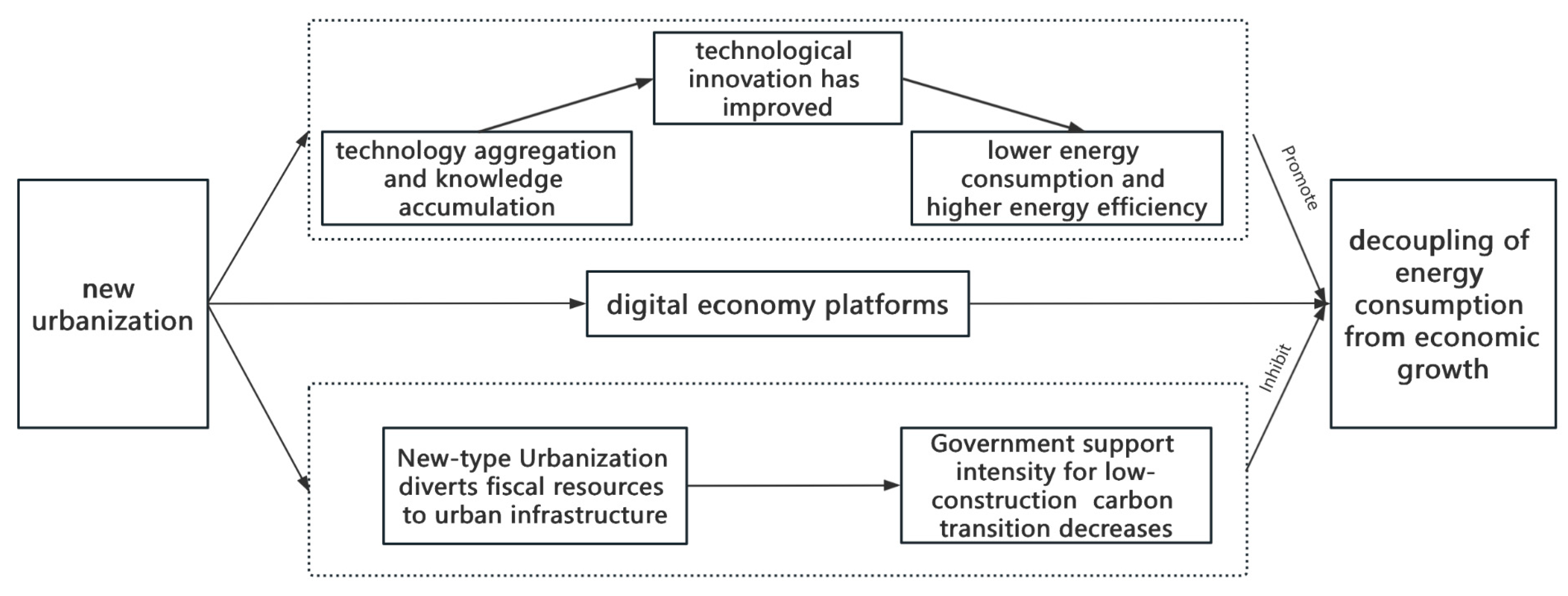
Figure 1. Mechanism flowchart.
Platforms 04 00003 g001
Table 1. New urbanization index system.
System LayerTarget LayerIndicator LayerSpecific Definition of IndicatorTypes
NTUPopulation UrbanizationUrban Population DensityDirect data+
Urban Registered Unemployment RateDirect data
Urbanization Rate of Permanent PopulationUrban population/year-end permanent population+
Proportion of Employees in Secondary and Tertiary IndustriesEmployees in secondary and tertiary industries/total employees+
Economic UrbanizationPer Capita Disposable Income of Urban ResidentsDirect data+
Economic LevelPer capita GDP+
Proportion of Tertiary Industry Value-addedTertiary industry value-added/GDP+
Per Capita Local Fiscal General-Budget RevenueLocal fiscal general-budget expenditure/year-end permanent population+
Education InputEducation expenditure/local fiscal general-budget expenditure+
Per Capita Total Retail Sales of Social Consumer GoodsTotal retail sales of social consumer goods/year-end permanent population+
Social UrbanizationEducation ScaleAverage number of enrolled students in institutions of higher learning per 100,000 population+
Per Capita Total Collection of Public Library BooksDirect data+
Medical and Health Care LevelNumber of beds in medical and health care institutions+
Public Transport Development LevelNumber of public transport vehicles per 10,000 people+
Ecological UrbanizationPark Green Space LevelPer capita park green space area+
Daily Urban Sewage Treatment CapacityDirect data+
Waste Treatment LevelHarmless treatment rate of domestic waste+
Forest Coverage RateDirect data+
Table 2. Statistical description of the variables.
VariablesSymbolObservationsMeanStdMinMax
Decoupling of economic growth from energy consumptionED300−0.00020.0681−1.0720.177
New urbanizationNTU3000.3360.09780.1600.617
Regional degree of opennessLnOPEN300−1.7940.943−4.8760.126
Regional urban–rural gapURG3003.5164.7721.37033.32
Industrial structure upgradingISU3001.4690.7810.7045.690
Digital economy platformDEP3002.9250.5000.6934.111
Fiscal support intensityFSI3000.2530.1030.1070.643
Technological innovationTI3006.2901.3881.3869.464
Table 3. Main estimation results.
(1)(2)(3)
VariablesEDEDED
NTU−0.603 *−0.686 **−0.436
(−1.8182)(−2.0012)(−1.2548)
DEP 0.0287 **
(2.4487)
NTU×DEP −0.184 *
(−1.7759)
ISU −0.0655 **−0.0561 *
(−2.0504)(−1.7750)
LnOPEN 0.0365 *0.0407 **
(1.8030)(2.0194)
URG −0.0109−0.0104
(−1.5157)(−1.4702)
Constant0.166 *0.362 ***0.235 *
(1.8449)(3.0772)(1.8843)
Province FEYESYESYES
Year FEYESYESYES
R-squared0.0640.0890.122
F-test1.77 *1.94 **2.37 ***
Observations300300300
Note: *, **, and *** denote significance levels of 10%, 5%, and 1%, respectively, with t-values indicated in parentheses. The same applies below.
Table 4. Heterogeneity test.
(1)(2)(3)
VARIABLESEastern RegionCentral RegionWestern Region
NTU−0.460 ***−5.791 **0.489
(−2.6571)(−2.2082)(0.9134)
ISU−0.0149−0.402 **−0.00981
(−0.7852)(−2.2516)(−0.2712)
LnOPEN0.03590.374 **−0.00636
(1.4291)(2.2185)(−0.5934)
URG−0.0321−0.144−0.00236
(−0.8681)(−0.3251)(−0.7219)
Constant0.280 ***2.975 **−0.0888
(2.7474)(2.5040)(−0.7794)
Province FEYESYESYES
Year FEYESYESYES
R-squared0.2330.4280.092
Observations13060110
Note: **, and *** denote significance levels of 10%, 5%, and 1%, respectively, with t-values indicated in parentheses. The same applies below.
Table 5. Robustness checks.
(1)(2)(3)(4)(5)
VARIABLESEDEDEDEDED
NTU −0.331 *−0.990 ***−0.847 *−1.044 ***
(−1.6825)(−2.6863)(−1.7771)(−2.8105)
L.NTU−0.723 *
(−1.7684)
L.ED 1.019 ***
(5.8366)
ISU−0.0861 **−0.0713 **−0.105 ***−0.0886 **−0.0452 *
(−2.1826)(−2.2389)(−2.8853)(−2.2717)(−1.8318)
LnOPEN0.0453 *0.02550.0537 **0.0501 **0.0650 ***
(1.9005)(1.2753)(2.3103)(2.0786)(2.6301)
URG−0.0166 *−0.005790.0169−0.0164 *−0.00315
(−1.8606)(−0.7808)(0.4562)(−1.8453)(−1.2059)
Constant1.481 ***3.038 ***1.518 ***1.537 ***1.407 ***
(10.7555)(2.8470)(10.0773)(9.4710)(4.1059)
AR (1)-p value 0.001
AR (2)-p value 0.755
Hansen-p value 1.000
Province FEYESYESYESYESYES
Year FEYESYESYESYESYES
R-squared0.0990.0850.1380.108
Observations270300260270270
Note: *, **, and *** denote significance levels of 10%, 5%, and 1%, respectively, with t-values indicated in parentheses. The same applies below.
Table 6. Mechanism test results.
(1)(2)(3)
VARIABLESEDFSITI
NTU−0.686 **−0.390 ***3.501 ***
(−2.0012)(−3.4189)(4.0075)
ISU−0.0655 **0.0438 ***−0.216 ***
(−2.0504)(4.1144)(−2.6488)
LnOPEN0.0365 *0.0143 **−0.143 ***
(1.8030)(2.1206)(−2.7738)
URG−0.01090.00216−0.0251
(−1.5157)(0.9050)(−1.3729)
Constant1.442 ***0.315 ***4.559 ***
(12.2670)(8.0563)(15.2120)
Province FEYESYESYES
Year FEYESYESYES
R-squared0.0890.3610.915
Observations300300300
Note: *, **, and *** denote significance levels of 10%, 5%, and 1%, respectively, with t-values indicated in parentheses. The same applies below.
Disclaimer/Publisher’s Note: The statements, opinions and data contained in all publications are solely those of the individual author(s) and contributor(s) and not of MDPI and/or the editor(s). MDPI and/or the editor(s) disclaim responsibility for any injury to people or property resulting from any ideas, methods, instructions or products referred to in the content.


