1. Introduction
Forest fires can cause economic, environmental, and societal damage [
1]. Understanding the scale of social damage is important when assessing public health in areas with active forest fires. One of the damaging factors of forest fires is carbonaceous particles heated up to high temperatures [
2]. These particles are carried away from the forest fire front and can subsequently interact with human tissue. Various scenarios for the impact of forest fire damaging factors on the population are possible. In recent decades, the impact of forest fire damaging factors on the protected layers of the skin has been studied in depth. However, carbonaceous particles heated up to high temperatures can impact exposed skin, the mucous membranes of the nasopharynx, and the tissues of the upper airways. In conditions of limited oxygen in the zone of an active forest fire, such relatively small carbonaceous particles can end up in the human respiratory tract.
Carbonaceous particles of various sizes can also enter the upper respiratory tract, causing various diseases [
3,
4]. The literature discusses various particles, such as PM2.5 and PM10 (or the range of 2.5–10 μm) [
5,
6]. Some researchers consider nano-sized particles [
7,
8,
9]. Particles larger than 10 μm are typically retained in the upper respiratory tract, while particles smaller than 10 μm have the ability to penetrate deep into the respiratory tract [
10]. Particles smaller than 4 μm can settle directly in the alveoli [
11]. Particles in the respiratory tract settle primarily under the influence of inertia, gravity, and diffusion [
12].
Particles can enter the nasopharyngeal mucosa and upper airways together with heated air or smoke. In recent decades, there has been a decrease in the severity of burns [
13]. At the same time, burns of the upper respiratory tract remain a high cause of injury and mortality [
14]. According to statistics, inhalation burns occur in only 10–20% of patients with burns, but they are the main factor of mortality among such patients [
15]. Studies have shown that 30% of patients with inhalation burns die, while among patients without inhalation burns, only 2% die [
16,
17,
18]. It has been established that patients with inhalation injury have a 20–30% risk of developing upper airway obstruction [
19]. Airway damage occurs as a result of three mechanisms: smoke inhalation, thermal injury, and chemical exposure [
13]. Smoke inhalation is the main cause of laryngeal burns [
18,
20]. For all types of burns, their severity is determined, for example, by the duration and intensity of exposure and the components of inhaled air (smoke, impurities, particles) [
14]. Regardless of the type of burn, it leads to cellular damage and an inflammatory process [
21]. Research on inhalation burns has primarily focused on smoke-induced damage to the trachea and lungs [
22,
23], taking into account the cellular and molecular levels [
24,
25]. In turn, in [
26], studies were conducted to examine temperature distribution in the upper respiratory tract after inhalation injury.
A classification of burns and corresponding tissue lesions is given in [
27]. The authors in [
28] examined burns of the skin of the head and neck. In [
29], the study of heat dissipation in the upper respiratory tract during inhalation thermal injury is examined. Model injuries are considered using dogs as an example. The authors in [
30] used dogs to measure surface temperature and assess pathological changes in respiratory tract tissues following inhalation injury. In addition to animals, mannequins are also used for burn examination [
31]. Instrumental methods include direct examination and fiberoptic bronchoscopy [
32,
33,
34].
In addition to instrumental methods for monitoring the state of the respiratory tract, work on mathematical modeling of processes in the human respiratory tract is also known. Computational fluid dynamics methods are used to model particle deposition in various parts of the human respiratory tract [
35,
36,
37,
38,
39,
40,
41]. The studies in [
42,
43,
44,
45,
46,
47,
48,
49] also utilize numerical modeling of various processes in the human respiratory tract. These include investigations of real-world geometry, varying surface layer thicknesses, blood circulation around the respiratory tract, various boundary conditions, and moisture transport. The authors of [
50] also conducted a study on the precise modeling of temperature and velocity distribution fields during thermal inhalation injury of the human upper respiratory tract. The objects of the study were the following structures: the entrance, nasal cavity, paranasal sinuses, nasopharynx, oropharynx, windpipe, and the upper part of the main bronchus. A three-dimensional mathematical model was formulated by taking into account the computed tomography data of an adult woman. Some works are devoted to the so-called bioheat models of the skin when it is insulated by clothing, for example, ref. [
51]. A two-dimensional thermal conductivity model with appropriate initial and boundary conditions is used. Along with mathematical modeling of heat transfer and computational fluid dynamics problems, so-called soft computing is used [
52]. Currently, artificial intelligence and image processing technologies Yolov7-PSA are used to assess the severity of skin burns [
53]. A number of works are devoted to the numerical study of the effect of laser radiation on human skin [
54,
55,
56]. Skin temperatures and the degree of damage can be considered. Numerical methods based on finite differences are used. In a number of situations, the virtual element method is used [
57].
During vegetation fires, embers and firebrands of various sizes are formed as a result of wood destruction [
58]. In addition, smaller carbonaceous particles can be formed [
59]. Such embers and particles can be carried away from the forest fire front [
60,
61]. Such particles are the subject of research on the ignition of forest fuels [
62,
63,
64]. However, the impact of such carbonaceous particles of a relatively small size on human tissue has not yet been properly studied.
The aim of the study is to mathematically model heat transfer in the “carbonaceous particle–human tissue” system, taking into account the initial heat content and the layered structure of human tissue.
The aim of the study is related to the following objectives:
- (1)
Mathematical modeling of the effect of a heated carbonaceous particle on human skin;
- (2)
Mathematical modeling of the effect of a heated carbonaceous particle on the mucous membrane of the human nasopharynx;
- (3)
Mathematical modeling of the effect of a heated carbonaceous particle on the tissues of the human upper airway;
- (4)
Comparative analysis of thermal injury degree of different human tissue;
- (5)
Suggestion of practical usage of presented mathematical model in public health organizations.
2. Materials and Methods
2.1. Physical Problem Statement
The skin consists of the epidermis, dermis, and subcutaneous fat (in its most general form). The epidermis interacts with the environment and protects the skin’s surface. It has the ability to regenerate. New cell formation occurs beneath the epidermal layers [
65]. The dermis acts as a regulator of thermal and mechanical stress [
66]. The final layer of the skin is adipose tissue, which has thermal insulation and impact-resistant properties to protect internal organs [
66]. The skin performs many vital functions, has a multilayered structure, and is a complex subject for mathematical study.
Body cells typically obtain energy from the oxidative breakdown of nutrients. Therefore, they require a constant supply of oxygen. At the same time, normal cellular function is only possible with the removal of the end product of metabolism—carbon dioxide. The exchange of gases between cells and the environment is called respiration [
67]. Pulmonary ventilation ensures the transfer of gases by convective transport over long distances. The transfer of oxygen from the environment to the parts of the body where it is absorbed by cells occurs through a series of steps in the following sequence [
67]:
- (1)
Convective transport to the alveoli (ventilation);
- (2)
Diffusion from the alveoli into the blood of the pulmonary capillaries;
- (3)
Convective transport by the blood to the tissue capillaries;
- (4)
Diffusion from the capillaries into the surrounding tissue.
The process of carbon dioxide removal involves the same four steps in reverse order. The first and second stages are called pulmonary (external) respiration [
67]. When the lungs expand, fresh air enters their gas-exchange sections through a system of branching tubes [
68,
69]. Initially, it passes through the trachea and then along smaller branches of the bronchial tree. Up to the 16th branching, followed by the terminal bronchioles, the only function of the respiratory tract is to conduct air. After the 17th–19th divisions, respiratory bronchioles are formed, whose walls already contain individual alveoli. After the 20th division, the alveolar ducts begin, which are tightly surrounded by alveoli. This zone of the lungs primarily performs the function of gas exchange and is called the respiratory zone. Up to the terminal bronchioles, air transport through the respiratory tract occurs exclusively by convection.
The following model of heat transfer is proposed for the contact of a heated carbonaceous particle with the superficial tissues of the respiratory tract. It is assumed that a person is in the zone of an active forest fire. Small heated particles of wood, formed as a result of thermal destruction of its material, are carried from its front. During pulmonary respiration, they enter the respiratory tract and settle on their surface tissues (the surfaces of the nasopharynx and upper respiratory tract). Ideal contact between the particle and the surface tissues of the respiratory tract is assumed. The particle transfers heat through the process of thermal conductivity to the upper layers of the respiratory tract tissue. The tissues are heated and their normal functioning is disrupted. The particle is surrounded by a gaseous medium. The particle is modeled as a cubic object in a two-dimensional setting. It is assumed that heat exchange with the external environment and the bronchial system is constant [
70]. Air warming occurs mainly in the nasopharynx. In the upper respiratory tract, the air temperature can be taken to be several degrees higher than the ambient temperature [
71].
2.2. Geometrical Problem Statement
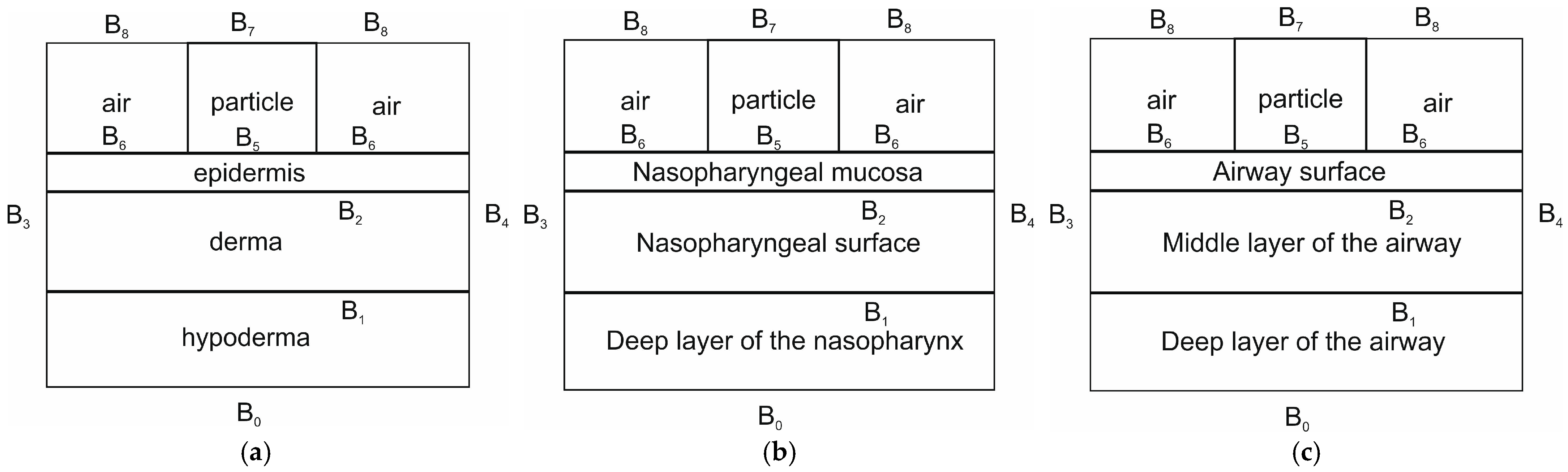
Figure 1 shows the geometry of the solution domains.
2.3. Mathematical Problem Statement
The problem was formulated in two dimensions in this paper. Previously, for example, one-dimensional mathematical models of the impact of forest fire damaging factors on human skin were developed [
72]. A general explanation for the choice of the dimensionality of the mathematical model should be provided. For example, in [
73], a three-dimensional mathematical model of the ignition of a coniferous tree trunk by a cloud-to-ground lightning discharge is considered. A rather complex mathematical model is considered, which includes certain physicochemical, thermophysical, and electrophysical processes occurring during the impact of the electric current of a cloud-to-ground lightning discharge on the coniferous tree trunk. A comparative analysis showed that the execution time and the required amount of RAM vary significantly depending on the choice of dimensionality of the mathematical model. It is clear that the most complete and physically meaningful results can only be obtained in the case of using a three-dimensional mathematical model of the ignition of a coniferous tree by a cloud-to-ground lightning discharge. The same situation applies to the development of one-dimensional, two-dimensional, and three-dimensional mathematical models of the effects of heated carbonaceous particles on human tissue. However, a two-dimensional mathematical model is a reasonable compromise between the accuracy and completeness of theoretical results and the execution time of the software implementation of such a mathematical model on computer hardware. A hospital or health department, at best, has a high-performance workstation capable of using the sequential programming paradigm. Furthermore, RAM capacity is also limited. Practical application requires calculating a large number of scenarios for the effects of heated carbonaceous particles on human tissue within a limited time interval, taking into account real fire danger conditions. However, to prevent any catastrophic event, a sufficient lead time is necessary.
In the context of this study, sufficient time is needed to assess predicted burns and tissue damage in a real fire-dangerous situation and prepare the necessary number of places to accommodate injured persons. However, with a three-dimensional mathematical model, it is virtually impossible to perform predictive calculations ahead of the real-time development of a catastrophic event. This would require the use of multiprocessor computing systems and parallel programming technology for supercomputers [
74]. This is currently impossible, as it would require restructuring all of the information and computing infrastructure of the healthcare system. In summary, it can be stated that a two-dimensional mathematical model is a compromise option that can be used in practice when modernizing the medical information system of a region with active forest fires.
The system of equations included the heat conduction equation for different parts of the model—layers of human tissue, air, and a wood particle.
The width of the solution domain is equal to 0.1 m. The height of the domain solution is dependent on the type and structure of human tissue and particle size (
Table 1 and
Table 2).
To solve this problem in its full mathematical formulation, a finite-difference method was applied on a uniform grid with an implicit scheme [
75]. The burn temperature was set to 315.15 K, which corresponds to the onset of skin protein denaturation. The burn severity was determined in accordance with the medical literature [
76].
A fourth-order boundary condition was imposed at the boundaries between layers and objects (at B1, B2, B5, B6). Boundary conditions with a heat convection coefficient are used on the top boundaries (at B7, B8). Insulation boundary conditions were used at the left and right boundaries of the solution area (at B3, B4). The heat flux of metabolism is used as boundary conditions at the bottom boundary of the solution area (at B0).
Burns are classified into five degrees of severity [
76]:
Degree I—Manifested by hyperemia and swelling of the skin;
Degree II—Damage to the superficial layers of the epidermis, with the appearance of blisters filled with transparent material;
Degree IIIa—Partial damage to the dermis, but retaining the skin appendages, from which epithelialization subsequently occurs;
Degree IIIb—Full-thickness skin damage with partial involvement of the subcutaneous fat;
Degree IV—Damage to deep structures (fascia, muscle, bone).
The burn temperature (tcrit) was set to 315.15 K, which corresponds to the onset of skin protein denaturation.
Mathematically, burn severity can be represented by the following criteria:
Grade I—tcrit reaches the superficial layers of the dermis;
Grade II—tcrit reaches the mid-dermis;
Grade IIIa—tcrit reaches 2/3 of the dermis;
Grade IIIb—tcrit reaches the superficial layers of the hypodermis;
Grade IV—tcrit reaches more than 1/2 the hypodermis.
A similar mathematical model was used to study heat transfer in the nasopharynx and upper respiratory tract.
Thermophysical and geometrical parameters are presented in
Table 1 and
Table 2.
Table 1.
Thermophysical properties of substances [
77].
Table 1.
Thermophysical properties of substances [
77].
| Substances | Layer Depth, m | Properties |
|---|
| Thermal Conductivity, W/(m∙K) | Heat Capacity, J/(kg∙K) | Density, kg/m3 |
|---|
| Epidermis (neck) | 0.00011 | 0.25 | 3625 | 1200 |
| Epidermis (cheek) | 0.0003 |
| Epidermis (palm) | 0.0005 |
| Dermis | 0.0025 | 0.45 | 3291 |
| Hypodermis | 0.015 | 0.15 | 2250 |
| Air | 0.003–0.01 | 0.0326 | 1068 | 0.525 |
| Particle (fir) | 0.18 | 2700 | 500 |
| Particle (pine) | 0.17 | 2300 | 500 |
| Particle (oak) | 0.23 | 2300 | 700 |
| Particle (birch) | 0.13 | 1250 | 650 |
Table 2.
Thermophysical properties of substances [
77].
Table 2.
Thermophysical properties of substances [
77].
| Substances | Layer Depth, m | Properties |
|---|
| Thermal Conductivity, W/(m∙K) | Heat Capacity, J/(kg∙K) | Density, kg/m3 |
|---|
| Nasopharyngeal mucosa | 0.00011 | 0.55 | 4200 | 1000 |
| Nasopharyngeal surface | 0.0025 | 0.45 | 3291 | 1200 |
| Deep layer of the nasopharynx | 0.015 | 0.15 | 2250 | 1200 |
| Airway surface | 0.00011 | 0.44 | 3360 | 1091 |
| Middle layer of the airway | 0.0025 | 0.45 | 3291 | 1200 |
| Deep layer of the airway | 0.015 | 0.15 | 2250 | 1200 |
2.4. Scenarios
In total, 54 scenarios of the impact of a heated carbonaceous particle of a relatively small size on human tissue were considered. In addition, each scenario included three subscenarios to account for the source material of the heated carbonaceous particle. Scenarios of the removal of heated carbonaceous particles from low- and high-intensity surface forest fires, as well as from a crown forest fire, were considered. In accordance with [
2], it was assumed that the initial temperature of the carbonaceous particle for a surface forest fire is 900 K and 1000 K for low- and high-intensity fires, respectively. In turn, particles that were removed from the front of a crown forest fire had an initial temperature of approximately 1100 K. In general, it is necessary to consider the firestorm scenario, which is characterized by particle temperatures of approximately 1200 K. However, it is believed that particles begin to interact with human tissue near the source of a forest fire. Clearly, human presence near a firestorm is incompatible with human life. Therefore, this scenario is excluded from consideration in this study. It should be noted that future studies should include this scenario in their analysis when taking into account the distances that heated carbonaceous particles can travel from the forest fire front. However, in this case, the particles will already have temperatures lower than their initial temperature. The greater the distance from the forest fire front, the lower the temperature of the carbonaceous particle. These issues will be discussed in more detail when describing the limitations of the study. Therefore, the main scenarios for the impact of heated carbonaceous particles on human tissue are presented in
Table 3.
Scenarios for ambient air temperature and the size of the heated carbonaceous particle should be discussed separately. This study examined three subseasons of the fire season in a typical Siberian region of the Russian Federation (Tomsk Oblast). Specifically, we used real temperatures characteristic of fire danger conditions of fire danger classes IV and V, where IV represents high forest fire danger while V represents extreme fire danger. As mentioned in the overview section of the article, micro- and nanoscale particles have been extensively examined in the scientific literature. Furthermore, they cool very quickly during transport in the air. Large particles, so-called firebrands, cannot enter the nasopharynx or upper respiratory tract. Therefore, their consideration is also excluded from this study. Moreover, simplified scenarios of the effects of large heated particles on the skin have already been considered previously. This is why particles of a relatively small size (3–10 mm) are of particular interest, as they have not previously been considered as sources of thermal impact on the specified human tissues (especially the nasopharynx and upper respiratory tract).
The three heated particle source material subscenarios correspond to the following tree species: oak, pine, and birch. It should be noted that pine is the most widespread coniferous tree species in the Russian Federation. Birch, in turn, is the most widespread deciduous tree species in the Russian Federation. Birch and pine are found throughout the country. Moreover, these trees also grow in several other countries worldwide. Therefore, the choice of these typical tree species as source particles is justified not only for the Russian Federation but also for several regions of other countries.
2.5. Computational Algorithm
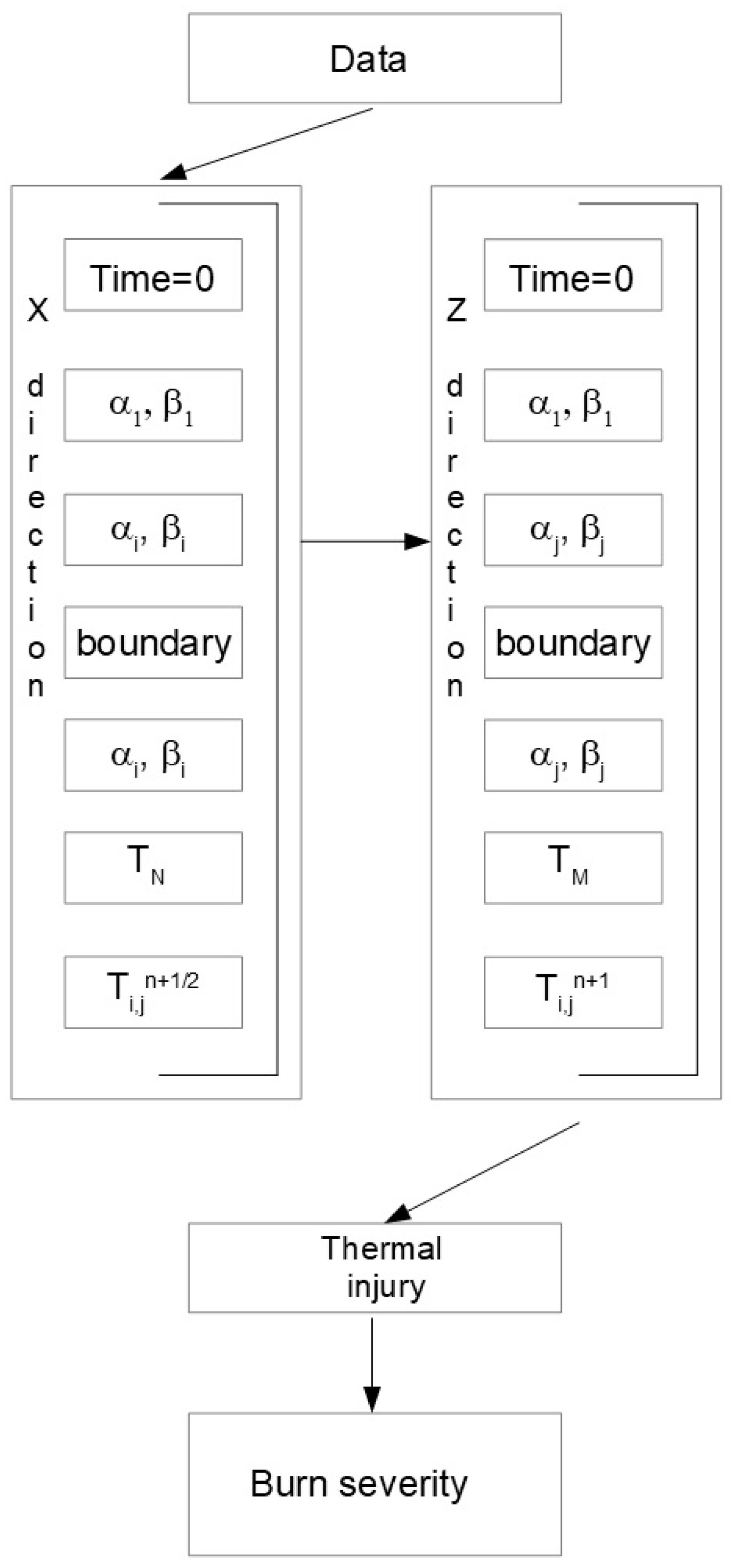
The algorithm for determining the degree of thermal damage to human tissue is shown in
Figure 2. In the first stage, the input data required for the computational procedure, implemented in a high-level programming language, is read and initialized in accordance with the algorithm. The calculation process then proceeds through several sequential stages. Three blocks can be distinguished. The first block is responsible for calculating the temperature field in the “carbonaceous particle–tissue” system. Since the system of equations being solved corresponds to a two-dimensional formulation, a locally one-dimensional method for solving two-dimensional equations of mathematical physics is used [
78,
79]. To solve one-dimensional equations, the finite-difference method [
80] was used. To solve difference analogs of parabolic partial differential equations, the marching method is used [
80]. In each block, the calculation is performed in a similar manner. In the forward pass, the running coefficients are initialized, and in the backward pass, the temperature at the next time layer is calculated. It should be noted that fourth-order boundary conditions are used to determine the running coefficients at the interfaces between media with different thermophysical characteristics. The second block allows for the calculation of the geometry of the thermal damage region. This is done using experimental information that protein destruction is observed at 42 °C. The next block allows for the determination of the degree of thermal position based on experimental data known in medicine [
76,
77].
3. Results and Discussion
3.1. Temperature Distribution and Thermal Injury Degree
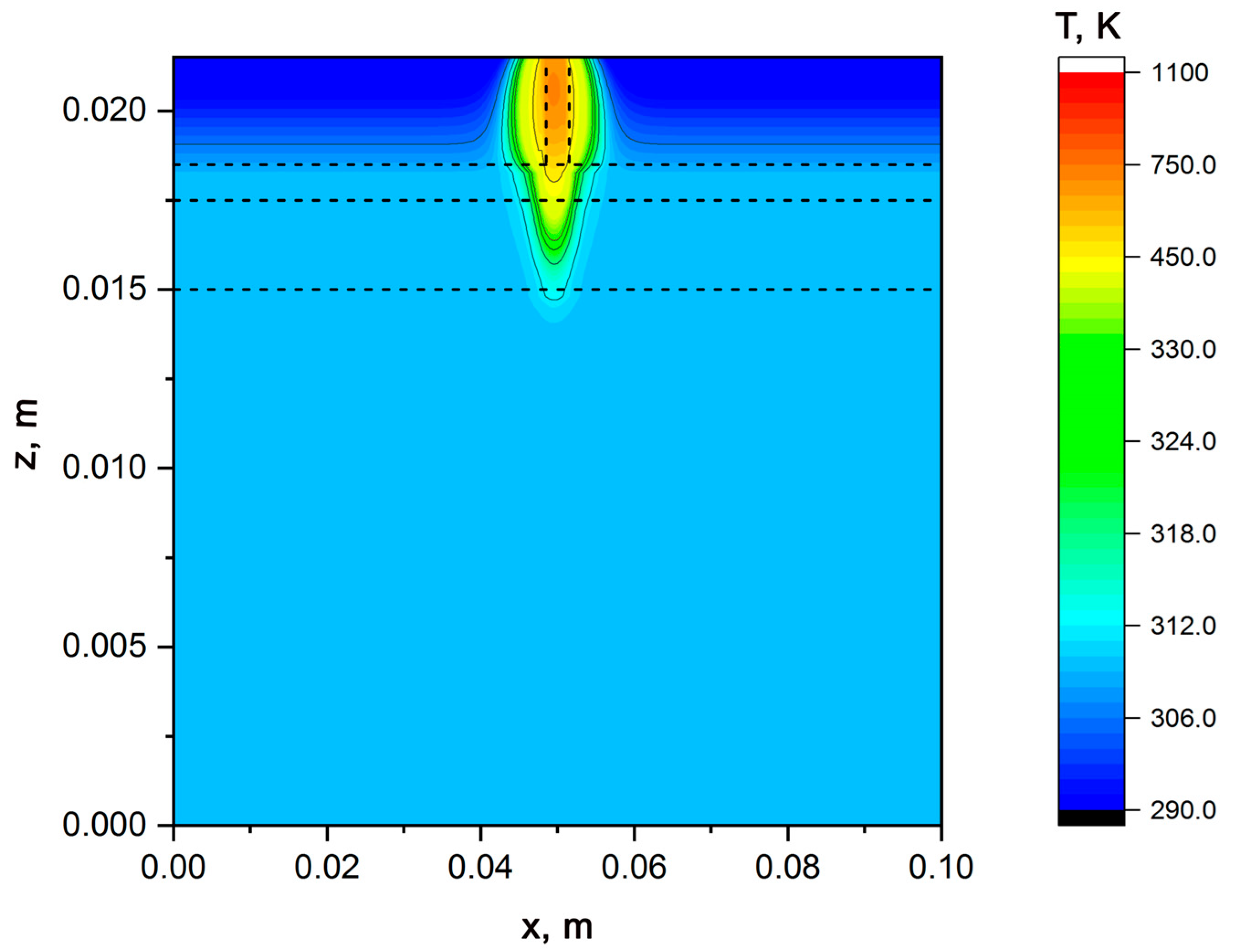
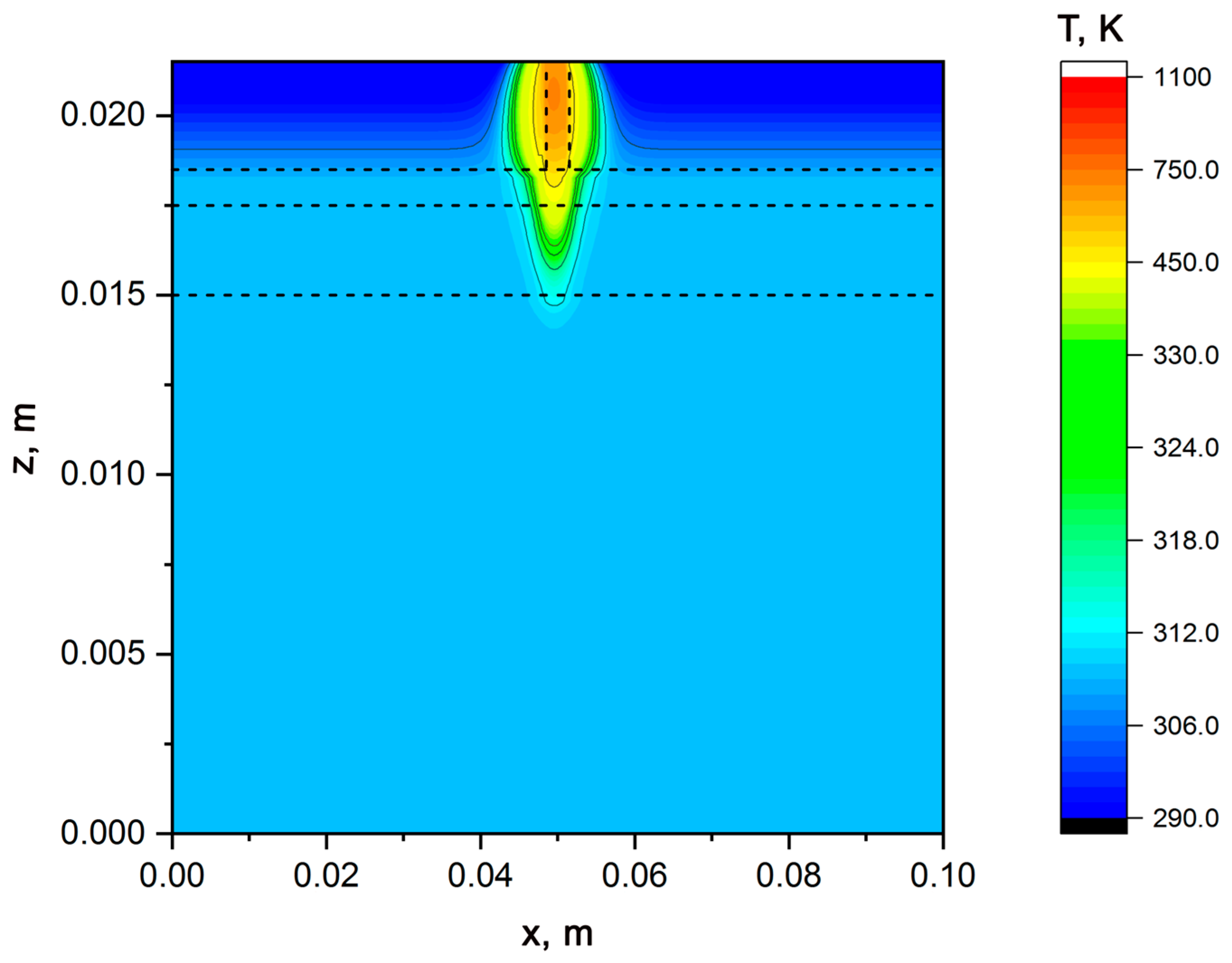
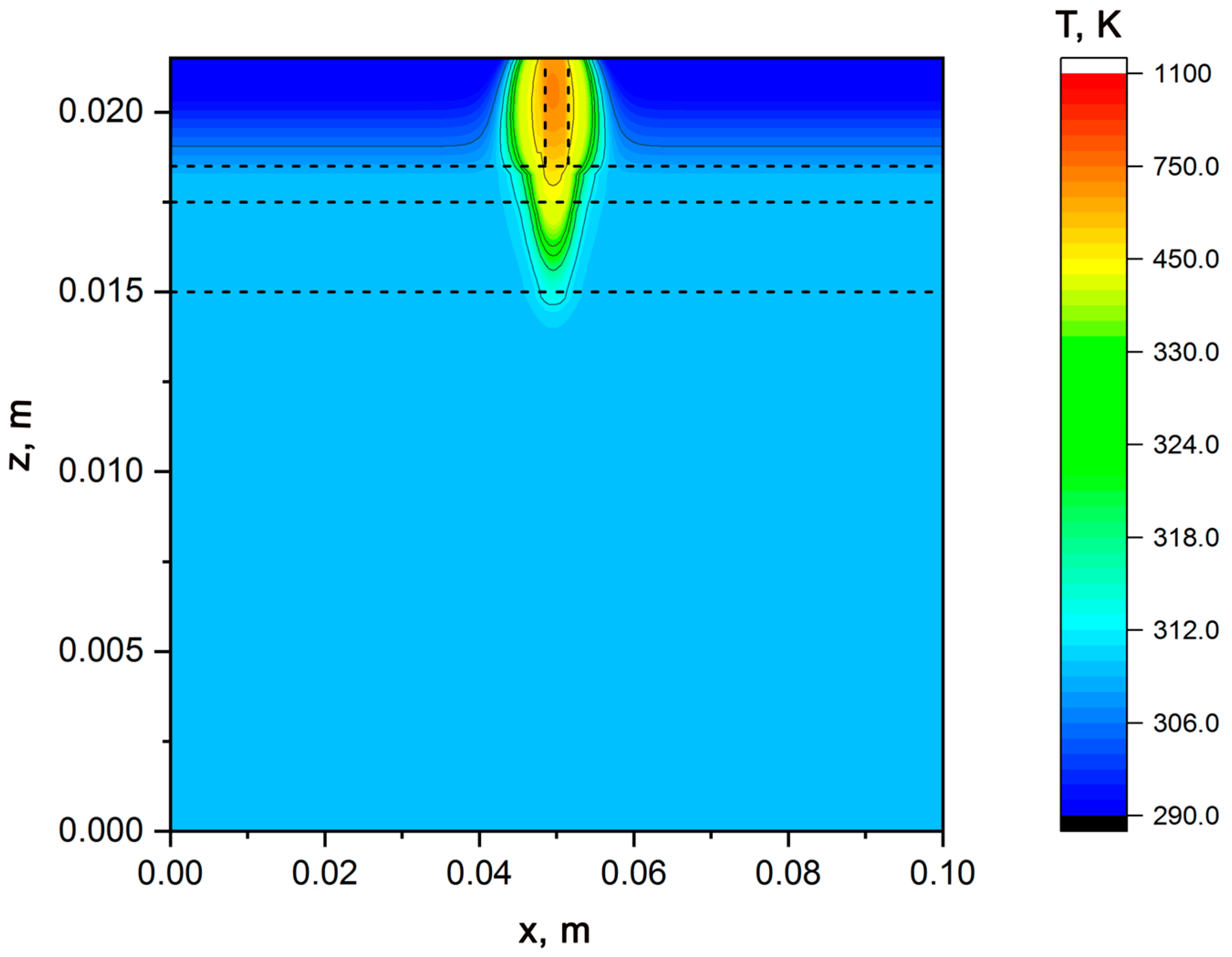
The temperature distributions in the “heated particle–human tissue” system are shown below.
The figures below show the typical geometry of the thermal damage area and temperature distribution (
Figure 3,
Figure 4 and
Figure 5).
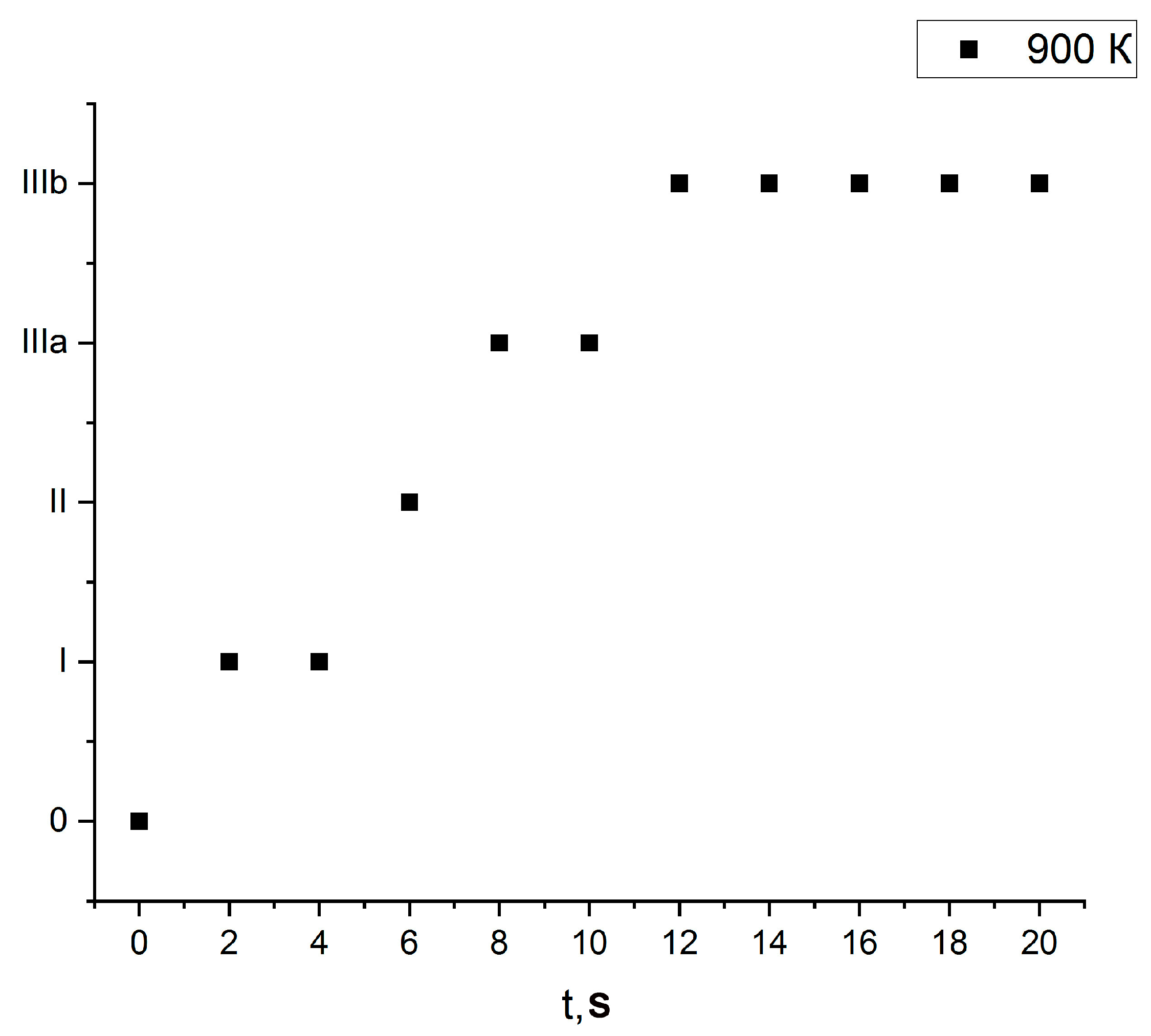
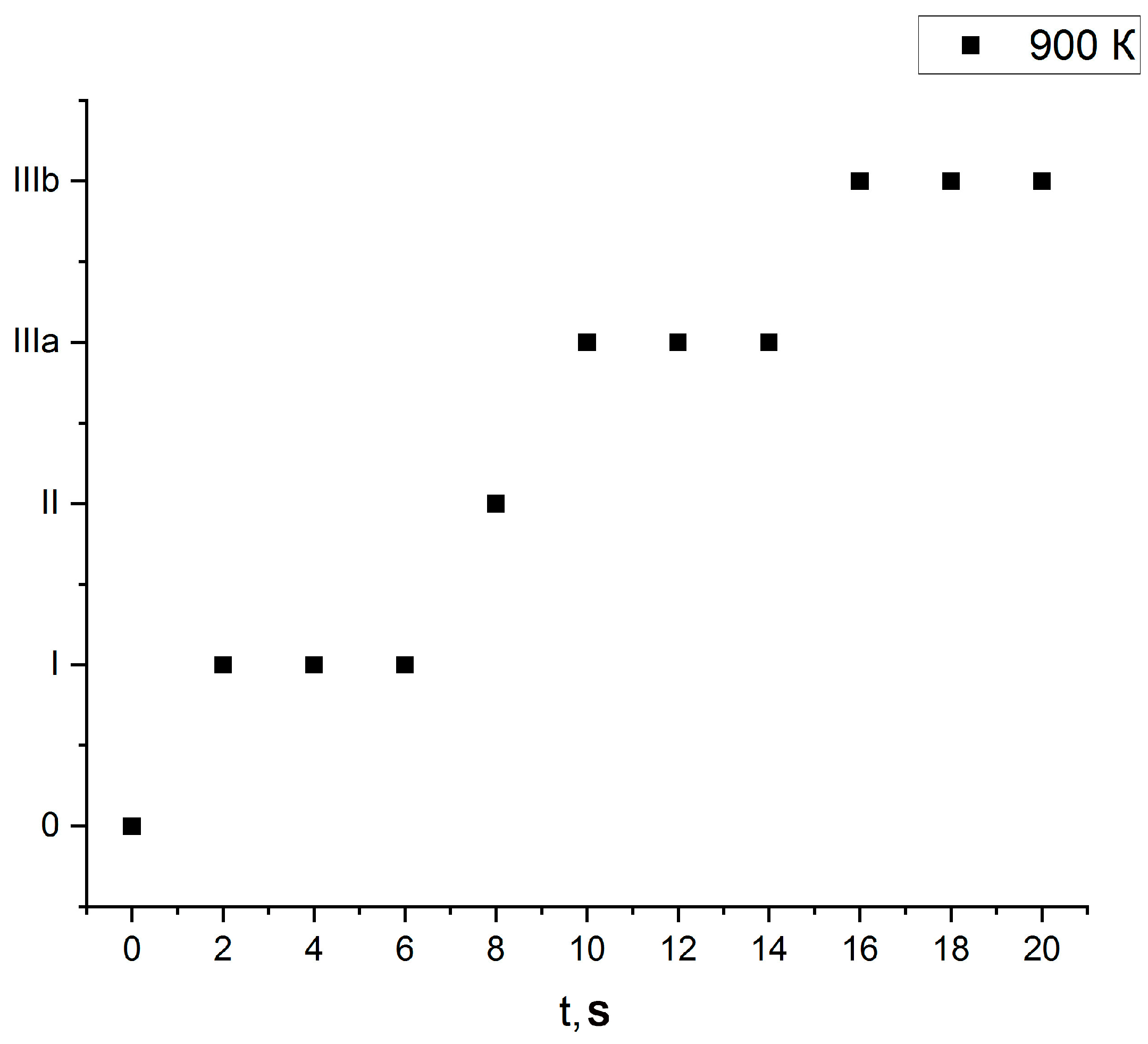
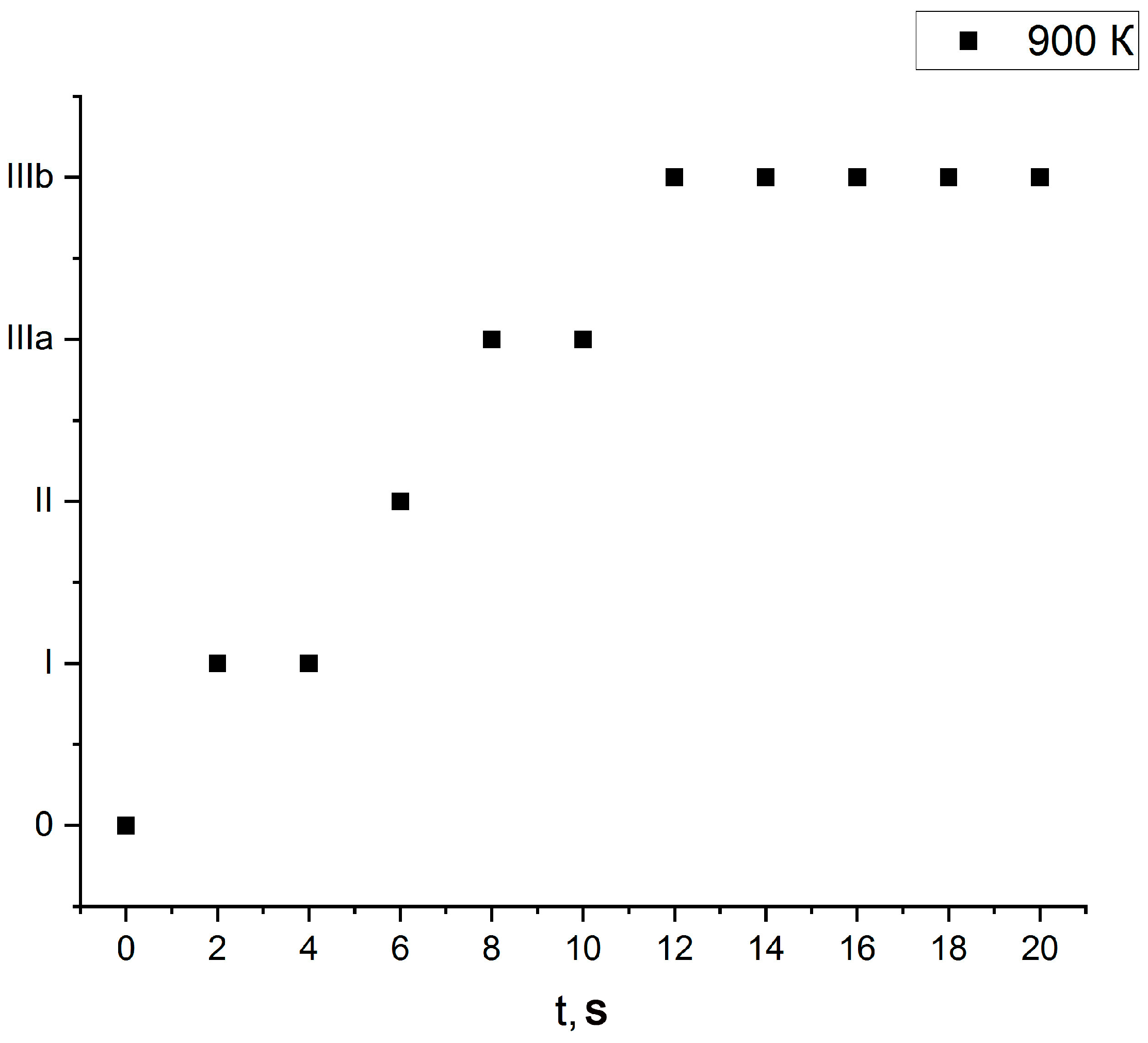
Typical results are shown below, demonstrating the formation time of the thermal injury zone (
Figure 6,
Figure 7 and
Figure 8).
A total of 54 main scenarios for the thermal impact of a single carbonaceous particle heated to high temperatures were considered. Each main scenario included three subscenarios to account for the particle initial material (oak, birch, pine).
First, it was necessary to analyze the temperature fields in the “carbonaceous particle–human tissue” system. First, the analysis shows that ambient temperature does not have a decisive influence on the cooling process of a single heated carbonaceous particle. Average seasonal temperatures for the summer period, when recreational loads on forested areas are widespread, were considered. Differences in surface layer temperatures are on the order of several Kelvins for initial particle temperatures of 900 K, 1000 K, and 1100 K. The velocity of the incident airflow, which was indirectly accounted for in the heat transfer coefficient, has a much greater influence on the cooling process of a single heated particle. Specific heat transfer coefficient values were used for each type of forest fire. The minimum heat transfer coefficient of 20 W/(m2·K) was recorded for a low-intensity surface forest fire, while the maximum value for a crown forest fire was 80 W/(m2·K). The maximum temperature gradient was recorded for particles emitted from the front of the crown forest fire.
An analysis of particle size in the context of thermal impact shows that particles 1 cm in size possess the maximum heat storage, while particles 3 mm in size possess the minimum. On the other hand, the central part of the particle is slightly susceptible to cooling due to interaction with the external environment and the surface of human tissue. Nevertheless, it should be expected that particles with a high heat storage could pose a greater health danger to humans and other living creatures. As is known, not only people but also animals and birds are often exposed to damaging factors during forest fires.
The modeling considered an optimistic scenario in which a person would be able to stop exposure to a heated particle within 10 s. However, the modeling shows that local tissue heating extends to the deepest layers (e.g., the hypodermis of the skin) depending on the initial particle temperature. Analysis of the degree of thermal injury at 10 s shows that a localized lesion of up to grade IIIb can form. Therefore, modeling was conducted to determine the degree of thermal injury for various human tissues depending on the exposure time, taking into account the initial temperature and particle size. For skin, it was found that even short-term exposure can lead to grades I and II thermal injury (up to 6 s). For nasopharyngeal tissue, short-term exposure was also found to lead to grades I and II thermal injury. For the surface of the upper respiratory tract, modeling showed that a grade IIIa thermal injury can form by 6 s. Larger particles cause more severe thermal injury more quickly.
The presented results were obtained under conditions where a person is sedentary and internal heat production is minimal. It is necessary to assess the influence of human activity on internal heat production through metabolism and, consequently, to evaluate the possible impact on the degree of thermal damage to human tissues. According to the literature, different types of human activity were considered: rest—50 W/m
2 [
81], light physical activity—135 W/m
2 [
82], and vigorous physical activity—275 W/m
2 [
83].
Below are typical results of a comparative analysis of the influence of metabolic heat flux on the degree of thermal damage to human tissues (
Table 7).
Indeed, the main difference in the obtained results (
Figure 3,
Figure 4,
Figure 5,
Figure 6,
Figure 7 and
Figure 8), at first glance, lies in the degree of thermal injury. Firstly, this is already sufficient for solving practical problems when using software implementations of the proposed mathematical model in the regional medical system. For example, with such information on the degree of expected thermal injury, it is possible to make a specific management decision on allocating hospital beds for expected injured persons, or the need to deploy mobile medical teams near active forest fire zones can be assessed. Furthermore, preliminary estimates of the required quantities of dressings and medications can be made.
Secondly, in addition to the degree of thermal injury, the predictive calculations also yielded temperature distributions within the structure of human tissue. This information can be used in the future to develop treatment regimens for thermal injury, as it provides insight into the depth of thermal injury. Accordingly, new treatment regimens for thermal injury can be proposed at the intersection of mathematical modeling and pharmaceuticals. Essentially, the proposed mathematical model creates a fundamental basis for the development of an entire field of medical and mathematical monitoring and treatment of thermal injury to human tissue. This is where the greatest potential of the proposed mathematical model lies, not just predictive modeling.
The overall conclusion is that isolated particles heated to high temperatures can pose a real health hazard to people in the front of active forest fires. However, the limitations of this study should also be noted. This study only examined the thermal impact of a single, relatively small, carbonaceous particle heated to high temperatures. The mechanical interaction of the particle with human tissue should also be addressed in future studies. Secondly, a global scenario was considered in which isolated particles are carried away from the forest fire front and immediately enter the contact zone with human tissue. Future studies should also consider scenarios in which the particle cools before traveling a certain distance from the forest fire front.
3.2. Model Validation and Sensitivity Analysis
The difficulty in validating mathematical models of the effects of heated carbonaceous particles on human tissue lies in the impossibility of conducting validation tests on living humans. At best, the consequences of such exposure can be assessed and only certain assumptions can be made about the actual thermal effects of such particles on living human tissue. This is typically accomplished using visual assessment methods [
32,
33,
34]. However, there are some experiments on the effects of elevated temperatures on tissue, for example, in dogs [
29]. In this case, we are talking about inhalation burns of upper respiratory tract tissue caused by a stream of heated air.
Clearly, a different mechanism of thermal action was considered—namely, convective heat transfer during the interaction of heated air with animal tissue. In turn, the present study examines conductive heat transfer during contact between a heated carbonaceous particle and human tissue. However, at a minimum, qualitative agreement can be reached between the theoretical results obtained in this study and previously published experimental data [
29]. Even if experimental studies on the effects of heated carbonaceous particles on animal tissue are published in the future, this will not completely resolve the question of the validity of theoretical results for human tissue. It must be assumed that the only viable approach is to develop a set of mathematical models of the interaction of heated carbonaceous particles with human tissue, varying in size and complexity, followed by a retrospective analysis of the theoretical extent of thermal injury and actual data on forest fire casualties. To achieve this goal, software implementations of such mathematical models should be integrated into medical information systems used in hospitals treating people with thermal injuries. Then, a retrospective analysis of a certain number of medical incidents involving thermal injuries to humans will allow us to demonstrate quantitative consistency with the theoretical results obtained. Alternatively, it can be reasonable to develop the approach to solving inverse heat conduction problems as applied to human tissue. However, it should be noted that in this case, the structural heterogeneity of human tissue can be a significant disturbing factor, leading to large errors in the obtained parameters of the inverse heat conduction problem. Therefore, internal testing of the algorithm and software implementation of the mathematical model was conducted. Convergence testing of the numerical method was performed on a sequence of mesh refinements. The results of the algorithm’s sensitivity to the mesh parameters of the mathematical model are presented below (
Table 8). A classification of modes was introduced: inaccurate, sufficient, optimal, and redundant. The mode was determined by estimating the temperature at the control point. If the temperature during subsequent mesh refinements differs by more than 0.25 K, the mode is considered inaccurate. Otherwise, the mode is considered sufficient or optimal (the optimal mode ensures shorter program execution time compared to a merely sufficient mode). All subsequent mesh refinements that improve calculation accuracy, in which the temperature difference at the control point is even smaller, are considered redundant.
The recommended mesh parameters are as follows: 200 x nodes and 400 z nodes accompanied by a time step that is equal to 10−3 s.
A 3D mathematical model of the effect of a heated carbon particle on human tissue was also developed. A comparative analysis of the calculated temperature at control points in the computational domain was conducted. Three points on the particle were selected—on the left, center, and right along the x-coordinate of the computational domain. A control point was also selected in the epidermal layer beneath the particle’s center. The table presents the geometric coordinates of the control points and the temperature obtained using the 2D and 3D mathematical models (
Table 9). The relative error in percentage calculations of the temperature at the control points using the 2D and 3D mathematical models is also presented. The execution time of the same scenario in the 2D and 3D versions differs by a factor of x. The larger the dimensionality of the mathematical model, the longer the execution time of the program code.
Typical results for a particle with a characteristic size of 0.01 m are presented. The left control point in the particle is located 0.002 m from the left boundary along the x-coordinate and 0.002 m from the skin surface along the z-coordinate. The right control point is located 0.002 m from the right boundary along the x-coordinate and 0.002 m from the skin surface along the z-coordinate. The central control point is located at the center of the particle and 0.002 m above the skin surface along the z-coordinate. In the epidermis, the fourth control point is located under the center of the particle. The central node along the y-coordinate was used in the 3D model.
The configuration of the computing system is presented in
Appendix A. A comparative analysis of the execution time of various settings shows that the 1D mathematical model requires a computation time of about 1–2 s, and the 2D mathematical model with software implementation requires a computation time of about 22 s, while the 3D mathematical model with software implementation requires a computation time of about 2 h 45 min.
Some comments should be made regarding the deviations in calculated temperatures at control points when using 2D and 3D mathematical models. In this case, the results of the 3D mathematical model were used as a reference value for temperatures at control points. Identical deviations of the numerical solution for the 2D mathematical model were obtained at the left and right control points, since a symmetrical setup was considered. Naturally, at the particle’s central point, the difference in temperatures calculated by the 2D and 3D mathematical models is smaller than at points near the particle’s edge. However, at the central point in the epidermal layer, the deviations between the results of the 2D and 3D mathematical models are greater due to the superposition of influencing factors along three coordinate axes. As the initial particle temperature increases, so does the deviation in temperatures at control points for the 2D and 3D mathematical models. Overall, the maximum deviation in temperature at control points is approximately 10%. This is a good confirmation of the possibility of using a 2D mathematical model in practice to assess the social risk to the population during active forest fires. A comparative analysis of the accuracy of temperature calculations at control points using 2D and 3D mathematical models showed that, for practical purposes, using a 2D mathematical model is sufficient for acceptable code execution times.
3.3. Research Limitations
A number of limitations have already been discussed throughout the article. Therefore, in this section, we summarize the information:
- -
A firestorm scenario was not considered, as being near such a forest fire is incompatible with human life.
- -
Large particles, including micro- and nano-sized particles, were not considered, as they have already been discussed in the literature.
- -
A two-dimensional mathematical model was used. Although the most complete and accurate theoretical results can be obtained using a three-dimensional mathematical model, the two-dimensional formulation allows for the practical application of numerical modeling.
- -
The process of mechanical interaction between a heated carbon particle and human tissue was not considered. Since such particles are in the stage of active thermal decomposition, their fragmentation into several smaller particles is possible [
84].
- -
At this point, we can only speak of a qualitative agreement between the numerical modeling results and known experimental data on inhalation burns in animals. A parametric analysis of the influence of metabolic heat flux for different activities shows that these changes do not affect the degree of local thermal injury. However, it is possible that increased internal heat production, combined with the resulting thermal injury, could affect the overall body’s heat balance. However, this cannot be taken into account when modeling local heat transfer in a fragment of human tissue.
3.4. Practical Application
In the Tomsk Oblast of the Russian Federation, the following scenario for the practical use of the mathematical model can be proposed: The first step will be the creation of a software product based on the proposed mathematical model. This could be a standalone information and computing system or an integrated module into the region’s existing medical information system. Secondly, it is necessary to develop a probabilistic criterion for assessing harm to public health, taking into account the theoretical results of mathematical modeling, as well as statistical information on forest fires and medical incidents in the monitored forested area. Information on active forest fires can be obtained from the Remote Forest Fire Monitoring Information System ISDM-Rosleskhoz, which is used throughout the Russian Federation [
85]. Statistical medical information can be obtained from medical institutions in the region. The third step is to organize the interaction of the proposed information and computing system or the modernized medical information system with a geographic information system. Information on forest fires and medical incidents can be imported into this GIS system. The use of such a system will enable regional and medical institution management to make management decisions to minimize societal damage from forest fires.
3.5. Future Research
The following future research areas can be identified:
- -
Development of a comprehensive three-dimensional mathematical model taking into account the interaction of a heated particle and convective and radiant heat flux with human tissue.
- -
Development of measures and proposals for the protection of human tissue.
- -
Development of treatment regimens for thermal injuries based on the theoretical results of predictive modeling.
- -
Accounting for the mechanical interaction of a particle and human tissue.
- -
Development of a software prototype for assessing societal damage from forest fires based on the proposed mathematical model.
- -
Comparative analysis of theoretical results taking into account real fire danger situations and data from medical incidents.