Article

Air Quality Profiles in Latin America and the Caribbean: A Multivariate Characterization Using HJ-Biplot (2024)


by
Mitzi Cubilla-Montilla
1,2,
Andrés Castillo
1 and
Carlos A. Torres-Cubilla
3,*
1
Departamento de Estadística, Facultad de Ciencias Naturales, Exactas y Tecnología, Universidad de Panamá, Ciudad de Panamá 0824, Panama
2
Miembro del Sistema Nacional de Investigación de Panamá (SNI-SENACYT), Ciudad de Panamá 0816, Panama
3
Independent Researcher, Panama City 0824, Panama
*
Author to whom correspondence should be addressed.
Submission received: 7 April 2026 / Revised: 7 May 2026 / Accepted: 14 May 2026 / Published: 16 May 2026

Abstract

Monitoring ambient air quality is essential for assessing environmental conditions and examining relationships among pollution indicators. This study presents a cross-sectional comparative analysis of key air quality indicators (PM2.5, O3, NO2, SO2, CO, and volatile organic compounds), together with a contextual variable related to pollution exposure (household solid fuels), across countries in Latin America and the Caribbean for the year 2024. The objective is to characterize air quality profiles by analyzing the interrelationships among indicators and the relative positioning of countries, integrating both elements within a multivariate framework. Multivariate statistical techniques, including HJ-Biplot and cluster analysis, were applied to provide an integrated representation of the data. The results indicate differences in the configuration of air quality indicators across countries, with some Caribbean countries associated with lower levels of pollution indicators, while several South and Central American countries are associated with higher levels. These results also suggest associations between air quality indicators and factors such as industrial activity proxies, population density, and the use of household solid fuels. Given the cross-sectional nature of the data, these findings should be interpreted as associations rather than causal relationships.

1. Introduction

Air is an essential natural resource for sustaining life on Earth; however, its mere presence does not guarantee suitable conditions for biological systems. Air quality, understood as the composition and concentration of atmospheric constituents, is a critical factor influencing both ecosystem integrity and human health [1].
Air quality (AQ) reflects the level of purity of the air, determined by the concentration of gaseous and particulate pollutants present in the atmosphere [2,3,4,5]. Degraded air quality has been associated with significant risks to human health [6,7,8] and environmental stability in various regions worldwide [9]. In this context, air pollution remains one of the most pressing environmental challenges globally [10]. Consequently, the assessment of air quality has become central to environmental management and public health.
Air quality has been widely documented in scientific literature through studies conducted in different regions of the world. Fowler et al. [11] analyzed air pollution in China, Garland et al. [9] in South Africa, Mukta et al. [5] in Bangladesh, Idrees et al. [12] in Pakistan, and Wu et al. [13] in northern China. In America, Ordoñez-Aquino and Gonzales [14] examined the situation in Peru, while Gómez-Peláez et al. [15] focused on the South American region. In turn, Donzelli et al. [16] studied the relationship between COVID-19 pandemic lockdown policies and air quality in urban areas. Likewise, scientific evidence has shown that prolonged exposure to atmospheric pollutants is associated with a variety of health conditions [17,18,19].
According to the World Health Organization, in 2019, 99% of the world’s population lived in areas where the air quality levels established by the organization were not met [20]. Recent global evidence further underscores this concern; for instance, the IQAir World Air Quality Report indicates that only a small proportion of cities worldwide meet the recommended air quality guidelines based on standardized PM2.5 measurements [21]. This situation highlights the need for environmental monitoring systems that allow the assessment of the presence of atmospheric pollutants [22]. In response to this need, several internationally recognized indices have been developed to serve as a basis for assessing and comparing air quality levels, including the Air Quality Index [21], the Clean Air Institute [23], Climate Watch [24] and the Environmental Performance Index—Air Quality Category [25].
Despite the growing interest in atmospheric pollution, studies on the comparative performance of air quality across countries are scarce or lack multivariate approaches capable of capturing underlying regional structures. This gap hinders a comprehensive understanding of atmospheric heterogeneity in Latin America and the Caribbean. To address this limitation, the present study examines air quality indicators in 31 countries, integrating the insular Caribbean within a common analytical framework alongside continental Latin America.
The main objective of this article is to apply multivariate techniques to characterize atmospheric pollution profiles and to establish comparisons among countries in the region.
Accordingly, this study addresses the following research questions: What are the main factors that describe the differences and similarities among countries in the region? How are these countries grouped according to shared characteristics?
To achieve this objective, the Environmental Performance Index (EPI), specifically its air quality category, was used [26], which allows the simultaneous representation of countries and indicators in a common space, facilitating the identification of structural configurations, associations among variables, and proximity relationships. This approach was complemented with clustering techniques, enabling the identification and ordering of similar profiles along an interpretative pattern. This methodological combination facilitated a structured reading of the relationships between countries and indicators, revealing relevant similarities and differences in air quality. In this way, the study contributes to the state of the art in atmospheric pollution research by providing an updated, comparative, and multivariate analysis for the region, thereby overcoming traditional approaches that typically address indicators in an isolated or purely descriptive manner.
This article is structured into four main sections. Following the introduction, Section 2 describes the research methodology and the statistical analyses applied. Section 3 presents the results, highlighting the main relationships and groupings identified in the analysis. Finally, Section 4 discusses the main findings in the context of existing literature and proposes future lines of research.

2. Materials and Methods

2.1. Materials

This study analyzes the air quality indicators reported in the Environmental Performance Index (EPI) [25] for the year 2024 and includes 31 countries from Latin America and the Caribbean.
The data used to construct these indicators is primarily obtained from international organizations, research institutions, academia, and government agencies. These sources rely on a variety of methods to collect, curate, and validate global data, including remotely sensed satellite observations, ground-based monitoring stations, surveys and questionnaires, estimates derived from in situ measurements and statistical models, industry reports on resource consumption and pollutant emissions, and government statistics reported through international organizations such as the United Nations Environment Programme. Further details on the data sources and methodologies are provided in the EPI 2024 Technical Appendix [25]. A summary of the data sources for each indicator is presented in the Supplementary Material (Table S1).
The EPI is constructed based on seven key indicators that represent different dimensions of environmental pollution. These include Fine Particulate Matter (PM2.5), which reflects the concentration of small suspended particles with a high impact on human health [27]; Household Solid Fuels (HSF), associated with the use of firewood, charcoal, and other traditional household energy sources [28,29]; Ozone (O3), a secondary pollutant formed through photochemical reactions [30]; Nitrogen Dioxide (NO2) and Sulfur Dioxide (SO2), mainly linked to vehicular and industrial emissions [31,32]; Carbon Monoxide (CO), a byproduct of incomplete combustion of fossil fuels [33]; and exposure to Volatile Organic Compounds (VOC), which are present in everyday products such as paints, cosmetics, cleaning products, and building materials, and contribute to air quality deterioration, with adverse effects on human health [34,35]. A summary of these indicators, including their definitions and codes, is presented in Table 1.
The EPI assesses overall air quality using a standardized scale ranging from 0 to 100%, where higher values represent better environmental conditions and lower population exposure to atmospheric pollutants.
The sample of the 31 Latin American and Caribbean countries included in the analysis, with available Environmental Performance Index (EPI) air quality data for the year 2024, is presented in Table 2.

2.2. Statistical Analysis

The analysis followed a structured workflow, beginning with the preprocessing of the dataset to ensure consistency and comparability across indicators. Given that the indicators were measured in different units, all variables were standardized to zero mean and unit variance prior to analysis.
The methodology used for data analysis combines the HJ-Biplot technique, developed by [36], with cluster analysis [37].
The HJ-Biplot technique was employed to examine the multivariate structure of the data. This method was chosen for its capacity to simultaneously represent both variables and observations within a reduced-dimensional space, enabling a comprehensive interpretation of underlying relationships and patterns. In comparison to classical methods such as Principal Component Analysis, the HJ-Biplot offers an optimal joint representation of rows and columns, thereby enhancing visualization quality and interpretability.
To provide a more formal description of the method, the construction of the HJ-Biplot is briefly outlined below.
For the construction of the HJ-Biplot, a data matrix X of dimension n × p is considered, where n represents the observations and p the variables. Before the analysis, the variables were standardized to eliminate scale effects and ensure comparability among them:
z i j = x i j x ˉ j s j
where x ˉ j and s j correspond to the mean and standard deviation of variable j , respectively.
Subsequently, a singular value decomposition (SVD) of matrix X is performed:
X = U D V T
where:
U is the matrix of eigenvectors of X X T ,
V is the matrix of eigenvectors of X T X ,
D is a diagonal matrix containing the singular values λ 1 λ 2 λ r 0 .
These matrices satisfy the orthonormality conditions U T U = V T V = I , ensuring the uniqueness of the decomposition.
The best rank-q approximation of matrix X , denoted as X q , is given by:
X q = U q D q V q T = k = 1 q λ k u k v k T
where, U q and V q contain the first q singular vectors associated with the largest singular values.
The Biplot method approximates the original matrix through the factorization:
X E q G q T
where the matrices E q (rows) and G q (columns) are defined as:
E q = U q D q ρ , G q = V q D q 1 ρ , 0 ρ 1
The HJ-Biplot representation allows for the simultaneous description of the relationships between rows (countries) and columns (air quality indicators, represented by vectors) of a data matrix, projected onto a low-dimensional factorial space. Based on this formulation, the graphical interpretation of the HJ-Biplot is presented in Figure 1.
In the HJ-Biplot, countries are represented as points and indicators as vectors. Thus, the interpretation of the factorial representation in Figure 1 is based on a set of geometric and statistical criteria, as described below [36]:
  • The proximity between points reflects the similarity among countries; that is, countries located closer to each other exhibit similar profiles based on their values for the air quality indicators.
  • The length of the vectors indicates the degree of variability or discriminating power of each indicator: longer vectors indicate a greater contribution to the variability structure of the data, whereas shorter vectors correspond to indicators with lower capacity to differentiate among countries.
  • The angles formed between vectors enable the interpretation of associations among indicators: acute angles indicate positive correlation, obtuse angles indicate negative correlation, and angles close to 90° indicate the absence of correlation.
  • Finally, the orthogonal projection of points (countries) onto vectors (indicators) makes it possible to establish the relative position of countries with respect to the indicators in the factorial plane. Countries located closer to the positive direction of a vector exhibit relatively higher values for that indicator, whereas those situated in the opposite direction display lower values. This arrangement provides a solid basis for the joint comparison and interpretation of the relationships between countries and indicators.
In this study, the HJ-Biplot was used, corresponding to the case ρ = 1/2, which simultaneously optimizes the representation of rows and columns, providing a balanced interpretation of the relationships between observations and variables. The number of retained components was determined based on the proportion of explained variance.
Additionally, a hierarchical cluster analysis was applied to identify groups of countries exhibiting similar behavior across the air quality indicators. Squared Euclidean distance was used as the dissimilarity measure, and Ward’s method was employed as the linkage criterion, as it minimizes within-cluster variance and maximizes between-cluster variance. The combination of the HJ-Biplot and cluster analysis provides a comprehensive view of the relationships among countries and air pollution profiles in the region.
The statistical analyses and corresponding graphical representations were generated using the SparseBiplots package [38] in the R programming language (version 4.2.1) [39]. This package has been widely used across diverse fields for multivariate data analysis [40,41].

3. Results

This section presents the results describing the associations among air quality indicators for the year 2024 in the countries of Latin America and the Caribbean. First, the descriptive characteristics and observed variability of the indicators are presented, followed by the correlation matrix. Finally, multivariate associations are examined using the HJ-Biplot methodology.

3.1. Descriptive Results

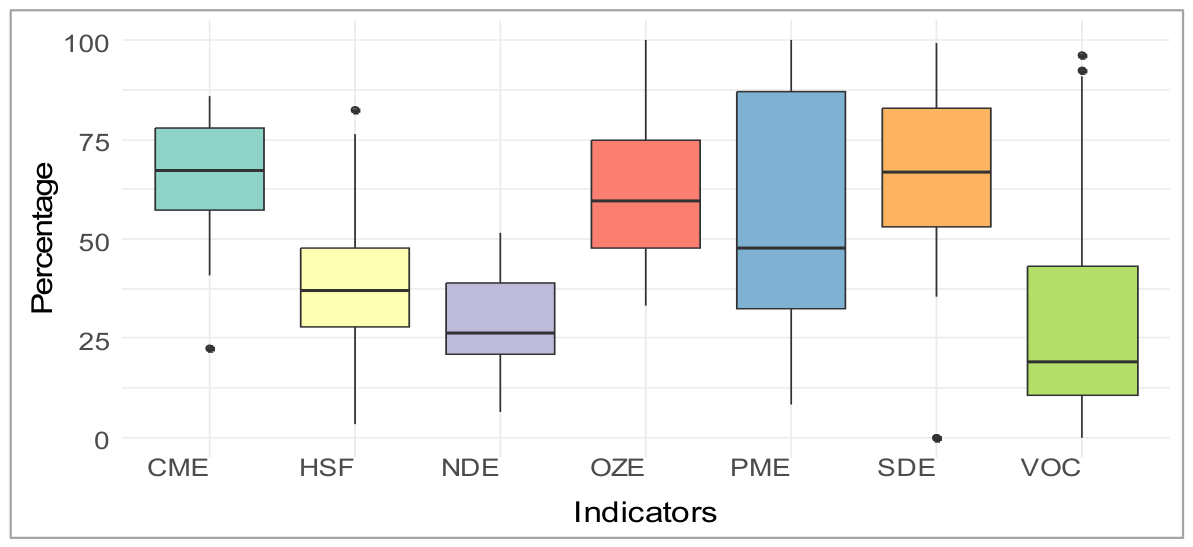
Table 3 summarizes the descriptive statistics of the air quality indicators for Latin American and Caribbean countries in 2024, while Figure 2 illustrates the distribution of these indicators.
At the regional level, air quality indicators in Central America and the Caribbean reveal notable differences in levels of exposure to atmospheric pollution, linked to both structural conditions and local emission processes.
Overall air quality is positioned at an intermediate level, with values centered around 50%, which suggests that approximately half of the countries lie above and below this threshold, highlighting the diversity of environmental conditions across the region.
The PME indicator stands out as the most heterogeneous, with a median value of 48% and a range extending up to 100%. In contrast, exposure to VOCs shows the lowest median (≈19%) and a narrow distribution, indicating relatively uniform and limited exposure across the region. Similarly, NDE exhibits a low median (≈25%), accompanied by a low standard deviation, suggesting limited variability in the observed values.
The SDE and CME indicators display similar profiles (≈67%), with high median values and moderate interquartile ranges, suggesting a significant presence of these pollutants in urban and industrial areas.
Exposure to HSF remains above the regional average (≈37%), reflecting both secondary emissions and the persistence of traditional household practices in rural areas.
These findings suggest that while some pollutants exhibit relatively homogeneous distributions, others reveal marked disparities that may be associated with differences in infrastructure, environmental regulation, population density, and emission sources.
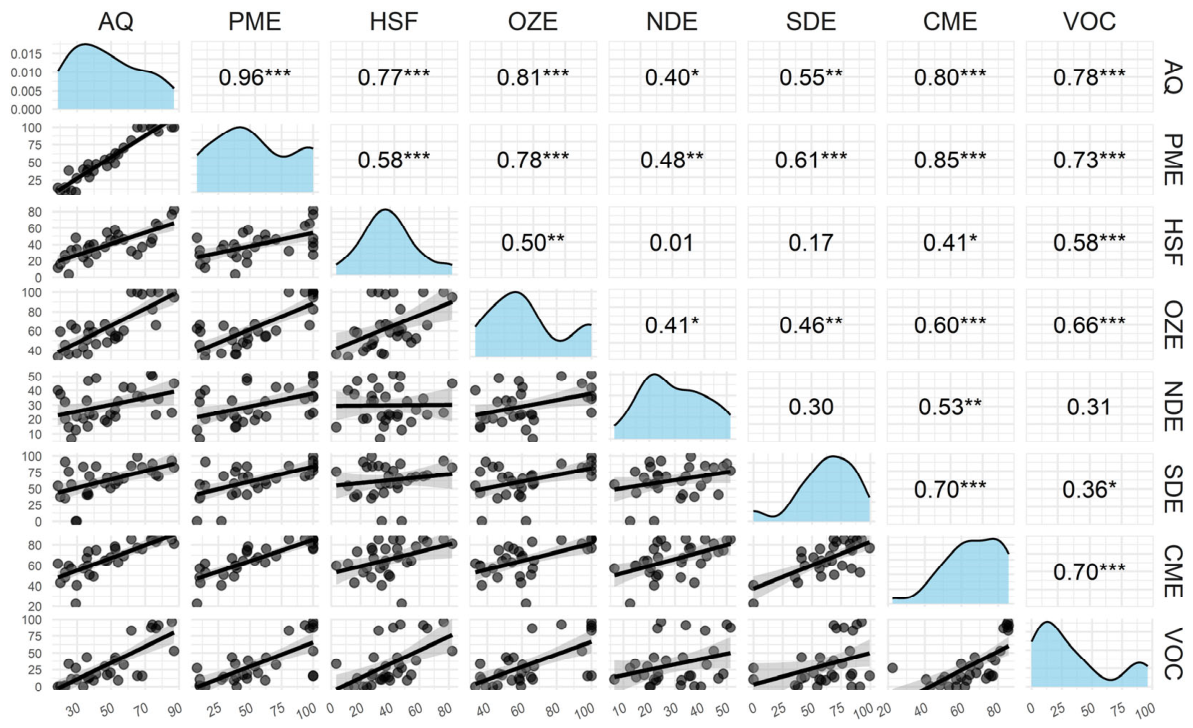
Figure 3 presents the correlation matrix among air quality indicators for countries in Latin America and the Caribbean in 2024. The upper panel displays Pearson correlation coefficients along with their corresponding levels of statistical significance (* p < 0.05, ** p < 0.01, *** p < 0.001), while the lower panel shows the scatterplots for each pair of indicators.
Figure 3 shows significant associations among several indicators, both statistically and visually. A strong positive correlation is observed between AQ and PME (r = 0.96, p < 0.001), suggesting that overall air quality is strongly influenced by exposure to anthropogenic fine particles. High correlations are also evident between PME and CME (r = 0.85, p < 0.001), between AQ and Ozone (r = 0.81, p < 0.001), and between AQ and CME (r = 0.80, p < 0.001). These relationships indicate that suspended particles and fine particulate matter tend to vary jointly, possibly because of common emission sources or similar atmospheric conditions.
On the other hand, VOCs show moderate, although statistically significant, correlations with PME (r = 0.73, p < 0.001), CME (r = 0.70, p < 0.001), and OZE (r = 0.66, p < 0.001). These associations suggest that these pollutants share common sources, mainly related to combustion processes. In addition, the relationship between VOCs and PME reflects gas-to-particle conversion via VOC oxidation, forming secondary organic aerosols. In contrast, NDE exhibits weaker correlations with OZE (r = 0.41, p < 0.05) and with VOCs (r = 0.31, p < 0.05), indicating that its behavior is driven by different emissions, formation, or dispersion dynamics. This is particularly relevant for OZE, a secondary pollutant whose concentration depends on photochemical reactions in the atmosphere.
The scatterplots in the lower panel of the matrix reinforce these associations, showing clear linear relationships for highly correlated pairs and more diffuse patterns for those with weaker relationships.

3.2. Methods

This section presents the results obtained from the applied multivariate methodology. The interpretation of the HJ-Biplot is based on key metrics such as eigenvalues and explained variance (Table 4), and the relative contribution of each factor (Table 5).
According to the values reported in Table 4, the first axis accounts for 59.95% of the total inertia of the system, positioning it as the dominant component of the analysis. The first two axes jointly explain 75.85% of the variability, while the inclusion of the third axis increases the cumulative inertia to 85.83% and the fourth axis to 91.43%. Beyond this point, the remaining factors contribute relatively little additional information; therefore, retaining the first two factorial axes is considered appropriate.
Table 5 indicates that Axis 1 is characterized by relatively high and homogeneous loadings across most air quality indicators, with PME showing the largest contribution. Comparable loadings are also observed for CME, OZE and VOC, supporting the interpretation of this axis as a broad measure of atmospheric pollution intensity. Rather than reflecting a specific emission source, the first component captures a general exposure gradient driven by the combined presence of particulate matter and combustion-related pollutants, summarizing overall air pollution burden across the region.
In contrast, Axis 2 exhibits a more differentiated structure, with strong but opposing loadings for HSF and NDE. This configuration suggests that the second component reflects contrasting emission profiles associated with household solid fuel use on one side and traffic- and industry-related nitrogen dioxide exposure on the other. As such, Axis 2 appears to capture a developmental or structural dimension of air pollution, distinguishing domestic combustion patterns from more urbanized emission sources. Sulfur Dioxide Exposure (SDE) exhibits moderate loadings on the first two axes, indicating that it does not contribute predominantly to either. This pattern suggests that most of its variance may be more appropriately captured along a potential third axis, rather than the first two principal dimensions.
Overall, the two axes can be interpreted as representing complementary dimensions of air quality. Axis 1 reflects the overall intensity of atmospheric pollution, as indicated by its strong association with most pollutant exposures, particularly PM2.5, carbon monoxide, and ozone. In contrast, Axis 2 appears to capture the energy transition pattern, distinguishing between pollution linked to household solid fuel use and that associated with urban and industrial emission sources.
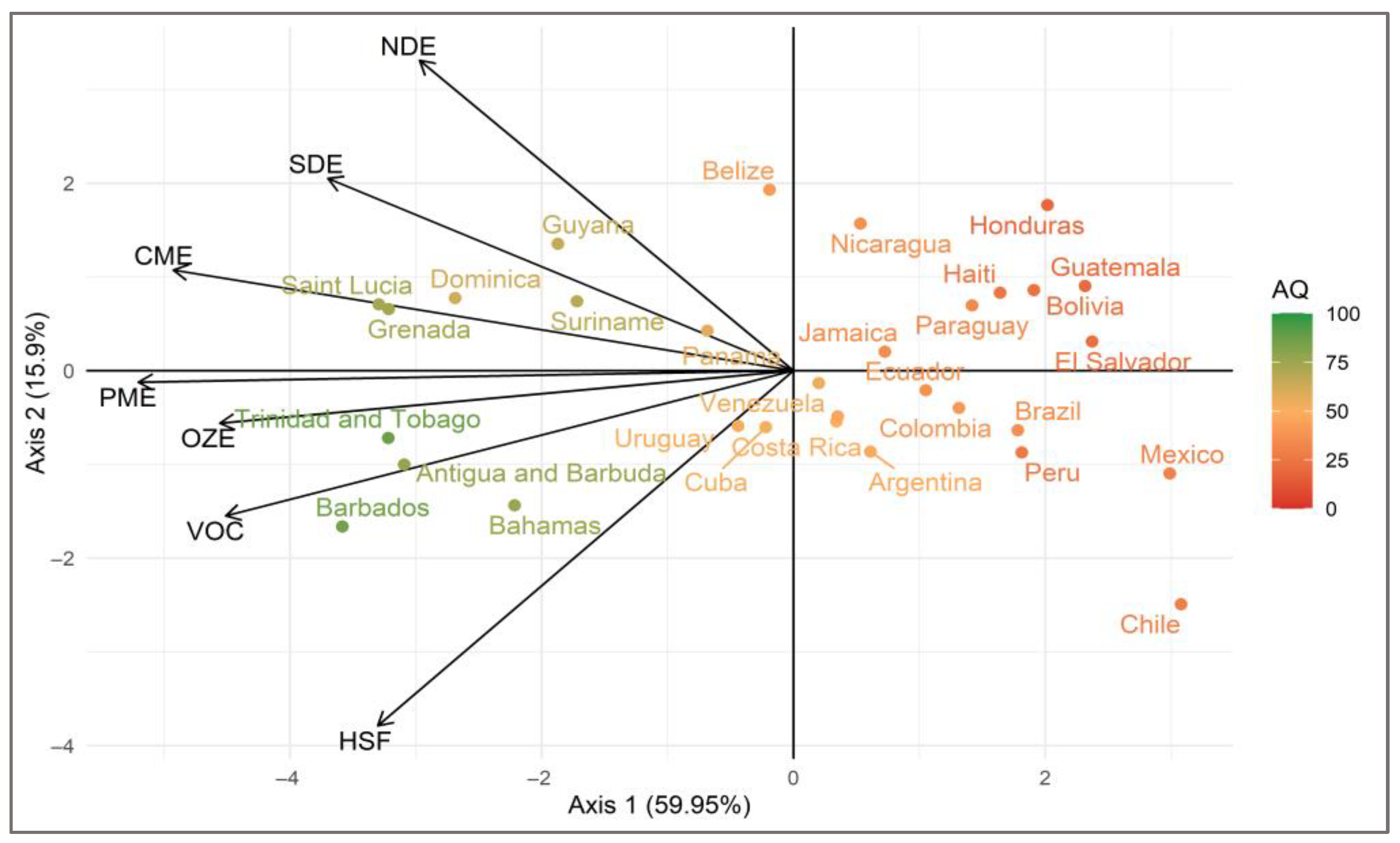
Figure 4 presents the HJ-Biplot, in which countries and air quality indicators (vectors) are jointly represented, allowing for the simultaneous visualization of associations between the observations (countries) and the variables considered. This representation facilitates the interpretation of clustering structures, proximity, and direction, revealing structural relationships between environmental exposure profiles and the countries analyzed.
Figure 4 shows that Axis 1 explains 59.95% of the total variability, representing the dominant gradient in the data structure. This axis reflects a common pattern of pollution, characterized by relatively similar loadings among most pollutants, although PME, OZE, CME, and VOC display higher weights in the definition of this dimension. Meanwhile, Axis 2 explains an additional relevant proportion of variability (15.90%). This axis introduces a contrasting pattern primarily structured by household solid fuel use and nitrogen dioxide exposure. The opposite orientation of these indicators suggests a differentiation between traditional domestic combustion practices and urban traffic-related emissions, pointing to a structural dimension linked to energy transition and urbanization levels. Figure 4 also shows the spatial distribution of countries within the factorial plane, allowing the identification of differentiated regional profiles in terms of exposure to the various pollutants. The color scale representing Air Quality adds an additional layer of interpretation, as it facilitates comparison between the structural pollution gradients and overall air quality performance.
Countries located in Quadrant I—including Honduras, Guatemala, Haiti, Bolivia, Paraguay, El Salvador, Nicaragua, and Jamaica—exhibit positive values on both axes. Their position toward the NDE and SDE vectors suggests that atmospheric pollution exposure is largely driven by domestic sources related to residential combustion. The AQ color scale indicates generally moderate to lower performance within this group, consistent with higher exposure intensity. This pattern points to a mixed form of pollution, with a predominance of socioeconomic factors associated with dependence on solid fuels.
Quadrant II includes Guyana, Suriname, Dominica, Saint Lucia, Grenada, and Panama. These countries combine negative values on Axis 1 with positive values on Axis 2. Their location suggests relatively stable environmental conditions and low exposure to combustion-related pollutants. This may be associated with lower levels of industrialization, more dispersed or low-intensity emissions, and, in some cases, more effective environmental control policies.
In Quadrant III, the Bahamas, Barbados, Antigua and Barbuda, Trinidad and Tobago, Uruguay and Cuba display negative values on both axes, indicating relatively low overall pollution. This configuration suggests that, although these countries generally show favorable air quality levels, domestic or local combustion sources persist, possibly related to fossil fuel use in transportation and electricity generation, or to limited biomass use in residential or tourism-related sectors. Nevertheless, good ventilation conditions and low urban density contribute to favorable air quality outcomes.
Quadrant IV includes Chile, Mexico, Peru, Brazil, Argentina, Colombia, Costa Rica, the Dominican Republic, Ecuador and Venezuela. These countries are associated with relatively high values along Axis 1. These countries are closely related to PME, OZE, VOC and HSF, suggesting that their atmospheric pollution is dominated by urban and industrial sources. This pattern reflects the profile of modern atmospheric pollution, characteristics of more urbanized economies with high levels of motorization.
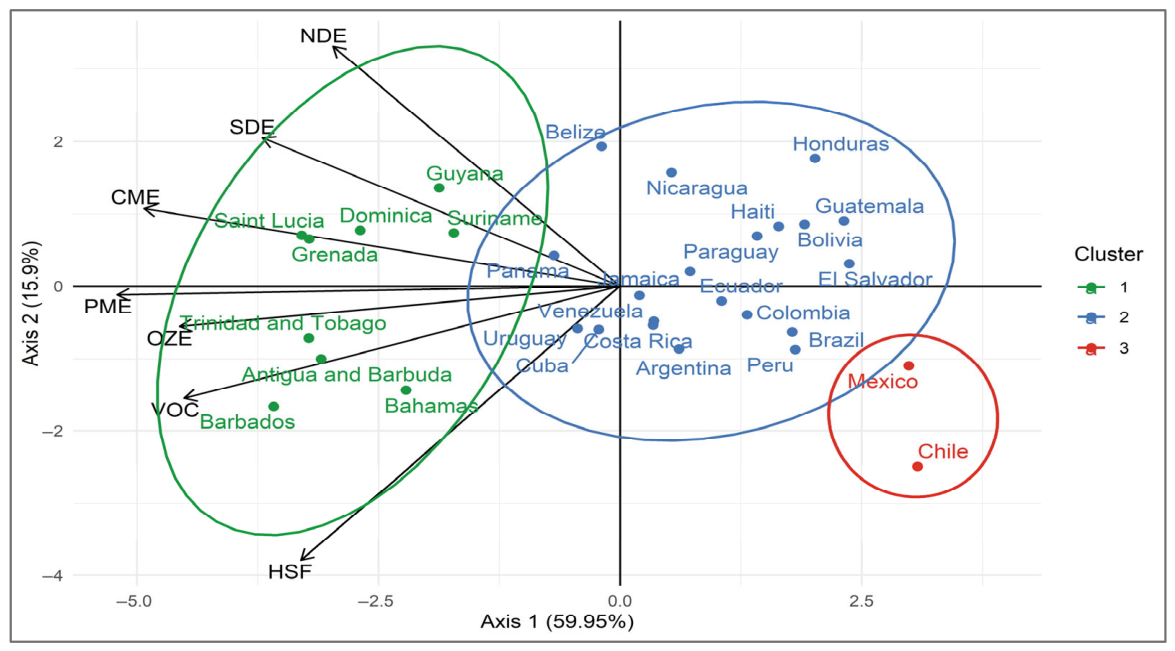
To complement this analysis, a cluster analysis was conducted to identify groups of countries with similar characteristics based on their exposure profiles across the different air quality indicators (Figure 5).
The cluster analysis (Figure 5) reveals three distinct regional profiles in terms of exposure to atmospheric pollutants.
Cluster 1, located at the leftmost end of Axis 1, groups Caribbean island states such as Dominica, Saint Lucia, Grenada, the Bahamas, Barbados, Antigua and Barbuda, and Trinidad and Tobago, as well as two continental countries on the Atlantic coast: Guyana and Suriname. These nations are characterized by low exposure to the pollutants analyzed and generally better air quality levels. Their position toward the vectors associated with VOC, OZE, and, to a lesser extent, HSF suggests that pollution sources, when present, tend to be more diffuse and less dominated by large-scale industrial combustion processes.
Cluster 2, located in the intermediate zone of the factorial space, represents the most structurally heterogeneous group. It includes Central American countries such as Belize, Panama, Nicaragua, Costa Rica, Honduras, Guatemala, and El Salvador; Caribbean states such as Jamaica, Haiti, the Dominican Republic and Cuba; and several South American countries including Colombia, Ecuador, Peru, Bolivia, Paraguay, Argentina, Uruguay, Brazil and Venezuela. Despite their geographic dispersion, these countries share intermediate-to-elevated pollution burdens along Axis 1. Their distribution along Axis 2 reflects heterogeneous emission structures: some align more closely with NDE and SDE (urban–industrial patterns), while others remain nearer to the central region of the factorial space. Air quality performance within this cluster reflects differences in urban concentration, energy structure, and emission management, consistent with regional evidence linking pollution levels to urbanization and industrial activity.
Cluster 3, situated at the rightmost end of Axis 1, consists of Mexico and Chile. These countries exhibit the highest pollution profiles, with greater overall exposure intensity. Their position, distant from the household solid fuel vector and closer to combustion-related pollutant directions, suggests pollution structures more strongly associated with urbanization, motorization, and industrial activity—factors widely recognized as major sources of air pollution in the region. The air quality scale indicates relatively lower performance within this cluster compared to the regional average, reinforcing the interpretation of a more concentrated atmospheric burden.
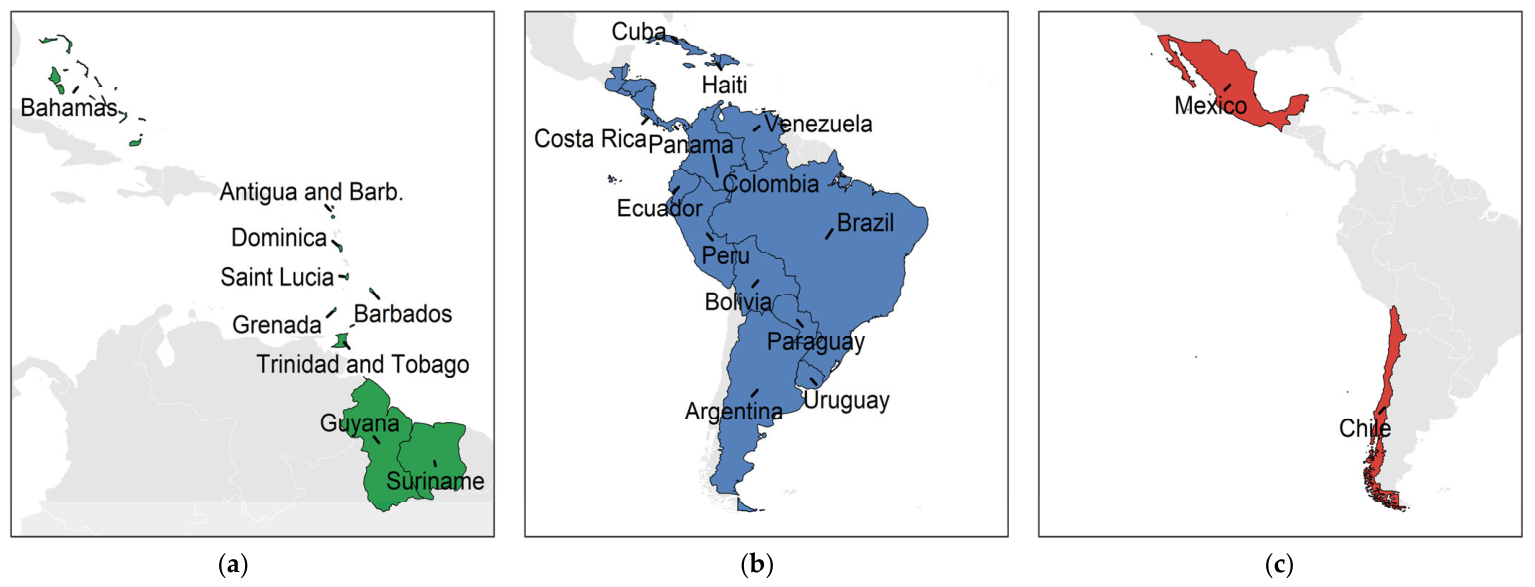
Figure 6 illustrates the geographic distribution of the countries belonging to each cluster, allowing for a clearer visualization of the spatial differences and regional profiles identified in the analysis.
Figure 6a groups countries characterized by low levels of industrial and urban density, favorable natural ventilation conditions, and relatively stable environmental dynamics, which together suggest better air quality compared to the rest of the countries in the region.
Figure 6b represents a mixed profile that combines urban and domestic emission sources, with moderate levels of pollution. This pattern reflects diversified emission structures in which urban–industrial sources and other localized emission profiles coexist to varying degrees.
Figure 6c concentrates on countries exhibiting high levels of pollution, typical of highly urbanized nations or those with strong energy-related emission sources. Moreover, in these territories, emissions derived from fossil fuel combustion predominate, intensifying the atmospheric pollutant load and posing significant challenges in terms of public health and environmental sustainability.
In summary, the geographic representation confirms the structural consistency of the HJ-Biplot and highlights differentiated profiles across Latin America and the Caribbean. Figure 6a shows countries with low overall pollution, where moderate domestic emissions prevail and air quality is relatively better. Figure 6b includes countries with intermediate pollution levels, influenced by mixed emission sources. Figure 6c comprises countries with high levels of urban and industrial pollution, dominated by combustion-related gaseous emissions.

4. Discussion

The results of this study provide a clearer understanding of the differences and similarities in air quality indicators across countries in Latin America and the Caribbean. The analysis reveals a regional pollution gradient ranging from Caribbean islands—characterized by less polluting economic structures—to the more industrialized and densely populated nations of the continent. In this context, Caribbean island countries tend to exhibit relatively low levels of atmospheric pollution. According to Mark [42], this is largely attributable to climatic factors such as the trade winds, which enhance pollutant dispersion, as well as to the absence of large continental landmasses.
In contrast, countries in South and Central America show a deterioration in air quality, consistent with findings reported in Refs. [43,44]. The high concentrations of anthropogenic PM2.5 and nitrogen dioxide observed in these regions are consistent with studies emphasizing the combined contributions of vehicular [32,45], industrial, and domestic sources [12] in densely populated urban environments [15].
A key contribution of this study is the identification of household solid fuel use as a persistent source of pollution, even in peri-urban areas. The literature has extensively documented its impact on human health [28] and on both indoor and outdoor air quality [46]. These findings underscore the urgency of advancing energy transitions that promote cleaner cooking technologies, particularly in countries where such practices remain widespread, as well as fostering more energy-efficient cities supported by the use of clean energy sources [47].
From a methodological perspective, the combined application of the HJ-Biplot and cluster analysis made it possible to identify structural relationships among air quality indicators, revealing clear groupings of countries with similar pollution profiles. This multivariate approach has been highlighted in previous studies for its ability to synthesize large volumes of data and facilitate the interpretation of spatial patterns [48,49].
The assessment and management of air quality have become strategic priorities for governments and communities, particularly in urban areas where emissions from industrial activity, transportation, and energy generation intensify pollutant concentrations. Overall, the findings suggest that atmospheric pollution levels in the region are strongly shaped by socioeconomic, demographic, and technological factors. The observed differences among countries highlight the importance of strengthening monitoring systems, harmonizing measurement methodologies, and advancing toward integrated management approaches that consider both urban and domestic emissions.
Future research may focus on evaluating the effectiveness of energy transition and sustainable mobility policies across different contexts in Latin America and the Caribbean, complemented by longitudinal studies documenting the evolution of air quality in response to climate change and emerging technological transformations. Such an approach would help inform more targeted public policies and coordinated regional strategies to reduce exposure to atmospheric pollutants.

5. Conclusions

This study examined air quality indicators in Latin America and the Caribbean through a multivariate approach based on HJ-Biplot and cluster analysis, using data from the Environmental Performance Index (EPI) for the year 2024. The results revealed that air quality in the region presents a heterogeneous regional structure, defined by a gradient that clearly differentiates island states from continental nations with more urban–industrial emission structures.
The application of the HJ-Biplot methodology made it possible to identify two main dimensions: the first axis captured a general gradient of atmospheric pollution intensity, strongly associated with exposure to fine particulate matter (PM2.5), ozone, carbon monoxide, and volatile organic compounds. In turn, the second axis reflected contrasting emission structures related to the use of household solid fuels and exposure to urban–industrial nitrogen dioxide. This characterization enabled the identification of differentiated regional profiles, grouping countries into three clusters with specific environmental challenges: one characterized by low exposure in the Caribbean, an intermediate group with mixed emission structures, and a third group led by Mexico and Chile with the most critical pollution levels.
From a methodological perspective, the integration of HJ-Biplot with clustering techniques proved to be an effective tool for simultaneously examining correlations among indicators and similarities among countries within the same geometric space. This approach not only provided an interpretable visualization of pollution structures but also contributed to a comprehensive understanding of atmospheric heterogeneity in the region.
In conclusion, the findings highlight the importance of developing differentiated environmental strategies that consider both the transition toward cleaner energy sources in vulnerable households and the strengthening of urban and industrial emission control in countries with higher levels of pollution.

Supplementary Materials

The following supporting information can be downloaded at: https://www.mdpi.com/article/10.3390/air4020012/s1, Table S1: Primary sources of indicators used in the study.

Author Contributions

Conceptualization, M.C.-M.; methodology, M.C.-M.; software, C.A.T.-C.; validation, C.A.T.-C. and A.C.; formal analysis, M.C.-M.; investigation, A.C.; resources, C.A.T.-C.; data curation, A.C.; writing—original draft preparation, M.C.-M.; writing—review and editing, C.A.T.-C.; visualization, A.C.; supervision, M.C.-M.; project administration, A.C.; funding acquisition, M.C.-M. All authors have read and agreed to the published version of the manuscript.

Funding

This study was made possible thanks to the support of the Sistema Nacional de Investigacion (SNI) of the Secretaria Nacional de Ciencia, Tecnologia e Innovacion (Panama). Convocatoria Pública para el Ingreso de Nuevos Miembros al SIN de Panama 2020 (Grant Number: SIN-NM2020).

Institutional Review Board Statement

Not applicable.

Informed Consent Statement

Not applicable.

Data Availability Statement

The data analyzed in this study were collected from the Air Quality category of the 2024 Environmental Performance Index, available at: https://epi.yale.edu/measure/2024/AIR, accessed on 28 October 2025.

Conflicts of Interest

The authors declare no conflicts of interest.

References

  1. Kang, G.K.; Gao, J.Z.; Chiao, S.; Lu, S.; Xie, G. Air Quality Prediction: Big Data and Machine Learning Approaches. Int. J. Environ. Sci. Dev. 2018, 9, 8–16. [Google Scholar] [CrossRef]
  2. Yavuz, V. An Analysis of Atmospheric Stability Indices and Parameters under Air Pollution Conditions. Environ. Monit. Assess. 2023, 195, 934. [Google Scholar] [CrossRef]
  3. Schulze, F.; Gao, X.; Virzonis, D.; Damiati, S.; Schneider, M.R.; Kodzius, R. Air Quality Effects on Human Health and Approaches for Its Assessment through Microfluidic Chips. Environ. Monit. Assess. 2017, 8, 244. [Google Scholar] [CrossRef]
  4. Feeney, J.; McLoughlin, S.; Nolan, A. Fine Particulate Matter Air Pollution and Cognitive Function in Older Age: Evidence from the Irish Longitudinal Study on Ageing (Tilda). SSRN 2025. [Google Scholar] [CrossRef]
  5. Mukta, T.A.; Hoque, M.M.M.; Sarker, M.E.; Hossain, M.N.; Biswas, G.K. Seasonal Variations of Gaseous Air Pollutants (SO2, NO2, O3, CO) and Particulates (PM2.5, PM10) in Gazipur: An Industrial City in Bangladesh. Adv. Environ. Technol. 2020, 6, 195–209. [Google Scholar] [CrossRef]
  6. Meo, S.A.; Shaikh, N.; Alotaibi, M. Association between Air Pollutants Particulate Matter (PM2.5, PM10), Nitrogen Dioxide (NO2), Sulfur Dioxide (SO2), Volatile Organic Compounds (VOCs), Ground-Level Ozone (O3) and Hypertension. J. King Saud Univ. Sci. 2024, 36, 103531. [Google Scholar] [CrossRef]
  7. Saini, J.; Dutta, M.; Marques, G. A Comprehensive Review on Indoor Air Quality Monitoring Systems for Enhanced Public Health. Sustain. Environ. Res. 2020, 30, 6. [Google Scholar] [CrossRef]
  8. Manisalidis, I.; Stavropoulou, E.; Stavropoulos, A.; Bezirtzoglou, E. Environmental and Health Impacts of Air Pollution: A Review. Front. Public Health 2020, 8, 14. [Google Scholar] [CrossRef]
  9. Garland, R.M.; Naydoo, M.; Sibiya, B.; Oosthuizen, R. Air Quality Indicators from the Environmental Performance Index: Potential Use and Limitations in South Africa. Clean Air J. 2017, 27, 33–41. [Google Scholar] [CrossRef]
  10. Bhatti, U.A.; Zeeshan, Z.; Nizamani, M.M.; Bazai, S.; Yu, Z.; Yuan, L. Assessing the Change of Ambient Air Quality Patterns in Jiangsu Province of China Pre-to Post-COVID-19. Chemosphere 2022, 288, 132569. [Google Scholar] [CrossRef] [PubMed]
  11. Fowler, D.; Brimblecombe, P.; Burrows, J.; Heal, M.R.; Grennfelt, P.; Stevenson, D.S.; Jowett, A.; Nemitz, E.; Coyle, M.; Lui, X.; et al. A Chronology of Global Air Quality. Philos. Trans. R. Soc. A Math. Phys. Eng. Sci. 2020, 378, 20190314. [Google Scholar] [CrossRef]
  12. Idrees, M.; Nergis, Y.; Irfan, M. Industrial Emission Monitoring and Assessment of Air Quality in Karachi Coastal City, Pakistan. Atmosphere 2023, 14, 1515. [Google Scholar] [CrossRef]
  13. Wu, L.; Li, N.; Yang, Y. Prediction of Air Quality Indicators for the Beijing-Tianjin-Hebei Region. J. Clean. Prod. 2018, 196, 682–687. [Google Scholar] [CrossRef]
  14. Ordoñez-Aquino, C.; Gonzales, G.F. Air Quality in Peru Doesn’t Adopts the Values Recommended by the World Health Organization (WHO). Rev. Medica Hered. 2023, 34, 236–238. [Google Scholar] [CrossRef]
  15. Gómez Peláez, L.M.; Santos, J.M.; de Almeida Albuquerque, T.T.; Reis, N.C.; Andreão, W.L.; de Fátima Andrade, M. Air Quality Status and Trends over Large Cities in South America. Environ. Sci. Policy 2020, 114, 422–435. [Google Scholar] [CrossRef]
  16. Donzelli, G.; Cioni, L.; Cancellieri, M.; Llopis-Morales, A.; Morales-Suárez-Varela, M. Air Quality during Covid-19 Lockdown. Encyclopedia 2021, 1, 519–526. [Google Scholar] [CrossRef]
  17. Zhong, S.; Yu, Z.; Zhu, W. Study of the Effects of Air Pollutants on Human Health Based on Baidu Indices of Disease Symptoms and Air Quality Monitoring Data in Beijing, China. Int. J. Environ. Res. Public Health 2019, 16, 1014. [Google Scholar] [CrossRef] [PubMed]
  18. Monoson, A.; Schott, E.; Ard, K.; Kilburg-Basnyat, B.; Tighe, R.M.; Pannu, S.; Gowdy, K.M. Air Pollution and Respiratory Infections: The Past, Present, and Future. Toxicol. Sci. 2023, 192, 3–14. [Google Scholar] [CrossRef]
  19. Leontjevaite, K.; Donnelly, A.; MacIntyre, T.E. Air Pollution Effects on Mental Health Relationships: Scoping Review on Historically Used Methodologies to Analyze Adult Populations. Air 2024, 2, 258–291. [Google Scholar] [CrossRef]
  20. WHO. Available online: https://www.who.int/news-room/fact-sheets/detail/ambient-(outdoor)-air-quality-and-health (accessed on 1 October 2025).
  21. IQAir. First in Air Quality. Available online: https://www.iqair.com/ (accessed on 28 October 2025).
  22. Gautam, S.; Gautam, A.S.; Awasthi, A.; Ramsundram, N. Air Quality Monitoring and Measurement. In Sustainable Air: Strategies for Cleaner Atmosphere and Healthier Communities; Springer: Cham, Switzerland, 2024; pp. 39–46. [Google Scholar] [CrossRef]
  23. Home—Clean Air Institute. Available online: https://www.cleanairinstitute.org/ (accessed on 28 October 2025).
  24. Climate Data for Action. Climate Watch—Emissions and Policies. Available online: https://www.climatewatchdata.org/ (accessed on 28 October 2025).
  25. Environmental Performance Index. Available online: https://epi.yale.edu/ (accessed on 28 October 2025).
  26. Block, S.; Emerson, J.W.; Esty, D.C.; Sherbinin, A.D.; Wendling, Z.A. Environmental Performance Index; Yale Center for Environmental Law & Policy: New Haven, CT, USA, 2024. [Google Scholar]
  27. Jiang, L.; Zhou, H.; Bai, L.; Zhou, P. Does Foreign Direct Investment Drive Environmental Degradation in China? An Empirical Study Based on Air Quality Index from a Spatial Perspective. J. Clean. Prod. 2018, 176, 864–872. [Google Scholar] [CrossRef]
  28. Balmes, J.R. Household Air Pollution from Domestic Combustion of Solid Fuels and Health. J. Allergy Clin. 2019, 143, 1979–1987. [Google Scholar] [CrossRef] [PubMed]
  29. Mitchell, E.J.S. Emissions from Residential Solid Fuel Combustion and Implications for Air Quality and Climate Change. Doctoral Dissertation, University of Leeds, Leeds, UK, 2017. [Google Scholar]
  30. Dhanya, G.; Pranesha, T.S.; Nagaraja, K.; Chate, D.M.; Beig, G. Variability of Ozone and Oxides of Nitrogen in the Tropical City, Bengaluru, India. Environ. Monit. Assess. 2021, 193, 844. [Google Scholar] [CrossRef] [PubMed]
  31. Ali, M.A.; Assiri, M.E.; Islam, M.N.; Bilal, M.; Ghulam, A.; Huang, Z. Identification of NO2 and SO2 over China: Characterization of Polluted and Hotspots Provinces. Air Qual. Atmos. Health 2024, 17, 2203–2221. [Google Scholar] [CrossRef]
  32. Sitanggang, J.W.; Sunarsih, E.; Hasyim, H. Literature Review: Analysis of Exposure of Vehicle Emission Gases (Co, No2, So2, Pm2.5, and Pm10) to Public Health Risks. J. Soc. Res. 2023, 2, 2278–2287. [Google Scholar] [CrossRef]
  33. Salthammer, T. Carbon Monoxide as an Indicator of Indoor Air Quality. Environ. Sci. Atmos. 2024, 4, 291–305. [Google Scholar] [CrossRef]
  34. Rumchev, K.; Brown, H.; Spickett, J. Volatile Organic Compounds: Do They Present a Risk to Our Health? Rev. Environ. Health 2007, 22, 39. [Google Scholar] [CrossRef]
  35. Kotzias, D. Built Environment and Indoor Air Quality: The Case of Volatile Organic Compounds. AIMS Environ. Sci. 2021, 8, 135–147. [Google Scholar] [CrossRef]
  36. Villardón, M.P.G. Una Alternativa de Representación Simultánea: HJ-Biplot. Qüestiió Quad. D’estadística Investig. Oper. 1986, 10, 13–23. [Google Scholar]
  37. Romesburg, H.C. Cluster Analysis for Researchers; Lulu Press: Durham, NC, USA, 2004. [Google Scholar]
  38. Cubilla-Montilla, M. Contribuciones al Análisis Biplot Basadas en Soluciones Factoriales Disjuntas y en Soluciones Sparse. Ph.D. Thesis, Universidad de Salamanca, Salamanca, Spain, 2019. [Google Scholar]
  39. RStudio: Integrated Development for R, Version 4.2.1. [Computer Software]. RStudio PBC: Boston, MA, USA, 2020.
  40. Cubilla-Montilla, M.; Castillo, A.; Torres-Cubilla, C.A. Cross-National Patterns of Quality of Life According to HDI Levels: A Multivariate Approach Using Partial Triadic Analysis. Reg. Sci. Environ. Econ. 2026, 3, 2. [Google Scholar] [CrossRef]
  41. Cubilla-Montilla, M.; Carrasco, G.; Castillo, M. Assessment of Water Quality in the Panama Canal Watershed Using Multivariate Analysis of Physicochemical and Biological Parameters. Water 2025, 17, 979. [Google Scholar] [CrossRef]
  42. Jury, M.R. Caribbean Air Chemistry and Dispersion Conditions. Atmosphere 2017, 8, 151. [Google Scholar] [CrossRef]
  43. Huneeus, N.; Denier Van Der Gon, H.; Castesana, P.; Menares, C.; Granier, C.; Granier, L.; Alonso, M.; De, M.; Andrade, F.; Dawidowski, L.; et al. Evaluation of Anthropogenic Air Pollutant Emission Inventories for South America at National and City Scale. Atmos. Environ. 2020, 235, 117606. [Google Scholar] [CrossRef]
  44. La Colla, N.S.; Botté, S.E.; Marcovecchio, J.E.; La Colla, N.; Botté, S.; La Colla, N. Atmospheric Particulate Pollution in South American Megacities. Environ. Rev. 2021, 29, 415–429. [Google Scholar] [CrossRef]
  45. Chasapi, M.-A.; Moustris, K.; Fameli, K.-M.; Spyropoulos, G. The Application of an Empirical Method for the Estimation of Vehicles’ Contribution to Air Pollution in an Urban Environment: A Case Study in Athens, Greece. Air 2025, 3, 14. [Google Scholar] [CrossRef]
  46. Husaini, D.C.; Manzur, K.; Medrano, J. Indoor and Outdoor Air Pollutants as Emerging Public Health Threat in Latin America and the Caribbean: A Systematic Review. Arab Gulf J. Sci. Res. 2024, 42, 134–145. [Google Scholar] [CrossRef]
  47. Usman, M.; Balsalobre-Lorente, D.; Jahanger, A.; Ahmad, P. Are Mercosur Economies Going Green or Going Away? An Empirical Investigation of the Association between Technological Innovations, Energy Use, Natural Resources and GHG Emissions. Gondwana Res. 2023, 113, 53–70. [Google Scholar] [CrossRef]
  48. Kariyam; Abdurakhman; Effendie, A.R. Comparison of Several Clustering Methods in Classifying Countries Based on the Environmental Performance Index. AIP Conf. Proc. 2025, 3248, 40001. [Google Scholar] [CrossRef]
  49. Saraiva, C.; Caiado, J. Global Development Patterns: A Clustering Analysis of Economic, Social and Environmental Indicators. Sustain. Futures 2025, 10, 100907. [Google Scholar] [CrossRef]
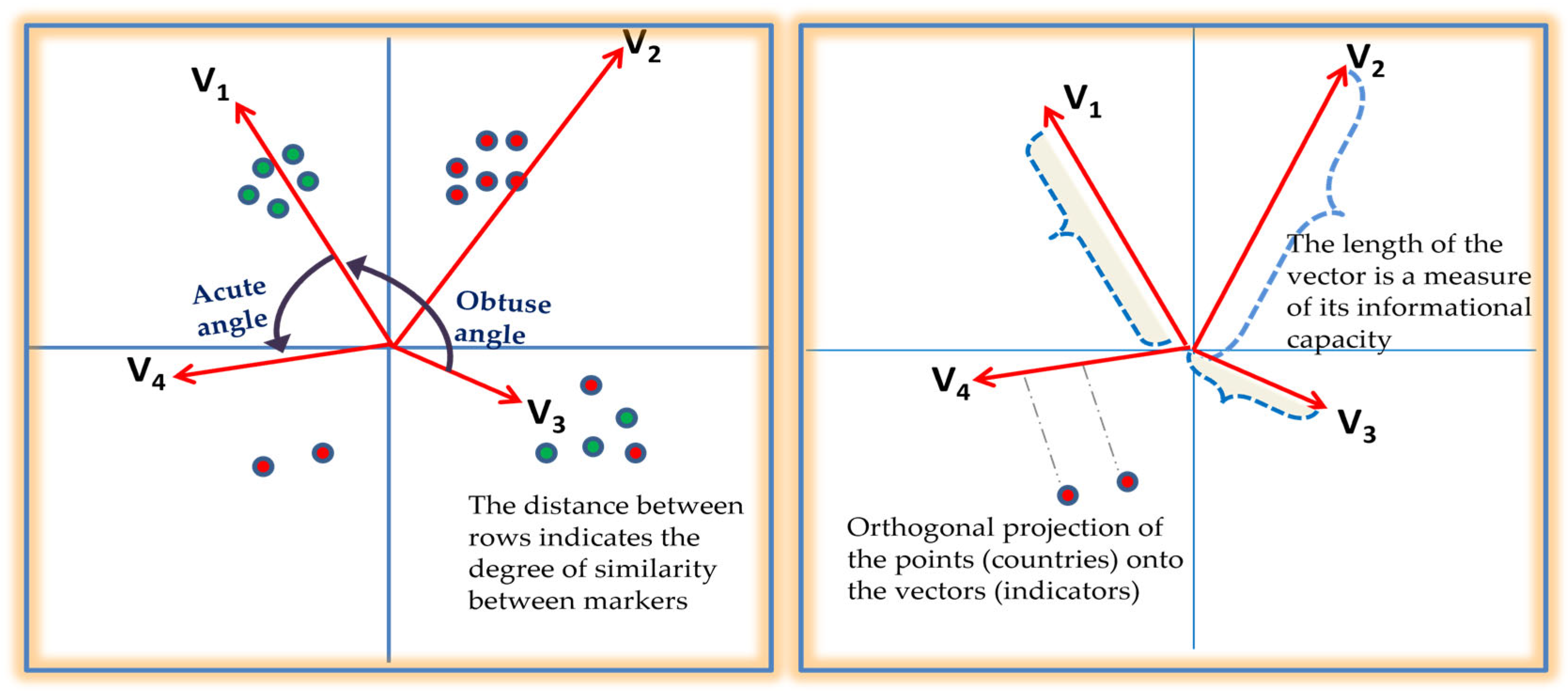
Figure 1. Interpretation of the elements in the HJ-Biplot representations.
Air 04 00012 g001
Figure 2. Air Quality Indicators in Latin America and the Caribbean, 2024.
Air 04 00012 g002
Figure 3. Bivariate correlation matrix of air quality indicators. Significance levels: * p < 0.05; ** p < 0.01; *** p < 0.001.
Air 04 00012 g003
Figure 4. HJ-Biplot of air quality indicators in Latin America and the Caribbean.
Air 04 00012 g004
Figure 5. Cluster representation.
Air 04 00012 g005
Figure 6. Geographic distribution of the countries forming each cluster. (a) Countries with low overall pollution; (b) Countries with intermediate pollution levels; (c) Countries with high urban and industrial pollution.
Air 04 00012 g006
Table 1. Air quality indicators compiled by the Environmental Performance Index (EPI).
Indicator (%)CodeDescription [25]
Air QualityAQMeasures the impacts of air pollution on human health in each country.
Anthropogenic PM2.5 exposurePMEMeasures the exposure to fine particulate matter (PM2.5) from satellite-derived ground-level measurements, weighted by population density.
Household Solid FuelsHSFMeasures the health impacts from the combustion of household solid fuels, using the number of age-standardized disability-adjusted life-years lost per 100,000 persons.
Ozone exposureOZEMeasures ozone exposure using the number of age-standardized disability-adjusted life-years lost per 100,000 persons due to ground-level ozone pollution.
Nitrogen Dioxide exposureNDEMeasures nitrogen dioxide exposure at ground level, using the number of age-standardized disability-adjusted life-years lost per 100,000 persons.
Sulfur Dioxide exposureSDEMeasures sulfur dioxide exposure using the population-weighted annual average concentration at ground level.
Carbon Monoxide exposureCMEMeasures carbon monoxide exposure using the population-weighted annual average concentration at ground level.
Volatile Organic CompoundsVOCMeasures volatile organic compound exposure using the population-weighted annual average concentration at ground level.
Table 2. Countries in the sample, classified by subregions.
CaribbeanCentral AmericaSouth America
Antigua and BarbudaBelizeArgentina
BahamasCosta RicaBolivia
BarbadosEl SalvadorBrazil
CubaGuatemalaChile
DominicaHondurasColombia
GrenadaMexicoEcuador
HaitiNicaraguaGuyana
JamaicaPanamaParaguay
Dominican Republic Peru
Saint Lucia Uruguay
Trinidad and Tobago Surinam
Venezuela
Table 3. Descriptive Statistics.
Indicator (%)MeanStd. Dev.MinimumMaximum
Carbon Monoxide exposure (CME)66.0615.4122.4085.80
Household Solid Fuels (HSF)39.3117.713.4082.40
Nitrogen Dioxide exposure (NDE)29.7211.916.5051.50
Ozone exposure (OZE)63.7521.7833.10100.00
Anthropogenic PM2.5 exposure (PME)54.2831.558.30100.00
Sulfur Dioxide exposure (SDE62.9023.640.0099.30
Volatile Organic Compounds exposure (VOC)32.6230.910.0096.30
Table 4. Eigenvalues and explained variance.
AxisEigenvaluesExplained Variance (%)Cumulative (%)
14.2059.9559.95
21.1115.9075.85
30.709.9885.83
40.395.6091.43
50.354.9496.37
60.172.3798.74
70.091.26100.00
Table 5. Relative contribution of the factor to the element.
IndicatorsAxis 1Axis 2
Anthropogenic PM2.5 exposure9191
Household Solid Fuels420442
Ozone exposure6963
Nitrogen Dioxide exposure262393
Sulfur Dioxide exposure424173
Carbon Monoxide exposure78163
Volatile Organic Compounds exposure67949
Disclaimer/Publisher’s Note: The statements, opinions and data contained in all publications are solely those of the individual author(s) and contributor(s) and not of MDPI and/or the editor(s). MDPI and/or the editor(s) disclaim responsibility for any injury to people or property resulting from any ideas, methods, instructions or products referred to in the content.