
Targeting RAS/MAPK Signaling in Pediatric Gastrointestinal Malignancies: Current Challenges and Future Directions


Abstract
1. Introduction
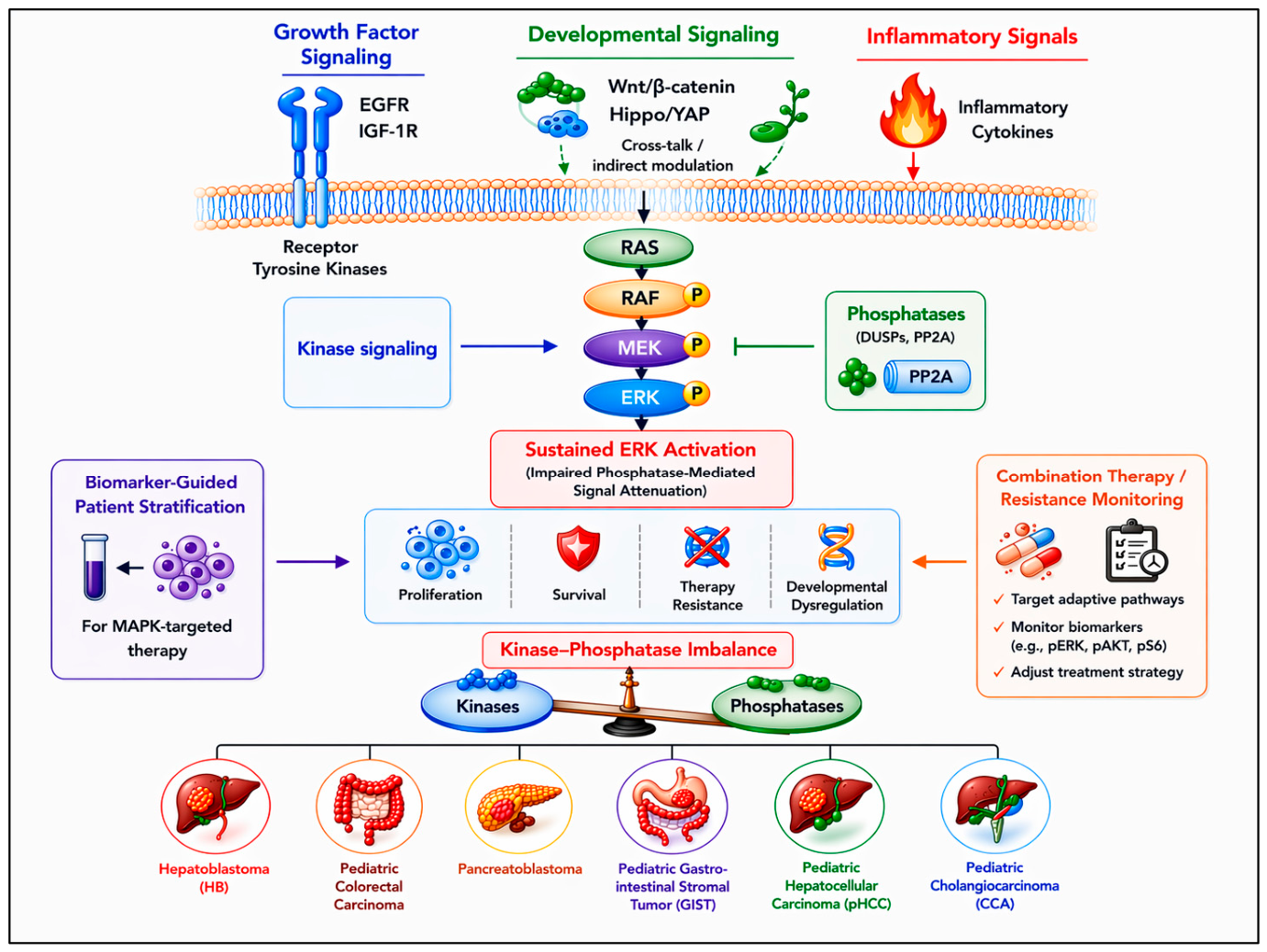
2. RAS/MAPK Signaling as a Post-Translationally Regulated Network
3. Developmental Context of RAS/MAPK Signaling in Pediatric GI Cancers
3.1. Hepatoblastoma (HB): RAS/MAPK Signaling as a Proliferative Amplifier and Therapeutic Modifier
3.2. Pediatric Colorectal Carcinoma: Treatment Challenges and Functional MAPK Activation Beyond KRAS
3.3. Pancreatoblastoma: Developmental Tumor Biology and Limited Therapeutic Standardization
3.4. Pediatric Gastrointestinal Stromal Tumors (GIST): Distinct Biology and Potential MAPK Escape Signaling
3.5. Pediatric Hepatocellular Carcinoma (pHCC): Limited Systemic Options and Need for Pathway-Driven Strategies
3.6. Pediatric Cholangiocarcinoma (CCA): Ultra-Rare Disease with Potential MAPK Linked Vulnerabilities
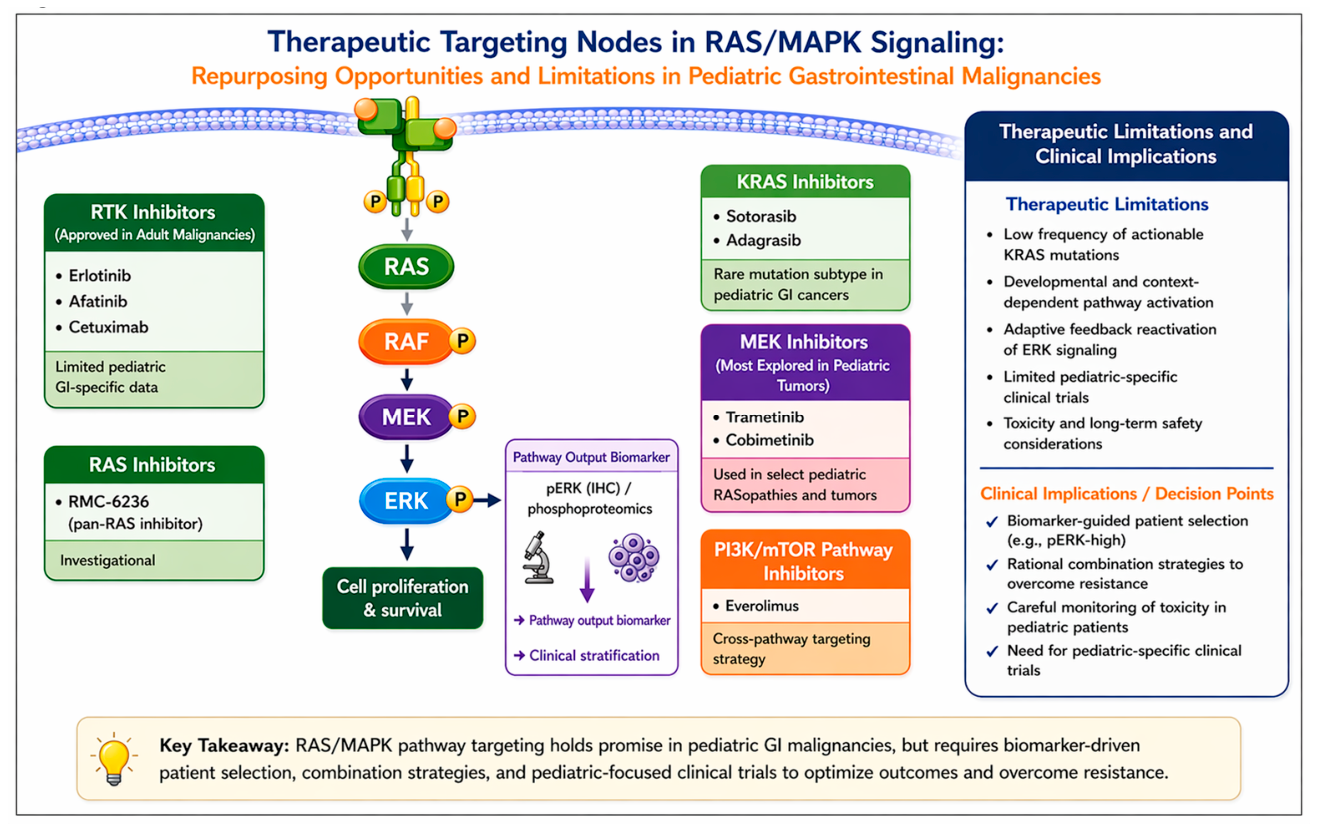
4. Therapeutic Targeting of RAS/MAPK Signaling in Pediatric GI Cancers: Repurposing Opportunities and Limitations
5. Therapeutic Outlook and Research Priorities
6. Disclaimer
Author Contributions
Funding
Institutional Review Board Statement
Informed Consent Statement
Data Availability Statement
Acknowledgments
Conflicts of Interest
References
- Vaske, O.M.; Bjork, I.; Salama, S.R.; Beale, H.; Tayi Shah, A.; Sanders, L.; Pfeil, J.; Lam, D.L.; Learned, K.; Durbin, A. Comparative tumor RNA sequencing analysis for difficult-to-treat pediatric and young adult patients with cancer. JAMA Netw. Open 2019, 2, e1913968. [Google Scholar] [CrossRef]
- Khater, F.; Vairy, S.; Langlois, S.; Dumoucel, S.; Sontag, T.; St-Onge, P.; Bittencourt, H.; Dal Soglio, D.; Champagne, J.; Duval, M. Molecular profiling of hard-to-treat childhood and adolescent cancers. JAMA Netw. Open 2019, 2, e192906. [Google Scholar] [CrossRef]
- Fernández-Medarde, A.; Santos, E. Ras in cancer and developmental diseases. Genes Cancer 2011, 2, 344–358. [Google Scholar] [CrossRef]
- Rauen, K.A.; Schoyer, L.; Schill, L.; Stronach, B.; Albeck, J.; Andresen, B.S.; Cavé, H.; Ellis, M.; Fruchtman, S.M.; Gelb, B.D. Proceedings of the fifth international RASopathies symposium: When development and cancer intersect. Am. J. Med. Genet. Part A 2018, 176, 2924–2929. [Google Scholar] [CrossRef]
- Roberts, P.J.; Der, C.J. Targeting the Raf-MEK-ERK mitogen-activated protein kinase cascade for the treatment of cancer. Oncogene 2007, 26, 3291–3310. [Google Scholar] [CrossRef]
- Barbosa, R.; Acevedo, L.A.; Marmorstein, R. The MEK/ERK network as a therapeutic target in human cancer. Mol. Cancer Res. 2021, 19, 361–374. [Google Scholar] [CrossRef] [PubMed]
- Vanclooster, P.; Seghers, S.; Prenen, H. State-of-the-art and upcoming trends in RAS-directed therapies in gastrointestinal malignancies. Curr. Opin. Oncol. 2024, 36, 313–319. [Google Scholar] [CrossRef] [PubMed]
- Imperial, R.; Toor, O.M.; Hussain, A.; Subramanian, J.; Masood, A. Comprehensive pancancer genomic analysis reveals (RTK)-RAS-RAF-MEK as a key dysregulated pathway in cancer: Its clinical implications. In Seminars in Cancer Biology; Elsevier: Amsterdam, The Netherlands; pp. 14–28.
- Vaseva, A.V.; Yohe, M.E. Targeting RAS in pediatric cancer: Is it becoming a reality? Curr. Opin. Pediatr. 2020, 32, 48–56. [Google Scholar] [CrossRef]
- Pearson, A.D.; Allen, C.; Fangusaro, J.; Hutter, C.; Witt, O.; Weiner, S.; Reaman, G.; Russo, M.; Bandopadhayay, P.; Ahsan, S. Paediatric Strategy Forum for medicinal product development in mitogen-activated protein kinase pathway inhibitors: ACCELERATE in collaboration with the European Medicines Agency with participation of the Food and Drug Administration. Eur. J. Cancer 2022, 177, 120–142. [Google Scholar] [CrossRef] [PubMed]
- Ney, G.M.; McKay, L.; Koschmann, C.; Mody, R.; Li, Q. The emerging role of Ras pathway signaling in pediatric cancer. Cancer Res. 2020, 80, 5155–5163. [Google Scholar] [CrossRef]
- Levinson, A.; Shannon, K.; Huang, B.J. Targeting Hyperactive Ras Signaling in Pediatric Cancer. Cold Spring Harb. Perspect. Med. 2025, 15, a041572. [Google Scholar] [CrossRef]
- Lei, Y.-Y.; Wang, W.-J.; Mei, J.-H.; Wang, C.-L. Mitogen-activated protein kinase signal transduction in solid tumors. Asian Pac. J. Cancer Prev. 2014, 15, 8539–8548. [Google Scholar] [CrossRef]
- Khan, A.Q.; Kuttikrishnan, S.; Siveen, K.S.; Prabhu, K.S.; Shanmugakonar, M.; Al-Naemi, H.A.; Haris, M.; Dermime, S.; Uddin, S. RAS-mediated oncogenic signaling pathways in human malignancies. In Seminars in Cancer Biology; Elsevier: Amsterdam, The Netherlands; pp. 1–13.
- Samatar, A.A.; Poulikakos, P.I. Targeting RAS–ERK signalling in cancer: Promises and challenges. Nat. Rev. Drug Discov. 2014, 13, 928–942. [Google Scholar] [CrossRef]
- Caunt, C.J.; Keyse, S.M. Dual-specificity MAP kinase phosphatases (MKPs) Shaping the outcome of MAP kinase signalling. FEBS J. 2013, 280, 489–504. [Google Scholar] [CrossRef]
- Westermarck, J.; Hahn, W.C. Multiple pathways regulated by the tumor suppressor PP2A in transformation. Trends Mol. Med. 2008, 14, 152–160. [Google Scholar] [CrossRef]
- Fedele, C.; Ran, H.; Diskin, B.; Wei, W.; Jen, J.; Geer, M.J.; Araki, K.; Ozerdem, U.; Simeone, D.M.; Miller, G. SHP2 inhibition prevents adaptive resistance to MEK inhibitors in multiple cancer models. Cancer Discov. 2018, 8, 1237–1249. [Google Scholar] [CrossRef] [PubMed]
- Gröbner, S.N.; Worst, B.C.; Weischenfeldt, J.; Buchhalter, I.; Kleinheinz, K.; Rudneva, V.A.; Johann, P.D.; Balasubramanian, G.P.; Segura-Wang, M.; Brabetz, S. The landscape of genomic alterations across childhood cancers. Nature 2018, 555, 321–327. [Google Scholar] [CrossRef] [PubMed]
- Smith, J.C.; Sheltzer, J.M. Genome-wide identification and analysis of prognostic features in human cancers. Cell Rep. 2022, 38, 110569. [Google Scholar] [CrossRef]
- Tirosh, I.; Izar, B.; Prakadan, S.M.; Wadsworth, M.H.; Treacy, D.; Trombetta, J.J.; Rotem, A.; Rodman, C.; Lian, C.; Murphy, G. Dissecting the multicellular ecosystem of metastatic melanoma by single-cell RNA-seq. Science 2016, 352, 189–196. [Google Scholar] [CrossRef]
- Binnewies, M.; Roberts, E.W.; Kersten, K.; Chan, V.; Fearon, D.F.; Merad, M.; Coussens, L.M.; Gabrilovich, D.I.; Ostrand-Rosenberg, S.; Hedrick, C.C. Understanding the tumor immune microenvironment (TIME) for effective therapy. Nat. Med. 2018, 24, 541–550. [Google Scholar] [CrossRef]
- Wedekind, M.F.; Denton, N.L.; Chen, C.-Y.; Cripe, T.P. Pediatric Cancer Immunotherapy: Opportunities and Challenges. Pediatr. Drugs 2018, 20, 395–408. [Google Scholar] [CrossRef]
- Pio, L.; O’Neill, A.F.; Woodley, H.; Murphy, A.J.; Tiao, G.; Franchi-Abella, S.; Fresneau, B.; Watanabe, K.; Alaggio, R.; Lopez-Terrada, D. Hepatoblastoma. Nat. Rev. Dis. Primers 2025, 11, 36. [Google Scholar] [CrossRef]
- Shi, K.; Xu, C.; Zhang, X.; Liang, H.; Li, X.; Liu, B.; Wang, Q. Global trends and regional differences of hepatoblastoma: A systematic analysis and predictions to 2035 based on the global burden of disease study 2021. BMC Public Health 2025, 25, 3227. [Google Scholar] [CrossRef]
- Adesina, A.M.; Lopez-Terrada, D.; Wong, K.K.; Gunaratne, P.; Nguyen, Y.; Pulliam, J.; Margolin, J.; Finegold, M.J. Gene expression profiling reveals signatures characterizing histologic subtypes of hepatoblastoma and global deregulation in cell growth and survival pathways. Hum. Pathol. 2009, 40, 843–853. [Google Scholar] [CrossRef]
- Zhou, S.; Malvar, J.; Chi, Y.-Y.; Stein, J.; Wang, L.; Genyk, Y.; Sposto, R.; Mascarenhas, L. Independent assessment of the children’s hepatic tumors international collaboration risk stratification for hepatoblastoma and the association of tumor histological characteristics with prognosis. JAMA Netw. Open 2022, 5, e2148013. [Google Scholar] [CrossRef]
- Katzenstein, H.M.; Langham, M.R.; Malogolowkin, M.H.; Krailo, M.D.; Towbin, A.J.; McCarville, M.B.; Finegold, M.J.; Ranganathan, S.; Dunn, S.; McGahren, E.D. Minimal adjuvant chemotherapy for children with hepatoblastoma resected at diagnosis (AHEP0731): A Children’s Oncology Group, multicentre, phase 3 trial. Lancet Oncol. 2019, 20, 719–727, Erratum in Lancet Oncol. 2019, 20, e243. [Google Scholar] [CrossRef]
- Hishiki, T.; Ida, K.; Watanabe, K.; Mori, M.; Fujimura, J.; Nogami, Y.; Iehara, T.; Hoshino, K.; Yokoi, A.; Honda, S. Treatment of Intermediate-Risk Hepatoblastoma Using a Combined Cisplatin and Doxorubicin (PLADO) Regimen and Optimized Surgical Resection. Pediatr. Blood Cancer 2025, 72, e31770. [Google Scholar] [CrossRef] [PubMed]
- Hiyama, E.; Hishiki, T.; Yoshimura, K.; Krailo, M.; Maibach, R.; Haeberle, B.; Rangaswami, A.; Lopez-Terrada, D.; Malogolowkin, M.H.; Ansari, M. Upfront or delayed surgery in resectable hepatoblastoma: Analysis from the children’s hepatic tumors international collaboration database. EClinicalMedicine 2024, 76, 102811. [Google Scholar] [CrossRef] [PubMed]
- Kastenberg, Z.J.; Vasudevan, S.A.; Dolmadjian, L.; Langham, M.R.; Piao, J.; Tiao, G.M.; Dunn, S.P.; McGahren, E.D.; Towbin, A.J.; McCarville, M.B. Implementation of Comprehensive Surgical Guidelines for Hepatoblastoma: Analysis of the Children’s Oncology Group AHEP0731 Phase III Trial. Ann. Surg. 2025; Online ahead of print.
- Hiyama, E.; Hishiki, T.; Watanabe, K.; Ida, K.; Ueda, Y.; Kurihara, S.; Yano, M.; Hoshino, K.; Yokoi, A.; Takama, Y. Outcome and late complications of hepatoblastomas treated using the Japanese Study Group for Pediatric Liver Tumor 2 Protocol. J. Clin. Oncol. 2020, 38, 2488–2498. [Google Scholar] [CrossRef] [PubMed]
- Squires, R.H.; Ng, V.; Romero, R.; Ekong, U.; Hardikar, W.; Emre, S.; Mazariegos, G.V. Evaluation of the pediatric patient for liver transplantation: 2014 practice guideline by the American Association for the Study of Liver Diseases, American Society of Transplantation and the North American Society for Pediatric Gastroenterology, Hepatology and Nutrition. Hepatology 2014, 60, 362–398. [Google Scholar] [CrossRef]
- O’Neill, A.F.; Trobaugh-Lotrario, A.; Geller, J.I.; Hiyama, E.; Watanabe, K.; Aerts, I.; Fresneau, B.; Toutain, F.; Sullivan, M.J.; Katzenstein, H.M. The RELIVE consortium for relapsed or refractory pediatric hepatoblastoma and hepatocellular carcinoma: A scoping review of the problem and a proposed solution. EClinicalMedicine 2024, 69, 102446. [Google Scholar] [CrossRef] [PubMed]
- Sinicrope, F.A. Increasing incidence of early-onset colorectal cancer. N. Engl. J. Med. 2022, 386, 1547–1558. [Google Scholar] [CrossRef]
- Danti, G.; Santini, D.; Treballi, F.; Anichini, M.; Giannessi, C.; Piccolo, C.L.; Trinci, M.; Miele, V. New Updates in Diagnostic Imaging and Treatment of Rectal Cancer. Ann. Ital. Chir. 2025, 96, 1299–1314. [Google Scholar] [CrossRef] [PubMed]
- Ness, R.M.; Llor, X.; Abbass, M.A.; Bishu, S.; Chen, C.T.; Cooper, G.; Early, D.S.; Friedman, M.; Fudman, D.; Giardiello, F.M. NCCN guidelines® insights: Colorectal Cancer screening, version 1.2024: Featured updates to the NCCN Guidelines. J. Natl. Compr. Cancer Netw. 2024, 22, 438–446. [Google Scholar] [CrossRef]
- Alsop, K.; Mead, L.; Smith, L.D.; Royce, S.G.; Tesoriero, A.A.; Young, J.P.; Haydon, A.; Grubb, G.; Giles, G.G.; Jenkins, M.A. Low somatic K-ras mutation frequency in colorectal cancer diagnosed under the age of 45 years. Eur. J. Cancer 2006, 42, 1357–1361. [Google Scholar] [CrossRef]
- Aljehani, M.A.; Bien, J.; Lee, J.S.; Fisher, G.A., Jr.; Lin, A.Y. KRAS sequence variation as prognostic marker in patients with young-vs late-onset colorectal cancer. JAMA Netw. Open 2023, 6, e2345801. [Google Scholar] [CrossRef]
- Watson, R.; Liu, T.-C.; Ruzinova, M.B. High frequency of KRAS mutation in early onset colorectal adenocarcinoma: Implications for pathogenesis. Hum. Pathol. 2016, 56, 163–170. [Google Scholar] [CrossRef]
- Ponvilawan, B.; Sakornsakolpat, P.; Pongpaibul, A.; Roothumnong, E.; Akewanlop, C.; Pithukpakorn, M.; Korphaisarn, K. Comprehensive genomic analysis in sporadic early-onset colorectal adenocarcinoma patients. BMC Cancer 2025, 25, 349. [Google Scholar] [CrossRef]
- Li, J.; Pan, Y.; Guo, F.; Wang, C.; Liang, L.; Li, P.; Liang, W.; Lian, P.; Chen, Y.; Yang, Y. Patterns in genomic mutations among patients with early-onset colorectal cancer: An international, multicohort, observational study. Lancet Oncol. 2025, 26, 1055–1066. [Google Scholar] [CrossRef]
- Guanà, R.; Soto Torselli, A.S.; De Leo, F.; Marino, B.; Perin, S.; Morgani, G.; Allaix, M.E.; Piglione, M.; Di Martino, V.; Falco, E.C. Colorectal adenocarcinoma in children and adolescents: The management of advanced disease. Int. J. Color. Dis. 2025, 40, 237. [Google Scholar] [CrossRef] [PubMed]
- Wild, H.; Liebmann, A.; Maennel, L.; Maschke, L.; Block, A.; Kager, L.; Kontny, U.; Agaimy, A.; Kuhlen, M.; Redlich, A. Colorectal carcinoma in childhood and adolescence: Microsatellite instability correlates with a favorable prognosis. Pediatr. Blood Cancer 2025, 72, e31830. [Google Scholar] [CrossRef] [PubMed]
- Busico, A.; Gasparini, P.; Rausa, E.; Cattaneo, L.; Bozzi, F.; Silvestri, M.; Capone, I.; Conca, E.; Tamborini, E.; Perrone, F. Molecular profiling of pediatric and young adult colorectal cancer reveals a distinct genomic landscapes and potential therapeutic avenues. Sci. Rep. 2024, 14, 13138. [Google Scholar] [CrossRef]
- Sepulveda, A.R.; Hamilton, S.R.; Allegra, C.J.; Grody, W.; Cushman-Vokoun, A.M.; Funkhouser, W.K.; Kopetz, S.E.; Lieu, C.; Lindor, N.M.; Minsky, B.D. Molecular biomarkers for the evaluation of colorectal cancer: Guideline from the American Society for Clinical Pathology, College of American Pathologists, Association for Molecular Pathology, and American Society of Clinical Oncology. Am. J. Clin. Pathol. 2017, 147, 221–260. [Google Scholar] [CrossRef]
- Isobe, T.; Seki, M.; Yoshida, K.; Sekiguchi, M.; Shiozawa, Y.; Shiraishi, Y.; Kimura, S.; Yoshida, M.; Inoue, Y.; Yokoyama, A. Integrated molecular characterization of the lethal pediatric cancer pancreatoblastoma. Cancer Res. 2018, 78, 865–876. [Google Scholar] [CrossRef]
- Gestrich, C.K.; Skaugen, J.M.; Bukowinski, A.; Roe, M.; Umstead, E.C.; Wang, Q. Pediatric Pancreatoblastoma with an NRAS Mutation: Expanding the Spectrum of Genetic Alterations in Pancreatoblastoma. Pediatr. Dev. Pathol. 2026, 29, 93–97. [Google Scholar] [CrossRef]
- Honda, S.; Okada, T.; Miyagi, H.; Minato, M.; Suzuki, H.; Taketomi, A. Spontaneous rupture of an advanced pancreatoblastoma: Aberrant RASSF1A methylation and CTNNB1 mutation as molecular genetic markers. J. Pediatr. Surg. 2013, 48, e29–e32. [Google Scholar] [CrossRef]
- Huang, Y.; Yang, W.; Hu, J.; Zhu, Z.; Qin, H.; Han, W.; Wang, H. Diagnosis and treatment of pancreatoblastoma in children: A retrospective study in a single pediatric center. Pediatr. Surg. Int. 2019, 35, 1231–1238. [Google Scholar] [CrossRef] [PubMed]
- Benesch, M.; Wardelmann, E.; Ferrari, A.; Brennan, B.; Verschuur, A. Gastrointestinal stromal tumors (GIST) in children and adolescents: A comprehensive review of the current literature. Pediatr. Blood Cancer 2009, 53, 1171–1179. [Google Scholar] [CrossRef] [PubMed]
- Agaram, N.P.; Laquaglia, M.P.; Ustun, B.; Guo, T.; Wong, G.C.; Socci, N.D.; Maki, R.G.; DeMatteo, R.P.; Besmer, P.; Antonescu, C.R. Molecular characterization of pediatric gastrointestinal stromal tumors. Clin. Cancer Res. 2008, 14, 3204–3215. [Google Scholar] [CrossRef]
- Janeway, K.A.; Liegl, B.; Harlow, A.; Le, C.; Perez-Atayde, A.; Kozakewich, H.; Corless, C.L.; Heinrich, M.C.; Fletcher, J.A. Pediatric KIT–Wild-Type and platelet-derived growth factor receptor α–Wild-Type gastrointestinal stromal tumors share KIT activation but not mechanisms of genetic progression with adult gastrointestinal stromal tumors. Cancer Res. 2007, 67, 9084–9088. [Google Scholar] [CrossRef]
- Belinsky, M.G.; Rink, L.; von Mehren, M. Succinate dehydrogenase deficiency in pediatric and adult gastrointestinal stromal tumors. Front. Oncol. 2013, 3, 117. [Google Scholar] [CrossRef] [PubMed]
- Khanna, R.; Verma, S.K. Pediatric hepatocellular carcinoma. World J. Gastroenterol. 2018, 24, 3980. [Google Scholar] [CrossRef]
- Young, E.P.; O’Neill, A.F.; Rangaswami, A.A. Pediatric hepatocellular carcinoma: A review of predisposing conditions, molecular mechanisms, and clinical considerations. Int. J. Mol. Sci. 2025, 26, 1252. [Google Scholar] [CrossRef] [PubMed]
- Sakamoto, S.; Harikrishnan, S.; Uchida, H.; Yanagi, Y.; Fukuda, A.; Kasahara, M. Liver transplantation for pediatric liver malignancies. Liver Transplant. 2025, 31, 1053–1063. [Google Scholar] [CrossRef]
- Murawski, M.; Weeda, V.B.; Maibach, R.; Morland, B.; Roebuck, D.J.; Zimmerman, A.; Casanova, M.; Perilongo, G.; Laithier, V.; Kebudi, R. Hepatocellular carcinoma in children: Does modified platinum-and doxorubicin-based chemotherapy increase tumor resectability and change outcome? Lessons learned from the SIOPEL 2 and 3 studies. J. Clin. Oncol. 2016, 34, 1050–1056. [Google Scholar] [CrossRef]
- Rassner, M.; Häberle, B.; Maxwell, R.; Frowein, J.v.; Kappler, R.; Rassner, M.; Vokuhl, C.; von Schweinitz, D.; Schmid, I. Does Chemotherapy Have an Effect on the Treatment Success of Children and Adolescents with Unresectable Hepatocellular Carcinoma? Findings from the German Liver Tumour Registry. Cancers 2025, 17, 2444. [Google Scholar] [CrossRef]
- Digiacomo, G.; Serra, R.P.; Turrini, E.; Tiri, A.; Cavazzoni, A.; Alfieri, R.; Bertolini, P. State of the art and perspectives in pediatric hepatocellular carcinoma. Biochem. Pharmacol. 2023, 207, 115373. [Google Scholar] [CrossRef]
- Zhong, X.; Wen, X.; Wang, X.; Ye, J.; Huang, L.; Wang, J.; Chi, J.; Zeng, X. Safety and clinical efficacy of immune checkpoint inhibitors in pediatric hepatocellular carcinoma: A case report and review of the literature. Front. Oncol. 2025, 15, 1576892. [Google Scholar] [CrossRef]
- Newsome, J.R.; Venkatramani, R.; Heczey, A.; Danysh, H.E.; Fishman, D.S.; Miloh, T. Cholangiocarcinoma among children and adolescents: A review of the literature and surveillance, epidemiology, and end results program database analysis. J. Pediatr. Gastroenterol. Nutr. 2018, 66, e12–e18. [Google Scholar] [CrossRef]
- Valle, J.W.; Kelley, R.K.; Nervi, B.; Oh, D.-Y.; Zhu, A.X. Biliary tract cancer. Lancet 2021, 397, 428–444. [Google Scholar] [CrossRef] [PubMed]
- Bekaii-Saab, T.; Bridgewater, J.; Normanno, N. Practical considerations in screening for genetic alterations in cholangiocarcinoma. Ann. Oncol. 2021, 32, 1111–1126. [Google Scholar] [CrossRef] [PubMed]
- Yuan, W.; Shi, Y.; Dai, S.; Deng, M.; Zhu, K.; Xu, Y.; Chen, Z.; Xu, Z.; Zhang, T.; Liang, S. The role of MAPK pathway in gastric cancer: Unveiling molecular crosstalk and therapeutic prospects. J. Transl. Med. 2024, 22, 1142. [Google Scholar] [CrossRef]
- Shukla, N.; Ameur, N.; Yilmaz, I.; Nafa, K.; Lau, C.-Y.; Marchetti, A.; Borsu, L.; Barr, F.G.; Ladanyi, M. Oncogene mutation profiling of pediatric solid tumors reveals significant subsets of embryonal rhabdomyosarcoma and neuroblastoma with mutated genes in growth signaling pathways. Clin. Cancer Res. 2012, 18, 748–757. [Google Scholar] [CrossRef]
- Crotty, E.E.; Sato, A.A.; Abdelbaki, M.S. Integrating MAPK pathway inhibition into standard-of-care therapy for pediatric low-grade glioma. Front. Oncol. 2025, 15, 1520316. [Google Scholar] [CrossRef]
- Fangusaro, J.; Onar-Thomas, A.; Poussaint, T.Y.; Wu, S.; Ligon, A.H.; Lindeman, N.; Banerjee, A.; Packer, R.J.; Kilburn, L.B.; Goldman, S. Selumetinib in paediatric patients with BRAF-aberrant or neurofibromatosis type 1-associated recurrent, refractory, or progressive low-grade glioma: A multicentre, phase 2 trial. Lancet Oncol. 2019, 20, 1011–1022. [Google Scholar] [CrossRef] [PubMed]
- Engelman, J.A.; Settleman, J. Acquired resistance to tyrosine kinase inhibitors during cancer therapy. Curr. Opin. Genet. Dev. 2008, 18, 73–79. [Google Scholar] [CrossRef] [PubMed]
- Baek, H.B.; Arur, S. RAS/ERK signaling and PLK1: Coordinating developmental regulation and disease mechanisms. Curr. Opin. Cell Biol. 2025, 95, 102544. [Google Scholar] [CrossRef]



| Adult GI Cancer | Pediatric GI Cancer |
|---|---|
| Mutation-driven | Developmentally driven |
| Recurrent KRAS/RAF mutations | RAS/MAPK developmental signaling |
| Genotype-driven therapy selection | Functional pathway-output assessment |
| Constitutive pathway activation | Developmentally driven and receptor-driven activation |
| Mutation blockade | Signal modulation |
| Pediatric GI Malignancy | Standard Management/Treatment | Major Limitations in Pediatrics | MAPK Pathway Relevance (Why It Matters) | Therapeutic Opportunity (MAPK Angle) |
|---|---|---|---|---|
| Hepatoblastoma (HB) | Risk-adapted chemotherapy + surgical resection; liver transplant for unresectable disease | Treatment toxicity; relapse/refractory cases need better options | MAPK may act as a proliferative amplifier, often without KRAS/RAF mutations | Consider MAPK output testing (pERK) to support MEK/ERK modulation in refractory/high-risk disease and as a potential chemosensitizer |
| Pediatric colorectal carcinoma | Surgery + systemic chemotherapy (often adult-derived regimens) | Rare + aggressive; limited pediatric trials; adult mutation-guided therapy may not translate | Functional MAPK activation may occur without canonical KRAS | Evaluate pathway output (not mutation only); explore downstream MAPK inhibition or pathway-based trial enrollment |
| Pancreatoblastoma | Surgical resection ± chemotherapy | Extremely rare; no standardized pediatric protocols | Developmental tumor biology suggests pathway convergence including MAPK | Use functional biomarkers to identify MAPK dependence and guide investigational targeted options in refractory disease |
| Pediatric Gastrointestinal stromal tumor (GIST) | Surgery when feasible; selective use of TKIs depending on biology | Pediatric GIST differs from adult; variable response to standard TKIs | MAPK may mediate RTK downstream signaling and escape pathways | Consider MAPK signaling as a resistance node; rational basis for RTK + MAPK combination strategies (investigational) |
| Pediatric hepatocellular carcinoma (pHCC) | Resection or transplant when possible; limited systemic options | Often chemo-resistant; limited pediatric targeted therapy data | Pathway-level dysregulation may be present even without actionable mutations | Use MAPK output stratification to support enrollment in pathway-driven trials or investigational combinations |
| Pediatric cholangiocarcinoma (CCA) | Resection when possible; limited systemic therapy | Very rare; poor outcomes in advanced disease; no pediatric standards | Potential RTK → MAPK activation and resistance mechanisms | Basket trials/pathway-based strategies guided by functional activation rather than histology |
Disclaimer/Publisher’s Note: The statements, opinions and data contained in all publications are solely those of the individual author(s) and contributor(s) and not of MDPI and/or the editor(s). MDPI and/or the editor(s) disclaim responsibility for any injury to people or property resulting from any ideas, methods, instructions or products referred to in the content. |
© 2026 by the authors. Licensee MDPI, Basel, Switzerland. This article is an open access article distributed under the terms and conditions of the Creative Commons Attribution (CC BY) license.
Share and Cite
AlOudat, O.; Al-Odat, O.S. Targeting RAS/MAPK Signaling in Pediatric Gastrointestinal Malignancies: Current Challenges and Future Directions. Kinases Phosphatases 2026, 4, 10. https://doi.org/10.3390/kinasesphosphatases4020010
AlOudat O, Al-Odat OS. Targeting RAS/MAPK Signaling in Pediatric Gastrointestinal Malignancies: Current Challenges and Future Directions. Kinases and Phosphatases. 2026; 4(2):10. https://doi.org/10.3390/kinasesphosphatases4020010
Chicago/Turabian StyleAlOudat, Osama, and Omar S. Al-Odat. 2026. "Targeting RAS/MAPK Signaling in Pediatric Gastrointestinal Malignancies: Current Challenges and Future Directions" Kinases and Phosphatases 4, no. 2: 10. https://doi.org/10.3390/kinasesphosphatases4020010
APA StyleAlOudat, O., & Al-Odat, O. S. (2026). Targeting RAS/MAPK Signaling in Pediatric Gastrointestinal Malignancies: Current Challenges and Future Directions. Kinases and Phosphatases, 4(2), 10. https://doi.org/10.3390/kinasesphosphatases4020010