
Review

How Phytophthora Effectors Disrupt Post-Translational Regulation in Plant Immunity: Canonical and Non-Canonical Mechanisms


by
Gilberto Muñoz-Pérez
1,2,
Fátima Álvarez-Camarena
1,2 and
Julio Vega-Arreguin
1,2,*
1
Laboratorio de Ciencias AgroGenómicas, Escuela Nacional de Estudios Superiores Unidad León, Universidad Nacional Autónoma de México (ENES-León, UNAM), Blvd. UNAM 2011, Leon 37684, Guanajuato, Mexico
2
Laboratorio Nacional PlanTECC, Escuela Nacional de Estudios Superiores Unidad León, Universidad Nacional Autónoma de México (ENES-León, UNAM), Blvd. UNAM 2011, Leon 37684, Guanajuato, Mexico
*
Author to whom correspondence should be addressed.
Kinases Phosphatases 2026, 4(2), 11; https://doi.org/10.3390/kinasesphosphatases4020011
Submission received: 16 March 2026 / Revised: 28 April 2026 / Accepted: 8 May 2026 / Published: 11 May 2026

Abstract

Plant–pathogen interactions are shaped by dynamic regulatory processes that control immune signaling. Among these, post-translational modifications (PTMs) play central roles in modulating protein activity, stability, and interaction networks. Increasing evidence indicates that Phytophthora effectors target PTM-dependent regulatory systems to suppress host immunity and promote infection. Here, we synthesize current knowledge on how Phytophthora virulence factors manipulate post-translational regulation through two mechanistically distinct strategies: (i) canonical mechanisms, involving direct enzymatic modification of host proteins or the recruitment of host PTM-modifying enzymes, and (ii) non-canonical mechanisms, in which effectors alter the activity, organization, or localization of PTM-associated regulatory systems without directly inducing covalent modification. These processes frequently involve protein–protein interactions and oligomerization-dependent regulation that reshape signaling complexes and enzymatic accessibility. By distinguishing effector-mediated PTM induction from regulatory interference, we provide a mechanistic framework for interpreting how diverse virulence strategies converge on the control of immune signaling pathways, including those governing reactive oxygen species production, transcriptional regulation, hormone signaling, and cell death. We further highlight current limitations in mechanistic understanding and emphasize the need for integrative approaches combining structural biology and proteomics to resolve how effectors reprogram host signaling systems.

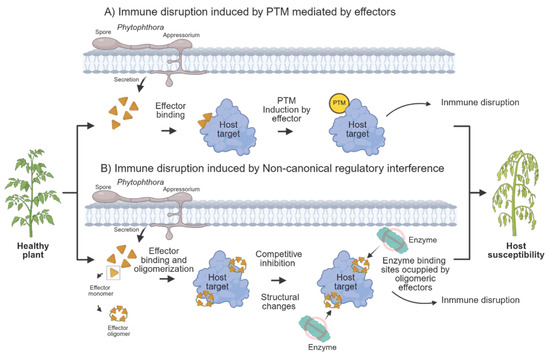
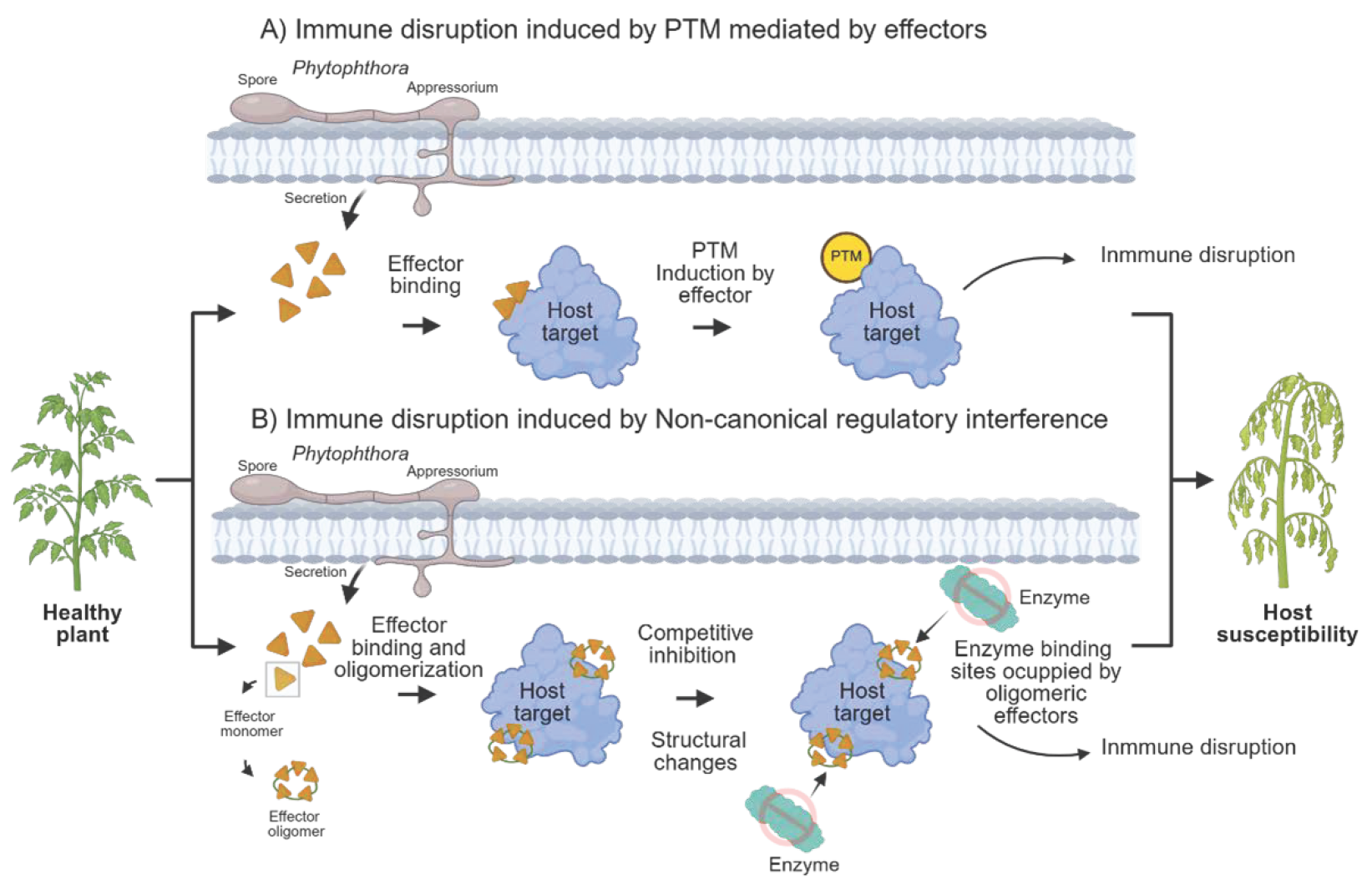
Graphical Abstract

1. Introduction

Plant-derived foods are fundamental to human nutrition and global food security, providing essential nutrients for human health [1,2]. However, agricultural productivity is continually threatened by phytopathogens, which contribute to substantial crop yield losses worldwide that can exceed 40% annually [2]. Understanding the molecular mechanisms underlying plant–pathogen interactions is therefore critical for developing sustainable disease-resistant crops.
Plants possess multilayered immune systems that detect invading pathogens and activate complex defense responses, including reactive oxygen species (ROS) production, transcriptional reprogramming, callose deposition, and programmed cell death, which collectively restrict pathogen colonization [3]. Early studies in plant immunity focused on resistance (R) genes that recognize pathogen avirulence (Avr) effectors through gene-for-gene interactions [4,5,6,7]. However, successful pathogens circumvent these defenses by deploying specialized virulence factors, commonly referred to as effectors, that manipulate host cellular processes to promote infection [8,9,10,11].
Among the regulatory systems frequently targeted by pathogen effectors are post-translational modifications (PTMs), which control protein stability, enzymatic activity, localization, and signaling interactions [12]. PTMs play central roles in regulating immune signaling pathways, and their perturbation can profoundly alter plant defense responses. Increasing evidence indicates that pathogen effectors manipulate PTM-dependent processes either by directly or indirectly modifying host proteins or by interfering with regulatory mechanisms that govern PTM-associated signaling [13].
Importantly, PTMs do not operate as isolated biochemical events but are embedded within interconnected regulatory systems that integrate enzymatic activity, protein–protein interactions, and the spatial organization of signaling complexes. In this context, protein oligomerization, defined as the assembly of monomeric subunits into homo- or hetero-multimeric complexes, has emerged as an additional regulatory mechanism influencing immune signaling. Oligomerization can modulate enzymatic activity, substrate accessibility, and signaling specificity through cooperative and allosteric interactions [14,15]. Pathogen effectors can exploit these structural properties to reorganize host protein complexes and alter the function of PTM-associated regulatory systems [16,17].
Among plant pathogens, species of the genus Phytophthora represent some of the most destructive agents affecting global agriculture. Their pathogenic success is largely attributed to extensive repertoires of secreted effector proteins that manipulate host cellular pathways during infection [18]. Accumulating evidence indicates that Phytophthora effectors interfere with post-translational regulation through diverse molecular strategies, including direct enzymatic modification of host proteins, indirect modulation of host PTM machinery, and structural interference with regulatory complexes.
Despite increasing recognition of these mechanisms, the current literature often treats them as isolated processes, without clearly distinguishing whether effector activities involve direct induction of post-translational modifications or perturbation of the regulatory systems that control them. This lack of mechanistic distinction limits a comprehensive understanding of how these strategies converge on the control of immune signaling and host susceptibility.
In this review, we propose a mechanistic framework to distinguish effector-mediated induction of post-translational modifications from non-canonical regulatory interference with PTM-dependent signaling. By integrating biochemical and structural perspectives, we aim to provide a unified view of how Phytophthora effectors reprogram host immune responses. This framework highlights key mechanistic principles, clarifies current conceptual ambiguities, and provides a foundation for future studies aimed at developing innovative strategies for disease resistance.

2. Conceptual Framework for Effector-Mediated Disruption of Post-Translational Regulation

Successful colonization of host plants by pathogens depends on their ability to reprogram cellular signaling processes that regulate immune responses [19,20]. Among these, post-translational modifications (PTMs) constitute a central regulatory layer that controls protein activity, stability, localization, and interaction dynamics. Rather than functioning as isolated biochemical events, PTMs operate within interconnected regulatory systems that integrate enzymatic activity, protein–protein interactions, and the spatial organization of signaling complexes [21].
Increasing evidence indicates that Phytophthora effectors target PTM-regulated processes through mechanistically distinct strategies [21,22,23]. However, the current literature often describes these mechanisms in a fragmented manner, without clearly distinguishing whether effectors directly induce covalent modifications or instead perturb the regulatory systems that control PTM dynamics. This ambiguity complicates the interpretation of effector function and limits the development of a unified mechanistic framework.
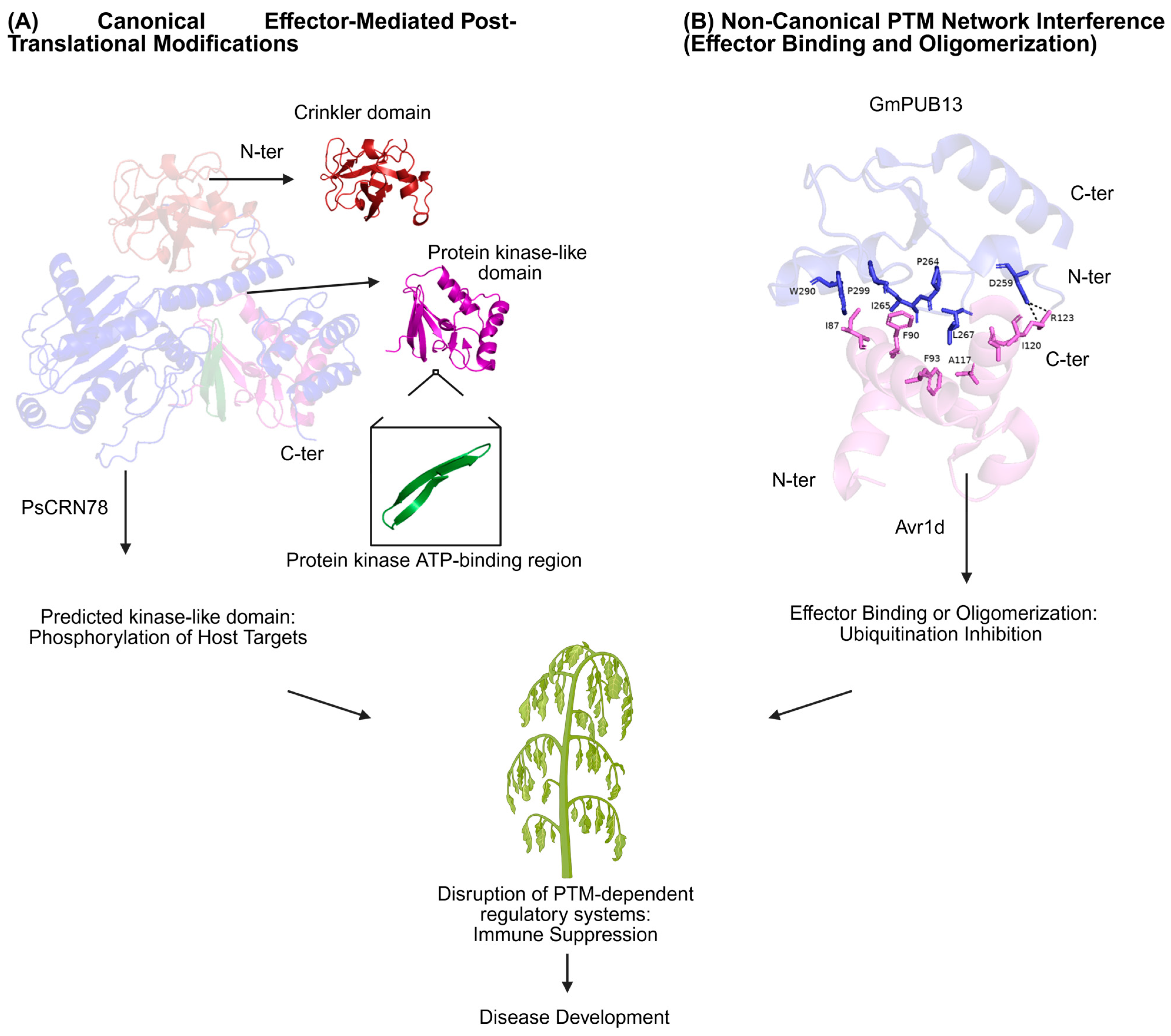
To address this, we propose a classification based on the proximal molecular action by which effectors influence post-translational regulation. In this framework, effector activities are divided into two principal categories: canonical mechanisms, which directly result in covalent modification of host proteins, and non-canonical mechanisms, which alter PTM-dependent regulation without directly inducing covalent modification (Figure 1).
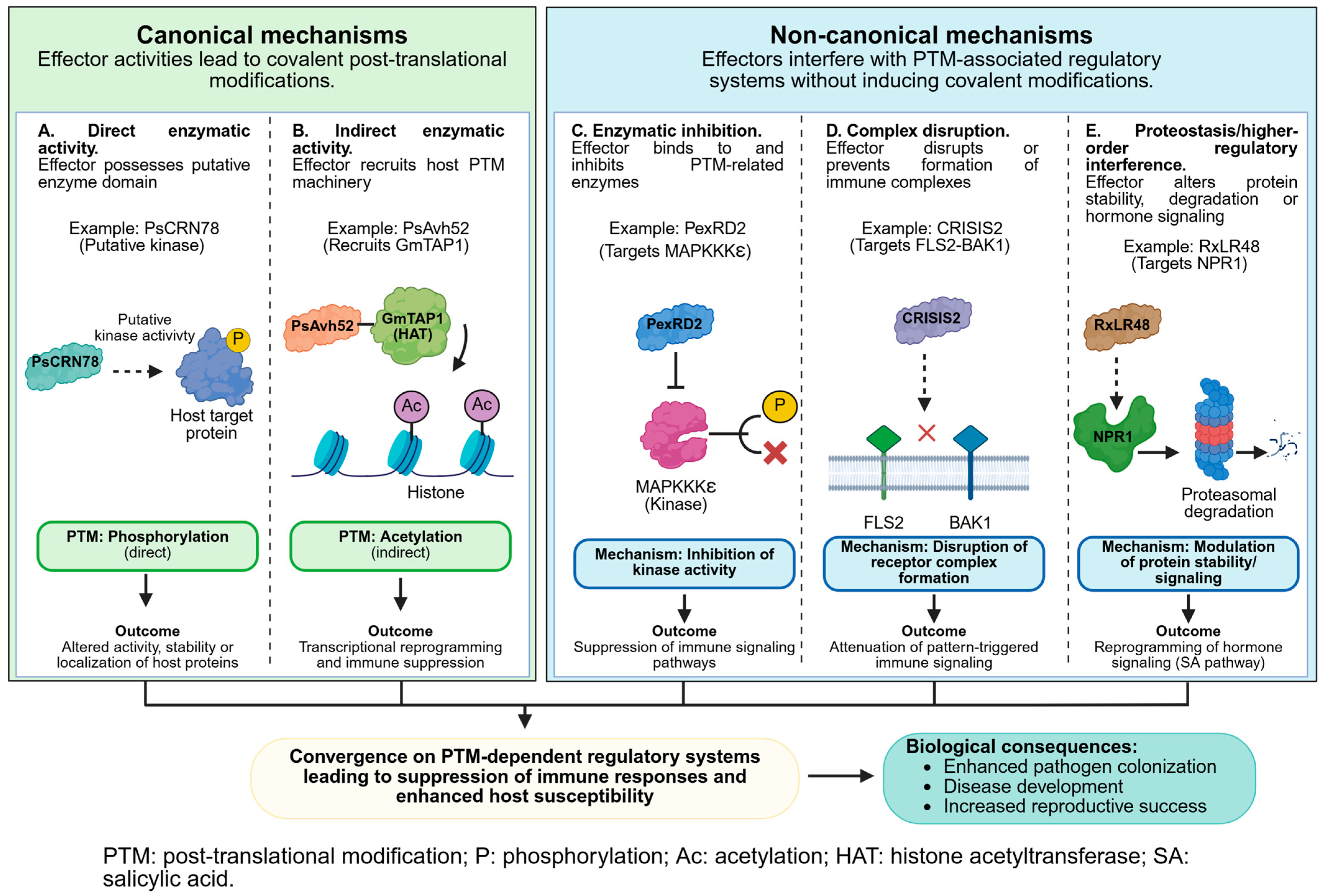
This classification is based on the immediate biochemical or structural action of the effector, rather than on downstream changes in PTM states or immune outcomes. The mechanistic distinctions and representative modes of action described in this framework are illustrated in Figure 2.

2.1. Canonical Mechanisms: Effector-Mediated Induction of Post-Translational Modifications

Canonical mechanisms involve effector activities that directly lead to covalent modification of host proteins, thereby modulating immune signaling pathways [30,31]. These mechanisms can occur through two primary routes: (i) direct enzymatic activity encoded by the effector, or (ii) indirect induction of PTMs through recruitment, stabilization, or redirection of host PTM-modifying enzymes toward specific substrates.
In the first case, effectors function as enzymatic modifiers that catalyze phosphorylation, acetylation, ubiquitination, or other covalent modifications [32,33]. In the second case, effectors lack intrinsic catalytic activity but promote PTM establishment by bringing host enzymes into proximity with target proteins or by altering substrate specificity [34].
In both scenarios, the defining feature of canonical mechanisms is that the effector activity results in the formation of a covalent modification on the host protein. These modifications can alter protein stability, enzymatic activity, interaction capacity, or subcellular localization, thereby reshaping immune signaling pathways [35].

2.2. Non-Canonical Mechanisms: Regulatory Interference with PTM-Dependent Signaling

In contrast, non-canonical mechanisms involve effector-mediated perturbation of PTM-dependent regulatory systems without directly inducing covalent modification of host proteins [35,36,37]. Rather than acting as enzymatic modifiers or directing enzymatic activity toward substrates, effectors in this category influence the organization, activity, or accessibility of PTM-associated regulatory machinery [38].
These mechanisms are primarily mediated through protein–protein interactions and can include competitive binding, allosteric inhibition, disruption of protein complexes, subcellular relocalization of regulatory components, and modulation of enzyme availability [19,39,40]. Through these processes, effectors indirectly reshape PTM-dependent signaling by altering how regulatory systems operate, rather than by directly modifying protein substrates [40,41].

2.3. Oligomerization as a Structural Mechanism of Regulatory Interference

Protein oligomerization represents an important structural mechanism embedded within non-canonical regulation. Oligomerization refers to the assembly of proteins into higher-order complexes that can alter enzymatic activity, substrate accessibility, and signaling specificity through cooperative and allosteric effects [15,42].
In Phytophthora effectors, conserved structural motifs such as WY domains provide conformational flexibility that facilitates interaction with multiple host targets [43,44]. Phytophthora effectors can exploit this property by promoting or disrupting the oligomeric states of host proteins or effector–host complexes. Such changes can reorganize signaling assemblies, modify the functional properties of enzymes, and alter the spatial distribution of regulatory components without requiring direct covalent modification of substrates, promoting conditions favorable for pathogen colonization [41,45].
Within this framework, oligomerization should not be considered a separate regulatory category, but rather a mechanistic mode through which non-canonical interference operates.

2.4. Operational Criteria for Classification

To facilitate consistent interpretation of effector mechanisms, we propose the following criteria for classification:
  • Canonical mechanism: The effector directly catalyzes a covalent modification or recruits/modulates host enzymes in a manner that leads to covalent modification of a specific substrate.
  • Non-canonical mechanism: The effector alters the activity, organization, localization, or interaction dynamics of PTM-associated regulatory systems without directly causing covalent modification of the substrate.
This framework provides a mechanistic basis for distinguishing effector activities and enables systematic comparison across studies.

2.5. Integrative Perspective on Effector-Mediated Regulation

Although canonical and non-canonical mechanisms are mechanistically distinct, they are not mutually exclusive and may operate in a coordinated manner during infection. Direct induction of PTMs and structural reorganization of regulatory systems can converge on common signaling pathways, leading to complex reprogramming of host immune responses [35,40,46].
By distinguishing between covalent modification and regulatory interference, this framework clarifies how diverse effector activities converge on the control of post-translational regulation. This perspective provides a foundation for interpreting experimental evidence, identifying mechanistic gaps, and guiding future studies aimed at understanding how pathogens manipulate host signaling systems.

3. Canonical Post-Translational Modifications Mediated by Phytophthora Effectors

Canonical post-translational modifications (PTMs) represent a central mechanism by which Phytophthora effectors manipulate host cellular signaling during infection. As defined in Section 2, canonical mechanisms are characterized by effector activities that directly result in covalent modification of host proteins, either through intrinsic enzymatic activity or through the recruitment and redirection of host PTM-modifying enzymes.
In this section, we examine representative examples of phosphorylation, acetylation, and ubiquitination mediated by Phytophthora effectors, with emphasis on the level of experimental evidence supporting these mechanisms and their functional consequences in plant immunity. The effector-mediated canonical post-translational modification mechanisms discussed in this section are summarized in Table 1. The table integrates information on effector–host targets, the type of modification involved, and the resulting biological outcomes, providing a structured overview of how these mechanisms contribute to the modulation of plant immune responses. Together, these examples highlight the functional impact of covalent modification events induced through effector activity.
Table 1 summarizes effector–host interactions associated with canonical post-translational modifications, including their corresponding targets and functional outcomes. The reported interactions are supported by experimental approaches such as protein–protein interaction assays, localization studies, and functional analyses, as described in the cited references.

3.1. Effector-Mediated Phosphorylation

Protein phosphorylation is one of the most extensively characterized PTMs involved in plant immune signaling, regulating protein activity, protein–protein interactions, and downstream signaling cascades [50,51]. Phytophthora effectors exploit phosphorylation-dependent regulatory systems through both direct enzymatic activity and indirect modulation of host kinase networks.
A representative example of putative direct canonical phosphorylation is provided by the P. sojae effector PsCRN78, which contains a predicted kinase-like domain. PsCRN78 has been reported to promote the phosphorylation of the aquaporin PIP2;7 and its orthologs in Nicotiana benthamiana and soybean, leading to reduced hydrogen peroxide transport and attenuation of reactive oxygen species (ROS)-dependent immune signaling [24,25]. However, whether PsCRN78 possesses intrinsic kinase activity has not been fully established biochemically, and its classification as a direct enzymatic effector remains based primarily on structural predictions and functional assays.
In contrast, indirect canonical phosphorylation mechanisms involve effectors that reconfigure host kinase-dependent signaling without directly catalyzing the modification. The effector PsRLK6 is proposed to associate with host receptor complexes, including LRR-RLPs and co-receptors such as BAK1 and SOBIR1, thereby modulating phosphorylation-dependent immune signaling in soybean, tomato, and N. benthamiana [47]. Although this model is supported by interaction studies, the precise molecular mechanism by which PsRLK6 alters kinase activity or signaling output remains to be fully elucidated.
Additional complexity is illustrated by the P. infestans effector PITG20303, which stabilizes the MAPK cascade component StMKK1 in potato [48]. In this case, the effector does not directly catalyze phosphorylation but instead modulates the stability of a kinase that controls downstream phosphorylation events. This represents a canonical mechanism because effector activity ultimately results in altered phosphorylation states through modulation of host enzymatic machinery.
Together, these observations indicate that Phytophthora effectors preferentially target central nodes within kinase signaling networks, enabling efficient reprogramming of early immune responses. Notably, both direct and indirect mechanisms converge on the modulation of signal amplification processes, suggesting that control of phosphorylation dynamics represents a strategic entry point for virulence.

3.2. Effector-Mediated Acetylation

Protein acetylation is a reversible post-translational modification that regulates chromatin organization, transcriptional activity, and stress-responsive gene expression [50]. In plant–pathogen interactions, acetylation represents an important regulatory layer through which pathogens can reprogram host transcriptional responses.
Current evidence suggests that Phytophthora effectors primarily manipulate acetylation through indirect canonical mechanisms, in which host acetyltransferases are redirected or repurposed rather than directly mimicked by effector enzymatic activity. A well-characterized example is the P. sojae effector PsAvh52, which interacts with the soybean transacetylase GmTAP1 and relocalizes it to the nucleus [26]. This relocalization enables GmTAP1 to promote acetylation of histones H2A and H3, resulting in increased chromatin accessibility and transcriptional activation of susceptibility-associated genes.
Importantly, PsAvh52 does not appear to possess intrinsic acetyltransferase activity. Instead, its function depends on altering the spatial distribution and substrate accessibility of a host enzyme, thereby promoting selective acetylation of chromatin-associated targets. This mechanism is therefore classified as canonical because effector activity results in covalent modification of host proteins, despite the absence of direct enzymatic activity encoded by the effector.
These findings indicate that effector-mediated acetylation operates primarily at the level of chromatin regulation, enabling sustained transcriptional reprogramming during infection. By targeting host acetyltransferases, Phytophthora effectors exert broad and persistent control over gene expression without requiring direct enzymatic activity. However, the extent to which these mechanisms are conserved across effectors and host systems remains unclear, and further studies are needed to define how specificity in effector-mediated acetylation is achieved.

3.3. Effector-Mediated Ubiquitination

Ubiquitination is a post-translational modification that regulates protein stability, localization, and signaling activity through the covalent attachment of ubiquitin to target proteins. This process is mediated by a hierarchical enzymatic cascade involving E1 activating enzymes, E2 conjugating enzymes, and E3 ubiquitin ligases [50].
Phytophthora effectors frequently target ubiquitination pathways through indirect canonical mechanisms that modulate the activity or specificity of host ubiquitin machinery. A well-characterized example is the P. infestans effector AVR3a, which interacts with and stabilizes the host E3 ubiquitin ligase CMPG1 [39]. CMPG1 is required for the activation of immune-associated programmed cell death; therefore, its stabilization by AVR3a prevents the execution of defense responses. Although AVR3a does not catalyze ubiquitination directly, its activity alters the functional state of a key component of the ubiquitin system, thereby influencing downstream ubiquitination-dependent signaling.
A complementary strategy is employed by the P. infestans effector Pi02860, which promotes the interaction between the CULLIN3-associated adaptor NRL1 and the immune regulator SWAP70, leading to ubiquitination and subsequent degradation of SWAP70 [49]. In this case, the effector facilitates selective targeting of a host protein for proteasome-mediated degradation by reconfiguring substrate recognition within the ubiquitination machinery.
These examples highlight that Phytophthora effectors can both stabilize and destabilize components of the ubiquitination system or their substrates, depending on the regulatory outcome required for infection. Rather than encoding intrinsic ubiquitin ligase activity, these effectors act by modulating host enzymatic pathways to selectively control protein turnover and signaling outputs [52,53].
Despite these advances, key mechanistic questions remain, including how effectors achieve substrate specificity and whether additional regulatory layers, such as ubiquitin chain topology, are targeted during infection. Collectively, these mechanisms highlight selective control of protein stability as a recurrent virulence strategy, whereby Phytophthora effectors modulate ubiquitination pathways to dynamically regulate the abundance and activity of immune components.

3.4. Functional Integration of Canonical PTMs During Infection

Although phosphorylation, acetylation, and ubiquitination represent distinct biochemical modifications, they function within interconnected regulatory systems during Phytophthora infection. Effector-mediated perturbation of these processes does not occur in isolation but instead converges on key signaling nodes that coordinate immune responses.
Phosphorylation primarily regulates signal transduction and early immune activation, including reactive oxygen species (ROS) production and kinase cascade dynamics [54,55]. Acetylation modulates chromatin accessibility and transcriptional reprogramming, thereby influencing the expression of defense-related genes, whereas ubiquitination controls protein stability and turnover, shaping the abundance of immune regulators and signaling components [56,57].
Importantly, Phytophthora effectors often target multiple PTM-dependent processes simultaneously or sequentially, suggesting coordinated manipulation of host regulatory systems. This integration enables pathogens to exert multilayered control over immune signaling, resulting in suppression of defense responses and enhanced host susceptibility.
However, the extent to which these PTM processes are mechanistically coordinated remains unclear, as most studies focus on individual modifications without addressing potential cross-talk between pathways. Future work integrating proteomics, structural biology, and functional assays will be essential to resolve how multiple PTM-dependent processes are orchestrated during infection. Collectively, these findings support a model in which PTMs function as an integrated regulatory system, where coordinated targeting of phosphorylation, acetylation, and ubiquitination enables multilayered reprogramming of host immunity.

4. Non-Canonical Regulatory Interference with PTM-Dependent Signaling

Beyond canonical post-translational modifications, Phytophthora effectors employ a wide range of non-canonical mechanisms to interfere with host immune signaling. As defined in Section 2, these mechanisms do not involve direct covalent modification of host proteins but instead act by perturbing the regulatory systems that control PTM-dependent processes.
A central feature of this interference is the ability of effectors to target key regulatory components, including kinases, phosphatases, chromatin-associated factors, and elements of the ubiquitin–proteasome system through protein–protein interactions that alter their activity, localization, or structural organization. Through these interactions, effectors can indirectly reshape PTM-dependent signaling outputs without directly catalyzing post-translational modifications.
Importantly, these non-canonical strategies frequently involve higher-order regulatory effects, such as disruption of protein complexes, relocalization of signaling components, and modulation of protein stability. In some cases, effectors also exploit oligomerization-dependent mechanisms to reorganize the composition and activity of regulatory complexes, thereby influencing signaling pathways at a systems level [58].
To provide mechanistic clarity, the following subsections classify non-canonical interference strategies based on their mode of action, including direct binding-mediated inhibition, disruption of protein complexes, subcellular relocalization, oligomerization-mediated regulation, and proteostasis-dependent control of regulatory systems. Key examples of non-canonical mechanisms employed by Phytophthora effectors are summarized in Table 2. These cases illustrate how effectors interfere with PTM-dependent regulatory systems through diverse modes of action, including direct binding-mediated inhibition, disruption of protein complexes, subcellular relocalization, oligomerization-dependent regulation, and proteostasis-mediated control. Together, these mechanisms highlight the capacity of effectors to reshape immune signaling by targeting regulatory architecture rather than inducing direct covalent modification.
Table 2 summarizes effector-mediated non-canonical interactions affecting host regulatory systems, including the targeted components and their functional consequences. These mechanisms are primarily supported by interaction, localization, and functional studies, highlighting how effectors alter regulatory processes underlying immune signaling.

4.1. Direct Binding and Enzymatic Inhibition

Mitogen-activated protein kinase (MAPK) cascades constitute central regulatory hubs in plant immune signaling and are recurrent targets of Phytophthora effectors. In contrast to canonical mechanisms, several effectors suppress kinase-dependent signaling through direct protein–protein interactions that impair enzymatic function without inducing covalent modification.
A representative example is the P. infestans effector PexRD2, which binds the kinase domain of MAPKKKε and interferes with its activity, resulting in attenuation of downstream signaling associated with programmed cell death [27]. Similarly, SFI5 from P. infestans disrupts kinase activation indirectly through interaction with calmodulin (CaM), a key regulator of calcium-dependent signaling, thereby impairing activation of downstream kinases involved in MAMP-triggered immunity [59].
Additional evidence supports this mechanism as a broader strategy. The P. infestans effector Pi17316 targets the potato kinase StVIK, altering its regulatory function and suppressing PTI responses and INF1-triggered cell death [60]. Although these effectors act through distinct molecular interactions, they converge on the disruption of kinase-mediated signal propagation.
Together, these observations indicate that direct binding-mediated inhibition of key signaling enzymes represents a conserved mechanism to attenuate early immune responses. By targeting central regulatory nodes within kinase-dependent pathways, Phytophthora effectors efficiently compromise signal amplification without directly modifying protein substrates.

4.2. Disruption of Protein Complexes

Many PTM-dependent regulatory processes rely on the formation of multiprotein complexes that coordinate enzymatic activity and substrate specificity. Phytophthora effectors can interfere with these processes by disrupting the assembly or stability of such complexes, thereby impairing signaling without directly affecting catalytic function.
A representative example is the P. capsici effector CRISIS2, which targets the FLS2-BAK1 receptor complex. By preventing proper complex formation, CRISIS2 disrupts early phosphorylation-dependent signaling events required for immune activation at the plasma membrane [28].
Similarly, the P. sojae effector PsAvh23 interferes with the assembly of the SAGA histone acetyltransferase complex by targeting the ADA2 subunit and preventing its association with GCN5. This disruption reduces histone acetylation and suppresses transcription of defense-related genes [66].
Although these effectors act on distinct molecular systems, both operate by destabilizing protein complexes essential for PTM-dependent regulation, thereby impairing coordinated signaling. By targeting structural organization rather than catalytic activity, Phytophthora effectors can simultaneously affect multiple components of immune signaling pathways.

4.3. Subcellular Relocalization of Regulatory Components

Subcellular localization is a critical determinant of PTM-dependent signaling, as proper spatial organization ensures effective interactions between regulatory enzymes and their substrates [40,70,71]. Phytophthora effectors exploit this dependency by altering the localization of key host proteins, thereby modifying their functional context without directly affecting catalytic activity.
A representative example is the P. infestans effector Pi04314, which interacts with the protein phosphatase PP1c and promotes its relocalization to the nucleolus. This spatial redistribution alters PP1c regulatory activity and disrupts dephosphorylation processes associated with defense-related transcriptional programs [45,65].
Similarly, the P. infestans effector Pi22926 interferes with the localization of chloroplast-associated proteins by disrupting phosphorylation-dependent targeting mechanisms. Through interaction with chloroplast elongation factors and associated kinases, this effector alters protein trafficking and contributes to the destabilization of immune-associated components [61].
Although these effectors act on distinct targets, they share a common mechanism: reorganization of the spatial context in which PTM-dependent processes occur. By redirecting regulatory components to different cellular compartments, Phytophthora effectors reshape signaling outputs. Together, these observations indicate that subcellular relocalization is an effective strategy to modulate immune signaling by controlling the spatial availability of regulatory machinery.

4.4. Oligomerization-Mediated Regulation

Oligomerization represents an additional layer of non-canonical regulation through which Phytophthora effectors modulate host immune signaling. In this context, oligomerization refers to the assembly of proteins into higher-order complexes that influence enzymatic activity, substrate specificity, and signaling dynamics [15,58]. Unlike canonical mechanisms, this process does not involve covalent modification but instead alters the structural organization of regulatory systems.
A representative example is the P. sojae effector PSR2, which targets the protein phosphatase 2A (PP2A) complex and promotes the formation of alternative holoenzyme assemblies. This reorganization modifies the composition and activity of PP2A complexes, leading to altered dephosphorylation patterns and widespread changes in phosphorylation-dependent signaling [63,64].
In a related context, the P. capsici effector RxLR25 interferes with RLCK-VII kinases through oligomerization-dependent mechanisms, affecting key signaling components such as BIK1, PBL8, and PBL17. This structural interference disrupts phosphorylation-mediated signal transduction and attenuates downstream immune responses [62]. Rather than acting through catalytic modification, these effectors operate by reshaping protein assembly states, thereby influencing the functional organization of signaling complexes. This highlights the importance of higher-order structural regulation as a determinant of PTM-dependent signaling outcomes.
From a broader perspective, oligomerization-mediated interference enables coordinated modulation of multiple regulatory components simultaneously. By altering the composition and organization of protein complexes, Phytophthora effectors can exert system-level control over immune signaling pathways without requiring direct enzymatic activity.

4.5. Proteostasis and Higher-Order Regulatory Interference

In addition to direct interference with regulatory enzymes and protein complexes, Phytophthora effectors can modulate host immune responses by altering proteostasis and higher-order regulatory systems. These mechanisms influence the stability, abundance, and functional availability of key signaling components, thereby reshaping PTM-dependent processes.
In this context, higher-order regulatory interference refers to effector activities that impact global regulatory layers, such as transcriptional programs, hormone signaling, and protein homeostasis, rather than directly targeting individual enzymes or protein complexes.
A representative example is the P. infestans effector Pi22798, which promotes homodimerization of the transcription factor StKNOX3. This interaction restricts the formation of alternative transcriptional complexes required for proper immune gene expression, thereby altering transcriptional regulation associated with defense responses [68].
Similarly, the P. capsici effector RxLR48 targets NPR1, a central regulator of salicylic acid signaling, by modulating its stability and nuclear localization. This interference disrupts hormone-dependent transcriptional activation of immune responses and compromises defense signaling [29].
Additional evidence highlights direct interference with protein homeostasis machinery. The P. infestans effector Pi06432 promotes degradation of the proteasome subunit StRPT3b, thereby impairing proteasome function and altering protein turnover associated with salicylic acid-mediated immunity [69]. In a related context, the P. infestans effector AVR8 exemplifies this strategy by interacting with the potato deSUMOylating isopeptidase StDeSI2 and promoting its destabilization via the 26S proteasome, further illustrating how effectors can influence protein stability and system-level regulation leading to impaired regulation of immune signaling components [67].
In contrast to mechanisms that primarily affect enzymatic activity or protein assembly, these effectors influence immune signaling by controlling the abundance and functional availability of key regulatory components. By modulating protein stability and transcriptional regulators, they enable sustained reprogramming of defense responses over time. This proteostasis-based interference introduces a temporal dimension to immune suppression, allowing Phytophthora effectors to maintain altered signaling states rather than transiently perturbing individual steps within signaling cascades. This capacity for prolonged modulation distinguishes proteostasis-centered mechanisms from more immediate structural or enzymatic modes of interference.

5. Integrative Perspectives on Effector-Mediated Interference with PTM-Dependent Immunity

The studies discussed throughout this review indicate that Phytophthora effectors employ diverse strategies to manipulate host immune signaling, targeting both canonical post-translational modification pathways and non-canonical regulatory processes. Rather than acting on isolated proteins, these effectors frequently converge on key regulatory components that control signaling dynamics, localization, and protein stability, as illustrated by multiple examples described in Section 3 and Section 4 [26,27,28,29,39,49,59,60,61,62,63,64,65,66,67,68,69].
Despite these advances, a major limitation in the field is the incomplete mechanistic characterization of many effector–host interactions. In several cases, effector functions have been inferred from interaction studies or phenotypic assays, while direct biochemical evidence remains limited. This is particularly evident for effectors whose activity is linked to proteostasis or higher-order regulatory processes, where the precise molecular mechanisms remain only partially resolved [29,39,49,68,69].
Another key challenge lies in understanding how specificity is achieved within highly interconnected signaling systems. Individual effectors have been shown to target central regulatory nodes, including kinases, phosphatases, and transcriptional regulators [27,28,29,59,60,61,62,63,64,65,68]. However, it remains unclear whether this targeting reflects selective recognition of specific substrates or broader perturbation of regulatory pathways. Addressing this question will be essential to explain how relatively small repertoires of effectors can exert widespread effects on host immunity.
Furthermore, most current studies focus on individual effectors in isolation, whereas natural infections involve the coordinated action of multiple effectors. Evidence from different systems suggests that effectors may act synergistically or redundantly to suppress immune responses, but this aspect remains largely unexplored in the context of PTM-dependent regulation [58,62,63,64]. Future work integrating combinatorial approaches will be necessary to understand how these mechanisms operate collectively during infection.
In addition, the temporal dimension of effector activity remains poorly characterized. Several effectors influence processes such as protein stability, complex assembly, and transcriptional regulation, which are inherently dynamic and time-dependent [29,61,65,68,69]. However, the timing of effector deployment and the persistence of their effects on host regulatory systems are still not well understood. Incorporating temporal and spatial analyses will therefore be critical to obtain a more complete view of effector-mediated interference.
Taken together, these observations highlight the need for integrative approaches that combine biochemical, structural, and systems-level analyses to resolve the mechanisms by which Phytophthora effectors manipulate host immunity. Such efforts will be essential to refine current models and to bridge the gap between molecular interactions and physiological outcomes.

6. Conclusions

In this review, we examined how Phytophthora effectors manipulate host immune signaling through both canonical post-translational modifications and non-canonical regulatory mechanisms. By distinguishing between covalent modification of protein substrates and interference with regulatory systems, we provide a framework that clarifies how diverse effector activities converge on the control of PTM-dependent processes [26,39,49].
The evidence discussed highlights that effector-mediated virulence is not limited to direct enzymatic modification but frequently involves perturbation of key regulatory components that govern signaling dynamics, spatial organization, and protein stability. Through mechanisms such as direct binding-mediated inhibition, disruption of protein complexes, subcellular relocalization, oligomerization, and proteostasis-dependent regulation, Phytophthora effectors exert multilayered control over host immunity [27,28,29,59,60,61,62,63,64,65,66,67,68,69].
Importantly, these mechanisms do not operate in isolation but instead converge on central regulatory nodes within immune signaling pathways. This convergence enables efficient reprogramming of host responses, allowing pathogens to suppress defense activation and promote susceptibility. At the same time, the diversity of strategies employed underscores the complexity of effector–host interactions and highlights the need for integrative approaches to fully understand these processes [58,61,65].
Despite significant advances, key questions remain regarding the specificity, coordination, and temporal dynamics of effector activity. Addressing these challenges will require the integration of mechanistic and system-level perspectives to connect effector activities with their broader impact on host immune regulation during infection.
Overall, the framework presented here provides a conceptual basis for understanding how Phytophthora effectors manipulate host regulatory systems through both PTM-dependent and structural mechanisms. This integrated perspective not only advances our understanding of host–pathogen interactions but also offers a foundation for the development of innovative strategies to control Phytophthora diseases, including approaches aimed at stabilizing key regulatory networks or disrupting effector–host interactions.

Author Contributions

G.M.-P. wrote and revised the manuscript. F.Á.-C. designed and created the figures. J.V.-A. conceived the original idea, corrected, revised, provided critical feedback, and contributed ideas. All authors have read and agreed to the published version of the manuscript.

Funding

Funding was provided by PAPIIT-DGAPA-UNAM (Project IN218024) to J.V.-A.

Data Availability Statement

No new data were created or analyzed in this study. Data sharing is not applicable to this article.

Acknowledgments

G.M.-P. received a postdoctoral fellowship from SECIHTI (Secretaría de Ciencia, Humanidades, Tecnología e Innovación).

Conflicts of Interest

The authors declare no conflicts of interest.

References

  1. Ezrari, S.; Legrifi, I.; Taoussi, M.; Khadiri, M.; Belabess, Z.; Lahlali, R. Plant–Pathogen Interactions and Global Food Security. In Plant Pathogen Interaction; Verma, P.K., Mishra, S., Srivastava, V., Mehrotra, S., Eds.; Springer Nature: Singapore, 2023; pp. 11–52. [Google Scholar]
  2. Tang, R.; Tan, H.; Dai, Y.; Li, L.; Huang, Y.; Yao, H.; Cai, Y.; Yu, G. Application of Antimicrobial Peptides in Plant Protection: Making Use of the Overlooked Merits. Front. Plant Sci. 2023, 14, 1139539. [Google Scholar] [CrossRef] [PubMed]
  3. Yin, J.; Yi, H.; Chen, X.; Wang, J. Post-Translational Modifications of Proteins Have Versatile Roles in Regulating Plant Immune Responses. Int. J. Mol. Sci. 2019, 20, 2807. [Google Scholar] [CrossRef]
  4. Vega-Arreguín, J.C.; Jalloh, A.; Bos, J.I.; Moffett, P. Recognition of an Avr3a Homologue Plays a Major Role in Mediating Nonhost Resistance to Phytophthora capsici in Nicotiana Species. Mol. Plant Microbe Interact. 2014, 27, 770–780. [Google Scholar] [CrossRef]
  5. Vega-Arreguín, J.C.; Shimada-Beltrán, H.; Sevillano-Serrano, J.; Moffett, P. Non-Host Plant Resistance against Phytophthora capsici Is Mediated in Part by Members of the I2 R Gene Family in Nicotiana spp. Front. Plant Sci. 2017, 8, 205. [Google Scholar] [CrossRef][Green Version]
  6. Hurlburt, N.K.; Chen, L.-H.; Stergiopoulos, I.; Fisher, A.J. Structure of the Cladosporium fulvum Avr4 Effector in Complex with (GlcNAc)6 Reveals the Ligand-Binding Mechanism and Uncouples Its Intrinsic Function from Recognition by the Cf-4 Resistance Protein. PLoS Pathog. 2018, 14, e1007263. [Google Scholar] [CrossRef]
  7. Ahn, Y.J.; Kim, H.; Choi, S.; Mazo-Molina, C.; Prokchorchik, M.; Zhang, N.; Kim, B.; Mang, H.; Koehler, N.; Kim, J.; et al. Ptr1 and ZAR1 Immune Receptors Confer Overlapping and Distinct Bacterial Pathogen Effector Specificities. New Phytol. 2023, 239, 1935–1953, Correction in New Phytol. 2024, 242, 320–322. [Google Scholar] [CrossRef]
  8. Li, Y.; Kou, S. A Ralstonia solanacearum Effector Targets Splicing Factor SR34a to Reprogram Alternative Splicing and Regulate Plant Immunity. Plants 2025, 14, 534. [Google Scholar] [CrossRef] [PubMed]
  9. Khan, M.S.S.; Islam, F.; Chen, H.; Chen, J. A Fungal Effector Hijacks a Plastid Protein to Dampen Plant Immunity; PR1 Is Here for Rescue. Stress Biol. 2025, 5, 23. [Google Scholar] [CrossRef]
  10. Irieda, H.; Inoue, Y.; Mori, M.; Yamada, K.; Oshikawa, Y.; Saitoh, H.; Uemura, A.; Terauchi, R.; Kitakura, S.; Kosaka, A.; et al. Conserved Fungal Effector Suppresses PAMP-Triggered Immunity by Targeting Plant Immune Kinases. Proc. Natl. Acad. Sci. USA 2019, 116, 496–505. [Google Scholar] [CrossRef]
  11. Liu, X.; Zhao, H.; Yuan, M.; Li, P.; Xie, J.; Fu, Y.; Li, B.; Yu, X.; Chen, T.; Lin, Y.; et al. An Effector Essential for Virulence of Necrotrophic Fungi Targets Plant HIRs to Inhibit Host Immunity. Nat. Commun. 2024, 15, 9391. [Google Scholar] [CrossRef] [PubMed]
  12. Seo, J.; Lee, K.-J. Post-Translational Modifications and Their Biological Functions: Proteomic Analysis and Systematic Approaches. J. Biochem. Mol. Biol. 2004, 37, 35–44. [Google Scholar] [CrossRef]
  13. Tahir, J.; Rashid, M.; Afzal, A.J. Post-Translational Modifications in Effectors and Plant Proteins Involved in Host–Pathogen Conflicts. Plant Pathol. 2019, 68, 628–644. [Google Scholar] [CrossRef]
  14. Marianayagam, N.J.; Sunde, M.; Matthews, J.M. The Power of Two: Protein Dimerization in Biology. Trends Biochem. Sci. 2004, 29, 618–625. [Google Scholar] [CrossRef] [PubMed]
  15. Ali, M.H.; Imperiali, B. Protein Oligomerization: How and Why. Bioorg. Med. Chem. 2005, 13, 5013–5020. [Google Scholar] [CrossRef]
  16. Hu, M.; Qi, J.; Bi, G.; Zhou, J.-M. Bacterial Effectors Induce Oligomerization of Immune Receptor ZAR1 In Vivo. Mol. Plant 2020, 13, 793–801. [Google Scholar] [CrossRef]
  17. Contreras, M.P.; Pai, H.; Tumtas, Y.; Duggan, C.; Yuen, E.L.H.; Cruces, A.V.; Kourelis, J.; Ahn, H.; Lee, K.; Wu, C.; et al. Sensor NLR Immune Proteins Activate Oligomerization of Their NRC Helpers in Response to Plant Pathogens. EMBO J. 2022, 42, EMBJ2022111519. [Google Scholar] [CrossRef]
  18. Ouyang, H.-B.; Wang, Y.-P.; He, M.-H.; Wu, E.-J.; Hu, B.-H.; Zhan, J.; Yang, L. Mutations in the Signal Peptide of Effector Gene Pi04314 Contribute to the Adaptive Evolution of the Phytophthora infestans. BMC Ecol. Evol. 2025, 25, 21. [Google Scholar] [CrossRef]
  19. Dodds, P.N.; Rathjen, J.P. Plant Immunity: Towards an Integrated View of Plant–Pathogen Interactions. Nat. Rev. Genet. 2010, 11, 539–548. [Google Scholar] [CrossRef]
  20. Ngou, B.P.M.; Ahn, H.-K.; Ding, P.; Jones, J.D.G. Mutual Potentiation of Plant Immunity by Cell-Surface and Intracellular Receptors. Nature 2021, 592, 110–115. [Google Scholar] [CrossRef] [PubMed]
  21. Withers, J.; Dong, X. Post-Translational Regulation of Plant Immunity. Curr. Opin. Plant Biol. 2017, 38, 124–132. [Google Scholar] [CrossRef]
  22. Wang, S.; McLellan, H.; Bukharova, T.; He, Q.; Murphy, F.; Shi, J.; Sun, S.; van Weymers, P.; Ren, Y.; Thilliez, G.; et al. Phytophthora infestans RXLR Effectors Act in Concert at Diverse Subcellular Locations to Enhance Host Colonization. J. Exp. Bot. 2019, 70, 343–356. [Google Scholar] [CrossRef]
  23. Zhou, J.-M.; Zhang, Y. Plant Immunity: Danger Perception and Signaling. Cell 2020, 181, 978–989. [Google Scholar] [CrossRef]
  24. Zhu, H.; Bao, Y.; Peng, H.; Li, X.; Pan, W.; Yang, Y.; Kuang, Z.; Ji, P.; Liu, J.; Shen, D.; et al. Phosphorylation of PIP2;7 by CPK28 or Phytophthora Kinase Effectors Dampens Pattern-Triggered Immunity in Arabidopsis. Plant Commun. 2025, 6, 101135. [Google Scholar] [CrossRef]
  25. Ai, G.; Xia, Q.; Song, T.; Li, T.; Zhu, H.; Peng, H.; Liu, J.; Fu, X.; Zhang, M.; Jing, M.; et al. A Phytophthora sojae CRN Effector Mediates Phosphorylation and Degradation of Plant Aquaporin Proteins to Suppress Host Immune Signaling. PLoS Pathog. 2021, 17, e1009388. [Google Scholar] [CrossRef]
  26. Li, H.; Wang, H.; Jing, M.; Zhu, J.; Guo, B.; Wang, Y.; Lin, Y.; Chen, H.; Kong, L.; Ma, Z.; et al. A Phytophthora Effector Recruits a Host Cytoplasmic Transacetylase into Nuclear Speckles to Enhance Plant Susceptibility. eLife 2018, 7, e40039. [Google Scholar] [CrossRef]
  27. King, S.R.F.; McLellan, H.; Boevink, P.C.; Armstrong, M.R.; Bukharova, T.; Sukarta, O.; Win, J.; Kamoun, S.; Birch, P.R.J.; Banfield, M.J. Phytophthora infestans RXLR Effector PexRD2 Interacts with Host MAPKKKε to Suppress Plant Immune Signaling. Plant Cell 2014, 26, 1345–1359. [Google Scholar] [CrossRef]
  28. Mang, H.; Seo, Y.-E.; Lee, H.-Y.; Kim, H.; Jeon, H.; Yan, X.; Lee, S.; Park, S.A.; Kim, M.-S.; Segonzac, C.; et al. The Phytophthora capsici RxLR Effector CRISIS2 Has Roles in Suppression of PTI and Triggering Cell Death in Host Plant. bioRxiv 2022. [Google Scholar] [CrossRef]
  29. Li, Q.; Chen, Y.; Wang, J.; Zou, F.; Jia, Y.; Shen, D.; Zhang, Q.; Jing, M.; Dou, D.; Zhang, M. A Phytophthora capsici Virulence Effector Associates with NPR1 and Suppresses Plant Immune Responses. Phytopathol. Res. 2019, 1, 6. [Google Scholar] [CrossRef]
  30. Lee, A.H.-Y.; Hurley, B.; Felsensteiner, C.; Yea, C.; Ckurshumova, W.; Bartetzko, V.; Wang, P.W.; Quach, V.; Lewis, J.D.; Liu, Y.C.; et al. A Bacterial Acetyltransferase Destroys Plant Microtubule Networks and Blocks Secretion. PLoS Pathog. 2012, 8, e1002523. [Google Scholar] [CrossRef]
  31. Rufián, J.S.; Rueda-Blanco, J.; López-Márquez, D.; Macho, A.P.; Beuzón, C.R.; Ruiz-Albert, J. The Bacterial Effector HopZ1a Acetylates MKK7 to Suppress Plant Immunity. New Phytol. 2021, 231, 1138–1156. [Google Scholar] [CrossRef]
  32. Dean, P. Functional Domains and Motifs of Bacterial Type III Effector Proteins and Their Roles in Infection. FEMS Microbiol. Rev. 2011, 35, 1100–1125. [Google Scholar] [CrossRef]
  33. Dorival, J.; Philys, S.; Giuntini, E.; Brailly, R.; de Ruyck, J.; Czjzek, M.; Biondi, E.; Bompard, C. Structural and Enzymatic Characterisation of the Type III Effector NopAA (=GunA) from Sinorhizobium fredii USDA257 Reveals a Xyloglucan Hydrolase Activity. Sci. Rep. 2020, 10, 9932. [Google Scholar] [CrossRef]
  34. Liu, Y.; Jackson, E.; Liu, X.; Huang, X.; van der Hoorn, R.A.L.; Zhang, Y.; Li, X. Proteolysis in Plant Immunity. Plant Cell 2024, 36, 3099–3115. [Google Scholar] [CrossRef]
  35. Howden, A.J.M.; Huitema, E. Effector-Triggered Post-Translational Modifications and Their Role in Suppression of Plant Immunity. Front. Plant Sci. 2012, 3, 160. [Google Scholar] [CrossRef]
  36. Ribet, D.; Cossart, P. Pathogen-Mediated Posttranslational Modifications: A Re-Emerging Field. Cell 2010, 143, 694–702. [Google Scholar] [CrossRef]
  37. Salomon, D.; Orth, K. What Pathogens Have Taught Us about Posttranslational Modifications. Cell Host Microbe 2013, 14, 269–279. [Google Scholar] [CrossRef]
  38. Ai, G.; Peng, H.; Pan, W.; Li, Y.; Wan, Z.; Yin, Z.; Shen, D.; Dong, S.; Wang, Y.; Dou, D. A Catalogue of Virulence Strategies Mediated by Phytopathogenic Effectors. Fundam. Res. 2024, 5, 663–673. [Google Scholar] [CrossRef]
  39. Bos, J.I.B.; Armstrong, M.R.; Gilroy, E.M.; Boevink, P.C.; Hein, I.; Taylor, R.M.; Zhendong, T.; Engelhardt, S.; Vetukuri, R.R.; Harrower, B.; et al. Phytophthora infestans Effector AVR3a Is Essential for Virulence and Manipulates Plant Immunity by Stabilizing Host E3 Ligase CMPG1. Proc. Natl. Acad. Sci. USA 2010, 107, 9909–9914, Correction in Proc. Natl. Acad. Sci. USA 2020, 117, 28531–28533. [Google Scholar] [CrossRef]
  40. Toruño, T.Y.; Stergiopoulos, I.; Coaker, G. Plant-Pathogen Effectors: Cellular Probes Interfering with Plant Defenses in Spatial and Temporal Manners. Annu. Rev. Phytopathol. 2016, 54, 419–441. [Google Scholar] [CrossRef]
  41. Zhang, S.; Li, C.; Si, J.; Han, Z.; Chen, D. Action Mechanisms of Effectors in Plant-Pathogen Interaction. Int. J. Mol. Sci. 2022, 23, 6758. [Google Scholar] [CrossRef]
  42. Wang, J.; Hu, M.; Wang, J.; Qi, J.; Han, Z.; Wang, G.; Qi, Y.; Wang, H.-W.; Zhou, J.-M.; Chai, J. Reconstitution and Structure of a Plant NLR Resistosome Conferring Immunity. Science 2019, 364, eaav5870. [Google Scholar] [CrossRef]
  43. Boutemy, L.S.; King, S.R.F.; Win, J.; Hughes, R.K.; Clarke, T.A.; Blumenschein, T.M.A.; Kamoun, S.; Banfield, M.J. Structures of Phytophthora RXLR Effector Proteins: A Conserved but Adaptable Fold Underpins Functional Diversity. J. Biol. Chem. 2011, 286, 35834–35842. [Google Scholar] [CrossRef]
  44. Win, J.; Krasileva, K.V.; Kamoun, S.; Shirasu, K.; Staskawicz, B.J.; Banfield, M.J. Sequence Divergent RXLR Effectors Share a Structural Fold Conserved across Plant Pathogenic Oomycete Species. PLoS Pathog. 2012, 8, e1002400. [Google Scholar] [CrossRef]
  45. Bentham, A.R.; Wang, W.; Trusch, F.; Varden, F.A.; Birch, P.R.J.; Banfield, M.J. The WY Domain of an RxLr Effector Drives Interactions with a Host Target Phosphatase to Mimic Host Regulatory Proteins and Promote Phytophthora infestans Infection. Mol. Plant Microbe Interact. 2024, 37, 239–249. [Google Scholar] [CrossRef]
  46. Kazan, K.; Lyons, R. Intervention of Phytohormone Pathways by Pathogen Effectors. Plant Cell 2014, 26, 2285–2309. [Google Scholar] [CrossRef]
  47. Pei, Y.; Ji, P.; Si, J.; Zhao, H.; Zhang, S.; Xu, R.; Qiao, H.; Duan, W.; Shen, D.; Yin, Z.; et al. A Phytophthora Receptor-like Kinase Regulates Oospore Development and Can Activate Pattern-Triggered Plant Immunity. Nat. Commun. 2023, 14, 4593. [Google Scholar] [CrossRef]
  48. Du, Y.; Chen, X.; Guo, Y.; Zhang, X.; Zhang, H.; Li, F.; Huang, G.; Meng, Y.; Shan, W. Phytophthora infestans RXLR Effector PITG20303 Targets a Potato MKK1 Protein to Suppress Plant Immunity. New Phytol. 2021, 229, 501–515, Erratum in New Phytol. 2021, 230, 878. [Google Scholar] [CrossRef]
  49. He, Q.; Naqvi, S.; McLellan, H.; Boevink, P.C.; Champouret, N.; Hein, I.; Birch, P.R.J. Plant Pathogen Effector Utilizes Host Susceptibility Factor NRL1 to Degrade the Immune Regulator SWAP70. Proc. Natl. Acad. Sci. USA 2018, 115, E7834–E7843. [Google Scholar] [CrossRef]
  50. Zhong, Q.; Xiao, X.; Qiu, Y.; Xu, Z.; Chen, C.; Chong, B.; Zhao, X.; Hai, S.; Li, S.; An, Z.; et al. Protein Posttranslational Modifications in Health and Diseases: Functions, Regulatory Mechanisms, and Therapeutic Implications. MedComm 2023, 4, e261. [Google Scholar] [CrossRef]
  51. Gough, C.; Sadanandom, A. Understanding and Exploiting Post-Translational Modifications for Plant Disease Resistance. Biomolecules 2021, 11, 1122. [Google Scholar] [CrossRef]
  52. Zhou, B.; Zeng, L. Conventional and Unconventional Ubiquitination in Plant Immunity. Mol. Plant Pathol. 2017, 18, 1313–1330. [Google Scholar] [CrossRef]
  53. Trujillo, M.; Shirasu, K. Ubiquitination in Plant Immunity. Curr. Opin. Plant Biol. 2010, 13, 402–408. [Google Scholar] [CrossRef]
  54. Jones, J.D.G.; Dangl, J.L. The Plant Immune System. Nature 2006, 444, 323–329. [Google Scholar] [CrossRef]
  55. Zhang, M.; Zhang, S. Mitogen-Activated Protein Kinase Cascades in Plant Signaling. J. Integr. Plant Biol. 2022, 64, 301–341. [Google Scholar] [CrossRef]
  56. Kang, H.; Fan, T.; Wu, J.; Zhu, Y.; Shen, W.-H. Histone Modification and Chromatin Remodeling in Plant Response to Pathogens. Front. Plant Sci. 2022, 13, 986940. [Google Scholar] [CrossRef]
  57. Gao, C.; Tang, D.; Wang, W. The Role of Ubiquitination in Plant Immunity: Fine-Tuning Immune Signaling and Beyond. Plant Cell Physiol. 2022, 63, 1405–1413. [Google Scholar] [CrossRef]
  58. Hashimoto, K.; Panchenko, A.R. Mechanisms of Protein Oligomerization, the Critical Role of Insertions and Deletions in Maintaining Different Oligomeric States. Proc. Natl. Acad. Sci. USA 2010, 107, 20352–20357. [Google Scholar] [CrossRef]
  59. Habiba; Mu, J.; Wang, W.; Dou, Z.; Liao, D.; Dai, H.; Tan, M.; Lin, C.; Akbar, S.; Redenti, S.; et al. RXLR Effector SFI5 of Phytophthora Infestans Suppress MAMP-Triggered Immunity via Inhibition of NbPHB1 in Nicotiana Benthamiana. Plant Stress 2025, 16, 100831. [Google Scholar] [CrossRef]
  60. Murphy, F.; He, Q.; Armstrong, M.; Giuliani, L.M.; Boevink, P.C.; Zhang, W.; Tian, Z.; Birch, P.R.J.; Gilroy, E.M. The Potato MAP3K StVIK Is Required for the Phytophthora infestans RXLR Effector Pi17316 to Promote Disease. Plant Physiol. 2018, 177, 398–410. [Google Scholar] [CrossRef]
  61. Qi, Y.; Wu, J.; Yang, Z.; Li, H.; Liu, L.; Wang, H.; Sun, X.; Wu, X.; Nie, J.; Zhou, J.; et al. Chloroplast Elongation Factors Break the Growth-Immunity Trade-off by Simultaneously Promoting Yield and Defence. Nat. Plants 2024, 10, 1576–1591. [Google Scholar] [CrossRef]
  62. Liang, X.; Bao, Y.; Zhang, M.; Du, D.; Rao, S.; Li, Y.; Wang, X.; Xu, G.; Zhou, Z.; Shen, D.; et al. A Phytophthora capsici RXLR Effector Targets and Inhibits the Central Immune Kinases to Suppress Plant Immunity. New Phytol. 2021, 232, 264–278. [Google Scholar] [CrossRef]
  63. Li, H.; Wang, J.; Kuan, T.A.; Tang, B.; Feng, L.; Wang, J.; Cheng, Z.; Skłenar, J.; Derbyshire, P.; Hulin, M.; et al. Pathogen Protein Modularity Enables Elaborate Mimicry of a Host Phosphatase. Cell 2023, 186, 3196–3207.e17. [Google Scholar] [CrossRef]
  64. Wang, J.; Li, H.; Sun, W.; Wang, J.; Fang, X.; Yang, X.; Liu, C.; Sheng, G.; Ma, W.; Wang, Y. Pathogen Effector Forms a Hexameric Phosphatase Holoenzyme with Host Core Enzyme to Promote Disease. bioRxiv 2025. [Google Scholar] [CrossRef]
  65. Boevink, P.C.; Wang, X.; McLellan, H.; He, Q.; Naqvi, S.; Armstrong, M.R.; Zhang, W.; Hein, I.; Gilroy, E.M.; Tian, Z.; et al. A Phytophthora infestans RXLR Effector Targets Plant PP1c Isoforms That Promote Late Blight Disease. Nat. Commun. 2016, 7, 10311. [Google Scholar] [CrossRef]
  66. Kong, L.; Qiu, X.; Kang, J.; Wang, Y.; Chen, H.; Huang, J.; Qiu, M.; Zhao, Y.; Kong, G.; Ma, Z.; et al. A Phytophthora Effector Manipulates Host Histone Acetylation and Reprograms Defense Gene Expression to Promote Infection. Curr. Biol. 2017, 27, 981–991. [Google Scholar] [CrossRef]
  67. Jiang, R.; He, Q.; Song, J.; Liu, Z.; Yu, J.; Hu, K.; Liu, H.; Mu, Y.; Wu, J.; Tian, Z.; et al. A Phytophthora infestans RXLR Effector AVR8 Suppresses Plant Immunity by Targeting a Desumoylating Isopeptidase DeSI2. Plant J. 2023, 115, 398–413. [Google Scholar] [CrossRef]
  68. Zhou, J.; Qi, Y.; Nie, J.; Guo, L.; Luo, M.; McLellan, H.; Boevink, P.C.; Birch, P.R.J.; Tian, Z. A Phytophthora Effector Promotes Homodimerization of Host Transcription Factor StKNOX3 to Enhance Susceptibility. J. Exp. Bot. 2022, 73, 6902–6915. [Google Scholar] [CrossRef]
  69. Wang, Z.; Li, T.; Zhang, X.; Feng, J.; Liu, Z.; Shan, W.; Joosten, M.H.A.J.; Govers, F.; Du, Y. A Phytophthora infestans RXLR Effector Targets a Potato Ubiquitin-like Domain-Containing Protein to Inhibit the Proteasome Activity and Hamper Plant Immunity. New Phytol. 2023, 238, 781–797. [Google Scholar] [CrossRef]
  70. Scott, J.D.; Pawson, T. Cell Signaling in Space and Time: Where Proteins Come Together and When They’re Apart. Science 2009, 326, 1220–1224. [Google Scholar] [CrossRef]
  71. Millar, A.H.; Heazlewood, J.L.; Giglione, C.; Holdsworth, M.J.; Bachmair, A.; Schulze, W.X. The Scope, Functions, and Dynamics of Posttranslational Protein Modifications. Annu. Rev. Plant Biol. 2019, 70, 119–151. [Google Scholar] [CrossRef]
Figure 1. Structural basis of canonical and non-canonical mechanisms employed by Phytophthora effectors to manipulate host post-translational regulation. Conceptual framework illustrating two mechanistically distinct modes of effector activity rather than a comprehensive representation of all molecular interactions. Specifically, the figure contrasts (A) effectors that contain putative catalytic domains capable of mediating post-translational modifications and (B) effectors that act through protein–protein interactions and oligomerization-dependent mechanisms to alter the organization and function of host regulatory complexes. To support these concepts with representative molecular examples, we included structural information from two complementary sources. The PsCRN78 model was generated using AlphaFold and annotated based on domain prediction analyses to highlight putative catalytic regions; however, we acknowledge that these predictions do not constitute direct biochemical evidence of enzymatic activity and should be interpreted with caution. In contrast, the Avr1d–GmPUB13 complex is based on experimentally resolved structural data obtained from the Protein Data Bank (PDB code: 7C96), providing a validated example of effector-mediated disruption of host protein interactions. These elements are intended to bridge conceptual representation with experimentally supported and predicted structural insights while maintaining the clarity and interpretability of the figure. Created in BioRender. Garcia, S. (2026) https://BioRender.com/a86gzea (accessed on 28 April 2026).
Kinasesphosphatases 04 00011 g001
Figure 2. Mechanistic overview of canonical and non-canonical effector strategies targeting host post-translational regulation. Phytophthora effectors manipulate plant immune signaling through two principal modes of action. On the left, canonical mechanisms involve effector activities that result in covalent modification of host proteins. These include (A) direct enzymatic activity, illustrated by effectors such as PsCRN78, which are proposed to promote phosphorylation of host targets [24,25], and (B) indirect mechanisms, in which effectors such as PsAvh52 recruit host enzymes (e.g., GmTAP1) to mediate histone acetylation and transcriptional reprogramming [26]. On the right, non-canonical mechanisms alter PTM-dependent regulatory systems without directly inducing covalent modification. Representative examples include (C) direct binding-mediated inhibition of kinase activity (e.g., PexRD2 targeting MAPKKKε [27]), (D) disruption of receptor complexes involved in immune signaling (e.g., CRISIS2 targeting the FLS2–BAK1 complex [28]), and (E) higher-order regulatory interference affecting protein stability and hormone signaling (e.g., RxLR48 targeting NPR1 [29]). Together, these mechanisms illustrate how effectors reprogram immune responses by targeting both enzymatic modification and the regulatory architecture of signaling networks. Created in BioRender. Garcia, S. (2026) https://BioRender.com/yfirbd1 (accessed on 28 April 2026).
Kinasesphosphatases 04 00011 g002
Table 1. Phytophthora effectors inducing PTM-dependent regulatory changes in host targets.
Effector
(Species)
Target (s) in
Host
Plant
Host
Mechanism/
PTM
Functional
Outcome
Reference
Induced PTM: Phosphorylation
PsCRN78
(P. sojae)
Aquaporins
(PIP2;7, NbPIP2, GmPIP2-13)
A. thaliana, N benthamiana, G. maxPhosphorylationInhibits H2O2 accumulation and suppresses immunity-related gene expression [24,25]
PsRLK6
(P. sojae)
LRR receptor-like kinasesG. max, N. benthamiana, S. lycopersicumPhosphorylationModulates PTI-associated signaling and enhances oospore production[47]
PITG20303
(P. infestans)
MAPK kinase
(StMKK1)
S. tuberosumPhosphorylationStabilizes MAPK cascade components and negatively regulates PTI[48]
Induced PTM: Acetylation
PsAvh52
(P. sojae)
Transacetylase
(GmTAP1)
G. maxAcetylationRelocalizes GmTAP1 to the nucleus and promotes susceptibility-associated gene expression[26]
Induced PTM: Ubiquitination
AVR3a
(P. infestans)
E3 ubiquitin ligase
(CMPG1)
S. tuberosumUbiquitinationStabilizes CMPG1 and suppresses host cell death during infection[39]
Pi02860
(P. infestans)
SWAP70
(via NRL1-mediated ubiquitination)
S. tuberosum, N. benthamianaUbiquitinationPromotes degradation of SWAP70, suppressing immunity and enhancing colonization[49]
Table 2. Phytophthora effectors targeting host regulatory systems through non-canonical mechanisms.
Effector
(Species)
Target (s)
in Host
Plant
Host
MechanismFunctional
Outcome
Reference
Kinase activity inhibition
PexRD2
(P. infestans)
MAPKKKεN. benthamianaKinase inhibitionInhibits MAPKKKε activity, increasing host susceptibility [27]
SFI5
(P. infestans)
Calmodulin; NbPHB1N. benthamianaKinase inhibitionSuppresses PTI and interferes with calmodulin-dependent signaling[59]
Pi17316
(P. infestans)
MAP3K
(StVIK)
S. tuberosumKinase inhibition Suppresses PTI and INF1-triggered cell death[60]
CRISIS2
(P. capsici)
BAK1 (PRR co-receptor)N. benthamianaComplex disruption Suppresses plant defenses and promotes cell death [28]
Pi22926
(P. infestans)
StTuA, StTuB; StMAP3Kβ2S. tuberosumComplex disruptionReduces MAP3Kβ2 phosphorylation activity by disrupting protein interactions [61]
RxLR25
(P. capsici)
BIK1; PBL8; PBL17A. thalianaKinase inhibition Inhibits PAMP-induced phosphorylation during early immune signaling[62]
Phosphatase activity interference
PSR2
(P. sojae)
PP2A complexA. thalianaPhosphatase modulationAlters phosphorylation patterns to promote infection[63,64]
Pi04314
(P. infestans)
PP1CN. benthamianaPhosphatase interferenceReduces nucleolar PP1C levels and enhances susceptibility[45,65]
Acetylation machinery interference
PsAvh23
(P. sojae)
ADA2
(HAT complex)
G. maxChromatin regulation disruption Disrupts the ADA2 complex and suppresses H3K9 acetylation[66]
Desumoylation pathway interference
AVR8
(P. infestans)
StDeSI2S. tuberosumProteostasis modulationPromotes degradation of deSUMOylating enzyme, attenuating PTI[67]
Transcriptional and proteostasis interference
Pi22798
(P. infestans)
StKNOX3S. tuberosumTranscriptional reprogramming Reprograms host gene expression toward susceptibility[68]
RxLR48
(P. capsici)
NPR1A. thalianaHormonal signaling interference Suppresses SA-dependent defense gene expression[29]
Pi06432
(P. infestans)
StUDP
Ubiquitin-like domain-containing protein
S. tuberosumProteostasis modulationSuppresses SA-related immune responses[69]
Disclaimer/Publisher’s Note: The statements, opinions and data contained in all publications are solely those of the individual author(s) and contributor(s) and not of MDPI and/or the editor(s). MDPI and/or the editor(s) disclaim responsibility for any injury to people or property resulting from any ideas, methods, instructions or products referred to in the content.