Review

Targeting RAS/MAPK Signaling in Pediatric Gastrointestinal Malignancies: Current Challenges and Future Directions


1
Department of Pediatrics, School of Medicine, Saint Louis University, SSM Health Cardinal Glennon Children’s Hospital, St. Louis, MO 63104, USA
2
Lymphoid Malignancies Branch, Center for Cancer Research, National Cancer Institute, National Institutes of Health, Bethesda, MD 20892, USA
*
Authors to whom correspondence should be addressed.
Kinases Phosphatases 2026, 4(2), 10; https://doi.org/10.3390/kinasesphosphatases4020010
Submission received: 2 March 2026 / Revised: 28 April 2026 / Accepted: 4 May 2026 / Published: 8 May 2026

Abstract

Pediatric gastrointestinal (GI) cancers are rare malignancies that differ fundamentally from their adult counterparts in molecular drivers, histology, and clinical behavior. While adult GI cancers are frequently driven by recurrent oncogenic mutations, pediatric tumors often exhibit pathway-level dysregulation involving developmental signaling networks. Among these, the RAS/MAPK pathway emerges as a central convergent axis integrating growth factor signaling, developmental programs, inflammatory cues, and post-translational regulatory mechanisms. Increasing evidence suggests that aberrant phosphorylation dynamics result from imbalanced kinase activation and phosphatase-mediated signal attenuation, which contribute to sustained MAPK signaling in pediatric GI malignancies, even in the absence of canonical RAS or RAF mutations. This review synthesizes current knowledge on RAS/MAPK signaling in pediatric GI cancers, emphasizing the role of kinase–phosphatase imbalance, signal duration, and regulatory failure in shaping oncogenic outcomes. We highlight how altered phosphorylation control may influence tumor differentiation, therapeutic responsiveness, and resistance mechanisms, and discuss emerging opportunities for targeting signaling dynamics rather than single genetic lesions. This signaling-centric framework provides a biologically grounded rationale for functional biomarker-driven precision therapy in pediatric GI malignancies.

1. Introduction

Pediatric GI cancers constitute a small but clinically significant subset of childhood malignancies and are associated with substantial morbidity and long-term treatment-related toxicity. Their rarity has limited large-scale molecular characterization, and therapeutic strategies are frequently extrapolated from adult oncology despite clear biological differences [1,2]. Pediatric GI tumors typically arise in tissues undergoing active growth and differentiation, where developmental signaling pathways play a dominant role [3,4]. Consequently, oncogenesis in this context often reflects dysregulated signaling networks rather than a high somatic mutational burden.
The RAS/mitogen-activated protein kinase (MAPK) pathway is a prototypical kinase-driven signaling cascade that regulates proliferation, survival, and differentiation through tightly controlled phosphorylation events [5,6]. While this pathway has been extensively studied in adult GI cancers, particularly in relation to KRAS mutations, its role in pediatric GI malignancies is less clearly defined [7,8]. Increasing evidence suggests that RAS/MAPK signaling in pediatric tumors frequently functions as a convergent signaling hub rather than a mutation-defined oncogenic driver [9,10] (Table 1). While canonical KRAS/RAF mutations are less frequent in certain pediatric GI tumors such as hepatoblastoma, early-onset colorectal carcinoma may still demonstrate RAS pathway alterations. Thus, MAPK activation in pediatric GI malignancies likely reflects a spectrum ranging from mutation-driven to developmentally driven or receptor-driven pathway activation [11]. For example, KRAS or NRAS mutations drive constitutive, ligand-independent MAPK activation, whereas receptor-driven activation occurs through upstream signals such as EGFR or IGF-1R in tumors lacking canonical RAS mutations. Recognition of this distinction is essential for the rational development of kinase- and phosphatase-targeted therapeutic strategies in children.

2. RAS/MAPK Signaling as a Post-Translationally Regulated Network

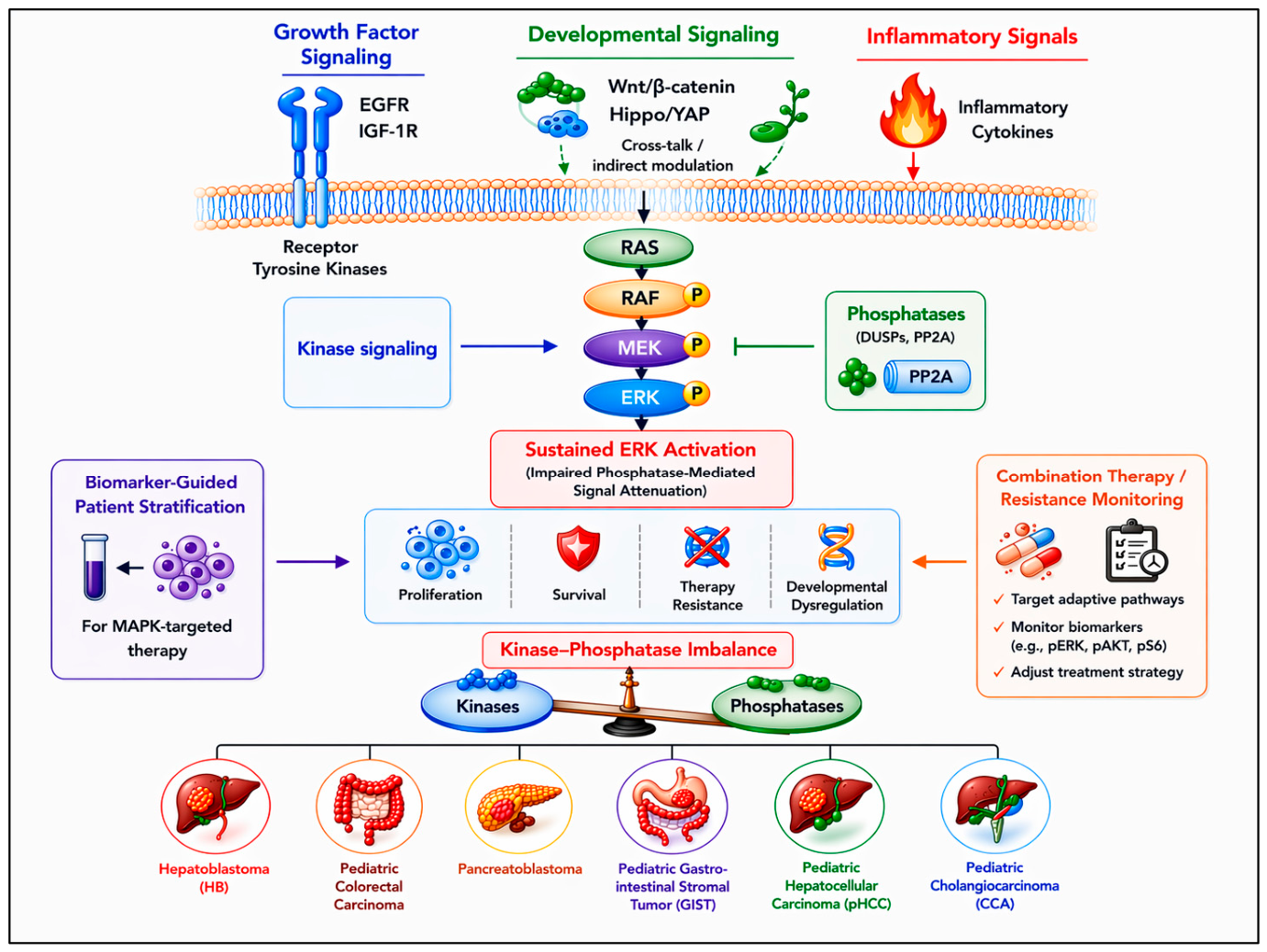
Activation of the RAS/MAPK pathway is typically initiated by receptor tyrosine kinases (RTKs) in response to extracellular ligands, leading to RAS activation and sequential phosphorylation of RAF, MEK, and ERK [12]. These phosphorylation events transmit signals to the nucleus and regulate transcriptional programs controlling proliferation, differentiation, and cellular survival. Under physiologic conditions, pathway activity is tightly constrained by negative feedback loops and phosphatase-mediated dephosphorylation, ensuring transient and context-dependent signaling output [6,13]. An overview of RAS/MAPK signaling as a kinase–phosphatase-regulated pathway integrating developmental, growth factor, and inflammatory inputs in pediatric GI cancers is shown in Figure 1.
In cancer, disruption of the balance between kinase-driven activation and phosphatase-mediated signal attenuation results in sustained MAPK signaling and oncogenic transcriptional reprogramming [14]. Importantly, in pediatric GI malignancies, persistent MAPK activation may occur even in the absence of canonical activating mutations in RAS or RAF genes [9,10]. Instead, pathway activation may be driven through heightened upstream RTK signaling and ligand-dependent stimulation, integration with developmental signaling networks, inflammatory microenvironment cues, and/or impaired phosphatase activity that prolongs ERK phosphorylation and signal duration [9,10,13]. Candidate RTKs that can converge on MAPK activation in GI tissues include EGFR/ERBB family receptors, FGFR signaling axes, MET, IGF1R, PDGFR, and KIT, each of which can promote downstream RAS activation through adaptor-mediated signaling and feedback-sensitive network dynamics [13]. Importantly, epithelial proliferation in pediatric GI tumors is not exclusively dependent on MAPK signaling, as parallel pathways—including PI3K–AKT–mTOR and Wnt/β-catenin—can independently sustain tumor growth or cooperate with MAPK signaling in a context-dependent manner [15]. This distinction has direct therapeutic implications: reliance on mutational profiling alone may underestimate MAPK dependency in pediatric GI cancers, whereas functional assessment of pathway output (e.g., ERK phosphorylation or phosphoproteomic signatures) may better identify actionable vulnerabilities. Standardization of phospho-ERK immunohistochemistry or phosphoproteomic-based pathway output scoring systems may provide a pragmatic entry point for clinical translation. To facilitate implementation, phospho-ERK (pERK) immunohistochemistry (IHC) will require harmonization of pre-analytical variables, including tissue fixation time and processing, as well as antibody selection and scoring criteria. Semi-quantitative scoring systems integrating staining intensity and the percentage of positive tumor cells may improve reproducibility across centers.
In parallel, mass spectrometry-based phosphoproteomic profiling offers a more comprehensive and quantitative assessment of pathway activation, although its clinical integration is currently limited by technical complexity, cost, and sample requirements. Emerging targeted phosphoproteomic approaches may help bridge this gap and support future biomarker-driven trials.
Emerging evidence suggests that dysregulation of MAPK-directed phosphatases such as DUSP family members and PP2A may contribute to sustained ERK activation in tumors lacking canonical RAS mutations [16,17]. In addition, upstream regulators such as SHP2 facilitate RTK-mediated RAS activation and may promote adaptive pathway rebound following MEK inhibition [18]. Collectively, these mechanisms highlight the importance of pathway regulation beyond canonical mutations in shaping MAPK signaling output in pediatric GI tumors.
Direct phosphoproteomic profiling of pediatric GI tumors remains limited, and systematic evaluation of ERK activation states across histologies is lacking. Prospective integration of pathway-output biomarkers into collaborative pediatric trials represents a key unmet research priority. Emerging single-cell and spatial profiling approaches are beginning to refine our understanding of mutational and signaling heterogeneity in pediatric tumors. While comprehensive single-cell studies specifically in pediatric gastrointestinal malignancies remain limited, data from broader pediatric cancer analyses suggest substantial intra-tumoral heterogeneity, including variability in pathway activation states across distinct cellular compartments. Importantly, bulk genomic analyses may underestimate the presence of subclonal RAS/MAPK alterations or fail to capture cell-state-dependent signaling activity, particularly in highly proliferative tissues where non-malignant or less-transformed cells can dilute mutation signals. These considerations highlight the need for higher-resolution approaches to more accurately define the frequency and functional relevance of MAPK pathway alterations in pediatric GI tumors [19,20,21]. Accordingly, pediatric GI malignancies represent a setting where targeting signaling dynamics, signal amplitude, duration, and feedback regulation may be more clinically informative than targeting single genetic lesions.

3. Developmental Context of RAS/MAPK Signaling in Pediatric GI Cancers

During normal development, gastrointestinal tissues rely on coordinated signaling through pathways such as Wnt/β-catenin, Hippo/YAP, and PI3K–AKT–mTOR to regulate growth, lineage commitment, and differentiation. These pathways engage in context-dependent cross-talk with MAPK signaling, shaping downstream transcriptional and cellular responses. RAS/MAPK signaling intersects with these programs at multiple levels, serving as a central integrator of developmental and environmental cues. In pediatric cancers, this physiologic signaling architecture may be co-opted to support malignant growth, particularly in tumors arising from tissues with active developmental remodeling and high proliferative capacity. While RAS/MAPK pathway involvement is supported by varying levels of evidence across pediatric GI tumor types, it is important to distinguish between tumor-specific data and hypothesis-driven extrapolation based on shared developmental signaling architecture. Available genomic studies indicate that, in contrast to adult gastrointestinal malignancies—where KRAS mutations occur in approximately 40–50% of colorectal cancers and BRAF alterations define additional subsets—pediatric GI tumors generally exhibit lower and more variable frequencies of canonical RAS/MAPK pathway mutations, with many cases lacking recurrent KRAS, NRAS, or BRAF alterations [19].
This developmental context distinguishes pediatric GI tumors from many adult malignancies, in which MAPK pathway activation more commonly reflects discrete oncogenic mutations that constitutively activate the pathway independent of extracellular cues [10]. In children, sustained MAPK signaling may instead represent persistence or dysregulation of developmentally programmed signaling states, rather than irreversible genetic activation, thereby creating a therapeutic landscape in which pathway modulation—and biomarker-guided targeting of signaling dynamics—may be preferable to complete pathway blockade. In addition, the developing immune microenvironment in pediatric patients may influence tumor initiation and progression through differences in immune surveillance, inflammatory tone, and stromal interactions compared with adult tissues. Pediatric tumors often arise in the context of an evolving immune system characterized by distinct innate and adaptive immune responses, which may alter tumor–immune equilibrium and facilitate tumor growth. Importantly, inflammatory cytokines and growth factors within the tumor microenvironment can activate receptor tyrosine kinases and downstream RAS/MAPK signaling in epithelial cells, providing a potential link between immune context and pathway activation. Furthermore, the relatively low mutational burden and unique immune context of many pediatric tumors may influence responses to immunotherapeutic strategies, including immune checkpoint blockade. However, the extent to which immune immaturity directly contributes to MAPK-driven signaling dynamics in pediatric GI tumors remains incompletely defined and represents an area for further investigation [22,23]. Accordingly, pediatric GI oncology increasingly requires conceptual frameworks that extend beyond mutation-centered models to incorporate signaling intensity, duration, and feedback regulation as actionable determinants of tumor behavior and therapeutic response. While MAPK inhibitors are not part of current standard therapy due to limited pediatric trial evidence and uncertainty regarding toxicity–benefit balance in the absence of validated biomarkers, pathway-output assessment may support investigational enrollment and rational pathway-oriented strategies in biologically selected patients. Herein, we focus on hepatoblastoma (HB), pediatric colorectal carcinoma, pancreatoblastoma, pediatric gastrointestinal stromal tumor (GIST), pediatric hepatocellular carcinoma (pHCC), and pediatric cholangiocarcinoma (CCA) (Table 2).

3.1. Hepatoblastoma (HB): RAS/MAPK Signaling as a Proliferative Amplifier and Therapeutic Modifier

Hepatoblastoma (HB) is the most common malignant liver tumor in children, with global epidemiologic analyses showing geographic variation and an overall incidence of approximately 1.5 cases per million children per year, predominantly affecting those under 5 years of age [24,25].
Although aberrant Wnt/β-catenin signaling is a hallmark of hepatoblastoma, transcriptomic profiling demonstrates broader deregulation of growth and survival programs, supporting integration of additional kinase-driven pathways. In this context, RAS/MAPK signaling may function as a proliferative amplifier that enhances cell-cycle progression and tumor survival, even in the absence of canonical RAS mutations, consistent with a post-translational activation model driven by upstream growth factor signaling and/or impaired negative regulation [26,27].
Standard therapy remains multimodal and risk-adapted, combining systemic chemotherapy with definitive surgical resection when feasible. Modern protocols emphasize chemotherapy optimization and surgical standardization, including evidence supporting PLADO-based regimens (Cisplatin and Doxorubicin) and structured surgical guidelines [28,29,30,31,32]. For unresectable tumors or extensive hepatic involvement, liver transplantation remains a curative option in selected patients [33]. Relapsed or refractory hepatoblastoma remains a major unmet clinical need, prompting collaborative efforts to improve biologic stratification and trial infrastructure [34].

3.2. Pediatric Colorectal Carcinoma: Treatment Challenges and Functional MAPK Activation Beyond KRAS

Pediatric colorectal carcinoma is clinically aggressive, representing less than 1% of pediatric malignancies, with increasing attention to early-onset colorectal cancer as a distinct clinical and molecular entity [35].
Adult colorectal cancer paradigms heavily emphasize KRAS mutation status for predicting resistance to standard therapy, and multiple studies in early-onset disease demonstrate a meaningful role for KRAS-related variation and broader genomic complexity [36,37]. Notably, some pediatric and early-onset colorectal cancers do harbor KRAS alterations, underscoring the heterogeneity of MAPK pathway dependency across age groups [38,39,40]. In pediatric and young adult colorectal cancers, molecular profiling suggests distinct genomic landscapes, supporting the concept that MAPK pathway activation may occur through alternative upstream drivers and signaling feedback dysregulation rather than KRAS mutation status alone [41,42].
Because pediatric-specific prospective evidence is limited, management is often extrapolated from adult regimens and generally includes surgical resection with systemic chemotherapy for advanced disease. Molecular stratification may have prognostic relevance, as microsatellite instability has been associated with favorable prognosis in pediatric cohorts [43,44].
MAPK-targeted therapies are not currently standard in pediatric colorectal carcinoma due to limited pediatric trial evidence and lack of validated functional biomarkers for patient selection; however, pathway-output assessment may help identify investigational opportunities for targeted or combination strategies in refractory disease [45,46].

3.3. Pancreatoblastoma: Developmental Tumor Biology and Limited Therapeutic Standardization

Pancreatoblastoma is a rare pediatric pancreatic malignancy characterized by embryonal histology and strong developmental biology. Integrated molecular characterization supports the concept that pancreatoblastoma is driven by distinct oncogenic programs and developmental signaling architecture rather than high mutational burden [47].
While direct evidence for MAPK-driven oncogenesis remains limited, emerging reports expand the spectrum of potential RAS/MAPK involvement, including NRAS mutation in select cases, supporting biologic plausibility for MAPK-related vulnerabilities in a subset of tumors [48]. Ongoing molecular investigations are beginning to clarify the signaling alterations underlying pancreatoblastoma pathogenesis. For example, a recent report describing spontaneous rupture of an advanced pancreatoblastoma identified aberrant RASSF1A promoter methylation and a CTNNB1 mutation, highlighting disruption of key growth-regulatory pathways. RASSF1A is a well-established Ras effector and tumor suppressor that modulates Ras/MAPK signaling by interfacing with RAF kinases and restraining ERK activation, while also promoting pro-apoptotic signaling through Hippo pathway components. Epigenetic silencing of RASSF1A therefore shifts KRAS output toward unchecked MAPK-driven proliferation and survival. In parallel, activating mutations in CTNNB1 stabilize β-catenin and enhance Wnt signaling, reinforcing developmental programs that are frequently co-opted in embryonal tumors such as pancreatoblastoma. Together, these alterations support the concept that dysregulated Ras/MAPK and developmental signaling networks cooperate in the biology of this rare tumor [49].
Treatment is multimodal and typically includes surgical resection when feasible, often combined with systemic chemotherapy for locally advanced or metastatic disease. However, standardized pediatric regimens remain limited due to extreme rarity, and clinical decision-making often relies on case-based evidence [50].

3.4. Pediatric Gastrointestinal Stromal Tumors (GIST): Distinct Biology and Potential MAPK Escape Signaling

Gastrointestinal stromal tumor (GIST) in children typically presents in the second decade of life (median age of 13 years) with a strong predilection toward females, who represent ∼70–75% of sporadic pediatric cases [51]. Pediatric GIST is biologically distinct from adult GIST, with early foundational studies demonstrating differences in driver alterations and mechanisms of progression [52]. A minority (10–15%) of GISTs in adults, along with ∼85% of pediatric GISTs, lacks oncogenic mutations in KIT and PDGFRA [53]. Not surprisingly, these wild-type (WT) GISTs respond poorly to kinase inhibitor therapy. Pediatric KIT/PDGFRA–wild-type tumors may still demonstrate KIT activation through distinct biology, and succinate dehydrogenase (SDH) enzyme complex deficiency represents a major molecular subgroup contributing to unique clinical behavior and therapeutic response patterns [54].
Surgical resection remains central when feasible, while systemic therapy decisions may incorporate TKIs depending on tumor biology and clinical context. Long-term management can be challenging in recurrent or metastatic disease, and responses to adult-derived TKI approaches may be variable. MAPK signaling may contribute to downstream survival signaling and adaptive resistance, supporting interest in pathway-informed investigational strategies.

3.5. Pediatric Hepatocellular Carcinoma (pHCC): Limited Systemic Options and Need for Pathway-Driven Strategies

Pediatric hepatocellular carcinoma is rare but high-risk, occurring either sporadically or in the context of underlying liver disease with biologic and clinical features that differ from hepatoblastoma (HB) and from adult HCC. Overall, the prognosis of pediatric HCC is dismal with 5-year event-free survival of <30% as compared to >80% for HB. Contemporary reviews highlight predisposing conditions, molecular mechanisms, and ongoing challenges in pediatric-specific therapeutic development [55,56].
Curative therapy relies on complete surgical resection when possible, and liver transplantation may be considered in selected cases [57]. International groups have done trials in pediatric HCC with chemotherapy optimization regimen, based on PLADO-based regimens (Cisplatin and Doxorubicin) as for HB [32]. Sorafenib, a multi-kinase inhibitor, following positive results in adults and in a pilot study in children, is now tested in conjunction with chemotherapy in the PHITT phase III clinical trial. Evidence from pediatric cooperative experiences continues to evaluate whether modified platinum- and doxorubicin-based chemotherapy improves resectability and outcomes, while registry-based studies highlight persistent uncertainty regarding systemic therapy benefit in unresectable disease [58]. Notably, HCC showed a meaningful response to neoadjuvant chemotherapy, which enabled secondary resection in several initially unresectable cases, suggesting that chemotherapy may be a valuable component of treatment in selected patients [59]. An extended molecular analysis of tumor samples could give information about pathways as possible targets of biological and immunotherapeutic agents and immune checkpoint inhibitors (ICIs) bringing new pharmacological options for the treatment of pediatric HCC [60,61]. MAPK-targeted therapies are not established as standard treatment; however, pathway-driven stratification remains a rational investigational direction particularly for refractory disease where standard options are limited.

3.6. Pediatric Cholangiocarcinoma (CCA): Ultra-Rare Disease with Potential MAPK Linked Vulnerabilities

Pediatric cholangiocarcinoma (CCA) is a biliary malignancy, exceptionally rare, and registry-based analyses emphasize the limited number of pediatric cases available for systematic study [62].
Surgical resection offers the best chance of cure when feasible, while advanced disease remains challenging due to limited systemic options and poor outcomes [63]. Current approaches are largely extrapolated from adult biliary tract cancer management, including molecular screening strategies and guideline-based systemic treatment frameworks [64]. MAPK pathway-directed strategies may represent a rational investigational approach in biomarker-selected pediatric cases.

4. Therapeutic Targeting of RAS/MAPK Signaling in Pediatric GI Cancers: Repurposing Opportunities and Limitations

Targeted therapy development in pediatric gastrointestinal oncology is constrained by tumor rarity, limited trial enrollment, and the developmental importance of MAPK signaling in normal tissue growth. Consequently, treatment paradigms are often extrapolated from adult GI oncology despite major biological differences between pediatric and adult tumors.
In adult GI cancers, MAPK-directed strategies have historically focused on mutation-defined targets and resistance mechanisms [65]. However, pediatric GI malignancies may exhibit MAPK pathway activation without canonical KRAS or RAF mutations, emphasizing the importance of pathway-output evaluation rather than mutation status alone [66]. In this setting, downstream inhibition at the level of MEK or ERK represents a theoretically attractive approach [67].
Despite this rationale, clinical evidence for MAPK inhibitor use in pediatric GI cancers remains limited, and toxicity considerations are critical given the pathway’s role in development. Pediatric-specific clinical trials evaluating MAPK-targeted therapies in gastrointestinal malignancies remain scarce, and available evidence suggests variable and often context-dependent responses. In particular, MAPK inhibitors have demonstrated limited or transient efficacy as monotherapy in tumors lacking clear mutational drivers, with adaptive resistance frequently observed. MEK inhibitors such as trametinib and selumetinib have demonstrated clinical activity in pediatric MAPK-driven conditions, although responses are often partial and associated with class-specific toxicities, including dermatologic, gastrointestinal, and potential cardiac or ocular effects [68]. However, pediatric-specific clinical trials in gastrointestinal malignancies remain scarce, and available data suggest variable and context-dependent responses. In particular, MAPK inhibitors have shown limited or transient efficacy as monotherapy in tumors lacking clear mutational drivers.
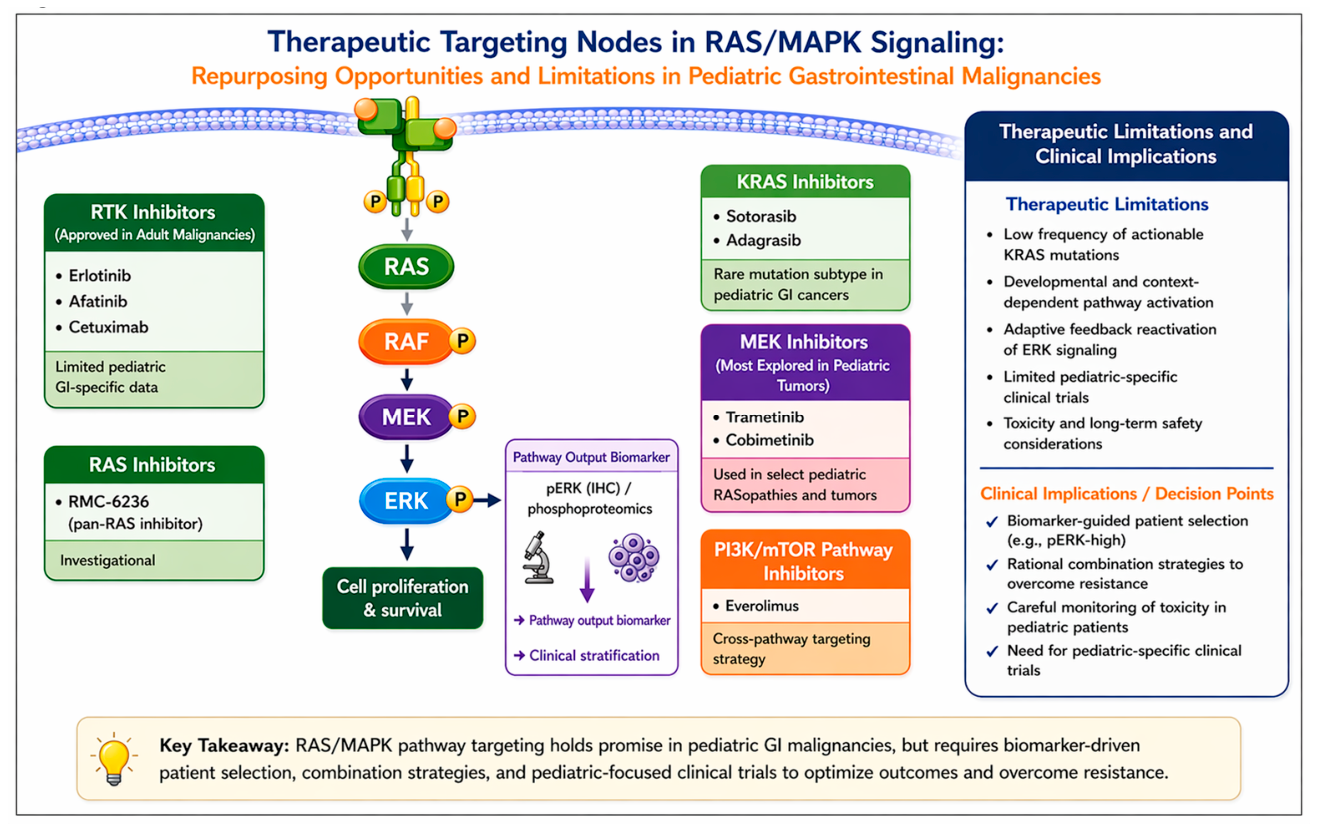
Resistance to MAPK inhibition frequently arises through pathway reactivation mechanisms, including upstream receptor tyrosine kinase signaling, SHP2-mediated feedback, and engagement of parallel pathways such as PI3K/AKT [18,69]. These observations support the need for biomarker-guided patient selection and rational combination strategies in pediatric GI malignancies. Combination approaches may be particularly relevant, including MAPK inhibition with chemotherapy, dual pathway targeting, and RTK-directed combinations [70] (Figure 2).

5. Therapeutic Outlook and Research Priorities

Available evidence supports a paradigm shift in pediatric gastrointestinal oncology: RAS/MAPK signaling is not solely a mutation-defined cascade, but a dynamic signaling output shaped by developmental context, upstream receptor inputs, signaling crosstalk, and failures of phosphatase-mediated attenuation. This distinction explains why adult-derived targeted strategies cannot be directly translated to children and underscores the need for functional biomarkers that measure pathway activity rather than genotype alone. Therapeutically, MAPK-directed agents offer important repurposing opportunities, including convergent inhibition at the level of MEK or ERK and upstream approaches such as SHP2 or SOS1 inhibition to reduce RAS activation and pathway rebound. Nevertheless, developmental toxicity concerns and adaptive resistance favor biomarker-guided, combination-based approaches—such as MAPK modulation with chemotherapy, co-targeting MAPK with PI3K/AKT/mTOR, or pairing MAPK-directed therapy with RTK inhibition in receptor-driven tumors. By synthesizing emerging biology with practical therapeutic implications, this review defines a functional roadmap for precision therapy development in rare pediatric GI malignancies and highlights key priorities for collaborative trial design and translational investigation.

6. Disclaimer

The content of this publication is solely the responsibility of the authors and does not necessarily represent the official views of the National Institutes of Health (NIH) or the National Cancer Institute (NCI).

Author Contributions

Conceptualization, O.S.A.-O. and O.A.; methodology, O.S.A.-O. and O.A.; software, O.S.A.-O.; writing—original draft preparation, O.A.; writing—review and editing, O.S.A.-O.; visualization, O.S.A.-O. and O.A. All authors have read and agreed to the published version of the manuscript.

Funding

This research received no external funding.

Institutional Review Board Statement

Not applicable.

Informed Consent Statement

Not applicable.

Data Availability Statement

No new data were generated or analyzed in this study. Data sharing is not applicable to this article.

Acknowledgments

All scientific content, interpretation, and conclusions were developed independently by the authors. During the preparation of this manuscript, the authors used ChatGPT (OpenAI, GPT-5.3) for assistance in designing the figures. The authors have reviewed and edited the output and take full responsibility for the content of this publication.

Conflicts of Interest

The authors declare no conflicts of interest.

References

  1. Vaske, O.M.; Bjork, I.; Salama, S.R.; Beale, H.; Tayi Shah, A.; Sanders, L.; Pfeil, J.; Lam, D.L.; Learned, K.; Durbin, A. Comparative tumor RNA sequencing analysis for difficult-to-treat pediatric and young adult patients with cancer. JAMA Netw. Open 2019, 2, e1913968. [Google Scholar] [CrossRef]
  2. Khater, F.; Vairy, S.; Langlois, S.; Dumoucel, S.; Sontag, T.; St-Onge, P.; Bittencourt, H.; Dal Soglio, D.; Champagne, J.; Duval, M. Molecular profiling of hard-to-treat childhood and adolescent cancers. JAMA Netw. Open 2019, 2, e192906. [Google Scholar] [CrossRef]
  3. Fernández-Medarde, A.; Santos, E. Ras in cancer and developmental diseases. Genes Cancer 2011, 2, 344–358. [Google Scholar] [CrossRef]
  4. Rauen, K.A.; Schoyer, L.; Schill, L.; Stronach, B.; Albeck, J.; Andresen, B.S.; Cavé, H.; Ellis, M.; Fruchtman, S.M.; Gelb, B.D. Proceedings of the fifth international RASopathies symposium: When development and cancer intersect. Am. J. Med. Genet. Part A 2018, 176, 2924–2929. [Google Scholar] [CrossRef]
  5. Roberts, P.J.; Der, C.J. Targeting the Raf-MEK-ERK mitogen-activated protein kinase cascade for the treatment of cancer. Oncogene 2007, 26, 3291–3310. [Google Scholar] [CrossRef]
  6. Barbosa, R.; Acevedo, L.A.; Marmorstein, R. The MEK/ERK network as a therapeutic target in human cancer. Mol. Cancer Res. 2021, 19, 361–374. [Google Scholar] [CrossRef] [PubMed]
  7. Vanclooster, P.; Seghers, S.; Prenen, H. State-of-the-art and upcoming trends in RAS-directed therapies in gastrointestinal malignancies. Curr. Opin. Oncol. 2024, 36, 313–319. [Google Scholar] [CrossRef] [PubMed]
  8. Imperial, R.; Toor, O.M.; Hussain, A.; Subramanian, J.; Masood, A. Comprehensive pancancer genomic analysis reveals (RTK)-RAS-RAF-MEK as a key dysregulated pathway in cancer: Its clinical implications. In Seminars in Cancer Biology; Elsevier: Amsterdam, The Netherlands; pp. 14–28.
  9. Vaseva, A.V.; Yohe, M.E. Targeting RAS in pediatric cancer: Is it becoming a reality? Curr. Opin. Pediatr. 2020, 32, 48–56. [Google Scholar] [CrossRef]
  10. Pearson, A.D.; Allen, C.; Fangusaro, J.; Hutter, C.; Witt, O.; Weiner, S.; Reaman, G.; Russo, M.; Bandopadhayay, P.; Ahsan, S. Paediatric Strategy Forum for medicinal product development in mitogen-activated protein kinase pathway inhibitors: ACCELERATE in collaboration with the European Medicines Agency with participation of the Food and Drug Administration. Eur. J. Cancer 2022, 177, 120–142. [Google Scholar] [CrossRef] [PubMed]
  11. Ney, G.M.; McKay, L.; Koschmann, C.; Mody, R.; Li, Q. The emerging role of Ras pathway signaling in pediatric cancer. Cancer Res. 2020, 80, 5155–5163. [Google Scholar] [CrossRef]
  12. Levinson, A.; Shannon, K.; Huang, B.J. Targeting Hyperactive Ras Signaling in Pediatric Cancer. Cold Spring Harb. Perspect. Med. 2025, 15, a041572. [Google Scholar] [CrossRef]
  13. Lei, Y.-Y.; Wang, W.-J.; Mei, J.-H.; Wang, C.-L. Mitogen-activated protein kinase signal transduction in solid tumors. Asian Pac. J. Cancer Prev. 2014, 15, 8539–8548. [Google Scholar] [CrossRef]
  14. Khan, A.Q.; Kuttikrishnan, S.; Siveen, K.S.; Prabhu, K.S.; Shanmugakonar, M.; Al-Naemi, H.A.; Haris, M.; Dermime, S.; Uddin, S. RAS-mediated oncogenic signaling pathways in human malignancies. In Seminars in Cancer Biology; Elsevier: Amsterdam, The Netherlands; pp. 1–13.
  15. Samatar, A.A.; Poulikakos, P.I. Targeting RAS–ERK signalling in cancer: Promises and challenges. Nat. Rev. Drug Discov. 2014, 13, 928–942. [Google Scholar] [CrossRef]
  16. Caunt, C.J.; Keyse, S.M. Dual-specificity MAP kinase phosphatases (MKPs) Shaping the outcome of MAP kinase signalling. FEBS J. 2013, 280, 489–504. [Google Scholar] [CrossRef]
  17. Westermarck, J.; Hahn, W.C. Multiple pathways regulated by the tumor suppressor PP2A in transformation. Trends Mol. Med. 2008, 14, 152–160. [Google Scholar] [CrossRef]
  18. Fedele, C.; Ran, H.; Diskin, B.; Wei, W.; Jen, J.; Geer, M.J.; Araki, K.; Ozerdem, U.; Simeone, D.M.; Miller, G. SHP2 inhibition prevents adaptive resistance to MEK inhibitors in multiple cancer models. Cancer Discov. 2018, 8, 1237–1249. [Google Scholar] [CrossRef] [PubMed]
  19. Gröbner, S.N.; Worst, B.C.; Weischenfeldt, J.; Buchhalter, I.; Kleinheinz, K.; Rudneva, V.A.; Johann, P.D.; Balasubramanian, G.P.; Segura-Wang, M.; Brabetz, S. The landscape of genomic alterations across childhood cancers. Nature 2018, 555, 321–327. [Google Scholar] [CrossRef] [PubMed]
  20. Smith, J.C.; Sheltzer, J.M. Genome-wide identification and analysis of prognostic features in human cancers. Cell Rep. 2022, 38, 110569. [Google Scholar] [CrossRef]
  21. Tirosh, I.; Izar, B.; Prakadan, S.M.; Wadsworth, M.H.; Treacy, D.; Trombetta, J.J.; Rotem, A.; Rodman, C.; Lian, C.; Murphy, G. Dissecting the multicellular ecosystem of metastatic melanoma by single-cell RNA-seq. Science 2016, 352, 189–196. [Google Scholar] [CrossRef]
  22. Binnewies, M.; Roberts, E.W.; Kersten, K.; Chan, V.; Fearon, D.F.; Merad, M.; Coussens, L.M.; Gabrilovich, D.I.; Ostrand-Rosenberg, S.; Hedrick, C.C. Understanding the tumor immune microenvironment (TIME) for effective therapy. Nat. Med. 2018, 24, 541–550. [Google Scholar] [CrossRef]
  23. Wedekind, M.F.; Denton, N.L.; Chen, C.-Y.; Cripe, T.P. Pediatric Cancer Immunotherapy: Opportunities and Challenges. Pediatr. Drugs 2018, 20, 395–408. [Google Scholar] [CrossRef]
  24. Pio, L.; O’Neill, A.F.; Woodley, H.; Murphy, A.J.; Tiao, G.; Franchi-Abella, S.; Fresneau, B.; Watanabe, K.; Alaggio, R.; Lopez-Terrada, D. Hepatoblastoma. Nat. Rev. Dis. Primers 2025, 11, 36. [Google Scholar] [CrossRef]
  25. Shi, K.; Xu, C.; Zhang, X.; Liang, H.; Li, X.; Liu, B.; Wang, Q. Global trends and regional differences of hepatoblastoma: A systematic analysis and predictions to 2035 based on the global burden of disease study 2021. BMC Public Health 2025, 25, 3227. [Google Scholar] [CrossRef]
  26. Adesina, A.M.; Lopez-Terrada, D.; Wong, K.K.; Gunaratne, P.; Nguyen, Y.; Pulliam, J.; Margolin, J.; Finegold, M.J. Gene expression profiling reveals signatures characterizing histologic subtypes of hepatoblastoma and global deregulation in cell growth and survival pathways. Hum. Pathol. 2009, 40, 843–853. [Google Scholar] [CrossRef]
  27. Zhou, S.; Malvar, J.; Chi, Y.-Y.; Stein, J.; Wang, L.; Genyk, Y.; Sposto, R.; Mascarenhas, L. Independent assessment of the children’s hepatic tumors international collaboration risk stratification for hepatoblastoma and the association of tumor histological characteristics with prognosis. JAMA Netw. Open 2022, 5, e2148013. [Google Scholar] [CrossRef]
  28. Katzenstein, H.M.; Langham, M.R.; Malogolowkin, M.H.; Krailo, M.D.; Towbin, A.J.; McCarville, M.B.; Finegold, M.J.; Ranganathan, S.; Dunn, S.; McGahren, E.D. Minimal adjuvant chemotherapy for children with hepatoblastoma resected at diagnosis (AHEP0731): A Children’s Oncology Group, multicentre, phase 3 trial. Lancet Oncol. 2019, 20, 719–727, Erratum in Lancet Oncol. 2019, 20, e243. [Google Scholar] [CrossRef]
  29. Hishiki, T.; Ida, K.; Watanabe, K.; Mori, M.; Fujimura, J.; Nogami, Y.; Iehara, T.; Hoshino, K.; Yokoi, A.; Honda, S. Treatment of Intermediate-Risk Hepatoblastoma Using a Combined Cisplatin and Doxorubicin (PLADO) Regimen and Optimized Surgical Resection. Pediatr. Blood Cancer 2025, 72, e31770. [Google Scholar] [CrossRef] [PubMed]
  30. Hiyama, E.; Hishiki, T.; Yoshimura, K.; Krailo, M.; Maibach, R.; Haeberle, B.; Rangaswami, A.; Lopez-Terrada, D.; Malogolowkin, M.H.; Ansari, M. Upfront or delayed surgery in resectable hepatoblastoma: Analysis from the children’s hepatic tumors international collaboration database. EClinicalMedicine 2024, 76, 102811. [Google Scholar] [CrossRef] [PubMed]
  31. Kastenberg, Z.J.; Vasudevan, S.A.; Dolmadjian, L.; Langham, M.R.; Piao, J.; Tiao, G.M.; Dunn, S.P.; McGahren, E.D.; Towbin, A.J.; McCarville, M.B. Implementation of Comprehensive Surgical Guidelines for Hepatoblastoma: Analysis of the Children’s Oncology Group AHEP0731 Phase III Trial. Ann. Surg. 2025; Online ahead of print.
  32. Hiyama, E.; Hishiki, T.; Watanabe, K.; Ida, K.; Ueda, Y.; Kurihara, S.; Yano, M.; Hoshino, K.; Yokoi, A.; Takama, Y. Outcome and late complications of hepatoblastomas treated using the Japanese Study Group for Pediatric Liver Tumor 2 Protocol. J. Clin. Oncol. 2020, 38, 2488–2498. [Google Scholar] [CrossRef] [PubMed]
  33. Squires, R.H.; Ng, V.; Romero, R.; Ekong, U.; Hardikar, W.; Emre, S.; Mazariegos, G.V. Evaluation of the pediatric patient for liver transplantation: 2014 practice guideline by the American Association for the Study of Liver Diseases, American Society of Transplantation and the North American Society for Pediatric Gastroenterology, Hepatology and Nutrition. Hepatology 2014, 60, 362–398. [Google Scholar] [CrossRef]
  34. O’Neill, A.F.; Trobaugh-Lotrario, A.; Geller, J.I.; Hiyama, E.; Watanabe, K.; Aerts, I.; Fresneau, B.; Toutain, F.; Sullivan, M.J.; Katzenstein, H.M. The RELIVE consortium for relapsed or refractory pediatric hepatoblastoma and hepatocellular carcinoma: A scoping review of the problem and a proposed solution. EClinicalMedicine 2024, 69, 102446. [Google Scholar] [CrossRef] [PubMed]
  35. Sinicrope, F.A. Increasing incidence of early-onset colorectal cancer. N. Engl. J. Med. 2022, 386, 1547–1558. [Google Scholar] [CrossRef]
  36. Danti, G.; Santini, D.; Treballi, F.; Anichini, M.; Giannessi, C.; Piccolo, C.L.; Trinci, M.; Miele, V. New Updates in Diagnostic Imaging and Treatment of Rectal Cancer. Ann. Ital. Chir. 2025, 96, 1299–1314. [Google Scholar] [CrossRef] [PubMed]
  37. Ness, R.M.; Llor, X.; Abbass, M.A.; Bishu, S.; Chen, C.T.; Cooper, G.; Early, D.S.; Friedman, M.; Fudman, D.; Giardiello, F.M. NCCN guidelines® insights: Colorectal Cancer screening, version 1.2024: Featured updates to the NCCN Guidelines. J. Natl. Compr. Cancer Netw. 2024, 22, 438–446. [Google Scholar] [CrossRef]
  38. Alsop, K.; Mead, L.; Smith, L.D.; Royce, S.G.; Tesoriero, A.A.; Young, J.P.; Haydon, A.; Grubb, G.; Giles, G.G.; Jenkins, M.A. Low somatic K-ras mutation frequency in colorectal cancer diagnosed under the age of 45 years. Eur. J. Cancer 2006, 42, 1357–1361. [Google Scholar] [CrossRef]
  39. Aljehani, M.A.; Bien, J.; Lee, J.S.; Fisher, G.A., Jr.; Lin, A.Y. KRAS sequence variation as prognostic marker in patients with young-vs late-onset colorectal cancer. JAMA Netw. Open 2023, 6, e2345801. [Google Scholar] [CrossRef]
  40. Watson, R.; Liu, T.-C.; Ruzinova, M.B. High frequency of KRAS mutation in early onset colorectal adenocarcinoma: Implications for pathogenesis. Hum. Pathol. 2016, 56, 163–170. [Google Scholar] [CrossRef]
  41. Ponvilawan, B.; Sakornsakolpat, P.; Pongpaibul, A.; Roothumnong, E.; Akewanlop, C.; Pithukpakorn, M.; Korphaisarn, K. Comprehensive genomic analysis in sporadic early-onset colorectal adenocarcinoma patients. BMC Cancer 2025, 25, 349. [Google Scholar] [CrossRef]
  42. Li, J.; Pan, Y.; Guo, F.; Wang, C.; Liang, L.; Li, P.; Liang, W.; Lian, P.; Chen, Y.; Yang, Y. Patterns in genomic mutations among patients with early-onset colorectal cancer: An international, multicohort, observational study. Lancet Oncol. 2025, 26, 1055–1066. [Google Scholar] [CrossRef]
  43. Guanà, R.; Soto Torselli, A.S.; De Leo, F.; Marino, B.; Perin, S.; Morgani, G.; Allaix, M.E.; Piglione, M.; Di Martino, V.; Falco, E.C. Colorectal adenocarcinoma in children and adolescents: The management of advanced disease. Int. J. Color. Dis. 2025, 40, 237. [Google Scholar] [CrossRef] [PubMed]
  44. Wild, H.; Liebmann, A.; Maennel, L.; Maschke, L.; Block, A.; Kager, L.; Kontny, U.; Agaimy, A.; Kuhlen, M.; Redlich, A. Colorectal carcinoma in childhood and adolescence: Microsatellite instability correlates with a favorable prognosis. Pediatr. Blood Cancer 2025, 72, e31830. [Google Scholar] [CrossRef] [PubMed]
  45. Busico, A.; Gasparini, P.; Rausa, E.; Cattaneo, L.; Bozzi, F.; Silvestri, M.; Capone, I.; Conca, E.; Tamborini, E.; Perrone, F. Molecular profiling of pediatric and young adult colorectal cancer reveals a distinct genomic landscapes and potential therapeutic avenues. Sci. Rep. 2024, 14, 13138. [Google Scholar] [CrossRef]
  46. Sepulveda, A.R.; Hamilton, S.R.; Allegra, C.J.; Grody, W.; Cushman-Vokoun, A.M.; Funkhouser, W.K.; Kopetz, S.E.; Lieu, C.; Lindor, N.M.; Minsky, B.D. Molecular biomarkers for the evaluation of colorectal cancer: Guideline from the American Society for Clinical Pathology, College of American Pathologists, Association for Molecular Pathology, and American Society of Clinical Oncology. Am. J. Clin. Pathol. 2017, 147, 221–260. [Google Scholar] [CrossRef]
  47. Isobe, T.; Seki, M.; Yoshida, K.; Sekiguchi, M.; Shiozawa, Y.; Shiraishi, Y.; Kimura, S.; Yoshida, M.; Inoue, Y.; Yokoyama, A. Integrated molecular characterization of the lethal pediatric cancer pancreatoblastoma. Cancer Res. 2018, 78, 865–876. [Google Scholar] [CrossRef]
  48. Gestrich, C.K.; Skaugen, J.M.; Bukowinski, A.; Roe, M.; Umstead, E.C.; Wang, Q. Pediatric Pancreatoblastoma with an NRAS Mutation: Expanding the Spectrum of Genetic Alterations in Pancreatoblastoma. Pediatr. Dev. Pathol. 2026, 29, 93–97. [Google Scholar] [CrossRef]
  49. Honda, S.; Okada, T.; Miyagi, H.; Minato, M.; Suzuki, H.; Taketomi, A. Spontaneous rupture of an advanced pancreatoblastoma: Aberrant RASSF1A methylation and CTNNB1 mutation as molecular genetic markers. J. Pediatr. Surg. 2013, 48, e29–e32. [Google Scholar] [CrossRef]
  50. Huang, Y.; Yang, W.; Hu, J.; Zhu, Z.; Qin, H.; Han, W.; Wang, H. Diagnosis and treatment of pancreatoblastoma in children: A retrospective study in a single pediatric center. Pediatr. Surg. Int. 2019, 35, 1231–1238. [Google Scholar] [CrossRef] [PubMed]
  51. Benesch, M.; Wardelmann, E.; Ferrari, A.; Brennan, B.; Verschuur, A. Gastrointestinal stromal tumors (GIST) in children and adolescents: A comprehensive review of the current literature. Pediatr. Blood Cancer 2009, 53, 1171–1179. [Google Scholar] [CrossRef] [PubMed]
  52. Agaram, N.P.; Laquaglia, M.P.; Ustun, B.; Guo, T.; Wong, G.C.; Socci, N.D.; Maki, R.G.; DeMatteo, R.P.; Besmer, P.; Antonescu, C.R. Molecular characterization of pediatric gastrointestinal stromal tumors. Clin. Cancer Res. 2008, 14, 3204–3215. [Google Scholar] [CrossRef]
  53. Janeway, K.A.; Liegl, B.; Harlow, A.; Le, C.; Perez-Atayde, A.; Kozakewich, H.; Corless, C.L.; Heinrich, M.C.; Fletcher, J.A. Pediatric KIT–Wild-Type and platelet-derived growth factor receptor α–Wild-Type gastrointestinal stromal tumors share KIT activation but not mechanisms of genetic progression with adult gastrointestinal stromal tumors. Cancer Res. 2007, 67, 9084–9088. [Google Scholar] [CrossRef]
  54. Belinsky, M.G.; Rink, L.; von Mehren, M. Succinate dehydrogenase deficiency in pediatric and adult gastrointestinal stromal tumors. Front. Oncol. 2013, 3, 117. [Google Scholar] [CrossRef] [PubMed]
  55. Khanna, R.; Verma, S.K. Pediatric hepatocellular carcinoma. World J. Gastroenterol. 2018, 24, 3980. [Google Scholar] [CrossRef]
  56. Young, E.P.; O’Neill, A.F.; Rangaswami, A.A. Pediatric hepatocellular carcinoma: A review of predisposing conditions, molecular mechanisms, and clinical considerations. Int. J. Mol. Sci. 2025, 26, 1252. [Google Scholar] [CrossRef] [PubMed]
  57. Sakamoto, S.; Harikrishnan, S.; Uchida, H.; Yanagi, Y.; Fukuda, A.; Kasahara, M. Liver transplantation for pediatric liver malignancies. Liver Transplant. 2025, 31, 1053–1063. [Google Scholar] [CrossRef]
  58. Murawski, M.; Weeda, V.B.; Maibach, R.; Morland, B.; Roebuck, D.J.; Zimmerman, A.; Casanova, M.; Perilongo, G.; Laithier, V.; Kebudi, R. Hepatocellular carcinoma in children: Does modified platinum-and doxorubicin-based chemotherapy increase tumor resectability and change outcome? Lessons learned from the SIOPEL 2 and 3 studies. J. Clin. Oncol. 2016, 34, 1050–1056. [Google Scholar] [CrossRef]
  59. Rassner, M.; Häberle, B.; Maxwell, R.; Frowein, J.v.; Kappler, R.; Rassner, M.; Vokuhl, C.; von Schweinitz, D.; Schmid, I. Does Chemotherapy Have an Effect on the Treatment Success of Children and Adolescents with Unresectable Hepatocellular Carcinoma? Findings from the German Liver Tumour Registry. Cancers 2025, 17, 2444. [Google Scholar] [CrossRef]
  60. Digiacomo, G.; Serra, R.P.; Turrini, E.; Tiri, A.; Cavazzoni, A.; Alfieri, R.; Bertolini, P. State of the art and perspectives in pediatric hepatocellular carcinoma. Biochem. Pharmacol. 2023, 207, 115373. [Google Scholar] [CrossRef]
  61. Zhong, X.; Wen, X.; Wang, X.; Ye, J.; Huang, L.; Wang, J.; Chi, J.; Zeng, X. Safety and clinical efficacy of immune checkpoint inhibitors in pediatric hepatocellular carcinoma: A case report and review of the literature. Front. Oncol. 2025, 15, 1576892. [Google Scholar] [CrossRef]
  62. Newsome, J.R.; Venkatramani, R.; Heczey, A.; Danysh, H.E.; Fishman, D.S.; Miloh, T. Cholangiocarcinoma among children and adolescents: A review of the literature and surveillance, epidemiology, and end results program database analysis. J. Pediatr. Gastroenterol. Nutr. 2018, 66, e12–e18. [Google Scholar] [CrossRef]
  63. Valle, J.W.; Kelley, R.K.; Nervi, B.; Oh, D.-Y.; Zhu, A.X. Biliary tract cancer. Lancet 2021, 397, 428–444. [Google Scholar] [CrossRef] [PubMed]
  64. Bekaii-Saab, T.; Bridgewater, J.; Normanno, N. Practical considerations in screening for genetic alterations in cholangiocarcinoma. Ann. Oncol. 2021, 32, 1111–1126. [Google Scholar] [CrossRef] [PubMed]
  65. Yuan, W.; Shi, Y.; Dai, S.; Deng, M.; Zhu, K.; Xu, Y.; Chen, Z.; Xu, Z.; Zhang, T.; Liang, S. The role of MAPK pathway in gastric cancer: Unveiling molecular crosstalk and therapeutic prospects. J. Transl. Med. 2024, 22, 1142. [Google Scholar] [CrossRef]
  66. Shukla, N.; Ameur, N.; Yilmaz, I.; Nafa, K.; Lau, C.-Y.; Marchetti, A.; Borsu, L.; Barr, F.G.; Ladanyi, M. Oncogene mutation profiling of pediatric solid tumors reveals significant subsets of embryonal rhabdomyosarcoma and neuroblastoma with mutated genes in growth signaling pathways. Clin. Cancer Res. 2012, 18, 748–757. [Google Scholar] [CrossRef]
  67. Crotty, E.E.; Sato, A.A.; Abdelbaki, M.S. Integrating MAPK pathway inhibition into standard-of-care therapy for pediatric low-grade glioma. Front. Oncol. 2025, 15, 1520316. [Google Scholar] [CrossRef]
  68. Fangusaro, J.; Onar-Thomas, A.; Poussaint, T.Y.; Wu, S.; Ligon, A.H.; Lindeman, N.; Banerjee, A.; Packer, R.J.; Kilburn, L.B.; Goldman, S. Selumetinib in paediatric patients with BRAF-aberrant or neurofibromatosis type 1-associated recurrent, refractory, or progressive low-grade glioma: A multicentre, phase 2 trial. Lancet Oncol. 2019, 20, 1011–1022. [Google Scholar] [CrossRef] [PubMed]
  69. Engelman, J.A.; Settleman, J. Acquired resistance to tyrosine kinase inhibitors during cancer therapy. Curr. Opin. Genet. Dev. 2008, 18, 73–79. [Google Scholar] [CrossRef] [PubMed]
  70. Baek, H.B.; Arur, S. RAS/ERK signaling and PLK1: Coordinating developmental regulation and disease mechanisms. Curr. Opin. Cell Biol. 2025, 95, 102544. [Google Scholar] [CrossRef]
Figure 1. Kinase–phosphatase regulation of RAS/MAPK signaling in pediatric gastrointestinal (GI) cancers. Extracellular signals activate the RAS/MAPK cascade through sequential phosphorylation of RAF, MEK, and ERK, while MAPK-directed phosphatases (e.g., DUSPs and PP2A) constrain signal amplitude and duration. Disruption of this kinase–phosphatase balance promotes sustained ERK activation and oncogenic signaling in pediatric GI cancers, including hepatoblastoma (HB), pediatric colorectal carcinoma, pancreatoblastoma, pediatric gastrointestinal stromal tumor (GIST), pediatric hepatocellular carcinoma (pHCC), and pediatric cholangiocarcinoma (CCA).
Kinasesphosphatases 04 00010 g001
Figure 2. Therapeutic targeting nodes in the RAS/MAPK signaling pathway in pediatric gastrointestinal malignancies. Schematic representation of the canonical RAS/MAPK cascade, beginning with receptor tyrosine kinase (RTK) activation and sequential signaling through RAS, RAF, MEK, and ERK to promote cell proliferation and survival. Pharmacologic targeting strategies are highlighted at multiple pathway nodes. RTK inhibitors (erlotinib, afatinib, cetuximab) are approved in adult malignancies but have limited pediatric GI-specific data. KRAS G12C inhibitors (sotorasib, adagrasib) are mutation-specific and may have limited applicability due to the low frequency of actionable KRAS mutations in pediatric gastrointestinal cancers. Pan-RAS inhibition Daraxonrasib (RMC-6236) represents an emerging strategy aimed at broader RAS targeting. MEK inhibitors (trametinib, cobimetinib) are the most clinically explored MAPK-directed agents in pediatric tumors and RASopathies. Cross-pathway targeting with PI3K/mTOR inhibitors (everolimus) is also shown. Key therapeutic limitations in pediatric GI malignancies include developmental context-dependent pathway activation, adaptive ERK feedback reactivation, limited pediatric-specific clinical trials, and long-term toxicity considerations.
Kinasesphosphatases 04 00010 g002
Table 1. Comparison of RAS/MAPK pathway activation in adult and pediatric gastrointestinal cancers.
Adult GI CancerPediatric GI Cancer
Mutation-drivenDevelopmentally driven
Recurrent KRAS/RAF mutationsRAS/MAPK developmental signaling
Genotype-driven therapy selectionFunctional pathway-output assessment
Constitutive pathway activationDevelopmentally driven and receptor-driven activation
Mutation blockadeSignal modulation
Table 2. Overview of pediatric gastrointestinal cancers, including standard treatments, limitations, RAS/MAPK pathway relevance, and therapeutic opportunities.
Pediatric GI MalignancyStandard Management/TreatmentMajor Limitations in PediatricsMAPK Pathway Relevance (Why It Matters)Therapeutic Opportunity (MAPK Angle)
Hepatoblastoma (HB)Risk-adapted chemotherapy + surgical resection; liver transplant for unresectable diseaseTreatment toxicity; relapse/refractory cases need better optionsMAPK may act as a proliferative amplifier, often without KRAS/RAF mutationsConsider MAPK output testing (pERK) to support MEK/ERK modulation in refractory/high-risk disease and as a potential chemosensitizer
Pediatric colorectal carcinomaSurgery + systemic chemotherapy (often adult-derived regimens)Rare + aggressive; limited pediatric trials; adult mutation-guided therapy may not translateFunctional MAPK activation may occur without canonical KRASEvaluate pathway output (not mutation only); explore downstream MAPK inhibition or pathway-based trial enrollment
PancreatoblastomaSurgical resection ± chemotherapyExtremely rare; no standardized pediatric protocolsDevelopmental tumor biology suggests pathway convergence including MAPKUse functional biomarkers to identify MAPK dependence and guide investigational targeted options in refractory disease
Pediatric Gastrointestinal stromal tumor (GIST)Surgery when feasible; selective use of TKIs depending on biologyPediatric GIST differs from adult; variable response to standard TKIsMAPK may mediate RTK downstream signaling and escape pathwaysConsider MAPK signaling as a resistance node; rational basis for RTK + MAPK combination strategies (investigational)
Pediatric hepatocellular carcinoma (pHCC)Resection or transplant when possible; limited systemic optionsOften chemo-resistant; limited pediatric targeted therapy dataPathway-level dysregulation may be present even without actionable mutationsUse MAPK output stratification to support enrollment in pathway-driven trials or investigational combinations
Pediatric cholangiocarcinoma (CCA)Resection when possible; limited systemic therapyVery rare; poor outcomes in advanced disease; no pediatric standardsPotential RTK → MAPK activation and resistance mechanismsBasket trials/pathway-based strategies guided by functional activation rather than histology
Disclaimer/Publisher’s Note: The statements, opinions and data contained in all publications are solely those of the individual author(s) and contributor(s) and not of MDPI and/or the editor(s). MDPI and/or the editor(s) disclaim responsibility for any injury to people or property resulting from any ideas, methods, instructions or products referred to in the content.