1. Introduction
Lymphedema is an increasingly recognized complication of head and neck cancer (HNC) treatment. Head and neck lymphedema (HNL) can be separated into internal and external. External HNL refers to fluid accumulation in the subcutaneous tissue that manifests as visible swelling and skin changes. External HNL can often result in noticeable cosmetic deformities that contribute to body image disturbance, psychological distress, and subsequent social withdrawal. Furthermore, chronic swelling and secondary fibrosis of the neck lead to reduced cervical range of motion, increased tissue stiffness, and pain during functional movement. Internal HNL, by contrast, involves edema of the mucosal surfaces of the aerodigestive tract (i.e., pharynx and larynx), which can result in significant dysphagia, dysphonia, and in severe cases, airway compromise.
The reported prevalence of HNL ranges widely from 12 to 90%, a variability largely attributable to differences assessment tools utilized, tumor subsite, treatment modalities, follow-up timing, and whether internal lymphedema was included in the evaluation [
1]. When both internal and external components are systematically assessed using objective tools, prevalence has been reported as high as 75–98% [
2]. However, HNL may often be subclinical or well-tolerated by the patient. In the HeNLy-1 study of 421 HNC survivors, the overall prevalence of HNL was 45.1%, with the majority classified as early stage 1a (soft, visible, reversible edema) [
3]. This distinction between objectively detected and clinically significant HNL is important, as it may reconcile differences seen in research settings versus clinical practice. Moreover, rates of HNL vary widely with treatment modality and intensity. Rates tend to be the highest among patients undergoing multimodal therapy (often surgery with adjuvant radiation or definitive chemoradiotherapy), with estimates as high as 70% in this group [
1,
4]. Conversely, single modality therapies tend to result in lower but still meaningful rates [
3]. Unilateral selective neck dissection carries a lymphedema rate of approximately 19%, while bilateral neck dissection—particularly with bilateral jugular vein sacrifice—increases the rate to 33–54% [
5]. In comparison, around 40% of non-operative patients treated with radiation ± chemotherapy develop HNL, with concurrent chemoradiotherapy increasing risk [
5].
As novel therapies continue to extend the lives of HNC patients, survivorship has become a key priority. Given the widespread impact of lymphedema following HNC treatment, a thorough understanding of the disease and its management is of importance. The aim of this narrative review is to provide a broad overview in order to educate the provider on the modern prevention, assessment, and management of HNL.
2. Narrative Review Scope and Approach
This narrative review was conducted to provide a comprehensive, clinically oriented synthesis of the current understanding of HNL, including its pathophysiology, assessment, risk factors, and management. As a narrative review, a thorough and iterative literature search was performed across PubMed/MEDLINE (National Center for Biotechnology Information (NCBI), National Library of Medicine (NLM), Bethesda, MD, USA), Google Scholar (Google LLC, Mountain View, CA, USA) and the Cochrane Library (ohn Wiley & Sons, Ltd., Chichester, UK (published on behalf of The Cochrane Collaboration, London, UK) from database inception through May 2026. Search terms included combinations of “head and neck cancer,” “head and neck neoplasms,” “lymphedema,” “cervicofacial edema,” and “swelling,” combined with domain-specific terms including “complete decongestive therapy,” “manual lymphatic drainage,” “lymphovenous anastomosis,” “vascularized lymph node transfer,” “liposuction,” “indocyanine green lymphography,” “lymphoscintigraphy,” “compression therapy,” “radiation,” “neck dissection,” “patient-reported outcomes,” and “glymphatic.” Reference lists of retrieved articles were hand-searched to identify additional relevant publications, and citation tracking was performed for seminal studies in the field. The authors reviewed and selected key studies based on their relevance, methodological rigor, and contribution to the current understanding of HNL. Emphasis was placed on prospective cohort studies, randomized controlled trials, and systematic reviews when available, supplemented by case series and case reports for emerging diagnostic and surgical techniques where higher-level evidence was limited. Non-English-language publications, editorials, and commentaries were excluded. To ensure comprehensive coverage of the literature, the search was cross-referenced against existing systematic reviews on HNL assessment, treatment, and outcomes.
3. Anatomy and Pathophysiology
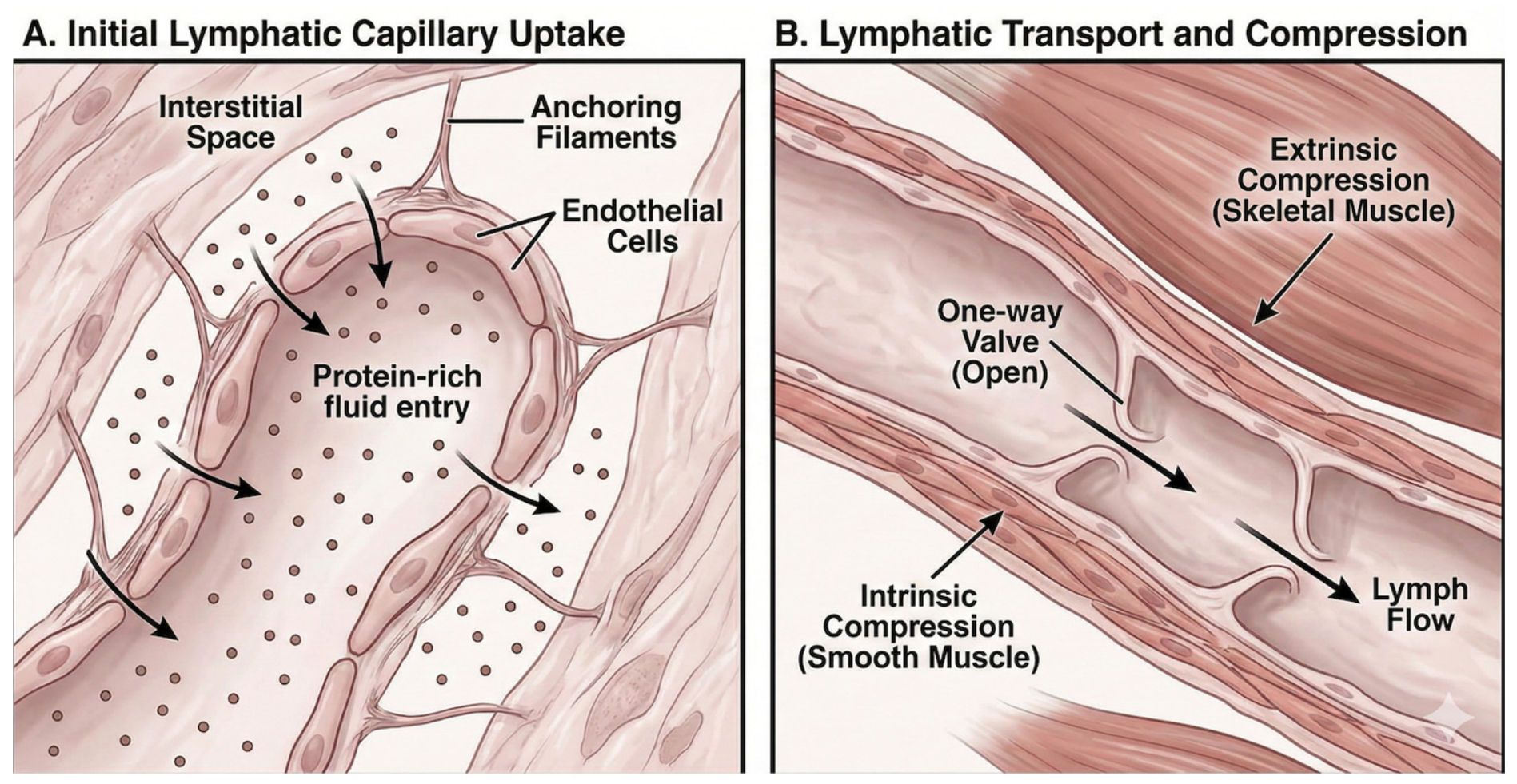
The lymphatic system is a unidirectional network that is essential for fluid balance and immune surveillance. Protein-rich fluid from the interstitial space is drawn into lymphatic capillaries, where it is transported through a hierarchy of lymphatic vessels and filtering lymph nodes before returning to the venous circulation. Lymphatic flow is driven by extrinsic compression from surrounding musculature and intrinsic compression from smooth muscles in the vessel walls, aided by one-way valves (
Figure 1).
The head and neck present unique anatomical considerations for the lymphatic system. Despite its relatively small area, the head and neck contain approximately one-third of the body’s total nodal volume [
6]. Broadly, these nodes can be anatomically divided by the deep cervical fascia: the superficial system drains the cutaneous skin and superficial musculature, while the deep system drains the mucosal linings of the upper aerodigestive tract [
6]. On a granular level, the lymphatic network can be further subdivided into distinct territories, where specific subgroups are named according to the subsite they drain (i.e., submental). Lymphatic fluid eventually descends to the base of the neck, entering the systemic venous circulation via the thoracic duct on the left and the right lymphatic duct on the right prior to dumping into the venous circulation. A final distinction should be made for the facial and scalp lymphatic systems, which often lack one-way valves and thus permit retrograde flow [
6].
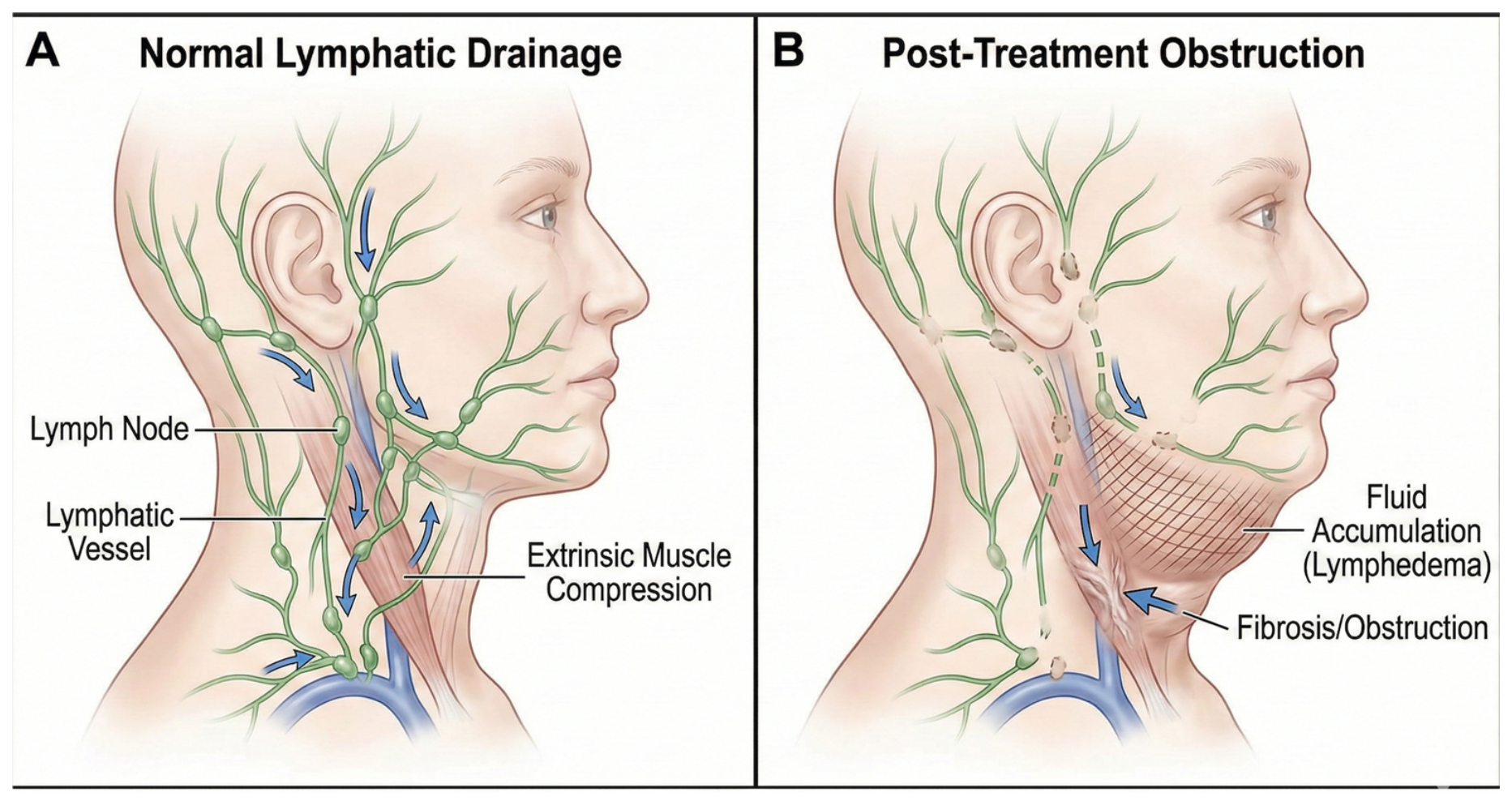
Lymphedema can be defined as a pathological accumulation of fluid in interstitial tissues. In the setting of HNC treatment, secondary lymphedema often arises from a “two-hit” mechanism as a direct result of surgery and radiation (
Figure 2). Surgical resection of tumors and diseased lymph nodes inevitably transects lymphatic vessels, physically severing drainage pathways. Surgical damage to surrounding musculature further reduces flow from extrinsic compression. Meanwhile, adjuvant radiation compounds this injury by causing fibrosis of surrounding tissue, constricting any remaining functional lymphatics, and simultaneously damaging the endothelial lining of the lymphatic vessels. The result of this damage is an accumulation of interstitial fluid, leading to the hallmark manifestation of swelling. Moreover, the stagnation of protein-rich lymph triggers a chronic inflammatory response characterized by dysregulation of CD4+ T cells, macrophages, and fibroblasts, leading to excess collagen deposition and adipose tissue remodeling [
7,
8]. These changes initiate a self-perpetuating cycle: increasing fibrosis from chronic inflammation prevents mechanical compression necessary to shunt lymph to healthy vessels, while the failing lymphatic system remains unable to clear the accumulating fluid and inflammatory mediators [
7].
An emerging concept with implications for HNL is the glial-lymphatic (glymphatic) system, which is a brain-wide perivascular transport network that serves as the central nervous system’s functional analog to the peripheral lymphatic system [
9]. In this pathway, cerebrospinal fluid enters the brain along periarterial spaces, exchanges with interstitial fluid through aquaporin-4 water channels on astrocytic end-feet, and exits along perivenous channels, thus clearing metabolic waste. This waste-laden fluid ultimately drains via meningeal lymphatic vessels into the deep cervical lymph nodes—the same nodal basins routinely disrupted by neck dissection and cervical irradiation [
10]. This anatomical convergence raises the possibility that treatment-induced HNL may simultaneously impair intracranial waste clearance. A recent preclinical model combining cervical lymph node dissection with radiation demonstrated ventricular enlargement, increased brain water content, and motor decline consistent with impaired glymphatic drainage [
11]. While clinical data in HNC survivors remain limited, recognition that the cervical lymphatic basin serves as the terminal drainage point for both peripheral and centrally derived brain interstitial fluid adds another layer of significance to preventing HNL for its potential neurological consequences beyond its well-established local effects.
4. Methods of HNL Assessment and Patient-Reported Outcome Measures (PROMs)
Having a reliable assessment tool is key to diagnosing, quantifying, and monitoring HNL. Accurate characterization of HNL subtype and severity is essential for guiding treatment selection. Because conservative therapies have demonstrated efficacy primarily for external lymphedema but have not achieved improvement in internal lymphedema, the identification of internal HNL on endoscopic evaluation may prompt consideration of complementary or alternative approaches, including emerging surgical options. Furthermore, early detection is critical, as early-stage lymphedema may be reversible, whereas late-stage lymphedema may be less responsible to treatment. However, despite this importance, no gold standard for assessing HNL currently exists. Nevertheless, an understanding of the available assessment tools is important for the head and neck cancer provider. Broadly, assessment tools can be categorized into PROs, clinician-reported methods, and imaging-based methods.
4.1. PROMs
Patient-reported outcome measures are useful for quantifying and monitoring the impact of HNL on QOL [
12]. While a variety of assessment methods exists, few are specific to HNL [
13]. Generic lymphedema assessments have been applied to HNL, including the Visual Analog Scale, Wong-Baker Faces Pain Scale, Positive and Negative Affect Schedule, and Distress Thermometer [
14,
15,
16]. However, these measures are not specific to the head and neck region, missing key components unique to this body site. Other PROMs that are specific to the head and neck such as the European Organization for Research and Treatment of Cancer Quality of Life Questionnaire: Head and Neck, and the Vanderbilt Head and Neck Symptom Survey have been utilized [
9,
10]. While these capture symptoms unique to HNC patients, they are not specific to lymphedema. Only two PROMs have been designed specifically for HNL. The Lymphedema Symptom Intensity & Distress Survey—Head & Neck was first reported in 2012, followed by its abbreviated versions, the Head and Neck Lymphedema and Fibrosis Symptom Inventory, and the Lymphedema Symptom Intensity & Distress Survey—Head & Neck version 2.0 [
17,
18,
19,
20]. More recently, Starmer et al. published on The Comprehensive Assessment of Lymphedema Impact in the Head and Neck (CALI-HaN) [
21]. These measures address HNL-specific symptomatology including altered sensation, neck/shoulder musculoskeletal changes, head and neck function, psychosocial burden, systemic symptoms, and site-specific swelling.
4.2. Clinician-Reported Assessments
Assessments by trained clinicians hold the advantage of greater standardization than PROMs, allowing for more sensitive diagnosis and more consistent tracking of HNL. Broadly, these measurements can be categorized as being focused on external versus internal lymphedema. Popular measurements based on external appearance include the American Cancer Society Lymphedema of the Head and Neck Staging Criteria, the MD Anderson Cancer Centre Head and Neck Lymphedema Rating Scale, and the Head and Neck External Lymphedema and Fibrosis Grading Criteria [
3,
4,
22]. The National Cancer Institute has also published a patient-reported outcomes version of the common terminology criteria for adverse events (PRO-CTCAE) that includes lymphedema, though this is not specific to HNL [
23,
24]. These scales require the clinician to take into account several standardized features rather than a general impression. For internal HNL, scales are based solely on appearance on laryngoscopy. The most widely recognized is the Revised Patterson Edema Scale, which requires the clinician to estimate the amount of edema at laryngeal subsites [
25]. However, it should be noted that while these scales have been validated, they remain inherently subjective and variable due to their reliance on human observers. Future studies may benefit from integrating clinician-reported and PROMs to create a comprehensive score.
Beyond clinician-reported rating scales, instrumental swallowing evaluations serve a dual role in HNL assessment by enabling direct visualization and grading of internal lymphedema while simultaneously providing functional assessment of swallowing safety and efficiency. Fiberoptic endoscopic evaluation of swallowing (FEES) allows point-of-care visualization of pharyngolaryngeal anatomy, secretion management, and bolus handling, and can be combined with the Revised Patterson Edema Scale to grade internal lymphedema. Queija et al. used FEES to demonstrate that patients with composite HNL had significantly higher rates of pharyngeal residue, penetration, and aspiration compared to those with external HNL [
4]. The videofluoroscopic swallowing study (VFSS), also known as the modified barium swallow (MBS), complements FEES by providing real-time fluoroscopic imaging of the oral, pharyngeal, and esophageal phases of swallowing, enabling detection of submucosal edema, stricture, and aspiration events that may not be captured on endoscopy alone [
4]. The AAO-HNS Expert Consensus Statement on Dysphagia in HNC reached strong consensus that both FEES and VFSS are useful instrumental evaluation methods, with FEES affording direct visualization at the point of care and VFSS providing functional imaging of the oral cavity and upper esophagus [
26]. The NCCN Head and Neck Cancer Guidelines similarly recommend that dysphagia and swallowing function be measured by clinical swallowing assessments, FEES, or VFSS [
27]. Importantly, Jackson et al. demonstrated that internal lymphedema graded by the Patterson Scale on endoscopy correlated with objective swallowing dysfunction on MBS, with edema of the aryepiglottic folds, pharyngoepiglottic folds, epiglottis, and pyriform sinus most strongly associated with impaired swallowing [
28]. These findings underscore the importance of incorporating instrumental swallowing evaluations into the routine assessment of HNL, particularly for patients with suspected internal lymphedema, as clinical examination alone may miss silent aspiration.
4.3. Imaging and Emerging Modalities
Numerous medical devices and technology to diagnose and monitor lymphedema have been described, though most remain in experimental stages, they hold the potential to reduce the subjectivity inherent to clinician assessments. Digital photographs have been used to create a 3D profile of the head and neck, allowing for objective calculations of volumetric changes representative of external lymphedema [
29]. Ultrasound has been used to measure skin-to-bone distance, subcutaneous tissue thickness, and resistance to compression as markers of external HNL, and is attractive for serial monitoring given its availability, low cost, and lack of radiation [
30]. Shear wave elastography, a subtype of ultrasound, may additionally evaluate the fibrotic component of HNL by measuring tissue stiffness [
31]. The ability to quantify HNL using established imaging modalities such as ultrasound, CT scans [
32], and MRI scans have also been examined, though these are limited by feasibility, cost, and radiation exposure [
33]. Molecular markers of lymphedema such as microRNAs have also been linked to lymphedema and may eventually evolve into more sensitive biomarkers [
34].
The tissue dielectric constant, measured by the MoistureMeterD device (Delfin Technologies, Kuopio, Finland) generates an ultrahigh-frequency electromagnetic wave and calculates the degree of absorption/reflection as an index for local tissue water content; in the ALOHA trial, Purcell et al. demonstrated excellent discrimination between patients with HNL and healthy controls using tissue dielectric constant alongside tape measurements, with high interrater and intrarater reliability [
35]. Bioimpedance spectroscopy is another non-invasive tool that measures tissue resistance to electric current as a proxy for extracellular fluid content [
36]. While bioimpedance spectroscopy has been FDA-approved for limb lymphedema, its application to HNL is limited by the fact that conventional BIS relies on comparison between affected and unaffected limbs, which is difficult to translate to the head and neck, where bilateral involvement is common [
37].
Perhaps the most promising modality that has emerged is lymphatic imaging. Imaging of the lymphatic channels allows for both anatomic visualization and functional assessment of lymphatic drainage pathways [
38]. By localizing lymphatic drainage pathways to target, providers may personalize therapies and enhance treatment efficacy. Lymphoscintigraphy requires intradermal and/or subcutaneous injection of radiolabeled tracer (typically 99m-Tc), which is then taken up by the lymphatic system and imaged by a gamma camera at several timepoints. While a functional “map” of lymphatic drainage pathways is possible, it is limited by poor spatial resolution [
38]. Magnetic resonance lymphangiography provides higher spatial resolution and 3D imagery, but its reliance on MRI scanners results in high costs, long scan times, and limited availability [
39].
Near-infrared fluorescence/indocyanine green (ICG) lymphography is a rapidly emerging modality that is accessible, minimally invasive, and radiation-free [
40,
41]. In this technique, ICG is injected intradermally and a near-infrared laser is used to map the lymphatic system in real-time and with high resolution. Using this technique, providers have successfully used this map to guide conservative therapies and plan surgical interventions [
30]. Unlike extremity lymphedema, where ICG can more simply be injected into the distal limb, the head and neck requires specialized injection protocols adapted to complex cervicofacial lymphatic anatomy. In one of the first reported uses of ICG lymphography for HNL, Maus et al. (2012) performed multiple intradermal facial injections (i.e., perioral, periorbital, postauricular, and submental) in a patient with severe post-treatment facial lymphedema; the resulting lymphatic map identified patent drainage channels that were used to redirect manual lymphatic drainage therapy, producing measurable reductions in facial volume over the subsequent four weeks [
42]. Most recently, Suami et al. (2025) proposed a standardized anatomy-based ICG lymphography protocol specifically for HNL assessment, using four intradermal facial injection sites designed to demonstrate three lymphatic territories draining to the upper cervical, submandibular, and submental nodes [
41]. However, it should be recognized that ICG lymphography has been limited by its depth penetration (typically 3–4 cm from the skin surface at most), which restricts visualization of deep internal lymphatic vessels [
43]. While intraoral injections are designed to address this limitation, detection of intraoral injections has been inconsistent across reports in part due to technical difficulty. Nevertheless, ICG lymphography represents a promising imaging modality for HNL.
Photoacoustic imaging is a novel technique that may overcome the depth limitation of ICG lymphography. Photoacoustic imaging creates images by irradiating tissue with pulsed laser light and detecting the ultrasound waves produced when the target absorbs energy and undergoes thermal expansion [
44]. Using ICG as a contrast agent, photoacoustic imaging can simultaneously visualize both lymphatic vessels and surrounding venules in three dimensions, including collecting vessels beneath areas of dermal backflow that are not traceable by conventional ICG lymphography [
44]. While photoacoustic imaging has not yet been applied to HNL specifically, its ability to visualize deeper lymphatic structures may be particularly valuable in the head and neck, where depth penetration is a major limitation of current imaging [
45].
5. Risk Factors for HNL
Understanding the risk factors of HNL is essential for identifying and targeting modifiable variables. While surgery and radiation are often unavoidable, optimizing these treatments to ameliorate long-term morbidity, without sacrificing disease control, is very pertinent.
5.1. Surgical
Intraoperative transection of lymphatic drainage pathways is often the primary driver of HNL. While neck dissection is often necessary to remove lymph nodes harboring disease, it unavoidably damages the lymphatic architecture. Various surgical-related factors have been linked to increased risk of HNL. In general, a more extensive ablation with a greater disruption of lymphatic architecture can be assumed to confer a higher risk of HNL [
31]. Number of lymph nodes removed and N stage are proxies of the extent of neck dissection. The NCCN Survivorship Guidelines explicitly list an increased number of lymph nodes removed as a factor that increases the risk of HNL [
27]. In a prospective study by Tribius et al. of 280 patients with locally advanced HNC, number of removed nodes predicted HNL at 3 months after treatment [
46]. Similarly, advanced tumor stage often infers a need for greater surgical dissection and more aggressive treatment, which increases the risk of HNL [
5]. Bilateral neck dissection confers a particularly higher risk than unilateral neck dissection as well. In the same study by Tribius et al., bilateral treatment to the neck was an independent predictor of grade ≥2 HNL on multivariable analysis [
46]. Similarly, while it has been reported that around 20% of patients undergoing unilateral selective neck dissection develop persistent lymphedema, rates of postoperative facial edema following bilateral radical neck dissection ranges from 33% to 54% depending on jugular vein preservation status [
47]. The greater risk of HNL with bilateral neck treatment is not only due to the greater extent of dissection, but bilateral disruption also eliminates the compensatory cross-drainage that might otherwise mitigate unilateral lymphatic injury.
Furthermore, tumor subsite and specific nodal levels influence HNL. Pharyngeal and laryngeal cancers carry a relatively higher rate of internal lymphedema, whereas oral cavity cancers have predominantly external HNL. In a direct comparison, Jeans et al. found that patients treated for oral cavity cancers were more likely to develop combined external/internal HNL (69% vs. 24%), whereas patients treated for oropharyngeal, laryngeal, and hypopharyngeal cancers were more likely to have internal HNL only (74% vs. 25%) [
1]. This is in part due to the lymph node levels that are associated with the primary tumor subsite. For oral cavity cancers, neck dissection typically includes levels I–III, whereas oropharyngeal, hypopharyngeal, and laryngeal cancers typically include levels II–IV. Removal of level Ib and II nodes is particularly impactful for external HNL, as these levels serve as primary drainage pathways for the face and oral cavity [
32]. Clearance of level Ib necessitates dissection around the perifacial nodes along the course of the facial vein at the inferior border of the mandible, and thorough clearance of these nodes frequently requires ligation of the facial vein. Raad et al. demonstrated that facial vein ligation was independently associated with an 8.9-fold increased odds of HNL (OR 8.87, 95% CI 2.46–31.99,
p < 0.001), suggesting that the facial vein provides compensatory venolymphatic drainage that [
33]. However, level IV neck dissection risks contains the lymphatic duct, which if severed, can significantly disrupt lymphatic drainage [
48].
An understanding of how different surgical approaches can influence HNL may help the provider better anticipate postoperative morbidity. Moreover, limiting the extent of dissection to that which is oncologically necessary can limit HNL. With the advent of neoadjuvant therapies and immune checkpoint inhibitors, there is growing evidence that organ preserving approaches and lymphatic preservation are oncologically safe and potentially beneficial. In a landmark study by Saddawi-Konefka et al., ablation of tumor-draining lymph nodes in murine models impaired the efficacy of immune checkpoint inhibition, suggesting an oncologic benefit of lymphatic preservation during neck dissection [
49]. A randomized controlled trial by Chaukar et al. demonstrated that neoadjuvant chemotherapy may allow for mandibular preservation in oral cancers without compromising survival, suggesting that neoadjuvant therapies may reduce the necessary extent of resection [
50]. As the field shifts toward these selective surgical approaches, quantifying the impact on HNL will be of high importance.
5.2. Radiation
Radiation-induced tissue injury represents a second major insult that leads to late-onset, progressive lymphedema [
5]. The underlying mechanism involves a complex cascade of proinflammatory cytokines, such as TGF-beta, which drive fibrosis and subsequent constriction of lymphatic channels [
7]. Notably, radiation may have a greater impact on the development of lymphedema than surgery, with Nilsen et al. demonstrating a 3.46 times higher risk in those who received nonsurgical treatment versus surgery alone [
51]. Moreover, the addition of concurrent chemotherapy as a radiosensitizer can further exacerbate damage to healthy lymphatic endothelium [
39].
The dose of radiation is directly related to the risk of HNL, with specific dosimetric thresholds found to be predictive [
17]. For example, Rogacki et al. demonstrated that a dose of V30 >50% strongly predicted external lymphedema, while a laryngeal dose of V45 >50% predicted internal lymphedema [
52]. These findings suggest that lymphedema-specific dose constraints may be incorporated into treatment planning, though further validation is needed. Many studies have investigated the safety of response-adjusted adjuvant RT reduction, and several strategies exist to optimize radiation delivery [
53]. Intensity-modulated radiation therapy (IMRT) has become the preferred technique for head and neck cancers, as it allows for closer shaping of dose to target volumes while sparing organs at risk. Liao et al. demonstrated a novel approach using cervical dose-limiting rings set at 16 Gy during IMRT planning for early nasopharyngeal carcinoma, which significantly reduced HNL incidence without compromising target coverage [
53]. Proton beam therapy is another approach that offers an additional dosimetric advantage through the Bragg peak phenomenon, which deposits energy at a defined depth with minimal exit dose, thereby further reducing integral dose to non-target tissues. De-escalation of adjuvant therapy for HNC, particularly oropharyngeal cancer, has been a primary focus of the field over recent years [
54]. Reducing radiation dose can substantially reduce treatment toxicities and improve quality of life for survivors [
54]. Despite this, HNL is rarely studied as an endpoint. Given the direct relationship with radiation, future studies may benefit from investigating changes in HNL with treatment de-escalation.
5.3. Other
Other risk factors include obesity, in which excess adipose tissue promotes chronic inflammation and exerts mechanical pressure that impairs contractility of lymphatic capillaries [
40]. In breast cancer-related lymphedema, recurrent skin infections such as cellulitis have been shown to be capable of leading to a vicious cycle through which lymphedema predisposes patients to infection, and each subsequent infection causes worsening scarring of lymphatic endothelium [
55]. Other co-morbidities include advanced age, chronic venous insufficiency, and smoking, all of which impair microvascular healing capabilities [
55]. Such risk factors, though not specifically investigated in HNL, should also be considered.
6. Treatments for HNL
Treatments options for HNL are limited and vary in their efficacy. Broadly, these can be categorized into conservative, medical, and surgical. Notably, current therapies are reactive, occurring after the development of lymphedema, whereas there is a noticeable lack of preventative interventions. A second major consideration is that while current interventions have demonstrated efficacy for treating external lymphedema, options of internal lymphedema remain limited.
6.1. Conservative Interventions
Conservative interventions represent the most widely used treatment for HNL. Historically, manual lymphatic drainage was the first-line therapy for lymphedema, in which guided, light-pressure massage redirects stagnant lymph from congested areas toward functioning drainage basins [
56]. More recently, complete decongestive therapy (CDT) has become the cornerstone of conservative management. CDT builds on manual lymphatic drainage, adding the use of compression garments, skin and nail care, and decongestive exercises (e.g., neck rotations, shoulder shrugs to encourage muscle-driven lymphatic flow) to optimize results [
56,
57]. CDT was originally developed for extremity lymphedema, but its application to the head and neck requires several important modifications. First, the manual lymphatic drainage technique differs. Rather than draining proximally along a single limb, management of HNL begins with pretreatment of edema-free areas in the chest to clear the distal supraclavicular and axillary lymph node chains, followed by peripheral areas of the neck to move along the anatomic lymphatic pathway toward the central area of edema [
58]. Second, the use of compression garments is a challenge in the head and neck. In comparison to limbs, compression garments for HNL must conform to complex, irregular contours [
59]. Thus, customized garments are often designed using variations in foam inserts, kinesiology taping, and textured pads. More recent studies have sought to enhance CDT with technologies such as advanced pneumatic compression devices [
44]. Finally, the exercise component of CDT includes neck rotations, shoulder shrugs, jaw and tongue exercises, and range-of-motion activities designed to encourage muscle-driven lymphatic flow through the cervicofacial region [
58].
Despite these modifications and challenges, as many as 60% of patients will see measurable improvement with CDT, though this leaves a significant number of poor responders [
45]. Moreover, a critical limitation of CDT is that it does not address the deep lymphatic system responsible for internal lymphedema, which often has the greatest impact on dysphagia, speech, and breathing [
60]. This gap underscores the need for complementary approaches, including emerging surgical options, to address the full spectrum of HNL. Nevertheless, CDT remains the most evidence-based conservative intervention for HNL and should be pursued when feasible.
6.2. Pharmacological Interventions
No FDA-approved medications currently exist for lymphedema. The use of orally administered sodium selenite has been investigated, though the only RCT by Zimmermann et al. found no difference in neck lymphedema compared to placebo at two weeks post-treatment [
61]. Leukotriene B4 has been targeted for its role in chronic inflammation, with small scale trials showing moderate success [
62,
63]. However, the evidence for pharmacologic therapy remains weak overall, with no medications currently being used in clinical practice.
6.3. Surgical Interventions
Surgical interventions to improve lymphedema represent a promising and exciting avenue. Current interventions include lymphovenous anastomosis, vascularized lymph node transfer, and liposuction.
Liposuction addresses the adipose tissue remodeling and accumulation characteristic of lymphedema [
64]. While it provides volume reduction, the change is temporary and does not address the underlying pathology. The evidence for liposuction in HNL is derived primarily from two single-institution studies, which both targeted submental lymphedema. In the Brake et al. cohort study (N = 9), participants experienced a 13.6-point improvement on the modified blepharoplasty outcome evaluation (MBOE) score, with patients reporting substantially improved perception of chin aesthetics and confidence [
65]. This was corroborated by a non-blinded randomized controlled trial by Alamoudi et al., in which the intervention group demonstrated a 10.3-point MBOE improvement compared to a 0.5-point worsening in the CDT-only control group [
66]. While liposuction may provide meaningful volume reduction and improve patient satisfaction, neither study reported follow-up beyond 6 months nor the underlying lymphatic dysfunction, limiting its durable utility.
Lymphovenous anastomosis is achieved by performing supermicrosurgery to anastomose submillimeter lymphatic vessels to neighboring veins, creating a bypass for lymphatic drainage [
67]. However, studies have been limited to case reports and small case series [
52,
53,
54]. A 2025 systematic review by Rajaram et al. identified only 5 studies with a combined sample size of 8 patients treated with lymphovenous anastamosis for HNL [
56]. In the largest case series of 4 patients, Ayestaray et al. performed end-to-side technique LVA, achieving an average facial composite circumference reduction of 3.7%, with 75% of patients reporting subjective improvement in skin tissue fibrosis [
68]. In vascularized lymph node transfer, healthy lymph nodes are harvested along with their own artery and vein, and transferred to the affected area. In theory, vascularized lymph node transfer may be particularly valuable when radiation-induced obliteration of local lymphatic vessels renders lymphovenous anastamosis not feasible, as the transferred nodes can independently regenerate lymphatic drainage. However, while vascularized lymph node transfer has found robust success in extremity lymphedema, only 1 study has reported its use for HNL: Almadani et al. (2025) reported a case of fasciocutaneous vascularized lymph node transfer for HNL, in which a groin-based flap was transferred to facial vessels [
69]. At 11 months, the patient experienced reduction in swelling, improvement of symptoms, elimination of the need for conservative therapies, and ICG lymphography demonstrated new lymphatics [
69].
While promising, lymphovenous anastomosis and vascularized lymph node transfer are highly technically demanding and limited to surgeons with extensive microvascular reconstruction experience. Additionally, depending on where in the neck the surgery is performed, lymphovenous bypass can address internal lymphatic systems, a major limitation of conservative therapy [
69,
70]. They rely heavily on preoperative imaging to identify and address the correct pathway(s), which itself may benefit from further investigation within head and neck. Given the rarity of these cases, standardization of patient selection, planning, and surgical technique have much room to grow. It is notable that current surgical approaches for HNL are reactive, only occurring once lymphedema has manifested. Despite the extent of surgery being directly related to lymphedema development, intraoperative decision-making has rarely been investigated. Immediate lymphatic reconstruction, performed at the time of initial surgery, has been heavily investigated within breast surgery and has shown benefit, though the same has not been applied to head and neck cancer. Raad et al. provided the only investigation into the relationship of intraoperative vein preservation and HNL, demonstrating value in facial vein preservation [
71]. Future studies should continue to investigate methods of intraoperative lymphatic pathway preservation that may prevent the development of HNL without sacrificing disease control. Until the benefits of these emerging surgical methods are more thoroughly investigated, surgeons may consider preserving lymphatic architecture and nodal packets when oncologically feasible. Moreover, following response-adapted RT protocols may reduce HNL without compromising disease control.
7. Implications and Future Directions
Despite affecting over 70% of HNC survivors, HNL remains an unresolved issue that significantly impacts quality of life. Current management is hindered by a lack of standardized assessment tools and surveys for quantifying and tracking disease progression. Moreover, a critical gap exists in treatment options. While conservative therapies such as CDT remain the sole standard-of-care option, nearly half of patients fail to see improvement, and internal lymphedema is not addressed, leaving patients with chronic functional deficits in swallowing and speech. Furthermore, contemporary interventions are largely reactive, initiated only after HNL has declared itself. Future studies may pivot toward prophylactic therapies. A promising avenue for this may involve changes in intraoperative decision making, by which critical lymphatic and venous structures are preserved without sacrificing disease control.
Author Contributions
Conceptualization, M.K.H., J.D.S., J.K., W.C., K.J.C., S.B.C., M.L.N., S.S.S. and M.E.S.; writing—original draft preparation, M.K.H. and J.D.S.; writing—review and editing, M.K.H., J.D.S., J.K., W.C., K.J.C., S.B.C., M.L.N., S.S.S. and M.E.S.; supervision, M.E.S. All authors have read and agreed to the published version of the manuscript.
Funding
This research received no external funding.
Institutional Review Board Statement
Not applicable.
Informed Consent Statement
Not applicable.
Data Availability Statement
No new data were created or analyzed in this study. Data sharing is not applicable to this article.
Acknowledgments
AI-generated images were used solely for the creation of
Figure 1 and
Figure 2 using Google Gemini 3.1 Pro (generated 13 February 2026). No AI tools were used in the writing, analysis, or preparation of any other portion of this manuscript.
Conflicts of Interest
The authors declare no conflicts of interest.
Abbreviations
The following abbreviations are used in this manuscript:
| CDT | Complete decongestive therapy |
| HNC | Head and neck cancer |
| HNL | Head and neck lymphedema |
| ICG | Indocyanine green |
| PROM | Patient-reported outcome measure |
| QOL | Quality of life |
References
- Jeans, C.; Brown, B.; Ward, E.C.; Vertigan, A.E.; Pigott, A.E.; Nixon, J.L.; Wratten, C. Comparing the prevalence, location, and severity of head and neck lymphedema after postoperative radiotherapy for oral cavity cancers and definitive chemoradiotherapy for oropharyngeal, laryngeal, and hypopharyngeal cancers. Head Neck 2020, 42, 3364–3374. [Google Scholar] [CrossRef]
- Deng, J.; Ridner, S.H.; Dietrich, M.S.; Wells, N.; Wallston, K.A.; Sinard, R.J.; Cmelak, A.J.; Murphy, B.A. Prevalence of secondary lymphedema in patients with head and neck cancer. J. Pain Symptom Manag. 2012, 43, 244–252. [Google Scholar] [CrossRef]
- Thiagarajan, S.; Rukmangathan, T.; Sharma, D.; Kakade, A.; Balaji, A.; Rebeka, M.; Noronha, V.; Prabhash, K.; Ghosh-Laskar, S.; Pantvaidya, G. Prevalence, risk Factors, and quality of life in patients with head and neck lymphedema following treatment for head and neck Cancer: The HeNLy-1 study. Oral Oncol. 2026, 173, 107838. [Google Scholar] [CrossRef] [PubMed]
- Queija, D.D.S.; Dedivitis, R.A.; Arakawa-Sugueno, L.; de Castro, M.A.F.; Chamma, B.M.; Kulcsar, M.A.V.; de Matos, L.L. Cervicofacial and Pharyngolaryngeal Lymphedema and Deglutition After Head and Neck Cancer Treatment. Dysphagia 2020, 35, 479–491, Erratum in Dysphagia 2020, 35, 492–493. [Google Scholar] [CrossRef] [PubMed]
- Lao, I.J.; Berry, J.; Li, J.; Balogun, Z.; Elgohari, B.; Skinner, H.; Johnson, J.; Nilsen, M.L. Prognostic Factors and Outcomes Associated With Neck Lymphedema in Head and Neck Cancer Survivors. Laryngoscope 2024, 134, 3656–3663. [Google Scholar] [CrossRef]
- Iwanaga, J.; Lofton, C.; He, P.; Dumont, A.S.; Tubbs, R.S. Lymphatic System of the Head and Neck. J. Craniofac. Surg. 2021, 32, 1901–1905. [Google Scholar] [CrossRef] [PubMed]
- Avraham, T.; Yan, A.; Zampell, J.C.; Daluvoy, S.V.; Haimovitz-Friedman, A.; Cordeiro, A.P.; Mehrara, B.J. Radiation therapy causes loss of dermal lymphatic vessels and interferes with lymphatic function by TGF-beta1-mediated tissue fibrosis. Am. J. Physiol. Cell Physiol. 2010, 299, C589–C605. [Google Scholar] [CrossRef]
- Lee, S.O.; Kim, I.K. Molecular pathophysiology of secondary lymphedema. Front Cell Dev. Biol. 2024, 12, 1363811. [Google Scholar] [CrossRef]
- Rasmussen, M.K.; Mestre, H.; Nedergaard, M. The glymphatic pathway in neurological disorders. Lancet Neurol. 2018, 17, 1016–1024. [Google Scholar] [CrossRef]
- Aspelund, A.; Antila, S.; Proulx, S.T.; Karlsen, T.V.; Karaman, S.; Detmar, M.; Wiig, H.; Alitalo, K. A dural lymphatic vascular system that drains brain interstitial fluid and macromolecules. J. Exp. Med. 2015, 212, 991–999. [Google Scholar] [CrossRef]
- Cheon, H.; Woo, D.C.; Cha, S.; Chae, Y.J.; Maeng, I.; Oh, S.J.; Jeon, J.Y. Brain alterations and neurologic disorder progression induced by lymphatic dysfunction in the head and neck region. Acta Neuropathol. Commun. 2025, 13, 72. [Google Scholar] [CrossRef]
- Magaña, L.C.; Murati, S.; Riffitts, M.; Harrison, C.; Harris, A.; Sowa, G.; Johnson, J.T.; Bell, K.; Nilsen, M. Subjective and Objective Measures in Assessing Neck Disability and Pain in Head and Neck Cancer. Laryngoscope 2021, 131, 2015–2022. [Google Scholar] [CrossRef] [PubMed]
- Arends, C.R.; van der Molen, L.; Lindhout, J.E.; Bragante, K.; Navran, A.; van den Brekel, M.W.M.; Stuiver, M.M. Lymphedema and Trismus after Head and Neck Cancer, and the Impact on Body Image and Quality of Life. Cancers 2024, 16, 653. [Google Scholar] [CrossRef] [PubMed]
- de Valois, B.A.; Young, T.E.; Melsome, E. Assessing the feasibility of using acupuncture and moxibustion to improve quality of life for cancer survivors with upper body lymphoedema. Eur. J. Oncol. Nurs. 2012, 16, 301–309. [Google Scholar] [CrossRef]
- Nixon, J.L.; Pigott, A.E.; Cartmill, B.; Turner, J.; Fleming, J.; Porceddu, S.V. A mixed methods examination of distress and person-centred experience of head and neck lymphoedema. Oral Oncol. 2018, 83, 18–24. [Google Scholar] [CrossRef]
- Doke, K.N.; Bowman, L.; Shnayder, Y.; Shen, X.; TenNapel, M.; Thomas, S.M.; Neupane, P.; Yeh, H.W.; Lominska, C.E. Quantitative clinical outcomes of therapy for head and neck lymphedema. Adv. Radiat. Oncol. 2018, 3, 366–371. [Google Scholar] [CrossRef]
- Deng, J.; Ridner, S.H.; Dietrich, M.S.; Wells, N.; Wallston, K.A.; Sinard, R.J.; Cmelak, A.J.; Murphy, B.A. Factors associated with external and internal lymphedema in patients with head-and-neck cancer. Int. J. Radiat. Oncol. Biol. Phys. 2012, 84, e319–e328. [Google Scholar] [CrossRef]
- Deng, J.; Ridner, S.H.; Murphy, B.A.; Dietrich, M.S. Preliminary development of a lymphedema symptom assessment scale for patients with head and neck cancer. Support Care Cancer 2012, 20, 1911–1918. [Google Scholar] [CrossRef] [PubMed]
- Deng, J.; Dietrich, M.S.; Niermann, K.J.; Sinard, R.J.; Cmelak, A.J.; Ridner, S.H.; Gilbert, J.; Murphy, B.A. Refinement and Validation of the Head and Neck Lymphedema and Fibrosis Symptom Inventory. Int. J. Radiat. Oncol. Biol. Phys. 2021, 109, 747–755. [Google Scholar] [CrossRef]
- Van Aperen, K.; Nuyts, S.; Devoogdt, N.; Troosters, T.; De Vrieze, T.; Gürsen, C.; De Groef, A. Cross-cultural adaptation, validity and reliability of the Dutch version of the Lymphedema Symptom Intensity and Distress Survey-Head and Neck version 2.0 (LSIDS-H&N v2.0) in head and neck cancer patients. Disabil. Rehabil. 2026, 48, 1125–1140. [Google Scholar] [CrossRef]
- Starmer, H.M.; Patterson, J.; Young, B.; Fleming, J.; Cherry, M.G. Development of a head and neck lymphoedema specific quality of life tool: The Comprehensive Assessment of Lymphoedema Impact in the Head and Neck. Head Neck 2024, 46, 1103–1111. [Google Scholar] [CrossRef] [PubMed]
- Ozdemir, K.; Keser, I.; Duzlu, M.; Erpolat, O.P.; Saranli, U.; Tutar, H. The Effects of Clinical and Home-based Physiotherapy Programs in Secondary Head and Neck Lymphedema. Laryngoscope 2021, 131, E1550–E1557. [Google Scholar] [CrossRef]
- Basch, E.; Reeve, B.B.; Mitchell, S.A.; Clauser, S.B.; Minasian, L.M.; Dueck, A.C.; Mendoza, T.R.; Hay, J.; Atkinson, T.M.; Abernethy, A.P.; et al. Development of the National Cancer Institute’s patient-reported outcomes version of the common terminology criteria for adverse events (PRO-CTCAE). J. Natl. Cancer Inst. 2014, 106, dju244. [Google Scholar] [CrossRef]
- Dueck, A.C.; Mendoza, T.R.; Mitchell, S.A.; Reeve, B.B.; Castro, K.M.; Rogak, L.J.; Atkinson, T.M.; Bennett, A.V.; Denicoff, A.M.; O’Mara, A.M.; et al. Validity and Reliability of the US National Cancer Institute’s Patient-Reported Outcomes Version of the Common Terminology Criteria for Adverse Events (PRO-CTCAE). JAMA Oncol. 2015, 1, 1051–1059, Erratum in JAMA Oncol. 2016, 2, 146. [Google Scholar] [CrossRef]
- Starmer, H.M.; Drinnan, M.; Bhabra, M.; Watson, L.J.; Patterson, J. Development and reliability of the revised Patterson Edema Scale. Clin. Otolaryngol. 2021, 46, 752–757. [Google Scholar] [CrossRef]
- Kuhn, M.A.; Gillespie, M.B.; Ishman, S.L.; Ishii, L.E.; Brody, R.; Cohen, E.; Dhar, S.I.; Hutcheson, K.; Jefferson, G.; Johnson, F.; et al. Expert Consensus Statement: Management of Dysphagia in Head and Neck Cancer Patients. Otolaryngol. Head Neck Surg. 2023, 168, 571–592. [Google Scholar] [CrossRef] [PubMed]
- NCCN. NCCN Clinical Practice Guidelines in Oncology: Head and Neck Cancers, version 1; NCCN: Fort Washington, PA, USA, 2025. [Google Scholar]
- Jackson, L.K.; Ridner, S.H.; Deng, J.; Bartow, C.; Mannion, K.; Niermann, K.; Gilbert, J.; Dietrich, M.S.; Cmelak, A.J.; Murphy, B.A. Internal Lymphedema Correlates with Subjective and Objective Measures of Dysphagia in Head and Neck Cancer Patients. J. Palliat. Med. 2016, 19, 949–956. [Google Scholar] [CrossRef]
- van der Meer, W.J.; Dijkstra, P.U.; Visser, A.; Vissink, A.; Ren, Y. Reliability and validity of measurements of facial swelling with a stereophotogrammetry optical three-dimensional scanner. Br. J. Oral Maxillofac. Surg. 2014, 52, 922–927. [Google Scholar] [CrossRef]
- Fadhil, M.; Singh, R.; Havas, T.; Jacobson, I. Systematic review of head and neck lymphedema assessment. Head Neck 2022, 44, 2301–2315. [Google Scholar] [CrossRef]
- Liu, K.H.; Bhatia, K.; Chu, W.; He, L.T.; Leung, S.F.; Ahuja, A.T. Shear Wave Elastography—A New Quantitative Assessment of Post-Irradiation Neck Fibrosis. Ultraschall Med. 2015, 36, 348–354. [Google Scholar] [CrossRef] [PubMed]
- Harris, A.; Branstetter, B.; Li, J.; Piva, S.R.; Johnson, J.T.; Nilsen, M.L. Evaluation of Neck Disability Using Computed-Tomography in Head and Neck Cancer Survivors. Front. Pain Res. 2022, 3, 910247. [Google Scholar] [CrossRef]
- Ren, X.; Li, L. Magnetic resonance imaging in lymphedema: Opportunities, challenges, and future perspectives. Magn. Reson. Imaging 2025, 123, 110461. [Google Scholar] [CrossRef]
- Yusof, K.M.; Groen, K.; Rosli, R.; Avery-Kiejda, K.A. Crosstalk Between microRNAs and the Pathological Features of Secondary Lymphedema. Front. Cell Dev. Biol. 2021, 9, 732415. [Google Scholar] [CrossRef]
- Purcell, A.; Nixon, J.; Fleming, J.; McCann, A.; Porceddu, S. Measuring head and neck lymphedema: The “ALOHA” trial. Head Neck 2016, 38, 79–84. [Google Scholar] [CrossRef] [PubMed]
- Qin, E.S.; Bowen, M.J.; Chen, W.F. Diagnostic accuracy of bioimpedance spectroscopy in patients with lymphedema: A retrospective cohort analysis. J. Plast. Reconstr. Aesthet. Surg. 2018, 71, 1041–1050. [Google Scholar] [CrossRef] [PubMed]
- Qin, E.S.; Bowen, M.J.; James, S.L.; Chen, W.F. Multi-segment bioimpedance can assess patients with bilateral lymphedema. J. Plast. Reconstr. Aesthet. Surg. 2020, 73, 328–336. [Google Scholar] [CrossRef] [PubMed]
- van Heumen, S.; Riksen, J.J.M.; Bramer, W.M.; van Soest, G.; Vasilic, D. Imaging of the Lymphatic Vessels for Surgical Planning: A Systematic Review. Ann. Surg. Oncol. 2023, 30, 462–479, Erratum in Ann. Surg Oncol. 2022, 29, 628. [Google Scholar] [CrossRef]
- Mills, M.; van Zanten, M.; Borri, M.; Mortimer, P.S.; Gordon, K.; Ostergaard, P.; Howe, F.A. Systematic Review of Magnetic Resonance Lymphangiography From a Technical Perspective. J. Magn. Reson. Imaging 2021, 53, 1766–1790. [Google Scholar] [CrossRef]
- Chan, J.Y.W.; Wong, S.T.S.; Wei, W.I. Real time indocyanin green near infrared lymphangiography for the reduction of drainage volume after neck dissection. Oral Oncol. 2018, 78, 52–55. [Google Scholar] [CrossRef]
- Suami, H.; Gaitatzis, K.; Mackie, H.; Thompson, B.; Blake, F.T.; Forstner, D.; Sundaresan, P.; Skoracki, R.; Koelmeyer, L. A New Indocyanine Green Lymphography Protocol for Assessment of Lymphedema in the Head and Neck. Otolaryngol. Head Neck Surg. 2025, 173, 1302–1306. [Google Scholar] [CrossRef]
- Maus, E.A.; Tan, I.C.; Rasmussen, J.C.; Marshall, M.V.; Fife, C.E.; Smith, L.A.; Guilliod, R.; Sevick-Muraca, E.M. Near-infrared fluorescence imaging of lymphatics in head and neck lymphedema. Head Neck 2012, 34, 448–453. [Google Scholar] [CrossRef]
- Rasmussen, J.C.; Tan, I.C.; Naqvi, S.; Aldrich, M.B.; Maus, E.A.; Blanco, A.I.; Karni, R.J.; Sevick-Muraca, E.M. Longitudinal monitoring of the head and neck lymphatics in response to surgery and radiation. Head Neck 2017, 39, 1177–1188. [Google Scholar] [CrossRef]
- Suzuki, Y.; Kajita, H.; Watanabe, S.; Otaki, M.; Okabe, K.; Sakuma, H.; Imanishi, N.; Kishi, K. Preoperative photoacoustic versus indocyanine green lymphography in lymphaticovenular anastomosis outcomes for lower extremity lymphedema: A pilot study. Microsurgery 2024, 44, e31153. [Google Scholar] [CrossRef] [PubMed]
- Giacalone, G.; Yamamoto, T.; Belva, F.; Hayashi, A. Bedside 3D Visualization of Lymphatic Vessels with a Handheld Multispectral Optoacoustic Tomography Device. J. Clin. Med. 2020, 9, 815. [Google Scholar] [CrossRef] [PubMed]
- Tribius, S.; Pazdyka, H.; Tennstedt, P.; Busch, C.J.; Hanken, H.; Krüll, A.; Petersen, C. Prognostic factors for lymphedema in patients with locally advanced head and neck cancer after combined radio(chemo)therapy-results of a longitudinal study. Oral Oncol. 2020, 109, 104856. [Google Scholar] [CrossRef]
- Teymoortash, A.; Hoch, S.; Eivazi, B.; Werner, J.A. Postoperative morbidity after different types of selective neck dissection. Laryngoscope 2010, 120, 924–929. [Google Scholar] [CrossRef]
- Campisi, C.C.; Boccardo, F.; Piazza, C.; Campisi, C. Evolution of chylous fistula management after neck dissection. Curr. Opin. Otolaryngol. Head Neck Surg. 2013, 21, 150–156. [Google Scholar] [CrossRef] [PubMed]
- Saddawi-Konefka, R.; O’Farrell, A.; Faraji, F.; Clubb, L.; Allevato, M.M.; Jensen, S.M.; Yung, B.S.; Wang, Z.; Wu, V.H.; Anang, N.A.; et al. Lymphatic-preserving treatment sequencing with immune checkpoint inhibition unleashes cDC1-dependent antitumor immunity in HNSCC. Nat. Commun. 2022, 13, 4298. [Google Scholar] [CrossRef]
- Chaukar, D.; Prabash, K.; Rane, P.; Patil, V.M.; Thiagarajan, S.; Ghosh-Laskar, S.; Sharma, S.; Pai, P.S.; Chaturvedi, P.; Pantvaidya, G.; et al. Prospective Phase II Open-Label Randomized Controlled Trial to Compare Mandibular Preservation in Upfront Surgery with Neoadjuvant Chemotherapy Followed by Surgery in Operable Oral Cavity Cancer. J. Clin. Oncol. 2022, 40, 272–281. [Google Scholar] [CrossRef]
- Nilsen, M.L.; Lyu, L.; Belsky, M.A.; Mady, L.J.; Zandberg, D.P.; Clump, D.A., 2nd; Skinner, H.D.; Peddada, S.D.; George, S.; Johnson, J.T. Impact of Neck Disability on Health-Related Quality of Life among Head and Neck Cancer Survivors. Otolaryngol. Head Neck Surg. 2020, 162, 64–72. [Google Scholar] [CrossRef]
- Rogacki, K.R.; Teo, P.T.; Gopalakrishnan, M.; Pachigolla, S.L.; Lyons, C.E.; Abazeed, M.E.; Das, I.; Mittal, B.B.; Gentile, M. Clinical, Pathologic, and Dosimetric Predictors of Head and Neck Lymphedema Following Definitive or Adjuvant Radiation Therapy for Head and Neck Cancer. Adv. Radiat. Oncol. 2024, 9, 101545. [Google Scholar] [CrossRef]
- Liao, K.; Tian, Y.; Li, H.; Zheng, R. Neck dose-limiting rings reduce head and neck lymphedema in early nasopharyngeal carcinoma patients undergoing IMRT: A dosimetric-clinical validation. Sci. Rep. 2025, 15, 11755. [Google Scholar] [CrossRef] [PubMed]
- Duprez, F.; Daisne, J.F.; Longton, E.; Nuyts, S. De-escalation of head-and-neck cancer radiotherapy: Balancing cure and side effects. Front. Oncol. 2026, 16, 1798321. [Google Scholar] [CrossRef]
- Asdourian, M.S.; Skolny, M.N.; Brunelle, C.; Seward, C.E.; Salama, L.; Taghian, A.G. Precautions for breast cancer-related lymphoedema: Risk from air travel, ipsilateral arm blood pressure measurements, skin puncture, extreme temperatures, and cellulitis. Lancet Oncol. 2016, 17, e392–e405. [Google Scholar] [CrossRef]
- Rajaram, R.; Lee, J.; Lok, E.; Ng, S.; Yamamoto, T. The Management of Head and Neck Lymphoedema: A 2025 Systematic Review. Head Neck 2025, 47, 2897–2910. [Google Scholar] [CrossRef]
- Keskin Kavak, S.; Duran, A.; Ünsal Delialioğlu, S.; Aktekin, L. Effect of Complex Decongestive Therapy on Quality of Life and Physical Parameters in Head and Neck Lymphedema. Laryngoscope 2024, 134, 3152–3157. [Google Scholar] [CrossRef]
- Mayrovitz, H.N.; Ryan, S.; Hartman, J.M. Usability of advanced pneumatic compression to treat cancer-related head and neck lymphedema: A feasibility study. Head Neck 2018, 40, 137–143. [Google Scholar] [CrossRef] [PubMed]
- Tacani, P.M.; Franceschini, J.P.; Tacani, R.E.; Machado, A.F.; Montezello, D.; Góes, J.C.; Marx, A. Retrospective study of the physical therapy modalities applied in head and neck l ymphedema treatment. Head Neck 2016, 38, 301–308. [Google Scholar] [CrossRef] [PubMed]
- de-la-Cruz-Fernández, L.; Galiano-Castillo, N.; Galván-Banqueri, P.; Castro-Martín, E.; Lozano-Lozano, M.; Postigo-Martin, P.; Lopez-Garzon, M. Lymphedema management in patients with head and neck cancer: A systematic review of randomized controlled trials on physical therapy interventions. Support Care Cancer 2025, 33, 420. [Google Scholar] [CrossRef]
- Zimmermann, T.; Leonhardt, H.; Kersting, S.; Albrecht, S.; Range, U.; Eckelt, U. Reduction of postoperative lymphedema after oral tumor surgery with sodium selenite. Biol. Trace Elem. Res. 2005, 106, 193–203. [Google Scholar] [CrossRef]
- Bhatt, L.; Roinestad, K.; Van, T.; Springman, E.B. Recent advances in clinical development of leukotriene B4 pathway drugs. Semin. Immunol. 2017, 33, 65–73. [Google Scholar] [CrossRef] [PubMed]
- Tian, W.; Rockson, S.G.; Jiang, X.; Kim, J.; Begaye, A.; Shuffle, E.M.; Tu, A.B.; Cribb, M.; Nepiyushchikh, Z.; Feroze, A.H.; et al. Leukotriene B4 antagonism ameliorates experimental lymphedema. Sci. Transl. Med. 2017, 9, eaal3920. [Google Scholar] [CrossRef]
- Chen, J.; Feng, X.; Zhou, Y.; Wang, Y.; Xiao, S.; Deng, C. Outcomes after liposuction-based treatment of lymphedema: A systematic review and meta-analysis. Front. Oncol. 2025, 15, 1651472. [Google Scholar] [CrossRef]
- Brake, M.K.; Jain, L.; Hart, R.D.; Trites, J.R.; Rigby, M.; Taylor, S.M. Liposuction for Submental Lymphedema Improves Appearance and Self-Perception in the Head and Neck Cancer Patient. Otolaryngol. Head Neck Surg. 2014, 151, 221–225. [Google Scholar] [CrossRef]
- Alamoudi, U.; Taylor, B.; MacKay, C.; Rigby, M.H.; Hart, R.; Trites, J.R.B.; Taylor, S.M. Submental liposuction for the management of lymphedema following head and neck cancer treatment: A randomized controlled trial. J. Otolaryngol. Head Neck Surg. 2018, 47, 22. [Google Scholar] [CrossRef]
- Scaglioni, M.F.; Fontein, D.B.Y.; Arvanitakis, M.; Giovanoli, P. Systematic review of lymphovenous anastomosis (LVA) for the treatment of lymphedema. Microsurgery 2017, 37, 947–953. [Google Scholar] [CrossRef] [PubMed]
- Ayestaray, B.; Bekara, F.; Andreoletti, J.B. π-shaped lymphaticovenular anastomosis for head and neck lymphoedema: A preliminary study. J. Plast. Reconstr. Aesthet. Surg. 2013, 66, 201–206. [Google Scholar] [CrossRef] [PubMed]
- Almadani, H.; Rhyu, H.; Cantor, A.; Brazio, P.S. Fasciocutaneous Vascularized Lymph Node Transfer for Head and Neck Lymphedema: A Case Report. Microsurgery 2025, 45, e70098. [Google Scholar] [CrossRef]
- Sanka, S.A.; Chryssofos, S.; Anolik, R.A.; Sacks, J.M. Advances in surgical management of chronic lymphedema: Current strategies and future directions. Med. Oncol. 2025, 42, 44. [Google Scholar] [CrossRef]
- Raad, R.A.; Obuekwe, F.; Smith, J.D.; Berry, J.; Chinn, S.B.; Spector, B.E.; Maxwell, J.; Kim, S.; Zevallos, J.P.; Contrera, K.J.; et al. Facial Vein Ligation is Associated with Lymphedema Among Patients with Head and Neck Cancer Undergoing Surgery and Radiation. Ann. Surg. Oncol. 2025, 33, 2485–2492. [Google Scholar] [CrossRef]
| Disclaimer/Publisher’s Note: The statements, opinions and data contained in all publications are solely those of the individual author(s) and contributor(s) and not of MDPI and/or the editor(s). MDPI and/or the editor(s) disclaim responsibility for any injury to people or property resulting from any ideas, methods, instructions or products referred to in the content. |





 ,
,