
Genetic Contributions to Breast Cancer-Related Lymphedema—Does Subclinical Disease Increase Risk? A Systematic Review
 , , , , and
Abstract
1. Introduction
2. Materials and Methods
2.1. Eligibility Criteria
2.2. Search Strategy
2.3. Study Review and Data Collection
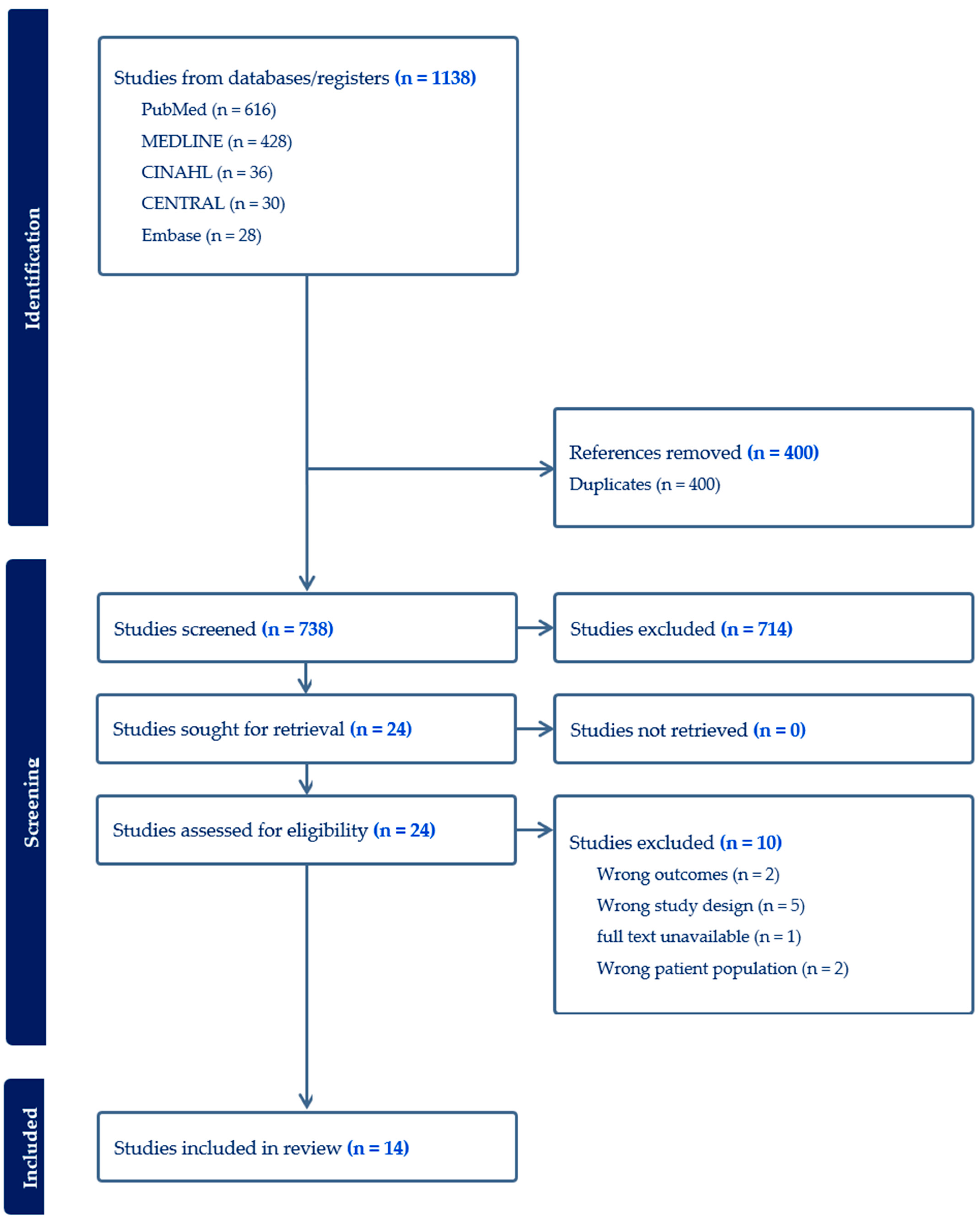
3. Results
4. Discussion
4.1. Genes Impacting Lymphatic Structure and Development
4.2. Inflammatory and Immunological Genes
4.3. Immune Cell Activation and Adhesion Genes
4.4. Function and Contractility
4.5. Limitations
5. Conclusions
Author Contributions
Funding
Conflicts of Interest
References
- Sakorafas, G.H.; Peros, G.; Cataliotti, L.; Vlastos, G. Lymphedema following axillary lymph node dissection for breast cancer. Surg. Oncol. 2006, 15, 153–165. [Google Scholar] [CrossRef] [Scilit]
- Page, M.J.; McKenzie, J.E.; Bossuyt, P.M.; Boutron, I.; Hoffmann, T.C.; Mulrow, C.D.; Shamseer, L.; Tetzlaff, J.M.; Akl, E.A.; Brennan, S.E.; et al. The PRISMA 2020 statement: An updated guideline for reporting systematic reviews. Rev. Esp. Cardiol. (Engl. Ed.) 2021, 74, 790–799. [Google Scholar] [CrossRef]
- Newman, B.; Lose, F.; Kedda, M.A.; Francois, M.; Ferguson, K.; Janda, M.; Yates, P.; Spurdle, A.B.; Hayes, S.C. Possible genetic predisposition to lymphedema after breast cancer. Lymphat. Res. Biol. 2012, 10, 2–13. [Google Scholar] [CrossRef] [Scilit]
- Miaskowski, C.; Conley, Y.P.; Cooper, B.A.; Paul, S.M.; Smoot, B.J.; Hammer, M.J.; Fu, M.; Levine, J.D. Identification of a Higher Risk Lymphedema Phenotype and Associations with Cytokine Gene Polymorphisms. J. Pain. Symptom Manag. 2024, 67, 375–383 e373. [Google Scholar] [CrossRef] [Scilit]
- Leung, G.; Baggott, C.; West, C.; Elboim, C.; Paul, S.M.; Cooper, B.A.; Abrams, G.; Dhruva, A.; Schmidt, B.L.; Kober, K.; et al. Cytokine candidate genes predict the development of secondary lymphedema following breast cancer surgery. Lymphat. Res. Biol. 2014, 12, 10–22. [Google Scholar] [CrossRef] [Scilit] [PubMed]
- Finegold, D.N.; Schacht, V.; Kimak, M.A.; Lawrence, E.C.; Foeldi, E.; Karlsson, J.M.; Baty, C.J.; Ferrell, R.E. HGF and MET mutations in primary and secondary lymphedema. Lymphat. Res. Biol. 2008, 6, 65–68. [Google Scholar] [CrossRef] [Scilit]
- Nikitenko, L.L.; Shimosawa, T.; Henderson, S.; Makinen, T.; Shimosawa, H.; Qureshi, U.; Pedley, R.B.; Rees, M.C.; Fujita, T.; Boshoff, C. Adrenomedullin haploinsufficiency predisposes to secondary lymphedema. J. Investig. Dermatol. 2013, 133, 1768–1776. [Google Scholar] [CrossRef] [Scilit] [PubMed]
- Miaskowski, C.; Dodd, M.; Paul, S.M.; West, C.; Hamolsky, D.; Abrams, G.; Cooper, B.A.; Elboim, C.; Neuhaus, J.; Schmidt, B.L.; et al. Lymphatic and angiogenic candidate genes predict the development of secondary lymphedema following breast cancer surgery. PLoS ONE 2013, 8, e60164. [Google Scholar] [CrossRef] [Scilit]
- Smoot, B.; Kober, K.M.; Paul, S.M.; Levine, J.D.; Abrams, G.; Mastick, J.; Topp, K.; Conley, Y.P.; Miaskowski, C.A. Potassium Channel Candidate Genes Predict the Development of Secondary Lymphedema Following Breast Cancer Surgery. Nurs. Res. 2017, 66, 85–94. [Google Scholar] [CrossRef] [Scilit] [PubMed]
- Hespe, G.E.; Ly, C.L.; Kataru, R.P.; Mehrara, B.J. Baseline Lymphatic Dysfunction Amplifies the Negative Effects of Lymphatic Injury. Plast. Reconstr. Surg. 2019, 143, 77e–87e. [Google Scholar] [CrossRef] [Scilit]
- Fu, M.R.; Conley, Y.P.; Axelrod, D.; Guth, A.A.; Yu, G.; Fletcher, J.; Zagzag, D. Precision assessment of heterogeneity of lymphedema phenotype, genotypes and risk prediction. Breast 2016, 29, 231–240. [Google Scholar] [CrossRef] [Scilit]
- Watanabe-Asaka, T.; Hayashi, M.; Harada, T.; Uemura, S.; Takai, J.; Nakamura, Y.; Moriguchi, T.; Kawai, Y. Perturbed collagen metabolism underlies lymphatic recanalization failure in Gata2 heterozygous deficient mice. J. Biochem. 2024, 175, 551–560. [Google Scholar] [CrossRef] [Scilit]
- Zampell, J.C.; Elhadad, S.; Avraham, T.; Weitman, E.; Aschen, S.; Yan, A.; Mehrara, B.J. Toll-like receptor deficiency worsens inflammation and lymphedema after lymphatic injury. Am. J. Physiol. Cell Physiol. 2012, 302, C709–C719. [Google Scholar] [CrossRef] [Scilit]
- Hadizadeh, M.; Mohaddes Ardebili, S.M.; Salehi, M.; Young, C.; Mokarian, F.; McClellan, J.; Xu, Q.; Kazemi, M.; Moazam, E.; Mahaki, B.; et al. GJA4/Connexin 37 Mutations Correlate with Secondary Lymphedema Following Surgery in Breast Cancer Patients. Biomedicines 2018, 6, 23. [Google Scholar] [CrossRef] [Scilit] [PubMed]
- Davis, M.J.; Castorena-Gonzalez, J.A.; Li, M.; Simon, A.M.; Srinivasan, R.S. Hierarchical Requirement for Endothelial Cell Connexins Cx37, Cx47, Cx43, and Cx45 in Lymphatic Valve Function. Function 2025, 6, zqaf034. [Google Scholar] [CrossRef] [Scilit]
- Finegold, D.N.; Baty, C.J.; Knickelbein, K.Z.; Perschke, S.; Noon, S.E.; Campbell, D.; Karlsson, J.M.; Huang, D.; Kimak, M.A.; Lawrence, E.C.; et al. Connexin 47 mutations increase risk for secondary lymphedema following breast cancer treatment. Clin. Cancer Res. 2012, 18, 2382–2390. [Google Scholar] [CrossRef] [Scilit] [PubMed]
- Sabine, A.; Agalarov, Y.; Maby-El Hajjami, H.; Jaquet, M.; Hagerling, R.; Pollmann, C.; Bebber, D.; Pfenniger, A.; Miura, N.; Dormond, O.; et al. Mechanotransduction, PROX1, and FOXC2 cooperate to control connexin37 and calcineurin during lymphatic-valve formation. Dev. Cell 2012, 22, 430–445. [Google Scholar] [CrossRef] [Scilit]
- Cursiefen, C.; Chen, L.; Borges, L.P.; Jackson, D.; Cao, J.; Radziejewski, C.; D’Amore, P.A.; Dana, M.R.; Wiegand, S.J.; Streilein, J.W. VEGF-A stimulates lymphangiogenesis and hemangiogenesis in inflammatory neovascularization via macrophage recruitment. J. Clin. Investig. 2004, 113, 1040–1050. [Google Scholar] [CrossRef] [PubMed]
- Francois, M.; Caprini, A.; Hosking, B.; Orsenigo, F.; Wilhelm, D.; Browne, C.; Paavonen, K.; Karnezis, T.; Shayan, R.; Downes, M.; et al. Sox18 induces development of the lymphatic vasculature in mice. Nature 2008, 456, 643–647. [Google Scholar] [CrossRef] [Scilit]
- Duong, T.; Proulx, S.T.; Luciani, P.; Leroux, J.C.; Detmar, M.; Koopman, P.; Francois, M. Genetic ablation of SOX18 function suppresses tumor lymphangiogenesis and metastasis of melanoma in mice. Cancer Res. 2012, 72, 3105–3114. [Google Scholar] [CrossRef] [Scilit]
- Jackson, D.G.; Prevo, R.; Clasper, S.; Banerji, S. LYVE-1, the lymphatic system and tumor lymphangiogenesis. Trends Immunol. 2001, 22, 317–321. [Google Scholar] [CrossRef] [Scilit] [PubMed]
- Jubb, A.M.; Sa, S.M.; Ratti, N.; Strickland, L.A.; Schmidt, M.; Callahan, C.A.; Koeppen, H. Neuropilin-2 expression in cancer. Histopathology 2012, 61, 340–349. [Google Scholar] [CrossRef] [Scilit]
- Norrmen, C.; Ivanov, K.I.; Cheng, J.; Zangger, N.; Delorenzi, M.; Jaquet, M.; Miura, N.; Puolakkainen, P.; Horsley, V.; Hu, J.; et al. FOXC2 controls formation and maturation of lymphatic collecting vessels through cooperation with NFATc1. J. Cell Biol. 2009, 185, 439–457. [Google Scholar] [CrossRef] [Scilit]
- Jin, D.; Harada, K.; Ohnishi, S.; Yamahara, K.; Kangawa, K.; Nagaya, N. Adrenomedullin induces lymphangiogenesis and ameliorates secondary lymphoedema. Cardiovasc. Res. 2008, 80, 339–345. [Google Scholar] [CrossRef] [Scilit]
- Kurebayashi, S.; Ueda, E.; Sakaue, M.; Patel, D.D.; Medvedev, A.; Zhang, F.; Jetten, A.M. Retinoid-related orphan receptor gamma (RORgamma) is essential for lymphoid organogenesis and controls apoptosis during thymopoiesis. Proc. Natl. Acad. Sci. USA 2000, 97, 10132–10137. [Google Scholar] [CrossRef] [Scilit] [PubMed]
- Telinius, N.; Kim, S.; Pilegaard, H.; Pahle, E.; Nielsen, J.; Hjortdal, V.; Aalkjaer, C.; Boedtkjer, D.B. The contribution of K(+) channels to human thoracic duct contractility. Am. J. Physiol. Heart Circ. Physiol. 2014, 307, H33–H43. [Google Scholar] [CrossRef] [Scilit]
- Hall, J.D.; Farzaneh, S.; Babakhani Galangashi, R.; Pujari, A.; Sweet, D.T.; Kahn, M.L.; Jimenez, J.M. Lymphoedema conditions disrupt endothelial barrier function in vitro. J. R. Soc. Interface 2022, 19, 20220223. [Google Scholar] [CrossRef] [Scilit] [PubMed]
- Brakenhielm, E.; Gonzalez, A.; Diez, J. Role of Cardiac Lymphatics in Myocardial Edema and Fibrosis: JACC Review Topic of the Week. J. Am. Coll. Cardiol. 2020, 76, 735–744. [Google Scholar] [CrossRef] [Scilit]
- Hassanein, A.H.; Sinha, M.; Neumann, C.R.; Mohan, G.; Khan, I.; Sen, C.K. A Murine Tail Lymphedema Model. J. Vis. Exp. 2021, 168, e61848. [Google Scholar] [CrossRef] [Scilit]
- Fu, M.R.; Axelrod, D.; Guth, A.A.; Scagliola, J.; Rampertaap, K.; El-Shammaa, N.; Qiu, J.M.; McTernan, M.L.; Frye, L.; Park, C.S.; et al. A Web- and Mobile-Based Intervention for Women Treated for Breast Cancer to Manage Chronic Pain and Symptoms Related to Lymphedema: Results of a Randomized Clinical Trial. JMIR Cancer 2022, 8, e29485. [Google Scholar] [CrossRef] [Scilit]


| Gene | Function | Reference |
|---|---|---|
| Connexin Isoforms | Lymphatic Structure and Development | Davis et al. 2025 [15], Hadizadeh et al. 2018 [14], Finegold et al. 2012 [16] |
| Vascular Endothelial Growth Factor (VEGF) | Lymphatic Structure and Development | Newman et al. 2012 [3], Miaskowski et al. 2013 [8], Fu et al. 2016 [11] |
| Forkhead Box Protein C2 (FOXC2) | Lymphatic Structure and Development | Newman et al. 2012 [3], Miaskowski et al. 2013 [8] |
| Prospero Homeobox 1 (PROX1) | Lymphatic Structure and Development | Newman et al. 2012 [3], Hespe et al. 2019 [10] |
| SYR-Box Transcription Factor (SOX18) | Lymphatic Structure and Development | Newman et al. 2012 [3] |
| Lymphatic Vessel Endothelial Hyaluronan Receptor 1 (LYVE1) | Lymphatic Structure and Development | Newman et al. 2012 [3] |
| Adrenomedullin (ADM) | Lymphatic Structure and Development | Newman et al. 2012 [3], Nikitenko et al. 2013 [7] |
| Hepatocyte Growth Factor/Mesenchymal Epithelial Transitional Tyrosine Kinase (HGF/MET) | Lymphatic Structure and Development | Finegold et al. 2008 [6] |
| Neuropilin-2 | Lymphatic Structure and Development | Miaskowski et al. 2013 [8] |
| GATA Binding Protein 1 (GATA2) | Lymphatic Structure and Development | Watanabe-Asaka 2024 [12] |
| IL4 | Inflammation and Immune Response | Miaskowski et al. 2024 [4], Fu et al. 2016 [11], Leung et al. 2014 [5] |
| IL10 | Inflammation and Immune Response | Miaskowski et al. 2024 [4], Leung et al. 2014 [5], Fu et al. 2016 [11] |
| IL2 | Inflammation and Immune Response | Miaskowski et al. 2024 [4] |
| IL17A | Inflammation and Immune Response | Miaskowski et al. 2024 [4] |
| IL1 | Inflammation and Immune Response | Miaskowski et al. 2024 [4], Fu et al. 2016 [11] |
| IL6 | Inflammation and Immune Response | Miaskowski et al. 2024 [4], Fu et al. 2016 [11] |
| IL13 | Inflammation and Immune Response | Miaskowski et al. 2024 [4], Fu et al. 2016 [11] |
| C-X-C Motif Chemokine Ligand 8 (CXCL8 (Formerly IL-8)) | Inflammation and Immune Response | Miaskowski et al. 2024 [4], Fu et al. 2016 [11] |
| RAR Related Orphan Receptor C (RORC) | Inflammation and Immune Response | Newman et al. 2012 [3] |
| Interferon Gamma (IFNG) | Inflammation and Immune Response | Miaskowski et al. 2024 [4] |
| IFNG Receptor 1 | Inflammation and Immune Response | Miaskowski et al. 2024 [4] |
| Tumor Necrosis Factor (TNF) | Inflammation and Immune Response | Miaskowski et al. 2024 [4], Fu et al. 2016 [11] |
| Nuclear Factor Kappa Beta (NFKB) | Inflammation and Immune Response | Miaskowski et al. 2024 [4], Leung et al. 2014 [5] |
| Toll-Like Receptor (TLR) | Inflammation and Immune Response | Zampell et al. 2012 [13] |
| Lymphocyte Cytosolic Protein 2 (LCP2) | Immune Cell Activation and Adhesion | Miaskowski et al. 2013 [8] |
| Spleen Tyrosine Kinase (SYK) | Immune Cell Activation and Adhesion | Miaskowski et al. 2013 [8] |
| Vascular Cell Adhesion Molecule 1 (VCAM-1) | Immune Cell Activation and Adhesion | Miaskowski et al. 2013 [8] |
| Voltage-Gated Potassium Channels | Function and Contractility | Smoot et al. 2017 [9] |
| Source | Gene Variants Investigated | Sample Size | Study Type | Clinical Outcomes |
|---|---|---|---|---|
| Newman et al. 2012 [3] | SOX18, VEGFC, VEGFD, VEGFR2, VEGFR3, RORC, FOXC2, LYVE1, ADM, PROX1 | 120 | Case-control | Polymorphisms in VEGFR2, VEGFR3, and RORC found to be associated with lymphedema |
| Miaskowski et al. 2024 [4] | CXCL8, IFNG, IFNG1, IFNGR1, IL1R1, IL1R2, IL2, IL4, IL6, IL17A, IL1B, IL10, IL13, IL17A, NFKB1, NFKB2, TNFSF | 155 | Observational (cross-sectional and longitudinal) | Polymorphisms in IL1B and IL6 found to be associated with increased lymphedema severity |
| Leung et al. 2014 [5] | IFNG1, IFNGR1, IL1B, IL1R1, IL1R2, IL2, IL4, IL6, IL8, IL10, IL13, IL17A, NFKB1, NFKB2, TNFA | 542 | Observational (cross-sectional and longitudinal) | Polymorphisms in IL4, IL10, and NFKB2 associated with inflammatory responses in the development of lymphedema |
| Finegold et al. 2008 [6] | HGF, MET | 239 | Case–control | Mutations in HGF and MET found to contribute to lymphedema |
| Nikitenko et al. 2013 [7] | ADM | Not specified | In vivo experimental study | Reduced adrenomedullin levels increase susceptibility to secondary lymphedema |
| Miaskowski et al. 2013 [8] | ANGPT2, FOXC2, HGF, LCP2, LYVE1, MET, NRP2, PROX1, RORC, SOX17, SYK, VCAM1, VEGFB, VEGFC, VEGFD, VEGFR2, VEGFR3 | 543 | Observational (cross-sectional and longitudinal) | Polymorphisms in LCP2, NRP2, SYK, VCAM1, and three haplotypes (FOXC2 A03, NRP2 F03, VEGFC B03) associated with lymphangiogensis and angiogenesis |
| Smoot et al. 2017 [9] | KCNA1, KCND2, KCNS1, KCNJ3, KCNJ5, KCNJ6, KCNJ9, KCNK2, KCNK3, KCNK9 | 542 | Observational (cross-sectional and longitudinal) | Polymorphisms in KCNA1, KCNJ3, and KCNJ6, and KCNK3 associated with lymphedema |
| Hespe et al. 2019 [10] | Prox1 | Not specified | In vivo experimental study | Subclinical lymphatic dysfunction intensifies the effects of lymphatic injury |
| Fu et al. 2016 [11] | VEGF-C, VEGF-D, IL1-a, IL-4, IL6, IL8, IL10, IL13, TNF-a | 140 | Prospective cohort (genetic association) | Polymorphisms in IL4 contribute to impaired limb mobility, polymorphisms in IL6 and IL4 contribute to fluid accumulation, and polymorphisms in VEGF-C and IL-13 contribute to patient discomfort |
| Watanabe-Asaka et al. 2024 [12] | GATA2 | Not specified | In vivo experimental study | Placement of soluble type I collagen significantly improved lymphatic recanalization in GATA2 heterozygous-deficient mice, suggesting a potential therapeutic strategy for GATA2-related lymphedema |
| Zampell et al. 2012 [13] | TLR2, TLR4, TLR9, VEGF-A, VEGF-C, LYVE-1 | Not specified | In vivo experimental study | Loss of TLR signaling (TLR2, TLR4, TLR9) in mice impairs lymphatic repair and lymphangiogenesis |
| Hadizadeh et al. 2018 [14] | GJA4 | 102 | Retrospective case–control | Polymorphisms in GJA4 associated with an increased risk of secondary lymphedema |
| Davis et al. 2025 [15] | GJA4, GJA1, GJC1, GJC2 | Not specified | In vivo experimental study | 4 connexin isoforms (Cx37, Cx47, Cx43, Cx45) contribute to lymphatic valve function, and polymorphisms in GJA4 predispose to lymphedema |
| Finegold et al. 2012 [16] | GJC2, FOXC2, HGF, MET, FLT4 | 188 | Case-control study with in vitro functional validation | Polymorphisms in GJC2 implicated in impaired lymphatic gap junctions |
Disclaimer/Publisher’s Note: The statements, opinions and data contained in all publications are solely those of the individual author(s) and contributor(s) and not of MDPI and/or the editor(s). MDPI and/or the editor(s) disclaim responsibility for any injury to people or property resulting from any ideas, methods, instructions or products referred to in the content. |
© 2026 by the authors. Licensee MDPI, Basel, Switzerland. This article is an open access article distributed under the terms and conditions of the Creative Commons Attribution (CC BY) license.
Share and Cite
James, A.J.; Carr, Q.L.; Connor, C.H.; Paul, B.J.; Laurent, C.; Shapiro, R. Genetic Contributions to Breast Cancer-Related Lymphedema—Does Subclinical Disease Increase Risk? A Systematic Review. Lymphatics 2026, 4, 10. https://doi.org/10.3390/lymphatics4010010
James AJ, Carr QL, Connor CH, Paul BJ, Laurent C, Shapiro R. Genetic Contributions to Breast Cancer-Related Lymphedema—Does Subclinical Disease Increase Risk? A Systematic Review. Lymphatics. 2026; 4(1):10. https://doi.org/10.3390/lymphatics4010010
Chicago/Turabian StyleJames, Andrew J., Quinton L. Carr, Colton H. Connor, Brian J. Paul, Christian Laurent, and Ryan Shapiro. 2026. "Genetic Contributions to Breast Cancer-Related Lymphedema—Does Subclinical Disease Increase Risk? A Systematic Review" Lymphatics 4, no. 1: 10. https://doi.org/10.3390/lymphatics4010010
APA StyleJames, A. J., Carr, Q. L., Connor, C. H., Paul, B. J., Laurent, C., & Shapiro, R. (2026). Genetic Contributions to Breast Cancer-Related Lymphedema—Does Subclinical Disease Increase Risk? A Systematic Review. Lymphatics, 4(1), 10. https://doi.org/10.3390/lymphatics4010010