Commentary

Functional Intraclonal Heterogeneity in Chronic Lymphocytic Leukemia: Proliferation vs. Quiescence


by
Daniel Friedman
1,
Piers E. M. Patten
1,2 and
Robbert Hoogeboom
1,*
1
Department of Haematology, Comprehensive Cancer Centre, King’s College London, London SE5 9NU, UK
2
Department of Haematological Medicine, King’s College Hospital, London SE5 9RS, UK
*
Author to whom correspondence should be addressed.
Lymphatics 2025, 3(4), 47; https://doi.org/10.3390/lymphatics3040047

Submission received: 22 September 2025 / Revised: 21 November 2025 / Accepted: 11 December 2025 / Published: 17 December 2025
(This article belongs to the Special Issue Chronic Lymphocytic Leukemia (CLL): From Benchside to Bedside)

Abstract

Chronic lymphocytic leukemia (CLL) is an indolent malignancy with modest proliferation in the lymph nodes and accumulation of quiescent B cells in the peripheral blood. Targeted agents, including BTK inhibitors such as ibrutinib and the BCL2 antagonist venetoclax, have transformed therapy by disrupting proliferation, survival, and lymph node retention of CLL cells, yet CLL remains incurable. Recent studies reveal that CLL cells exist along a spectrum of proliferating, activated, and quiescent states, with dynamic transitions that shape intraclonal behavior. Whilst proliferation occurs mainly in lymph nodes, most emigrant cells in the peripheral blood become quiescent, with only a minority remaining activated. Quiescent, activated, and proliferating fractions display distinct phenotypes and CXCR4 and CD5 levels can be used to distinguish these states in the CLL life cycle. While proliferating and activated cells are more susceptible to BTK inhibition, quiescent subsets show greater sensitivity to BCL2 blockade. These functional differences, together with emerging evidence that phenotypic markers may correlate with residual disease activity, point to potential translational significance. Understanding how CLL cells switch between proliferative, activated and quiescent states will be important to uncover novel vulnerabilities and inform rational treatment strategies.

1. Introduction

Historically, chronic lymphocytic leukemia (CLL) was considered a disease of accumulating cells with defective apoptosis. Over the last decades, in vivo labeling studies using deuterated water have revealed birth rates estimated between 0.1% and 1% of the clone per day, indicating substantial proliferation of CLL cells albeit modest compared to high grade lymphomas [1]. Higher birth rates (>0.35%) inversely correlate with somatic hypermutations [2] and these patients are more likely to develop disease progression [1]. At the other end of the spectrum, there is a large fraction of quiescent CLL cells, In addition to being quiescent, these cells often display reduced B cell receptor (BCR) responsiveness [3], a state called anergy that has been extensively reviewed elsewhere [4,5]. Anergic CLL cells are characterized by low levels of surface IgM and have reduced Ca2+ responses when stimulated via the BCR in vitro. However, we poorly understand which CLL cells are able to proliferate, which CLL cells remain quiescent, and how CLL cells switch between these two states. This is important as the most effective (combination) therapy may need to target all CLL cells, regardless of activation state.

2. Activated, Proliferative and Quiescent States of CLL Cells

CLL cell division rates are highest in the lymph nodes (LNs), followed by peripheral blood (PB) and bone marrow [2,6], with the spleen notably understudied. Within LNs the highest proliferation is observed in proliferation centers (PCs), which are pseudofollicular structures enriched for Ki67+ para-immunoblasts. However, only a fraction of LN CLL cells resides in proliferation centres, and an even smaller fraction of LN CLL cells expresses proliferation markers [7,8]. LN CLL cells display higher IgM levels and elevated BCR signaling, indicating these cells are not anergic [9,10]. Together, several microenvironmental stimuli (reviewed elsewhere) lead to NFkB activation, driving proliferation [9,11,12].
Recently, a single cell transcriptomics study quantified 0.4–1% of LN CLL cells actively dividing, with 2–4% of LN CLL cells activated, and the majority of LN CLL cells in a resting state [13]. Of note, a similar spectrum of cell states exists in the PB, where we recently used flow cytometry to identify a small fraction of actively dividing cells in M-G2 phase of the cell cycle (±0.2% of PB CLL cells), whilst a larger fraction of activated CLL cells were in G1 and the majority of cells were in G0 [14]. It is unclear to what extent LN dividing, activated, and resting CLL cells differ from dividing, activated, and resting counterparts circulating in the PB. This is an important question as most experimental drugs are tested on PB CLL cells in vitro, as LN sampling is unfeasible for such studies.

2.1. Migration of Activated and Proliferative CLL Cells

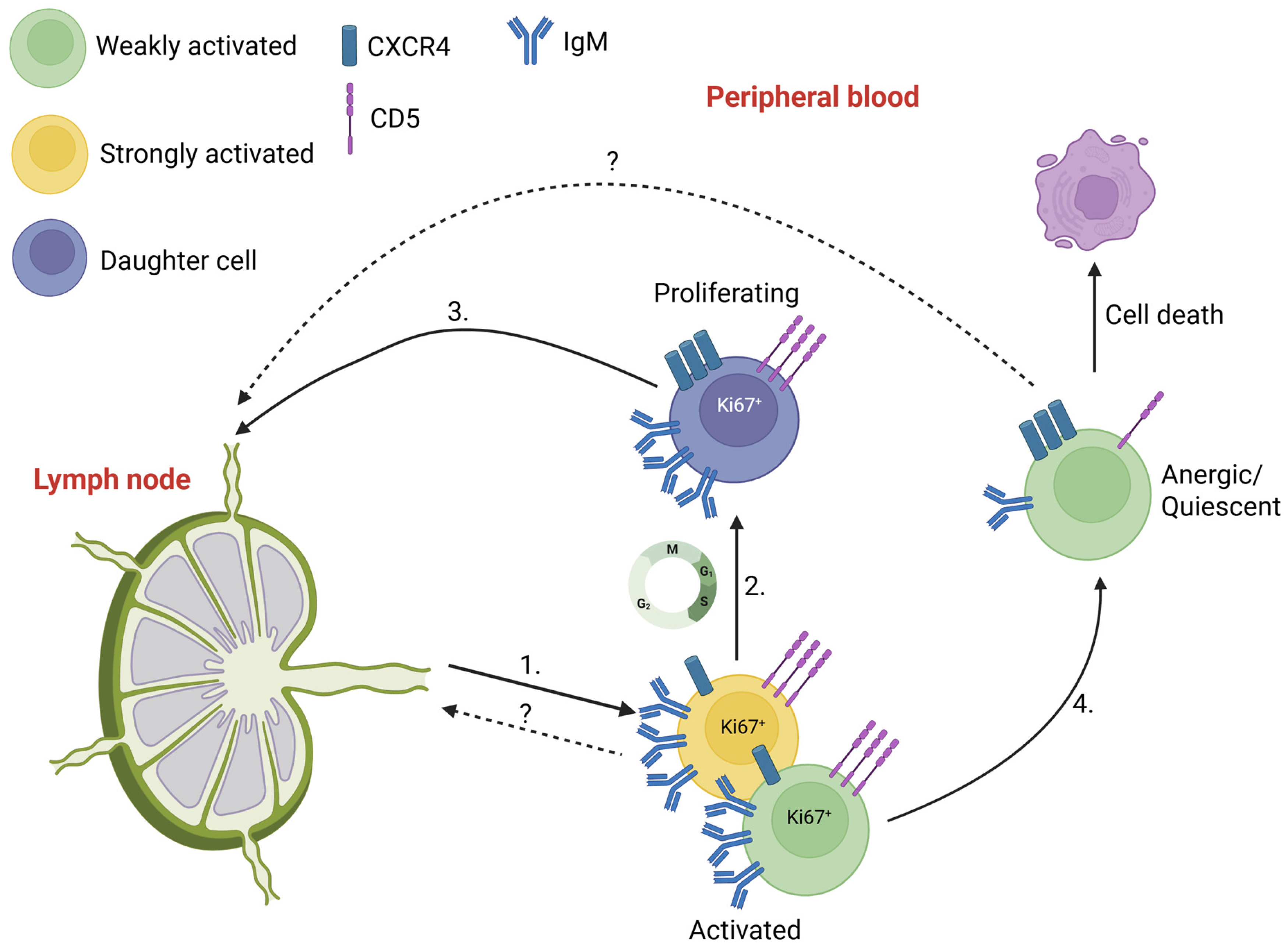
In vivo labeling of dividing cells has revealed that recently divided LN emigrants in the PB have a distinct CXCR4loCD5hi phenotype [15,16], a fraction we found enriched for cells in G1 of the cell cycle, identified by high ki67 expression and 2n of DNA [14] (Figure 1). The CXCR4loCD5hi recent LN emigrant fraction displays an activated phenotype with higher levels of CD5, CD38, CD23, AID, IgD, and IgM and is receptive of BCR stimulation in vitro [3,14,16,17], indicating these cells are not anergic. The CXCR4loCD5hi fraction also expresses higher levels of genes associated with cell cycle entry and anti-apoptotic pathways and is enriched for epigenetic marks associated with progressive disease [16,18].
Surprisingly, this fraction in the PB contained very few cells that are in S or G2 phase of the cell cycle [14]. We found that PB CLL cells in S and G2 phase express high levels of CXCR4 and CD5, suggesting that the phenotype of CLL cells may change over the course of the cell cycle. This was supported by the Eµ-TCL1 mouse model, in which dividing cells also expressed high levels of CXCR4 and CD5 In accordance, CD40L-stimulated PB CLL cells showed increased CXCR4 levels when progressing from G1 to S and G2 phase in vitro. Based on these in vitro and in vivo observations, we hypothesize that only the most activated CXCR4loCD5hi recent LN emigrants progress through the cell cycle, leading to upregulation of CXCR4. Of note, the PB CXCR4hiCD5hi fraction that is enriched for actively dividing cells expressed high levels of IgM, CXCR4, CXCR5, and CCR7 and migrated efficiently in vitro [14], suggesting these cells may be able to return to the LNs swiftly for further rounds of activation and proliferation, and where the lifecycle of the cells may start over.
As the LNs are a major site for proliferation and survival signals [9,11,12], most studies have focused on LN retention rather than egress of CLL cells. It remains unclear why CLL cells egress from the LNs in steady state conditions. It has been postulated that CXCL12-mediated CXCR4 downregulation facilitates CLL cell egress; however, CXCR4 is also rapidly downregulated following activation through CD40, the B cell receptor (BCR), IL-4, and other receptors implicated in the LN tumor microenvironment [14,19,20]. This reduction in CXCR4 levels may only be temporary as CXCR4 quickly resurfaces when CLL cells progress through the cell cycle or when stimulation ceases [14,21]. CXCR4 is one of several markers whose expression changes upon CLL cell activation in the LNs, indicating that its levels may correlate with, rather than cause, tumor cell egress. Indeed, a range of migration markers have been found differentially expressed on LN CLL cells and CXCR4loCD5hi recent LN emigrants, including increased CXCR3, CD49d, and decreased CCR7 [14,16,22,23]. Moreover, the migration potential of CLL cells may not be solely dependent on expression levels of chemokine receptors, as we found activated and actively dividing cell fractions both migrated equally in response to CCL21 despite having differential CCR7 expression levels, whilst quiescent cells migrated poorly [14]. This suggests that the ability to migrate to and from activating niches in the LNs may depend on a combination of chemokine receptor expression levels and the activation status of CLL cells.
CLL cells in the LNs display elevated levels of BCR signaling [9], known to facilitate LN retention by downregulating sphingosine-1-phosphate receptor 1 (S1PR1) and upregulating adhesion molecules, such as integrins, in healthy B cells and CLL cells alike [24,25,26]. In accordance with this, disruption of BCR signaling using BTK inhibitors leads to CLL cell egress and lymphocytosis [27,28,29]. It is possible that in some LN CLL cells, disruption of BCR signaling leads to downregulation of adhesion molecules and upregulation of egress-promoting chemokine receptors such as S1PR1 [30]; however, this is at odds with the activated phenotype of CXCR4loCD5hirecent LN emigrants [16]. Alternatively, the loss of normal LN architecture and the sheer number of CLL cells may result in disrupted retention signals. In this scenario, LN egress is not an active process dictated by chemokine receptor levels but the consequence of ligands for LN retention no longer being accessible or not sufficiently present to support all CLL cells. Potentially, newly developed 3D in vitro culture systems, where the tissue microenvironment may be more faithfully recapitulated, can be utilized to address the question of CLL cell egress from LNs [31,32].

2.2. Re-Activation of Quiescent Cells

Following egress, only a small fraction of activated LN emigrants may progress through the cell cycle [14], while most cells may become quiescent CXCR4hiCD5lo cells due to a reduction in activating signals in the PB. What drives the transition to quiescence is unclear. It may be related to transformation into an anergic state. Indeed, CXCR4hiCD5lo cells have lowest IgM levels and reduced Ca2+ responses when stimulated in vitro [3,14]. Epigenetic regulation of gene transcription may also play a role, as activated CXCR4loCD5hi cells are enriched for epigenetic modifications associated with longevity and disease progression, whilst the quiescent CXCR4hiCD5lo fraction is enriched for epigenetic marks associated with indolent disease [18,33]. Of note, both bulk surface IgM levels and the balance between progression and indolence-associated epigenetic modifications have been identified as independent prognostic markers [18,34]. It is possible these parameters reflect the ratio between quiescent and activated/proliferative CLL cells.
Anergy is considered a reversible state that reverses spontaneously in vitro or can be overcome within 24 h by microenvironmental stimuli, such as IL-4 [34,35,36]. In contrast, transversing from a quiescent state to a proliferative state takes 3–5 days of persistent mitogen stimulation in vitro to allow cells to build up the molecular machinery for cell division. It is unclear to what extent quiescent CLL cells can transverse to a proliferative state in vivo. When PB CLL cells are stimulated in vitro using strong proliferation-inducing signals provided by CD40L-expressing fibroblasts, IL-4 and IL-21, ki67 levels and proliferation rates of CXCR4hiCD5lo cells trail behind [14], suggesting the quiescent state may not be easily overcome in a substantial fraction of PB CLL cells. This notion is supported by ex vivo trajectory analysis of single cell transcriptomics data using the velocity algorithm, suggesting that the transition between cell states was unidirectional, starting in the proliferating state, then transitioning into the activated state, and ending in the quiescent state [13]; the notion was also supported by mathematical modeling of the intraclonal dynamics of in vivo-labeled CLL cells of patients with indolent disease, which indicated quiescent cells did not return to a proliferative state within months [37].
Additionally, the induction of proliferation of CLL cells will require proliferative signals in the LN tumor microenvironment. As quiescent PB CLL cells may migrate inefficiently, they may not be able to return to the LNs without prior stimulation. In CLL with unmutated IGHV (U-CLL), Toll-like receptor stimulation in the PB may activate and mobilize cells for a return to the LNs [38]. In CLL with mutated IGHV (M-CLL), activating signals in the PB may be sparser, resulting in circulation and accumulation of quiescent cells in the PB until cell death ensues. Alternatively, quiescent cells may be able to enter the LNs but fail to reach activating niches. This could explain the presence of a large fraction of quiescent LN CLL cells. Whilst out-competed by activated cells during steady-state disease, these quiescent cells may be able to enter activating niches when therapy has wiped out activated and dividing cells, potentially driving remission.

3. Discussion

The identification of distinct subpopulations of CLL cells carries potential translational significance, as quiescent and activated/dividing cells may require distinct signals for survival. Current therapeutic approaches target distinct vulnerabilities with BTK inhibitors targeting proliferation and LN retention, whilst BCL2 inhibitors disrupt anti-apoptotic signals. As a result, subfractions of CLL cells may respond differently to these therapies. Indeed, recent LN emigrant CXCR4loCD5hi cells initially respond better to BTK inhibition in vivo [39], after which compensatory BTK-independent signaling pathways may take over [40,41]. Quiescent CXCR4hiCD5lo cells are more vulnerable to BCL2 inhibition in vitro [42], whilst activating signals in the LN microenvironment are thought to confer resistance to BCL2 inhibitors by upregulating compensatory anti-apoptotic molecules [43]. The discovery that actively dividing CLL cells in S/G2/M-phase exhibit a distinct CXCR4hiCD5hi phenotype and express migratory receptors such as CCR7 and CXCR5 [14] raises the possibility that this fraction contributes to tissue trafficking and disease persistence in LNs. This may help explain why combination strategies, which simultaneously interrupt survival, activation, and migratory pathways, achieve deeper remissions than monotherapies.

4. Future Directions

The studies described here warrant further research into how IGHV mutation status, disease stage, cytogenetics, epigenetics, and prior therapies influence the lifecycle of CLL and vice versa how the lifecycle of CLL affects the clinical course and response to therapy. Additionally, these observations support further exploration of phenotypic markers as dynamic biomarkers in clinical trials. The expansion of CXCR4loCD5hi and CXCR4hiCD5hi cells at relapse [14,44], suggests that these populations may reflect residual proliferative activity not captured by current measurable residual disease (MRD) assays. Given that surface phenotypes are detectable by standard flow cytometry, there is potential to incorporate phenotypic analyses into translational substudies of ongoing and future trials, particularly those testing time-limited or response adapted strategies.
In conclusion, recent findings revise the current model of CLL intraclonal dynamics and highlight functionally distinct subpopulations with clinical relevance. Further single cell analyses are required to delineate how CLL cells switch between proliferative and quiescent states and vice versa, which may expose novel vulnerabilities and inform new treatment rationales.

Author Contributions

Conceptualization: R.H.; writing—original draft preparation: D.F. and R.H.; writing—review and editing: P.E.M.P. All authors have read and agreed to the published version of the manuscript.

Funding

This research received no external funding.

Data Availability Statement

No new data were created or analyzed in this study.

Conflicts of Interest

The authors declare no conflicts of interest.

References

  1. Messmer, B.T.; Messmer, D.; Allen, S.L.; Kolitz, J.E.; Kudalkar, P.; Cesar, D.; Murphy, E.J.; Koduru, P.; Ferrarini, M.; Zupo, S.; et al. In vivo measurements document the dynamic cellular kinetics of chronic lymphocytic leukemia B cells. J. Clin. Investig. 2005, 115, 755–764. [Google Scholar] [CrossRef] [PubMed]
  2. van Gent, R.; Kater, A.P.; Otto, S.A.; Jaspers, A.; Borghans, J.A.; Vrisekoop, N.; Ackermans, M.A.; Ruiter, A.F.; Wittebol, S.; Eldering, E.; et al. In vivo dynamics of stable chronic lymphocytic leukemia inversely correlate with somatic hypermutation levels and suggest no major leukemic turnover in bone marrow. Cancer Res. 2008, 68, 10137–10144. [Google Scholar] [CrossRef] [PubMed]
  3. Cui, B.; Chen, L.; Zhang, S.; Mraz, M.; Fecteau, J.F.; Yu, J.; Ghia, E.M.; Zhang, L.; Bao, L.; Rassenti, L.Z.; et al. MicroRNA-155 influences B-cell receptor signaling and associates with aggressive disease in chronic lymphocytic leukemia. Blood 2014, 124, 546–554. [Google Scholar] [CrossRef] [PubMed]
  4. Packham, G.; Krysov, S.; Allen, A.; Savelyeva, N.; Steele, A.J.; Forconi, F.; Stevenson, F.K. The outcome of B-cell receptor signaling in chronic lymphocytic leukemia: Proliferation or anergy. Haematologica 2014, 99, 1138–1148. [Google Scholar] [CrossRef]
  5. Forconi, F.; Lanham, S.A.; Chiodin, G. Biological and Clinical Insight from Analysis of the Tumor B-Cell Receptor Structure and Function in Chronic Lymphocytic Leukemia. Cancers 2022, 14, 663. [Google Scholar] [CrossRef]
  6. Herndon, T.M.; Chen, S.S.; Saba, N.S.; Valdez, J.; Emson, C.; Gatmaitan, M.; Tian, X.; Hughes, T.E.; Sun, C.; Arthur, D.C.; et al. Direct in vivo evidence for increased proliferation of CLL cells in lymph nodes compared to bone marrow and peripheral blood. Leukemia 2017, 31, 1340–1347. [Google Scholar] [CrossRef]
  7. Patten, P.E.; Buggins, A.G.; Richards, J.; Wotherspoon, A.; Salisbury, J.; Mufti, G.J.; Hamblin, T.J.; Devereux, S. CD38 expression in chronic lymphocytic leukemia is regulated by the tumor microenvironment. Blood 2008, 111, 5173–5181. [Google Scholar] [CrossRef]
  8. Gine, E.; Martinez, A.; Villamor, N.; Lopez-Guillermo, A.; Camos, M.; Martinez, D.; Esteve, J.; Calvo, X.; Muntanola, A.; Abrisqueta, P.; et al. Expanded and highly active proliferation centers identify a histological subtype of chronic lymphocytic leukemia (“accelerated” chronic lymphocytic leukemia) with aggressive clinical behavior. Haematologica 2010, 95, 1526–1533. [Google Scholar] [CrossRef]
  9. Herishanu, Y.; Perez-Galan, P.; Liu, D.; Biancotto, A.; Pittaluga, S.; Vire, B.; Gibellini, F.; Njuguna, N.; Lee, E.; Stennett, L.; et al. The lymph node microenvironment promotes B-cell receptor signaling, NF-kappaB activation, and tumor proliferation in chronic lymphocytic leukemia. Blood 2011, 117, 563–574. [Google Scholar] [CrossRef]
  10. Coulter, E.M.; Pepper, A.; Mele, S.; Folarin, N.; Townsend, W.; Cuthill, K.; Phillips, E.H.; Patten, P.E.M.; Devereux, S. In vitro and in vivo evidence for uncoupling of B-cell receptor internalization and signaling in chronic lymphocytic leukemia. Haematologica 2018, 103, 497–505. [Google Scholar] [CrossRef]
  11. Haselager, M.V.; Kater, A.P.; Eldering, E. Proliferative Signals in Chronic Lymphocytic Leukemia; What Are We Missing? Front. Oncol. 2020, 10, 592205. [Google Scholar] [CrossRef]
  12. Delgado, J.; Nadeu, F.; Colomer, D.; Campo, E. Chronic lymphocytic leukemia: From molecular pathogenesis to novel therapeutic strategies. Haematologica 2020, 105, 2205–2217. [Google Scholar] [CrossRef] [PubMed]
  13. Sun, C.; Chen, Y.C.; Martinez Zurita, A.; Baptista, M.J.; Pittaluga, S.; Liu, D.; Rosebrock, D.; Gohil, S.H.; Saba, N.S.; Davies-Hill, T.; et al. The immune microenvironment shapes transcriptional and genetic heterogeneity in chronic lymphocytic leukemia. Blood Adv. 2023, 7, 145–158. [Google Scholar] [CrossRef] [PubMed]
  14. Friedman, D.; Mehtani, D.P.; Vidler, J.B.; Patten, P.E.M.; Hoogeboom, R. Proliferating CLL cells express high levels of CXCR4 and CD5. Hemasphere 2024, 8, e70064. [Google Scholar] [CrossRef]
  15. Calissano, C.; Damle, R.N.; Hayes, G.; Murphy, E.J.; Hellerstein, M.K.; Moreno, C.; Sison, C.; Kaufman, M.S.; Kolitz, J.E.; Allen, S.L.; et al. In vivo intraclonal and interclonal kinetic heterogeneity in B-cell chronic lymphocytic leukemia. Blood 2009, 114, 4832–4842. [Google Scholar] [CrossRef]
  16. Calissano, C.; Damle, R.N.; Marsilio, S.; Yan, X.J.; Yancopoulos, S.; Hayes, G.; Emson, C.; Murphy, E.J.; Hellerstein, M.K.; Sison, C.; et al. Intraclonal complexity in chronic lymphocytic leukemia: Fractions enriched in recently born/divided and older/quiescent cells. Mol. Med. 2011, 17, 1374–1382. [Google Scholar] [CrossRef]
  17. Mazzarello, A.N.; Fitch, M.; Cardillo, M.; Ng, A.; Bhuiya, S.; Sharma, E.; Bagnara, D.; Kolitz, J.E.; Barrientos, J.C.; Allen, S.L.; et al. Characterization of the Intraclonal Complexity of Chronic Lymphocytic Leukemia B Cells: Potential Influences of B-Cell Receptor Crosstalk with Other Stimuli. Cancers 2023, 15, 4706. [Google Scholar] [CrossRef]
  18. Chapaprieta, V.; Maiques-Diaz, A.; Nadeu, F.; Clot, G.; Massoni-Badosa, R.; Mozas, P.; Mateos-Jaimez, J.; Vidal, A.; Charalampopoulou, S.; Duran-Ferrer, M.; et al. Dual biological role and clinical impact of de novo chromatin activation in chronic lymphocytic leukemia. Blood 2025, 145, 2473–2487. [Google Scholar] [CrossRef]
  19. Vlad, A.; Deglesne, P.A.; Letestu, R.; Saint-Georges, S.; Chevallier, N.; Baran-Marszak, F.; Varin-Blank, N.; Ajchenbaum-Cymbalista, F.; Ledoux, D. Down-regulation of CXCR4 and CD62L in chronic lymphocytic leukemia cells is triggered by B-cell receptor ligation and associated with progressive disease. Cancer Res. 2009, 69, 6387–6395. [Google Scholar] [CrossRef]
  20. Aguilar-Hernandez, M.M.; Blunt, M.D.; Dobson, R.; Yeomans, A.; Thirdborough, S.; Larrayoz, M.; Smith, L.D.; Linley, A.; Strefford, J.C.; Davies, A.; et al. IL-4 enhances expression and function of surface IgM in CLL cells. Blood 2016, 127, 3015–3025. [Google Scholar] [CrossRef]
  21. Coelho, V.; Krysov, S.; Steele, A.; Sanchez Hidalgo, M.; Johnson, P.W.; Chana, P.S.; Packham, G.; Stevenson, F.K.; Forconi, F. Identification in CLL of circulating intraclonal subgroups with varying B-cell receptor expression and function. Blood 2013, 122, 2664–2672. [Google Scholar] [CrossRef] [PubMed]
  22. Tissino, E.; Pozzo, F.; Benedetti, D.; Caldana, C.; Bittolo, T.; Rossi, F.M.; Bomben, R.; Nanni, P.; Chivilo, H.; Cattarossi, I.; et al. CD49d promotes disease progression in chronic lymphocytic leukemia: New insights from CD49d bimodal expression. Blood 2020, 135, 1244–1254. [Google Scholar] [CrossRef] [PubMed]
  23. Pasikowska, M.; Walsby, E.; Apollonio, B.; Cuthill, K.; Phillips, E.; Coulter, E.; Longhi, M.S.; Ma, Y.; Yallop, D.; Barber, L.D.; et al. Phenotype and immune function of lymph node and peripheral blood CLL cells are linked to transendothelial migration. Blood 2016, 128, 563–573. [Google Scholar] [CrossRef] [PubMed]
  24. Till, K.J.; Pettitt, A.R.; Slupsky, J.R. Expression of functional sphingosine-1 phosphate receptor-1 is reduced by B cell receptor signaling and increased by inhibition of PI3 kinase delta but not SYK or BTK in chronic lymphocytic leukemia cells. J. Immunol. 2015, 194, 2439–2446. [Google Scholar] [CrossRef]
  25. Spaargaren, M.; Beuling, E.A.; Rurup, M.L.; Meijer, H.P.; Klok, M.D.; Middendorp, S.; Hendriks, R.W.; Pals, S.T. The B cell antigen receptor controls integrin activity through Btk and PLCgamma2. J. Exp. Med. 2003, 198, 1539–1550. [Google Scholar] [CrossRef]
  26. Cyster, J.G. B cell follicles and antigen encounters of the third kind. Nat. Immunol. 2010, 11, 989–996. [Google Scholar] [CrossRef]
  27. de Rooij, M.F.; Kuil, A.; Geest, C.R.; Eldering, E.; Chang, B.Y.; Buggy, J.J.; Pals, S.T.; Spaargaren, M. The clinically active BTK inhibitor PCI-32765 targets B-cell receptor- and chemokine-controlled adhesion and migration in chronic lymphocytic leukemia. Blood 2012, 119, 2590–2594. [Google Scholar] [CrossRef]
  28. Herman, S.E.; Niemann, C.U.; Farooqui, M.; Jones, J.; Mustafa, R.Z.; Lipsky, A.; Saba, N.; Martyr, S.; Soto, S.; Valdez, J.; et al. Ibrutinib-induced lymphocytosis in patients with chronic lymphocytic leukemia: Correlative analyses from a phase II study. Leukemia 2014, 28, 2188–2196. [Google Scholar] [CrossRef]
  29. Rey-Barroso, J.; Munaretto, A.; Rouquie, N.; Mougel, A.; Chassan, M.; Gadat, S.; Dewingle, O.; Poincloux, R.; Cadot, S.; Ysebaert, L.; et al. Lymphocyte migration and retention properties affected by ibrutinib in chronic lymphocytic leukemia. Haematologica 2024, 109, 809–823. [Google Scholar] [CrossRef]
  30. Cassarino, M.C.; Colado, A.; Martinez, V.S.; Martines, C.; Bonato, A.; Bertini, M.; Pavlovksy, M.; Custidiano, R.; Bezares, F.R.; Morande, P.E.; et al. G-protein coupled receptor kinase-2 regulates the migration of chronic lymphocytic leukaemia cells to sphingosine-1 phosphate in vitro and their trafficking in vivo. Sci. Rep. 2025, 15, 6530. [Google Scholar] [CrossRef]
  31. Lenti, E.; Visentin, E.; Bojnik, E.; Neroni, A.; Franchino, M.; Talarico, D.; Sacchetti, N.; Scarfo, L.; Maurizio, A.; Garcia-Manteiga, J.M.; et al. A spheroid model that recapitulates the protective role of the lymph node microenvironment and serves as a platform for drug testing in chronic lymphocytic leukemia. Hemasphere 2025, 9, e70170. [Google Scholar] [CrossRef]
  32. Haselager, M.V.; van Driel, B.F.; Perelaer, E.; de Rooij, D.; Lashgari, D.; Loos, R.; Kater, A.P.; Moerland, P.D.; Eldering, E. In Vitro 3D Spheroid Culture System Displays Sustained T Cell-dependent CLL Proliferation and Survival. Hemasphere 2023, 7, e938. [Google Scholar] [CrossRef] [PubMed]
  33. Bartholdy, B.A.; Wang, X.; Yan, X.J.; Pascual, M.; Fan, M.; Barrientos, J.; Allen, S.L.; Martinez-Climent, J.A.; Rai, K.R.; Chiorazzi, N.; et al. CLL intraclonal fractions exhibit established and recently acquired patterns of DNA methylation. Blood Adv. 2020, 4, 893–905. [Google Scholar] [CrossRef] [PubMed]
  34. D’Avola, A.; Drennan, S.; Tracy, I.; Henderson, I.; Chiecchio, L.; Larrayoz, M.; Rose-Zerilli, M.; Strefford, J.; Plass, C.; Johnson, P.W.; et al. Surface IgM expression and function are associated with clinical behavior, genetic abnormalities, and DNA methylation in CLL. Blood 2016, 128, 816–826. [Google Scholar] [CrossRef] [PubMed]
  35. Mockridge, C.I.; Potter, K.N.; Wheatley, I.; Neville, L.A.; Packham, G.; Stevenson, F.K. Reversible anergy of sIgM-mediated signaling in the two subsets of CLL defined by VH-gene mutational status. Blood 2007, 109, 4424–4431. [Google Scholar] [CrossRef]
  36. Guo, B.; Zhang, L.; Chiorazzi, N.; Rothstein, T.L. IL-4 rescues surface IgM expression in chronic lymphocytic leukemia. Blood 2016, 128, 553–562. [Google Scholar] [CrossRef]
  37. Cuthill, K.M.; Zhang, Y.; Pepper, A.; Boelen, L.; Coulter, E.; Asquith, B.; Devereux, S.; Macallan, D.C. Identification of proliferative and non-proliferative subpopulations of leukemic cells in CLL. Leukemia 2022, 36, 2233–2241. [Google Scholar] [CrossRef]
  38. Kennedy, E.; Coulter, E.; Halliwell, E.; Profitos-Peleja, N.; Walsby, E.; Clark, B.; Phillips, E.H.; Burley, T.A.; Mitchell, S.; Devereux, S.; et al. TLR9 expression in chronic lymphocytic leukemia identifies a promigratory subpopulation and novel therapeutic target. Blood 2021, 137, 3064–3078. [Google Scholar] [CrossRef]
  39. Morande, P.E.; Sivina, M.; Uriepero, A.; Seija, N.; Berca, C.; Fresia, P.; Landoni, A.I.; Di Noia, J.M.; Burger, J.A.; Oppezzo, P. Ibrutinib therapy downregulates AID enzyme and proliferative fractions in chronic lymphocytic leukemia. Blood 2019, 133, 2056–2068. [Google Scholar] [CrossRef]
  40. Woyach, J.A.; Smucker, K.; Smith, L.L.; Lozanski, A.; Zhong, Y.; Ruppert, A.S.; Lucas, D.; Williams, K.; Zhao, W.; Rassenti, L.; et al. Prolonged lymphocytosis during ibrutinib therapy is associated with distinct molecular characteristics and does not indicate a suboptimal response to therapy. Blood 2014, 123, 1810–1817. [Google Scholar] [CrossRef]
  41. Chiodin, G.; Drennan, S.; Martino, E.A.; Ondrisova, L.; Henderson, I.; Del Rio, L.; Tracy, I.; D’Avola, A.; Parker, H.; Bonfiglio, S.; et al. High surface IgM levels associate with shorter response to ibrutinib and BTK bypass in patients with CLL. Blood Adv. 2022, 6, 5494–5504. [Google Scholar] [CrossRef]
  42. Lu, P.; Wang, S.; Franzen, C.A.; Venkataraman, G.; McClure, R.; Li, L.; Wu, W.; Niu, N.; Sukhanova, M.; Pei, J.; et al. Ibrutinib and venetoclax target distinct subpopulations of CLL cells: Implication for residual disease eradication. Blood Cancer J. 2021, 11, 39. [Google Scholar] [CrossRef]
  43. Thijssen, R.; Slinger, E.; Weller, K.; Geest, C.R.; Beaumont, T.; van Oers, M.H.; Kater, A.P.; Eldering, E. Resistance to ABT-199 induced by microenvironmental signals in chronic lymphocytic leukemia can be counteracted by CD20 antibodies or kinase inhibitors. Haematologica 2015, 100, e302–e306. [Google Scholar] [CrossRef]
  44. Pozzo, F.; Forestieri, G.; Vit, F.; Ianna, G.; Tissino, E.; Bittolo, T.; Papotti, R.; Gaglio, A.; Terzi di Bergamo, L.; Steffan, A.; et al. Early reappearance of intraclonal proliferative subpopulations in ibrutinib-resistant chronic lymphocytic leukemia. Leukemia 2024, 38, 1712–1721. [Google Scholar] [CrossRef]
Figure 1. The lifecycle of CLL cells. CLL cells become activated and proliferate in the lymph nodes (LNs) until they leave and enter the periphery as activated CXCR4loCD5hi CLL cells, expressing high levels of IgM and Ki67 (1). Despite low CXCR4 expression, some activated CXCR4loCD5hi CLL cells may return to the LNs immediately. Recent emigrant CXCR4loCD5hi cells that have been strongly activated will progress through the cell cycle in the peripheral blood (PB) and upregulate CXCR4 in the process (2), generating daughter cells with high IgM and chemokine receptor levels, equipped to return to the LN (3). However, the majority of recent LN emigrants may downregulate CD5 and upregulate CXCR4 (4), accumulating in the PB as CXCR4hiCD5lo quiescent CLL cells with low IgM expression and reduced responsiveness to BCR stimulation (anergy). Whether these cells are able to return to the LNs without prior stimulation is questionable and likely cell death will ensue. Created in BioRender. Hoogeboom, R. (2025) https://BioRender.com/223kiv8 (accessed date: 21 September 2025).
Lymphatics 03 00047 g001
Disclaimer/Publisher’s Note: The statements, opinions and data contained in all publications are solely those of the individual author(s) and contributor(s) and not of MDPI and/or the editor(s). MDPI and/or the editor(s) disclaim responsibility for any injury to people or property resulting from any ideas, methods, instructions or products referred to in the content.