Article

Synthesis of Selenium Nanoparticles: Influence of Reaction Parameters on Physicochemical, Morphological, and Biological Properties


by
Tainá Pereira da Silva Oliveira
1,*,
Alan Kelbis Oliveira Lima
1,2,
Talita Pereira Gonçalves
1,
Isadora Florêncio
3,
Sônia Nair Báo
3,
Namuhell Oliveira da Silva
4,
Patrícia Albuquerque
4,
Ildinete Silva-Pereira
4 and
Luís Alexandre Muehlmann
1,5,*
1
Laboratory of Nanobiotechnology, Darcy Ribeiro University Campus, University of Brasilia, Brasilia 70910-900, DF, Brazil
2
Brazilian Agricultural Research Corporation (EMBRAPA), Embrapa Agroenergy, Brasilia 70770-901, DF, Brazil
3
Laboratory of Microscopy and Microanalysis, University of Brasilia, Brasilia 70910-900, DF, Brazil
4
Laboratory of Molecular Biology of Fungi, University of Brasilia, Brasilia 70910-900, DF, Brazil
5
School of Health Sciences and Technologies, Campus Ceilandia, University of Brasilia, Brasilia 72220-275, DF, Brazil
*
Authors to whom correspondence should be addressed.
Drugs Drug Candidates 2026, 5(1), 22; https://doi.org/10.3390/ddc5010022
Submission received: 26 January 2026 / Revised: 26 February 2026 / Accepted: 6 March 2026 / Published: 8 March 2026
(This article belongs to the Collection Bioinorganic Chemistry in Drug Discovery)

Abstract

Background/Objectives: Optimizing synthesis parameters is essential to ensure the quality and stability of nanostructures. This study aimed to optimize the synthesis of selenium nanoparticles (SeNPs) by chemical reduction, using sodium selenite (Na2SeO3), ascorbic acid (AA), and polyvinyl alcohol (PVA) at different concentrations, volumes, and molar ratios. The effects of reduction time, purification steps, and variations in the concentration of the precursor and reducing agent, as well as in the volume of the stabilizer, on the characteristics of SeNPs were investigated to ensure their long-term stability, maintenance of their properties, and biological applicability. Methods: The SeNPs were analyzed by UV/Vis absorption spectroscopy, Dynamic Light Scattering (DLS), and Transmission Electron Microscopy (TEM), and were also evaluated for antifungal activity against the SC5314 strain of Candida albicans. Results/Conclusions: Monodisperse SeNPs were obtained under high concentrations of Na2SeO3 and AA, short reduction time, higher volumes of PVA (2–4 mL), and purification at 24.300× g, presenting a spherical morphology, hydrodynamic diameter of 137.0–171.7 nm, dry diameter of 20–120 nm, polydispersity index of 0.049–0.306, Zeta potential of −7.79 to −19.6 mV, and stability for up to 180 days. In the absence or presence of 1 mL of PVA, the SeNPs were predominantly amorphous. Regarding biological activity, the SeNPs did not exhibit antifungal activity under the experimental conditions in the tested strain. Together, this study provides a comprehensive update on the synthesis of SeNPs under different conditions and their stability over time, contributing to the consolidation of knowledge in the field.

1. Introduction

The advancement of nanoscience and nanobiotechnology in the contemporary scientific landscape has driven a significant reformulation in the understanding and application of various chemical elements and their compounds, particularly with regard to nanoparticles (NPs) synthesis strategies [1,2]. This arises from the current understanding that, in general, materials at the nanoscale exhibit behavior distinct from their bulk forms (macroscopic), due to the increased surface area-to-volume ratio and the influence of surface effects [3,4]. Among these materials, selenium (Se), a metalloid and essential micronutrient for human and animal health discovered in 1817 by Jöns Jacob Berzelius, is notable for its remarkable electronic versatility and reactivity, stemming from its multiple oxidation states and the presence of stable isotopes, which allow it to form various compounds and expand its range of applications [5,6,7,8,9,10,11,12]. Selenium occurs in both organic and inorganic forms, the structural differences and oxidation states of which directly modulate its activities, characterized by a narrow margin between non-toxic and potentially toxic levels and variations in bioavailability, with organic species exhibiting antioxidant, antineoplastic, antiviral, and antimicrobial properties, while inorganic forms, despite their genotoxic potential, fulfill important roles in biological processes and biogeochemical cycles [6,7,13,14,15,16,17].
Due to the limitations associated with bulk selenium, particularly regarding toxicity and low bioavailability, selenium nanoparticles (SeNPs) have emerged as a promising alternative. Structured at the nanoscale, SeNPs have been extensively investigated for exhibiting lower toxicity, greater stability, high bioactivity, and improved biocompatibility [6], thereby expanding the potential of the element for biomedical, environmental, and technological applications [18,19,20,21,22,23,24,25]. In this context, their antiviral, antioxidant, antidiabetic, anticancer, and antimicrobial activities stand out, including effects against pathogenic bacteria and fungi [26,27,28,29,30,31,32,33,34,35,36,37,38,39,40,41,42,43,44,45]. These and other properties are directly related to the physicochemical characteristics of SeNPs, including size, morphology, surface potential, and colloidal stability, parameters that are modulated by the synthesis strategy and approach (chemical, physical, or biological) employed [6,46,47]. Among the available approaches, the chemical method is the most widely employed due to its operational simplicity and process control, relying on the reduction of selenium ions (Se+) from precursors to the elemental form (Se0) via redox reactions mediated by reducing agents [48,49]. Simultaneously, the stabilization of SeNPs is essential, as particle aggregation compromises colloidal stability and the overall performance of the system [46,50].
In the present study, we explored how different synthesis conditions, including variations in precursor, reducing, and stabilizing agents, affect the formation of stable SeNPs colloidal solutions and their physicochemical properties, such as absorption spectra, visual dispersion stability, hydrodynamic diameter, polydispersity index, surface charge, pH, and morphology over time, considering that the maintenance of these parameters is critical for biological applications. The synthesis employed widely reported agents, including sodium selenite (Na2SeO3) as the selenium precursor, ascorbic acid (AA) as the reducing agent, and polyvinyl alcohol (PVA) as the stabilizing agent [46,48,49,51,52]. The study design and choice of agents were guided by selenium’s growing importance in SeNPs research and the limited systematic investigations on how varying concentrations and volumes of these reagents affect SeNPs formation, stability, and physicochemical properties over time.
A growing line of research on SeNPs focuses on their antifungal activity against resistant strains, in both planktonic cells and biofilms, representing a promising therapeutic alternative in a largely unexplored area of antifungal strategies [53,54]. Species of the genus Candida, particularly C. albicans, are of particular concern, being classified as a priority pathogen by the World Health Organization (WHO) and frequently associated with infections in intensive care units, either alone or in co-infection [55,56,57,58,59,60,61]. Their clinical importance is largely due to their ability to form biofilms—organized structures embedded in an extracellular matrix that protect against antifungal agents and host immune responses—compounded by the limited availability of antifungal drugs and the growing prevalence of resistance, highlighting SeNPs as a potentially effective therapeutic alternative [58,59,60,61,62,63,64,65,66,67,68,69,70,71].
The main objective of this study was to optimize the synthesis process of SeNPs by investigating different concentrations and volumes of the reactive agents, as well as the synthesis time, with the aim of evaluating how these conditions influence the formation and stability of the nanoparticles over a 180-day monitoring period. The specific objectives included: (I) optimizing the synthesis of SeNPs from Na2SeO3, AA, and PVA; (II) identifying the conditions that ensure the long-term stability of SeNPs; (III) assessing how varying Na2SeO3 and AA concentrations affects SeNPs characteristics; (IV) determining the impact of different PVA volumes on SeNPs formation over both short and extended periods; and (V) evaluating the antifungal efficacy of SeNPs against planktonic C. albicans cells and pre-formed biofilms.

2. Results and Discussion

2.1. Phase I—Variation in the Concentration of the Precursor, Reducing Agent, Stirring Time, and Purification Condition

2.1.1. Monitoring of Synthesis Conditions

Initially, the aqueous solutions of the sodium selenite (Na2SeO3), polyvinyl alcohol (PVA-(C2H4O)n), and ascorbic acid (AA-C6H8O6) reagents used in the synthesis were colorless. The start of the synthesis process, characterized by the addition of PVA to Na2SeO3, did not result in any visual changes in color, and the solution remained colorless. The prior addition of PVA in relation AA is considered essential, since, when the nucleation and growth process of selenium nanoparticles (SeNPs) begins, it is already available in the medium, allowing its adsorption to the surface of the particles and acting as a steric barrier that inhibits aggregation [72,73,74]. The addition of AA initiated the nucleation process, observed by the color transition from colorless to light yellow (at different time intervals) to orange tones after 30 or 60 min of stirring. This transition is often reported as the first indication of the successful formation of SeNPs [73,74,75,76,77].
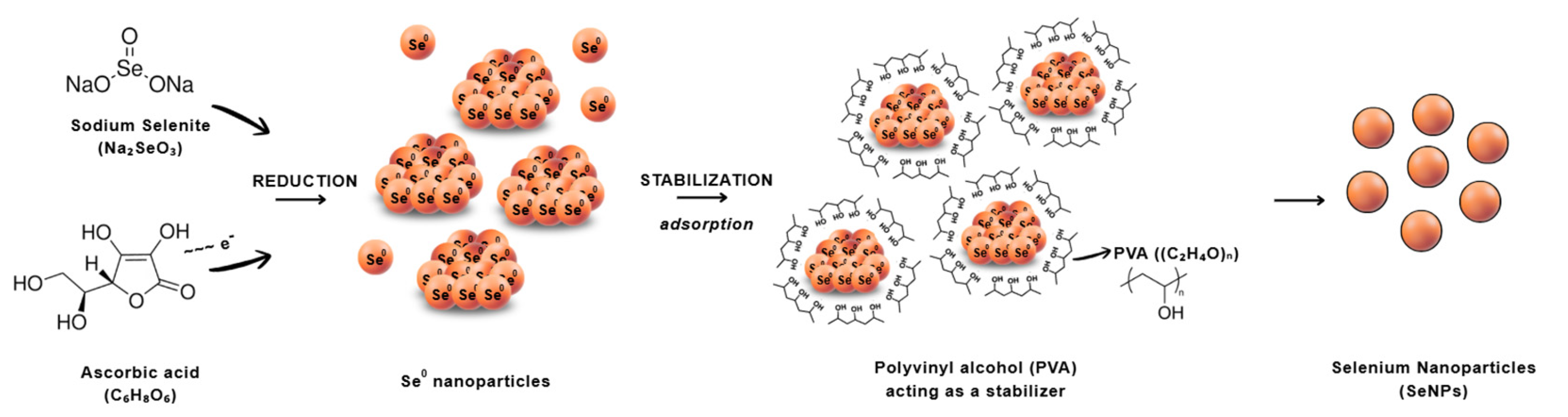
The chromsatic transition observed occurs due to the reduction in the selenite ion ( SeO 3 2 ), in which selenium is in the +4 oxidation state (Se+4), supplied in aqueous solution by the precursor Na2SeO3 by AA. This reaction forms elemental selenium (Se0), whose presence is accompanied by the surface plasmon resonance (SPR) effect. During the process, Se0 nucleates into small particles that tend to aggregate due to high surface energy. To prevent agglomeration, PVA is used, which adsorbs on the surface of the nanoparticles, forming a protective layer that keeps the suspension stable [48,73,74] (Figure 1).
The increase in Na2SeO3 and AA concentrations, maintaining a 1:4 ratio, intensified the final coloration of the suspensions, with more evident orange tones in conditions 4:16 and 5:20, in addition to reducing the initial color change time (ICCt). Under condition 5:20, the ICCt occurred immediately after the addition of AA. In general, more intense orange tones were observed after 60 min of stirring. The results are presented in Table 1.

2.1.2. Visual Inspection and UV/Vis Spectrophotometry—Phase I

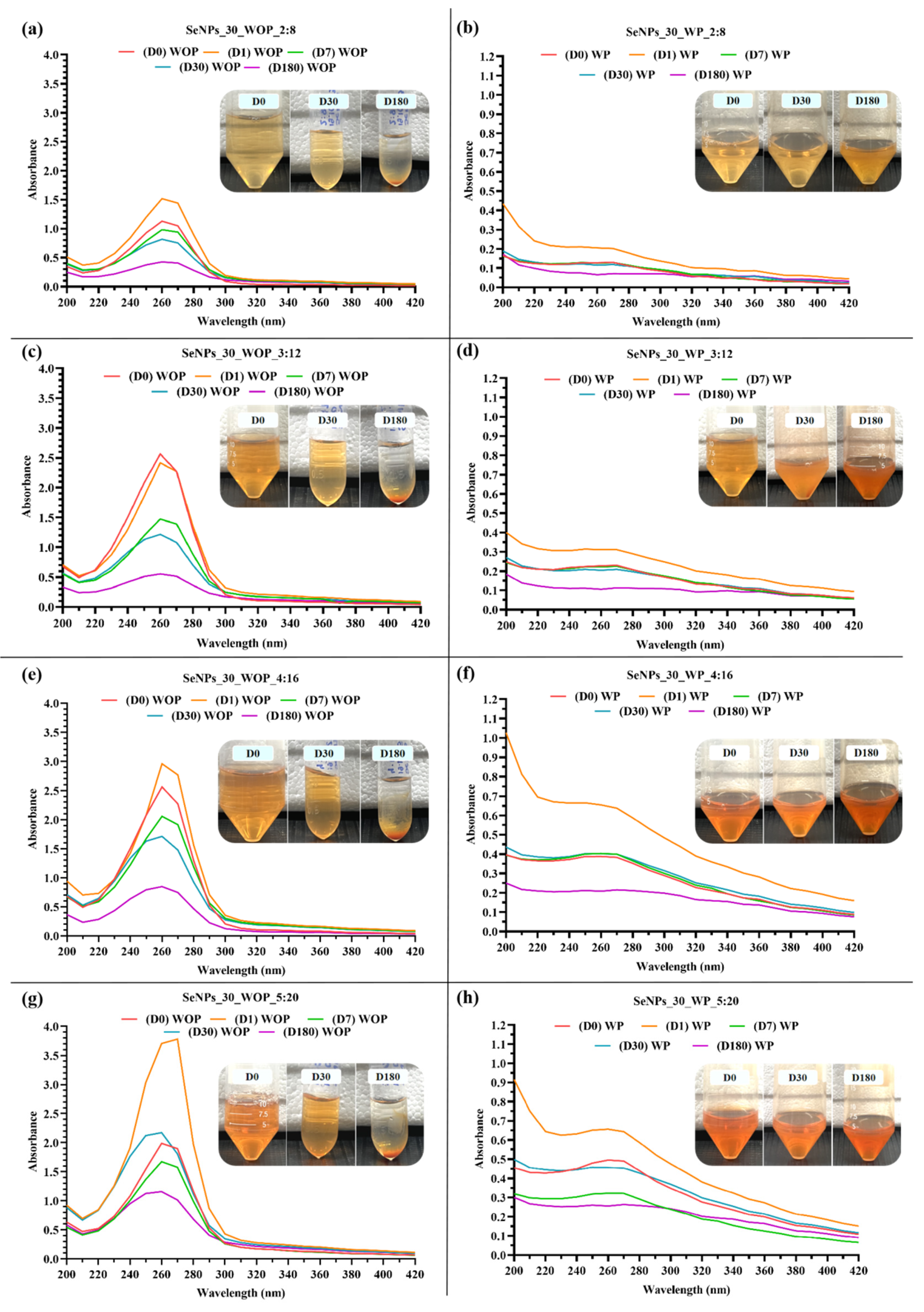
The formation of SeNPs was monitored via visual inspection and UV/Vis spectroscopy over a period of 180 days, providing essential data on structure, composition, and colloidal stability, as nanoparticles are generally sensitive to morphological and concentration changes that can affect the refractive index and the spectra resulting from electron oscillations induced by radiation [78,79]. The characterization of SeNPs synthesized for 30 and 60 min is presented in Figure 2 and Figure 3, respectively.
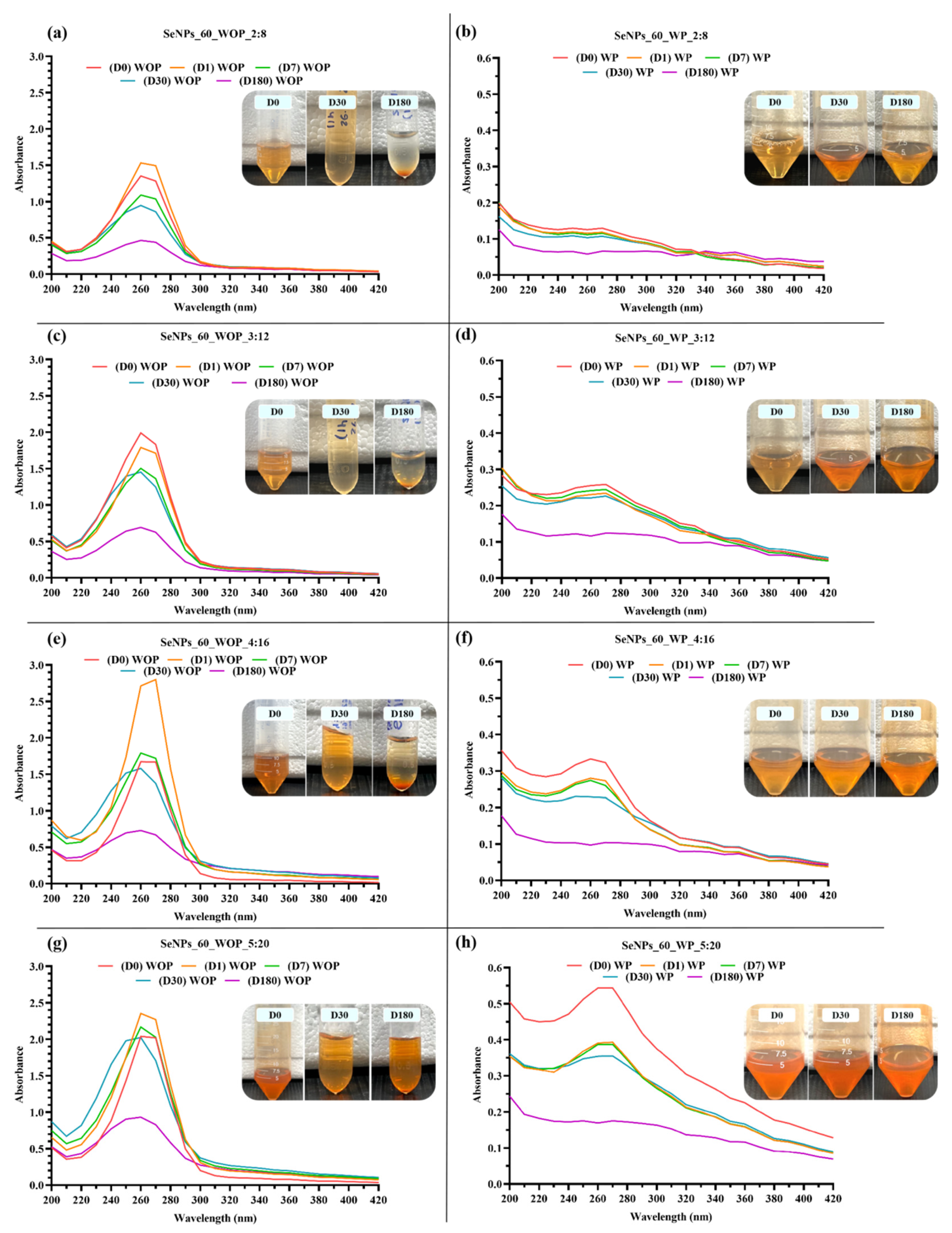
The results demonstrated that, after 30 or 60 min of synthesis, regardless of the molar ratio (2:8, 3:12, 4:16, and 5:20) or the absence (WOP) or presence (WP) of purification, the colloidal solutions exhibited similar coloration at D0. Over the monitoring period, the SeNPs WOP synthesized for 30 min (SeNPs_30_WOP) (Figure 2a,c,e,g) and 60 min (SeNPs_60_WOP) (Figure 3a,c,e,g) showed progressive loss of color and the formation of precipitates that were difficult to redisperse, effects particularly pronounced at D180. Among the SeNPs_60_WOP samples, only the 5:20 condition (Figure 3g) maintained macroscopic stability, indicating preservation of the colloidal dispersion at the macroscopic scale. In contrast, the SeNPs WP synthesized for 30 min (SeNPs_30_WP) (Figure 2b,d,f,h) and 60 min (SeNPs_60_WP) (Figure 3b,d,f,h) exhibited greater visual stability over time, with precipitates observed only in the 2:8 and 3:12 conditions of SeNPs_30_WP (Figure 2b and Figure 2d, respectively) and SeNPs_60_WP (Figure 3b and Figure 3d, respectively), whereas the 4:16 and 5:20 conditions of SeNPs_30_WP (Figure 2f and Figure 2h, respectively) and SeNPs_60_WP (Figure 3f and Figure 3h, respectively) remained visually unchanged, indicating maintenance of macroscopic stability throughout the monitoring period. Regarding kinetic monitoring, it was observed that, regardless of synthesis time or the Na2SeO3:AA concentration ratio (2:8, 3:12, 4:16, and 5:20), the maximum absorption wavelength (λmax) remained constant, at 260 nm for SeNPs WOP, exhibiting sharper and more intense peaks, and 270 nm for SeNPs WP, characterized by broader and less intense bands.
It was observed that increasing the molar ratio between Na2SeO3 and AA intensified the SPR band and the color of the dispersion, without altering the absorption range or λmax, which is attributed to interband and core electronic transitions [48,77,80,81,82]. This suggested an increase in SeNPs density, while particle size and morphology remained relatively constant. Such behavior is consistent with the fact that λmax may depend on size and morphology, whereas the absorbance peak intensity reflects particle concentration [83]. Moreover, all samples exhibited a reduction in the absorption peak intensity, possibly due to physicochemical changes in the SeNPs, including aggregation, diameter variation, and morphological modifications [79]. Unlike metallic nanoparticles, such as gold and silver, well-defined SPR bands were not observed in SeNPs WOP or WP, consistent with the non-metallic nature of selenium. The λmax values obtained are consistent with those previously reported: 267 nm [84], 264 nm [74], 265 nm [85], and 264 nm [86].
Additionally, regardless of molar concentration, color, pellet formation, or purification, the SeNPs remained translucent for 180 days, possibly due to the Tyndall effect, in which light is scattered by monodispersed SeNPs without being significantly obstructed [87]. Color changes and absorption spectra demonstrated that, regardless of synthesis time or the molar ratio between samples, the absence of purification compromised the characteristics of the colloidal solutions, except for SeNPs_60_WOP_5:20 (Figure 3g). These results indicate that centrifugation played a crucial role in the physical separation of particles from possible unreacted residues, as well as in fractionating SeNPs by shape, size, and density [88]. The effectiveness of this process can be evidenced by UV/Vis spectra, which allow verification and quantification of particle distribution under WOP and WP conditions. These observations are consistent with previous studies highlighting the importance of separation methods to isolate different morphologies in colloidal solutions, with such differences being directly monitored by UV/Vis spectroscopy [88].

2.1.3. Evaluation of Colloidal Stability by Dynamic Light Scattering (DLS) and Zeta Potential (ZP)—Phase I

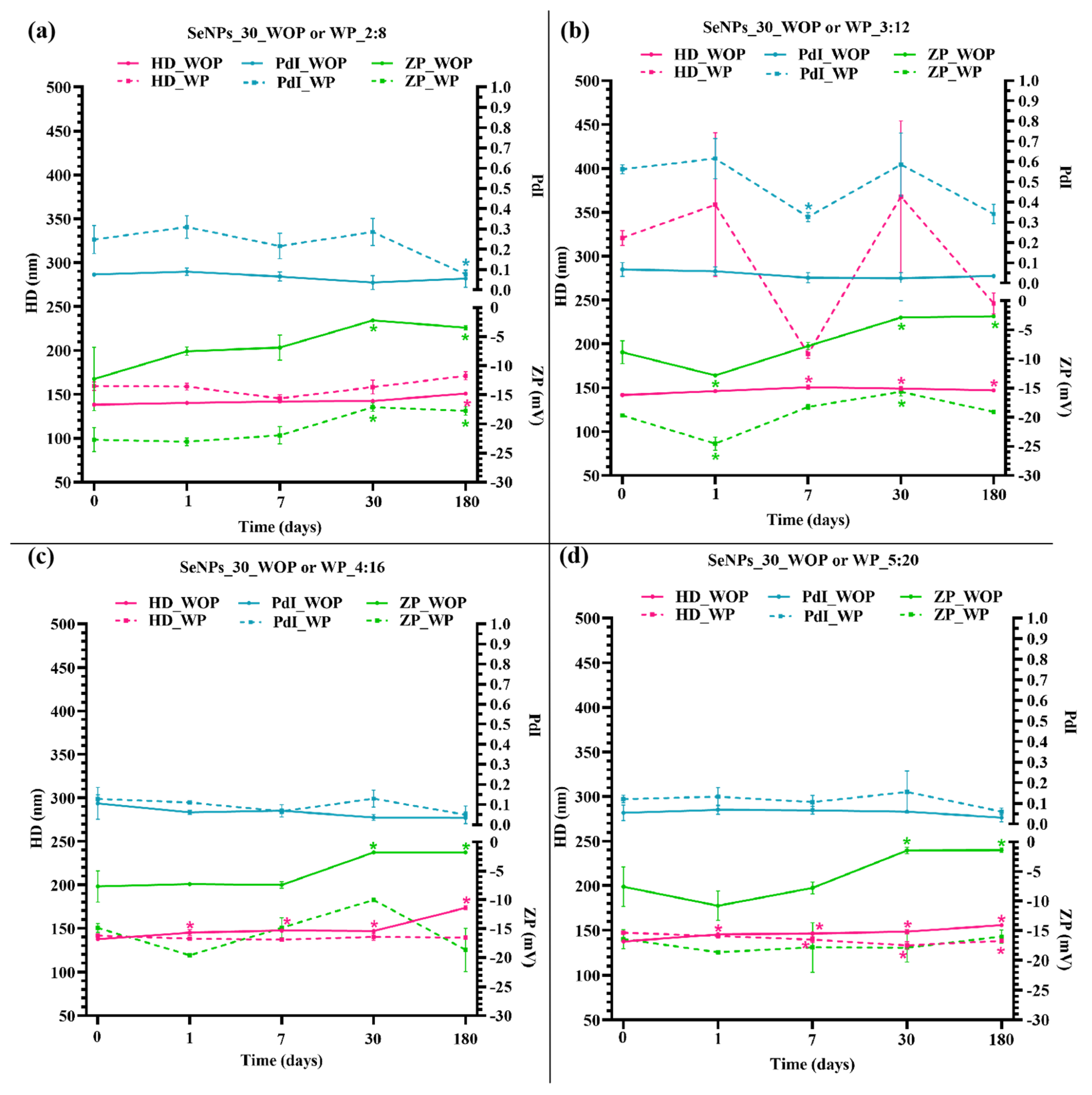
The colloidal stability of SeNPs was evaluated by Dynamic Light Scattering (DLS), including hydrodynamic diameter (HD), polydispersity index (PdI), and Zeta potential (ZP). The PdI ranges from 0 to 1, with values closer to 0 indicating more homogeneous systems [79,89,90]. ZP follows the classification reported in the literature: ±0–10 mV (highly unstable), ±10–20 mV (limited stability), ±20–30 mV (moderately stable), and >±30 mV (highly stable) [90,91,92,93,94]. In the graphs, SeNPs WOP are represented by solid lines and SeNPs WP by dashed lines. The average values are detailed in Table S1 (Supplementary Materials).
The SeNP synthesis over 30 min, under molar conditions of 2:8, 3:12, 4:16, and 5:20, is shown in Figure 4a–d, respectively. In general, the HD remained constant throughout the analysis period, and the increase in the molar concentration of Na2SeO3 and AA promoted greater monodispersity under both conditions (WOP and WP). The increase in HD in SeNPs WOP may possibly explain the observed visual changes and the alterations in the absorption spectra. Significant differences (p < 0.05) were observed under the WOP condition for 3:12 (D7-D180), 4:16, and 5:20 (D1-D180), while under the WP condition, differences occurred only for 5:20 on days D7, D30, and D180. Regarding dispersity, the PdI of SeNPs WOP ranged from 0.024 to 0.106, while SeNPs WP ranged from 0.049 to 0.615, with greater dispersion at 3:12. In WP, 4:16 (0.049–0.129) and 5:20 (0.060–0.156) showed no significant changes over time, whereas 2:8 (D180) and 3:12 (D7) exhibited significant differences (p < 0.05). The main distinction between SeNPs WOP and WP was evident in the ZP analysis. For ZP, WOP showed initial values between −10 and −15 mV, decreasing to approximately <−5 mV over 180 days, while WP ranged from −10 and −20 mV, indicating limited colloidal stability. In SeNPs_30_WP, the pH increased from 5 (D0) to 6 (D180), indicating that the removal of synthesis residues, combined with the presence of PVA as a stabilizer, contributed to maintaining colloidal stability and reducing the tendency for aggregation. In contrast, in SeNPs_30_WOP, the pH decreased from 5 (D0) to 3 (D180), likely reflecting the influence of residual byproducts on the ionic balance of the suspension, which may promote changes in the electric double layer and greater particle aggregation. Changes in the pH of SeNPs are widely reported in the literature as determining factors influencing their physicochemical characteristics [95].
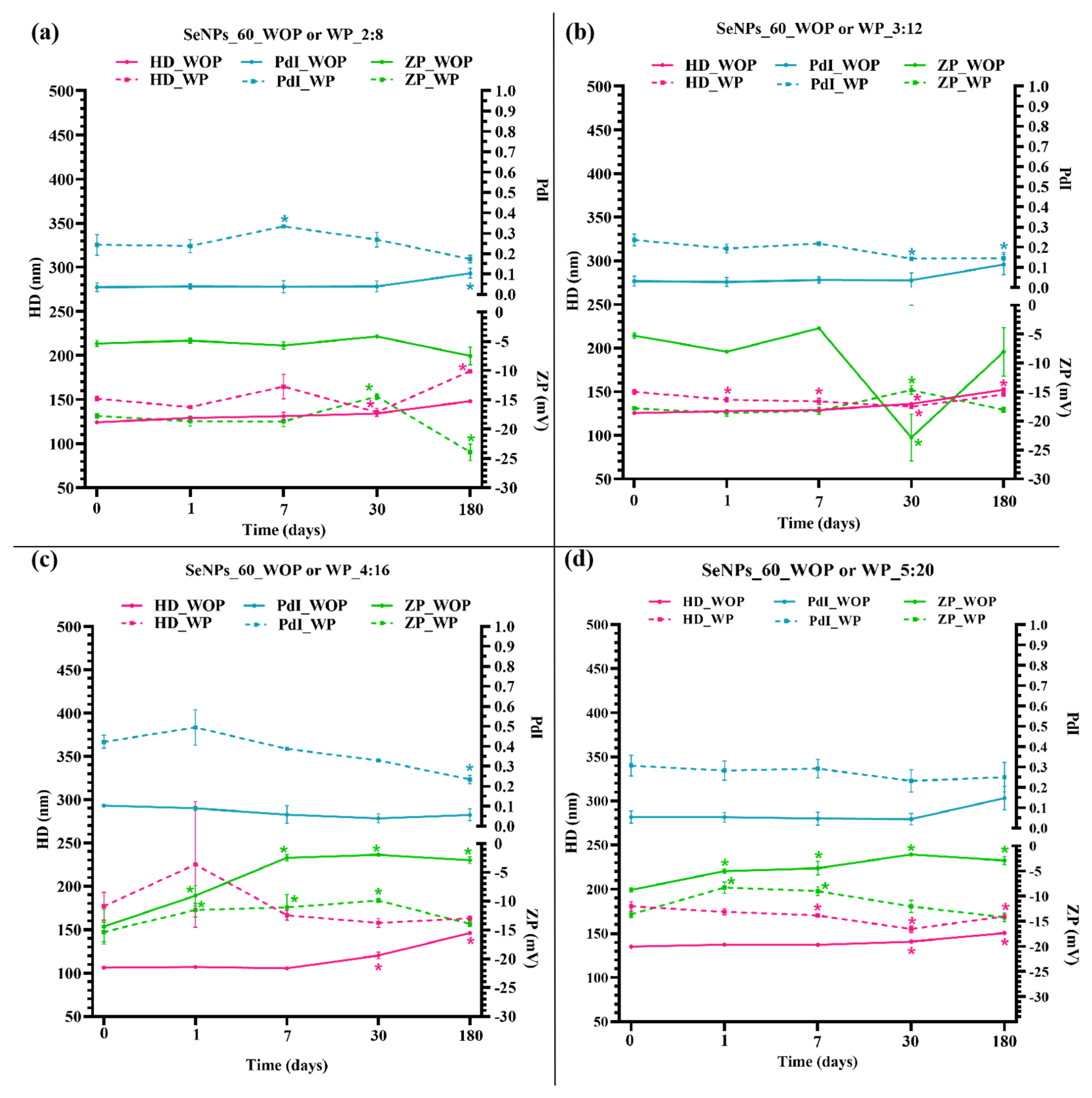
The SeNP synthesis over 60 min, under molar conditions of 2:8, 3:12, 4:16, and 5:20, is shown in Figure 5a–d, respectively. The results demonstrated that the synthesis time influenced the HD of SeNPs in a manner dependent on the experimental condition. In general, SeNPs WOP exhibited smaller diameters compared to WP, except for the 5:20 molar ratio, while SeNPs WP showed larger values, except under the 3:12 condition. Despite the lower HD observed for WOP, these samples showed greater variations throughout the storage period, whereas WP samples exhibited higher temporal stability. Among the SeNPs WP, the 4:16 condition did not show statistically significant differences. Regarding dispersity, 60 min reduced the PdI of SeNPs WOP (≤0.183), with a significant difference only in 2:8 (D180), whereas in SeNPs WP, the PdI increased in all molar ratios, reaching a maximum of 0.495, with significant differences in 2:8 (D7), 3:12 (D30 and D180), and 4:16 (D180). The parameter that differed most between the synthesized samples was ZP. It was observed that SeNPs WOP presented the greatest variations, with lower ZP values (−10 or −5 mV), indicating the low stability of these systems under this condition. For SeNPs WP, the ZP was lower with 60 min of synthesis, especially under conditions 4:16 (−9.90 to −15.0 mV) and 5:20 (−9.03 to −14.3 mV), indicating limited stability. Regarding D0 of the synthesis, statistically significant differences (p < 0.05) were observed in all concentrations of SeNPs WP and in SeNPs WOP for 3:12 (D30) and 4:16 and 5:20 (D1 to D180). In SeNPs_60_WOP, the pH decreased from 5 (D0) to 4 (D180), showing a similar but less pronounced behavior than in the 30 min SeNPs, possibly due to the formation of slightly more stable particles with the longer stirring time. In SeNPs_60_WP, the pH remained between 5 (D0) and 6 (D180), indicating that purification combined with PVA promotes colloidal stability regardless of stirring time.

2.1.4. Selection of Optimized Synthesis Conditions and Colloidal Properties of SeNPs for Phase II

The variation in the molar concentration between Na2SeO3 and AA, as well as the stirring time, directly influenced the physicochemical parameters of SeNPs, including the HD, PdI, and ZP, in agreement with data obtained by UV/Vis and visual inspection. The greatest variations occurred at the molar concentrations of 2:8 and 3:12, while 4:16 and 5:20 exhibited higher stability, even at higher concentrations and with only 30 min of stirring, showing statistically minimal or non-existent variations. The SeNPs WOP exhibited lower initial variation in HD and PdI but demonstrated instability over time, evidenced by pellet formation, color change, and reduction in ZP, with values approaching neutrality. This behavior may be associated with pH variation, increased particle concentration, and possible overlapping of the electrical double layer, resulting in decreased ZP and colloidal stability, favoring aggregation [91]. In contrast, SeNPs WP maintained higher colloidal stability throughout the evaluated period. Similar results have shown that variation in volumetric ratios, while keeping precursor concentrations constant, can lead to a reduction in nanoparticle size [96]. These findings corroborate the results observed under the 4:16 and 5:20 conditions. Among the conditions evaluated, the 4:16 molar ratio with 30 min of stirring presented the lowest HD, PdI, and ZP values, with statistically minimal or negligible differences (WOP or WP), and was therefore selected for the subsequent stage, designated as “SeNPs_30_WOP or WP_4:16”.

2.2. Phase II—Variation in the Volume of the Stabilizing Agent

2.2.1. Visual Inspection and UV/Vis Spectrophotometry—Phase II

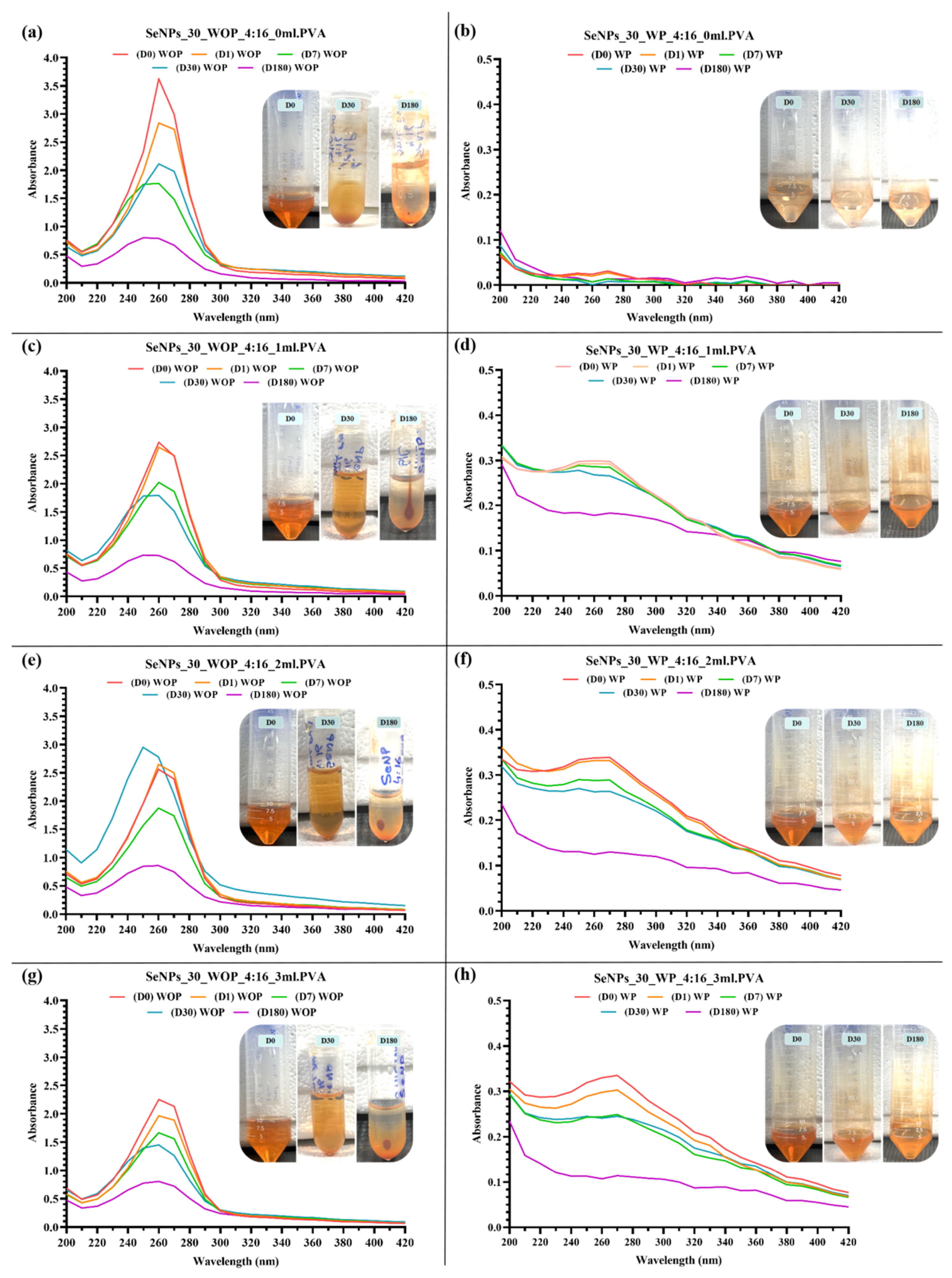
The analysis of the absorption spectra and visual inspection of “SeNPs_30_WOP or WP_4:16” showed, similarly to “Phase I”, a progressive decay of the SPR bands from the first day up to 180 days, with λmax at 260 nm (SeNPs_30_WOP) and 270 nm (SeNPs_30_WP). The SeNPs WOP exhibited more defined bands and well-established λmax, whereas WP samples showed broader and less defined bands. Visually, regardless of the PVA volume used in the synthesis, SeNPs_30_WOP samples showed color loss and precipitate formation, while SeNPs_30_WP samples maintained visual stability, with no pellet formation or other changes throughout the analysis period. The results of “Phase II” are presented in Figure 6.
In the absence of PVA addition (0 mL) during the synthesis process, although a color change from colorless to light yellow and subsequently to orange was observed, the resulting colloidal solution did not remain stable, regardless of the synthesis condition adopted. Under the WOP condition, corresponding to the initial colloidal solution, the orange coloration appeared more intense; however, still on the day of synthesis, the formation of dark-brown aggregates precipitated at the bottom of the tube was observed after 30 min of reaction (Figure 6a). After purification (WP), the SeNPs exhibited a loss of the orange coloration at D0, again accompanied by the presence of dark-brown aggregates precipitated at the bottom of the tube (Figure 6b). Moreover, the absence of PVA as a stabilizer promoted changes in the UV/Vis spectra, with no well-defined SPR bands or λmax, independent of the condition (WOP or WP), this effect being more pronounced in WP samples, suggesting that the purification process, combined with the absence of PVA, significantly reduced the optical signal of the system. These behaviors can be attributed to the high surface energy of the SeNPs formed in the absence of a steric and/or electrostatic barrier, which was not provided by PVA, possibly due to the large number of selenium atoms exposed on the particle surface, increasing their reactivity and favoring attractive intermolecular interactions, leading to progressive aggregation with the formation of agglomerates of larger hydrodynamic size, compromising colloidal stability and resulting in the sedimentation and precipitation of the SeNPs in the aqueous medium. This behavior has been reported in previous studies demonstrating the synthesis of SeNPs in the absence of a stabilizing agent [48].
With the addition of 1, 2, and 3 mL of PVA, although presenting wider bands, the SeNPs WP (Figure 6d,f,h—respectively) showed SPR bands with greater similarity, evidenced by the uniform overlap of the peaks, indicative of stability in the absorption pattern, compared to the SeNPs WOP (Figure 6c,e,g—respectively). The SeNPs WP with 1 mL showed more homogeneous SPR bands over time, despite the formation of a precipitate at the bottom, as observed in the 0 mL sample, indicating changes in their characteristics. Those prepared with 2 and 3 mL showed no visible changes, although their spectra displayed less homogeneous bands throughout the analysis period. The SeNPs WOP maintained partial colloidal stability during the first 30 days, although precipitate formation occurred, which increased significantly over the storage period. To date, no studies have been identified that investigate the addition of PVA in different volumes. However, previous works have shown that the presence of a stabilizing agent in systems containing SeNPs synthesized at different proportions of precursor and reducing agents in aqueous media tends to confer greater stability compared to the absence of the stabilizer [48], possibly due to the characteristic viscosity of PVA [46,51,52], which promoted good dispersion of the SeNPs. In addition, it has been observed that increasing the ratio between these agents can influence the maximum absorption intensity in the UV/Vis spectra, possibly indicating an increase in SeNP concentration as well as band broadening [48].

2.2.2. Evaluation of Colloidal Stability by DLS and Zeta Potential—Phase II

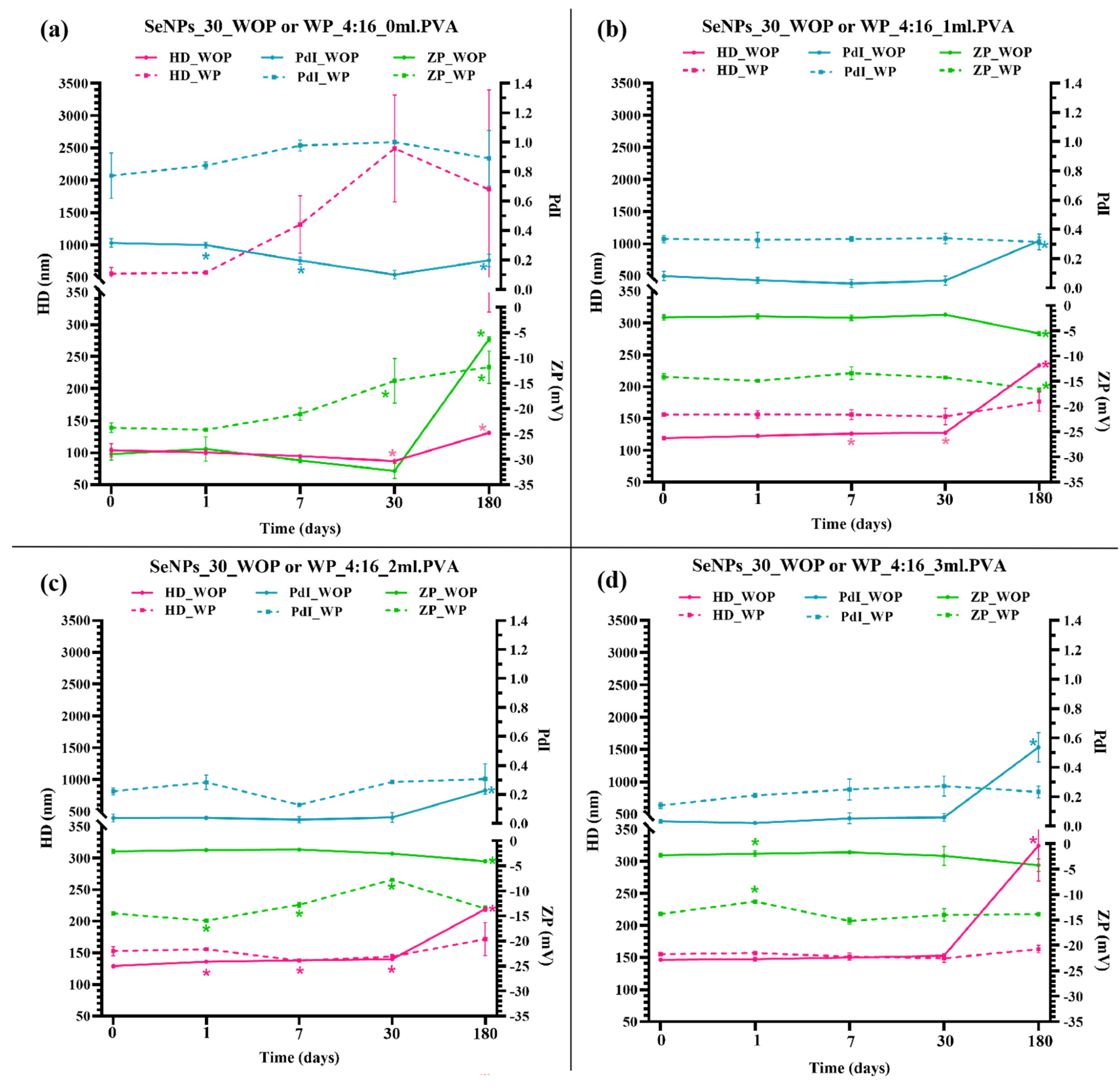
The DLS and ZP analyses confirmed the UV/Vis and visual inspection results, with significant differences (p < 0.05) in HD, PdI and ZP for SeNPs WOP and only in ZP for SeNPs WP (Figure 7). The pH varied from 5 (D0) to 3 (D180) in the SeNPs WOP and from 5 (D0) to 4 (D180) in the SeNPs WP, regardless of the PVA volume. The corresponding values are detailed in Table S2 (Supplementary Materials).
The results showed that the absence of PVA in the preparation of SeNPs (Figure 7a) compromised long-term stability, especially in SeNPs WP. For HD: The absence of PVA, associated with the purification process, affected the particle diameter from the day of synthesis, with SeNPs WP showing marked variations (554.7–2493 nm), while SeNPs WOP maintained more stable values (103.7–131.0 nm) over 180 days. For PdI: SeNPs WP exhibited high and unstable PdI values (0.773–1.000), indicating high polydispersity, while SeNPs WOP showed a progressive reduction in PdI (from 0.315 to 0.197). For ZP: In the first days, both systems showed incipient ZP values, with higher magnitudes for SeNPs WOP (−28.9 ± 1.18 mV, −27.9 ± 2.37 mV, and −30.2 ± 0.50 mV) compared to SeNPs WP (−23.7 ± 0.96 mV, −24.1 ± 0.20 mV, and −21.1 ± 1.22 mV). From D30 onwards, a sharp drop in ZP was observed, indicating a probable loss of colloidal stability.
When adding 1, 2, and 3 mL of PVA in the preparation of SeNPs, a reduction in fluctuations over time was observed. For HD: SeNPs WP showed a progressive reduction in HD values, with variations between 153.3 and 176.5 nm (1 mL), 143.8–171.7 nm (2 mL), and 148.5–162.8 nm (3 mL), indicating greater colloidal stability. In contrast, SeNPs WOP showed a progressive increase in HD, with variations of 119.2–233.6 nm (1 mL), 128.8–219.2 nm (2 mL), and 146.0–324.6 nm (3 mL), showing an increase in the average particle diameter over time. For the PdI: SeNPs WP exhibited lower and more stable values that favored monodispersity (0.127–0.339) compared to SeNPs WOP, which showed an increase and greater dispersion of PdI values (0.032–0.536), indicating polydispersity and possible aggregation. The ZP was the only parameter showing statistically significant differences (p < 0.05). SeNPs WOP exhibited lower absolute values, regardless of PVA volume, whereas SeNPs WP showed higher values and greater stability with increasing PVA. Statistical differences were observed for WOP at D180 (1 and 2 mL) and at D1 (3 mL), and for WP at D180 and D1 (1 and 3 mL, respectively), as well as at D1, D7, and D30 (2 mL).
The results obtained by DLS and ZP corroborate the observations from visual inspection and absorption spectra, indicating that the use of PVA, combined with increasing applied volume, promoted the formation of more stable colloidal solutions. A reduction in particle diameter was observed as the PVA volume increased, suggesting enhanced steric and electrostatic control between particles, which also contributed to the maintenance of surface electric potential characteristics, as previously reported in studies on the use of stabilizing agents in SeNP synthesis [48].

2.2.3. Selection of Optimized Synthesis Conditions and Colloidal Properties of SeNPs from Phase II for Microscopic Analysis

The results of “Phase II” demonstrated that PVA acted as a coating and stabilizing agent for the SeNPs, influencing their physicochemical properties. The findings suggest that, in long-term stability assessments, the observed variations may not be exclusively associated with the absolute volume of PVA used in the synthesis, but possibly also with its concentration in the reaction medium, which was not varied in the present study.
Previous studies have demonstrated that varying the PVA concentration, while keeping the selenium precursor concentration constant, directly influences the spectral properties, promoting an increase in peak intensity and a shift in the absorption maximum toward shorter (blue shift) or longer (red shift) wavelengths, depending on the experimental conditions [97]. In the present study, the purification process promoted a slight red shift in the UV/Vis spectra compared to the non-purified samples. Although this behavior could be interpreted as indicative of an increase in particle size regardless of the PVA volume employed, this hypothesis was not confirmed, since the same spectral pattern was observed even without variation in the PVA concentration. The same study demonstrates that increasing the PVA concentration during synthesis, in association with band shifts, results in the formation of SeNPs with smaller diameters, confirming its role as a stabilizing agent in controlling nucleation and growth, as well as in reducing particle aggregation [97]. This behavior was not observed in the present study. In this work, the slight band shift did not promote significant variations in the average diameter of the SeNPs, except for the samples synthesized without PVA, in which particle sizes remained similar in most cases and more pronounced changes occurred only over longer periods. These findings indicate that the dimensional variations are more closely associated with colloidal stability than with the observed spectral shift.
The increase in PVA volume during the preparation of purified SeNPs led to enhanced colloidal stability, as evidenced by reduced HD and PdI values, increased ZP, and the absence of pellet formation. In SeNPs WP, purification appears to have facilitated the removal of byproducts and residual compounds present under WOP conditions, thereby contributing to a more homogeneous size distribution, improved stability, and preservation of physicochemical properties over time. Additionally, the literature indicates that higher centrifugation speeds promote the formation of more uniform particles through digestive maturation, favoring applications that require consistent sizes. Previous studies have reported the formation of monodisperse SeNPs after centrifugation for 30 min at 9000 rpm [84], 10,000 rpm [73,98], 12,000 rpm [85] and with an increase in speed from 8000 to 12,000 rpm [76], corroborating and justifying the high speed used in this study 13,000 rpm (24,300× g).
Considering the promising performance of the SeNPs WP prepared in “Phase II” (1–3 mL of PVA) and those previously obtained in “Phase I” (4 mL of PVA), these particles were selected for Transmission Electron Microscopy (TEM) analysis to morphologically assess the influence of the absence or presence of the stabilizing agent in the system.

2.2.4. Transmission Electron Microscopy (TEM)—Phase I and II

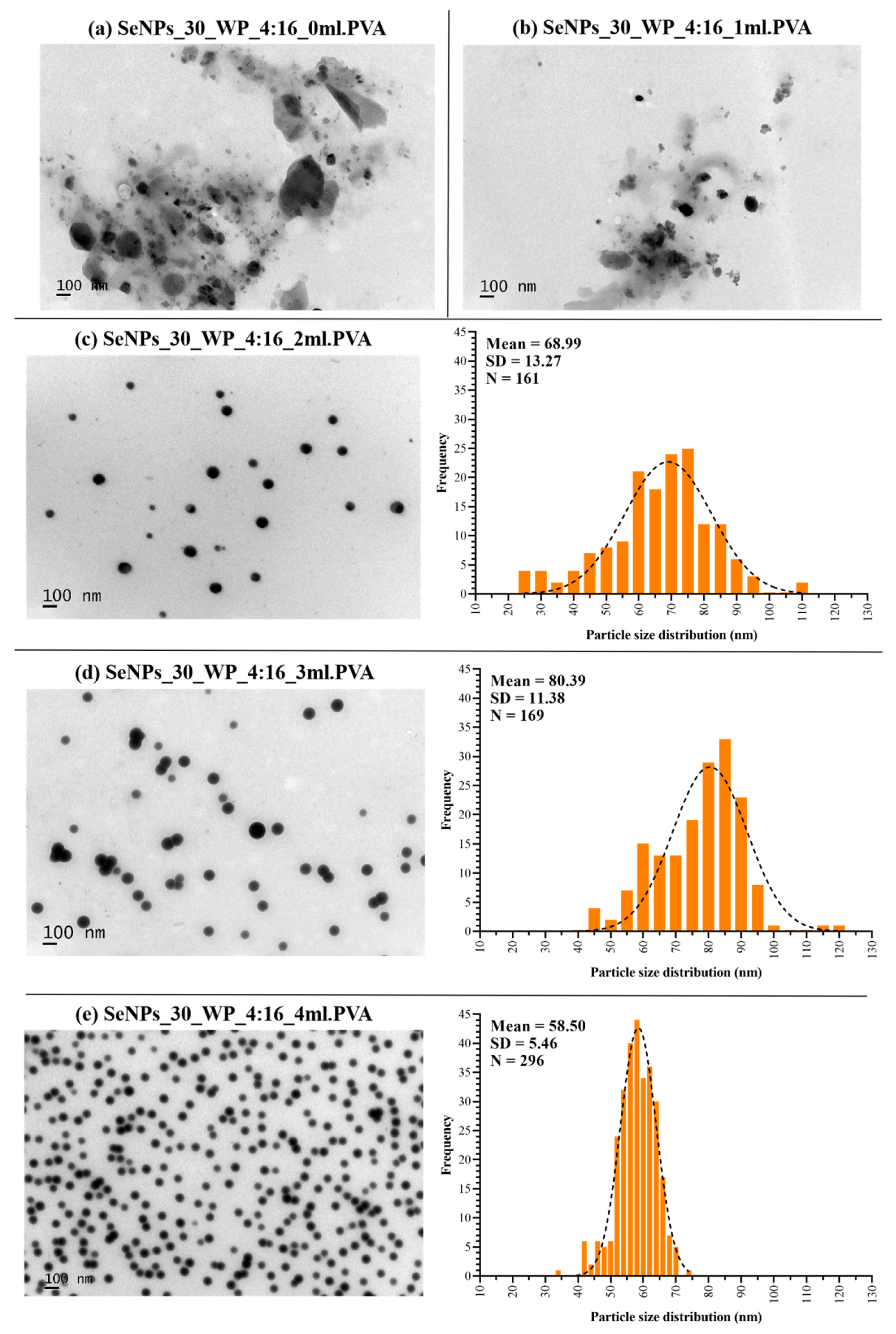
The TEM micrographs (Figure 8) show the influence of PVA volume on the stabilization of SeNPs_30_WP_4:16, highlighting its role in particle morphology, size, and dispersion, in agreement with DLS data, absorption spectra, and visual inspection.
In the absence of PVA (0 mL) (Figure 8a), SeNPs exhibited an undefined morphology, with a spotted appearance and signs of aggregation, in accordance with the attenuation of coloration, and the formation of dark sediment after 180 days. In the presence of 1 mL of PVA (Figure 8b), the micrographs showed undefined morphology, with spots and aggregation, an unexpected result since, despite the formation of a dark pellet, visual inspection remained unchanged. The SeNPs presented spherical morphology with 2, 3, and 4 mL of PVA. With 2 mL (Figure 8c), spherical particles with well-defined edges were observed, but with different sizes and polydisperse distribution. With 3 mL (Figure 8d), the distribution became more homogeneous, suggesting increased monodispersion. With 4 mL of PVA (Figure 8e), the SeNPs exhibited well-defined morphology, monodisperse distribution, and uniform sizes, in agreement with previous results and observations.
The histogram of the dry diameters of SeNPs showed that, with 2, 3, and 4 mL of PVA, the diameters ranged from 25–110, 45–120, and 34–74 nm, with averages of 68.99, 80.39, and 58.50 nm, respectively, evidencing a reduction in the average diameter and the range of particle sizes with increasing PVA volume. These results corroborate the DLS data, which indicate a reduction in the average diameter of SeNPs with increasing PVA volume and after purification. It was not possible to determine the dry diameter in the absence of or with 1 mL of PVA due to the absence of well-defined morphologies.
Micrographs after 180 days suggest that PVA helped control the morphology and reduce the aggregation of SeNPs, especially with 2, 3, and 4 mL, an effect possibly associated with refrigerated storage conditions and dark lighting during the analysis period [72,99,100]. The observation of the spherical morphology and dry diameter of SeNPs synthesized with Na2SeO3, AA, and PVA, whether entirely, partially, or in isolation, is consistent with previous reports [73,74,84,86,98,101,102]. To date, no studies have been identified in the literature that systematically investigate the optimization and evaluation of the incorporation of different PVA volumes, nor the effects of such variation on the morphology and long-term colloidal stability of the analyzed systems. This gap underscores the need for further investigations to elucidate these parameters within the framework of the physicochemical characterization of SeNPs.

2.3. Antifungal Activity

The preparation of SeNPs is an essential step for biological applications, as it allows the control of chemical and physical parameters that enhance the effects of selenium and reduce its toxicity [6,20,103]. Studies indicate that the physicochemical properties of SeNPs, such as size and surface charge, play a fundamental role in antimicrobial activity, since the adhesion of these particles to the cell walls and membranes of microorganisms can lead to their destruction, as well as interfering with energy transfer, inhibiting enzymatic activity and compromising DNA synthesis [6,104,105,106,107]. Based on the results of UV/Vis, DLS, ZP, visual inspection, pH, and MET, the SeNPs WP synthesized under condition 4:16 (4 mM Na2SeO3 and 16 mM AA) and stabilized with 4 mL of PVA (SeNPs_30_WP_4:16_4mL.PVA) were selected for antifungal evaluation because they had a smaller size, better distribution, no statistical differences, and stability over 180 days.

The Effect of SeNPs Towards Candida albicans

Based on the antifungal assay in planktonic cells of Candida albicans, the results revealed that none of the tested samples exhibited inhibitory activity, except for the positive control (fluconazole). The SeNPs and their constituent compounds (PVA, AA, and Na2SeO3) failed to inhibit the visible growth of C. albicans at the highest concentrations tested. In contrast, fluconazole showed a minimum inhibitory concentration (MIC) of 0.5 µg/mL, confirming its antifungal effectiveness and validating the experimental methodology employed (Table 2).
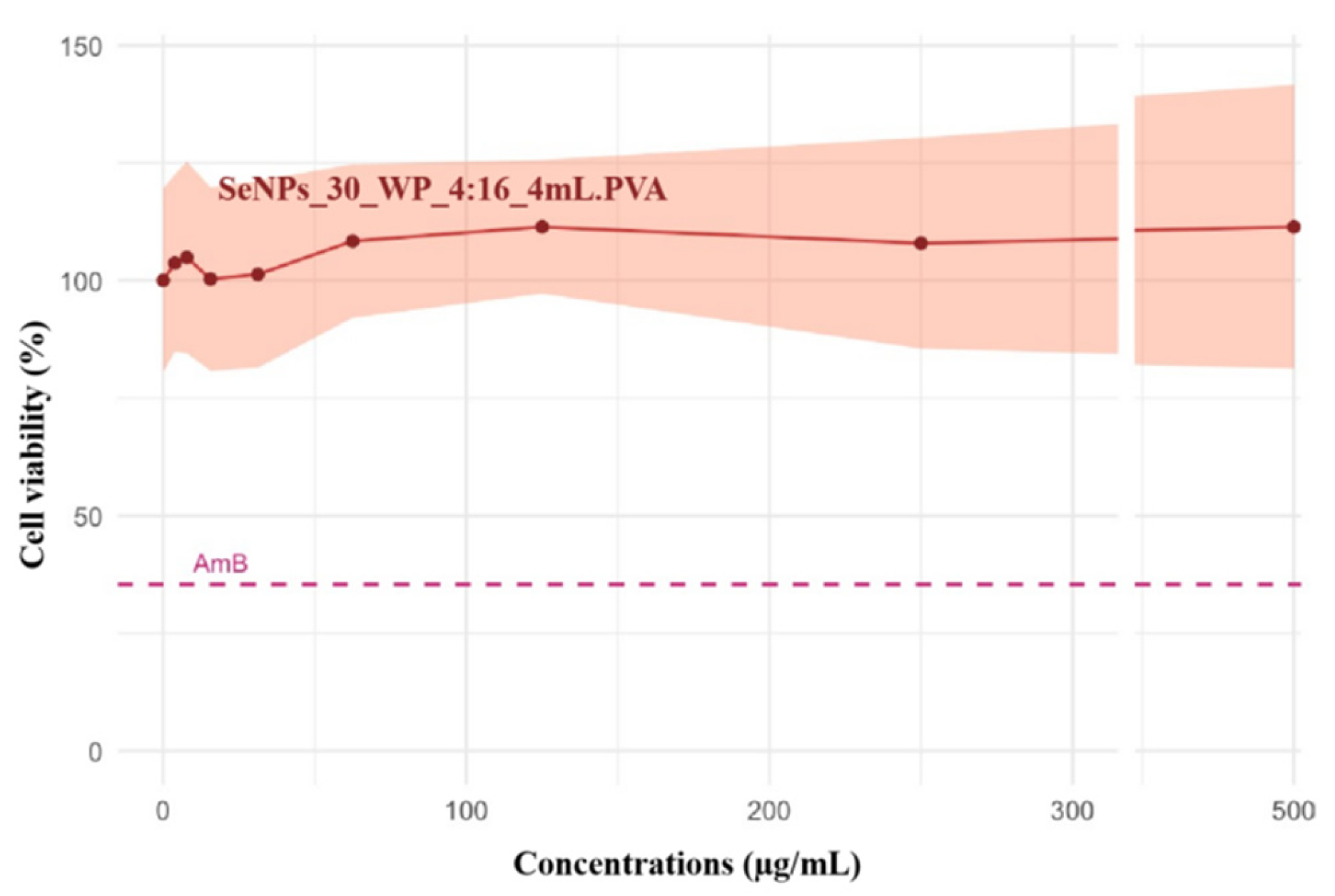
A similar trend was observed in the resazurin viability assay of C. albicans biofilms. The results did not indicate any inhibitory effect of SeNPs on the mature biofilms. Only the antifungal control of amphotericin b (AmB) (1 µg/mL) showed a significant reduction of 65% in cell viability (Figure 9). Additionally, the tested concentrations of PVA, AA, and Na2SeO3 did not show any cytotoxicity in the preformed biofilms.
These results contrast with previous reports involving different SeNPs against C. albicans. In planktonic cells, a biogenic SeNPs synthesized by Bacillus species showed an MIC of 70 µg/mL using the broth microdilution method [70]. In addition, 70 µg/mL of a chemical SeNPs reduced the growth of C. albicans by 90% in a disk diffusion method [108]. Besides that, SeNPs synthesized by pulsed laser ablation exhibited activity in biofilms detected by a colorimetric assay based on the XTT reduction. These assays quantified 50% of the inhibition of C. albicans in a concentration of 26 ppm of a sample of nanoparticles [109,110]. Although our study outlines the limitations of the application of SeNPs, it also guides future research. It is suggested that the effects of SeNPs be evaluated against other microbial models (bacteria or other fungi, including other Candida ssp.) and that potential synergistic activities with known antimicrobial agents such as fluconazole and AmB be explored.

3. Materials and Methods

3.1. Materials

For the synthesis of selenium nanoparticles (SeNPs), sodium selenite (Na2SeO3) (Sigma Aldrich, Burlington, MA, USA), ascorbic acid (C6H8O6) (AA) (Sigma Aldrich, Tokyo, Japan), and polyvinyl alcohol (PVA-(C2H4O)n) (Dinamica, São Paulo, Brazil) were used, dissolved exclusively in ultrapure water. In biological tests, the culture media Sabouraud Dextrose (Sabouraud Dextrose Broth Eur. Pharma./USP—Kasvi, Madrid, Spain), Roswell Park Memorial Institute (RPMI) 1640 (Gibco, Thermo Fisher, Waltham, MA, USA), inactivated Fetal Bovine Serum (iFBS) (Gibco), sterile phosphate-buffered saline (PBS) (LaborClin, Pinhais, Brazil) and Alamar Blue (ThermoFisher, Waltham, MA, USA) were employed. The SC5314 strain of Candida albicans, used in the antifungal capacity evaluation, was provided by the fungal culture collection of the Laboratory of Molecular Biology of Fungi, Department of Molecular Biology, University of Brasilia (UnB), Campus Darcy Ribeiro, Brasilia/DF, Brazil.

3.2. Chemical Synthesis of Selenium Nanoparticles (SeNPs)

The chemical synthesis was carried out based on previous works, with adaptations, which demonstrate the use of Na2SeO3, AA and PVA [73,74,84,85,98] in two phases. In “Phase I”, the influence of varying the precursor (Na2SeO3) and reducer (AA) concentrations on the characteristics of SeNPs was investigated, while keeping the stabilizer concentration (PVA), stirring time, and the presence or absence of purification constant. In “Phase II”, the optimized condition from “Phase I” was used to evaluate the effect of varying the stabilizer volume in the system.

3.2.1. Phase I—Variation in the Concentration of the Na2SeO3, AA, Stirring Time, and Purification Condition

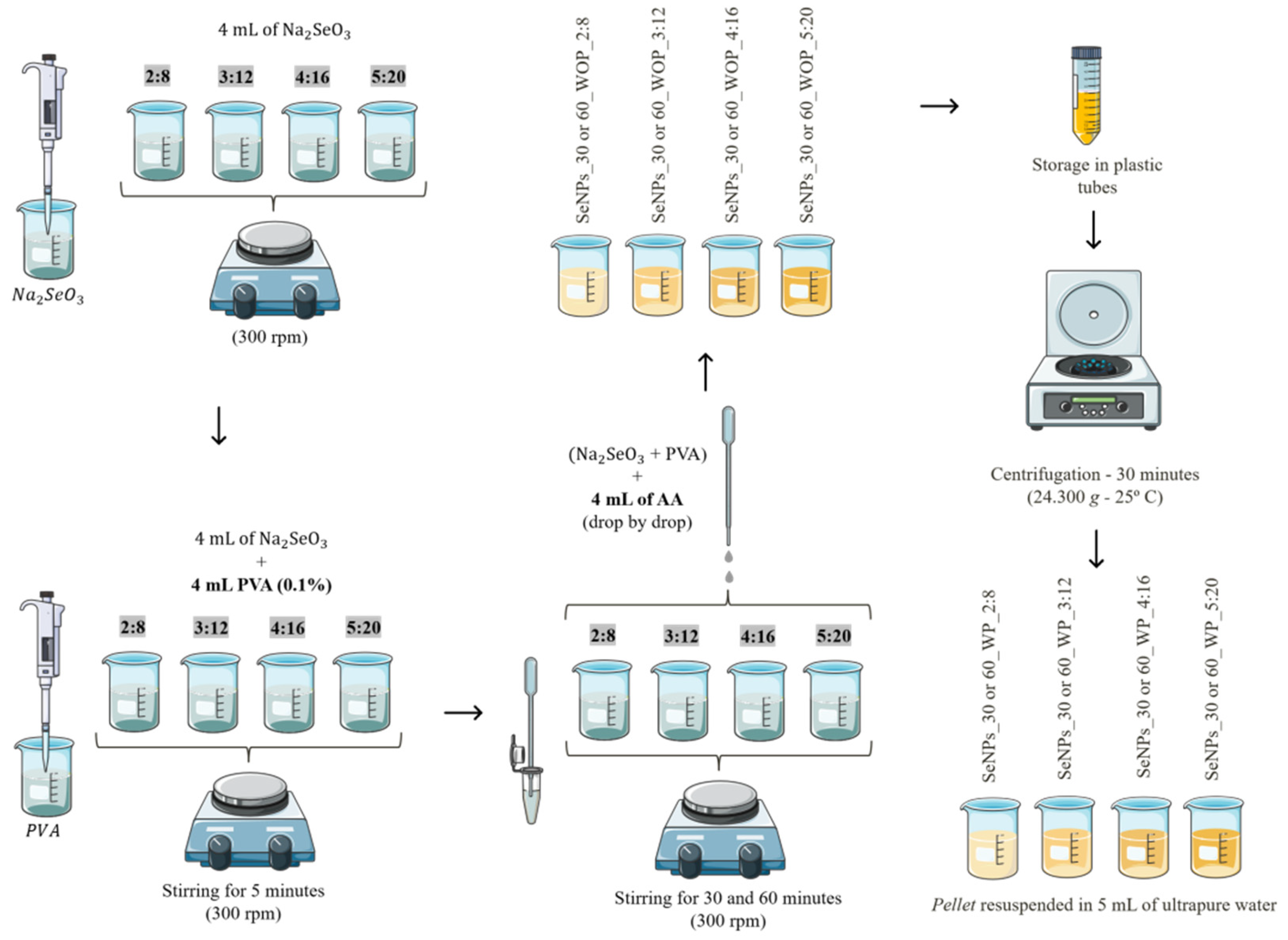
The SeNPs were prepared using different molar concentrations of Na2SeO3 and AA (2:8, 3:12, 4:16, and 5:20—Na2SeO3(mM):AA(mM)), keeping the molar ratio between the reagents constant at 1:4. The concentration of PVA was maintained at 0.1%. For the synthesis, 4 mL of Na2SeO3 was added to a glass container under magnetic stirring at 300 rpm, followed by 4 mL of PVA, and the stirring was maintained for 5 min for homogenization. Then, 4 mL of AA was added dropwise, without altering the stirring speed, resulting in a final volume of 12 mL, which remained under stirring for 30 or 60 min. The synthesis was conducted at room temperature (~25 °C), with the containers holding the colloidal solutions protected from light by aluminum foil, following the same procedure for all the molar concentrations studied.
After the stirring time was completed, the SeNPs were transferred to plastic tubes and subjected to centrifugation at 24.300× g for 30 min at room temperature (~25 °C) using a Thermo Scientific centrifuge (USA). The tubes were then carefully removed from the centrifuge to avoid re-dispersion of the pellet into the supernatant, which was discarded, while the pellet was resuspended in 5 mL of ultrapure water. The analysis of all colloidal solutions is performed without purification (WOP) and with purification (WP), and they are identified according to the molar concentrations studied: for 30 min of stirring, the samples are named SeNPs_30_WOP or WP_(molar concentrations studied—2:8, 3:12, 4:16, or 5:20), and for 60 min of stirring, the samples are named SeNPs_60_WOP or WP_(molar concentrations studied—2:8, 3:12, 4:16, or 5:20). All colloidal solutions are analyzed, and at the end, one condition is selected to proceed to Phase II (Figure 10).

3.2.2. Phase II—Variation in the Volume of the PVA

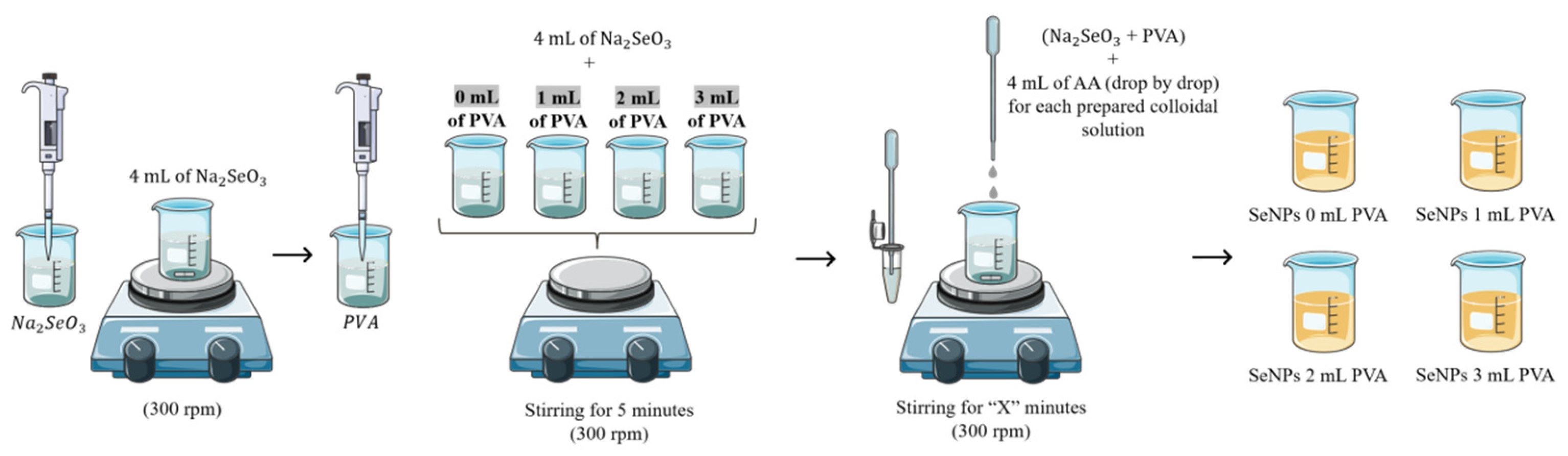
After selecting the colloidal solution with the best characteristics regarding concentration, stirring time, and the presence or absence of purification in Phase I, Phase II was initiated, in which the volumes of PVA (0.1%) in the selected solution were adjusted. In this phase, the influence of varying the PVA volume in the system was evaluated while maintaining the “Phase I” protocol, with modifications restricted to the PVA addition step. Four colloidal solutions of the selected condition were prepared, containing 0 (no addition), 1, 2, and 3 mL of PVA, resulting in final SeNP volumes of 8, 9, 10, and 11 mL, respectively (Figure 11). The samples were analyzed WOP and WP, as performed in Phase I.

3.3. Characterization of SeNPs

3.3.1. Ultraviolet–Visible Spectroscopy (UV/Vis)

The formation kinetics of SeNPs was analyzed using a UV/Vis spectrophotometer (UV1800PC, Phenix, Blomberg, Germany). For this, the samples were diluted at a 1:30 (v/v) ratio, in a final volume of 2 mL. Spectrophotometric analyses were performed over 180 days (6 months), with measurements taken at different time intervals (in days—D): D0 (synthesis day—sample at room temperature) and D1, D7, D30 and D180 (subsequent days—samples stored under refrigeration at 4 °C). The equipment was configured to perform readings within the absorbance range of 200 to 420 nm, using a quartz cuvette, at 25 °C.

3.3.2. Dynamic Light Scattering (DLS) and Surface Zeta Potential

The colloidal characterization of SeNPs, including hydrodynamic diameter (HD), polydispersity index (PdI) and Zeta potential (ZP), was performed using the ZetaSizer Nano ZS (Malvern Instruments, Malvern, UK) equipment, utilizing polystyrene cuvettes. For the analysis, the samples were initially diluted in ultrapure water at a 1:10 (v/v) ratio, and a final volume of 1 mL. The samples were introduced into the equipment, which was pre-configured to perform measurements using a helium–neon laser at 633 nm, at a 90° angle. Before data acquisition, the equipment temperature stabilized at 25 °C for 30 s, followed by 10 triplicate readings. The equipment settings and data processing were carried out using the ZetaSizer 7.13 software, developed by the equipment manufacturer. To analyze colloidal stability, the readings were performed over 180 days (6 months), with measurements taken at different time intervals (in days—D): D0 (synthesis day—sample at room temperature) and D1, D7, D30 and D180 (subsequent days—samples stored under refrigeration at 4 °C).

3.3.3. Transmission Electron Microscopy (TEM)

The morphological characterization of SeNPs under different synthesis conditions was performed using a JEOL JEM-1011 transmission electron microscope (Tokyo, Japan), operated at 80 kV. For this, 3 µL of the pure colloidal solution were deposited onto 400 mesh copper grids coated with Formvar® film, which were kept at room temperature (~25 °C), under subdued light, for 24 h to allow complete drying before analysis. The micrographs were obtained 180 days after synthesis, with the samples kept refrigerated at 4 °C throughout the period, to assess the long-term stability of the colloid. The dry diameter of the SeNPs was measured by MET and analyzed using ImageJ (1.54g) software to construct the particle size distribution histogram.

3.4. Antifungal Activity of SeNPs

3.4.1. Culture Conditions

The SC5314 strain of C. albicans, stored as frozen aliquots in 50% glycerol, was cultured on Sabouraud dextrose agar at 30 °C for 48 h for use in the experiments. After growth, a selected colony was inoculated into Sabouraud dextrose broth and incubated for 24 h at 30 °C with shaking at 200 rpm. Following incubation, the cells were harvested by centrifugation (1000× g, 5 min, 25 °C), washed three times with sterile PBS, counted using a hemocytometer, and diluted to the appropriate cell densities for subsequent assays.

3.4.2. Minimum Inhibitory Concentration

The in vitro antifungal assay was performed following the broth microdilution susceptibility guidelines of the Clinical and Laboratory Standards Institute (CLSI) M27-A3, with minor modifications. To evaluate antifungal potential, MIC was determined by exposing C. albicans to treatments and controls at a ratio of 50 μL:50 μL. Fungal suspensions were standardized at 2 × 10³ cells/mL. The positive control was fluconazole (64–0.5 µg/mL), and the experimental groups included SeNPs (691.76–2.70 µg/mL) and their components: AA (2817.92–11.01 µg/mL), PVA (1000–3.91 µg/mL), and Na2SeO3 (691.76–2.70 µg/mL). Untreated wells served as growth controls. The 96-well, flat-bottomed, polystyrene microplates (Kasvi) were incubated at 37 °C for 24 h under orbital shaking at 200 rpm. The MIC was defined as the lowest concentration of the samples that completely inhibited visible growth at the end of the incubation period. All assays were performed in biological triplicates on different days.

3.4.3. Antibiofilm Activity

The establishment of C. albicans biofilms in 96-well plates was performed based on a previously described protocol [111], with minor modifications. Briefly, the plates received 100 μL of iFBS in each well and were incubated at 37 °C for 24 h. After incubation, C. albicans cultures were used to prepare liquid inocula with a final concentration adjusted to 1 × 10⁶ cells/mL in RPMI 1640 medium. The iFBS were removed from those plates and the standardized cell cultures were added, 100 μL in each well.
After 24 h incubation at 37 °C, the biofilms were washed two times with PBS, removing non-adherent cells. After that, the wells were filled with 100 μL of RPMI 1640 medium containing serial dilutions of SeNPs (500.0, 250.0, 125.0, 62.5, 31.2, 15.6, 7.8 and 3.9 µg/mL), along with fixed concentrations of AA (2817.92 µg/mL), PVA (1000.00 µg/mL) and Na2SeO3 (691.76 µg/mL), as well as amphotericin B (AmB) as an antifungal control (1 µg/mL) and an untreated control containing only fresh culture medium. Further incubation of the plates was carried out at 37 °C for 24 h, followed by viability assays.
The antifungal activity was tested using the resazurin viability assay. The growth medium was removed, and biofilms were incubated for 2 h with the Alamar Blue reagent, 100 μL in each well. Subsequently, the fluorescence intensity was read with excitation at 550 nm and emission at 585 nm, using a SpectraMax® M plate reader (Molecular Devices, LLC, San Jose, CA, USA). These values were normalized to the average of the untreated control wells to determine relative cell viability data. Each condition was tested in quadruplicate and repeated in three independent assays.

3.5. Statistical Analysis

The statistical analyses of the DLS data, including HD, PdI, and ZP, were performed using one-way analysis of variance (ANOVA), followed by the Tukey test (p < 0.05). For these analyses and other statistical procedures in the study, as well as for the construction of the UV/Vis graphs, GraphPad Prism 8 software (GraphPad Software, San Diego, CA, USA) was used.

4. Conclusions

This study presents a comprehensive update on the behavior of SeNPs, exploring a wide range of chemical synthesis conditions with Na2SeO3, AA, and PVA, including different molar concentrations, stirring times, and the presence or absence of purification, with monitoring by HD, PdI, ZP, UV/Vis, visual inspection, and micrographs over 180 days. In “Phase I”, SeNPs synthesized in a 4:16 ratio, stirred for 30 min, and subjected to purification exhibited stable properties for the parameters analyzed compared to the other samples. In “Phase II”, the variation in PVA volume showed that purification and increased stabilizer volume delay physicochemical changes, reducing HD and PdI, increasing the modulus and ZP value, and preserving spectrophotometric and visual characteristics. SeNPs prepared with 4 mL of PVA showed greater colloidal stability, confirmed by micrography and UV/Vis, DLS, ZP, and visual inspection.
The SeNPs selected for antifungal activity assessment had no effect on planktonic cells or preformed biofilms of the SC5314 strain of Candida albicans, possibly due to the greater resistance of this growth form. Considering the scarcity of studies involving this strain and SeNPs, the result is relevant, indicating that, at the concentrations and synthesis conditions used, these particles may not be effective against this microorganism. Despite this, the data point to the potential of other biological applications, including tests with normal and tumor cells, investigations of antioxidant properties, and action against other pathogens, including other strains of C. albicans.

Supplementary Materials

The following supporting information can be downloaded at: https://www.mdpi.com/article/10.3390/ddc5010022/s1, Table S1: Analysis of the hydrodynamic diameter, polydispersity index and Zeta potential of selenium nanoparticles (SeNPs), synthesized by the traditional chemical method, without purification (WOP) and with purification (WP), in different molar ratios of sodium selenite (Na2SeO3) and ascorbic acid (AA) (2:8, 3:12, 4:16 and 5:20—(Na2SeO3(mM):AA(mM)), prepared with 4 mL of polyvinyl alcohol (PVA) (0.1%), using the dynamic light scattering (DLS) technique.; Table S2: Analysis of the hydrodynamic diameter, polydispersity index and Zeta potential of selenium nanoparticles synthesized by the traditional chemical method (SeNPs), without purification (WOP) and with purification (WP), in the molar ratio of 4 mM sodium selenite (Na2SeO3) and 16 mM ascorbic acid (AA), (4:16—Na2SeO3(mM):AA(mM)), prepared in the absence and with different volumes of polyvinyl alcohol (PVA) (0. 1%) (0, 1, 2 and 3 mL), using the dynamic light scattering (DLS) technique.

Author Contributions

Conceptualization: T.P.d.S.O., A.K.O.L., T.P.G. and L.A.M.; Data Curation: T.P.d.S.O., A.K.O.L., T.P.G., I.F., S.N.B., N.O.d.S., P.A., I.S.-P. and L.A.M.; Formal Analysis: T.P.d.S.O., A.K.O.L., T.P.G., I.F., S.N.B., N.O.d.S., P.A., I.S.-P. and L.A.M.; Funding Acquisition: S.N.B. and L.A.M.; Investigation: T.P.d.S.O., A.K.O.L., T.P.G., I.F. and N.O.d.S.; Methodology: T.P.d.S.O., A.K.O.L., T.P.G., I.F., S.N.B., N.O.d.S., P.A., I.S.-P. and L.A.M.; Project Administration: T.P.d.S.O., A.K.O.L. and L.A.M.; Resources: S.N.B., P.A., I.S.-P. and L.A.M.; Supervision: S.N.B., P.A., I.S.-P. and L.A.M.; Validation: T.P.d.S.O., A.K.O.L., T.P.G., I.F. and N.O.d.S.; Visualization: T.P.d.S.O., A.K.O.L., T.P.G., I.F. and N.O.d.S.; Writing—Original Draft: T.P.d.S.O., A.K.O.L., T.P.G. and L.A.M.; Writing—Review and Editing: T.P.d.S.O., A.K.O.L., T.P.G., I.F., S.N.B., N.O.d.S., P.A., I.S.-P. and L.A.M. All authors have read and agreed to the published version of the manuscript.

Funding

This work was funded by the Brazilian agencies: Federal District Research Support Foundation (FAPDF)—Brazil (00193.00001053/2021-24), National Council for Scientific and Technological Development (CNPq)—Brazil (403536/2021-9), Coordination for the Improvement of Higher Education Personnel (CAPES)—Brazil—Finance Code 001, and Financier of Studies and Projects (FINEP)—Brazil (01.08.0457.00).

Institutional Review Board Statement

Not applicable.

Informed Consent Statement

Not applicable.

Data Availability Statement

The authors make the data presented in this study available upon request.

Acknowledgments

The authors acknowledge the support provided by the Brazilian funding agencies: Coordination for the Improvement of Higher Education Personnel (CAPES), National Council for Scientific and Technological Development (CNPq), Federal District Research Support Foundation (FAPDF) e Financier of Studies and Projects (FINEP). We also thank the Brazilian research institutions for the research infrastructure, both physical and personnel, that contributed, directly or indirectly, to the development of this work, especially the University of Brasília (UnB)—Brasília/DF, the host institution of this study. This study is derived from the master’s research of the first author, Tainá Pereira da Silva Oliveira, whose dedication and effort were essential for the completion of this work, together with the research partners involved in this study: Alan Kelbis Oliveira Lima, Talita Pereira Gonçalves, Isadora Florêncio, Sônia Nair Báo, Namuhell Oliveira da Silva, Patrícia Albuquerque, Ildinete Silva-Pereira and Luís Alexandre Muehlmann.

Conflicts of Interest

The author Alan Kelbis Oliveira Lima was employed by the Brazilian Agricultural Research Corporation (EMBRAPA); however, the institution was not involved in the design or development of the study, data analysis or interpretation, manuscript writing, or the decision to publish the results. The other authors declare that the research was conducted without any commercial or financial relationships that could constitute a potential conflict of interest.

Abbreviations

The following abbreviations are used in this manuscript:
°CCelsius degrees
µgMicrogram
AAAscorbic acid
AmBAmphotericin b
CLSIClinical and Laboratory Standards Institute
DLSDynamic Light Scattering
gG-Force
HDHydrodynamic diameter
ICCtInitial color change time
iFBSinactivated Fetal Bovine Serum
MICMinimum inhibitory concentration
minMinutes
mLMilliliter
mMMillimolar
mVMillivolts
Na2SeO3Sodium selenite
nmNanometer
PBSPhosphate-buffered saline
PdIPolydispersity index
PVAPolyvinyl alcohol
rpmRevolutions per minute
RPMIRoswell Park Memorial Institute
SeSelenium
Se0Elemental selenium
SeNPsSelenium nanoparticles
SeO 3 2 Selenite ions
SPRSurface plasmon resonance
TEMTransmission Electron Microscopy
WHOWorld Health Organization
WOPWithout purification
WPWith purification
ZPZeta potential
λmaxMaximum absorption wavelength

References

  1. Saxena, R.; Kotnala, S.; Bhatt, S.C.; Uniyal, M.; Rawat, B.S.; Negi, P.; Riyal, M.K. A review on green synthesis of nanoparticles toward sustainable environment. Sustain. Chem. Clim. Action 2025, 6, 100071. [Google Scholar] [CrossRef]
  2. Altammar, K.A. A review on nanoparticles: Characteristics, synthesis, applications, and challenges. Front. Microbiol. 2023, 14, 1155622. [Google Scholar] [CrossRef]
  3. Ulusoy, U. A review of particle shape effects on material properties for various engineering applications: From macro to nanoscale. Minerals 2023, 13, 91. [Google Scholar] [CrossRef]
  4. Gangadoo, S.; Stanley, D.; Hughes, R.J.; Moore, R.J.; Chapman, J. The synthesis and characterisation of highly stable and reproducible selenium nanoparticles. Inorg. Nano-Met. Chem. 2017, 47, 1568–1576. [Google Scholar] [CrossRef]
  5. Guisbiers, G. Selenium: A critical chemical element in nano and quantum physics. Adv. Phys. X 2024, 9, 2357809. [Google Scholar] [CrossRef]
  6. Oliveira, T.P.S.; Lima, A.K.O.; Muehlmann, L.A. An updated review of the antimicrobial potential of selenium nanoparticles and selenium-related toxicological issues. Future Pharmacol. 2025, 5, 3. [Google Scholar] [CrossRef]
  7. Hadrup, N.; Ravn-Haren, G. Toxicity of repeated oral intake of organic selenium, inorganic selenium, and selenium nanoparticles: A review. J. Trace Elem. Med. Biol. 2023, 79, 127235. [Google Scholar] [CrossRef] [PubMed]
  8. Van der Torre, H.W.; Van Dokkum, W.; Schaafsma, G.; Wedel, M.; Ockhuizen, T. Effect of various levels of selenium in wheat and meat on blood Se status indices and on Se balance in Dutch men. Br. J. Nutr. 1991, 65, 69–80. [Google Scholar] [CrossRef]
  9. Plessi, M.; Bertelli, D.; Monzani, A. Mercury and selenium content in selected seafood. J. Food Compos. Anal. 2001, 14, 461–467. [Google Scholar] [CrossRef]
  10. Thomson, C.D.; Chisholm, A.; McLachlan, S.K.; Campbell, J.M. Brazil nuts: An effective way to improve selenium status. Am. J. Clin. Nutr. 2008, 87, 379–384. [Google Scholar] [CrossRef]
  11. Yamashita, Y.; Yamashita, M.; Iida, H. Selenium content in seafood in Japan. Nutrients 2013, 5, 388–395. [Google Scholar] [CrossRef]
  12. Cardoso, B.R.; Duarte, G.B.S.; Reis, B.Z.; Cozzolino, S.M. Brazil nuts: Nutritional composition, health benefits and safety aspects. Food Res. Int. 2017, 100, 9–18. [Google Scholar] [CrossRef]
  13. Li, X.; Wang, X.; Liu, G.; Xu, Y.; Wu, X.; Yi, R.; Su, X. Antioxidant stress and anticancer activity of peptide-chelated selenium in vitro. Int. J. Mol. Med. 2021, 48, 153. [Google Scholar] [CrossRef] [PubMed]
  14. Radomska, D.; Czarnomysy, R.; Radomski, D.; Bielawski, K. Selenium compounds as novel potential anticancer agents. Int. J. Mol. Sci. 2021, 22, 1009. [Google Scholar] [CrossRef]
  15. Liu, H.; Xiao, C.; Qiu, T.; Deng, J.; Cheng, H.; Cong, X.; Zhang, Y. Selenium regulates antioxidant, photosynthesis, and cell permeability in plants under various abiotic stresses: A review. Plants 2022, 12, 44. [Google Scholar] [CrossRef]
  16. Ramos-Inza, S.; Plano, D.; Sanmartin, C. Metal-based compounds containing selenium: An appealing approach towards novel therapeutic drugs with anticancer and antimicrobial effects. Eur. J. Med. Chem. 2022, 244, 114834. [Google Scholar] [CrossRef]
  17. Ren, Z.; Jia, G.; He, H.; Ding, T.; Yu, Y.; Zuo, Z.; Deng, J. Antiviral effect of selenomethionine on porcine deltacoronavirus in pig kidney epithelial cells. Front. Microbiol. 2022, 13, 846747. [Google Scholar] [CrossRef]
  18. Khurana, A.; Tekula, S.; Saifi, M.A.; Venkatesh, P.; Godugu, C. Therapeutic applications of selenium nanoparticles. Biomed. Pharmacother. 2019, 111, 802–812. [Google Scholar] [CrossRef] [PubMed]
  19. Khalil, H.S.; Maulu, S.; Verdegem, M.; Abdel-Tawwab, M. Embracing nanotechnology for selenium application in aquafeeds. Rev. Aquac. 2023, 15, 112–129. [Google Scholar] [CrossRef]
  20. Skalickova, S.; Milosavljevic, V.; Cihalova, K.; Horky, P.; Richtera, L.; Adam, V. Selenium nanoparticles as a nutritional supplement. Nutrition 2017, 33, 83–90. [Google Scholar] [CrossRef]
  21. Gunti, L.; Dass, R.S.; Kalagatur, N.K. Phytofabrication of selenium nanoparticles from Emblica officinalis fruit extract and exploring its biopotential applications: Antioxidant, antimicrobial, and biocompatibility. Front. Microbiol. 2019, 10, 931. [Google Scholar] [CrossRef]
  22. Niranjan, R.; Zafar, S.; Lochab, B.; Priyadarshini, R. Synthesis and characterization of sulfur and sulfur–selenium nanoparticles loaded on reduced graphene oxide and their antibacterial activity against gram-positive pathogens. Nanomaterials 2022, 12, 191. [Google Scholar] [CrossRef]
  23. Salem, S.S.; Hammad, E.N.; Mohamed, A.A.; El-Dougdoug, W. A comprehensive review of nanomaterials: Types, synthesis, characterization, and applications. Biointerface Res. Appl. Chem. 2022, 13, 41. [Google Scholar] [CrossRef]
  24. Salem, M.F.; Abd-Elraoof, W.A.; Tayel, A.A.; Alzuaibr, F.M.; Abonama, O.M. Antifungal application of biosynthesized selenium nanoparticles with pomegranate peels and nanochitosan as edible coatings for citrus green mold protection. J. Nanobiotechnol 2022, 20, 182. [Google Scholar] [CrossRef]
  25. Chen, N.; Yao, P.; Zhang, W.; Zhang, Y.; Xin, N.; Wei, H.; Zhao, C. Selenium nanoparticles: Enhanced nutrition and beyond. Crit. Rev. Food Sci. Nutr. 2023, 63, 12360–12371. [Google Scholar] [CrossRef]
  26. Lin, Z.; Li, Y.; Xu, T.; Guo, M.; Wang, C.; Zhao, M.; Zhu, B. Inhibition of enterovirus 71 by selenium nanoparticles loaded with siRNA through Bax signaling pathways. ACS Omega 2020, 5, 12495–12500. [Google Scholar] [CrossRef] [PubMed]
  27. Gad, S.S.; Abdelrahim, D.S.; Ismail, S.H.; Ibrahim, S.M. Selenium and silver nanoparticles: A new approach for treatment of bacterial and viral hepatic infections via modulating oxidative stress and DNA fragmentation. J. Biochem. Mol. Toxicol. 2022, 36, e22972. [Google Scholar] [CrossRef]
  28. Shao, C.; Yu, Z.; Luo, T.; Zhou, B.; Song, Q.; Li, Z.; Song, H. Chitosan-coated selenium nanoparticles attenuate PRRSV replication and ROS/JNK-mediated apoptosis in vitro. Int. J. Nanomed. 2022, 20, 3043–3054. [Google Scholar] [CrossRef]
  29. Mohammed, E.J.; Abdelaziz, A.E.; Mekky, A.E.; Mahmoud, N.N.; Sharaf, M.; Al-Habibi, M.M.; Shoun, A.A. Biomedical promise of Aspergillus flavus-biosynthesized selenium nanoparticles: A green synthesis approach to antiviral, anticancer, anti-biofilm, and antibacterial applications. Pharmaceuticals 2024, 17, 915. [Google Scholar] [CrossRef] [PubMed]
  30. Kokila, K.; Elavarasan, N.; Sujatha, V. Diospyros montana leaf extract-mediated synthesis of selenium nanoparticles and their biological applications. New J. Chem. 2017, 41, 7481–7490. [Google Scholar] [CrossRef]
  31. Ullah, A.; Yin, X.; Wang, F.; Xu, B.; Mirani, Z.A.; Xu, B.; Naveed, M. Biosynthesis of selenium nanoparticles (via Bacillus subtilis BSN313), and their isolation, characterization, and bioactivities. Molecules 2021, 26, 5559. [Google Scholar] [CrossRef]
  32. Iqbal, M.S.; Abbas, K.; Qadir, M.I. Synthesis, characterization and evaluation of biological properties of selenium nanoparticles from Solanum lycopersicum. Arab. J. Chem. 2022, 15, 103901. [Google Scholar] [CrossRef]
  33. Hashem, A.H.; Saied, E.; Ali, O.M.; Selim, S.; Al Jaouni, S.K.; Elkady, F.M.; El-Sayyad, G.S. Pomegranate peel extract stabilized selenium nanoparticles synthesis: Promising antimicrobial potential, antioxidant activity, biocompatibility, and hemocompatibility. Appl. Biochem. Biotechnol. 2023, 195, 5753–5776. [Google Scholar] [CrossRef]
  34. Saranya, T.; Ramya, S.; Kavithaa, K.; Paulpandi, M.; Cheon, Y.P.; Harysh Winster, S.; Narayanasamy, A. Green synthesis of selenium nanoparticles using Solanum nigrum fruit extract and its anti-cancer efficacy against triple negative breast cancer. J. Clust. Sci. 2023, 34, 1709–1719. [Google Scholar] [CrossRef]
  35. Ahmed, H.H.; Abd El-Maksoud, M.D.; Abdel Moneim, A.E.; Aglan, H.A. Pre-clinical study for the antidiabetic potential of selenium nanoparticles. Biol. Trace Elem. Res. 2017, 177, 267–280. [Google Scholar] [CrossRef]
  36. Liu, Y.; Zeng, S.; Liu, Y.; Wu, W.; Shen, Y.; Zhang, L.; Wang, C. Synthesis and antidiabetic activity of selenium nanoparticles in the presence of polysaccharides from Catathelasma ventricosum. Int. J. Biol. Macromol. 2018, 114, 632–639. [Google Scholar] [CrossRef] [PubMed]
  37. Zeng, S.; Ke, Y.; Liu, Y.; Shen, Y.; Zhang, L.; Li, C.; Liu, Y. Synthesis and antidiabetic properties of chitosan-stabilized selenium nanoparticles. Colloids Surf. B Biointerfaces 2018, 170, 115–121. [Google Scholar] [CrossRef] [PubMed]
  38. Hassan, M.G.; Hawwa, M.T.; Baraka, D.M.; El-Shora, H.M.; Hamed, A.A. Biogenic selenium nanoparticles and selenium/chitosan-nanoconjugate biosynthesized by Streptomyces parvulus MAR4 with antimicrobial and anticancer potential. BMC Microbiol. 2024, 24, 21. [Google Scholar] [CrossRef]
  39. Al-Duais, M.A.; El Rabey, H.A.; Mohammed, G.M.; Al-Awthan, Y.S.; Althiyabi, A.S.; Attia, E.S.; Tayel, A.A. The anticancer activity of fucoidan coated selenium nanoparticles and curcumin nanoparticles against colorectal cancer lines. Sci. Rep. 2025, 15, 287. [Google Scholar] [CrossRef] [PubMed]
  40. Dorazilová, J.; Muchová, J.; Šmerková, K.; Kočiová, S.; Diviš, P.; Kopel, P.; Vojtová, L. Synergistic effect of chitosan and selenium nanoparticles on biodegradation and antibacterial properties of collagenous scaffolds designed for infected burn wounds. Nanomaterials 2020, 10, 1971. [Google Scholar] [CrossRef]
  41. Golmohammadi, R.; Najar-Peerayeh, S.; Tohidi Moghadam, T.; Hosseini, S.M.J. Synergistic antibacterial activity and wound healing properties of selenium-chitosan-mupirocin nanohybrid system: An in vivo study on rat diabetic Staphylococcus aureus wound infection model. Sci. Rep. 2020, 10, 2854. [Google Scholar] [CrossRef] [PubMed]
  42. Huang, T.; Holden, J.A.; Reynolds, E.C.; Heath, D.E.; O’Brien-Simpson, N.M.; O’Connor, A.J. Multifunctional antimicrobial polypeptide-selenium nanoparticles combat drug-resistant bacteria. ACS Appl. Mater. Interfaces 2020, 12, 55696–55709. [Google Scholar] [CrossRef] [PubMed]
  43. El-Saadony, M.T.; Saad, A.M.; Taha, T.F.; Najjar, A.A.; Zabermawi, N.M.; Nader, M.M.; Salama, A. Selenium nanoparticles from Lactobacillus paracasei HM1 capable of antagonizing animal pathogenic fungi as a new source from human breast milk. Saudi J. Biol. Sci. 2021, 28, 6782–6794. [Google Scholar] [CrossRef]
  44. Safaei, M.; Mozaffari, H.R.; Moradpoor, H.; Imani, M.M.; Sharifi, R.; Golshah, A. Optimization of green synthesis of selenium nanoparticles and evaluation of their antifungal activity against oral Candida albicans infection. Adv. Mater. Sci. Eng. 2022, 2022, 1376998. [Google Scholar] [CrossRef]
  45. Nile, S.H.; Thombre, D.; Shelar, A.; Gosavi, K.; Sangshetti, J.; Zhang, W.; Kai, G. Antifungal properties of biogenic selenium nanoparticles functionalized with nystatin for the inhibition of Candida albicans biofilm formation. Molecules 2023, 28, 1836. [Google Scholar] [CrossRef]
  46. Al-hakimi, A.N.; Asnag, G.M.; Alminderej, F.; Alhagri, I.A.; Al-Hazmy, S.M.; Abdallah, E.M. Enhanced structural, optical, electrical properties and antibacterial activity of selenium nanoparticles loaded PVA/CMC blend for electrochemical batteries and food packaging applications. Polym. Test. 2022, 116, 107794. [Google Scholar] [CrossRef]
  47. Bisht, N.; Phalswal, P.; Khanna, P.K. Selenium nanoparticles: A review on synthesis and biomedical applications. Mater. Adv. 2022, 3, 1415–1431. [Google Scholar] [CrossRef]
  48. Xiao, Y.; Huang, Q.; Zheng, Z.; Guan, H.; Liu, S. Construction of a Cordyceps sinensis exopolysaccharide-conjugated selenium nanoparticle and enhancement of their antioxidant activities. Int. J. Biol. Macromol. 2017, 99, 483–491. [Google Scholar] [CrossRef]
  49. Basit, F.; Abbas, S.; Zhu, M.; Tanwir, K.; El-Keblawy, A.; Sheteiwy, M.S.; Guan, Y. Ascorbic acid and selenium nanoparticles synergistically interplay in chromium stress mitigation in rice seedlings by regulating oxidative stress indicators and antioxidant defense mechanism. Environ. Sci. Pollut. Res. 2023, 30, 120044–120062. [Google Scholar] [CrossRef]
  50. Sharifiaghdam, M.; Shaabani, E.; Asghari, F.; Faridi-Majidi, R. Chitosan coated metallic nanoparticles with stability, antioxidant, and antibacterial properties: Potential for wound healing application. J. Appl. Polym. Sci. 2022, 139, 51766. [Google Scholar] [CrossRef]
  51. Wong, D.; Parasrampuria, J. Polyvinyl alcohol. Anal. Profiles Drug Subst. Excip. 1996, 24, 397–441. [Google Scholar] [CrossRef]
  52. Rivera-Hernández, G.; Antunes-Ricardo, M.; Martínez-Morales, P.; Sánchez, M.L. Polyvinyl alcohol-based drug delivery systems for cancer treatment. Int. J. Pharm. 2021, 600, 120478. [Google Scholar] [CrossRef] [PubMed]
  53. Rokas, A. Evolution of the human pathogenic lifestyle in fungi. Nat. Microbiol. 2022, 7, 607–619. [Google Scholar] [CrossRef]
  54. Siscar-Lewin, S.; Hube, B.; Brunke, S. Emergence and evolution of virulence in human pathogenic fungi. Trends Microbiol. 2022, 30, 693–704. [Google Scholar] [CrossRef]
  55. Barantsevich, N.; Barantsevich, E. Diagnosis and treatment of invasive candidiasis. Antibiotics 2022, 11, 718. [Google Scholar] [CrossRef] [PubMed]
  56. Conte, M.; Eletto, D.; Pannetta, M.; Petrone, A.M.; Monti, M.C.; Cassiano, C.; Porta, A. Effects of Hst3p inhibition in Candida albicans: A genome-wide H3K56 acetylation analysis. Front. Cell. Infect. Microbiol. 2022, 12, 1031814. [Google Scholar] [CrossRef]
  57. Kumar, S.; Kumar, A.; Roudbary, M.; Mohammadi, R.; Černáková, L.; Rodrigues, C.F. Overview on the infections related to rare Candida species. Pathogens 2022, 11, 963. [Google Scholar] [CrossRef] [PubMed]
  58. Guilhelmelli, F.; Vilela, N.; Smidt, K.S.; De Oliveira, M.A.; da Cunha Morales Álvares, A.; Rigonatto, M.C.; Silva-Pereira, I. Activity of scorpion venom-derived antifungal peptides against planktonic cells of Candida spp. and Cryptococcus neoformans and Candida albicans biofilms. Front. Microbiol. 2016, 7, 1844. [Google Scholar] [CrossRef]
  59. World Health Organization. WHO Fungal Priority Pathogens List to Guide Research, Development and Public Health Action. Available online: https://www.who.int/publications/i/item/9789240060241 (accessed on 5 January 2025).
  60. Zwolak, I.; Zaporowska, H. Selenium interactions and toxicity: A review. Cell Biol. Toxicol. 2012, 28, 31–46. [Google Scholar] [CrossRef]
  61. Rayman, M.P. Selenium intake, status, and health: A complex relationship. Hormones 2020, 19, 9–14. [Google Scholar] [CrossRef]
  62. Tan, J.A.; Zhu, W.; Wang, W.; Li, R.; Hou, S.; Wang, D.; Yang, L. Selenium in soil and endemic diseases in China. Sci. Total Environ. 2002, 284, 227–235. [Google Scholar] [CrossRef] [PubMed]
  63. Bhattacharjee, A.; Basu, A.; Bhattacharya, S. Selenium nanoparticles are less toxic than inorganic and organic selenium to mice in vivo. Nucleus 2019, 62, 259–268. [Google Scholar] [CrossRef]
  64. Radomska, D.; Czarnomysy, R.; Radomski, D.; Bielawska, A.; Bielawski, K. Selenium as a bioactive micronutrient in the human diet and its cancer chemopreventive activity. Nutrients 2021, 13, 1649. [Google Scholar] [CrossRef]
  65. Kushwaha, A.; Goswami, L.; Lee, J.; Sonne, C.; Brown, R.J.; Kim, K.H. Selenium in soil-microbe-plant systems: Sources, distribution, toxicity, tolerance, and detoxification. Crit. Rev. Environ. Sci. Technol. 2022, 52, 2383–2420. [Google Scholar] [CrossRef]
  66. Burk, R.F.; Hill, K.E.; Awad, J.A.; Morrow, J.D.; Kato, T.; Cockell, K.A.; Lyons, P.R. Pathogenesis of diquat-induced liver necrosis in selenium-deficient rats: Assessment of the roles of lipid peroxidation and selenoprotein P. Hepatology 1995, 21, 561–569. [Google Scholar] [CrossRef]
  67. Coppinger, R.J.; Diamond, A.M. Selenium deficiency and human disease. In Selenium: Its Molecular Biology and Role in Human Health; Springer: Boston, MA, USA, 2001; pp. 219–233. [Google Scholar] [CrossRef]
  68. Chen, N.; Zhao, C.; Zhang, T. Selenium transformation and selenium-rich foods. Food Biosci. 2021, 40, 100875. [Google Scholar] [CrossRef]
  69. Kheradmand, E.; Rafii, F.; Yazdi, M.H.; Sepahi, A.A.; Shahverdi, A.R.; Oveisi, M.R. The antimicrobial effects of selenium nanoparticle-enriched probiotics and their fermented broth against Candida albicans. DARU J. Pharm. Sci. 2014, 22, 48. [Google Scholar] [CrossRef]
  70. Shakibaie, M.; Mohazab, N.S.; Mousavi, S.A.A. Antifungal activity of selenium nanoparticles synthesized by Bacillus species Msh-1 against Aspergillus fumigatus and Candida albicans. Jundishapur J. Microbiol. 2015, 8, e26381. [Google Scholar] [CrossRef]
  71. Rostamzadeh, M.; Sangdehi, S.A.S.; Salimizand, H.; Nouri, B.; Rahimi, F. Evaluating the anti-Candida effects of selenium nanoparticles impregnated in acrylic resins: An in vitro study. J. Dent. Res. Dent. Clin. Dent. Prospect. 2024, 18, 258. [Google Scholar] [CrossRef]
  72. Hashemi-Firouzi, N.; Afshar, S.; Asl, S.S.; Samzadeh-Kermani, A.; Gholamigeravand, B.; Amiri, K.; Shahidi, S. The effects of polyvinyl alcohol-coated selenium nanoparticles on memory impairment in rats. Metab. Brain Dis. 2022, 37, 3011–3021. [Google Scholar] [CrossRef] [PubMed]
  73. Tran, P.A.; O’Brien-Simpson, N.; Reynolds, E.C.; Pantarat, N.; Biswas, D.P.; O’Connor, A.J. Low cytotoxic trace element selenium nanoparticles and their differential antimicrobial properties against S. aureus and E. coli. Nanotechnology 2015, 27, 045101. [Google Scholar] [CrossRef] [PubMed]
  74. Boroumand, S.; Safari, M.; Shaabani, E.; Shirzad, M.; Faridi-Majidi, R. Selenium nanoparticles: Synthesis, characterization and study of their cytotoxicity, antioxidant and antibacterial activity. Mater. Res. Express 2019, 6, 0850d8. [Google Scholar] [CrossRef]
  75. Al-Kahtani, M.; Morsy, K. Ameliorative effect of selenium nanoparticles against aluminum chloride-induced hepatorenal toxicity in rats. Environ. Sci. Pollut. Res. 2019, 26, 32189–32197. [Google Scholar] [CrossRef]
  76. Sentkowska, A.; Pyrzyńska, K. The influence of synthesis conditions on the antioxidant activity of selenium nanoparticles. Molecules 2022, 27, 2486. [Google Scholar] [CrossRef]
  77. ElSheikh, S.K.; Eid, E.S.G.; Abdelghany, A.M.; Abdelaziz, D. Physical/mechanical and antibacterial properties of composite resin modified with selenium nanoparticles. BMC Oral Health 2024, 24, 1245. [Google Scholar] [CrossRef] [PubMed]
  78. Barhoum, A.; García-Betancourt, M.L. Physicochemical characterization of nanomaterials: Size, morphology, optical, magnetic, and electrical properties. In Emerging Applications of Nanoparticles and Architecture Nanostructures; Elsevier: Amsterdam, The Netherlands, 2018; pp. 279–304. [Google Scholar] [CrossRef]
  79. Kaliva, M.; Vamvakaki, M. Nanomaterials characterization. In Polymer Science and Nanotechnology; Elsevier: Amsterdam, The Netherlands, 2020; pp. 401–433. [Google Scholar] [CrossRef]
  80. Lin, Z.H.; Wang, C.C. Evidence on the size-dependent absorption spectral evolution of selenium nanoparticles. Mater. Chem. Phys. 2005, 92, 591–594. [Google Scholar] [CrossRef]
  81. Abou-Assy, R.S.; El-Deeb, B.A.; Al-Talhi, A.D.; Mostafa, N.Y. Biosynthesis of cadmium selenide quantum dots by Providencia vermicola. Afr. J. Microbiol. Res. 2019, 13, 106–121. [Google Scholar] [CrossRef]
  82. Sun, Y.; Liang, L.; Yi, Y.; Meng, Y.; Peng, K.; Jiang, X.; Wang, H. Synthesis, characterization and anti-inflammatory activity of selenium nanoparticles stabilized by aminated yeast glucan. Int. J. Biol. Macromol. 2023, 245, 125187. [Google Scholar] [CrossRef]
  83. Bartosiak, M.; Giersz, J.; Jankowski, K. Analytical monitoring of selenium nanoparticles green synthesis using photochemical vapor generation coupled with MIP-OES and UV–Vis spectrophotometry. Microchem. J. 2019, 145, 1169–1175. [Google Scholar] [CrossRef]
  84. Chen, W.; Li, Y.; Yang, S.; Yue, L.; Jiang, Q.; Xia, W. Synthesis and antioxidant properties of chitosan and carboxymethyl chitosan-stabilized selenium nanoparticles. Carbohydr. Polym. 2015, 132, 574–581. [Google Scholar] [CrossRef]
  85. Vahdati, M.; Tohidi Moghadam, T. Synthesis and characterization of selenium nanoparticles–lysozyme nanohybrid system with synergistic antibacterial properties. Sci. Rep. 2020, 10, 510. [Google Scholar] [CrossRef]
  86. Freire, B.M.; Cavalcanti, Y.T.; Lange, C.N.; Pieretti, J.C.; Pereira, R.M.; Gonçalves, M.C.; Batista, B.L. Evaluation of collision/reaction gases in single-particle ICP-MS for sizing selenium nanoparticles and assessment of their antibacterial activity. Nanotechnology 2022, 33, 355702. [Google Scholar] [CrossRef]
  87. Ogemdi, I.K. Properties and uses of colloids: A review. Colloid Surf. Sci. 2019, 4, 24. [Google Scholar] [CrossRef]
  88. Akbulut, O.; Mace, C.R.; Martinez, R.V.; Kumar, A.A.; Nie, Z.; Patton, M.R.; Whitesides, G.M. Separation of nanoparticles in aqueous multiphase systems through centrifugation. Nano Lett. 2012, 12, 4060–4064. [Google Scholar] [CrossRef]
  89. Babick, F. Dynamic light scattering (DLS). In Characterization of Nanoparticles; Elsevier: Amsterdam, The Netherlands, 2020; pp. 137–172. [Google Scholar] [CrossRef]
  90. Kumar, A.; Dixit, C.K. Methods for characterization of nanoparticles. In Advances in Nanomedicine for the Delivery of Therapeutic Nucleic Acids; Woodhead Publishing: Cambridge, UK, 2017; pp. 43–58. [Google Scholar] [CrossRef]
  91. ASTM D3921-96; Standard Test Method for Oil and Grease and Petroleum Hydrocarbons in Water. ASTM: West Conshohocken, PA, USA, 1985; pp. 3921–3985. [CrossRef]
  92. Malvern. Dynamic Light Scattering: An Introduction in 30 Minutes (Technical Note). Available online: https://www.research.colostate.edu/wp-content/uploads/2018/11/dls-30min-explanation.pdf (accessed on 10 October 2024).
  93. Clogston, J.D.; Patri, A.K. Zeta potential measurement. In Characterization of Nanoparticles Intended for Drug Delivery; Humana Press: Totowa, NJ, USA, 2010; pp. 63–70. [Google Scholar] [CrossRef]
  94. Bhattacharjee, S. DLS and zeta potential–what they are and what they are not? J. Control. Release 2016, 235, 337–351. [Google Scholar] [CrossRef]
  95. Cheng, B.; Liu, J.; Li, X.; Yue, L.; Cao, X.; Li, J.; Wang, C.; Wang, Z. Bioavailability of selenium nanoparticles in soil and plant: The role of particle size. Environ. Exp. Bot. 2024, 220, 105682. [Google Scholar] [CrossRef]
  96. Badr, Y.; Mahmoud, M.A. Effect of PVA surrounding medium on ZnSe nanoparticles: Size, optical, and electrical properties. Spectrochim. Acta A Mol. Biomol. Spectrosc. 2006, 65, 584–590. [Google Scholar] [CrossRef] [PubMed]
  97. Shah, C.P.; Singh, K.K.; Kumar, M.; Bajaj, P.N. Vinyl monomers-induced synthesis of polyvinyl alcohol-stabilized selenium nanoparticles. Mater. Res. Bull. 2010, 45, 56–62. [Google Scholar] [CrossRef]
  98. Khalid, A.; Tran, P.A.; Norello, R.; Simpson, D.A.; O’Connor, A.J.; Tomljenovic-Hanic, S. Intrinsic fluorescence of selenium nanoparticles for cellular imaging applications. Nanoscale 2016, 8, 3376–3385. [Google Scholar] [CrossRef]
  99. Pencheva, D.; Bryaskova, R.; Kantardjiev, T. Polyvinyl alcohol/silver nanoparticles (PVA/AgNps) as a model for testing the biological activity of hybrid materials with included silver nanoparticles. Mater. Sci. Eng. C 2012, 32, 2048–2051. [Google Scholar] [CrossRef] [PubMed]
  100. Yu, S.; Liu, H.; Yang, R.; Zhou, W.; Liu, J. Aggregation and stability of selenium nanoparticles: Complex roles of surface coating, electrolytes and natural organic matter. J. Environ. Sci. 2023, 130, 14–23. [Google Scholar] [CrossRef]
  101. Kora, A.J. Bacillus cereus, selenite-reducing bacterium from contaminated lake of an industrial area: A renewable nanofactory for the synthesis of selenium nanoparticles. Bioresour. Bioprocess. 2018, 5, 20. [Google Scholar] [CrossRef]
  102. Ibrahim, M.A.; Nasrallah, D.A.; El-Sayed, N.M.; Farag, O.F. Selenium loaded sodium alginate/polyvinyl alcohol nanocomposite film as wound dressing: Structural, optical, mechanical, antimicrobial properties and biocompatibility. Appl. Phys. A 2024, 130, 560. [Google Scholar] [CrossRef]
  103. Wong, C.W.; Chan, Y.S.; Jeevanandam, J.; Pal, K.; Bechelany, M.; Abd Elkodous, M.; El-Sayyad, G.S. Response surface methodology optimization of mono-dispersed MgO nanoparticles fabricated by ultrasonic-assisted sol–gel method for outstanding antimicrobial and antibiofilm activities. J. Clust. Sci. 2020, 31, 367–389. [Google Scholar] [CrossRef]
  104. Bafghi, M.H.; Darroudi, M.; Zargar, M.; Zarrinfar, H.; Nazari, R. Biosynthesis of selenium nanoparticles by Aspergillus flavus and Candida albicans for antifungal applications. Micro Nano Lett. 2021, 16, 656–669. [Google Scholar] [CrossRef]
  105. Lotfali, E.; Toreyhi, H.; Sharabiani, K.M.; Fattahi, A.; Soheili, A.; Ghasemi, R.; Iranpanah, S. Comparison of antifungal properties of gold, silver, and selenium nanoparticles against amphotericin B-resistant Candida glabrata clinical isolates. Avicenna J. Med. Biotechnol. 2021, 13, 47. [Google Scholar] [CrossRef]
  106. Al-Awsi, G.R.L.; Alameri, A.A.; Al-Dhalimy, A.M.B.; Gabr, G.A.; Kianfar, E. Application of nano-antibiotics in the diagnosis and treatment of infectious diseases. Braz. J. Biol. 2023, 84, e264946. [Google Scholar] [CrossRef] [PubMed]
  107. López-Gervacio, A.D.J.; Qui-Zapata, J.A.; Barrera-Martínez, I.; Montero-Cortés, M.I.; García-Morales, S. Selenium nanoparticles (SeNPs) inhibit the growth and proliferation of reproductive structures in Phytophthora capsici by altering cell membrane stability. Agronomy 2025, 15, 490. [Google Scholar] [CrossRef]
  108. Alagawany, M.; Qattan, S.Y.; Attia, Y.A.; El-Saadony, M.T.; Elnesr, S.S.; Mahmoud, M.A.; Reda, F.M. Use of chemical nano-selenium as an antibacterial and antifungal agent in quail diets and its effect on growth, carcasses, antioxidant, immunity and caecal microbes. Animals 2021, 11, 3027. [Google Scholar] [CrossRef] [PubMed]
  109. Guisbiers, G.; Lara, H.H.; Mendoza-Cruz, R.; Naranjo, G.; Vincent, B.A.; Peralta, X.G.; Nash, K.L. Inhibition of Candida albicans biofilm by pure selenium nanoparticles synthesized by pulsed laser ablation in liquids. Nanomed. Nanotechnol. Biol. Med. 2017, 13, 1095–1103. [Google Scholar] [CrossRef]
  110. Lara, H.H.; Guisbiers, G.; Mendoza, J.; Mimun, L.C.; Vincent, B.A.; Lopez-Ribot, J.L.; Nash, K.L. Synergistic antifungal effect of chitosan-stabilized selenium nanoparticles synthesized by pulsed laser ablation in liquids against Candida albicans biofilms. Int. J. Nanomed. 2018, 13, 2697–2708. [Google Scholar] [CrossRef] [PubMed]
  111. do Nascimento Dias, J.; Hurtado Erazo, F.A.; Bessa, L.J.; Eaton, P.; Leite, J.R.D.S.D.A.; Paes, H.C.; Albuquerque, P. Synergic effect of the antimicrobial peptide ToAP2 and fluconazole on Candida albicans biofilms. Int. J. Mol. Sci. 2024, 25, 7769. [Google Scholar] [CrossRef] [PubMed]
Figure 1. Schematic representation of the probable route of formation of selenium nanoparticles (SeNPs) by chemical reduction, using sodium selenite (Na2SeO3) as a precursor agent, ascorbic acid (AA-C6H8O6) as a reducing agent, and polyvinyl alcohol (PVA-(C2H4O)n) as a stabilizing agent.
Ddc 05 00022 g001
Figure 2. Absorption spectrum in the UV/Vis region and visual inspection of selenium nanoparticles (SeNPs) synthesized via the chemical method, stirred for 30 min, without purification (WOP) and with purification (WP). The syntheses were carried out at different molar conditions, in a 1:4 proportion, between sodium selenite (Na2SeO3) and ascorbic acid (AA) (Na2SeO3(mM):AA(mM)) (2:8, 3:12, 4:16, and 5:20), using a standard concentration of polyvinyl alcohol (PVA) (0.1%). Measurements were performed at different time intervals (in days—D): D0 (synthesis day—sample at room temperature) and D1, D7, D30, and D180 (subsequent days—samples stored under refrigeration). The samples are identified as SeNPs_30_WOP_2:8 (a); SeNPs_30_WP_2:8 (b); SeNPs_30_WOP_3:12 (c); SeNPs_30_WP_3:12 (d); SeNPs_30_WOP_4:16 (e); SeNPs_30_WP_4:16 (f); SeNPs_30_WOP_5:20 (g); SeNPs_30_WP_5:20 (h).
Ddc 05 00022 g002
Figure 3. Absorption spectrum in the UV/Vis region and visual inspection of selenium nanoparticles (SeNPs) synthesized via the chemical method, stirred for 60 min, without purification (WOP) and with purification (WP). The syntheses were carried out at different molar concentrations, in a 1:4 proportion, between sodium selenite (Na2SeO3) and ascorbic acid (AA) (Na2SeO3(mM):AA(mM)) (2:8, 3:12, 4:16, and 5:20), using a standard concentration of polyvinyl alcohol (PVA) (0.1%). Measurements were performed at different time intervals (in days—D): D0 (synthesis day—sample at room temperature) and D1, D7, D30, and D180 (subsequent days—samples stored under refrigeration). The samples are identified as SeNPs_60_WOP_2:8 (a); SeNPs_60_WP_2:8 (b); SeNPs_60_WOP_3:12 (c); SeNPs_60_WP_3:12 (d); SeNPs_60_WOP_4:16 (e); SeNPs_60_WP_4:16 (f); SeNPs_60_WOP_5:20 (g); SeNPs_60_WP_5:20 (h).
Ddc 05 00022 g003
Figure 4. Analysis of the hydrodynamic diameter (HD), polydispersity index (PdI), and Zeta potential (ZP) by Dynamic Light Scattering (DLS) of selenium nanoparticles (SeNPs) synthesized via the chemical method, stirred for 30 min, without purification (WOP) and with purification (WP). The syntheses were carried out at different molar concentrations, in a 1:4 proportion, between sodium selenite (Na2SeO3) and ascorbic acid (AA) (Na2SeO3(mM):AA(mM)) (2:8, 3:12, 4:16, and 5:20), using a standard concentration of polyvinyl alcohol (PVA) (0.1%). Measurements were performed at different time intervals (in days): 0 (synthesis day—sample at room temperature) and 1, 7, 30, and 180 (subsequent days—samples stored under refrigeration). The samples are identified as SeNPs_30_WOP or WP_2:8 (a); SeNPs_30_WOP or WP_3:12 (b); SeNPs_30_WOP or WP_4:16 (c); and SeNPs_30_WOP or WP_5:20 (d). The symbol “*” indicates statistically significant differences (p < 0.05) compared to D0, as determined by ANOVA and Tukey’s Test.
Ddc 05 00022 g004
Figure 5. Analysis of the hydrodynamic diameter (HD), polydispersity index (PdI), and Zeta potential (ZP) by Dynamic Light Scattering (DLS) of selenium nanoparticles (SeNPs) synthesized via the chemical method, stirred for 60 min, without purification (WOP) and with purification (WP). The syntheses were carried out at different molar concentrations, in a 1:4 proportion, between sodium selenite (Na2SeO3) and ascorbic acid (AA) (Na2SeO3(mM):AA(mM)) (2:8, 3:12, 4:16, and 5:20), using a standard concentration of polyvinyl alcohol (PVA) (0.1%). Measurements were performed at different time intervals (in days): 0 (synthesis day—sample at room temperature) and 1, 7, 30, and 180 (subsequent days—samples stored under refrigeration). The samples are identified as SeNPs_60_WOP or WP_2:8 (a); SeNPs_60_WOP or WP_3:12 (b); SeNPs_60_WOP or WP_4:16 (c); and SeNPs_60_WOP or WP_5:20 (d). The symbol “*” indicates statistically significant differences (p < 0.05) compared to D0, as determined by ANOVA and Tukey’s Test.
Ddc 05 00022 g005
Figure 6. Absorption spectrum in the UV/Vis region and visual inspection of selenium nanoparticles (SeNPs) synthesized via the chemical method, stirred for 30 min, without purification (WOP) and with purification (WP). The synthesis was conducted under the condition selected in Phase I, using 4 mM sodium selenite (Na2SeO3) and 16 mM ascorbic acid (AA) (4:16), with varying volumes of polyvinyl alcohol (PVA) at 0.1% (0, 1, 2, and 3 mL). Measurements were performed at different time intervals (in days—D): D0 (synthesis day—sample at room temperature) and D1, D7, D30, and D180 (subsequent days—samples stored under refrigeration). The visual inspection of SeNPs was performed at D0, D30 and D180 to assess their stability and possible changes over time. The samples are identified as: SeNPs_30_WOP_4:16_0ml.PVA (a); SeNPs_30_WP_4:16_0ml.PVA (b); SeNPs_30_WOP_4:16_1mL.PVA (c); SeNPs_30_WP_4:16_1mL.PVA (d); SeNPs_30_WOP_4:16_2mL.PVA (e); SeNPs_30_WP_4:16_2mL.PVA (f); SeNPs_30_WOP_4:16_3mL.PVA (g); SeNPs_30_WP_4:16_3mL.PVA (h).
Ddc 05 00022 g006
Figure 7. Analysis of the hydrodynamic diameter (HD), polydispersity index (PdI), and Zeta potential (ZP) by Dynamic Light Scattering (DLS) of selenium nanoparticles (SeNPs) synthesized via the chemical method, stirred for 30 min, without purification (WOP) and with purification (WP). The synthesis was conducted under the condition selected in Phase I, using 4 mM sodium selenite (Na2SeO3) and 16 mM ascorbic acid (AA) (4:16), with varying volumes of polyvinyl alcohol (PVA) at 0.1% (0, 1, 2, and 3 mL). Measurements were performed at different time intervals (in days—D): D0 (synthesis day—sample at room temperature) and D1, D7, D30, and D180 (subsequent days—samples stored under refrigeration). The samples are identified as SeNPs_30_WOP or WP_4:16_0ml.PVA (a); SeNPs_30_WOP or WP_4:16_1mL.PVA (b); SeNPs_30_WOP or WP_4:16_2mL.PVA (c); and SeNPs_30_WOP or WP_4:16_3mL.PVA (d). The symbol “*” indicates statistically significant differences (p < 0.05) compared to D0.
Ddc 05 00022 g007
Figure 8. Transmission Electron Microscopy (TEM) at 10,000× magnification and histograms of the dry diameter distribution of selenium nanoparticles (SeNPs) synthesized by chemical method with 4 mM sodium selenite (Na2SeO3) and 16 mM ascorbic acid (AA) (4:16), stirred for 30 min, with purification (WP) and analyzed after 180 days (6 months) of storage. The samples were prepared with different volumes of 0.1% polyvinyl alcohol (PVA) (0, 1, 2, 3 and 4 mL), and the dry diameter distribution analysis was carried out for the groups prepared with 2, 3 and 4 mL of PVA. The scale shown in all images is 100 nm. The samples are identified as SeNPs_30_WP_4:16_0 mL PVA (a); SeNPs_30_WP_4:16_1mL.PVA (b); SeNPs_30_WP_4:16_2mL.PVA (c); SeNPs_30_WP_4:16_3mL.PVA (d); and SeNPs_30_WP_4:16_4mL.PVA (e).
Ddc 05 00022 g008
Figure 9. Cell viability of Candida albicans strain SC5314 as a function of the concentration of selenium nanoparticles (SeNPs) synthesized by the traditional chemical method, with 30 min of stirring and with purification (WP), using a molar concentration of 4 mM of sodium selenite (NaSeO3) to 16 mM of ascorbic acid (AA), and 4 mL of polyvinyl alcohol (PVA) at 0.1% (sample SeNPs_30_WP_4:16_4mL. PVA). The concentrations tested were 500, 250, 125, 62.5, 31.25, 15.6, 7.81, and 3.9 µg/mL of SeNPs. The dotted line represents the percentage inhibition of 1 µg/mL of amphotericin B (AmB). The mean values are represented by dots and the shading represents the standard deviation.
Ddc 05 00022 g009
Figure 10. Diagram of the selenium nanoparticle (SeNP) synthesis protocol using the chemical method, varying the molar concentrations between sodium selenite (Na2SeO3) and ascorbic acid (AA) (Na2SeO3 (mM):AA (mM)—2:8, 3:12, 4:16, and 5:20), stirring times (30 and 60 min), and the formation of SeNPs without (WOP) and with (WP) purification. The figure was designed using Images adapted from Servier Medical Art (https://smart.servier.com/), licensed under CC BY 4.0 (https://creativecommons.org/licenses/by/4.0/—accessed on 9 December 2025).
Ddc 05 00022 g010
Figure 11. Diagram of the selenium nanoparticle (SeNP) synthesis protocol by the chemical method—Phase II, highlighting the adaptation in the process of adding different volumes of the stabilizing agent, polyvinyl alcohol (PVA) (0, 1, 2, 3 mL), based on the conditions selected in Phase I. The figure was designed using Images adapted from Servier Medical Art (https://smart.servier.com/), licensed under CC BY 4.0 (https://creativecommons.org/licenses/by/4.0/—accessed on 9 December 2025).
Ddc 05 00022 g011
Table 1. Monitoring of the initial time of color change, initial coloration, and final coloration of selenium nanoparticles obtained without purification, after the addition of ascorbic acid to the solution containing sodium selenite and polyvinyl alcohol.
SeNPsInitial ConditionFinal Coloration WOP
Na2SeO3(mM):AA(mM)ICCt(min)Initial
Coloration
30 min60 min
2:81Light yellowPale yellow-orangeMedium yellow-orange
3:120.6Light yellowModerate orangeModerate orange
4:160.5Light yellowModerate orangeDeep orange
5:20immediatelyLight yellowDeep orangeDeep orange
Sodium selenite (Na2SeO3); ascorbic acid (AA); minutes (min); initial color change time (ICCt); without purification (WOP).
Table 2. Inhibitory concentrations of different samples against Candida albicans strain SC5314.
Analyzed SamplesMIC (µg/mL)
SeNPs_30_WP_4:16_4mL.PVAN.D.
Na2SeO3 (4 mM)N.D.
AAN.D.
PVAN.D.
Fluconazole0.5 µg/mL
Minimum inhibitory concentration (MIC); selenium nanoparticles prepared with 4 mM sodium selenite, 16 mM ascorbic acid (4:16), stabilized with 4 mL polyvinyl alcohol, stirred for 30 min and purified (SeNPs_30_WP_4:16_4mL.PVA); sodium selenite (Na2SeO3); ascorbic acid (AA); polyvinyl alcohol (PVA); and not detected (N.D.).
Disclaimer/Publisher’s Note: The statements, opinions and data contained in all publications are solely those of the individual author(s) and contributor(s) and not of MDPI and/or the editor(s). MDPI and/or the editor(s) disclaim responsibility for any injury to people or property resulting from any ideas, methods, instructions or products referred to in the content.