Article

A Decade of Evolution: Evaluating Student Preferences for Degree Selection in the Spanish Public University System Through Directional Community Analysis (2014–2023)


by
José-Miguel Montañana
1,
Antonio Hervás
2,* and
Pedro-Pablo Soriano-Jiménez
3
1
inpeek GmbH, 64295 Darmstadt, Germany
2
Instituto Universitario de Matemática Multidisciplinar, Universitat Politècnica de València, 46022 València, Spain
3
S. Evaluación, Calidad y Acreditación, Universitat Politècnica de València, 46022 València, Spain
*
Author to whom correspondence should be addressed.
Analytics 2026, 5(1), 14; https://doi.org/10.3390/analytics5010014
Submission received: 21 November 2025 / Revised: 23 December 2025 / Accepted: 3 March 2026 / Published: 11 March 2026

Abstract

The Spanish Public University System (SUPE) assigns student placements through a multi-step application process governed by legal criteria. Analyzing how students move between different degree programs during this process is crucial for universities to optimize and plan their academic offerings. This paper analyzes a decade of student pre-registration data (2014–2023) to track evolving preferences and mobility between degrees. We model this process as a directed graph, mapping student traffic and studying the formation of directional communities within the degree network. A significant challenge is the weakly connected and poorly conditioned nature of these graphs, which impedes standard community detection algorithms. Extending prior work that relied on manually set thresholds for pruning edges, we propose a novel adaptive pruning algorithm that requires no manual intervention. Applying this method to annual data improves community detection performance and reveals gradual shifts in student preferences and demand, particularly in response to new degrees. These insights provide a valuable decision-making tool for higher education institutions, helping them refine their degree offerings in response to evolving trends.

1. Introduction

The Spanish Public University System (SUPE) employs a distinct, multi-step admissions process that differs from both private Spanish institutions and common international models. Annually, public universities allocate a fixed number of first-year places for each degree program. Prospective students must complete secondary education and pass the University Entrance Exam (PAU). Admission into a specific degree is ultimately calculated using a weighted formula that considers the PAU score, secondary school grades, and marks in relevant subject-specific modules.
The SUPE admissions process remains intricate and warrants detailed explanation. A central requirement is the University Entrance Exam (PAU), which underwent a major revision in 2022 and was scheduled for another update in 2024. This upcoming change is part of a governmental initiative to align the exam with the competency-based approach of the LOMLOE (Ley Celáa) educational reform. The transition will be phased in gradually and is set for full implementation by the 2026–2027 academic year [1,2,3].
In the new PAU model, students will take the same number of exams. However, the emphasis shifts from rote memorization toward critical thinking and the application of knowledge. For example, within their required subjects, students can choose between history or philosophy. Additional components will be introduced to assess student maturity and the ability to apply academic concepts, reflecting the curricular changes of the LOMLOE reform [1].
During the application process, students submit a ranked list of their preferred degree programs. For instance, a student might select Degree A as their first choice, Degree B as their second, and Degree C as their third.
A placement algorithm, operating under national and regional regulations, then assigns students to programs based on this stated preference and the number of available places. The maximum length of this preference list varies significantly by region. For example, students can list up to 8 degrees in Catalonia [4], 12 degrees in the Community of Madrid [5,6,7], or up to 20 degrees in the Valencian Community [8]. If a student is not placed in their highest-ranked degree choice, they are initially assigned to their next available preference. However, they are also placed on a waitlist for any higher-ranked programs. This mechanism frequently triggers multiple rounds of student movement, as individuals shift from their initial assignment to a higher-ranked program whenever a vacancy opens due to another student dropping out or being reassigned.
The scale of this system is significant. According to a 2023–2024 report by the Spanish central government, the annual number of participating students in 2022 was 45,915 in Catalonia, 44,430 in Madrid, and 26,729 in the Valencian Community [9].
These dynamics generate distinct patterns of student mobility between degree programs. High-demand programs generally see little movement, as students with the highest entrance scores secure these places in the initial assignment round. In contrast, middle-demand programs experience intense shuffling of students between their preferred and ultimately available choices. The entire process only stabilizes after several rounds of assignments and waitlist adjustments.
In our previous study, a structural model was developed to construct a graph representing student mobility between university degree programs. This model provided a deeper understanding of the underlying mobility patterns.
Now, a decade later, university program offerings have changed. While the original model may have contributed to shaping these new offerings, it also serves as a tool to study their evolution. By analyzing the behavior of this graph over the last ten years, we can observe clear shifts in student preferences and changes in program demand.
We have selected our regional focus comprising 5 public universities within the SUPE system and 5 private universities [10]. The agility to adapt degree offerings differs significantly between these two sectors. Private universities can adjust their programs rapidly based on internal criteria. In contrast, public universities are subject to a lengthy administrative process. Any proposed modifications to their degree programs must be approved by the regional government, which holds the authority to establish new degrees, set admission limits, and allow enrollment variations of up to 10%. Consequently, public universities must formulate their strategic plans several years in advance, often having to account for political factors that may shift with a change in government.
While graph-based modeling offers a promising framework, its application to the SUPE has been hindered by the inherently noisy, weakly connected nature of student mobility networks. Previous approaches, including our own prior work, relied on manual threshold selection for edge pruning [11]. This manual step is not only subjective and non-scalable but also fails to provide a principled, reproducible method for enhancing graph structure prior to community detection. To overcome this limitation, this paper makes the following key contributions:
1.
We introduce a novel, adaptive edge-pruning algorithm (EPA). This algorithm eliminates the need for manual intervention by providing a data-driven, theoretically justified metric (inspired by image-processing techniques) to automatically identify and remove spurious edges.
2.
We provide a decade-long analysis (2014–2023) of student mobility within a major Spanish autonomous community, applying this method to reveal evolving degree clusters and preference trends.
3.
Applied to the same dataset as our previous study [11], our automated method successfully reproduces the same community structure identified, obtaining the same number of communities. However, it achieves a substantially higher modularity score (0.971 vs. 0.716). This increase is a direct result of the algorithm’s efficacy: it cleanly separates communities, in many cases leaving them completely disconnected, much like segmenting distinct objects in an image. This outcome aligns with the core inspiration from edge detection in image processing, which aims to isolate well-defined entities from a complex background.

2. Background

A graph is a mathematical structure for modeling pairwise relationships between objects. It is composed of nodes (or vertices) and edges that connect them. In a directed graph, edges have a direction, representing a one-way relationship from a source node to a target node.
Within the context of the Public University System (SUPE), this structure is applied by representing each degree program as a node. A directed edge from one node to another then models the transition of students between those two degree programs, illustrating the directional flow of student movement.
A community within a graph is a subset of nodes with denser internal connections than connections to nodes outside the subset. These communities often reveal underlying patterns in the data, such as clusters of degree programs between which student mobility is particularly strong.
Community detection is a critical tool for understanding the structure of large networks. By identifying these meaningful groupings, it provides insights into the relationships between the entities—in this case, academic programs—represented in the graph [12,13,14,15,16].
The data examined in this study, including student preferences and mobility between degree programs, is naturally represented as a directed graph. Analyzing the communities within this graph allows us to investigate patterns of student mobility within the SUPE system.
Furthermore, tracking the evolution of this graph over time—particularly with the introduction of new degree programs and the rise of dual-degree offerings—provides a more comprehensive view of the system’s dynamics. Dual degrees, which enable students to obtain two qualifications through a structured, combined curriculum, create new pathways in the graph. This alters the network’s structure, making community detection an even more crucial tool for understanding these systemic shifts.
However, the large volume of data and the high degree of interconnection between programs create significant challenges for community detection within this directed graph.
Existing algorithms struggled to identify clear communities due to the graph’s weak connectivity and poor conditioning. This issue arises primarily because the complex mobility patterns of students, especially within a system as large and intricate as SUPE, result in a densely interconnected network that is difficult to analyze using traditional methods.
To address these challenges, we have proposed several methods in our previous work. These approaches include utilizing dual graph representations and employing algorithms adapted from image processing techniques.
These methods aimed to improve community detection by transforming the graph’s structure. In this paper, we present a novel, adaptive edge-pruning algorithm that significantly enhances the graph’s conditioning. This approach provides a more effective solution for community detection, ultimately yielding deeper insights into student mobility patterns and the evolution of degree offerings within a public university system of a medium-to-large regional government.

3. Materials and Methods

This section outlines the process and methodology used to analyze student mobility within the Spanish Public University System (SUPE). Our approach is centered on constructing and analyzing directed graphs. In these graphs, nodes represent individual degree programs, and directed edges represent student transitions based on their ranked preferences during the university admissions process.
Mobility between universities located in different autonomous communities is typically low. Exceptions exist for specific, highly sought-after fields such as medicine or for highly specialized degrees offered by only one or two institutions nationwide. This pattern indicates that inter-regional student mobility is limited, with preferences largely confined to local options within each autonomous community.
Consequently, the analysis presented in this paper focuses on a single regional autonomy, as opposed to the national scope of our previous work. This regional focus enables a more precise and relevant examination of student mobility patterns, which are shaped by the availability of degree programs and the specific admission processes within that region.
We first describe the construction of graphs from the input data, which consist of student preferences and degree program information. Using Algorithm 1 [11], we build a distinct graph for each academic year. Edge weights are assigned based on student enrollment probabilities, which are calculated according to Algorithm 2 in [11]. This methodology models the flow of students between degree programs as a function of their academic scores and admission likelihood.
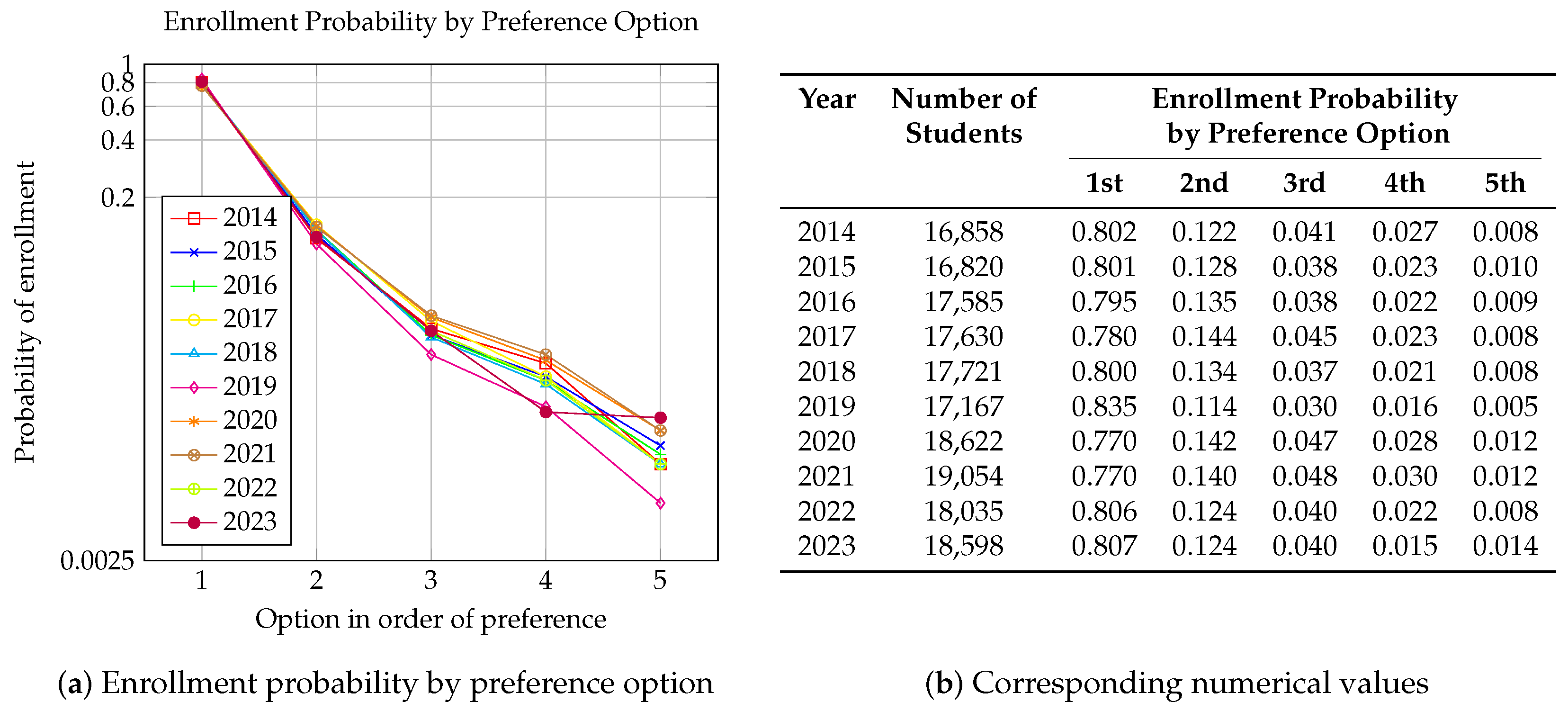
The calculated probabilities of student enrollment for each preference option are a central input for constructing the weighted graphs in this study. These probabilities, calculated annually using the AWEBSEP algorithm (Algorithm 2), show a consistent and expected pattern across the decade. As illustrated in Figure 1, the probability of enrollment is highest for a student’s first-choice degree, with an average of approximately 0.79. This probability declines sharply for subsequent options. The second-choice probability averages around 0.13, and probabilities for the third, fourth, and fifth choices are significantly lower, each typically below 0.05. This strong, monotonic decline confirms that the system is heavily driven by first-choice admissions, providing a crucial weighting scheme for the edges in our mobility graph model.
To refine the graph and improve the accuracy of community detection, we propose Algorithm 3. This pruning technique is inspired by edge-detection methods in image processing. It employs a metric that evaluates the relevance of each edge by comparing its weight to that of its neighboring edges. This process allows us to identify and remove edges that do not contribute significantly to the overall structure of student mobility. This metric-driven pruning enhances the graph’s clarity, ensuring that subsequent community detection algorithms focus on the most meaningful relationships within the mobility patterns.
Algorithm 1: Construction of Initial Graph from Input Data
Analytics 05 00014 i017
    By applying these algorithms to construct the graphs and subsequently prune insignificant edges, we aim to uncover meaningful patterns in student behavior and the evolution of degree offerings. This includes assessing the specific impact of new and dual-degree programs introduced over the past decade.
Algorithm 2: Assign Weights to the Edges Based on Student Enrollment Probabilities
Analytics 05 00014 i018
Algorithm 3: Edge Pruning Algorithm
Analytics 05 00014 i019

Algorithm for Pruning Edges in a Graph
Inspired by metrics used in image edge detection, we define a quantitative metric to evaluate the relevance of each edge in the graph [18,19,20,21]. This metric enables the systematic comparison of edges, distinguishing those that likely represent substantive connections between communities from those that may result from noise or insignificant transitions.
Within the context of university degree selection, pruning edges that represent improbable transitions between programs is crucial. Such transitions may arise from data collection errors or behavioral outliers. Since mobility patterns can reflect either strong preferences or incidental selections, removing irrelevant or noisy edges is essential. This step ensures that community detection algorithms can accurately identify meaningful clusters of degree programs.
The purpose of this pruning process is to refine the graph by removing weak and irrelevant edges, particularly those that connect distinct degree communities. This ensures that community detection algorithms can operate more effectively on a cleaner, more representative graph. The resulting structure captures genuine student mobility patterns without the distortion caused by noise or statistical outliers.
In this paper, we introduce a metric to evaluate the significance of each edge. Its objective is to selectively prune only the less relevant edges, as these are responsible for the incorrect identification of communities. These low-significance edges often lie on the boundaries between communities. If left unpruned, they can mislead the algorithm, causing it to merge distinct communities or fail to identify clear divisions between them.
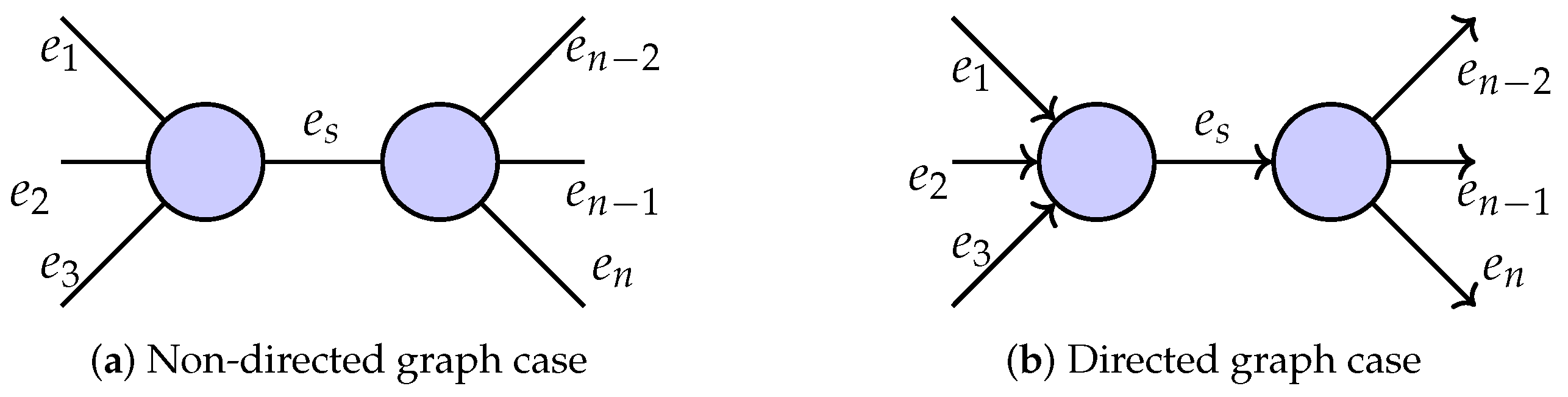
We define the pruning metric in Equation (1), a formulation inspired by edge-detection techniques in image processing. In that field, edges are identified by analyzing the relationships between a pixel and its neighbors. Analogously, our algorithm evaluates the significance of a graph edge by analyzing its relationship with adjacent edges. This allows for the systematic pruning of edges that weaken the overall community structure. Figure 2 illustrates this concept, showing the central edge e s connecting two nodes and the neighboring edges— e 1 , e 2 , , e n that appear in the summation term of Equation (1).
Processing Order for Determinism and Reproducibility. The algorithm processes edges in strict ascending order of their weight. This order is not merely an implementation detail but a fundamental requirement for the algorithm’s consistency. The pruning decision for each edge depends dynamically on the current state of its local neighborhood—specifically, which neighboring edges are still considered “active” (not yet pruned).
If edges were processed in a random or arbitrary order, the final result could become path-dependent. For example, if a moderately strong edge were evaluated before a weak neighboring edge, it might be retained. However, if that same strong edge were evaluated after the weak neighbor had already been pruned (thus altering the local average weight), it might itself be flagged for removal. This would lead to different graph structures from the same input, violating scientific reproducibility.
By systematically evaluating the weakest edges first, the algorithm adopts a conservative and stable strategy. It removes the most likely noise upfront, establishing a fixed local context before evaluating stronger connections. This guarantees that applying the EPA to the same graph will always produce identical results, making the method a reliable and reproducible tool for analysis.
Applying this pruning process enhances the performance of community detection algorithms. The result is a clearer and more accurate representation of the underlying student mobility patterns and the relationships between degree programs.
M ( s , t ) = t t + | ( n 1 ) e s j = 1 j s j n e j | where j are the adjacent elements to s and edges from i to n are sorted from smaller to larger weight .
Figure 2. Adjacent Edges to Edge e s .
Analytics 05 00014 g002
This metric allows us to define the pruning condition for an edge as occurring when the value of its corresponding expression within the metric is negative.
Importantly, edges are processed in order from the smallest to the largest weight, an approach shown to improve the method’s results. Smaller-weighted edges are more likely to represent noise or less significant connections. Pruning these first more effectively isolates and preserves the edges that contribute meaningfully to the graph’s overall connectivity, thereby enhancing the community structures detected later. Conversely, processing larger edges first risks removing potentially significant connections before less relevant ones, which could distort the identified community boundaries.
  • Example Usage:
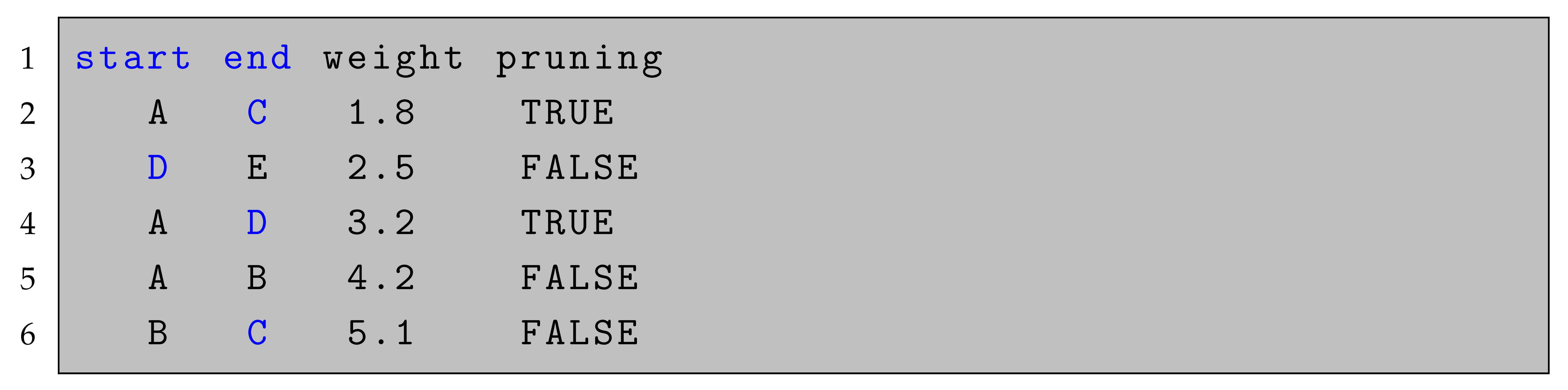
To demonstrate the application of the process_edges function, we define a set of graph edges with corresponding start node, end node, and weight values. The code snippet shown in Listing 1 illustrates how the function is used, while the one in Listing 2 presents the corresponding results.
The input gp_edges is a matrix of graph edges, where each row defines an edge by its start node, end node, and weight. The process_edges function processes this matrix to determine which edges should be pruned according to the established criteria.
The expected output is a data frame containing the original edges, augmented with a new ‘pruning’ column. This column indicates the pruning decision (e.g., True or False) for each corresponding edge. The complete step-by-step logic is provided in Appendix A.
The output at the Figure 3 indicates that edges from node 1 to 2, node 2 to 3, and node 4 to 5 are not pruned. In contrast, edges from node 1 to 3 and node 1 to 4 are pruned. This determination is based on their calculated weights relative to the active edges in their local graph neighborhood.
Listing 1: R code example for processing graph edges in Figure 3.
Analytics 05 00014 i015
Listing 2: Output of the edge processing function in Listing 1.
Analytics 05 00014 i016
Figure 3. Example graph with 5 nodes and 5 edges.
Analytics 05 00014 g003

4. Results

4.1. Validation of the Pruning Algorithm on Synthetic Graphs
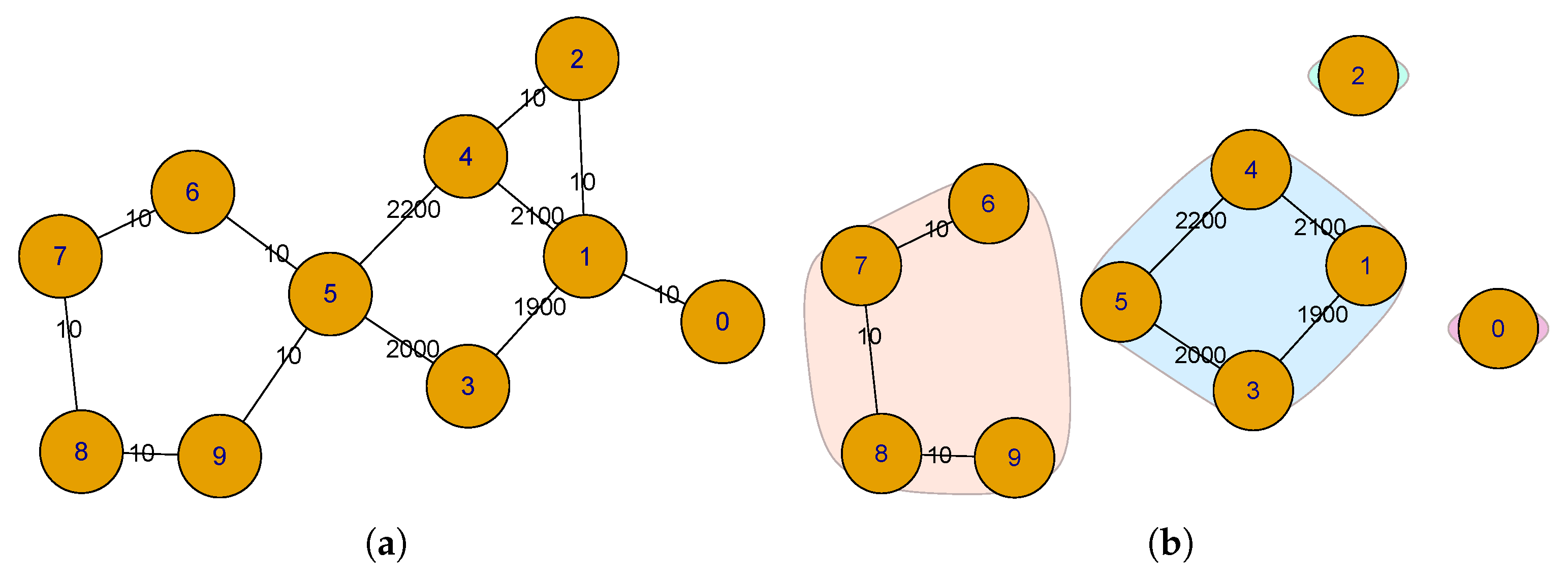
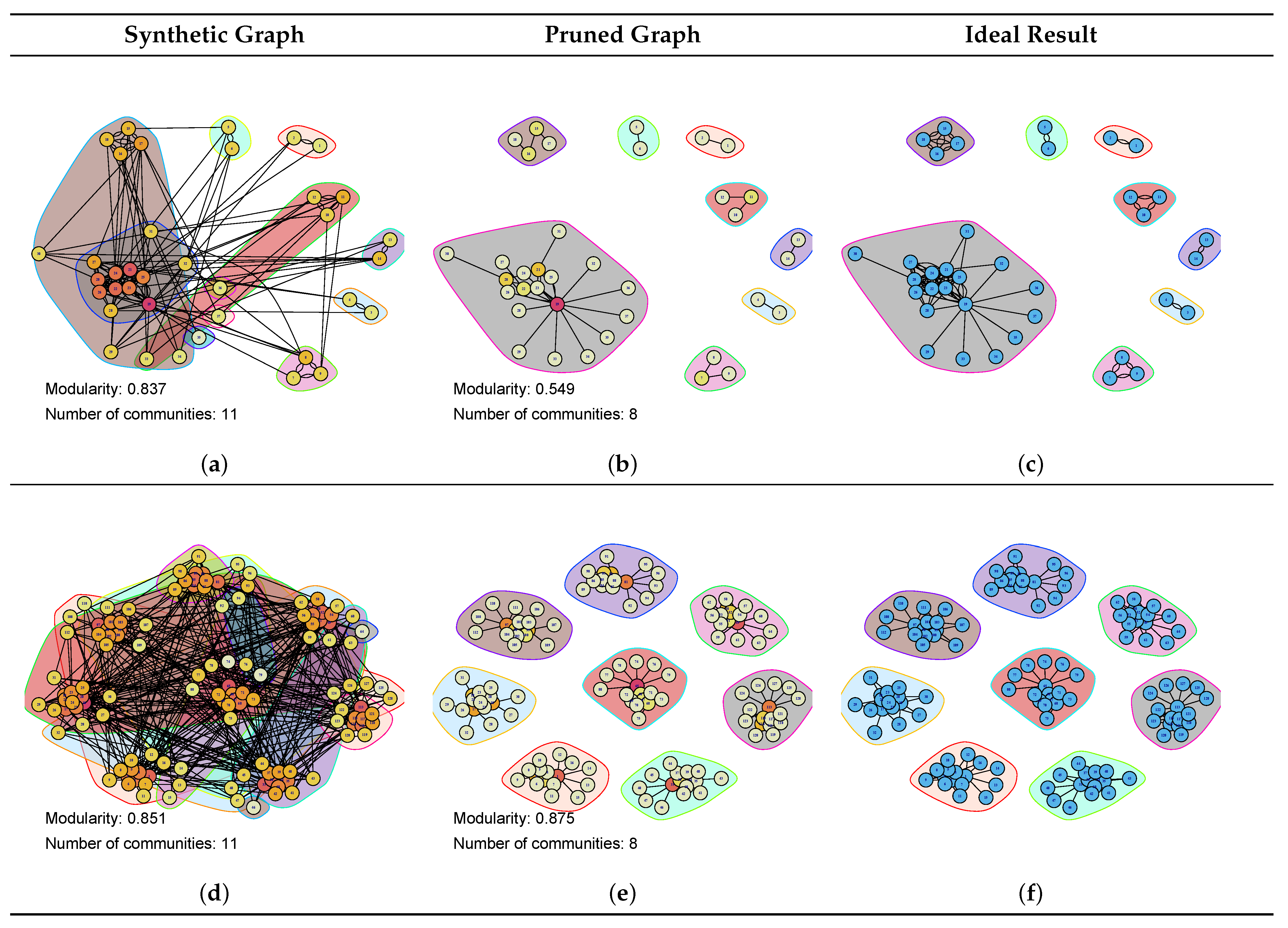
The pruning method performs satisfactorily when applied to the example provided in [20], as illustrated in Figure 4.
Before applying the algorithm to real student data, we conducted an initial evaluation using synthetically generated graphs. These graphs were intentionally created to be weakly connected and poorly conditioned, with clearly predefined communities. They were generated using a custom parameterizable graph generator developed in our prior work [22]. We introduced controlled noise into these graphs to simulate realistic distortions and test the robustness of our method.
After applying the proposed pruning algorithm, we used standard community detection algorithms to assess the resulting structure. The pruning process effectively filtered out noisy and less relevant edges. This allowed the detection algorithms to accurately identify the expected communities as initially defined in the synthetic data.
A comparison between the original, pruned, and ideal graph structures (see Figure 5) further confirms the method’s ability to recover the underlying community structure, even in the presence of noise.
Figure 4. (a) Original graph provided in [20], and (b) pruned graph with the proposed method.
Analytics 05 00014 g004
Figure 5. Results of applying the Label Propagation community detection algorithm to (a) the first and (d) the second synthetic graphs. Panels (b,e) show the corresponding results after pruning. Panels (c,f) depict the target communities to be detected for the first and second graphs, respectively.
Analytics 05 00014 g005

4.2. Analysis of Student Preferences Through Pruned Graphs (2014–2023)

The results of applying our proposed method are compared with previously established optimal results achieved through manual adjustments [11]. The resulting graphs appear nearly identical, demonstrating the consistency and effectiveness of our automated approach.
A key finding is that all edges retained by our proposed method are also present in the graphs produced by the previous manual method. However, our method successfully prunes a few additional edges that the older method retained. This highlights the increased precision of our algorithm in eliminating less meaningful connections.
Regarding modularity and community detection, results from the previous manual methods show variation. The “directed-in” version identified 57 communities with a modularity of 0.716, while the “directed-out” version detected 30 communities with a modularity of 0.838.
In contrast, our automated method identifies the same number of communities as the “directed-in” version (57) but achieves a substantially higher modularity of 0.971. This significant increase suggests a much stronger and more coherent internal structure within the detected communities.
Overall, these results demonstrate that our pruning technique achieves two key improvements. First, it eliminates the need for manual parameter adjustment required by the previous method. Second, it enhances the graph’s structural quality by significantly improving its modularity score.
The higher modularity achieved by our method reflects the formation of more clearly defined communities. This provides a more accurate and reliable representation of the underlying student mobility patterns compared to earlier approaches.
It is important to note that the proposed pruning method operates solely based on link weights. Since these specific weight values are not used in the calculation of the modularity metric itself, it cannot be predicted a priori whether applying the pruning will improve or worsen the final modularity score.
The quantitative results across all years are summarized in Table 1.

4.3. Stability Assessment of Community Cohesion in Student Preference on Degree Programs

To quantify the stability of communities across consecutive academic years, we introduce a series of cohesion and persistence indices. These measures assess stability at both the individual vertex (degree program) level and the overall community level. The analysis is weighted to account for both the number of programs and the volume of student demand within each grouping.
In this study, vertices represent university degree programs. We use the term “vertices” explicitly to avoid confusion with “degree,” which might otherwise refer to the number of connections a vertex has (i.e., vertex degree). Our indices are designed to measure the consistency and structural alignment of these academic programs within their assigned communities across consecutive years.

4.3.1. Vertex Stability

We aim to evaluate the stability of vertices (degree programs) that remain in the same communities across consecutive academic years. However, we cannot directly apply the most relevant existing methods found in the literature. The method described by [23] is designed for undirected networks and uses the probability of a vertex remaining in the same community as an indicator of strong connectivity, similarly to the approach in [24].
The first method [23] is unsuitable for two main reasons. First, it is designed for undirected networks, while our graph is directed. Second, and more critically, our pruning process often results in communities with no connecting edges between them. In such a disconnected structure, a random walk cannot exit a community, leading to a transition probability of 1 for most communities across all years. This characteristic renders the method’s core metric ineffective for meaningful comparison or temporal analysis.
To evaluate vertex stability, we adapt the equation from [24]. Our adaptation focuses on the temporal persistence of vertices (degree programs) within the same community, rather than on edges. This results in a formulation similar to Equation (2).
Δ i , j ( t ) = a i j ( t ) a i j ( t 1 ) a i j ( t 1 )
We adopt Equation (2) from [24], which measures the ratio of change in edges from time t 1 to t relative to the total edges at t 1 . This formulation is derived from Equation (3) in [25], originally used to calculate the percentage change in an asset price S over time. We adapt this concept to compute the percentage of neighboring vertices that remain within the same community across both year t 1 and year t.
r ( t ) = S t S t 1 S t 1
For each vertex v in year t, we define its stability, denoted as S v ( t ) , as the percentage of its neighboring vertices that are contained within the same community in both year t 1 and year t.
Formally, let C v ( t ) represent the community containing vertex v at year t. The stability of vertex v at year t is then defined as:
S v ( t , t 1 ) = | C v ( t ) C v ( t 1 ) | | C v ( t 1 ) | × 100
where the numerator | C v ( t ) C v ( t 1 ) | represents the number of neighboring vertices common to both the community at year t and the community at year t 1 . The denominator | C v ( t 1 ) | is the total number of neighboring vertices of v in year t 1 .
This stability measure provides a percentage-based indicator of how consistently a vertex (degree program) maintains its community alignment from one year to the next.

4.3.2. Community Stability

The stability of a community C at year t, relative to the previous year t 1 , is denoted as S C ( t , t 1 ) . It is defined as the average stability of all vertices belonging to that community in year t.
If V C ( t ) represents the set of vertices in community C at year t, the community stability S C ( t , t 1 ) is calculated as:
S C ( t , t 1 ) = 1 | V C ( t ) | v V C ( t ) S v ( t , t 1 )
where | V C ( t ) | is the number of vertices in community C at year t, and S v ( t , t 1 ) is the stability of vertex v from year t 1 to year t. This measure reflects the overall cohesion of a community by quantifying the degree to which its member vertices maintain their associations over consecutive years.
The Community Average Stability for the entire graph, denoted as S average ( t , t 1 ) , is the mean stability value across all communities:
S average ( t , t 1 ) = C graph S C ( t , t 1 ) total number of communities in the graph

4.3.3. Community Weighted Average Stability by the Number of Vertices (WAS_NV)

The Community Weighted Average Stability by Number of Vertices for a pair of years t and t 1 , denoted as S w ( t , t 1 ) , is calculated as a weighted sum of each community’s stability. The weight for each community is its number of vertices. It is given by:
S w ( t , t 1 ) = C | V C ( t ) | · S C ( t , t 1 ) C | V C ( t ) |
where S C ( t , t 1 ) is the stability of community C and the summation is over all communities in the graph for year t. Weighting each community’s stability by its vertex count ensures that larger communities exert a proportionally greater influence on the overall stability score.

4.3.4. Community Weighted Average Stability by Students’ First-Choice Preferences (WAS_FC)

To incorporate student demand, which is highly relevant for university planning, we define a second weighted average. This metric, denoted as S C P ( t , t 1 ) , weights each community’s stability by the number of students who selected a program within that community as their first-choice preference. It is calculated as follows:
S C P ( t , t 1 ) = 1 u V C ( t ) P ( t , u ) v V C ( t ) S v ( t , t 1 ) · P ( t , v )
where P ( t , v ) represents the number of students who selected vertex (degree program) v as their first preference in year t, and S v ( t , t 1 ) denotes the stability of vertex v between years t 1 and t. This metric measures community stability in relation to student demand, giving greater weight to communities that are more popular among applicants.

4.3.5. Implications of the Stability of Communities

The defined stability metrics provide a quantitative framework for assessing community dynamics over time. They offer valuable insights into both the structural resilience and the ongoing transformation of student preference clusters within the university system.
A lower stability value for a community indicates a shift in its composition. This suggests either the attraction of new member programs or the migration of existing ones to other communities, likely reflecting evolving student interests or new academic trends. Conversely, a higher stability value reflects a cohesive structure where member programs consistently maintain their associations with one another across consecutive years.
Table 2 shows that the calculated average stability values remain consistently within the range of 0.65–0.70 throughout the entire period. These results, when interpreted alongside the corresponding graphs, indicate that approximately two-thirds of both the degree programs and the students’ first-choice preferences remain within the same communities from one year to the next. The remaining third tends to shift between a community and its immediate neighbors.
This pattern is of primary interest to those responsible for promoting degree programs. It suggests that recruitment and outreach efforts should be prioritized: first, by focusing on attracting students who have demonstrated interest in fields within the same community, and secondarily, by targeting students interested in programs in neighboring communities.

5. Evolution of Student Demand Across Academic Disciplines

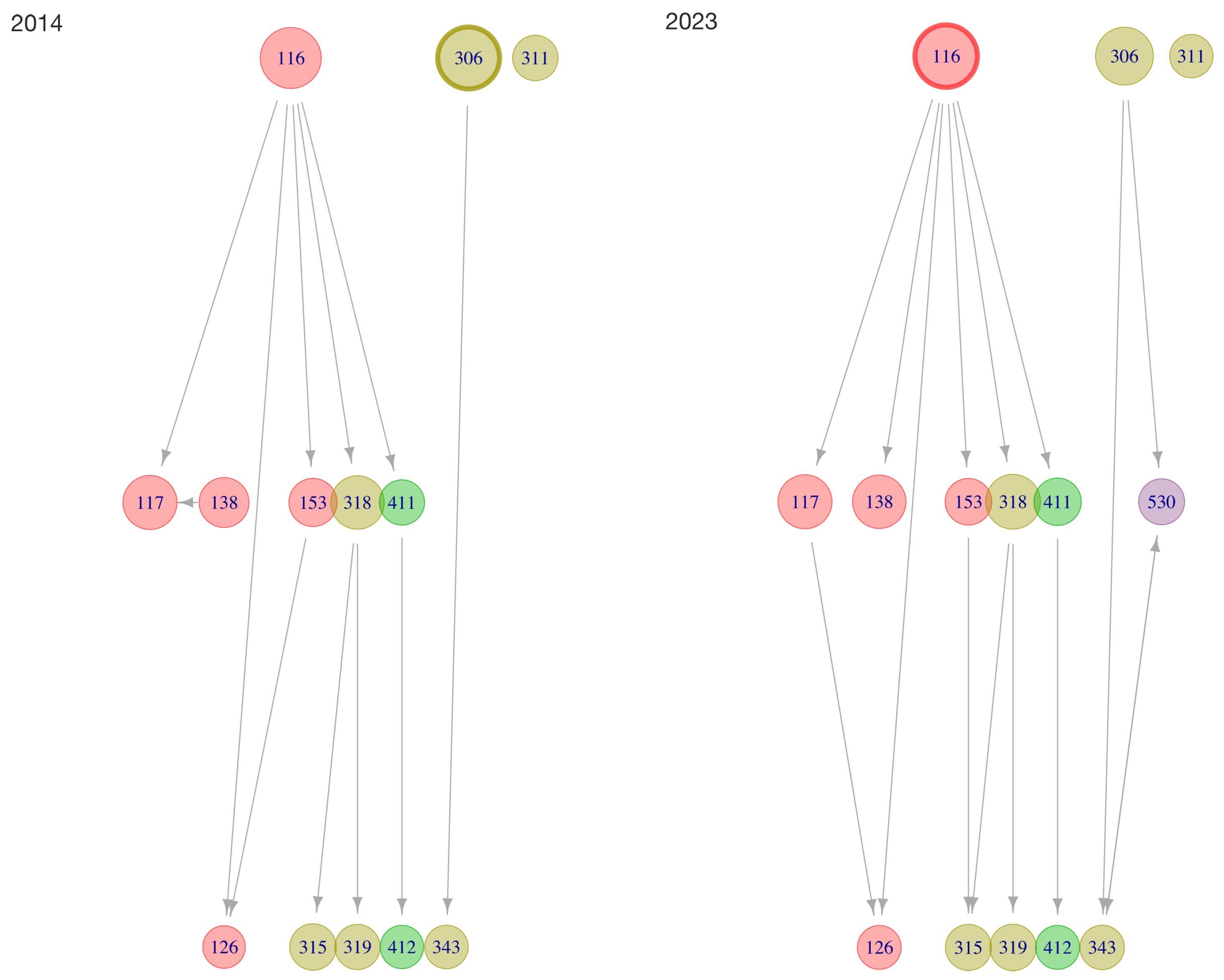
This section analyzes structural changes in student demand across various academic disciplines within the SUPE from 2015 to 2023. By examining the pruned graphs for each discipline, we identify how key factors—such as the introduction of new degrees, the establishment of dual-degree programs, and the restructuring of existing academic offerings—have influenced the formation of student preference communities.
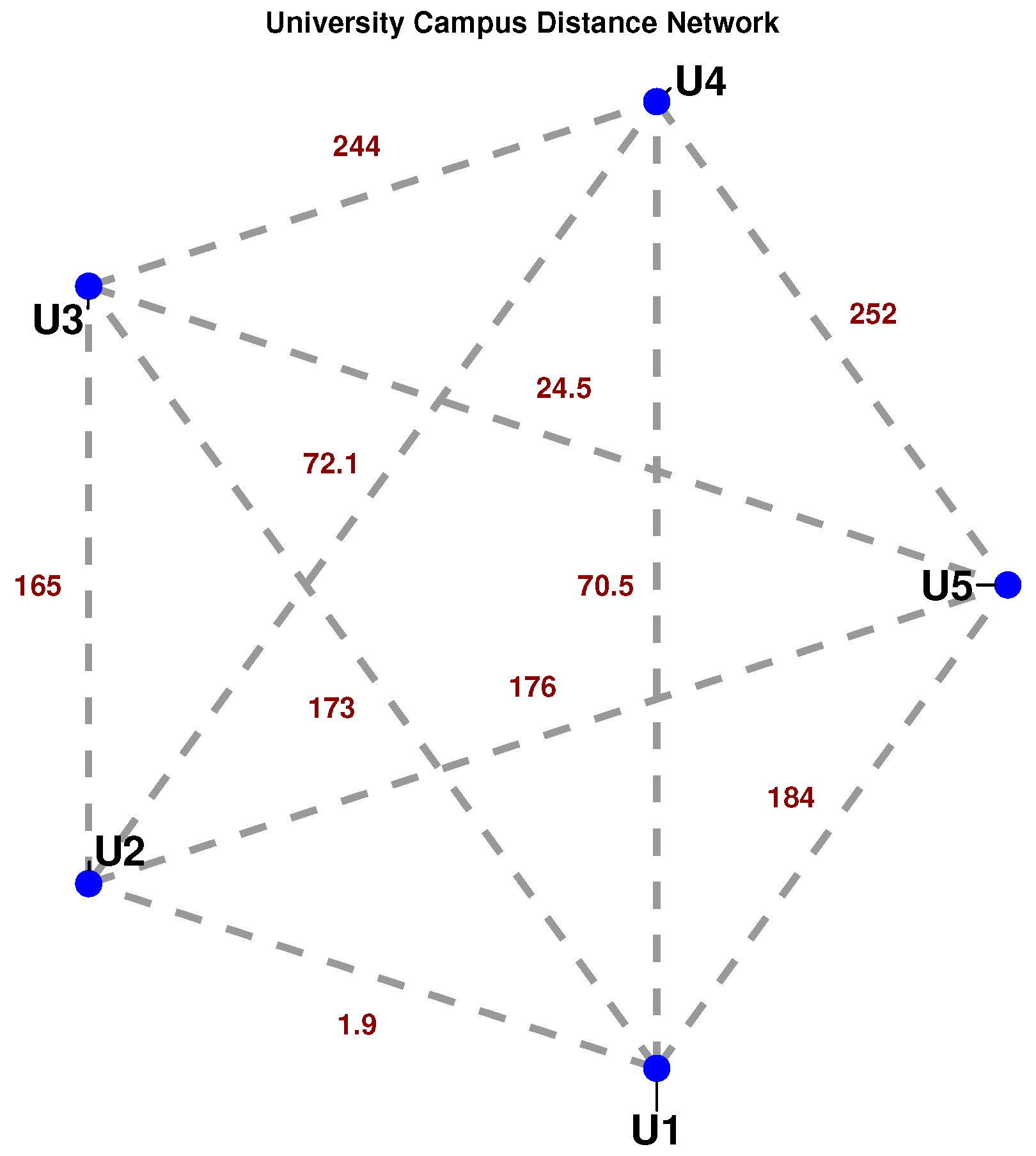
Figure 6 identifies the five reference universities considered in this study and illustrates the distances between their main campuses.
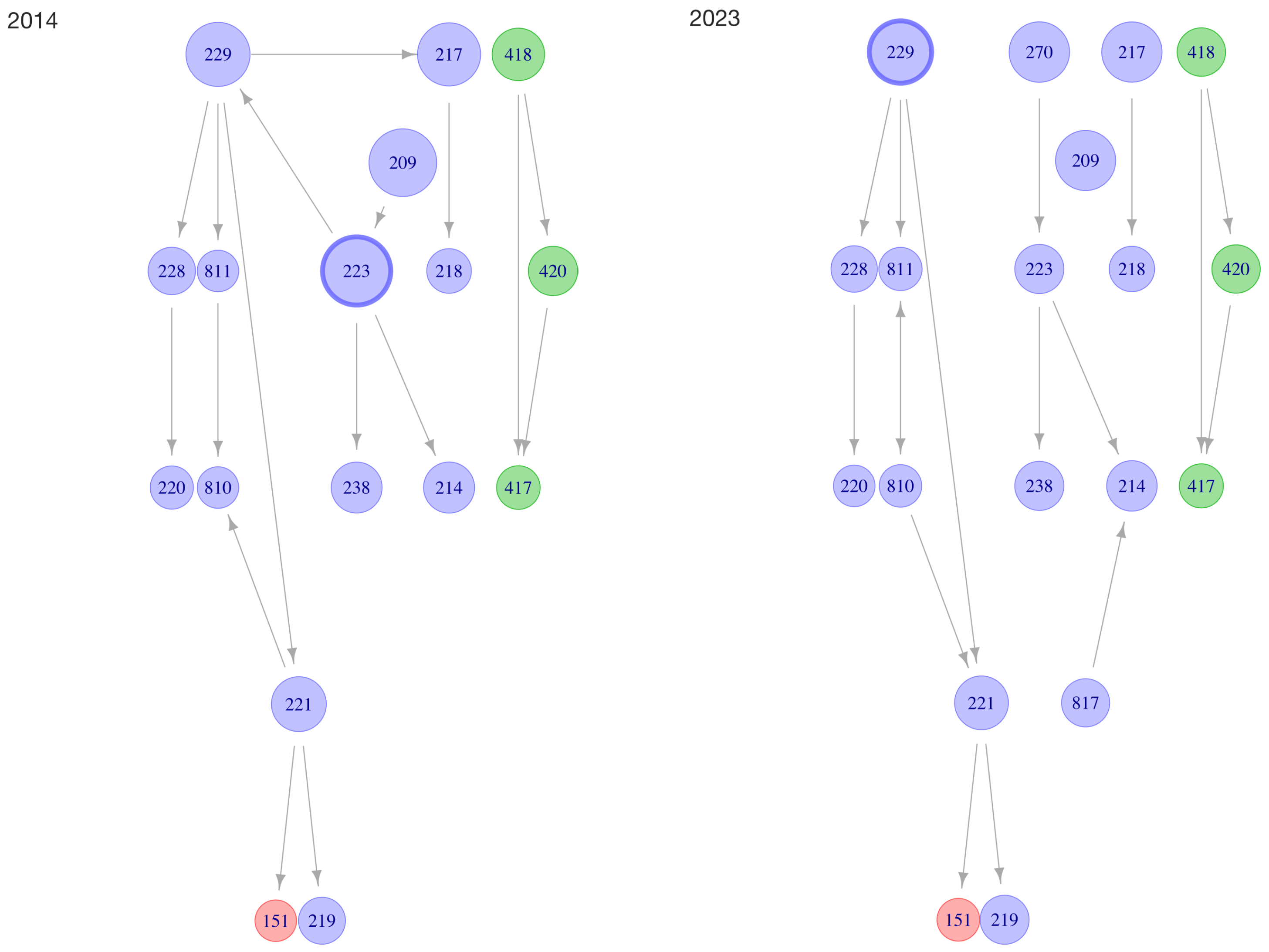
As a reference for these structural changes, Table 3 summarizes the most significant shifts observed within the engineering discipline. It details variations in existing student flows, the emergence of new connections, and the discontinuation of others.
The table highlights the following points:
  • Incorporation of New Degrees: 270 and 817.
  • Shifts in Enrollment Demand Paths: Changes on paths reflect evolving student preferences and shifting academic focus areas; notably, the edge from 270 to 223 with a strong new connection in enrollment interest.
  • Community Consolidation: The number of communities increased, suggesting a clustering of the demand.

In the following subsections, we examine the remaining academic disciplines, highlighting notable shifts in demand, the formation or dissolution of academic communities, and variations in patterns of inter-university mobility.
Over the past decade, university offerings and student demand have evolved significantly. We constructed yearly graphs, applied the proposed algorithms, and generated the resulting visualizations. These graphs illustrate the differing dynamics of community fragmentation and consolidation across academic disciplines.
Table 3. Changes on edges reveal shifts in the enrollment demand.
DegreesWeight (2014)Weight (2023)Weight DifferenceChange
270 → 223-32.0832.08New Flow
229 → 228-7.277.27New Flow
229 → 219-5.395.39New Flow
817 → 214-1.641.64New Flow
810 → 221-0.490.49New Flow
221 → 1513.744.660.92Increased
229 → 8110.561.090.53Increased
420 → 4175.045.330.29Increased
217 → 2185.535.640.11Increased
228 → 2202.171.45−0.72Decreased
418 → 4206.164.14−2.02Decreased
221 → 2198.915.19−3.72Decreased
223 → 2389.512.65−6.86Decreased
229 → 22114.606.60−8.00Decreased
417 → 4205.04-−5.04Discontinued
223 → 22914.02-−14.02Discontinued
209 → 22312.60-−12.60Discontinued
223 → 21412.68-−12.68Discontinued
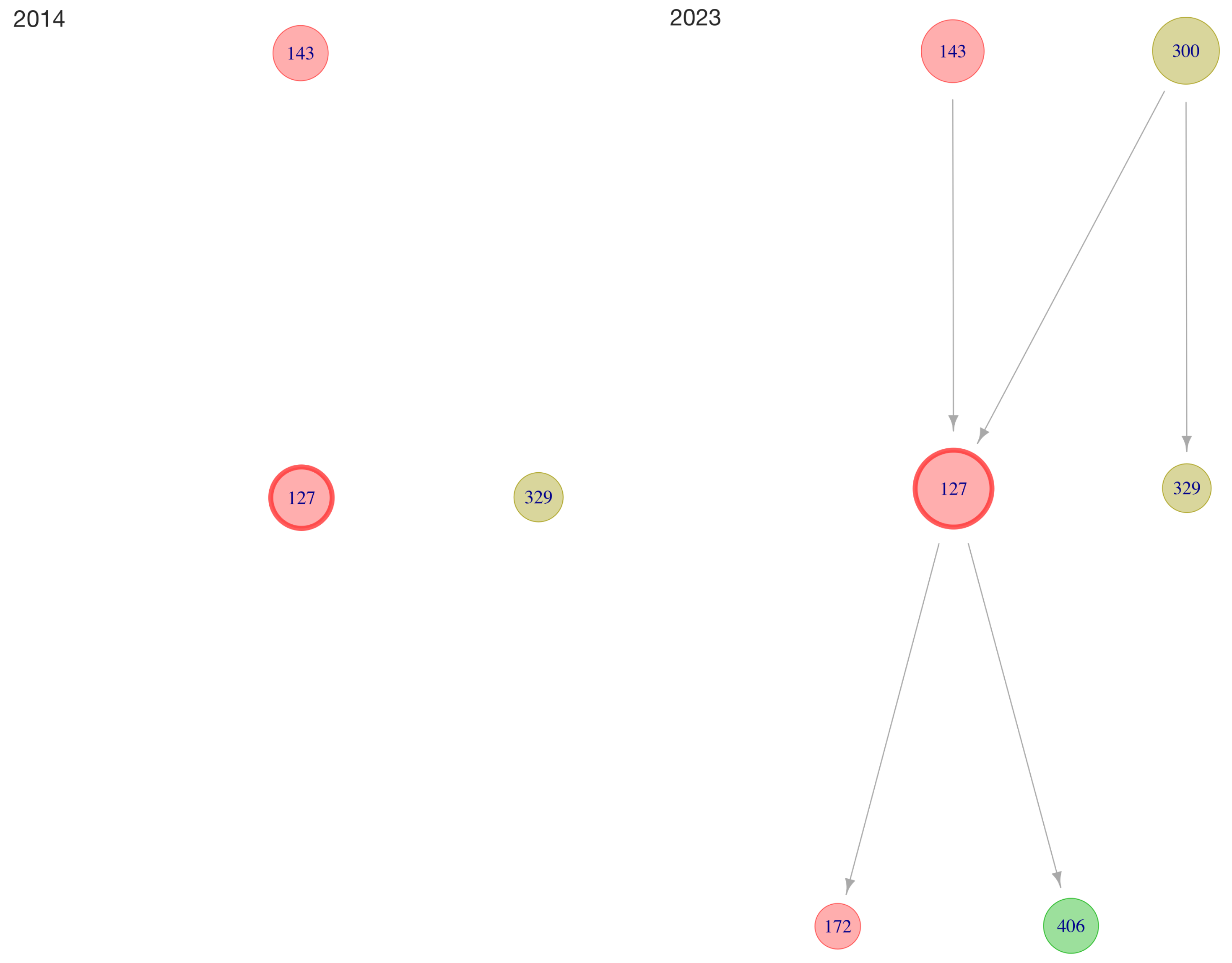
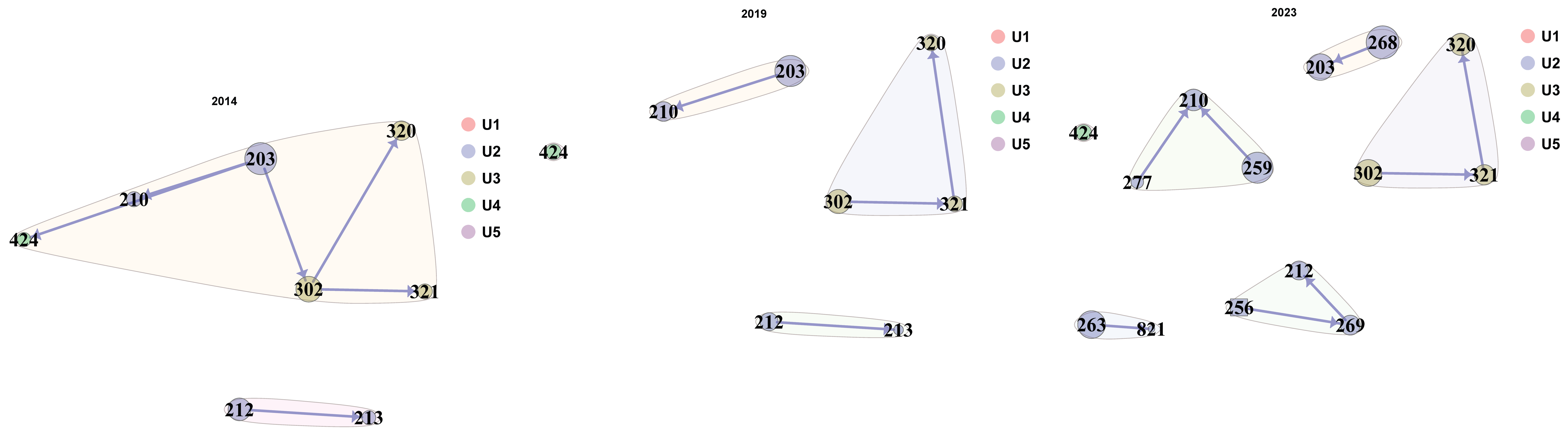
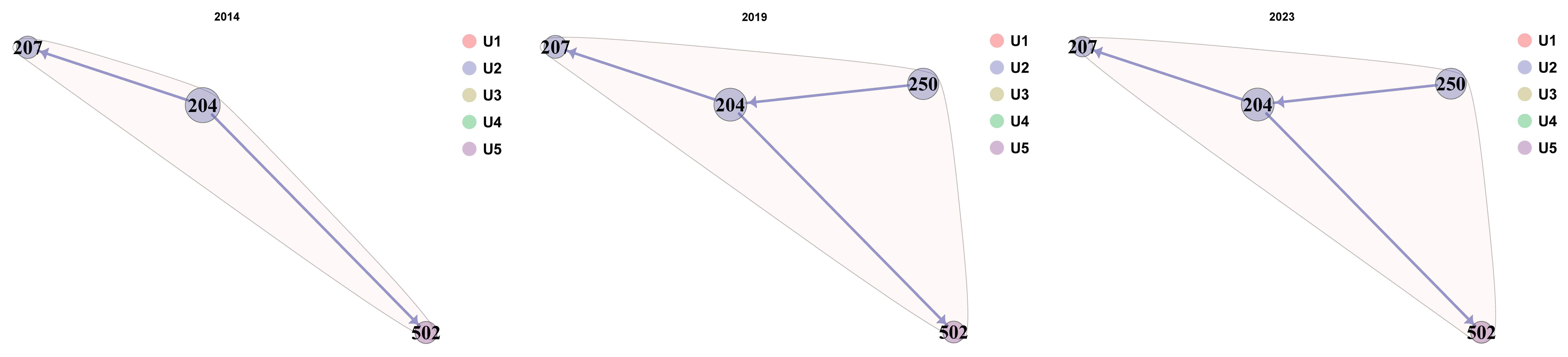
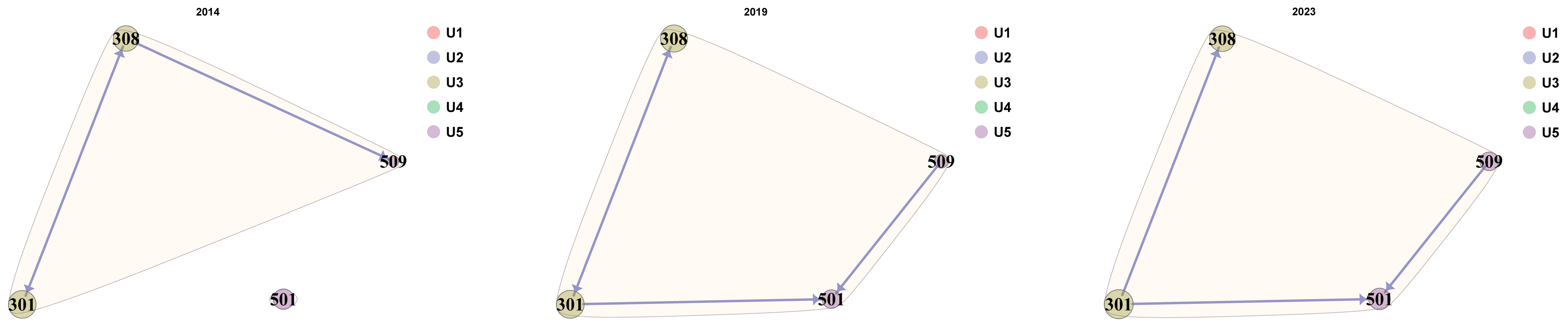
The evolution observed in these graphs is summarized in Table 4 and Table A6. The first table highlights the principal transformations between 2014 and 2023 across nine broad academic areas. The second extends the analysis to fourteen specific fields and includes data for the intermediate year of 2019.
Table 4. Comparison of degrees by for the years 2015 and 2023.
DisciplineKey Observations
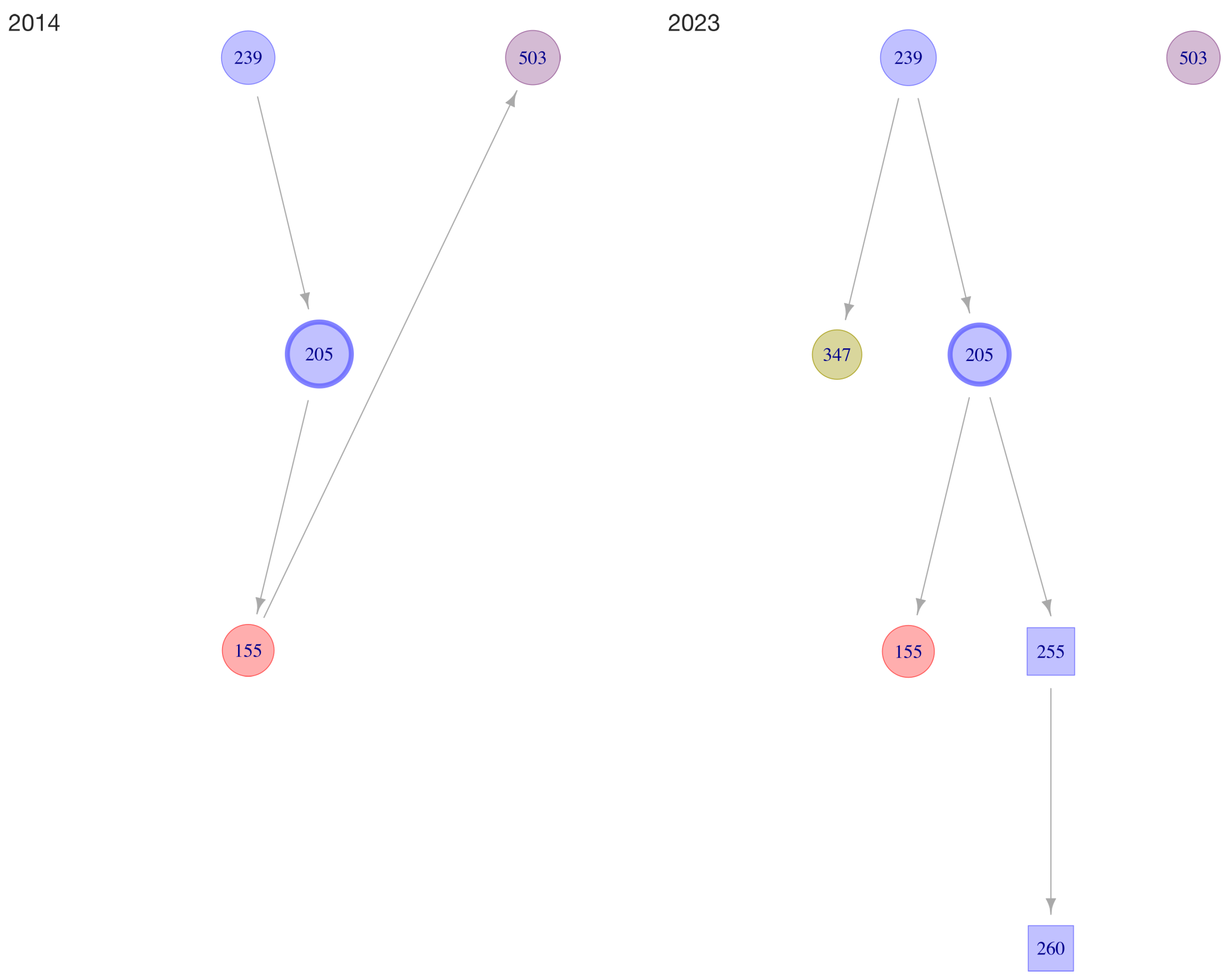
Industrial Engineering (see Figure 7)The number of communities has increased from one to three. Demand has become more concentrated, and demand for Aerospace Engineering (209) has matched supply, becoming self-sufficient.
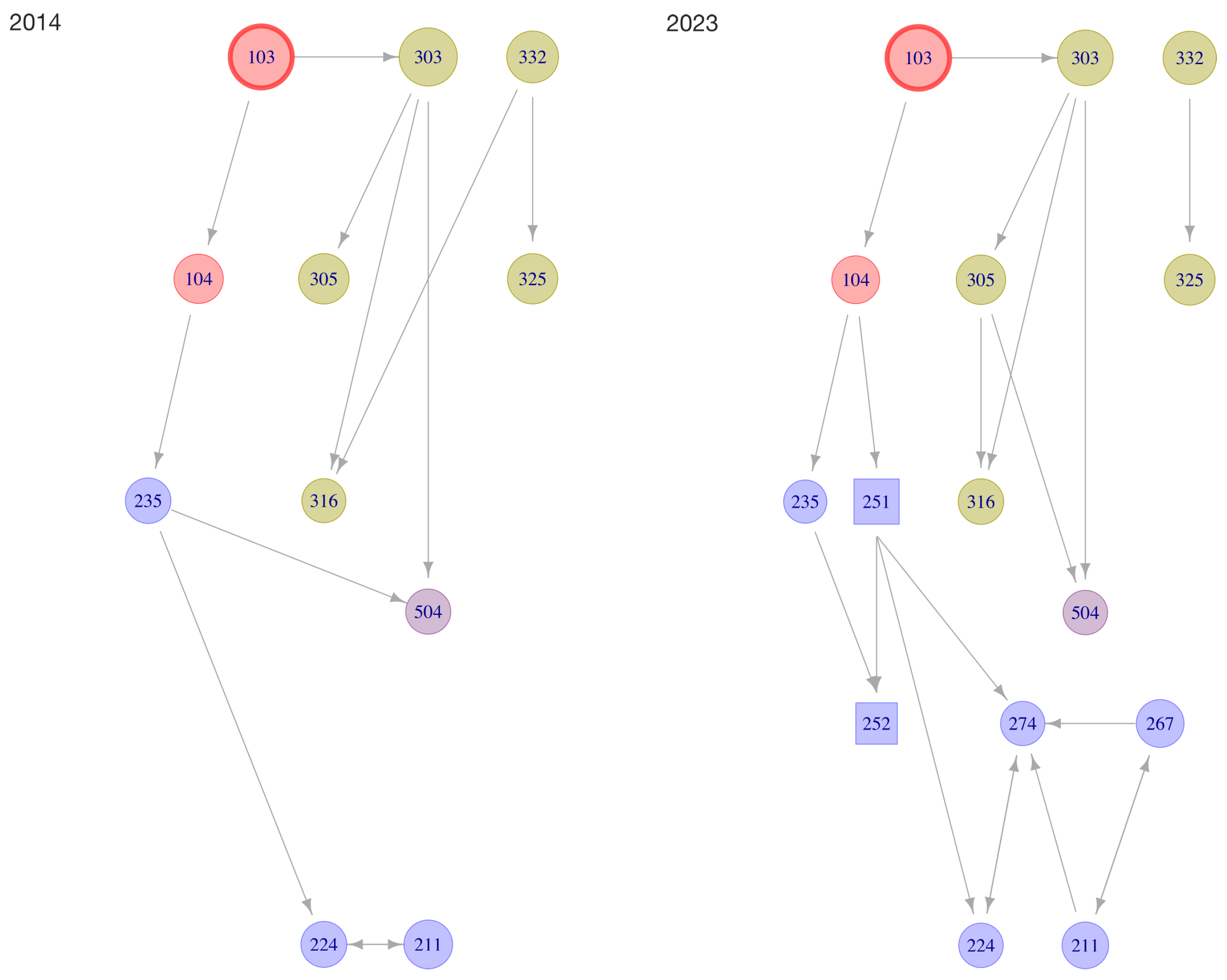
Biology and Environmental & Forestry Sciences (see Figure 8)The introduction of the double degree in Forestry Engineering and Natural and Environmental Sciences (251–252) has restructured demand. Furthermore, a certain geographic concentration is noted, although mobility exists, but it occurs in nearby centers.
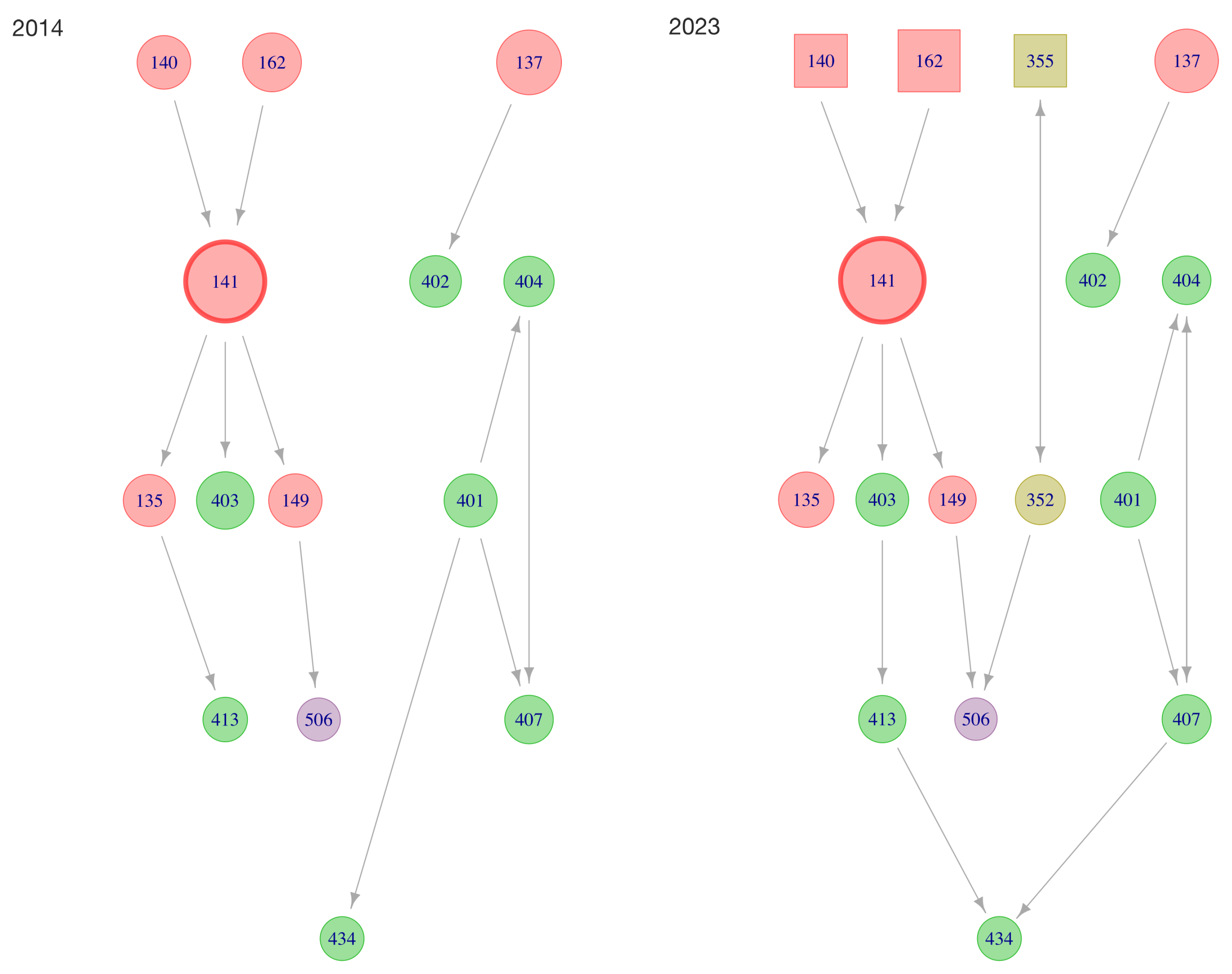
Law (see Figure 9)By 2024, the integration of double degrees with Law has strengthened the cluster, reducing fragmentation from two to one while increasing the number of nodes. Law remains the main attractor in the community.
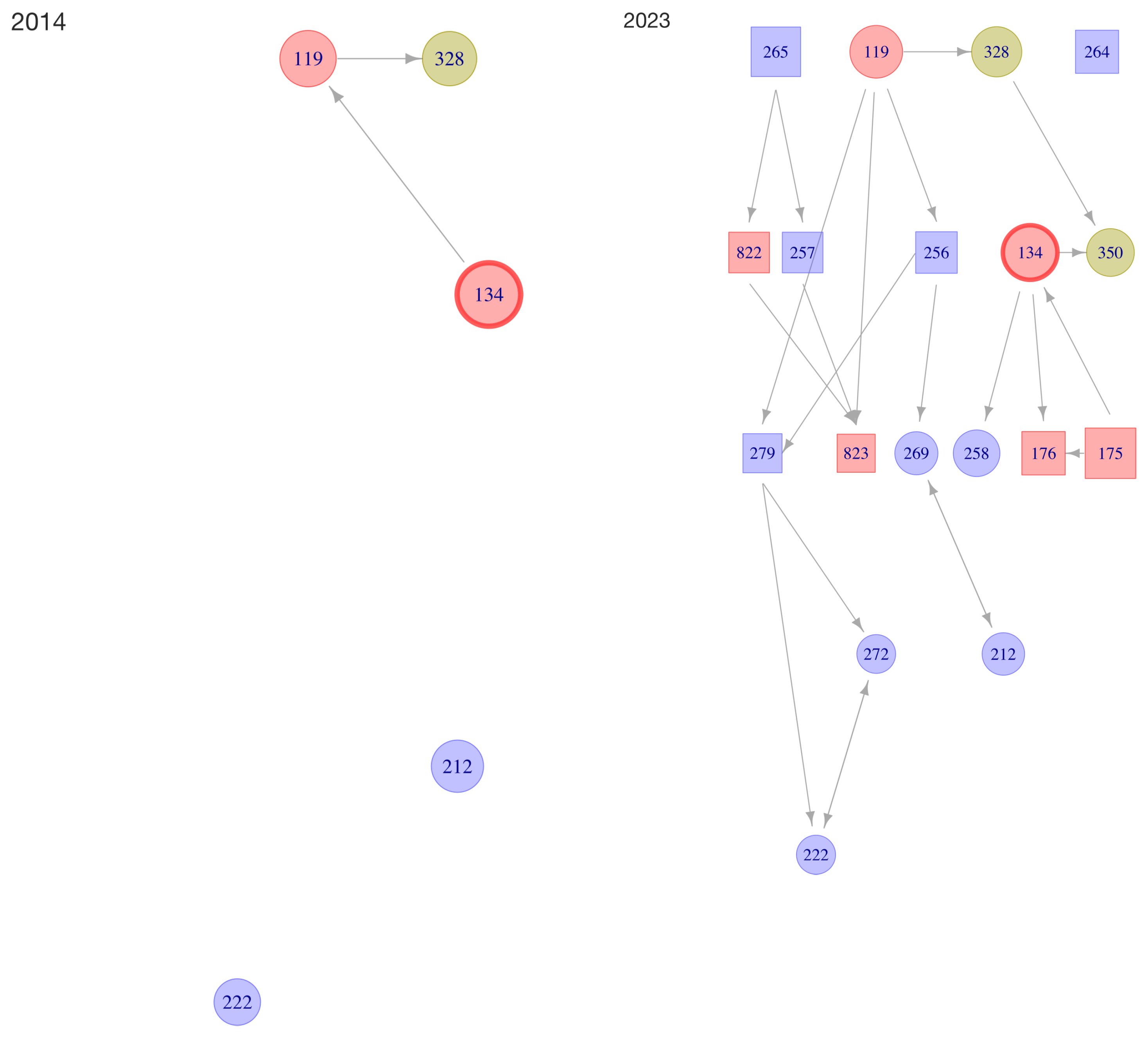
Physics and Mathematics (see Figure 10)In 2015: Only five vertices across two communities.In 2024: A single large community with 18 closely related degrees.The creation of double degrees in Physics & Mathematics and Mathematics & Engineering has significantly boosted interest in this area.
Biotechnology and Agri-Food Sciences (see Figure 11)The introduction of the dual degree in Biotechnology and Agrifood Sciences (205) has expanded the size of the community and increased student demand.
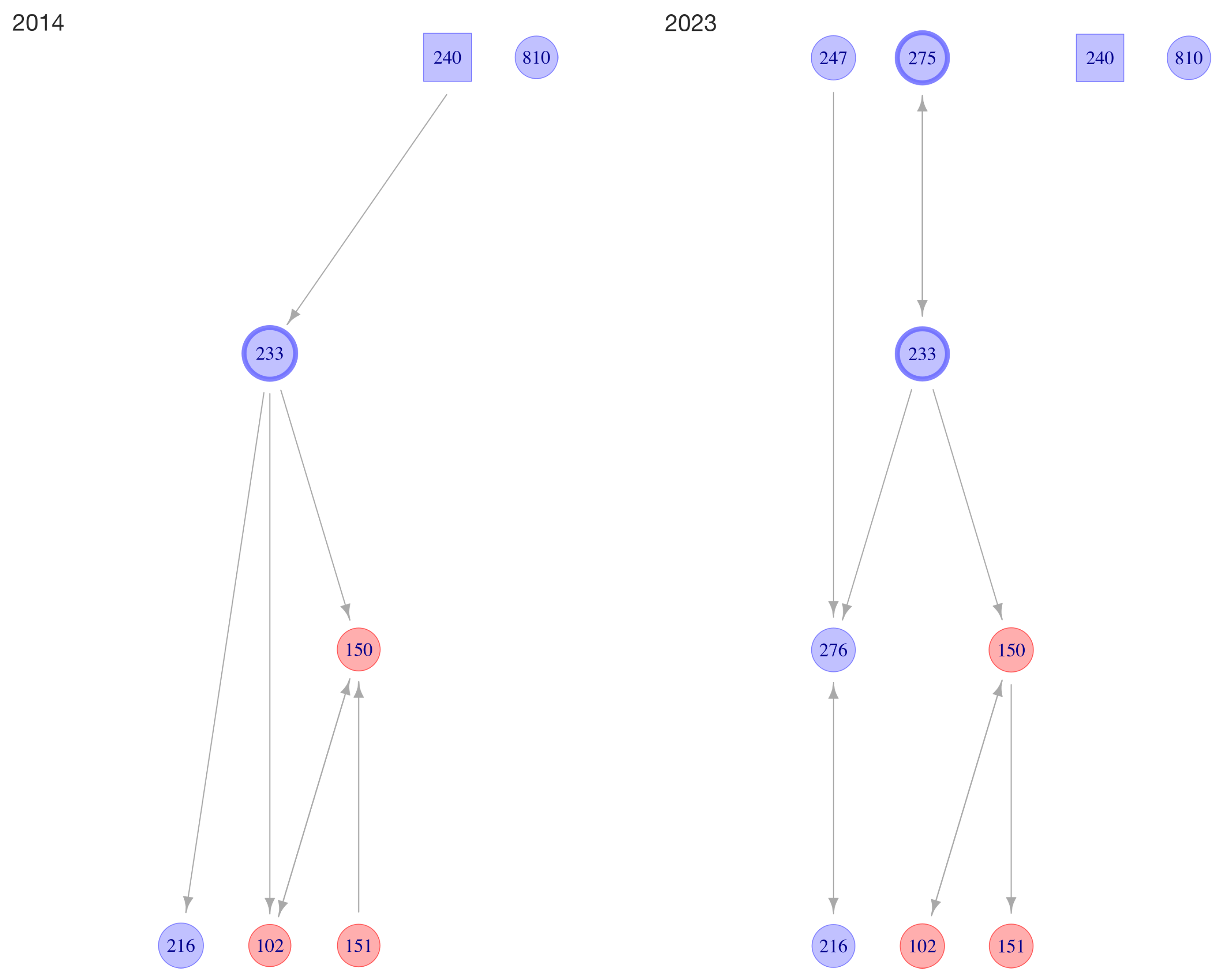
Telecommunications (see Figure 12)The introduction of new degrees in Telecommunications has improved the field overall; however, the effect remains localized to the university that implemented the program.
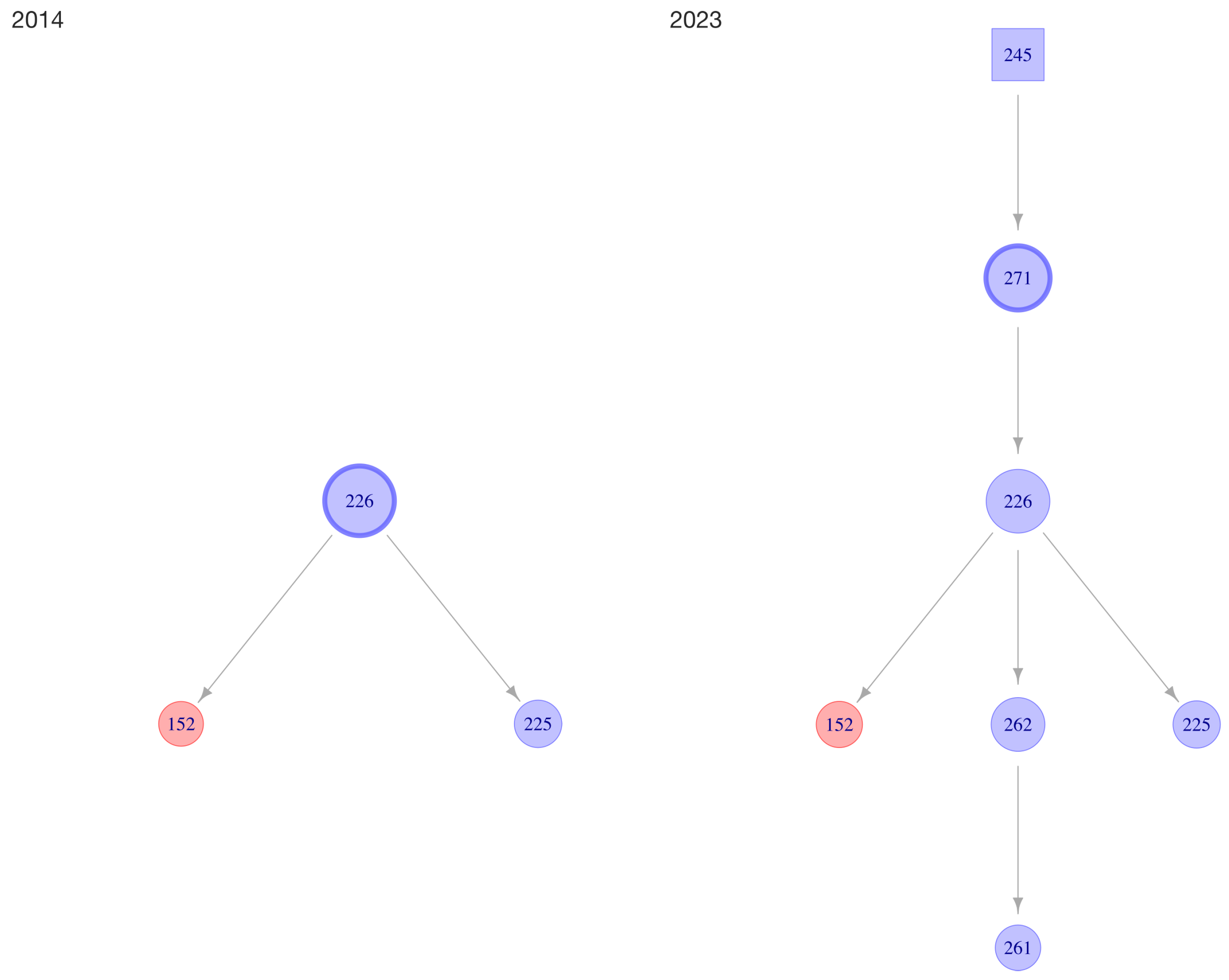
Computer Science (see Figure 13)A similar effect as Telecommunications, where double degrees significantly boost demand, but mobility between universities remains low, likely due to widespread availability.
Internal cluster structure changes, but effects remain localized to the offering university.
Nursing (see Figure 14)In 2015, demand was concentrated in three centers; with the increase in supply, student mobility between universities has been allowed.
Humanities(History) (see Figure 15)In 2015: Five separate communities.In 2024: A single, unified community.However, student mobility between universities remains relatively low.
Figure 7. Comparison of engineering degrees for the years 2015 and 2023 (vertices labeled by center).
Analytics 05 00014 g007
Figure 8. Comparison of Communities in 2015 and 2024: Biology and Environmental & Forestry Sciences.
Analytics 05 00014 g008
Figure 9. Comparison of Communities in 2015 and 2024: Law.
Analytics 05 00014 g009
Figure 10. Comparison of Communities in 2015 and 2024: Physics and Mathematics.
Analytics 05 00014 g010
Figure 11. Comparison of Communities in 2015 and 2024: Biotechnology and Agri-Food Sciences.
Analytics 05 00014 g011
Figure 12. Comparison of Communities in 2015 and 2024: Telecommunications.
Analytics 05 00014 g012
Figure 13. Comparison of Communities in 2015 and 2024: Computer Science.
Analytics 05 00014 g013
Figure 14. Comparison of Communities in 2015 and 2024: Nursing.
Analytics 05 00014 g014
Figure 15. Comparison of Communities in 2015 and 2024: Humanities (History).
Analytics 05 00014 g015
This analysis reveals clear trends in the evolution of student demand. The introduction of dual-degree programs has played a crucial role in shaping community structures, frequently leading to greater integration and consolidation within disciplines. Mobility patterns also vary: while some fields exhibit increased inter-university student movement (e.g., Nursing), others remain more localized (e.g., Computer Science, History). These observed transformations suggest that strategic decisions regarding academic offerings significantly influence long-term student choices and institutional attractiveness.

6. Discussion

The annual university admissions process within the Spanish Public University System (SUPE) involves thousands of students submitting ranked preferences, generating complex mobility patterns. Understanding these preferences is essential for optimizing degree offerings, improving student satisfaction, and ensuring efficient resource allocation. However, the student selection process is inherently complex and dynamic, influenced by a multitude of factors.
Analyzing these mobility patterns presents significant challenges due to the scale and complexity of the data. Student transitions form a highly interconnected, directed graph where traditional analytical techniques often fail to reveal meaningful structure. The graph’s inherent weak connectivity and poor conditioning further complicate the identification of distinct communities reflecting student preferences. Consequently, an effective pruning method is necessary to refine the graph’s structure by eliminating noisy connections while preserving the most relevant pathways.
To address these challenges, we developed and implemented an adaptive edge-pruning algorithm designed to enhance the graph’s structure for more effective community detection. Our method systematically reduces redundant or weak edges while preserving the most significant transitions between degrees. This process improves the overall modularity of the network.
The pruning process resulted in substantially higher modularity scores achieved by cleanly separating academic communities. In many cases, this separation leaves communities completely disconnected, analogous to segmenting distinct objects in an image. While this outcome was effective for our specific case study of student mobility analysis, we acknowledge that the algorithm’s level of aggressiveness may need calibration for application in other scenarios. Future implementations could incorporate adjustable parameters to control pruning intensity based on specific research objectives.
The approach builds upon prior research in graph-based student mobility analysis [11], incorporating refinements that more accurately capture underlying academic preferences. The improved conditioning of the pruned graph allows for the clearer identification of degree clusters, enabling the observation of structural trends in student choices over time. The consistency of the graph structure across multiple years, combined with the high modularity achieved, demonstrates the robustness of the pruning method as an analytical tool for weakly connected and poorly conditioned networks.
Applying the pruning method to SUPE student preference data reveals several key insights into the evolution of degree offerings over the past decade:
1.
The introduction of dual-degree programs has significantly altered student movement patterns. Rather than shifting between disparate academic fields, students increasingly opt for dual degrees that expand their qualifications within closely related disciplines. In fields such as Biology and Environmental Sciences, Physics and Mathematics, and Biotechnology, new dual-degree options have merged previously distinct communities and reinforced certain academic clusters as strong attractors for prospective students. This indicates that universities are successfully meeting student demand for interdisciplinary education while minimizing major field transitions.
2.
Stability analysis of student preference communities indicates that approximately two-thirds of students remain within the same academic clusters from one year to the next. The remaining third exhibits notable shifts, highlighting varying levels of consolidation across disciplines. Fields such as Medicine and Law demonstrate high stability, whereas more flexible programs like Engineering and Business undergo more frequent structural changes, reflecting evolving student interests and market dynamics.
3.
Institutional policies also influence student mobility in significant ways. While degrees such as Nursing have seen increased inter-university mobility due to broader program integration, disciplines like Computer Science and Humanities remain more localized, likely because of their widespread availability across many campuses. These findings offer valuable insights for policymakers seeking to optimize degree distribution and refine admission frameworks.
Finally, this study underscores the role of academic innovation in shaping student mobility. The emergence of new interdisciplinary degree offerings has driven measurable changes in preference structures. The evolution of these patterns suggests that future academic strategies should prioritize adaptability and responsiveness to emerging student interests.
Future methodological research should investigate connections to broader graph-theoretic literature. A comparative study benchmarking our adaptive pruning approach against established methods for graph sparsification [26] and community detection in sparse graphs [27] would be valuable. Such work would require adapting these methods to the context of directed, weighted graphs like those in our study, helping to better situate the empirical contributions made here.
Future applied research should also examine the long-term effects of these mobility trends on student outcomes, graduate employability, and the overall efficiency of the higher education system.

7. Conclusions

This study analyzed the evolution of student preferences within the Spanish Public University System (SUPE), focusing on a specific regional area. By modeling enrollment choices as a directed graph, we identified key trends and the evolving structure of student mobility.
To address the analytical complexity posed by the data, we developed an adaptive edge-pruning algorithm that improves the graph’s structural conditioning. This enhancement allowed for more effective community detection, revealing clearer clusters of student preference. The method demonstrated both high modularity and consistency across multiple academic years, confirming its robustness for analyzing complex mobility patterns.
Our findings highlight the increasing influence of dual-degree programs in reshaping student transitions. These interdisciplinary offerings strengthen existing academic clusters, often merging previously distinct fields and creating more flexible educational pathways. Stability analysis reveals that while disciplines like Medicine and Law exhibit strong continuity, others such as Business and Engineering experience more significant shifts due to evolving student interests and institutional adjustments. Regional factors also shape mobility, with some degrees fostering greater inter-university movement while others remain highly localized.
In summary, this study underscores the necessity for universities to continuously adapt their degree offerings, guided by data-driven insights into student preference evolution. The methodological approach presented here provides a practical tool for generating such insights from complex admissions data.

Author Contributions

Conceptualization, J.-M.M., A.H. and P.-P.S.-J.; data curation, J.-M.M.; formal analysis, J.-M.M.; investigation, J.-M.M. and A.H.; methodology, J.-M.M. and A.H.; project administration, A.H. and J.-M.M.; resources, A.H. and P.-P.S.-J.; supervision, A.H.; validation, J.-M.M. and A.H.; visualization, J.-M.M. and P.-P.S.-J.; writing—original draft, J.-M.M. and A.H.; writing—review and editing, J.-M.M. and A.H.; funding acquisition: Not applicable. All authors have read and agreed to the published version of the manuscript.

Funding

This research received no external funding.

Informed Consent Statement

Informed consent was not applicable as the study involved the analysis of aggregated, anonymized data on student enrollment preferences provided by local authorities, and did not involve direct interaction with human participants.

Data Availability Statement

The input data used in this study were obtained from the university under a restricted agreement and cannot be publicly released due to legal and privacy constraints. However, to support transparency and reproducibility, we provide all derived data relevant to the analyses presented in this paper. Specifically, we share the initial graphs for each year from 2014 to 2023 generated using the CIGID algorithm (graph structure) and the AWEBSEP algorithm (edge weights), as well as the outputs of the proposed Edge Pruning Algorithm applied to each yearly graph. For ease of reuse, each graph is distributed as two CSV files: one containing the vertices and another containing the corresponding edge weights. All of these derived datasets are available in a public repository (accessible at: https://bit.ly/4qjPuTN, (accessed on 21 November 2025)). The computational code and a detailed description of the synthetic data generation process are provided separately in the repository referenced in [22].

Acknowledgments

This article is a revised and expanded version of a paper entitled “Analysis of the Evolution of Student Enrollment Preferences in Degree University Programs Through Directional Community Analysis (2014–2023)”, which was presented at Modelling for Engineering & Human Behaviour, Valencia, Spain, 10 July 2025 [28].

Conflicts of Interest

José-Miguel Montañana was employed by inpeek GmbH. The remaining authors declare that the research was conducted in the absence of any commercial or financial relationships that could be construed as a potential conflict of interest.

Abbreviations

The following abbreviations are used in this manuscript:
PAUUniversity Entrance Exam (Prueba de Acceso a la Universidad)
SUPESpanish Public University System (Sistema Universitario Público Español)

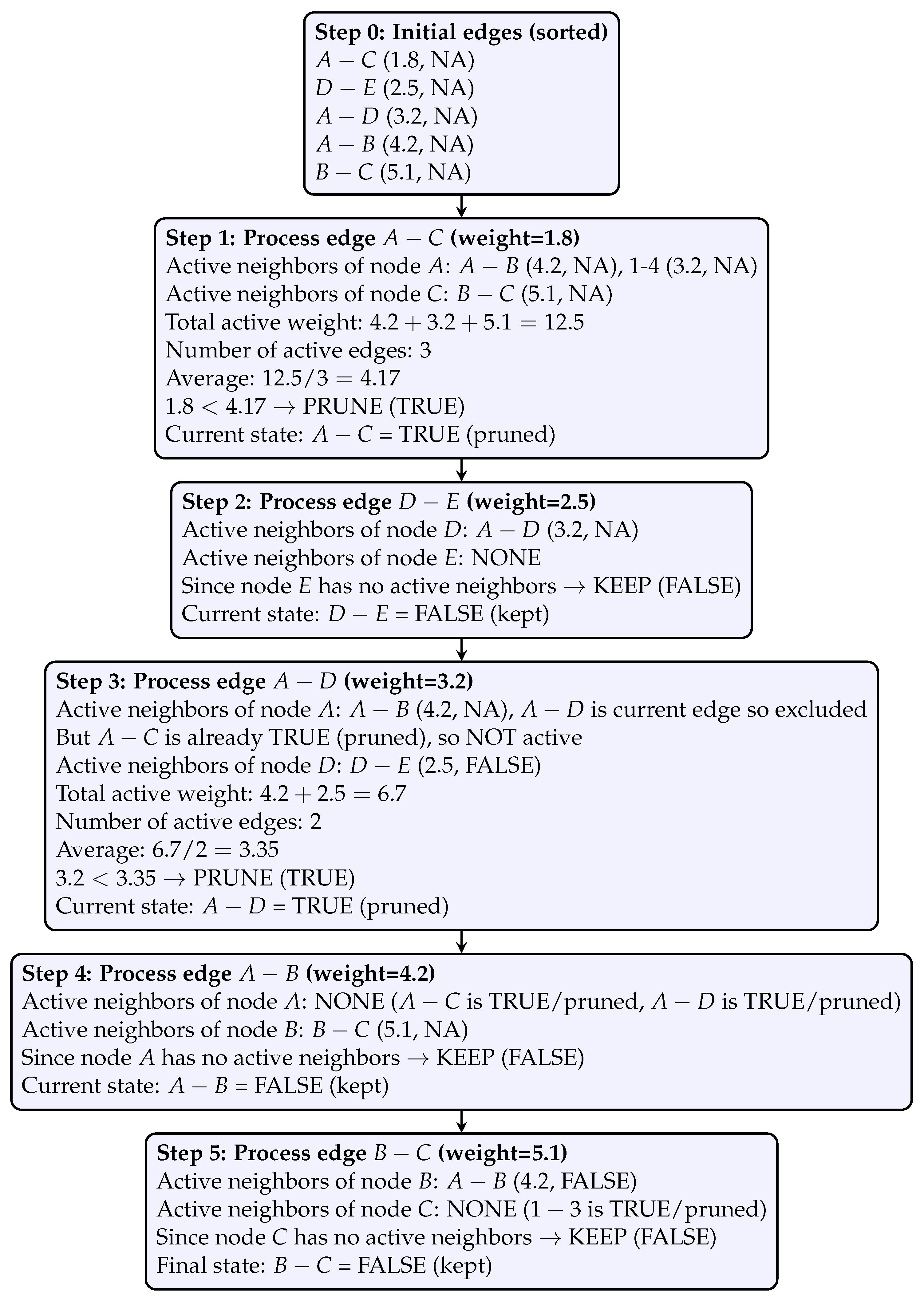
Appendix A. Step-by-Step Example of the Edge Pruning Algorithm

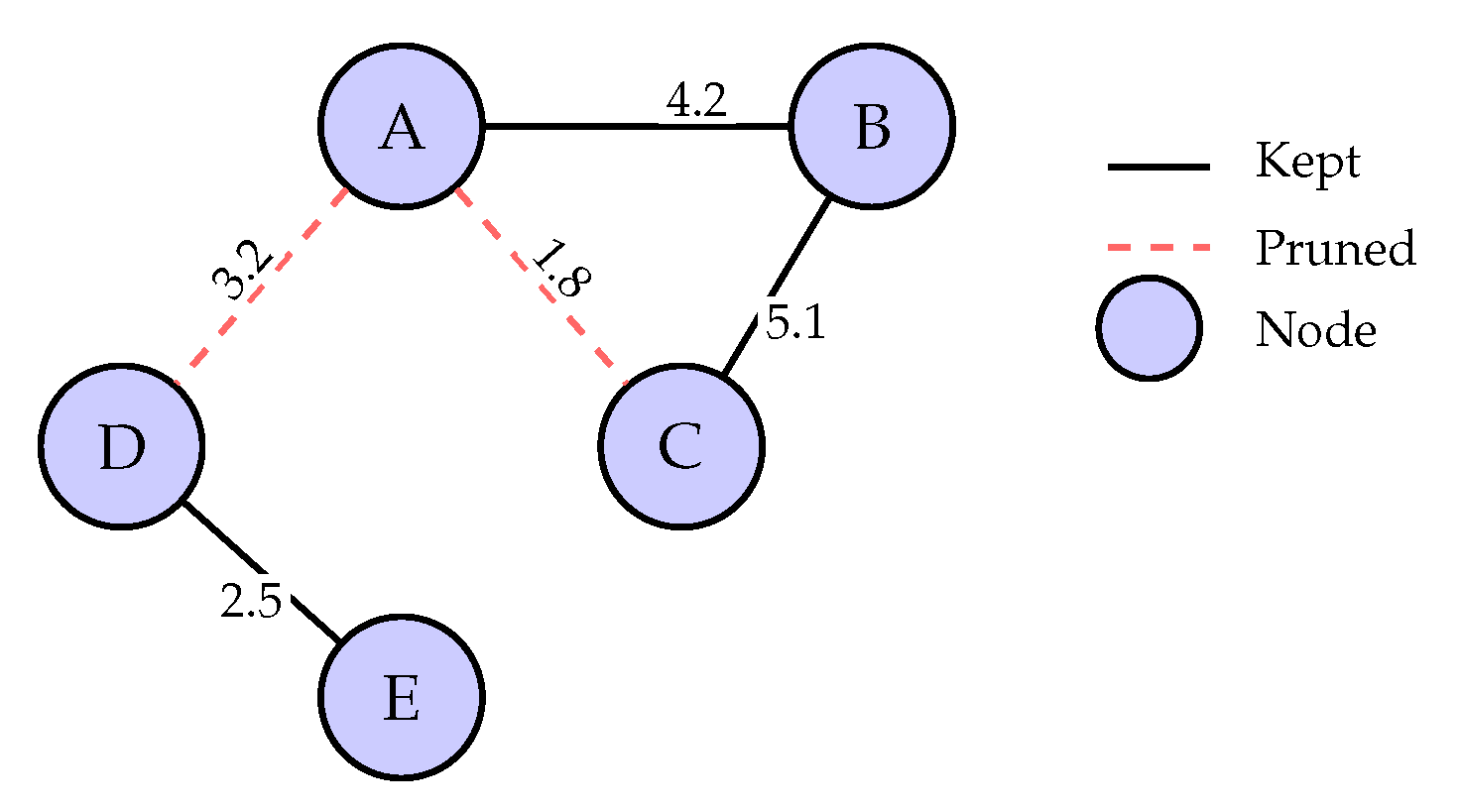
Below, an example of applying the edge pruning algorithm to a small graph is presented. The pruning criterion evaluates each edge e = ( u , v ) against the average weight of the active edges incident to nodes u and v.
Figure A1. Step-by-step execution of the Edge Pruning Algorithm on a small weighted directed graph, illustrating the evaluation and pruning of each edge.
Analytics 05 00014 g0a1

Appendix B. Pruning Results for Each Year

In this appendix, we provide detailed tables listing the degree programs and their corresponding numerical identifiers used in the construction of the graphs for each of the five public universities. These identifiers are essential for interpreting the graphs and understanding the flow of student mobility between different programs, as referenced in the main body of this paper.
The tables are organized by university, and each table includes the degree name alongside its unique identifier. These identifiers are used consistently across all graphs and analyses presented in the study, ensuring that the mobility patterns and communities detected can be accurately traced back to the specific degree programs involved.
Due to the length and detail of these tables, they are included here as an appendix to avoid interrupting the flow of the main text, while still providing the necessary data for those wishing to explore the finer details of our analysis.
Table A1. University U1.
IdDegree NameIdDegree Name
101Degree in Multimedia Engineering145Degree in Economics
102Degree in Telecommunications Engineering146Degree in Optics and Optometry
103Degree in Biology147Degree in Early Childhood Education
104Degree in Environmental Sciences148Degree in Primary Education
105Degree in Physical Activity and Sports Sciences149Degree in Political Science and Public Administration
106Degree in Audiovisual Communication150Degree in Electronic Telecommunications Engineering
107Degree in Sociology151Degree in Industrial Electronic Engineering
108Degree in Chemical Engineering152Degree in Computer Science
109Degree in Pharmacy153Degree in Geography and Environment
110Degree in Finance and Accounting154Degree in Biochemistry and Biomedical Sciences
112Degree in Tourism155Degree in Biotechnology
114Degree in Speech Therapy156Degree in Food Science and Technology
115Degree in Modern Languages and Their Literatures157Degree in Business Administration and Management
116Degree in History158Degree in Podology
117Degree in Art History159Degree in Translation and Interlinguistic Mediation (French)
118Degree in Nursing160Degree in Translation and Interlinguistic Mediation (English)
119Degree in Mathematics161Degree in Translation and Interlinguistic Mediation (German)
120Degree in Catalan Philology162Degree in Law + Criminology
121Degree in Pedagogy163Degree in Business Administration and Management
122Degree in Journalism164Degree in Telecommunications Engineering + Engineering
123Degree in Psychology165Degree in Law + Business Administration
124Degree in International Business166Degree in Pharmacy/Human Nutrition and Dietetics
125Degree in Nursing167Degree in Business Administration and Management + Law
126Degree in Information and Documentation168Degree in Physical Activity and Sports Sciences (Onteniente Section)
127Degree in Nursing169Degree in Gastronomic Sciences
128Degree in Hispanic Studies: Spanish Language and Its Literatures170Degree in Tourism + Degree in Business Administration and Management
129Degree in Social Education171Sociology/Political Science and Public Administration
130Degree in English Studies172Degree in Nursing
131Degree in Physiotherapy173Degree in Data Science
132Degree in Medicine174Degree in Business Intelligence and Analytics
133Degree in Human Nutrition and Dietetics175Double Degree in Physics and Mathematics
134Degree in Physics176Double Degree in Physics and Chemistry
135Degree in Labor Relations and Human Resources177Double Degree in Law and Economics
136Degree in Social Work178Double Degree in Chemistry and Chemical Engineering
137Degree in Criminology (On-site)805Degree in Business Administration and Management
138Degree in Philosophy806Degree in Tourism
139Degree in Classical Philology807Degree in Primary Education
140Degree in Law + Political Science and Public Administration808Degree in Early Childhood Education
141Degree in Law809Degree in Business Administration and Management
142Degree in Early Childhood Education815Degree in Business Administration and Management
143Degree in Dentistry822Double Degree in Mathematics and Computer Science
144Degree in Chemistry823Double Degree in Mathematics and Telecommunications Engineering
Table A2. University U2.
IdDegree NameIdDegree Name
201Degree in Business Administration and Management246Degree in Interactive Technologies
202Degree in Business Administration and Management247Degree in Audiovisual Communication and Sound and Image
203Degree in Architectural Foundations248Degree in Data Science
204Degree in Fine Arts249Degree in Business Administration and Tourism (E.P.S. Gandia)
205Degree in Biotechnology250Degree in Design and Creative Technologies
206Degree in Food Science and Technology251Double Degree in Forestry and Natural Environment Engineering and Environmental Sciences
207Degree in Conservation and Restoration of Cultural Heritage252Double Degree in Forestry and Natural Environment Engineering and Environmental Sciences
208Degree in Public Management and Administration253Degree in Digital and Multimedia Technology
209Degree in Aerospace Engineering254Double Degree in Business Administration and Food Science and Technology
210Degree in Building Engineering255Double Degree in Biotechnology and Agro-Food and Rural Environment Engineering
211Degree in Agro-Food and Rural Environment Engineering256Double Degree in Civil Engineering and Mathematics
212Degree in Civil Engineering257Double Degree in Telecommunication Technologies and Services Engineering and Mathematics
213Degree in Public Works Engineering258Degree in Physical Engineering
214Degree in Industrial Organization Engineering259Degree in Architectural Interior Design
216Degree in Telecommunication Systems, Sound and Image Engineering260Double Degree in Agro-Food and Rural Environment Engineering and Food Science and Technology
217Degree in Industrial Design and Product Development Engineering261Degree in Industrial Informatics and Robotics
218Degree in Industrial Design and Product Development Engineering262Degree in Industrial Informatics and Robotics
219Degree in Electrical Engineering263Degree in Transportation and Logistics Management
220Degree in Electrical Engineering (Alcoy)264Double Degree in Business Administration and Management and Mathematics
221Degree in Industrial Electronic and Automation Engineering265Double Degree in Information Technology Engineering and Mathematics
222Degree in Geomatics and Topography Engineering266Path in Aeronautical Engineering (via Aerospace Engineering Degree)
223Degree in Industrial Technologies Engineering267Path in Agronomic Engineering (via Agro-Food and Rural Environment Engineering Degree)
224Degree in Forestry and Natural Environment Engineering268Path in Architecture
225Degree in Information Technology Engineering (Alcoy)269Path in Civil Engineering (via Civil Engineering Degree)
226Degree in Information Technology Engineering270Path in Industrial Engineering (via Industrial Technologies Engineering Degree)
228Degree in Mechanical Engineering (Alcoy)271Path in Information Technology Engineering
229Degree in Mechanical Engineering272Path in Geomatics and Geoinformation Engineering (via Geomatics and Topography Engineering Degree)
230Degree in Mechanical Engineering (E.U. Ford)273Path in Chemical Engineering
231Degree in Chemical Engineering274Path in Forestry Engineering (via Forestry and Natural Environment Engineering Degree)
232Degree in Chemical Engineering (Alcoy)275Path in Telecommunication Engineering (via Telecommunication Technologies and Services Engineering Degree)
233Degree in Telecommunication Technologies and Services Engineering276Path in Telecommunication Engineering (via Telecommunication Systems, Sound and Image Engineering Degree)
235Degree in Environmental Sciences277Path in Building Construction
236Degree in Audiovisual Communication279Double Degree in Geomatics and Topography Engineering, and Mathematics
237Degree in Tourism Management280Double Degree in Data Science and Industrial Organization Engineering
238Degree in Energy Engineering810Degree in Industrial Electronic and Automation Engineering
239Degree in Biomedical Engineering811Degree in Mechanical Engineering (Florida U)
240Degree in Business Administration + Telecommunication Technologies and Services Engineering812Degree in Mechanical Engineering
241Degree in Business Administration + Tourism Management (E.P.S. Gandia)817Degree in Engineering and Business Management
242Degree in Business Administration + Tourism Management (E.P.S. Alcoy)819Degree in Design and Creative Technologies
243Degree in Business Administration and Information Technology Engineering (Alcoy)820Degree in Video Game Design and Development
245Degree in Business Administration and Information Technology Engineering821Degree in Transportation and Logistics Management
Table A3. University U3.
IdDegree NameIdDegree Name
300Degree in Nursing330Degree in Optics and Optometry
301Degree in Business Administration and Management331Degree in Advertising and Public Relations
302Degree in Architectural Foundations332Degree in Chemistry
303Degree in Biology333Degree in Labor Relations and Human Resources
304Degree in Physical Activity and Sports Sciences334Degree in Labor Relations and Human Resources
305Degree in Marine Sciences335Degree in Sociology
306Degree in Criminology (On-site)336Degree in Social Work
307Degree in Law337Degree in Tourism
308Degree in Economics338Degree in Translation and Interpretation (French)
309Degree in Nursing339Degree in Translation and Interpretation (German)
310Degree in Spanish: Language and Literatures340Degree in Translation and Interpretation (English)
311Degree in Arabic and Islamic Studies341Simultaneous Studies in Degree in Tourism and Degree in Business Administration
312Degree in French Studies342Degree in Labor Relations and Human Resources
313Degree in English Studies343Degree in Criminology (Online)
314Degree in Catalan Philology344Degree in Labor Relations and Human Resources
315Degree in Geography and Territorial Planning345Simultaneous Studies in Degree in Law and Degree in Business Administration
316Degree in Geology346Simultaneous Studies in Degree in Law and Degree in Criminology
317Degree in Public Management and Administration347Degree in Health Information Technologies
318Degree in History348Degree in Robotics Engineering
319Degree in Humanities349Double Degree in Computer Science and Business Administration
320Degree in Civil Engineering350Degree in Physics
321Degree in Building Engineering351Degree in Gastronomy and Culinary Arts
322Degree in Sound and Image Engineering in Telecommunications352Degree in International Relations
323Degree in Computer Science353Degree in Early Childhood Education
324Degree in Multimedia Engineering354Degree in Marketing
325Degree in Chemical Engineering355Double Degree in Law and International Relations
326Degree in Primary Education356Degree in Medicine
327Degree in Early Childhood Education357Degree in Artificial Intelligence Engineering
328Degree in Mathematics818Degree in Physics
329Degree in Human Nutrition and Dietetics
Table A4. University U4.
IdDegree NameIdDegree Name
401Degree in Business Administration420Degree in Mechanical Engineering
402Degree in Criminology and Security421Degree in Chemical Engineering
403Degree in Law422Degree in Telecommunication Engineering
404Degree in Economics423Degree in Primary Education Teaching
405Degree in English Studies424Degree in Building Engineering
406Degree in Nursing425Degree in Audiovisual Communication
407Degree in Finance and Accounting426Degree in Early Childhood Education Teaching
408Degree in Advertising and Public Relations427Degree in Computational Mathematics
409Degree in Chemistry429Degree in Psychology
410Degree in Translation and Interpretation430Degree in Journalism
411Degree in History and Heritage431Degree in Nursing
412Degree in Humanities: Intercultural Studies432Degree in Medicine
413Degree in Labor Relations and Human Resources433Degree in Video Game Design and Development
414Degree in Tourism434Degree in Public Management and Administration
415Degree in Agro-Food and Rural Environment Engineering435Double Degree in Business Administration and Management and Law
416Degree in Industrial Design and Product Development Engineering436Degree in Physical Activity and Sports Sciences
417Degree in Electrical Engineering437Degree in Robotic Intelligence
418Degree in Industrial Technologies Engineering438Degree in Biochemistry and Molecular Biology
419Degree in Information Technology Engineering
Table A5. University U5.
IdDegree NameIdDegree Name
501Degree in Business Administration and Management520Degree in Journalism
502Degree in Fine Arts521Degree in Podology
503Degree in Biotechnology522Degree in Psychology
504Degree in Environmental Sciences523Degree in Labor Relations and Human Resources
505Degree in Physical Activity and Sports Sciences (Elche)524Degree in Occupational Therapy
506Degree in Political Science and Public Management525Degree in Food Science and Technology (Orihuela)
507Double Degree in Audiovisual Communication and Journalism526Degree in Business Administration and Management
508Degree in Law527Degree in Audiovisual Communication
509Degree in Business Statistics528Degree in Law. Semi-presential
510Degree in Pharmacy529Double Degree in Law and Business Administration and Management
511Degree in Physiotherapy530Degree in Public and Private Security
513Degree in Agro-Food and Agro-Environmental Engineering801Degree in Business Administration and Management
514Degree in Electrical Engineering802Degree in Audiovisual Communication
515Degree in Electronic and Industrial Automation Engineering803Degree in Communication and Public Relations
516Degree in Information Technology Engineering813Degree in Event Organization, Protocol, and Institutional Relations
517Degree in Telecommunication Technologies Engineering814Degree in Commercial Management and Marketing
518Degree in Mechanical Engineering816Degree in International Business
519Degree in Medicine850Degree in Digital Business Management

Appendix C. Supplementary Comparisons of Degree Communities Across Selected Years

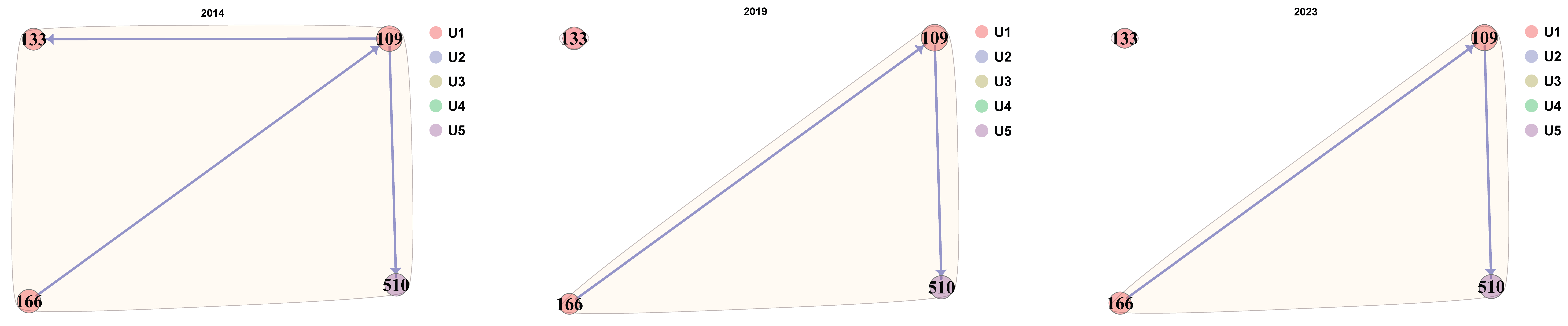
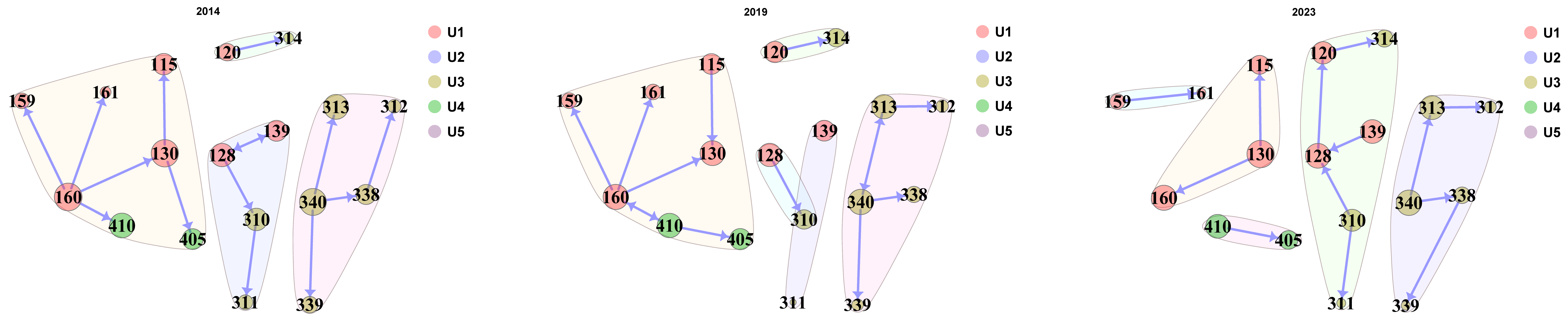
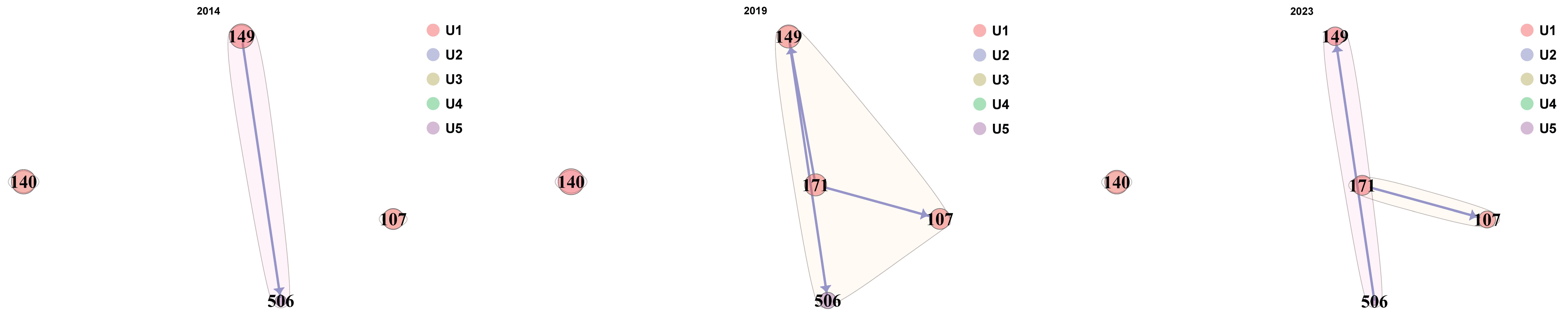
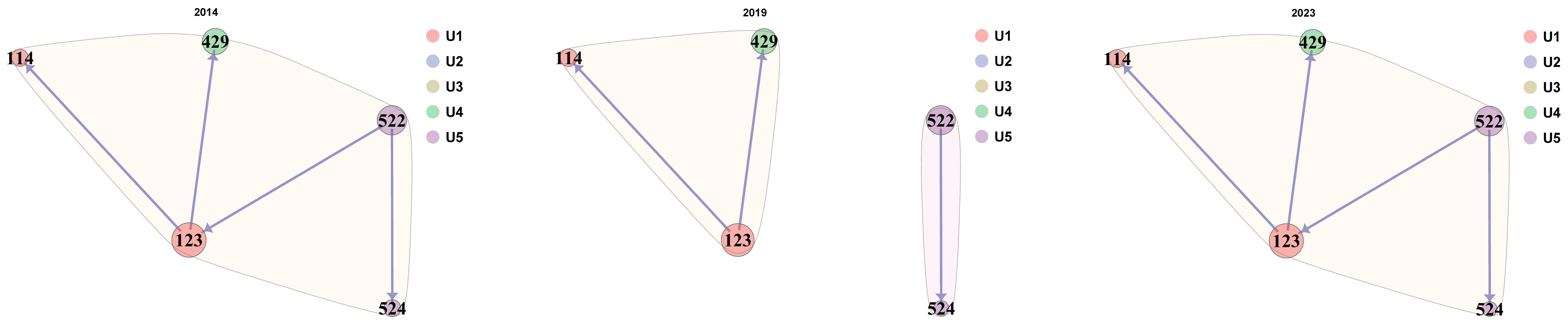
This appendix includes supplementary figures comparing university degree communities across major academic areas in 2014, 2019, and 2023. These plots complement the main results by illustrating temporal changes in the structure of these communities, with brief comments summarizing the most notable trends.
Table A6. Comparison of University Degree Communities by Area Across Selected Years (2014, 2019, 2023).
201420192023
A
r
c
h
i
t
e
c
t
u
r
e
Analytics 05 00014 i001
The emergence of new degree programs in the sector has concentrated demand in smaller clusters, reducing mobility. The system has shifted from 2 communities to 6. Note the geographical effect of the degree programs offered by University U3.
F
i
n
e

A
r
t
Analytics 05 00014 i002
The structure remains stable despite the introduction of a new degree. These are highly vocational degrees.
B
u
s
i
n
e
s
s
Analytics 05 00014 i003
The emergence of new degrees has led to a restructuring of traffic within the communities, but with very little variation. Note the geographic factor of University U4.
B
i
o
l
o
g
y
Analytics 05 00014 i004
The introduction of the double degree in Forestry Engineering and Natural Environment & Environmental Sciences has merged three communities, making it a key attraction point, particularly for students from other universities.
C
h
e
m
i
s
t
r
y
Analytics 05 00014 i005
The emergence of new degrees does not entail substantial changes; the community structure remains intact, and the flow of students is redistributed.
C
r
i
m
i
n
o
l
o
g
y
Analytics 05 00014 i006
Totally stable, there are no noticeable changes.
E
c
o
n
o
m
y
Analytics 05 00014 i007
Note that the traffic is limited to two universities that are very close to each other.
E
d
u
c
a
t
i
o
n
Analytics 05 00014 i008
There have been no changes in the degree offerings, but mobility has been determined by a geographic criterion, with movement occurring only within each university and not outward.
P
h
a
r
m
a
c
y
Analytics 05 00014 i009
Stable.
P
h
i
l
o
l
o
g
y
Analytics 05 00014 i010
There are no variations in the degree offerings, but there are changes in traffic; note the geographic effect of the degrees on the right side of the figures.
H
i
s
t
o
r
y
Analytics 05 00014 i011
Small intermediate changes, but the geographical effect remains.
M
e
d
i
c
i
n
e
Analytics 05 00014 i012
The structure had been stable for many years, but the creation of a new Faculty of Medicine in U3 has completely changed the structure of the communities, also giving rise to a clearly identifiable geographical effect.
P
o
l
i
t
i
c
s
Analytics 05 00014 i013
Slight changes driven by new degree programs, but they do not significantly affect the original structure.
P
s
y
c
h
o
l
o
g
y
Analytics 05 00014 i014
There are no changes.

References

  1. Farreras, C. University Entrance Exams Will Have the Same Number of Tests as Before, and Students Will Choose Between Spanish History and Philosophy (La Selectividad Tendrá el Mismo Número de Exámenes que Antes y se Elegirá Entre Historia de España y Filosofía). La Vanguardia. 2023. Available online: https://www.lavanguardia.com/vida/20231011/9292429/gobierno-introduce-cambios-minimos-pruebas-acceso-universidad-2024.html (accessed on 21 November 2025).
  2. The New University Entrance Exams: 5 Recent Changes to Keep in Mind (La Nueva Selectividad: 5 Cambios Recientes a Tener en Cuenta). Educaweb. 2023. Available online: https://www.educaweb.com/noticia/2023/02/14/nueva-selectividad-5-cambios-recientes-tener-cuenta-21140/ (accessed on 21 November 2025).
  3. Agreement Between the Government and Murcia on the New PAU Model: More Competence and Less Memorization (Acuerdo Entre el Gobierno y Murcia Sobre el Nuevo Modelo de PAU: Más Competencia y Menos Memorización). The Objective. 2024. Available online: https://theobjective.com/sociedad/educacion/2024-10-07/acuerdo-gobierno-murcia-modelo-pau/ (accessed on 21 November 2025).
  4. Universitat Rovira i Virgili. University Pre-Enrollment in Catalonia. (Preinscripción Universitaria en Cataluña). Available online: https://www.urv.cat/es/estudios/grados/admision/acceso/preinscripcion/ (accessed on 21 November 2025).
  5. Universidad de Salamanca. Frequently Asked Questions About Pre-Enrollment. (Preguntas Frecuentes Sobre la Preinscripción). Available online: https://precyl.usal.es/preguntas-frecuentes/ (accessed on 21 November 2025).
  6. Universidad de León. Information About Pre-Enrollment for Undergraduate Degrees. (Información Sobre la Preinscripción Para Grados). Available online: https://www.unileon.es/estudiantes/futuros-estudiantes/preinscripcion/grado (accessed on 21 November 2025).
  7. Universidad Complutense de Madrid. Information About Pre-Enrollment. (Información Sobre Preinscripción). Available online: https://www.ucm.es/preinscripcion-1 (accessed on 21 November 2025).
  8. Universidad Politécnica de Valencia. Information About Pre-Enrollment. (Información Sobre Preinscripción). Available online: https://wiki.upv.es/confluence/pages/viewpage.action?pageId=96927778 (accessed on 21 November 2025).
  9. Transparency Portal, General State Administration. Data and Figures of the Spanish University System 2024. (Datos y Cifras del Sistema Universitario Español 2024). Available online: https://www.ciencia.gob.es/InfoGeneralPortal/detalle-publicacion/MICIU/Datos-y-cifras-del-Sistema-Universitario-Espanol.html (accessed on 21 November 2025).
  10. List of Universities (Listado de Universidades). 2024. Available online: https://www.educacion.gob.es/ruct/consultauniversidades?actual=universidades (accessed on 21 November 2025).
  11. Hervás, A.; Soriano-Jiménez, P.P.; Jiménez, A.; Peinado, J.; Capilla, R.; Montañana, J.M. A Case Study of Directional Communities in a Directed Graph: The Accessing Procedure to the Spanish Public University System. In Modeling Human Behavior; Nova Science Publishers, Inc.: Hauppauge, NY, USA, 2015. [Google Scholar]
  12. Boccaletti, S.; Latora, V.; Moreno, Y.; Chavez, M.; Hwang, D.U. Complex networks: Structure and dynamics. Phys. Rep. 2006, 424, 175–308. [Google Scholar] [CrossRef]
  13. Girvan, M.; Newman, M.E.J. Community structure in social and biological networks. Proc. Natl. Acad. Sci. USA 2002, 99, 7821–7826. [Google Scholar] [CrossRef] [PubMed]
  14. Lancichinetti, A.; Fortunato, S. Community detection algorithms: A comparative analysis. Phys. Rev. E 2009, 80, 056117. [Google Scholar] [CrossRef] [PubMed]
  15. Liu, H.; Wei, J.; Xu, T. Community detection based on community perspective and graph convolutional network. Expert Syst. Appl. 2023, 231, 120748. [Google Scholar] [CrossRef]
  16. Ruggeri, N.; Contisciani, M.; Battiston, F.; De Bacco, C. Community detection in large hypergraphs. Sci. Adv. 2023, 9, eadg9159. [Google Scholar] [CrossRef] [PubMed]
  17. University Regulation Service, General Directorate of University, Research, and Science. University Pre-Enrollment. (Preinscripción Universitaria). Available online: https://universitats.gva.es/es/preinscripcio-universitaria (accessed on 21 November 2025).
  18. Deng, Y.; Kenney, C.; Moore, M.S.; Manjunath, B.S. Peer group filtering and perceptual color image quantization. In Proceedings of the 1999 IEEE International Symposium on Circuits and Systems (ISCAS); IEEE: Piscataway, NJ, USA, 1999; Volume 4, pp. 21–24. [Google Scholar]
  19. Morillas, S.; Gregori, V.; Hervás, A. Fuzzy peer groups for reducing mixed Gaussian-impulse noise from color images. IEEE Trans. Image Process. 2009, 18, 1452–1466. [Google Scholar] [CrossRef] [PubMed]
  20. Muñoz, H.; Vicente, E.; Gonzalez, I.; Mateos, A.; Jimenez-Martin, A. ConvGraph: Community Detection of Homogeneous Relationships in Weighted Graphs. Mathematics 2021, 9, 367. [Google Scholar] [CrossRef]
  21. Schulte, S.; Morillas, S.; Gregori, V.; Kerre, E.E. A new fuzzy color correlated impulse noise reduction method. IEEE Trans. Image Process. 2007, 16, 2565–2575. [Google Scholar] [CrossRef] [PubMed]
  22. Montañana, J.M.; Hervás, A.; Soriano Jiménez, P.P. A Proposal for a Benchmark Generator of Weakly Connected Directed Graphs. Open J. Model. Simul. 2020, 8, 18–34. [Google Scholar] [CrossRef]
  23. Delvenne, J.-C.; Yaliraki, S.N.; Barahona, M. Stability of graph communities across time scales. Proc. Natl. Acad. Sci. USA 2010, 107, 12755–12760. [Google Scholar] [CrossRef] [PubMed]
  24. Wang, W.; Li, X. Temporal Stable Community in Time-Varying Networks. IEEE Trans. Netw. Sci. Eng. 2020, 7, 1508–1520. [Google Scholar] [CrossRef]
  25. Figlewski, S. Financial Markets, Institutions & Instruments; John Wiley & Sons, Inc.: Hoboken, NJ, USA, 1997; Volume 6, pp. 1–88. [Google Scholar]
  26. Serrano, M.A.; Boguñá, M.; Vespignani, A. Extracting the multiscale backbone of complex weighted networks. Proc. Natl. Acad. Sci. USA 2009, 106, 6483–6488. [Google Scholar] [CrossRef] [PubMed]
  27. Chen, Y.; Sujay, S.; Xu, H. Clustering Sparse Graphs Advances in Neural Information Processing Systems. Volume 25. 2012. Available online: https://proceedings.neurips.cc/paper_files/paper/2012/file/1e6e0a04d20f50967c64dac2d639a577-Paper.pdf (accessed on 30 November 2025).
  28. Montañana, J.M.; Hervás, A.; Soriano Jiménez, P.P. Analysis of the Evolution of Student Enrollment Preferences in Degree University Programs Through Directional Community Analysis (2014–2023). In Proceedings of the Mathematical Modelling in Engineering & Human Behaviour, Valencia, Spain, 10 July 2025; pp. 397–407. Available online: https://imm.webs.upv.es/jornadas/2025/2025_Proceedings_MME_HB.pdf (accessed on 21 November 2025).
Figure 1. Calculated Student Enrollment Probabilities by Preference Option Over 10 Years (2014–2023). data provided by the Generalitat Valenciana [17].
Analytics 05 00014 g001
Figure 6. The graph represents the five public universities and distances in kilometers between them.
Analytics 05 00014 g006
Table 1. Modularity, community count, and edge count after applying the pruning algorithm to each yearly graph.
YearNumber of VerticesNumber of Edges Before PruningNumber of Edges After PruningNumber of CommunitiesModularity
20142159720161620.9750
201522210,100173590.9684
201622710,906171650.9723
201723010,903174620.9715
201824011,410181670.9717
201924411,378182730.9747
202024912,009186740.9724
202125612,487194750.9752
202227412,275211720.9769
202327912,508197880.9812
Table 2. Stability of Communities.
2014–20152015–20162016–20172017–20182018–20192019–20202020–20212021–20222022–2023
Average Stab.0.64380.66110.65390.64510.64860.63570.65290.64420.6442
WAS_NV0.69500.72760.69160.70070.69230.68580.70950.68820.6876
WAS_FC0.68350.71980.69630.70340.68810.63930.66480.64730.6757
Disclaimer/Publisher’s Note: The statements, opinions and data contained in all publications are solely those of the individual author(s) and contributor(s) and not of MDPI and/or the editor(s). MDPI and/or the editor(s) disclaim responsibility for any injury to people or property resulting from any ideas, methods, instructions or products referred to in the content.