1. Introduction
Modern supply chains (SCs) are under enormous stress to satisfy customers expectations where there is a rapid change in products and market. To survive in this volatile situation, production units and supply chains are moving toward make-to-order (MTO) platforms with ability for mass customization. This enables supply chains to meet demand of smaller markets for new and customized products while introducing new challenges in scheduling and operations management for the system. To increase the profit margin of these systems, it is necessary to select from pool of the received orders given the available resources of the supply chain and their utilization levels. In traditional systems, the order selection decisions are made in a central unit based on the expected available capacities [
1]. However, centralized optimization of the order management provides an optimistic solution with unrealistic assumptions for observability of the whole system and involved parameters. On the other hand, in this form of optimization it is assumed that all involved sections are part of the one system and share the same profit. In most of the modern businesses adopting new frameworks such as cloud manufacturing, many suppliers and production units collaborate with each other for multiple supply chains [
2]. The MTO supply chains are common practice in sectors including aerospace, defense, high-end electronics, chemical and pharmaceutical industries in which suppliers and other involved players are willing to hide their actual costs, lead times, capacities, and internal decisions. Not sharing such information help the partners of these industries to protect their sensitive information and most importantly their bargaining power for long-term strategic advantages. On the other hand, revealing such information can push upstream or downstream players to the optimistic behavior that can threaten success of the MTO contracts. In some sectors such as semiconductor and aerospace capacity information protection of sensitive information about proprietary processes, cycle times and tooling is important. Moreover, predicting such capacities is not hundred percent reliable and highly depends on the strategies of each sector that may not be willing to share with external units not to increase potential penalties and loss of trust. In this situation, the received income from orders needs to be divided between all participating units. Determining the share of each unit is crucial, because majority of order acceptance and rejection decisions are made much earlier than observing actual costs and incomes in the system. On the other hand, some units in the supply chain may prefer not to reveal their financial information and only share their decisions on whether are able to support certain orders or not.
Given these challenges, MTO platforms require a distributed decision-making system that participating agents have their authority and confidentiality while collaborating in a larger umbrella of the certain supply chain [
3]. The other advantage of the distributed optimization in supply chains is the high level of flexibility of the system to respond to different sources of uncertainty in the environment and system itself [
4]. Local modifications in the distributed systems enable subsystems to consider required accommodations without any major shift and effect on optimality and costs of the other collaborating units. Most importantly, distributed optimization highly decreases the computation time of the large-scale models while maintaining acceptable levels of precision and optimality [
5]. Supply chain and network models involve large number of variables and constraints that solving them as an integrated model can increase computation time of the model. The computation time exponentially increases by adding one or more suppliers, market and distribution centers. Distributed optimization provides a flexible and scalable platform for each center which is solved in a parallel form. In these models, adding more centers and complexities doesn’t highly affect the computation time and quality of the optimal solution [
6].
Optimization of the MTO supply chains is investigated from different perspectives including system design [
7], production planning [
8], job scheduling [
9], and order acceptance [
10,
11]. Wide range of techniques such as simulation, mixed integer programming [
12], dynamic programming [
13], stochastic programming [
14], and game theory [
15] were implemented for mathematical modeling and optimization of operations in such systems. However, majority of them applied centralized optimization framework that require huge computation time for large scale supply chains and high volume information sharing of the involved partners with the central unit. Even the meta-heuristics such as genetic algorithm [
16], memetic algorithm [
1], and particle swarm optimization and tabu search [
17] proposed to reduce computation time of these models still suffer from privacy concerns of the information sharing. Distributed optimization platform resolves this issue with dividing decisions between multiple sub-models solved by the related section. These systems also increase the reliability of the system by removing single failure point and dividing risks and authorities to react in case of failure of participating players. In literature various distributed optimization techniques were proposed for optimization of large-scale systems. Decomposition [
18] and consensus-based techniques [
19] are majority of the proposed techniques that can be defined in form of discrete and continuous time models. In this category of research, each agent or sub problem tries to reach agreement with other elements while considering weights of its neighboring agents and sub gradient of its own objective function [
20]. To handle the slow convergence of these techniques for supply chain problems, they are also combined by sub-gradients techniques [
21]. Other variations of such technique were developed for unweighted and stochastic networks. EXTRA, DIGing, distributed Proportional-integral (PI), and distributed Newton-Raphson algorithms are some of the well-known variations in this category [
22]. On the other hand, some of the researchers tried to apply common metaheuristics such as ant colony optimization for distributed planning and scheduling of supply chain tasks [
23]. The interactions between agents in this research is limited to information exchanges between agents as pheromones.
Another version of distributed optimization techniques was proposed in inventory system that maximizes resource utilization in these systems [
24]. In this research, the problem was split using primal and dual decomposition technique and it is solved in iterative rounds of updates in decision variables. This technique was also used for optimal flow allocations in supply chains where customer’s demand and price affect flows in each node [
25]. One of the main problems in using this technique is its complexity especially for large scale networks with multiple couplings constraints and limits. Computation time of the distributed optimization techniques can be also reduced by considering game-based techniques that set the problem as a game in the networks shared between subsystems to decide as players of the game. Stackelberg game was shown to be suitable for this approach. For example, ref. [
26] used this game when manufacturer is considered as a leader while suppliers and customers are followers and react to its decisions. In this game, each one of the players looks to maximize its own objectives and reaches a Nash equilibrium that is good enough for each one of supply chain elements. This framework usually requires to define bi-level or multi-level mixed integer nonlinear models which are difficult to be solved using common approaches. Sometimes the computation time can be decreased by applying complementary techniques such as community detection-based technique that partition networks into groups with sharing features and characteristics [
27].
Alternating Direction Method of Multipliers (ADMM) is considered as one of the most efficient techniques for distributed optimization of multi-agent systems. This technique is mainly minimizing the augmented Lagrangian of the optimization problem by iteratively updating primal and dual variables [
28]. Initial forms of this algorithm requires collecting all primal information from computation nodes to implement dual update in the central node [
29]. This requirement had lots of burdens for the central node and weakened robustness and reliability of the whole system due to existing of single failure point. In later versions of this algorithm used for signal processing, this requirement is released to gain the desired degree of parallelization [
30]. The algorithm was adopted for many other variations including two blocks with separable objective function, multi-block with separable objective functions, consensus problems, multi-block with coupled objective function, consensus problems, and nonlinearly constrained optimization problems [
31]. It was also shown that this technique can be successfully applied for mixed integer programming using the rounding steps to the nearest integer variable [
32]. Other variations of this technique were proposed for problems with mazed binary optimization problem in classical and quantum computers [
33].
One of the main applications of this algorithm is smart power grid [
34] which is applied for wide range of problems including optimal power flow, economic dispatch, demand response, pricing mechanism, electric vehicles, cyber-physical systems, multi energy systems, peer to peer trading forecast techniques, state estimation and other related topics. The variations of ADMM technique were also applied in other systems including vehicle routing in urban logistics [
35], co-optimization of natural gas and electricity in energy networks [
36], electric vehicle charging planning [
37], robots [
38], and smart home optimization [
39]. This technique is also considered very efficient in manufacturing domain. For example, it was applied for edge-cloud manufacturing to optimize sub-tasks allocations to factories [
40]. Another example is the research presented by [
41] that ADMM was integrated with deep Q learning to handle a large-scale model for green closed loop supply chain model. In this research, the proposed ADMM based technique optimized returns in an intelligent and smart manufacturing system. Another research for utilization of this technique was presented by [
42] in which ADMM was applied for optimization of a distribution system with joint constraints on replenishment. In this system, both replenishment and distribution capacity management are implemented in case of shortage. The other technique was proposed to solve procurement problem in large scale supply chains which are monitored and controlled using internet of things [
43]. Similar to these systems, order acceptance decisions in MTO supply chains require coordination of decisions in multiple units. Although distributed optimization has been applied in various applications of networked systems, it is not fully investigated for supply chain applications with large number of interacting units and information exchange between units. This is even more critical in order management system of MTO supply chains where the order acceptance decisions are highly depends on the participating players such as suppliers, manufacturers, distributors. To address the existing gaps in the literature, this research proposes a novel distributed optimization framework for managing order acceptance and planning other related operational decisions while preserving privacy and authority of the MTO supply chain players. The main contributions of this work lie in:
Proposing a distributed framework based on ADMM for order management and mass customization given available capacities for supply, production, storage, and distribution.
Incorporating profit share of the playing elements in supply chain operations and proposing a game-based framework to search its best setting.
Investigating the effects of hyper parameters and supply chain settings on efficiency of the proposed distributed framework using design of experiments.
The remainder of this paper is organized as follows. The problem under study is stated in the next section. The mathematical models for each sub-system of the proposed distributed order management are presented in
Section 3. The numerical example for a case supply chain is presented in
Section 4. Finally, the findings of the research and ideas for future direction are summarized in
Section 5.
2. Problem Statement and Assumptions
Make to order supply chains mostly rely on the orders and their efficient acceptance decisions. These decisions usually need full visibility of the available resources to make sure supply chain has enough capacities to fulfill the accepted order on time. Ineffective coordination of resources may result in penalties, contractual breaches, customer dissatisfaction, and future demands and profit reductions. Although integrated platforms provide access to the wide range of the required resources, they are not considered an efficient technique given concerns related to security, resilience, privacy and information sharing. Distributed planning of order acceptance decisions provide smooth coordination between different units and prevents local possible bottlenecks and overloads in the system. At the same time it helps to effectively utilize available resources without wasting them on redundant and unnecessary operations and idle times. It can also increase agility of the system to respond when facing potential fluctuations and disruptions.
To achieve these goals, supply chains can be modeled as multi-agent systems where each section and element of the supply chain is considered as an agent interacting with other agents of the system [
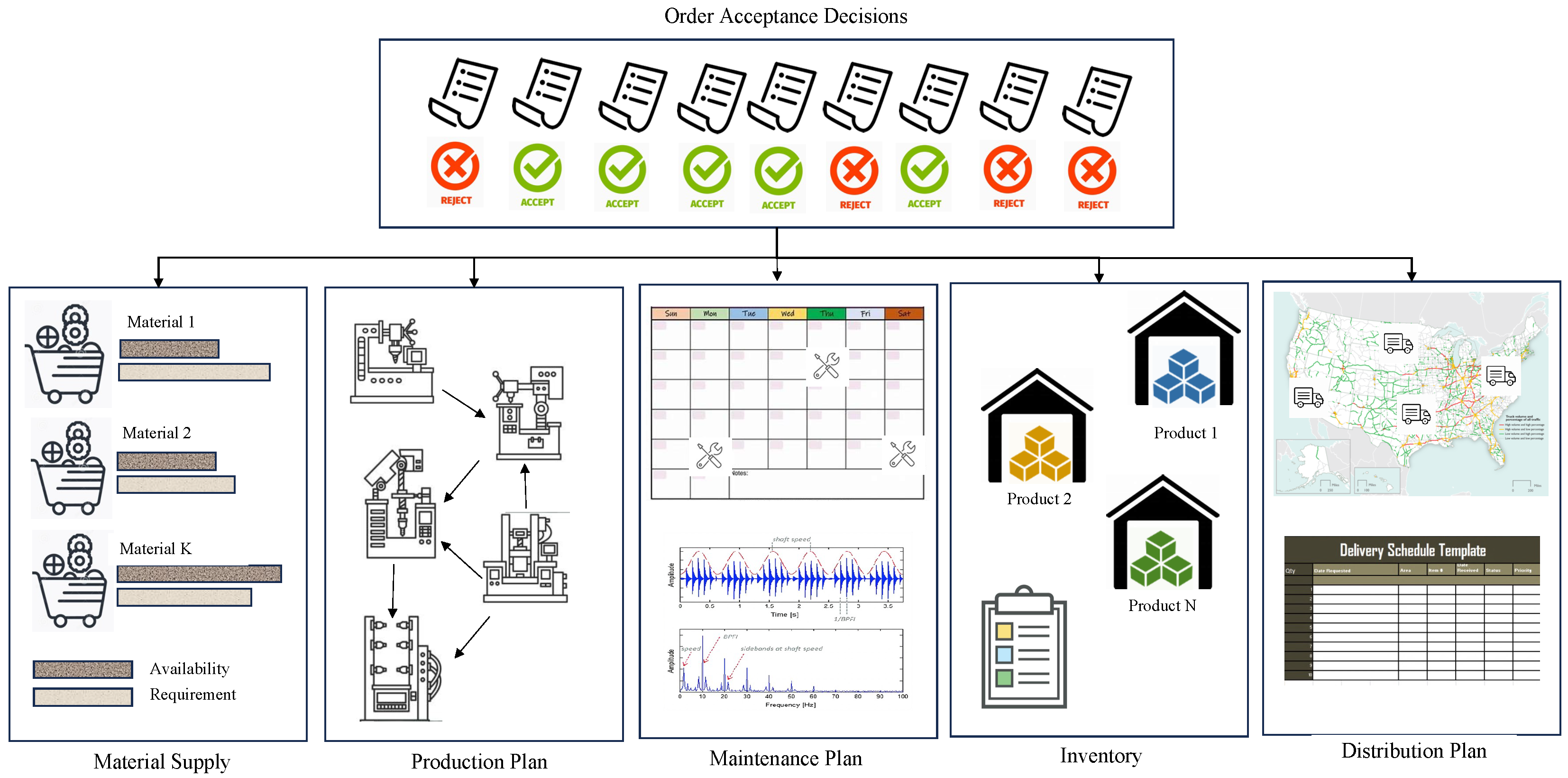
44]. The MTO supply chain system studied in this research consists of five agents for supply, inventory, production, maintenance, and distribution and another main marketing agent for the order management department. The overall picture of the proposed order acceptance system and its sub-systems is shown in
Figure 1.
It is assumed that the state of the agents represent their available capacities and objective functions and they have partial knowledge regarding their subsystem and other interacting agents. Agent actions are formed based on the decisions for supply chain operations while optimizing their own objectives. Complete list for agent states and actions are listed in
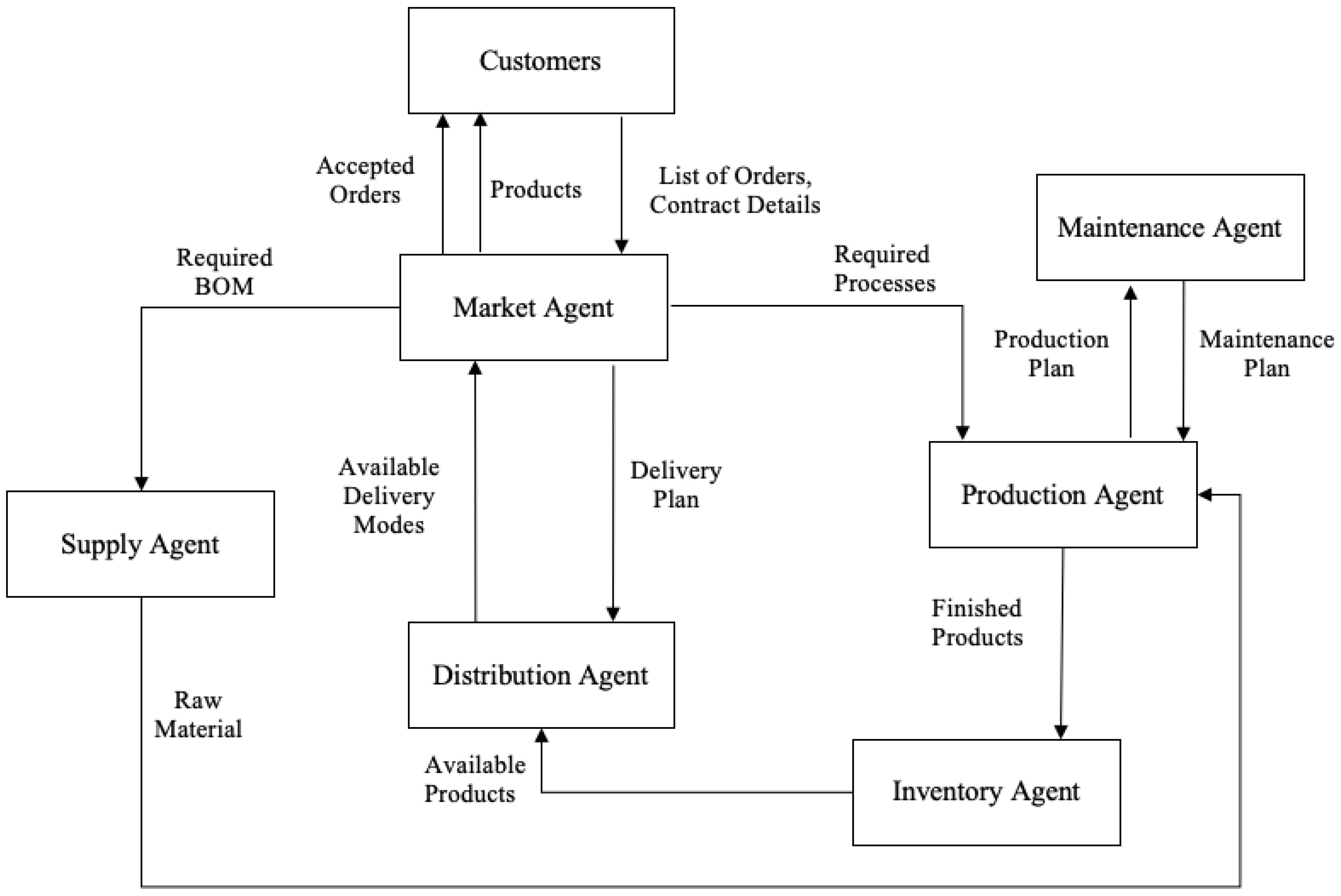
Table 1. The communication map for the relations among these agents and flows of information, orders, raw materials, and products in this supply chain is shown in
Figure 2. As the figure shows, the system receives orders from customers with different quantities, products, delivery dates and contract features. This data is collected by market agent which is in charge of order acceptance decisions and sharing order features with related units. The required bill of material (BOM) is shared with supply agent which is in charge of providing material and parts needed for full filling orders. Once the material is ready they are fed into production agent which includes manufacturing plants and machines needed to fabricate products. This agent is in charge of optimizing production plan and scheduling and managing work in process (WIP) between stations. This agent interacts with maintenance agent that monitors machines and set maintenance times based on their mean time to failure (MTTF) to prevent any potential failures and down times in the production unit. Finished products are shared with inventory agent that monitors and plans storage of products and parts. The products are delivered once all production quantity on the contract is received and is available on the inventory system. This is implemented by distribution agent that receives available capacities and paths from trucks and find the best delivery plans and modes given their availabilities. The main goal is to identify the orders that match best with available resources of the supply chain to maximize net profit of the system while considering the costs related to different unites of the system. the integrated model for order acceptance management and scheduling for mass customized orders is previously presented by [
12]. However one of the main challenges in this research is increase its computation time when system receives multiple orders at the same time. Moreover, the systems suffers from possible privacy issues that may arise due to sharing all detail information between other interacting units of the supply chain. In such cases, the players require more local authority to manage possible failure and disruptions while receiving fair price incentives from the system based on their contribution levels.
3. Methodology
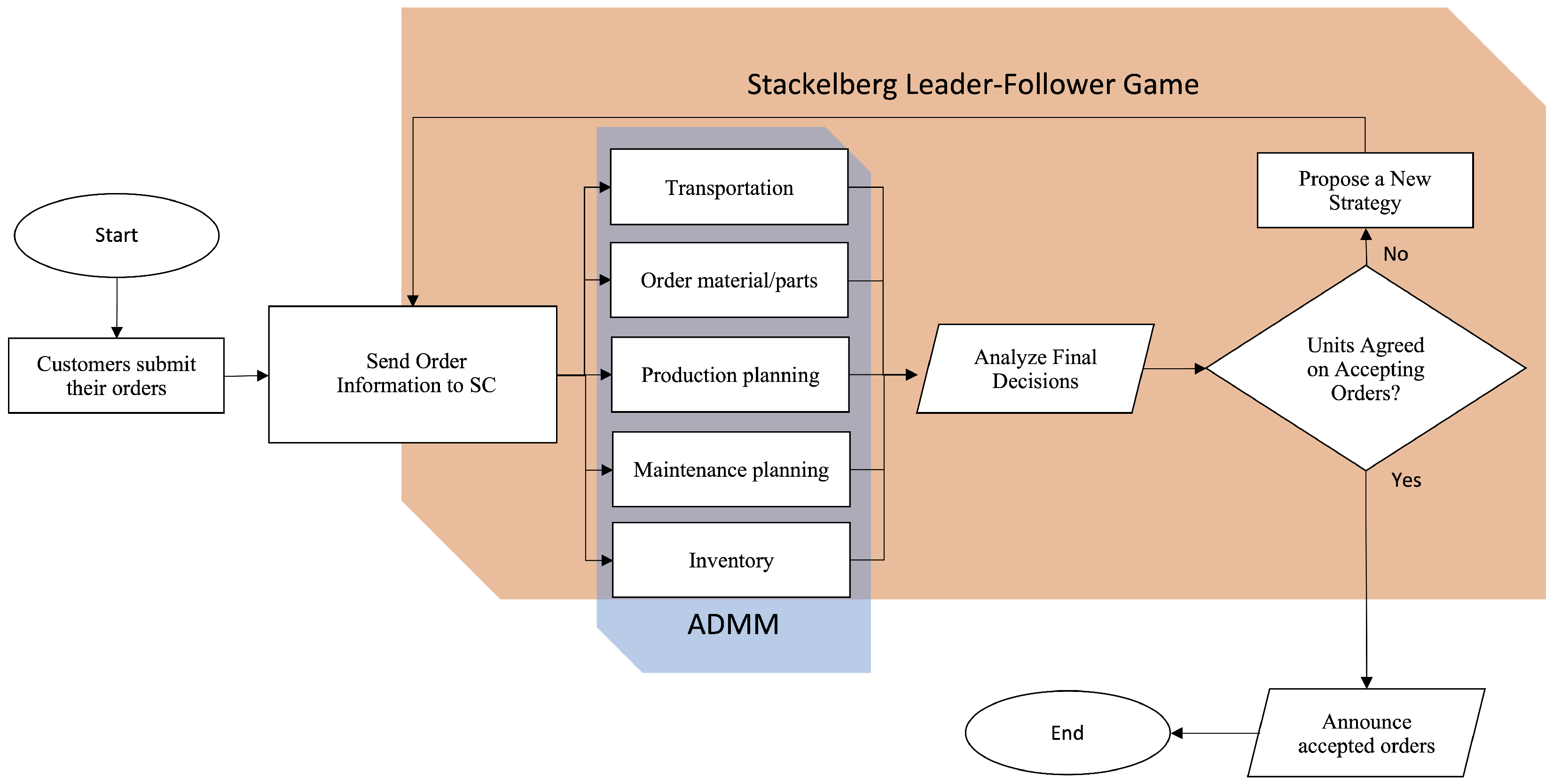
To coordinate order acceptances decisions with other available capacities in supply chain units, a distributed optimization framework based on ADMM and Stackelberg game is proposed (
Figure 3). The proposed framework is implemented in the previously published model for mass customization by [
12]. The cited research optimizes the best set of accepted orders given their requirements and available capacities in supply, production, maintenance, inventory, and distribution. To increase the resilience and privacy in the system, acceptance of the received orders are optimized iteratively based on the move of the market agent as a leader and coordinated decisions using ADMM in supply, inventory, production, maintenance, and distribution units as followers of this game.
3.1. ADMM Technique
The proposed distributed platform is based on ADMM technique that uses the concepts in augmented Lagrangian technique for solving large-scale convex optimization problems. It’s particularly useful in scenarios where the problem can be decomposed into smaller subproblems to be solved independently in parallel. The decomposed subproblems are solved iteratively to reach the optimal global solution. In this algorithm, each sub section only optimizes its own model and share the coupling variables with its neighboring agents to reach a point that satisfies the constraints for both participating agents. In its simplest form, consider the following model with variables
,
, and function
F and parameters
,
, and
, which are coefficient matrices encoding the linear constraints:
In ADMM technique, we write the related Lagrangian function in which the decision variables are iteratively updated and optimized in a distributed fashion.
In these sub-models,
and
shows Lagrangian multipliers and predefined penalty parameter.
indicates the
norm of a vector. In this distributed technique, the solution will be iteratively improved until all subsections reach a consensus for their final decision. This is implemented by updating dual variable
to converge to a point with negligible changes below defined trechold
[
28]:
In distributed optimization problems, the different subsections need to reach an agreement on certain variables. This is called global consensus problem that agents optimize their own objective function while holding a constraint that ensures the solution is same for all local solutions of the participating agents. This problem can be presented in the form of Equation (
4):
Consensus-based ADMM solved this model by remodeling the problem for sub systems shown in Equation (
5):
In large scales models such as supply chain systems, the system consists of n sub systems such as suppliers, manufacturing plants, distribution units and other elements. The main challenge for optimization of these systems is the computation burden caused by large number of equations that should be solved simultaneously. For example, the order acceptance decisions are decided based on the capacities received from supply chain sub-systems. Therefore, these decisions highly depend on decisions of other units while subsystems also have transactions with each other that need to be coordinated and defined at the same time. In supply chain systems, the production decisions depend on the suppliers’ decisions and plan of distributors to deliver the products. In fact, the availability of resources in these units determine whether to accept new orders or not. Moving to the distributed decisions, supply chain subsections will need to define their decisions while coordinating with other operations of the neighboring units. To handle such complexities, consensus based ADMM is applied to coordinate decisions shared between multiple units. The coupling variables are duplicated as local variables in each subsystem and they are modified in each iteration based on the received optimized local variables from subsystems.
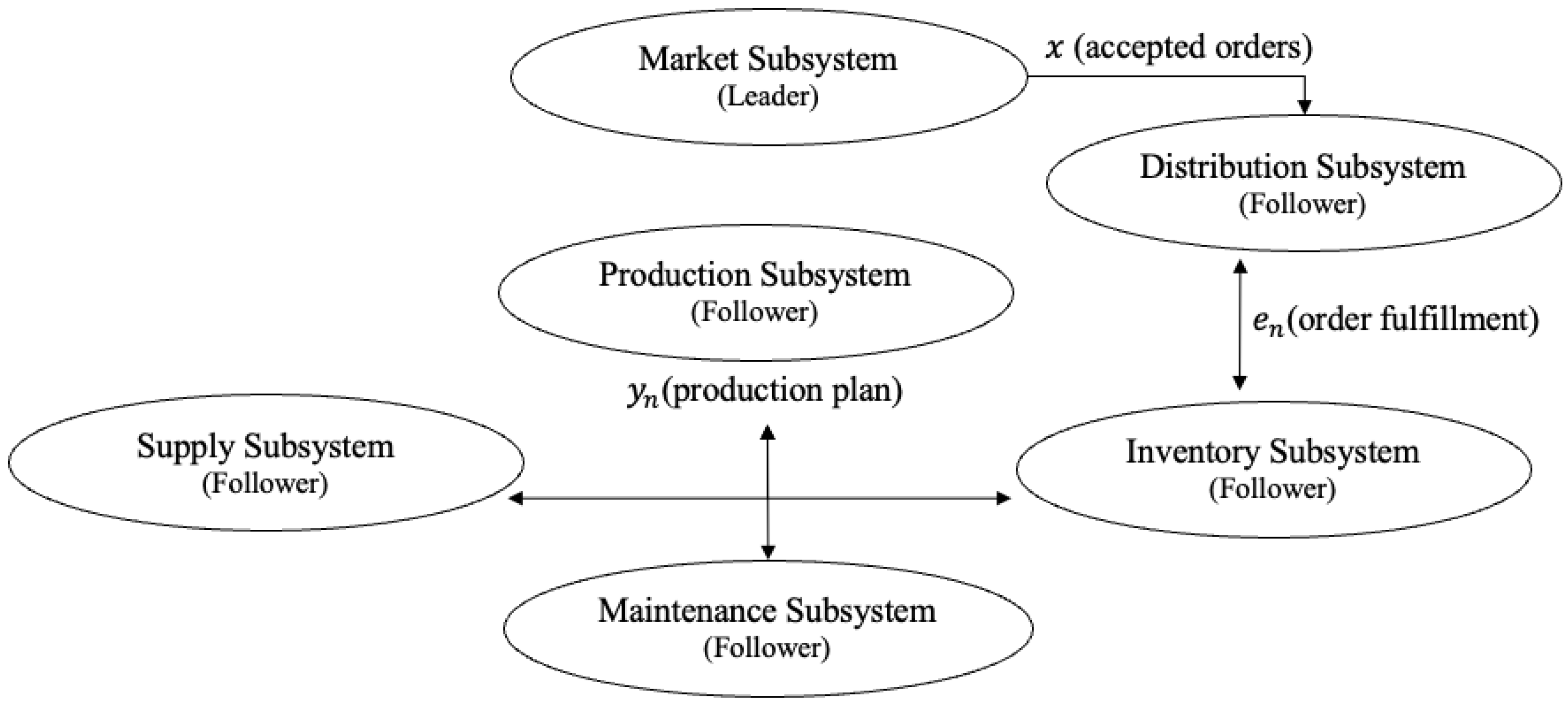
In the centralized framework, all subsystems share their capacities and costs information with the central order management unit. This unit finds the best decisions for order acceptance and shares it with all subsystems to get prepared for fulfillment of the accepted orders. In the proposed distributed format, all involved subsystems solve their own model individually, and then update the related coupling variables (b). These coupling variables are presented in
Figure 4. As it is shown in this figure, the information exchange between variables are limited to the number of accepted orders between market and distribution, order fulfillment plan between distribution and inventory, and production plan between production, supply and maintenance sections. In this platform, the order acceptance mechanism in the market agent only receives partial information about the agents to decide about accepting/rejecting of the received orders. This framework not only reduce the computation time of the system, but also help the subsystem to secure their decisions and not share private financial information. This also increase agility of the system to adjust subsystems’ decisions locally when they face with disruptions and delays.
3.2. Game-Based Order Acceptance Framework
Decomposing the supply chain problem to its subsystems considerably reduces computation times for each section. However, majority of subsystems are not willing to participate in the optimization, because acceptance of orders will impose additional costs for them. On the other hand, the main controller of the system, market agent, requires updates received from local supply chain units to decide about acceptance or rejection of the received orders. This issue is handled by introducing a Stackelberg game-based framework inspired from the proposed technique in [
45] with one leader and multiple followers. Stackelberg game is mainly used in economic and management field to model decisions shared between multiple decision makers. In this game, the leader is a player that decides first and other players respond to its decisions as followers by solving their own optimization models. In this framework, the market agent acts as a leader for the game that optimize its order acceptance binary decisions
given their resultant revenue
and total surrogate costs
F imposed by operations of the linked
N agents. These agents include suppliers, manufacturing plant, maintenance section, distribution and inventory which are modeled as followers of the Stackelberg game.
In each iteration of this game, the leader or order management unit provides price incentives,
, for to followers or supply chain units to motivate their operations. These incentive are proportional to their services provided for the accepted orders. In fact, the proposed ADMM structure coordinate the decisions of the subsystems or agents with each other and the game orchestrates their movements to achieve the goals of selecting best orders and distributing best price incentives. These updates are implemented in the sub models related to supply, production, inventory, maintenance, and distribution agents. These sub models not only optimize local decisions but also coordinate coupled decisions by including ADMM penalty terms and price incentives (
) received from the leader:
| Sets | |
| Total number of received orders () |
| Available transportation modes () |
| Available material () |
| Available machines in the plant () |
| Total number of subsystems/agents () |
| Total number of operation for order i () |
| Total number of suppliers () |
| Decision period (hrs.) () |
| Variables | |
| Completion time of order i |
| Delivery time of order i |
| Binary variable to show order fulfillment of order i at time t |
| Number of finished products for order i at time t |
| Binary variable to show if machine m is operating at time t |
| Inventory level for order i at time t |
| Delay in delivering of order i |
| Inventory of part k at time t |
| Binary variable of maintenance performed for machine m at time t |
| Binary variable to show unmet order i |
| Urgent supply for part k at time t |
| WIP of order i waiting before machine m at time t |
| Binary variable to show acceptance of order i |
| Number of parts for order i operated in machine m at time t |
| Binary variable of delivery of order i with transportation j at t |
| Parameters | |
| Delay penalty of order i ($/hr) |
| Storage cost of order i ($/item) |
| Maintenance cost for machine m at time t ($/maintenance) |
| Holding cost of part k ($/item) |
| Production cost for order i ($/hr) |
| Supply cost for part k from supplier s ($/part) |
| Transportation cost of order i using transportation j ($/item, mile) |
| Penalty cost for unmet order i ($/order) |
| Deadline for order i (hrs) |
| Locality index for order i (miles) |
| Mean time to failure of machine m (hrs) |
| Time to transport of order i using transportation mode j (hrs) |
| Profit margin for order i ($/order) |
| Quantity of order i |
| Revenue of order i ($/order) |
| Time required for maintenance of machine m (mins) |
| Utilization capacity index of machine m |
| Machine for operation of order i |
| Machine for the last operation of order i |
| Part k requirement in of order i |
| Estimated capacity of transportation mode j at time t |
| Estimated production capacity of machine m at time t |
| Estimated supply capacity of supplier s for part type k at time t |
| Estimated production capacity of m at time t during maintenance |
Each one of the followers will try to optimize the following sub-models:
Supply Sub-Model:
where the first equation defines the total cost and the next two equations balance the received material and their storage and their outflow for productions. Equation (
10) also ensures that the delivered material doesn’t exceed supplier available capacity. The objective function includes the costs for supply and material inventory and price incentives received from the leader as well as ADMM dual and penalty terms to ensure the consensus between coupled production variables.
In the above sub-model, the objective function is to minimize the operation costs of the machine defined in Equation (
12) considering price incentives for production and ADMM penalty terms. The first three constraints balance the production and work in process flow in the production plant while Equation (
16) set the number of produced products to the production of the last required process. Equation (
17) is set to show the periods that the machines are operating and not idle. In this model, the parameter BigM is utilized to handle logical constraints and its value is set to 99,999 ensuring stability of the optimization process. The last two equation ensures the production doesn’t exceed available production capacities in the plant and at the same time meets the required utilization level for machines.
Maintenance Sub-Model:
where the objective function minimizes the maintenance cost presented in Equation (
21) given price incentives and ADMM terms to reach consensus on production level while receiving price incentives from the leader to meet the maintenance requirement of the machines. The maintenance operations change the available production capacity (Equation (
22)) and defined machine utilization limits (Equation (
23)). The maintenance operations are set before mean time to failure of the equipment which is reflected in Equation (
24) and meeting the minimum required number of the maintenance are checked in Equation (
25).
In the above equations, the objective function minimizes the storage costs calculated in Equation (
27) while considering price incentives received from the leader and penalty terms for any mismatch on coupling variables. The incentives in this objective function is given based on total storage level in the decision period. The equations in this sub-model reflects balance equations for level of inventory for finished products. The storage capacity limit also is included in the last equation.
Distribution model minimizes the costs for delivery and penalties for delay and not delivery defined in (
32) and mismatches in the coupling variables included as ADMM penalty terms. It also receives price incentives for total deliveries from the leader. The completion time of orders and their delivery dates are determined using Equations (
33) and (
34). Equation (
35) calculates possible tardiness and Equation (
36) is defined to reflect if any delivery failure. The distribution operations in this unit also is limited to available capabilities reflected in Equation (
37).
In the proposed Stackelberg game, the leader cannot directly force followers to optimize their objectives by incurring related costs. Therefore it tries to set incentive terms (
) such as prices, payments or subsidies for its subsystems while they are trying to optimize their operations and coordinate with each other. These incentives are proportional to the operations of each unit. The leader updates incentives based on marginal costs of the follower action to make sure the best responses of the followers for the order acceptance decisions
coincides with the optimal actions of the system. At the same time the leader has its own limitations and each order acceptance decision will bring cost load for the whole system. To guide the decisions of the leader given future response, it is guided by logic-based Benders using optimality cuts approximating the followers costs for each order acceptance decisions [
46]. These considerations are included in the leader’s objective by including cost lower bound
for each subsysystem:
The followers also send information regarding feasibility of each set of order acceptance decisions in each iteration. The following feasibility cuts are added to the leader’s model if any of the sub-models face infeasibility to prevent that particular combination of accepted or denied orders
:
Lower bounds for costs in each section is defined based on the calculated costs of each unit () collected from previous iteration plus estimated changes that each order acceptance may cause (). At the beginning of running game-based ADMM, the values for are calculated based on specific features of the orders in terms of summation of expected supply cost plus its estimated operation and expected delivery costs. In real world applications, the historical data can be also utilized to get more precise estimates on these order expenses. Given the strategy designed in this research these estimates are utilized as initial guess for potential expenses and once the leader finds the best combination of the orders, the orders in two consecutive iterations will be the same and these terms are removed to get more precise estimates for lowers bound costs of the subsections. Once the leader solves its model to find the new set of accepted orders, the incentives weights of followers are adjusted based on the marginal costs of the subsections in previous iteration.
The game-based distributed order management problem is solved in a two-layer iterative framework that includes inner and outer loops. The indices
v and
are used to show the iteration number of each one of these loops. At the beginning, the leader sends its decisions to
n followers. Then, the followers start optimizing their decisions given the incentives received from the leader. After sharing their decisions, the leader updates its decisions and incentives based on their updated decisions. In the next iteration, the followers find a new agreement based on the adjusted incentives and decisions of the leader. In the proposed framework, the leader’s decisions are updated in an outer loop, while followers’ agreement and optimizations are presented in the ADMM based inner loop. The inner loop terminates when the stopping criteria of the ADMM is met. This criterion is expressed in terms of threshold for dual residuals in each subsystem. The stopping criteria for outer loop is based on the threshold (Equation (
42)) for changes in Lagrangian function of the leader:
The two layer game-based ADMM optimization algorithm is briefly described in Algorithm 1:
| Algorithm 1: Two layer distributed optimization |
 |
4. Numerical Experiments
In this section, the performance of the proposed algorithm is verified through a set of simulations for a supply chain with the data presented in
Table 2,
Table 3 and
Table 4:
The orders are generated randomly based on the parameter settings for the rates of complexity, promptness, revenue, customer location, quantity, and required parts or materials. These settings and categories are presented in
Table 5.
The late penalty in the model is defined as a percentage of the order revenue that will be charged per one day of delayed delivery.
First, the distributed game-based ADMM optimization algorithm is used to solve the same problem solved using a centralized decision-making algorithm by [
12]. The same simulation settings, as well as the same set of orders are used to show the effectiveness of the proposed algorithm. Then a sensitivity analysis is performed to show the effect of capacity change on the proposed incentive shares. At the end a sensitivity analysis is implemented on three control parameters to investigate the best settings for the proposed algorithm.
Compared to other distributed optimization techniques, ADMM technique is very straightforward algorithm with minimum number of hyper-parameters settings. The only parameter that needs to be set up properly in this algorithm is
. To analysis the effects of parameter setting, the model is solved for different settings of
parameter. The rest of the parameters including thresholds for stopping criteria are kept same for all these experiments. The results for costs is presented in
Table 6.
The result for this experiment shows that the value of highly affects the convergence rate and optimal total cost found by algorithm. In lower values of this parameter, the algorithm faces with convergence issue because this penalty is not large enough to motivate the system to decrease the difference between local and global variables. This is also caused because of the rate of the first portion of the local objective functions which is dedicated to local total costs in much larger scales compared to the penalty. The system shows more convincing moves in higher values of the parameter. Increasing this penalty also affects the total cost of the system, because local subsystems are forced not to react selfish and incur costs for coordinating their moves toward agreement with other players of the supply chain. In the rest of experiments, the setting for this parameter is set to 100, because it shows more stable response compared to other settings of the system.
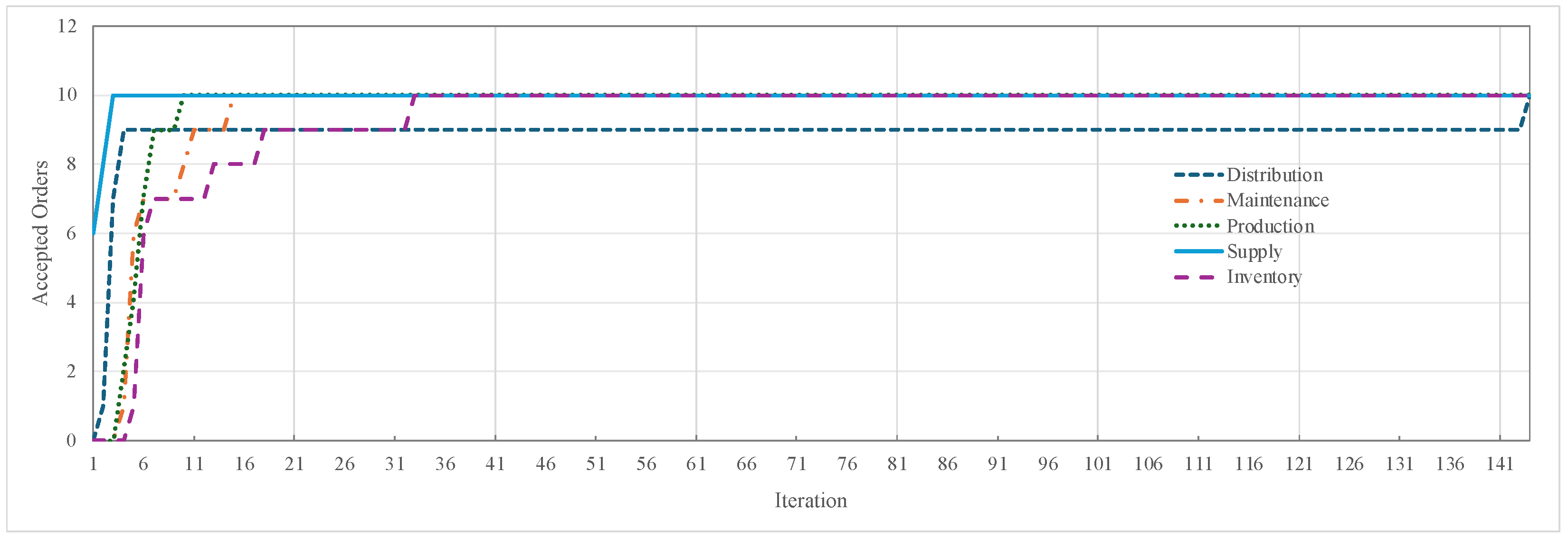
The results for total order acceptance in ADMM is presented in
Figure 5. Figure shows different subsystems optimize their decisions and share their accepted orders in multiple iterations until they reach an agreement on their decisions. Here the subsystems not only make agreements on accepted orders, but also coordinately decide about the best production and delivery decisions.
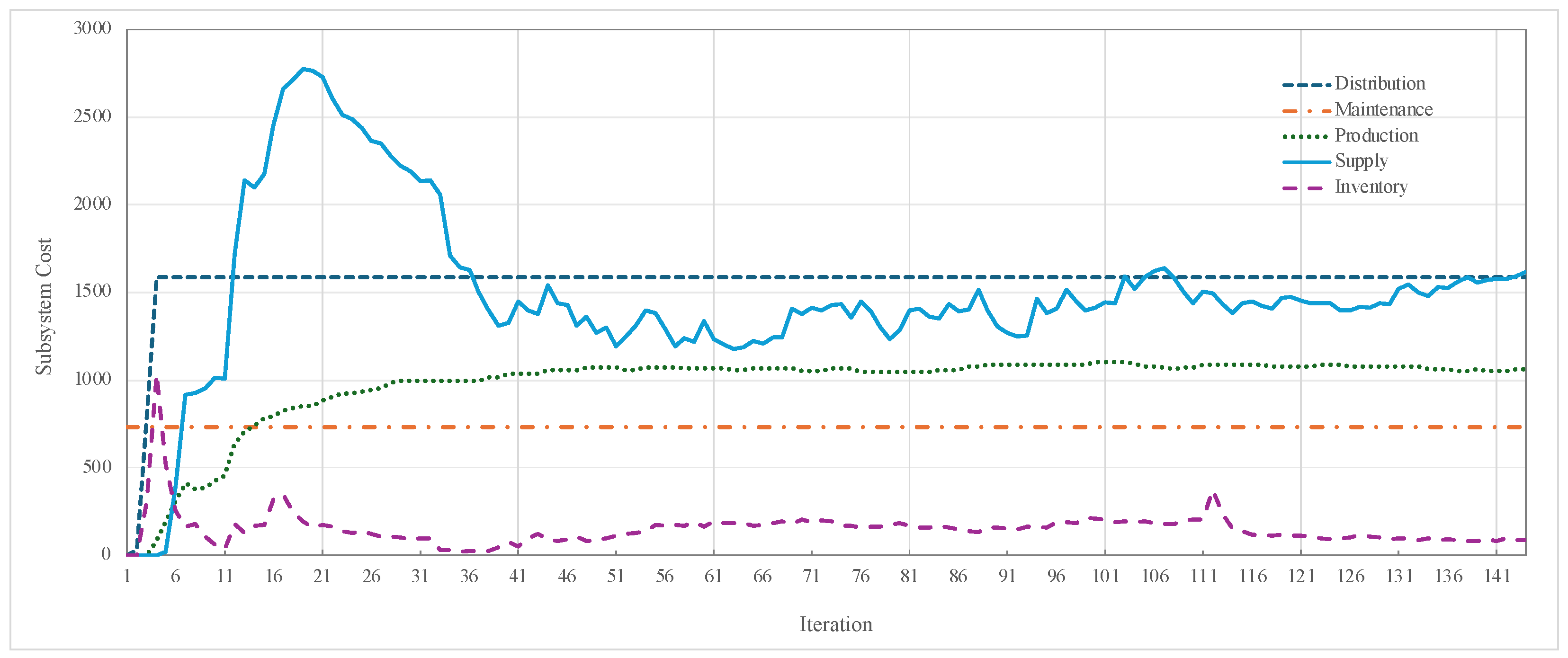
Figure 6 reflects the changes in totals costs for these supply chain units.
The performance of the proposed algorithm is also verified through a set of simulations. Initially, the algorithm is used to solve the model presented in [
12] based on the changes explained in this research. The numerical results, as well as the accepted orders from integrated optimization model and game-based ADMM optimization model are presented in
Table 7 and
Table 8.
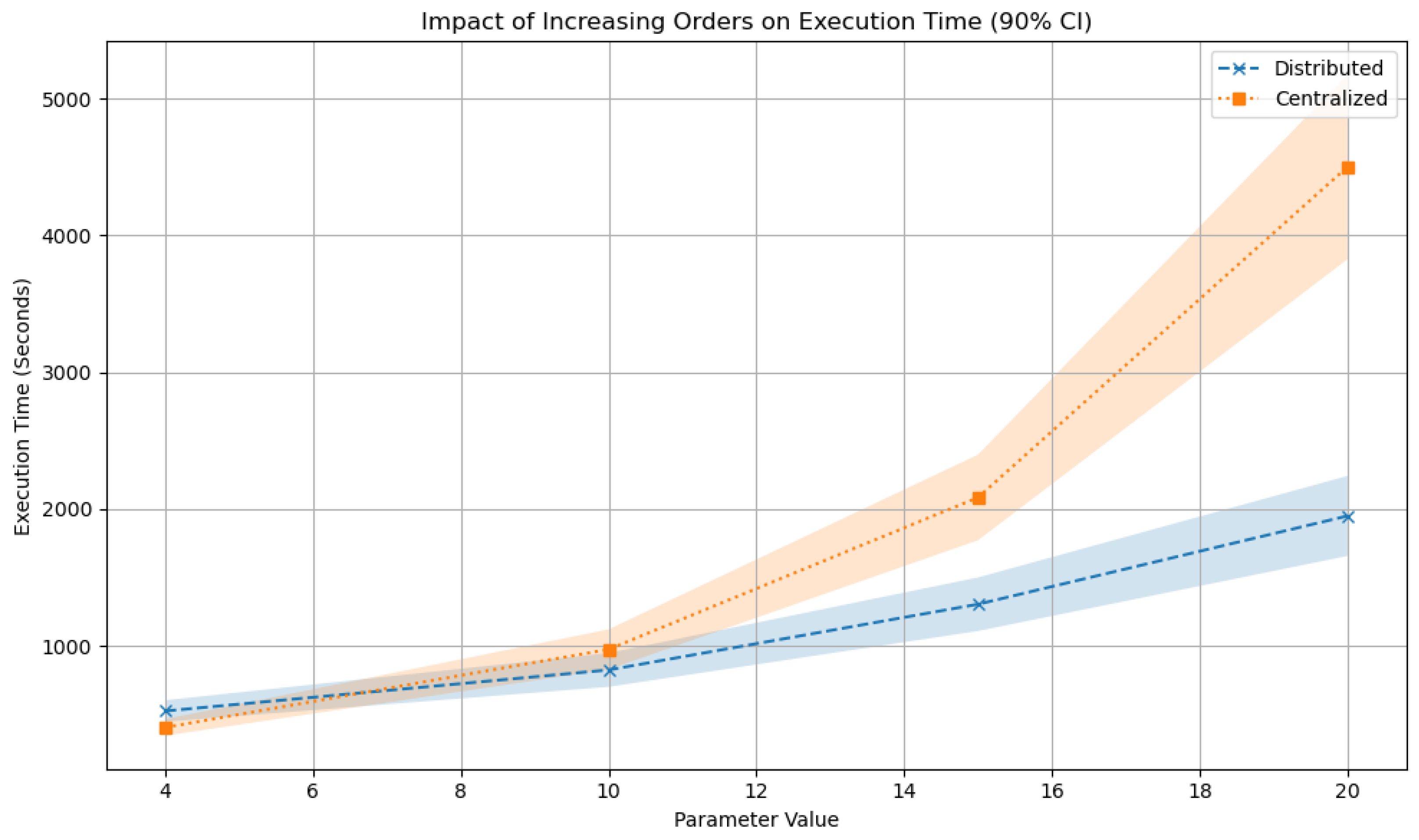
To evaluate the proposed technique in terms of its computation time, both models were run on different number of the received orders. The results for this experiment are shown in
Figure 7. As the chart shows the distributed technique is more efficient when number of the orders increases. This is mainly because the computation time of the centralized model significantly increases when the system receives more orders.
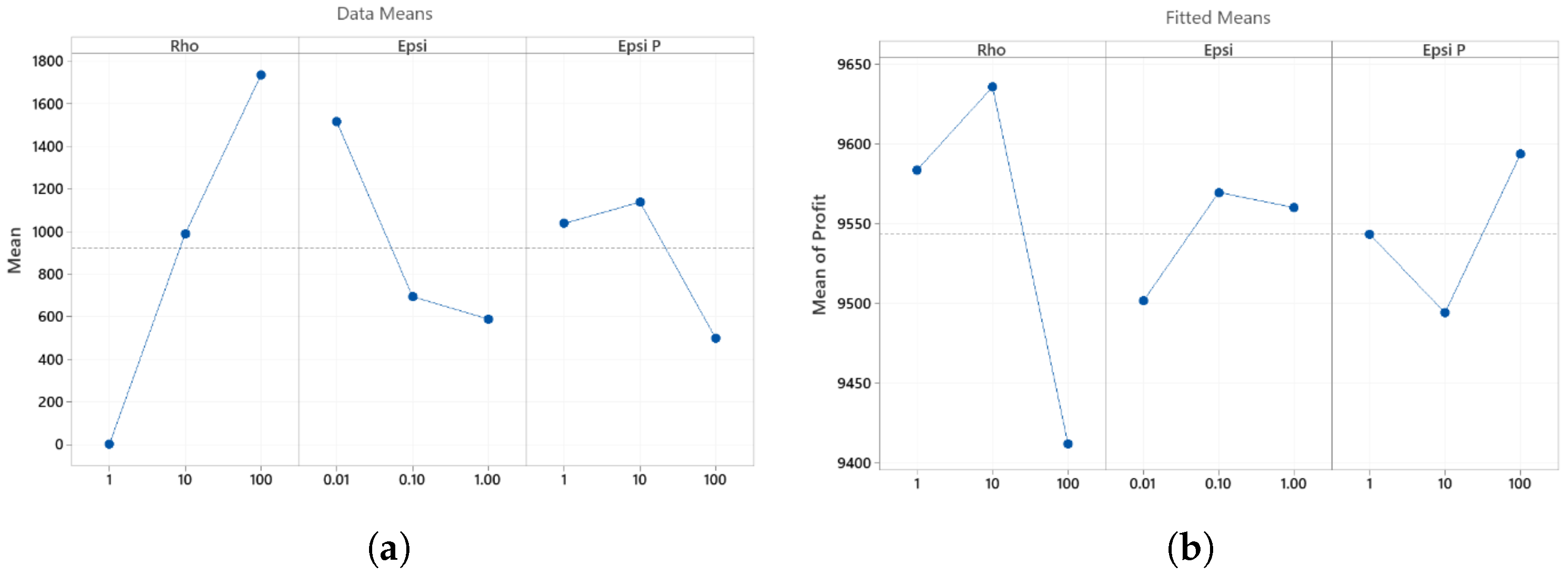
Although the sensitivity analysis on some factors of the proposed technique is implemented, more structured analysis like Multivariate Analysis of Variance (MANOVA) is needed to investigate the best settings for the proposed two level ADMM based game. To do so, three different levels for three different parameters of the algorithm are considered. The parameters are the penalty parameter (
), and the thresholds of internal (
) and external (
) loops. The used settings are listed in
Table 9.
For each setting of these parameters, the model is simulated and the results for run time and total profit is recorded.
Table 10 and
Table 11 show the MANOVA result. As the results show, the hyper parameter
, which is the penalty parameter of the model, is the most important factor. The related
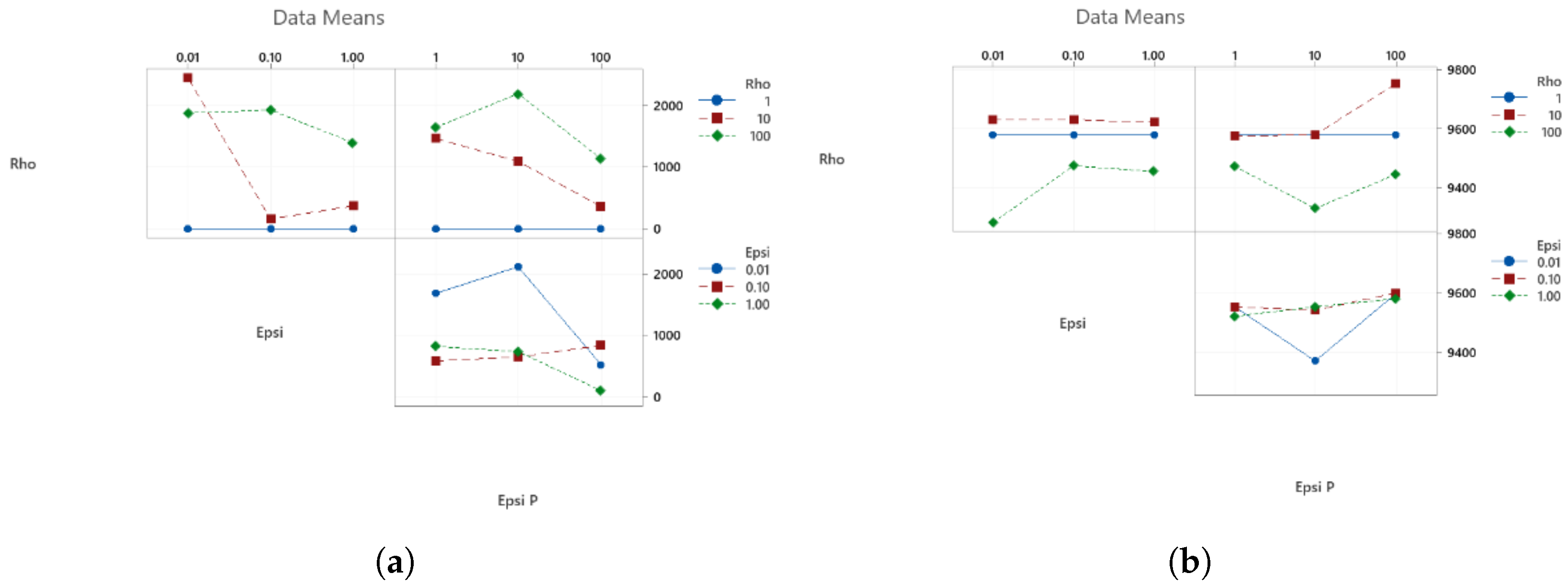
p-Value show that its setting highly affects the execution time, as well as the quality of solution in terms of total profit. Similar findings are shown as a result of MANOVA test indicating this fact that only penalty parameter setting is the most influencing factor in this analysis (
Figure 8 and
Figure 9).
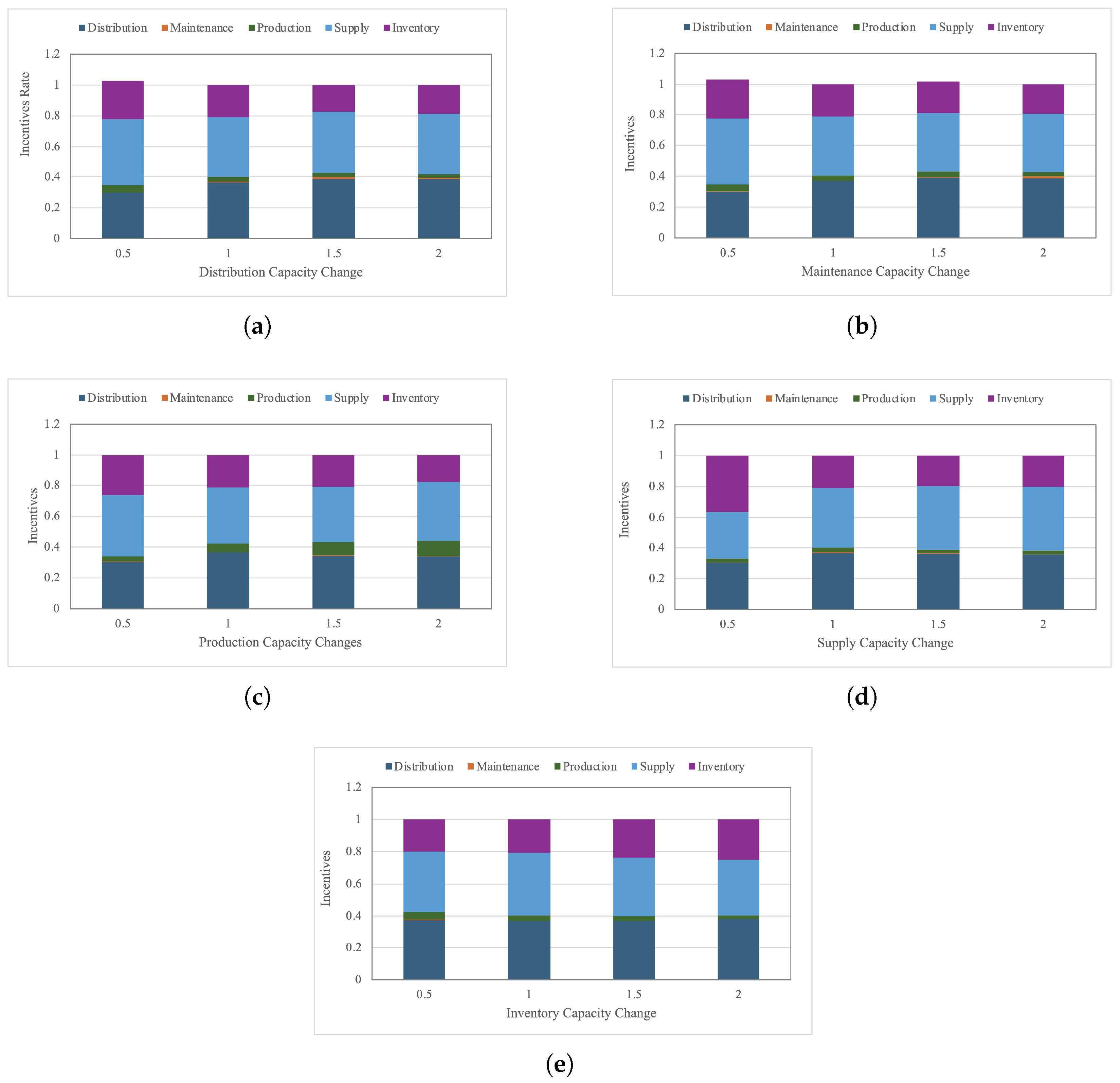
To investigate the effects of capacity settings on the proportion of incentives received for each subsystem, different values of these settings need to be used to solve the model. The model is initially solved for the base case when these capacities are set to the certain values. The results for sensitivity analysis of the distributed model are recorded. To capture the correct influence of these settings on total results, in each experiment, all other capacities are set to their base case and only one capacity is changed.
Figure 10 shows that increasing the capacity for subsystems increases the incentive proportion of that subsystem. This change is different for each subsystem, for example change on production capacity highly influences the proportion of the incentive receives with this subsection. The change is not considerable for other subsystems such as maintenance.
The results for sensitivity analysis on capacities also show that for each subsystem, increasing capacity only increases the incentives to certain level and after that increasing capacities doesn’t make any considerable change. This is mainly because even though changing one capacity help system to utilize the subsystem in a more efficient way, but the capacities of the other subsystems don’t let the target subsystem to fully utilize its own resources. For example, production level not only depends on production capacity, but also it depends on the material supply from suppliers. Not receiving enough material, the supply chain will not be able to utilize its full capacity to meet the orders.
5. Conclusions and Future Work
One of the main challenges in decision making and prescriptive modeling of the MTO supply chains is computation time, data privacy and information sharing between the involved sections. This paper addresses these challenges by proposing a distributed optimization platform that optimizes the order acceptance decisions in the supply chains with minimum information sharing between suppliers, production plants, inventory, maintenance team, and distribution units. The proposed framework is based on the Stackelberg game that enables negation between the order management unit and other service providing subsystems. It also utilizes ADMM technique to enable them to plan independently and reach an agreement for accepted orders. This is a critical in modern supply chain 4.0 to implement cloud-based systems to receive data from different subsystems and use that for real-time decision making on higher level decisions. The framework also facilitates information sharing between involved departments without risking the security of the system. Most importantly, the proposed framework prevents violating privacy concerns of the involved parties in customers’ order fulfillment. This means that each supply chain unit can plan for its own and operates without a need to share sensitive information with other supply chain units. The proposed framework also considerably improves the resilience of the system where failures in one unit doesn’t affects other units’ operations significantly. The experiments shows that the distributed model can achieve benefits comparable to those of an integrated model, even while sharing much less information between subsystems. This reduction in information sharing enhances data protection against cyber-attacks without compromising overall benefits across the entire supply chain.
There are some technical issues that need to be considered for practical applications of the proposed framework in current businesses. This framework relies on the timely feasibility responses and solutions received from supply chain units and they need to consider these capabilities in their existing IT infrastructures where plants, suppliers, and distribution centers already operate local planning systems. Each one of these units operate on their own local planning systems and effective launching of the proposed framework highly depends on the successful integration of local IT systems and seamless information flow within and across existing IT infrastructures. One of the advantages of the proposed technique is exchanging minimum aggregated information exchange between the involved parties that simplify its integration as a decision layer with existing ERP/MES systems without need for major redesigning the system. This framework is also economically feasible given reductions in computation, data sharing and monitoring costs. The distributed nature of the framework also allows supply chain units to gain more control and authority in handling internal failures and disruptions without need for reoptimizing the whole system. Increasing authority of the involved units decrease potential organizational resistances to adopt this framework and protect their preferences in choosing their suitable solver, model, and planning perspective. Protection of individual decision rights of the involved units also align with the requirements of the decentralized manufacturing environment for supporting smoother organizational buy-in.
The current research can be extended in multiple directions for future research. The proposed model in this research considers uncertainties limited to the settings for capacities in supply, distribution, market and the factors that define the main features of the orders. These features include order quantity, promptness, distance to the customer, deadline, and type of the ordered products. In real word systems, there are many other factors that may affect the efficiency and success of the real-world supply chains. Including more sources of the uncertainties can result in a more accurate and robust scheduling and production plan decisions. Using new emerging techniques such as multi-agent reinforcement learning can also be a great extension for the proposed research to generate more real-time platforms for MTO supply chains. The proposed framework can be also extended to other forms of supply chains such as reverse supply chain in which the products may be returned and reprocessed. Adding sustainability factor such as factors required in green supply chains and utilizing renewable energy sources is also an interesting extension for the proposed framework.