
Next Article in Journal
Is Cannabidiol (CBD) a Non-Psychoactive Phytocannabinoid?
Previous Article in Journal / Special Issue
From Adults to Adolescents: Bridging Scientific Potential and Evidence-Based Paths for Psychedelic-Assisted Interventions
 
 
Due to scheduled maintenance work on our servers, there may be short service disruptions on this website between 11:00 and 12:00 CEST on March 28th.
Article

Effects of Cannabis on Multiple Visual Parameters and Self-Perceived Eyesight: A Cross-Sectional Study in Cannabis Users in Morocco

1
Laboratory of Pharmacology, Neurobiology, Anthropology and Environment, Department of Biology, Faculty of Sciences Semlalia, Cadi Ayyad University, Marrakech 40000, Morocco
2
Laboratory of Plant and Biotechnology Vegetal, Department of Biology, Faculty of Science, Ibn Zohr University, Agadir 80000, Morocco
3
Laboratory of Scientific Innovation in Sustainability, Environment, Education and Health in the Era of Artificial Intelligence, Department of Biology, ENS, Sidi Mohamed Ben Abdellah University, Fes 30000, Morocco
4
Division of Professional Membership, Felloe College of Optometrists in Vision Development (FCOVD), Boston, MA 02115, USA
5
Department of Public Health, Bordeaux University, 33076 Bordeaux, France
6
Laboratory of Materials, Energy and Environment, Cadi Ayyad University, Marrakech 40000, Morocco
*
Author to whom correspondence should be addressed.
Psychoactives 2026, 5(1), 3; https://doi.org/10.3390/psychoactives5010003
Submission received: 10 December 2025 / Revised: 12 January 2026 / Accepted: 15 January 2026 / Published: 18 January 2026

Abstract

Cannabis is one of the most common intoxicants used worldwide. Cannabis is widely consumed worldwide and can lead to visual alterations. However, most of the available information on its effects comes from studies conducted in developed countries, while data remain limited in developing regions such as Morocco, despite its significant role in cannabis cultivation. The aim of this study was to explore multiple visual parameters and self-perceived eyesight in cannabis users in Morocco. A cross-sectional study was conducted between March 2022 and April 2023 in Marrakesh, Morocco, in cannabis consumers. Data collection was performed in two phases. First a hetero-administrated questionnaire was used to collect socio-demographics, intoxicant consumption habit information, and eye health information. Then, several visual acuity tests were performed, including a preliminary examination, a visual function assessment, and an eye health assessment. Ninety-five cannabis users participated in this study. The majority were single (62.1%) males (87.4%). All lived in the Marrakesh-Safi region (100%), and most had daily activities such as having a job or being a student (77.9%). Most had vision conditions like astigmatism or myopia (83.4%). The majority had multiple addictions (66.5%), mainly to tobacco (43.7%). Hashish was the main cannabis type used (57.9%), and smoked cannabis was the principal mode of consumption (94.7%). Many had a family history of cannabis addiction (58.9%). Day light sensitivity (66.3%) and appearance of eye symptoms after cannabis use (90.5%) were declared by the majority. In most cases, no impact on far or near vision or vision impairment due to cannabis use were declared. Our results showed that using cannabis could have significant adverse effects on visual functions.

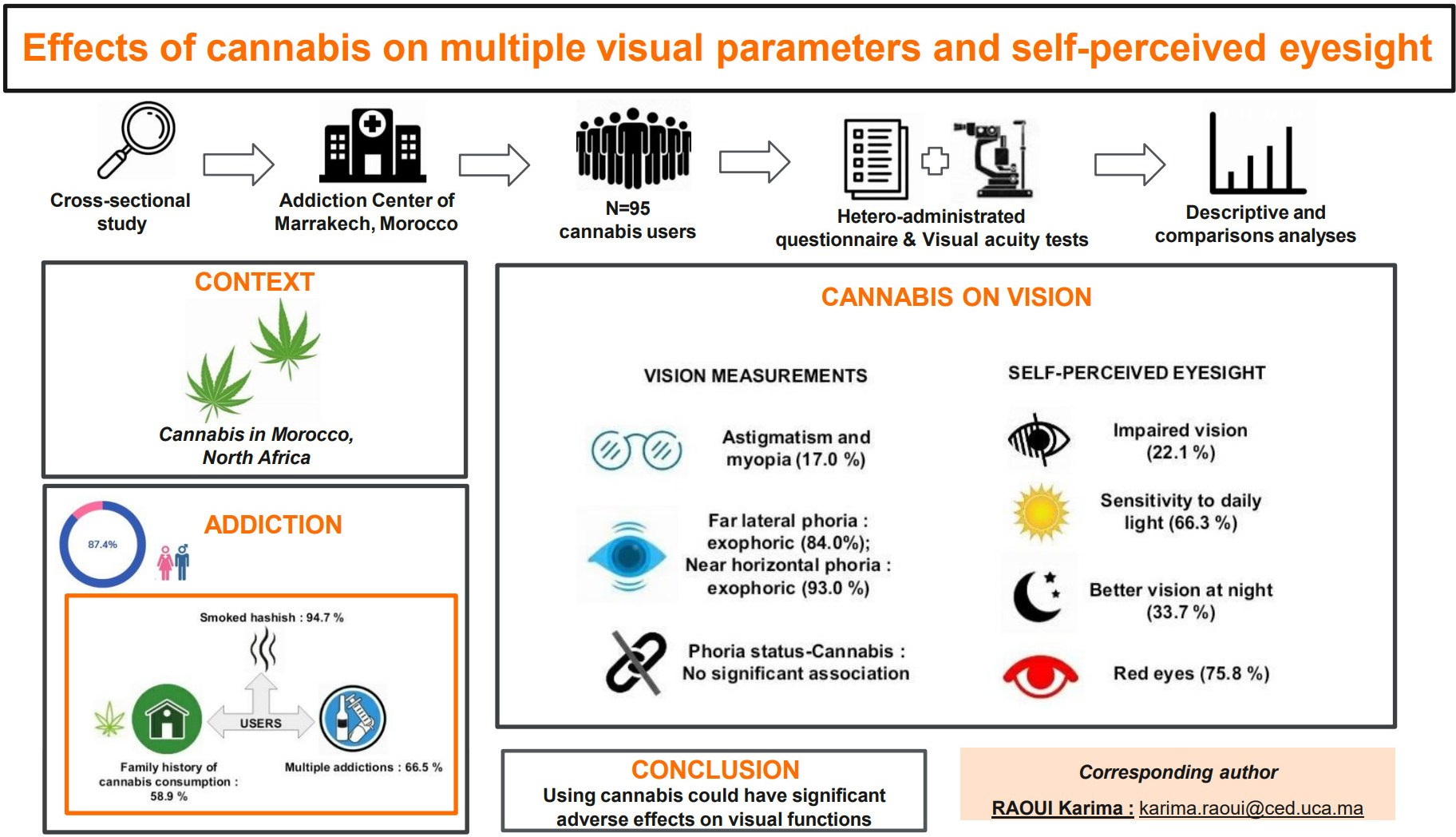
Graphical Abstract

1. Introduction

Cannabis is one of the most widely used psychoactive substances worldwide. Nearly all countries are affected by its use, and according to the World Health Organization (WHO), approximately 147 million people used cannabis in 2023, representing 2.5% of the global population. Cannabis can be consumed in various forms, including hashish, herbal cannabis, or oils. Regardless of its form, it is derived from Cannabis sativa, a plant containing numerous cannabinoids. Among these, Δ9-tetrahydrocannabinol (THC) and cannabidiol (CBD) are the most extensively studied for their pharmacological effects. THC is recognized as the primary compound responsible for acute psychoactive effects, whereas CBD is generally not considered psychotropic. However, the use of cannabis rich in THC, and to a lesser extent depending on cannabinoid composition, may be associated with undesirable psychological and physical effects [1,2,3].
Chronic cannabis use is thus associated with various impairments in general health, including persistent cognitive and memory deficits, alterations in motivation and executive functions, and an increased risk of anxiety and psychotic disorders, particularly in vulnerable individuals [4,5]. In addition, sleep disturbances are frequently reported among regular users [6]. From a somatic perspective, repeated cannabis use, especially when smoked, is associated with chronic respiratory disorders such as chronic bronchitis, persistent cough, and airway inflammation [5]. Cardiovascular effects have also been described, including tachycardia, blood pressure fluctuations, and an increased risk of cardiovascular events in certain users [7]. These effects are mainly attributed to the action of Δ9-tetrahydrocannabinol (THC) on the endocannabinoid system, whose activation can affect multiple physiological systems [8].
Regarding the effects of cannabis on vision, few studies have explored this field. Nevertheless, some have reported alterations in color vision, difficulties in visual information processing, reduced visual acuity, prolonged dark adaptation time, and increased tearing. Overall, cannabis use, particularly when regular, may significantly affect several visual functions. However, not all visual parameters have been comprehensively investigated, and the available data remain limited [9,10,11,12,13]. Moreover, a study examining self-reported visual quality among light and heavy adult cannabis users showed an altered perception of vision, with no significant difference between the two groups [14].
Most available data on the effects of cannabis on vision originate from developed countries, particularly the United States. In contrast, in developing countries, the health consequences of cannabis use remain poorly documented due to the limited number of studies and the lack of systematic research. According to the WHO, the negative biological effects of cannabis are comparable to those observed in developed countries, although cultural and social factors may modulate certain manifestations [3]. Morocco is a North African country where cannabis has been cultivated for several centuries, mainly in the Rif region [15,16]. However, scientific data on cannabis use and its health effects remain scarce, with most studies focusing on production and socio-economic aspects. A study conducted in 2020 examined factors associated with cannabis use among Moroccan patients with schizophrenia, without addressing visual consequences [17]. To our knowledge, only one study, published in 2004 as a case report, investigated the effects of cannabis on vision in Morocco, reporting an improvement in night vision parameters following the administration of THC or cannabis [18]. Overall, the available data suggest that cannabis use may influence certain visual functions, but the evidence remains insufficient, particularly in the Moroccan context. The objective of this study was therefore to jointly examine the impact of cannabis consumption on visual function among Moroccan consumers by assessing the level of cannabis dependence and its effects on self-perceived vision, lateral and vertical phoria at distance and near, and addiction-related characteristics in relation to ocular health information, as well as ocular symptoms reported after cannabis use. This comprehensive approach aimed to better characterize the visual effects of cannabis within this specific context.

2. Materials and Methods

2.1. Study Design and Ethical Approval

Following regional authorization No. 108 dated 18 February 2022 from the Ministry of Health and the Regional Directorate of Health and Social Protection of the Marrakech-Safi region, and with the approval of the management of the Marrakech Addiction Center, this cross-sectional study was conducted between March 2022 and April 2023. The study was carried out in accordance with the principles of the Declaration of Helsinki. The main objective of the study was explained to all participants, and voluntary informed consent was obtained prior to participation. All data were kept confidential. No financial compensation was provided; however, all participants received a free visual acuity examination, as visual parameters were collected for the purposes of this study.
The full study protocol, describing the inclusion and exclusion criteria, the methods for collecting visual data, and the outcome measures, was developed according to standards recognized by the World Health Organization. This study was non-interventional and observational in nature. No therapeutic, pharmacological, or behavioral interventions were introduced. All visual assessments were non-invasive and corresponded to routine procedures of a standard clinical ophthalmic examination. Ethical approval was granted by the Bioethics Advisory Commission of the Faculty of Sciences of Agadir (CCBE-FSA Ref. No: FCR-CS-07/2023-0001), serving as institutional ethics authorization.

2.2. Participants and Sampling

The target population consisted of cannabis users in Morocco, while the source population included individuals registered at the Marrakesh Addiction Center. Participants were selected using a non-probabilistic convenience sampling approach. Inclusion criteria required participants to be aged 18 years or older, to be Moroccan, to have resided in the Marrakesh-Safi region for at least five years, and to have been registered at the Marrakesh Addiction Center as a cannabis user for at least one month. Individuals with a history of cardiovascular disease or eye surgery were excluded.
Participant age and sex were recorded during recruitment to describe the population, but the study was not powered or designed to analyze sex-specific differences, and no stratified analyses by sex were performed. Cannabis consumption details, including type of cannabis used, age at first use, frequency, and use of other intoxicants, were collected to provide a complete characterization of participants.

2.3. Data Collection

After agreeing to participate, the participants met with the principal investigator of the study, a qualified optician, for data collection. A hetero-administered questionnaire was used. It consisted of three parts: (1) sociodemographic information, (2) cannabis consumption habits as well as possible consumption of other intoxicating substances, (3) information on ocular health. The questions were asked orally in Moroccan Arabic, as it is the most commonly spoken language in Morocco. If necessary, additional explanations were provided to help participants understand the questions correctly. All responses were recorded by the investigator.
The various visual parameters were assessed using the WHO/PBL eye examination form [19]. The chart proposed in the POLA VistaVision Visual Chart System (DMD Med Tech srl., Turin, Italy) was used for the analysis of visual acuity, corrected visual acuity, color vision, and visual field. Then, a visual function assessment was performed using the UNIQUE.RK autorefractor (Indo srl., Barcelona, Spain), which included both subjective and objective refraction tests. Using the UNICOS DIGITAL REFRACTOR (Indo srl., Barcelona, Spain), measurements of eye convergence, pupillary reflex, interpupillary distance, and phoria were obtained.
To do this, participants were invited to fixate on letters on a 6/6 visual acuity scale (Snellen notation) placed 6 m away [20], viewed through a phoropter. They had to maintain their gaze on the target until achieving vertical alignment, then report it verbally. While their eyes were occluded, prisms were introduced in front of both eyes: a dissociation prism and a measurement prism. A 6 Base-Up (BU) prism was added to the left eye, causing the target to appear lower compared to what the right eye perceived. This led to the perception of two scales: one higher on the right and the other lower on the left of the subject, which was confirmed by the participant. The participant then had to announce when vertical alignment was reached by saying “Stop.” This moment corresponded to the alignment of the upper target with the lower target, while the amount of Base-In (BI) prism un front of the eye was gradually reduced. The amount of horizontal prism placed in front of the right eye at the moment the subject indicated alignment was recorded as the lateral phoria for the tested distance. The same procedure was repeated with a near target (40 cm) using a reduced Snellen scale, allowing for the determination of near phoria. It is noteworthy that a Base-In prism indicated esophoria, a Base-Out prism indicated exophoria, and if the pointer remained at zero, it signified orthophoria. All visual assessment tests and the measurement procedures were conducted with a clinically validated refraction tool, and data collection lasted about 30 min per participant [20].

2.4. Data Analyses

Data were entered using Microsoft Excel and subsequently analyzed with the Statistical Package for Social Sciences (SPSS), version 16. Participants’ sociodemographic characteristics (age, sex, marital status, level of education, occupation, living conditions, and type of housing) were analysed descriptively. Quantitative variables were expressed as means ± standard deviation (SD), while qualitative variables were presented as frequencies and percentages. Eye symptoms reported after cannabis use, as well as addiction characteristics, eye-health-related information, and self-perceived effects of cannabis on participants’ eyesight, were analysed by comparing frequencies according to the type of cannabis consumed (kif, hashish, kif and hashish) and the mode of consumption. Comparisons of proportions were performed using Fisher’s exact test, given the sample size. The association between cannabis consumption and subjective perception of visual quality (improvement, deterioration, or no change in vision) was examined using appropriate comparative tests depending on the nature of the variables. Results were expressed as frequencies, percentages, and p-values. The horizontal and vertical phoria status, at distance and near, was analyzed in relation to cannabis consumption. Differences in phoria distribution according to the type of cannabis consumed and its association with other substances were assessed using Fisher’s exact test. The level of statistical significance was set at 5% (p < 0.05) for all analyses.

3. Results

3.1. Sociodemographic Characteristics of Participants

A total of 95 participants were included in the study. The sample was predominantly male, with 83 men (87.4%) and 12 women (12.6%). The mean age was 33.6 ± 13.8 years, with ages ranging from 18 to 67 years. Most participants were single (62.1%, n = 59), while 34.7% (n = 33) were married and 3.2% (n = 3) were widowed.
All participants originated from the Marrakech-Safi region of Morocco. Regarding educational attainment, the majority had received formal education, with 22.1% having primary education, 25.3% secondary education, 19.0% high school education, and 23.1% university education, while 10.5% reported no formal education. In terms of professional status, most participants were employed or students, mainly workmen (29.5%), employees (23.2%), and students (20.0%). Unemployed individuals accounted for 22.1% of the sample.
Most participants reported stable living conditions (98.9%) and lived with their family (96.8%). A detailed summary of the sociodemographic characteristics is presented in Table 1.

3.2. Cannabis Addiction of Participants and Its Effects on Self-Perceived Eyesight

All participants reported cannabis use (100%). Two-thirds of the sample presented multiple substance use (66.5%), most frequently associated with tobacco (43.7%), whereas less than one quarter were exclusive cannabis users (23.8%). A minority of participants (9.5%, n = 9) reported irregular or occasional cannabis use that could not be classified as mono- or poly-substance use. Hashish was the most commonly consumed form of cannabis (57.9%), and all participants reported smoking as the sole mode of consumption. The mean age at first cannabis use was 17.5 ± 5.4 years, indicating early initiation. A family history of cannabis addiction was reported by more than half of participants (58.9%), most commonly involving first-degree relatives, particularly brothers (22.1%) and fathers (15.8%) (Table 2).
Regarding self-perceived visual effects, the majority of participants reported no blurred near vision (71.6%) or blurred distance vision (64.2%) following cannabis use. However, one third of participants (33.7%) perceived an improvement in night vision, mainly among users of hashish or combined kif and hashish. Despite the absence of perceived overall visual impairment in most participants (77.9%), sensitivity to daily light was frequently reported (66.3%), suggesting a possible subclinical visual discomfort associated with cannabis use.
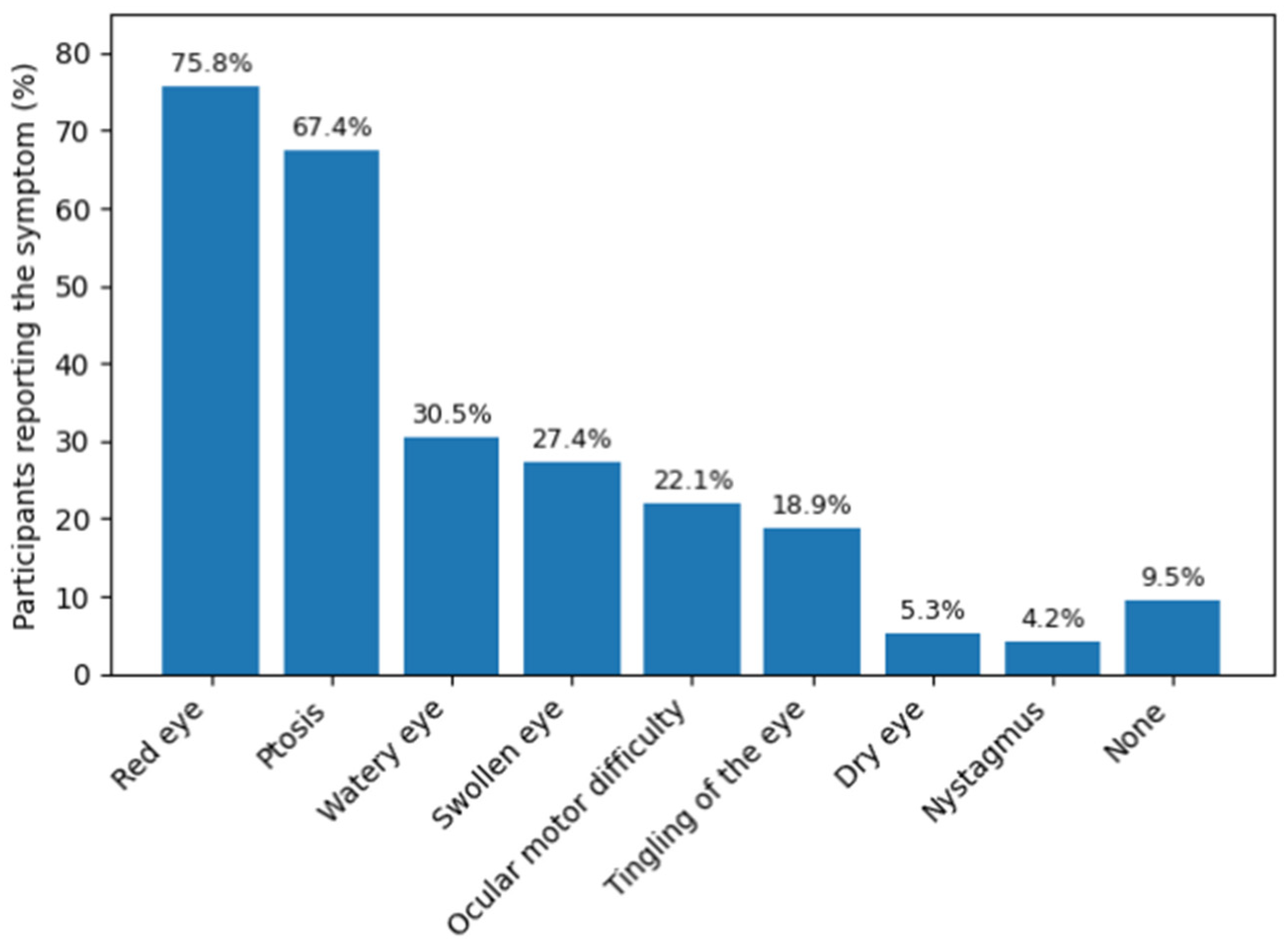
Ocular symptoms following cannabis consumption were common, with red eye (75.8%) and ptosis (67.4%) being the most frequently reported manifestations. Watery eyes (30.5%) and swollen eyelids (27.4%) were also relatively frequent, whereas nystagmus (4.2%) and dry eye symptoms (5.3%) were less commonly reported. Only 9.5% of participants reported no ocular symptoms after cannabis use.
Most participants had no diagnosed eye disease (97.9%), and more than half had never undergone an ophthalmologic examination (50.5%). Among those reporting refractive errors, hyperopia with astigmatism (31.6%) and isolated astigmatism (13.7%) were the most frequent conditions. A detailed summary of cannabis use patterns, ocular history, and self-perceived visual effects is presented in Table 2.
Comparative analysis revealed statistically significant associations between cannabis type and certain self-perceived visual effects. Improved night vision was significantly more frequently reported among hashish users compared with non-users (81.8% vs. 45.0%, p < 0.001), whereas kif users reported this effect less often (28.0% vs. 80.0%, p < 0.001). Impaired vision was significantly more prevalent among kif users (92.0% vs. 72.9%, p = 0.048), while combined kif and hashish use was associated with a lower perception of impaired vision (59.1% vs. 83.6%, p = 0.015). Blurred near and distance vision were also significantly associated with kif consumption and poly-substance use (p < 0.01), suggesting a possible interaction between cannabis type and visual discomfort.
Sensitivity to daylight did not differ significantly according to cannabis type or consumption mode (p > 0.05). These findings indicate that specific patterns of cannabis use may influence subjective visual perception, particularly night vision and visual clarity. (Table 3).Ocular symptoms following cannabis use were frequently reported. Only nine participants (9.5%) reported no eye-related symptoms. The most common manifestations were red eyes (75.8%) and ptosis (67.4%), followed by watery eyes (30.5%) and eyelid swelling (27.4%). Less frequent symptoms included ocular motor difficulty (22.1%) and tingling sensations (18.9%), while dry eye (5.3%) and nystagmus (4.2%) were rare. As participants could report multiple symptoms, the cumulative percentage exceeded 100% (Figure 1).

3.3. Lateral and Vertical Phoria Status of Participants at Far and Near

At far distances, most participants exhibited lateral exophoria (84.0%), whereas smaller proportions presented esophoria (8.4%) or orthophoria (7.3%). Vertical phoria at far distances was orthophoric in all participants (100%). At near distances, exophoria remained predominant for horizontal phoria (93.0%), and all participants were orthophoric for vertical phoria (100%).
No statistically significant associations were found between phoria status and cannabis use patterns. Specifically, lateral phoria at far distances and horizontal phoria at near distances were not significantly associated with the number of daily cannabis consumptions (p = 0.771 and p = 0.407, respectively). Similarly, no significant associations were observed with hashish use (p = 0.710 at distance; p = 0.402 near), kif use (p = 0.987 at distance; p = 0.302 near), or combined kif and hashish consumption (p = 0.615 at distance; p = 0.563 near).
These findings suggest that, in this sample, cannabis consumption patterns were not associated with measurable alterations in lateral or vertical phoria at either far or near viewing distances (Table 4).

4. Discussion

In this study, we explored multiple visual parameters and self-perceived eyesight in cannabis users in Morocco. All visual parameters were evaluated while the participants were under the influence of cannabis or had used cannabis in the past 24 h before data collection. This element is significant because it means they definitely had residual cannabis levels maintained in their body. Indeed, cannabis can be maintained for between several hours and several days in the body after use according to the frequency and consumption mode [21,22].
Our participants were mainly single males (87.4%). Our results are in accordance with other studies which indicate that men are more likely to be cannabis users [23,24]. It seems that women have higher perceptions of risks associated with cannabis use. That could be a reason for the male predominance in our study [25,26,27]. The age of first cannabis use in our participants was 17.5 ± 5.4 years old. This shows that there is a clear adolescent exposure to cannabis.
The literature suggests that individuals with early cannabis use are more likely to develop psychosocial disorders as well as brain alterations and cognitive impairments [28,29]. On top of that, they tend to have several addictions in addition to cannabis. This is in line with our results as the majority of participants consumed other drugs aside from cannabis.
The main ones were tobacco and alcohol. Co-use of tobacco and cannabis or alcohol and cannabis is common according to the literature. These multiple dependencies could increase the negative impacts on overall health, inducing worse clinical outcomes and worse social behavioral consequences compared to cannabis use only [30,31,32,33].
However, concerning social consequences of cannabis use in our participants, we found that most of them live with their family in stable living conditions, with daily activities such as having a job or being a student. Indeed, one third (34.7%) of our participants were married, and less than half had no occupation (22.1%). This shows that the social life of most of our participants was not too impaired. Often, cannabis users are less satisfied with their social relations and social activities than the non-users. However, the satisfaction regarding these social aspects were not examined in this study [34].
Concerning the cannabis type and its mode of consumption in our participants, our results showed that hashish was the main cannabis type and smoking was the only consumption mode. These two elements are quite common in cannabis users according to the literature [35,36]. Other types of cannabis consumption exist and are common too, such as edible marijuana, but were not found in our participants [36].
A reason for this could be the easy access to smoked hashish in Morocco compared to other cannabis forms. With this study, we also found that many of our participants had a family history of cannabis addiction from male members of the family (70.1%). This is in accordance with other studies which suggest that parental or family cannabis use is a risk factor for the children to use cannabis as well. Thus, when there is a family addiction history, adolescents are more likely to consume cannabis than others without parental cannabis addiction [37,38,39]. Concerning the vision of our participants, we found that most had a vision condition, most commonly hyperopia associated with astigmatism (32%). This is in line with the scientific knowledge, as astigmatism is often associated with other vision conditions such as hyperopia [40,41].
In this study, phoria measurements were also considered. Only seven participants were classified as orthophoric for distance lateral phoria, and none were orthophoric for near lateral phoria. These findings are consistent with previous reports in the literature indicating that phoria status may vary in visually active individuals using psychoactive substances. However, to the best of our knowledge, no study has specifically examined the association between cannabis use and phoria status [42].
Regarding the association between cannabis use and vision, most participants reported no changes in either distance or near vision, nor any vision impairments. These findings are consistent with a previous study suggesting that self-reported quality of eyesight does not differ significantly between heavy cannabis users, light cannabis users, and individuals who have never used cannabis [14].
However, another study strongly suggests that cannabis use negatively impacts visual functions. It seems that this fact is not self-perceived as there is a low risk perception of harm for the eyes due to cannabis use among cannabis consumers [43]. Daily light sensitivity was a discomfort reported in three quarters of our participants (66.3%). It is known in the literature that cannabis users are sensitive to high luminance levels, such as in day-time [13]. Three main recommendations emerged according to our results. Firstly, we recommend continuing to study the effects of cannabis use on vision and self-perceived eyesight, especially in Muslim and developing countries.
Given the widespread use of cannabis worldwide, it is important to consider the complex social and cultural contexts in which it occurs. Research on drug use in Arab countries has been relatively limited in the past, despite a recent increase in such studies. This topic remains sensitive for many individuals in Arab societies due to cultural and religious factors [44,45,46]. Cannabis users constitute a specific population that is often difficult to reach, as discussions about addiction can be considered taboo in certain countries, including Morocco. In this context, cannabis use is generally prohibited according to Islamic tradition, which continues to play an important role in Moroccan communities [47,48].
For this study, participants were recruited through the addiction center in Marrakesh using a non-representative sampling approach. Therefore, the findings may not reflect all regions of Morocco, as socioeconomic factors differ across rural areas or smaller cities without accessible addiction centers for their cannabis user populations [49]. Nevertheless, a sufficient number of participants were included, allowing the study to be conducted. In addition, promoting eye health monitoring among cannabis users is recommended. Regular eye examinations remain important for maintaining visual health, and yearly eye exams for individuals aged 18 to 64, regardless of current eye health status, are advised according to the American Optometric Association (AOA) guidelines [50].
In our participants, we discovered that half (50.5%) had never had any eye examination in their life, even though they underwent psychiatric follow-up at the addiction center by medical doctors. It is reported in the literature that psychiatrists can fail to carry out physical health checks in their patients. Thus, it is important to continue sharing and exploring scientific information on this subject in order to show the importance to mental health specialists of not forgetting the physical health of their patients. This would help reduce health disparities as well [51,52].
Despite the relevance of the present findings, several methodological limitations should be acknowledged when interpreting the results and considering their generalizability. First, the cross-sectional nature of the study prevents the establishment of a causal relationship between cannabis use and visual alterations; therefore, the results should be interpreted as associations rather than direct effects, as previously reported [53].
In addition, cannabis use was assessed exclusively through self-report, which may be subject to recall bias or social desirability bias. The absence of biological verification of THC exposure further limits the precision of the exposure assessment [54]. The relatively small sample size and the marked predominance of male participants may also have reduced the ability to detect sex-related differences and limit the extrapolation of the findings to broader populations.
Moreover, the study design does not allow a clear distinction between acute and chronic effects of cannabis use, nor does it fully isolate the impact of cannabis from that of commonly associated substances such as tobacco or alcohol, both of which may independently affect visual function [55]. Finally, although multiple visual parameters were evaluated, other relevant aspects of visual performance, including contrast sensitivity and light halo perception, may have been subtly but clinically affected and were not explored in the present study, as suggested by recent studies [53]. Taken together, these limitations underline the need for future longitudinal and experimental studies, using objective measures of cannabis exposure and more diverse samples, to better elucidate the specific effects of cannabis on visual function.
Finally, we recommend conducting more research on eyesight during night-time. A third of our participants declared having better eyesight during night-time. Very few studies reported the same information. One research based on an observation of Jamaican fishermen who consumed cannabis showed that they had excellent night vision, and a Moroccan case report on three subjects showed the same outcome as well [13,56]. Therefore, we suggest deeper explorations of this element as the reasons underlying this phenomenon are still unclear and there are not many scientific papers on this topic.

5. Conclusions

This study, conducted with 95 cannabis users, provides insights into the potential associations between cannabis use and visual function. The results suggest that certain visual aspects, such as light sensitivity and phoria, may be influenced in some users, although most participants did not report blurred vision at near or far distances. Most participants were single men living in the Marrakech-Safi region, engaged in daily activities such as work or studies. Many had pre-existing visual conditions, including astigmatism or myopia, and multiple substance use, primarily tobacco. Hashish was the most commonly used type of cannabis, and smoking was the main mode of consumption. The most frequently reported visual symptom was increased light sensitivity, while a subset of participants (33.7%) reported some improvement in night vision. This study highlights potential associations between cannabis use and visual function. While causal relationships cannot be established, light sensitivity and phoria appeared to differ among users, whereas most participants reported no blurred vision.
The study provides valuable insights into visual function among cannabis users, despite limitations such as its cross-sectional design, small sample size, male predominance, and self-reported use. The results highlight the importance of regular eye exams and the need for future longitudinal studies with objective measures to better understand potential associations and inform public health recommendations.

Author Contributions

Conception and design of the work or data acquisition: K.R., C.A., M.C.; data analysis: K.R., A.B., S.M.; data interpretation: K.R., E.W., R.C., H.G., M.C., C.A.; manuscript writing: K.R.; critical revision: K.R., E.W., A.B., R.C., S.M., H.G., M.C., C.A. All authors have read and agreed to the published version of the manuscript.

Funding

This research received no external funding.

Institutional Review Board Statement

Following the regional authorization No. 108 dated 18 February 2022 from the Ministry of Health and the Regional Directorate of Health and Social Protection of the Marrakech-Safi region and with the approval of the management of the Marrakech Addiction Center, this cross-sectional study was conducted between March 2022 and April 2023. The study was carried out in accordance with the principles of the Declaration of Helsinki. The ethics committee of the Regional Academy of Education approved the study protocol (REF 9365/21) on 25 October 2021.

Informed Consent Statement

Informed consent was obtained from all subjects involved in the study.

Data Availability Statement

The data presented in this study are available in this article.

Acknowledgments

Our thanks go to all the participants as well as the Marrakesh Addiction Center. The authors have reviewed and edited the output and take full responsibility for the content of this publication.

Conflicts of Interest

The authors declare no conflicts of interest.

Abbreviations

The following abbreviations are used in this manuscript:
CBDCannabidiol
THCΔ9-tetrahydrocannabinol
WHOWorld Health Organization

References

  1. Karila, L.; Roux, P.; Rolland, B.; Benyamina, A.; Reynaud, M.; Aubin, H.-J.; Lançon, C. Acute and Long-Term Effects of Cannabis Use: A Review. Curr. Pharm. Des. 2014, 20, 4112–4118. [Google Scholar] [CrossRef]
  2. Leung, J.; Chan, G.C.K.; Hides, L.; Hall, W.D. What Is the Prevalence and Risk of Cannabis Use Disorders among People Who Use Cannabis? A Systematic Review and Meta-Analysis. Addict. Behav. 2020, 109, 106479. [Google Scholar] [CrossRef] [PubMed]
  3. World Health Organization. Alcohol, Drugs and Addictive Behaviours Unit. Available online: https://www.who.int/teams/mental-health-and-substance-use/alcohol-drugs-and-addictive-behaviours/drugs-psychoactive/cannabis (accessed on 23 September 2023).
  4. Hall, W.; Degenhardt, L. Adverse Health Effects of Non-Medical Cannabis Use. Lancet 2009, 374, 1383–1391. [Google Scholar] [CrossRef] [PubMed]
  5. Volkow, N.D.; Baler, R.D.; Compton, W.M.; Weiss, S.R.B. Adverse Health Effects of Marijuana Use. N. Engl. J. Med. 2014, 370, 2219–2227. [Google Scholar] [CrossRef]
  6. Crean, R.D.; Crane, N.A.; Mason, B.J. An Evidence-Based Review of Acute and Long-Term Effects of Cannabis Use on Executive Cognitive Functions. J. Addict. Med. 2011, 5, 1–8. [Google Scholar] [CrossRef]
  7. Storck, W.; Elbaz, M.; Vindis, C.; Déguilhem, A.; Lapeyre-Mestre, M.; Jouanjus, E. Cardiovascular risk associated with the use of cannabis and cannabinoids: A systematic review and meta-analysis. Heart 2025, 111, 1047–1056. [Google Scholar] [CrossRef]
  8. Hasin, D.S.; Walsh, C. Cannabis Use, Cannabis Use Disorder, and Comorbid Psychiatric Illness: A Narrative Review. J. Clin. Med. 2021, 10, 15. [Google Scholar] [CrossRef]
  9. Martino, F.; Ortiz-Peregrina, S.; Casares-López, M.; Granados-Delgado, P.; Castro-Torres, J.J.; Anera, R.G. Influence of Cannabidiol Use on Visual Function and Optical Quality: A Randomized Controlled Trial. Transl. Vis. Sci. Technol. 2025, 14, 10. [Google Scholar] [CrossRef] [PubMed]
  10. Adams, A.J.; Brown, B.; Haegerstrom-Portnoy, G.; Flom, M.C.; Jones, R.T. Evidence for Acute Effects of Alcohol and Marijuana on Color Discrimination. Percept. Psychophys. 1976, 20, 119–124. [Google Scholar] [CrossRef]
  11. Semple, D.M.; Ramsden, F.; McIntosh, A.M. Reduced Binocular Depth Inversion in Regular Cannabis Users. Pharmacol. Biochem. Behav. 2003, 75, 789–793. [Google Scholar] [CrossRef]
  12. Emrich, H.M.; Weber, M.M.; Wendl, A.; Zihl, J.; von Meyer, L.; Hanisch, W. Reduced Binocular Depth Inversion as an Indicator of Cannabis-Induced Censorship Impairment. Pharmacol. Biochem. Behav. 1991, 40, 689–690. [Google Scholar] [CrossRef]
  13. Mikulskaya, E.; Martin, F.H. Contrast Sensitivity and Motion Discrimination in Cannabis Users. Psychopharmacology 2018, 235, 2459–2469. [Google Scholar] [CrossRef]
  14. Akano, O.F. Marijuana Use and Self-Reported Quality of Eyesight. Optom. Vis. Sci. 2017, 94, 630–633. [Google Scholar] [CrossRef]
  15. World Health Organization. Health Data Overview for the Kingdom of Morocco. Available online: https://data.who.int/countries/504 (accessed on 23 September 2023).
  16. Bachir, F.; Eddouks, M.; Arahou, M.; Fekhaoui, M. Origin, Early History, Cultivation, and Characteristics of the Traditional Varieties of Moroccan Cannabis sativa L. Cannabis Cannabinoid Res. 2022, 7, 603–615. [Google Scholar] [CrossRef] [PubMed]
  17. Bouri, S.; Zemmama, H.; Idrissi, K.E.A.; Berraho, M.A.; Abdellaoui, A.; Badiaa, L.; Rammouz, I.; Achour, S. Determining Factors for Cannabis Use among Moroccan Schizophrenic Patients: A Cross-Sectional Study. Avicenna J. Phytomed. 2020, 10, 89–100. [Google Scholar] [PubMed]
  18. Russo, E.B.; Merzouki, A.; Mesa, J.M.; Frey, K.A.; Bach, P.J. Cannabis Improves Night Vision: A Case Study of Dark Adaptometry and Scotopic Sensitivity in Kif Smokers of the Rif Mountains of Northern Morocco. J. Ethnopharmacol. 2004, 93, 99–104. [Google Scholar] [CrossRef] [PubMed]
  19. World Health Organization. Coding Instructions for the WHO/PBL Eye Examination Record (Version III); WHO: Geneva, Switzerland, 1988. Available online: https://iris.who.int/handle/10665/67896 (accessed on 16 January 2024).
  20. Allary, J.-C.; Kovarski, C. Réfraction Oculaire et Vision Binoculaire; Tec & Doc/Lavoisier: Paris, France, 2018. [Google Scholar]
  21. Sharma, P.; Murthy, P.; Bharath, M.M.S. Chemistry, Metabolism, and Toxicology of Cannabis: Clinical Implications. Iran. J. Psychiatry 2012, 7, 149–156. [Google Scholar]
  22. Chayasirisobhon, S. Mechanisms of Action and Pharmacokinetics of Cannabis. Transl. Pharmacol. J. 2021, 25, 1–3. [Google Scholar] [CrossRef]
  23. Cuttler, C.; Mischley, L.K.; Sexton, M. Sex Differences in Cannabis Use and Effects: A Cross-Sectional Survey of Cannabis Users. Cannabis Cannabinoid Res. 2016, 1, 166–175. [Google Scholar] [CrossRef]
  24. Fairman, B.J. Trends in Registered Medical Marijuana Participation across 13 U.S. States and the District of Columbia. Drug Alcohol Depend. 2016, 159, 72–79. [Google Scholar] [CrossRef]
  25. Pacek, L.R.; Mauro, P.M.; Martins, S.S. Perceived Risk of Regular Cannabis Use in the United States from 2002 to 2012: Differences by Sex, Age, and Race/Ethnicity. Drug Alcohol Depend. 2015, 149, 232–244. [Google Scholar] [CrossRef] [PubMed]
  26. Okaneku, J.; Vearrier, D.; McKeever, R.G.; LaSala, G.S.; Greenberg, M.I. Change in Perceived Risk Associated with Marijuana Use in the United States from 2002 to 2012. Clin. Toxicol. 2015, 53, 151–155. [Google Scholar] [CrossRef] [PubMed]
  27. Hasin, D.; Walsh, C. Trends over Time in Adult Cannabis Use: A Review of Recent Findings. Curr. Opin. Psychol. 2021, 38, 80–85. [Google Scholar] [CrossRef]
  28. Hawke, L.D.; Wilkins, L.; Henderson, J. Early Cannabis Initiation: Substance Use and Mental Health Profiles of Service-Seeking Youth. J. Adolesc. 2020, 83, 112–121. [Google Scholar] [CrossRef] [PubMed]
  29. Hasin, D.S. U.S. Epidemiology of Cannabis Use and Associated Problems. Neuropsychopharmacology 2018, 43, 195–212. [Google Scholar] [CrossRef]
  30. Kroon, E.; Kuhns, L.; Hoch, E.; Cousijn, J. Heavy Cannabis Use, Dependence and the Brain: A Clinical Perspective. Addiction 2020, 115, 559–572. [Google Scholar] [CrossRef]
  31. Akbar, S.A.; Tomko, R.L.; Salazar, C.A.; Squeglia, L.M.; McClure, E.A. Tobacco and Cannabis Co-Use and Interrelatedness among Adults. Addict. Behav. 2019, 90, 354–361. [Google Scholar] [CrossRef]
  32. Agrawal, A.; Lynskey, M.T.; Pergadia, M.L.; Bucholz, K.K.; Heath, A.C.; Martin, N.G.; Madden, P.A.F. Early Cannabis Use and DSM-IV Nicotine Dependence: A Twin Study. Addiction 2008, 103, 1896–1904. [Google Scholar] [CrossRef]
  33. Yurasek, A.M.; Aston, E.R.; Metrik, J. Co-Use of Alcohol and Cannabis: A Review. Curr. Addict. Rep. 2017, 4, 184–193. [Google Scholar] [CrossRef]
  34. Bruins, J.; Pijnenborg, G.H.M.; Visser, E.; Castelein, S. The Association of Cannabis Use with Quality of Life and Psychosocial Functioning in Psychosis. Schizophr. Res. 2021, 228, 229–234. [Google Scholar] [CrossRef]
  35. Kalaba, M.; Ware, M.A. Cannabinoid Profiles in Medical Cannabis Users: Effects of Age, Gender, Symptoms, and Duration of Use. Cannabis Cannabinoid Res. 2022, 7, 840–851. [Google Scholar] [CrossRef]
  36. Simpson, K.A.; Cho, J.; Barrington-Trimis, J.L. The Association Of Type of Cannabis Product Used And Frequency of Use with Problematic Cannabis Use in A Sample of Young Adult Cannabis Users. Drug Alcohol Depend. 2021, 226, 108865. [Google Scholar] [CrossRef] [PubMed]
  37. Bailey, J.A.; Hill, K.G.; Guttmannova, K.; Epstein, M.; Abbott, R.D.; Steeger, C.M.; Skinner, M.L. Associations between Parental and Grandparental Marijuana Use and Child Substance Use Norms in a Prospective Three-Generation Study. J. Adolesc. Health 2016, 59, 262–268. [Google Scholar] [CrossRef]
  38. Hill, M.; Sternberg, A.; Suk, H.W.; Meier, M.H.; Chassin, L. The intergenerational transmission of cannabis use: Associations between parental history of cannabis use and cannabis use disorder, low positive parenting, and offspring cannabis use. Psychol. Addict. Behav. 2018, 32, 93–103. [Google Scholar] [CrossRef] [PubMed]
  39. Duncan, T.E.; Duncan, S.C.; Hops, H.; Stoolmiller, M. An Analysis of the Relationship Between Parent and Adolescent Marijuana Use Via Generalized Estimating Equation Methodology. Multivar. Behav. Res. 1995, 30, 317–339. [Google Scholar] [CrossRef] [PubMed]
  40. Kulp, M.T.; Ying, G.-S.; Huang, J.; Maguire, M.; Quinn, G.; Ciner, E.B.; Cyert, L.A.; Orel-Bixler, D.A.; Moore, B.D. Associations between Hyperopia and Other Vision and Refractive Error Characteristics. Optom. Vis. Sci. 2014, 91, 383–389. [Google Scholar] [CrossRef]
  41. Armarnik, S.; Kozlov, Y.; Yahalomi, T.; Ekshtein, A.; Levian, L.; Gurfinkel, Y.; Tehori, O.; Ben-Ari, O.; Kinori, M. Influence of Refractive State and Heterophorias on Visual Acuity and Stereoacuity in Healthy Young Adults. J. AAPOS 2022, 26, 181.e1–181.e6. [Google Scholar] [CrossRef]
  42. Igwe, S.A.; Ezenwaeze, M.N.; Okpalanwa, G.I. Effects of drugs on phoria status of visually active individuals (Igbos). Int. J. Biol. Pharm. Sci. Arch. 2021, 1, 218–224. [Google Scholar]
  43. Casares-López, M.; Ortiz-Peregrina, S.; Castro-Torres, J.J.; Ortiz, C.; Martino, F.; Jiménez, J.R. Assessing the Influence of Cannabis and Alcohol Use on Different Visual Functions: A Comparative Study. Exp. Eye Res. 2022, 224, 109231. [Google Scholar] [CrossRef]
  44. Sweileh, W.M.; Zyoud, S.H.; Al-Jabi, S.W.; Sawalha, A.F. Substance Use Disorders in Arab Countries: Research Activity and Bibliometric Analysis. Subst. Abuse Treat. Prev. Policy 2014, 9, 33. [Google Scholar] [CrossRef]
  45. Alharbi, F.F.; Alsubaie, E.G.; Al-Surimi, K. Substance Abuse in the Arab World: Does It Matter and Where Are We? In Handbook of Healthcare in the Arab World; Laher, I., Ed.; Springer: Cham, Switzerland, 2021; pp. 2371–2398. [Google Scholar] [CrossRef]
  46. Shirah, B.H.; Ahmed, M.M. The Use of Cannabis for Medical Purposes in the Arab World. Med. Cannabis Cannabinoids 2020, 4, 72–74. [Google Scholar] [CrossRef]
  47. Nassif, R.N. Cannabis Use in Muslim Youth. Cureus 2021, 13, e15615. [Google Scholar] [CrossRef] [PubMed]
  48. Ghiabi, M.; Maarefvand, M.; Bahari, H.; Alavi, Z. Islam and Cannabis: Legalisation and Religious Debate in Iran. Int. J. Drug Policy 2018, 56, 121–127. [Google Scholar] [CrossRef]
  49. Boutayeb, A. Social Inequalities and Health Inequity in Morocco. Int. J. Equity Health 2006, 5, 1. [Google Scholar] [CrossRef]
  50. American Optometric Association. Comprehensive Eye Exams. Available online: https://www.aoa.org/healthy-eyes/caring-for-your-eyes/eye-exams (accessed on 23 September 2023).
  51. Hitchen, L. Psychiatrists Neglect Patients’ Physical Health Problems, Says Study. BMJ 2011, 343, d5209. [Google Scholar] [CrossRef]
  52. De Hert, M.; Correll, C.U.; Bobes, J.; Cetkovich-Bakmas, M.; Cohen, D.; Asai, I.; Detraux, J.; Gautam, S.; Möller, H.; Ndetei, D.M.; et al. Physical Illness in Patients with Severe Mental Disorders. I. Prevalence, Impact of Medications and Disparities in Health Care. World Psychiatry 2011, 10, 52–77. [Google Scholar] [CrossRef]
  53. Ortiz-Peregrina, S.; Ortiz, C.; Casares-López, M.; Jiménez, J.R.; Anera, R.G. Effects of Cannabis on Visual Function and Self-Perceived Visual Quality. Sci. Rep. 2021, 11, 1655. [Google Scholar] [CrossRef]
  54. Ortiz-Peregrina, S.; Ortiz, C.; Castro-Torres, J.J.; Jiménez, J.R.; Anera, R.G. Effects of Smoking Cannabis on Visual Function and Driving Performance: A Driving Simulator-Based Study. Int. J. Environ. Res. Public Health 2020, 17, 9033. [Google Scholar] [CrossRef] [PubMed]
  55. American Optometric Association. High Sight Impairs Contrast Sensitivity and Visual Acuity After Marijuana Use. AOA Clinical Eye Care. Available online: https://www.aoa.org/news/clinical-eye-care/diseases-and-conditions/details-of-visual-functions-immediately-following-marijuana-use (accessed on 23 September 2023).
  56. West, M.E. Cannabis and Night Vision. Nature 1991, 351, 703–704. [Google Scholar] [CrossRef] [PubMed]
Figure 1. Self-reported eye symptoms following cannabis use (%).
Psychoactives 05 00003 g001
Table 1. Sociodemographic characteristics of participants in the cannabis use study (n = 95).
VariableFrequency (n = 95)Percentage (%)
Age (years)
Mean (SD)33.6 (13.8)-
Range18–67-
Gender
Female1212.6
Male8387.4
Marital status
Married3334.7
Single5962.1
Widowed33.2
Region
Marrakech-Safi95100
Level of education
None1010.5
Primary education2122.1
Secondary education2425.3
High school1819
University2223.1
Profession
Unemployed2122.1
Workman2829.5
Employee2223.2
Liberal profession44.4
Student1920
Retired11.1
Living condition
Stable9498.9
Precarious11.1
Housing
Family9296.8
Alone33.2
Table 2. Cannabis use characteristics, ocular history, and self-perceived visual effects among participants (n = 95).
VariableFrequency (n = 95)Percentage (%)
Cannabis type consumed
Hashish5557.9
Kif2526.4
Kif and hashish2223.2
Mode of consumption
Smoked95100
Drug use associated with cannabis *
None2728.5
Cocaine11.1
Alcohol1414.7
Solvents22.1
Tobacco4643.7
Ecstasy77.4
Others88.4
Age of first cannabis use (years)
Mean (SD)17.5 (5.4)-
Family history of cannabis addiction
No3941.1
Yes5658.9
Family members with cannabis addiction
Father1515.8
Brother2122.1
Cousin1212.6
Uncle1818.9
Grandfather11.1
Self-perceived effects of cannabis on vision
Better vision at night3233.7
Blurred distance vision3435.8
Blurred near vision2728.4
Sensitivity to daily light6366.3
Impaired vision2122.1
Eye symptoms after cannabis use *
Red eye7275.8
Ptosis6467.4
Watery eye2930.5
Swollen eye2627.4
Ocular motor difficulty2122.1
Tingling sensation1818.9
Dry eye55.3
Nystagmus44.2
None99.5
Family history of eye disease
No6972.6
Yes2627.4
Diagnosed eye disease
No9397.9
Yes (glaucoma)22.1
Vision examination
Never had4850.5
Previously had4749.5
Time since last eye examination (years)
Mean (SD)5.65 (4.7)-
Wearing lenses or glasses
No8690.5
Yes99.5
Vision condition
Myopia1111.6
Myopia and astigmatism1616.8
Hyperopia88.4
Hyperopia and astigmatism3031.6
Astigmatism1313.7
* Participants could report more than one type of cannabis use or ocular symptom; therefore, the sum of categories may exceed the total sample size.
Table 3. Association between cannabis use patterns and self-perceived visual effects among participants (n = 95).
Self-Perceived EyesightCannabis TypeNo (n/N, %)Yes (n/N, %)p-Value95% CI No (%)95% CI Yes (%)
Better night visionHashish18/40 (45.0)45/55 (81.8)<0.00129.0–61.069.0–90.0
Kif56/70 (80.0)7/25 (28.0)<0.00169.0–88.012.0–49.0
Kif + hashish49/73 (67.1)14/22 (63.6)0.76255.0–78.040.0–82.0
Consumption mode53/68 (77.9)10/27 (37.0)<0.00166.0–87.018.0–59.0
Impaired visionHashish31/40 (77.5)43/55 (78.2)0.93762.0–88.065.0–87.0
Kif51/70 (72.9)23/25 (92.0)0.04861.0–82.074.0–99.0
Kif + hashish61/73 (83.6)13/22 (59.1)0.01573.0–91.036.0–79.0
Consumption mode48/68 (70.6)26/27 (96.3)0.00658.0–81.081.0–100
Sensitivity to daylightHashish14/40 (35.0)18/55 (32.7)0.81721.0–51.021.0–46.0
Kif24/70 (34.3)8/25 (32.0)0.83624.0–46.014.0–54.0
Kif + hashish22/73 (30.1)10/22 (45.5)0.18321.0–41.024.0–68.0
Consumption mode23/68 (33.8)9/27 (33.3)0.96423.0–46.016.0–55.0
Blurred near visionHashish32/40 (80.0)36/55 (65.5)0.12164.0–90.051.0–78.0
Kif45/70 (64.3)23/25 (92.0)0.00852.0–75.074.0–99.0
Kif + hashish55/73 (75.3)13/22 (59.1)0.13864.0–84.036.0–79.0
Consumption mode43/68 (63.2)25/27 (92.6)0.00451.0–74.076.0–99.0
Blurred distance visionHashish27/40 (67.5)34/55 (61.8)0.56851.0–81.047.0–75.0
Kif41/70 (58.6)20/25 (80.0)0.05546.0–70.059.0–93.0
Kif + hashish51/73 (69.9)10/22 (45.5)0.03658.0–80.024.0–68.0
Consumption mode39/68 (57.4)22/27 (81.5)0.02744.0–70.061.0–95.0
“Associated consumption mode” refers to participants using cannabis with at least one other substance; “Non-associated consumption mode” refers to participants using cannabis only. p-values were calculated using the chi-square test for categorical variables.
Table 4. Lateral and vertical phoria status at far and near distances according to cannabis consumption patterns (n = 95).
VariableFar Lateral Phorian (%) or Mean ± SDp-Value95% CI (%)Near Horizontal Phorian (%) or Mean ± SDp-Value95% CI (%)
Number of cannabis consumptions per dayExophoria (N = 80)10.3 ± 11.50.7710–60Exophoria (N = 88)10.3 ± 11.20.4070–60
Esophoria (N = 8)7.5 ± 6.0-1–20Esophoria (N = 7)6.7 ± 6.3-0–20
Orthophoria (N = 7)9.2 ± 6.7-1–20----
Hashish consumptionNo35 (43.8)0.7132–56No36 (40.9)0.40229–54
Yes45 (56.2)-44–68Yes52 (59.1)46–71
Kif consumptionNo59 (73.8)0.98763–83No66 (75.0)0.30265–85
Yes21 (26.2)-17–37Yes22 (25.0)-15–35
Kif + hashish consumptionNo60 (75.0)0.61565–85No67 (76.1)0.56366–87
Yes20 (25.0)-15–35Yes21 (23.9)-13–34
Exophoria, esophoria, and orthophoria were assessed using standard clinical phoria measurements at far (6 m) and near (40 cm) distances. Percentages may not sum to 100% due to rounding.
Disclaimer/Publisher’s Note: The statements, opinions and data contained in all publications are solely those of the individual author(s) and contributor(s) and not of MDPI and/or the editor(s). MDPI and/or the editor(s) disclaim responsibility for any injury to people or property resulting from any ideas, methods, instructions or products referred to in the content.