1.1. When Did Psychoactive Substances Become Synonymous with Hallucinogens?
People in general, including the media, are increasingly using the word “psychoactive” as a replacement for “hallucinogen”. Within scientific contexts, however, authors clearly distinguish the phytocannabinoids found in the Cannabis sativa L. plant, i.e., CBD (cannabidiol) is considered non-psychoactive, whereas THC (tetrahydrocannabinol) is classified as psychoactive. Before determining the plausibility of these meanings, it is important to know how the ideas and groups of psychoactive substances have been classified over time.
Theophrastus (370–287 BC), the Father of Botany, is credited with the first documented mention of psychoactive plants. Dioscorides continued recording these plants, including information on their preparations and applications, in his work
De Materia Medica, written between 50 and 70 AD. However, Ernst von Bibra, a pioneer in the study of psychoactive chemicals, would not conduct a thorough investigation of it until much later, in the 19th century, culminating in his 1855 publication
Die narkotischen genußmittel und der mensch (“Narcotic agents and human beings”) [
1].
Bertolote and Girolamo [
2] characterized psychoactive substances (not only plants) as
“…those capable of affecting aspects of the mind, acting on thought and behavior, including thought patterns, mood, anxiety, cognitive performance, and well-being”, while psychoactive medications are defined by the World Health Organization as “
substances that, when taken in or administered into one’s system, affect mental processes, e.g.,
perception, consciousness, cognition, or mood and emotions” [
3].
Depending on the author, psychoactive substances have historically been categorized into classes. Louis Lewin made the initial classification in 1924 when he published the first edition of his book
Phantastica [
4]. He divided them into five categories and gave the following examples of both synthetic and natural (plant-derived) chemicals (
Box 1).
Box 1. Classification of substances that alter the activities of the mind, according to Lewin (1998) [
4]:
| Euphorica (affective life sedatives)—opium and coca. |
| Phantastica (agents of sensory illusions)—peyote, marijuana, amanita and yage. |
| Inebriantia (intoxicating substances)—alcohol, chloroform, ether and protoxide. |
| Hipnotica (sleep inducers)—chloral and barbiturates. |
| Excitantia (brain stimulants)—camphor, caffeine, khat and tea. |
Later, in 1957, Delay and Deniker proposed a classification based on the primary psychological impact of these substances, grouping them into three classes: “Psycholeptics” (mental tone depressants), “psychoanaleptics” (mental tone stimulants), and “psychodysleptics” (mental tone disruptors) [
5] (
Box 2).
Box 2. Classification of substances that alter the tone of the mind, according to Delay and Deniker (1957) [
5]:
| I—Psycholeptics (lower mental tone)—hypnotics, neuroleptics and tranquilizers. |
| II—Psychoanaleptics (raise mental tone). |
| IIa—Nooanaleptics (stimulate vigil)—amphetamines. |
| IIb—Thymoanaleptics (mood stimulants)—antidepressants. |
| III—Psychodysleptics (disturb mental tone). |
Chaloult [
6] introduced categories with simpler and more straightforward titles in the following decade, such as “depressant”, “stimulant”, or “disturbing the activity of the Central Nervous System”, as seen below (
Box 3).
Box 3. Substances that act on the central nervous system (CNS), according to Chaloult (1971) [
6]:
| I—CNS depressants—alcohol, hypnotics, anxiolytics, analgesics, and antipsychotics. |
| II—CNS stimulants—wakefulness stimulants and mood stimulants. |
| III—CNS disruptors—hallucinogens (LSD, mescaline, and psilocybin); |
| derivatives of cannabis (hashish and THC); |
| volatile solvents (glues, removers, thinners, and paints); |
| anticholinergics (natural belladonna alkaloids: atropine and scopolamine); |
| synthetic products; and others (MDA and DMT). |
It is also important to note one final contemporary concept and categorization: New Psychoactive Substances (NPSs), which was introduced in 2005 by the European Monitoring Center for Drugs and Drug Addictions (EMCDDA). These are chemical substitutes for traditional drugs of abuse and belong to the three classes presented above, including piperazides, benzodiazepines, tryptamines, synthetic cannabinoids, synthetic cathinones, and phenethylamines, among other synthetic drugs [
7]. However, the focus of the present text is on psychoactive compounds of natural origin, i.e., those produced from plants, fungi, animals, and minerals, whereas this final classification only applies to synthetic chemicals. In this regard, the scientific literature currently only contains the three classifications proposed by Lewin [
4], Delay and Deniker [
5], and Chaloult [
6]. In these classifications, the phytocannabinoid CBD is not mentioned among the authors’ examples, while THC and hashish are examples of CNS disruptors in Chaloult’s work [
6]; and marijuana, as an agent of sensory illusions, according to Lewin [
4].
1.2. How to Classify These Substances into Boxes?
Bringing psychopharmacology to Brazil in the 1960s, Prof. Elisaldo Luiz de Araújo Carlini spent much of his academic career studying psychoactive substances, including
C. sativa. He was the first scientist to describe the plant’s anticonvulsant properties in the 1970s [
8,
9]. Over his fifty years of teaching, Prof. Elisaldo was known to have used the following scheme (
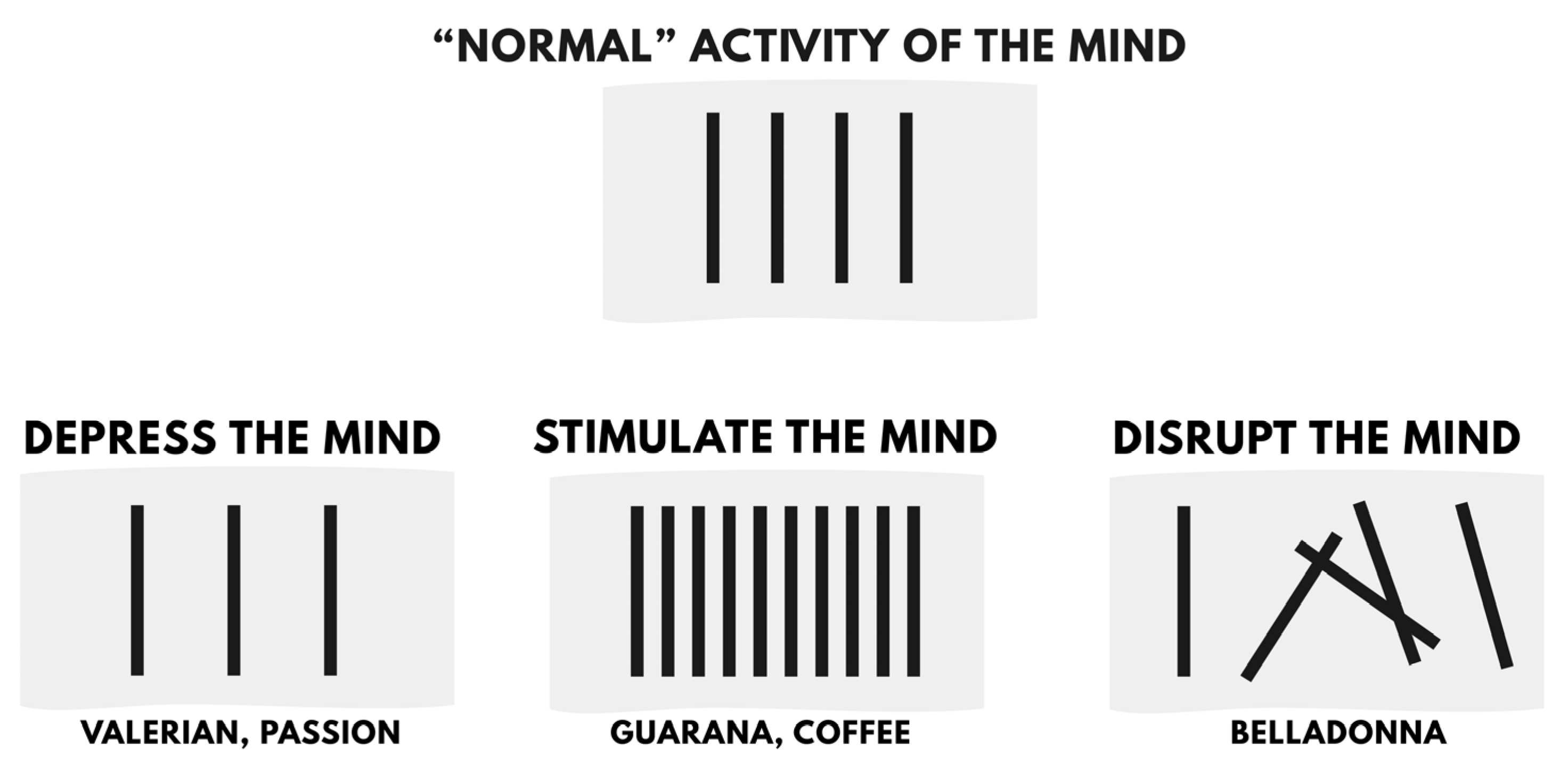
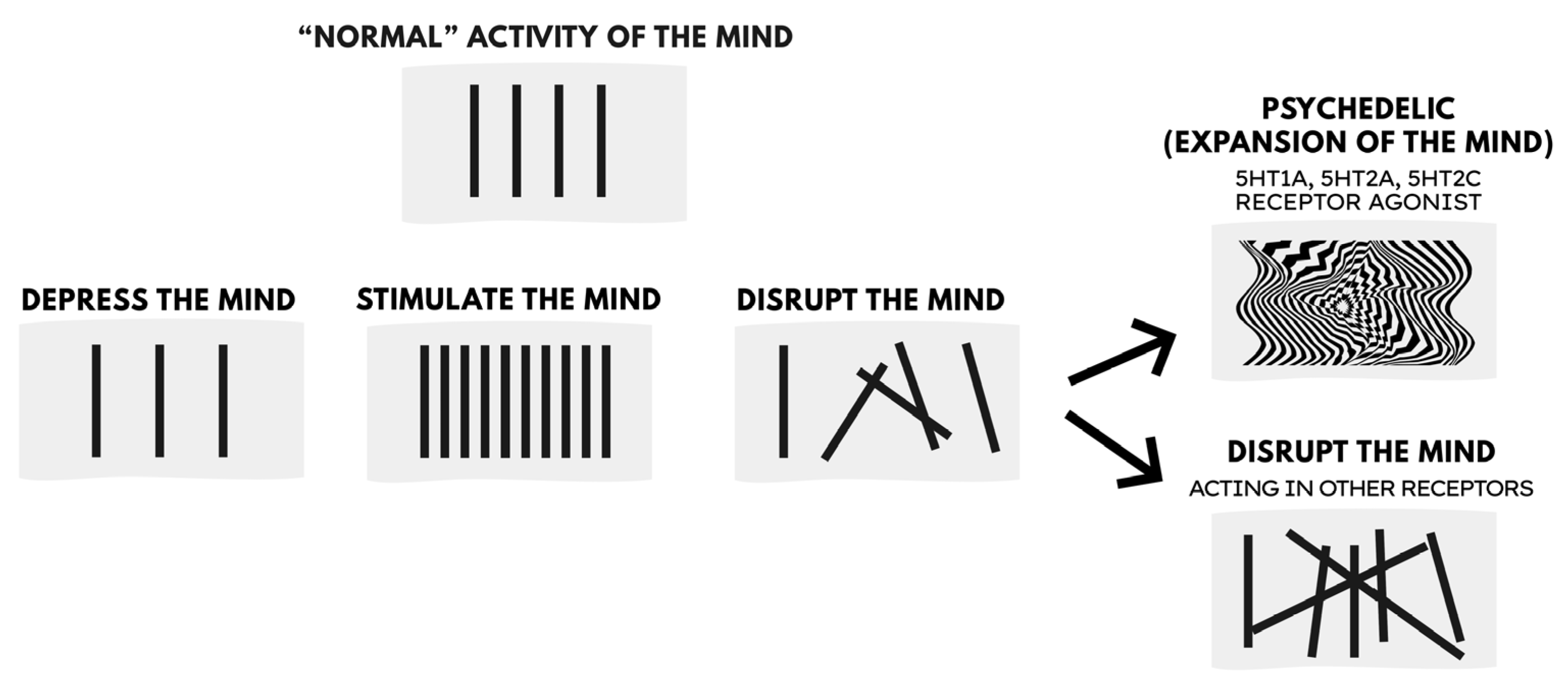
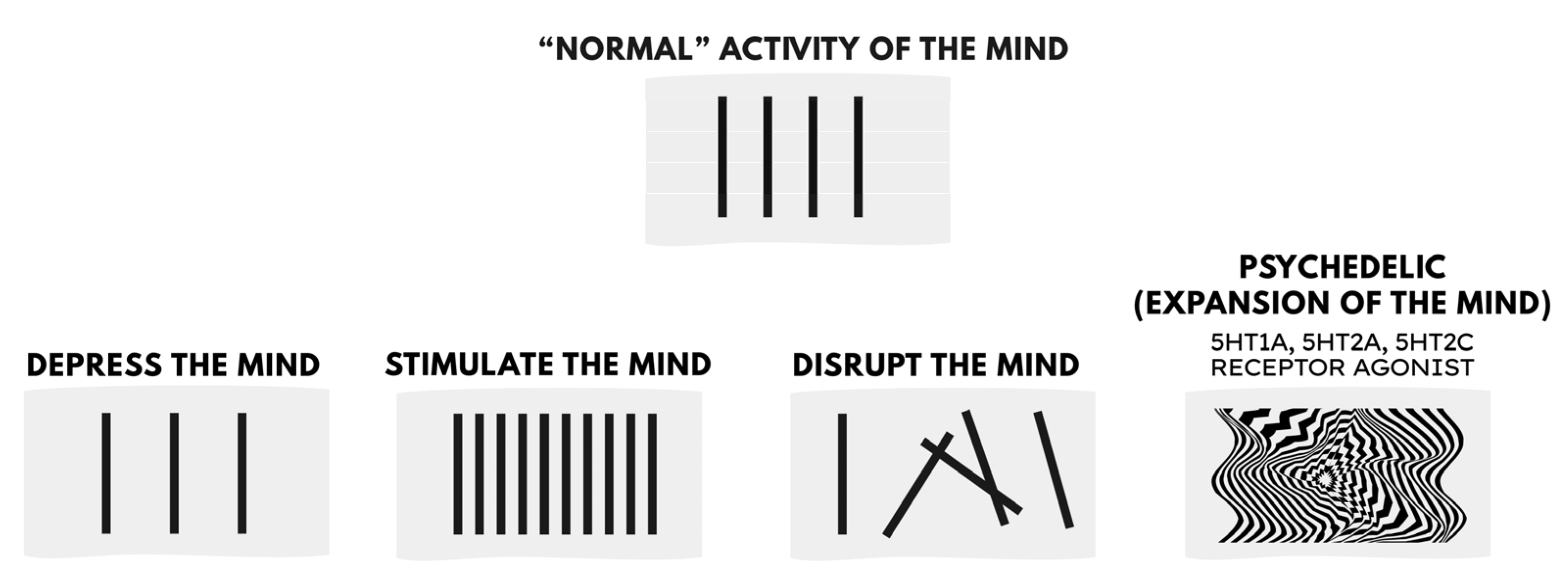
Figure 1) to show how psychoactives from natural sources are categorized: those that stimulate the mind (coffee, guarana), depress it (passion, valerian), or disrupt perception (belladonna).
In clinical psychiatric therapy, depressant substances may be employed as hypnotics, neuroleptics, analgesics, antipsychotics, and anxiolytics. Depression, as well as memory and cognitive impairment, may be treated with stimulants. It has been demonstrated that disrupting substances are the most significant for the advancement of neuroscience as they offer new insights into our psychopharmacology; the use of
C. sativa and the explanation of the endocannabinoid system serve as examples (the category of disrupting substances and their clinical applications will be covered later). Yet, because of their chemical complexity, natural sources—plants, animals, and fungi—cannot always be categorized into such simple “boxes”. Which of these three “boxes” would
C. sativa fall into in this context? A hasty assessment might assign it solely to the third “box”, as a “mind-disrupting” plant. However, it can also be classified into the other two “boxes”, “stimulant” and “depressant”, due to the antidepressant and anxiolytic properties of CBD, for example [
11,
12]. Furthermore, according to the dosage, route of administration, and context of use, THC can be regarded as a “mind-disrupting” substance in addition to being an anxiolytic [
13], thus placing also it in the “depressant” category—this is without considering the diverse activities of other phytocannabinoids such as CBN, CBG, and THCV, among many others.
C. sativa has hundreds of agronomic varieties, each with varying percentages of phytocannabinoids, terpenes, flavonoids, and alkaloids, among other active compounds. These varying ratios can encourage distinct psychoactive behaviors. As a result, the plant can be classified into three groups of psychoactive substances: as “depressants”, as “stimulants”, and as “disruptors”. The same is true of the fungi commonly known as magic mushrooms (
Psilocybe caerulescens Murrill and
Psilocybe cubensis (Earle) Singer) and the beverage ayahuasca, concocted from the plants jagube [
Banisteriopsis caapi (Spruce ex Griseb.) Morton—Malpighiaceae] and queen (
Psychotria viridis Ruiz and Pav.—Rubiaceae). In addition to being classified as psychedelics, or a form of “disruptors”, as we shall see below, studies have shown their effects on anxiety and depression [
14,
15]. The poppy,
Papaver somniferum L. (Papaveraceae), is another plant that can fit into more than one “box” in this classification because, depending on the dosage and method of usage, it can function as both a “depressant” and a “disruptor”.
1.3. The Third “Box”
Since the third “box” seems to be the root of many terminological misconceptions, it is necessary to revisit it. It is well recognized that this problem extends far beyond nomenclature and reaches into matters of ideology. Thus, instead of using the term “disrupting”, as proposed by Chaloult for this third “box”, other terms will be discussed below. This is because the term does not seem to be the most appropriate, as multiple authors point out that substances in this category do not always actually disrupt. Christian Ratsch gives us a comprehensive list of 414 psychoactive plants in his renowned work published in 2005,
Encyclopedia of Psychoactive Plants: Ethnopharmacology and Its Applications [
1], in which he defines them as
“Those ingested in simple forms or as complex preparations, with the purpose of altering the mind or the state of consciousness”. Ratsch goes on to explain that in the case of “disrupting substances”, non-medical circles and some publications typically prefer to use the terms “psychedelics”, “entheogens”, or “visionary substances”, as the term is typically confused with “hallucinogens”, which is often associated with psychopathological connotations. In fact, calling them hallucinogens is incorrect. He also references other authors who offer a number of names that could be better associated with the natural sources in that third “box”: psychotomimetic, “mimic psychosis”; psychotic, “induce psychosis”; hallucinogenic, “cause hallucinations”; psychedelic, “promote the manifestation of the mind”; entheogenic, “evoke the divine within”; entactogenic, “promote self-knowledge”; empathogenic, “stimulate empathy”; eidetic, “originate ideas”; psychotogenic, “affect the mind”; and psychodysleptic, “soften the mind”.
However, what, precisely, does the term “hallucinogen” denote? The clinical concept of hallucination is a perceptual experience in the absence of an external stimulus [
16]. Thus, hallucinogenic substances are those that create experiences without the requirement of a stimulus. The user is able to see or hear objects or sounds when visual and auditory inputs are not present. When a person sees something that is not actually present, this is referred to as a visual hallucination. Likewise, perceiving a sound that has no external source is known as an auditory hallucination. An individual under the influence of these substances may also experience additional effects, such as the following:
-Kinesthesia: feelings related to limb positioning and muscle movements. For instance, the size of a person’s head varies.
-Cenesthesia: organic or interior feelings; experiencing bowel movements, for instance.
-Illusion: distortion of reality through the senses.
-Synesthesia: combining the senses; for instance, the scent of a color.
-Flashback: chronic disorder of perception; sudden, intense, and involuntary recollections of the person’s prior experiences.
-Delusions: erroneous assessment of reality; unlike the other effects, this involves a change in the content of the mind rather than the sensations.
However, it is recognized that not all users of these substances experience similar effects as there are other components in the equation that promote such brain activities. According to Zinberg [
17], the final effect of consuming a drug—which is often erroneously called a hallucinogen—depends on at least three factors: the drug, set (individual characteristics), and setting (the environment). In this sense, not everyone who takes it will actually experience hallucinations. As a result, it is challenging to predict whether a psychoactive chemical will be psychotropic for a specific individual. In other words, a substance can be both psychoactive (which alters the mind) and psychotropic (which reinforces the use of the substance), causing the user to be “attracted” to it—often in a pathological fashion. When this occurs in the general population, it is referred to as addiction or dependency, but in medicine, this is known as substance use disorder.
1.4. Returning to the Initial Question
Is it then correct to say that CBD is a non-psychoactive phytocannabinoid? Before answering this question, it is important to highlight a few points about CBD.
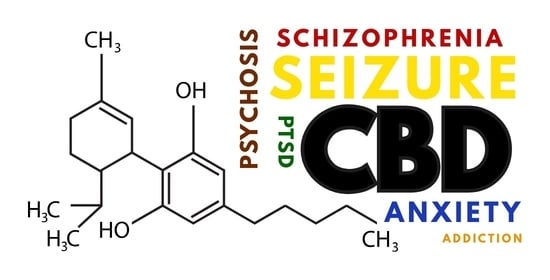
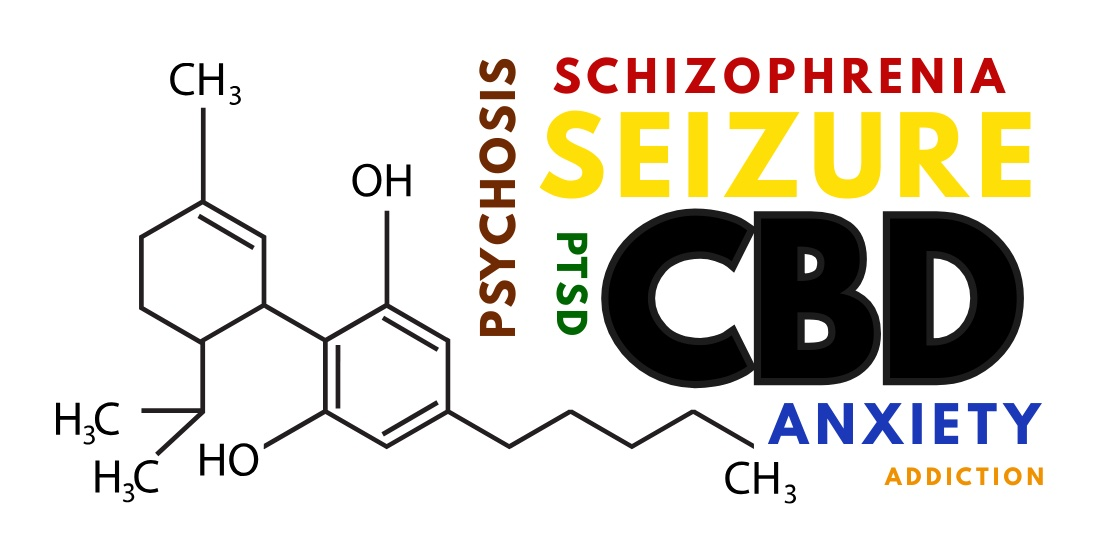
Cannabidiol (CBD), in its acidic form CBDA, is one of approximately 100 phytocannabinoids present in the
C. sativa [
18], along with many others, including THCA, CBNA, CBGA, and THCVA. It is important to mention that phytocannabinoids are not exclusive to this plant and can occur in others, such as in some species of
Radula and
Rhododendron, as well as in some fungi [
19]. In the case of the
C. sativa, these phytocannabinoids are located within its trichomes, which are spread throughout the plant, from inflorescences, leaves, roots, stems, and seeds to its pollen, with their highest concentrations being found in female inflorescences and young leaves [
20]. In addition to phytocannabinoids, trichomes produce and store other active principles, such as terpenes [
21]. The effect produced by the combination of these active principles is called the entourage effect and is responsible for several pharmacological properties [
22].
Most robust scientific studies—randomized, placebo-controlled, double-blind clinical trials—were conducted using isolated CBD, either natural or synthetic [
23]. These studies have revealed several pharmacological properties of this phytocannabinoid for various treatments. A review conducted by O’Sullivan et al. [
24] compiled data from robust clinical trials performed with isolated natural CBD, allowing for the determination of different levels of scientific evidence regarding medical treatments. The highest level of evidence was demonstrated for refractory epilepsy, based on several meta-analyses, with the authors considering the use of CBD for the treatment of epilepsy in various related syndromes to be unquestionable. In addition to this scientific evidence, at least one CBD-based product derived from
C. sativa—Epidiolex
® (GW Pharmaceuticals, Cambridge, England) — has been indicated for the following treatments: seizures in patients with Lennox–Gastaut syndrome, Dravet syndrome, and tuberous sclerosis complex. In this review, the authors also point to other effects of CBD with strong scientific evidence based on several robust clinical trials, including anxiety (positive data in 7 uncontrolled studies and 17 randomized controlled trials), psychosis and schizophrenia (1; 8), post-traumatic stress disorder (2; 4), and addiction (2; 3). Among these effects, nearly all are used in psychiatry, acting as either a stimulant or depressant of the mind, thus verifying that CBD is a psychoactive substance. Then, why does CBD’s non-psychoactive nature continue appearing in scientific texts? As if one could distinguish between positive and negative active components, a myth emerged, portraying CBD as inherently “safe” while characterizing THC as “dangerous”. This is so that CBD can be consumed (by patients), sold (by pharmaceutical companies), and researched (by scientists) without being impacted by the stigma associated with cannabis. However, as previously noted, this notion is not only skewed but also false as both exhibit psychoactive effects. When approaching these denominations, it is possible to observe a clear attempt to transform the word “psychoactive” into a synonym for “hallucinogen”. This trend may have emerged in recent years due to a resurgence of interest in
C. sativa, given the success of its products in medical treatments. Thus, it appears to have been necessary to create a culture of perceiving THC as a negative substance, distancing it from the plant, and pointing to CBD as the solution. However, similarly to any other herbal remedy, the effectiveness of
C. sativa lies in the interaction between its active principles. Isolating one of them in the form of a phytopharmaceutical, such as CBD, does not seem to be as interesting from a therapeutic point of view.
Despite all the misinformation and prejudice regarding THC, six of the seven medications based on this plant that are sold in pharmacies worldwide are synthetic or natural versions of THC (alone or together with CBD) and are used to treat symptoms of multiple sclerosis, anorexia, pain, or nausea brought on by chemotherapy. They include Sativex® (GW Pharmaceuticals, Cambridge, England), Cannimed® (Aurora Cannabis Inc., Saskatoon, SK, Canada), and Bedrocan® (Bedrocan International B.V., Veendam, Netherlands), (composed by natural THC and CBD), as well as the synthetics THC, Cesamet® (nabilone) (Eli Lilly and Company, Indianapolis, IN, USA) and Marinol® (dronabinol) (AbbVie Inc., Chicago, IL, USA). Some of these have been registered across a number of countries since 1985. Would these medications have been registered by international health agencies if THC was truly a negative substance? Evidently, the relevance of considering the risk and safety in the use of C. sativa cannot be denied, especially when it involves product quality, the age group that consumes THC, the route of administration, and dosage.
Finally, it is important to assume that although CBD is a psychoactive substance, it does not alter perception via any route or dose. In this sense, it differs from THC, which—depending on the dose or route of administration—can act not only as a stimulant or inhibitor of mental activity, but also as a mind-disrupting agent, or psychodysleptic. These terms have been associated with those such as “intoxicant”, “euphoric”, and others. It may therefore be more appropriate to use these terms to distinguish CBD from THC, instead of the label “psychoactive”.
1.5. What Are Psychedelics?
“Psychedelic” is yet another term that has been appropriated and reshaped by contemporary popular trends. Nichols [
25] defines psychedelics as “serotonergic hallucinogens”, which are drugs that influence serotonergic receptors, typically the 5HT2A receptor. The issue of “hallucinogens”, which are fraught with unfavorable connotations, resurfaces here. The ability of “psychedelics” to promote manifestation—making the spirit, soul, self, essence, or inner God visible—is widely recognized as one of its special qualities; hallucinations may or may not follow from this. The term itself combines the ideas of “revelation of the spirit” or “manifestation of the mind” through the use of the words “psyche” (soul/mind) and “delos” (manifestation). This is because not all “disrupting substances” result in hallucinations. In addition, some authors have been attempting to change the negative connotations associated with the term “hallucinogen” by using other terms, such as “psychedelics”, “entactogens”, “eidelics”, and “empathogens”, to refer to some of these plants, fungi, and animals. Some researchers propose the term “entheogen” for the ayahuasca beverage, which is derived from the ancient Greek word “entheos”, meaning “inner manifestation of the divine” and refers to the process of “leading someone to have the divine within themselves” [
26].
Kelmendi et al. [
27] carefully extend the definition provided by Nichols [
25]. According to their interpretation, “psychedelics” are agonists of our serotonergic neurotransmitters (5HT1A, 5HT2A, and 5HT2C) due to their chemical structures, which intensify the psychedelic experience; it is also referred to as “the manifestation of the mind, or revelation of the spirit”. The authors do not, however, necessarily associate these drugs with hallucinations. Their article presents a few “psychedelics”, both natural and synthetic (made from plants, animals, or fungi), such as the following: the plants
Ipomoea corymbosa (L.) Roth (morning glory, precursor of LSA),
Trichocereus macrogonus var.
pachanoi (Britton and Rose) Albesiano and R. Kiesling (a cactus, known as San Pedro),
Lophophora williamsii (Lem. ex J.F.Cels) J.M.Coult. (a cactus, known as peyote), and
Psychotria viridis Ruiz and Pav. (queen/chacrona); the fungi, known as magic mushrooms,
Psilocybe caerulescens Murrill and
Psilocybe cubensis (Earle) Singer; and the animal
Bufo alvarius Girard in ‘Baird, 1859 (Colorado River toad). Since its phytocannabinoids operate on serotonergic receptors—5HT1A and 5HT2A—in a manner akin to molecular promiscuity [
28],
C. sativa itself may also be regarded as a “psychedelic”.
The issue arises when, in addition to these plants, animals, and fungi that are actually “psychedelic”, attempts are made, either purposefully or mistakenly, to put other plants and animals in this category; for example, the iboga plant (Tabernanthe iboga Baill.—Apocynaceae) yields ibogaine, which acts on the glutamatergic system; the fly agaric mushroom (Amanita muscaria), whose muscimol acid acts as an agonist of the GABAergic system; and the mandrake (Mandragora officinarum L.—Solanaceae) and belladonna (Atropa belladonna L.—Solanaceae), both of which produce atropine and scopolamine, and which function as cholinergic antagonists. It should be mentioned that all of these substances affect other systems and their receptors rather than acting as agonists of those serotonergic receptors. For this reason, they should not be classified as “psychedelics”. Is it possible that belladonna, which was once employed by witches and sorcerers to control people, could aid us in our quest for the “inner manifestation of the divine”?