1. Introduction
The rapid expansion of digital technologies has fundamentally transformed the way health information is produced, disseminated, and consumed, positioning social media as one of the principal sources of health-related information worldwide [
1]. Platforms such as Instagram, YouTube, TikTok, and Facebook enable instantaneous access to information on disease prevention, pharmacological treatments, healthy lifestyles, and healthcare services, influencing millions of users’ health-related decisions every day [
2]. Consequently, social media has become an integral component of contemporary health communication ecosystems, extending its role beyond information dissemination to shaping individual attitudes and health-related behaviors [
2,
3,
4].
This transformation represents a shift from traditional institution-centered models of health communication toward decentralized, highly interactive digital environments in which users actively seek, interpret, and share health information [
3,
4]. Although these platforms have substantially expanded access to health knowledge, they have simultaneously increased exposure to inaccurate, misleading, or false information, creating significant challenges for public health [
5]. The World Health Organization has described this phenomenon as an “infodemic,” highlighting the risks associated with the rapid dissemination of misinformation and its potential implications for health behaviors, risk perception, adherence to evidence-based recommendations, and healthcare utilization [
6,
7,
8].
Within this digital environment, merely accessing health information is no longer sufficient to support informed decision-making. Individuals must also evaluate the trustworthiness and relevance of the information they encounter before incorporating it into health-related decisions. This process, commonly referred to as health-information appraisal, encompasses the cognitive evaluation of online information and represents a central component of decision-making in digital health environments [
9,
10]. Health-information appraisal is multidimensional and may be influenced by characteristics of the information source, content quality, platform features, and individual factors, including previous knowledge, prior beliefs, and heuristic processing strategies [
5,
9,
11].
Two complementary dimensions of health-information appraisal are particularly relevant in social media environments: perceived credibility and information-verification behavior. Perceived credibility reflects users’ subjective judgment regarding the trustworthiness and reliability of health information, whereas information-verification behavior refers to the extent to which individuals actively seek to confirm the accuracy or reliability of online content before incorporating it into health-related decisions [
11,
12]. Although conceptually related, these dimensions are not necessarily equivalent. Individuals may attribute high credibility to information without independently verifying it, particularly when credibility judgments rely on heuristic cues such as professional appearance, visual quality, popularity, perceived expertise, or social endorsement rather than on the evaluation of scientific evidence [
11]. Conversely, verification represents an active appraisal behavior that may occur regardless of the initial credibility attributed to the information.
These appraisal processes are closely related to digital health literacy, which encompasses the knowledge and skills required to locate, understand, critically evaluate, and appropriately apply health information obtained through digital media [
12,
13,
14]. Limited digital health literacy may impair users’ ability to distinguish reliable from unreliable information and to critically assess sources before incorporating digital content into health-related decisions [
14]. Accordingly, examining perceived credibility and information-verification behavior together may provide a more comprehensive understanding of how individuals appraise online health information and how these appraisal processes are associated with subsequent health-related behaviors.
Among the behavioral outcomes potentially associated with digital health information, self-medication represents an important public health concern. The widespread availability of medication-related content on social media combined with perceptions of convenience, autonomy, and rapid access to health advice may contribute to decisions to initiate, discontinue, or modify medication use without professional guidance [
15,
16,
17]. Although previous studies have associated exposure to online misinformation with inappropriate medication use and other potentially harmful behaviors [
10,
12,
14,
17], less is known about how individuals’ appraisal of online health information—particularly their perceived credibility and verification practices—is associated with medication-related decision-making.
Digital health information may also be associated with a broader spectrum of health-related decisions, including lifestyle modifications, preventive practices, and healthcare-seeking behaviors [
18,
19]. Importantly, perceiving information as credible does not necessarily imply that it has been independently verified, and verification does not necessarily imply low initial credibility. Examining these dimensions concurrently may therefore provide additional insight into the processes through which online health information is incorporated into behavioral decisions. Nevertheless, previous investigations have frequently examined credibility, information verification, digital health literacy, or self-medication separately, with fewer studies examining perceived credibility and information-verification behavior concurrently in relation to self-medication attributed to health information encountered on social media [
19,
20].
Addressing this gap is particularly relevant in contemporary digital environments, where health-related decisions are increasingly informed by content encountered on social media in addition to information obtained from healthcare professionals. A better understanding of how perceived credibility and verification practices are associated with medication-related decisions may inform digital health communication strategies, interventions designed to strengthen critical appraisal and verification skills, and public health initiatives aimed at reducing the potential harms associated with health misinformation [
21,
22,
23].
Therefore, the present study aimed to examine the associations of perceived credibility of health information encountered on social media and information-verification behavior with self-medication among adult social media users, as well as to investigate the relationship between perceived credibility and information-verification behavior. As a secondary exploratory objective, the study examined self-reported negative perceived effects following health-related decisions influenced by information obtained through social media. By examining these dimensions within an integrated conceptual framework, the study sought to improve understanding of digital health-information appraisal and its association with medication-related decision-making.
The conceptual framework was informed by models of health-information appraisal and dual-process accounts of information processing, according to which judgments of credibility may reflect both analytical evaluation and heuristic cues related to source expertise, presentation, familiarity, and social endorsement. Within this perspective, perceived credibility and verification represent conceptually distinct dimensions of information appraisal: credibility reflects a subjective judgment regarding information trustworthiness, whereas verification represents an active information-checking behavior. Both dimensions may therefore be associated with whether health information encountered online is incorporated into medication-related decisions. However, given the cross-sectional design, these expected relationships are conceptual associations rather than hypothesized temporal or causal pathways.
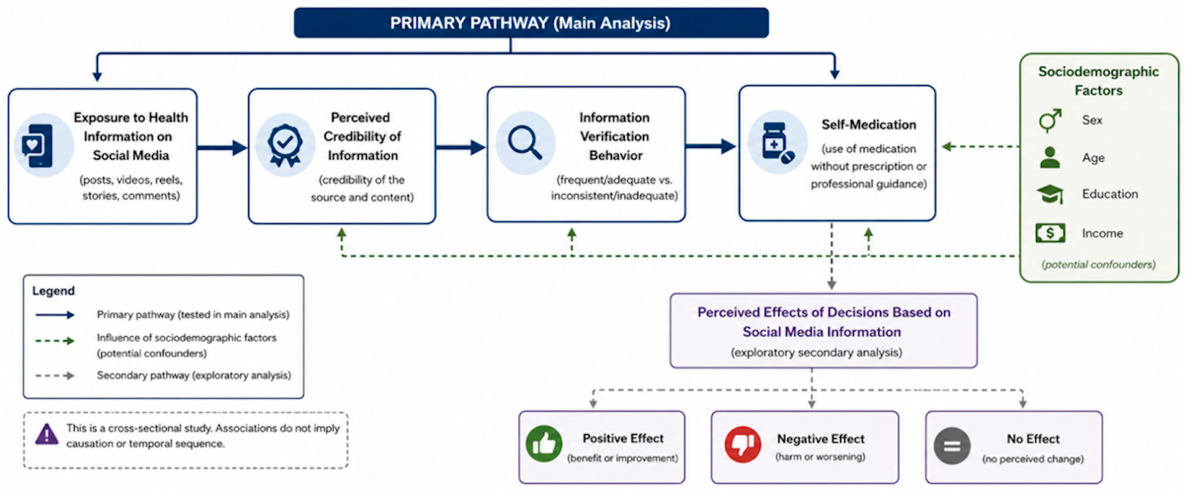
Figure 1 presents the conceptual framework adopted in this study. The framework depicts perceived credibility and information-verification behavior as distinct, but potentially related dimensions of health-information appraisal and self-medication as the primary behavioral outcome. Reported negative perceived effects were considered a secondary exploratory outcome. Sociodemographic characteristics, including sex, age, educational level, and income, were considered potential confounding variables. Given the cross-sectional design, all relationships represented in the framework should be interpreted as conceptual and statistical associations rather than temporal or causal pathways.
2. Methods
2.1. Study Design and Setting
This observational cross-sectional study was conducted using an online survey targeting adult social media users. Data were collected between August 2025 and February 2026.
The study examined perceived credibility and information-verification behavior as related, but distinct dimensions of health-information appraisal and evaluated their associations with self-medication attributed by participants to health information encountered on social media. The association between perceived credibility and information-verification behavior was also examined. Reported negative perceived effects following health-related decisions attributed to social media information were considered a secondary exploratory outcome.
Data were collected using a structured electronic questionnaire administered through Google Forms. The questionnaire was accessed through an online link and completed asynchronously. Participation was not geographically restricted. Access to the response database was restricted to the research team. Participation was voluntary and preceded by electronic informed consent.
2.2. Study Population and Sampling
The study population consisted of adults aged 18 years or older who reported using social media and accessing health-related information through these platforms. Participants were recruited using a non-probabilistic convenience-sampling strategy.
Recruitment was conducted through online networks accessible to the research team. The survey invitation and electronic questionnaire link were disseminated through Instagram, WhatsApp groups, and email invitations during the data-collection period. The invitation provided brief information about the purpose of the study and directed interested individuals to the electronic informed-consent form before questionnaire completion. Participation was voluntary, and no financial or material incentives were offered.
This recruitment strategy was intended to reach active social media users, but did not involve a population-based sampling frame. Consequently, the resulting sample should be regarded as a convenience sample of survey participants rather than as representative of Brazilian adults or social media users more broadly. The implications of the geographical and educational composition of the sample for selection bias and generalizability were considered when interpreting the findings.
A total of 1949 questionnaires were initially submitted. Following application of the predefined eligibility and data-cleaning criteria, 14 records were excluded because of absent or ambiguous informed consent, age below 18 years, or inconsistent age information resulting from simultaneous selection of multiple age categories. The final analytical sample therefore comprised 1935 participants. The primary analyses were based on this full analytical sample. Secondary analyses involving reported negative perceived effects were restricted to the 1556 participants who reported having made at least one health-related decision based on information obtained through social media, in accordance with the intended sequential structure of the questionnaire. Prior to analysis, categorical variables were reviewed and harmonized to standardize spelling variations, capitalization differences, duplicate category labels, and semantically equivalent response categories while preserving the original meaning of participants’ responses.
Because Google Forms recorded submitted questionnaires, but did not provide information on individuals who accessed or initiated the survey without submitting a response, the number of potential participants who discontinued the questionnaire before submission was not available. Consequently, a conventional survey completion or dropout rate could not be calculated [
24,
25].
2.3. Inclusion and Exclusion Criteria
Eligible participants were adults aged 18 years or older who reported using social media and accessing health-related information through these platforms and who voluntarily agreed to participate by providing electronic informed consent.
Records were excluded from the analytical sample when participants did not provide informed consent, presented ambiguous consent responses, were younger than 18 years of age, or provided inconsistent age information that precluded confirmation of eligibility. Submitted questionnaires were also reviewed for completeness and internal consistency during data cleaning. Duplicate submissions and incomplete or internally inconsistent responses that precluded confirmation of eligibility or reliable classification of the study variables were considered potential grounds for exclusion. However, no additional records were excluded for these reasons beyond the 14 records described above.
2.4. Data Collection and Variables
2.4.1. Questionnaire Development and Pilot Testing
Data were collected using a study-specific multidomain structured questionnaire designed to assess the constructs required by the study objectives within the context of health information encountered on social media. Rather than adopting a single validated psychometric instrument, the questionnaire integrated items addressing sociodemographic characteristics and social media use, health-information seeking, perceived credibility, credibility-related cues, information-verification behavior, health-related decisions influenced by social media information, and perceived consequences of those decisions.
Questionnaire development was informed by a review of the literature on online health-information seeking and appraisal, perceived credibility, information verification, digital health literacy, and health-related decision-making. The credibility-related component was informed by concepts addressed in previous health-information credibility measures, while the wording and response formats were adapted to the specific context of health information encountered on social media. Although validated instruments are available for related individual constructs, including digital health literacy and specific dimensions of message or source credibility, the present questionnaire was not designed as a psychometric assessment of these broader constructs. Instead, brief study-specific items were used to capture participants’ overall retrospective appraisal of health information encountered across social media environments and their reported frequency of source verification. Accordingly, the measures used in this study should be interpreted as operational indicators rather than substitutes for validated multidimensional scales.
The questionnaire was organized into three main components: (1) sociodemographic characteristics and social media use; (2) exposure to and appraisal of health information encountered on social media, including perceived credibility, factors influencing credibility judgments, and information-verification behavior; and (3) health-related decisions attributed by participants to information encountered on social media and the perceived consequences of those decisions. Candidate items were formulated to correspond directly to these domains and to the study objectives.
A preliminary version of the questionnaire was qualitatively reviewed by five specialists with expertise in public health, pharmaceutical care, epidemiology, digital health, and health communication. The review focused on the relevance of the items to the intended constructs, conceptual correspondence, wording clarity, comprehensibility, adequacy of response options, and overall questionnaire organization. Qualitative recommendations from the expert review were incorporated to improve wording, organization, and comprehensibility before pilot testing.
The revised questionnaire was pilot-tested with 30 adults from the target population to assess comprehension, usability, completion time, and overall acceptability. Minor linguistic adjustments were made following pilot testing before administration of the final version. Participants involved in the pilot test were not included in the final analytical sample.
The questionnaire was designed as a multidomain structured survey rather than as a unidimensional psychometric scale. Accordingly, an overall internal-consistency coefficient such as Cronbach’s alpha was not calculated because the questionnaire intentionally assessed conceptually distinct domains rather than a single latent construct. Quantitative content-validity indices, including the content-validity index (CVI), were not prospectively calculated during instrument development and therefore were not reconstructed retrospectively.
Importantly, the central constructs examined in the present analysis, perceived credibility, and information-verification behavior, were operationalized using brief self-reported indicators rather than validated multidimensional scales. These measures were intended to capture participants’ overall appraisal of the credibility of health information encountered on social media and the reported frequency with which they verified its sources. They should therefore be interpreted as operational indicators of these constructs rather than as comprehensive psychometric measures. The full questionnaire in the original Portuguese and an English translation, together with the exact wording of the items, response options, intended constructs, and analytical coding used in the present study, are provided in the
Supplementary Materials (Table S1).
2.4.2. Sociodemographic Characteristics and Social Media Use
Sociodemographic characteristics included sex, age group, educational level, monthly income, country of residence, and state of residence. For descriptive analyses, these variables were retained according to the categories defined in the questionnaire.
Monthly income was categorized according to the Brazilian minimum wage applicable during the study period as no income, ≤1 minimum wage, 1–3 minimum wages, and ≥4 minimum wages. For multivariable analyses, sociodemographic variables were subsequently regrouped according to the analytical categories specified in
Section 2.5.
Participants were also asked about their frequency of social media use and the platforms they accessed. Daily social media use was defined as reported access every day, irrespective of the number of daily accesses or duration of use. Participants could select more than one social media platform, including Instagram, YouTube, TikTok, Facebook, WhatsApp, X (formerly Twitter), and other platforms. Accordingly, platform categories were not mutually exclusive.
2.4.3. Health-Information Appraisal: Perceived Credibility and Information-Verification Behavior
For the purposes of the present study, health-information appraisal was operationalized through two related, but distinct dimensions: perceived credibility of health information encountered on social media and information-verification behavior [
11,
12]. Both constructs were assessed using brief self-reported items contextualized to health information consumed through social media.
Perceived credibility was assessed using the item “How do you rate the credibility of health information found on social media?”, with responses recorded on a five-point Likert-type scale ranging from 1 (not at all credible) to 5 (very credible). For descriptive analyses, perceived credibility was categorized as low (scores 1–2), moderate (score 3), and high (scores 4–5). For the primary inferential analyses, perceived credibility was dichotomized into low/moderate (scores 1–3) and high (scores 4–5).
Because no universally accepted threshold exists for credibility measures of this nature, this categorization was defined a priori as an analytical operationalization to distinguish clearly favorable credibility judgments from neutral or unfavorable evaluations. This approach facilitated interpretation of the measures of association while maintaining conceptual consistency with previous studies employing similar ordinal measures of perceived credibility [
7,
21,
22,
25,
26,
27,
28,
29]. To assess whether the findings were dependent on this dichotomization, an additional sensitivity analysis retained all five original credibility scores.
Participants were additionally asked which characteristics influenced their perception of the reliability of health information encountered on social media. Multiple responses were permitted, including information provided by healthcare professionals, citation of reliable sources, well-produced images or videos, clear technical language, and information disseminated by digital influencers. These characteristics were analyzed descriptively as credibility-related cues and were not considered objective indicators of information quality [
11,
22].
Information-verification behavior was assessed using the item “Do you verify the sources of the health information you consume?”, with five response categories: always, frequently, sometimes, rarely, and never. For the primary inferential analyses, verification behavior was categorized a priori as regular verification (always or frequently) versus inconsistent verification (sometimes, rarely, or never), consistent with the distinction between more systematic and less consistent information-appraisal practices considered in previous research [
12,
21,
22].
Importantly, this classification reflects the self-reported frequency of verification attempts rather than the quality, reliability, or type of sources consulted. The questionnaire did not assess whether participants verified information using authoritative scientific or healthcare sources, other social media content, general websites, or other information sources. Therefore, regular verification should not be interpreted as evidence that verification was performed using high-quality sources or that inaccurate information was necessarily identified or corrected. To evaluate the robustness of the findings to the dichotomization of verification behavior, sensitivity analyses also retained all five original response categories.
2.4.4. Medication-Related Decisions and Reported Perceived Effects
Health-related decisions attributed to information encountered on social media were assessed using sequential questionnaire items. Participants were first asked “Have you ever made health-related decisions based on information obtained through social media?”, with yes/no response options. Participants reporting such decisions were subsequently asked to identify the types of decisions they had made. Multiple responses were permitted, including self-medication, lifestyle modification, healthcare-seeking behavior, adoption of preventive health measures, and other health-related decisions.
The primary behavioral outcome was self-medication attributed by participants to health information encountered on social media. Operationally, self-medication was identified when the participant selected “self-medication” among the health-related decisions reported in the questionnaire. Thus, the outcome represents self-reported self-medication attributed to social media health information and should not be interpreted as a measure of self-medication in general or as an estimate of its prevalence in the general population.
The questionnaire did not distinguish between prescription-only and over-the-counter medications and did not collect information on specific medications, therapeutic classes, doses, duration of use, or whether medication use occurred with prior professional guidance. In addition, no predefined recall period was specified. Consequently, the measure reflects participants’ retrospective self-reported lifetime experience of self-medication attributed to health information encountered on social media rather than self-medication occurring within a defined epidemiological recall period.
Perceived effects were assessed using the item “What were the effects of the decisions made based on information from social media?”, with response options of positive effects, negative effects, or no noticeable effects. This item referred to consequences perceived by participants following health-related decisions attributed to social media information and did not constitute an objective or clinically validated assessment of adverse outcomes.
Although the decision-type and perceived-effect items were presented as sequential questions following the initial question on whether a health-related decision had been made, the exported dataset indicated that subsequent items remained answerable regardless of the response to the initial decision question. Therefore, to preserve the intended conditional structure of the questionnaire and avoid classifying participants who reported no social media-influenced health decision according to the perceived effects of a decision they had not reported making, analyses of perceived effects were restricted to participants who answered “yes” to the initial health-decision question.
Accordingly, the secondary analysis of perceived effects was restricted to the 1556 participants who reported having made at least one health-related decision based on information obtained through social media. Within this eligible subgroup, negative perceived effects were operationalized as a binary outcome (negative perceived effects versus non-negative perceived effects), with the latter category comprising positive or no noticeable effects. Because perceived effects were retrospectively self-reported and derived from questionnaire items referring to the same decision-making context as the explanatory variables, these analyses were considered secondary and exploratory and were interpreted as associative rather than predictive or causal findings.
2.5. Statistical Analysis
Statistical analyses were performed using the final cleaned analytical dataset. Descriptive statistics were expressed as absolute and relative frequencies. Percentages were calculated using the valid denominator for each variable, and table notes indicate when multiple responses were permitted. For perceived credibility, the mean and standard deviation (SD) and median and interquartile range (IQR) were additionally calculated.
The association between perceived credibility and information-verification behavior was examined using Pearson’s chi-squared test. For the primary analysis, perceived credibility was categorized as low/moderate (scores 1–3) versus high (scores 4–5), whereas information-verification behavior was categorized as regular (“always” or “frequently”) versus inconsistent (“sometimes,” “rarely,” or “never”). The magnitude of this association is expressed as an unadjusted odds ratio (OR) with its corresponding 95% confidence interval (95% CI), using low/moderate perceived credibility as the reference category and inconsistent information-verification behavior as the outcome.
Bivariate associations between sociodemographic characteristics and the principal study variables, self-medication attributed to social media health information, information-verification behavior, and perceived credibility, were examined using Pearson’s chi-squared test. These analyses were considered exploratory, and no formal adjustment for multiple comparisons was applied. A cross-tabulation of self-medication according to the five original information-verification categories was additionally performed, with the overall association assessed using Pearson’s chi-squared test.
The primary multivariable analysis used binary logistic regression to examine factors associated with self-reported self-medication attributed to health information encountered on social media. Covariates were selected on the basis of the conceptual framework and their theoretical relevance in the previous literature, and included sex, age group, educational level, monthly income, perceived credibility, and information-verification behavior. For this model, age was categorized as ≥35 versus 18–34 years, educational level as complete higher education/postgraduate versus up to incomplete higher education, and monthly income as ≤3 versus ≥4 Brazilian minimum wages. Perceived credibility was modeled as low/moderate versus high, and information-verification behavior as inconsistent versus regular. The coding of sex and all reference categories are specified in the corresponding regression table.
To assess the robustness of the primary findings to dichotomization of the two principal appraisal variables, an additional sensitivity analysis retained their original response categories. Perceived credibility was entered using all five original scale scores (1–5), with the highest credibility score as the reference category, and information-verification behavior was entered using all five original response categories (always, frequently, sometimes, rarely, and never), with “always” as the reference category. The remaining covariates were coded identically to those in the primary model. This analysis was intended to determine whether the observed associations were dependent on the binary cutoffs used in the primary analysis and to characterize the pattern of associations across the original response categories.
As a secondary exploratory analysis, perceived effects were examined only among participants who reported having made at least one health-related decision based on information obtained through social media (n = 1556). Within this eligible subgroup, perceived effects were categorized as negative versus non-negative, with non-negative effects comprising positive or no noticeable effects. Bivariate associations of negative perceived effects with self-medication, information-verification behavior, and perceived credibility were examined using Pearson’s chi-squared test. These analyses were considered exploratory, and no formal adjustment for multiple comparisons was applied.
A secondary exploratory multivariable logistic regression model was subsequently fitted with negative perceived effects as the outcome. The model included self-medication, perceived credibility, information-verification behavior, sex, age group, educational level, and monthly income, using the same sociodemographic and appraisal-variable categorizations applied in the primary model. Because perceived effects were retrospectively self-reported and assessed within the same decision-making context as the explanatory variables, estimates from this model were interpreted cautiously as exploratory associations rather than as evidence of predictive or causal relationships.
Adjusted odds ratios (aORs) and corresponding 95% CIs were estimated for the multivariable logistic regression models. Multicollinearity was assessed using variance inflation factors (VIFs), and model discrimination for the primary model was evaluated using the area under the receiver operating characteristic curve (AUC).
Given the magnitude of some associations observed in the primary model and the possibility of sparse-data or quasi-separation effects, penalized logistic regression using Firth’s method was performed as an additional sensitivity analysis. Estimates from the penalized model were compared with those obtained using conventional maximum-likelihood logistic regression to assess the statistical stability of the main associations. Because penalized regression addresses estimation problems related to sparse data or separation, but does not address conceptual overlap, common-method variance, measurement limitations, or residual confounding, the magnitude of the associations was interpreted cautiously.
Descriptive analyses, bivariate analyses, and conventional logistic regression models were performed using IBM SPSS Statistics version 28.0 (IBM Corp., Armonk, NY, USA). Additional sensitivity and diagnostic analyses, including penalized logistic regression, were conducted using R 4.4.2 (R Foundation for Statistical Computing, Vienna, Austria). All statistical tests were two-sided, and a p-value < 0.05 was considered statistically significant.
3. Results
3.1. Sociodemographic and Socioeconomic Characteristics of the Sample
Of the 1949 questionnaires initially submitted, 14 records were excluded because of lack of informed consent, ambiguous consent responses, age below 18 years, or inconsistent age information, yielding a final analytical sample of 1935 participants. The sociodemographic and socioeconomic characteristics of the sample are presented in
Table 1.
The sample was predominantly female (58.6%). The largest age groups were 25–34 years (34.0%) and 35–44 years (30.2%), followed by participants aged 18–24 years (17.7%), 45–54 years (11.6%), and 55 years or older (6.5%). Regarding educational attainment, 47.6% of participants had completed higher education or postgraduate education, 17.1% reported incomplete higher education, and 35.3% had an educational level up to high school.
Most participants reported monthly incomes below four Brazilian minimum wages. Specifically, 12.6% reported no income, 31.9% reported an income of up to one minimum wage, 34.7% reported an income between one and three minimum wages, and 20.9% reported an income of four or more minimum wages. Nearly all participants resided in Brazil (98.2%), whereas 1.8% resided in other countries.
3.2. Health-Information Appraisal: Perceived Credibility and Information-Verification Behavior
Participants identified several characteristics as contributing to their perception of the credibility of health information encountered on social media (
Table 2). Healthcare professionals as the source of information was the most frequently selected credibility cue, reported by 59.9% of participants, followed by the citation of reliable sources (44.1%). Presentation-related characteristics were also reported, including high-quality images or videos (33.0%) and clear technical language (28.5%). Information disseminated by digital influencers was selected by 27.9% of participants. Because multiple responses were permitted, these categories were not mutually exclusive and their percentages therefore sum to more than 100%.
Information-verification behavior and perceived credibility are summarized in
Table 3. Overall, 26.6% of participants reported always verifying the sources of health information consumed on social media, while 18.6% reported doing so frequently. Together, these categories represented 45.1% of participants reporting regular verification. Conversely, 54.9% reported inconsistent verification, comprising those who verified sources sometimes (21.8%), rarely (13.8%), or never (19.3%).
Moderate perceived credibility was the most frequently reported category (50.9%), followed by high (34.1%) and low perceived credibility (15.0%). The mean perceived credibility score was 3.26 ± 0.89 and the median was 3 (IQR: 3–4).
3.3. Association Between Perceived Credibility and Information-Verification Behavior
The association between perceived credibility and information-verification behavior was examined using the dichotomized categories defined for the primary analysis. Among participants reporting low or moderate perceived credibility, 53.3% reported regular information verification and 46.7% reported inconsistent verification. In contrast, among participants reporting high perceived credibility, 29.2% reported regular verification, whereas 70.8% reported inconsistent verification (
Table 4).
A statistically significant association was observed between perceived credibility and information-verification behavior (Pearson’s χ2 = 101.93; p < 0.001). Participants reporting high perceived credibility had 2.77 times the odds of reporting inconsistent information verification compared with those reporting low or moderate perceived credibility (OR = 2.77; 95% CI: 2.26–3.38).
3.4. Exploratory Associations Between Sociodemographic Characteristics and Health-Information Appraisal
Exploratory bivariate associations between sociodemographic characteristics and self-medication attributed to social media health information, information-verification behavior, and perceived credibility are presented in
Table 5. Statistically significant differences according to sex, age group, educational level, and monthly income were observed for all three variables (all
p < 0.001).
Regular information verification was more frequently reported by women than by men (58.2% vs. 26.2%), whereas high perceived credibility was more frequently reported by men than by women (54.0% vs. 20.4%). Self-medication attributed to social media health information was also more frequently reported by men than by women (61.6% vs. 11.6%).
Patterns also differed across age groups. Self-medication was most frequently reported among participants aged ≥55 years (56.8%) and 18–24 years (40.5%), whereas regular information verification was most frequent among those aged 25–34 years (54.2%). High perceived credibility ranged from 26.5% among participants aged 25–34 years to 42.4% among those aged ≥55 years.
Marked differences were also observed according to educational level and monthly income. Regular information verification increased across educational categories, from 15.1% among participants with up to high-school education to 63.7% among those with complete higher education or postgraduate education. Conversely, self-medication attributed to social media health information decreased from 73.8% among participants with up to high-school education to 7.8% among those with complete higher education or postgraduate education. Similarly, participants reporting higher monthly income showed higher proportions of regular information verification and lower proportions of self-medication. Because these analyses were exploratory and unadjusted, these patterns should be interpreted as bivariate associations rather than independent effects.
3.5. Social Media Use and Health-Related Decisions
Patterns of social media use and health-related decisions attributed to information encountered on social media are presented in
Table 6. Nearly all participants (97.7%) reported daily social media use. Instagram was the most frequently accessed platform (73.5%), followed by YouTube (39.2%) and TikTok (27.5%). Because participants could report more than one platform, platform categories were not mutually exclusive.
Overall, 1556 participants (80.4%) reported having made at least one health-related decision based on information obtained through social media. In the total analytical sample, self-medication attributed to social media health information was reported by 623 participants (32.2%), lifestyle modification by 601 (31.1%), healthcare-seeking behavior by 251 (13.0%), and adoption of preventive health measures by 174 (9.0%). Multiple types of health-related decisions could be reported by the same participant.
3.6. Secondary Exploratory Analysis of Reported Negative Perceived Effects
Secondary exploratory analyses of reported negative perceived effects were restricted to the 1556 participants who reported having made at least one health-related decision based on information obtained through social media. Overall, 555 participants in this subgroup reported negative perceived effects. Associations between negative perceived effects and self-medication, information-verification behavior, and perceived credibility are presented in
Table 7.
Negative perceived effects were reported by 84.5% of participants who reported self-medication attributed to social media health information, compared with 3.4% of those who did not report self-medication (p < 0.001). Similarly, negative perceived effects were more frequent among participants reporting inconsistent information-verification behavior than among those reporting regular information-verification behavior (56.6% vs. 2.5%; p < 0.001). Negative perceived effects were also more frequent among participants reporting high perceived credibility than among those reporting low or moderate perceived credibility (60.8% vs. 19.3%; p < 0.001).
Given the exploratory nature of these analyses, the retrospective self-report of perceived effects, and the assessment of these variables within the same decision-making context, these findings should be interpreted as unadjusted descriptive associations rather than as evidence of predictive or causal relationships.
3.7. Multivariable Analyses of Factors Associated with Self-Medication
Multivariable logistic regression was performed with self-reported self-medication attributed to health information encountered on social media as the primary behavioral outcome (
Table 8). After simultaneous adjustment for sociodemographic characteristics, perceived credibility, and information-verification behavior, inconsistent information-verification behavior showed the largest magnitude of association with self-medication (aOR = 14.80; 95% CI: 10.07–21.73;
p < 0.001).
Participants aged ≥35 years had higher odds of reporting self-medication than those aged 18–34 years (aOR = 1.89; 95% CI: 1.41–2.54; p < 0.001), as did participants with a monthly income ≤ 3 minimum wages compared with those with an income ≥ 4 minimum wages (aOR = 2.76; 95% CI: 1.62–4.70; p < 0.001). Conversely, female participants (aOR = 0.19; 95% CI: 0.14–0.26; p < 0.001), participants with complete higher education or postgraduate education (aOR = 0.24; 95% CI: 0.17–0.34; p < 0.001), and those reporting low or moderate perceived credibility (aOR = 0.36; 95% CI: 0.26–0.49; p < 0.001) had lower odds of reporting self-medication.
Model diagnostics indicated no evidence of problematic multicollinearity (all VIFs < 2.0). The primary model had an AUC of 0.925, indicating high apparent discrimination within the analytical sample. Penalized logistic regression using Firth’s method yielded estimates comparable to those obtained using conventional maximum-likelihood logistic regression (
Supplementary Table S2), indicating that the main estimates were not substantially altered by penalization for potential sparse-data or quasi-separation effects.
Sensitivity analyses retaining the original response categories of perceived credibility and information-verification behavior further examined the influence of the dichotomization used in the primary model. Compared with participants who reported always verifying health-information sources, the adjusted odds of self-medication increased across progressively less frequent verification categories: frequently (aOR = 2.98; 95% CI: 1.50–5.94), sometimes (aOR = 6.14; 95% CI: 3.33–11.31), rarely (aOR = 34.99; 95% CI: 19.11–64.07), and never (aOR = 242.23; 95% CI: 112.38–522.12). Associations across the five perceived-credibility scores were less uniform (
Supplementary Table S3).
Consistent with this pattern, the unadjusted proportion of participants reporting self-medication increased from 2.9% among those who always verified information sources to 6.4% among those who verified frequently, 14.0% among those who verified sometimes, 62.9% among those who verified rarely, and 95.7% among those who never verified sources (Pearson’s χ
2 = 1181.79;
p < 0.001;
Supplementary Table S4).
In the secondary exploratory multivariable analysis restricted to the 1556 participants who reported having made at least one health-related decision based on information obtained through social media, self-medication showed the largest association with reported negative perceived effects (aOR = 33.41; 95% CI: 20.42–54.67;
p < 0.001) (
Table 9). Inconsistent information-verification behavior was also associated with higher odds of reporting negative perceived effects (aOR = 6.57; 95% CI: 3.41–12.67;
p < 0.001), whereas low or moderate perceived credibility was associated with lower odds of reporting negative perceived effects compared with high perceived credibility (aOR = 0.59; 95% CI: 0.36–0.96;
p = 0.035).
Sociodemographic characteristics also remained associated with reported negative perceived effects in the secondary model. Participants aged ≥35 years had higher odds of reporting negative perceived effects (aOR = 3.15; 95% CI: 1.95–5.10; p < 0.001), as did those with a monthly income ≤ 3 minimum wages (aOR = 3.20; 95% CI: 1.28–8.03; p = 0.013). Female participants (aOR = 0.18; 95% CI: 0.11–0.29; p < 0.001) and participants with complete higher education or postgraduate education (aOR = 0.20; 95% CI: 0.11–0.37; p < 0.001) had lower odds of reporting negative perceived effects.
Given the secondary and exploratory nature of this analysis, the retrospective self-report of perceived effects, and the assessment of these variables within the same decision-making context, these estimates should be interpreted as adjusted associations rather than as evidence of predictive or causal relationships.
4. Discussion
The present study examined perceived credibility and information-verification behavior as related, but distinct dimensions of health-information appraisal and evaluated their associations with self-medication influenced by health information encountered on social media. Perceived credibility was significantly associated with information-verification behavior, with participants reporting high perceived credibility showing substantially higher odds of inconsistent information-verification behavior. In the multivariable analysis, inconsistent information-verification behavior showed the strongest association with self-medication after adjustment for sociodemographic characteristics and perceived credibility. Perceived credibility was also independently associated with self-medication, with participants reporting low or moderate perceived credibility showing lower odds of self-medication than those reporting high perceived credibility. Together, these findings highlight the importance of considering both credibility judgments and verification practices when examining medication-related decision-making in digital environments [
11,
17,
19,
24,
30].
More than half of the participants reported inconsistent verification of online health information, despite the relatively high educational attainment observed in the sample. This finding is consistent with evidence indicating that formal educational attainment alone does not necessarily ensure adequate digital health literacy. Effective engagement with online health information requires competencies related to source evaluation, critical appraisal, evidence interpretation, and the ability to distinguish indicators of scientific reliability from persuasive characteristics of digital content [
20,
23,
31].
The credibility cues identified by participants further illustrate the multidimensional nature of perceived credibility in online health communication. Information produced by healthcare professionals and supported by reliable sources represented the most frequently reported credibility cues, consistent with previous evidence emphasizing the importance of professional expertise and scientific authority in digital health communication [
32]. However, presentation-related characteristics, including visual quality and technical language, were also identified as credibility cues. This pattern is consistent with models of information processing in which analytical evaluation may coexist with heuristic judgments based on presentation, familiarity, perceived expertise, and social endorsement [
22,
33]. Importantly, perceived credibility should not be equated with objective information quality, since scientifically unsupported information may nevertheless appear credible when accompanied by persuasive heuristic cues [
5,
22,
23].
An important finding was the association between perceived credibility and information-verification behavior, with higher perceived credibility being associated with less consistent verification. This pattern indicates that perceiving health information as credible does not necessarily correspond to more systematic verification of its reliability [
34].
The observed association indicates that perceived credibility and verification behavior are related dimensions of health-information appraisal. Several mechanisms could potentially underlie this relationship, including heuristic credibility judgments, prior beliefs, source familiarity, or differences in information-appraisal practices. However, because both constructs were measured simultaneously, neither the temporal sequence nor the direction of the relationship can be established. These findings therefore support their conceptualization as related, but distinct dimensions of health-information appraisal [
35].
The strong adjusted association between inconsistent information-verification behavior and self-medication represents the principal behavioral finding of this study. Participants reporting inconsistent verification practices had substantially higher odds of self-medication than those who regularly verified health-information sources, even after adjustment for sociodemographic characteristics and perceived credibility. This finding suggests that verification behavior may represent an important component of the process through which digital health information is incorporated into medication-related decisions. Importantly, given the cross-sectional design, these findings do not establish that inconsistent verification causes self-medication. Rather, they indicate that these behaviors were strongly associated within the study population [
17,
19,
22,
26,
36].
The magnitude of this association warrants cautious interpretation. Adjusted odds ratios of this magnitude are uncommon in behavioral health research and may reflect, in part, conceptual overlap and the close measurement relationship between information-appraisal practices and medication-related behavior. Although the association remained stable in sensitivity analyses using penalized logistic regression and multicollinearity diagnostics did not indicate instability attributable to strong correlations among model covariates, these findings do not eliminate other important sources of bias. Because exposure and outcome were self-reported and measured simultaneously within the same questionnaire, common-method variance and measurement limitations may have contributed to the observed magnitude of the association. Residual confounding by unmeasured characteristics also cannot be excluded. The estimated odds ratio should therefore be interpreted cautiously as a measure of association rather than as an estimate of causal effect or absolute risk [
28,
29,
30,
37].
The association between perceived credibility and self-medication provides an additional perspective on how online information may be translated into behavioral action. Participants reporting low or moderate perceived credibility had lower odds of self-medication than those reporting high perceived credibility [
38]. Rather than being counterintuitive, this finding is compatible with the possibility that information perceived as more credible is more likely to be considered actionable. In this context, perceived credibility may facilitate the incorporation of online information into medication-related decisions, whereas lower perceived credibility may reduce willingness to act on such information. This interpretation is also noteworthy when considered alongside the observed association between high perceived credibility and inconsistent information-verification behavior, suggesting that greater perceived credibility may coexist with a reduced tendency to independently verify online information. However, these findings should not be interpreted as evidence of a causal pathway, because the temporal ordering among credibility judgments, verification behavior, and medication-related decisions cannot be established in a cross-sectional study. Longitudinal investigations are needed to clarify whether perceived credibility precedes behavioral adoption or is itself influenced by previous experiences with digital health information [
36,
39].
These findings are consistent with contemporary approaches to digital health literacy, which extend beyond access to online information and encompass the competencies required to evaluate evidence, identify reliable sources, interpret health recommendations, and appropriately incorporate digital information into decision-making [
12,
13,
22,
37]. Verification behavior may therefore represent an observable component of critical information appraisal. Individuals who inconsistently verify online information may be more susceptible to acting on persuasive content without independently assessing its scientific basis [
38]. Digital health literacy should therefore include not only the ability to identify reliable information but also the capacity to critically assess why particular content appears credible and whether its claims are supported by verifiable evidence [
22,
23,
25,
38].
Secondary exploratory analyses, restricted to the 1556 participants who reported having made at least one health-related decision based on information obtained through social media, showed that reported negative perceived effects were more frequent among participants reporting self-medication, inconsistent information-verification behavior, and high perceived credibility. These findings warrant particular caution because the outcome represented participants’ subjective perceptions rather than objectively verified clinical events and was assessed through questionnaire items related to the same decision-making context. The observed associations may therefore reflect conceptual overlap, common-method variance, measurement limitations, reverse causality, or residual confounding. Accordingly, these results should be regarded as hypothesis-generating rather than as evidence of predictive or causal relationships. Future studies incorporating longitudinal follow-up and objectively assessed clinical outcomes are required to determine whether these perceived effects correspond to measurable health consequences [
36,
39].
Sociodemographic differences were also observed. Male participants reported substantially higher frequencies of self-medication influenced by social media information than female participants, and female sex remained associated with lower odds of self-medication after multivariable adjustment. This differs from studies of self-medication in the general population, which have frequently reported higher prevalence among women [
14,
16,
20,
21]. However, the outcome examined in the present study was more specific, referring to self-medication reported as being influenced by information encountered on social media. The observed sex difference should therefore not be interpreted as evidence that men have a higher overall prevalence of self-medication. Rather, it may reflect differences in how digital health information is incorporated into medication-related decisions. Because this finding differs from much of the existing literature, replication in independent populations is warranted before sex-specific behavioral mechanisms are inferred [
8,
9,
10,
40].
Educational attainment and monthly income were also associated with self-medication after multivariable adjustment. Participants with complete higher education or postgraduate education had lower odds of self-medication, whereas those with monthly incomes of ≤3 minimum wages had higher odds. These findings are compatible with the broader recognition that digital health literacy and health-information appraisal are socially patterned competencies [
22,
23,
36]. Greater educational resources may facilitate critical appraisal of health information, whereas socioeconomic constraints may coexist with barriers to professional healthcare and greater reliance on self-directed health-management strategies. These interpretations remain tentative, however, because healthcare access and other potentially relevant socioeconomic mechanisms were not directly measured.
Instagram, YouTube, and TikTok were among the most frequently accessed platforms in the study population. These highly interactive and predominantly visual environments play an increasingly important role in contemporary health communication [
2,
5,
8,
10,
14,
20,
21,
22,
23,
40]. Their architecture can facilitate access to health information while also amplifying persuasive, anecdotal, commercially driven, or scientifically unsupported content through engagement-based recommendation systems [
5,
16]. However, because the present study measured platforms accessed rather than platform-specific exposure to particular health information, the findings should not be interpreted as demonstrating that any individual platform was responsible for the medication-related behaviors observed.
From a public health perspective, the findings support digital health strategies that combine the dissemination of evidence-based information with interventions designed to strengthen users’ ability to critically appraise and verify online health content. Healthcare professionals may contribute not only by providing reliable digital health information but also by helping users recognize credible sources, assess scientific evidence, and distinguish indicators of expertise from heuristic credibility cues. At the institutional level, transparency regarding information sources, conflicts of interest, and responsible dissemination practices may further contribute to safer digital health-information environments [
28,
29,
30,
37].
The study has several strengths. The large analytical sample included participants from different geographical regions and allowed perceived credibility, information-verification behavior, and self-medication to be examined within a common analytical framework. Importantly, the study also directly examined the association between perceived credibility and verification behavior, addressing the relationship between two central dimensions of health-information appraisal rather than considering them solely as independent predictors. Self-medication was operationalized specifically in relation to information encountered on social media, enabling examination of a medication-related behavioral pathway that differs from general self-medication irrespective of information source. In addition, the principal multivariable findings were evaluated using model diagnostics and penalized logistic regression sensitivity analyses, which supported the statistical stability of the estimates with respect to potential sparse-data or quasi-separation effects, while not resolving the conceptual and measurement limitations inherent to the study design [
27,
39,
40].
Several limitations should be considered. The cross-sectional design precludes determination of temporality or causal relationships among perceived credibility, information-verification behavior, and self-medication. Accordingly, although perceived credibility was associated with both verification behavior and self-medication, the present study cannot establish whether credibility judgments precede verification practices or medication-related decisions. The non-probabilistic convenience-sampling strategy may have introduced selection bias and limits generalizability, particularly to populations with different patterns of internet access or social media use. The comparatively high educational attainment of the sample suggests that the recruitment strategy may have preferentially reached individuals with higher levels of formal education and possibly greater engagement with digital environments. Importantly, within our sample, higher educational attainment was associated with more regular information verification and substantially lower self-reported self-medication attributed to social media health information. This selection pattern may therefore have underrepresented participants with less favorable information-appraisal behaviors and may limit the extrapolation of our findings to populations with lower educational attainment or more limited digital access. All principal variables were self-reported and collected through the same online questionnaire, making recall bias, social-desirability bias, and common-method variance possible. Residual confounding by unmeasured characteristics, including health status, healthcare access, previous experiences with health services, health anxiety, trust in healthcare institutions, and patterns of digital engagement, also cannot be excluded. Perceived credibility and information-verification behavior were assessed using self-reported measures that may not fully capture the multidimensional nature of these constructs or establish their discriminant validity, representing an additional measurement limitation. In addition, perceived credibility was assessed using a single global retrospective item referring to health information encountered across heterogeneous social media contexts, rather than to a standardized or content-specific stimulus. Participants were therefore required to aggregate experiences across different platforms, sources, and health topics into a single judgment, which may have introduced measurement noise and limited construct validity. Future studies could use multidimensional credibility measures or stimulus-anchored assessments based on specific social media content. Finally, although the questionnaire underwent expert review and pilot testing, formal psychometric indices such as the content validity index and measures of internal consistency were not prospectively calculated.




 ,
,