Article

Antibiotic Prescribing for Group B Streptococcus Coverage in Preterm Prelabour Rupture of Membranes: A Retrospective Cohort Study


1
Department of Pharmacy, Mount Sinai Hospital, Toronto, ON M5G 1X5, Canada
2
Antimicrobial Stewardship Program, Mount Sinai Hospital, Toronto, ON M5G 1X5, Canada
*
Author to whom correspondence should be addressed.
Pharmacoepidemiology 2026, 5(1), 8; https://doi.org/10.3390/pharma5010008
Submission received: 29 January 2026 / Revised: 5 March 2026 / Accepted: 5 March 2026 / Published: 7 March 2026
(This article belongs to the Special Issue Women’s Special Issue Series: Pharmacoepidemiology)

Abstract

Background: Preterm prelabour rupture of membranes (PPROM) is the spontaneous rupture of fetal membranes prior to 37 weeks of pregnancy. Latency antibiotics, including macrolides with or without group B streptococcus (GBS)-covering antibiotics, are recommended as part of expectant management. Currently, there is no consensus on whether GBS-covering antibiotics should be prescribed. The primary objective of this retrospective cohort study was to characterize practice variation in GBS-covering antibiotic prescribing in PPROM. The secondary objective was to explore the association between maternal characteristics and GBS-covering antibiotic prescribing. Methods: Pregnant women with PPROM prescribed azithromycin (institutional standard antibiotic regimen) in 2024 and not in active labour were included. Maternal characteristics, stratified by GBS status, were compared. The association between antibiotic prescribing for GBS coverage and maternal factors was assessed using odds ratios. Two-sided p-values < 0.05 were considered statistically significant. Results: Out of the 181 admissions assessed for eligibility, 146 patients were included. Their GBS status at PPROM diagnosis was negative (19/146; 13%), positive (8/146; 5%), or unknown (119/146; 82%). The frequency of GBS-covering antibiotics prescribing was 5/8 (63%) in the positive group, 4/19 (21%) in the negative group, and 65/119 (55%) in those with an unknown GBS status. Aminopenicillin-based and penicillin regimens accounted for (69/74; 93%) of antibiotic regimens. Half (38/74; 51%) of the GBS-covering antibiotics were prescribed for 3–7 days, with a 33/74 (45%) completion rate as prescribed at PPROM diagnosis. The main reason for antibiotic discontinuation was negative GBS recto-vaginal swabs or urine cultures collected in those with an unknown GBS status at PPROM diagnosis, highlighting the role of microbiology laboratory testing in adjusting antibiotic therapy and facilitating antimicrobial stewardship. Aside from GBS status, no maternal characteristics were associated with GBS-covering antibiotic prescribing. Conclusions: At PPROM diagnosis, GBS coverage was prescribed in 21%, 63%, and 55% of patients with a negative, positive, and unknown GBS status, respectively. Only GBS status was associated with GBS-covering antibiotic prescribing. Further research is required to determine the impact of GBS coverage on perinatal outcomes.

1. Introduction

Preterm prelabour rupture of membranes (PPROM) is the spontaneous rupture of fetal membranes prior to full-term pregnancy at 37 weeks of gestation and preceding the onset of labour. In Canada, PPROM complicates 3% of pregnancies and can be a precursor to preterm delivery [1,2]. While the exact mechanism of PPROM in pregnant people is often not identified, it is associated with pregnancy complications including maternal hemorrhage and placental abruptions, as well as neonatal morbidity including neonatal sepsis and necrotizing enterocolitis [1]. Possible etiologies of PPROM include increased intraamniotic pressure, intrauterine inflammation, and infection [3]. Bacteria and bacterial products trigger the fetal membranes to produce pro-inflammatory cytokines, which in turn activate proteases, resulting in weakened structural integrity [4]. Additionally, bacteria can produce collagenases, which also weaken the fetal membranes and predispose them to rupture [5]. Rupture of fetal membranes creates a pathway for maternal flora from the recto-vaginal cavity to be introduced into the amniotic space and birth canal, increasing the risk of infection [6].
Once PPROM is initiated, a latency period follows, ranging from 2 days up to 4 weeks with duration inversely proportional to weeks of gestation. Within one week of diagnosis, 50% of pregnancies with PPROM result in delivery [7]. Medications prescribed in expectant management of PPROM include antenatal corticosteroids, tocolytics, and latency antibiotics [1]. In the ORACLE randomized controlled trial, macrolide use prolonged pregnancy and reduced neonatal morbidity [8]. At birth, neonates are at risk of early onset sepsis, which is primarily caused by group B streptococcus (GBS) and Escherichia coli in Canada [9]. Also known as Streptococcus agalactiae, GBS is a part of the commensal flora in adults. GBS recto-vaginal colonization contributes to asymptomatic bacteriuria and urinary tract infections in pregnancy and is also a risk factor for neonatal morbidity. While the role of intrapartum antibiotic prophylaxis is established, there is currently a therapeutic dilemma on whether GBS coverage is warranted in PPROM [10,11].
Antibiotic prescribing for PPROM was systematically reviewed in 2013. There was no evidence to support antibiotic choice or specific antibiotic regimens except the recommendation against amoxicillin/clavulanic acid due to an increased risk of necrotizing enterocolitis [11]. Although macrolides could theoretically cover GBS, they are no longer considered acceptable alternatives due to antimicrobial resistance [12]. In late 2022, the Society of Obstetricians and Gynaecologists of Canada (SOGC) published updated practice guidelines for PPROM. Table 1 presents the two endorsed antibiotic regimens: (1) an oral macrolide alone or combined with GBS coverage if GBS colonization status is unknown or positive at the time of PPROM diagnosis or (2) an oral macrolide in combination with GBS coverage for 7 days independently of GBS status [1]. Recommended antibiotic regimens differ across other international societies: intravenous ampicillin and erythromycin for 2 days followed by oral amoxicillin and erythromycin for 5 days (or erythromycin alone in those with beta-lactam allergies) by the American College of Obstetricians and Gynecologists (ACOG) with no consideration for GBS status; oral erythromycin for 10 days or until labour (or oral penicillin alone in those with contraindications to macrolides) with no specific antepartum GBS coverage by the Royal College of Obstetricians and Gynecologists (RCOG); and oral erythromycin for 10 days combined with intravenous amoxicillin/ampicillin for 2 days or until a negative GBS result is returned by the Royal Australian and New Zealand College of Obstetricians and Gynecologists (RANZCOG) [13,14,15,16]. There is variation in medication choice, regimens, and the duration of therapy. This highlights the lack of consensus around latency antibiotics in PPROM management, as well as the potential for antibiotic misuse and selection of antibiotic resistance.
Currently at our institution, the PPROM management order set includes an oral regimen of azithromycin (500 mg on day 1 followed by 250 mg every 24 h for days 2–5). Practice was not amended to include GBS coverage with the introduction of updated guidelines after an assessment of the strength and quality of available evidence. Based on clinical judgement, prescribers may consider antibiotics for GBS coverage but factors contributing to their decision to initiate additional antibiotics and their associated prescribing patterns are not apparent. With an ongoing evaluation of whether there is a need to provide GBS coverage and update the institutional order set, the aim of this study was to characterize practice variation in GBS-covering antibiotic prescribing in PPROM. We describe antibiotic regimens and explore patient factors associated with GBS-covering antibiotic prescribing.

2. Results

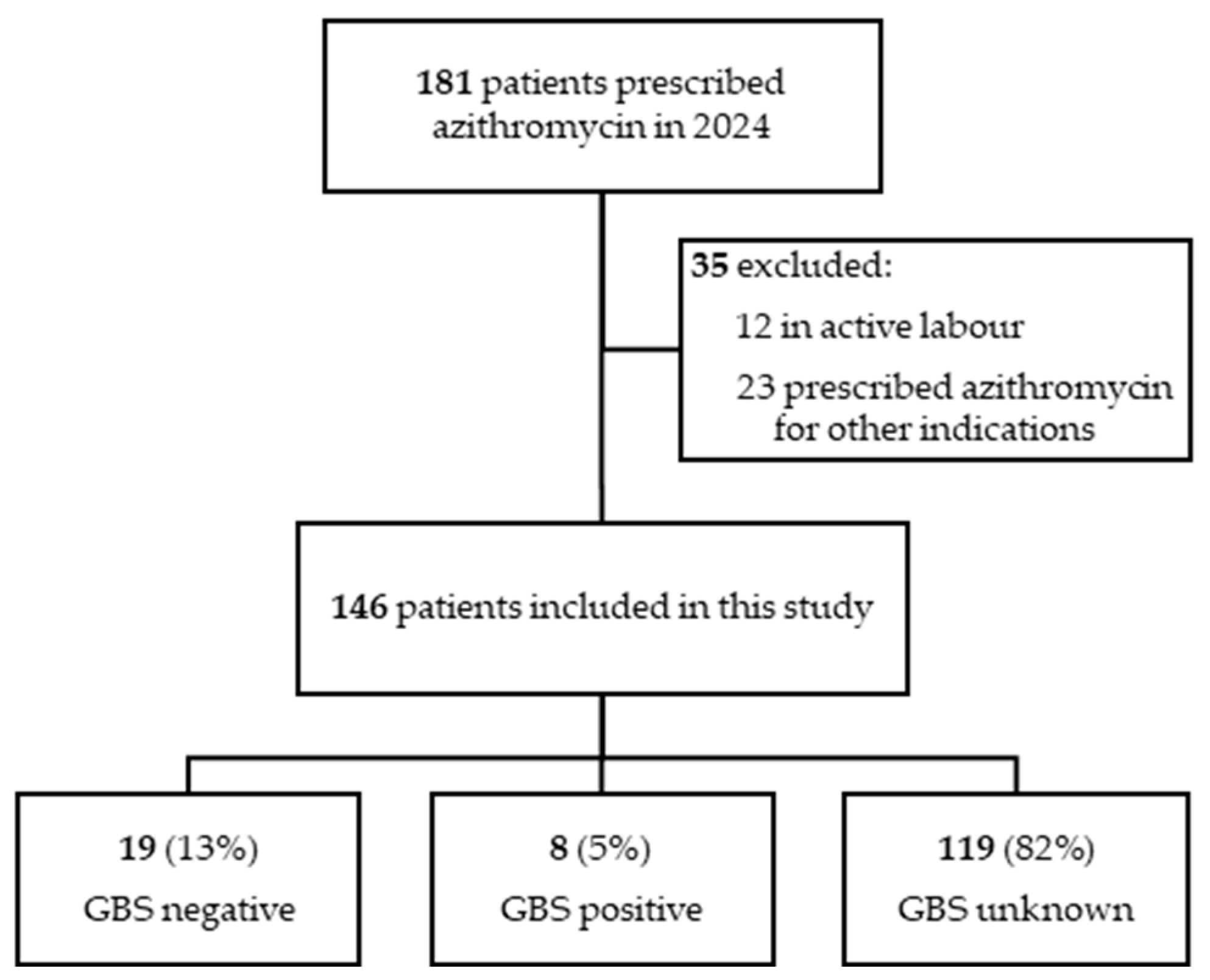
During the 12-month study period, 181 pregnant women were admitted with a diagnosis of PPROM and were prescribed azithromycin. After screening, 35 were excluded (for active labour or azithromycin prescribed for indications unrelated to PPROM), and 146 patients were included in this analysis. At PPROM diagnosis, 19 (13%) patients were GBS-negative, 8 (5%) were GBS-positive, and 119 (82%) had an unknown GBS status (Figure 1).
Maternal baseline and clinical characteristics stratified by GBS status at PPROM diagnosis are presented in Table 2. Of note, negative GBS status was more common in later gestation (median 32 weeks) compared to unknown GBS (median 28 weeks). While there was a significant difference in GBS bacteriuria in the current pregnancy, this was only detected in the positive GBS group (in keeping with the diagnosis of GBS status). The remaining maternal characteristics were balanced across the groups.
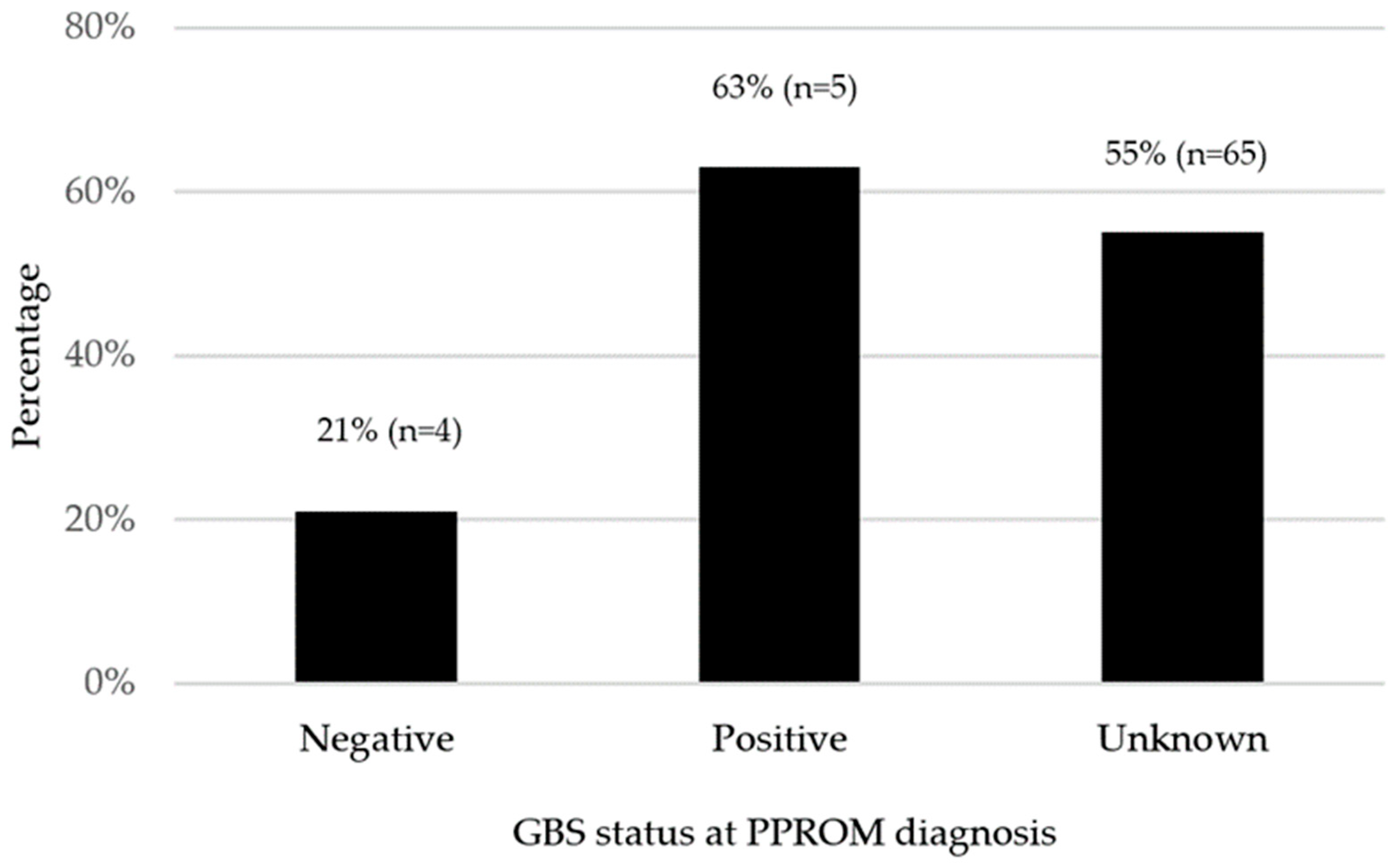
In the study population, 74/146 (51%) patients received GBS-covering antibiotics in addition to the standard of care of azithromycin. When stratified by GBS status, the frequency of prescribing was 4/19 (21%) in the negative GBS group, 5/8 (63%) in the positive GBS group, and 65/119 (55%) in the unknown GBS group (Figure 2).
The most frequently prescribed antibiotics were aminopenicillin-based and penicillin regimens (69/74; 93%). Several distinct antibiotic regimens were prescribed and are detailed in Table 3. Miscellaneous regimens were prescribed in cases of documented allergies to penicillin/ampicillin/amoxicillin or co-infections (e.g., urinary tract infection).
In terms of duration, antibiotic regimens were prescribing for ≤2 days (24/74; 32%), 3–7 days (38/74; 51%), or 8–10 days (12/74; 16%), as shown in Table 4 stratified by regimens. Only 33/74 (45%) patients completed their regimens as originally prescribed. Table 5 delineates the reasons for incompletion, with the main reason being a negative GBS status when tested after PPROM diagnosis (15/41; 37%). Among those with an unknown GBS status, the recto-vaginal swab and/or urine collection rate after PPROM diagnosis was 97% (115/119), with results available within 1 to 3 days.
Table 6 explores the association between antibiotic prescribing for GBS coverage and clinically meaningful a priori selected patient factors. Odds ratios represent the effect per 1-unit increase for continuous variables and presence versus absence for binary variables. Compared to GBS-negative patients, GBS-unknown patients had higher odds of receiving GBS coverage (OR 4.5, 95% CI 1.4–14.4, p = 0.01). GBS-positive patients also had higher odds of being prescribed GBS-covering antibiotics; however, this was not statistically significant, with an imprecise estimate due to the low number of GBS-positive patients (OR 6.3, 95% CI 1.0–38.1, p = 0.05). Maternal age, gravida, gestational age, gestational hypertension, gestational diabetes, history of infant with GBS infection, and history of GBS bacteriuria in current pregnancies were not found to be associated with prescribing decisions in the current model. Instability in the regression model, resulting in wide or undefined confidence intervals, is attributed to low counts, specifically the number of GBS-positive patients (n = 8), gestational hypertension (n = 5 in the unknown GBS group only), history of infant with GBS infection (n = 1 in the unknown GBS group only), and history of GBS bacteriuria in current pregnancy (n = 3 in the positive GBS group only).

3. Discussion

In this retrospective cohort study, we described GBS-covering antibiotic prescribing practices in the management of PPROM at a single tertiary perinatal care centre. GBS coverage was prescribed for 63% of GBS-positive patients and 55% of those with an unknown GBS status. Variation in the decision to add GBS coverage to standard macrolide prescribing is reflective of the lack of consensus for latency antibiotic prescribing in PPROM proposed by international societies of obstetrics and gynecology. When prescribed, 93% of antibiotics were aminopenicillin or penicillin-based, which is an appropriate targeted GBS therapy from an antimicrobial stewardship perspective. However, there were considerable differences in antibiotic dosing and duration, highlighting a lack of standardization. This inconsistency may stem from differences within and between guidelines and can be attributed to limited high-quality evidence to guide optimal regimen selection. When regimens other than aminopenicillin or penicillin-based ones were prescribed, patient allergies or the need to manage co-infections were contributing factors. When exploring the association between patient factors and prescribing antibiotics for GBS coverage in PPROM, only GBS status was associated with prescribing decisions. At PPROM diagnosis, negative GBS status was more common in later gestation (median 32 weeks) compared to unknown GBS status (median 28 weeks), suggesting that GBS screening plays an important role in prescribing decisions. Among those with unknown GBS status, GBS screening via recto-vaginal swab and/or urine collection after PPROM diagnosis contributed to the optimization of antibiotic therapy. Based on the microbiology results, antibiotic therapy was adjusted (including discontinuation if the GBS results were negative), highlighting the utility of microbiology testing. While GBS testing is not recommended by all international societies, it should be considered as part of diagnostic stewardship. Though no other maternal characteristics than GBS status were linked to GBS-covering antibiotics in our study, the logistic regression results should be interpreted cautiously and validated/explored further due to our limited sample size.
In the setting of increasing antimicrobial resistance and the need to preserve antibiotic activity, it is imperative to understand variations in prescribing practices and aim for a standardized approach based on high-quality data. In the WHO AWaRe (Access, Watch, Reserve) framework, aminopenicillins and penicillin are classified as widely available antibiotics with a narrow spectrum of activity (Access group). Macrolides and cephalosporins have a higher potential for selection of antibiotic-resistant organisms (Watch group) [17]. With the role of GBS coverage in PPROM still being a topic of debate, it is prudent to reserve the use of aminopenicillins and penicillin for established infections to preserve their effectiveness. Another crucial consideration is the microbiological landscape of early-onset neonatal sepsis. While GBS is the most frequently implicated microorganism in term infants, Escherichia coli disproportionately affects preterm infants [18]. As PPROM is a risk factor for preterm delivery and macrolides do not provide coverage for Gram-negative bacteria, other antibiotic regimens need to be studied to improve neonatal outcomes.
With the introduction of practice guidelines or the consideration of updating an institutional standard care, real-world implementation should be examined. Based on established taxonomy, implementation outcomes include acceptability, adoption, appropriateness, feasibility, fidelity, implementation cost, penetration, and sustainability [19]. Focusing on acceptability (e.g., perception among prescribers that GBS-covering antibiotics prescribing is satisfactory) and adoption (e.g., uptake of new guidelines by prescribers and institutions), our study highlights the need to understand prescriber-level factors in addition to patient factors in antibiotic prescribing for GBS coverage. Antibiotics regimens for PPROM were initiated or modified by the specialized maternal-fetal-medicine service only at our institution. The standard of care (azithromycin) alone was available as an electronic order set, and all GBS-covering antibiotic prescribing had to be completed as individual separate orders. In addition to obtaining clinical efficacy/effectiveness and safety data for additional antibiotic use, future work should survey healthcare professionals regarding their acceptability and adoption of a practice change, among other relevant implementation outcomes, before considering its implementation. In terms of implementation costs, the cost of antibiotics (both financial and that of the threat of antimicrobial resistance) as well as bedside care (e.g., insertion of intravenous lines for provision of GBS-covering antibiotics) must be factored in.
The significance of our results lies in two key points. First, local prescriber behaviour mirrors the uncertainty reflected across international guidelines, reinforcing the need for more research to guide practice. Second, the variability in regimen selection and duration may expose patients to inconsistent treatment benefits and potential harm. This study provides a unique insight into real-world prescibing practices for PPROM at a Canadian tertiary perinatal care centre and, to our knowledge, is among the first local evaluations of this type. A comprehensive retrospective chart review, including capturing antibiotic administration in the electronic medical record, allowed for a detailed characterization of regimens and their clinical context. Moreover, its pharmacist-led design offers a distinct professional perspective, integrating pharmacists’ clinical expertise into obstetric research and contributing to the growing body of literature supporting pharmacist involvement in perinatal care. Limitations include the study setting of a single tertiary perinatal care centre and evaluating practice over one year only. This limits the sample size (reflected in the precision of estimates) and may affect external generalizability to other centres or practice settings without specialized obstetrical services. Confounding variables, including non-documented patient, prescriber, or system factors, could have contributed to prescribing practices and could not be accounted for when examining factors associated with GBS-covering antibiotic prescribing. A future multi-site study with adequate power is proposed to minimize the effect of confounding. Neonatal outcome data also could not be ascertained in the current study design, and it is important to capture them using a large population-level dataset to guide optimal antibiotic use in PPROM.

4. Materials and Methods

4.1. Objectives

  • Describe the frequency of antibiotic prescribing for GBS coverage in PPROM, stratified by GBS status at the time of diagnosis.
  • Characterize antibiotic regimens prescribed for GBS coverage (antibiotic, dose, route of administration, duration of therapy) in PPROM.
  • Explore the association between patient factors and prescribing antibiotics for GBS coverage in PPROM.

4.2. Study Design

This study was a retrospective cohort of all patients admitted to Mount Sinai Hospital with a diagnosis of PPROM between 1 January 2024 and 31 December 2024.

4.2.1. Study Population

Patients prescribed azithromycin for PPROM management, as per the institutional order set, were included. Exclusion criteria were patients in active labour or those prescribed azithromycin for other indications documented in the electronic health record (e.g., eradication of Ureaplasma species). Patients were assessed until completion of antibiotics prescribed for PRROM, progression into labour, or transfer outside of the institution.

4.2.2. Data Sources/Measurements

Eligible patients were identified via the electronic health record. Study data were collected using a standardized data dictionary and data extraction forms. The operational definition of unknown GBS status at PPROM diagnosis was GBS recto-vaginal swabs or urine cultures never being collected or a previous result outside the 5-week validity window. The operational definition of GBS coverage was based on the antibiotic’s spectrum of activity and the local antibiogram. The operational definition of antibiotic completion was antibiotic courses completed as originally prescribed. Data validation was completed (for 10% of the dataset) by a co-investigator. There was no imputation of missing data.

4.2.3. Sample Size

A convenience sample of patients admitted over a one-year period (between 1 January 2024 and 31 December 2024) was selected. This coincided with the period after the introduction of updated national guidelines and before consideration of a practice change, including antibiotic order set update.

4.3. Outcomes

For objective 1, baseline and clinical characteristics of all patients meeting the eligibility criteria were recorded and stratified by GBS status at PPROM diagnosis. The number of patients with GBS-covering antibiotic prescribing was collected.
For objective 2, antibiotic regimens were recorded, including the antibiotic name, dose, route of administration, duration of therapy, course completion, and reason for incompletion (when applicable).
For objective 3, the association between antibiotic prescribing for GBS coverage and the following clinically meaningful a priori selected patient factors (contributing to maternal complications or neonatal morbidity through vertical GBS transmission) were explored: GBS status at PPROM diagnosis, maternal age, gravida, gestational age at time of PPROM diagnosis, gestational hypertension, gestational diabetes, history of infant with a previous GBS infection, and documented GBS bacteriuria during pregnancy [1,20].

4.4. Statistical Methods

For objective 1, maternal characteristics stratified by GBS status at PPROM diagnosis (negative, positive, unknown) were compared. For continuous variables, characteristics were presented as mean and standard deviation when data distribution was approximately normal or as median and interquartile range when data were non-normal or presented as counts. Analysis of variance or the Kruskal–Wallis test were used to analyze differences in the means of normally distributed variables or medians of non-normally distributed variables, respectively. Categorical characteristics are presented as counts and percentages and were compared using the Fisher exact test.
For objective 2, antibiotic regimens are qualitatively described. The number of patients prescribed antibiotic regimens are reported in counts and percentages.
For objective 3, a logistic regression was constructed to assess the association between antibiotic prescribing for GBS coverage and each clinically meaningful a priori selected patient factor (GBS status at PPROM diagnosis, maternal age, gravida, gestational age at time of PPROM diagnosis, gestational hypertension, gestational diabetes, history of infants with a previous GBS infection, and documented GBS bacteriuria during pregnancy). Effect estimates are presented as odds ratios with 95% confidence intervals.
All statistical analyses were performed using R Studio version 4.4.1 (R Foundation for Statistical Computing, Vienna, Austria) [21]. A two-sided p-value < 0.05 was considered statistically significant.

5. Conclusions

There was practice variation in GBS-covering antibiotic prescribing in PPROM. GBS coverage was prescribed in 21% of GBS-negative, 63% of GBS-positive, and 55% of GBS-unknown patients at PPROM diagnosis. Aminopenicillin-based and penicillin regimens were the most common antibiotic regimens and were prescribed for 3–7 days in half of the courses. GBS status at PPROM diagnosis was associated with GBS-covering antibiotic prescribing. Further research is necessary to determine the clinical effectiveness of GBS-covering antibiotic prescribing and its impact on perinatal outcomes. In addition to patient factors, prescriber-level factors should also be explored in antibiotic prescribing.

Author Contributions

Conceptualization, E.A., M.M. and N.T.; methodology, E.A., M.M. and N.T.; software, E.A. and N.T.; validation, E.A. and N.T.; formal analysis, E.A. and N.T.; writing—original draft preparation, E.A.; writing—review and editing, M.M. and N.T.; project administration, E.A. and N.T. All authors have read and agreed to the published version of the manuscript.

Funding

This research received no external funding.

Institutional Review Board Statement

The study was conducted in accordance with the Declaration of Helsinki and approved by the Mount Sinai Hospital Research Ethics Board (0022, 14 April 2025).

Informed Consent Statement

Patient consent was waived due to the retrospective nature of the study.

Data Availability Statement

The data presented in this article are not readily available because of privacy and ethical reasons. Requests to access the data should be directed to the corresponding author.

Conflicts of Interest

The authors declare no conflicts of interest.

Abbreviations

The following abbreviations are used in this manuscript:
PPROMPreterm Prelabour Rupture of Membranes
GBSGroup B Streptococcus
SOGCSociety of Obstetricians and Gynaecologists of Canada

References

  1. Ronzoni, S.; Boucoiran, I.; Yudin, M.H.; Coolen, J.; Pylypjuk, C.; Melamed, N.; Holden, A.C.; Smith, G.; Barrett, J. Guideline No. 430: Diagnosis and Management of Preterm Prelabour Rupture of Membranes. J. Obstet. Gynaecol. Can. 2022, 44, 1193–1208.e1. [Google Scholar] [CrossRef] [PubMed]
  2. Goldenberg, R.L.; Culhane, J.F.; Iams, J.D.; Romero, R. Epidemiology and Causes of Preterm Birth. Lancet 2008, 371, 75–84. [Google Scholar] [CrossRef] [PubMed]
  3. Hall, M.; Sharps, M.; Wright, L.; Stevens, A.; Shennan, A.; Story, L. Controversies in the Diagnosis and Management of Preterm Prelabour Rupture of the Membranes. Eur. J. Obstet. Gynecol. Reprod. Biol. 2025, 313, 114635. [Google Scholar] [CrossRef] [PubMed]
  4. Daskalakis, G.; Psarris, A.; Koutras, A.; Fasoulakis, Z.; Prokopakis, I.; Varthaliti, A.; Karasmani, C.; Ntounis, T.; Domali, E.; Theodora, M.; et al. Maternal Infection and Preterm Birth: From Molecular Basis to Clinical Implications. Children 2023, 10, 907. [Google Scholar] [CrossRef] [PubMed]
  5. Menon, R.; Richardson, L.S. Preterm Prelabor Rupture of the Membranes: A Disease of the Fetal Membranes. Semin. Perinatol. 2017, 41, 409–419. [Google Scholar] [CrossRef] [PubMed]
  6. Alikamali, M.; Mohammad-Alizadeh-Charandabi, S.; Ahmadi, S.; Memar, M.Y.; Shahnazi, M. The Role of the Vaginal Microbiome in Preterm Premature Rupture of Membranes: A Comprehensive Review of Mechanisms and Clinical Implications. Health Sci. Rep. 2025, 8, e71484. [Google Scholar] [CrossRef] [PubMed]
  7. Peaceman, A.M.; Lai, Y.; Rouse, D.J.; Spong, C.Y.; Mercer, B.M.; Varner, M.W.; Thorp, J.M.; Ramin, S.M.; Malone, F.D.; O’Sullivan, M.J.; et al. Length of Latency with Preterm Premature Rupture of Membranes before 32 Weeks’ Gestation. Am. J. Perinatol. 2015, 32, 57–62. [Google Scholar] [CrossRef] [PubMed]
  8. Kenyon, S.L.; Taylor, D.J.; Tarnow-Mordi, W.; ORACLE Collaborative Group. Broad-spectrum Antibiotics for Preterm, Prelabour Rupture of Fetal Membranes: The ORACLE I Randomised Trial. Lancet 2001, 357, 979–988. [Google Scholar] [CrossRef] [PubMed]
  9. Beltempo, M.; Mukerji, A.; Yoon, E.W.; Goswami, N.; Members of the Annual Report Review Committee. The Canadian Neonatal Network 2023 Annual Report—Le Réseau Néonatal Canadien 2023 Rapport Annuel; The Canadian Neonatal Network: Toronto, ON, Canada, 2023; Available online: https://www.canadianneonatalnetwork.org/portal/Portals/0/Annual%20Reports/2023%20CNN%20Annual%20Report.pdf (accessed on 1 December 2024).
  10. Puopolo, K.M. Group B Streptococcal Disease. N. Engl. J. Med. 2026, 394, 896–905. [Google Scholar] [CrossRef] [PubMed]
  11. Kenyon, S.; Boulvain, M.; Neilson, J.P. Antibiotics for Preterm Rupture of Membranes. Cochrane Database Syst. Rev. 2013, 2013, CD001058. [Google Scholar] [CrossRef] [PubMed]
  12. Verani, J.R.; McGee, L.; Schrag, S.J.; Division of Bacterial Diseases, National Center for Immunization and Respiratory Diseases Centers for Disease Control and Prevention (CDC). Prevention of Perinatal Group B Streptococcal Disease—Revised Guidelines from CDC. MMWR Recomm. Rep. 2010, 59, 1–36. [Google Scholar] [PubMed]
  13. Mader, J.; Craig, C. Management of Group B Streptococcus–Positive Women with Preterm Premature Rupture of the Membranes: Still a Therapeutic Dilemma. J. Obstet. Gynaecol. Can. 2018, 40, 1627–1631. [Google Scholar] [CrossRef] [PubMed]
  14. Society for Maternal-Fetal Medicine (SMFM); Battarbee, A.N.; Osmundson, S.S.; McCarthy, A.M.; Louis, J.M.; SMFM Publications Committee. Management of Previable and Periviable Preterm Prelabor Rupture of Membranes. Am. J. Obstet. Gynecol. 2024, 231, B2–B15. [Google Scholar] [CrossRef] [PubMed]
  15. National Institute for Health and Care Excellence (NICE). Preterm Labour and Birth; NICE: Manchester, UK, 2022; Available online: https://www.nice.org.uk/guidance/ng25/resources/preterm-labour-and-birth-pdf-1837333576645 (accessed on 1 December 2024).
  16. The Royal Australian and New Zealand College of Obstetricians and Gynaecologists (RANZCOG). Maternal Group B Streptococcus in Pregnancy: Screening and Management; The Royal Australian and New Zealand College of Obstetricians and Gynaecologists (RANZCOG): Melbourne, Australia, 2019; Available online: https://ranzcog.edu.au/wp-content/uploads/Maternal-Group-B-Streptococcus-in-Pregnancy-Screening-Management.pdf (accessed on 1 December 2024).
  17. Zanichelli, V.; Sharland, M.; Cappello, B.; Moja, L.; Getahun, H.; Pessoa-Silva, C.; Sati, H.; van Weezenbeek, C.; Balkhy, H.; Simão, M.; et al. The WHO AWaRe (Access, Watch, Reserve) Antibiotic Book and Prevention of Antimicrobial Resistance. Bull. World Health Organ. 2023, 101, 290–296. [Google Scholar] [CrossRef]
  18. Stoll, B.J.; Puopolo, K.M.; Hansen, N.I.; Sánchez, P.J.; Bell, E.F.; Carlo, W.A.; Cotten, C.M.; D’Angio, C.T.; Kazzi, S.N.J.; Poindexter, B.B.; et al. Early-Onset Neonatal Sepsis 2015 to 2017, the Rise of Escherichia coli, and the Need for Novel Prevention Strategies. JAMA Pediatr. 2020, 174, e200593. [Google Scholar] [CrossRef] [PubMed]
  19. Proctor, E.; Silmere, H.; Raghavan, R.; Hovmand, P.; Aarons, G.; Bunger, A.; Griffey, R.; Hensley, M. Outcomes for Implementation Research: Conceptual Distinctions, Measurement Challenges, and Research Agenda. Adm. Policy Ment. Health 2011, 38, 65–76. [Google Scholar] [CrossRef] [PubMed]
  20. Money, D.; Allen, V.M. The Prevention of Early-Onset Neonatal Group B Streptococcal Disease. J. Obstet. Gynaecol. Can. 2016, 38, S326–S335. [Google Scholar] [CrossRef] [PubMed]
  21. R Core Team. R: A Language and Environment for Statistical Computing. 2025. Available online: https://www.r-project.org/ (accessed on 1 December 2024).
Figure 1. Flow diagram.
Pharmacoepidemiology 05 00008 g001
Figure 2. GBS-covering antibiotic prescribing.
Pharmacoepidemiology 05 00008 g002
Table 1. Recommended antibiotic regimens for the management of PPROM in Canada.
Antibiotic AlternativeRegimen
Macrolides (one of options) *
Azithromycin1 g as a single oral dose
or
500 mg–1 g oral dose followed by 250 mg orally every 24 h for 4 days
Clarithromycin500 mg orally every 12 h for 7 days
GBS coverage (one of options)
Ampicillin/AmoxicillinAmpicillin 2 g intravenously every 6 h for 2 days, followed by
amoxicillin 500 mg orally every 8 h for 5 days
Penicillin G5 million units intravenously followed by 2.5–3 million units intravenously every 4 h for 2 days
* Oral erythromycin has been discontinued from the Canadian market and is not presented.
Table 2. Maternal baseline and clinical characteristics.
Maternal CharacteristicGBS Negative
(n = 19)
GBS Positive
(n = 8)
GBS Unknown
(n = 119)
p-Value
Maternal age (years)34.1 (5.5)32.5 (4.6)33.4 (5.0)0.72
Gravida2 (1–3)1.5 (1–4)2 (1–3)0.84
Parity0 (0–1)0 (0–2)0 (0–1)0.84
Gestational age at time of PPROM (weeks)32.0 (27.9–35.7)28.2 (27.3–29.1)28.0 (25.3–33.0)0.02
Multiple pregnancy1 (5)019 (16)0.33
Gestational hypertension0 (0)05 (4)>0.99
Gestational diabetes1 (5)2 (25)14 (12)0.37
History of PPROM1 (5)1 (13)12 (10)0.74
History of preterm labour4 (21)014 (12)0.34
Previous infant with GBS infection001 (1)>0.99
GBS bacteriuria in current pregnancy03 (38)0<0.001
Antibiotic usage in the past month8 (42)2 (25)37 (31)0.67
Reported as mean (standard deviation), median (interquartile range), or count (percentage). Comparisons were performed using ANOVA, Kruskal–Wallis, or Fisher’s exact tests.
Table 3. Antibiotic regimens in addition to the standard of care.
Regimenn = 74
Aminopenicillin and penicillin-based (n = 69)
Amoxicillin 250 mg orally every 8 h1
Amoxicillin 500 mg orally every 12 h2
Amoxicillin 500 mg orally every 8 h20
Ampicillin 1 g intravenously every 6 h2
Ampicillin 1 g intravenously every 6 h followed by amoxicillin 500 mg orally every 8 h1
Ampicillin 2 g intravenously every 8 h2
Ampicillin 2 g intravenously every 8 h followed by amoxicillin 500 mg orally every 8 h1
Ampicillin 2 g intravenously every 6 h1
Ampicillin 2 g intravenously every 6 h followed by amoxicillin 250 mg orally every 8 h16
Ampicillin 2 g intravenously every 6 h followed by amoxicillin 500 mg orally every 8 h20
Penicillin G 5 million units intravenously once followed by penicillin 2.5 million units
intravenously every 4 h
3
Miscellaneous (n = 5)
Amoxicillin 500 mg orally every 8 h and nitrofurantoin 100 mg orally every 12 h1
Ampicillin 2 g intravenously every 8 h, tobramycin 80 mg intravenously every 8 h and
nitrofurantoin 200 mg orally every 12 h
1
Cefazolin 2 g intravenously once followed by cephalexin 500 mg orally every 6 h1
Ceftriaxone 2 g intravenously every 24 h1
Cephalexin 500 mg orally every 6 h1
Table 4. Prescribed GBS-covering antibiotic regimen duration at PPROM diagnosis.
Antibiotic Duration
Aminopenicillin and penicillin-based regimens (n = 69)
2 days or less24 (35)
3–7 days36 (52)
8–10 days 9 (13)
Miscellaneous regimens (n = 5)
2 days or less0
3–7 days2 (40)
8–10 days 3 (60)
Reported as count (percentage).
Table 5. Reasons for incomplete antibiotic regimens prescribed at PPROM diagnosis.
Reasonn = 41
Negative GBS status after PPROM diagnosis15 (37)
Onset of labour12 (29)
Transfer outside of institution3 (7)
Termination of pregnancy2 (5)
Intolerance to antibiotics2 (5)
Not documented7 (17)
Reported as count (percentage).
Table 6. Association between maternal characteristics and antibiotic prescribing.
Maternal CharacteristicOdds Ratio (95% CI)p-Value
GBS negativeReference category
GBS positive6.3 (1.0–38.1)0.05
GBS unknown4.5 (1.4–14.4)0.01
Maternal age1 (0.9–1.1)0.88
Gravida0.97 (0.8–1.2)0.74
Gestational age1 (0.95–1.1)0.60
Gestational hypertension4.1 (0.4–37.2)0.22
Gestational diabetes1.9 (0.7–5.5)0.22
History of infant with GBS infection1 (0–∞)0.99
History of GBS bacteriuria in current pregnancy1 (0–∞)0.93
p-value < 0.05 was considered statistically significant.
Disclaimer/Publisher’s Note: The statements, opinions and data contained in all publications are solely those of the individual author(s) and contributor(s) and not of MDPI and/or the editor(s). MDPI and/or the editor(s) disclaim responsibility for any injury to people or property resulting from any ideas, methods, instructions or products referred to in the content.