3. Results
The mean age of the sample was 1.77 ± 5.46 days (mean ± SD). The mean height and weight of the sample were 38.17 ± 6.87 cm and 1.77 ± 1.16 kg, respectively. The sample comprised 33.3% (n = 10) females and 66.7% (n = 20) males, with an ancestry distribution of 86.7% (n = 26) South African Black and 13.3% (n = 4) South African White individuals.
3.1. Superficial Vascular Structures of the Anterior Abdominal Wall
Within the established anatomical grid, the superior, medial, inferior, and lateral measurements at each established anatomical landmark (superior, left, inferior, and right measurements were obtained for anatomical landmarks in the midline) are summarised in
Table 1,
Table 2 and
Table 3, and visualised in
Figure 3A.
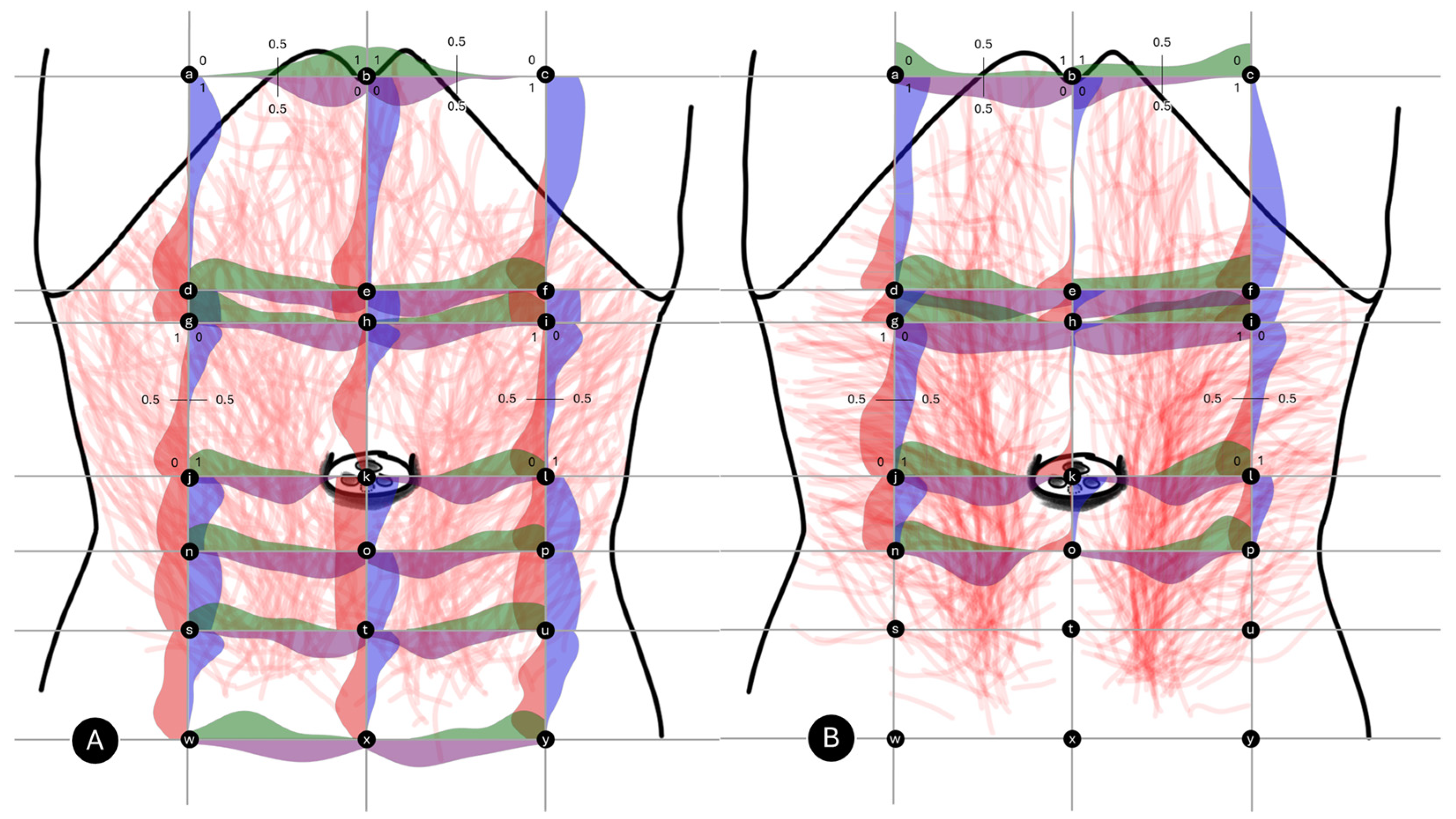
Figure 3 show the standardised measurements (measurement from the anatomical point to the closest vasculature divided by total distance between anatomical points) at the anatomical points in each direction relative to the closest vasculature structure.
On average, the anatomical landmark points “k”, “w”, “x”, and “y” demonstrated the greatest minimal circumferential (in no specific direction) distances of 5.80 ± 2.66 mm, 4.78 ± 2.97 mm, 5.47 ± 3.87 mm, and 4.10 ± 3.10 mm, respectively, outside of the pathway of underlying abdominal vascular structures. This is also seen in
Figure 3A, with peaks around these points that are further away from the anatomical points mentioned above.
3.1.1. Above the Level of the Umbilicus
Superior to the transumbilical plane, transverse lines through the xiphoid process and Lee-Huang’s point, together with the subcostal plane, established intersections with the right midclavicular line (anatomical landmark points “a”, “d”, and “g”), the mid-sagittal plane (anatomical points “b”, “e”, and “h”), and left midclavicular plane (anatomical landmark points “c”, “f”, and “i”). Points “a” and “c” had no superior and lateral values, as this extended outside of the dissection area, and no observations were made in those two directions.
Right Midclavicular Line: Anatomical Landmark Points “a”, “d”, and “g”
The pathways of the superficial vascular structures of the anterior abdominal wall were found on average (closest distance) between 2.62 and 3.45 mm above these landmark points in the right midclavicular line, 3.15–15.58 mm inferior to these landmark points, 4.10–15.61 mm medial to these landmark points, and 3.37–4.25 mm lateral to these anatomical landmark points (
Table 1). Although the kernel density plot peaks (
Figure 3A) are further away from the anatomical point “a”, it bears considering that some of those points (superior and lateral) are above the costal margin, and extended outside the dissection area; thus, closer vasculature was not recorded.
Table 1.
Closest mean distance (in mm) from anatomical landmarks to the nearest superficial vasculature in two perpendicular planes; four directional measurements taken above the level of the umbilicus. (Sup = Superior, Med = Medial, Inf = Inferior, Lat = Lateral, SD = Standard deviation.)
Table 1.
Closest mean distance (in mm) from anatomical landmarks to the nearest superficial vasculature in two perpendicular planes; four directional measurements taken above the level of the umbilicus. (Sup = Superior, Med = Medial, Inf = Inferior, Lat = Lateral, SD = Standard deviation.)
| | Directional Measurement at Each Anatomical Landmark |
|---|
| | Sup | Med | Inf | Lat | Sup | Left | Inf | Right | Sup | Med | Inf | Lat |
|---|
| | a | b (Xiphoid process) | c |
| N | | 26 | 27 | | 11 | 25 | 29 | 25 | | 26 | 26 | |
| Range | | 25.28 | 22.62 | | 6.22 | 8.98 | 20.65 | 7.81 | | 19.97 | 19.84 | |
| Mean | | 15.61 | 15.58 | | 3.56 | 3.88 | 6.41 | 3.84 | | 16.86 | 16.21 | |
| SD | | 5.74 | 6.50 | | 2.04 | 2.46 | 5.96 | 2.44 | | 4.98 | 5.64 | |
| | d | e | f |
| N | 26 | 27 | 28 | 25 | 26 | 28 | 29 | 29 | 22 | 29 | 27 | 26 |
| Range | 10.61 | 12.64 | 12.32 | 11.52 | 11.00 | 17.01 | 9.80 | 11.86 | 12.80 | 14.24 | 10.33 | 10.66 |
| Mean | 3.45 | 4.44 | 5.24 | 4.25 | 3.42 | 5.26 | 3.68 | 4.11 | 3.81 | 4.58 | 3.19 | 3.76 |
| SD | 2.67 | 3.24 | 3.79 | 2.95 | 3.05 | 4.58 | 2.77 | 3.51 | 3.52 | 3.80 | 2.95 | 3.54 |
| | g | h (Lee-Huang’s Point) | i |
| N | 28 | 29 | 28 | 27 | 27 | 27 | 27 | 28 | 27 | 30 | 29 | 28 |
| Range | 9.32 | 14.76 | 9.90 | 9.63 | 13.86 | 14.93 | 8.60 | 10.13 | 14.30 | 17.31 | 15.93 | 14.46 |
| Mean | 2.62 | 4.10 | 3.15 | 3.37 | 4.42 | 5.04 | 2.97 | 4.22 | 4.26 | 4.81 | 4.44 | 4.07 |
| SD | 2.38 | 4.01 | 2.69 | 2.78 | 3.60 | 3.87 | 2.37 | 2.91 | 3.90 | 3.58 | 4.80 | 3.46 |
Mid-Sagittal Plane: Anatomical Landmark Points “b”, “e”, and “h”
The course of superficial vascular structures of the anterior abdominal wall was found on average (closest distance) between 3.42 and 4.42 mm superiorly, 2.97–6.41 mm inferiorly, 3.88–5.26 mm to the left, and 3.84–4.22 mm to the right of these anatomical landmark points in the mid-sagittal plane (
Table 1). Considering the kernel density plots (
Figure 3A), there is a significant accumulation of high peaks surrounding point “b”, with GREEN indicating medial measurements from points “a” and “c” and PURPLE indicating the left and right distances from point “b”. This indicates that the left and right measurements from point “b” (xiphoid process) were consistently similar, possibly the same, as the superficial vasculature measured from anatomical landmark points “a”, “b”, and “c”. When taking into account all three anatomical points (“b”, “e”, and “h”), and the density distribution found to the left and right, a general trend is noted that the superficial vasculature courses laterally to the midline, as they course cranially.
Left Midclavicular Line: Anatomical Landmark Points “c”, “f”, and “i”
When considering the course of the superficial vascular structures of the anterior abdominal wall in this plane, the average closest distance was found between 3.81 and 4.26 mm superior to these landmark points in the left midclavicular line, 3.19–16.21 mm inferior to these landmark points, 4.58–16.86 mm medial to these landmark points, and 3.76–4.07 mm lateral to these landmark points (
Table 1). Similar to anatomical point “a”, point “c” is above the costal margin, and a point closer to the vasculature might be present; however, this extends outside of the dissection area. When considering the kernel density plots (
Figure 3A) surrounding points “f” and “i”, the superior (RED) and inferior (BLUE) plots indicate a higher frequency that vasculature is found near those anatomical points. The vasculature found medially is more equally distributed away from the anatomical points; however, it still presents with a high frequency of the vasculature crossing the plane closer to the anatomical point.
3.1.2. At the Level of the Umbilicus
Three intersections with the transumbilical plane were recorded as anatomical landmarks in
Table 2: one at the right midclavicular line (“j”), another in the mid-sagittal plane (“k”), and the last at the left midclavicular line (“l”).
Table 2.
Closest mean distance (in mm) from anatomical landmarks to the nearest superficial vasculature in two perpendicular planes; four directional measurements taken at the level of the umbilicus. (Sup = Superior, Med = Medial, Inf = Inferior, Lat = Lateral, SD = Standard deviation.)
Table 2.
Closest mean distance (in mm) from anatomical landmarks to the nearest superficial vasculature in two perpendicular planes; four directional measurements taken at the level of the umbilicus. (Sup = Superior, Med = Medial, Inf = Inferior, Lat = Lateral, SD = Standard deviation.)
| | Directional Measurement at Each Anatomical Landmark |
|---|
| | Sup | Med | Inf | Lat | Sup | Left | Inf | Right | Sup | Med | Inf | Lat |
|---|
| | j | k (Umbilicus) | l |
| N | 29 | 30 | 30 | 27 | 27 | 30 | 27 | 29 | 30 | 30 | 29 | 29 |
| Range | 18.79 | 12.90 | 10.16 | 12.88 | 17.59 | 14.64 | 11.01 | 12.67 | 18.64 | 9.67 | 13.76 | 12.13 |
| Mean | 5.51 | 3.54 | 3.45 | 4.15 | 11.20 | 9.31 | 7.80 | 9.71 | 4.88 | 3.68 | 4.28 | 4.83 |
| SD | 5.19 | 3.07 | 2.83 | 3.50 | 4.32 | 3.69 | 2.84 | 3.41 | 4.63 | 2.37 | 3.28 | 3.50 |
Anatomical Landmark Points “j”, “k”, and “l”
Point “j” revealed that, on average, a vessel was found 5.51 ± 5.19 mm superiorly, 3.54 ± 3.07 mm medially, 3.45 ± 2.83 mm inferiorly, and 4.15 ± 3.50 mm laterally. Similar values were seen for point “l”, as on average the closest vasculature found superiorly was 4.88 ± 4.63 mm, 3.68 ± 2.37 mm medially, 4.28 ± 3.28 mm inferiorly, and 4.83 ± 3.50 mm laterally. In reference to
Figure 3A, the anatomical points “j” and “l” have high peaks surrounding the point, indicating that the vasculature is near the determined intersections. This is unlike point “k,” which shows a barren region near the anatomical point, with the highest density peak of the vasculature crossing the plane to the left, right, and superiorly, roughly halfway between the adjacent anatomical points. However, the kernel density plot for the vasculature inferior to point “k” indicates a general distribution, with no prominent high-density peaks. On average, the closest superficial vasculature found from point “k”, circumferential, was 5.80 ± 2.66 mm (95% CI: 4.81–6.79 mm). The average distance from point “k” to the closest vasculature superiorly was 11.20 ± 4.32 mm, 9.31 ± 3.69 mm to the left, 9.71 ± 3.41 mm to the right, and 7.80 ± 2.84 mm inferiorly.
3.1.3. Below the Level of the Umbilicus
Just inferior to the transumbilical plane, transverse lines through the McBurney’s point, ASIS, and the palpable pubic crests were established, intersecting with the right midclavicular line, anatomical landmark points “n”, “s”, and “w”, the mid-sagittal plane, anatomical points “o”, “t”, and “x”, and left midclavicular plane, anatomical landmark points “p”, “u”, and “y” (
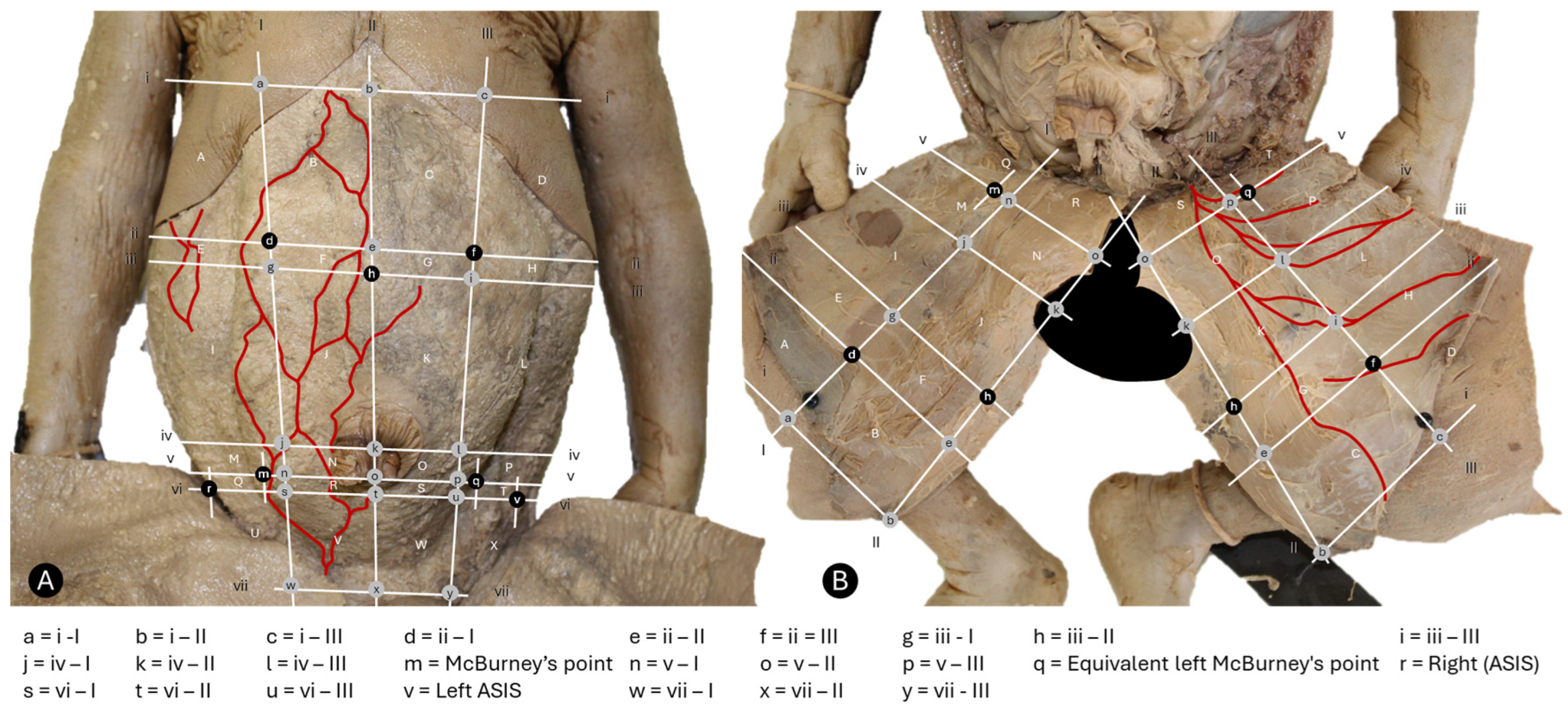
Table 3). In addition to anatomical landmarks within the established grid, four additional distinct anatomical landmarks were identified. These included one at McBurney’s point (right side), point “m”, another at the contralateral equivalent of McBurney’s point (left side), point “q”, and the right (point “r”) and left (point “v”) ASIS. At each of these landmarks, two perpendicular planes were established, one parallel to the midclavicular lines and the other to the transverse plane, facilitating four measurements—superior, medial, inferior, and lateral—at each of the four locations.
Table 3.
Closest mean distance (in mm) from anatomical landmarks to the nearest superficial vasculature in two perpendicular planes; four directional measurements taken below the level of the umbilicus. (Sup = Superior, Med = Medial, Inf = Inferior, Lat = Lateral, SD = Standard deviation.)
Table 3.
Closest mean distance (in mm) from anatomical landmarks to the nearest superficial vasculature in two perpendicular planes; four directional measurements taken below the level of the umbilicus. (Sup = Superior, Med = Medial, Inf = Inferior, Lat = Lateral, SD = Standard deviation.)
| | Directional Measurement at Each Anatomical Landmark |
|---|
| | Sup | Med | Inf | Lat | Sup | Left | Inf | Right | Sup | Med | Inf | Lat |
|---|
| | n | o | p |
| N | 29 | 29 | 27 | 29 | 28 | 30 | 23 | 30 | 29 | 30 | 29 | 29 |
| Range | 19.20 | 11.69 | 7.54 | 12.25 | 34.02 | 14.16 | 4.86 | 13.62 | 10.48 | 9.47 | 14.37 | 11.90 |
| Mean | 4.44 | 3.34 | 2.32 | 3.45 | 10.92 | 5.45 | 2.02 | 6.11 | 3.18 | 3.52 | 4.02 | 4.49 |
| SD | 5.10 | 3.17 | 2.30 | 3.54 | 9.69 | 3.47 | 1.29 | 3.73 | 3.22 | 3.15 | 3.80 | 4.16 |
| | s | t | u |
| N | 28 | 30 | 25 | 25 | 26 | 28 | 25 | 29 | 30 | 30 | 30 | 27 |
| Range | 5.85 | 14.15 | 5.95 | 11.33 | 22.02 | 14.25 | 18.37 | 15.45 | 9.83 | 13.47 | 11.80 | 8.93 |
| Mean | 3.01 | 4.75 | 2.50 | 3.57 | 5.55 | 6.36 | 4.44 | 5.35 | 2.97 | 3.77 | 4.44 | 4.01 |
| SD | 1.81 | 3.79 | 1.72 | 2.75 | 6.16 | 3.09 | 4.69 | 3.93 | 2.52 | 3.65 | 3.66 | 3.17 |
| | w | x (Pubic crests) | y |
| N | 30 | 11 | 2 | 6 | 27 | 11 | 4 | 9 | 30 | 11 | 4 | 6 |
| Range | 18.60 | 11.26 | 1.47 | 5.51 | 16.12 | 14.62 | 6.05 | 14.49 | 18.74 | 9.36 | 1.72 | 6.68 |
| Mean | 7.86 | 5.39 | 0.73 | 2.39 | 7.25 | 7.21 | 2.77 | 7.24 | 6.28 | 3.49 | 1.71 | 3.72 |
| SD | 5.19 | 3.12 | 1.04 | 1.97 | 4.77 | 5.28 | 2.70 | 4.88 | 4.33 | 3.11 | 0.91 | 2.30 |
Right Midclavicular Line: Anatomical Landmark Points “n”, “s”, and “w”
Vascular structures of the anterior abdominal wall were found on average (closest distance) between 3.01 and 7.86 mm superior to these landmark points in the right midclavicular line, 0.73–2.50 mm inferior to these landmark points, 3.34–5.39 mm medial to these landmark points, and 2.39–3.57 mm lateral to these anatomical landmark points (
Table 3). Considering the kernel density plots (
Figure 3A) medial to the anatomical points within the right midclavicular line, the high-density peaks laterally migrate from the median as the vasculature coursed cranially. Point “w” has a density peak that is further medially than those of points “s” and “n”. On average, the closest vasculature (circumferential) to point “w” was 4.78 ± 2.97 mm; medially, the closest vasculature was 5.39 ± 3.12 mm. Superior to point “w”, the vasculature was seen on average, at the closest distance, at 7.86 ± 5.19 mm.
Mid-Sagittal Plane: Anatomical Landmark Points “o”, “t”, and “x”
On average, the closest distance from the anatomical points to the vascular structures of the anterior abdominal wall were between 10.92 and 5.55 mm superior, 4.44–2.02 mm inferior, 5.45–7.21 mm left, and 5.35–7.24 mm right to these anatomical landmark points in the mid-sagittal plane (
Table 3).
Left Midclavicular Line: Anatomical Landmark Points “p”, “u”, and “y”
On the anterior abdominal wall, the superficial vasculature in relation to the left midclavicular line was on average between 2.97 and 6.28 mm superior, 1.71–4.44 mm inferior, 3.49–3.77 mm medial, and 3.72–4.49 mm lateral to these anatomical landmark points (
Table 3). Considering the kernel density plots (
Figure 3A) medial to the anatomical points within the left midclavicular line, the high-density peaks laterally migrate from the median as the vasculature coursed cranially, similar to the right side. The medial density plots at points “y” and “p” both have two high-density peaks, a bimodal distribution, suggesting that the vasculature bisected the plane at those levels at two separate common distances.
Planes Through McBurney’s Point and the Contralateral Equivalent Anatomical Landmark Points “m” and “q”
The minimal circumferential distance from point “m” was 1.15 ± 0.079 mm (95% CI: 0.84–1.46 mm). Point “q” had similar results, with 3.84 ± 4.00 mm superiorly, 4.14 ± 3.86 mm medially, 2.68 ± 2.76 mm inferiorly, 3.36 ± 2.74 mm laterally, and an average minimal circumferential distance to the closest vasculature structure of 1.30 ± 1.30 (95% CI: 0.81–1.79 mm).
Planes Through ASIS: Anatomical Landmark Points “r” and “v”
The four directional measurements for the two anatomical landmarks associated with the right (“r”) and left (“v”) ASIS were measured superiorly (“r”: 6.58 ± 4.19 mm, “v”: 4.51 ± 2.74 mm), medially (“r”: 5.71 ± 3.13 mm, “v”: 4.76 ± 3.36 mm), inferiorly (“r”: 4.35 ± 2.80 mm, “v”: 3.17 ± 1.87 mm), laterally (“r”: 3.40 ± 2.76 mm, “v”: 2.25 ± 1.53 mm), and the to the minimal circumferential distance (“r”: 2.73 ± 2.02 mm; 95% CI:1.98–3.48 mm, “v”: 2.29 ± 2.03 mm; 95% CI: 1.50–3.08 mm) between the anatomical landmark and the vascular structure.
3.2. Deep Vascular Structures of the Anterior Abdominal Wall
Using the same established anatomical grid and superior, medial, inferior, and lateral measurements at each established anatomical landmark (superior, left, inferior, and right measurements at landmarks in the midline), the results are summarised in
Table 4,
Table 5 and
Table 6, and visualised in
Figure 3B.
3.2.1. Above the Level of the Umbilicus
The results from established intersections with the right midclavicular line, anatomical landmark points “a”, “d”, and “g”, the mid-sagittal plane, anatomical points “b”, “e”, and “h”, and the left midclavicular plane, anatomical landmark points “c”, “f”, and “i”, are shown in
Table 4. Points “a” and “c” had no superior and lateral values, as this extended outside of the dissection area, and no observations were made in those two directions.
Table 4.
Closest mean distance (in mm) from anatomical landmarks to the nearest vasculature in two perpendicular planes; four directional measurements taken above the level of the umbilicus. (Sup = Superior, Med = Medial, Inf = Inferior, Lat = Lateral, SD = Standard deviation.)
Table 4.
Closest mean distance (in mm) from anatomical landmarks to the nearest vasculature in two perpendicular planes; four directional measurements taken above the level of the umbilicus. (Sup = Superior, Med = Medial, Inf = Inferior, Lat = Lateral, SD = Standard deviation.)
| Directional Measurement at Each Anatomical Landmark |
|---|
| | Sup | Med | Inf | Lat | Sup | Left | Inf | Right | Sup | Med | Inf | Lat |
|---|
| | a | b (Xiphoid process) | c |
| N | 0 | 5 | 13 | 0 | 0 | 12 | 7 | 6 | 0 | 11 | 13 | 0 |
| Range | | 11.63 | 11.91 | | | 12.79 | 19.8 | 11.17 | | 14.29 | 20.79 | |
| Mean | | 11.86 | 15.53 | | | 8.41 | 12.07 | 6.57 | | 16.61 | 19.76 | |
| SD | | 4.22 | 4.13 | | | 4.39 | 7.73 | 4.43 | | 5.39 | 6.30 | |
| | d | e | f |
| N | 22 | 28 | 30 | 24 | 5 | 29 | 5 | 29 | 22 | 28 | 28 | 17 |
| Range | 17.85 | 11.12 | 18.68 | 16.49 | 17.66 | 22.35 | 5.24 | 21.12 | 10.8 | 14.35 | 15.66 | 19.93 |
| Mean | 4.80 | 4.68 | 5.35 | 4.62 | 7.66 | 11.41 | 3.41 | 8.45 | 4.05 | 4.98 | 6.50 | 5.51 |
| SD | 4.17 | 3.52 | 4.48 | 4.20 | 6.77 | 5.71 | 2.16 | 5.61 | 3.21 | 4.21 | 4.92 | 5.03 |
| | g | h (Lee-Huang’s Point) | i |
| N | 12 | 24 | 28 | 10 | 7 | 28 | 6 | 27 | 7 | 29 | 27 | 13 |
| Range | 10.79 | 10.27 | 16.79 | 10.11 | 17.26 | 22.59 | 7.24 | 21.94 | 11.7 | 22.08 | 18.13 | 8.9 |
| Mean | 6.93 | 5.82 | 6.75 | 3.30 | 6.10 | 9.68 | 3.08 | 9.99 | 4.13 | 6.63 | 5.69 | 5.31 |
| SD | 3.31 | 3.35 | 5.24 | 3.58 | 5.90 | 6.18 | 2.74 | 6.36 | 4.53 | 5.45 | 4.89 | 2.42 |
Right Midclavicular Line: Anatomical Landmark Points “a”, “d”, and “g”
The minimal distance from “a” in a medial and inferior direction was 11.86 ± 4.22 mm and 15.53 ±4.13 mm, respectively (
Table 4). The kernel density plots (
Figure 3B) around point “a” present relatively flat plots in all directions, indicative that there was no common site where the vasculature bisected the planes. The minimum circumferential distance from the anatomical landmarks to a vascular structure that was the closest to the points was “d” (2.37 ± 2.23 mm; 95% CI: 1.55–3.19 mm) and “g” (4.03 ± 3.26 mm; 95% CI: 2.79–5.27 mm).
Mid-Sagittal Plane: Anatomical Landmark Points “b”, “e”, and “h”
The vasculature surrounding the median anatomical landmarks “e” and “h” on both sides are positioned relatively further away, compared to the anatomical points situated in the right and left midclavicular lines. On average, the closest distances (
Table 4) to the left of these points were 8.41 ± 4.39 mm for “b”, 11.41 ± 5.71 mm for “e”, and 6.10 ± 5.90 mm for “h”. To the right, the average closest distances were 6.57 ± 4.43 mm for “b”, 8.45 ± 5.61 mm for “e”, and 9.99 ± 6.36 mm for “h”. This vacant vasculature corridor is apparent in
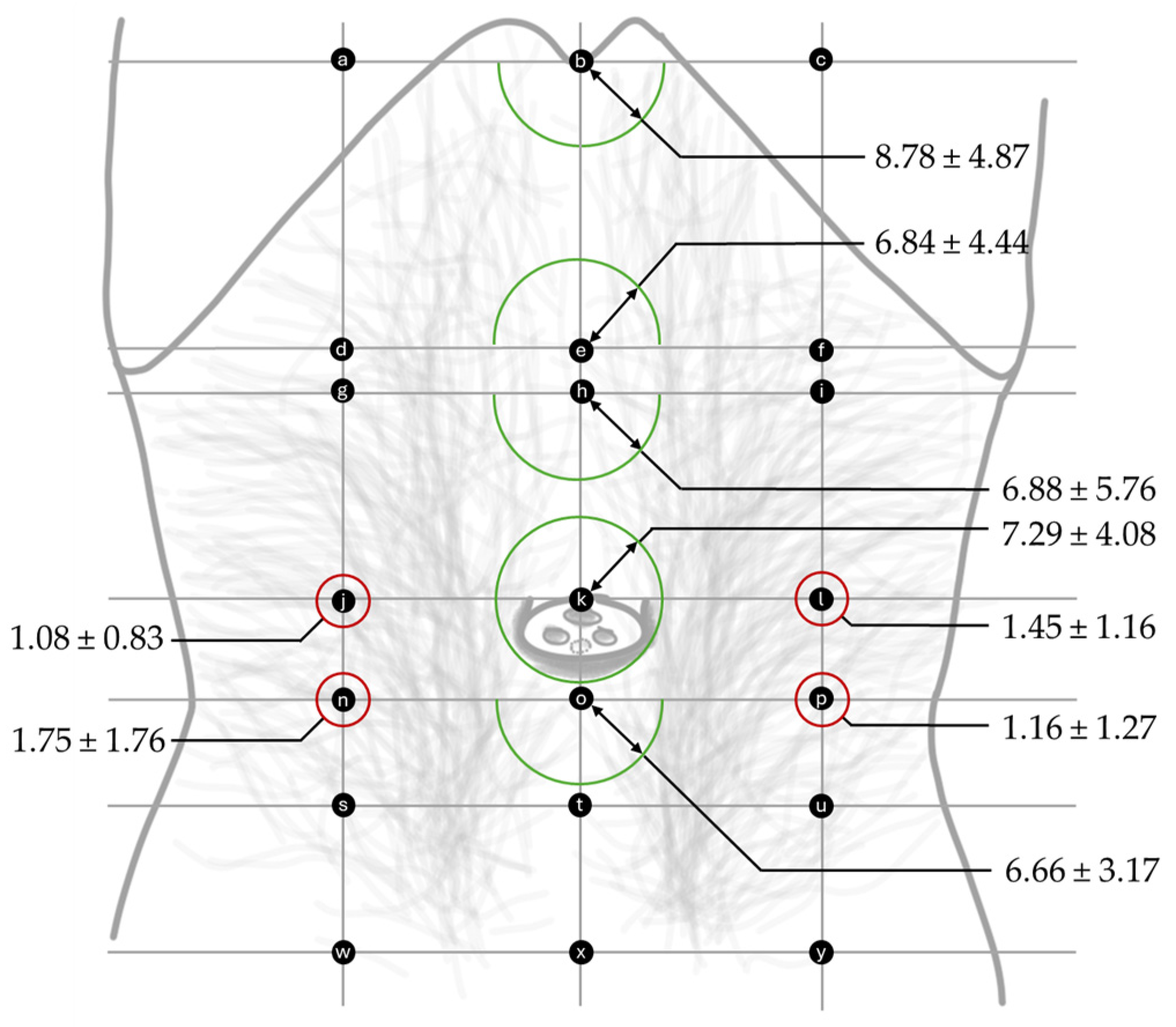
Figure 4, with some discrepancy around points “e” and “h”, which shows a flat distribution from the point. The flat distribution is confirmed with the SD ranging between 5.71 mm and 5.61 mm for left and right measurements from point “e”, and 9.68 and 9.99 mm for the measurements to the left and right of point “h”. On average, the minimum circumferential distance from anatomical landmarks to a vascular structure that was further away was at point “b” (8.78 ± 4.87 mm; 95% CI: 6.90–10.67 mm), “e” (6.84 ± 4.44 mm; 95% CI: 5.21–8.47 mm), and “h” (6.88 ± 5.76 mm; 95% CI: 4.73–9.03 mm), compared to the average distance within the right and left midclavicular lines.
Left Midclavicular Line: Anatomical Landmark Points “c”, “f”, and “i”
The shortest medial distance from point “c” to the closest vasculature structure was 16.61 ± 5.39 mm, and inferiorly 19.76 ± 6.30 mm (
Table 4). Meanwhile, the minimum circumferential distance from the anatomical landmarks points “f” and “i” was 2.76 ± 2.71 mm (95% CI: 1.77–3.75 mm) and 2.46 ± 2.29 mm (95% CI: 1.59–3.33 mm), respectively.
3.2.2. At the Level of the Umbilicus
Three intersections with the transumbilical plane were recorded at points “j”, “k”, and “l” (
Table 5).
Table 5.
Closest mean distance (in mm) from anatomical landmarks to the nearest vasculature in two perpendicular planes; four directional measurements taken at the level of the umbilicus. (Sup = Superior, Med = Medial, Inf = Inferior, Lat = Lateral, SD = Standard deviation.)
Table 5.
Closest mean distance (in mm) from anatomical landmarks to the nearest vasculature in two perpendicular planes; four directional measurements taken at the level of the umbilicus. (Sup = Superior, Med = Medial, Inf = Inferior, Lat = Lateral, SD = Standard deviation.)
| Directional Measurement at Each Anatomical Landmark |
|---|
| | Sup | Med | Inf | Lat | Sup | Left | Inf | Right | Sup | Med | Inf | Lat |
|---|
| | j | k (Umbilicus) | l |
| N | 31 | 31 | 30 | 30 | 3 | 31 | 5 | 31 | 29 | 29 | 28 | 24 |
| Range | 14.37 | 7.78 | 11.4 | 12.97 | 6.1 | 19.19 | 9.35 | 17.62 | 18.93 | 8.33 | 8.17 | 5.22 |
| Mean | 6.16 | 3.40 | 4.03 | 3.40 | 7.50 | 10.87 | 8.78 | 9.70 | 4.54 | 3.12 | 3.29 | 2.08 |
| SD | 4.48 | 2.42 | 3.16 | 3.22 | 3.09 | 4.40 | 3.50 | 5.03 | 4.97 | 2.41 | 2.75 | 1.73 |
Anatomical Landmark Points “j”, “k”, and “l”
At the umbilicus (point “k”), the nearest vascular structures were approximately 7.50 ± 5.90 mm above, 10.87 ± 4.40 mm to the left, 8.78 ± 3.50 mm below, and 3.08 ± 2.74 mm to the right (
Table 5). The average minimum circumferential distance from point “k” to a vascular structure was 7.29 ± 4.08 mm (95% CI: 5.79–8.78 mm). The closest circumferential vascular structures to the points were near “j” at 1.08 ± 0.83 mm (95% CI: 0.77–1.39 mm) and to point “l” 1.45 ± 1.16 mm (95% CI: 1.02–1.88 mm).
Figure 3B, specifically between points “k” and “h”, depicts a region of reduced vasculature midway between the two anatomical landmark points. High-density peaks are visible near the two points, with very few instances of vasculature crossing between them farther away. Since the methodology only recorded the closest vasculature, there might be a third vasculature structure between the two points that is neither close to “h” nor “k” and may not have been recorded. The kernel density plots on either side of point “k” indicate that the majority of vasculature crossing the transumbilical plane would have been further away from point “k”, approximately midway between points “j” and “l”.
3.2.3. Below the Level of the Umbilicus
The deep abdominal wall dissection area limited the measurements to the points located on the horizontal line through McBurney’s point. The anatomical landmark points “n”, “o”, and “p” are listed in
Table 6, whereas the points “q”, “r”, “s”, “t”, “u”, “v”, “w”, “x”, and “y” have no comparable measurements.
Table 6.
Closest mean distance (in mm) from anatomical landmarks to the nearest vasculature in two perpendicular planes; four directional measurements taken below the level of the umbilicus. (Sup = Superior, Med = Medial, Inf = Inferior, Lat = Lateral, SD = Standard deviation.)
Table 6.
Closest mean distance (in mm) from anatomical landmarks to the nearest vasculature in two perpendicular planes; four directional measurements taken below the level of the umbilicus. (Sup = Superior, Med = Medial, Inf = Inferior, Lat = Lateral, SD = Standard deviation.)
| Directional Measurement at Each Anatomical Landmark |
|---|
| | Sup | Med | Inf | Lat | Sup | Left | Inf | Right | Sup | Med | Inf | Lat |
|---|
| | n | o | p |
| N | 30 | 31 | 29 | 22 | 3 | 31 | 4 | 31 | 30 | 30 | 27 | 27 |
| Range | 17.02 | 10.06 | 10.87 | 12.49 | 6.81 | 17.56 | 2.71 | 11.86 | 14.36 | 9.26 | 6.24 | 12 |
| Mean | 5.71 | 3.41 | 4.22 | 3.14 | 5.06 | 9.49 | 4.17 | 9.90 | 4.81 | 3.10 | 1.87 | 3.24 |
| SD | 4.81 | 3.04 | 3.06 | 4.12 | 3.41 | 4.33 | 1.38 | 3.60 | 3.81 | 2.59 | 1.56 | 3.72 |
Right Midclavicular Line: Anatomical Landmark Point “n”
The minimum circumferential distance from the anatomical landmarks to a vascular structure that was the closest to the points was “n” (1.75 ± 1.76 mm; 95% CI: 1.11–2.40 mm).
Mid-sagittal Plane: Anatomical Landmark Point “o”
Below the umbilicus, where the horizontal line through McBurney’s point intersects with the mid-sagittal plane, the nearest vascular structure to point “o” was, on average, 5.06 ± 3.41 mm above, 9.49 ± 4.33 mm to the left, 4.17 ± 1.38 mm below, and 9.90 ± 3.60 mm to the right (
Table 6). On average, the minimum circumferential distance at point “o” was 6.66 ± 3.17 mm (95% CI: 5.49–7.82 mm). A vacant vasculature corridor is apparent within
Figure 3B, as we visually note the high peaks further away from points “k” and “o”.
Left Midclavicular Line: Anatomical Landmark Point “p”
The minimum circumferential distance from the anatomical landmarks point “p” to a vascular structure was 1.16 ± 1.27 mm (95% CI: 0.68–1.64 mm).
3.3. Internal Vasculature and Organs of the Abdominal Cavity
The umbilical vein was found in the midline at point “e”. On twelve (n = 12) occasions, the umbilical veins were found to the right of point “e”, with an average distance of 0.80 ± 0.88 mm, and on eleven (n = 11) occasions to the left of point “e”, with an average distance of 0.59 ± 0.85 mm. The horizontal measurements of the in situ umbilical vein were on average 18.97 ± 5.26 mm medial to point “d”, and 21.00 ± 4.94 mm medial to point “f”. At the level of Lee-Huang’s point (point “h”), the umbilical vein was found 17.38 ± 6.47 mm from the intersection with the right midclavicular line (point “g”), and on average was found 20.97 ± 6.39 mm from point “i”, the intersection between Lee-Huang’s point and the left midclavicular line.
Below the umbilicus, the average shortest horizontal distances to the umbilical arteries were 8.95 ± 2.86 mm medially from point “n” and 11.94 ± 3.42 mm medially from point “p”. The average lateral measurements from point “o” to the right were 2.22 ± 2.53 mm, and to the left 2.14 ± 2.10 mm. More caudally, at the level of the ASIS (point “s”), the umbilical arteries were on average 6.96 ± 2.88 mm medially, and from point “u”, the umbilical arteries were medially on average 9.44 ± 3.61 mm. From point “t”, the umbilical arteries were on average 2.48 ± 2.21 mm to the right, and 3.89 ± 3.76 mm to the left. The minimal circumferential distances from point “t” were 2.22 ± 2.25 mm (95% CI: 1.33–3.11 mm).
In addition to determining the surface anatomy of the liver and stomach within specific anatomical cells (A–L), measurements of the distance from the subcostal border to the inferior margins of both organs were used to describe the surface anatomy.
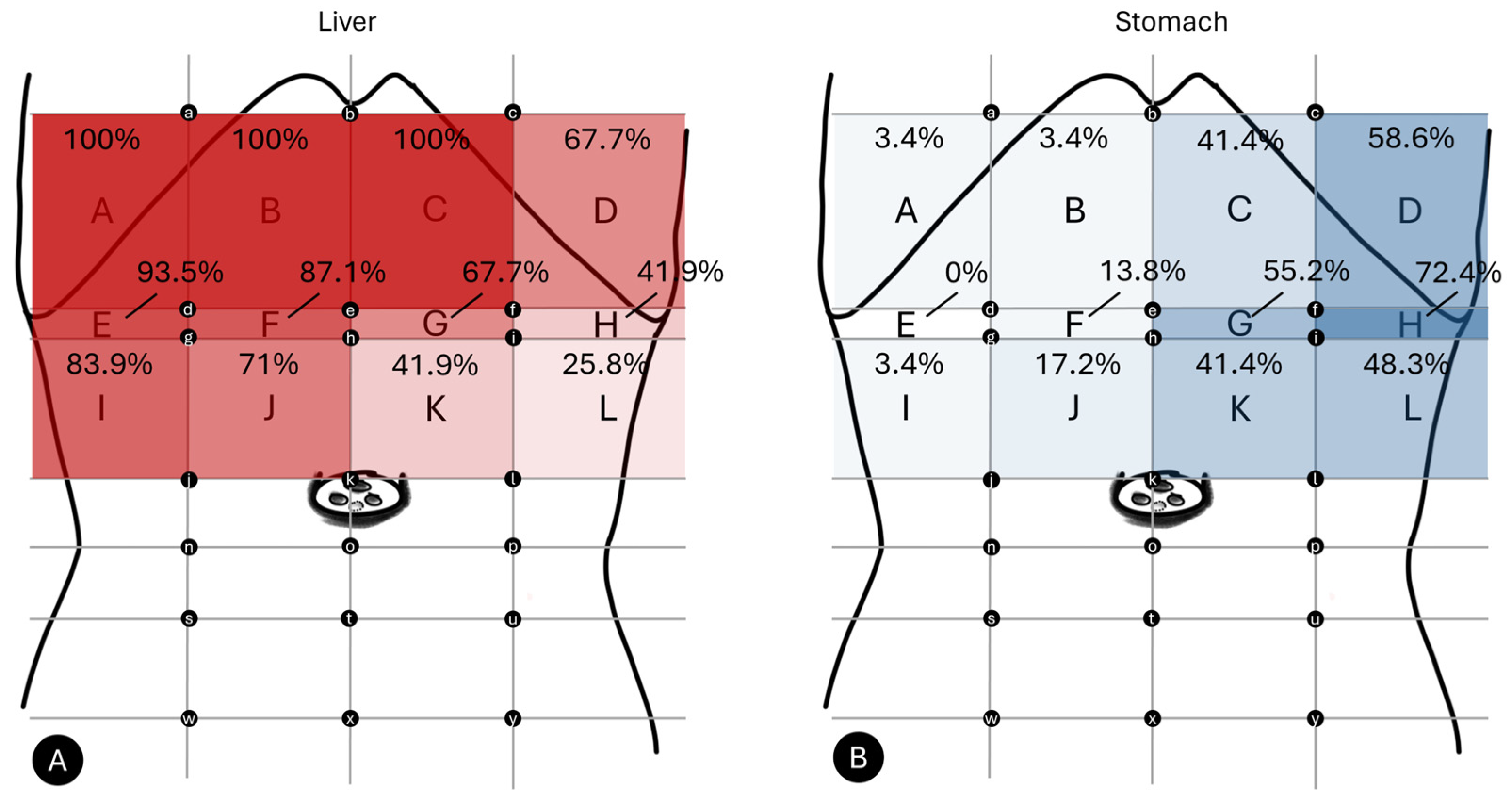
Table 7 summarises the frequency of liver and stomach in each anatomical cell; a visual representation of these values is also depicted in
Figure 4. The liver was consistently observed in cells A–C. In cell A, the liver either completely occupied the entirety of the cell (93.5%), or only partially occupied some of the cell (6.5%). Similarly, in cell B, the liver was completely present 80.6% of the time and partially present in the remaining 19.4% of cases. In cell C, the liver was partially located in 54.8% of cases and only completely within the cell in 45.2% of cases. The liver was absent from cell D in 32.3% of cases and was found in varying degrees. In cell E, the liver was completely present in 83.9% of cases, partially in 9.7%, and absent in 6.5% of cases. The liver was only partially located or absent in cells I to L, with the frequency of its presence decreasing from right to left (I to L), from 83.9% to 25.8%. The inferior margin of the liver extended below the costal border on average by 17.34 ± 8.24 mm (95% CI: 14.26–20.42 mm) within the right midclavicular line, 20.61 ± 8.29 mm (95% CI: 17.56–23.65 mm) within the mid-sagittal plane, and 12.41 ± 8.32 mm (95% CI: 8.81–16.01 mm) within the left midclavicular line.
Table 7.
Frequency table of the in situ location of the liver and stomach related to the established anatomical cells.
Table 7.
Frequency table of the in situ location of the liver and stomach related to the established anatomical cells.
| | Liver |
| | Yes | Partially | No | Yes | Partially | No | Yes | Partially | No | Yes | Partially | No |
| | A | B | C | D |
| Freq (n) | 29 | 2 | 0 | 25 | 6 | 0 | 14 | 17 | 0 | 6 | 15 | 10 |
| (%) | 93.5 | 6.5 | 0 | 80.6 | 19.4 | 0 | 45.2 | 54.8 | 0 | 19.4 | 48.4 | 32.3 |
| | E | F | G | H |
| Freq (n) | 26 | 3 | 2 | 17 | 10 | 4 | 8 | 13 | 10 | 3 | 10 | 18 |
| (%) | 83.9 | 9.7 | 6.5 | 54.8 | 32.3 | 12.9 | 25.8 | 41.9 | 32.3 | 9.7 | 32.3 | 58.1 |
| | I | J | K | L |
| Freq (n) | 0 | 26 | 5 | 0 | 22 | 9 | 0 | 13 | 18 | 0 | 8 | 23 |
| (%) | 0 | 83.9 | 16.1 | 0 | 71 | 29 | 0 | 41.9 | 58.1 | 0 | 25.8 | 74.2 |
| | Stomach |
| | Yes | Partially | No | Yes | Partially | No | Yes | Partially | No | Yes | Partially | No |
| | A | B | C | D |
| Freq (n) | 0 | 1 | 28 | 0 | 1 | 28 | 0 | 12 | 17 | 0 | 17 | 12 |
| (%) | 0 | 3.4 | 96.6 | 0 | 3.4 | 96.6 | 0 | 41.4 | 58.6 | 0 | 58.6 | 41.4 |
| | E | F | G | H |
| Freq (n) | 0 | 0 | 29 | 0 | 4 | 25 | 0 | 16 | 13 | 0 | 21 | 8 |
| (%) | 0 | 0 | 100 | 0 | 13.8 | 86.2 | 0 | 55.2 | 44.8 | 0 | 72.4 | 27.6 |
| | I | J | K | L |
| Freq (n) | 0 | 1 | 28 | 0 | 5 | 24 | 0 | 12 | 17 | 0 | 14 | 15 |
| (%) | 0 | 3.4 | 96.6 | 0 | 17.2 | 82.8 | 0 | 41.4 | 58.6 | 0 | 48.3 | 51.7 |
Figure 4.
Visual representation of the liver (A) and stomach (B) frequency (if present, entirely or partially) within the related anatomical cells. Darker shades represent cells that occupy the organ more often. In contrast, lighter shades indicate that the organ was found less frequently in the specific cell.
Figure 4.
Visual representation of the liver (A) and stomach (B) frequency (if present, entirely or partially) within the related anatomical cells. Darker shades represent cells that occupy the organ more often. In contrast, lighter shades indicate that the organ was found less frequently in the specific cell.
The stomach was most frequently observed within the anatomical cell H. Within this sample, the stomach never completely occupied a single anatomical cell and was only partially visible in cell H 72.4% of the time. The presence radiates from cell H to the right, with decreasing observations: 55.2% in cell G, 13.8% in cell F, and 0% in cell E. Superiorly (cranially) and inferiorly (caudally) to cell H, the presence of the stomach also diminishes, with 58.6% in cell D and 48.3% in cell L. On average, the inferior margin of the stomach was found 34.18 ± 14.44 mm (95% CI: 22.11–46.25 mm) inferior to the costal border within the mid-sagittal plane. Within the left midclavicular line, the inferior margin of the stomach was found on average to be 19.51 ± 11.13 mm (95% CI: 14.81–24.21 mm) inferior to the costal margin. On one occasion, the stomach was observed within the right midclavicular line, and the inferior margin of the stomach was found 19.11 mm inferior to the costal border.
3.4. Inter-Observer and Intra-Observer Error Analysis
The intra-observer error analysis indicated no significant difference between the principal investigator’s initial observations and those made to test repeatability (p > 0.05). The intra-observer error analysis also showed no biases in the measured variables. The inter-observer error analysis of accuracy revealed some bias in the measurement (p < 0.05). As such, individual analysis of the measurement pairs was conducted and indicated bias at point “p” (1.16 ± 1.27 mm; p = 0.01), at the intersection of the left midclavicular line and the horizontal line through McBurney’s point for measurements made for the deep vascular structures of the anterior abdominal wall. The second observer’s measurements were consistently above those made by the principal investigator, with the 95% CI of the difference ranging from −0.21 mm to −0.06 mm, with a mean difference of −0.14 mm. These differences do not invalidate the topographical measurements, but highlight the narrow tolerances when referring to a typical trocar placement and diameter. Moreover, when comparing the internal vasculature and organ measurements of the co-author and the principal investigator, numerous measurement biases were observed between the pair (p < 0.05). The difference between the pair was 1.67 mm at point “I” medially towards the umbilical vein (20.97 ± 6.39 mm), a difference of 1.16 mm at point “u” medially (9.44 ± 3.61 mm), and a difference of 1.37 mm was observed from the costal border to the inferior margin of the liver (17.34 ± 8.24 mm). All these differences could be considered as small and less significant when considering the overall measurement. However, all three measurements the co-author obtained had a value smaller than the principal investigator’s original measurements. Although there is a strong bias, the authors determined that the differences are not significant, given the proximity to the zero value. It should be noted that this assessment was conducted on a small subset of the overall experimental group (n = 5, about 16% of the 30 total specimens). While this subsample is adequate for detecting major systematic biases or significant methodological issues, the limited sample size naturally reduces the statistical power needed to define very precise confidence limits of agreement.
4. Discussion
Within this current study investigating low-birth-weight neonatal anatomy, a reduced vascular midline corridor was observed, exhibiting greater distances to the nearest deep vasculature compared to their lateral counterparts along the midclavicular lines. For instance, the minimum circumferential distance from deep vessels at midline points “e”, “h”, and “o” averaged 6.84 mm, 6.88 mm, and 6.66 mm, respectively. In contrast, the distances at lateral points at the level or inferior to the umbilicus, such as “j”, “l”, “n”, and “p, were, on average, smaller at 1.08 mm, 1.45 mm, 1.75 mm, and 1.16 mm, respectively. At the level of the umbilicus, the closest deep vasculature is found 10.87 mm to the left and 9.70 mm to the right of the midline. Even more caudally, the closest deep vasculature at the level of McBurney’s point was 9.49 mm to the left and 9.90 mm to the right.
The superior and inferior epigastric arteries have been shown to exhibit considerable variation in their branching patterns and intramuscular course [
5,
6,
16]. This demonstrates inherent anatomical variability in both its vascular and neural structures, while the iliohypogastric and ilioinguinal nerves may also vary in their course relative to commonly used surface landmarks [
17]. Although the present study demonstrates consistent spatial trends, including a relative reduction in vascular density along the midline, these findings should be interpreted as probabilistic rather than absolute.
From a clinical perspective, bleeding from trocar or port sites from superficial vessels is often easily controlled with localised pressure, whereas injury to the deep vascular system can lead to haematomas or intra-abdominal bleeding which is typically more difficult to manage [
18]. Epstein and Ellis [
19], as well as Rao et al. [
20], studied the course of the inferior epigastric artery in adults. They found that the branches of the inferior epigastric artery are highly variable, but found that within the midline of the abdomen, the presence of vasculature was reduced, and that the main stem of the inferior epigastric artery can be avoided if a trocar is placed lateral to the point defined by the distance two-thirds from the ASIS towards the midline within a horizontal plane [
19,
20]. This study found the same high variability and a reduced vascular midline within this low-birth-weight neonatal sample, as previously reported by Epstein and Ellis [
19] and Rao et al. [
20]. The minimal distances to deep vessels along the midclavicular lines ranged between 3.10 mm and 6.63 mm medially and 2.08 mm and 5.51 mm laterally, and the minimal distance to superficial vessels along the midclavicular lines ranged between 3.11 mm and 4.58 mm medially and 1.97 mm and 4.83 mm laterally. This quantification of vascular relations provides anatomical evidence to support that all secondary ports should be placed under direct laparoscopic visualisation to avoid injury to the superficial and inferior epigastric vessels.
The anatomical findings from this study lend themselves to translation into clinical practice, helping clinicians reconsider laparoscopic port placement approaches. When considering a supra-umbilical working port placement after successful insufflation for procedures in the upper abdomen, such as a Nissen fundoplication or cholecystectomy, both the location of the vasculature and viscera should be considered. Considering the neonatal liver and the location of the stomach, as this study found, they extend below the costal margin, averaging 17.34 mm at the right midclavicular line, 20.61 mm in the midline, and 12.41 mm at the left midclavicular line. The stomach was also frequently present in the upper left abdominal quadrant (i.e., cell H). This demonstrates that an optimal port strategy cannot be based solely on vascular anatomy; it requires an integrated understanding of both vascular and visceral topography to ensure both safety and adequate surgical access for the chosen procedure. The results from this study support a 5 mm working port placed at or near Lee-Huang’s point (‘h’) [
2]; a 3 mm or 5 mm left-hand working port in the subcostal region, just left of the midline (near ‘e’) [
21]; a 3 mm or 5 mm right-hand working port along the right midclavicular line, placed caudally to the inferior margin of the liver (near ‘g’); and a 3 mm subxiphoid port (near ‘b’) [
2]. This configuration prioritises the safety of the midline corridor for these port placements, respecting the position of the liver while accommodating a wide angle for working ports (
Table 8,
Figure 5). This configuration does not, however, consider the location of the umbilical vein, which in this study was found above the umbilicus within the midline of the abdomen.
Table 8.
Mean circumferential distances to deep vasculature from key anatomical landmarks together with the percentile-based minimum distances to the deep vasculature.
Table 8.
Mean circumferential distances to deep vasculature from key anatomical landmarks together with the percentile-based minimum distances to the deep vasculature.
| Anatomical Landmark | Mean Circumferential Distance to
Deep Vasculature (mm) | 10th Percentile Distance (mm) | 5th Percentile Distance (mm) |
|---|
Point “b”
(Midline, subxiphoid) | 8.78 ± 4.87 mm
(95% CI: 6.90–10.67 mm) | 2.54 | 0.77 |
Point “e”
(Midline, midway between xiphoid and umbilicus) | 6.84 ± 4.44 mm
(95% CI: 5.21–8.47 mm) | 1.15 | 0.00 * |
Point “h”
(Lee-Huang’s point) | 6.88 ± 5.76 mm
(95% CI: 4.73–9.03 mm) | 0.00 * | 0.00 * |
Point “j”
(Right midclavicular, transumbilical) | 1.08 ± 0.83 mm
(95% CI: 0.77–1.39 mm) | 0.02 | 0.00 * |
Point “k”
(Umbilicus) | 7.29 ± 4.08 mm
(95% CI: 5.79–8.78 mm) | 2.06 | 0.58 |
Point “l”
(Left midclavicular, transumbilical) | 1.45 ± 1.16 mm
(95% CI: 1.02–1.88 mm) | 0.00 * | 0.00 * |
Point “n”
(Right midclavicular line, lower quadrant) | 1.75 ± 1.76 mm;
(95%CI: 1.11–2.40 mm) | 0.00 * | 0.00 * |
Point “o”
(Midline, at the horizontal line through McBurney’s point) | 6.66 ± 3.17 mm
(95%CI: 5.49–7.82 mm) | 2.60 | 1.45 |
Point “p”
(Left midclavicular, lower quadrant) | 1.16 ± 1.27 mm
(95%CI: 0.68–1.64 mm) | 0.00 * | 0.00 * |
While mean distances provide a useful overview of spatial relationships, they may underestimate the proximity of vascular structures. To provide a more conservative, clinically relevant interpretation, 5th- and 10th-percentile distances were calculated to represent the minimum expected distance to vascular structures for the majority of the population. These percentile values highlight the potential for small safety margins, even in regions that appear relatively less vascular when considering mean values alone, and support the need for cautious port placement and the use of direct visualisation where possible (
Table 8).
The umbilicus (point “k”) presents as an anatomical challenge. The current study’s data on superficial vasculature indicate a relatively vessel-free zone around the umbilicus (mean distances of 7.80–11.20 mm). However, surgeons need to consider the deeper-lying umbilical vein, superiorly, and the umbilical arteries and urachus, inferiorly, within the neonatal population. This anatomical relationship provides a strong rationale for the common clinical preference for the open (Hasson) technique over a blind Veress needle insertion for primary umbilical access. Clinical studies have reported a very low incidence of clinically significant embolism [
22]. The primary danger at this site is not superficial but deep, and not from the inherent properties of CO
2 insufflation but from procedural technique in the context of patent umbilical vessels. An air embolism can occur if insufflation tubing is not purged correctly [
22].
Placement of a primary camera port is primarily achieved through the umbilicus, or just inferior to the umbilicus, within the infraumbilical fold [
2]. A primary camera port at the umbilicus (‘k’) can provide a sufficient panoramic view, but should be placed using an open technique to avoid umbilical vessel injury [
2]. This study demonstrated that within this neonatal sample, the closest deep vascular structure to the left of the umbilicus was 10.87 ± 4.40 mm, and 3.08 ± 2.74 mm to the right. Considering the superficial and deep vasculature in this sample, a primary camera port placed lateral to the umbilicus, preferably to the left, would be considered a safe anatomical location to penetrate the abdomen either through an open or blind access. When the primary camera port via umbilical access is contraindicated, surgeons may consider alternative entry sites, such as Palmer’s point in the left upper quadrant. While a standard alternative in adults, its use in neonates warrants extreme caution. The adult landmark, typically 3 cm below the costal margin within the left midclavicular line, is where the liver is protected by the rib cage [
23].
The findings of increased lateral vasculature in neonates align with advanced imaging studies performed in adults by Bowness et al. [
24] and Le Saint-Grant et al. [
25]. They demonstrated through computed tomography and ultrasound evaluation that the safest site to penetrate the rectus abdominis muscles, with respect to avoiding the inferior epigastric arteries, is at the transpyloric plane, while regions near the anterior superior iliac spines show a high vascular presence [
24,
25]. The perforator vessels [
5,
16,
26] highlight the variable intramuscular paths that supply the skin. Kostov [
6] underscores that a failure to appreciate this vascular anatomy during abdominal incisions leads to complications [
6]. While their results were established in adult reconstructive and general surgery, this study’s data echoes the same hazardous lateral vascular density in the neonatal abdomen. Fixed anatomical landmarks cannot consistently predict the exact location of underlying vessels or nerves in every individual. This variability further supports the recommendation that lateral port placement should be performed under direct visualisation.
This current neonatal study suggests the liver extends significantly below the costal margin, in the left midclavicular line, with the stomach also frequently occupying this region, cautioning the use of a blind Veress needle insertion below the costal margin. As such, the neonatal equivalent of Palmer’s point, from the anatomical findings from this sample, suggests a blind Veress needle insertion, where the liver and stomach would not be in danger, should be significantly below the costal margin in the left midclavicular line, considering the upper limit of the 95% CI for the stomach. The baseline measurements were obtained on non-distended, flaccid abdominal walls. The induction of pneumoperitoneum in a live patient dynamically alters parietal-visceral spatial relationships. Therefore, these static cadaveric thresholds must undergo clinical validation before they can be reliably implemented in routine clinical practice. The contralateral equivalent of Palmer’s point below the costal margin within the right midclavicular line would suggest a blind Veress needle below 20.42 mm would avoid the liver, as per the upper limit of the 95% CI. As a blind insertion of a Veress needle carries a high risk of direct perforation of the liver or stomach, this study recommends that entry at this site be performed using an open technique.
Procedures below the umbilicus, within the lower abdomen and pelvis, such as appendicectomy or colectomy, require a different strategy. From this study, points ‘n’ and ‘p’, which have minimal vascular distances of approximately 1–2 mm, indicate that secondary working ports should be placed under direct visualisation, lateral to the rectus sheath, to avoid the inferior epigastric vessels. This aligns with existing descriptions of paediatric appendicectomy port placement while providing the quantitative anatomical justification for the techniques used [
27]. This study provides surgeons with anatomical data to consider alternative positioning of the secondary port without compromising patient safety.
4.1. Limitations of the Study
The use of formalin-fixed body donations, while necessary for detailed dissection, introduces inherent limitations related to altered tissue properties and the absence of physiological factors such as blood pressure and muscle tone. Fixation reduces tissue elasticity and may result in some degree of dimensional change, potentially altering the spatial relationships observed from those in living tissue. Furthermore, the dissections were performed on a flaccid abdominal wall, without the distension created by pneumoperitoneum during live surgery. This insufflation-induced expansion increases the distance between the abdominal wall and underlying viscera and may alter the spatial relationships observed. These factors should be considered when translating the present findings to clinical practice.
The exact gestational ages were not available for this very-low- to low-birth-weight group. Therefore, the quantitative results should be interpreted with caution when applying them to full-term, normal-weight neonates. The sample consisted predominantly of Black South African neonatal body donations (86.7%), which, while appropriate for a descriptive anatomical study, may not capture the full spectrum of anatomical variation present in the broader neonatal population. Additionally, the mean weight of the sample (1.77 ± 1.16 kg) is less than that of typical full-term neonates, and this should be considered when interpreting the findings.
The small amount of subcutaneous fat and the notably large liver size significantly alter the distance from the epidermis to deep blood vessels compared to full-term, normal-weight infants. Performing statistically valid stratified correlation analyses based on weight, crown-heel length, or precise gestational age was not feasible, as the resulting subgroups lacked enough power for reliable conclusions. Therefore, the quantitative maps from this study should be applied with caution to full-term or demographically different neonatal groups. While there is no definitive evidence to suggest clinically significant differences in the course of the anterior abdominal wall vasculature between different population groups, the findings should be validated in more diverse populations to ensure their global applicability.
Finally, multiple directional and circumferential measurements were obtained from a geometric grid applied to each specimen, resulting in a dataset that exhibits intra-class correlation, also known as spatial clustering. A single neonatal specimen with a complex, dense, or unusual bilateral vascular branching provides multiple data points that can influence the overall analysis, potentially giving a false impression of localised density variations across nearby grid cells. Although pooling data in this way is acceptable for descriptive anatomical purposes, the non-independent nature of these data points means that the variances and standard deviations should be viewed as topographical patterns rather than precise biological probabilities.
4.2. Future Research Directions
In vivo validation of this cadaveric data with the use of non-invasive imaging techniques, such as high-frequency ultrasonography with Doppler mapping, could also be used to prospectively map the course of the inferior epigastric vessels in live neonates prior to surgery, allowing for a direct comparison with our anatomical findings. Finally, this data could form the basis for developing advanced surgical planning technologies, such as preoperative planning software or augmented reality systems that could overlay these anatomically based measurements onto the patient’s abdomen, guiding surgeons to the optimal port sites with precision.