
The Building of the Triangular Locus of the Atrioventricular Node from Todaro to Tandler


Abstract
1. Introduction
2. The Announcement of the “Knoten” (Node) and Its Place
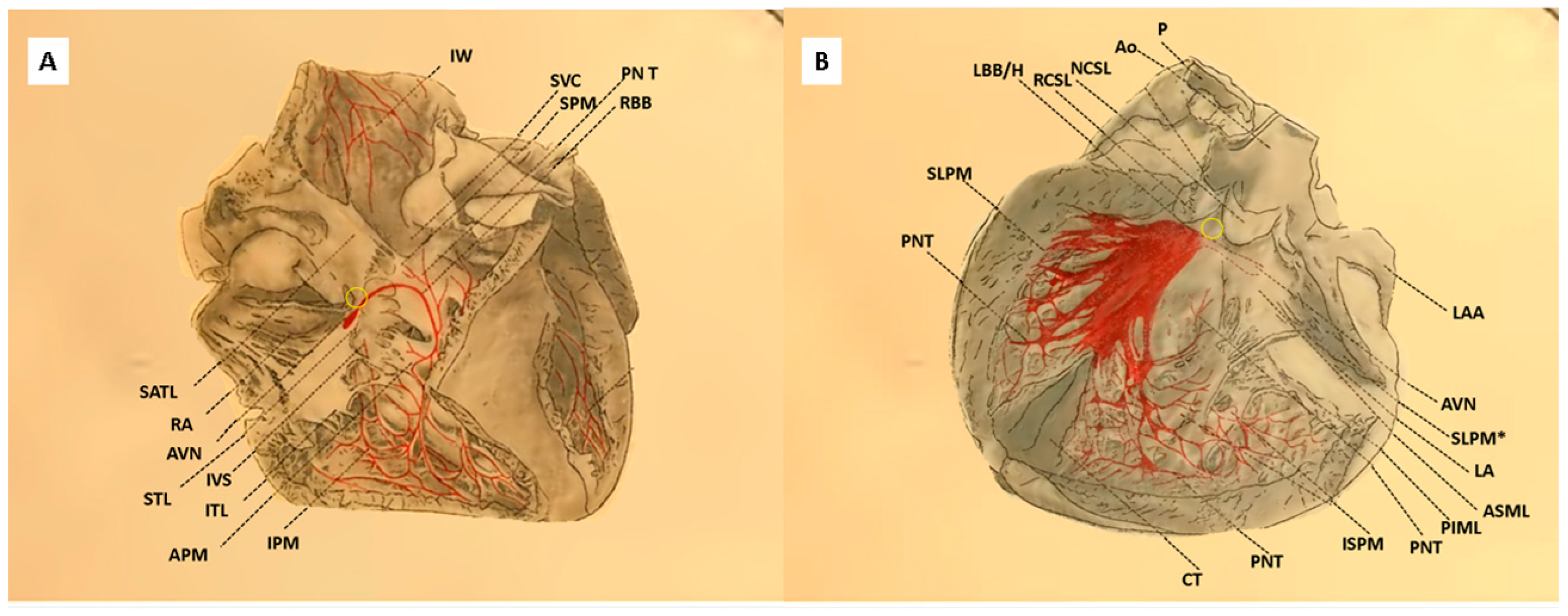
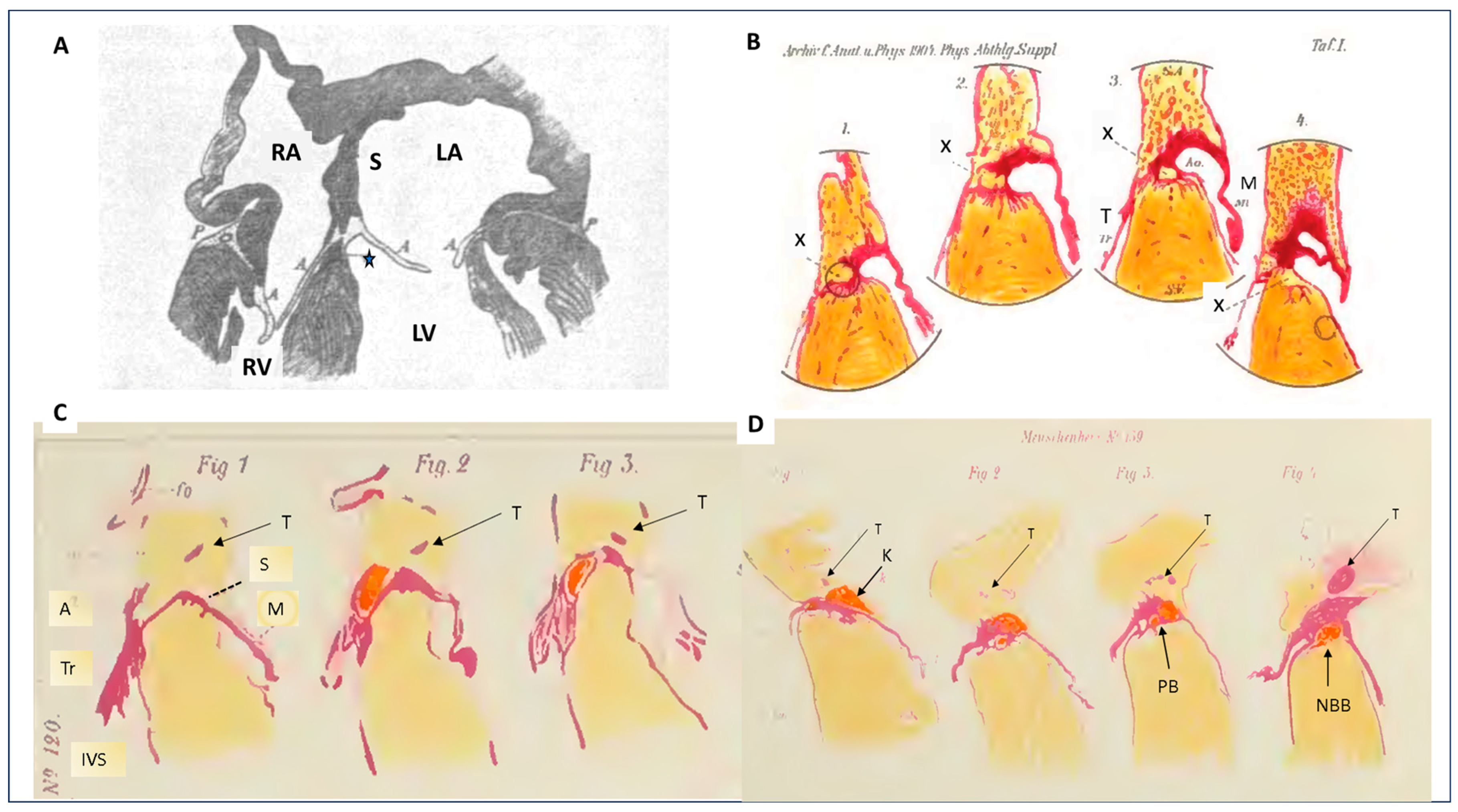
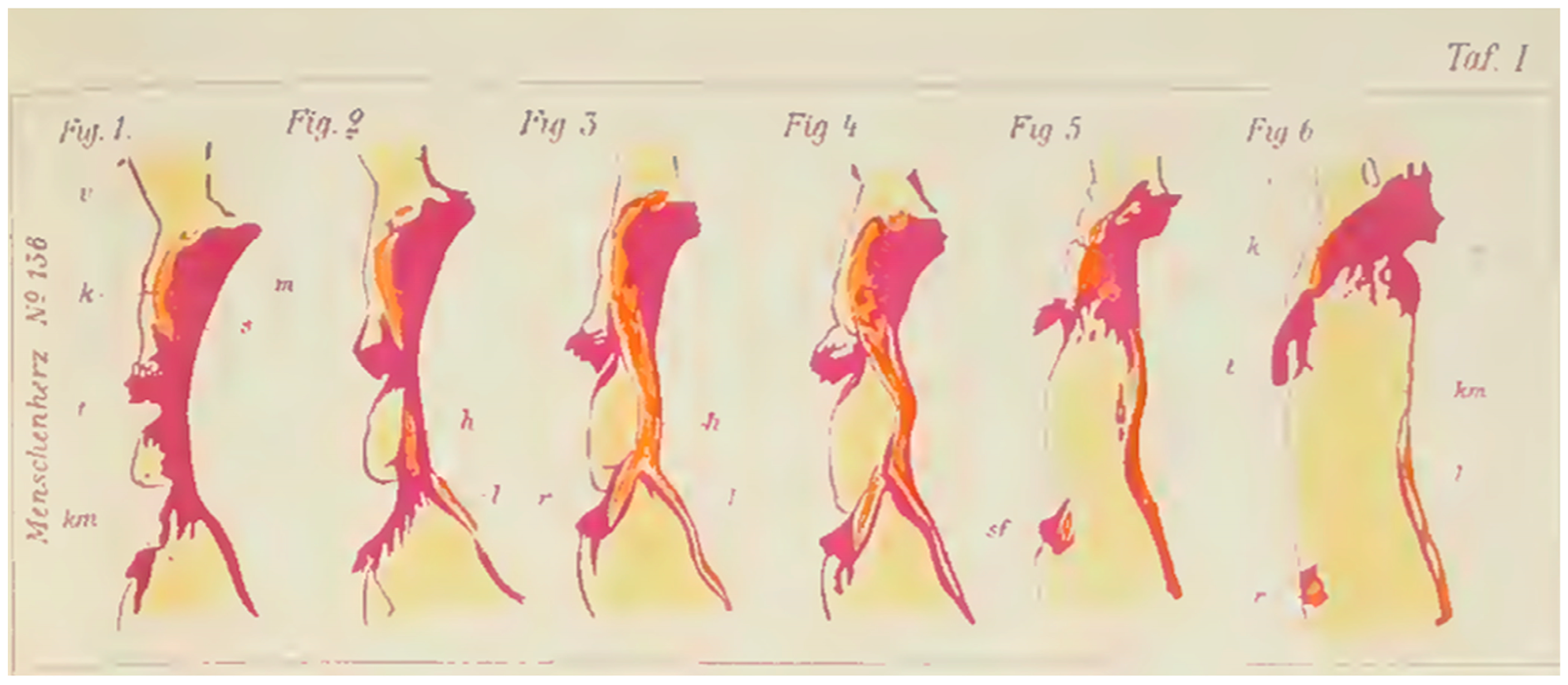
“Atrial fibers first appear as a closed bundle at the coronary sinus. They then run anteriorly along the atrial septum [atrial myocardium] to the area of the insertion of the medial tricuspid leaflet [septal cusp of tricuspidal valve]. They form a tangled network and then, together with the plexus from which the fibers of the ventricular segment arise, form the so-called node. This lies as a flat, ridged structure in the fibrous septum [fibrous skeleton of heart] between the tricuspid and mitral insertions, and from it the ventricular fibers pass anteriorly through the fibrous septum [fibrous skeleton of heart] in an easily traceable bundle to the ventricular septum”.
“So far, I have only been able to identify one region that has been precisely characterized histologically… its center is in a mesh-like node in the atrial septum [atrial myocardium] directly above the atrioventricular fibrous septum [fibrous skeleton of the heart]. From this node, a fiber bundle runs backward, often to the anterior border of the coronary sinus. A second fiber bundle runs anteriorly downward through the atrioventricular fibrous septum [fibrous skeleton of heart], where it continues with the system of Purkinje fibers [subendocardial branches]…”.
“These fibers are characterized by various features: …they are narrower than the remaining fibers of the atrial muscle and are extraordinarily rich in nuclei and exhibit slight fibrillar differentiation, limited only to the peripheral layer. The protoplasm of these fibers always stains a distinct color than the other muscle fibers. In their imperfect development, they resemble embryonic muscle fibers…”.
3. The Development of the Concept of a Triangular Locus
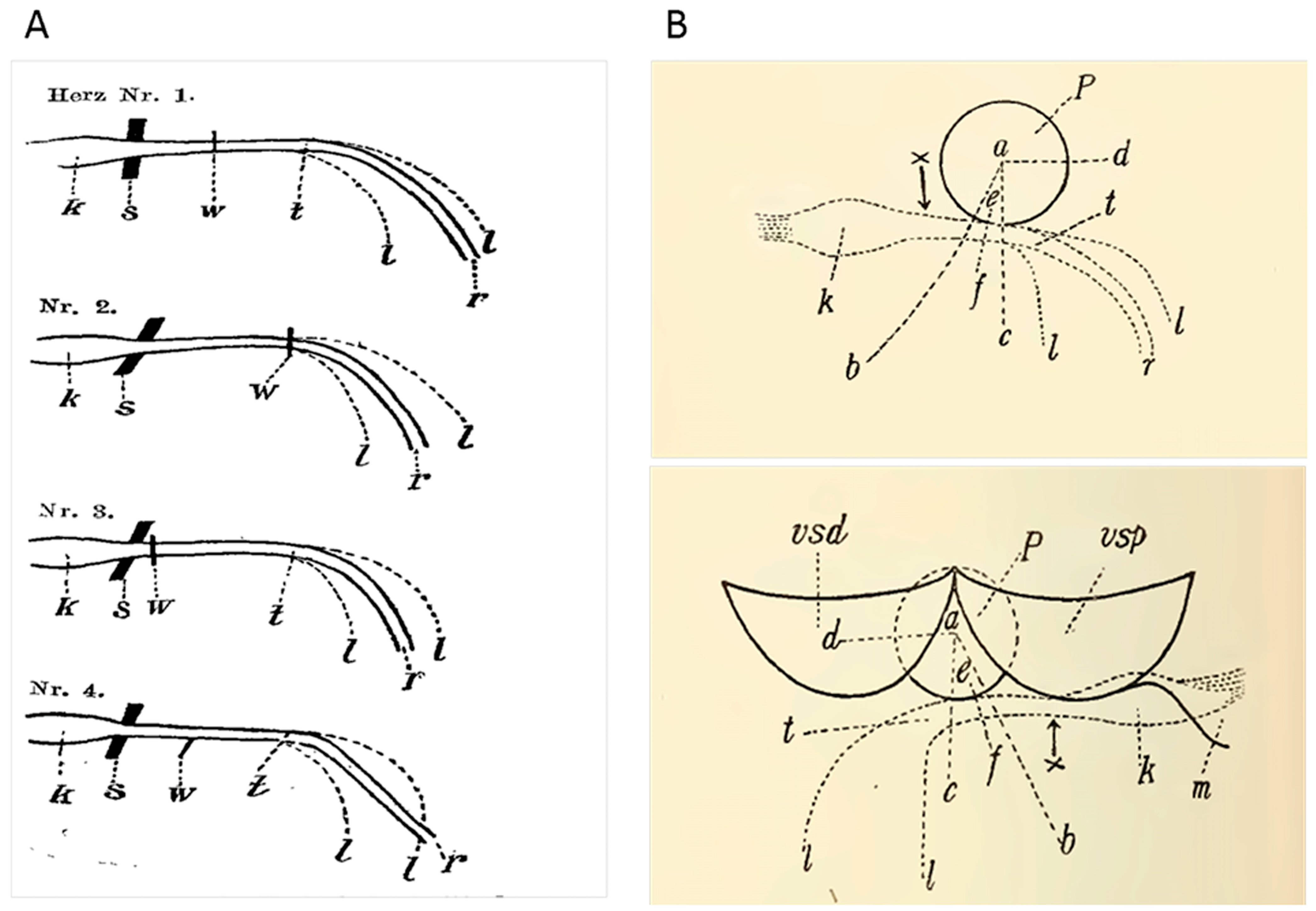
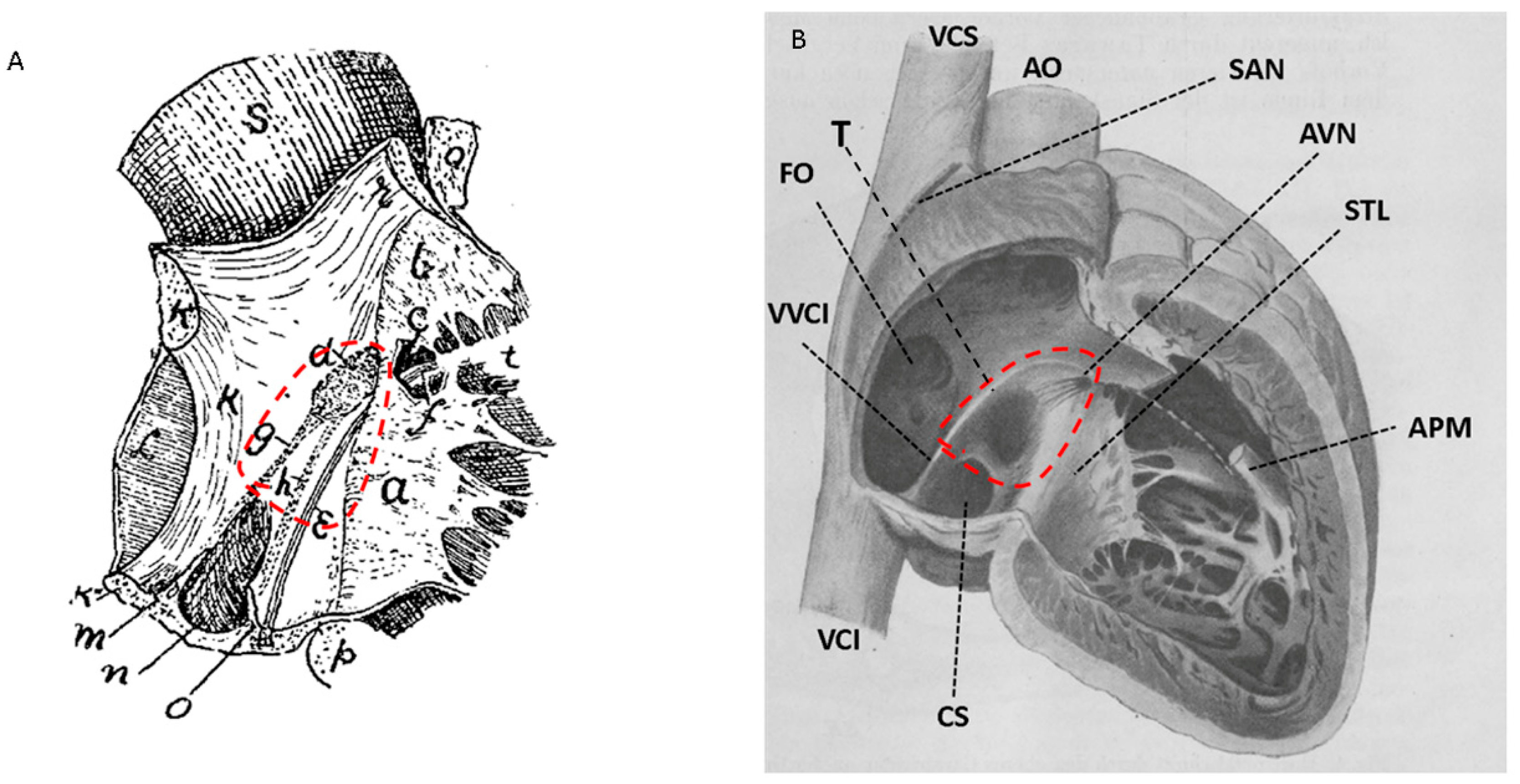
“In the musculature beneath the endocardium will be found two fibrous bands [see g, h, in Figure 3A] which are of great interest but, as far as I know, have never been described. These bands begin in the membranous space [membranous septum] and run through the musculature of the septum [not interatrial septum but right atrial myocardium] to the inferior vena cava valve (g) and valve of coronary sinus (h)…” [6].
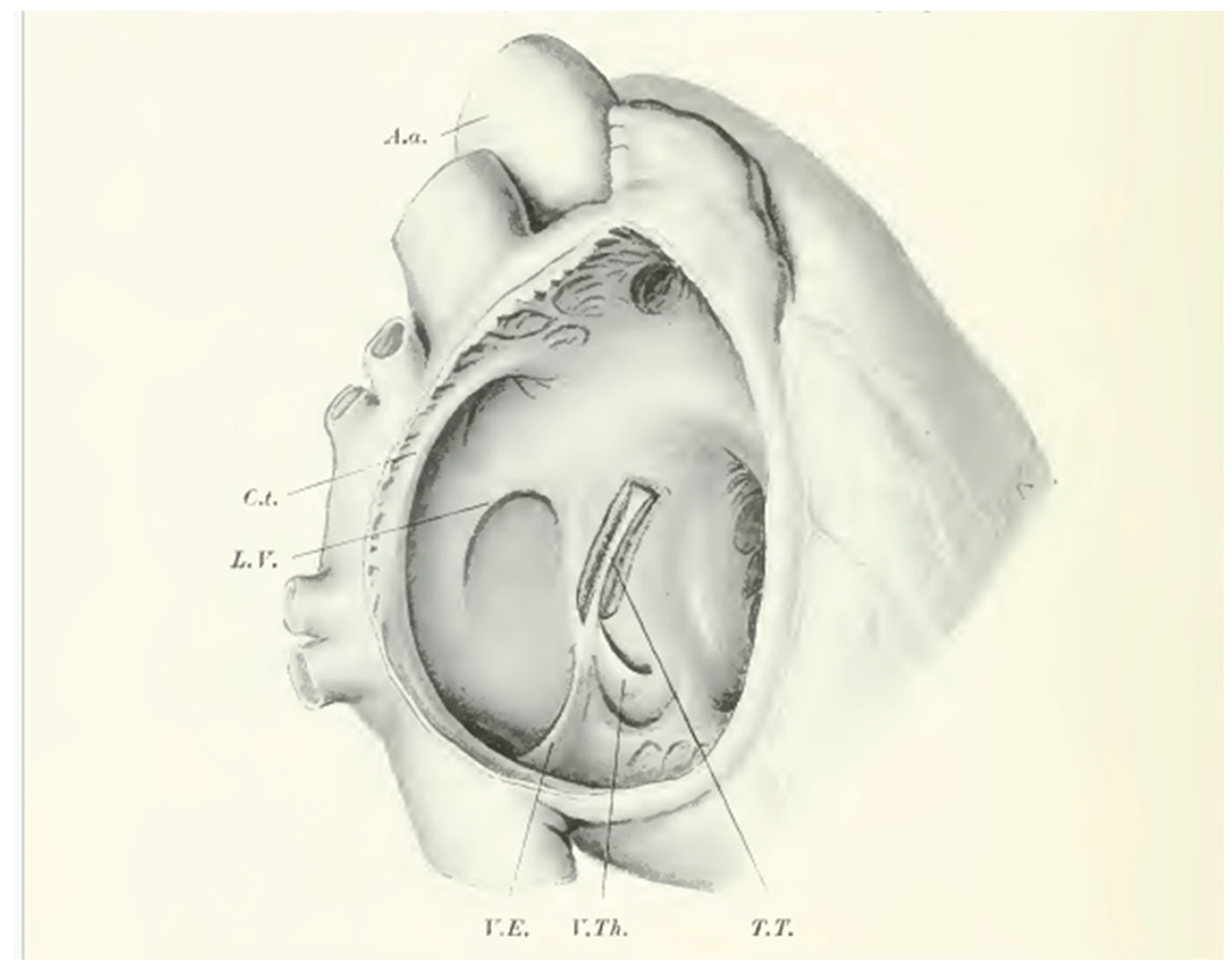
“I immediately noticed that from the right posterior part of the tendinous center [right fibrous trigone], a fibrous ribbon started [tendon of inferior vena cava valve]. I followed it, with great care, among the muscular fibers below and accompanied it up to the posterior pillar of the oval fossa [posterior limbus of fossa ovalis]… it entered through the posterior horn, which originates here, in the valve, following along its entire free margin, I have always found the tendon constant, even when the inferior vena cava valve is almost deficient“.
“…as Tawara described, fine, multinucleated cells with indistinct striation; I observed also, as he did, that the fibers were accompanied by numerous nerve fibers, and there are cells, too, which have the appearance of ganglionic nerve cells”.
“We take this opportunity of clearly stating that although some of our observations are new our work is in the main, but a verification of the accurate and complete monograph published recently by Tawara, a Japanese working in the laboratory of Professor Aschoff of Marburg”.
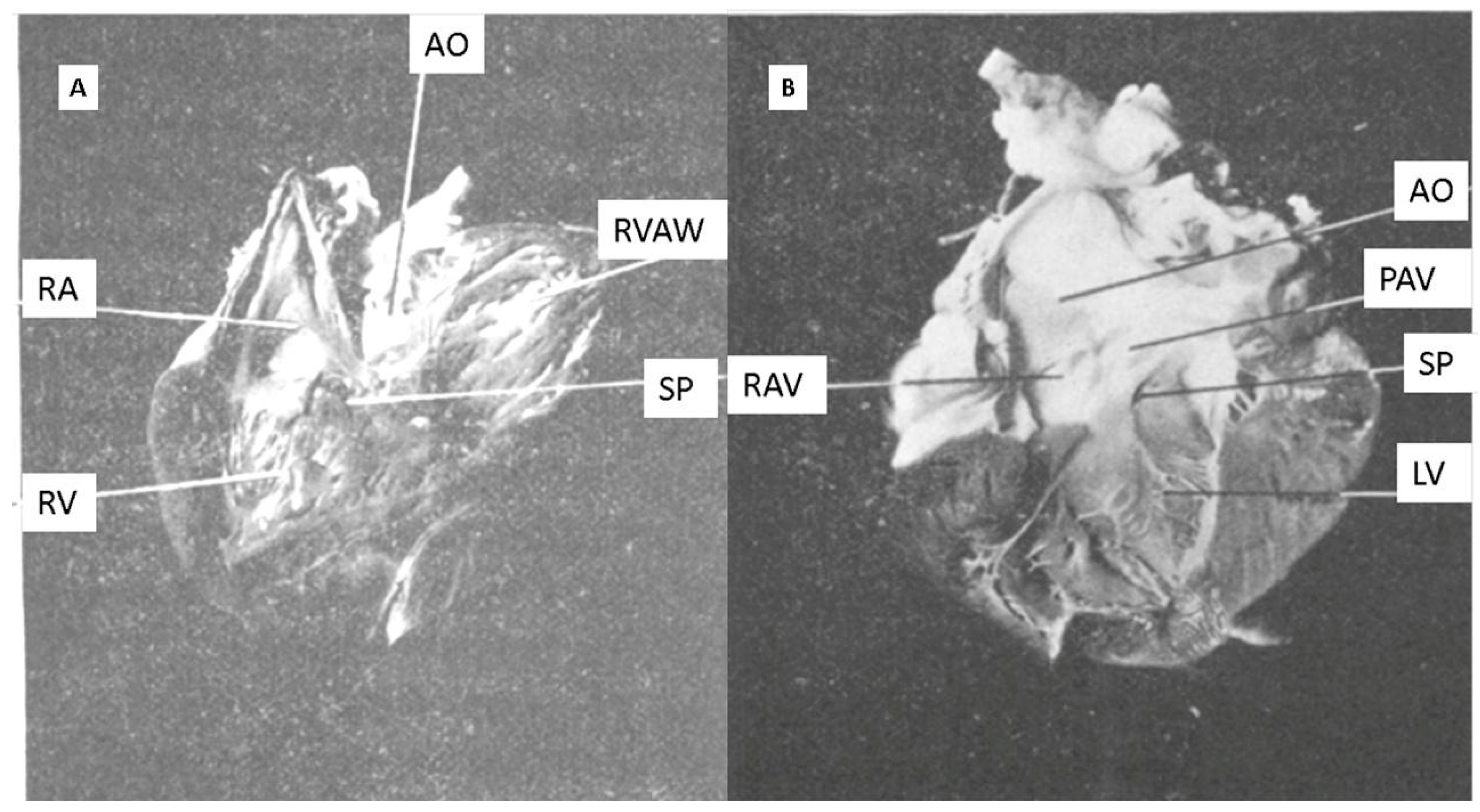
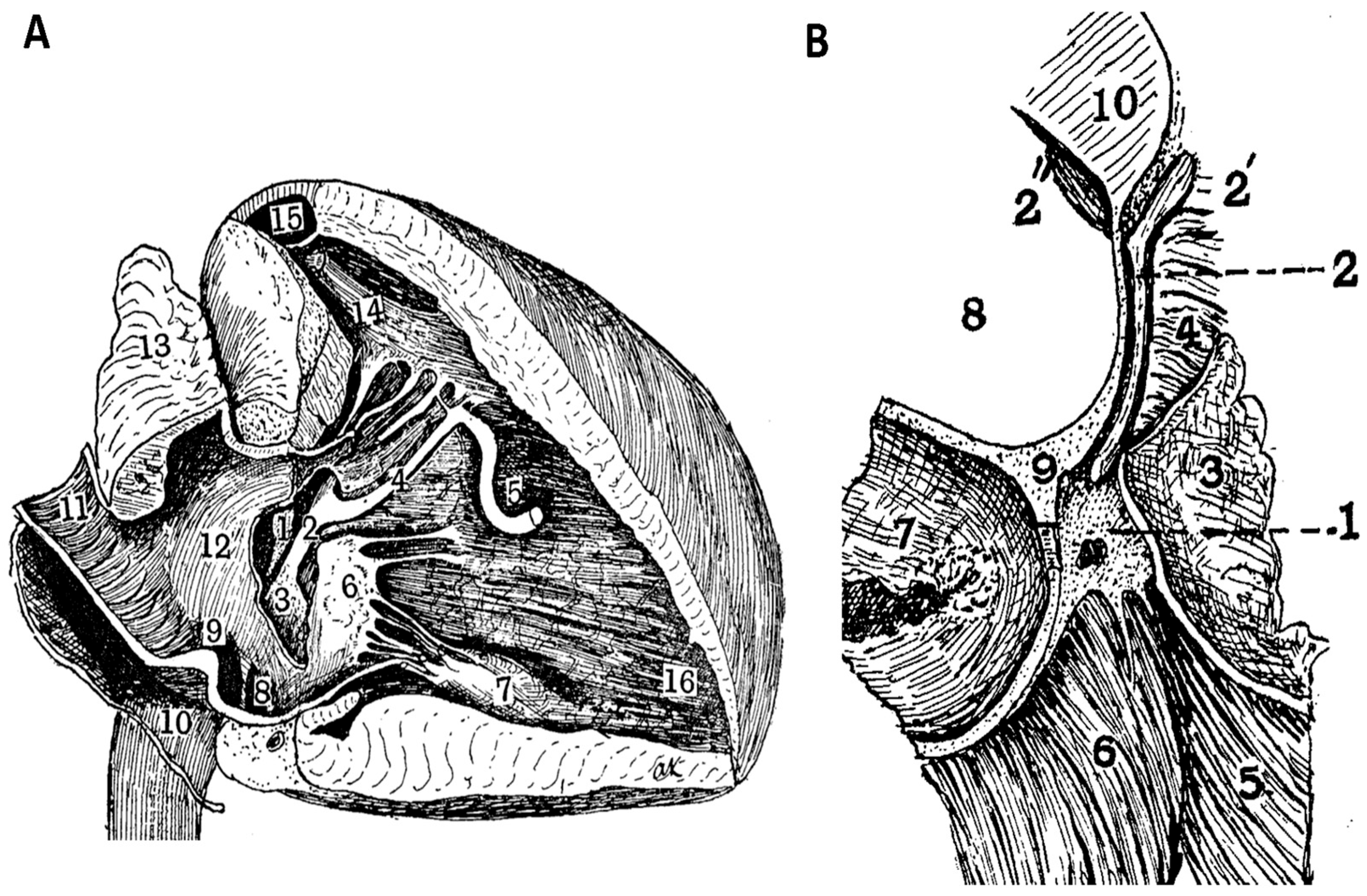
“The bundle originates from the posterior wall of the right atrium, near the atrial septum, in the atrioventricular groove, attaches to the superior edge of the ventricular septum muscle with multiple fiber exchanges, travels anteriorly along it until, near the aorta, it bifurcates into a right and left branch. which latter ends in the base of the aortic cusp of the mitral valve [anterior leaflet of left atrioventricular valve]”.
“It was ten years before the anatomists took cognizance of the A-V bundle. In 1903, Retzer, at the behest of Spalteholz, and Braeunig, at the suggestion of Engelmann, tested my results and fully substantiated them. In 1906, under the leadership of Aschoff, the important work of Tawara appeared…”,
“Two special muscle systems are given: the atrioventricular conduction system, specifically the Aschoff-Tawara node [atrioventricular node], and the sinuatrial node. Determining the precise location of these starting points had to be the first important task. The location of the atrioventricular node has been precisely established by the descriptions of Tawara and by the confirming studies of Mönckeberg, Fahr, Keith and Flack, Retzer, and Dewitt. In contrast, apart from the information provided by Keith and Flack, who only briefly described the location of the sinuatrial node, no further details about this muscle system are available. In my last two publications, I gave a more detailed description of the macroscopic and microscopic behavior of the sinuatrial node in humans and mammals and determined the extent of the sinuatrial node”.
“On the other hand, at another location in the entry of the atrial cavity, more anteriorly, near the upper border of the right atrial appendage [right auricle of heart], there is a peculiar muscular system discovered by Keith and described in more detail by me in a previously published work, which in many respects, it can be considered parallel to the atrial part of the conduction system [conduction system of heart] between the atrium and the ventricle. I was able to demonstrate it at the time, at the border between the atrium and the cava [superior vena cava] in the sulcus already discussed, beginning at the upper edge of the atrial appendage [right auricle of heart]. As recent observations have shown me, it appears to extend along the sulcus, its fibers extending outward and downward almost 1 cm further than I previously stated (2 cm) (Figure 3B). It splits and disappears upward into the musculature of the cava [superior vena cava] and downward into the atrial musculature…. I consider the demonstration of this muscular system discovered by Keith to be important, since with a better understanding of its function, disturbances in it may perhaps be able to be used to explain physiological and pathological cardiac processes.”
“Topographically, the nodule was described almost entirely consistently by all authors, although the relationship to the aortic valve was particularly emphasized. This relationship, at least for locating the nodule, does not seem particularly well chosen, since the nodule is most easily located from the right side of the atrial septum [right atrium myocardium]. Koch relocated the nodule [atrioventricular node] into the triangle he described, outlining it as follows: the caudal border is formed by the insertion of the tricuspid valve [right atrioventricular valve]. The cranial border is formed by a fold that appears when the junction of the Eustachian and Thebesian valves is stretched to the right with pincers. The fold then runs obliquely forward and downward toward the membranous septum. In my opinion, it is the result of tension on the Todaro tendon, which has already been described elsewhere. The posterior border of this triangular field is represented by the opening of the coronary sinus. Near the apex of this triangle, as Koch correctly points out, lies the node [atrioventricular node]. We already emphasized elsewhere that Koch’s deductions, as if this field were originally a sinus area [cardiac sinus venosus], are not valid for evolutionary reasons. However, Koch’s topographical definition is certainly acceptable.”
4. Conclusions
Funding
Institutional Review Board Statement
Data Availability Statement
Acknowledgments
Conflicts of Interest
Abbreviations
| TLAVN | Triangular Locus of the Atrioventricular Node |
| TIVCV | Tendon of the Inferior Vena Cava Valve |
References
- Tandler, J. Anatomie Des Herzens, 1st ed.; Gustav Fischer: Jena, Germany, 1913. [Google Scholar]
- Koch, W. Weitere Mitteilungen über den Sinusknoten des Herzens. Verh. Dtsch. Ges. Pathol. 1909, 13, 85–92. [Google Scholar]
- James, T.N. The tendons of Todaro and the “Triangle of Koch”: Lessons from eponymous hagiolatry. J. Cardiovasc. Electrophysiol. 1999, 10, 1478–1496. [Google Scholar] [CrossRef]
- Drenckhahn, D. Benninghoff Anatomie, 16th ed.; Drenckhahn, D., Ed.; Urban and Fischer; Elsevier: München, Germany, 2004. [Google Scholar]
- Stranding, S. Gray’s Anatomy, 41st ed.; Stranding, S., Ed.; Elsevier: Amsterdam, The Netherlands, 2016. [Google Scholar]
- Keith, A. The auriculo ventricular bundle of His. Lancet 1906, 167, 623–625. [Google Scholar] [CrossRef]
- Ottaviani, A. Francesco Todaro. In Dizionario Biografico Degli Italiani; Istituto della Enciclopedia Italiana fondata da Giovanni Treccani S.p.A: Roma, Italy, 2019. [Google Scholar]
- Fye, W.B. Ludwig Aschoff. Clin. Cardiol. 1999, 22, 545–546. [Google Scholar] [CrossRef]
- Suma, K. Sunao Tawara: Father of modern cardiology. Pacing Clin. Electrophysiol. 2001, 24, 88–96. [Google Scholar] [CrossRef] [PubMed]
- De Almeida, M.C.; Sánchez-Quintana, D.; Davis, N.; Charles, F.R.; Chikweto, A.; Sylvester, W.; Loukas, M.; Anderson, R.H. The ox atrioventricular conduction axis compared to human in relation to the original investigation of Sunao Tawara. Clin. Anat. 2020, 33, 383–393. [Google Scholar] [CrossRef] [PubMed]
- De Almeida, M.C. Heinrich Ewald Hering’s discovery of the heart pacemaker: Hering, Tawara and Aschoff’s search for its morphological basis, the sinoatrial node, and why they failed. Anat. Sci. Int. 2023, 98, 482–492. [Google Scholar] [CrossRef] [PubMed]
- Clark, W. Arthur Keith 1866–1955. Biogr. Mem. Fellows R. Soc. 1955, 1, 144–151. [Google Scholar]
- Keith, A. The Sino-auricular node: A Historical note. Heart 1942, 4, 77–79. [Google Scholar] [CrossRef][Green Version]
- Conti, A.A. Calling the heart by name: Distinguished eponyms in the history of cardiac anatomy. Heart Surg. Forum 2011, 14, E183–E187. [Google Scholar] [CrossRef]
- Kyle, R.A.; Shampo, M.A. Professor Julius Tandler, Anatomist and Public Health Advocate. Mayo Clin. Proc. 1990, 65, 530. [Google Scholar] [CrossRef]
- Ottaviani, G.; Thomas, N.; James, M.D. MACP (1925–2010): In Memoriam. Am. J. Cardiol. 2011, 108, 330. [Google Scholar] [CrossRef][Green Version]
- Mori, S.; Fukuzawa, K.; Takaya, T.; Takamine, S.; Ito, T.; Fujiwara, S.; Nishii, T.; Kono, A.K.; Yoshida, A.; Hirata, K. Clinical Structural Anatomy of the Inferior Pyramidal Space Reconstructed Within the Cardiac Contour Using Multidetector-Row Computed Tomography. J. Cardiovasc. Electrophysiol. 2015, 26, 705–712. [Google Scholar] [CrossRef]
- Tawara, S. The Conduction System of the Mammalian Heart: An Anatomico-Histological Study of the Atrioventricular Bundle and the Purkinje Fibers, 1st ed.; Suma, K., Shimada, M., Eds.; Imperial College Press: London, UK, 2000. [Google Scholar]
- Tawara, S. Das Reizleitungssystem Des Säugetierherzens. Eine Anatomisch-Histologische Studie Über Das Atrioventrikularbündel Und Die Purkinjeschen Fäden; Gustav Fischer: Jena, Germany, 1906. [Google Scholar]
- Todaro, F. Novelle Ricerche Sopra La Struttura Delle Orecchiette Del Cuore Umano e Sopra Ta Valvola Di Eustachio; Stabilimento Civelli: Firenze, Italy, 1865. [Google Scholar]
- Tawara, S. Anatomisch-histologische Nachpriifung der Schnittfuhrung an den von Prof. H.E. Hering ubersandten Hundeherzen. Zentrallblatt Fur. Physiol. 1906, 111, 300–302. [Google Scholar]
- Aschoff, L. Ueber die Untersuchungen des Herrn Dr. Tawara, die Bruckenfasern betreffend und Demonstration der zugehorigen mikroskopischen Praparate. Muenchener Med. Wochenschr. 1905, 52, 674. [Google Scholar]
- Tawara, S. Die Topographie und Histologie der Brückenfasern. Ein Beitrag zur Lehre von der Bedeutung der Purkinjeschen Fäden. Zentrallblatt Fur. Physiol. 1906, 19, 70–76. [Google Scholar]
- His, W. The activity of the embryonic human heart and its significance for the understanding of the heart movement in the adult (english translation). J. Hist. Med. Allied Sci. 1949, 4, 289–318. [Google Scholar] [CrossRef] [PubMed]
- Hering, H.E. Nachweis, dass das His’sche Uebergangsbündel Vorhof und Kammer des Säugethierherzens functionell verbindet—Zweite Mittheilung. Pflüger Arch. Für. Die Gesammte Physiol. Des Menschen Und. Der. Thiere 1905, 108, 267–280. [Google Scholar] [CrossRef]
- Koch, W. Uber das ultimum moriens des menschlichen Herzens. Ein beitrag zur Frage des Sinusgebietes. Beitr. Pathol. Anat. 1907, 42, 208–224. [Google Scholar]
- His, W. The story of the atrioventricular bundle with remarks concerning embryonic heart activity. J. Hist. Med. Allied Sci. 1949, 4, 319–333. [Google Scholar] [CrossRef]
- Keith, A.; Flack, M. The auriculo-ventricular bundle of the human heart. Lancet 1906, 168, 359–364. [Google Scholar] [CrossRef]
- Loukas, M.; El-Zammar, D.; Tubbs, R.S.; Birungi, J.; Jacob, J.; Shoja, M.; Anderson, R.H. Intervenous tubercle of Lower: True tubercle or normal interatrial fold? Clin. Anat. 2012, 25, 729–736. [Google Scholar] [CrossRef]
- Widran, J.; Lev, M. The Dissection of the Atrioventricular Node Bundle and Bundle Branches in the Human Heart. Circulation 1951, 6, 863–867. [Google Scholar] [CrossRef]
- Kawashima, T.; Sasaki, H. Gross anatomy of the human cardiac conduction system with comparative morphological and developmental implications for human application. Ann. Anat. 2011, 193, 1–12. [Google Scholar] [CrossRef]
- Tompsett, D.H.; Barrett, G.S. Museum preparations of the conducting system of the heart. Aznnals R. Coll. Surg. Englantd 1975, 56, 38–42. [Google Scholar]
- Braeunig, K. Ueber musculöse Verbindungen zwischen Vorkammer und Kammer bei verschiedenen Wirbelthierherzen. Arch. Für. Physiol. 1904, 1–19.
- Keith, A.; Mackenzie, I. Recent Researches on the anatomy of the Heart. Lancet 1910, 175, 101–103. [Google Scholar] [CrossRef]
- Koch, W. Ueber die Struktur des oberen Cavatrichters und seine beziehungen zum Pulsus irregularis perpetuus. Dtsch. Med. Wochenschr. 1909, 10, 429–432. [Google Scholar]
- Koch, W. Ueber die Blutversorgung des Sinusknotens und etwaige beziehungen des letzteren zum Atrioventrikular knoten. Muenchener Med. Wochenschr. 1909, 46, 2362–2364. [Google Scholar]
- Koch, W. Zur Anatomie und Physiologie der intra kardialen motorischen Centren des Herzens. Med. Klin. 1912, 3, 108–112. [Google Scholar]
- Keith, A.; Flack, M. The form and nature of the muscular connections between the primary divisions of the vertebrate heart. J. Anat. Physiol. 1907, 41, 172–189. [Google Scholar]
- Koch, W. Der Funktionelle Bau Des Menschlichen Herzens, 1st ed.; Urban & Schwazenberger: Berlin, Germany, 1922. [Google Scholar]
- Keith, A. The Anatomy of the Valvular Mechanism round the Venous Orifices of the Right and Left Auricles, with some Observations on the Morphology of the Heart. J. Anat. Physiol. 1903, 37, ii–xxxix. [Google Scholar]
- Ogden, D.J. Time to drop eponyms: Curbing Medicalese is the issue. BMJ 2007, 335, 528. [Google Scholar] [CrossRef] [PubMed][Green Version]
- Woywodt, A.; Matteson, E. Should eponyms be abandoned? Yes. BMJ 2007, 335, 424. [Google Scholar] [CrossRef] [PubMed]


| Author | Date of the Report | Achievements and Comments |
|---|---|---|
| Francesco Todaro | 1865 [20] | He described the tendon of the inferior vena calva valve (TIVCV). The tendon was identified as a fibrous structure. |
| Wilhem His Jr. | 1893 [24] | He found a muscular bundle crossing the fibrous skeleton of the heart connecting the right atrium and ventricles. He mentioned that the atrioventricular bundle originates from the posterior wall of the right atrium myocardium |
| Sunao Tawara | 1905, 1906 [19,21,22,23] | He discovered the atrioventricular node. He confirmed that the atrioventricular conduction system starts near the coronary sinus opening and goes along the commissure of septal cusp of tricuspid valve crossing the fibrous skeleton of the heart. He identified the node as a connecting point between the atrial and ventricular portions of the conduction system. |
| Arthur Keith | 1906 [6] | The first report to assemble all the components of the TLAVN. He was also the first to propose the TLAVN as a useful tool for investigating the atrial portion of the conduction system. He rediscovered the TIVCV. |
| Arthur Keith and Martin Flack | 1906 [28] | They dissected the atrial portion of the conduction system in mammals and established its relations with the fibrous skeleton of the heart. They validated the macroscopic dissection with microscopic slides. The node was rightly positioned. |
| Walter Koch | 1907 [26] | The TLAVN was delimited as the locus of the heart’s last moriens [last part of the heart to die or contract]. He published a drawing of the TLAVN that was reproduced several times since then. He described a fold instead of the TIVCV. |
| Julius Tandler | 1913 [1] | He recognized the triangular nature of the TLAVN and named it Koch’s triangle. He wrongly argues that no one except Koch described the topographical relationships of the atrioventricular node in the right atrial wall. |
Disclaimer/Publisher’s Note: The statements, opinions and data contained in all publications are solely those of the individual author(s) and contributor(s) and not of MDPI and/or the editor(s). MDPI and/or the editor(s) disclaim responsibility for any injury to people or property resulting from any ideas, methods, instructions or products referred to in the content. |
© 2026 by the author. Licensee MDPI, Basel, Switzerland. This article is an open access article distributed under the terms and conditions of the Creative Commons Attribution (CC BY) license.
Share and Cite
De Almeida, M.C. The Building of the Triangular Locus of the Atrioventricular Node from Todaro to Tandler. Anatomia 2026, 5, 3. https://doi.org/10.3390/anatomia5010003
De Almeida MC. The Building of the Triangular Locus of the Atrioventricular Node from Todaro to Tandler. Anatomia. 2026; 5(1):3. https://doi.org/10.3390/anatomia5010003
Chicago/Turabian StyleDe Almeida, Marcos C. 2026. "The Building of the Triangular Locus of the Atrioventricular Node from Todaro to Tandler" Anatomia 5, no. 1: 3. https://doi.org/10.3390/anatomia5010003
APA StyleDe Almeida, M. C. (2026). The Building of the Triangular Locus of the Atrioventricular Node from Todaro to Tandler. Anatomia, 5(1), 3. https://doi.org/10.3390/anatomia5010003