



Physico-Mechanical Properties of an Aluminosilicate Refractory Castable Obtained After Chamotte Waste Recycling by Firing Method

 ,
,  ,
,
Abstract
1. Introduction
Integration of Secondary Resources in Refractory Castables
2. Experimental Procedure
2.1. Raw Materials
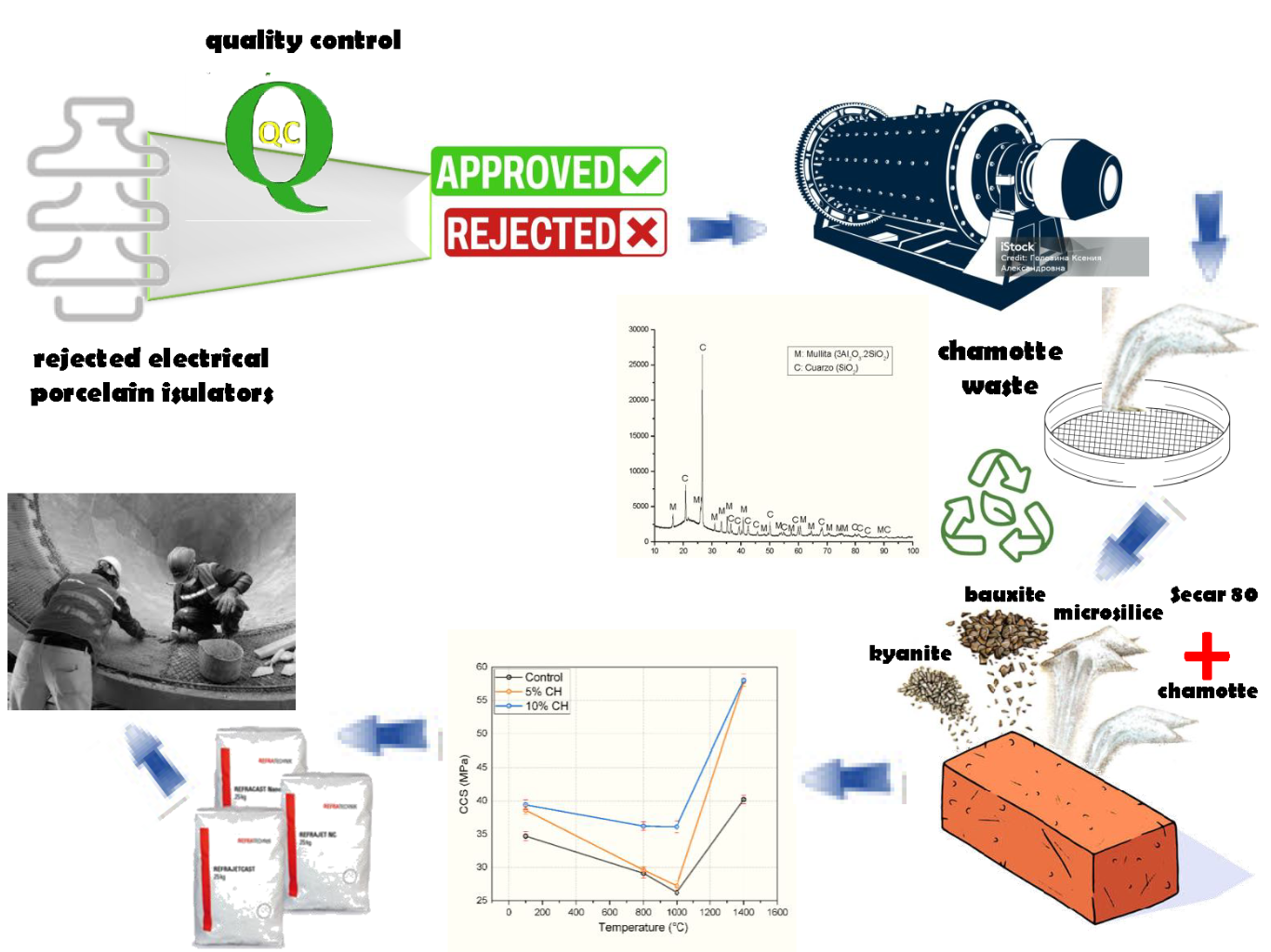
Method of Recycling Porcelain Scrap
2.2. Refractory Formulation and Specimen Preparation
2.3. Characterization Techniques
2.3.1. Physical Properties
2.3.2. Mechanical Properties
2.3.3. Crystalline Phase Evolution of Secar 80 Cement and Kyanite
2.3.4. TGA/SDTA Measurements
2.3.5. Microstructural Analysis
3. Results and Discussion
3.1. Characterization of Raw Materials and Chamotte
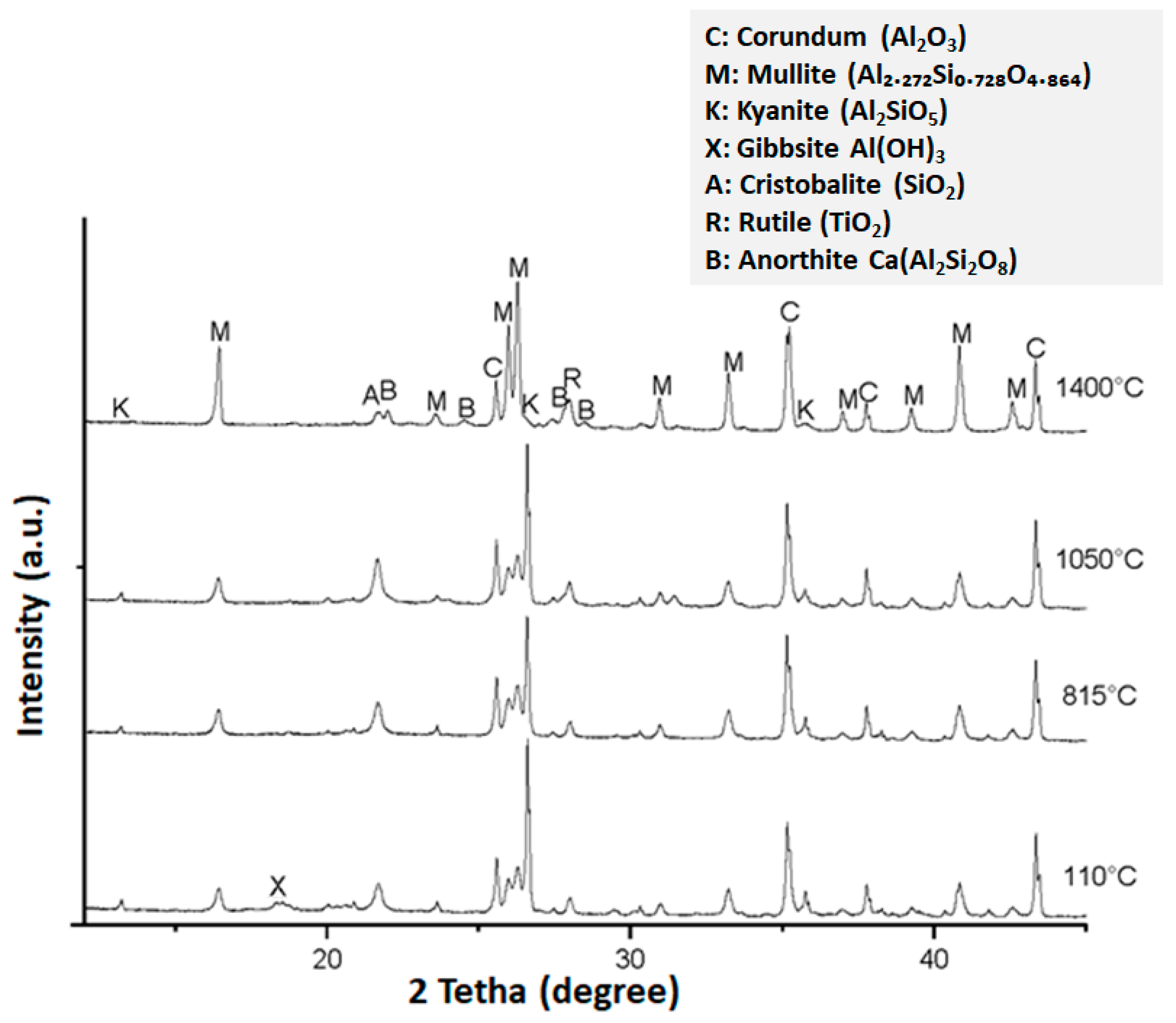
3.2. Crystalline Phase Analysis of Refractory Specimens
3.2.1. Control Composition (CC)
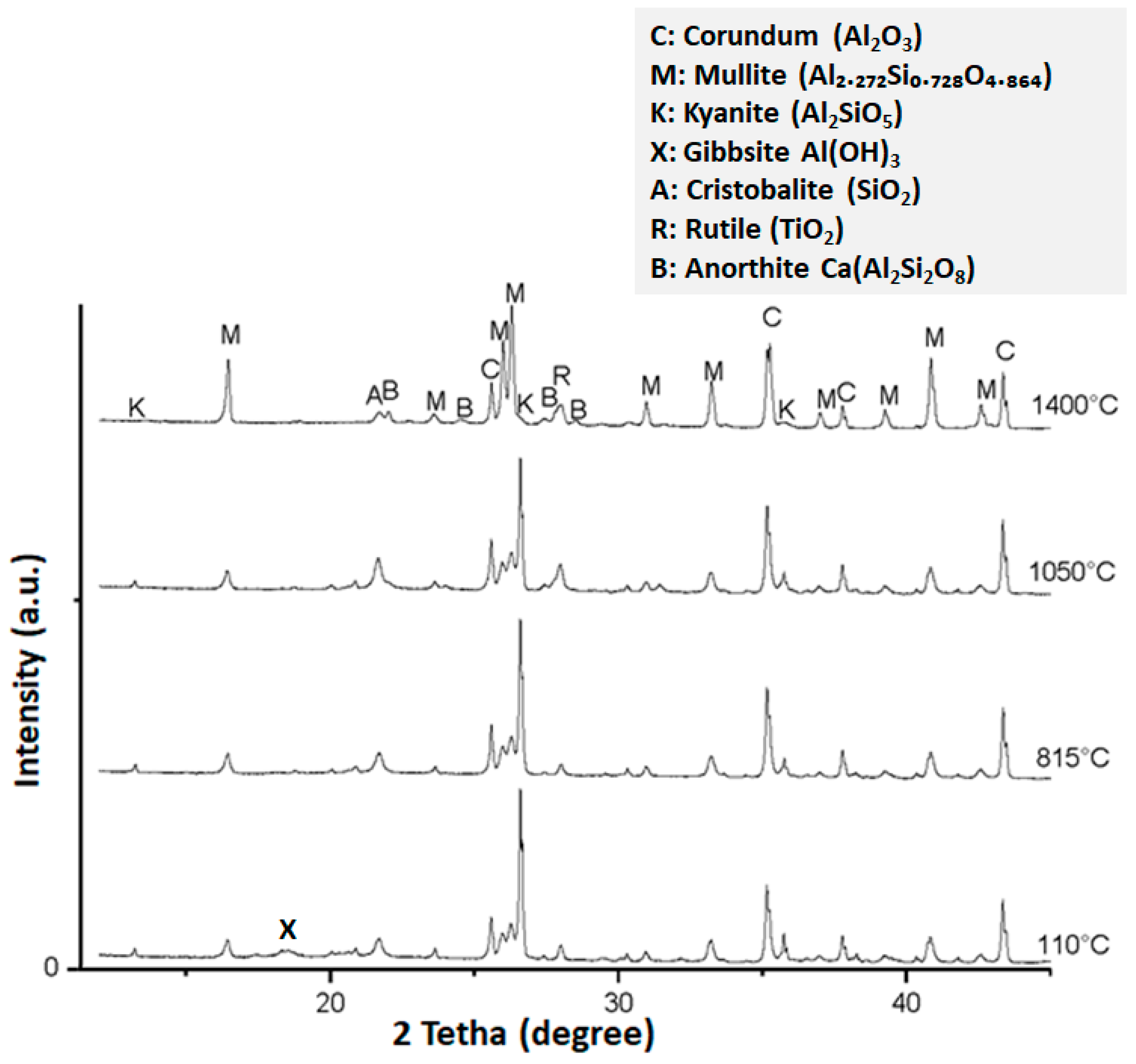
3.2.2. 5CH Composition
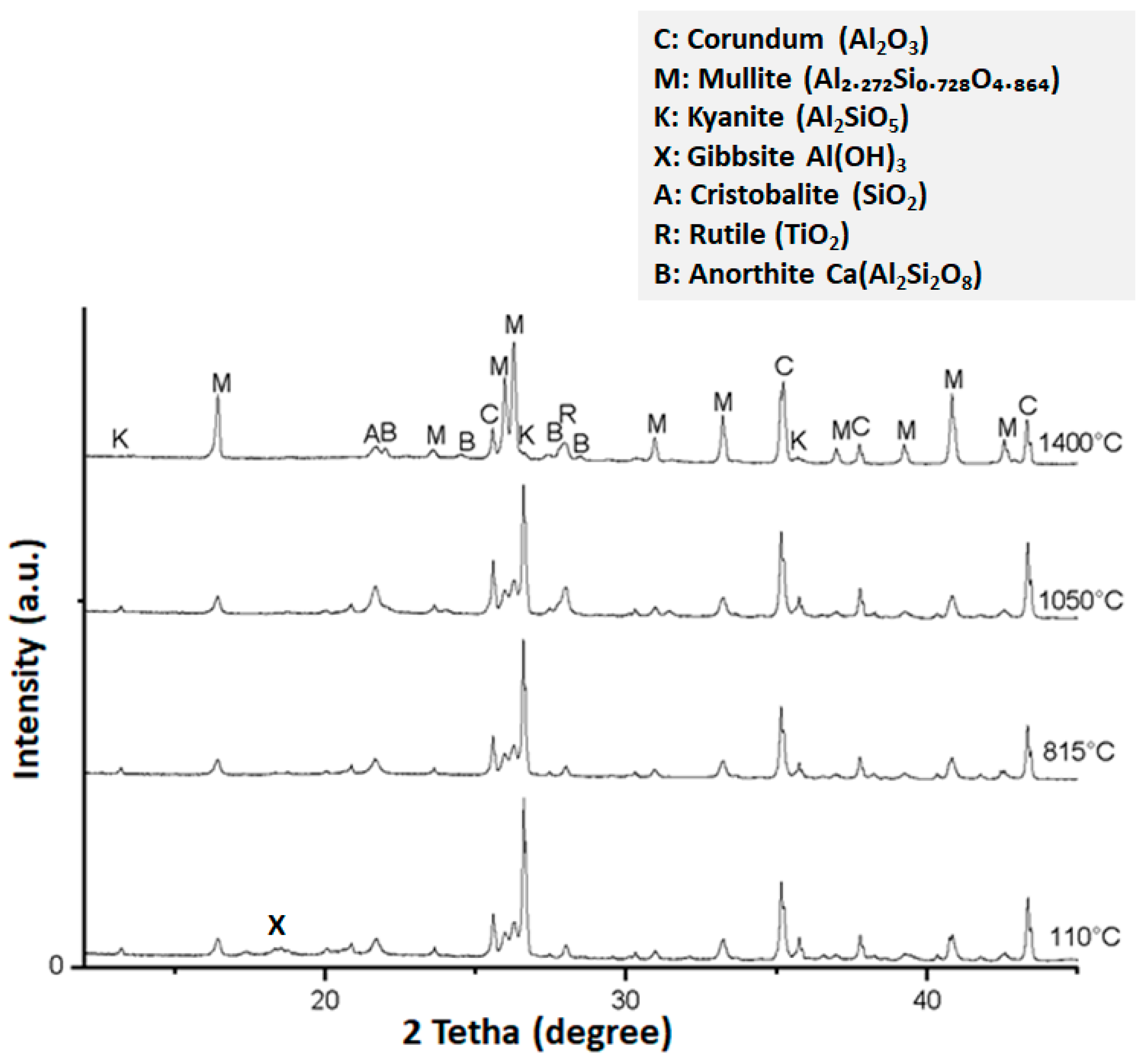
3.2.3. 10CH Composition
- Dehydroxylation of gibbsite (220–350 °C):
- 2.
- Formation of transition aluminas (350–1000 °C):
- 3.
- Stabilization of corundum (above ~1100 °C):
- 4.
- Kyanite decomposition and mullite crystallization (1350–1400 °C):
- 5.
- Anorthite formation at high temperature (CaO-containing system):
3.2.4. Rietveld Refinement Analysis
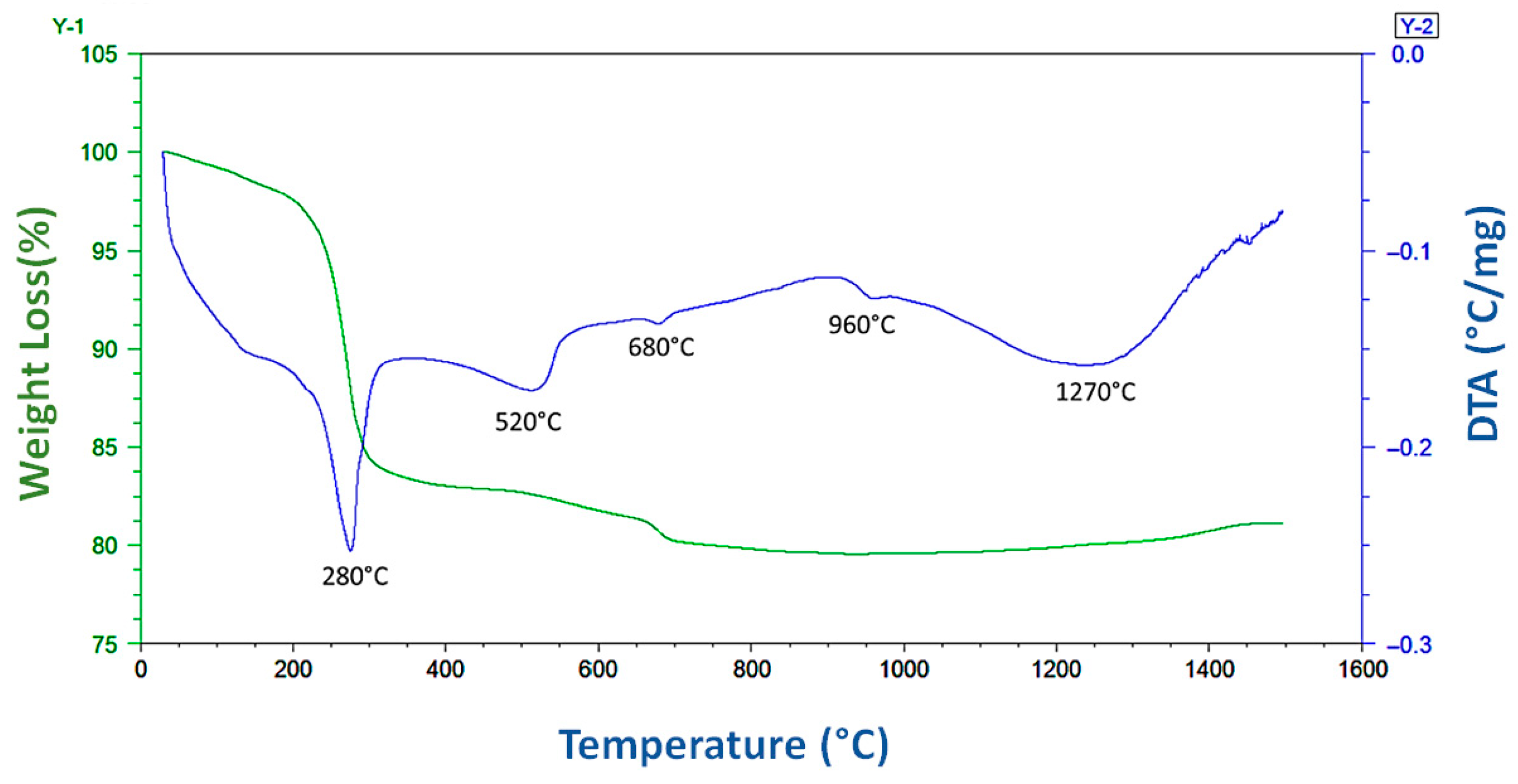
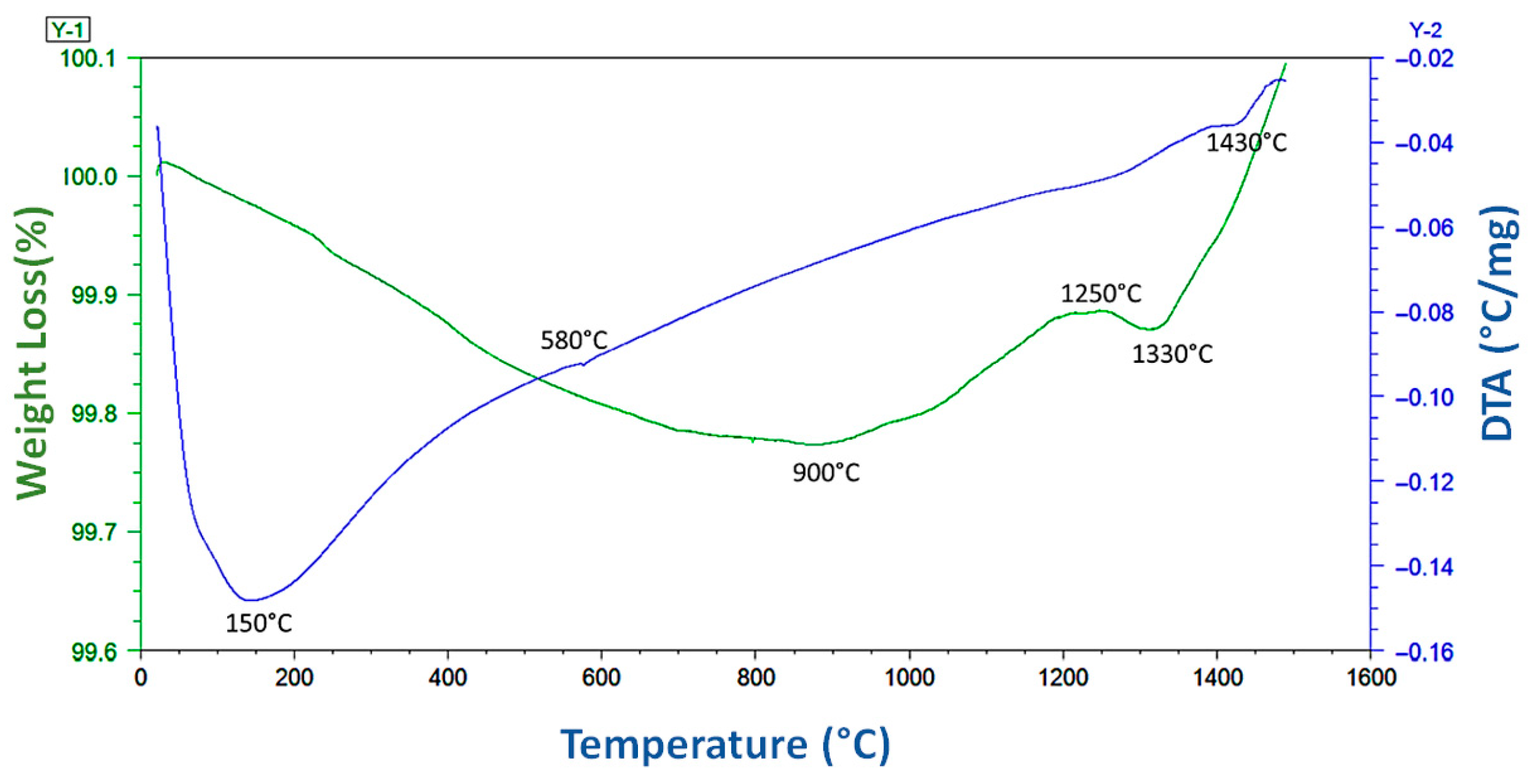
3.3. Thermal Evolution of Secar 80 and Kyanite
3.3.1. Thermal Analysis (TGA–SDTA) of Secar 80 and Kyanite
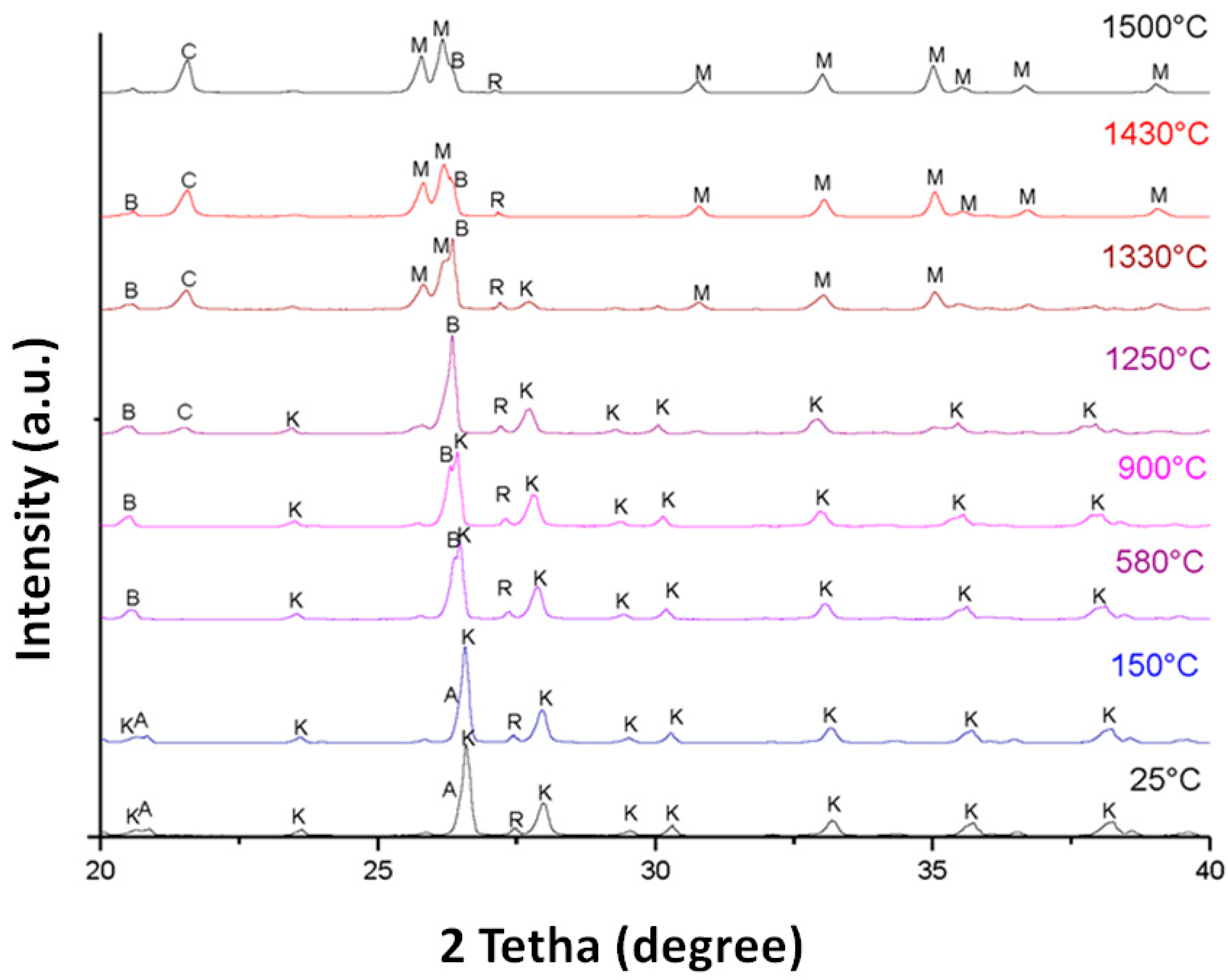
3.3.2. High-Temperature XRD (Thermodiffraction) Analysis of Secar 80 and Kyanite
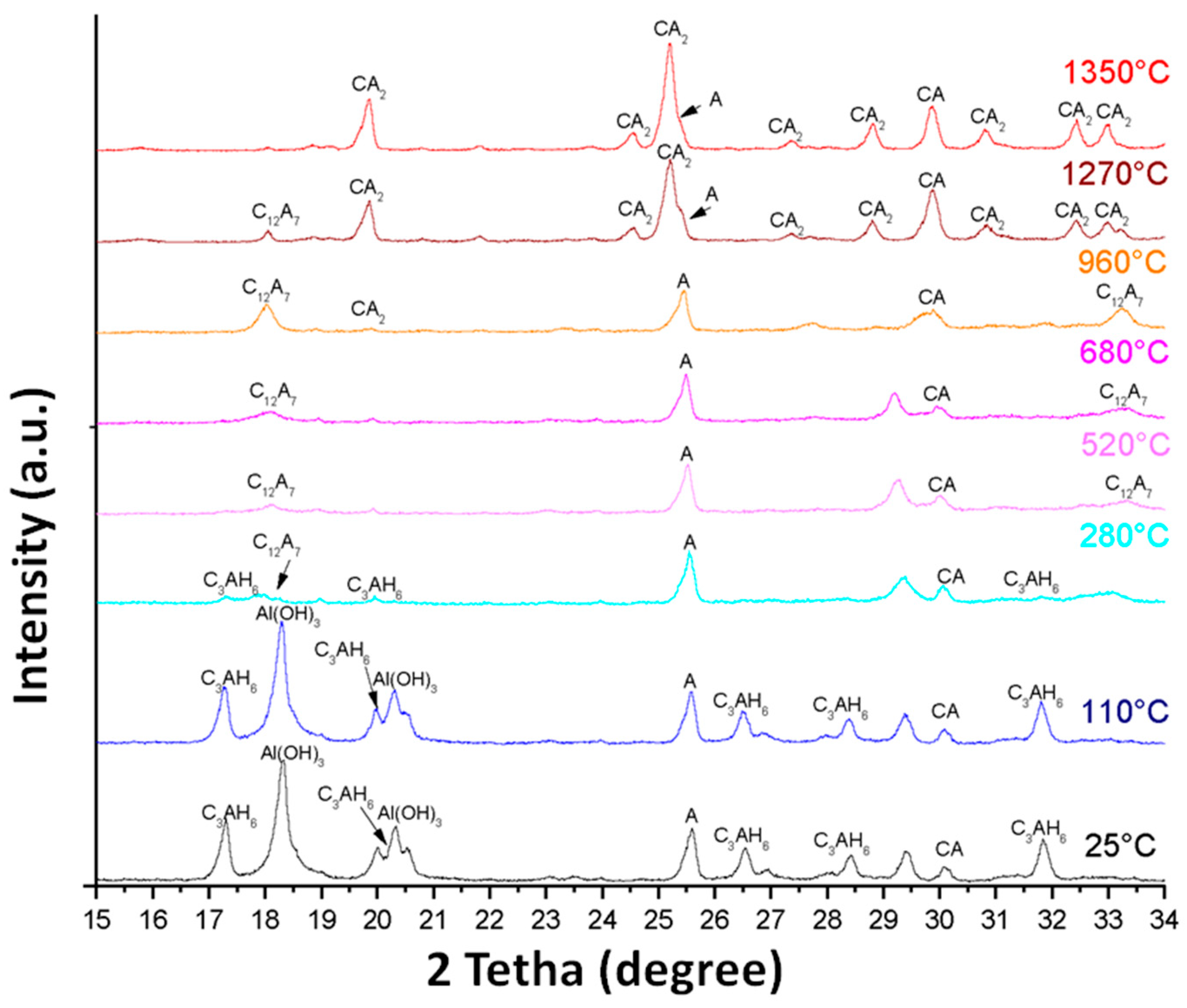
High-Temperature XRD Analysis of Secar 80
High-Temperature XRD Analysis of Kyanite
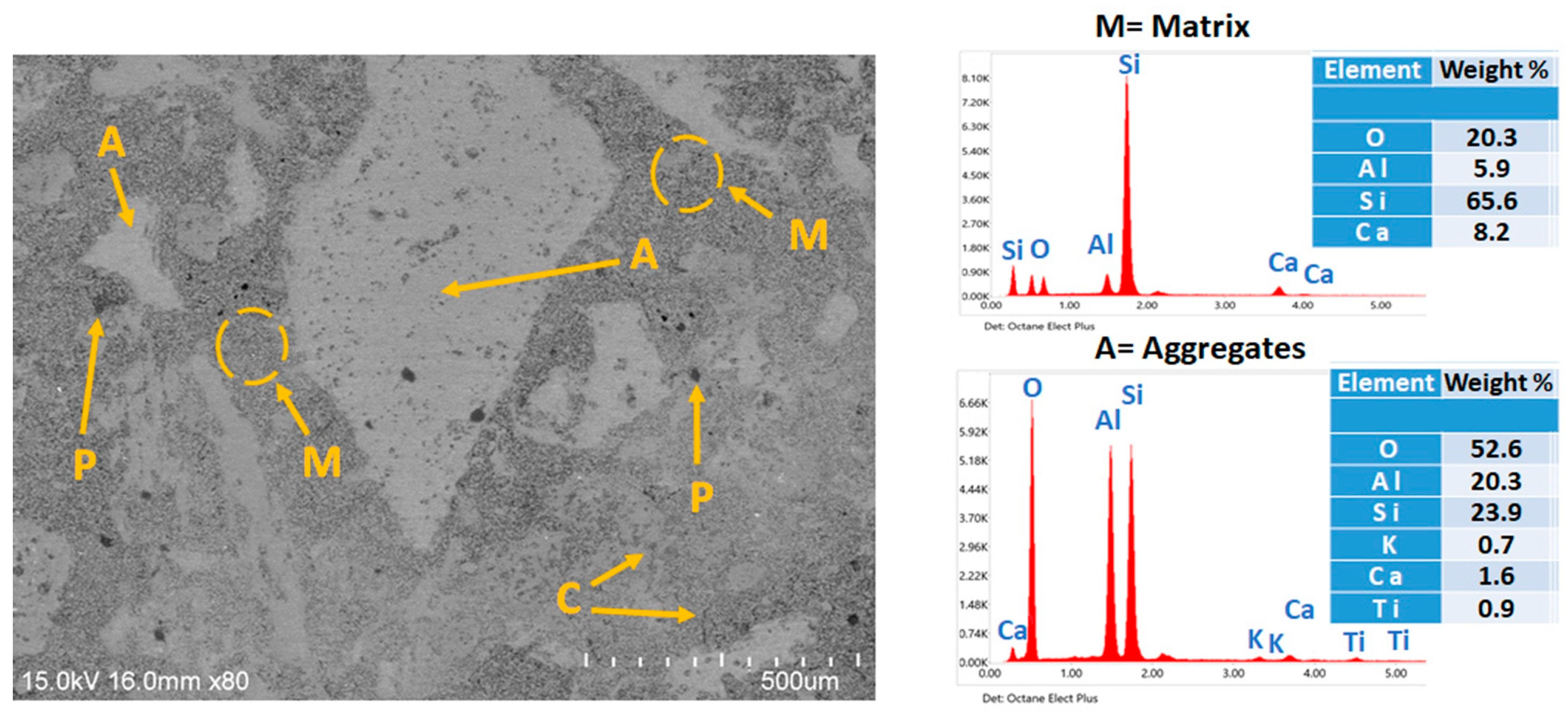
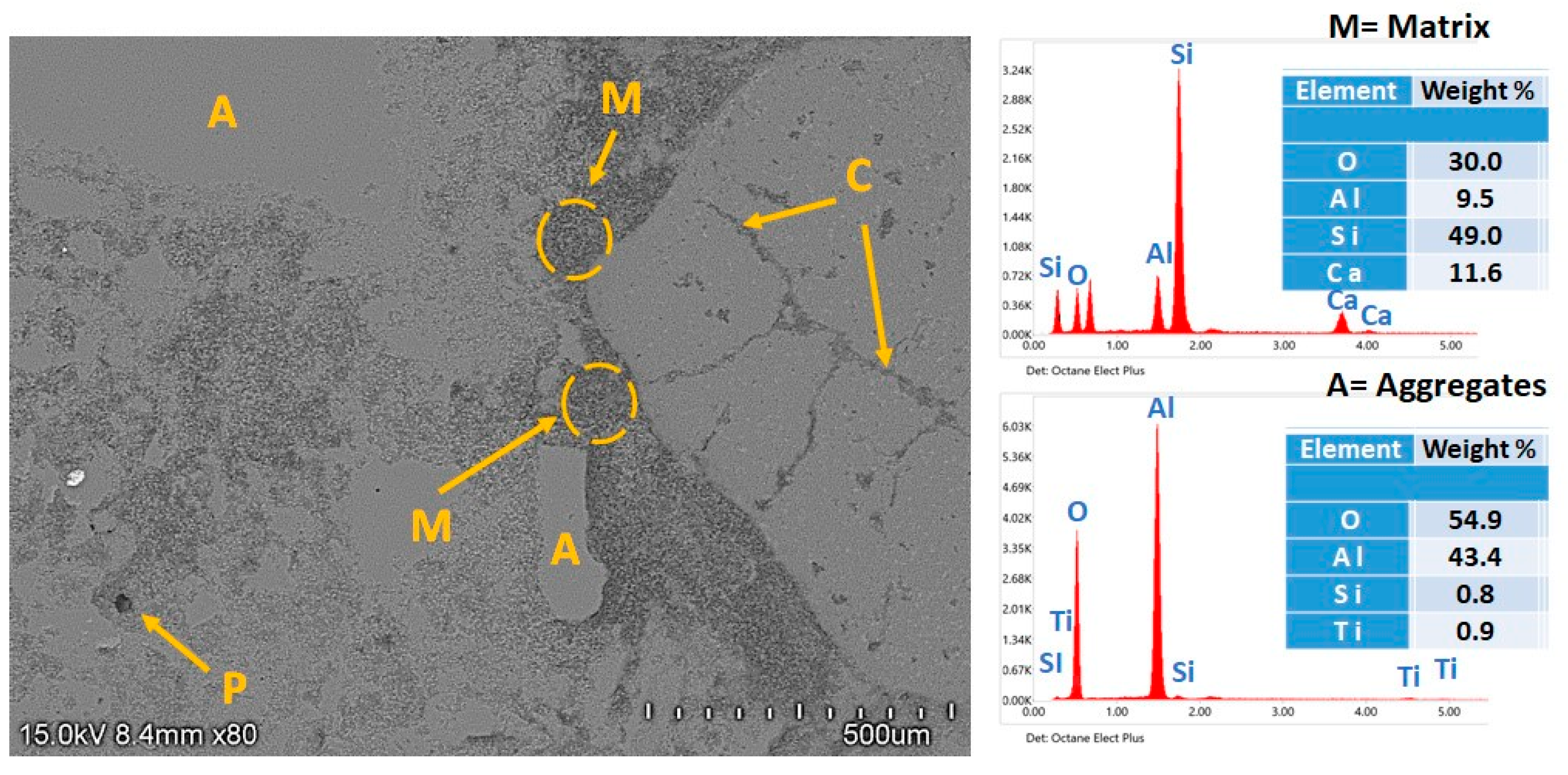
3.4. Microstructure
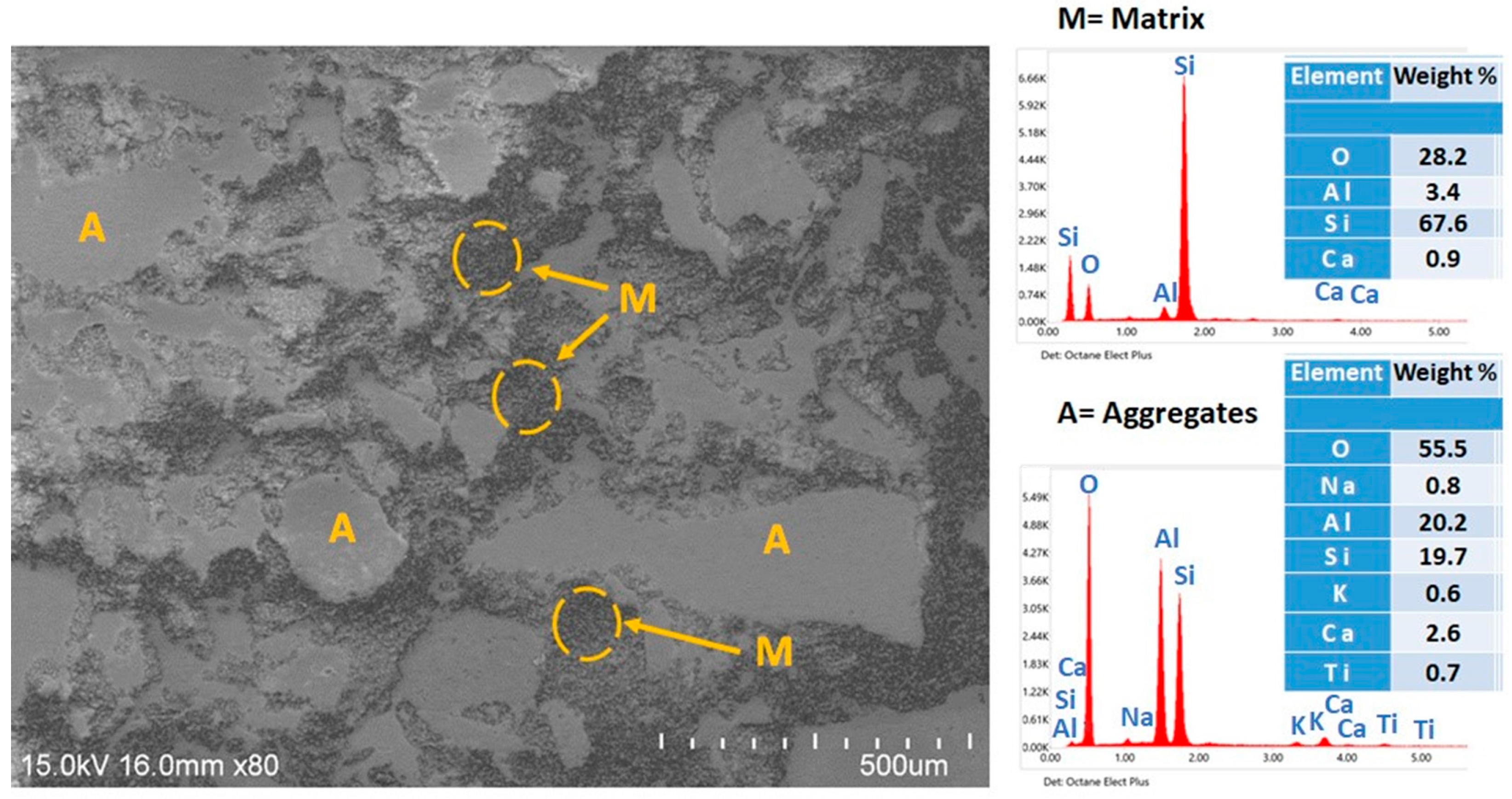
3.4.1. Control Specimen (CC)
3.4.2. 5CH
3.4.3. 10CH
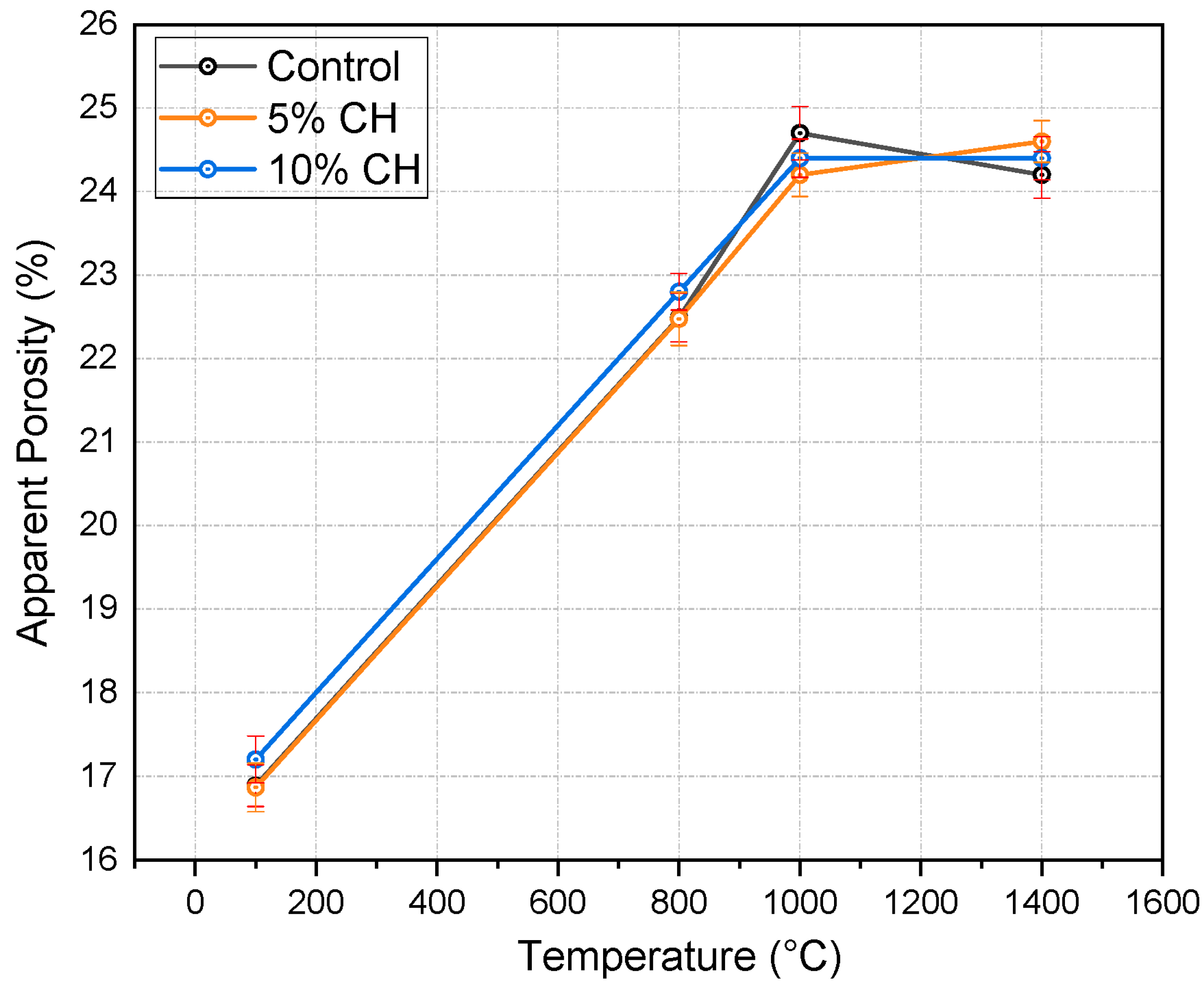
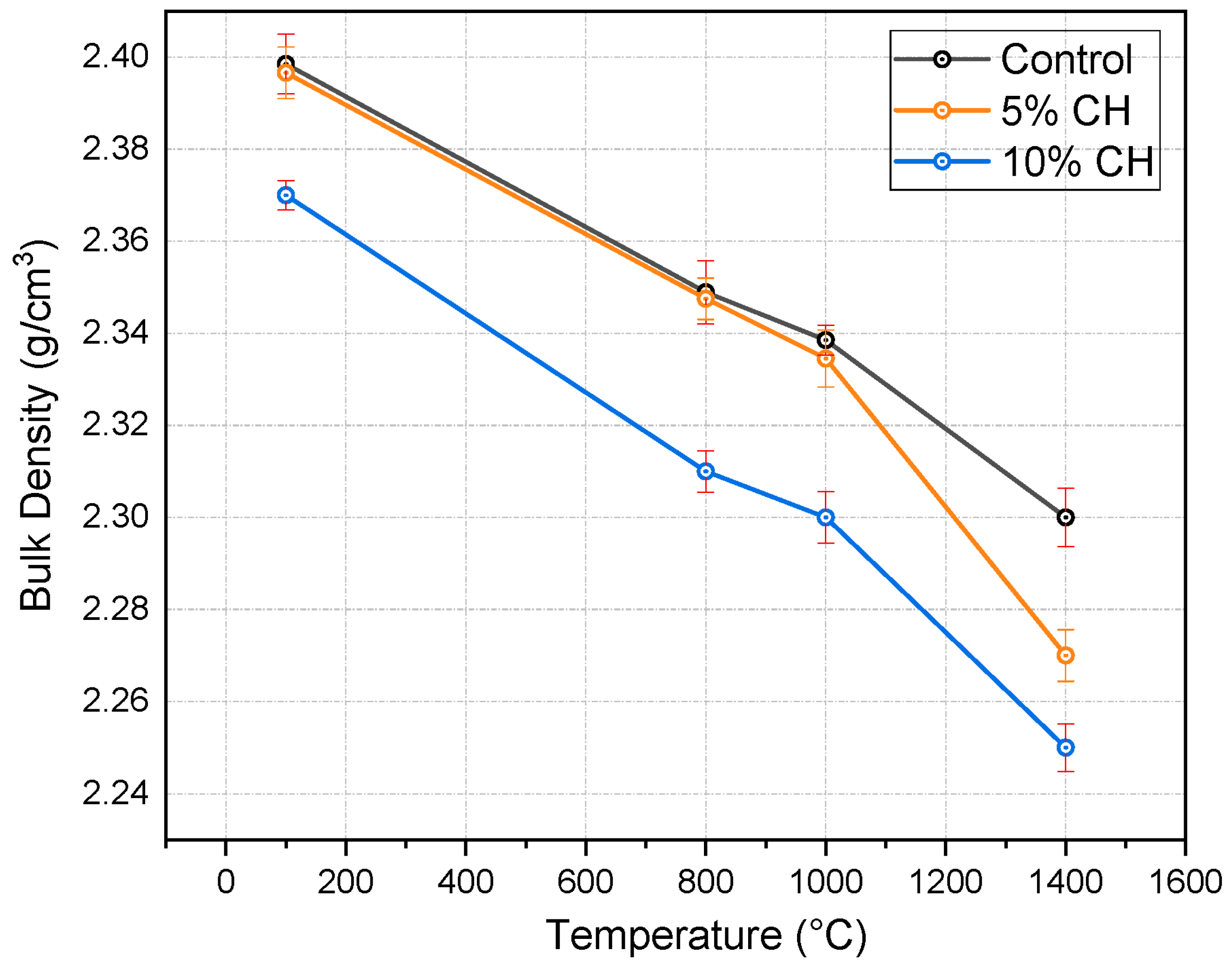
3.5. Physical Properties of Refractory Specimens
3.6. Mechanical Behavior of Refractory Samples
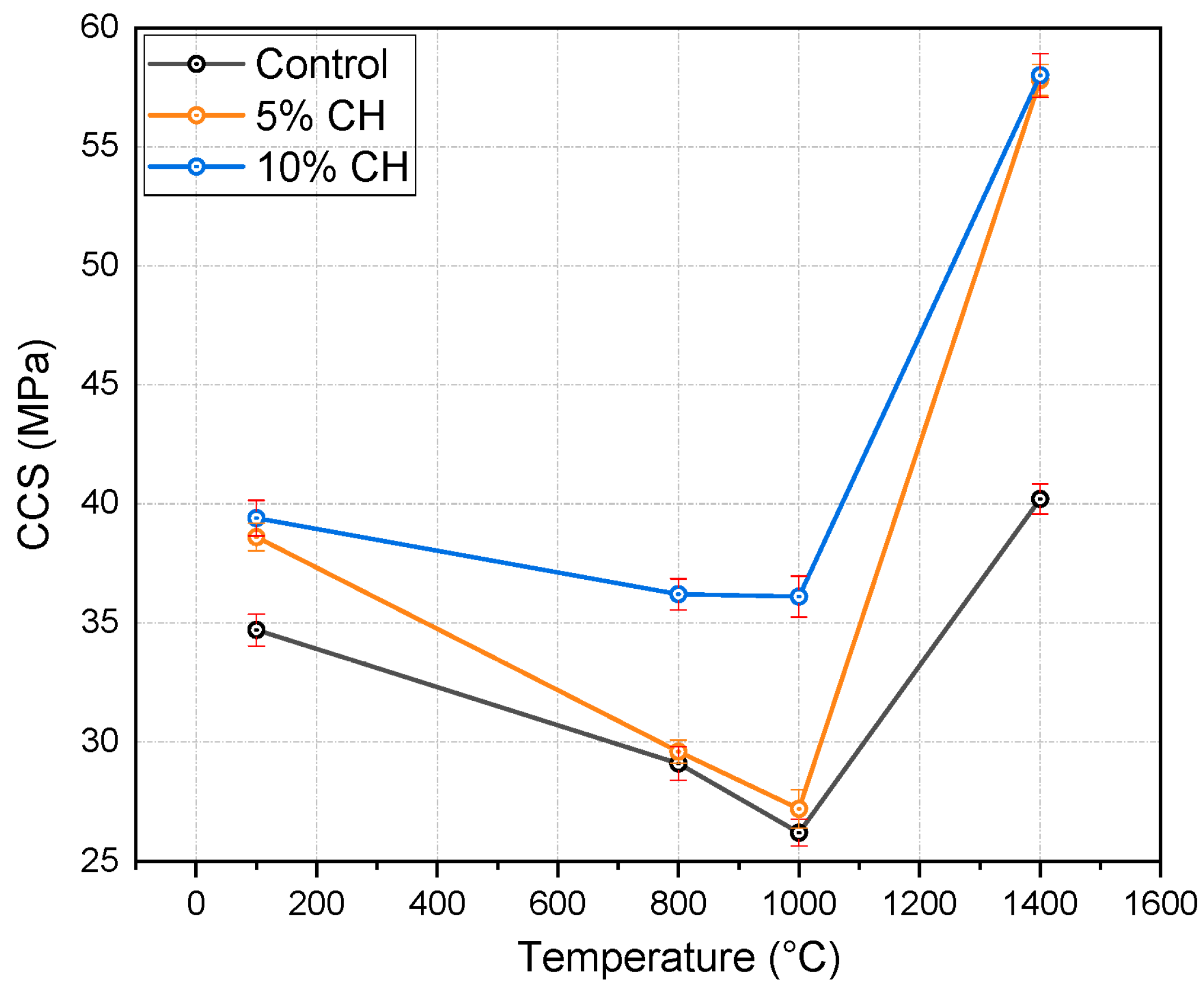
3.6.1. Cold Crushing Strength (CCS)
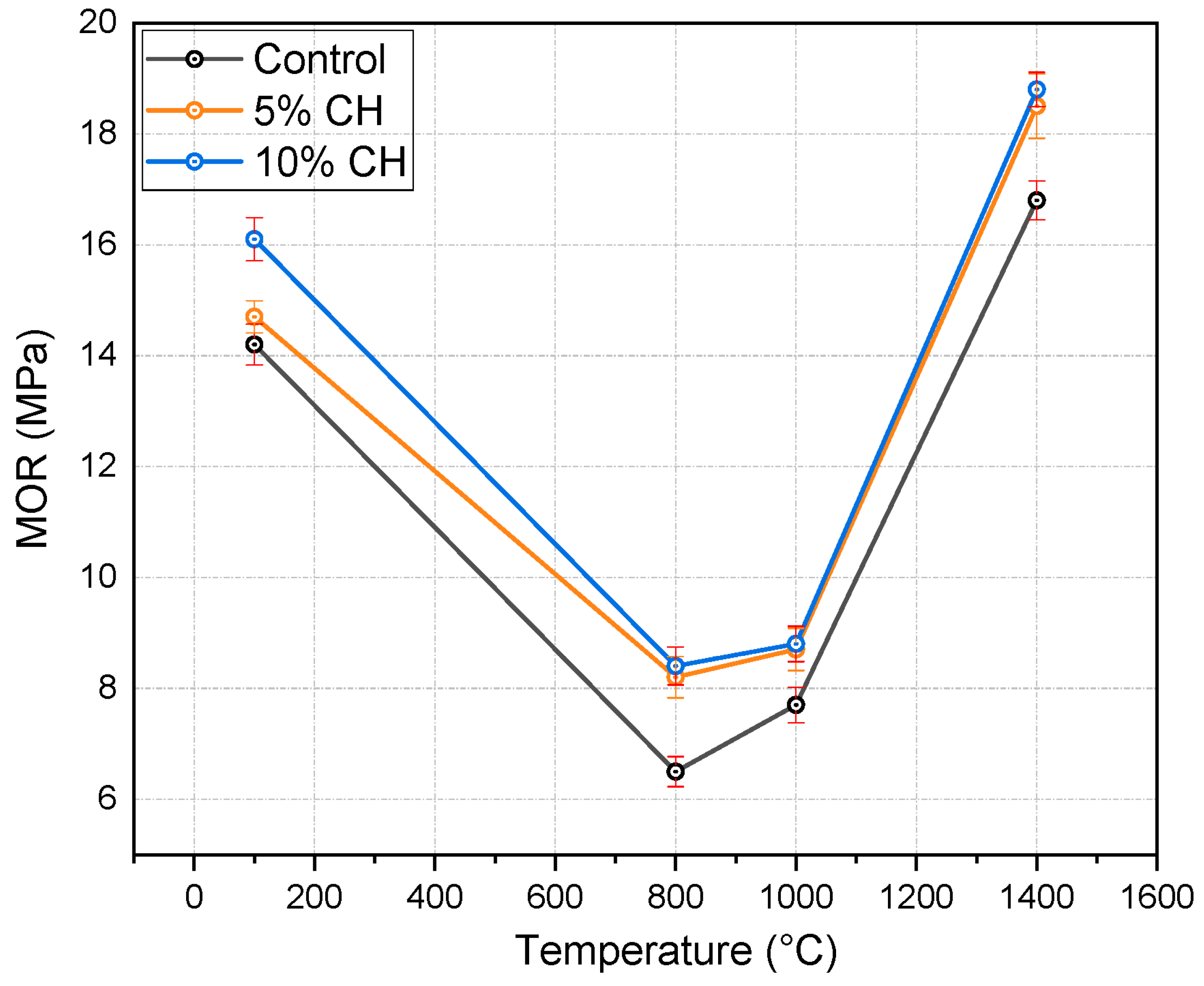
3.6.2. Modulus of Rupture (MOR)
3.7. Environmental and Sustainability Implications of Chamotte-Modified Refractory Castables
3.8. Limitations of Chamotte Recycling in Aluminosilicate Refractory Castables
3.9. Future Work
4. Conclusions
Author Contributions
Funding
Institutional Review Board Statement
Informed Consent Statement
Data Availability Statement
Acknowledgments
Conflicts of Interest
References
- Abou-Sekkina, M.M.; Abo-El-Enein, S.A.; Khalil, N.M.; Shalma, O.A. Phase Composition of Bauxite-Based Refractory Castables. Ceram. Int. 2011, 37, 411–418. [Google Scholar] [CrossRef]
- Soltan, A.M.; Pöllmann, H.; Kaden, R.; König, A.; Abd El-Raoof, F.; Eltaher, M.; Serry, M. Degradation of Aluminosilicate Refractories: An Integrated Approach. J. Eur. Ceram. Soc. 2015, 35, 4573–4592. [Google Scholar] [CrossRef]
- Aksel, C. The effect of mullite on the mechanical properties and thermal shock behaviour of alumina–mullite refractory materials. Ceram. Int. 2003, 29, 183–188. [Google Scholar] [CrossRef]
- Spyridakos, A.; Alexakis, D.E.; Vryzidis, I.; Tsotsolas, N.; Varelidis, G.; Kagiaras, E. Waste Classification of Spent Refractory Materials to Achieve Sustainable Development Goals Exploiting Multiple Criteria Decision Aiding Approach. Appl. Sci. 2022, 12, 3016. [Google Scholar] [CrossRef]
- Bezerra, B.; Luz, A. Comparative assessment of calcium aluminate cement and potassium-metakaolin-based geopolymer as binders in high-alumina refractories. Cerâmica 2025, 71, eMKWV7164. [Google Scholar] [CrossRef]
- Consonni, L.; Luz, A.; Pandolfelli, V. Evaluation of the combined addition of aluminum lactate and calcium carbonate to alumina-based castables. Cerâmica 2021, 67, 196–202. [Google Scholar] [CrossRef]
- Horckmans, L.; Nielsen, P.; Dierckx, P.; Ducastel, A. Recycling of refractory bricks used in basic steelmaking: A review. Resour. Conserv. Recycl. 2019, 140, 297–304. [Google Scholar] [CrossRef]
- Hossain, S.; Roy, P. Fabrication of sustainable insulation refractory: Utilization of different wastes. Bol. Soc. Esp. Ceram. Vidr. 2019, 58, 115–125. [Google Scholar] [CrossRef]
- Levinov, B.; D’yakov, V.; Krasnyi, B.; Kopeikin, V. A study of the chamotte materials produced using a dry aluminum–chromium phosphate binder. Refractories 1986, 27, 205–208. [Google Scholar] [CrossRef]
- Bezerra, B.; Luz, A.; Pandolfelli, V. Novel drying additives and their evaluation for self-flowing refractory castables. Ceram. Int. 2020, 46, 3209–3217. [Google Scholar] [CrossRef]
- Mathapati, P. An experimental investigation on behaviour of geo-polymer concrete slab with fly ash & GGBS under ambient curing. Int. J. Res. Eng. Technol. 2016, 5, 165–171. [Google Scholar] [CrossRef]
- Minh, D.; Nhi, N.; Thang, N. Development of refractory synthesized from waste ceramic fiber and chamotte. J. Polym. Compos. 2020, 8, 101–109. [Google Scholar] [CrossRef]
- Lima, L.; Silva, K.; Menezes, R.; Santana, L.; Lira, H. Microstructural characteristics, properties, synthesis and applications of mullite: A review. Cerâmica 2022, 68, 126–142. [Google Scholar] [CrossRef]
- Coglitore, A.; Brentari, A.; Burresi, E.; Mazzanti, F.; Mingazzini, C.; Villa, M. Thermomechanical Behaviour of Alumina–Mullite Refractories Developed by Recycling Industrial Ceramic Wastes. In Proceedings of the Convegno Nazionale IGF XXII, Rome, Italy, 1–3 July 2013; pp. 43–47. [Google Scholar]
- Stonys, R.; Malaiškienė, J.; Škamat, J.; Antonovič, V. Effect of hollow corundum microspheres additive on physical and mechanical properties and thermal shock resistance behavior of bauxite-based refractory castable. Materials 2021, 14, 4736. [Google Scholar] [CrossRef]
- Mazzanti, F.; Brentari, A.; Burresi, E.; Coglitore, A.; Martelli, S.; Mingazzini, C.; Ricci, A.; Sangiorgi, S.; Scafe’, M.; Villa, M. Exploitation of ceramic wastes by recycling in alumina–mullite refractories. Adv. Sci. Technol. 2010, 70, 9–14. [Google Scholar] [CrossRef]
- Berjonneau, J.; Prigent, P.; Poirier, J. The Development of a Thermodynamic Model for Al2O3–MgO Refractory Castable Corrosion by Secondary Metallurgy Steel Ladle Slags. Ceram. Int. 2009, 35, 623–635. [Google Scholar] [CrossRef]
- Patra, R.K.; Mukharjee, B.B. Influence of Incorporation of Granulated Blast Furnace Slag as Replacement of Fine Aggregate on Properties of Concrete. J. Clean. Prod. 2017, 165, 468–476. [Google Scholar] [CrossRef]
- Karamanova, E.; Avdeev, G.; Karamanov, A. Ceramics from Blast Furnace Slag, Kaolin and Quartz. J. Eur. Ceram. Soc. 2011, 31, 989–998. [Google Scholar] [CrossRef]
- Tiwari, A.; Singh, S.; Nagar, R. Feasibility Assessment for Partial Replacement of Fine Aggregate to Attain Cleaner Production Perspective in Concrete: A Review. J. Clean. Prod. 2016, 135, 490–507. [Google Scholar] [CrossRef]
- Marinković, S.; Dragaš, J.; Ignjatović, I.; Tošić, N. Environmental assessment of green concretes for structural use. J. Clean. Prod. 2017, 154, 633–649. [Google Scholar] [CrossRef]
- Jittin, V.; Bahurudeen, A.; Ajinkya, S. Utilisation of rice husk ash for cleaner production of different construction products. J. Clean. Prod. 2020, 263, 121578. [Google Scholar] [CrossRef]
- Zharmenov, A.; Yefremova, S.; Satbaev, B.; Shalabaev, N.; Satbaev, S.; Yermishin, S.; Kablanbekov, A. Production of Refractory Materials Using a Renewable Source of Silicon Dioxide. Minerals 2022, 12, 1010. [Google Scholar] [CrossRef]
- Antonovič, V.; Stonys, R.; Boris, R.; Malaiškienė, J. Effect of quartz sand on the properties and alkali resistance of refractory aluminosilicate castables. Constr. Build. Mater. 2022, 351, 128978. [Google Scholar] [CrossRef]
- Xiang, R.; Li, Y.; Li, S.; Xue, Z.; He, Z.; Ouyang, S.; Nana, X. The potential usage of waste foundry sand from investment casting in refractory industry. J. Clean. Prod. 2019, 211, 1322–1327. [Google Scholar] [CrossRef]
- De Lourdes Dos Santos Schackow, M.; Schackow, A.; Mundstock, K.; Folgueras, M. Sustainable silico-aluminous refractory wastes as an alternative raw material for hydraulic binder for foundry industry. Clean. Mater. 2024, 11, 100228. [Google Scholar] [CrossRef]
- Bahtli, T.; Bostanci, V. Effect of precision casting sand waste of 4140 steel on the sintering and densification behaviour of chamotte refractories. J. Therm. Anal. Calorim. 2020, 142, 2385–2390. [Google Scholar] [CrossRef]
- Iqbal, M.; Javed, M.; Rauf, M.; Azim, I.; Ashraf, M.; Yang, J.; Liu, Q. Sustainable utilization of foundry waste: Forecasting mechanical properties of foundry sand-based concrete using multi-expression programming. Sci. Total Environ. 2021, 780, 146524. [Google Scholar] [CrossRef]
- Angulo-Ramírez, D.E.; Mejía de Gutiérrez, R.; Puertas, F. Alkali-activated Portland blast-furnace slag cement: Mechanical properties and hydration. Constr. Build. Mater. 2017, 140, 119–128. [Google Scholar] [CrossRef]
- Li, Z.; Li, S. Carbonation resistance of fly ash and blast furnace slag-based geopolymer concrete. Constr. Build. Mater. 2018, 163, 668–680. [Google Scholar] [CrossRef]
- Surul, O.; Bilir, T.; Gholampour, A.; Sutcu, M.; Ozbakkaloglu, T.; Gencel, O. Recycle of ground granulated blast furnace slag and fly ash on eco-friendly brick production. Eur. J. Environ. Civ. Eng. 2020, 26, 1738–1756. [Google Scholar] [CrossRef]
- Teng, S.; Lim, T.Y.D.; Sabet Divsholi, B. Durability and mechanical properties of high strength concrete incorporating ultrafine ground granulated blast-furnace slag. Constr. Build. Mater. 2013, 40, 875–881. [Google Scholar] [CrossRef]
- Chargui, F.; Hamidouche, M.; Belhouchet, H.; Jorand, Y.; Doufnoune, R.; Fantozzi, G. Mullite fabrication from natural kaolin and aluminium slag. Bol. Soc. Esp. Ceram. Vidr. 2018, 57, 169–177. [Google Scholar] [CrossRef]
- Kumar, P.H.; Srivastava, A.; Kumar, V.; Majhi, M.R.; Singh, V.K. Implementation of industrial waste ferrochrome slag in conventional and low cement castables: Effect of microsilica addition. J. Asian Ceram. Soc. 2014, 2, 169–175. [Google Scholar] [CrossRef]
- Kumar, P.H.; Srivastava, A.; Kumar, V.; Singh, V.K. Implementation of industrial waste ferrochrome slag in conventional and low cement castables: Effect of calcined alumina. J. Asian Ceram. Soc. 2014, 2, 371–379. [Google Scholar] [CrossRef]
- Kurama, S.; Ozel, E. The influence of different CaO source in the production of anorthite ceramics. Ceram. Int. 2009, 35, 827–830. [Google Scholar] [CrossRef]
- Boom Cárcamo, E.A.; Peñabaena-Niebles, R. Opportunities and Challenges for the Waste Management in Emerging and Frontier Countries through Industrial Symbiosis. J. Clean. Prod. 2022, 363, 132607. [Google Scholar] [CrossRef]
- Das, D.; Rout, P.K. A Review of Coal Fly Ash Utilization to Save the Environment. Water Air Soil Pollut. 2023, 234, 61. [Google Scholar] [CrossRef]
- Shukla, B.K.; Gupta, A.; Gowda, S.; Srivastav, Y. Constructing a Greener Future: A Comprehensive Review on the Sustainable Use of Fly Ash in the Construction Industry and Beyond. Mater. Today Proc. 2023, 93, 257–264. [Google Scholar] [CrossRef]
- Nguyen, H.-H.T.; Nguyen, H.T.; Ahmed, S.F.; Rajamohan, N.; Yusuf, M.; Sharma, A.; Arunkumar, P.; Deepanraj, B.; Tran, H.-T.; Al-Gheethi, A.; et al. Emerging Waste-to-Wealth Applications of Fly Ash for Environmental Remediation: A Review. Environ. Res. 2023, 227, 115800. [Google Scholar] [CrossRef] [PubMed]
- Liebermann, J. Reliability of Materials for High-Voltage Insulators. Am. Ceram. Soc. Bull. 2000, 79, 55–58. [Google Scholar]
- Amigó, J.M.; Serrano, F.J.; Kojdecki, M.A.; Bastida, J.; Esteve, V.; Reventós, M.M. X-Ray Diffraction Microstructure Analysis of Mullite, Quartz and Corundum in Porcelain Insulators. J. Eur. Ceram. Soc. 2005, 25, 1479–1486. [Google Scholar] [CrossRef]
- Gubanski, S. Outdoor High Voltage Insulation. IEEE Trans. Dielectr. Electr. Insul. 2010, 17, 325. [Google Scholar] [CrossRef]
- Meng, Y.; Gong, G.; Wu, Z.; Yin, Z.; Xie, Y.; Liu, S. Fabrication and Microstructure Investigation of Ultra-High-Strength Porcelain Insulator. J. Eur. Ceram. Soc. 2012, 32, 3043–3049. [Google Scholar] [CrossRef]
- Contreras, J.E.; Rodríguez, E.A. Nanostructured Insulators—A Review of Nanotechnology Concepts for Outdoor Ceramic Insulators. Ceram. Int. 2017, 43, 8545–8550. [Google Scholar] [CrossRef]
- Ogbonda, C.; Onuchuku, P. Enhancement of Mechanical and Dielectric Properties of Porcelain Insulators Using Locally Available Raw Materials. BW Acad. J. 2023, 14. Available online: https://bwjournal.org/index.php/bsjournal/article/view/1314 (accessed on 18 June 2023).
- Addis, T.; Wondemagegnehu, E.B.; Zereffa, E.A.; Tullu, A.M.; Brehane, B. Sugarcane Bagasse Ash Substituent Feldspar for the Production of Porcelain Electrical Insulators. Ceram. Int. 2023, 49, 7727–7736. [Google Scholar] [CrossRef]
- Harper, C. Handbook of Ceramics, Glasses, and Diamonds; McGraw-Hill Professional: Sydney, Australia, 2001. [Google Scholar]
- Bragança, S.R.; Bergman, C.P. Microestrutura e Propriedades de Porcelanas. Cerâmica 2004, 50, 291–299. [Google Scholar] [CrossRef][Green Version]
- Dana, K.; Das, S.; Das, K.S. Effect of Substitution of Fly Ash for Quartz in Triaxial Kaolin–Quartz–Feldspar System. J. Eur. Ceram. Soc. 2004, 24, 3169–3175. [Google Scholar] [CrossRef]
- Sánchez, E.; García-Ten, J.; Sanz, V.; Moreno, A. Porcelain Tile: Almost 30 Years of Steady Scientific-Technological Evolution. Ceram. Int. 2010, 36, 831–845. [Google Scholar] [CrossRef]
- Liebermann, J. High-Voltage Insulators: Basics and Trends for Producers, Users and Students; Fraunhofer Institute for Ceramic Technologies and Systems IKTS: Dresden, Germany, 2012. [Google Scholar]
- Piva, D.H.; Piva, R.H.; Venturini, J.; Ramon, J.; Caldas, V.; Morelli, M.R.; Bergmann, C. Effect of Fe2O3 Content on the Electrical Resistivity of Aluminous Porcelain Applied to Electrical Insulators. Ceram. Int. 2016, 42, 5045–5052. [Google Scholar] [CrossRef]
- Owoeye, S.S.; Toludare, T.S.; Isinkaye, O.E.; Kingsley, U. Influence of Waste Glasses on the Physico-Mechanical Behavior of Porcelain Ceramics. Bol. Soc. Esp. Ceram. Vidr. 2019, 58, 77–84. [Google Scholar] [CrossRef]
- GlobalData Energy. Tracking the Growth of the Global Power Insulator Market, 2018–2022. Power Technology. 2022. Available online: https://www.power-technology.com/comment/tracking-growth-global-power-insulator-market (accessed on 10 January 2024).
- Kaviraj, A.K.; Saha, S.; Chakraborty, A.; Pahari, G.; Ray, D.; Parya, T.K.; Das, S.K. Differences in Phase, Microstructural, and Electrical Characteristics of Quartz-Substituted Alumina Porcelain Insulator. J. Australas. Ceram. Soc. 2020, 57, 327–337. [Google Scholar] [CrossRef]
- Pereira, V.M.; Geraldo, R.H.; Baldusco, R.; Camarini, G. Porcelain Waste from Electrical Insulators in Self-Leveling Mortar: Materials Characterization and Properties. J. Build. Eng. 2022, 61, 105297. [Google Scholar] [CrossRef]
- Naenudon, S.; Wongsa, A.; Ekprasert, J.; Sata, V.; Chindaprasirt, P. Enhancing the Properties of Fly Ash-Based Geopolymer Concrete Using Recycled Aggregate from Waste Ceramic Electrical Insulator. J. Build. Eng. 2023, 68, 106132. [Google Scholar] [CrossRef]
- Liu, T.; Zhang, J.; Wu, J.; Liu, J.; Li, C.; Ning, T.; Luo, Z.; Zhou, X.; Yang, Q.; Lu, A. The Utilization of Electrical Insulators Waste and Red Mud for Fabrication of Partially Vitrified Ceramic Materials with High Porosity and High Strength. J. Clean. Prod. 2019, 223, 790–800. [Google Scholar] [CrossRef]
- Campos, M.A.; Paulon, V.A.; De Argollo Ferrao, A.M. Concrete Made with Alternative Fine Aggregates: The Reuse of Porcelain Electrical Insulators. Mater. Sci. Forum 2018, 912, 185–190. [Google Scholar] [CrossRef]
- Pivak, A.; Pavlíková, M.; Zaleská, M.; Lojka, M.; Lauermannová, A.-M.; Jankovský, O.; Pavlík, Z. Low-Carbon Composite Based on MOC, Silica Sand and Ground Porcelain Insulator Waste. Processes 2020, 8, 829. [Google Scholar] [CrossRef]
- Pereira, V.M.; Camarini, G. Fresh and Hardened Properties of Self-Leveling Mortars with Porcelain and Red Ceramic Wastes. Adv. Civ. Eng. 2018, 2018, 6378643. [Google Scholar] [CrossRef]
- Garg, N.; Shrivastava, S. Mechanical, Durability and Sustainability Assessment of Rendering Mortar with Synergistic Utilisation of Recycled Concrete and Ceramic Insulator Fine Aggregates. J. Build. Eng. 2023, 76, 107269. [Google Scholar] [CrossRef]
- Xu, N.; Li, S.; Li, Y.; Xue, Z.; Yuan, L.; Zhang, J.; Wang, L. Preparation and Properties of Porous Ceramic Aggregates Using Electrical Insulators Waste. Ceram. Int. 2015, 41, 5807–5811. [Google Scholar] [CrossRef]
- ASTM-C860; Standard Practice for Determining the Consistency of Refractory Castable Using the Ball-in-Hand Test. ASTM International: West Conshohocken, PA, USA, 2000; pp. 1–5.
- ASTM-C865; Standard Practice for Firing Refractory Concrete Specimens. ASTM International: West Conshohocken, PA, USA, 2002; pp. 1–3.
- ASTM-C20; Standard Test Methods for Apparent Porosity, Water Absorption, Apparent Specific Gravity, and Bulk Density of Burned Refractory Brick and Shapes by Boiling Water. ASTM International: West Conshohocken, PA, USA, 2000; pp. 1–3.
- ASTM-C133; Standard Test Methods for Cold Crushing Strength and Modulus of Rupture of Refractories. ASTM International: West Conshohocken, PA, USA, 1997; pp. 1–6.
- Liu, Y.; Yin, H.; Tang, Y.; Xin, Y.; Yuan, H.; Ren, X.; Wan, Q. Synthesis Mechanism and Properties of Lightweight Mullite–Corundum Refractories Obtained through High Temperature Liquid-Assisted Micrometer-Scale Kirkendall Effect. Ceram. Int. 2021, 47, 9234–9244. [Google Scholar] [CrossRef]
- You, Q.; Wu, Z.; Li, Y.; Zhong, Y.; Shang, S.; Yuan, M.; Ou, Y.; Xu, H.; Cui, S. Amorphous SiOC-Coated Submicron Mullite Aerogels with Excellent Thermal and Structural Stability up to 1500 °C. J. Eur. Ceram. Soc. 2024, 45, 117079. [Google Scholar] [CrossRef]
- Xu, X.; Shen, Y.; Wu, J.; Qiu, S.; Yu, J.; Zhou, Y. Effect of Different Silicon Sources on the Properties of In-Situ Synthesized Corundum–Mullite Composite Thermal Storage Ceramics. Ceram. Int. 2024, 50, 17043–17053. [Google Scholar] [CrossRef]
- Kenzhaliyev, B.; Biryukova, A.; Dzhienalyev, T.; Panichkin, A.; Imbarova, A.; Uskenbaeva, A.; Yusoff, A.H. Assessment of Microsilica as a Raw Material for Obtaining Mullite–Silica Refractories. Processes 2024, 12, 200. [Google Scholar] [CrossRef]
- Ondro, T.; Al-Shantir, O.; Csáki, I.; Lukáč, F.; Trník, A. Kinetic Analysis of Sinter-Crystallization of Mullite and Cristobalite from Kaolinite. Thermochim. Acta 2019, 678, 178312. [Google Scholar] [CrossRef]
- Sainz, M.; Serrano, F.; Bastida, J.; Caballero, A. Microstructural Evolution and Growth of Crystallite Size of Mullite during Thermal Transformation of Kyanite. J. Eur. Ceram. Soc. 1997, 17, 1277–1284. [Google Scholar] [CrossRef]
- Yu, P.; Tsai, Y.; Yen, F.; Huang, C. Thermal Reaction of Cristobalite in Nano-SiO2/Al2O3 Powder Systems for Mullite Synthesis. J. Am. Ceram. Soc. 2014, 97, 2431–2438. [Google Scholar] [CrossRef]
- Barrientos-Hernández, F.R.; Pérez-Labra, M.; Lobo-Guerrero, A.; Reyes-Pérez, M.; Juárez-Tapia, J.C.; Hernández-Ávila, J.; Cardoso-Legorreta, E.; Hernández-Lara, J. Effect of Particle Size and Sintering Temperature on the Formation of Mullite from Kyanite and Aluminum Mixtures. Adv. Mater. Sci. Eng. 2021, 2021, 6678297. [Google Scholar] [CrossRef]
- Zhai, K.; Xue, W.; Wang, H.; Wu, X.; Zhai, S. Raman Spectra of Sillimanite, Andalusite, and Kyanite at Various Temperatures. Phys. Chem. Miner. 2020, 47, 23. [Google Scholar] [CrossRef]
- He, Q.; Liu, X.; Li, B.; Deng, L.; Liu, W.; Wang, L. Thermal Equation of State of a Natural Kyanite up to 8.55 GPa. Matter Radiat. Extremes 2016, 1, 269–276. [Google Scholar] [CrossRef]
- Nemaleu, J.G.D.; Kaze, C.R.; Belela, E.A.; Lecomte-Nana, G.; Kamseu, E.; Sglavo, V.; Leonelli, C. Refractory Ceramics Bonds from Potassium-Based Inorganic Polymer for Advanced Applications: Crystalline Phase Changes and Descriptive Microstructure. Ceram. Int. 2022, 48, 21579–21588. [Google Scholar] [CrossRef]
- Lin, S.; Yu, Y.; Zhong, M.; Yang, H.; Liu, Y.; Li, H.; Zhang, C.Y.; Zhang, Z.J. Preparation of Anorthite/Mullite In Situ and Phase Transformation in Porcelain. Materials 2023, 16, 416. [Google Scholar] [CrossRef] [PubMed]
- Li, C.; Chao, B.; Han, Y.; Wang, C.; An, L. Mullite Whisker Reinforced Porous Anorthite Ceramics with Low Thermal Conductivity and High Strength. J. Eur. Ceram. Soc. 2016, 36, 761–765. [Google Scholar] [CrossRef]
- Ryu, H.; Kasai, E.; Saito, F. Effect of Mixed Grinding of Kaolinite–Gibbsite Mixture on Formation of Mullite. Shigen-to-Sozai 1992, 108, 221–226. [Google Scholar] [CrossRef]
- Taşkıran, F.; Kalpaklı, Y. In Situ Boro-Mullite Phase Formation in Glass–Ceramic Glazes: Anatase–Rutile Phase Transformations and Microstructure Properties. Ceram. Int. 2024, 50, 50667–50679. [Google Scholar] [CrossRef]
- Wallez, G.; Bouquillon, A.; Coquinot, Y. Thermal Evolution of a Kaolin: Quantitative Phase Analysis and Assessment of the Thermal Markers of the Provins Clay. Appl. Clay Sci. 2024, 261, 107582. [Google Scholar] [CrossRef]
- Wang, H.; Li, B.; He, M.; Hwang, J.Y. Mullitization Characteristics and Sinterability of Kyanite in Ceramic Preparation. In Characterization of Minerals, Metals, and Materials 2017; Springer: Cham, Switzerland, 2017; pp. 251–259. [Google Scholar] [CrossRef]
- Schneider, H.; Majdič, A. Kinetics of the Thermal Decomposition of Kyanite. Ceramurgia Int. 1980, 6, 61–66. [Google Scholar] [CrossRef]
- Lin, Y.-M.; Li, C.-W.; Wang, C.-A. Effects of Mullite Content on the Properties and Microstructure of Porous Anorthite/Mullite Composite Ceramics. J. Inorg. Mater. 2011, 26, 1095–1100. [Google Scholar] [CrossRef]
- Lin, Y.-M.; Li, C.-W.; Yang, F.-K.; Wang, C.-A. Preparation and Properties of Porous Anorthite–Mullite Ceramics. Key Eng. Mater. 2012, 512–515, 590–595. [Google Scholar] [CrossRef]
- Frost, R.; Kloprogge, J.; Russell, S.; Szetu, J. Vibrational Spectroscopy and Dehydroxylation of Aluminum (Oxo)Hydroxides: Gibbsite. Appl. Spectrosc. 1999, 53, 423–434. [Google Scholar] [CrossRef]
- Ingram-Jones, V.J.; Slade, R.; Davies, T.; Southern, J.; Salvador, S. Dehydroxylation Sequences of Gibbsite and Boehmite: Study of Differences between Soak and Flash Calcination and of Particle-Size Effects. J. Mater. Chem. 1996, 6, 73–79. [Google Scholar] [CrossRef]
- Djaida, R.D.R.; Foudil, S.F.S. Kinetics Parameters of the Thermal Dehydroxylation of Gibbsite Al(OH)3 by Differential Thermal Analysis (DTA). J. Mater. Environ. Sci. 2016, 5, 7–12. [Google Scholar]
- Zhu, B.; Fang, B.; Li, X. Dehydration Reactions and Kinetic Parameters of Gibbsite. Ceram. Int. 2010, 36, 2493–2498. [Google Scholar] [CrossRef]
- Namiranian, A.; Kalantar, M. Mullite Synthesis and Formation from Kyanite Concentrates in Different Conditions of Heat Treatment and Particle Size. Iran. J. Mater. Sci. Eng. 2011, 8, 29–36. [Google Scholar]
- Abolhasani, A.; Samali, B.; Aslani, F. Physicochemical, Mineralogical, and Mechanical Properties of Calcium Aluminate Cement Concrete Exposed to Elevated Temperatures. Materials 2021, 14, 3855. [Google Scholar] [CrossRef] [PubMed]
- Geng, G.; Li, J.; Yu, Y.S.; Shapiro, D.; Kilcoyne, D.; Monteiro, P. Nanometer-Resolved Spectroscopic Study Reveals the Conversion Mechanism of CaO·Al2O3·10H2O to 2CaO·Al2O3·8H2O and 3CaO·Al2O3·6H2O at an Elevated Temperature. Cryst. Growth Des. 2017, 17, 4246–4253. [Google Scholar] [CrossRef]
- Zapata, J.; Colorado, H.; Gómez, M. Effect of High Temperature and Additions of Silica on the Microstructure and Properties of Calcium Aluminate Cement Pastes. J. Sustain. Cem.-Based Mater. 2020, 9, 323–349. [Google Scholar] [CrossRef]
- Aguilar-Santillan, J.; Cuenca-Álvarez, R.; Balmori-Ramírez, H.; Bradt, R. Mechanical Activation of the Decomposition and Sintering of Kyanite. J. Am. Ceram. Soc. 2002, 85, 2425–2431. [Google Scholar] [CrossRef]
- Kashcheev, I.; Ust’yantsev, V.M.; Sychev, S.N. Kyanite Concentrate of the Karabash Deposit: Phase Transformations during Heating. Refract. Ind. Ceram. 2007, 48, 250–254. [Google Scholar] [CrossRef]
- Zhang, Y.; Chang, J.; Ji, J. AH3 Phase in the Hydration Product System of AFt–AFm–AH3 in Calcium Sulfoaluminate Cements: A Microstructural Study. Constr. Build. Mater. 2018, 167, 587–596. [Google Scholar] [CrossRef]
- Irisawa, K.; García-Lodeiro, I.; Kinoshita, H. Influence of Mixing Solution on Characteristics of Calcium Aluminate Cement Modified with Sodium Polyphosphate. Cem. Concr. Res. 2020, 137, 105951. [Google Scholar] [CrossRef]
- Pacewska, B.; Nowacka, M. Studies of Conversion Progress of Calcium Aluminate Cement Hydrates by Thermal Analysis Method. J. Therm. Anal. Calorim. 2014, 117, 653–660. [Google Scholar] [CrossRef]
- Vasile, B.; Dobra, G.; Iliev, S.; Cotet, L.; Neacșu, I.; Surdu, V.A.; Nicoară, A.; Boiangiu, A.; Filipescu, L. Thermally Activated Al(OH)3. Part II—Effect of Different Thermal Treatments. Ceramics 2021, 4, 40. [Google Scholar] [CrossRef]
- Kitamura, M.; Senna, M. Effects of Preheating on Mechanochemical Amorphization and Enhanced Reactivity of Aluminum Hydroxide. Adv. Powder Technol. 2001, 12, 215–226. [Google Scholar] [CrossRef]
- Eisinas, A.; Dambrauskas, T.; Baltakys, K.; Ruginytė, K. The Peculiarities of Mayenite Formation from Synthetic Katoite and Calcium Monocarboaluminate Samples in the Temperature Range 25–1150 °C. J. Therm. Anal. Calorim. 2019, 138, 2275–2282. [Google Scholar] [CrossRef]
- Das, S.; Mitra, A.; Poddar, P.K.D. Thermal Analysis of Hydrated Calcium Aluminates. J. Therm. Anal. 1996, 47, 765–774. [Google Scholar] [CrossRef]
- Salasin, J.; Rawn, C. In-Situ Kinetic Investigation of Calcium Aluminate Formation. Ceramics 2018, 1, 16. [Google Scholar] [CrossRef]
- Abd-El-Raoof, F.; Youssef, H.; El-Sokkary, T.; El-Shakour, Z.A.A.; Tawfik, A.Y. Fabrication and Characterization of Calcium Aluminate Cement via Microwave-Hydrothermal Route: Mayenite, Katoite, and Hydrocalumite. Constr. Build. Mater. 2023, 369, 132988. [Google Scholar] [CrossRef]
- Khaliq, W.; Khan, H.A. High Temperature Material Properties of Calcium Aluminate Cement Concrete. Constr. Build. Mater. 2015, 94, 475–487. [Google Scholar] [CrossRef]
- Salomão, R.; Kawamura, M.; Emilio, A.B.; Sakihama, J.; Segadães, A.M. Calcium Aluminate Cement in Castable Alumina: From Hydrate Bonding to the In Situ Formation of Calcium Hexaluminate. Ceram. Int. 2021, 47, 3668–3678. [Google Scholar] [CrossRef]
- Koplík, J.; Švec, J.; Másilko, J.; Sedlačík, M.; Bartoníčková, E. Synthesis of Calcium Aluminate Hydrates, Their Characterization and Dehydration. Ceram. Int. 2024, 51, 5536–5543. [Google Scholar] [CrossRef]
- Lin, P.X.; Zhang, D.; Yan, W.; Yu, H.Y. Synthesis and Characterization of Calcium Aluminate Compounds from Gehlenite by High-Temperature Solid-State Reaction. Ceram. Int. 2018, 44, 10241–10249. [Google Scholar] [CrossRef]
- Zuluaga, C.A.; Ríos, C.A.; Castellanos, O. Early Paleozoic and Jurassic Orogenic Events in the Northern Andes: Evidence from Polymetamorphism in a Kyanite–Andalusite–Sillimanite Crystallization Sequence. Geol. Soc. Lond. Spec. Publ. 2025, 558, 121. [Google Scholar] [CrossRef]
- Whitney, D. Coexisting Andalusite, Kyanite, and Sillimanite: Sequential Formation of Three Al2SiO5 Polymorphs during Progressive Metamorphism near the Triple Point, Sivrihisar, Turkey. Am. Miner. 2002, 87, 405–416. [Google Scholar] [CrossRef]
- Tsuneyuki, S.; Aoki, H.; Tsukada, M.; Matsui, Y. Molecular-Dynamics Study of the Alpha to Beta Structural Phase Transition of Quartz. Phys. Rev. Lett. 1990, 64, 776–779. [Google Scholar] [CrossRef]
- Ranieri, V.; Bourgogne, D.; Darracq, S.; Cambon, M.; Haines, J.; Cambon, O.; Leparc, R.; Levelut, C.; Largeteau, A.; Demazeau, G. Raman Scattering Study of α-Quartz and Si1−xGexO2 Solid Solutions. Phys. Rev. B 2009, 79, 224304. [Google Scholar] [CrossRef]
- Murri, M.; Prencipe, M. Anharmonic Effects on the Thermodynamic Properties of Quartz from First-Principles Calculations. Entropy 2021, 23, 1366. [Google Scholar] [CrossRef] [PubMed]
- Kohn, M. A Refined Zirconium-in-Rutile Thermometer. Am. Miner. 2020, 105, 963–971. [Google Scholar] [CrossRef]
- Mechri, M.L.; Chihi, S.; Mahdadi, N.; Beddiaf, S. Study of Heat Effect on the Composition of Dunes Sand of Ouargla (Algeria) Using XRD and FTIR. Silicon 2017, 9, 933–941. [Google Scholar] [CrossRef]
- Zhou, H.; Qiao, X.; Yu, J. Influences of Quartz and Muscovite on the Formation of Mullite from Kaolinite. Appl. Clay Sci. 2013, 80, 176–181. [Google Scholar] [CrossRef]
- Rana, A.; Aiko, O.; Pask, J.A. Sintering of α-Al2O3/Quartz and α-Al2O3/Cristobalite Related to Mullite Formation. Ceram. Int. 1982, 8, 151–153. [Google Scholar] [CrossRef]
- Garcia-Valles, M.; Cuevas, D.; Alfonso, P.; Martínez, S. Thermal Behaviour of Ceramics Obtained from the Kaolinitic Clays of Terra Alta, Catalonia, Spain. J. Therm. Anal. Calorim. 2022, 147, 5303–5312. [Google Scholar] [CrossRef]
- Zhang, J.; Jia, Q.; Yan, S.; Zhang, S.; Liu, X. Microstructure and Properties of Hydratable Alumina Bonded Bauxite–Andalusite Based Castables. Ceram. Int. 2016, 42, 310–316. [Google Scholar] [CrossRef]
- Stjernberg, J.; Lindblom, B.; Wikström, J.; Antti, M.-L.; Odén, M. Microstructural Characterization of Alkali Metal Mediated High Temperature Reactions in Mullite Based Refractories. Ceram. Int. 2010, 36, 733–740. [Google Scholar] [CrossRef]
- Maldhure, A.V.; Tripathi, H.S.; Ghosh, A. Mechanical Properties of Mullite–Corundum Composites Prepared from Bauxite. Int. J. Appl. Ceram. Technol. 2015, 12, 860–866. [Google Scholar] [CrossRef]
- Zare, S.; Monshi, A.; Saidi, A. Improving In Situ Spinel Refractory Castables Using a Novel Binder. Ceram. Int. 2016, 42, 5885–5896. [Google Scholar] [CrossRef]
- Liu, Y.; Xu, L.; Chen, M.; Zhang, D. Effects of Andalusite and Kyanite Addition on the Microstructure, Thermo-Mechanical Properties and Corrosion Resistance of Ultralow-Cement Bauxite–Corundum Castables. Ceram. Int. 2022, 48, 14141–14150. [Google Scholar] [CrossRef]
- Andreeva, O.V. Calculation of the Concentration of Chamotte in Ceramics: New Experimental Data. Vestn. Novosib. State Univ. Ser. Hist. Philol. 2024, 23, 35–42. [Google Scholar] [CrossRef]
- McNutt, P.F.; Sood, S.S.; Brandvold, A.S.; Ozer, A.; Kriven, W. Optimizing the Design Parameters for Chamotte Particle-Reinforced Geopolymers. J. Am. Ceram. Soc. 2024, 107, 6045–6059. [Google Scholar] [CrossRef]
- Gu, W.; Zhu, L.; Shang, X.; Ding, D.; Liu, L.; Chen, L.; Ye, G. Effect of particle size of calcium aluminate cement on volumetric stability and thermal shock resistance of CAC-bonded castables. J. Alloys Compd. 2019, 772, 637–641. [Google Scholar] [CrossRef]
- Bareiro, W.G.; De Andrade Silva, F.; Sotelino, E.D.; Gomes, O.D.F.M. The influence of alumina content on the chemical and mechanical behavior of refractory concretes fired at different temperatures. Constr. Build. Mater. 2018, 187, 1214–1223. [Google Scholar] [CrossRef]
- Zapata, J.; Azevedo, A.; Fontes, C.; Monteiro, S.; Colorado, H. Environmental impact and sustainability of calcium aluminate cements. Sustainability 2022, 14, 2751. [Google Scholar] [CrossRef]
- De Sousa, L.L.; Salomão, R.; Arantes, V.L. Development and characterization of porous moldable refractory structures of the alumina–mullite–quartz system. Ceram. Int. 2017, 43, 1362–1370. [Google Scholar] [CrossRef]
- Pan, L.; He, Z.; Li, Y.; Zhu, T.; Wang, Q.; Li, B. Effects of cement content on the microstructural evolution and mechanical properties of cement-bonded corundum castables. Ceram. Int. 2020, 46, 4634–4642. [Google Scholar] [CrossRef]
- Gao, S.; Zhang, P.; Li, N.; Zhang, J.; Luan, J.; Ye, G.; Liao, G. Effect of CAC content on the strength of castables at temperatures between 300 and 1000 °C. Ceram. Int. 2020, 46, 14957–14963. [Google Scholar] [CrossRef]
- Zhang, P.; Li, N.; Luan, J.; Gao, S.; Ye, G. Relationship between the strength and microstructure of CAC-bonded castables under intermediate temperatures. Ceram. Int. 2020, 46, 888–892. [Google Scholar] [CrossRef]
- Cultrone, G.; Sebastián, E.; Elert, K.; De la Torre, M.; Cazalla, O.; Navarro, C. Influence of Mineralogy and Firing Temperature on the Porosity of Bricks. J. Eur. Ceram. Soc. 2004, 24, 547–564. [Google Scholar] [CrossRef]
- Khater, G.; Romero, M.; López-Delgado, A.; Padilla, I.; El-Kheshen, A.A.; Farag, M.M.; Elmaghraby, M.S.; Nasralla, N.; Shendy, H. Novel Ceramic Materials Based on Industrial Wastes within the CaO–MgO–Al2O3–SiO2 System. Mater. Chem. Phys. 2024, 331, 130178. [Google Scholar] [CrossRef]
- Sarpoolaky, H.; Ahari, K.G.; Lee, W.E. Influence of in situ phase formation on microstructural evolution and properties of castable refractories. Ceram. Int. 2002, 28, 487–493. [Google Scholar] [CrossRef]
- Hossain, S.S.; Roy, P.K. Waste rice husk ash derived sol: A potential binder in high alumina refractory castables as a replacement of hydraulic binder. J. Alloys Compd. 2020, 817, 152806. [Google Scholar] [CrossRef]
- Badioli, S.; Jubayed, M.; Dargaud, M.; Siebring, R.; Léonard, A. Environmental performance of refractories: A state-of-the-art review on current methodological practices and future directions. Environ. Sustain. Indic. 2025, 27, 100868. [Google Scholar] [CrossRef]
- Kurovics, E.; Ibrahim, J.F.M.; Tihtih, M.; Udvardi, B.; Nuilek, K.; Gömze, L.A. Examination of mullite ceramic specimens made by conventional casting method from kaolin and sawdust. J. Phys. Conf. Ser. 2020, 1527, 012034. [Google Scholar] [CrossRef]
- Mandal, B.; Sarkar, R.; Daspoddar, P.K. Effect of different mullite precursors on the properties of low cement high alumina castable. Ind. Ceram. 2011, 31, 217–222. [Google Scholar]
- Quanli, J.; Ju, Z.; Ying, Z.; Gaoyang, J.; Xinhong, L. Effect of microsilica addition on the properties of colloidal silica bonded bauxite–andalusite based castables. Ceram. Int. 2018, 44, 3064–3068. [Google Scholar] [CrossRef]
- Koehler, A.; Rößler, C.; Neubauer, J.; Goetz-Neunhoeffer, F. Phase and Porosity Changes in a Calcium Aluminate Cement and Alumina System under Hydrothermal Conditions. Ceram. Int. 2022, 48, 18873–18883. [Google Scholar] [CrossRef]
- Shirani, S.; Cuesta, A.; Torre, G.; Diaz, A.; Trtik, P.; Holler, M.; Aranda, M. Calcium Aluminate Cement Conversion Analysed by Ptychographic Nanotomography. Cem. Concr. Res. 2020, 137, 106201. [Google Scholar] [CrossRef]
- Romero, M.; Andrés, A.; Alonso, R.; Viguri, J.; Rincón, J. Sintering Behaviour of Ceramic Bodies from Contaminated Marine Sediments. Ceram. Int. 2008, 34, 1917–1924. [Google Scholar] [CrossRef]
- Zan, W.; Ma, B.; Chen, G.; Cao, C.; Li, M.; Wang, Y.; Shen, H. Preparation and Properties of Mullite Ceramic-Based Porous Aggregates with High Closed Porosity Utilizing Low-Voltage Electroceramics Waste. Constr. Build. Mater. 2024, 392, 136943. [Google Scholar] [CrossRef]
- Lu, P.K.; Xu, X.; Yi, W.; German, R. Porosity Effect on Densification and Shape Distortion in Liquid Phase Sintering. Mater. Sci. Eng. A 2001, 318, 111–121. [Google Scholar] [CrossRef]
- Low, R.; Robertson, I.; Schaffer, G. Excessive Porosity after Liquid-Phase Sintering of Elemental Titanium Powder Blends. Scr. Mater. 2007, 56, 895–898. [Google Scholar] [CrossRef]
- Young, E. High Density Supersolidus Liquid Phase Sintering of Steel Powders. Ph.D. Thesis, The University of British Columbia, Vancouver, BC, Canada, 2002. [Google Scholar] [CrossRef]
- Firoozjaei, E.A.; Saidi, A.; Monshi, A.; Koshy, P. The effect of microsilica and refractory cement content on the properties of andalusite-based low cement castables used in aluminum casthouse. Cerâmica 2010, 56, 411–421. [Google Scholar] [CrossRef]
- Hou, X.; Chen, J.; Cao, Y.; Liu, G.; Wei, G.; Yan, W.; Wei, Y.; Li, N.; Zhang, Y. Influence of bonding systems on the properties of Al2O3–MgO refractory castables: Aluminate cement and alumina silica gel. Ceram. Int. 2024, 50, 46695–46704. [Google Scholar] [CrossRef]
- Consonni, L.B.; Luz, A.P.; Pandolfelli, V.C. Binding additives with sintering action for high-alumina based castables. Ceram. Int. 2019, 45, 15290–15297. [Google Scholar] [CrossRef]
- Krishnan, M.; Manikandan, R.; Thenmuhil, D. Effect of heat treatment and zircon addition on the properties of low-cement castables based on recycled alumina grog. Ceram. Int. 2021, 47, 3430–3443. [Google Scholar] [CrossRef]
- Ferreira, G.; López-Sabirón, A.M.; Aranda, J.; Mainar-Toledo, M.D.; Aranda-Usón, A. Environmental Analysis for Identifying Challenges to Recover Used Reinforced Refractories in Industrial Furnaces. J. Clean. Prod. 2015, 88, 242–253. [Google Scholar] [CrossRef]
- Korai, H.; Saotome, H.; Ohmi, M. Effects of Water Soaking and Outdoor Exposure on Modulus of Rupture and Internal Bond Strength of Particleboard. J. Wood Sci. 2014, 60, 127–133. [Google Scholar] [CrossRef]
- Korai, H.; Adachi, K.; Saotome, H. Deterioration of Wood-Based Boards Subjected to Outdoor Exposure in Tsukuba. J. Wood Sci. 2013, 59, 24–34. [Google Scholar] [CrossRef]
- Jun, D.; Yu, C.; Jianpeng, L.; Deng, C.; Xi Zhu, H. Effects of Silicon Powder Content on the Properties and Interface Bonding of Nitrided Al2O3–C Refractories. Mater. Chem. Phys. 2018, 206, 193–203. [Google Scholar] [CrossRef]
- Zhu, B.; Zhu, Y.; Li, X.; Zhao, F. Effect of Ceramic Bonding Phases on the Thermo-Mechanical Properties of Al2O3–C Refractories. Ceram. Int. 2013, 39, 6069–6076. [Google Scholar] [CrossRef]
- Yanshan, L.; Han, B.; Zhang, T.; Yu, H.; Yan, W.; Wu Wei, Y.; Li, N. Effect of Zirconia Particle Size on the Properties of Alumina–Spinel Castables. Ceram. Int. 2016, 42, 16961–16968. [Google Scholar] [CrossRef]
- Lu, J.; Zhang, Z.; Li, Y.; Liu, Z. Effect of Alumina Source on the Densification, Phase Evolution, and Strengthening of Sintered Mullite-Based Ceramics from Milled Coal Fly Ash. Constr. Build. Mater. 2019, 229, 116851. [Google Scholar] [CrossRef]
- Zheng, M.; Li, N.; Yan, W. Effect of Sintering Temperature on the Phase Composition and Microstructure of Anorthite–Mullite–Corundum Porous Ceramics. Ceram. Int. 2014, 40, 15795–15799. [Google Scholar] [CrossRef]
- Grabias-Blicharz, E.; Franus, W. A Critical Review on Mechanochemical Processing of Fly Ash and Fly Ash-Derived Materials. Sci. Total Environ. 2023, 860, 160529. [Google Scholar] [CrossRef] [PubMed]
- Bezerra, B.P.; Luz, A.P. Geopolymers: A Viable Binder Option for Ultra-Low-Cement and Cement-Free Refractory Castables? J. Eur. Ceram. Soc. 2024, 44, 5241–5251. [Google Scholar] [CrossRef]
- Krasnyi, B.L.; Ikonnikov, K.I.; Lemeshev, D.O.; Sizova, A.S. Fly Ash as Technogenic Raw Material for Producing Refractory and Insulating Ceramic Materials (Review). Glass Ceram. 2021, 78, 48–56. [Google Scholar] [CrossRef]
- Mathapati, M.; Amate, K.; Durga Prasad, C.; Jayavardhana, M.L.; Hemanth Raju, T. A Review on Fly Ash Utilization. Mater. Today Proc. 2022, 50, 1535–1540. [Google Scholar] [CrossRef]







| Characteristic/Parameter | High-Alumina Cement Castable | Medium-Cement Castable | Low-Cement/Ultra-Low Cement Castable |
|---|---|---|---|
| Typical bulk density (g·cm−3) | 2.7–3.3 | 2.5–3.0 | 2.3–2.8 |
| Apparent porosity (%) | 15–28 | 18–30 | 20–35 |
| Cold compressive strength (CCS, MPa) | 80–250 | 50–150 | 30–100 |
| Cold modulus of rupture (MOR, MPa) | 15–40 | 10–30 | 6–20 |
| Hot MOR/strength (e.g., 1000–1400 °C) | 5–30 | 3–20 | 1–12 |
| Typical maximum continuous service temperature (°C) | 1600–1750 (mullite/corundum systems) | 1400–1600 | 1200–1400 |
| Characteristic linear thermal expansion (10−6·k−1) | 3–6 (mullite-rich) | 4–8 | 6–10 (more silica/glass influence) |
| Representative melting/softening behavior | High refractoriness; softening >~1800 °C; corundum stable | Softening range variable (may form low-viscosity phases near 1500–1650 °C if fluxed) | Lower softening temperature (glass-rich phases) ~1400–1550 °C |
| Principal crystalline phases after firing | Mullite (primary), corundum, minor cristobalite/glass | Mullite, anorthite, corundum, cristobalite, glassy phase | Cristobalite/quartz, anorthite/glass, limited mullite |
| Typical microstructural features | Interlocked mullite needles; corundum skeleton; relatively low pore connectivity when well sintered | Mixed mullite/anorthite matrix with partial liquid-phase sintering; moderate densification | Glassy matrix with dispersed crystalline phases; higher open porosity unless optimized |
| Advantages | Highest refractoriness and mechanical stability at very high temperature; proven for severe service | Balanced performance and cost; good at moderate-high temperature | Cost-effective for moderate temperature; easier workability |
| Limitations/risks | Higher material cost; more energy to manufacture | May form fluxed phases if impurities high | Lower refractoriness and mechanical capacity at high temperature |
| Typical industrial applications | Steel ladles, glass tank skirts, high-temperature kilns | Cement kilns, furnaces, glass forehearths (moderate-high temperature zones) | Biomass boilers, recuperators, low-temperature furnace linings |
| Design/processing considerations | Low water demand, high-temperature densification; careful aggregate grading | Control of CaO and fluxes to prevent excessive liquid phase | Minimize glass content where high temperature needed; optimize binder system |
| Environmental/economic note | High performance but higher embodied energy per kg | Trade-off between cost and performance | Lower embodied energy; lower cost |
| Oxide | Raw Materials (wt.%) | |||||
|---|---|---|---|---|---|---|
| Secar 80 | Microsilica | Flint Clay | Bauxite | Kyanite | Chamotte | |
| SiO2 | 0.40 | 94.33 | 47.85 | 9.18 | 41.20 | 69.56 |
| Al2O3 | 78.76 | 0.78 | 43.59 | 81.17 | 54.73 | 21.37 |
| Fe2O3 | 0.61 | 1.04 | 2.23 | 4.93 | 1.47 | 1.63 |
| CaO | 17.80 | 0.72 | 0.14 | 0.12 | 0.11 | 0.49 |
| MgO | 0.17 | 0.61 | 0.22 | 0.00 | 0.00 | 0.26 |
| SO3 | 0.04 | 0.18 | 0.04 | 0.01 | 0.15 | 0.03 |
| Na2O | 1.26 | 0.19 | 0.00 | 0.00 | 0.08 | 2.58 |
| K2O | 0.00 | 0.49 | 0.65 | 0.00 | 0.00 | 2.14 |
| P2O5 | 0.11 | 0.07 | 0.20 | 0.09 | 0.14 | 0.16 |
| Cr2O3 | 0.18 | 0.04 | 0.28 | 0.66 | 0.20 | 0.18 |
| Mn2O3 | 0.00 | 0.10 | 0.00 | 0.04 | 0.00 | 0.00 |
| TiO2 | 0.00 | 0.00 | 2.40 | 3.29 | 1.46 | 0.87 |
| ZrO2 | 0.00 | 0.00 | 0.13 | 0.29 | 0.05 | 0.17 |
| L.O.I. | 0.67 | 1.45 | 2.27 | 0.22 | 0.41 | 0.56 |
| Total | 100.0 | 100.0 | 100.0 | 100.0 | 100.0 | 100.0 |
| Raw Material | Grain Size | Control | 5CH wt.% | 10CH |
|---|---|---|---|---|
| Flint clay | (6.3–4 mm) | 5.0 | 5.0 | 5.0 |
| (4–2 mm) | 10.0 | 10.0 | 10.0 | |
| (<2 mm) | 5.0 | 5.0 | 5.0 | |
| Fine (MB) | 20 | 15 | 10 | |
| Bauxite | (4–2 mm) | 10.0 | 10.0 | 10.0 |
| (<2 mm) | 10.0 | 10.0 | 10.0 | |
| Fine (MB) | 20.0 | 20.0 | 20.0 | |
| Secar 80 | (˂75 µm) | 12.5 | 12.5 | 12.5 |
| Kyanite | (˂75 µm) | 5.0 | 5.0 | 5.0 |
| Microsilica | (˂75 µm) | 2.5 | 2.5 | 2.5 |
| Chamotte | (˂75 µm) | 0.0 | 5.0 | 10.0 |
| Mixing water | – | 11.0 | 11.25 | 11.5 |
| Raw Materials | |||||
|---|---|---|---|---|---|
| Crystalline Phases | Chamotte | Calcined Flint Clay | Calcined Bauxite | Kyanite | Secar 80 |
| Quartz (SiO2) ICDD 01-087-2096 | Mullite (Al2.272Si0.728O4.864) ICDD 01-083-1881 | Corundum (α-Al2O3) ICDD 01-070-7049 | Kyanite (Al2SiO5) ICDD 01-072-1447 | Calcium monoaluminate (CA) ICDD 01-076-7124 | |
| Mullite (Al2.272Si0.728O4.864) ICDD 01-083-1881 | Cristobalite (SiO2) ICDD 01-087-2096 | Mullite (Al2.272Si0.728O4.864) ICDD 01-083-1881 | Quartz (SiO2) ICDD 01-087-2096 | Calcium dialuminate (CA2) ICDD 01-089-3851 | |
| Rutile (TiO2) ICDD 01-087-2096 | Aluminum titanate (Al2TiO5) ICDD 01-076-8797 | Rutile (TiO2) ICDD 01-087-2096 | Corundum (α-Al2O3) ICDD 01-070-7049 | ||
| Quartz (SiO2) ICDD 01-087-2096 | |||||
| Temperature Range | Main Phase Changes | Mechanism | Ref. |
|---|---|---|---|
| 1050–1350 °C | Kyanite stable; mullite increases | Initial kyanite → mullite conversion begins | [86] |
| 1350–1400 °C | Kyanite disappears; mullite grows | Complete kyanite → mullite transformation | [81] |
| ∼1400 °C | Anorthite appears | CaO reacts with SiO2 and Al2O3; anorthite forms | [75] |
| Sample | Phase | wt.% | Lattice Parameters (Å, °) | χ2 |
|---|---|---|---|---|
| Control | Mullite | 57.8 | a = 7.554, b = 7.696, c = 2.888, α = β = 90, γ = 90 | 2.27277 |
| Corundum | 27.2 | a = 4.761, b = 4.761, c = 12.996, α = β = 90, γ = 120 | ||
| Anorthite | 14.2 | a = 8.173, b = 12.868, c = 12.927, α = 85.846, β = 81.042, γ = 89.190 | ||
| Cristobalite | 0.7 | a = 4.997, b = 4.997, c = 7.07, α = β = γ = 90 | ||
| 5CH | Mullite | 58.2 | a = 7.554, b = 7.696, c = 2.888, α = β = 90, γ = 90 | 2.23914 |
| Corundum | 27.4 | a = 4.761, b = 4.761, c = 12.996, α = β = 90, γ = 120 | ||
| Anorthite | 13.7 | a = 8.173, b = 12.868, c = 12.925, α = 85.883, β = 81.065, γ = 89.184 | ||
| Cristobalite | 0.7 | a = 4.997, b = 4.997, c = 7.07, α = β = γ = 90 | ||
| 10CH | Mullite | 61.6 | a = 7.553, b = 7.695, c = 2.887, α = β = 90, γ = 90 | 2.26134 |
| Corundum | 23.9 | a = 4.761, b = 4.761, c = 12.996, α = β = 90, γ = 120 | ||
| Anorthite | 13.6 | a = 8.173, b = 12.868, c = 12.925, α = 85.854, β = 81.075, γ = 89.296 | ||
| Cristobalite | 0.8 | a = 4.997, b = 4.997, c = 7.07, α = β = γ = 90 |
Disclaimer/Publisher’s Note: The statements, opinions and data contained in all publications are solely those of the individual author(s) and contributor(s) and not of MDPI and/or the editor(s). MDPI and/or the editor(s) disclaim responsibility for any injury to people or property resulting from any ideas, methods, instructions or products referred to in the content. |
© 2025 by the authors. Licensee MDPI, Basel, Switzerland. This article is an open access article distributed under the terms and conditions of the Creative Commons Attribution (CC BY) license (https://creativecommons.org/licenses/by/4.0/).
Share and Cite
Díaz-Tato, L.; López-Perales, J.F.; González-Carranza, Y.; Contreras de León, J.E.; Rodríguez-Castellanos, E.A. Physico-Mechanical Properties of an Aluminosilicate Refractory Castable Obtained After Chamotte Waste Recycling by Firing Method. Waste 2025, 3, 35. https://doi.org/10.3390/waste3040035
Díaz-Tato L, López-Perales JF, González-Carranza Y, Contreras de León JE, Rodríguez-Castellanos EA. Physico-Mechanical Properties of an Aluminosilicate Refractory Castable Obtained After Chamotte Waste Recycling by Firing Method. Waste. 2025; 3(4):35. https://doi.org/10.3390/waste3040035
Chicago/Turabian StyleDíaz-Tato, Leonel, Jesús Fernando López-Perales, Yadira González-Carranza, José Eulalio Contreras de León, and Edén Amaral Rodríguez-Castellanos. 2025. "Physico-Mechanical Properties of an Aluminosilicate Refractory Castable Obtained After Chamotte Waste Recycling by Firing Method" Waste 3, no. 4: 35. https://doi.org/10.3390/waste3040035
APA StyleDíaz-Tato, L., López-Perales, J. F., González-Carranza, Y., Contreras de León, J. E., & Rodríguez-Castellanos, E. A. (2025). Physico-Mechanical Properties of an Aluminosilicate Refractory Castable Obtained After Chamotte Waste Recycling by Firing Method. Waste, 3(4), 35. https://doi.org/10.3390/waste3040035