1. Introduction
In 2015, a metagenomic analysis of three unexplained cases of fatal encephalitis and meningoencephalitis that occurred between 2011 and 2013 led to the unexpected identification of a novel zoonotic pathogen: the variegated squirrel bornavirus 1 (VSBV-1) [
1]. Since its initial description, VSBV-1 has been implicated in a small number of zoonotic infections among private breeders and zookeepers in Germany. At least five confirmed human cases have been reported in Germany. Here, infection resulted in progressive and ultimately fatal encephalitis [
1,
2,
3,
4,
5,
6,
7]. The absence of clinical signs in infected squirrels combined with a high case-fatality rate in humans places veterinarians at the center of risk detection and mitigation [
6,
7,
8,
9]. To date, all VSBV-1–infected squirrels have been detected in the German states Saxony-Anhalt, Saxony, Schleswig-Holstein, North Rhine-Westphalia, and Lower Saxony.
VSBV-1 is an emerging One Health concern that requires coordinated surveillance, increased awareness, and proactive management across animal and human health sectors. This narrative review provides a comprehensive overview of the current knowledge on VSBV-1, with specific emphasis on aspects relevant to veterinary practice. These aspects include epidemiology, transmission dynamics, diagnostic approaches, surveillance, and risk management in captive exotic squirrel populations, defined here as species that are non-native to Europe. This review also identifies critical knowledge gaps and outlines priorities for future research, including the identification of natural VSBV-1 reservoirs, characterization of viral shedding and transmission pathways, and improvement of diagnostic tools.
2. Materials and Methods
A literature search was conducted in January 2026 to identify peer-reviewed literature relevant to the veterinary and zoonotic aspects of VSBV-1. The electronic database search was conducted on PubMed, Web of Science, Scopus, and Google Scholar. Search terms were developed to capture both general and specific veterinary and zoonotic aspects of VSBV-1, and included combinations of ‘VSBV-1’, ‘orthobornavirus’, ‘squirrel’, ‘zoonotic encephalitis’, and ‘mammalian bornavirus’. Boolean operators (AND and OR) and database-specific search modifications (e.g., PubMed Advanced Search Builder) were applied to the aforementioned search terms to optimize retrieval. Only results in the English language with full-text availability were included.
This study was conducted as a narrative review rather than a systematic review. Accordingly, formal screening protocols, risk-of-bias assessment, and meta-analytic methods were beyond the scope of this review. The retrieved literature was subsequently evaluated by the authors for relevance to the scope of this narrative review. The primary objective was to synthesize current knowledge, highlight emerging themes, and identify gaps in the literature regarding surveillance, biosecurity, and zoonotic risk management of VSBV-1.
3. Taxonomy and Relationship to Other Mammalian Orthobornaviruses
VSBV-1 is the sole member of the species
Orthobornavirus sciuri, which belongs to the genus
Orthobornavirus within the family
Bornaviridae. Of the ten recognized species in this genus, two are known to infect mammals:
O. sciuri (VSBV-1) and
O. bornaense, which includes Borna disease virus 1 (BoDV-1) and Borna disease virus 2 [
10]. BoDV-1 is maintained in nature by the bicolored white-toothed shrew (
Crocidura leucodon) and is endemic in Germany and neighboring regions [
11,
12,
13,
14,
15]. Although zoonotic transmission of BoDV-1 is rare, human infections result in severe, often fatal, encephalitis [
16,
17,
18,
19,
20,
21,
22]. Similarly to BoDV-1, human VSBV-1 infection is highly likely to result in clinical disease and subsequent death due to progressive encephalitis [
4,
5,
23].
VSBV-1 may be classified into six distinct subgroups, which have been defined by the place of sample collection, i.e., in holdings or zoos. The genetic diversity of the VSBV-1 groups is shaped primarily by in situ evolution, and most of the amino acid changes are deleterious polymorphisms removed by purifying selection [
24].
The observed similarities at the sequence level between BoDV-1 and VSBV-1 may provide a useful framework for interpreting gaps in knowledge regarding VSBV-1, given the more extensive body of research available for BoDV-1 [
7,
24].
4. Epidemiology
4.1. Host and Geographic Range in Wild and Captive Squirrels
To date, VSBV-1 has only been detected in five captive exotic squirrel species. Three species, the Prevost’s squirrel, Finlayson’s squirrel (
Callosciurus finlaysonii), and Swinhoe’s striped squirrel (
Tamiops swinhoei), belong to the Southeast Asian subfamily
Callosciurinae. The remaining two species, the variegated squirrel (
Sciurus variegatoides) and red-tailed squirrel (
S. granatensis), belong to the Latin American subfamily
Sciurinae [
2,
3,
4,
8,
9]. Currently, there is no evidence that VSBV-1 circulates in wild squirrels in Europe or globally [
7,
8,
9,
25].
Infected squirrels have been detected in both private and zoological collections in Germany, the Netherlands, and Croatia [
4,
6,
8,
9,
26]. Broad-range orthobornavirus quantitative reverse-transcription polymerase chain reaction (RT-qPCR) and VSBV-1 specific RT-qPCR performed on duplicate oral and fecal swabs were used to screen these collections. Despite the detection of infected squirrels in three European countries, confirmed zoonotic infections have thus far only been reported in Germany.
It should be noted, however, that study sample sizes to date have been limited in both size and geographic distribution. Moreover, free-ranging populations are currently underrepresented in the available literature. Consequently, it must be considered that VSBV-1 may be more widespread in captive and free-ranging squirrel populations than currently assumed. Future research efforts should include the use of larger sample sizes, different geographic areas, and should include free-ranging populations.
4.2. Origin Hypotheses and Phylogenetics
Although the precise route of introduction is unclear, phylogenetic analysis of multiple squirrel and human isolates strongly suggests that all currently known VSBV-1 strains derive from a single strain introduced into captive exotic squirrels in Germany before 2003 [
6]. The trade of Prevost’s squirrels most likely contributed to the spread of VSBV-1 [
6,
24]. Some of these squirrels were imported into German collections from Costa Rica in 1999 and Southeast Asia in the 1980s [
3,
4,
6]. Whether VSBV-1 originated from Latin America, Southeast Asia, or if an unidentified local reservoir host may yet be present remains unclear [
3,
4,
6,
8,
9,
24].
Epidemiological investigations indicate that viral spread between holdings and zoological institutions was most plausibly mediated by the transfer of single infected animals, followed by inter- and intraspecific transmission between resident animals. Documented within-holding spread includes transmission from a Prevost’s squirrel to Finlayson’s squirrels and Swinhoe’s striped squirrels [
6].
5. Clinical Presentation and Pathology
5.1. Squirrels
To date, no clinical signs have been observed in infected squirrels, and no characteristic macroscopic lesions have been identified at necropsy [
8,
9]. Histologically, however, most infected squirrels exhibit mild inflammatory alterations within the central nervous system on routine hematoxylin and eosin staining. Reported changes include mononuclear meningoencephalitis or meningitis, mononuclear perivascular infiltrations, satellitosis, and gliosis [
1,
27]. Using immunohistochemistry, the presence of VSBV-1 phosphoprotein may be detected in nearly all organ systems of naturally infected squirrels [
27]. The absence of clinical signs in VSBV-1–infected squirrels, in combination with limited neuroinflammation on histological examination, supports the hypothesis that infection may persist in squirrels and is likely lifelong.
Investigations into viral tissue distribution demonstrated the highest viral loads in the central nervous system of infected squirrels. Viral RNA may also be detected in samples from secretory and excretory organs, including the salivary glands, urinary bladder, kidneys, skin, trachea, nose, gastrointestinal tract, and reproductive organs [
8,
9,
27]. These findings support the theoretical potential for viral shedding via saliva, urine, feces, or other bodily secretions. However, the detection of viral RNA does not necessarily indicate the presence of infectious virions. Orthobornaviruses are considered strongly cell-associated viruses, and only low levels of free virus are typically present in bodily fluids [
28]. A critical distinction must therefore be made between viral RNA detection within excretory tissues and confirmed shedding of infectious virions.
The histological findings associated with VSBV-1 differ from those observed in shrews persistently infected with BoDV-1. While limited neuroinflammation is present in squirrels, shrews typically show no inflammatory changes in either the peripheral or central nervous system [
12,
15]. It is hypothesized that this discrepancy may reflect a longer co-evolutionary adaptation between BoDV-1 and its natural host. Moreover, for BoDV-1, it is recognized that the development of disease in infected rodents is dependent on the age, immune status, and genetic background of the host [
7].
5.2. Humans
VSBV-1 infection in humans is associated with severe and frequently fatal neurological disease. Confirmed cases have presented with encephalitis or meningoencephalitis, typically progressing to death within two to four months after onset of neurological symptoms [
1]. To date, only a single reported case of probable infection survived [
6].
Notably, clinical disease often begins with nonspecific symptoms, including fever, fatigue, malaise, cough, sore throat, and abdominal discomfort, before the onset of neurological symptoms [
20]. This initial presentation may contribute to delayed recognition and diagnosis. Medical awareness of VSBV-1 remains limited, and early diagnostic confirmation is challenging. As a result, treatment is frequently initiated late in the disease course, and patients often succumb despite therapeutic intervention [
20]. Currently, no evidence-based therapy for bornaviral encephalitis is established [
20,
29,
30]. An early diagnosis and rapid treatment with antiviral and anti-inflammatory therapy may result in initial clinical improvement, although the disease course is still expected to be fatal [
30].
All confirmed human cases of VSBV-1 were reported in individuals with close and frequent contact with variegated or Prevost’s squirrels. Some, but not all, of these cases involved patients with underlying comorbidities [
4]. Therefore, the risk posed to members of the general public should be low. Even individuals with frequent exposure to known VSBV-1–positive animals, including repeated scratches or bites, may remain uninfected for prolonged periods [
6].
6. Transmission Dynamics
6.1. Squirrel-to-Squirrel and Zoonotic Transmission
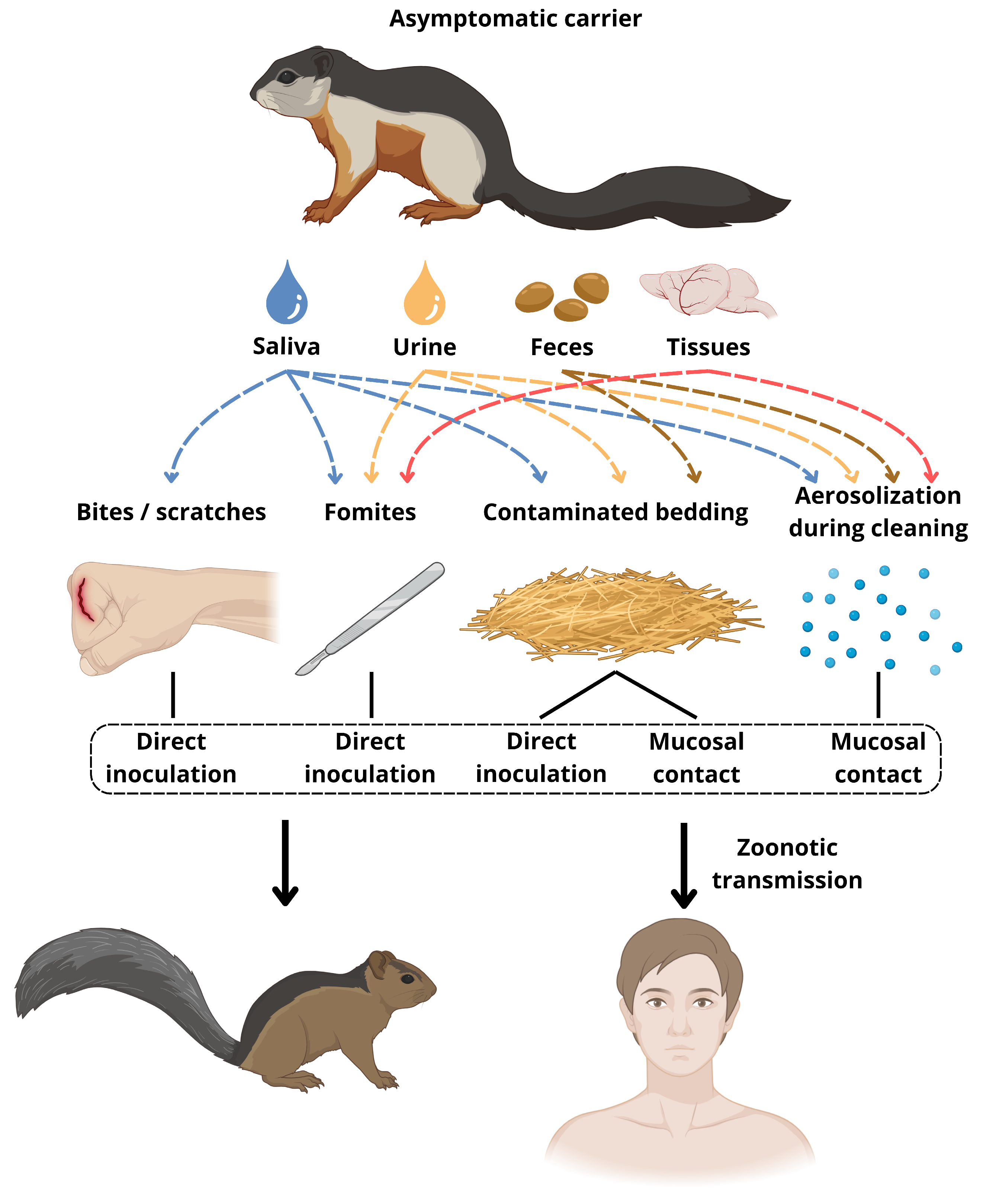
The precise routes of VSBV-1 transmission between squirrels and from squirrels to humans remain unclear. Hypothesized transmission routes include direct exposure through scratches or bites, or indirect exposure via contact with urine, feces, or soiled bedding material (
Figure 1) [
1,
6,
8,
9].
For BoDV-1, intranasal transmission is considered the most likely route between bicolored white-toothed shrews and horses and sheep [
15,
31]. For avian bornaviruses, contamination of wounds or skin defects, followed by viral spread along peripheral nerve fibers to the central nervous system, is considered a principal but unconfirmed route [
32,
33]. Whether VSBV-1 transmission more closely parallels the mammalian BoDV-1 model, resembles mechanisms hypothesized for avian bornaviruses, or involves distinct host- and species-specific transmission routes remains unclear and requires further investigation.
6.2. Human-to-Human Transmission
To date, no cases of human-to-human VSBV-1 transmission have been documented, suggesting that humans constitute a dead-end host for VSBV-1. RT-qPCR data from individuals who died from VSBV-1 support this hypothesis, as the virus was detected only in the central nervous system. Indirect support for a low transmission risk is provided by observations from occupational BoDV-1 exposure, in which an autopsy knife injury, needlestick injury, and spill accident with cerebrospinal fluid did not result in transmission of BoDV-1 [
34].
7. Diagnostics and Surveillance
7.1. Diagnostic Tools
For humans, molecular diagnostic and serological tests for the detection of the virus and antibodies against the pathogen have been developed and validated [
5,
35]. Serological assays for detecting antibodies against this virus in squirrels have also been developed [
8]. In squirrels, viral RNA can be detected by RT-qPCR, most commonly using duplicate oral swabs and fecal samples, analyzed by two different PCR systems to increase diagnostic sensitivity [
4,
8,
9]. However, these tests remain restricted to specialized reference laboratories and are not presently commercially available.
In deceased animals, a complete macroscopic and histopathological postmortem examination should be conducted. Definitive confirmation of infection should, at minimum, rely on RT-qPCR analysis of brain tissue. Immunohistochemistry and in situ hybridization can support postmortem diagnosis [
1,
4,
6,
8,
9,
27,
35].
VSBV-1 can be cultured by isolating the virus from infected tissues, primarily the brain and kidney, through co-cultivation with established permanent cell cultures [
7].
No distinction between BoDV-1 and VSBV-1 encephalitis can be made based on magnetic resonance imaging (MRI) results alone [
36]. Nevertheless, as MRI investigations are becoming increasingly available worldwide, diagnostic imaging techniques may help facilitate an early presumptive diagnosis of VSBV-1 encephalitis when VSBV-1–specific molecular and/or serological testing is unavailable.
7.2. Diagnostic Limitations
Despite the availability of validated tests, several limitations complicate reliable detection and interpretation in squirrels. Generally accepted limitations of antibody tests also apply to VSBV-1, including possible false-positive results due to cross-reactivity with other pathogens, and false-negative results during the early stage of infection, before antibody production [
37,
38]. Moreover, serology cannot distinguish active from past infections, and the presence of antibodies does not guarantee immunity, as the protective antibody level for VSBV-1 has not been established.
Viral RNA can be detected in oral swabs and fecal samples; however, shedding dynamics remain insufficiently characterized and may be intermittent.
Although the virus can be cultured, it is fastidious and requires co-cultivation of mammalian cell lines with primary squirrel cells. Moreover, attempts to culture the virus from saliva or feces can only be conducted in specialized high-containment laboratories (biosafety level-3).
Although surveillance in captive populations is important, surveillance in free-ranging populations is essential to identify the origin of the virus.
8. Veterinary Risk Management and Biosecurity
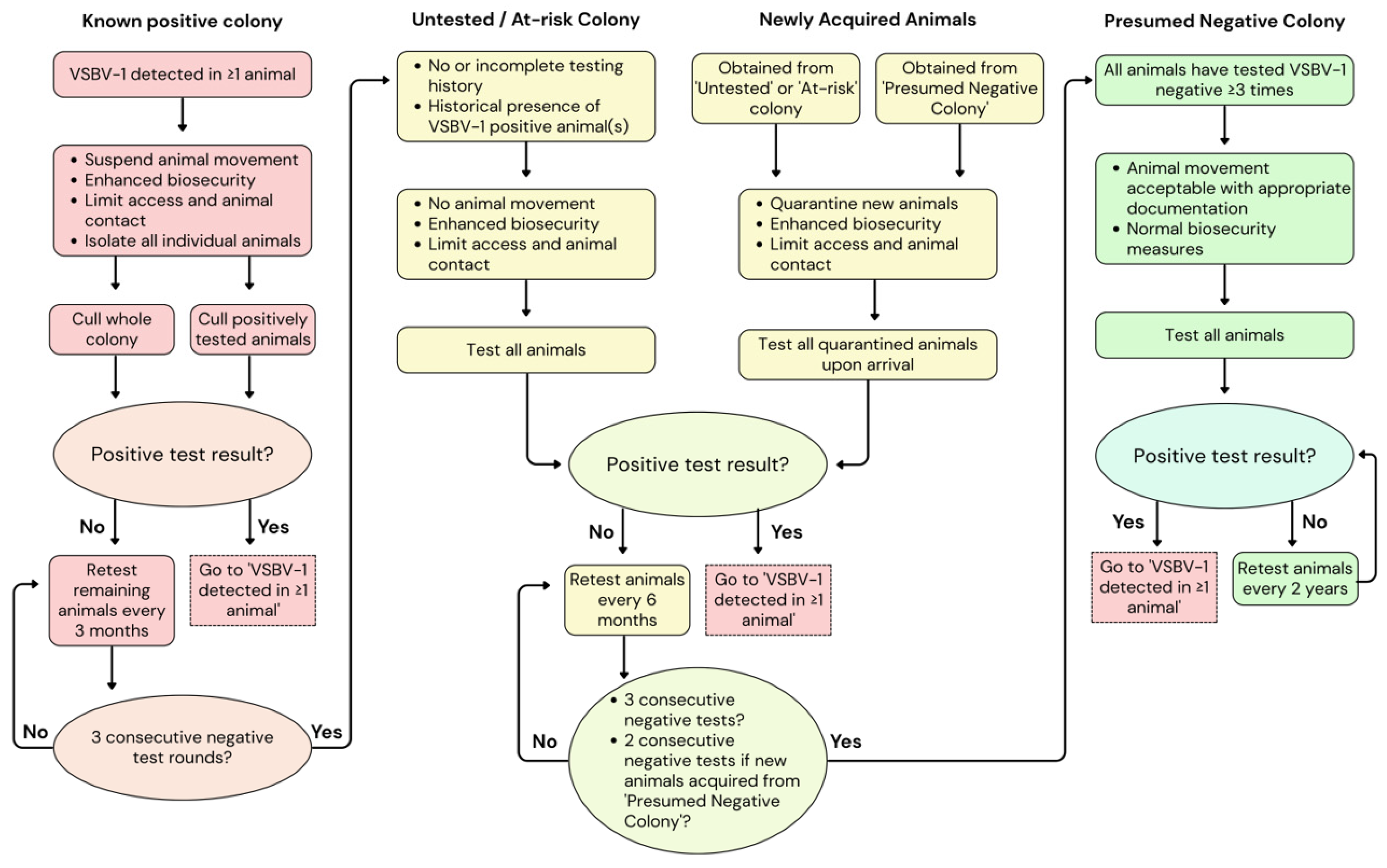
Incomplete understanding of transmission dynamics and asymptomatic infection in squirrels necessitates stringent preventive measures despite low reported prevalence rates. Moreover, given that the disease prevalence in both captive and wild squirrels remains unclear, all positive and untested individuals or holdings should be treated as zoonotic hazards until proven otherwise. In light of this, and our incomplete understanding of VSBV-1 shedding dynamics, a deliberately precaution-oriented surveillance framework is proposed based on the available literature (
Figure 2).
8.1. Management of Positive Holdings
Presently, no effective treatment exists for VSBV-1 in either squirrels or humans. Infected squirrels are suspected to be lifelong carriers [
6,
26].
Euthanasia or culling of VSBV-1–positive animals may be considered. In such cases, every euthanized or culled animal should be submitted for pathological and molecular testing. To account for intermittent viral shedding, animals testing negative in holdings with positive cases should be isolated and retested every three months until three consecutive negative results are obtained [
8,
26,
28].
Routine euthanasia or culling of VSBV-1–positive squirrels is, however, not explicitly recommended in all instances. The preservation of infected animals may contribute to essential research on viral shedding, transmission dynamics, and pathogenesis. When justified and conducted in accordance with ethical and legal standards, infected animals may be transferred or donated for research purposes.
8.2. Management of Untested or Negative Holdings
In holdings or colonies testing negative, repeat sampling after six months is recommended. After three consecutive negative tests, the colony can be regarded as presumed negative. Nevertheless, continued retesting every two years is advisable due to presumed intermittent shedding.
Imported squirrels should undergo quarantine. Quarantine has the dual benefit of protecting public health as well as reducing animal morbidity and mortality by preventing pathogen transmission and controlling infectious diseases. Reliance on a single test performed only upon arrival at the new facility is discouraged, as transport and acclimation stress could influence viral shedding dynamics.
8.3. Occupational Zoonotic Protection
Individuals working directly with potentially infectious squirrels should use appropriate personal protective equipment to reduce the risk of direct or indirect exposure. Handling carcasses or tissues during postmortem examination requires double gloves, mask use, eye protection, and the use of a biosafety cabinet [
33]. BoDV-1 may remain infectious for at least four days in the environment at ambient temperatures [
23]. Accordingly, environments housing VSBV-1–positive animals should be thoroughly disinfected, and care should be taken to avoid aerosol-generating activities such as pressure washing or dry sweeping.
In the event of potential exposure, immediate first-aid measures should include encouraging bleeding from puncture wounds, thorough washing with water, disinfection with alcohol-based agents, wound closure, and, in cases of mucosal contamination, cleansing of eyes, nose, or mouth with water or isotonic saline [
33]. Medical consultation should be sought promptly to assess further risk and determine whether additional monitoring or intervention is required.
9. Regulatory Gaps in Exotic Animal Trade
Complex networks in which exotic squirrels are bred and traded, combined with limited oversight of animal movements, significantly hinder epidemiological investigations of VSBV-1 [
4]. Unlike domesticated species, exotic squirrels are not subject to mandatory identification, registration, quarantine of imported animals, or structural health surveillance. Moreover, in many European countries, exotic squirrels can be legally kept as pets without oversight of population size or distribution. Routine screening coupled with centralized registration of traded squirrels could provide the first steps toward understanding the virus distribution in Europe. Moreover, establishing an international database for exotic pet trades would facilitate trace-back investigations and rapid identification of potentially infectious animals. Such a system would enhance control of VSBV-1 and could, if extended to other non-domesticated species, facilitate timely investigations of novel emerging pathogens in exotic pets.
10. Future Research Priorities
10.1. Wild Reservoir Identification
Identifying the natural reservoir of VSBV-1 is a critical research priority, both to prevent new introductions into captive squirrel populations and to guide risk mitigation for those working with these animals, as well as for the general public. Future studies to identify the source of VSBV-1 in wildlife should include free-ranging populations in Latin America and Southeast Asia [
24].
10.2. Transmission Pathways, Pathogenesis, and Countermeasure Development
Understanding viral shedding patterns and transmission routes for VSBV-1 is critical, as current diagnostic, surveillance, and biosecurity recommendations are based on presumed or potential routes of transmission. Animal models have proven valuable for studying bornavirus pathogenicity and evaluating treatment options [
39]. An important step was the establishment of a rhesus macaque (
Macaca mulatta) model as a surrogate for human bornavirus infections [
40]. In rats, the functions of VSBV-1 genes were investigated to understand the highly pathogenic potential of VSBV-1 [
41]. It has been suggested that the differences in inhibitory activity against the innate immune response may drive the difference in the virulence among mammalian bornaviruses.
Future studies should focus on elucidating the mechanisms underlying VSBV-1 transmission, as well as the precise pathophysiological mechanisms responsible for differences in disease susceptibility among species.
10.3. Vaccine Development
A prophylactic vaccine capable of conferring sterilizing immunity would be of high value to protect humans with regular close contact with exotic squirrels. Similarly, vaccination of exotic squirrels could help limit viral spread within captive populations. However, no efforts have yet been undertaken to develop a VSBV-1 vaccine. Experience with other orthobornaviruses suggests that achieving sterilizing immunity is challenging [
42,
43,
44].
11. Conclusions
While infection in captive exotic squirrels is typically asymptomatic, infection in humans is associated with fatal encephalitis. The absence of clinical signs in infected squirrels, diagnostic uncertainty due to intermittent shedding, and incomplete knowledge of transmission routes necessitate a precautionary approach. Structured surveillance, including free-ranging populations, strict biosecurity measures, quarantine for imported animals, and controlled animal trade, is essential to limit spread. Veterinarians occupy a central role in risk recognition, disease surveillance, and the implementation of preventive measures. VSBV-1 is a One Health concern that demands broader awareness, enhanced monitoring, and proactive management. Future research should prioritize the identification of natural reservoirs in Europe, Latin America, and Southeast Asia, clarification of shedding and transmission dynamics, and improvement of diagnostic and surveillance tools to enable evidence-based control strategies.
Author Contributions
Conceptualization, J.B. and R.A.N.; writing—original draft preparation, J.B. and R.A.N.; writing—review and editing, J.B., H.K., K.S. and R.A.N.; supervision, R.A.N. All authors have read and agreed to the published version of the manuscript.
Funding
This research received no external funding.
Institutional Review Board Statement
Not applicable.
Informed Consent Statement
Not applicable.
Data Availability Statement
No new data were created or analyzed in this study. Data sharing is not applicable to this article.
Conflicts of Interest
The authors declare no conflicts of interest.
Abbreviations
The following abbreviations are used in this manuscript:
| BoDV-1 | Borna disease virus 1 |
| MRI | Magnetic resonance imaging |
| RT-qPCR | Quantitative reverse-transcription polymerase chain reaction |
| VSBV-1 | Variegated squirrel bornavirus 1 |
References
- Hoffmann, B.; Tappe, D.; Höper, D.; Herden, C.; Boldt, A.; Mawrin, C.; Niederstraßer, O.; Müller, T.; Jenckel, M.; van der Grinten, E.; et al. A Variegated Squirrel Bornavirus Associated with Fatal Human Encephalitis. N. Engl. J. Med. 2015, 373, 154–162. [Google Scholar] [CrossRef]
- Tappe, D.; Schlottau, K.; Cadar, D.; Hoffmann, B.; Balke, L.; Bewig, B.; Hoffmann, D.; Eisermann, P.; Fickenscher, H.; Krumbholz, A.; et al. Occupation-Associated Fatal Limbic Encephalitis Caused by Variegated Squirrel Bornavirus 1, Germany, 2013. Emerg. Infect. Dis. 2018, 24, 978–987. [Google Scholar] [CrossRef] [PubMed]
- Tappe, D.; Frank, C.; Homeier-Bachmann, T.; Wilking, H.; Allendorf, V.; Schlottau, K.; Muñoz-Fontela, C.; Rottstegge, M.; Port, J.R.; Rissland, J.; et al. Analysis of exotic squirrel trade and detection of human infections with variegated squirrel bornavirus 1, Germany, 2005 to 2018. Eurosurveillance 2019, 24, 1800483. [Google Scholar] [CrossRef] [PubMed]
- Tappe, D.; Schmidt-Chanasit, J.; Rauch, J.; Allartz, P.; Herden, C. Immunopathology of Fatal Human Variegated Squirrel Bornavirus 1 Encephalitis, Germany, 2011–2013. Emerg. Infect. Dis. 2019, 25, 1058–1065. [Google Scholar] [CrossRef] [PubMed]
- Eisermann, P.; Rubbenstroth, D.; Cadar, D.; Thomé-Bolduan, C.; Eggert, P.; Schlaphof, A.; Leypoldt, F.; Stangel, M.; Fortwängler, T.; Hoffmann, F.; et al. Active Case Finding of Current Bornavirus Infections in Human Encephalitis Cases of Unknown Etiology, Germany, 2018–2020. Emerg. Infect. Dis. 2021, 27, 1371–1379. [Google Scholar] [CrossRef]
- Cadar, D.; Allendorf, V.; Schulze, V.; Ulrich, R.G.; Schlottau, K.; Ebinger, A.; Hoffmann, B.; Hoffmann, D.; Rubbenstroth, D.; Ismer, G.; et al. Introduction and spread of variegated squirrel bornavirus 1 (VSBV-1) between exotic squirrels and spill-over infections to humans in Germany. Emerg. Microbes Infect. 2021, 10, 602–611. [Google Scholar] [CrossRef]
- Schlottau, K.; Nobach, D.; Herden, C.; Finke, S.; Beer, M.; Hoffmann, D. First isolation, in-vivo and genomic characterization of zoonotic variegated squirrel Bornavirus 1 (VSBV-1) isolates. Emerg. Microbes Infect. 2020, 9, 2474–2484. [Google Scholar] [CrossRef]
- Schlottau, K.; Hoffmann, B.; Homeier-Bachmann, T.; Fast, C.; Ulrich, R.G.; Beer, M.; Hoffmann, D. Multiple detection of zoonotic variegated squirrel bornavirus 1 RNA in different squirrel species suggests a possible unknown origin for the virus. Arch. Virol. 2017, 162, 2747–2754. [Google Scholar] [CrossRef]
- Schlottau, K.; Jenckel, M.; van den Brand, J.; Fast, C.; Herden, C.; Höper, D.; Homeier-Bachmann, T.; Thielebein, J.; Mensing, N.; Diender, B.; et al. Variegated Squirrel Bornavirus 1 in Squirrels, Germany and the Netherlands. Emerg. Infect. Dis. 2017, 23, 477–481. [Google Scholar] [CrossRef]
- International Committee on Taxonomy of Viruses (ICTV). Available online: http://ictv.global/taxonomy (accessed on 4 February 2026).
- Ebinger, A.; Santos, P.D.; Pfaff, F.; Dürrwald, R.; Kolodziejek, J.; Schlottau, K.; Ruf, V.; Liesche-Starnecker, F.; Ensser, A.; Korn, K.; et al. Lethal Borna Disease Virus 1 Infections of Humans and Animals—In-Depth Molecular Epidemiology and Phylogeography. Nat. Commun. 2024, 15, 7908. [Google Scholar] [CrossRef]
- Puorger, M.E.; Hilbe, M.; Müller, J.P.; Kolodziejek, J.; Nowotny, N.; Zlinszky, K.; Ehrensperger, F. Distribution of Borna disease virus antigen and RNA in tissues of naturally infected bicolored white-toothed shrews, Crocidura leucodon, supporting their role as reservoir host species. Vet. Pathol. 2010, 47, 236–244. [Google Scholar] [CrossRef]
- Hilbe, M.; Herrsche, R.; Kolodziejek, J.; Nowotny, N.; Zlinszky, K.; Ehrensperger, F. Shrews as reservoir hosts of Borna Disease Virus. Emerg. Infect. Dis. 2006, 12, 675–677. [Google Scholar] [CrossRef]
- Dürrwald, R.; Kolodziejek, J.; Weissenböck, H.; Nowotny, N. The bicolored white-toothed shrew Crocidura leucodon (HERMANN 1780) is an indigenous host of mammalian Borna disease virus. PLoS ONE 2014, 9, e93659. [Google Scholar] [CrossRef] [PubMed]
- Nobach, D.; Bourg, M.; Herzog, S.; Lange-Herbst, H.; Encarnação, J.A.; Eickmann, M.; Herden, C. Shedding of Infectious Borna Disease Virus-1 in Living Bicolored White-Toothed Shrews. PLoS ONE 2015, 10, e0137018. [Google Scholar] [CrossRef] [PubMed]
- Bourgade, K.; Thouard, A.; Abravanel, F.; Hebral, A.L.; Del Bello, A.; Viguier, A.; Gonzalez-Dunia, D.; Kamar, N. Fatal encephalitis and Borna Disease Virus-1 seropositivity in two kidney-transplant patients living in the same nonendemic area. Transpl. Infect. Dis. 2021, 23, e13734. [Google Scholar] [CrossRef] [PubMed]
- Korn, K.; Coras, R.; Bobinger, T.; Herzog, S.M.; Lücking, H.; Stöhr, R.; Huttner, H.B.; Hartmann, A.; Ensser, A. Fatal Encephalitis Associated with Borna Disease Virus 1. N. Engl. J. Med. 2018, 379, 1375–1377. [Google Scholar] [CrossRef]
- Frank, C.; Wickel, J.; Brämer, D.; Matschke, J.; Ibe, R.; Gazivoda, C.; Günther, A.; Hartmann, C.; Rehn, K.; Cadar, D.; et al. Human Borna disease virus 1 (BoDV-1) encephalitis cases in the north and east of Germany. Emerg. Microbes Infect. 2022, 11, 6–13. [Google Scholar] [CrossRef]
- Bauswein, M.; Eidenschink, L.; Knoll, G.; Neumann, B.; Angstwurm, K.; Zoubaa, S.; Riemenschneider, M.J.; Lampl, B.M.J.; Pregler, M.; Niller, H.H.; et al. Human Infections with Borna Disease Virus 1 (BoDV-1) Primarily Lead to Severe Encephalitis: Further Evidence from the Seroepidemiological BoSOT Study in an Endemic Region in Southern Germany. Viruses 2023, 15, 188. [Google Scholar] [CrossRef]
- Pörtner, K.; Wilking, H.; Frank, C.; Stark, K.; Wunderlich, S.; Tappe, D. Clinical analysis of Bornavirus Encephalitis cases demonstrates a small time window for Etiological Diagnostics and treatment attempts, a large case series from Germany 1996–2022. Infection 2025, 53, 155–164. [Google Scholar] [CrossRef]
- Schlottau, K.; Forth, L.; Angstwurm, K.; Höper, D.; Zecher, D.; Liesche, F.; Hoffmann, B.; Kegel, V.; Seehofer, D.; Platen, S.; et al. Fatal encephalitic Borna Disease Virus 1 in solid-organ transplant recipients. N. Engl. J. Med. 2018, 379, 1377–1379. [Google Scholar] [CrossRef]
- Niller, H.H.; Angstwurm, K.; Rubbenstroth, D.; Schlottau, K.; Ebinger, A.; Giese, S.; Wunderlich, S.; Banas, B.; Forth, L.F.; Hoffmann, D.; et al. Zoonotic spillover infections with Borna Disease Virus 1 leading to fatal human encephalitis, 1999–2019: An epidemiological investigation. Lancet Infect. Dis. 2020, 20, 467–477. [Google Scholar] [CrossRef]
- Böhmer, M.M.; Haring, V.C.; Schmidt, B.; Saller, F.S.; Coyer, L.; Chitimia-Dobler, L.; Dobler, G.; Tappe, D.; Bonakdar, A.; Ebinger, A.; et al. One Health in Action: Investigation of the First Detected Local Cluster of Fatal Borna Disease Virus 1 (BoDV-1) Encephalitis, Germany 2022. J. Clin. Virol. 2024, 171, 105658. [Google Scholar] [CrossRef] [PubMed]
- Cadar, D.; Schmidt-Chanasit, J.; Tappe, D. Genomic and Micro-Evolutionary Features of Mammalian 2 orthobornavirus (Variegated Squirrel Bornavirus 1, VSBV-1). Microorganisms 2021, 9, 1141. [Google Scholar] [CrossRef]
- Schulze, V.; Lurz, P.W.W.; Ferrari, N.; Romeo, C.; Steele, M.A.; Marino, S.; Mazzamuto, M.V.; Calvignac-Spencer, S.; Schlottau, K.; Beer, M.; et al. Search for polyoma-, herpes-, and bornaviruses in squirrels of the family Sciuridae. Virol. J. 2020, 17, 42. [Google Scholar] [CrossRef]
- Allendorf, V.; Rubbenstroth, D.; Schlottau, K.; Hoffmann, D.; Frank, C.; Amler, S.; Beer, M.; Conraths, F.J.; Homeier-Bachmann, T. Assessing the occurrence of the novel zoonotic variegated squirrel bornavirus 1 in captive squirrels in Germany—A prevalence study. Zoonoses Public Health 2021, 68, 110–120. [Google Scholar] [CrossRef] [PubMed]
- Petzold, J.; van den Brand, J.M.A.; Nobach, D.; Hoffmann, B.; Hoffmann, D.; Fast, C.; Reusken, C.B.E.M.; van Run, P.R.W.A.; Schlottau, K.; Beer, M.; et al. Distribution of zoonotic variegated squirrel bornavirus 1 in naturally infected variegated and Prevost’s squirrels. Sci. Rep. 2019, 9, 11402. [Google Scholar] [CrossRef] [PubMed]
- Rubbenstroth, D. Avian Bornavirus Research—A Comprehensive Review. Viruses 2022, 14, 1513. [Google Scholar] [CrossRef]
- Paal, M.; Habler, K.; Ewert, A.; Vogeser, M.; Grosse, L.; Lieftüchter, V.; Tauber, S.C.; Schiefer, J.; Allartz, P.; Tappe, D.; et al. First Therapeutic Drug Monitoring of Experimental Favipiravir in Borna Disease Virus 1 (BoDV-1) Encephalitis Patients Reveals Significant Gaps in Antiviral Treatment: A Pilot Investigation. Eur. J. Med. Res. 2025, 30, 928. [Google Scholar] [CrossRef]
- Grosse, L.; Lieftüchter, V.; Vollmuth, Y.; Hoffmann, F.; Olivieri, M.; Reiter, K.; Tacke, M.; Heinen, F.; Borggraefe, I.; Osterman, A.; et al. First detected geographical cluster of BoDV-1 encephalitis from same small village in two children: Therapeutic considerations and epidemiological implications. Infection 2023, 51, 1383–1398. [Google Scholar] [CrossRef]
- Kupke, A.; Becker, S.; Wewetzer, K.; Ahlemeyer, B.; Eickmann, M.; Herden, C. Intranasal Borna Disease Virus (BoDV-1) Infection: Insights into Initial Steps and Potential Contagiosity. Int. J. Mol. Sci. 2019, 20, 1318. [Google Scholar] [CrossRef]
- Heckmann, J.; Enderlein, D.; Piepenbring, A.K.; Herzog, S.; Heffels-Redmann, U.; Malberg, S.; Herden, C.; Lierz, M. Investigation of Different Infection Routes of Parrot Bornavirus in Cockatiels. Avian Dis. 2017, 61, 90–95. [Google Scholar] [CrossRef] [PubMed]
- Leal De Araujo, J.; Rech, R.R.; Heatley, J.J.; Guo, J.; Giaretta, P.R.; Tizard, I.; Rodrigues-Hoffmann, A. From Nerves to Brain to Gastrointestinal Tract: A Time-Based Study of Parrot Bornavirus 2 (PaBV-2) Pathogenesis in Cockatiels (Nymphicus hollandicus). PLoS ONE 2017, 12, e0187797. [Google Scholar] [CrossRef]
- Reinmiedl, J.; Schulz, H.; Ruf, V.C.; Hernandez Petzsche, M.R.; Rissland, J.; Tappe, D. Healthcare-Associated Exposure to Borna Disease Virus 1 (BoDV-1). J. Occup. Med. Toxicol. 2022, 17, 13. [Google Scholar] [CrossRef]
- Schlegel, M.; Allartz, P.; Wenzel, A.; Faupel, T.; Loester, K.; Tappe, D. Highly specific serological diagnosis of Borna disease virus 1 (BoDV-1) and variegated squirrel bornavirus 1 (VSBV-1) encephalitis by novel antibody isotype assay with multiple viral antigens. J. Clin. Virol. 2025, 178, 105803. [Google Scholar] [CrossRef] [PubMed]
- Huhndorf, M.; Juhasz, J.; Wattjes, M.P.; Schilling, A.; Schob, S.; Kaden, I.; Klaß, G.; Tappe, D. Magnetic resonance imaging of human variegated squirrel bornavirus 1 (VSBV-1) encephalitis reveals diagnostic pattern indistinguishable from Borna disease virus 1 (BoDV-1) encephalitis but typical for bornaviruses. Emerg. Microbes Infect. 2023, 12, 2179348. [Google Scholar] [CrossRef] [PubMed]
- Liu, G.; Rusling, J.F. COVID-19 Antibody Tests and Their Limitations. ACS Sens. 2021, 6, 593–612. [Google Scholar] [CrossRef]
- Cassedy, A.; Parle-McDermott, A.; O’Kennedy, R. Virus Detection: A Review of the Current and Emerging Molecular and Immunological Methods. Front. Mol. Biosci. 2021, 8, 637559. [Google Scholar] [CrossRef]
- Widerspick, L.; Steffen, J.F.; Tappe, D.; Muñoz-Fontela, C. Animal Model Alternatives in Filovirus and Bornavirus Research. Viruses 2023, 15, 158. [Google Scholar] [CrossRef]
- Schlottau, K.; Feldmann, F.; Hanley, P.W.; Lovaglio, J.; Tang-Huau, T.L.; Meade-White, K.; Callison, J.; Williamson, B.N.; Rosenke, R.; Long, D.; et al. Development of a nonhuman primate model for mammalian bornavirus infection. PNAS Nexus 2022, 1, pgac073. [Google Scholar] [CrossRef]
- Makino, A.; Tanaka, C.; Fujino, K.; Tomonaga, K. Antagonistic activity against innate immunity determines virulence in mammalian bornaviruses. npj Viruses 2025, 3, 82. [Google Scholar] [CrossRef]
- Pörtner, K.; Frank, C.; Wilking, H.; Stark, K.; Herden, C.; Beer, M.; Rubbenstroth, D.; Tappe, D. Is Vaccination a Feasible Public Health Strategy against Fatal Borna Disease Virus 1 (BoDV-1) Encephalitis? An Epidemiological Perspective. PLoS Pathog. 2025, 21, e1013571. [Google Scholar] [CrossRef] [PubMed]
- Hameed, S.S.; Guo, J.; Tizard, I.; Shivaprasad, H.L.; Payne, S. Studies on Immunity and Immunopathogenesis of Parrot Bornaviral Disease in Cockatiels. Virology 2018, 515, 81–91. [Google Scholar] [CrossRef] [PubMed]
- Dürrwald, R.; Kolodziejek, J.; Oh, D.-Y.; Herzog, S.; Liebermann, H.; Osterrieder, N.; Nowotny, N. Vaccination against Borna Disease: Overview, Vaccine Virus Characterization and Investigation of Live and Inactivated Vaccines. Viruses 2022, 14, 2706. [Google Scholar] [CrossRef] [PubMed]
| Disclaimer/Publisher’s Note: The statements, opinions and data contained in all publications are solely those of the individual author(s) and contributor(s) and not of MDPI and/or the editor(s). MDPI and/or the editor(s) disclaim responsibility for any injury to people or property resulting from any ideas, methods, instructions or products referred to in the content. |