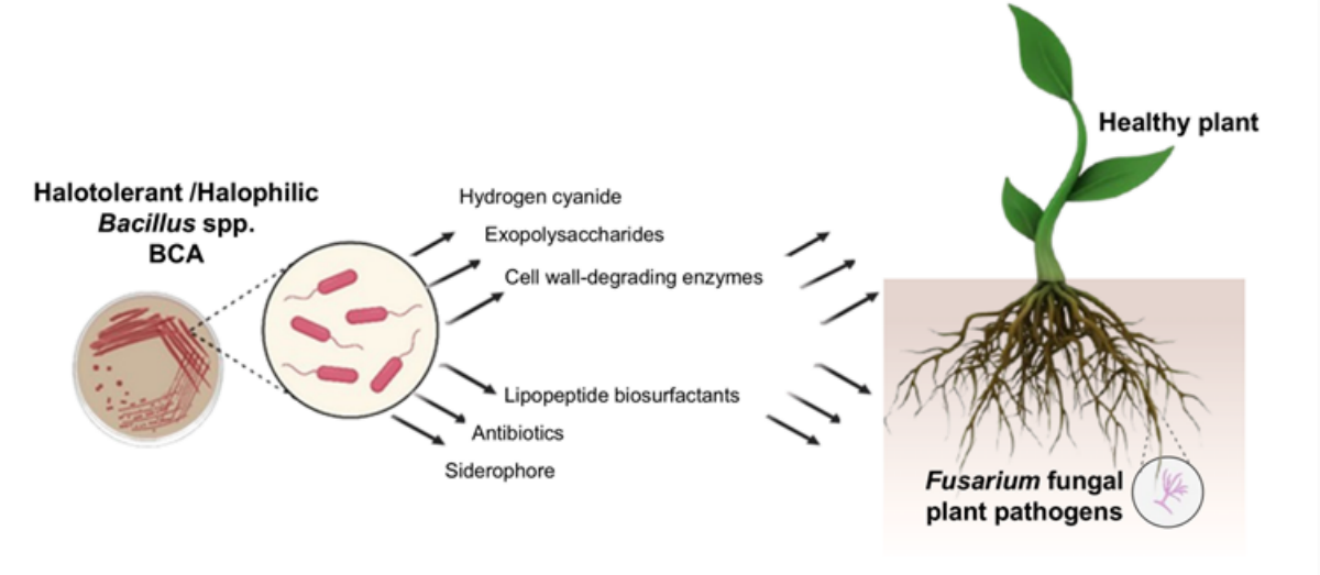

Mechanisms Underpinning the Biocontrol Potential of Halophilic and Halotolerant Bacillus Species Against Fusarium and Other Fungal Phytopathogens: An Eco-Friendly Alternative for Sustainable Agriculture



Abstract
1. Introduction
2. Mechanisms Involved by Halophilic/Halotolerant Bacillus spp. in the Biocontrol of Fusarium and Other Fungal Plant Pathogens

| Antifungal Metabolite(s)/Traits | Bacterial Strain | Saline Habitat/Origin | Target Fungal Pathogens | Disease/Crop | References |
|---|---|---|---|---|---|
| Siderophores | Bacillus subtilis | Dead Sea, Jordan | Fusarium culmorum | Crown rot/durum wheat | [43] |
| Antibiotics | B. subtilis D6A & Dar | Salt deserts, Iran | F. oxysporum, Aspergillus flavus, Botrytis cinerea | Postharvest and soilborne diseases | [44] |
| Protease, cellulase | Bacillus spp. | Sabkha and Chott, NW Algeria | F. oxysporum, F. verticillioides, Phytophthora capsici, B. cinerea | Vegetable crops | [45] |
| Siderophores, HCN, antibiotics, protease | B. halotolerans BFOA1–4 | Coastal saline depressions, Mediterranean Sea | F. oxysporum f. sp. albedinis | Bayoud disease/date palm | [46] |
| Siderophores, VOCs (acetoin, 2,3-butanediol), EPS | B. velezensis XT1 | Saline habitat, Spain | Alternaria alternata and Fusarium spp. | Tomato, cucumber | [47] |
| Chitinase | B. licheniformis J24 | Salt lake, Tunisia | Fusarium spp., Sclerotinia spp. | Corn | [48] |
| Protease, cellulase | B. siamensis S1-20 | Aral Sea, Uzbekistan | Fusarium spp., Verticillium dahliae | Potato, cotton | [49] |
| Siderophores, hydrolytic enzymes | Bacillus spp. | Salt pans, Formentera, Spain | Macrophomina phaseolina | Charcoal rot | [50] |
| VOCs (acetoin, acetic acid, 2,3-butanediol, sulfur compounds) | B. atrophaeus L193; B. velezensis XT1 | Saline and hypersaline environments | F. oxysporum, F. solani | Vine, potato, peach | [51] |
| Cyclic lipopeptides (surfactin, fengycin) | B. halotolerans KKD1 | Qinghai–Tibet Plateau | F. graminearum | Wheat, barley, maize | [52] |
| Siderophores; amylase, lipase, protease, glucanases | Bacillus spp. | Salt marshes, Goa, India | Fusarium spp., Rhizoctonia solani | Chili | [31] |
| Cyclic lipopeptides (mycosubtilin, surfactin, bacillaene, bacillibactin) | B. subtilis subsp. spizizenii MC6B-22 | Marine biofilm | Fusarium spp., Colletotrichum spp. | Not specified | [53] |
| Hydrolytic enzymes | Bacillus sp. QSLA1 | Qarun Lake, Egypt | F. oxysporum f. sp. lycopersici | Tomato | [54] |
| Glucanase | Marine B. subtilis BS90 | Gulf of Khambhat, India | F. oxysporum f. sp. ciceris | Chickpea | [32] |
| Lipase, protease, cellulase | B. zhangzhouensis | Hypersaline Aral Sea | Multiple Fusarium spp., Alternaria, Aspergillus spp, | Multicrop pathogens | [55] |
| EPS | B. tequilensis TSIS01 | Sambhar Lake, India | Alternaria solani, Fusarium spp., Xanthomonas citri | Tomato blight | [56] |
| Cyclic lipopeptide (surfactin) | B. amyloliquefaciens | Ribandar salt pans, Goa, India | F. solani | Soilborne disease | [57] |
| VOCs (DAPG, pyrrolnitrin), HCN, chitinase | Bacillus spp. | Lake Bogoria, Kenya | F. solani | Common bean | [35] |
2.1. Siderophore
2.2. Antibiotics
2.3. Lipopeptide Biosurfactants
2.4. Volatile Organic Compounds (VOCS)
2.5. Hydrogen Cyanide (HCN)
2.6. Exopolysaccharides (EPS)
2.7. Cell Wall-Degrading Enzymes (CWDEs)/Hydrolytic Enzymes
2.7.1. Chitinases
2.7.2. Cellulases
2.7.3. Proteases
2.7.4. β-Glucanases
2.7.5. Lipases
3. Synergistic Microbial Mechanisms Driving Biocontrol Efficacy in Saline Soils
| Mechanism | How It Works/Interaction | Effect | Reference |
|---|---|---|---|
| Siderophores (iron scavenging) | Chelate Fe3+, starving pathogens and improving plant iron uptake; directly suppress fungi | Strong pathogen suppression; improved plant iron nutrition | [287,288] |
| VOCs can induce siderophore production, tightening iron competition and amplifying inhibition | Reinforced pathogen suppression | [289] | |
| CWDEs and antibiotics | CWDEs combined with antiiotics and siderophores | Multi-layered suppression of pathogens (Botrytis, Fusarium) | [290] |
| VOCs from neighboring microbes up-regulate genes for antibiotics and siderophore systems | Amplified inhibitory effects | [291] | |
| VOCs | Act at a distance to inhibit pathogens, modulate microbial communities, and trigger plant defenses (ISR/SAR) | Inhibition of pathogens; activation of plant systemic resistance | [292,293] |
| VOC mixtures often show synergistic antibiosis, more inhibitory than single compounds | Enhanced pathogen suppression | ||
| VOCs can modulate partners (e.g., enhancing siderophore production, P & K solubilization, IAA synthesis) | Promotes plant root growth and nutrient acquisition |
4. Harnessing Halophilic/Halotolerant Bacillus for Sustainable Agriculture
5. Functional Diversity of Halophilic/Halotolerant Non-Bacillus Genera in Antifungal Biocontrol
| Antifungal Metabolites | Biocontrol Bacteria | Geographical Origin | Target Fungal Pathogens | Disease/Crop | Reference |
|---|---|---|---|---|---|
| EPS | Halomonas sp. Exo1 | Mangrove (Avicennia marina), Indian Sundarbans | Fusarium oxysporum | Rice | [302] |
| Siderophores; hydrolytic enzymes (β-1,3-glucanase, chitinase); VOCs (β-phenylethanol, dodecanal) | Stenotrophomonas rhizophila | CIBNOR Phytopathology Laboratory, Mexico | Colletotrichum gloeosporioides | Mango anthracnose | [147] |
| VOCs (2-furanmethanol, phenylacetonitrile, 2,4-dimethylpentanol) | Paenibacillus spp. | Colombian reefs | C. gloeosporioides | Anthracnose/Yam | [148] |
| VOCs (acetoin, acetic acid, 2,3-butanediol, isopentanol dimethyl disulfide, isopentyl and isobutanoate) | Peribacillus sp. | Saline and hypersaline environments | Multiple fungal spp. | Vine, potato, peach | [51] |
| VOCs (2,3-butanediol, fenretinide) | Brevibacterium halotolerans JZ7 | Not reported | F. oxysporum | Chinese Jujube | [149] |
| Hydrolytic enzymes | Paenibacillus sp. PNM200 | Colombian reefs | F. oxysporum | Tomato | [200] |
| VOCs (2,4-di-tert-butylphenol); hydrogen cyanide (HCN) | Serratia marcescens BKACT | Marine environment | F. foetens | Wheat | [146] |
| Hydrolytic enzymes | Halophilic bacteria (unidentified) | Great Sabkha and Chott, Northwestern Algeria | Fusarium spp.; Penicillium spp. | Not indicated | [307] |
| Hydrolytic enzymes | Halotolerant bacterium QSLA1 | Qarun Lake, Egypt | F. oxysporum f. sp. lycopersici | Tomato | [54] |
| β-1,3–1,4-glucanase | Halomonas meridiana ES021 | Saline ponds, Qarun Lake, Egypt | Penicillium sp.; Aspergillus niger | Not reported | [254] |
| CLPs (locillomycin A–C); bacillibactin | Virgibacillus massiliensis | Sebkha El-Meleh, Tunisia | Fusarium sp. | Not reported | [131] |
| HCN; hydrolytic enzymes (cellulase, amylase, lipase, proteases, urease, chitinase); VOCs (polyphenols) | Serratia spp. (SB6, CH11); Halomonas sp. (SB39) | Saline soils (Sabkha), Eastern Algeria | Botrytis cinerea; Aspergillus niger | Apple | [160] |
6. Halophilic/Halotolerant Bacillus-Based BCAs Versus Conventional Fungicides
6.1. Efficacy and Stability
6.2. Environmental Impact and Non-Target Effects
6.3. Resistance Development
6.4. Long-Term Sustainability
7. In Vitro Antifungal Activity Versus in Planta and Field Performance of Halophilic/Halotolerant Bacillus Strains Under Saline Conditions
8. Discussion
9. Challenges and Future Prospects
10. Conclusions
Author Contributions
Funding
Institutional Review Board Statement
Informed Consent Statement
Data Availability Statement
Conflicts of Interest
Abbreviations
| 2,4-DBTP | 2,4-dibromothiophenol |
| ACC deaminase | 1-aminocyclopropane-1-carboxylate deaminase |
| AMF | Arbuscular mycorrhizal fungi |
| ARGs | Antibiotic resistance genes |
| BCAs | Biological control agents |
| CRISPR | Clustered regularly interspaced short palindromic repeats |
| CWDEs | Cell wall-degrading enzymes |
| EC | Enzyme Commission |
| EPS | Exopolysaccharides |
| GC–MS | Gas chromatography–mass spectrometry |
| HCN | Hydrogen cyanide |
| IAA | Indole-3-acetic acid |
| IC50 | Half maximal inhibitory concentration |
| IPM | Integrated pest management |
| ISR | Induced systemic resistance |
| kDa | Kilodalton |
| LC–MS | Liquid chromatography–mass spectrometry |
| LPs | Lipopeptides |
| MIC | Minimum inhibitory concentration |
| MVOCs | Microbial volatile organic compounds |
| PGPB | Plant growth-promoting bacteria |
| PGPR | Plant growth-promoting rhizobacteria |
| ROS | Reactive oxygen species |
| SPME | Solid-phase microextraction |
| VOCs | Volatile organic compounds |
References
- World Bank Group. Climate-Smart Agriculture. Available online: https://www.worldbank.org/en/topic/climate-smart-agriculture (accessed on 20 January 2024).
- Liu, F.; Xi, M.; Liu, T.; Wu, X.; Ju, L.; Wang, D. Bridging biotic and abiotic stress—The central role of transcription factors in plant convergent adaptation. New Crops 2023, 1, 100005. [Google Scholar] [CrossRef] [Scilit]
- Gowtham, H.G.; Singh, S.B.; Shilpa, N.; Aiyaz, M.; Nataraj, K.; Udayashankar, A.C.; Amruthesh, K.N.; Murali, M.; Poczai, P.; Gafur, A. Insight into recent progress and perspectives in improvement of antioxidant machinery upon PGPR augmentation in plants under drought stress: A Review. Antioxidants 2022, 11, 1763. [Google Scholar] [CrossRef] [Scilit] [PubMed]
- Naz, R.; Bano, A.; Nosheen, A.; Yasmin, H.; Keyani, R.; Shah, S.T.A.; Anwar, Z.; Roberts, T.H. Induction of defense-related enzymes and enhanced disease resistance in maize against Fusarium verticillioides by seed treatment with Jacaranda mimosifolia formulations. Sci. Rep. 2021, 11, 59. [Google Scholar] [CrossRef] [Scilit] [PubMed]
- Wang, B.; Abubakar, Y.S.; Wang, Z. Special Issue “Genomics of fungal plant pathogens”. J. Fungi 2023, 9, 713. [Google Scholar] [CrossRef] [Scilit] [PubMed]
- Ristaino, J.B.; Anderson, P.K.; Bebber, D.P.; Brauman, K.A.; Cunniffe, N.J.; Fedoroff, N.V.; Finegold, C.; Garrett, K.A.; Gilligan, C.A.; Jones, C.M.; et al. The persistent threat of emerging plant disease pandemics to global food security. Proc. Natl. Acad. Sci. USA 2021, 118, e2022239118. [Google Scholar] [CrossRef] [Scilit] [PubMed]
- Alblooshi, A.A.; Purayil, G.P.; Saeed, E.E.; Ramadan, G.A.; Tariq, S.; Altaee, A.S.; El-Tarabily, K.A.; Abuqamar, S.F. Bio-control potential of endophytic actinobacteria against Fusarium solani, the causal agent of sudden decline syndrome on date palm in the UAE. J. Fungi 2021, 8, 8. [Google Scholar] [CrossRef] [Scilit] [PubMed]
- Ekwomadu, T.I.; Mwanza, M. Fusarium fungi pathogens, identification, adverse effects, disease management, and global food security: A review of the latest research. Agriculture 2023, 13, 1810. [Google Scholar] [CrossRef] [Scilit]
- Ajmal, M.; Hussain, A.; Ali, A.; Chen, H.; Lin, H. Strategies for controlling the sporulation in Fusarium spp. J. Fungi 2022, 9, 10. [Google Scholar] [CrossRef] [Scilit] [PubMed]
- Ezrari, S.; Legrifi, I.; Taoussi, M.; Khadiri, M.; Belabess, Z.; Lahlali, R. Plant–pathogen interactions and global food security. In Plant Pathogen Interaction; Springer: Cham, Switzerland, 2024; pp. 11–52. [Google Scholar]
- Barker, R.; Phillipson, B. Biosecurity procedures for working with fungal plant pathogens. In Fungal Plant Pathogens; CABI: Wallingford, UK, 2023; pp. 229–251. [Google Scholar]
- Rafanomezantsoa, P.; El-Hasan, A.; Voegele, R.T. Potential of Bacillus halotolerans in mitigating biotic and abiotic stresses: A comprehensive review. Stresses 2025, 5, 24. [Google Scholar] [CrossRef] [Scilit]
- Patel, M.; Vurukonda, S.S.K.P.; Patel, A. Multi-trait halotolerant plant growth-promoting bacteria mitigate induced salt stress and enhance growth of Amaranthus viridis. J. Soil Sci. Plant Nutr. 2023, 23, 1860–1883. [Google Scholar] [CrossRef] [Scilit]
- Çam, S.; Küçük, Ç.; Almaca, A. Bacillus strains exhibit various plant growth-promoting traits and their biofilm-forming capability correlates with salt stress alleviation in maize seedlings. J. Biotechnol. 2023, 369, 35–42. [Google Scholar] [CrossRef] [Scilit]
- Manathunga, K.K.; Gunasekara, N.W.; Meegahakumbura, M.K.; Ratnaweera, P.B.; Faraj, T.K.; Wanasinghe, D.N. Exploring endophytic fungi as natural antagonists against fungal pathogens of food crops. J. Fungi 2024, 10, 606. [Google Scholar] [CrossRef] [Scilit] [PubMed]
- Bosco, S.; Prencipe, S.; Mezzalama, M.; Spadaro, D. Screening and characterization of bacterial and fungal endophytes as potential biocontrol agents for rice seed dressing against Fusarium fujikuroi. Biol. Control 2024, 196, 105580. [Google Scholar] [CrossRef] [Scilit]
- McLaughlin, M.S.; Roy, M.; Abbasi, P.A.; Carisse, O.; Yurgel, S.N.; Ali, S. Why do we need alternative methods for fungal disease management in plants? Plants 2023, 12, 3822. [Google Scholar] [CrossRef] [Scilit] [PubMed]
- Mansour, M.; Kara Ali, M.; Berkani, M.; Flahaut, S.; Chaoua, S.; Kamyab, H.; Vasseghian, Y.; Kacem Chaouche, N. Optimization of physicochemical parameters for lipopeptides surfactin production by Bacillus halotolerans under oat straw medium using Box–Behnken design and artificial neural networks. Sustain. Chem. Pharm. 2024, 37, 101419. [Google Scholar] [CrossRef] [Scilit]
- Ayaz, M.; Ali, Q.; Zhao, W.; Chi, Y.-K.; Ali, F.; Rashid, K.A.; Cao, S.; He, Y.; Bukero, A.A.; Huang, W.-K.; et al. Exploring plant growth-promoting traits and biocontrol potential of newly isolated Bacillus subtilis BS-2301 strain in suppressing Sclerotinia sclerotiorum through various mechanisms. Front. Plant Sci. 2024, 15, 1444328. [Google Scholar] [CrossRef] [Scilit]
- Heimpel, G.E.; Mills, N.J. Biological Control: Ecology and Applications; Cambridge University Press: Cambridge, UK, 2017; pp. 1–380. [Google Scholar] [CrossRef] [Scilit]
- Collinge, D.B.; Jensen, D.F.; Rabiey, M.; Sarrocco, S.; Shaw, M.W.; Shaw, R.H. Biological control of plant diseases—What has been achieved and what is the direction? Plant Pathol. 2022, 71, 1024–1047. [Google Scholar] [CrossRef] [Scilit]
- Paul, V.G.; Mormile, M.R. A case for the protection of saline and hypersaline environments: A microbiological perspective. FEMS Microbiol. Ecol. 2017, 93, fix091. [Google Scholar] [CrossRef] [Scilit] [PubMed]
- Bouri, M.; Mehnaz, S.; Şahin, F. Extreme environments as potential sources for PGPR. In Secondary Metabolites and Volatiles of PGPR in Plant-Growth Promotion; Springer: Cham, Switzerland, 2022; pp. 249–276. [Google Scholar] [CrossRef] [Scilit]
- Green, L.H.; Goldman, E. Practical Handbook of Microbiology; CRC Press: Boca Raton, FL, USA, 2021. [Google Scholar] [CrossRef] [Scilit]
- Mahapatra, S.; Chakraborty, S.; Samanta, M.; Das, S.; Islam, T. Current understanding and future directions of biocontrol of plant diseases by Bacillus spp., with special reference to induced systemic resistance. In Bacilli in Agrobiotechnology: Plant Stress Tolerance, Bioremediation, and Bioprospecting; Springer: Cham, Switzerland, 2022; pp. 127–150. [Google Scholar] [CrossRef] [Scilit]
- Shafi, J.; Tian, H.; Ji, M. Bacillus species as versatile weapons for plant pathogens: A review. Biotechnol. Biotechnol. Equip. 2017, 31, 446–459. [Google Scholar] [CrossRef] [Scilit]
- Rafanomezantsoa, P.; Gharbi, S.; Karkachi, N.; Kihal, M. Antifungal activity of Bacillus spp. against Fusarium oxysporum f. sp. lycopersici and Ascochyta sp. J. Plant Prot. Res. 2022, 62, 247–257. [Google Scholar] [CrossRef] [Scilit]
- Surovy, M.Z.; Gupta, D.R.; Mahmud, N.U.; Dame, Z.T.; Roy, P.K.; Islam, M.T. Genomics and Post-Genomics Approaches for Elucidating Molecular Mechanisms of Plant Growth-Promoting Bacilli. In Bacilli and Agrobiotechnology: Phytostimulation and Biocontrol; Springer: Cham, Switzerland, 2019; Volume 2, pp. 161–200. [Google Scholar] [CrossRef] [Scilit]
- Rayanoothala, P.; Divya, M.; Mahapatra, S.; Das, S. Microbial biofilm: Formation, quorum sensing, and its applications in plant disease management. In Emerging Trends in Plant Pathology; Springer: Cham, Switzerland, 2021; pp. 385–397. [Google Scholar] [CrossRef] [Scilit]
- Islam, M.T.; Kim, K.-H.; Choi, J. Wheat blast in Bangladesh: The current situation and future impacts. Plant Pathol. J. 2019, 35, 1–10. [Google Scholar] [CrossRef] [Scilit] [PubMed]
- Pawaskar, M.; Krishnan, K.P.; Kerkar, S. Salt-pan bacteria as potential plant growth promoters and their antagonistic activity to fungal pathogens of Capsicum annuum L. Curr. Sci. 2022, 123, 1129–1135. [Google Scholar] [CrossRef] [Scilit]
- Rathod, K.; Rana, S.; Dhandhukia, P.; Thakker, J.N. Marine Bacillus as a potent biocontrol agent against Fusarium oxysporum f. sp. ciceris. Plant Stress 2023, 10, 100289. [Google Scholar] [CrossRef] [Scilit]
- Yahaya, S.M.; Kamalu, A.B.; Ali, M.U.; Lawan, M.; Ajingi, Y.S.; Haruna, M.; Hayatu, L.W.; Abba, H.; Safiyanu, I.; Abdullahi, J. A study of pathogenic fungi causing post-harvest losses of pineapple sold at Wudil and Yan Lemo markets of Kano State. J. Exp. Agric. Int. 2019, 38, 1–6. [Google Scholar] [CrossRef] [Scilit]
- Iqbal, O.; Li, C.; Ahmed Rajput, N.; Mubeen Lodhi, A. Management of phytopathogens by antagonistic Bacillus spp. in tomato crop. In Tomato Cultivation and Consumption—Innovation and Sustainability; IntechOpen: London, UK, 2024. [Google Scholar] [CrossRef] [Scilit]
- Wekesa, T.B.; Onguso, J.M.; Barminga, D.; Kavesu, N. Harnessing extremophile Bacillus spp. for biocontrol of Fusarium solani in Phaseolus vulgaris L. agroecosystems. Bacteria 2025, 4, 39. [Google Scholar] [CrossRef] [Scilit]
- Karačić, V.; Miljaković, D.; Marinković, J.; Ignjatov, M.; Milošević, D.; Tamindžić, G.; Ivanović, M. Bacillus species: Excellent biocontrol agents against tomato diseases. Microorganisms 2024, 12, 457. [Google Scholar] [CrossRef] [Scilit] [PubMed]
- Ramírez, V.; Martínez, J.; Bustillos-Cristales, M.d.R.; Catañeda-Antonio, D.; Munive, J.; Baez, A. Bacillus cereus MH778713 elicits tomato plant protection against Fusarium oxysporum. J. Appl. Microbiol. 2022, 132, 470–482. [Google Scholar] [CrossRef] [Scilit] [PubMed]
- Samaras, A.; Roumeliotis, E.; Ntasiou, P.; Karaoglanidis, G. Bacillus subtilis MBI600 promotes growth of tomato plants and induces systemic resistance contributing to the control of soilborne pathogens. Plants 2021, 10, 1113. [Google Scholar] [CrossRef] [Scilit] [PubMed]
- Kim, J.-A.; Song, J.-S.; Kim, P.I.; Kim, D.-H.; Kim, Y. Bacillus velezensis TSA32-1 as a promising agent for biocontrol of plant pathogenic fungi. J. Fungi 2022, 8, 1053. [Google Scholar] [CrossRef] [Scilit] [PubMed]
- Ramírez-Martínez, J.; Pacheco-Aguilar, J.R. Production of volatile compounds and lipopeptides as antagonistic mechanisms of two Bacillus strains towards phytopathogenic fungi. Rev. Simul. Lab. 2022, 9, 29–35. [Google Scholar] [CrossRef] [Scilit]
- Santos, A.M.; Soares, A.; Luz, J.; Cordeiro, C.; Sousa Silva, M.; Dias, T.; Melo, J.; Cruz, C.; Carvalho, L. Microbial interactions as a sustainable tool for enhancing PGPR antagonism against phytopathogenic fungi. Sustainability 2024, 16, 2006. [Google Scholar] [CrossRef] [Scilit]
- Carmona-Hernandez, S.; Reyes-Pérez, J.J.; Chiquito-Contreras, R.G.; Rincon-Enriquez, G.; Cerdan-Cabrera, C.R.; Hernandez-Montiel, L.G. Biocontrol of postharvest fruit fungal diseases by bacterial antagonists: A review. Agronomy 2019, 9, 121. [Google Scholar] [CrossRef] [Scilit]
- Albdaiwi, R.N.; Khyami-Horani, H.; Ayad, J.Y.; Alananbeh, K.M.; Al-Sayaydeh, R. Isolation and characterization of halotolerant plant growth-promoting rhizobacteria from durum wheat (Triticum turgidum subsp. durum) cultivated in saline areas of the Dead Sea region. Front. Microbiol. 2019, 10, 1639. [Google Scholar] [CrossRef] [Scilit] [PubMed]
- Elyasifar, B.; Jafari, S.; Hallaj-Nezhadi, S.; Chapeland-Leclerc, F.; Ruprich-Robert, G.; Dilmaghani, A. Isolation and Identification of Antibiotic-Producing Halophilic Bacteria from Dagh Biarjmand and Haj Aligholi Salt Deserts, Iran. Pharm. Sci. 2019, 25, 70–77. [Google Scholar] [CrossRef] [Scilit]
- Menasria, T.; Monteoliva-Sánchez, M.; Benammar, L.; Benhadj, M.; Ayachi, A.; Hacène, H.; Gonzalez-Paredes, A.; Aguilera, M. Culturable halophilic bacteria inhabiting Algerian saline ecosystems: A Source of promising features and potentialities. World J. Microbiol. Biotechnol. 2019, 35, 132. [Google Scholar] [CrossRef] [Scilit] [PubMed]
- Ben Slama, H.; Cherif-Silini, H.; Bouket, A.C.; Qader, M.; Silini, A.; Yahiaoui, B.; Alenezi, F.N.; Luptakova, L.; Triki, M.A.; Vallat, A.; et al. Screening for Fusarium antagonistic bacteria from contrasting niches designated the endophyte Bacillus halotolerans as plant warden against Fusarium. Front. Microbiol. 2019, 10, 3236. [Google Scholar] [CrossRef] [Scilit]
- Torres, M.; Llamas, I.; Torres, B.; Toral, L.; Sampedro, I.; Bejar, V. Growth promotion on horticultural crops and antifungal activity of Bacillus velezensis XT1. Appl. Soil Ecol. 2020, 150, 103453. [Google Scholar] [CrossRef] [Scilit]
- Essghaier, B.; Zouaoui, M.; Najjari, A.; Sadfi, N. Potentialities and characterization of an antifungal chitinase produced by a halotolerant Bacillus licheniformis. Curr. Microbiol. 2021, 78, 513–521. [Google Scholar] [CrossRef] [Scilit] [PubMed]
- Gao, L.; Ma, J.; Liu, Y.; Huang, Y.; Mohamad, O.A.A.; Jiang, H.; Egamberdieva, D.; Li, W.; Li, L. Diversity and biocontrol potential of cultivable endophytic bacteria associated with halophytes from the West Aral Sea Basin. Microorganisms 2021, 9, 1448. [Google Scholar] [CrossRef] [Scilit] [PubMed]
- Petrillo, C.; Castaldi, S.; Lanzilli, M.; Selci, M.; Cordone, A.; Giovannelli, D.; Isticato, R. Genomic and physiological characterization of Bacillus spp. isolated from salt pans with plant growth-promoting features. Front. Microbiol. 2021, 12, 715678. [Google Scholar] [CrossRef] [Scilit] [PubMed]
- Toral, L.; Rodríguez, M.; Martínez-Checa, F.; Montaño, A.; Cortés-Delgado, A.; Smolinska, A.; Llamas, I.; Sampedro, I. Identification of volatile organic compounds in extremophilic bacteria and their effective use in biocontrol of post-harvest fungal phytopathogens. Front. Microbiol. 2021, 12, 773092. [Google Scholar] [CrossRef] [Scilit] [PubMed]
- Wu, X.; Wu, H.; Wang, R.; Wang, Z.; Zhang, Y.; Gu, Q.; Farzand, A.; Yang, X.; Semenov, M.; Borriss, R.; et al. Genomic features and molecular function of a novel stress-tolerant Bacillus halotolerans strain isolated from an extreme environment. Biology 2021, 10, 1030. [Google Scholar] [CrossRef] [Scilit] [PubMed]
- Guillén-Navarro, D.; González-Vázquez, R.; León-Ávila, G.; Giono-Cerezo, S. Quorum quenching with a diffusible signal factor analog in Stenotrophomonas maltophilia. Pathogens 2023, 12, 1448. [Google Scholar] [CrossRef] [Scilit] [PubMed]
- Mousa, A.E.-M.; Ahmed, A.; Mahmoud, W.H.; Elbeltagy, A.E.; El-Saed, H.E. Biotechnological studies on salinity-tolerant microorganisms. Menoufia J. Agric. Biotechnol. 2023, 8, 56–57. [Google Scholar] [CrossRef] [Scilit]
- Aytenov, I.S.; Bozorov, T.A.; Zhang, D.; Samadiy, S.A.; Muhammadova, D.A.; Isokulov, M.Z.; Murodova, S.M.; Zakirova, O.R.; Chinikulov, B.K.; Sherimbetov, A.G. Uncovering the antifungal potential of plant-associated cultivable bacteria from the Aral Sea region against phytopathogenic fungi. Pathogens 2024, 13, 585. [Google Scholar] [CrossRef] [Scilit] [PubMed]
- Upadhyaya, C.; Patel, H.; Patel, I.; Ahir, P.; Upadhyaya, T. Development of biological coating from novel halophilic exopolysaccharide exerting shelf-life-prolonging and biocontrol actions for post-harvest applications. Molecules 2024, 29, 695. [Google Scholar] [CrossRef] [Scilit] [PubMed]
- Malik, R.; Pawaskar, M.; Temkar, D.; Mohanty, A.K.; Tilve, S.; Kerkar, S. Characterization of a cyclic lipopeptide from a halotolerant Bacillus amyloliquefaciens and its bioactivity as a fungicide and a larvicide. Int. J. Pept. Res. Ther. 2025, 31, 42. [Google Scholar] [CrossRef] [Scilit]
- Chaaban, T.; Mohsen, Y.; Ezzeddine, Z.; Ghssein, G. Overview of Yersinia pestis metallophores: Yersiniabactin and yersinopine. Biology 2023, 12, 598. [Google Scholar] [CrossRef] [Scilit] [PubMed]
- Ghosh, S.K.; Bera, T.; Chakrabarty, A.M. Microbial siderophore—A boon to agricultural sciences. Biol. Control 2020, 144, 104214. [Google Scholar] [CrossRef] [Scilit]
- Teta, R.; Esposito, G.; Kundu, K.; Stornaiuolo, M.; Scarpato, S.; Pollio, A.; Costantino, V. A glimpse at siderophore production by Anabaena flos-aquae UTEX 1444. Mar. Drugs 2022, 20, 256. [Google Scholar] [CrossRef] [Scilit] [PubMed]
- Neilands, J.B. Siderophores: Structure and function of microbial iron transport compounds. J. Biol. Chem. 1995, 270, 26723–26726. [Google Scholar] [CrossRef] [Scilit] [PubMed]
- Rana, K.L.; Kour, D.; Sheikh, I.; Dhiman, A.; Yadav, N.; Yadav, A.N.; Rastegari, A.A.; Singh, K.; Saxena, A.K. Endophytic fungi: Biodiversity, ecological significance, and potential industrial applications. In Recent Advancement in White Biotechnology Through Fungi; Springer: Cham, Switzerland, 2019; pp. 1–62. [Google Scholar] [CrossRef] [Scilit]
- Roskova, Z.; Skarohlid, R.; McGachy, L. Siderophores: An alternative bioremediation strategy? Sci. Total Environ. 2022, 819, 153144. [Google Scholar] [CrossRef] [Scilit] [PubMed]
- Rizzi, A.; Roy, S.; Bellenger, J.-P.; Beauregard, P.B. Iron homeostasis in Bacillus subtilis requires siderophore production and biofilm formation. Appl. Environ. Microbiol. 2019, 85, e02439-18. [Google Scholar] [CrossRef] [Scilit] [PubMed]
- Lyng, M.; Jørgensen, J.P.B.; Schostag, M.D.; Jarmusch, S.A.; Aguilar, D.K.C.; Lozano-Andrade, C.N.; Kovács, Á.T. Competition for iron shapes metabolic antagonism between Bacillus subtilis and Pseudomonas. ISME J. 2023, 17, 1234–1246. [Google Scholar] [CrossRef] [Scilit] [PubMed]
- Timofeeva, A.M.; Galyamova, M.R.; Sedykh, S.E. Bacterial siderophores: Classification, biosynthesis, perspectives of use in agriculture. Plants 2022, 11, 3065. [Google Scholar] [CrossRef] [Scilit] [PubMed]
- Schalk, I.J. Bacterial siderophores: Diversity, uptake pathways, and applications. Nat. Rev. Microbiol. 2025, 23, 24–40. [Google Scholar] [CrossRef] [Scilit] [PubMed]
- Fatima, T.; Verma, P.; Verma, S.; Alaylar, B.; Arora, N.K. Role of metabolites produced by plant growth-promoting bacteria in biocontrol of phytopathogens under saline conditions. In Microbial Biotechnology for Sustainable Agriculture Volume 1; Springer: Cham, Switzerland, 2022; pp. 287–324. [Google Scholar] [CrossRef] [Scilit]
- Sun, Y.; Wu, J.; Shang, X.; Xue, L.; Ji, G.; Chang, S.; Niu, J.; Emaneghemi, B. Screening of siderophore-producing bacteria and their effects on promoting the growth of plants. Curr. Microbiol. 2022, 79, 150. [Google Scholar] [CrossRef] [Scilit] [PubMed]
- Kumar, R.; Singh, A.; Shukla, E.; Singh, P.; Khan, A.; Singh, N.K.; Srivastava, A. Siderophore of plant growth-promoting rhizobacterium origin reduces reactive oxygen species-mediated injury in Solanum spp. caused by fungal pathogens. J. Appl. Microbiol. 2024, 135, lxae036. [Google Scholar] [CrossRef] [Scilit] [PubMed]
- Pham, H.T.; Kim, W.; Jang, J.; Kim, J.S.; Lim, Y.W.; Kovács, Á.T.; Kang, K.B. Siderophores can alter the population dynamics of fungal–bacterial communities by inhibiting specialized metabolism. Microbiome 2025, 13, 45. [Google Scholar] [CrossRef] [Scilit]
- Charron-Lamoureux, V.; Haroune, L.; Pomerleau, M.; Hall, L.; Orban, F.; Leroux, J.; Rizzi, A.; Bourassa, J.-S.; Fontaine, N.; d’Astous, É.V.; et al. Pulcherriminic acid modulates iron availability and protects against oxidative stress during microbial interactions. Nat. Commun. 2023, 14, 2536. [Google Scholar] [CrossRef] [Scilit] [PubMed]
- Masmoudi, F.; Abdelmalek, N.; Tounsi, S.; Dunlap, C.A.; Trigui, M. Abiotic stress resistance, plant growth promotion, and antifungal potential of halotolerant bacteria from a Tunisian solar saltern. Microbiol. Res. 2019, 229, 126331. [Google Scholar] [CrossRef] [Scilit] [PubMed]
- Nagaraju, Y.; Gundappagol, R.; Naik, N.M.; Rao, K.N. Exploration of the biocontrol potential of halophilic bacteria against Sclerotium oryzae and Rhizoctonia solani. J. Environ. Biol. 2021, 42, 1345–1352. [Google Scholar] [CrossRef]
- Montero-Palmero, B.; Lucas, J.A.; Montalbán, B.; García-Villaraco, A.; Gutiérrez-Mañero, J.; Ramos-Solano, B. Iron deficiency in tomatoes reversed by Pseudomonas strains: A synergistic role of siderophores and plant gene activation. Plants 2024, 13, 3585. [Google Scholar] [CrossRef] [Scilit] [PubMed]
- Brick, M.B.; Hussein, M.H.; Mowafy, A.M.; Hamouda, R.A.; Ayyad, A.M.; Refaay, D.A. Significance of siderophore-producing cyanobacteria on enhancing iron uptake potentiality of maize plants grown under iron deficiency. Microb. Cell Fact. 2025, 24, 3. [Google Scholar] [CrossRef] [Scilit] [PubMed]
- Meena, M.; Swapnil, P.; Divyanshu, K.; Kumar, S.; Harish; Tripathi, Y.N.; Zehra, A.; Marwal, A.; Upadhyay, R.S. PGPR-mediated induction of systemic resistance and physicochemical alterations in plants against pathogens: Current perspectives. J. Basic Microbiol. 2020, 60, 828–861. [Google Scholar] [CrossRef] [Scilit] [PubMed]
- Gu, S.; Wei, Z.; Shao, Z.; Friman, V.-P.; Cao, K.; Yang, T.; Kramer, J.; Wang, X.; Li, M.; Mei, X.; et al. Competition for iron drives phytopathogen control by natural rhizosphere microbiomes. Nat. Microbiol. 2020, 5, 1002–1010. [Google Scholar] [CrossRef] [Scilit] [PubMed]
- Singh, P.; Chauhan, P.K.; Upadhyay, S.K.; Singh, R.K.; Dwivedi, P.; Wang, J.; Jain, D.; Jiang, M. Mechanistic insights and potential use of siderophore-producing microbes in the rhizosphere for mitigation of stress in plants grown in degraded land. Front. Microbiol. 2022, 13, 898979. [Google Scholar] [CrossRef] [Scilit] [PubMed]
- Ezzeddine, Z.; Ghssein, G. Metallophores as promising chelates for heavy metals Removal from polluted water. Bioremediat. J. 2024, 1–3. [Google Scholar] [CrossRef] [Scilit]
- Ezzeddine, Z.; Ghssein, G. Towards new antibiotic classes targeting bacterial metallophores. Microb. Pathog. 2023, 182, 106221. [Google Scholar] [CrossRef] [Scilit] [PubMed]
- Palmieri, D.; Ianiri, G.; Del Grosso, C.; Barone, G.; De Curtis, F.; Castoria, R.; Lima, G. Advances and perspectives in the use of biocontrol agents against fungal plant diseases. Horticulturae 2022, 8, 577. [Google Scholar] [CrossRef] [Scilit]
- Odoh, C.K.; Obi, C.J.; Francis, A.; Unah, U.V.; Egbe, K.; Akpi, U.K.; Lerum, N.; Wanderi, K. Extremophilic fungi and their role in control of pathogenic microbes. In Extremophiles in Environmental Sustainability; Springer: Cham, Switzerland, 2021; pp. 219–249. [Google Scholar] [CrossRef] [Scilit]
- Cobongela, S.Z.Z. Applications of microbes in antibiotics. In Application of Microbes in Environmental and Microbial Biotechnology; Springer: Singapore, 2022; pp. 693–710. [Google Scholar]
- Gupta, J.-M.; Abat, C.; Jimeno, M.-T.; Fournier, P.-E.; Raoult, D. Do we need new antibiotics? Clin. Microbiol. Infect. 2016, 22, 408–415. [Google Scholar] [CrossRef] [Scilit]
- Fira, D.; Dimkić, I.; Berić, T.; Lozo, J.; Stanković, S. Biological control of plant pathogens by Bacillus species. J. Biotechnol. 2018, 285, 44–55. [Google Scholar] [CrossRef] [Scilit] [PubMed]
- Mei, C.; Amaradasa, B.S.; Chretien, R.L.; Liu, D.; Snead, G.; Samtani, J.B.; Lowman, S. A potential application of endophytic bacteria in strawberry production. Horticulturae 2021, 7, 504. [Google Scholar] [CrossRef] [Scilit]
- Kapadia, C.; Patel, N.; Rana, A.; Vaidya, H.; Alfarraj, S.; Ansari, M.J.; Gafur, A.; Poczai, P.; Sayyed, R.Z. Evaluation of plant growth-promoting and salinity-ameliorating potential of halophilic bacteria isolated from saline soil. Front. Plant Sci. 2022, 13, 946217. [Google Scholar] [CrossRef] [Scilit] [PubMed]
- Li, S.; Xu, J.; Fu, L.; Xu, G.; Lin, X.; Qiao, J.; Xia, Y. Biocontrol of wheat crown rot using Bacillus halotolerans QTH8. Pathogens 2022, 11, 595. [Google Scholar] [CrossRef] [Scilit] [PubMed]
- Nagaraju, Y.; Mahadevaswamy; Naik, N.M.; Gowdar, S.B.; Narayanarao, K.; Satyanarayanarao, K. ACC deaminase–positive halophilic bacterial isolates with multiple plant growth-promoting traits improve the growth and yield of chickpea (Cicer arietinum L.) under salinity stress. Front. Agron. 2021, 3, 681007. [Google Scholar] [CrossRef] [Scilit]
- Roca, A.; Matilla, M.A. Microbial antibiotics take the lead in the fight against plant pathogens. Microb. Biotechnol. 2023, 16, 28–33. [Google Scholar] [CrossRef] [Scilit] [PubMed]
- Raaijmakers, J.M.; Vlami, M.; de Souza, J.T. Antibiotic production by bacterial biocontrol agents. Antonie Leeuwenhoek 2002, 81, 537–547. [Google Scholar] [CrossRef] [Scilit] [PubMed]
- Li, X.; Pan, C.; Wang, H.; Shen, Y.; Li, Y.; Du, L. Heterologous production of phenazines in the biocontrol agent Lysobacter enzymogenes C3. J. Agric. Food Chem. 2025, 73, 1345–1355. [Google Scholar] [CrossRef] [Scilit] [PubMed]
- Zhi, Q.; Tan, G.; Wu, S.; Ma, Q.; Fan, J.; Chen, Y.; Li, J.; Hu, Z.; Xiao, Y.; Li, L.; et al. What role do biocontrol agents with Mg2+ play in the fate of the antibiotic resistome and pathogenic bacteria in the phyllosphere? mSystems 2024, 9, e01126-23. [Google Scholar] [CrossRef] [Scilit] [PubMed]
- Srivastava, D.A.; Harris, R.; Breuer, G.; Levy, M. Secretion-based modes of action of biocontrol agents with a focus on Pseudozyma aphidis. Plants 2021, 10, 210. [Google Scholar] [CrossRef] [Scilit] [PubMed]
- Manzar, N.; Kashyap, A.S.; Goutam, R.S.; Rajawat, M.V.S.; Sharma, P.K.; Sharma, S.K.; Singh, H.V. Trichoderma: Advent of a versatile biocontrol agent, its secrets, and insights into mechanisms of biocontrol potential. Sustainability 2022, 14, 12786. [Google Scholar] [CrossRef] [Scilit]
- Sharifi, R.; Ryu, C.-M. Are bacterial volatile compounds poisonous odors to the fungal pathogen Botrytis cinerea, alarm signals to Arabidopsis seedlings for eliciting induced resistance, or both? Front. Microbiol 2016, 7, 196. [Google Scholar] [CrossRef] [Scilit] [PubMed]
- Ali, D.C.; Wang, Z. Biodegradation of hydrophobic polycyclic aromatic hydrocarbons. In Microbial Biodegradation and Bioremediation; Elsevier: Amsterdam, The Netherlands, 2021; pp. 117–146. [Google Scholar] [CrossRef] [Scilit]
- Kourmentza, K.; Gromada, X.; Michael, N.; Degraeve, C.; Vanier, G.; Ravallec, R.; Coutte, F.; Karatzas, K.A.; Jauregi, P. Antimicrobial activity of lipopeptide biosurfactants against foodborne pathogens and food spoilage microorganisms and their cytotoxicity. Front. Microbiol. 2021, 11, 561060. [Google Scholar] [CrossRef] [Scilit] [PubMed]
- Nouri, H.; Moghimi, H.; Lashani, E. Fungal biosurfactants and their applications. In Multifunctional Microbial Biosurfactants; Springer Nature: Cham, Switzerland, 2023; pp. 87–128. [Google Scholar] [CrossRef] [Scilit]
- Hubrich, F.; Bösch, N.M.; Chepkirui, C.; Morinaka, B.I.; Rust, M.; Gugger, M.; Robinson, S.L.; Vagstad, A.L.; Piel, J. Ribosomally Derived Lipopeptides Containing Distinct Fatty Acyl Moieties. Proc. Natl. Acad. Sci. USA 2022, 119, e2113120119. [Google Scholar] [CrossRef] [Scilit] [PubMed]
- Hentati, D.; Cheffi, M.; Hadrich, F.; Makhloufi, N.; Rabanal, F.; Manresa, A.; Sayadi, S.; Chamkha, M. Investigation of halotolerant marine Staphylococcus sp. CO100 as a promising hydrocarbon-degrading and biosurfactant-producing bacterium under saline conditions. J. Environ. Manag. 2021, 277, 111480. [Google Scholar] [CrossRef] [Scilit] [PubMed]
- Lysenko, V.; Machushynets, N.V.; van Dam, J.L.; Sterk, F.A.C.; Speer, A.; Ram, A.F.J.; Slingerland, C.J.; van Wezel, G.P.; Martin, N.I. Total synthesis, structure elucidation, and bioactivity evaluation of the cyclic lipopeptide natural product paenilipoheptin A. Org. Lett. 2025, 27, 2826–2831. [Google Scholar] [CrossRef] [Scilit] [PubMed]
- Sani, A.; Qin, W.-Q.; Li, J.-Y.; Liu, Y.-F.; Zhou, L.; Yang, S.-Z.; Mu, B.-Z. Structural diversity and applications of lipopeptide biosurfactants as biocontrol agents against phytopathogens: A review. Microbiol. Res. 2024, 278, 127518. [Google Scholar] [CrossRef] [Scilit] [PubMed]
- Ragozzino, C.; Palma Esposito, F.; Buonocore, C.; Tedesco, P.; Coppola, D.; Paccagnella, D.; Ziemert, N.; Della Sala, G.; de Pascale, D. Integrated genome and metabolome mining unveils structure and biosynthesis of novel lipopeptides from a deep-sea Rhodococcus. Microb. Biotechnol. 2024, 17, e70011. [Google Scholar] [CrossRef] [Scilit] [PubMed]
- Belén Moldes, A.; Vecino, X.; Rodríguez-López, L.; Rincón-Fontán, M.; Cruz, J.M. Microbial glycoprotein and lipopeptide biosurfactants: Production, properties and applications. In Microbial Biosurfactants and Their Environmental and Industrial Applications; CRC Press/Taylor & Francis Group: Boca Raton, FL, USA, 2019; pp. 106–128. [Google Scholar] [CrossRef] [Scilit]
- Crouzet, J.; Argüelles-Arias, A.; Dhondt-Cordelier, S.; Cordelier, S.; Pršić, J.; Hoff, G.; Mazeyrat-Gourbeyre, F.; Baillieul, F.; Clément, C.; Ongena, M.; et al. Biosurfactants in plant protection against diseases: Rhamnolipids and lipopeptides case study. Front. Bioeng. Biotechnol. 2020, 8, 1014. [Google Scholar] [CrossRef] [Scilit] [PubMed]
- Wang, Y.; Zhang, C.; Liang, J.; Wu, L.; Gao, W.; Jiang, J. Iturin A extracted from Bacillus subtilis WL-2 affects Phytophthora infestans via cell structure disruption, oxidative stress, and energy supply dysfunction. Front. Microbiol. 2020, 11, 536083. [Google Scholar] [CrossRef] [Scilit] [PubMed]
- Yadav, M.; Eswari, J.S. Opportunistic challenges of computer-aided drug discovery of lipopeptides: New insights for large molecule therapeutics. Avicenna J. Med. Biotechnol. 2023, 15, 3–13. [Google Scholar] [CrossRef] [Scilit] [PubMed] [PubMed Central]
- Al-Mutar, D.M.K.; Noman, M.; Alzawar, N.S.A.; Qasim, H.H.; Li, D.; Song, F. Extracellular lipopeptides and volatile organic compounds of Bacillus subtilis DHA41 display broad-spectrum antifungal activity against soil-borne phytopathogenic fungi. J. Fungi 2023, 9, 797. [Google Scholar] [CrossRef] [Scilit]
- Mnif, I.; Grau-Campistany, A.; Coronel-León, J.; Hammami, I.; Triki, M.A.; Manresa, A.; Ghribi, D. Purification and identification of Bacillus subtilis SPB1 lipopeptide biosurfactant exhibiting antifungal activity against Rhizoctonia bataticola and Rhizoctonia solani. Environ. Sci. Pollut. Res. 2016, 23, 6690–6699. [Google Scholar] [CrossRef] [Scilit] [PubMed]
- Mnif, I.; Hammami, I.; Triki, M.A.; Azabou, M.C.; Ellouze-Chaabouni, S.; Ghribi, D. Antifungal efficiency of a lipopeptide biosurfactant derived from Bacillus subtilis SPB1 versus the phytopathogenic fungus Fusarium solani. Environ. Sci. Pollut. Res. 2015, 22, 18137–18147. [Google Scholar] [CrossRef] [Scilit] [PubMed]
- Toral, L.; Rodríguez, M.; Béjar, V.; Sampedro, I. Antifungal activity of lipopeptides from Bacillus XT1 CECT 8661 against Botrytis cinerea. Front. Microbiol. 2018, 9, 1315. [Google Scholar] [CrossRef] [Scilit] [PubMed]
- Desmyttere, H.; Deweer, C.; Muchembled, J.; Sahmer, K.; Jacquin, J.; Coutte, F.; Jacques, P. Antifungal activities of Bacillus subtilis lipopeptides against two Venturia inaequalis strains possessing different tebuconazole sensitivity. Front. Microbio. 2019, 10, 2327. [Google Scholar] [CrossRef] [Scilit] [PubMed]
- Ma, Z.; Zhang, S.; Sun, K.; Hu, J. Identification and characterization of a cyclic lipopeptide iturin A from a marine-derived Bacillus velezensis 11-5 as a fungicidal agent to Magnaporthe oryzae in rice. J. Plant Dis. Prot. 2020, 127, 15–24. [Google Scholar] [CrossRef] [Scilit]
- Wen, Q.; Liu, R.; Ouyang, Z.; He, T.; Zhang, W.; Chen, X. Identification of a new antifungal peptide W1 from a marine Bacillus amyloliquefaciens reveals its potential in controlling fungal plant diseases. Front. Microbiol. 2022, 13, 922454. [Google Scholar] [CrossRef] [Scilit] [PubMed]
- Yi, Y.; Luan, P.; Fan, M.; Wu, X.; Sun, Z.; Shang, Z.; Yang, Y.; Li, C. Antifungal efficacy of Bacillus amyloliquefaciens ZK-9 against Fusarium graminearum and analysis of the potential mechanism of its lipopeptides. Int. J. Food Microbiol. 2024, 422, 110821. [Google Scholar] [CrossRef] [Scilit] [PubMed]
- Ongena, M.; Jacques, P. Bacillus lipopeptides: Versatile weapons for plant disease biocontrol. Trends Microbiol. 2008, 16, 115–125. [Google Scholar] [CrossRef] [Scilit] [PubMed]
- Caulier, S.; Nannan, C.; Gillis, A.; Licciardi, F.; Bragard, C.; Mahillon, J. Overview of the antimicrobial compounds produced by members of the Bacillus subtilis group. Front. Microbiol. 2019, 10, 302. [Google Scholar] [CrossRef] [Scilit] [PubMed]
- Daas, M.S.; Rosana, A.R.R.; Acedo, J.Z.; Douzane, M.; Nateche, F.; Kebbouche-Gana, S.; Vederas, J.C. Draft genome sequence of Bacillus paralicheniformis F47 isolated from an Algerian salty lake. Genome Announc. 2018, 6, e00190-18. [Google Scholar] [CrossRef] [Scilit]
- Rebib, H. Biological control of Fusarium foot rot of wheat using fengycin-producing Bacillus subtilis isolated from salty soil. Afr. J. Biotechnol. 2012, 11, 2887. [Google Scholar] [CrossRef] [Scilit]
- Wang, Y.; Sun, Z.; Zhao, Q.; Yang, X.; Li, Y.; Zhou, H.; Zhao, M.; Zheng, H. Whole-genome analysis revealed the growth-promoting and biological control mechanism of the endophytic bacterial strain Bacillus halotolerans Q2H2 in potato plants. Front. Microbiol. 2024, 14, 1287921. [Google Scholar] [CrossRef] [Scilit] [PubMed]
- Olmedo, C.; Koch, A.; Sarmiento, B.; Izquierdo, A. Antifungal potential of biosurfactants produced by strains of Bacillus spp. selected by molecular screening. Rev. Biol. Trop. 2022, 70, 49716. [Google Scholar] [CrossRef] [Scilit]
- Jumpathong, W.; Intra, B.; Euanorasetr, J.; Wanapaisan, P. Biosurfactant-producing Bacillus velezensis PW192 as an antifungal biocontrol agent against Colletotrichum gloeosporioides and Colletotrichum musae. Microorganisms 2022, 10, 1017. [Google Scholar] [CrossRef] [Scilit] [PubMed]
- Goswami, M.; Deka, S. Biosurfactant production by a rhizosphere bacterium Bacillus altitudinis MS16 and its emulsification and antifungal activity. Colloids Surf. B 2019, 178, 285–296. [Google Scholar] [CrossRef] [Scilit] [PubMed]
- Cortés-Camargo, S.; Acuña-Avila, P.E.; Arrieta-Báez, D.; Montañez-Barragán, B.; Morato, A.I.; Sanz-Martín, J.L.; Barragán-Huerta, B.E. Biosurfactant production by Bacillus tequilensis ZSB10: Structural characterization, physicochemical, and antifungal properties. J. Surfactants Deterg. 2021, 24, 773–782. [Google Scholar] [CrossRef] [Scilit]
- Wu, S.; Liu, G.; Zhou, S.; Sha, Z.; Sun, C. Characterization of antifungal lipopeptide biosurfactants produced by marine bacterium Bacillus sp. CS30. Mar. Drugs 2019, 17, 199. [Google Scholar] [CrossRef] [Scilit] [PubMed]
- Liao, F.; Xu, X.; Wang, H.; Huang, L.; Li, K. Antifungal lipopeptides from the marine Bacillus amyloliquefaciens HY2-1 exhibiting antagonistic activities against Penicillium digitatum. Int. J. Biol. Macromol. 2025, 287, 138583. [Google Scholar] [CrossRef] [Scilit] [PubMed]
- Jamali, H.; Sharma, A.; Roohi; Srivastava, A.K. Biocontrol potential of Bacillus subtilis RH5 against sheath blight of rice caused by Rhizoctonia solani. J. Basic Microbiol. 2020, 60, 268–280. [Google Scholar] [CrossRef] [Scilit] [PubMed]
- Ran, J.; Wu, Y.; Zhang, B.; Su, Y.; Lu, N.; Li, Y.; Liang, X.; Zhou, H.; Shi, J. Paenibacillus polymyxa antagonism towards Fusarium: Identification and optimisation of antibiotic production. Toxins 2023, 15, 138. [Google Scholar] [CrossRef] [Scilit] [PubMed]
- Essghaier, B.; Naccache, C.; Ben-Miled, H.; Mottola, F.; Ben-Mahrez, K.; Mezghani Khemakhem, M.; Rocco, L. Discovery and characterization of novel lipopeptides produced by Virgibacillus massiliensis with biosurfactant and antimicrobial activities. 3 Biotech 2024, 14, 258. [Google Scholar] [CrossRef] [Scilit] [PubMed]
- del Rosario Cappellari, L.; Chiappero, J.; Banchio, E. Invisible signals from the underground: A practical method to investigate the effect of microbial volatile organic compounds emitted by rhizobacteria on plant growth. Biochem. Mol. Biol. Educ. 2019, 47, 388–393. [Google Scholar] [CrossRef] [Scilit] [PubMed]
- Toffano, L.; Fialho, M.B.; Pascholati, S.F. Potential of fumigation of orange fruits with volatile organic compounds produced by Saccharomyces cerevisiae to control citrus black spot disease at postharvest. Biol. Control 2017, 108, 77–82. [Google Scholar] [CrossRef] [Scilit]
- Jiao, Y.; Kramshøj, M.; Davie-Martin, C.L.; Albers, C.N.; Rinnan, R. Soil uptake of VOCs exceeds production when VOCs are readily available. Soil Biol. Biochem. 2023, 185, 109153. [Google Scholar] [CrossRef] [Scilit]
- Sun, Y.; Cao, J.; Ma, J. Sorption and attenuation of petroleum VOCs in five unsaturated soils: Microcosms and column experiments. Chemosphere 2024, 361, 142551. [Google Scholar] [CrossRef] [Scilit] [PubMed]
- Abis, L.; Loubet, B.; Ciuraru, R.; Lafouge, F.; Houot, S.; Nowak, V.; Tripied, J.; Dequiedt, S.; Maron, P.A.; Sadet-Bourgeteau, S. Reduced microbial diversity induces larger volatile organic compound emissions from soils. Sci. Rep. 2020, 10, 6104. [Google Scholar] [CrossRef] [Scilit] [PubMed]
- McBride, S.G.; Choudoir, M.; Fierer, N.; Strickland, M.S. Volatile organic compounds from leaf litter decomposition alter soil microbial communities and carbon dynamics. Ecology 2020, 101, e03130. [Google Scholar] [CrossRef] [Scilit] [PubMed]
- Ortíz-Castro, R.; Contreras-Cornejo, H.A.; Macías-Rodríguez, L.; López-Bucio, J. The role of microbial signals in plant growth and development. Plant Signal. Behav. 2009, 4, 701–712. [Google Scholar] [CrossRef] [Scilit] [PubMed]
- Raza, W.; Ling, N.; Yang, L.; Huang, Q.; Shen, Q. Response of tomato wilt pathogen Ralstonia solanacearum to volatile organic compounds produced by the biocontrol strain Bacillus amyloliquefaciens SQR-9. Sci. Rep. 2016, 6, 24856. [Google Scholar] [CrossRef] [Scilit] [PubMed]
- Fernando, W.G.D.; Ramarathnam, R.; Krishnamoorthy, A.S.; Savchuk, S.C. Identification and use of potential bacterial organic antifungal volatiles in biocontrol. Soil Biol. Biochem. 2005, 37, 955–964. [Google Scholar] [CrossRef] [Scilit]
- Syed-Ab-Rahman, S.F.; Carvalhais, L.C.; Chua, E.T.; Chung, F.Y.; Moyle, P.M.; Eltanahy, E.G.; Schenk, P.M. Soil bacterial diffusibe and volatile organic compounds inhibit Phytophthora capsici and promote plant growth. Sci. Total Environ. 2019, 692, 267–280. [Google Scholar] [CrossRef] [Scilit] [PubMed]
- Tilocca, B.; Cao, A.; Migheli, Q. Scent of a killer: Microbial volatilome and its role in the biological control of plant pathogens. Front. Microbiol. 2020, 11, 41. [Google Scholar] [CrossRef] [Scilit] [PubMed]
- Radouane, N.; Adadi, H.; Ezrari, S.; Kenfaoui, J.; Belabess, Z.; Mokrini, F.; Barka, E.A.; Lahlali, R. Exploring the bioprotective potential of halophilic bacteria against major postharvest fungal pathogens of citrus fruit Penicillium digitatum and Penicillium italicum. Horticulturae 2023, 9, 922. [Google Scholar] [CrossRef] [Scilit]
- Zhou, Y.; Hao, L.; Ji, C.; Zhou, Q.; Song, X.; Liu, Y.; Li, H.; Li, C.; Gao, Q.; Li, J.; et al. Effect of salt-tolerant antagonistic bacteria CZ-6 on the rhizosphere microbial community of winter jujube (Ziziphus jujuba Mill. “Dongzao”) in saline–alkali land. BioMed Res. Int. 2021, 2021, 5171086. [Google Scholar] [CrossRef] [Scilit] [PubMed]
- Rana, A.; Sudakov, K.; Carmeli, S.; Miyara, S.B.; Bucki, P.; Minz, D. Volatile organic compounds of the soil bacterium Bacillus halotolerans suppress pathogens and elicit defense-responsive genes in plants. Microbiol. Res. 2024, 281, 127611. [Google Scholar] [CrossRef] [Scilit] [PubMed]
- Kharat, B.A.; Said, M.S.; Dastager, S.G. Antifungal compound from marine Serratia marcescens BKACT and its potential activity against Fusarium sp. Int. Microbiol. 2022, 25, 851–862. [Google Scholar] [CrossRef] [Scilit] [PubMed]
- Reyes-Perez, J.J.; Hernandez-Montiel, L.G.; Vero, S.; Noa-Carrazana, J.C.; Quiñones-Aguilar, E.E.; Rincón-Enríquez, G. Postharvest biocontrol of m on mango using the marine bacterium Stenotrophomonas rhizophila. J. Food Sci. Technol. 2019, 56, 4992–4999. [Google Scholar] [CrossRef] [Scilit] [PubMed]
- Sinuco León, D.C.; Coconubo Guio, L.C.; Castellanos Hernández, L. Fungicidal activity of volatile organic compounds from Paenibacillus bacteria against Colletotrichum gloeosporioides. Rev. Colomb. Quim. 2020, 49, 20–25. [Google Scholar]
- Wang, X.; Xiao, C.; Ji, C.; Liu, Z.; Song, X.; Liu, Y.; Li, C.; Yan, D.; Li, H.; Qin, Y.; et al. Isolation and characterization of endophytic bacteria for controlling root rot disease of Chinese jujube. J. Appl. Microbiol. 2021, 130, 926–936. [Google Scholar] [CrossRef] [Scilit] [PubMed]
- Almeida, O.A.C.; de Araujo, N.O.; Dias, B.H.S.; de Sant’Anna Freitas, C.; Coerini, L.F.; Ryu, C.-M.; de Castro Oliveira, J.V. The power of the smallest: Inhibitory activity of microbial volatile organic compounds against phytopathogens. Front. Microbiol. 2023, 13, 951130. [Google Scholar] [CrossRef] [Scilit] [PubMed]
- Joo, J.H.; Hussein, K.A. Biological control and plant growth promotion properties of volatile organic compound-producing antagonistic Trichoderma spp. Front. Plant Sci. 2022, 13, 897668. [Google Scholar] [CrossRef] [Scilit] [PubMed]
- Rajani, P.; Rajasekaran, C.; Vasanthakumari, M.M.; Olsson, S.B.; Ravikanth, G.; Uma Shaanker, R. Inhibition of plant pathogenic fungi by endophytic Trichoderma spp. through mycoparasitism and volatile organic compounds. Microbiol. Res. 2021, 242, 126595. [Google Scholar] [CrossRef] [Scilit] [PubMed]
- Freitas, C.S.A.; Maciel, L.F.; Corrêa dos Santos, R.A.; Costa, O.M.M.M.; Maia, F.C.B.; Rabelo, R.S.; Franco, H.C.J.; Alves, E.; Consonni, S.R.; Freitas, R.O.; et al. Bacterial volatile organic compounds induce ultrastructural damage and DNA injury in the sugarcane pathogenic fungus Thielaviopsis ethacetica. Environ. Microbiol. 2022, 24, 1430–1453. [Google Scholar] [CrossRef] [Scilit] [PubMed]
- Cucu, M.A.; Gilardi, G.; Pugliese, M.; Matić, S.; Gisi, U.; Gullino, M.L.; Garibaldi, A. Influence of biological control agents and compost on rhizosphere and soil microbial communities in a lettuce–Fusarium oxysporum f. sp. lactucae pathosystem. J. Appl. Microbiol. 2019, 126, 905–918. [Google Scholar] [CrossRef] [Scilit] [PubMed]
- Zdor, R.E. Bacterial cyanogenesis: Impact on biotic interactions. J. Appl. Microbiol. 2015, 118, 267–274. [Google Scholar] [CrossRef] [Scilit] [PubMed]
- Sehrawat, A.; Sindhu, S.S.; Glick, B.R. Hydrogen cyanide production by soil bacteria: Biological control of pests and promotion of plant growth in sustainable agriculture. Pedosphere 2022, 32, 15–38. [Google Scholar] [CrossRef] [Scilit]
- Santos, A.; Núñez-Montero, K.; Lamilla, C.; Pavez, M.; Quezada-Solís, D.; Barrientos, L. Antifungal activity screening of Antarctic actinobacteria against phytopathogenic fungi. Acta Biol. Colomb. 2020, 25, 353–358. [Google Scholar] [CrossRef] [Scilit]
- Reverchon, F.; Contreras-Ramos, S.M.; Eskalen, A.; Guerrero-Analco, J.A.; Quiñones-Aguilar, E.E.; Rios-Velasco, C.; Velázquez-Fernández, J.B. Microbial biocontrol strategies for ambrosia beetles and their associated phytopathogenic fungi. Front. Sustain. Food Syst. 2021, 5, 737977. [Google Scholar] [CrossRef] [Scilit]
- Ratanaprom, S.; Nakkanong, K.; Nualsri, C.; Jiwanit, P.; Rongsawat, T.; Woraathasin, N. Overcoming stem brown spot disease of dragon fruit plant using combined biological control and sodium bicarbonate. Plant Pathol. J. 2021, 37, 413. [Google Scholar] [CrossRef] [Scilit] [PubMed]
- Ould Ouali, K.; Houali, K.; Cruz, C.; Melo, J.; Benakli, Y.; Ousmer, L.; Madani, Z.; Nabti, E.-H. Halophilic plant growth-promoting rhizobacteria as producers of antifungal metabolites under salt stress. Agronomy 2024, 14, 845. [Google Scholar] [CrossRef] [Scilit]
- Díaz-Rueda, P.; Morales de los Ríos, L.; Romero, L.C.; García, I. Old poisons, new signaling molecules: The case of hydrogen cyanide. J. Exp. Bot. 2023, 74, 6040–6051. [Google Scholar] [CrossRef] [Scilit]
- Zhou, W.; Zhang, Y.; Li, W.; Jia, H.; Huang, H.; Li, B. Adsorption isotherms, degradation kinetics, and leaching behaviors of cyanogen and hydrogen cyanide in agricultural soils from China. Ecotoxicol. Environ. Saf. 2019, 185, 109704. [Google Scholar] [CrossRef] [Scilit]
- Rijavec, T.; Lapanje, A. Hydrogen cyanide in the rhizosphere: Regulation of phosphate availability rather than pathogen suppression. Front. Microbiol. 2016, 7, 1785. [Google Scholar] [CrossRef] [Scilit]
- Rezzonico, F.; Zala, M.; Keel, C.; Duffy, B.; Moënne-Loccoz, Y.; Défago, G. Relationship between 2,4-diacetylphloroglucinol production and plant protection by fluorescent Pseudomonas. New Phytol. 2007, 173, 861–872. [Google Scholar] [CrossRef] [Scilit] [PubMed]
- Anand, A.; Falquet, L.; Abou-Mansour, E.; L’Haridon, F.; Keel, C.; Weisskopf, L. Biological hydrogen cyanide emission impacts the physiology of Pseudomonas. mBio 2023, 14, e00857-23. [Google Scholar] [CrossRef] [Scilit] [PubMed]
- Karygianni, L.; Ren, Z.; Koo, H.; Thurnheer, T. Biofilm matrixome: Extracellular components in structured microbial communities. Trends Microbiol. 2020, 28, 668–681. [Google Scholar] [CrossRef] [Scilit] [PubMed]
- Zboralski, A.; Filion, M. Genetic factors involved in rhizosphere colonization by phytobeneficial Pseudomonas spp. Comput. Struct. Biotechnol. J. 2020, 18, 3539–3554. [Google Scholar] [CrossRef] [Scilit] [PubMed]
- Mahmoudnia, F. Isolation of a novel halothermophilic strain of the genus Gracilibacillus from Howz-e Sultan hypersaline lake, Iran. Iran. J. Microbiol. 2021, 13, 364–371. [Google Scholar] [CrossRef] [Scilit] [PubMed]
- Xiao, M.; Ren, X.; Yu, Y.; Gao, W.; Zhu, C.; Sun, H.; Kong, Q.; Fu, X.; Mou, H. Fucose-containing bacterial exopolysaccharides: Sources, biological activities, and food applications. Food Chem. X 2022, 13, 100233. [Google Scholar] [CrossRef] [Scilit] [PubMed]
- Stephen, J.; Jisha, M.S. Gluconic acid production as the principal mechanism of mineral phosphate solubilization by Burkholderia sp. J. Trop. Agric. 2011, 49, 99–103. [Google Scholar]
- Wu, B.; Sun, Z.; Zhang, F.; Waseem, R.; Yu, J.; Huang, R.; Ren, Y.; Li, R.; Shen, Q. Bacillus amyloliquefaciens strain W19 promotes growth and suppresses Fusarium wilt in banana under greenhouse and field conditions. Pedosphere 2016, 26, 733–744. [Google Scholar] [CrossRef] [Scilit]
- Zhu, M.-L.; Wu, X.-Q.; Wang, Y.-H.; Dai, Y. Role of biofilm formation by Bacillus pumilus HR10 in biocontrol against pine seedling damping-off disease caused by Rhizoctonia solani. Forests 2020, 11, 652. [Google Scholar] [CrossRef] [Scilit]
- Herrera, S.D.; Grossi, C.; Zawoznik, M.; Groppa, M.D. Wheat seeds harbour bacterial endophytes with potential as plant growth promoters and biocontrol agents of Fusarium graminearum. Microbiol. Res. 2016, 186, 37–43. [Google Scholar] [CrossRef] [Scilit] [PubMed]
- Vives-Peris, V.; de Ollas, C.; Gómez-Cadenas, A.; Pérez-Clemente, R.M. Root exudates: From plant to rhizosphere and beyond. Plant Cell Rep. 2020, 39, 3–17. [Google Scholar] [CrossRef] [Scilit]
- Thambugala, K.M.; Daranagama, D.A.; Phillips, A.J.L.; Kannangara, S.D.; Promputtha, I. Fungi vs. fungi in biocontrol: An overview of fungal antagonists against plant pathogenic fungi. Front. Cell. Infect. Microbiol. 2020, 10, 604923. [Google Scholar] [CrossRef] [Scilit] [PubMed]
- Van Acker, H.; Van Dijck, P.; Coenye, T. Molecular mechanisms of antimicrobial tolerance and resistance in bacterial and fungal biofilms. Trends Microbiol. 2014, 22, 326–333. [Google Scholar] [CrossRef] [Scilit] [PubMed]
- Laraib, F.; Rauf, R.; Dilshad, R.; Jameel, N.; Batool, R. Characterization of halophilic bacteria isolated from Khewra salt mines. LGU J. Life Sci. 2022, 6, 133–147. [Google Scholar] [CrossRef] [Scilit]
- Guevara-Luna, J.; Arroyo-Herrera, I.; Tapia-García, E.Y.; Estrada-de los Santos, P.; Ortega-Nava, A.J.; Vásquez-Murrieta, M.S. Diversity and biotechnological potential of cultivable halophilic and halotolerant bacteria from the “Los Negritos” geothermal area. Microorganisms 2024, 12, 482. [Google Scholar] [CrossRef] [Scilit] [PubMed]
- Shameer, S. Biosorption of lead, copper and cadmium using extracellular polysaccharides of Bacillus sp. from solar salterns. 3 Biotech 2016, 6, 194. [Google Scholar] [CrossRef] [Scilit] [PubMed]
- Oren, A. Halophilic microbial communities and their environments. Curr. Opin. Biotechnol. 2015, 33, 119–124. [Google Scholar] [CrossRef] [Scilit] [PubMed]
- Kumar, V.; Saxena, J.; Tiwari, S.K. Description of a halocin-producing Haloferax larsenii HA1 isolated from Pachpadra Salt Lake, Rajasthan. Arch. Microbiol. 2016, 198, 181–192. [Google Scholar] [CrossRef] [Scilit] [PubMed]
- Reel, P.S.; Reel, S.; Pearson, E.; Trucco, E.; Jefferson, E. Machine learning approaches for multi-omics data analysis. Biotechnol. Adv. 2021, 49, 107739. [Google Scholar] [CrossRef] [Scilit] [PubMed]
- Cao, Z.-J.; Gao, G. Multi-omics single-cell data integration and regulatory inference with graph-linked embedding. Nat. Biotechnol. 2022, 40, 1458–1466. [Google Scholar] [CrossRef] [Scilit] [PubMed]
- Pedraza-Herrera, L.; Carrascal, C.; Vélez, D. Mecanismos de acción de Bacillus spp. (Bacillaceae) contra microorganismos fitopatógenos durante su interacción con plantas. Bothalia 2020, 25, 112–125. [Google Scholar] [CrossRef] [Scilit]
- Mahto, K.U.; Vandana; Priyadarshanee, M.; Samantaray, D.P.; Das, S. Bacterial biofilm and extracellular polymeric substances in environmental pollutant treatment. J. Clean. Prod. 2022, 379, 134759. [Google Scholar] [CrossRef] [Scilit]
- Butucel, E.; Balta, I.; McCleery, D.; Popescu, C.A.; Iancu, T.; Pet, I.; Marcu, A.; Horablaga, N.-M.; Stef, L.; Corcionivoschi, N. Effect of Citrox BCL on Legionella pneumophila biofilm formation, oxidative stress and virulence. Antioxidants 2022, 11, 2186. [Google Scholar] [CrossRef] [Scilit] [PubMed]
- Shen, T.; Cao, C.; Zhu, R.; Chen, J.; Wang, F.; Wang, Y. Identification of a TonB-dependent siderophore receptor as an anti-biofilm target in Pseudomonas fluorescens. Foods 2025, 14, 531. [Google Scholar] [CrossRef] [Scilit] [PubMed]
- Giordani, B.; Naldi, M.; Croatti, V.; Parolin, C.; Erdoğan, Ü.; Bartolini, M.; Vitali, B. Exopolysaccharides from vaginal lactobacilli modulate microbial biofilms. Microb. Cell Fact. 2023, 22, 45. [Google Scholar] [CrossRef] [Scilit] [PubMed]
- Thakur, R.; Yadav, S. Biofilm-forming, exopolysaccharide-producing and halotolerant bacterial consortium mitigates salinity stress in Triticum aestivum. Int. J. Biol. Macromol. 2024, 262, 130049. [Google Scholar] [CrossRef] [Scilit] [PubMed]
- Haque, M.M.; Biswas, M.S.; Mosharaf, M.K.; Haque, M.A.; Islam, M.S.; Nahar, K.; Islam, M.M.; Shozib, H.B.; Islam, M.M.; Elahi, F.E. Halotolerant biofilm-producing rhizobacteria mitigate seawater-induced salt stress and promote growth of tomato. Sci. Rep. 2022, 12, 5599. [Google Scholar] [CrossRef] [Scilit] [PubMed]
- Chakraborty, S.; Mondal, S. Halotolerant Citrobacter sp. remediates salinity stress and promotes growth of Vigna radiata by secreting extracellular polymeric substances and biofilm formation. Int. Microbiol. 2023, 27, 291–301. [Google Scholar] [CrossRef] [Scilit] [PubMed]
- Liu, X.; Chai, J.; Zhang, Y.; Zhang, C.; Lei, Y.; Li, Q.; Yao, T. Halotolerant rhizobacteria mitigate salinity stress in maize by secreting exopolysaccharides. Environ. Exp. Bot. 2022, 204, 105098. [Google Scholar] [CrossRef] [Scilit]
- Nwankwo, C.; Hou, J.; Cui, H.-L. Extracellular proteases from halophiles: Diversity and application challenges. Appl. Microbiol. Biotechnol. 2023, 107, 5923–5934. [Google Scholar] [CrossRef] [Scilit] [PubMed]
- Saberi Riseh, R.; Vatankhah, M.; Hassanisaadi, M.; Barka, E.A. Role of hydrolytic enzymes from soil biocontrol bacteria in sustainable phytopathogen management. Front. Biosci. 2024, 29, 105. [Google Scholar] [CrossRef] [Scilit] [PubMed]
- Nowruzi, B.; Nemati, F. Evaluation of hydrolytic enzymes and antifungal activity of extracellular bioactive compounds of Desmonostoc alborizicum and Neowestiellopsis persica. Acta Biol. Slov. 2023, 66, 4–12. [Google Scholar] [CrossRef] [Scilit]
- Azeem, S.; Agha, S.I.; Jamil, N.; Tabassum, B.; Ahmed, S.; Raheem, A.; Jahan, N.; Ali, N.; Khan, A. Characterization and survival of broad-spectrum biocontrol agents against phytopathogenic fungi. Rev. Argent. Microbiol. 2022, 54, 233–242. [Google Scholar] [CrossRef] [Scilit] [PubMed]
- Mishra, P.; Mishra, J.; Dwivedi, S.K.; Arora, N.K. Microbial enzymes in biocontrol of phytopathogens. In Microbial Enzymes: Roles and Applications in Industries; Arora, N.K., Mishra, J., Mishra, V., Eds.; Springer: Singapore, 2020; pp. 259–285. [Google Scholar] [CrossRef] [Scilit]
- Jadhav, H.P.; Shaikh, S.S.; Sayyed, R.Z. Role of hydrolytic enzymes of rhizoflora in biocontrol of fungal phytopathogens. In Rhizotrophs: Plant Growth Promotion to Bioremediation; Meena, V.S., Ed.; Springer: Singapore, 2017; pp. 183–203. [Google Scholar] [CrossRef] [Scilit]
- Ajuna, H.; Lim, H.; Moon, J.; Won, S.; Choub, V.; Choi, S.; Yun, J.; Ahn, Y. The prospect of hydrolytic enzymes from Bacillus species in the biological control of pests and diseases in forest and fruit tree production. Int. J. Mol. Sci. 2023, 24, 16889. [Google Scholar] [CrossRef] [Scilit] [PubMed]
- Vinchira-Villarraga, D.M.; Castellanos, L.; Moreno-Sarmiento, N.; Suarez-Moreno, Z.R.; Ramos, F.A. Antifungal activity of marine-derived Paenibacillus sp. PNM200 against Fusarium oxysporum f. sp. lycopersici. Biol. Control 2021, 154, 104501. [Google Scholar] [CrossRef] [Scilit]
- Song, P.; Zhang, X.; Wang, S.; Xu, W.; Wang, F.; Fu, R.; Wei, F. Microbial proteases and their applications. Front. Microbiol. 2023, 14, 1236368. [Google Scholar] [CrossRef] [Scilit] [PubMed]
- Masmoudi, F.; Al Naimi, L.; Trigui, M.; Al Safran, M.; Tounsi, S.; Saadaoui, I. Thermo-halotolerant Bacillus cabrialesii enhances tomato growth, halotolerance and antifungal defense. J. Plant Growth Regul. 2024, 43, 587–604. [Google Scholar] [CrossRef] [Scilit]
- Bibi, F.; Ullah, I.; Alvi, S.A.; Bakhsh, S.A.; Yasir, M.; Al-Ghamdi, A.A.K.; Azhar, E.I. Isolation, diversity and biotechnological potential of rhizo- and endophytic bacteria associated with mangrove plants. Genet. Mol. Res. 2017, 16, gmr16014238. [Google Scholar] [CrossRef] [Scilit] [PubMed]
- Gooday, G.W. The ecology of chitin degradation. In Advances in Microbial Ecology; Marshall, K.C., Ed.; Springer: New York, NY, USA, 1990; pp. 387–430. [Google Scholar] [CrossRef] [Scilit]
- Tran, T.N.; Doan, C.T.; Nguyen, M.T.; Nguyen, V.B.; Vo, T.P.K.; Nguyen, A.D.; Wang, S.-L. An exochitinase with N-acetyl-β-glucosaminidase-like activity from Streptomyces speibonae and its application in β-chitin hydrolysis. Polymers 2019, 11, 1600. [Google Scholar] [CrossRef] [Scilit] [PubMed]
- Asif, T.; Javed, U.; Zafar, S.B.; Ansari, A.; Ul Qader, S.A.; Aman, A. Bioconversion of colloidal chitin using a novel chitinase from Glutamicibacter uratoxydans exhibiting antifungal potential by hydrolyzing chitin within fungal cell walls. Waste Biomass Valorization 2020, 11, 4129–4143. [Google Scholar] [CrossRef] [Scilit]
- Mishra, P.; Mishra, J.; Arora, N.K. Biocontrol of fungal phytopathogens in saline soils by halophilic chitinase-producing microbes. In Extremozymes and Their Industrial Applications; Elsevier: Amsterdam, The Netherlands, 2022; pp. 405–419. [Google Scholar] [CrossRef] [Scilit]
- Kurniawan, E.; Panphon, S.; Leelakriangsak, M. Potential of marine chitinolytic Bacillus isolates as biocontrol agents of phytopathogenic fungi. IOP Conf. Ser. Earth Environ. Sci. 2018, 217, 012044. [Google Scholar] [CrossRef] [Scilit]
- Essghaier, B.; Hedi, A.; Bejji, M.; Jijakli, H.; Boudabous, A.; Sadfi-Zouaoui, N. Characterization of a novel chitinase from a moderately halophilic bacterium, Virgibacillus marismortui strain M3-23. Ann. Microbiol. 2012, 62, 835–841. [Google Scholar] [CrossRef] [Scilit]
- Loni, P.P.; Patil, J.U.; Phugare, S.S.; Bajekal, S.S. Purification and characterization of alkaline chitinase from Paenibacillus pasadenensis NCIM 5434. J. Basic Microbiol. 2014, 54, 1080–1089. [Google Scholar] [CrossRef] [Scilit] [PubMed]
- Reang, L.; Bhatt, S.; Tomar, R.S.; Joshi, K.; Padhiyar, S.; Bhalani, H.; Kheni, J.; Vyas, U.M.; Parakhia, M.V. Extremozymes and compatible solute production potential of halophilic and halotolerant bacteria isolated from crop rhizospheric soils of southwest Saurashtra, Gujarat. Sci. Rep. 2024, 14, 15704. [Google Scholar] [CrossRef] [Scilit] [PubMed]
- Dobrzyński, J.; Jakubowska, Z.; Kulkova, I.; Kowalczyk, P.; Kramkowski, K. Biocontrol of fungal phytopathogens by Bacillus pumilus. Front. Microbiol. 2023, 14, 1194606. [Google Scholar] [CrossRef] [Scilit] [PubMed]
- Tewari, S.; Arora, N.K. Fluorescent Pseudomonas sp. PF17 as an efficient plant growth regulator and biocontrol agent for sunflower under saline conditions. Symbiosis 2016, 68, 99–108. [Google Scholar] [CrossRef] [Scilit]
- Rishad, K.S.; Rebello, S.; Shabanamol, P.S.; Jisha, M.S. Biocontrol potential of halotolerant bacterial chitinase from Bacillus pumilus MCB-7 autochthonous to mangrove ecosystems. Pestic. Biochem. Physiol. 2017, 137, 36–41. [Google Scholar] [CrossRef] [Scilit] [PubMed]
- Luu, T.A.; Phi, Q.T.; Nguyen, T.T.H.; Dinh, M.V.; Pham, B.N.; Do, Q.T. Antagonistic activity of endophytic bacteria isolated from weed plants against stem end rot pathogen of pitaya in Vietnam. Egypt. J. Biol. Pest Control 2021, 31, 14. [Google Scholar] [CrossRef] [Scilit]
- Budi Utama, S.P.; Sulistyowati, L.; Chang, P.P.-C. Characterization of plant growth-promoting rhizobacteria (PGPR) from saline soil in Taiwan. IOP Conf. Ser. Earth Environ. Sci. 2021, 709, 012079. [Google Scholar] [CrossRef] [Scilit]
- Anees, M.; Qayyum, A.; Jamil, M.; Rehman, F.u.; Abid, M.; Malik, M.S.; Yunas, M.; Ullah, K. Role of halotolerant and chitinolytic bacteria in phytoremediation of saline soil using spinach. Int. J. Phytoremediation 2020, 22, 653–661. [Google Scholar] [CrossRef] [Scilit] [PubMed]
- Akeed, Y.; Atrash, F.; Naffaa, W. Partial purification and characterization of chitinase produced by Bacillus licheniformis B307. Heliyon 2020, 6, e03858. [Google Scholar] [CrossRef] [Scilit] [PubMed]
- Bouqellah, N.A.; Abdel-Hafez, L.J.M.; Mostafa, I.Y.; Faraag, A.H.I. Investigating the antifungal potential of genetically modified hybrid chitinase enzymes derived from Bacillus subtilis and Serratia marcescens. Int. Microbiol. 2024, 28, 177–194. [Google Scholar] [CrossRef] [Scilit] [PubMed]
- Lynd, L.R.; Weimer, P.J.; van Zyl, W.H.; Pretorius, I.S. Microbial cellulose utilization: Fundamentals and biotechnology. Microbiol. Mol. Biol. Rev. 2002, 66, 506–577. [Google Scholar] [CrossRef] [Scilit] [PubMed]
- Jayasekara, S.; Ratnayake, R. Microbial cellulases: An overview and applications. Cellulose 2019, 26, 92. [Google Scholar] [CrossRef] [Scilit]
- Ruginescu, R.; Gomoiu, I.; Popescu, O.; Cojoc, R.; Neagu, S.; Lucaci, I.; Batrinescu-Moteau, C.; Enache, M. Bioprospecting for novel halophilic and halotolerant sources of hydrolytic enzymes in brackish, saline and hypersaline lakes of Romania. Microorganisms 2020, 8, 1903. [Google Scholar] [CrossRef] [Scilit] [PubMed]
- Ashwini, N.; Srividya, S. Potentiality of Bacillus subtilis as biocontrol agent for management of anthracnose disease of chilli caused by Colletotrichum gloeosporioides OGC1. 3 Biotech 2014, 4, 127–136. [Google Scholar] [CrossRef] [Scilit] [PubMed]
- Malik, M.S.; Haider, S.; Rehman, A.; Rehman, S.U.; Jamil, M.; Naz, I.; Anees, M. Biological control of fungal pathogens of tomato (Lycopersicon esculentum) by chitinolytic bacterial strains. J. Basic Microbiol. 2022, 62, 48–62. [Google Scholar] [CrossRef] [Scilit] [PubMed]
- Sorokin, D.Y.; Toshchakov, S.V.; Kolganova, T.V.; Kublanov, I.V. Halo(natrono)archaea isolated from hypersaline lakes utilize cellulose and chitin as growth substrates. Front. Microbiol. 2015, 6, 942. [Google Scholar] [CrossRef] [Scilit] [PubMed]
- Guerra-Camacho, M.Á.; Magaña-Tzuc, M.C.; Vargas-Díaz, A.A.; Silva-Rojas, H.V.; Gamboa-Angulo, M. Identification and antifungal activity of halophilic bacteria isolated from saline soils in Campeche, Mexico. Rev. Argent. Microbiol. 2024, 56, 298–311. [Google Scholar] [CrossRef] [Scilit] [PubMed]
- Rajesh, R.; Gummadi, S.N. α-Amylase and cellulase production by novel halotolerant Bacillus sp. PM06 isolated from sugarcane pressmud. Biotechnol. Appl. Biochem. 2022, 69, 149–159. [Google Scholar] [CrossRef] [Scilit] [PubMed]
- Ruginescu, R.; Enache, M.; Popescu, O.; Gomoiu, I.; Cojoc, R.; Batrinescu-Moteau, C.; Maria, G.; Dumbravician, M.; Neagu, S. Characterization of salt-tolerant bacterial hydrolases with potential utility in cultural heritage biocleaning. Microorganisms 2022, 10, 644. [Google Scholar] [CrossRef] [Scilit] [PubMed]
- Sharma, C.; Chaturvedi, P.; Mathur, P.; Mathur, N.; Bhatnagar, P. Halophilic and halotolerant actinomycetes of Sambhar Salt Lake, India: Screening and optimization of cellulolytic activity. J. Pure Appl. Microbiol. 2022, 16, 1809–1825. [Google Scholar] [CrossRef] [Scilit]
- Selvarajan, R.; Sibanda, T.; Tekere, M.; Nyoni, H.; Meddows-Taylor, S. Diversity analysis and bioresource characterization of halophilic bacteria isolated from a South African saltpan. Molecules 2017, 22, 657. [Google Scholar] [CrossRef] [Scilit] [PubMed]
- de Veras, B.O.; dos Santos, Y.Q.; Diniz, K.M.; Carelli, G.S.C.; dos Santos, E.A. Screening of protease, cellulase, amylase and xylanase from salt-tolerant and thermostable marine Bacillus subtilis strain SR60. F1000Research 2018, 7, 1704. [Google Scholar] [CrossRef] [Scilit]
- Malik, M.S.; Rehman, A.; Khan, I.U.; Khan, T.A.; Jamil, M.; Rha, E.S.; Anees, M. Thermo-neutrophilic cellulases and chitinases characterized from a novel putative antifungal biocontrol agent, Bacillus subtilis TD11. PLoS ONE 2023, 18, e0281102. [Google Scholar] [CrossRef] [Scilit]
- Yuan, H.; Yuan, M.; Shi, B.; Wang, Z.; Huang, T.; Zhu, J.; Hou, H.; Wang, L.; Tu, H. Biocontrol activity of Bacillus halotolerans strain PL7 against Botryosphaeria dothidea causing apple postharvest decay and potential mechanisms. Front. Microbiol. 2023, 13, 1058167. [Google Scholar] [CrossRef] [Scilit] [PubMed]
- Diabankana, R.G.C.; Afordoanyi, D.M.; Safin, R.I.; Nizamov, R.M.; Karimova, L.Z.; Validov, S.Z. Antifungal properties, abiotic stress resistance, and biocontrol ability of Bacillus mojavensis PS17. Curr. Microbiol. 2021, 78, 3124–3132. [Google Scholar] [CrossRef] [Scilit] [PubMed]
- Khan, M.A.; Ahmad, W. Microbes for Sustainable Insect Pest Management: An Eco-Friendly Approach; Springer Nature: Cham, Switzerland, 2019. [Google Scholar]
- Al-Askar, A.A.; Rashad, Y.M.; Hafez, E.E.; Abdulkhair, W.M.; Baka, Z.A.; Ghoneem, K.M. Characterization of alkaline protease produced by Streptomyces griseorubens E44G and its possibility for controlling Rhizoctonia root rot disease of corn. Biotechnol. Biotechnol. Equip. 2015, 29, 457–462. [Google Scholar] [CrossRef] [Scilit]
- Bhatia, R.K.; Ullah, S.; Hoque, M.Z.; Ahmad, I.; Yang, Y.-H.; Bhatt, A.K.; Bhatia, S.K. Psychrophiles: A source of cold-adapted enzymes for energy-efficient biotechnological industrial processes. J. Environ. Chem. Eng. 2021, 9, 104607. [Google Scholar] [CrossRef] [Scilit]
- Yanti, Y.; Hamid, H. Biochemical characterization of selected indigenous endophytic bacteria potential as growth promoters and biocontrol agents on tomato. Proc. IOP Conf. Ser. Earth Environ. Sci. 2021, 757, 012002. [Google Scholar] [CrossRef] [Scilit]
- Ji, Z.-L.; Peng, S.; Chen, L.-L.; Liu, Y.; Yan, C.; Zhu, F. Identification and characterization of a serine protease from Bacillus licheniformis W10: A potential antifungal agent. Int. J. Biol. Macromol. 2020, 145, 594–603. [Google Scholar] [CrossRef] [Scilit] [PubMed]
- Cira-Chávez, L.A.; Guevara-Luna, J.; Soto-Padilla, M.Y.; Román-Ponce, B.; Vásquez-Murrieta, M.S.; Estrada-Alvarado, M.I. Kinetics of halophilic enzymes. In Kinetics of Enzymatic Synthesis; IntechOpen: London, UK, 2018; pp. 3–26. [Google Scholar] [CrossRef] [Scilit]
- Castaldi, S.; Petrillo, C.; Donadio, G.; Di Piazza, F.; Cimmino, A.; Masi, M.; Evidente, A.; Isticato, R. Plant growth promotion function of Bacillus sp. strains isolated from salt-pan rhizosphere and their biocontrol potential against Macrophomina phaseolina. Int. J. Mol. Sci. 2021, 22, 3324. [Google Scholar] [CrossRef] [Scilit] [PubMed]
- Patel, R.R.; Patel, D.D.; Thakor, P.; Patel, B.; Thakkar, V.R. Alleviation of salt stress in germination of Vigna radiata L. by two halotolerant Bacillus spp. isolated from saline habitats of Gujarat. Plant Growth Regul. 2015, 76, 51–60. [Google Scholar] [CrossRef] [Scilit]
- Guleria, S.; Walia, A.; Chauhan, A.; Shirkot, C.K. Molecular characterization of alkaline protease of Bacillus amyloliquefaciens SP1 involved in biocontrol of Fusarium oxysporum. Int. J. Food Microbiol. 2016, 232, 134–143. [Google Scholar] [CrossRef] [Scilit] [PubMed]
- Paiva-Silva, C.; Proença Pereira, J.; Marcolino, F.; Figueiredo, A.; Santos, R.B. Silenced cutters: Mechanisms and effects of protease inhibition in plant–pathogen interactions. J. Exp. Bot. 2025, 76, 4248–4261. [Google Scholar] [CrossRef] [Scilit] [PubMed]
- Prajapati, V.; Patel, S.; Ray, S.; Patel, K.C. Identification of protease enzymes involved in biocontrol activity. In Practical Handbook on Agricultural Microbiology; Springer: New York, NY, USA, 2022; pp. 323–329. [Google Scholar] [CrossRef] [Scilit]
- Douriet-Gámez, N.R.; Maldonado-Mendoza, I.E.; Ibarra-Laclette, E.; Blom, J.; Calderón-Vázquez, C.L. Genomic analysis of Bacillus sp. strain B25, a biocontrol agent of maize pathogen Fusarium verticillioides. Curr. Microbiol. 2018, 75, 247–255. [Google Scholar] [CrossRef] [Scilit] [PubMed]
- Ni, M.; Wu, Q.; Wang, J.; Liu, W.C.; Ren, J.H.; Zhang, D.P.; Zhao, J.; Liu, D.W.; Rao, Y.H.; Lu, C.G. Identification and comprehensive evaluation of a novel biocontrol agent, Bacillus atrophaeus JZB120050. J. Environ. Sci. Health B 2018, 53, 777–785. [Google Scholar] [CrossRef] [Scilit] [PubMed]
- Carvalho, V.; Gómez-Delgado, L.; Curto, M.; Moreno, M.; Pérez, P.; Ribas, J.; Cortés, J. Analysis and application of a suite of recombinant endo-β(1,3)-d-glucanases for studying fungal cell walls. Microb. Cell Fact. 2021, 20, 126. [Google Scholar] [CrossRef] [Scilit] [PubMed]
- Thankam, S.R.; Manuel, S.G.A. Biocontrol efficacy of endophytic bacteria against fungal plant pathogens Cercospora punicae and Ceratocystis fimbriata. J. Plant Dis. Prot. 2024. [Google Scholar] [CrossRef] [Scilit]
- Wang, B.; Lei, X.; Chen, J.; Li, W.; Long, Y.; Wang, W. Antifungal activities of Bacillus mojavensis BQ-33 against kiwifruit black spot disease caused by Didymella glomerata. Microorganisms 2022, 10, 2085. [Google Scholar] [CrossRef] [Scilit] [PubMed]
- Saini, N.; Sahgal, M.; Singh, A.V. Mechanisms of cell wall-degrading enzymes from Bacillus methylotrophicus and Bacillus subtilis in suppressing foliar blight pathogens. J. Adv. Biol. Biotechnol. 2024, 27, 239–249. [Google Scholar] [CrossRef] [Scilit]
- Huang, Z.; Ni, G.; Zhao, X.; Wang, F.; Qu, M. Characterization of a GH8 β-1,4-glucanase from Bacillus subtilis B111 and its saccharification potential for agricultural straws. J. Microbiol. Biotechnol. 2021, 31, 1446–1456. [Google Scholar] [CrossRef] [Scilit] [PubMed]
- Djelid, H.; Flahaut, S.; Vander Wauven, C.; Oudjama, Y.; Hiligsmann, S.; Cornu, B.; Cherfia, R.; Gares, M.; Kacem Chaouche, N. Production of a halotolerant endo-1,4-β-glucanase by a newly isolated Bacillus velezensis H1 on olive mill wastes: Purification and characterization. Arch. Microbiol. 2022, 204, 681. [Google Scholar] [CrossRef] [Scilit] [PubMed]
- Gadallah, E.E.; El-Borai, A.M.; El-Aassar, S.A.; Beltagy, E.A. Purification, characterization, immobilization and applications of an enzybiotic β-1,3–1,4-glucanase from halotolerant marine Halomonas meridiana ES021. World J. Microbiol. Biotechnol. 2023, 39, 89. [Google Scholar] [CrossRef] [Scilit] [PubMed]
- Essghaier, B.; Dhieb, C.; Rebib, H.; Ayari, S.; Boudabous, A.; Sadfi-Zouaoui, N. Antimicrobial behavior of intracellular proteins from two moderately halophilic bacteria: Terribacillus halophilus J31 and Virgibacillus marismortui M3-23. J. Plant Pathol. Microbiol. 2014, 5, 1–7. [Google Scholar] [CrossRef]
- Anis Mufida, D.R.; Putra, I.P.; Nawangsih, A.A.; Krishanti, N.P.R.A.; Wahyudi, A.T. Glucanase enzyme activity from rhizospheric Streptomyces spp. inhibits growth and damages the cell wall of Fusarium oxysporum. Rhizosphere 2024, 32, 100991. [Google Scholar] [CrossRef] [Scilit]
- Ueki, A.; Takehara, T.; Ishioka, G.; Kaku, N.; Ueki, K. β-1,3-Glucanase production as an antifungal enzyme by phylogenetically different Clostridium strains isolated from biologically disinfested anoxic soil. Appl. Microbiol. Biotechnol. 2020, 104, 5563–5578. [Google Scholar] [CrossRef] [Scilit] [PubMed]
- Putri, R.E.; Mubarik, N.R.; Ambarsari, L.; Wahyudi, A.T. Antagonistic activity of glucanolytic Bacillus subtilis W3.15 against Fusarium oxysporum and enzyme characterization. Biodiversitas 2021, 22, 5096–5104. [Google Scholar] [CrossRef] [Scilit]
- Mohammadizadeh-Heydari, N.; Tohidfar, M.; Maleki Zanjani, B.; Mohsenpour, M.; Ghanbari Moheb Seraj, R.; Esmaeilzadeh-Salestani, K. Co-overexpression of chitinase and β-1,3-glucanase enhances resistance of Iranian wheat cultivars to Fusarium. BMC Biotechnol. 2024, 24, 35. [Google Scholar] [CrossRef] [Scilit] [PubMed]
- El-Katatny, M.H.; Gudelj, M.; Robra, K.-H.; Elnaghy, M.A.; Gübitz, G.M. Characterization of a chitinase and an endo-β-1,3-glucanase from Trichoderma harzianum Rifai T24 involved in control of Sclerotium rolfsii. Appl. Microbiol. Biotechnol. 2001, 56, 137–143. [Google Scholar] [CrossRef] [Scilit] [PubMed]
- Kashyap, A.S.; Manzar, N. Molecular characterization and biocontrol potential of rhizospheric Trichoderma and Bacillus spp. against Bipolaris sorokiniana in wheat. Physiol. Mol. Plant Pathol. 2025, 136, 102567. [Google Scholar] [CrossRef] [Scilit]
- Ramnath, L.; Sithole, B.; Govinden, R. Classification of lipolytic enzymes and their biotechnological applications in the pulping industry. Can. J. Microbiol. 2017, 63, 179–192. [Google Scholar] [CrossRef] [Scilit] [PubMed]
- Bornscheuer, U.T. Microbial carboxyl esterases: Classification, properties and application in biocatalysis. FEMS Microbiol. Rev. 2002, 26, 73–81. [Google Scholar] [CrossRef] [PubMed]
- Agobo, K.U.; Arazu, V.A.; Uzo, K.; Igwe, C.N. Microbial lipases: Prospects for biotechnological industrial catalysis for green products. Ferment. Technol. 2017, 6, 2. [Google Scholar]
- Javed, S.; Azeem, F.; Hussain, S.; Rasul, I.; Siddique, M.H.; Riaz, M.; Afzal, M.; Kouser, A.; Nadeem, H. Bacterial lipases: A review on purification and characterization. Prog. Biophys. Mol. Biol. 2018, 132, 23–34. [Google Scholar] [CrossRef] [Scilit] [PubMed]
- Melani, N.B.; Tambourgi, E.B.; Silveira, E. Lipases: From production to applications. Sep. Purif. Rev. 2020, 49, 143–158. [Google Scholar] [CrossRef] [Scilit]
- Jamilu, H.; Ibrahim, A.H.; Abdullahi, S.Z. Isolation, optimization and characterization of lipase-producing bacteria from abattoir soil. Int. J. Adv. Sci. Technol. 2022, 3, 2708–2717. [Google Scholar] [CrossRef] [Scilit]
- Opara, C.N.; Anumudu, C.K. Characterization and lipolytic activity of bacterial isolates from freshwater clam (Mercenaria mercenaria) in Bayelsa State, Nigeria. J. Food Technol. Nutr. Sci. 2020, 2, 1–4. [Google Scholar] [CrossRef] [Scilit]
- Carro, L.; Menéndez, E. Knock, knock—Let the bacteria in: Enzymatic potential of plant-associated bacteria. In Molecular Aspects of Plant Beneficial Microbes in Agriculture; Elsevier: Amsterdam, The Netherlands, 2020; pp. 169–178. [Google Scholar] [CrossRef] [Scilit]
- Okoth, B.A.; Makonde, H.M.; Bosire, C.M.; Kibiti, C.M. Characterization and enzymatic potential of bacteria and fungi from Mwakirunge dumpsite, Kenya. Int. J. Microbiol. 2025, 2025, 7818433. [Google Scholar] [CrossRef] [Scilit]
- Lin, S.; Chen, X.; Xie, L.; Zhang, Y.; Zeng, F.; Long, Y.; Ren, L.; Qi, X.; Wei, J. Biocontrol potential of lipopeptides produced by Paenibacillus polymyxa AF01 against Neoscytalidium dimidiatum in pitaya. Front. Microbiol. 2023, 14, 1188722. [Google Scholar] [CrossRef] [Scilit] [PubMed]
- Rajaei-Maleki, S.; Seyedalipour, B.; Ahmady-Asbchin, S.; Riazi, G. Production of lipase by the halophile Halobacillus sp. strain AR11 from the Miankaleh Wetland. J. Genet. Resour. 2021, 7, 188–195. [Google Scholar] [CrossRef]
- Devi, T.; Sistla, S.; Khan, R.T.; Kailoo, S.; Bhardwaj, M.; Rasool, S. Purification and characterization of a detergent-stable alkaline lipase from Bacillus safensis TKW3 isolated from Tso Kar brackish lake. PeerJ 2025, 13, e18921. [Google Scholar] [CrossRef] [Scilit] [PubMed]
- El-Naga, M.Y.A.; Khan, M.A.; Abu-Hussien, S.H.; Mahdy, S.M.; Al-Farga, A.; Hegazy, A.A. Optimization of lipase production by Bacillus subtilis on cheese whey and evaluation of antimicrobial, antibiofilm, antivirulence and biosafety properties. Sci. Rep. 2025, 15, 11087. [Google Scholar] [CrossRef] [Scilit] [PubMed]
- Chen, X.; Alonzo, F. Bacterial lipolysis of immune-activating ligands promotes evasion of innate defenses. Proc. Natl. Acad. Sci. USA 2019, 116, 3764–3773. [Google Scholar] [CrossRef] [Scilit] [PubMed]
- Zhao, S.; Liu, X.; Banerjee, S.; Hartmann, M.; Peng, B.; Elvers, R.; Zhao, Z.-Y.; Zhou, N.; Liu, J.-J.; Wang, B.; et al. Continuous Planting of Euhalophyte Suaeda salsa Enhances Microbial Diversity and Multifunctionality of Saline Soil. Appl. Environ. Microbiol. 2024, 90, e0235523. [Google Scholar] [CrossRef] [Scilit] [PubMed]
- Tiwari, S.; Sharma, B.; Bisht, N.; Tewari, L. Role of beneficial microbial gene pools in mitigating salt and nutrient stress in plants through underground phytostimulating signaling molecules. Pedosphere 2023, 33, 153–171. [Google Scholar] [CrossRef] [Scilit]
- Santhosh, S.S.; Meena, S.; Baskar, M.; Karthikeyan, S.; Vanniarajan, C.; Ramesh, T. Transformative strategies for saline soil restoration: Harnessing halotolerant microorganisms and advanced technologies. World J. Microbiol. Biotechnol. 2025, 41, 140. [Google Scholar] [CrossRef] [Scilit] [PubMed]
- Kumawat, K.C.; Sharma, P.; Nagpal, S.; Gupta, R.K.; Sirari, A.; Nair, R.M.; Bindumadhava, H.; Singh, S. Dual microbial inoculation as a strategy to mitigate salinity stress in spring mungbean. Front. Microbiol. 2021, 11, 600576. [Google Scholar] [CrossRef] [Scilit] [PubMed]
- Wang, Y.; Gong, H.; Zhang, Z.; Sun, Z.; Liu, S.; Ma, C.; Wang, X.; Liu, Z. Effects of microbial communities during cultivation of salt-tolerant plants for saline-alkali land improvement. Front. Microbiol. 2024, 15, 1470081. [Google Scholar] [CrossRef] [Scilit] [PubMed]
- Moreira, H.; Pereira, S.I.A.; Vega, A.; Castro, P.M.L.; Marques, A.P.G.C. Synergistic effects of arbuscular mycorrhizal fungi and plant growth-promoting bacteria on maize growth under salinity stress. J. Environ. Manag. 2020, 257, 109982. [Google Scholar] [CrossRef] [Scilit] [PubMed]
- Jiang, H.; Okoye, C.O.; Ezenwanne, B.C.; Wu, Y.; Jiang, J. Synergistic potential of halophytes and halophilic/halotolerant plant growth-promoting bacteria in saline soil remediation. Microbiol. Res. 2025, 298, 128227. [Google Scholar] [CrossRef] [Scilit] [PubMed]
- Kumar Arora, N.; Fatima, T.; Mishra, J.; Mishra, I.; Verma, S.; Verma, R.; Verma, M.; Bhattacharya, A.; Verma, P.; Mishra, P.; et al. Halotolerant plant growth-promoting rhizobacteria for productivity improvement and saline soil remediation. J. Adv. Res. 2020, 26, 69–82. [Google Scholar] [CrossRef] [Scilit] [PubMed]
- Kumar, A.; Singh, S.; Gaurav, A.K.; Srivastava, S.; Verma, J.P. Plant growth-promoting bacteria as biological tools for mitigation of salinity stress in plants. Front. Microbiol. 2020, 11, 1216. [Google Scholar] [CrossRef] [Scilit] [PubMed]
- Sliti, A.; Singh, V.; Pande, A.; Shin, J.H. Soil holobiont interplay and its role in protecting plants against salinity stress. Pedosphere 2025, 35, 97–115. [Google Scholar] [CrossRef] [Scilit]
- Acharya, B.R.; Gill, S.P.; Kaundal, A.; Sandhu, D. Strategies for combating plant salinity stress: Potential of plant growth-promoting microorganisms. Front. Plant Sci. 2024, 15, 1406913. [Google Scholar] [CrossRef] [Scilit] [PubMed]
- Deb, C.R.; Tatung, M. Siderophore-producing bacteria as biocontrol agents against phytopathogens for a better environment: A review. S. Afr. J. Bot. 2024, 165, 153–162. [Google Scholar] [CrossRef] [Scilit]
- Sharma, P.; Rawat, G.; Gupta, P.; Devi, B.; Nautiyal, D. Siderophores: Enhancing crop nutrition and improving stress tolerance through microbial iron scavenging. Asia Pac. J. Mol. Biol. Biotechnol. 2025, 33, 183–196. [Google Scholar] [CrossRef] [Scilit]
- Bruisson, S.; Alfiky, A.; L’Haridon, F.; Weisskopf, L. A new system to study directional volatile-mediated interactions reveals the ability of fungi to specifically react to other fungal volatiles. Front. Ecol. Evol. 2023, 11, 1128514. [Google Scholar] [CrossRef] [Scilit]
- Raio, A. Diverse roles played by Pseudomonas fluorescens complex volatile compounds in their interaction with phytopathogenic microorganisms, pests, and plants. World J. Microbiol. Biotechnol. 2024, 40, 80. [Google Scholar] [CrossRef] [Scilit] [PubMed]
- Hernández Gómez, Y.F.; González Espinosa, J.; Olvera Rivas, G.C.; Arvizu Gómez, J.L.; Valenzuela Soto, J.H.; Ramos López, M.A.; Amaro Reyes, A.; Rodríguez de León, E.; Saldaña, C.; Hernández Flores, J.L.; et al. Volatile metabolome and transcriptomic analysis of Kosakonia cowanii Ch1 during competitive interaction with Sclerotium rolfsii reveals new biocontrol insights. Microorganisms 2025, 13, 1483. [Google Scholar] [CrossRef] [Scilit] [PubMed]
- Ali, Q.; Khan, A.R.; Raza, W.; Bilal, M.S.; Khalid, S.; Ayaz, M.; Khan, A.; Mundra, S. Mechanisms of microbial VOC-mediated communication in plant ecosystems and agricultural applications. J. Sustain. Agric. Environ. 2025, 4, e70044. [Google Scholar] [CrossRef] [Scilit]
- Vasseur-Coronado, M.; Vlassi, A.; Boulois, H.D.d.; Schuhmacher, R.; Parich, A.; Pertot, I.; Puopolo, G. Ecological role of volatile organic compounds emitted by Pantoea agglomerans as interspecies and interkingdom signals. Microorganisms 2021, 9, 1186. [Google Scholar] [CrossRef] [Scilit] [PubMed]
- Haroon, U.; Liaquat, F.; Khizar, M.; Akbar, M.; Saleem, H.; Arif, S.; Ali, W.; Chaudhary, H.J.; Munis, M.F.H. Isolation of halotolerant bacteria from halophyte rhizospheres of the Khewra salt mine and their role in inducing salt tolerance in wheat. Geomicrobiol. J. 2021, 38, 768–775. [Google Scholar] [CrossRef] [Scilit]
- Ayaz, M.; Ali, Q.; Jiang, Q.; Wang, R.; Wang, Z.; Mu, G.; Khan, S.A.; Khan, A.R.; Manghwar, H.; Wu, H.; et al. Salt-tolerant Bacillus strains improve plant growth and phytohormone regulation in wheat under salinity stress. Plants 2022, 11, 2769. [Google Scholar] [CrossRef] [Scilit] [PubMed]
- Alonazi, M.A.; Alwathnani, H.A.; Al-Barakah, F.N.I.; Alotaibi, F. Native ACC deaminase-containing plant growth-promoting rhizobacteria alleviate salinity and heat stress in maize. Plants 2025, 14, 1107. [Google Scholar] [CrossRef] [Scilit] [PubMed]
- Benaissa, A.; Basseddik, A.; Chegga, A.; Djebbar, R. Halotolerant Bacillus species as plant growth-promoting rhizobacteria from hyper-arid regions of Algeria. Tarım Bilim. Derg. 2023. [Google Scholar] [CrossRef] [Scilit]
- Banerjee, A.; De, S.; Kanjilal, P.; Paul, S.; Rana, S.; Dutta, M.; Panda, R.; Chatterjee, B.; Roy, B.; Chandra, A.; et al. Unveiling the potential of Halotolerant bacteria as PGPR with an ANOVA and Time-Series enhanced study for sustainable agriculture. J. Mycopathol. Res. 2024, 62, 137–142. [Google Scholar] [CrossRef] [Scilit]
- Roca, A.; Cabeo, M.; Enguidanos, C.; Martínez-Checa, F.; Sampedro, I.; Llamas, I. Quorum-quenching and plant growth-promoting potential of the halotolerant Bacillus toyonensis AA1EC1 as a biocontrol agent. Microb. Biotechnol. 2024, 17, e14420. [Google Scholar] [CrossRef] [Scilit] [PubMed]
- Oliva, G.; Di Stasio, L.; Vigliotta, G.; Guarino, F.; Cicatelli, A.; Castiglione, S. Exploring the potential of four novel halotolerant bacterial strains as plant-growth-promoting rhizobacteria under saline conditions. Appl. Sci. 2023, 13, 4320. [Google Scholar] [CrossRef] [Scilit]
- Hintersatz, C.; Singh, S.; Rojas, L.A.; Kretzschmar, J.; Wei, S.T.-S.; Khambhati, K.; Kutschke, S.; Lehmann, F.; Singh, V.; Jain, R. Halomonas gemina sp. nov. and Halomonas llamarensis sp. nov., two siderophore-producing organisms isolated from high-altitude salars of the Atacama Desert. Front. Microbiol. 2023, 14, 1194916. [Google Scholar] [CrossRef] [Scilit] [PubMed]
- Mukherjee, P.; Mitra, A.; Roy, M. Halomonas rhizobacteria of Avicennia marina promote rice growth under saline and heavy metal stresses through exopolysaccharide production. Front. Microbiol. 2019, 10, 1207. [Google Scholar] [CrossRef] [Scilit] [PubMed]
- Yi, Y.; Hou, Z.; Shi, Y.; Zhang, C.; Zhu, L.; Sun, X.; Zhang, R.; Wang, Z. Pseudomonas fluorescens RB5 as a biocontrol strain for controlling wheat sheath blight caused by Rhizoctonia cerealis. Agronomy 2023, 13, 1986. [Google Scholar] [CrossRef] [Scilit]
- Abd-Allah, E.F.; Alqarawi, A.A.; Hashem, A.; Radhakrishnan, R.; Al-Huqail, A.A.; Al-Otibi, F.O.N.; Malik, J.A.; Alharbi, R.I.; Egamberdieva, D. Endophytic bacterium Bacillus subtilis (BERA 71) improves salt tolerance in chickpea plants by regulating plant defense mechanisms. J. Plant Interact. 2018, 13, 37–44. [Google Scholar] [CrossRef] [Scilit]
- Tewari, S.; Arora, N.K. Role of salicylic acid from Pseudomonas aeruginosa PF23 EPS+ in growth promotion of sunflower in saline soils infested with Macrophomina phaseolina. Environ. Sustain. 2018, 1, 49–59. [Google Scholar] [CrossRef] [Scilit]
- Vinchira Villarraga, D.M. Bioprospection of Marine-Derived Bacteria with Biocontrol Activity Against Fusarium oxysporum f. sp. lycopersici. Master’s Thesis, Universidad Nacional de Colombia, Bogotá, Colombia, 2020. [Google Scholar]
- Saibi, A.N.E.; Nas, F.; Arab, M.; Aissaoui, N.; Boukeroui, Y.; Klouche-Khelil, N. Antimicrobial and enzymatic profiling of halophilic and halotolerant bacteria from a hypersaline lake (Great Sebkha of Oran, Algeria). Geomicrobiol. J. 2022, 39, 816–831. [Google Scholar] [CrossRef] [Scilit]
- Ayaz, M.; Li, C.-H.; Ali, Q.; Zhao, W.; Chi, Y.-K.; Shafiq, M.; Ali, F.; Yu, X.-Y.; Yu, Q.; Zhao, J.-T.; et al. Bacterial and fungal biocontrol agents for plant disease protection: Journey from lab to field, current status, challenges, and global perspectives. Molecules 2023, 28, 6735. [Google Scholar] [CrossRef] [Scilit] [PubMed]
- Altieri, V.; Rossi, V.; Fedele, G. Efficacy of preharvest application of biocontrol agents against gray mold in grapevine. Front. Plant Sci. 2023, 14, 1154370. [Google Scholar] [CrossRef] [Scilit] [PubMed]
- Teixidó, N.; Usall, J.; Torres, R. Insight into a successful development of biocontrol agents: Production, formulation, packaging, and shelf life as key aspects. Horticulturae 2022, 8, 305. [Google Scholar] [CrossRef] [Scilit]
- Pérez-Pizá, M.C.; Sautua, F.J.; Kocira, S.; Bohatá, A.; Bedrníček, J.; Sozoniuk, M.; Carmona, M.A. Quick and effective evaluation methods for biocontrol agents and biostimulants against phytopathogenic fungi relevant for various cropping systems. Plant Pathol. 2025, 74, 641–668. [Google Scholar] [CrossRef] [Scilit]
- Islam, T.; Danishuddin; Tamanna, N.T.; Matin, M.N.; Barai, H.R.; Haque, M.A. Resistance mechanisms of plant pathogenic fungi to fungicides, environmental impacts of fungicides, and sustainable solutions. Plants 2024, 13, 2737. [Google Scholar] [CrossRef] [Scilit] [PubMed]
- Lahlali, R.; Ezrari, S.; Radouane, N.; Kenfaoui, J.; Esmaeel, Q.; El Hamss, H.; Belabess, Z.; Barka, E.A. Biological control of plant pathogens: A global perspective. Microorganisms 2022, 10, 596. [Google Scholar] [CrossRef] [Scilit] [PubMed]
- Madlhophe, S.; Ogugua, U.V.; Makhubu, F.N.; Figlan, S. Use of biological control agents for managing fungal pathogens in Solanaceae crops: Progress and future perspectives—A review. Discov. Appl. Sci. 2025, 7, 83. [Google Scholar] [CrossRef] [Scilit]
- Medeiros, C.A.A.; Bettiol, W. Multifaceted intervention of Bacillus spp. against salinity stress and Fusarium wilt in tomato. J. Appl. Microbiol. 2021, 131, 2387–2401. [Google Scholar] [CrossRef] [Scilit] [PubMed]
- Ibarra-Villarreal, A.L.; Gándara-Ledezma, A.; Godoy-Flores, A.D.; Herrera-Sepúlveda, A.; Díaz-Rodríguez, A.M.; Parra-Cota, F.I.; de los Santos-Villalobos, S. Salt-tolerant Bacillus species as a promising strategy to mitigate salinity stress in wheat (Triticum turgidum subsp. durum). J. Arid Environ. 2021, 186, 104399. [Google Scholar] [CrossRef] [Scilit]
- Nagaraju, Y.; Mahadevaswamy; Gowder, S.B. Harnessing saline soil–inhabiting bacteria for antagonistic activity, antibiotic resistance, and plant growth–promoting attributes. Vegetos 2022, 36, 907–919. [Google Scholar] [CrossRef] [Scilit]
- Valencia-Marin, M.F.; Chávez-Avila, S.; Guzmán-Guzmán, P.; Orozco-Mosqueda, M.C.; de los Santos-Villalobos, S.; Glick, B.R.; Santoyo, G. Survival strategies of Bacillus spp. in saline soils: Key factors promoting plant growth and health. Biotechnol. Adv. 2024, 70, 108303. [Google Scholar] [CrossRef] [Scilit] [PubMed]
- Youssef, N.H.; Ashlock-Savage, K.N.; Elshahed, M.S. Phylogenetic diversities and community structure of extremely halophilic archaea in saline sediment habitats. Appl. Environ. Microbiol. 2012, 78, 1332–1344. [Google Scholar] [CrossRef] [Scilit] [PubMed]
- Mukhtar, S.; Mehnaz, S.; Mirza, M.S.; Malik, K.A. Isolation and characterization of bacteria associated with the rhizosphere of halophytes for hydrolytic enzyme production. Braz. J. Microbiol. 2019, 50, 85–97. [Google Scholar] [CrossRef] [Scilit] [PubMed]
- Pellegrini, M.; Djebaili, R.; Pagnani, G.; del Gallo, M. Role of actinomycetes in mitigating the impact of climate change. In Secondary Metabolites and Volatiles of PGPR in Plant-Growth Promotion; Springer: Cham, Switzerland, 2022; pp. 153–171. [Google Scholar] [CrossRef] [Scilit]
- Aslam, A.A.; Shamim, M.; Nazir, M.S.; Ishtaiq, M.; Akhtar, M.N.; Ali, Z.; Tahir, Z.; Abdullah, M.A. Applications of microbes in soil health maintenance for agricultural applications. In Application of Microbes in Environmental and Microbial Biotechnology; Springer: Cham, Switzerland, 2022; pp. 365–399. [Google Scholar] [CrossRef] [Scilit]
- Miloudi-Agha, L.; Kebdani, M.; Mediouni, R.M.; Seddiki, S.M.L.; Mahdad, M.Y.; Benzohra, I.E.; Amrane, A.; Mouni, L.; Rai, A. Halotolerant Bacillus strains as potential biocontrol agents against Fusarium proliferatum in date palm. Biologia 2026, 81, 11. [Google Scholar] [CrossRef] [Scilit]
- Mukhtar, S.; Zareen, M.; Khaliq, Z.; Mehnaz, S.; Malik, K.A. Phylogenetic analysis of halophyte-associated rhizobacteria and effects of phosphate-solubilizing biofertilizers on maize under salinity stress. J. Appl. Microbiol. 2020, 128, 556–573. [Google Scholar] [CrossRef] [Scilit]
- Patil, M.P.; Patil, R.H.; Maheshwari, V.L. Biological activities and identification of a bioactive metabolite from endophytic Aspergillus flavus L7. Curr. Microbiol. 2015, 71, 39–48. [Google Scholar] [CrossRef] [Scilit] [PubMed]
- Zhang, G.; Bai, J.; Zhai, Y.; Jia, J.; Zhao, Q.; Wang, W.; Hu, X. Microbial Diversity and Functions in Saline Soils: A Review from a Biogeochemical Perspective. J. Adv. Res. 2024, 59, 129–140. [Google Scholar] [CrossRef] [Scilit] [PubMed]
- Zhang, G.; Bai, J.; Tebbe, C.C.; Zhao, Q.; Jia, J.; Wang, W.; Wang, X.; Yu, L. Salinity controls soil microbial community structure and function in coastal wetlands. Environ. Microbiol. 2021, 23, 1020–1037. [Google Scholar] [CrossRef] [Scilit] [PubMed]
- Zhang, W.; Wang, C.; Xue, R.; Wang, L. Effects of salinity on soil microbial community and soil fertility. J. Integr. Agric. 2019, 18, 1360–1368. [Google Scholar] [CrossRef] [Scilit]
- Rath, K.M.; Murphy, D.N.; Rousk, J. Microbial community size, structure, and process rates along soil salinity gradients. Soil Biol. Biochem. 2019, 138, 107607. [Google Scholar] [CrossRef] [Scilit]
- Aizaz, M.; Ahmad, W.; Khan, I.; Asaf, S.; Bilal, S.; Jan, R.; Waqas, M.; Khan, A.L. Halotolerant bacteria from coastal regions mitigate salinity stress in wheat. Front. Plant Sci. 2023, 14, 1224731. [Google Scholar] [CrossRef] [Scilit] [PubMed]
- Singh, V.; Kumar, B. Agricultural microbial inoculants and their carriers in bioformulation. Rhizosphere 2024, 29, 100843. [Google Scholar] [CrossRef] [Scilit]
- Ramasamy, K.P.; Mahawar, L. Coping with salt stress: Interaction of halotolerant bacteria in crop plants. Front. Microbiol. 2023, 14, 1077561. [Google Scholar] [CrossRef] [Scilit] [PubMed]
- Damodaran, T.; Jha, S.K.; Kumari, S.; Gupta, G.; Mishra, V.K.; Sharma, P.C.; Gopal, R.; Singh, A.; Jat, H.S. Development of halotolerant microbial consortia for sustainable tomato production in sodic soils. Sustainability 2023, 15, 5186. [Google Scholar] [CrossRef] [Scilit]
- O’Callaghan, M.; Ballard, R.A.; Wright, D. Soil microbial inoculants for sustainable agriculture: Limitations and opportunities. Soil Use Manag. 2022, 38, 1340–1369. [Google Scholar] [CrossRef] [Scilit]
- Marghoob, M.U.; Nawaz, A.; Ahmad, M.; Waheed, M.Q.; Khan, M.H.; Imtiaz, M.; Imran, A.; Mubeen, F. Assessment of halotolerant bacterial and fungal consortia for wheat in saline soils. Front. Microbiol. 2023, 14, 1207784. [Google Scholar] [CrossRef] [Scilit] [PubMed]
- Valencia-Marin, M.F.; Chávez-Avila, S.; Sepúlveda, E.; Delgado-Ramírez, C.S.; Meza-Contreras, J.J.; Orozco-Mosqueda, M.d.C.; de los Santos-Villalobos, S.; Babalola, O.O.; Hernández-Martinez, R.; Santoyo, G. Stress-tolerant Bacillus strains for enhancing tomato growth and biocontrol of Fusarium oxysporum under saline conditions: Functional and genomic characterization. World J. Microbiol. Biotechnol. 2025, 41, 96. [Google Scholar] [CrossRef] [Scilit] [PubMed]
| Bacillus Strain | Crop/Environmental Context | In Vitro Antifungal Activity (Main Assay vs. Fusarium spp.) | In Planta/Field Efficacy Under Saline Conditions | References |
|---|---|---|---|---|
| Bacillus velezensis AF12; Bacillus halotolerans AF23 | Tomato, saline soil | Strong antagonism against F. oxysporum; retention of PGP traits under 100–200 mM NaCl | Significant reduction in Fusarium wilt and increased biomass and chlorophyll content under 100–200 mM NaCl; partial but not complete disease suppression | [52] |
| Halotolerant Bacillus velezensis AP-3 | Tomato, saline conditions | Strong dual-culture inhibition of F. oxysporum at 100 mM NaCl | ~50% reduction in Fusarium wilt severity and improved plant growth under saline pot/greenhouse conditions | [315] |
| Bacillus halotolerans RFP57 | Tomato and pea rhizosphere | Dual-culture inhibition of 44–61% vs. F. oxysporum f. sp. lycopersici; VOCs ≈ 55%; culture filtrates ≈ 33% | Only PGP traits and salt tolerance validated; greenhouse or field disease suppression not yet evaluated | [27] |
| Thermo-halotolerant Bacillus cabrialesii HB7 | Tomato, saline conditions | Strong in vitro inhibition of multiple fungi, including Botrytis cinerea | Marked reduction in gray mold on post-harvest tomato fruits; improved germination and seedling growth under salinity | [202] |
| Bacillus licheniformis/Bacillus paralicheniformis TRQ65 | Wheat, saline field | Salt-tolerant strain isolated from soils up to 6.4 dS m−1 EC; antifungal activity not primary selection criterion | Restored wheat growth in saline soil (6.4 dS m−1) to near non-saline levels; disease suppression not quantified | [316] |
| Diverse halotolerant Bacillus spp. | Saline soils | Eight isolates showing antibiosis against Sclerotium oryzae and Rhizoctonia solani; activity linked to siderophores and enzymes | No in planta or field disease data; proposed as candidates for further validation | [317] |
Disclaimer/Publisher’s Note: The statements, opinions and data contained in all publications are solely those of the individual author(s) and contributor(s) and not of MDPI and/or the editor(s). MDPI and/or the editor(s) disclaim responsibility for any injury to people or property resulting from any ideas, methods, instructions or products referred to in the content. |
© 2026 by the authors. Licensee MDPI, Basel, Switzerland. This article is an open access article distributed under the terms and conditions of the Creative Commons Attribution (CC BY) license.
Share and Cite
Miloudi-Agha, L.; Kebdani, M. Mechanisms Underpinning the Biocontrol Potential of Halophilic and Halotolerant Bacillus Species Against Fusarium and Other Fungal Phytopathogens: An Eco-Friendly Alternative for Sustainable Agriculture. Bacteria 2026, 5, 16. https://doi.org/10.3390/bacteria5010016
Miloudi-Agha L, Kebdani M. Mechanisms Underpinning the Biocontrol Potential of Halophilic and Halotolerant Bacillus Species Against Fusarium and Other Fungal Phytopathogens: An Eco-Friendly Alternative for Sustainable Agriculture. Bacteria. 2026; 5(1):16. https://doi.org/10.3390/bacteria5010016
Chicago/Turabian StyleMiloudi-Agha, Leyla, and Mohammed Kebdani. 2026. "Mechanisms Underpinning the Biocontrol Potential of Halophilic and Halotolerant Bacillus Species Against Fusarium and Other Fungal Phytopathogens: An Eco-Friendly Alternative for Sustainable Agriculture" Bacteria 5, no. 1: 16. https://doi.org/10.3390/bacteria5010016
APA StyleMiloudi-Agha, L., & Kebdani, M. (2026). Mechanisms Underpinning the Biocontrol Potential of Halophilic and Halotolerant Bacillus Species Against Fusarium and Other Fungal Phytopathogens: An Eco-Friendly Alternative for Sustainable Agriculture. Bacteria, 5(1), 16. https://doi.org/10.3390/bacteria5010016