1. Introduction
Cryptocurrencies are a peer-to-peer form of electronic cash or currency that allows online payments to be sent directly from one party to another without the involvement of a financial institution or financial intermediary [
1]. Each transaction is validated using cryptographic techniques and recorded on a public ledger that is not controlled by a single institution but is collectively maintained by a network of computers that are of an independent nature. This system retains the authenticity of transactions and reduces the reliance upon central institutional oversight. Although many cryptocurrencies exist, each with its own distinctive use cases and features, what ties them together is the ability to transfer value across platforms and borders with relatively low friction [
2]. In this paper, the term “crypto” is used interchangeably with cryptocurrency and digital assets; while these features were designed to give more control to the individuals while enabling effectiveness and financial innovation, certain aspects of user-controlled access have given rise to this innovation being used for illicit financial activity or Money Laundering (ML). In this context, ML refers to the process of concealing the illicit origin of funds so that they appear legitimate for illegal financial gain. It typically unfolds in three stages: (i) Placement:, which is the introduction of illegally acquired funds into the financial system; (ii) Layering: which is the moving or disguising of the origin of the funds through multiple transactions to enable a proper trace and create a facade; and (iii) Integration: which is the reintroduction of the cleaned funds into the formal economy through purchases, investments, or other financial activities [
3]. The world depends on various Anti-Money Laundering and Countering the Financing of Terrorism (AML-CFT) frameworks, established to prevent illicit funds from reaching bad actors and detect these flows through customer due diligence, transaction monitoring, and various reporting systems.
The primary framework governing these risks is established by the Financial Action Task Force (FATF), which classifies such instruments as virtual assets (VAs) and designates the entities that facilitate their exchange as Virtual Asset Service Providers (VASPs) subject to AML-CFT obligations.
This intergovernmental independent body extended AML-CFT standards to virtual assets and their service providers under recommendation 15, which was included in 2019 [
4]. Subsequent guidance has emphasized the need for licensing, supervision, and information sharing across borders. Yet implementation remains uneven worldwide, as highlighted by FATF as part of their annual report, with many jurisdictions still struggling to enforce core obligations and risk assessment [
5].
India’s regulatory response directly reflects this framework. India, like other emerging and developed nations, has moved swiftly to bring Virtual Assets (VA) into its anti-money laundering framework. In 2023, India amended existing regulations to classify virtual asset service providers (VASP) as reporting entities under national AML obligations [
6], which means they are to complete proper documentation and report any suspicious transactions to the government law agencies. Authorities in many countries have increased anti-money laundering efforts, which include action against unregistered offshore cryptocurrency platforms and exchanges regarding cryptocurrency-linked financial crimes [
7]. These steps indicate growing attention to the risks associated with cryptocurrencies and digital assets.
The scale of this regulatory challenge is illustrated by adoption trends. The 2024 Global Crypto Adoption Index, which measures how actively cryptocurrencies are used in practice through cryptocurrency exchanges, everyday transactions, and Decentralised Finance (DeFi) platforms that operate without traditional banks, finds that developing nations are at the forefront of cryptocurrency adoption [
8]. The Chainalysis Index, as compiled by them, follows four metrics and hence is composed of four sub-indexes: (i) on-chain value received by centralized services; (ii) on-chain retail value received by centralized services (transactions less than 10,000 dollars); (iii) on-chain value received by DeFi protocols; and (iv) on-chain retail value received by DeFi protocols, each weighted by GDP per capita (PPP). Global regulators warn that this rapid adoption has increased interlinkages with traditional finance, exposing systemic vulnerabilities through channels such as stablecoins and institutional investment products [
9]. The International Monetary Fund (IMF) further cautions that in emerging markets, foreign-currency stablecoins and untracked cross-border flows can undermine monetary control and financial stability, while the Financial Stability Board (FSB) highlights that such stablecoins could destabilize financial flows, strain fiscal resources, and even become systemic in Emerging Markets and Developing Economies (EMDE) before regulators can respond [
10].
Although the analysis is based on the Indian context, we have used India as a practical case to show broader money laundering mechanisms and risks that are not limited to a specific country. The aim of the study is not to critique national policy but rather to show vulnerability in the system at large. The focus is on the laundering models and actions that can be used to counter them, which may be relevant across other jurisdictions with similar cryptocurrency ecosystems.
Information on financial crimes related to cryptocurrencies and digital assets is limited. When cryptocurrencies are used as part of a larger laundering process, rather than as the main offense, even less information/literature is available. There is little explanation of how such crimes might be carried out or how they are detected in practice, which shows that these laundering methods often receive limited attention.
One such channel, which has had limited discussion, involves the conversion of cryptocurrency and digital assets into prepaid vouchers, gift cards, or similar digital instruments that can be used as a medium to transfer value without detection. Despite broader progress in regulation, neither FATF reports nor publicly available enforcement disclosures address the money laundering risks associated with conversions of cryptocurrency into non-traditional instruments. These mechanisms matter because these instruments can be easily used, transferred or resold, allowing illicit funds to move into the economy with limited visibility.
In this paper, non-traditional instruments refer to value-bearing and transferable objects such as voucher codes, gift cards, and prepaid cards that carry monetary value independently of any bank account or regulated payment institution. These can be passed between parties through physical possession or the sharing of a code, without triggering any mandatory reporting at the point of transfer.
Vouchers and prepaid gift cards are widely used consumer products. People buy them as gifts, use them for personal budgeting, or simply use them as a convenient way to spend without linking a bank account to every transaction. In their most common form they are digital products, a code delivered instantly by email or on-screen that can be redeemed at a specific retailer, gaming platform, streaming service, or online marketplace. Beyond digital codes, some platforms also offer physical prepaid cards that look and work exactly like a regular VISA or MasterCard debit card, accepted anywhere those networks are accepted, with no visible indication of how they were funded.
What makes crypto-funded vouchers specifically relevant to money laundering is not the voucher itself, because in everyday use, these are completely ordinary consumer products. The problem arises when cryptocurrency, particularly a privacy coin, is used as the payment method. The code that comes out at the end carries its full monetary value and can be forwarded to anyone, anywhere in the world, in a text message. No bank transfer, no paper trail, no record of who sent it or who received it. That gap between how innocent these transactions look and how difficult they can be to trace through conventional means is exactly what this paper is concerned with.
This paper examines this blind spot, which we term a shadow payment architecture, meaning the interconnected network of crypto-funded platforms, aggregator services, and informal resale channels that together enable value to move across borders without detection outside the standard financial ecosystem, with no single entity legally required to monitor or report the transaction. We use the Indian context to show how these mechanisms might operate and where existing detection measures might fall short. The focus of the study is to not evaluate policy failure but to identify laundering pathways and risk while suggesting measures that could reduce such risks.
The remainder of the paper is organized as follows.
Section 2 reviews the relevant literature,
Section 3 outlines the conceptual framework and methodology,
Section 4 presents the empirical and platform-level analysis,
Section 5 discusses policy implications and
Section 6 concludes.
2. Literature Review
Understanding the evolution of AML efforts in virtual assets required looking at different strands of evidence that were global regulatory initiatives that highlight the global efforts in recognizing cryptocurrencies and digital assets and steps taken against money laundering by global bodies. Then, we looked at empirical studies on cryptocurrency and digital assets related to illicit finance, and lastly, we looked at the typologies drawn from industry and enforcement practice. Together, these sources illustrate both the progress but also the fragmentation in global AML implementation, setting the stage for identifying the overlooked laundering channel examined in this paper.
2.1. Global AML Implementations on Virtual Assets
The FATF has progressively expanded its standards to address risks arising from virtual assets. In 2019, the FATF provided the first comprehensive framework for national authorities, defining virtual asset service providers (VASPs), clarifying the scope of covered services, and setting detailed expectations for licensing, supervision, and compliance [
4]. An important aspect was the travel rule, which was first proposed through recommendation 15 in 2019, and the scope of it was further elaborated in the 2021 update, which requires VASPs to record information about the parties involved in the transaction with each transfer [
11]. Subsequent FATF publications, including the 2020 Red Flag Indicators of Money Laundering and Terrorist Financing [
12], identified warning signs such as incomplete KYC and links to high-risk jurisdictions while its 2021 [
11] and 2023 updates improved the scope to cover stablecoins, DeFi, and peer-to-peer transactions, highlighting that evolving technologies remain subject to the same AML principles [
13].
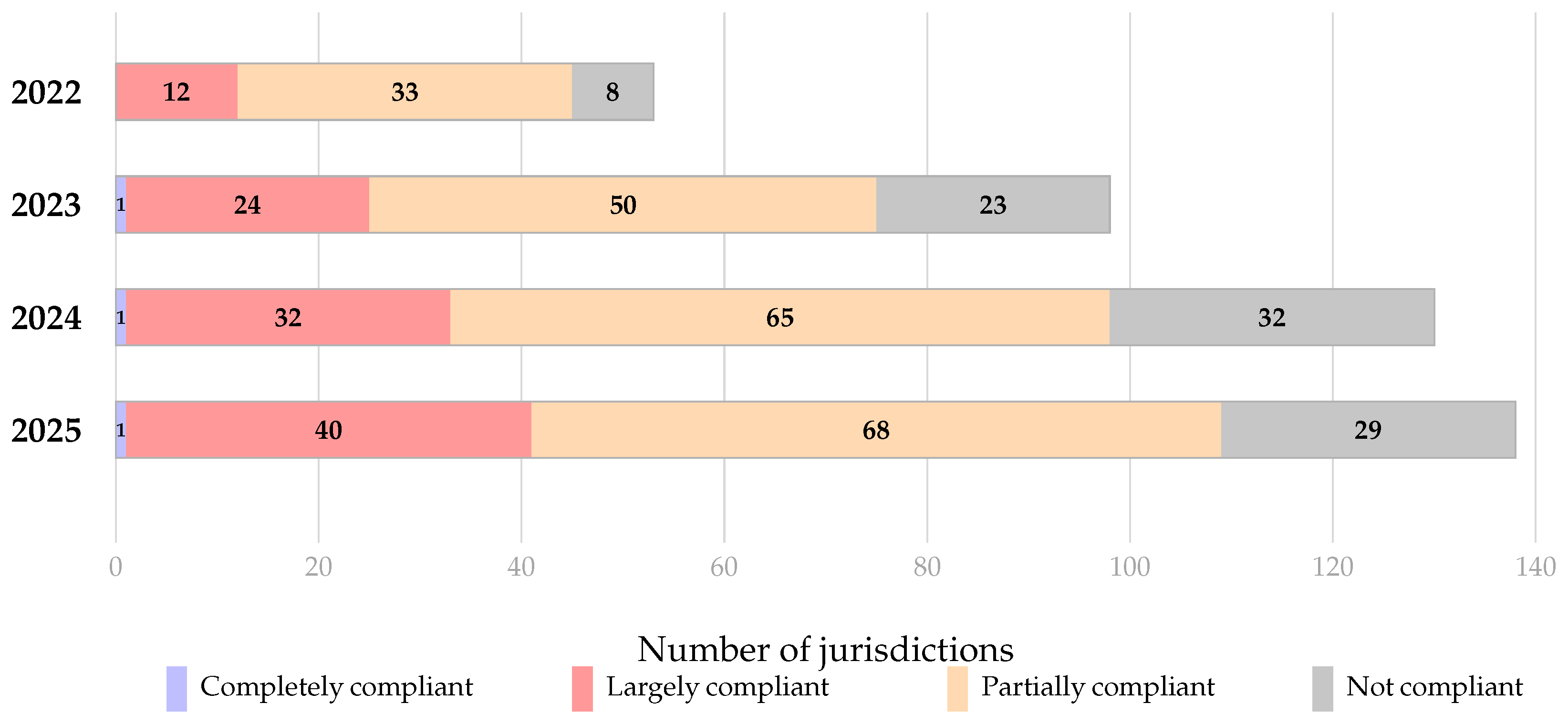
Global implementation still remains uneven, as shown in
Figure 1. These assessments reveal that although many jurisdictions have now implemented the Travel Rule, only a minority have applied it effectively in practice [
5,
13]. There are still persistent gaps when it comes to risk assessment, licensing and supervision, even as the scale of illicit use continues to grow. The IMF and FSB have similarly warned that stablecoins and cross-border cryptocurrency and digital asset flows may undermine monetary control and stability in emerging markets [
10], while the Bank for International Settlements (BIS) highlights that DeFi instruments [
14] and volatility associated with stablecoins can transmit systemic shocks across financial markets [
15]. Quantitatively, FATF’s own survey shows that almost three quarters of jurisdictions assessed in mutual evaluations were not conducting adequate risk assessments as of 2023, and nearly half remained only partially compliant with AML measures by 2025 [
5]. These findings point to a persistent gap between policy-making and effective enforcement of the said policy.
Akartuna et al. [
16] conducted a systematic review of money laundering and terrorist financing risks arising from new and alternative technologies, which included mention of cryptocurrencies and new payment methods. The study found that regulatory frameworks have consistently lagged behind the misuse of innovation by criminals. The study also identified prepaid instruments and virtual currencies as a high-risk mechanism. The study also identified that “convenience enhancers” services that reduce customer due diligence requirements as gateways to risk posed similar to peer-to-peer network channels, which are not under any sort of reporting standards. This highlights a mechanism directly relevant to the low-KYC voucher platforms examined in this paper. This gap between regulatory intention and operational reality is further reflected in the work of Spyra et al. (2025) [
17], through a survey of fifty financial sector professionals. They found that the seventy percent of respondents recognized that cryptocurrencies could potentially be used for money laundering activities, but their self-disclosed knowledge did not reflect a deeper understanding of the associated risks. This suggests that even professionals working directly with AML compliance may not be fully aware of the risk these less-visible laundering channels possess, particularly those that resemble ordinary consumer activity rather than conventional financial crime.
A subsequent study by Akartuna et al. [
18], drawing on consensus from 52 international experts, confirmed that emerging technologies, non-traditional instruments and digital platforms remain high likelihood risks within the new payment methods category, and that existing AML-CFT frameworks are structurally ill-suited to addressing their exploitation.
The region-specific evaluations also highlight a similar pattern with respect to gaps in enforcement and policy and the growing complexity of financial crimes involving cryptocurrencies and digital assets. The Asia Pacific Group on Money Laundering (APG) reported in 2023 that fraud and ransomware dominated VA related cases, with exchanges receiving most illicit flows [
19]. Its 2024 update highlighted the continuance of these trends, adding underground banking and cash conversion as common laundering methods that were seen in practice [
20]. MONEYVAL in their 2023 typologies report reached similar conclusions in Europe; the report also noted that inconsistent definitions of virtual assets have led to weaker regulation and classification in Europe [
21]. The Cambridge Center for Alternative Finance (CCAF) also similarly found that weaker legal definitions across jurisdictions have led to weaker regulations [
22]. Collectively, these regional and independent reviews reveal that while there is rising awareness regarding cryptocurrencies and digital assets and the financial crimes associated with them, there are also significant bottlenecks still in existence that make it difficult to maintain proper oversight, leading to weaker regulations and newer methods of bypassing the system that can be exploited.
2.2. Empirical Research on Cryptocurrency Illicit Finance
This section aims to understand both the quantitative and qualitative scales of cryptocurrency and digital-asset-enabled illicit activity. Work in this domain has placed cryptocurrencies within the landscape of financial innovation and has highlighted how the decentralized nature of cryptocurrencies challenges the regulatory approaches, traceability of funds and surveillance [
2]. Subsequently, estimates suggest that a significant number of Bitcoin transactions have been linked to illegal activity, with volumes comparable to major global black markets [
23]. A comprehensive review of studies published between 2011 and 2021 finds that money laundering risk is consistently identified as a defining characteristic of cryptocurrency ecosystems as consequences of their decentralized nature. The studies also highlight the need for clearer legal frameworks [
24].
A more recent study by Arnone et al. [
25] confirms that anonymity and regulatory fragmentation are the foundational weak points that enable illicit cryptocurrency flows across seven criminal typologies studied by them, including but not limited to money laundering, dark web markets, and cybercrime. The study also found that Bitcoin remains the dominant instrument for illicit transactions, while privacy coins are emerging laundering tools; this is a finding that aligns with the data presented later in this paper. Arnone et al. [
25] further found that differences in regulatory frameworks across various countries create gaps that illicit actors can exploit, specifically when platforms operate from countries with weaker oversight. This is directly relevant to the crypto-to-voucher platforms examined in this paper. Many of these platforms operate across borders and outside the reach of any single regulatory authority.
A few more recent contributions shift focus towards typology-based analysis, identifying a wide range of crimes, from investment frauds to ransomware, where illicit actors have exploited cryptocurrencies and digital assets [
26], while advances in machine learning demonstrate how graph-based methods can detect laundering patterns embedded within blockchain transaction networks [
27]. However, these graph-based detection methods operate on on-chain transaction data and are therefore structurally blind to off-chain conversions, including the crypto-to-voucher pathway examined in this paper. When illicit funds exit the blockchain and enter the voucher and retail ecosystem, they become effectively invisible to blockchain forensics, reinforcing the case for the regulatory and typological approach adopted here.
Within this body of work, gift cards and prepaid instruments have begun to receive attention as operational cryptocurrency laundering methods and as components of broader multi-stage laundering mechanisms. Almeida, Pinto and Fernández Vilas [
28] are among the few studies to explicitly identify gift card and prepaid card transactions as part of a cryptocurrency money laundering method. They note how these methods can be used at both the Placement and Integration stages of the PLI model. Building on this, Almeida et al. [
29] present a parametric assessment of cryptocurrency-based laundering methods across all three PLI stages, scoring each technique across dimensions including duration, traceability, operational difficulty, and cost. Their analysis scores gift cards as exhibiting low traceability and low operational difficulty. These characteristics of the instruments are what make them attractive to illicit actors. However, their analysis treats gift cards as a relatively simple standalone method and does not examine the ecosystem of platforms enabling crypto-funded voucher purchases, the role of privacy coins in amplifying anonymity within this pathway, or the aggregator models that route users across multiple low-KYC vendors. It is precisely this platform-level gap that the present study aims to address.
Collectively, this literature highlights both the active use and adoption of cryptocurrency as a means for money laundering by illicit actors, and the rise of awareness and improved analytical capacity to trace complex blockchain streams. Yet as the above review demonstrates, the literature has examined crypto money laundering primarily through the lens of on-chain transactions and detection technology, leaving the platform ecosystem behind crypto-to-voucher conversion largely unexamined.
2.3. Industry and Enforcement Typologies
The private sector attempts to provide quantitative assessment of these trends. Chainalysis, a reputed private body that specializes in on-chain analysis solutions for blockchain, estimates that almost USD 100 billion in crypto has been laundered through mixers, cross-chain bridges, OTC brokers, and stablecoin swaps since 2019 [
30]. Its 2025 Crypto Crime Report documents a shift toward platformised laundering, with industrial-scale scams such as high-yield investment and pig butchering schemes accounting for over 80 percent of global scam revenue in 2024. The report also highlights marketplaces such as Huione Guarantee, which facilitate large-scale conversion of illicit stablecoins into clean ones through structured intermediaries. These developments indicate that stablecoins and intermediary service platforms have become dominant laundering channels [
31].
Law enforcement identified trends that mirror these findings. Europol’s reports “Internet Organised Crime Threat Assessments” identified stablecoins, pig butchering scams, ransomware, P2P cash out networks, and cross-chain swaps as core laundering typologies [
32,
33], while the U.S. Treasury’s 2024 “National Money Laundering Risk Assessment” described virtual asset investment scams as the fastest growing category of financial fraud. Together, these assessments suggest that despite significant progress in regulation, enforcement efforts continue to lag behind the speed and complexity of crypto-based laundering techniques [
34].
This pattern of criminal migration toward unregulated intermediaries which might not deal in good faith, is also shown in research. Benson et al. [
35], examining the dark side of decentralised finance, demonstrate that as AML obligations on conventional centralised exchanges have increased and reporting has improved as a consequence of which, illicit actors have migrated towards unregulated intermediaries including decentralised exchanges and cross-chain bridges. The authors identify a core structural deficiency in current AML law, the current law presupposes a regulated intermediary who can be required to conduct customer due diligence, and where no such intermediary exists, the framework does not hold up. Crypto-to-voucher platforms represent a structurally different intermediary that exploits this blind spot, sitting outside conventional regulation while enabling the conversion of illicit crypto into bearer instruments that re-enter the economy through retail or other informal channels.
Taken together, these enforcement and industry assessments document a laundering ecosystem that is expanding in both scale and sophistication. Yet despite the scale of documented typologies across FATF, APG, MONEYVAL, Chainalysis, and Europol reporting, none of the law enforcement or policy making bodies explicitly identify or acknowledge crypto-funded voucher platforms as a distinct laundering channel, nor do they propose any countermeasures for this pathway.
2.4. Research Gap and Rationale
Despite extensive attention from regulators, researchers, and industry bodies, existing analysis mainly tends to examine cryptocurrencies primarily as standalone channels for illicit transfers or as direct objects of financial crime. Much less attention has been paid to how crypto assets are used as intermediate instruments within more complex laundering mechanisms, where they interact with other payment tools and markets. One such under examined pathway involves the use of cryptocurrency to acquire digital vouchers and gift cards, which can then be redeemed or resold within the formal economy.
The literature reviewed revealed three specific gaps. First, while Akartuna et al. [
16] establish that prepaid instruments and poorly regulated digital platforms constitute an under-regulated risk category and Akartuna, Johnson and Thornton [
18] confirm through expert consensus that these instruments remain high likelihood risks, neither study had examined the specific mechanism by which cryptocurrency is converted into vouchers as a laundering pathway, nor the platform ecosystem that enables this conversion. Second, while Almeida et al. [
29] score gift cards as exhibiting low traceability and low operational difficulty within the PLI framework, both studies treat the method as a relatively contained technical step and do not examine the broader shadow platform infrastructure such as including aggregator models, privacy coin integration, and offshore accessibility. Third, while Choo [
36] established in a foundational study that stored-value instruments share three structural vulnerabilities—anonymity at acquisition, portability across borders, and absence of mandatory reporting—that make them exploitable across all three PLI stages, the digitisation and crypto funding of these instruments has introduced a new layer of scale, speed, and cross-border reach that requires attention.
There is a difference between crypto-funded vouchers and regular fiat gift or store cards. While both are redeemable stored-value products, which are tied to specific merchants or platforms, they differ in key ways that matter for money laundering.
The first difference arises in the level of traceability of the payment process. Buying a gift card through a store or online usually means paying with a bank card or regulated payment service in fiat currency, which creates a transaction record that banks can see and monitor. But if someone buys the same voucher with cryptocurrency, especially a privacy coin like Monero, there is no such record. The payment is hidden from regulated financial systems, breaking the link between the buyer and the voucher before it is issued.
The second difference is about using vouchers across borders. Fiat gift cards have geographic limits. For example, a voucher in Indian rupees for an Indian store needs a local payment method to buy it, and buying from abroad means dealing with currency exchange and international payment systems that create compliance records. Crypto voucher platforms remove these limits. Anyone, anywhere, can buy an Indian store voucher with cryptocurrency, without showing ID, and send the code to someone in India through any messaging app. There is no bank transfer, remittance report, or foreign exchange record. Because of this untraceable payment and easy cross-border transfer, crypto-funded vouchers are very different from fiat ones and are harder to detect within the current anti-money laundering systems.
Current regulatory and institutional work has largely focused on issues such as the Travel Rule, supervision of virtual asset service providers, and risks associated with stablecoins. Assessments by bodies including the IMF, BIS, APG, and MONEYVAL similarly emphasize definitional challenges associated with cryptocurrencies and digital assets leading to uneven supervision, and cross-border coordination gaps focusing more towards a policy of inclusion and correct scope of coverage. Empirical research and industry have been reporting on illicit crypto markets, fraud typologies, and blockchain analytics.
With this paper, we try to examine how cryptocurrencies can be used as a tool within broader money laundering processes, rather than only as a direct means of transferring value. It focuses on situations in which illegal proceeds are first converted into cryptocurrency and then used to purchase digital vouchers, gift cards or similar instruments. These vouchers can be then redeemed or resold through informal or secondary markets, allowing value to move into the formal economy with limited visibility. Because such transactions often resemble ordinary consumer activity, and they may not trigger standard monitoring or reporting mechanisms by tracing these sequences, the paper highlights how crypto assets interact with other parts of the payment and retail ecosystem, forming a complex laundering structure that can remain difficult to detect.
In the Indian context, official reports acknowledge rising crypto-related fraud and have extended AML obligations to virtual asset service providers. However, publicly available information remains highly aggregated due to its sensitive nature and provides little insight into how crypto assets may be combined with other instruments in multi-stage laundering processes. This is important because voucher resale offers a practical way to convert crypto assets into instruments of fiat equivalent value while remaining largely outside the detection capacity of law enforcement agencies and direct VASP monitoring. As such, crypto-to-voucher conversion does not represent a separate crime category, but is part of a larger, complex mechanism that is a vulnerability within emerging AML frameworks that requires closer examination.
The tools that exist today for tackling crypto-related financial crime, whether that is blockchain forensics, quantitative estimates of illicit flows, or the growing catalogue of typologies covering mixers, DeFi, and NFT-based laundering, are genuinely valuable. But they all share the same blind spot. They work within the blockchain. The moment funds move off-chain, they disappear from view entirely. No forensics tool follows them there, no typology report accounts for them, and no regulator is watching that conversion happen. That is the gap this paper is concerned with.
With this study, we try to make three specific contributions. First, it provides a categorical platform-level analysis of the crypto-to-voucher ecosystem, examining 52 active platforms across four risk parameters to map where the vulnerabilities lie. Second, it traces the complete operational architecture of this laundering pathway within the PLI framework, moving beyond method classification to examine the platform infrastructure that makes this pathway functional and scalable. Third, it identifies five laundering typologies specific to this mechanism, none of which are currently recognised in institutional typology reports, providing a foundation for future regulatory recognition and detection efforts.
3. Conceptual Framework and Methodology
With this section, we aim to discuss the conceptual foundation. We will bridge the preceding literature review with the paper’s empirical results. Having identified a blind spot in global AML frameworks concerning crypto-to-voucher conversions, in this section, we adapt the classical Placement Layering Integration (PLI) model to capture the money laundering flow and how laundering can occur outside traditional financial stakeholders. The framework aims to provide both an analytical lens and a classifying structure to examine the dataset of platforms we analyze later in this paper.
3.1. Conceptual Framework: Adapting the PLI Model [3]
Traditionally, laundering passes through regulated participants such as banks or exchanges, creating points of vulnerability. Contrary to the usual structure, the pathway we are examining here operates almost entirely outside these channels using crypto-funded vouchers, offshore aggregators and informal markets without red-flagging compliance systems. It is an example of regulatory arbitrage where actors exploit mismatches in legal definitions, enforcement capacity, and data sharing mechanisms to hide the flow of funds. We build on Levi and Reuter [
3] model to attempt to extend this logic to show how platforms and pseudo compliant intermediaries form a money laundering network which is largely invisible to current AML controls.
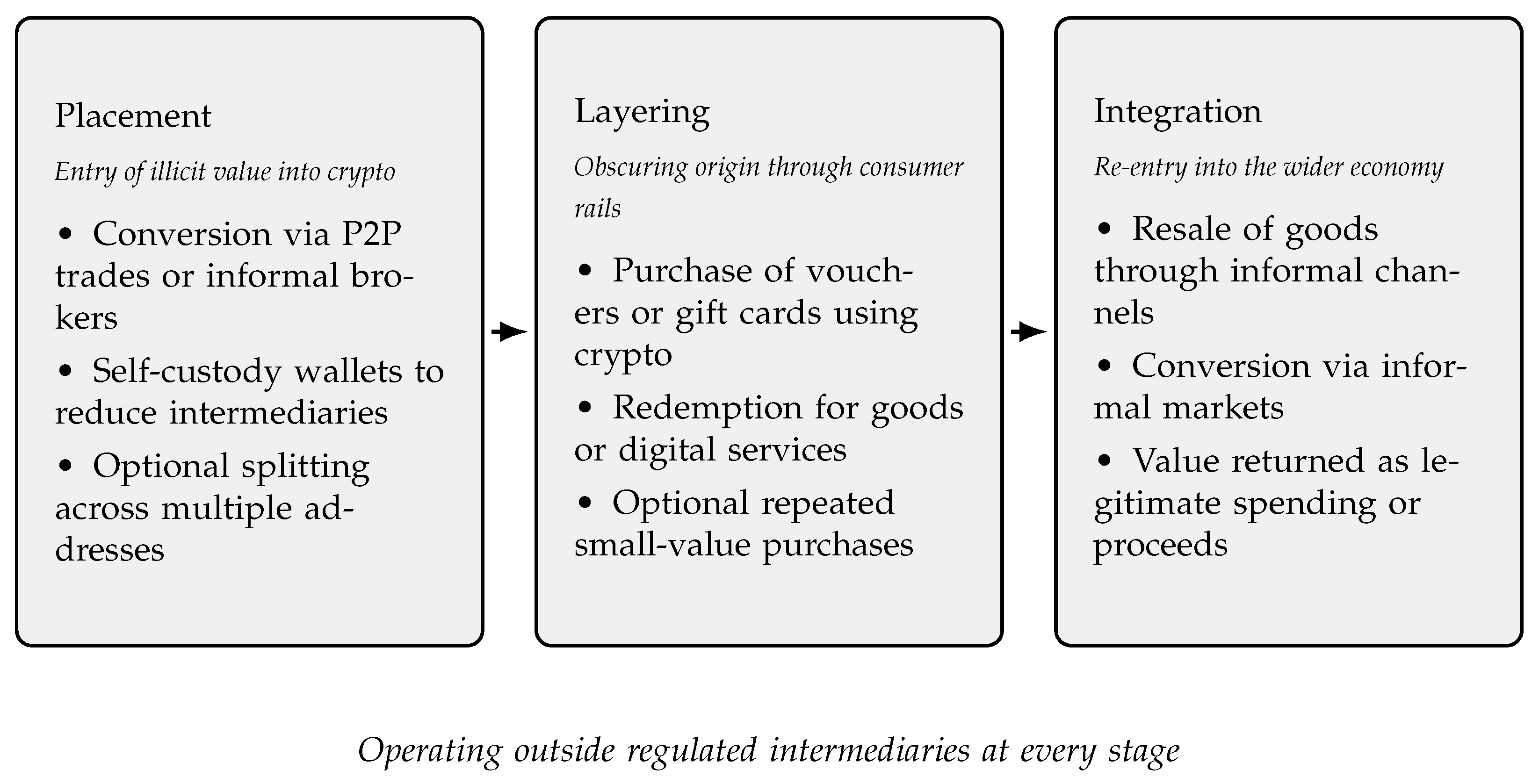
We break down the sequence in three stages of the laundering process as per the PLI Model:
Placement: Cash from illegal activity is converted into cryptocurrency via peer-to-peer channels or unregulated wallet transfers, otherwise cryptocurrency is also directly received as a consequence of certain illegal activities.
Layering: This illegally acquired cryptocurrency is then converted to gift cards and vouchers. Vouchers are then further redeemed for goods or sold directly at a discount to willing buyers or transferred to other associates in other countries, leading to illegal remittance, which is not traced.
Integration: Goods are resold in informal markets for cash or redeemed by associates in a foreign country. The cleaned cash is now reintroduced into the financial system in smaller amounts to avoid raising red flags.
The complete three-stage pathway is illustrated in
Figure 2.
3.2. Methodology: Dataset and Classifying Approach
To attempt to understand and examine this laundering model, the study builds a descriptive dataset of online platforms that facilitate cryptocurrency-funded voucher purchases. A total of 71 platforms were identified, of which 52 active or partially active platforms form the basis of the main analysis. The remainder were inactive, shut down, or purely service provider models at the time of writing.
We collected the data over three months, between June and August 2025. Since there was no official repository or alternative open-source database, we had to rely on web searches using terms like “crypto vouchers India”, “buy gift cards with cryptocurrency”, “crypto voucher no KYC”, “buy gift cards with Bitcoin”, and similar variations. These searches were run through standard search engines and were limited to English language results.
From there, we used two more methods to fill in gaps that direct searching alone would have missed. The first was looking at aggregator sites; these are platforms that act as a one-stop place for listing and linking to multiple crypto voucher vendors at once. These were particularly useful because smaller or newer platforms often do not rank highly in search results on their own, but show up within these aggregator directories. The second was going through publicly available discussions on Reddit and Telegram, where users actively share and recommend platforms for buying vouchers with crypto. We only looked at open, publicly accessible threads; no private groups or authenticated channels were accessed.
Once we had a list of platforms, we applied a straightforward set of rules to decide what stayed in and what was cut. To be included, a platform had to accept cryptocurrency as its main or only payment method, offer vouchers or gift cards that could actually be redeemed somewhere, and be reachable on the open internet without requiring a sign-up just to browse. We cut platforms that were inactive or unreachable, that only took fiat payments, or that turned out to be backend API services with no actual consumer interface. This left us with 52 platforms out of the 71 we initially found. The 19 that were excluded were mostly dead links, fiat-only services, or platforms that had already gone offline by the time we checked.
This dataset, by any means, is not meant to be an exhaustive list of every platform that exists, but a representative sample. These services are unstable by nature. They go offline, rebrand, and reappear under new names constantly. Trying to capture all of them over a longer period would have introduced more noise than clarity. The three-month window was a deliberate choice to obtain a consistent snapshot of what was actively operating, not a constraint we were working around.
The target of the study was voucher/gift card providers in exchange for cryptocurrency that can be redeemed and may facilitate remittances that fall outside reporting channels. This is different from prepaid card-related laundering mechanisms that use cryptocurrency as a funding mechanism, in the context that prepaid cards are issuer-regulated instruments while vouchers/gift cards are classified as tools for merchant-side value creation; many classify vouchers/gift cards as marketing initiatives. These cryptocurrency-to-voucher conversion mechanisms lack issuer anti-money laundering regulation and lack redemption traceability, which is something this paper highlights.
Each of the four parameters used to score platforms were defined as follows. For KYC requirements, platforms were scored across three levels. The platform was labeled None if there were no registration requirements to complete a purchase. The Minimal label was given where only an email address was required with no identity verification, and the Full label was given where the platform required information beyond an email address, such as a name, address, phone number, or government-issued identification. For privacy coin support, platforms were scored as Yes if they accepted one or more privacy-focused cryptocurrencies such as Monero (XMR), Zcash (ZEC), or Dash, and were labeled No if they did not. Monero was treated as the primary risk indicator given that it is specifically engineered to hide transaction amounts, sender addresses, and transaction links by default, making it one of the more relevant cryptocurrencies from an AML perspective. For geographic accessibility, platforms were scored based on whether they were directly reachable from an Indian internet connection without any additional tools, or whether access required a VPN to bypass geographic restrictions. Platforms accessible either way were coded as Accessible from India. For resale potential, platforms were scored as High if the vouchers they offered combined strong brand recognition and significant denomination size. These characteristics made them easier to be liquidated through secondary markets. Electronics retailers, jewellery platforms, and universal prepaid VISA or MasterCard instruments were typical examples of high-resale-potential products. Moderate resale potential was assigned to vouchers with reasonable brand recognition but narrower redemption utility or lower denomination caps. Low resale potential covered single-use, low-value, or highly niche vouchers with limited secondary market demand.
Each platform was manually reviewed and classified, and scored across four parameters:
KYC Requirement: None/Minimal/Full.
Support for Privacy Coins: Yes/No (e.g., Monero).
Geographic Accessibility: Accessible from India (direct or VPN).
Resale Potential: High/Moderate/Low.
The dataset thus provides a descriptive overview of how crypto-to-voucher ecosystems might operate and where their vulnerabilities lie. Given the opacity and evolving nature of these services, the findings are exploratory and typological rather than statistical generalizations.
From the Indian perspective, we note that cryptocurrency exchanges and a few other stakeholders have been brought under the Prevention of Money Laundering Act (PMLA), and are designated as reporting entities by the Financial Intelligence Unit. These participants/facilitators must enforce KYC and file Suspicious Transaction Reports (STRs). However, the laundering pathways we are discussing as part of this paper typically bypass these regulated participants by routing funds through offshore brokers, temporary domains with minimal KYC, or unregistered peer-to-peer groups operating via social media. These channels generally fall outside effective jurisdiction unless they are part of an active investigation or part of a larger case, and therefore represent a blind spot in the current AML framework.
4. Categorical Analysis of Platforms
The increasing adoption of virtual assets has given rise to a new class of online platforms that enable the purchase of digital gift cards, prepaid vouchers, and other redeemable products that can be purchased using cryptocurrency. These platforms, many of which operate globally with minimal or no KYC requirements, now function as informal payment networks that can facilitate cross-border value transfers, and thus present potential risks for illicit activities.
4.1. Platform Risk Landscape
Using the platforms analyzed, below we present the summary of the results generated. It is important to note that no transactions were conducted, no violation of any legal barriers has occurred to date in the study, and no proprietary or confidential data were accessed. The dataset covers clear-web, English-language platforms; darknet or closed-group channels were not systematically captured. All coding was based on stated KYC policies and visible user interfaces. This approach ensures transparency and staying within the legal parameters, but may under-represent actual enforcement practices, reflecting the opacity of the ecosystem itself.
Our study identifies over 50 active or partially active platforms that accept various cryptocurrencies in exchange for vouchers redeemable both within India and internationally. While marketed as legitimate spending gateways, these services also present features that could lower the barriers to misuse for laundering purposes. Specifically, they create conditions under which value can be stored, transferred, and spent across borders in ways that may not fall under remittance regulations, reduce visibility to Financial Intelligence Units, and operate outside the banking system without licensed VASP involvement.
In the descriptive dataset (
n = 52 analyzed platforms), we have additionally highlighted a platform supporting Monero (XMR) because Monero is specifically designed to provide stronger transaction privacy than most cryptocurrencies, which can limit the visibility of the fund movement and hence is used as a risk indicator, as it hides transaction chain, transaction amount and participant identity by default. The numbers reveal the following high-risk patterns, summarized in
Table 1. 76% of platforms had no meaningful KYC, 21% supported Monero, 90% were accessible from India, and 44% offered high resale value vouchers.
These findings show that cryptocurrency-funded voucher platforms pose significant and under-addressed AML risks. The majority bypass identity verification requirements, nearly a quarter support Monero, and most are accessible to users despite domestic regulation. Combined with high-resale-value vouchers that are available in these channels, this creates conditions for layering, micro-smurfing, and remittance without disclosures, which puts it beyond the scope of conventional surveillance.
To put the financial exposure these platforms represent in context, we conducted verification of maximum voucher and prepaid card denominations available across a sample of platforms from the dataset. The findings showed that individual transaction values could reach levels that are significant from an anti-money laundering perspective, transactions that are often conducted without triggering any form of identity verification requirement.
Across the platforms examined, maximum single transaction values ranged from approximately USD 800 to USD 5000 without any KYC requirement. Several platforms permitted cumulative unverified purchases of up to approximately USD 11,500 per email address before identity verification was triggered. Platforms accepting privacy coins such as Monero were found to offer anonymous prepaid virtual cards that were redeemable internationally as standard VISA or MasterCard instruments with a maximum capacity of approximately USD 1750, with no personal data required beyond a card activation email address. One platform explicitly stated in its published terms and FAQ that KYC would never be requested under any circumstances, while imposing no daily or monthly spending caps on single transactions of up to USD 5000.
These figures demonstrate that the crypto-to-voucher ecosystem is not limited to low-value transactions. A single anonymous session across two or three platforms could facilitate the movement of several thousand dollars in value without generating any identity record, suspicious transaction report, or an on-chain trail where privacy coins are used.
A further complication arises from the highly temporary nature of these platforms. Many services operate for only a short period before shutting down or rebranding, and might re-emerge under different domains. This creates a moving target for regulators; even when enforcement actions or domain blocks are applied, new services often appear almost immediately. The temporary character of these platforms increases the difficulty of building a durable AML structure around the cryptocurrency-to-voucher transfer mechanisms.
Limitations: With this dataset, we aim to provide insights rather than a complete catalogue. Many platforms are temporary, which means they shut down frequently, and some of them rebrand and resurface under a new domain. The study also does not focus on estimating the overall scale of voucher-linked laundering, as neither government sources nor platform operators publish reliable transaction data. Future research might address this by monitoring traffic or resale activity or analysing suspicious redemption patterns over time.
4.2. Laundering Typologies
As part of the initial concept of the paper, we try to improve understanding by highlighting five distinct typologies that are a few of the channels/ways illicit actors would look to exploit this ecosystem. Each illustrates how vouchers can/might serve as instruments for money laundering:
Cross-border value transfer outside reporting channels:
In a potential misuse scenario, a bad actor might purchase gift cards, which are transferable internationally, using cryptocurrencies or digital assets acquired through a peer-to-peer network or illicit activities. These cards can then be potentially redeemed abroad or resold, enabling unregulated international fund transfers beyond enforcement agencies and central bank oversight.
Remittance of funds outside reporting channels: Foreign collaborators can buy Indian brand vouchers with cryptocurrency and send codes to recipients in India. These are redeemed locally, enabling crypto inflows without remittance reporting or AML detection. This represents a significant gap in the AML and counter-financing-of-terrorism efforts undertaken.
Obscuring of funds from law enforcement detection: Illicit funds could potentially be converted into non-expiring digital assets. These act as pseudo currency units that appear to be legal and are extremely difficult to trace.
Micro-smurfing: A bad actor could potentially create multiple accounts to buy small-value vouchers across different platforms. This structure helps them to redeem small values and resell in secondary markets, disrupting traceability in a major way.
Informal Resale: Vouchers purchased with cryptocurrencies could potentially be resold on social media forums, darknet markets, and grey market e-commerce sites. Such resale operations, if conducted through informal channels, could contribute to money laundering and tax evasion risks.
4.3. Representative Platform Case Summaries
To better show how these typologies operate in practice, we have taken five representative platforms, three of which we have selected from the core dataset alongside two external cases, to demonstrate healthy compliance practices.
Platform-1: They offered a multitude of products that included vouchers, giftcards, prepaid cards and other services. The platform supported BTC, ETH, and USD. KYC collection was not required for most users; just an email was enough, making it attractive for anonymity while servicing customers without domestic registration or disclosures.
Platform-2: This platform accepted BTC, ETH, and Monero (privacy coin). It does not require user registration in any way. Monero integration elevated laundering risk by disabling blockchain traceability, such that even modern tools that trace transactions on the blockchain will not be able to trace the transaction due to the structure of privacy coins.
Platform-3: This platform acted as an aggregator. It routed users via APIs and links to various third-party vendors, many of which accept Monero or Lightning BTC, and many of which were also used as systems to spread malware. They collected no user data, complicating any sort of traceability by law enforcement agencies.
Platform-4: This platform reflected a positive case; they accepted both fiat and cryptocurrencies but strictly restricted privacy coins, enforced proper KYC for high-value users, and maintained logs in line with EU standards.
Platform-5: This platform was a fully regulated crypto exchange with mandatory KYC, real-time AML screening, and suspicious activity reporting. This platform did not offer vouchers but serves as a good regulatory example. It shows the gap between exchanges and consumer voucher platforms.
A comparative analysis of these cases shows three recurring structural risks: (1) lack of identity verification, (2) integration of privacy coins, and (3) aggregated delivery models. We demonstrate how stronger KYC and compliance frameworks can reduce exposure. Together, these cases emphasize that enforcement strategies must target not only individual platforms but also the combinations of characteristics that make laundering feasible.
The three structural risks identified across these platforms were the absence of identity verification, support for privacy coins, and the use of aggregated delivery models. Each of these corresponds to a specific failure in the existing AML framework. Voucher platforms operate entirely outside the scope of the Travel Rule and PMLA obligations, both of which are designed around registered exchanges and custodial wallets. This means that the point at which illicit cryptocurrency is converted into a voucher, the most critical stage of the laundering process, falls outside any mandatory identity verification requirement. Privacy coin support compounds this further. Platforms accepting Monero and other privacy coins effectively disable the one technical tool that enforcement agencies rely on most, which is blockchain forensics, since Monero is specifically built to hide transaction amounts, sender addresses, and the links between transactions. Once funds move through Monero, there is no on-chain trail to follow. The aggregator model adds a third layer of difficulty. By routing users across multiple third party vendors simultaneously, aggregator platforms fragment the transaction across different services and jurisdictions, making it practically impossible to identify a single reporting entity who could file a suspicious transaction report. What emerges from these findings is that the crypto-to-voucher pathway does not simply take advantage of poor enforcement; it is built around the edges of the existing framework, sitting in the space where each countermeasure stops. This is why stronger enforcement of the current rules alone will not close this gap.
6. Conclusions
This study analyzed the conversion of cryptocurrency and digital assets into vouchers/gift cards and other non-traditional instruments that could potentially be misused to facilitate money laundering, and how policies can be implemented to counteract this route potentially used by illicit actors, situating it within global AML debates and examining a dataset of over fifty active platforms accessible to Indian users. The study’s findings showed blind spots in how exchanges are regulated under the Prevention of Money Laundering Act (PMLA). Voucher intermediaries still operate outside the current AML perimeter. This is not simply a matter of weak enforcement. The crypto-to-voucher pathway is structurally positioned outside the reach of each existing countermeasure; the Travel Rule and PMLA obligations do not apply because no registered VASP is involved; blockchain forensics cannot follow funds that operate outside chain or use privacy coins; and no single reporting entity exists within the aggregator model to file a suspicious transaction report. According to the data collected and analyzed as part of the study, more than three-quarters of platforms imposed no meaningful KYC, nearly a quarter of the platforms supported privacy coins such as Monero, and the majority were accessible from India despite domestic registration. The platforms were of a temporary and recurring nature; they shut down, rebranded, and resurfaced under new domains, creating a constantly shifting system that present methods of detection cannot capture. The vulnerability highlighted here is comparable to other documented laundering channels. The absence of voucher pathways from current typology reports and risk flags suggests their risk has been underestimated relative to other methods. This study addresses that gap through three contributions: a platform-level analysis of 52 active platforms across four risk parameters, a mapping of the operational architecture within the PLI framework, and the identification of five laundering typologies specific to this mechanism that are absent from current institutional reports.
India and other countries have made progress in regulating VASPs, but there are still persistent gaps in detection, sanctioning, and international cooperation. To address these gaps, countries need to move beyond web scraping toward advanced blockchain analytics, and pursue cross-border coordination while also acknowledging the use of cryptocurrencies as part of complex mechanisms involved in money laundering. The dataset presented in the study is time-bound, yet this limitation shows the temporary nature of the platforms, which is central to the laundering risk. This study maps typologies and risk indicators rather than attempting to present quantitative insights into the laundering volumes, given the absence of transaction-level disclosures. Typology mapping is an important first step to identify a blind spot in the current system. By mapping this structural blind spot, the paper provides both evidence and a policy rationale for reforms that are urgently needed as digital assets and alternative payment structures expand.