1. Introduction
Startup investment decisions represent one of the most uncertain and strategically significant forms of capital allocation in modern innovation-driven economies [
1]. As engines of technological and business innovation, startups play a crucial role in value creation, employment generation, and the development of new technologies; however, their high failure rates, volatile growth trajectories, and limited historical data make investment decisions inherently multidimensional and complex [
2]. In such circumstances, decision-makers must balance potential returns, downside risk, and indicators of long-term sustainability and growth, a balance that is difficult to achieve in rapidly changing and competitive economic environments. Therefore, the need for multi-objective optimization models to support startup investment decisions is increasingly recognized [
3]. At the same time, increasing pressure from regulators, investors, and society requires capital allocation decisions to consider not only financial performance but also sustainability, innovation potential, and long-term resilience. In the past decade, the emergence of advanced computational methods and metaheuristic algorithms has made it possible to design intelligent decision-making models that are able to simultaneously consider multiple conflicting objectives [
4]. In the context of startup investment, such objectives typically include maximizing expected returns, minimizing risk, and optimizing sustainability indicators. Unlike traditional models, which usually focused on return criteria, new approaches attempt to guide decision-making towards economic and social sustainability [
5]. This approach is not only in line with the principles of responsible investment but also leads to smarter resource allocation in strategic sectors such as clean energy, FinTech, and healthcare [
6].
Despite significant advances in financial and optimization theories, decision-making in the startup space still faces multiple challenges. Uncertainty in cash flows, lack of sufficient historical data, and environmental fluctuations cause classical single-objective methods to have limited efficiency [
7]. In contrast, multi-objective models, by considering various decision dimensions, provide solutions that are not only optimal in terms of efficiency but also desirable in terms of sustainability and resilience [
8]. The use of metaheuristic algorithms such as non-dominated genetic algorithm (NSGA-II) and multi-objective particle swarm optimization (MOPSO) is considered one of the most efficient solutions for solving such models [
9]. Inspired by natural and social phenomena, these algorithms can search extensively in the decision space and produce a set of efficient solutions or Pareto fronts that represent a balance between conflicting objectives [
10]. On the other hand, investing in startups is not just a financial process but a strategic decision with technological, economic, and social dimensions [
11]. As a result, it is necessary to consider indicators such as portfolio diversity, cardinality, and environmental sustainability requirements in the design of decision-making models [
12]. The cardinality constraint helps the decision-maker to select a certain number of startups for investment and prevent the portfolio from being too dispersed or concentrated. On the other hand, the diversity constraint helps to maintain a balance between different areas of innovation to reduce the overall portfolio risk. Along with these constraints, the ESG (environmental, social, and governance) index is included in the model as a criterion for measuring the sustainability and responsibility of startups [
13]. The importance of using these indicators has increased significantly in the past decade, as investors and policymakers seek mechanisms that are aligned with sustainable development goals in addition to profitability [
14]. In fact, sustainable investment is recognized not only as an ethical choice but also as a strategic imperative in the global economy. Recent research has shown that portfolios with high ESG scores have better long-term financial performance and are more resilient to economic shocks [
15]. This fact reinforces the need to design multi-objective decision-making models that simultaneously consider financial and sustainability indicators.
From a Technology Management perspective, startup investment is not merely a financial allocation problem but a strategic technology portfolio decision. It reflects principles of Resource-Based View (RBV), where investments are directed toward ventures that create rare, valuable and hard-to-imitate technological capabilities, and Dynamic Capabilities Theory, where investors seek startups able to sense, seize, and reconfigure resources in rapidly changing environments. At the ecosystem level, startup portfolios function as innovation portfolios, aligning with Open Innovation and Entrepreneurial Ecosystem theories, where diversified yet focused technological bets drive long-term competitive advantage and regional development. However, most previous research has focused on traditional financial markets and has not fully covered the specific features of investing in startups. Unlike large companies, startups usually do not have a long financial history and face information asymmetry, high risk, and liquidity constraints [
16]. Furthermore, existing studies have rarely been able to combine CVaR-based downside risk, sustainability and innovation indicators, and realistic portfolio structural constraints in an integrated framework that is appropriate for startup investment.
Accordingly, the main issue of this research is how to design a decision-making framework that balances return, downside risk, sustainability, innovation, and liquidity in startup portfolio selection. In response to this issue, the present study presents a multi-objective optimization model that simultaneously considers these dimensions, along with realistic constraints such as cardinality, sectoral concentration caps, diversification, and minimum ESG thresholds, innovation, and liquidity.
The importance of this issue is not limited to the theoretical dimension but also has direct application for investors, digital investment platforms, and policymakers. In this regard, the present study makes three main contributions. First, it presents a multi-objective model tailored to startup portfolios that integrates CVaR, sustainability, liquidity, and structural constraints into a single framework. Second, by introducing constraints such as cardinality, sectoral caps, diversification, and liquidity floors, it provides a structure closer to the real conditions of portfolio management. Third, it shows how levers such as CVaR confidence level, ESG thresholds, and concentration limits change the sustainable return (risk) frontier, thereby providing practical insights for responsible investment and innovation policymaking.
The rest of the paper is structured as follows.
Section 2 is devoted to a literature review and an explanation of the research gap.
Section 3 presents the decision-making framework and the proposed model.
Section 4 describes the solution methods and computational environment.
Section 5 reports and analyzes the results. Finally,
Section 6 summarizes the research and makes suggestions for future studies.
2. Literature Review
Recent research in the field of investment decision-making, especially in startup ecosystems, shows that classical optimization models are no longer able to respond to the complexities of innovative environments [
17]. The dynamic structure of startup markets, high failure rates, and rapid technological changes have made traditional mean-variance-based approaches inadequate [
18]. In such circumstances, the focus of research has shifted towards multi-objective and intelligent models that are able to manage several conflicting criteria, such as return, risk, and sustainability, simultaneously [
19]. By using metaheuristic algorithms, these models not only make decision-making more flexible, but also allow for a more precise understanding of the relationships between objectives [
20]. In modern financial literature, one of the turning points is the replacement of classical risk measures with conditional loss-based indicators, such as CVaR (Conditional Value-at-Risk) [
21]. Unlike simpler models, this indicator considers the sequential behavior of the loss distribution and, as a result, provides a more accurate measure of investment risk. In this study, CVaR is chosen instead of traditional variance-based measures because investments in startups are more exposed to severe losses, sudden failures, and asymmetric downside outcomes, which variance alone cannot adequately represent. Recent studies have shown that CVaR-based models have better computational robustness and managerial interpretation, especially in turbulent and startup markets [
22]. In this regard, several studies have combined CVaR with evolutionary algorithms to optimize the portfolio selection process in uncertain environments [
23].
From the perspective of multi-objective optimization theory, the development of intelligent algorithms such as NSGA-II and MOPSO has made a significant breakthrough in solving complex models [
24]. By utilizing the concept of Pareto dominance and genetic operators, the NSGA-II algorithm is able to produce a front of efficient solutions that helps the decision-maker in choosing between conflicting objectives. In contrast, the MOPSO algorithm, inspired by the collective behavior of particles, performs well in faster convergence and discovery of optimal regions. In many comparative studies, combining these two algorithms or comparing their performance in financial problems, including portfolio management, capital planning, and resource allocation, has led to valuable results [
25]. In the field of startups, investment decision-making is characterized by characteristics such as information asymmetry, high diversity of domains, and budget constraints [
26]. Unlike traditional markets where there is abundant historical data, in innovative environments, data is often incomplete or qualitative, which doubles the need for the use of nonlinear and learning models [
27]. In this context, research has shown that the use of metaheuristic algorithms increases the accuracy of decision-making, especially in situations where the data is uncertain or ambiguous [
28]. These algorithms are able to intelligently navigate the search space and, instead of a single answer, present a set of efficient options that the decision-makers can choose based on their preferences. On the other hand, the sustainability dimension has gained increasing importance in modern investment models. ESG (environmental, social and corporate governance) indicators are used as complementary criteria to financial indicators so that investment decisions are not only profitable but also responsible and in line with sustainable development goals [
29]. Studies have shown that portfolios optimized based on ESG criteria are more resilient to market fluctuations in the long run and their returns are not lower than irresponsible portfolios [
30]. This approach has paved the way for the development of models in which financial and social criteria are taken into account simultaneously [
31].
In addition to these concepts, structural constraints also play an important role in the realism of optimization models. The cardinality constraint, which controls the number of assets that can be selected in the portfolio, allows the model to avoid scattered and impractical decisions [
32]. The diversification constraint, by limiting the concentration in one or more areas, prevents the increase in systematic risk and allows for the creation of a balance between different sectors [
33]. Several studies have shown that the simultaneous consideration of these constraints can make the portfolio structure closer to market reality in economic and practical terms [
34]. In the field of multi-objective algorithms, research has increasingly combined these approaches with fuzzy decision-making models and machine learning [
35]. In such models, data uncertainty is modeled through membership functions or adaptive learning methods to better reflect the real behavior of investors and market conditions. Furthermore, the combination of metaheuristic algorithms with learning predictive models, such as neural networks or support vector machines, has opened up new horizons for analyzing complex data and predicting startup performance [
36]. Recent studies have also paid special attention to the policy dimension of startup investment. Research emphasizes that the results of optimization models can be used to design support policies, intelligently allocate subsidies, and direct public financial resources to innovative sectors [
37]. In fact, the use of multi-objective models not only improves the efficiency of individual investors’ decision-making but also provides policymakers with a tool to manage macro-risk and stimulate technological growth [
38]. Despite substantial progress in sustainable finance, portfolio optimization, and multi-objective modeling, most existing work focuses on public equity or mature firms and rarely captures the specific conditions of startup investing. ESG is often treated as an add-on screening criterion rather than embedded in a formal multi-objective framework, and downside risk is typically approximated by variance instead of tail-focused measures such as CVaR. Furthermore, structural features that are central in early-stage practice—limited managerial capacity (cardinality), sector diversification requirements, and time-to-liquidity—are largely absent from prior formulations. This leaves a gap for models that simultaneously integrate CVaR-based downside risk, ESG and innovation metrics, liquidity considerations, and realistic portfolio constraints in the context of startup ecosystems.
A review of previous studies shows that some studies have covered a part of the present problem, but a truly comprehensive framework for startup investment has not yet emerged. For example, some models focus on multi-objective portfolio optimization with an emphasis on sustainability and ESG criteria, but they usually do not simultaneously incorporate liquidity and structural constraints specific to startup portfolios into the model. In contrast, some other studies have incorporated CVaR-based downside risk along with liquidity considerations into portfolio optimization, but their focus has been mainly on public markets or mature companies and the specific characteristics of startup investment, such as information asymmetry, managerial capacity constraints, and the need for sectoral diversification, have not been explicitly modeled. Also, some studies examine constraints such as cardinality or portfolio concentration, but these constraints are less often placed alongside ESG indicators, innovation, liquidity, and sequential risk, in an integrated formulation that is appropriate for the startup ecosystem. Therefore, the main distinction of the present study is not in the single use of CVaR or ESG, but in the simultaneous combination of these dimensions with realistic structural constraints and the ability to extract decision-making and policy implications in the context of startup investment.
By summarizing the existing literature, it can be concluded that although various models have been presented for portfolio management and investment decision-making, the simultaneous combination of three approaches (multi-objective optimization, consideration of ESG indicators, and portfolio structural constraints) has not yet been comprehensively considered in the context of startups. The main gap in research is that most models either focus only on the financial dimension or refer to sustainability at a conceptual level without providing a detailed computational framework. By presenting a model that combines these dimensions in an integrated manner, the present study is an attempt to fill this gap and create a link between quantitative analysis, sustainability, and policymaking in startup investment. This approach not only provides the basis for more accurate decision-making but can also be the basis for the development of intelligent decision-support tools for innovative ecosystems.
3. Decision Framework and Multi-Objective Optimization Model
Investment decisions in startups are a complex and multidimensional process that cannot be based solely on short-term financial indicators due to the dynamic, risky and innovative nature of these businesses. Among them, four basic dimensions play a fundamental role and provide a comprehensive framework for analyzing and selecting investment options: return, risk, sustainable growth and innovation. Return, as the first dimension, indicates the level of profitability or added value from the investment and is usually measured in the form of indicators such as revenue growth, market value increase or return on investment. However, accurate prediction of return in startups is always accompanied by many challenges, because market fluctuations and environmental uncertainties have a direct impact on it. Along with return, risk is also considered as an inseparable dimension. Risk in startups can be caused by financial, technological, market, legal or regulatory factors, and its lack of proper management, especially in the early stages of activity, can lead to a rapid loss of investors’ limited resources. The third dimension is dedicated to sustainable growth, which looks beyond short-term returns and focuses on the startup’s ability to create long-term and lasting value. This dimension is based on financial stability, adaptation to environmental changes, attention to environmental and social issues, and compliance with corporate governance principles. In this regard, ESG indicators have also increasingly become an integral part of investment criteria. Finally, innovation is of great importance as the fourth dimension and one of the main pillars of the existence of startups. The ability to create new products or services and offer different business models not only creates a competitive advantage but also provides nonlinear opportunities for growth and development. The combination of these four dimensions creates a multi-criteria framework for investment decision-making that, on the one hand, enables the achievement of desired returns, while on the other hand, it helps manage risk, ensure sustainability, and foster innovation. Neglecting any one of these dimensions increases the likelihood of suboptimal choices, while simultaneously addressing all of them provides decision-makers with a more comprehensive and balanced picture of investment options.
The startup investment decision problem can be formulated as a multi-objective optimization model. In this model, four key decision dimensions, namely, return, risk (especially CVaR-based downside risk), sustainable growth/ESG, and innovation, are considered simultaneously. Uncertainty of returns is modeled through scenarios, and to make the portfolio more realistic, a set of practical constraints such as budget constraints, number of choices (cardinality), sector exposure caps, ESG and innovation minimums, liquidity, and portfolio diversification are applied. The model structure is as follows.
From an analytical perspective, the proposed model is designed to represent the most important economic trade-offs in startup portfolio selection under uncertainty. This formulation combines four main decision-making dimensions, namely, expected return, downside risk, sustainability and innovation, and liquidity, into a single multi-objective framework. Also, a set of operational and structural constraints are introduced into the model in
Table 1 to make the final portfolio not only mathematically but also economically and managerially feasible and realistic.
In the proposed model, four main objective functions and ten key constraints are considered, which interact with each other to form the structure of investment decision-making in startups. Objective function (1) represents the maximization of the expected return of the portfolio. This function represents the decision-maker’s desire to achieve the highest possible level of return from total investment, assuming that each startup has a different rate of return in different scenarios. The goal is to select a combination among different investment combinations that has the highest weighted average of returns. In other words, the first objective function seeks to maximize short-term and medium-term financial benefits from the investor’s perspective. Objective function (2) focuses on minimizing downside risk and particularly uses the concept of Conditional Value-at-Risk (CVaR). Unlike the first function, which focuses on profit, this function emphasizes the conservative aspect of decision-making. In this section, the possible losses in pessimistic scenarios are considered and the aim is to reduce the average losses if the return falls below a certain confidence level as much as possible. Therefore, the second objective function creates a balance between return and capital safety and prevents risky behaviors in the selection of startups. Objective function (3) seeks to maximize the composite index of sustainability, innovation and growth and, in fact, reflects the strategic orientation of modern startup investments. This function tries to establish an appropriate weight between the three non-financial but decisive dimensions; that is, startups that score higher in terms of environmental responsibility, technological innovation or sustainable growth are prioritized. In addition, part of this function is dedicated to diversifying the portfolio to prevent excessive concentration of capital in a limited number of startups. From this perspective, the third function considers the long-term sustainability factor, diversification, and innovation simultaneously in decision-making. Objective function (4) seeks to minimize the liquidity delay or time-to-market. In many startups, the return on investment and positive cash flow may occur with a significant delay. This function seeks to select the investment mix in such a way that the average time for liquidity or real return is shorter. In fact, the fourth objective from an operational perspective ensures that the decision-maker selects a mix of startups that, while having growth potential, are also rational and efficient in terms of the time to realize returns. After the objective functions, a set of constraints is defined to maintain the realism of the model and prevent impractical decisions. Constraint (5) is related to the investor’s total budget and ensures that the sum of the capital allocated to startups and risk-free assets does not exceed the total available budget. This constraint acts as a financial balance and prevents overallocation. Constraint (6) specifies the relationship between selection and allocation, stating that only startups that are selected can receive a portion of the capital. This constraint prevents the allocation of resources to non-selected options and establishes a logical link between the binary selection variables and the continuous allocation variables. Constraint (7) concerns the cardinality of the portfolio and specifies the maximum number of startups that can be included in the investment mix. This constraint is important given the limited managerial resources and supervisory capacity of the investor, since investing in too many startups can reduce strategic focus. Constraint (8) defines a sector exposure cap and ensures that investments are not overly concentrated in a particular industry or technology area. This constraint ensures that the portfolio remains balanced in terms of sectoral diversification and reduces the risk arising from sectoral fluctuations. Constraint (9) refers to the minimum ESG level and expresses the investor’s commitment to complying with the principles of sustainability and social responsibility. This condition ensures that the final portfolio composition meets minimum environmental, social and governance standards. Next, constraint (10) requires a minimum level of innovation to prioritize startups with a technological and innovative approach and maintain the transformative nature of the investment. Constraint (11) determines the liquidity floor and ensures that the average liquidity of the portfolio remains at a desirable level, so as to allow for rapid response to market changes and timely exit from the investment. Finally, constraint (12) is dedicated to controlling the portfolio’s concentration and keeps the diversification index within an acceptable range to avoid excessive dependence on one or more startups. Constraint (13) defines the scenario-based loss function and the auxiliary relations required to linearize the CVaR criterion. In this constraint, the loss of each scenario is calculated as the negative value of the portfolio return in that scenario. Also, the auxiliary variable zs represents the amount of loss in excess of the CVaR threshold, i.e., η, and its non-negative condition ensures that only losses exceeding this threshold are included in the calculation of the downside risk. Therefore, this constraint allows the representation of the portfolio’s sequential risk behavior in a solvable and computationally feasible form. Constraint (14) specifies the domain and allowed range of the decision variables. This constraint ensures that the variables of capital allocation to startups and risk-free assets are non-negative, the startup selection variable is defined as binary, the CVaR threshold is considered without sign restrictions, and the auxiliary variables related to CVaR also remain non-negative. The existence of this constraint is essential to maintain the logical and mathematical consistency of the model and ensures that the final answer represents an acceptable and feasible investment portfolio.
In summary, objective functions (1) to (4) create a multi-criteria decision-making framework that balances financial goals, risk tolerance, sustainability, and time efficiency, and constraints (5) to (14) limit the decision space to a realistic, valid, and consistent region with the operational conditions of investing in startups.
From an economic perspective, the model constraints ensure that the final decision is not simply an abstract mathematical allocation. The budget constraint and the link constraint between selection and allocation preserve the financial feasibility of the decision; the cardinality constraint and concentration cap control the managerial capacity constraint and concentration risk; and the ESG, innovation, and liquidity thresholds ensure that the selected portfolio is consistent with the requirements of responsible investment, growth capacity, and exit considerations. Hence, the set of constraints defines the answer domain not only from an operational perspective but also from an economic rationality perspective for investing in startups.
4. Solution Methods
To solve the proposed model, two complementary approaches are used. At small scales where the number of startups and uncertainty scenarios is limited, the model is implemented and solved in GAMS environment to obtain reliable and reference solutions. In this implementation, the multi-objective nature of the problem is managed through ε-Constraint formulation; that is, one of the objectives is considered as the main objective function and the other objectives are applied as constraints with adjustable bounds. For the risk reduction objective, the standard CVaR linearization is used, and the corresponding auxiliary variables are included in the model to control the tail behavior of the loss distribution meaningfully. Since the entropy-based diversity term is inherently nonlinear, two solutions are used in the exact version of GAMS: either removing this term and relying on the centrality constraint (HHI) to preserve diversity or using a piecewise linear approximation with predetermined breakpoints to keep the model in the MILP category. Thus, the final model in GAMS is solved as a mixed integer programming with scenario-based constraints and binary startup selection variables, and the obtained solutions are used as a basis for evaluating large-scale metaheuristic methods.
At larger scales, where the number of startups, scenarios, and segmentation constraints increases, two multi-objective algorithms, NSGA-II and MOPSO, are used to produce diverse and high-quality Pareto fronts. The selection of NSGA-II and MOPSO in this study was based on their suitability to the nature of the problem. The present problem is a multi-objective, nonlinear, and structurally constrained problem in which the generation of a diverse set of Pareto solutions, rather than a single solution, is of great importance. NSGA-II was selected due to its good ability in non-dominated sorting, preservation of the diversity of responses through crowding distance, and established performance in portfolio optimization problems. In contrast, MOPSO was considered as a complementary method due to its good convergence speed, ability to search effectively in the solution space, and ability to maintain a set of non-dominated solutions in the form of an archive. The simultaneous selection of these two algorithms allows the results to be evaluated comparatively in terms of the quality of the Pareto front, diversity of responses, and behavioral stability. In NSGA-II, solutions are represented as continuous vectors of investment shares for each startup, and a fast non-dominated sorting mechanism with crowding distance is used to guide the population towards sparse and efficient regions of the Pareto front. Selection is performed as a binary tournament with a crowding criterion, and generation is performed by simplex-like intersection (SBX) and polynomial mutation. Model constraints are prioritized by the rule of equal feasibility; that is, feasible solutions are preferred over impossible ones, and strict penalties are imposed on constraint violators. In MOPSO, particles are encoded as continuous portfolios, and their speed and location are updated based on inertia and cognitive and social components. The non-dominated repository is managed using a goal space or ε-domination grid to both maintain the diversity of the front and to select leaders for updating the velocities in a balanced manner across the front. A boundary repair strategy prevents particles from leaving the allowed allocation boundaries, and a soft jump mechanism on position or velocity is used to prevent premature trapping. In both algorithms, the fitness assessment is performed directly based on the four objective functions defined in the model, and the main constraints, including budget, cardinality, sector ceilings, ESG and innovation minima, liquidity floor, and concentration limit or diversity approximation, are applied as a combination of repair, penalty, and feasibility rules to restrict the search space to the valid region.
In terms of how to deal with constraints, both algorithms have the ability to either return invalid solutions to the permissible region through a repair mechanism or prevent them from being superior through penalties and feasibility rules. This feature is of particular importance for the present problem, because the model includes a variety of constraints such as budget, cardinality, concentration ceiling, ESG and innovation minimums, and liquidity requirements. Compared to many exact or single-objective methods, these two algorithms are more suitable for the complex and multidimensional decision space of this study, because they can provide the decision-maker with a set of efficient and comparable solutions without reducing the problem to a single criterion.
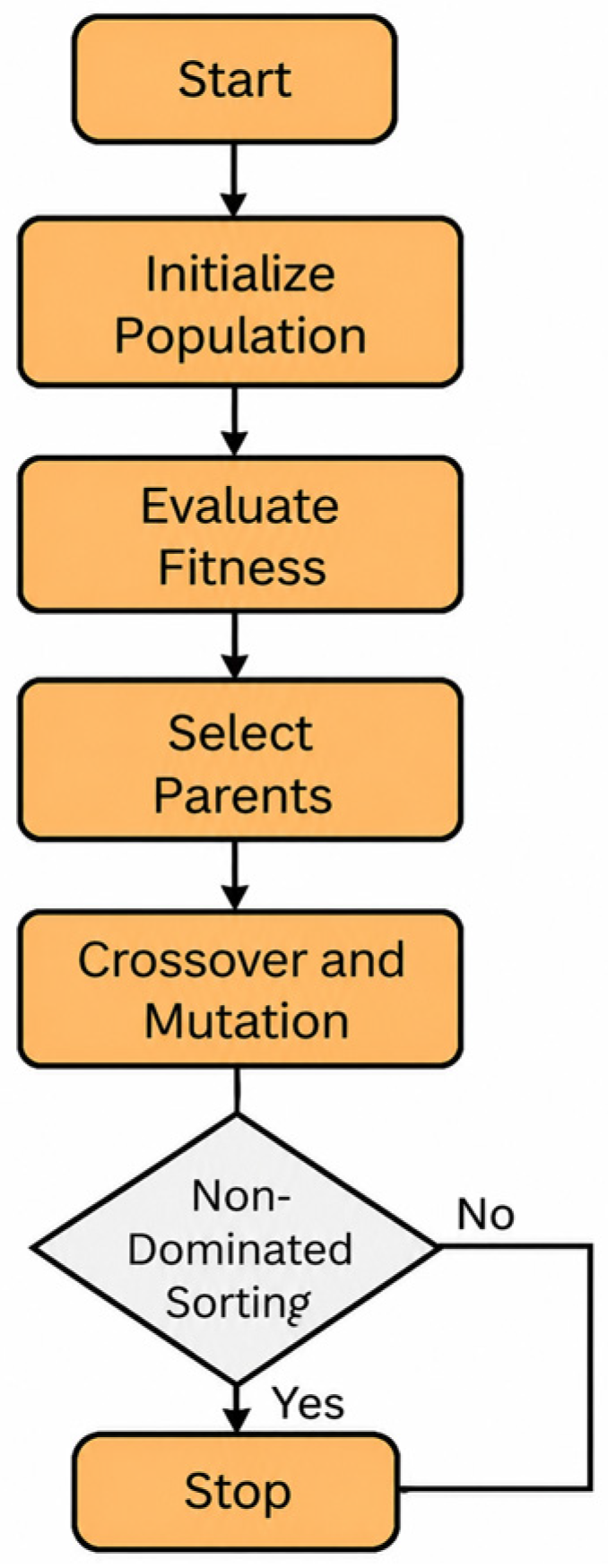
The NSGA-II implementation process proceeds according to the flowchart of
Figure 1. The initial population is generated and evaluated randomly and feasibly, then a non-dominated sorting forms the front lines, and the crowding distance balances the density of points on the front. By selecting a tournament based on the crowding criterion, parents are selected, and children are generated through SBX and polynomial mutation. The parent and child are merged, and the non-dominated sorting is performed again, then the front line nodes are filled sequentially to keep the population size constant, and if a part of a front line is filled, the crowding criterion is applied for the final cut. This cycle continues until the stopping criterion is met and a set of diverse non-dominated solutions is generated.
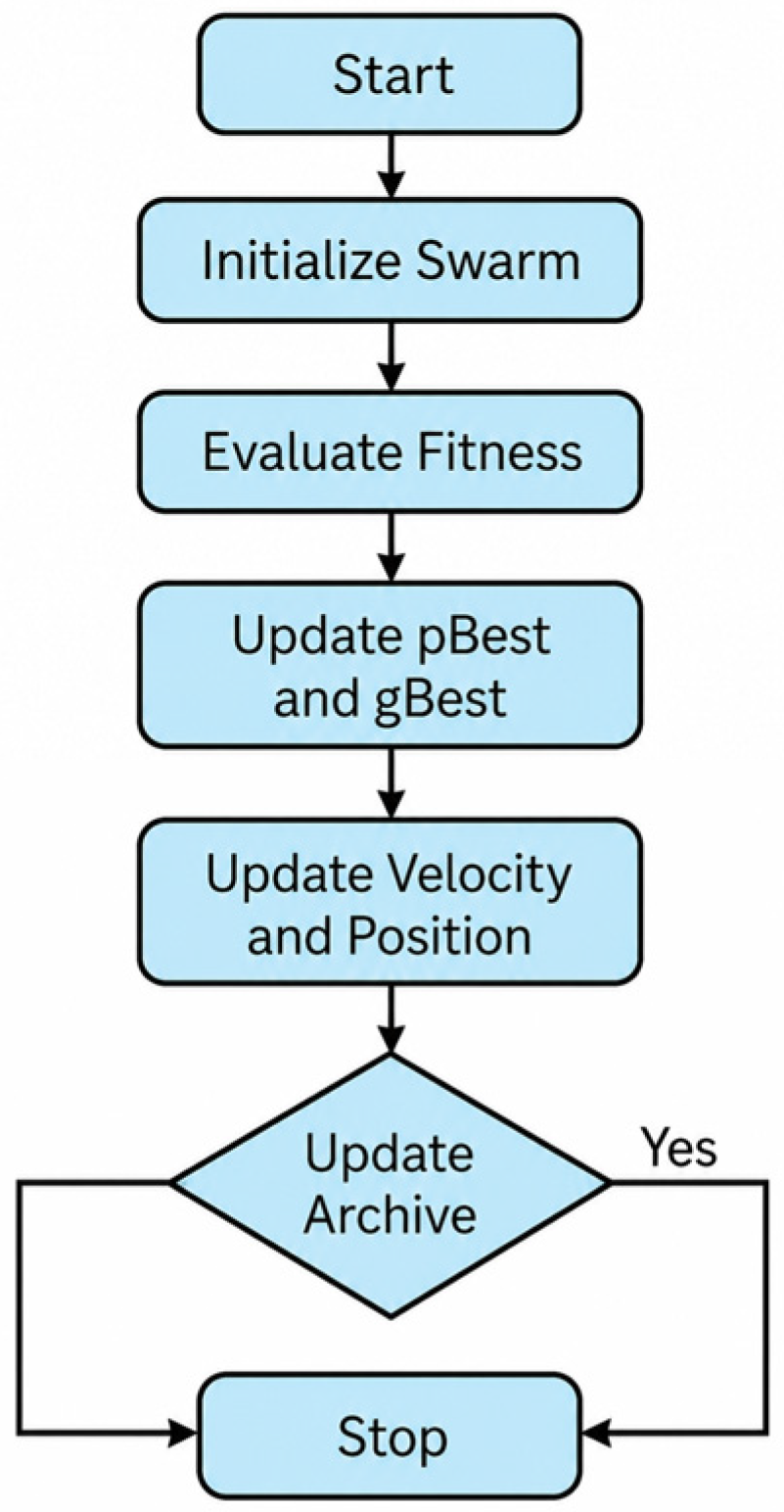
The MOPSO implementation process is as shown in the flowchart in
Figure 2. An initial swarm of feasible portfolios is constructed and the personal best and the non-dominated pool are initialized by meshing or ε-domination. In each iteration, leaders are selected from the pool with appropriate balance, particle velocities are updated by considering inertia and cognitive and social components, and positions are renewed, boundary repairs are performed, particles are evaluated, personal bests are updated, and the pool is modified by applying acceptance rules, removing nearby points, and maintaining the archive capacity. Iterations continue until a stopping criterion is met, and the output is a set of non-dominated solutions with a uniform Pareto front coverage.
To ensure fair comparison and robustness of the results, parameter tuning was carried out experimentally and systematically. In practice, a range of population or particle swarm size, number of generations or iterations, probability and severity of crossover and mutation in NSGA-II, as well as inertia, individual and social learning coefficients, size and reservoir management policy in MOPSO were tested and the final configuration was selected based on criteria such as front coverage, dispersion uniformity and iterative stability. A summary of the parameter settings is reported in
Table 2 to ensure the reproducibility and transparency of the method.
The computations were performed on a desktop computer running Windows 64-bit. GAMS was used for the accurate implementation of the model on a small scale, along with a standard solver compatible with mixed integer problems, and Python was used for simulations and metaheuristics. The programming environment used in this study was Python 3.10. NumPy 1.24.3 was employed for numerical implementation of the algorithms, and Pandas 2.0.3 was used for data reading, scenario handling, and data-frame management. In addition, all codes were executed with fixed random seeds to ensure the reproducibility of the results. For each configuration, several independent runs were performed, and the non-dominated response sets were analyzed in a pooled manner to reduce the effect of random fluctuations. Finally, the response sets generated by NSGA-II and MOPSO were compared and validated with reference solutions obtained from GAMS 41.2.0 to ensure that the metaheuristics maintained the response quality and Pareto front diversity while being scalable.
In addition to comparing the solution algorithms in this study, several baseline models were also considered to evaluate the added value of the proposed model. These baseline models included a version focusing solely on returns, a version based on the traditional risk–return trade-off, and a version considering stability without full structural constraints. Also, to examine the robustness of the results, robustness tests were conducted under changes in key parameters, changes in scenario settings, and repeated execution of the algorithms with different seeds to determine how stable and reliable the behavior of the proposed model is.
5. Analysis of Results
To analyze the results, it is first necessary to explain the structure of the data used and how they were prepared, since the replicability of the model largely depends on the transparency of the data, scenarios, and input variables. In this study, a structured and reproducible empirical dataset was designed to evaluate the proposed framework for startup portfolio optimization. The final sample consisted of 80 startups from four main sectors: financial technology, healthcare, clean energy, and educational technology; 20 startups were considered from each sector. To increase the homogeneity of the sample, only startups that had been in operation for at least 18 months were included in the study. The time period for data collection, adjustment, and validation covered the years 2021 to 2025. Financial, operational, and non-financial information was collected from public company reports, startup databases, investment platform records, and expert assessments. Since early-stage startups often lack a complete and standardized financial history, incomplete or qualitative indicators were smoothed through a scoring process and then normalized to a range of zero to one.
The expected return of each startup was calculated as a composite index of revenue growth, capitalization growth, market expansion capacity, and sector-adjusted growth expectations. For each startup, scenario returns were generated around the expected return value and in the form of three market conditions: pessimistic, base, and optimistic. The probabilities of these scenarios were assumed to be 0.25, 0.50, and 0.25, respectively, and the amount of return deviation in each scenario was adjusted based on the level of volatility of the same sector. The ESG index was calculated as the average of three environmental, social, and governance sub-indices, each measured on a normalized scale of zero to one. The innovation index was also constructed based on criteria such as technological novelty, intellectual property intensity, product scalability, and R&D orientation. The liquidity variable was defined as the expected time to exit capital or maturity of market entry and then transformed into a normalized score, with a higher value indicating a shorter and more favorable liquidity horizon. To enhance replicability, all variables used in the model were organized in a startup-variable matrix, and the same method for scenario generation, data normalization, and parameter tuning was used across all experiments. Although this dataset is not intended to be a universal benchmark for all startup ecosystems, it provides a reproducible computational basis for testing the proposed multi-objective CVaR–ESG framework.
In this research, the results of the multi-objective model of investment optimization in startups are examined. To more accurately assess the model’s performance, the results were examined not only in terms of Pareto fronts and portfolio composition, but also in comparison with several baseline models and under a set of robustness tests. These comparisons allow us to determine what added value the proposed model provides over simpler formulations and whether the insights it yields remain robust under different conditions. As shown in
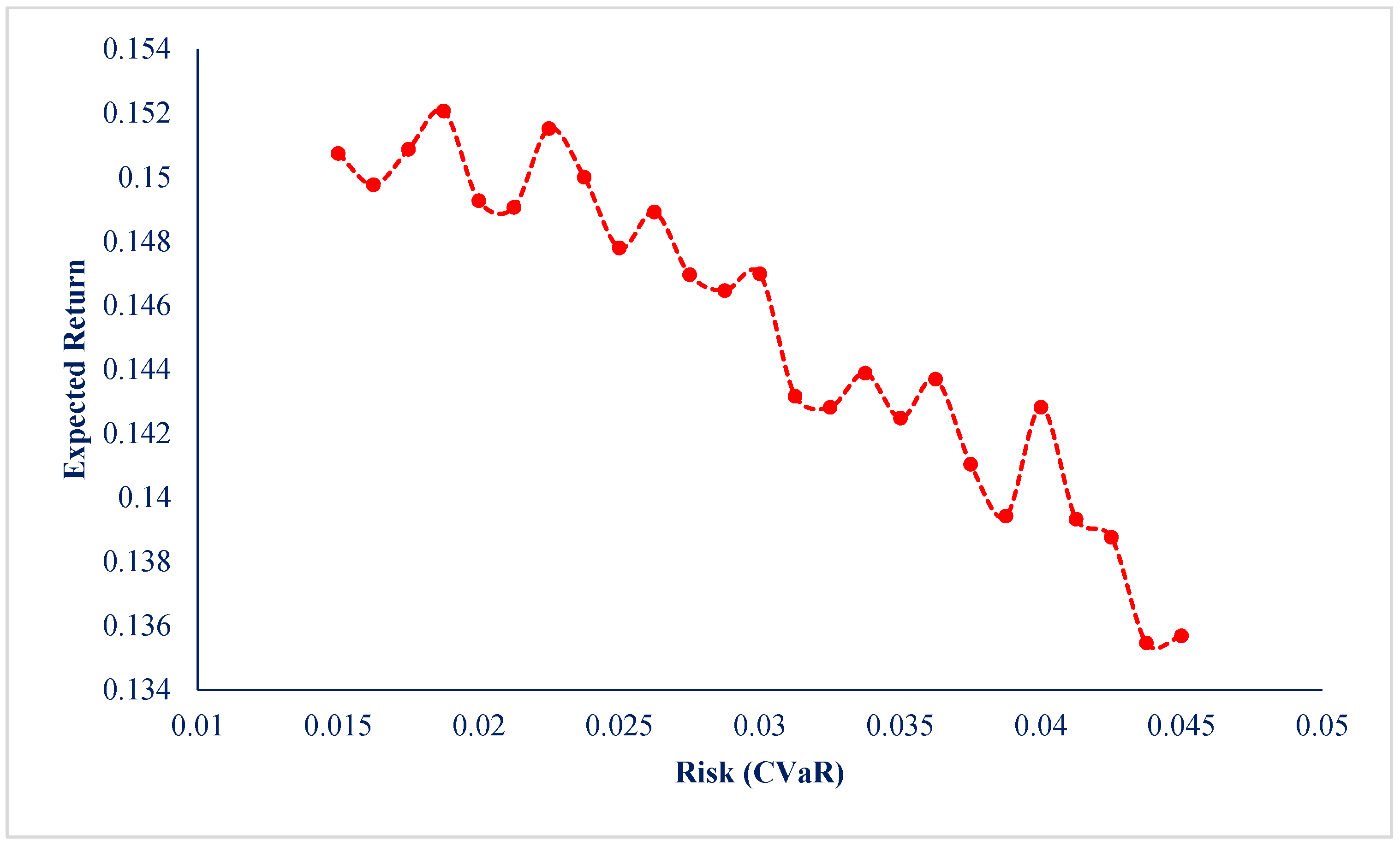
Figure 3, the Pareto curve represents the relationship between expected return and portfolio risk (based on the CVaR index). As can be seen, increasing returns are usually accompanied by increasing risk, but this relationship is nonlinear in nature. In the initial areas of the curve, conservative strategies are located, which have lower returns but higher stability. The middle part of the curve represents the equilibrium decision-making region; in this area, a small increase in risk can lead to a significant improvement in returns. In contrast, the end of the curve includes portfolios that, although they offer higher returns, are also more volatile and uncertain.
The behavior of the Pareto curve in
Figure 3 shows that the proposed model has been able to create a realistic balance between two conflicting goals, namely, maximizing returns and minimizing risk. Comparison with baseline models shows that the main advantage of the proposed model is not simply in generating another Pareto front, but in revealing trade-offs that are not visible in simpler models. Specifically, when liquidity, ESG thresholds, and structural constraints are simultaneously introduced into the model, the investment mix shifts away from a focus solely on startups with seemingly higher returns and toward portfolios that are also more balanced in terms of sustainability, diversification, and exitability. This finding suggests that decisions such as the intensity of focus on specific sectors, the level of downside risk acceptance, and the degree to which innovative but under-liquidated startups are prioritized can change meaningfully in light of the present model. This structure allows decision-makers to choose from a set of efficient solutions depending on their level of risk tolerance. From a practical point of view, these results reflect the real conditions of investing in startups, where managers and investors have to make a conscious choice between capital security, growth speed, and economic sustainability.
To quantitatively evaluate the quality of Pareto fronts obtained from NSGA-II and MOPSO algorithms, three standard indices in multi-objective optimization were used, namely, Hypervolume (HV), Generational Distance (GD), and Spread (Δ). The HV index measures the volume covered by the Pareto front and simultaneously indicates the convergence and proper coverage of the target space. The GD index shows the average distance of the solutions obtained from the reference front, and the lower its value, the higher the convergence quality. The Spread index also evaluates the uniformity of the distribution of solutions along the Pareto front. The results of calculating these indices are presented in
Table 3.
As can be seen in
Table 3, the NSGA-II algorithm has a higher Hypervolume value than MOPSO, which indicates better coverage of the target space and higher quality of the Pareto front. Also, the lower GD value in NSGA-II indicates better convergence of this algorithm to the reference front. In terms of the Spread index, NSGA-II also provides a more uniform distribution of solutions along the Pareto front. Overall, these results indicate that although both algorithms are able to produce efficient solutions, NSGA-II has a more stable and accurate performance in approximating the optimal front.
In order to more accurately analyze the difference between different levels of risk-taking, three indicator points from the Pareto front were selected and their characteristics are given in
Table 4. These three states represent conservative, balanced, and bold scenarios, respectively. As the data in the table shows, by moving from conservative to bold, the return almost doubles, while the risk and innovation rate also increase. In contrast, the sustainability (ESG) index and capital liquidity have a downward trend. This behavior confirms that the designed multi-objective model has been able to establish a reasonable compromise between financial and non-financial objectives and provide decision-makers with a set of diverse and practical options.
As shown in
Table 4, the transition from a conservative to an aggressive strategy leads to a significant increase in expected returns along with an increase in risk and innovation levels. However, this improvement in profitability is accompanied by a decrease in sustainability and liquidity, reflecting the inherent trade-off between financial returns and long-term stability in startup investment decisions. Next, the structure of the optimal portfolios resulting from the multi-objective model is examined. The results of running the model show that after determining the values of the decision variables, an optimal distribution of capital is formed among the different sectors of the startup.
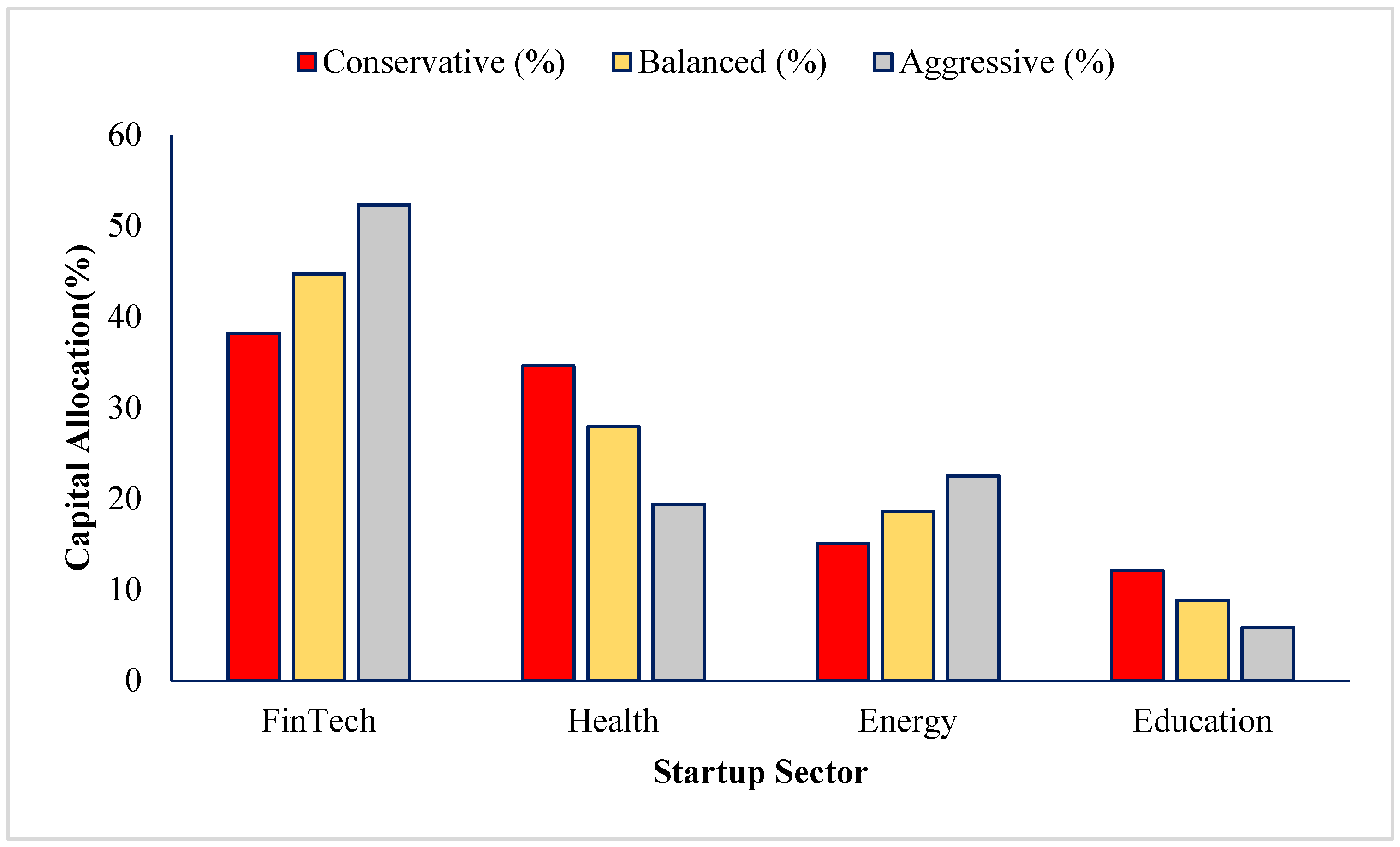
Figure 4 shows the final composition of the portfolio in four main areas, namely, financial technology, health, energy, and educational services.
As the chart shows, the financial technology sector has the largest share of the most efficient solutions, due to its higher returns and more controlled risk. The share of the health sector in balanced portfolios has increased, because although its return is lower than that of the technology sector, it has a more favorable financial stability and sustainability index (ESG). In contrast, the share of the energy sector in bold portfolios increases, which indicates the attractiveness of investing in new energy and clean technologies. The share of the education sector, although smaller, is also significant in maintaining diversity and reducing overall portfolio volatility.
To examine the stability of the model and assess the impact of changing key parameters on the results, a sensitivity analysis was conducted on three important parameters: the confidence level in calculating the downside risk (α in the CVaR function), the minimum sustainability score (ESG_min), and the portfolio concentration ceiling (H_max). The results of this analysis are shown in
Figure 5.
As can be seen in the graph, as the confidence level α increases from 0.9 to 0.99, the model tends to select low-risk and lower-yielding portfolios. In this case, the standard deviation of returns decreases and the concentration on more stable startups increases. This behavior indicates that the model has a consistent and predictable behavior against changes in risk sensitivity, and at higher levels of α, decisions tend to be more conservative. Increasing the minimum sustainability score (ESG_min) also has a significant effect on the portfolio composition. As this parameter becomes more stringent, the share of clean energy and health sectors increases and the share of high-risk areas such as FinTech decreases. This shows that the sustainability constraint can act as a lever to direct capital towards more responsible sectors that are in line with sustainable development policies. On the other hand, reducing this parameter too much causes the ESG index of the final portfolio to fall and increases the volatility of returns.
Finally, the change in the portfolio concentration limit (Hmax) has a direct effect on the degree of investment diversification. When Hmax increases, the model tends to concentrate capital more in high-yield startups, but this reduces the diversity index and increases the correlation between portfolio components. In contrast, lower values of Hmax enhance portfolio diversification but slightly reduce overall returns. This behavior confirms that the concentration limit plays a crucial role in maintaining the balance between returns, risk, and diversification. The results of robustness tests also show that the overall direction of the decision-making relationships in the model remains robust to reasonable changes in the main parameters. In other words, although the relative weights of the objectives and the final portfolio composition may be adjusted by changing risk levels, sustainability requirements, or concentration limits, the main insight of the model is preserved: startup investment optimization is more realistic and reliable when returns, downside risk, sustainability, liquidity, and structural constraints are viewed simultaneously, rather than separately.
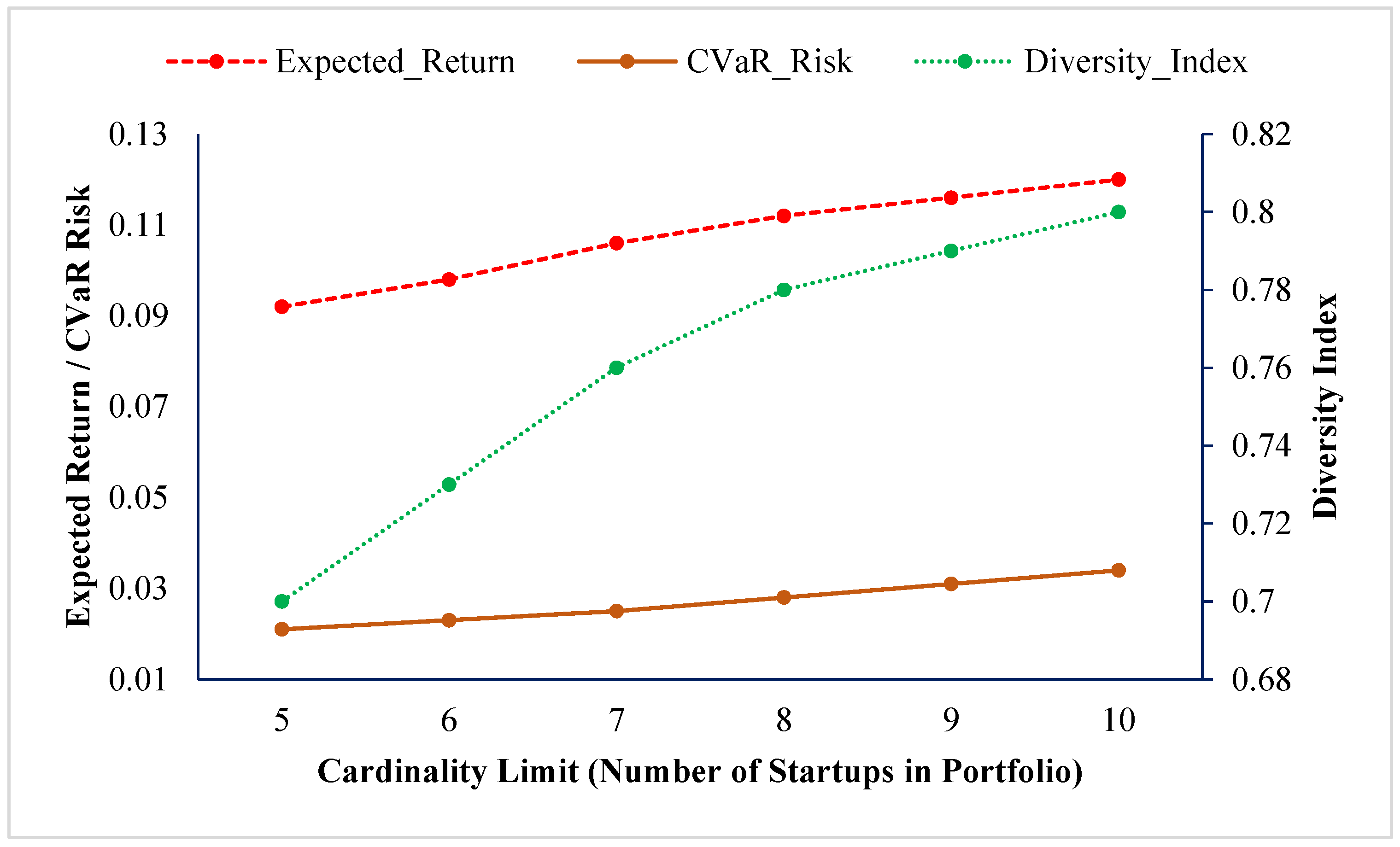
One of the key elements in designing an investment optimization model is how to control the number and composition of selected startups in the final portfolio. In this study, two main constraints, cardinality and diversity, play an important role in determining the final structure of the investment portfolio. The purpose of this analysis is to investigate the effect of these constraints on the model performance and the trade-off between return, risk, and sustainability. The results of this section are shown in
Figure 6.
Initially, the cardinality constraint is applied to limit the number of startups selected in the portfolio. This constraint effectively prevents the model from partially including all available options in the portfolio and instead makes more focused but targeted choices. As can be seen in
Figure 6, by increasing the cardinality limit from 5 to 10, the expected return increases nonlinearly, while the CVaR also experiences a slight increase. This pattern shows that adding more options to the portfolio increases the return opportunities, but at the cost of a small increase in the overall risk level. In fact, the model establishes an internal balance between the principles of concentration and diversification, and its behavior can be interpreted from an economic perspective. In the next step, the effect of the diversification constraint is examined. This constraint prevents over-concentration in one or more specific sectors (e.g., FinTech or energy) and helps maintain a balance across sectors. Analysis of the results shows that tightening the diversification constraint (reducing the sector exposure cap or increasing the minimum effective diversification) increases portfolio sustainability and improves the ESG index, although the expected return is slightly reduced. Conversely, reducing the severity of this constraint allows the model to concentrate investments in a few specific high-return sectors, which results in increased potential returns but reduced portfolio resilience to volatility.
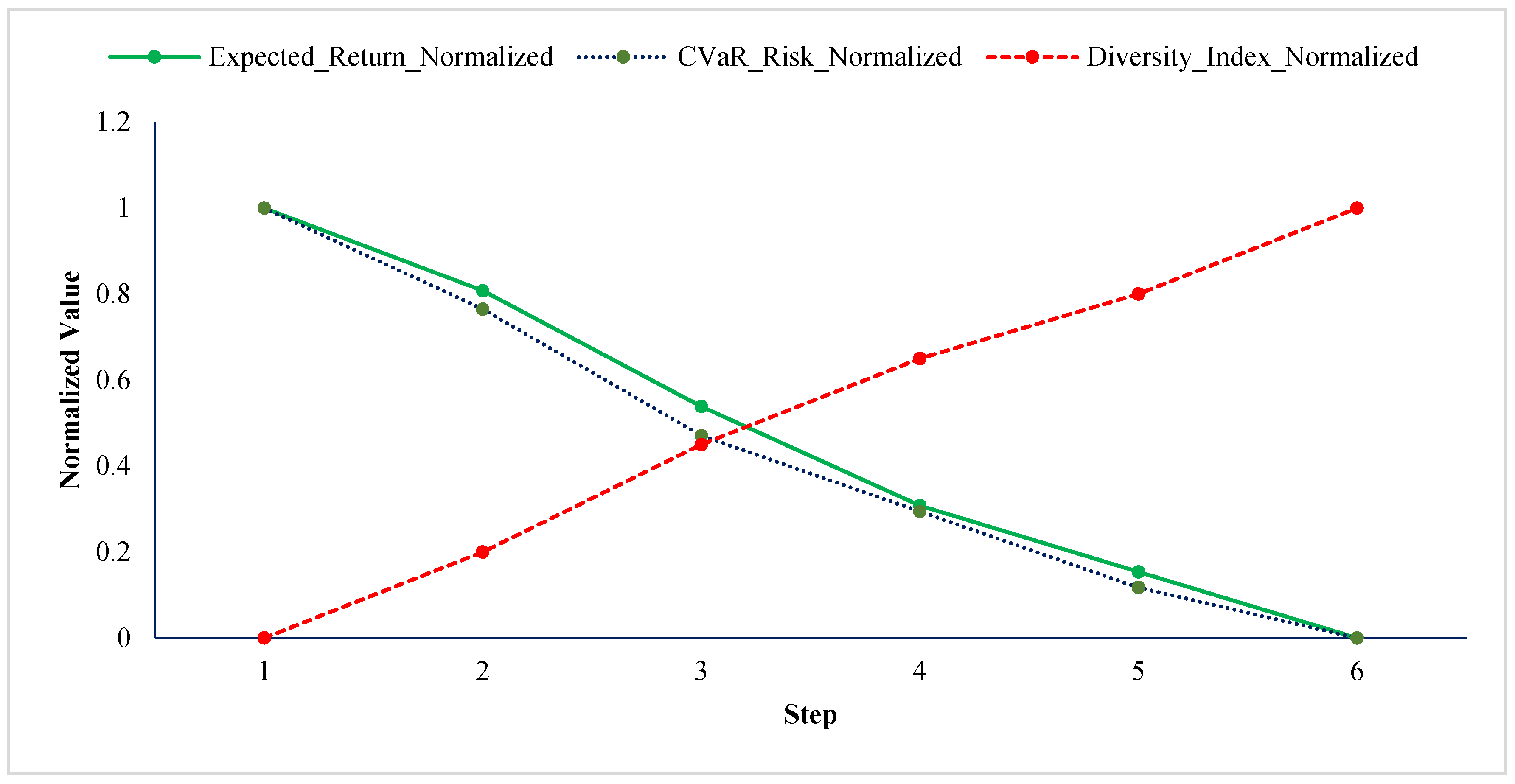
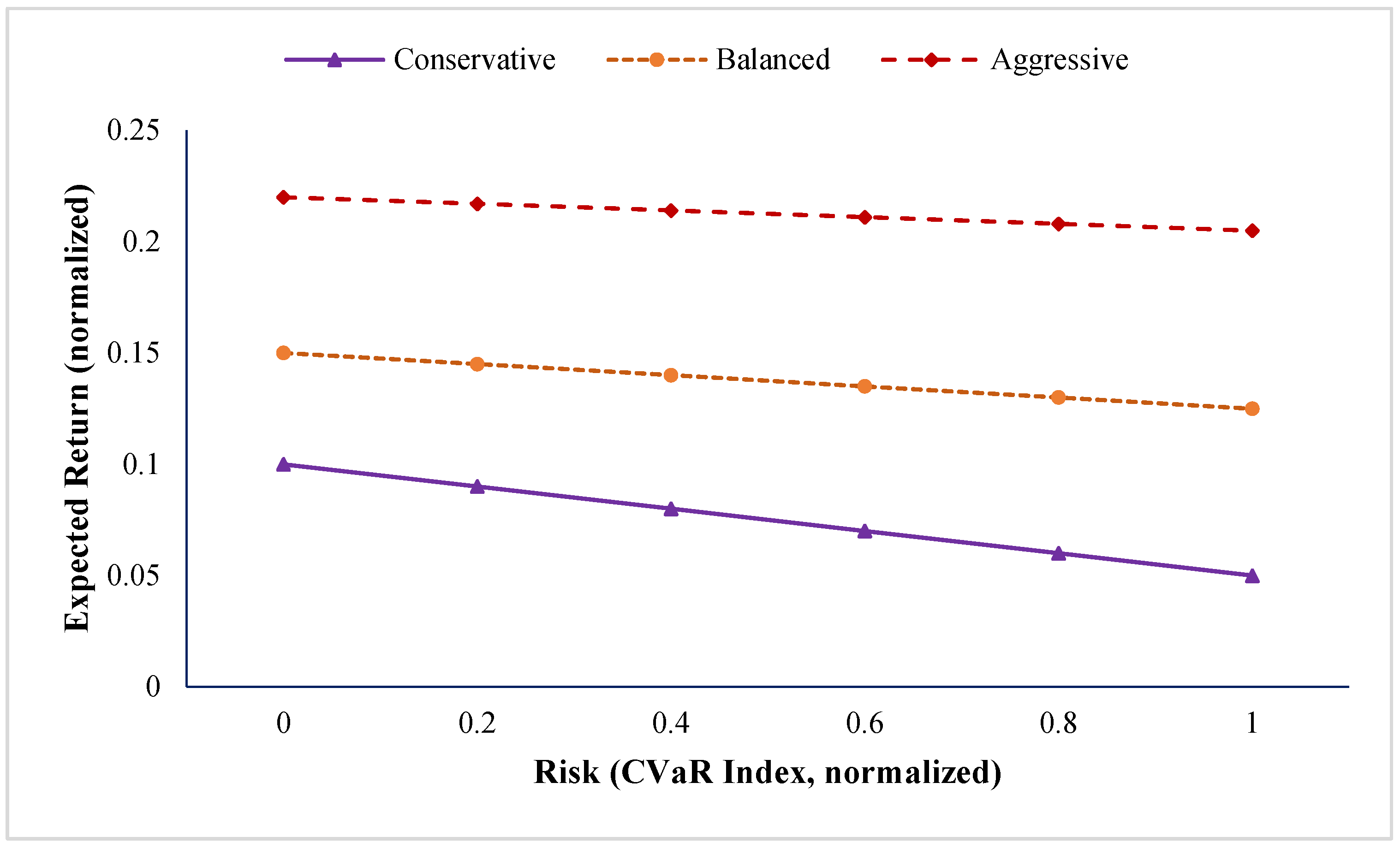
The results of the multi-objective model presented can be divided into three distinct decision-making patterns from a policy and investment management perspective, each representing a different approach to the trade-off between return and risk. As can be seen in
Figure 7, the three main curves show the relationship between risk (based on the normalized CVaR index) and expected return for conservative, balanced, and bold strategies.
In the conservative strategy, the decision-maker focuses on maintaining financial stability and reducing potential losses. In this case, the return is lower, but the risk is also minimized, and the portfolio composition mainly includes startups in lower-risk sectors such as health and education. This approach can be used by policymakers as a tool to ensure long-term sustainability in the innovation ecosystem, especially in situations where the main goal is to avoid severe fluctuations in the startup investment market. In a balanced strategy, the curve shows that a controlled increase in risk can generate higher returns without destroying the overall stability of the system. This is particularly important for sovereign wealth funds or public–private partnerships, as diversification and a mix of sustainable and innovative sectors can achieve economic growth while managing risk.
Finally, a bold strategy represents an approach in which higher risk is taken with the aim of achieving rapid growth and significant returns. As the corresponding curve shows, returns are maximized in this area, but the portfolio is also more sensitive to market fluctuations. From a policy perspective, this is a good case for creating incentives for innovation in emerging sectors such as FinTech, clean energy or biotechnology, where government support through tax incentives and guarantee funds can play a catalytic role.
6. Conclusions
In this study, an analytical and computational framework was presented to optimize investment decision-making in startups, which aimed to balance the five key dimensions of return, downside risk, sustainability, innovation, and liquidity. The main issue arises from the fact that investing in startups, unlike investing in mature companies or public markets, is associated with limited historical data, information asymmetry, high volatility, uncertain liquidity horizons, and an increasing requirement to pay attention to sustainability criteria. On this basis, the proposed model of the present study, relying on CVaR as a sequential risk measure and considering ESG indicators, budget constraints, cardinality, concentration ceiling, diversification, and minimum thresholds of innovation and liquidity, attempted to provide a more realistic structure of the startup portfolio selection process.
The research findings show that the proposed model is able to create a clear and interpretable Pareto front between return and risk, while also bringing non-financial dimensions of decision-making from the margins into the main text of the analysis. The results indicate that by moving from a conservative strategy to a bold strategy, the expected return increases, but this increase occurs with an increase in risk and innovation index and, on the contrary, a decrease in the level of sustainability and especially a decrease in liquidity. This pattern shows that in startup investment, higher profitability is not necessarily achieved without cost, but it is accompanied by a kind of structural trade-off between short-term return, long-term resilience and exit flexibility. From this perspective, the main value of the present model is that it shows these trade-offs in a transparent, quantitative and decision-supporting way.
From the perspective of portfolio structure, the results also indicate that the proposed model forms a more balanced mix of different sectors, instead of focusing solely on seemingly high-yielding options. In many efficient solutions, FinTech retains the largest share, but as sustainability and risk constraints become tighter, the share of the health and energy sectors increases, and the portfolio moves towards options with higher sustainability and lower structural risk. The presence of the education sector, although smaller, also plays an effective role in maintaining diversity and reducing overall portfolio volatility. Therefore, the model reveals that the capital allocation decision, if viewed simultaneously through the lens of return, ESG, liquidity, and structural constraints, will lead to different results than simpler models based on return or risk–return.
In terms of the solution method, the comparison of the algorithms showed that both NSGA-II and MOPSO methods are capable of producing efficient solutions, but based on standard multi-objective criteria, NSGA-II has shown stronger performance. The better values of Hypervolume, Generational Distance and Spread for NSGA-II indicate that this algorithm provides more stable and accurate results than MOPSO both in covering the target space and in proximity to the reference front and the uniformity of the distribution of the answers. On the other hand, robustness checks and sensitivity analysis showed that the overall behavior of the model remains stable against reasonable changes in the CVaR confidence level, the minimum ESG score and the portfolio concentration ceiling. In other words, although the final investment mix and the relative weights of the targets are adjusted by changing the parameters, the main insight of the model is preserved: capital allocation in startups is more realistic and reliable when returns, downside risk, sustainability, liquidity and structural constraints are viewed simultaneously.
The importance of these findings does not remain only at the theoretical level. From a managerial perspective, the present model can change some practical rules of decision-making. For example, instead of focusing solely on higher-yielding startups, an investor may move towards portfolios that are more balanced in terms of diversification, exitability, resilience, and alignment with responsible measures. From a policy perspective, the results also suggest that tools such as tightening ESG thresholds, adjusting the CVaR confidence level, or controlling the intensity of concentration can systematically shift capital flows toward more sustainable and innovative sectors. Therefore, the proposed model is not just a mathematical formulation but also a supporting mechanism for responsible investment and innovation policymaking in startup ecosystems [
40].
However, the present study also has several limitations. First, although a combination of real and simulated data is used, the quality and scope of startup data are still more limited than in mature financial markets, which may affect the generalizability of some results. Second, some non-financial variables such as sustainability and innovation are inevitably included in the model in a point-based or expert-based manner, which may be subject to some degree of subjectivity. Third, although baseline comparison and robustness checks have helped to improve the validity of the results, the model still does not capture all the behavioral complexities of investors, network interactions among startups, or temporal dynamics of the market. Fourth, the current framework is static in nature and does not yet model sequential decision-making, dynamic reallocation, and gradual learning from new data.
Accordingly, future research directions are clear and valuable. Developing the model in a dynamic, multi-period framework, using broader real-world data from venture capital funds and FinTech platforms, integrating machine learning to predict returns, risk, and liquidity, and connecting the model to financial digital twins could be important next steps. Also, incorporating decision-makers’ behavioral preferences, institutional uncertainties, and more advanced policy scenarios could help bring the model closer to real-world investment conditions. Overall, the present research suggests that the future of decision-making in startup investment lies not in relying solely on traditional financial metrics but in intelligently integrating risk analysis, sustainability, innovation, and operational considerations in a multi-objective, data-driven framework.